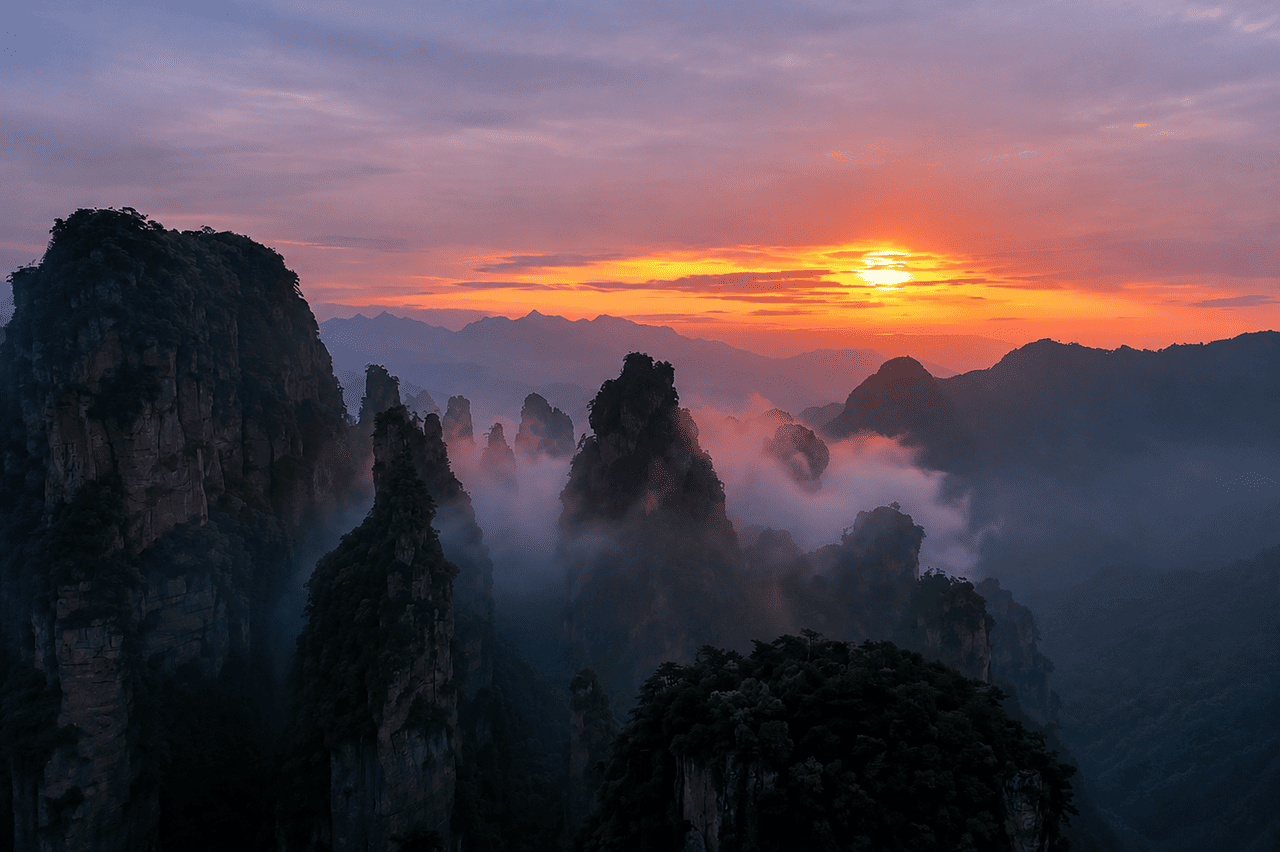
Zhangjiajie Sunrise & Sunset: Best Spots by Month
Zhangjiajie sunrise viewing means Old House Area (Laowuchang) and Tianzi Mountain inside Wulingyuan, with Qixing Mountain’s 1314 Sunrise Platform as a quieter alternative. Zhangjiajie sunset is best from Tianzi Mountain’s West Sea viewing platform, Tianbo Mansion in Yangjiajie, and Tianmen Mountain’s summit. Across all three areas, the same problem repeats: the transport systems that get you up the mountain don’t start early enough for a same-day sunrise. Real sunrise viewing almost always means sleeping on the mountain the night before.
Best sunrise spots | Old House Area (Laowuchang), Tianzi Mountain summit, Qixing Mountain 1314 Platform |
|---|---|
Best sunset spots | Tianzi Mountain West Sea Platform, Tianbo Mansion (Yangjiajie), Tianmen Mountain summit |
Best season for a clear sunrise | Autumn (Sept–Nov) — best raw odds of clear skies are summer (Jun–Aug) |
Wulingyuan eco-bus hours | 7:00 AM–7:00 PM (Mar–Nov), 8:00 AM–6:00 PM (Dec–Feb) |
Overnight-on-mountain lodging | A small number of guesthouses around Dingxiangrong village remain bookable, though room count is limited and status shifts often |
We route clients through Zhangjiajie every week, and this is the question we get more than almost any other: “we want to see sunrise over the peaks — where do we stay, and how do we actually get there?” The honest answer involves a trade-off most articles skip entirely, and it looks slightly different depending on which part of Zhangjiajie you mean.
Table of Contents
1. Sunrise and Sunset Times by Month
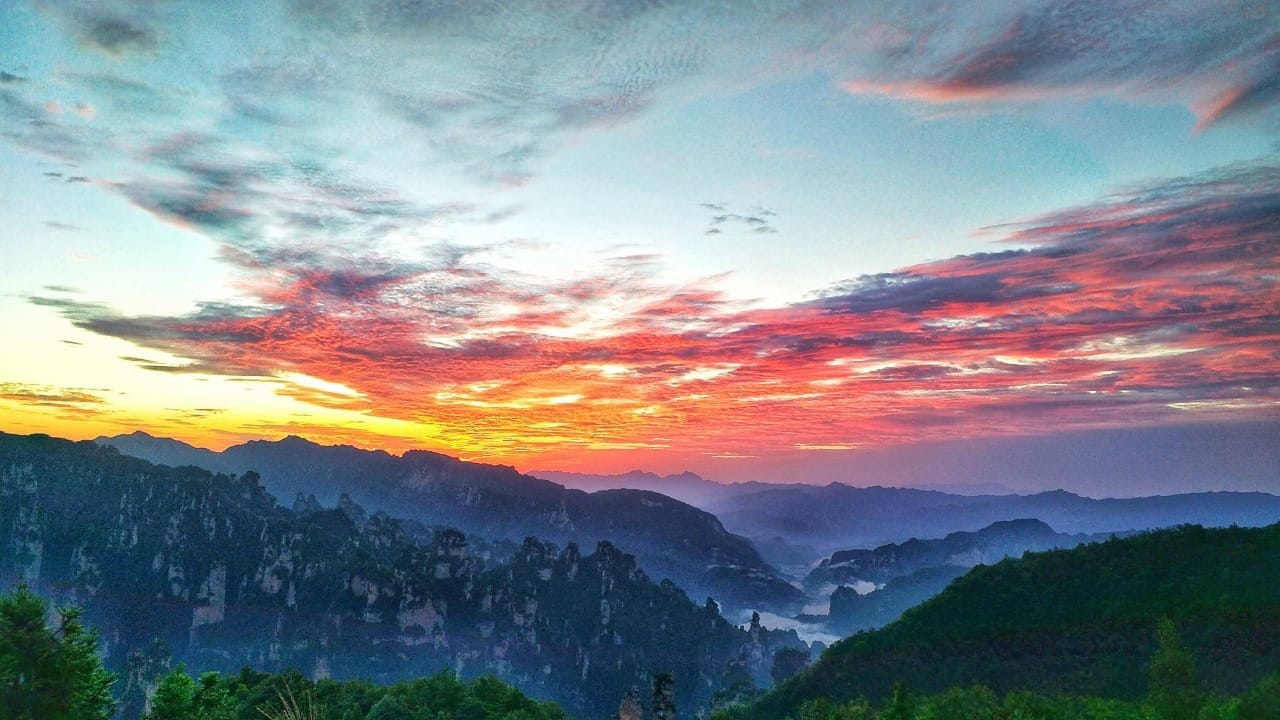
Zhangjiajie sits far enough south (29°N) that the swing between summer and winter is real but not extreme — sunrise moves by roughly two hours across the year, sunset by about the same. These are typical times for the middle of each month; check the exact date before you travel, since day-to-day shifts of a minute or two add up over a few weeks.
Month | Sunrise | Sunset | Month | Sunrise | Sunset |
|---|---|---|---|---|---|
January | 7:30 AM | 5:50 PM | July | 5:45 AM | 7:30 PM |
February | 7:15 AM | 6:05 PM | August | 6:00 AM | 7:15 PM |
March | 6:50 AM | 6:20 PM | September | 6:15 AM | 6:50 PM |
April | 6:15 AM | 6:40 PM | October | 6:35 AM | 6:15 PM |
May | 5:50 AM | 7:05 PM | November | 7:00 AM | 5:50 PM |
June | 5:45 AM | 7:25 PM | December | 7:25 AM | 5:45 PM |
Why the timing gap doesn't shrink in any season
The gap between "sunrise" and "eco-bus start time" barely changes across the year — it's roughly an hour, year-round, whether you're chasing a 5:45 AM summer sunrise or a 7:30 AM winter one. That's why the decision to sleep on the mountain or accept a same-day compromise doesn't really get easier in any season; the timing math stays the same, only the wake-up time shifts.
2. Zhangjiajie Sunrise vs. Sunset: Which Is Easier to Catch?
Sunset needs nothing special
Sunset is the easier one, by a wide margin, in every part of Zhangjiajie. Be inside the scenic area well before sunset on a normal day ticket, ride the transport up while the system is still running, watch the light change, and make the last bus down before the network shuts off for the night.
Sunrise runs into a timing wall
Inside Wulingyuan, the eco-bus system runs 7:00 AM–7:00 PM from March to November and 8:00 AM–6:00 PM from December to February — always starting after sunrise, never before. Walking up from the valley floor in the dark before the shuttle network starts isn't realistic for most visitors either, since the climbs to Yuanjiajie or Tianzi Mountain run two to three hours on foot. → See our Zhangjiajie Eco-Bus Guide for the full route map and timing quirks.
Tianmen Mountain and Qixing Mountain face the same structural gap with their own opening times. There are exactly two ways around it: sleep on the mountain the night before, or accept a compromise sunrise from a lower, gate-adjacent spot instead of the classic peak-top shot. Even with the timing solved, weather rules out most attempts anyway. There's a claim floating around English-language travel guides that clear sunrise mornings number under 100 a year — it's not an official or authoritative figure, and we can't verify it against any real count, so don't treat the number itself as reliable. But the fact that this claim exists and keeps getting repeated is itself telling: seeing a genuinely clear sunrise here is the exception, not something you can plan around with confidence.
3. Where to Watch Sunrise in Wulingyuan
Old House Area (Laowuchang, 老屋场)
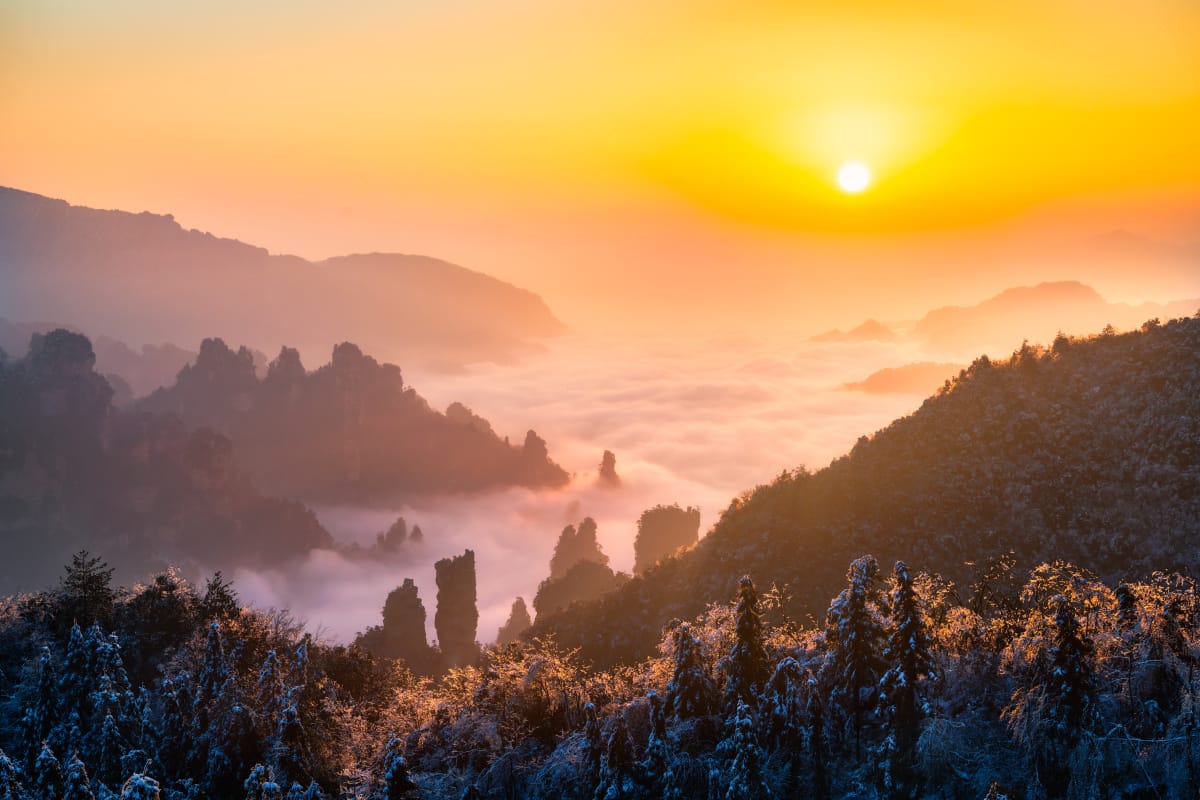
This is the spot local guides and photographers point to first, and it earns the reputation. It sits inside the Tianzi Mountain zone of Zhangjiajie National Forest Park, but off the standard eco-bus network entirely — there's no scenic shuttle stop here, which is exactly why it stays quiet even in high season.
Getting there takes two steps, based on what we tell clients before every trip out there:
Step | What to do | Cost |
|---|---|---|
1 | Ride the eco-bus to Sanchakou (三岔口) junction | Included in park ticket |
2 | Transfer to a local villager's electric cart for the final stretch | ~¥30–40 per person, round trip |
3 | Pay the land-use fee on entry to the Laowuchang area | ¥2 per person |
Guesthouse owners in the area can often arrange the cart transfer for you at a better rate if you book a room through them.
Once there, you're looking across a working rice terrace called Sky Field Garden (空中田园) — cliff-edge farmland on three sides, giving the odd sensation of floating fields, with the Bailong Elevator visible in the distance catching the first light. A short walk further is Spirit Soldiers Meeting (神兵聚会), which gives a different angle on the same elevator. You're looking down on it from above rather than up at it from a standard viewing platform — several clients have told us this feels far more dramatic than the conventional view. We've had clients describe Old House Area as the one place in Zhangjiajie that still feels undiscovered.
Tianzi Mountain
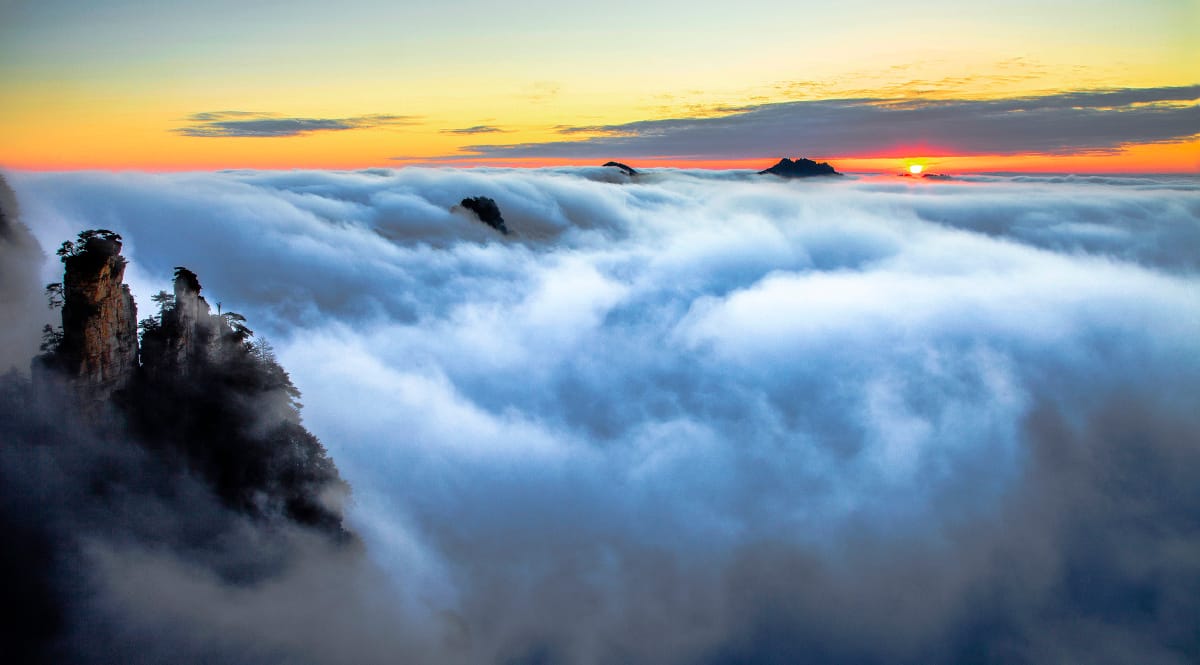
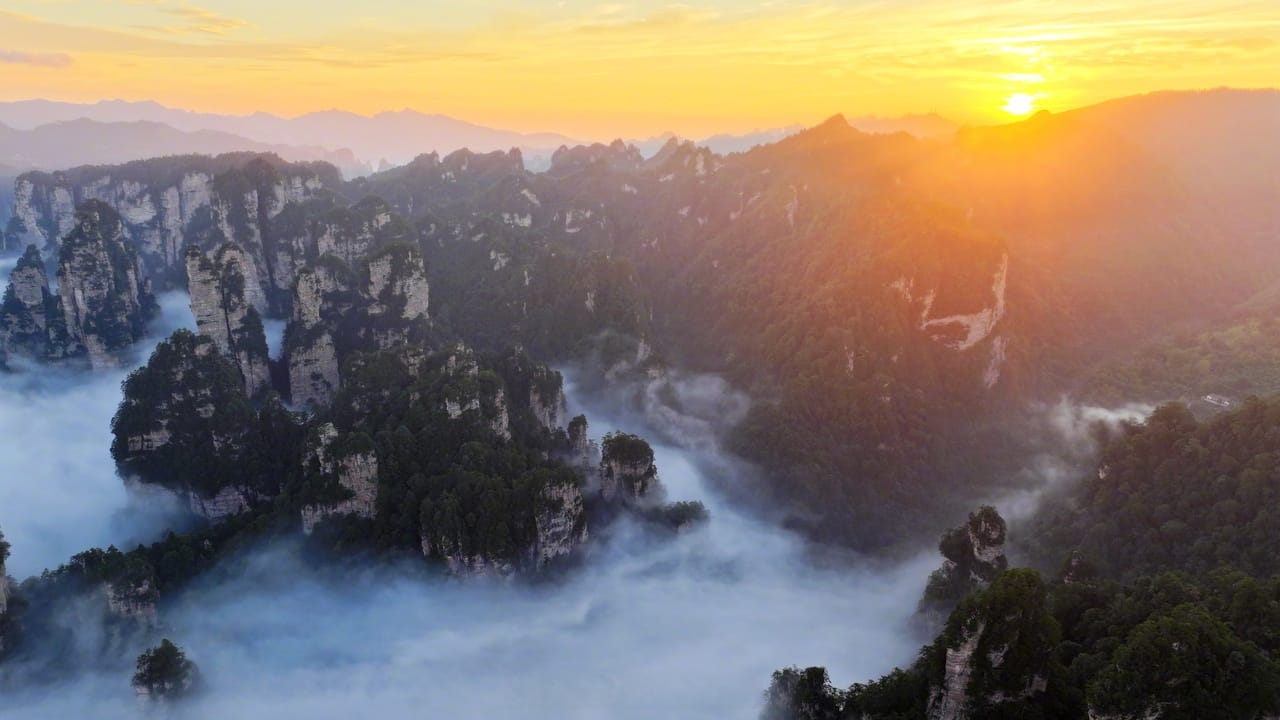
The more accessible option, and the one most first-time visitors end up using, since it sits directly on the eco-bus network once the system is running. The summit platforms — Tianzi Pavilion, Five Pines, Helong Park, and the Grand View Platform — face east across the peak forest, and on a clear morning after rain this is where the cloud sea forms most reliably. The trade-off is crowd size: this is also where every tour group photographer sends their group.
Daguantai (大观台)
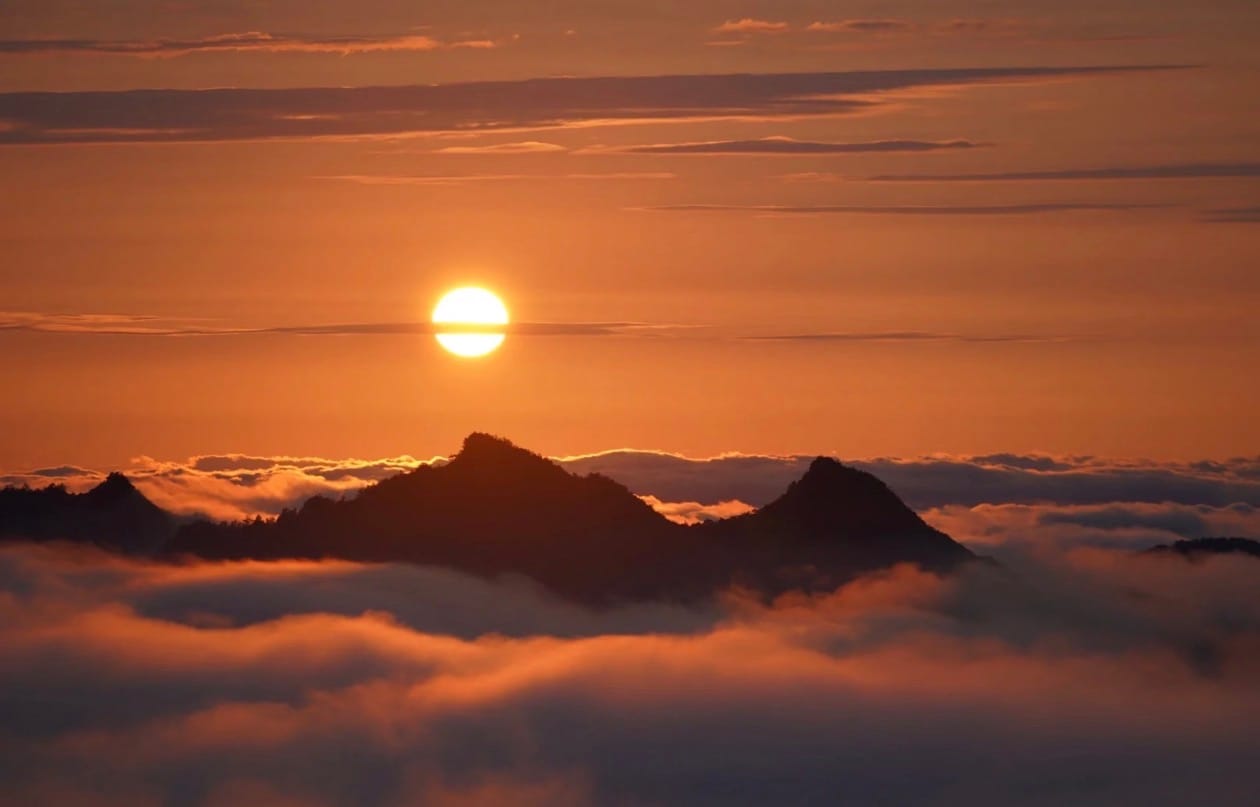
Meaning "Grand View Platform," Daguantai sits in the same general area as Old House Area and offers a wider, more open panorama, with a rock formation known as Magic Rooster Pecking at Corn (神鸡啄食) visible from the platform. Local tourism sources describe it as the official viewing point for sunrise among Zhangjiajie's traditionally named "four wonders" (sunrise, peak forest, winter snow, and sea of clouds) — a designation that predates the more recently popularized Old House Area. It's less commonly named in English-language guides, but it comes up constantly in Chinese travel forums as a secondary option when Old House Area lodging is full. It also requires a genuine flight of steps to reach, so factor in some effort if your group isn't used to stairs before dawn.
All three require you to already be on the mountain before dawn. None are reachable from a Wulingyuan town hotel via the normal eco-bus in time for a summer sunrise.
4. Where to Watch Sunset in Wulingyuan
Tianzi Mountain's West Sea Platform (西海峰林观景台)
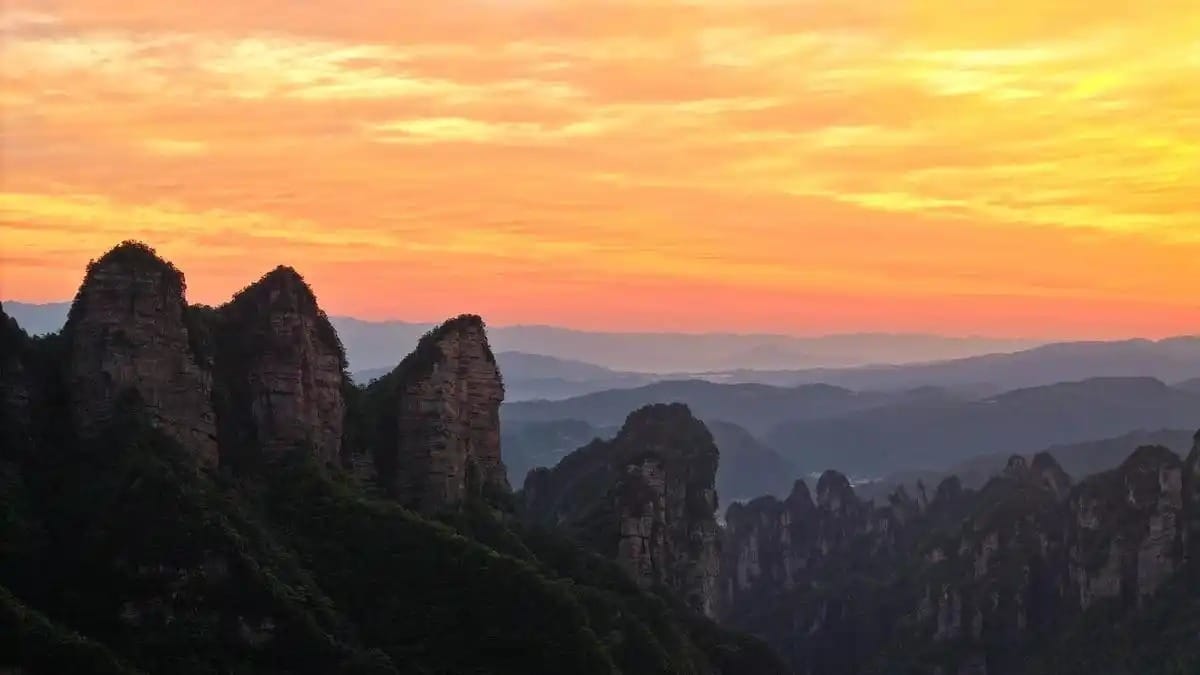
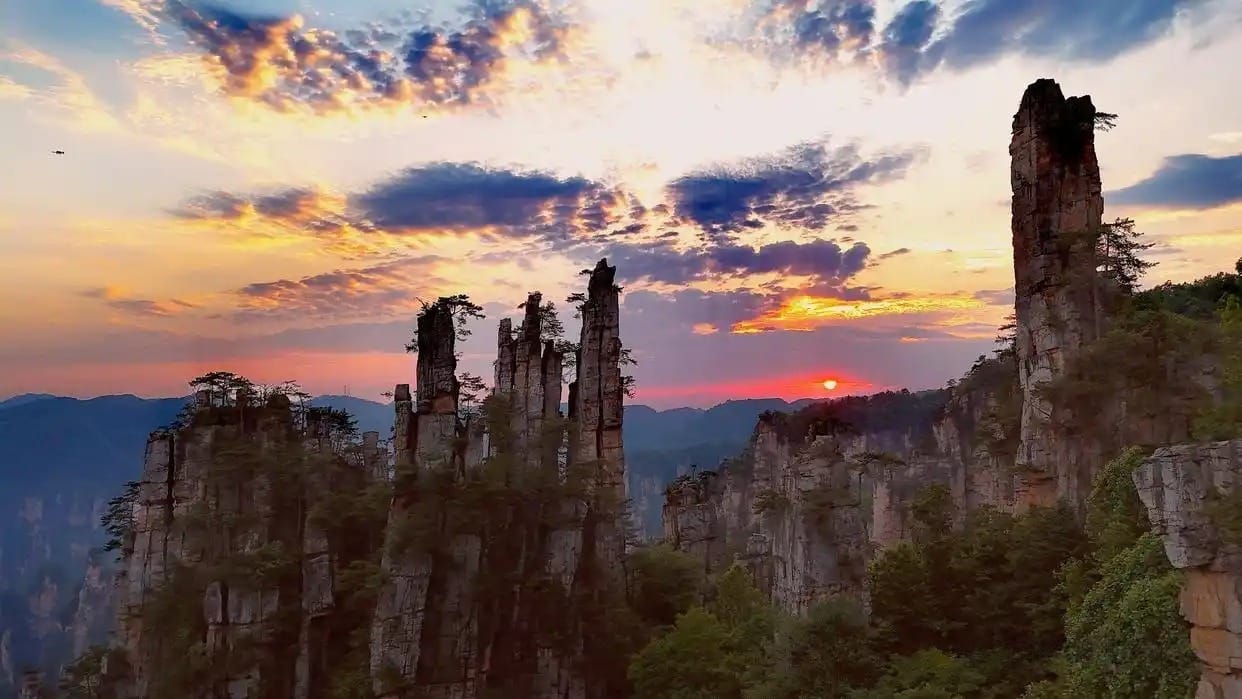
Near Helong Park and Yubi Peak, this is our first recommendation for sunset inside Wulingyuan. It sits on Tianzi Mountain, whose summit is the highest point in the eco-bus network at 1,262.5 meters, and looking west from the platform here puts you across the full peak forest as the sun drops behind the pillars. The towers turn to silhouette, and the sky runs gold to violet in the minutes after. Because sunset falls within normal eco-bus hours, this is realistic on a standard day ticket.
Tianbo Mansion (天波府)
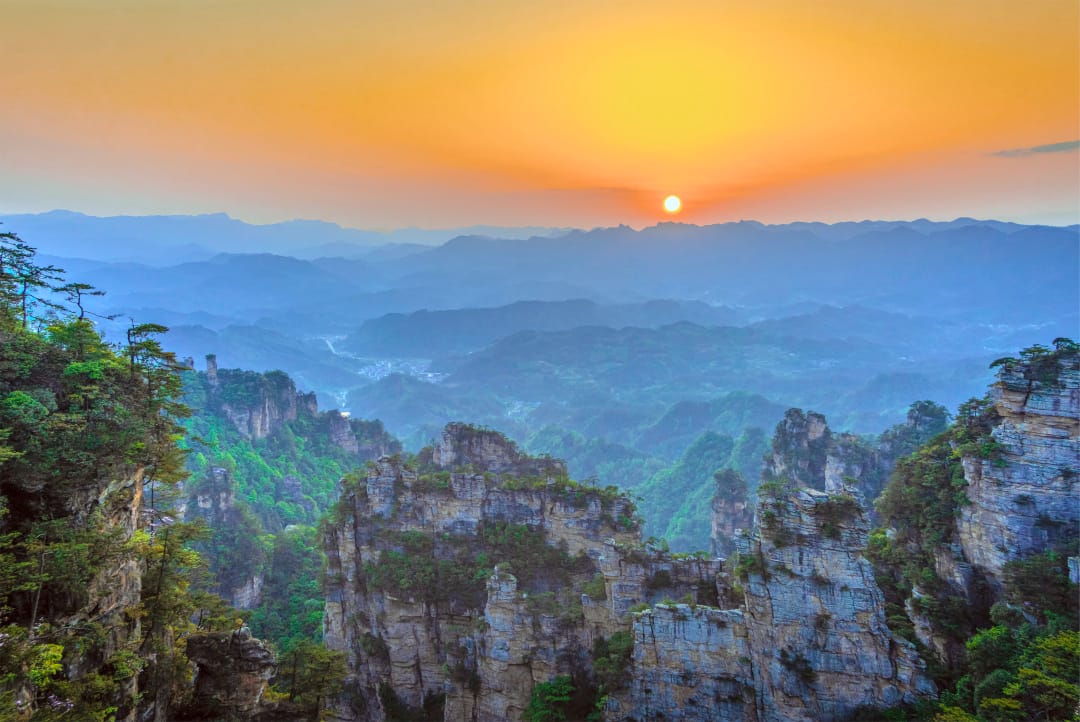
Inside the Yangjiajie scenic area, this is the strongest sunset spot for anyone who wants fewer people around them. It's a cliff-edge platform reached via the Oolong Village trail from the Yangjiajie cable car station, roughly 40 minutes on foot, and it delivers a genuinely 360-degree view over stacked sandstone walls. We've walked clients out here specifically because Yuanjiajie at the same hour can feel like a photo queue rather than a viewpoint — plan your day backward from last-bus time here, not forward from breakfast, since it's further from the standard circuit.
Yuanjiajie
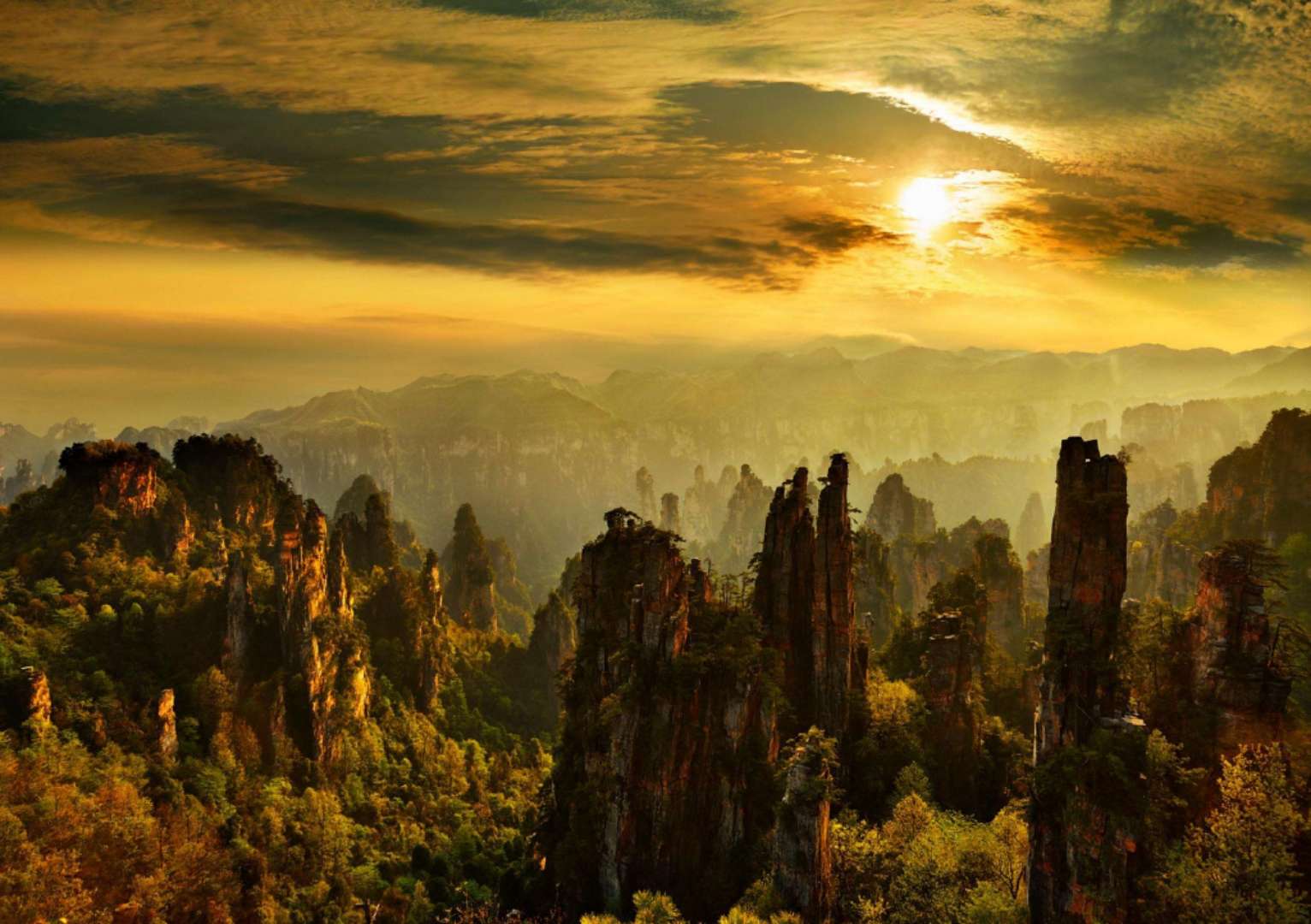
The western side, near the Avatar Hallelujah Mountain viewing platforms, works well simply because most visitors are already there after a full day exploring the floating mountains. The light comes in low across the pillar forest without requiring the extra hike to Tianbo Mansion. It gets more crowded than Yangjiajie at this hour, since it's the zone every day-tripper passes through.
Last bus timing
The last eco-bus typically departs around an hour before the park closes — plan to be at your pickup point by 6:00 PM in high season (March–November) or 5:00 PM in winter (December–February). Holiday periods like October Golden Week usually see extended hours, and severe weather (heavy snow, thick fog) can shut down high-altitude segments without much notice. Check the posted times at your stop or ask staff on-site for that day's exact cutoff.
5. Can You Stay Overnight Inside Wulingyuan for Sunrise?
The 2017 closure everyone still repeats
This is the part most English-language guides get wrong by simply not addressing, and where Chinese sources contradict each other. In May 2017, Chinese environmental authorities moved to clear commercial lodging from the core Wulingyuan scenic area. A number of older Chinese travel posts still describe Old House Area, Daguantai, and similar mountain-top guesthouses as permanently closed as a result.
The current, unsettled reality
That's out of date, but "reopened" isn't quite right either — call it an ongoing transition period. A small number of guesthouses around Dingxiangrong village remain bookable — this is the settlement that serves as the staging point for both Laowuchang and Daguantai sunrise trips. Recent guest reviews describe overnight stays, home-cooked dinners, and guided walks to the viewing platforms before dawn. Relocation and environmental policy continue to force individual properties to close or rebuild on a rolling basis, which is why a name published even a year ago can no longer be accurate.
The most reliable check is searching current listings directly on a major OTA platform: a property that no longer appears there has typically closed. Conditions on the mountain are basic by design — shared bathroom, basic heating, dinner and breakfast arranged by the owner rather than a menu, and no shops if you haven't packed your own snacks.
If sunrise from the peaks matters enough to your trip to justify this, confirm current availability and access rules directly with the guesthouse or through a local operator before you travel.
6. What to Do If You're Not Staying Overnight
The realistic same-day version
Most visitors on a standard multi-day itinerary aren't going to add a night on an unheated mountain guesthouse just for a sunrise photo, and that's a reasonable call. Enter through whichever gate is closest to your hotel right at opening — 6:30–7:30 AM depending on the gate — and head straight for Tianzi Mountain or Yuanjiajie rather than starting elsewhere. You'll miss true sunrise over the peaks by 30–60 minutes in most seasons. You'll still catch the morning light, though, and — if the timing lines up after a rain — the cloud sea, which often lingers into mid-morning rather than clearing the moment the sun is up.
Why arriving "late" still works
The "sunrise shot" everyone chases is really a two-hour morning-light window, not a five-minute event — something we've confirmed across enough client trips that we now build itineraries around it rather than around a single alarm-clock time. Arriving 45 minutes late still gets you most of it. For sunset, no compromise is needed anywhere in Zhangjiajie: a normal day plan reaching Tianzi Mountain, Yangjiajie, or Tianmen Mountain's summit by mid-afternoon puts you in position for the real thing.
7. Zhangjiajie Sunrise and Sunset Beyond Wulingyuan
Tianmen Mountain
 Sunset at Tianmen Mountain, Zhangjiajie, 4 Oct 2025
- Sunset at Tianmen Mountain, Zhangjiajie, 8 Jun 2026
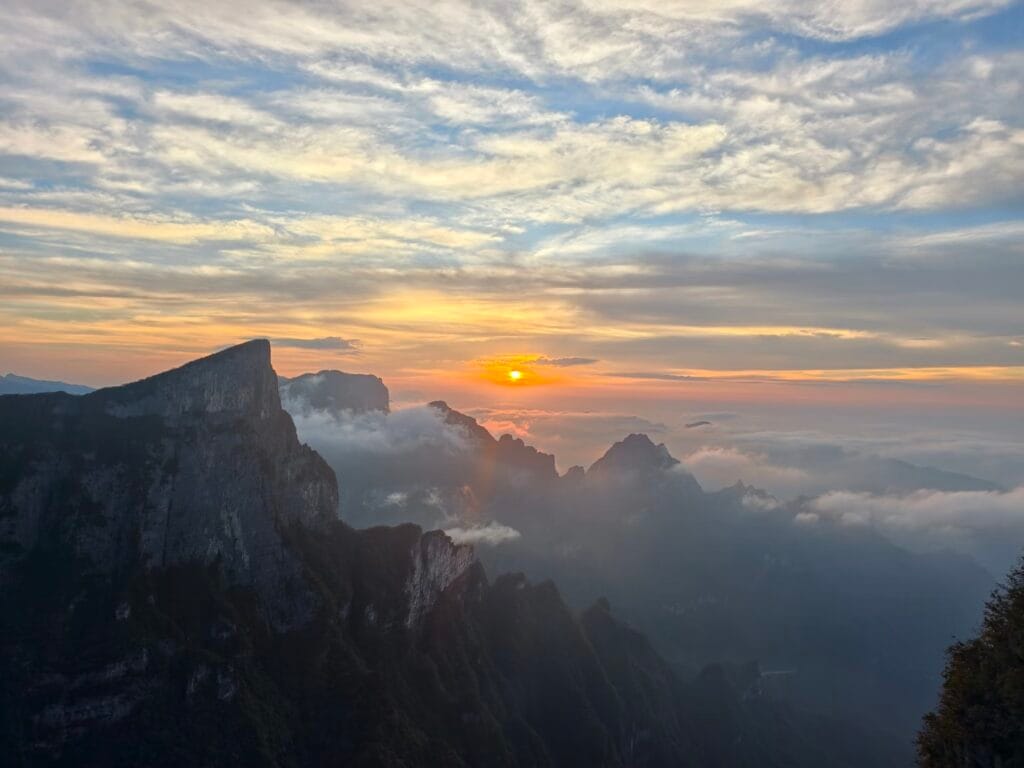
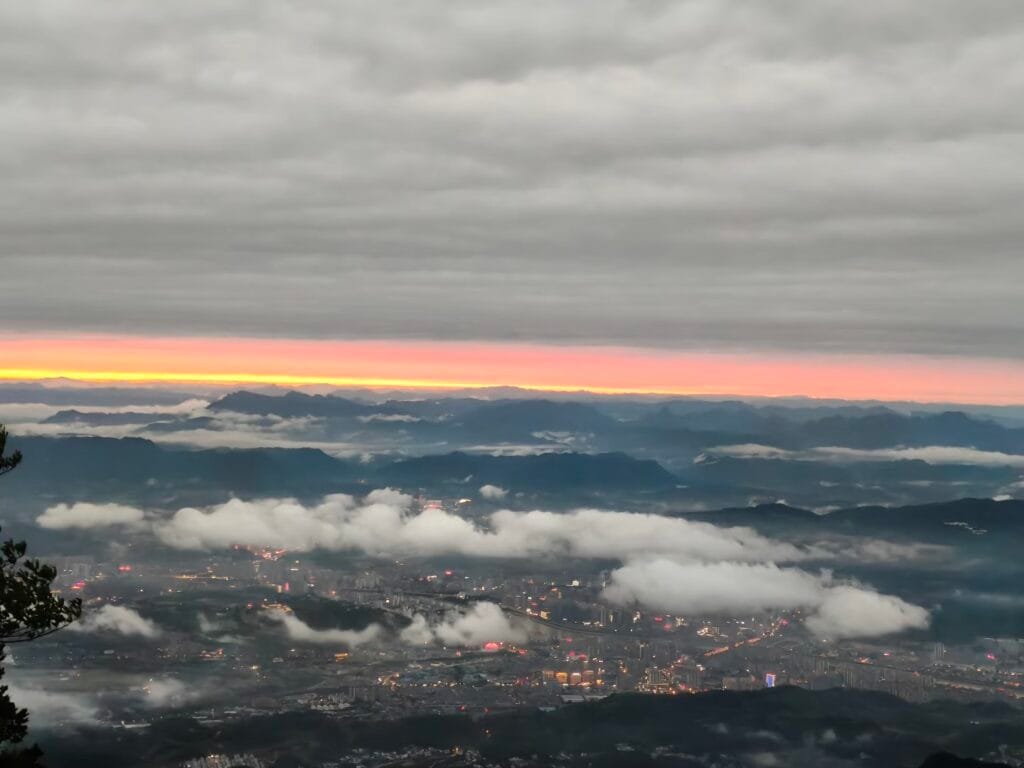
A separate ticketed park 35 km from Wulingyuan, with its own sunset draw at Cloud Dream Summit (云梦仙顶). Many repeat visitors actually prefer the western Ghost Valley Plank Path (鬼谷栈道) instead, for the same light with more drama underfoot. Sunrise here faces the same overnight-lodging problem as Wulingyuan, without an equivalent to Laowuchang as a staging option. The mountain's main cableway is currently mid-upgrade, changing how long the day takes. Our Tianmen Mountain guide covers the current routing in full — confirm details there before building a sunset plan around it.
Qixing Mountain
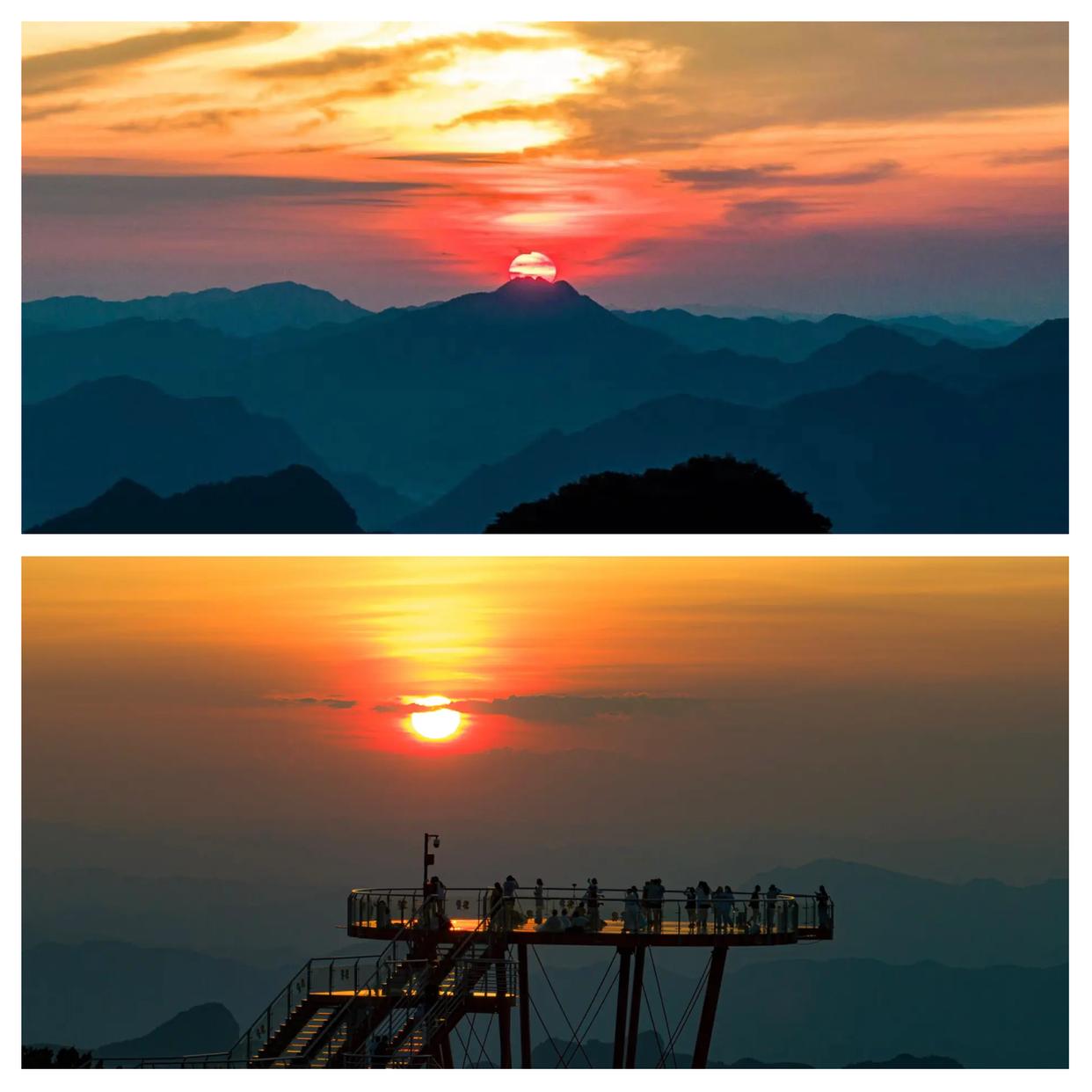
Zhangjiajie's newest major viewpoint draws far fewer people than either of the above for a comparable view. It has its own official 1314 Sunrise Platform and the 1520 Sky Eye glass platform for sunset, looking out over karst ridge lines rather than sandstone pillars — closer to the terrain around Guilin than to the Avatar-style pillars Wulingyuan is known for. We've brought clients here on days with 100-kilometer visibility and on days where the cable car simply couldn't run — the payoff depends on weather more than most Zhangjiajie viewpoints, since the site sits in a cloud band for much of the year. Check the forecast the morning of, and treat it as a bonus day rather than the centerpiece of a tight itinerary. --> Zhangjiajie Seven Star Mountain (Qixing Mountain): An Honest Guide for Foreign Visitors
8. The Best Season for a Clear Sunrise
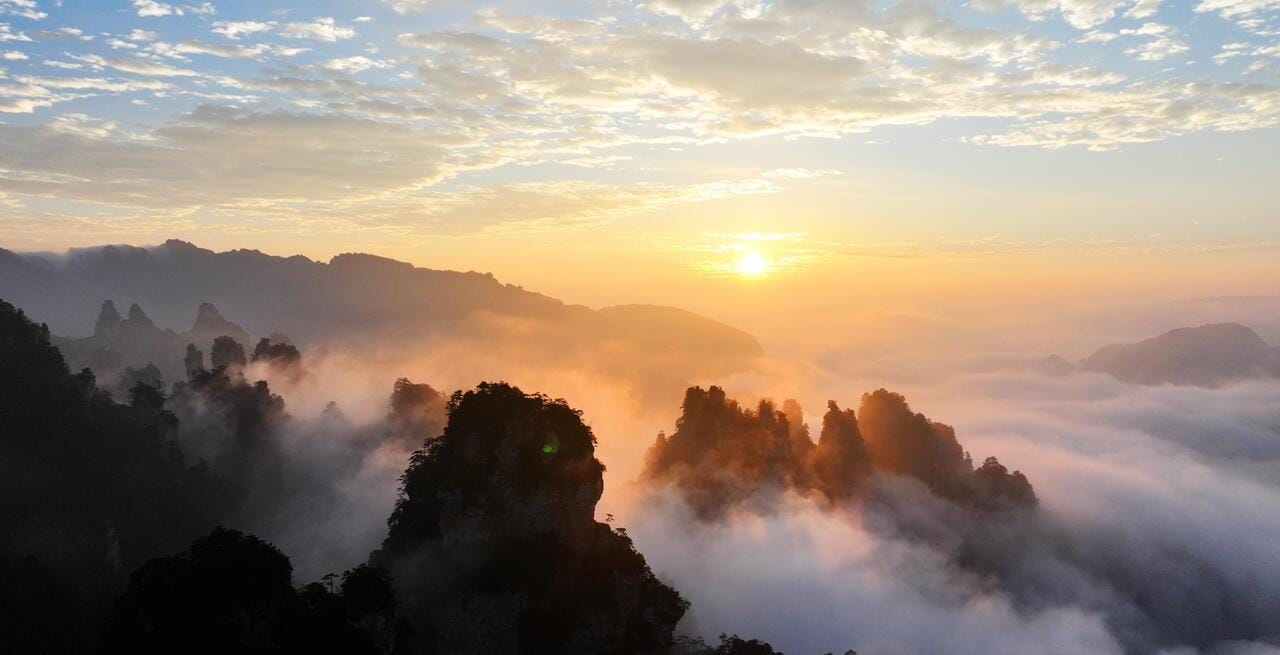
Autumn gives the clearest air, summer gives the most reliable odds
Autumn (September–November) delivers the clearest air of the year — low humidity, minimal haze, and the highest chance of an unobstructed sunrise with sharp visibility across the peak forest. It's also the most crowded season, so factor that into any overnight-lodging plan around Laowuchang or Daguantai. Summer (June–August) has the most stable weather day to day, meaning the highest raw odds of a clear sky at dawn even if the light itself is less dramatic. We've sent enough clients up in July and August to say the trade-off is real: an earlier wake-up (sunrise lands around 5:30–5:45 AM) and the heat and mosquitoes that come with the season.
Spring and winter are harder bets
Spring (March–May) is the wrong season if a clean, unobstructed sunrise is the goal — humidity is high and fog frequently obscures the peaks entirely. It's also, for the same reason, the season most likely to deliver a cloud sea on the mornings it does clear. Winter (December–February) is the wildcard: the latest sunrise of the year (around 7:25–7:30 AM), the coldest and most physically demanding conditions, but the rare payoff of snow-dusted peaks catching the first light after a clearing storm — worth it only if you're already planning a winter trip for other reasons.
If clear, reliable visibility is what you're after, aim for autumn. → See our Best Time to Visit Zhangjiajie guide for month-by-month rainfall and crowd data.
9. The Best Season for Sunset
Autumn and summer give you the longest, clearest window
Summer and early autumn (July–October) offer the latest sunsets of the year — landing between roughly 6:15 and 7:30 PM depending on the exact month — which gives a longer window to reach a viewpoint after a full day in the park without rushing. Autumn specifically pairs this with the clearest air of the year. The color transition from gold to violet across the peak forest tends to be sharper and more saturated than in other seasons.
Spring and winter narrow the margin
Spring sunsets land earlier, in the 6:20–7:05 PM range, and afternoon rain is common enough that a clear evening can't be counted on. A shower that clears an hour before sunset, though, often produces some of the most dramatic skies of the year, with leftover cloud catching color long after the sun itself has dropped. Winter gives the earliest sunsets (as early as 5:45 PM in December), which works in your favor logistically — you're not racing the last eco-bus as hard. We've taken clients up for winter sunsets expecting a washout and gotten one of the clearest views of the trip. The trade-off is a shorter, colder window and a higher chance the peaks are simply socked in with cloud rather than putting on a show.
Tianmen Mountain's summit adds an option specific to that park: riding the cableway down around sunset, when low light comes through the cabin glass into the canyon below. It's worth timing a Tianmen Mountain visit around this if you're already there for the day. Current cableway construction changes how that descent actually works, though, so confirm the routing before building an evening around it.
10. What to Bring
Item | Why |
|---|---|
A proper layer, even in summer | Elevation typically runs 8–10°C colder than the valley floor, based on what clients report before dawn and after sunset alike |
Headlamp or phone flashlight | Path lighting on the mountain is minimal to none |
Tripod | The best light window — especially the blue hour before sunrise — is dim enough to need one |
Fully charged phone and camera | No charging points on the mountain before dawn |
Park ticket and ID | Checked at every gate, sunrise trips included |
Frequently Asked Questions
How many days a year can you actually see sunrise in Zhangjiajie?
There's a figure that circulates in English-language travel guides — under 100 days a year — but it's not an official or authoritative count, and the source repeating it also contains at least one other claim we know to be outdated. We can't vouch for the number itself. What we can say with confidence: a genuinely clear sunrise here is the exception rather than something you can count on, which is exactly why the claim keeps getting repeated in the first place.
Can I see sunrise if I'm not staying inside the scenic area overnight?
Not the true peak-top sunrise — that requires already being on the mountain before the eco-bus network starts. What you can catch on a day-ticket basis is the tail end of the morning-light window, arriving 30–60 minutes after true sunrise, which still delivers the cloud sea on a good day.
What time should I leave my hotel for sunrise if I'm staying in Wulingyuan town?
Frankly, there's no departure time from a valley hotel that gets you to a peak-top sunrise — the eco-bus system doesn't start until 7:00–8:00 AM depending on season, well after the sun is already up. If sunrise from the peaks is the goal, the guesthouse has to be on the mountain, not in town.
Is it worth planning a Zhangjiajie trip specifically around sunrise or sunset?
If photography or the cloud sea is the main draw, yes — it's worth the one extra night on the mountain. If it's a minor bonus to an otherwise packed itinerary, entering at gate-opening and heading straight to a summit viewpoint usually delivers enough of the experience without reshaping your whole trip around one sunrise.
Which is better for sunset — Tianzi Mountain, Yangjiajie, or Tianmen Mountain?
Tianzi Mountain's West Sea Platform is the easiest and most reliable inside Wulingyuan. Yangjiajie's Tianbo Mansion has a stronger, quieter panorama but requires a longer walk. Tianmen Mountain's summit gives the widest 360-degree view of the three, though current cableway construction changes how long it takes to get there.
What's the best season for a clear Zhangjiajie sunrise?
Autumn (September–November), when low humidity gives the clearest air and the best odds of an unobstructed view across the peak forest. Summer has the most day-to-day weather stability if raw odds of a clear sky matter more to you than the sharpest possible light.
Planning a Zhangjiajie trip built around the right light, not just the right ticket? Get in touch and we'll build it around what you actually want to see.