Zhangjiajie Eco-Bus Guide: Routes, Hours, and Tips That Save Your Day
If you are visiting Zhangjiajie National Forest Park, the eco-bus is not optional — it is the only way to move between the park’s major sections. No private vehicles are allowed inside.
We run tours through Zhangjiajie every week. Last October at Sanchakou Junction, a wrong bus taken in the wrong direction cost a group of visitors 40 minutes and the best light of the day at Mihun Terrace. We have watched the Yangjiajie-to-Tianzi Mountain stretch turn confident travelers into pale, queasy passengers gripping the seat in front. And we have used the 13:00–14:00 plateau window to move groups smoothly past queues that had everyone else waiting 40 minutes.
This guide is what we tell every group before they enter the park. It also covers the one thing almost no English-language guide addresses honestly: motion sickness on the eco-bus is a real problem on certain segments, and knowing which ones in advance changes how you plan your day.
Table of Contents
1. What Is the Zhangjiajie Eco-Bus?
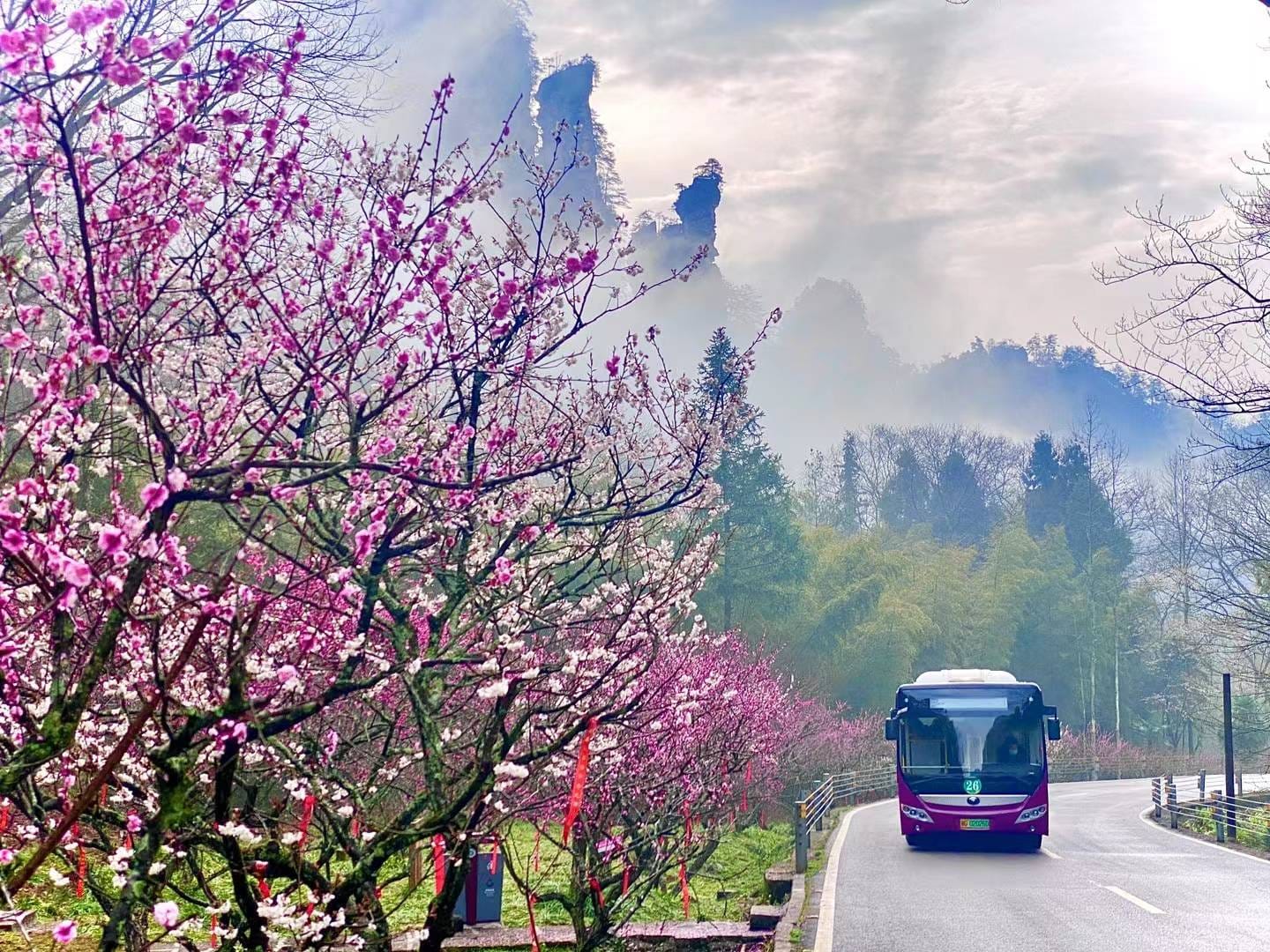
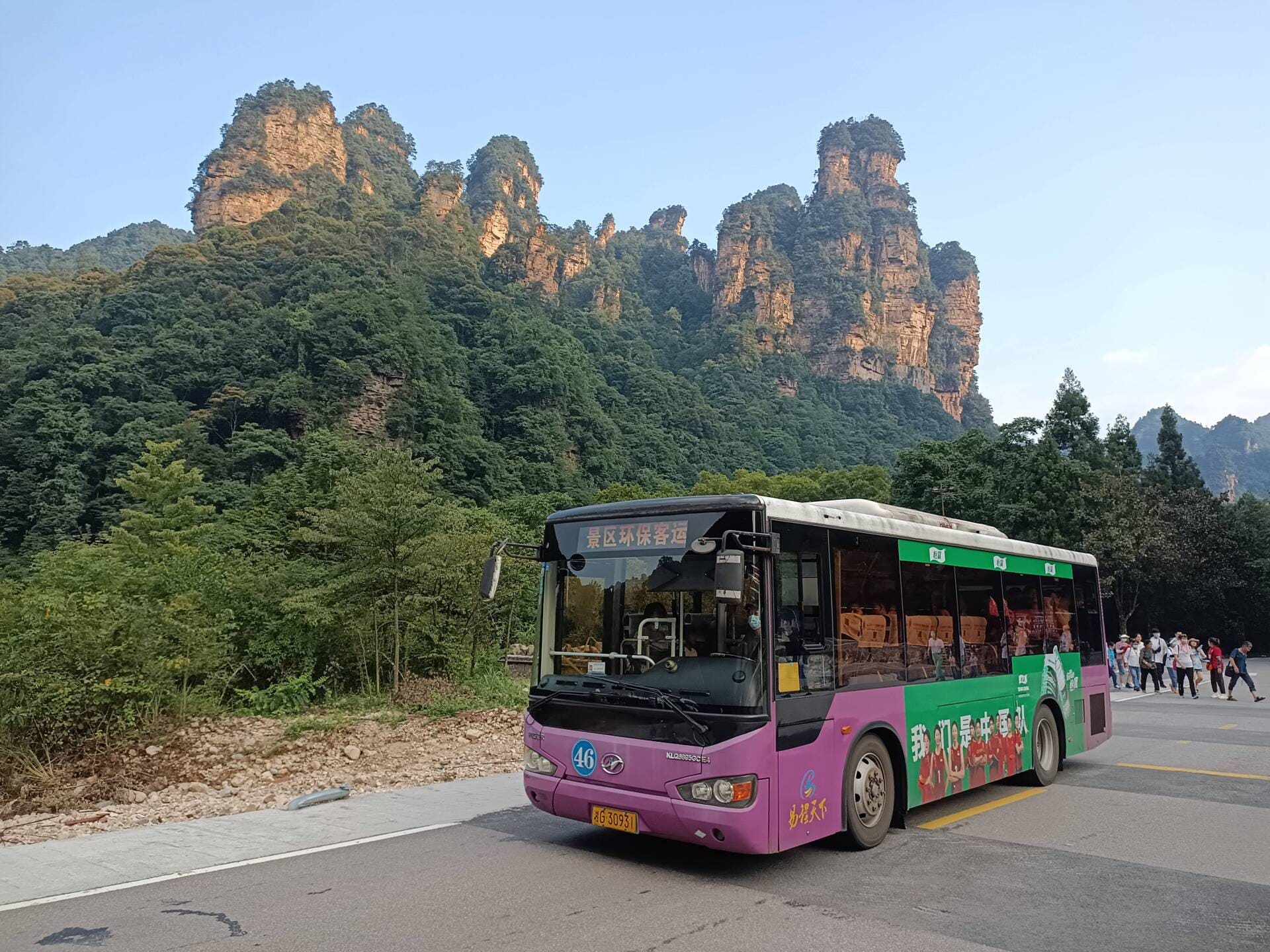
The eco-bus (环保客运车, huánbǎo kèyùn chē — also called the park shuttle bus) is the internal transit network inside Zhangjiajie’s scenic areas. A fleet of over 330 vehicles — with a new batch of pure electric models introduced in 2025 — runs across nine routes inside Wulingyuan Scenic Area. Tianmen Mountain operates its own separate eco-bus system entirely. No private cars are allowed in either park. Once you pass through a gate, the eco-bus is how you get anywhere beyond walking distance.
One thing that confuses visitors constantly: the eco-bus is not the Ten-Mile Gallery tram. The Ten-Mile Gallery has its own separate electric tram along the valley floor — a paid attraction at ¥38. The eco-bus is the park-wide transit system, and its cost is bundled into your entry ticket.
2. Is the Eco-Bus Included in Your Ticket?
Yes — if you buy the right ticket. The standard scenic area ticket includes unlimited eco-bus use for the entire valid period. You do not pay per ride.
Where visitors get tripped up: some third-party platforms sell discounted or partial tickets that do not include the eco-bus. Always confirm before buying. See our full Zhangjiajie tickets guide for a complete breakdown.
Ticket Type | Eco-Bus Included? | Valid Period |
|---|---|---|
Standard adult ticket (¥224) | Yes | 4 days |
1-day ticket | Yes | 1 day |
Child ticket (1.2m–1.4m, half price) | Yes | Same as adult |
Child under 1.2m | Free entry | Free eco-bus too |
Prices as of 2026. Government-regulated pricing can change — verify at time of booking.
3. Eco-Bus Operating Hours
The eco-bus runs 7:00 am to 7:00 pm in peak season, typically earlier in winter. Buses depart when full — not on a fixed timetable. In peak season that means nearly continuous service at the East Gate. At quieter stops or in low season, expect to wait 20 to 30 minutes.
If you ever get stranded, the park’s emergency transport hotline is 0744-5555555.
The last bus trap is real. The final buses from the mountain top fill fast as everyone heads down at once. Be at a stop by 6:30 pm at the latest.
4. The Wulingyuan Eco-Bus Routes
The park operates nine routes across two completely separate levels: mountain-bottom and mountain-top. These two levels do not connect by eco-bus. To move between them you must use the Bailong Elevator, the Tianzi Mountain Cable Car, or the Yangjiajie Cable Car — all priced separately. The valley routes and the plateau routes are two independent systems; the cable cars and elevator are the only way between them.
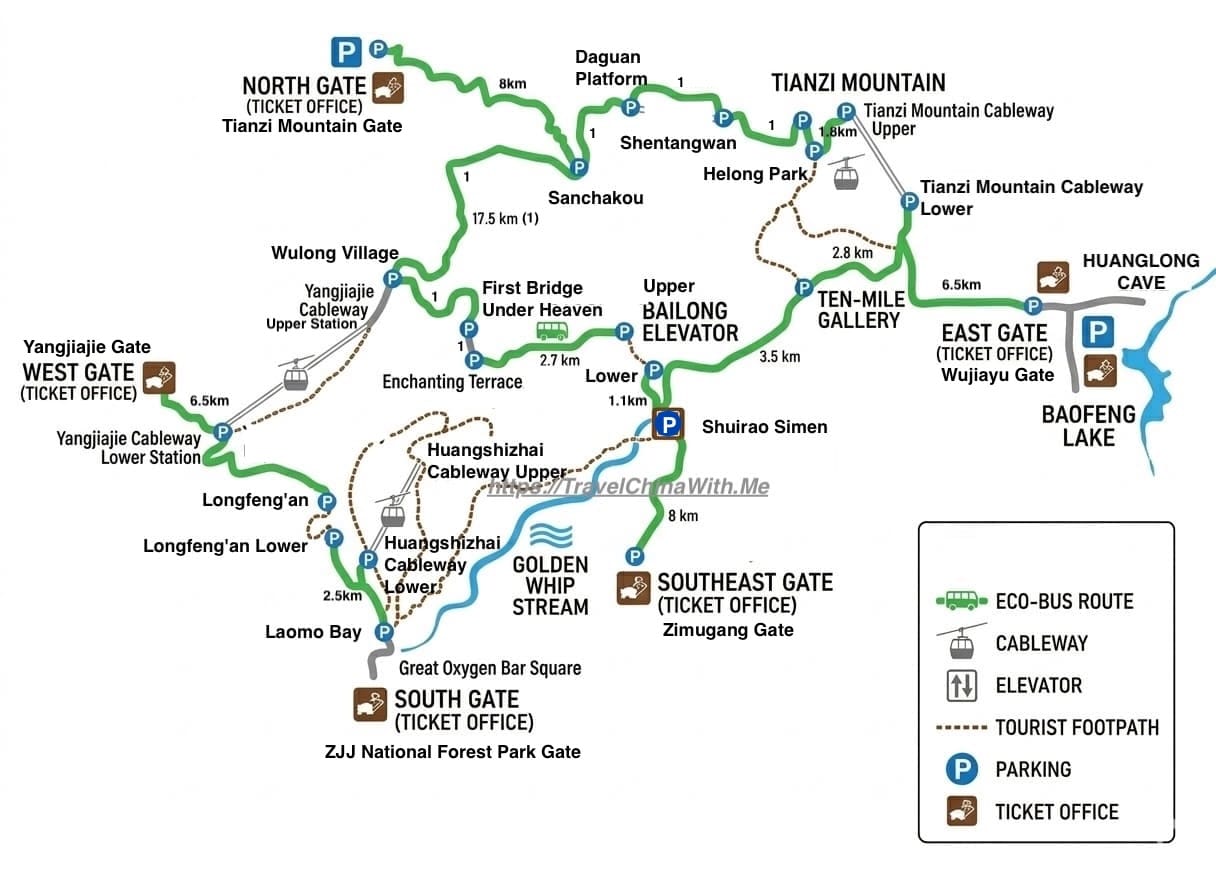
Note: the route numbers below are our own naming system for easy reference — they are NOT official park designations.
Route | Terminals | Stops |
|---|---|---|
🟢 Route 1 | Zhangmen Gate (标志门) ↔ Zimugang Gate (梓木岗) | Caijiayu Bridge, Ten-Mile Gallery, Shuiraosimen; branch to Bailong Elevator lower station |
🔵 Route 2 | Tianzi Mountain Parking Lot ↔ First Bridge Under Heaven (Yuanjiajie) | Shentang Bay†, Dijiang Platform†, Daguan Platform, Sanchakou Junction, Wulong Village |
🔵 Route 3 | Tianzi Mountain Gate (天子山门票站) — Branch A: → Tianzi Mountain Parking Lot; Branch B: → Yuanjiajie First Bridge | Branch A: Sanchakou, Daguan Platform, Dijiang Platform, Shentang Bay. Branch B: Sanchakou, Wulong Village |
🔵 Route 4 | Yangjiajie Gate ↔ Longfeng’an | — |
🟢 Route 5 | Forest Park Gate → Yangjiajie Longfeng’an | Laomo Bay |
🟢 Route 6 | Forest Park Gate → Huangshi Village cable car lower station | Laomo Bay |
🔵 Route 7 | Yuanjiajie Mihun Terrace → Bailong Elevator upper station | Rear Garden |
🟢 Route 8 | Zhangmen Gate (标志门) → Tianzi Mountain Cable Car lower station | — |
🔵 Route 9 | Helong Park → Tianzi Mountain Cable Car upper station | — |
† Request stops — tell the driver before departure or the bus passes straight through.
The Routes That Matter Most
Routes 1 and 8 are the first buses most visitors take from the East Gate. Route 8 reaches the Tianzi Mountain Cable Car base in about 12 minutes. The Route 1 branch via Shuiraosimen reaches the Bailong Elevator base in about 18 minutes.
Route 2 is the main plateau circuit — the busiest, the most scenic, and the one with the worst queues and the worst motion sickness. More on that below.
Route 3 is the underused entry for visitors coming through the Tianzi Mountain Gate — straight onto the plateau, no elevator or cable car needed.
Route 7 is short but easy to miss: it connects Mihun Terrace at Yuanjiajie to the top of the Bailong Elevator for the descent. Without it you are walking 2.7 km.
The Sanchakou Junction warning applies to Routes 2 and 3. At this junction, buses split toward Yuanjiajie/Yangjiajie in one direction and Tianzi Mountain in the other. Signage is minimal — poor wayfinding here catches visitors out regularly, including people who speak fluent Chinese. One visitor put it plainly:
“The signs at the north gate routes were completely unclear. Even as a Chinese person I was confused — and I really felt for the foreign visitors who couldn’t even ask for help easily.” — Guest feedback
Always confirm the destination with the driver or dispatcher before you sit down.
For itinerary advice on how to combine these routes into a full day plan, please check Zhangjiajie Itinerary Guide: From 1 Day to 7 Days.
5. The Tianmen Mountain Eco-Bus
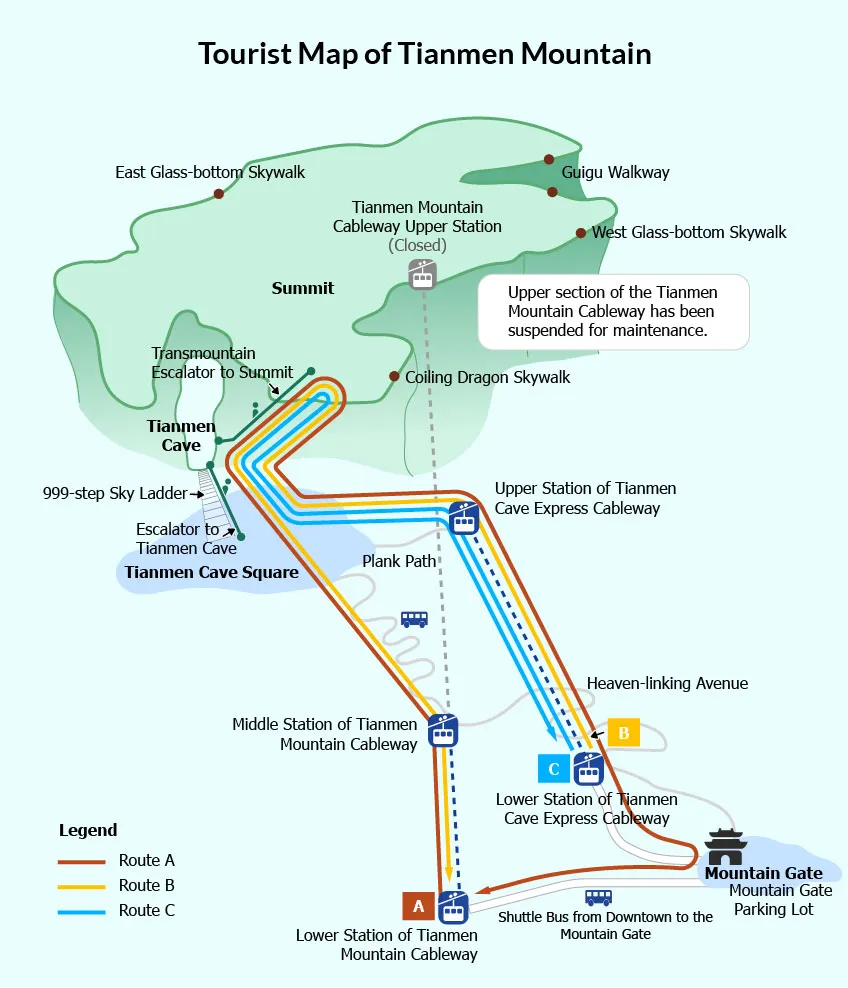
Tianmen Mountain is a completely separate scenic area located in Zhangjiajie city — about 30 km from Wulingyuan. It has its own eco-bus system running along the famous 99-bend Tongtian Avenue, and it has nothing to do with the Wulingyuan routes above.
Important 2026 update: the upper section of the main cableway closed for renovation in November 2025, and construction is expected to last for years. As a result, all three lines (A, B, and C) now include eco-bus segments — this is a significant change from older guides. The current ticket price is ¥288/person.
The eco-bus at Tianmen Mountain runs between the cable car mid-station (索道中站) and Tianmen Cave parking area (天门洞停车坪), covering the 99 bends in about 25–30 minutes. Buses run every 10 minutes and the cost is included in your ticket.
Which line you choose determines when and how you ride the eco-bus — and significantly affects your energy levels on the day. The three lines differ in sequence, not in what you see:
Line | Eco-Bus | 999 Steps | Best For |
|---|---|---|---|
Line A | Early in visit (fresh) | Walk DOWN (20–30 min) | Most visitors — energy-efficient sequence |
Line B | Late in visit (tired) | Walk UP (30–45 min) | Fit visitors who want the challenge |
Line C | Both directions | Optional/skip | Visitors with acrophobia or cable car concerns |
Line A is what we recommend for most visitors. You ride the eco-bus up the 99 bends first while your legs are fresh, walk the 999 steps downward after exploring the summit, and end on the cable car. Line B sends you up the 999 steps after already spending time on the mountain — that is the order that exhausted the visitor in the Tianmen Mountain team’s own account who couldn’t continue past the cave.
For the full comparison including the renovation impact, physical difficulty ratings, and seasonal strategy, see our dedicated Tianmen Mountain Line A, B or C guide.
The Tianmen Mountain eco-bus also has its own VIP fast track option — covered in our Zhangjiajie VIP Fast Track guide.
6. The Motion Sickness Problem Nobody Warns You About
Most English guides skip this entirely. We do not: certain eco-bus segments will make some people sick, and knowing which ones lets you prepare or plan around them.
The worst segment: Yangjiajie to Tianzi Mountain on Route 2 — or the reverse. About 28 minutes on a mid-sized minibus with sharper turns, a rougher road surface, and a driver who does not slow for bends. A heavy breakfast before this leg is a mistake:
“Don’t eat too much for breakfast — I saw people getting sick right on the bus.” — Guest feedback
The second worst: Route 1 from the East Gate to the Bailong Elevator base — 18 minutes of aggressive valley curves. The drivers know every bend after years on these roads, which means they take them at full speed. Visitors have arrived at the elevator looking pale before the experience even begins.

⬆️ Zhangjiajie Tianmen Mountain Route B Eco-Bus – immersive one-shot hairpin turns experience
The 99-bend Tianmen Mountain eco-bus is also worth flagging: 25–30 minutes on a road with 99 consecutive switchbacks. It is spectacular to look at and genuinely disorienting to ride. If you are prone to motion sickness, the same rules apply — front seat, forward-facing, medication before boarding.
What actually helps: sit directly behind the driver — that position has the least lateral movement. Choose forward-facing seats only; the side-facing seats in the middle are the worst on the bus. Take medication or patches before boarding, not after symptoms start. Carry a plastic bag for the Yangjiajie-Tianzi Mountain segment specifically.
If motion sickness is a real concern, plan your itinerary to avoid the Yangjiajie-to-Tianzi Mountain leg of Route 2, or do it during the quieter 13:00–14:00 window when the bus is less packed.
7. Zhangjiajie Forest Park – Which Gate to Enter
Your entry gate determines which routes you access first. See our full Zhangjiajie park entrances guide for directions.
East Gate (武陵源标志门/吴家峪口) is the most connected entry. Routes 1 and 8 both depart from here, reaching the two main ascent options in under 20 minutes. Best for most first-time visitors.
Tianzi Mountain Gate (天子山门票站) is 55 km from the city — about 90 minutes by bus — but puts you directly on the plateau via Route 3 with no elevator or cable car cost. Queues here are a fraction of those at the East Gate. For guests with mobility limitations, or visitors on a return trip focusing on Tianzi Mountain and Yangjiajie, the extra journey time is usually worth it.
Forest Park Gate / South Gate (南门) connects to Routes 5 and 6 and is the starting point for the Golden Whip Stream valley walk. The wrong choice if your goal is reaching the plateau quickly.
Yangjiajie Gate (杨家界门票站) connects to Route 4 only. Better as an exit gate than a main entry.
One connection almost nobody mentions: near the Route 4 terminus at Longfeng’an, a 15-minute walk on a wooden boardwalk connects to the Huangshi Village zone — linking two areas most visitors treat as completely separate.
8. Zhangjiajie Forest Park – The VIP Eco-Bus Option
In peak season, standard eco-bus queues at the East Gate run 30 to 45 minutes per transfer. Across a full day with three or four transfers on Route 2, that is up to two hours of standing before cable cars and the elevator even factor in.
The park operates a priority boarding system (绿色通道, lǜsè tōngdào) in two tiers.
Priority boarding (¥240/person/day) gives you a dedicated boarding zone at every stop ahead of the regular queue, cutting waits to roughly 10 to 15 minutes. You board before the regular queue — but a seat is not guaranteed. On a packed bus, move fast once you are on.
Charter (¥2,400/day for the whole group) means your guide coordinates a dedicated bus at each stop through the dispatcher. No other passengers board and the bus leaves when your group is ready. For six or more people in peak season, the per-person cost is often similar to individual priority passes — and for groups with elderly members, guaranteed seating matters more than the price difference.
Finding the priority lane: there is no permanent signage at any eco-bus stop. A dispatcher stands to the side of the main queue and manages priority boarding. If you cannot find them, ask any uniformed staff nearby.
The VIP eco-bus matters most at the East Gate and on Route 2. At the Tianzi Mountain Gate, queues are short enough that VIP adds little.
For all fast-track options across both parks — Wulingyuan and Tianmen Mountain — see our Zhangjiajie VIP Fast Track guide.
9. Timing Strategy
The single best free advantage costs nothing: stay in Wulingyuan District rather than commuting from Zhangjiajie city. The city is over 30 km away — 40 to 50 minutes each way. Guests in Wulingyuan can reach the East Gate before 7:30 am, ahead of the entire wave of tour groups bussing in from the city. On a peak day, that head start is worth more than most paid fast tracks.
The worst window to queue is 9:00–11:00 am. Every group that followed the “arrive early” advice converges simultaneously at the East Gate and Bailong Elevator base. If you are already on the plateau by then, you are ahead of the crowd.
For cross-plateau moves on Route 2, 13:00–14:00 is the quietest window — tour groups are at lunch and the plateau empties noticeably, especially between Tianzi Mountain and Yuanjiajie. The reverse direction quiets around 16:00 as groups start descending. Neither window eliminates queues in peak season, but both reduce them meaningfully without costing anything.
10. Practical Tips From Our Guides
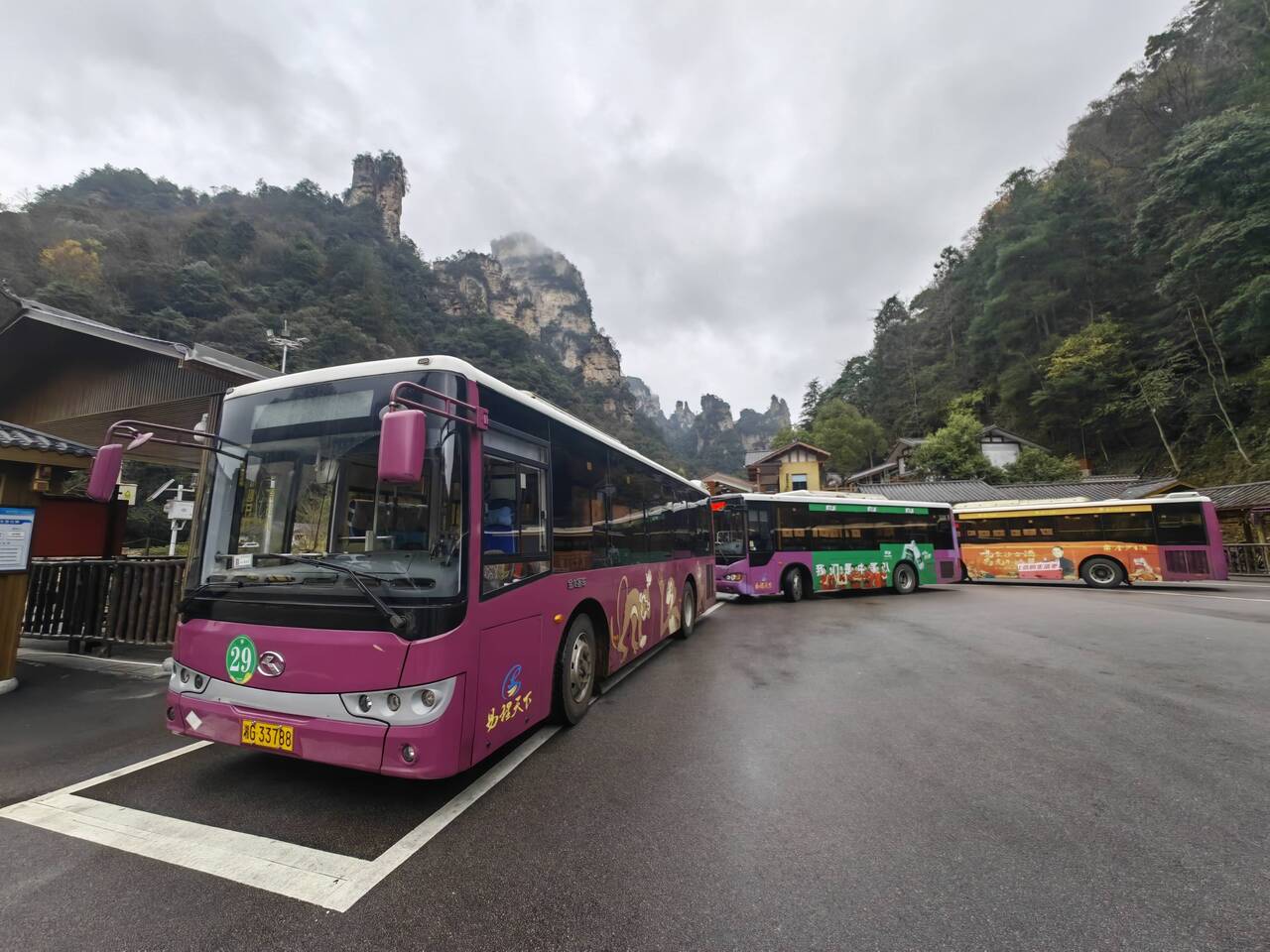
Do not try to hail the bus. Eco-buses stop only at designated boarding points. Standing on the road and waving does not work.
Ask the dispatcher at every stop before boarding. Multiple routes depart from the same location. Board without asking and you may be heading the wrong direction.
The signage inside the park is genuinely poor. Screenshot a route map before entering — mobile signal inside the park is unreliable in places, and you will not be able to load it when you need it.
Descending via the Yangjiajie Cable Car creates a routing problem. From the cable car base, there is no direct eco-bus connection to Tianzi Mountain. You either go back up, or exit toward South Gate and reroute. Decide your direction before descending.
Do not enter via the Forest Park Gate with large luggage. Golden Whip Stream is a 7.5 km walk from the gate to the first eco-bus connection. Leave bags at your accommodation or at luggage storage near the East Gate.
Food and water are available at bus stop areas throughout the park, though prices are higher than outside. You do not need to carry a full day’s supplies.
11. FAQ
Does the eco-bus run on a fixed schedule?
No — buses depart when full. On a busy October morning at the East Gate, buses left every 3 to 4 minutes. At the Tianzi Mountain Gate on the same day, the wait was 22 minutes for enough passengers. The experience varies significantly by gate and season.
Is the eco-bus free with the park ticket?
Yes. Unlimited eco-bus rides are included in any standard scenic area ticket. The separately paid transport inside the park is the Ten-Mile Gallery tram (¥38), the Bailong Elevator, and the cable cars. Full pricing in our tickets guide.
What if I miss the last bus?
Call 0744-5555555. Be at a stop by 6:30 pm in peak season — do not cut it close.
Can I hail an eco-bus anywhere in the park?
No. Designated stops only.
How is the eco-bus different from the Ten-Mile Gallery train?
The eco-bus is park-wide transit included in your ticket. The Ten-Mile Gallery tram (¥38) runs a short scenic loop in one valley. Completely different systems serving different purposes.
Is the eco-bus accessible for elderly or mobility-limited visitors?
Buses have steps and peak-season boarding moves fast. Charter eco-bus gives guaranteed seating with guide-managed boarding. Entering via the Tianzi Mountain Gate and boarding Route 3 puts you on the plateau with no elevator or cable car queues — for guests with mobility limitations, that trade-off is almost always worth the longer journey.
I get motion sick. What should I do?
Sit at the front, forward-facing seat, and take medication before boarding. The worst segment is the Yangjiajie-to-Tianzi Mountain leg of Route 2 — plan your itinerary to avoid it if possible, or tackle it during the quieter 13:00–14:00 window. The Tianmen Mountain 99-bend eco-bus is also worth preparing for separately.
What is the VIP eco-bus and is it worth it?
In peak season (May–October) with one or two days: yes. Priority boarding (¥240/person/day) cuts Route 2 transfer waits from 30–45 minutes to 10–15 minutes. Charter (¥2,400/day) gives a dedicated bus at every stop. In winter on a weekday: arrive before 8:00 am and skip it. Full breakdown in our VIP Fast Track guide.
What about the Tianmen Mountain eco-bus — is it the same system?
No. Tianmen Mountain is a separate scenic area with its own eco-bus running the 99-bend Tongtian Avenue. It is included in the Tianmen Mountain ticket (¥288) and has nothing to do with the Wulingyuan routes above. See the Tianmen Mountain section and our Line A, B or C guide for full details.
Travel China With Me has been running private tours to Zhangjiajie for over 20 years. Contact us to ask about itinerary planning or eco-bus VIP access for your travel dates.