Zhangjiajie Glass Bridge & Glass Skywalks: The Complete Honest Guide
You’ve seen the videos. Someone frozen mid-step, white-knuckled, staring straight down through 300 meters of air. Their friends are laughing. You’re not sure whether you’d laugh or cry. That’s the Zhangjiajie glass bridge — and that’s exactly why you’re here.
Here’s what most articles won’t tell you upfront: Zhangjiajie has more than one glass structure, and they are not the same experience, not at the same location, and not on the same ticket. We’ve had clients drive 90 minutes to Wulingyuan looking for the glass bridge — only to find out it’s another hour away in Cili County. Don’t be that group.
We’ve walked these structures countless times — with guests who were terrified, guests who were underwhelmed, and guests who cried (happy tears, mostly). Over 20 years of running China inbound tours, we’ve seen every version of this confusion play out. This guide gives you the real picture before you go.
Table of Contents
The Glass Structures in Zhangjiajie: 3 Very Different Things
Most visitors arrive thinking “Zhangjiajie glass bridge” refers to one thing. It doesn’t.
Structure | Location | Key Feature | Ticket |
|---|---|---|---|
Grand Canyon Glass Bridge | Cili County, ~60 km from city | 430 m suspension bridge, 300 m above valley | ¥178 combined |
Tianmen Mountain Glass Skywalks | Yongding District, in city | Cliffside walkways at ~1,400 m elevation | Included in ¥288 |
Qixing Mountain Glass Platform & Bridge | Yongding District, ~13 km from city | 1520 Sky Eye platform + glass sky bridge at 1,520 m | ¥11 on-site (within ¥199 ticket) |
These are three separate attractions in different locations. The Grand Canyon is 60 km from Tianmen Mountain. You cannot do both comfortably in one day. See our full Zhangjiajie tickets guide for the complete pricing breakdown.
Grand Canyon Glass Bridge: The One Most People Mean

What It Is
The Zhangjiajie Grand Canyon Glass Bridge — officially named Yuntiandu (云天渡) — opened in August 2016. It spans 430 meters across a canyon in Cili County, hanging 300 meters above the valley floor. Israeli architect Haim Dotan designed it, and at opening it held world records for both length and height among glass bridges.
It closed just 13 days after opening. Not from damage — it was simply overwhelmed with visitors. Management added a daily visitor cap and reopened. That cap is now part of what makes the experience work. The bridge doesn’t feel crowded in the way that, say, the Bailong Elevator does on a peak-season morning.
The Physical Experience
The bridge deck is made of 99 panels of triple-laminated tempered glass, each 50mm thick. Walk out to the middle and look down: you see the canyon walls, the trees 300 meters below, and your own feet in felt booties — yes, they give you felt shoe covers at the entrance, both to protect the glass and, let’s be honest, to make the moment more surreal.
The bridge has a gentle sway. It’s designed to move — that’s a feature of suspension engineering, not a defect. First-timers often grab the railing immediately. By the midpoint, most people relax enough to look around rather than just straight ahead. The view of the canyon from that height is genuinely hard to describe. The forest stretches in every direction and the cliffs drop away into green mist.
It’s the approach, not the crossing, that gets most people. Walking the first 20 meters feels significant. Once you’ve done it, the return crossing is almost casual.
The Grand Canyon Itself
The bridge is just one part of the Zhangjiajie Grand Canyon scenic area. The canyon stretches about 11 kilometers and reaches over 400 meters deep in sections. There are hiking trails through the canyon floor, along streams, past waterfalls, and beside karst formations.
There’s also a glass plank road — a narrower glass walkway mounted on the canyon wall at a lower elevation. It’s less dramatic than the bridge but gives you a different vantage point: you’re inside the canyon looking across, rather than above it looking down.
The canyon connects to the Avatar story that put this region on international maps, though the National Forest Park is where the sandstone pillar formations that actually inspired Avatar are located. The Grand Canyon is adjacent geography, different terrain.
On a foggy April morning a few years ago, we brought a group of twelve to the bridge at opening time. The mist filled the canyon so completely that the far cliff was invisible. People crossed into what felt like nothing — just white. Several said afterward it was more surreal than they’d expected because the height was concealed. Then the mist shifted, the canyon walls appeared 300 meters below, and two people stopped walking entirely for a moment.
Tianmen Mountain Glass Skywalks: Three Walks, One Mountain
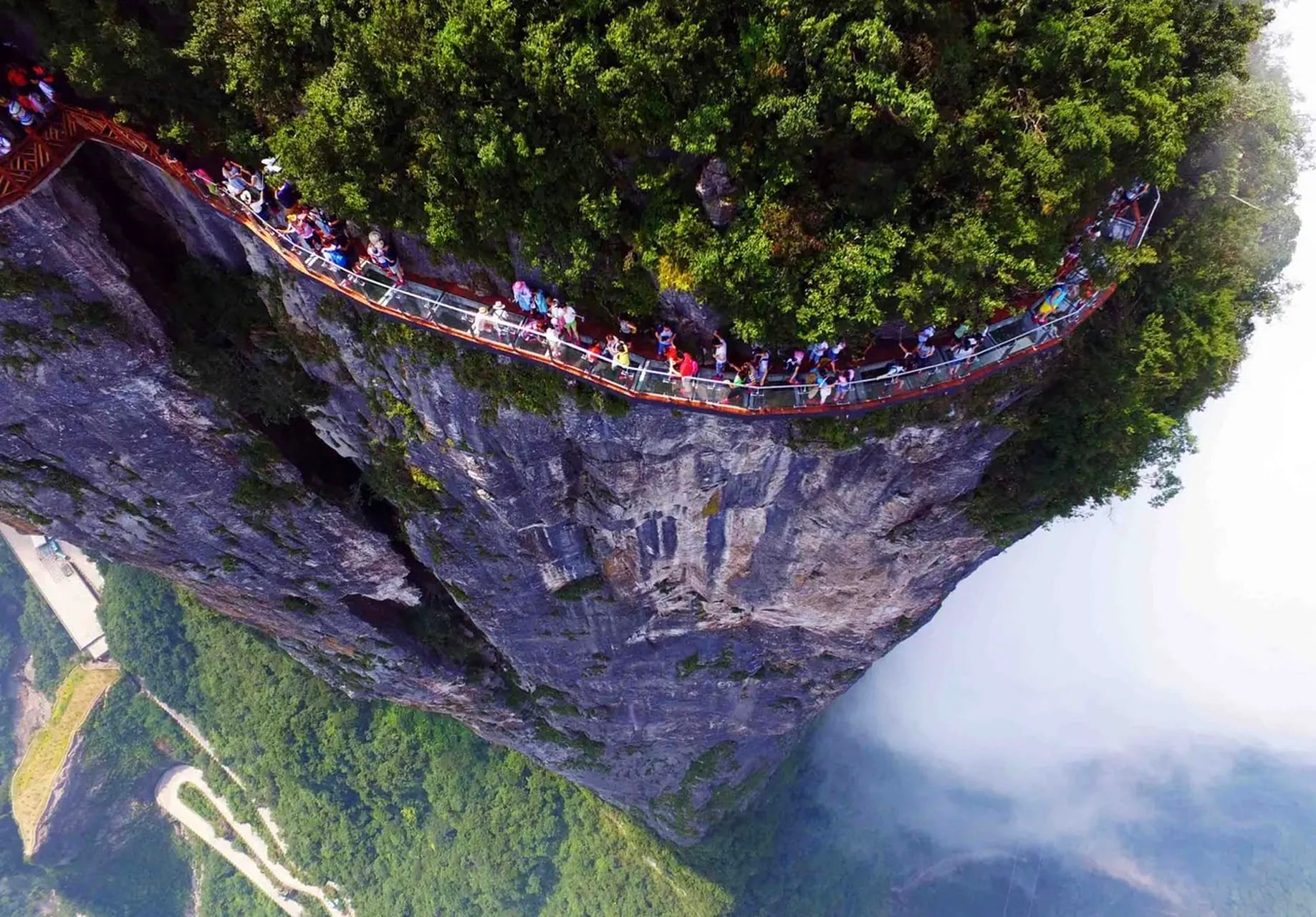
What Makes It Different
Tianmen Mountain has glass skywalks, plural — and they are structurally nothing like the Grand Canyon bridge. Here you’re walking along glass-floored walkways bolted directly to the mountain cliff face, at roughly 1,400 meters above sea level. You’re not crossing a gap — you’re traversing the edge of the mountain itself.
Three separate glass skywalks exist at the summit: the East Line Glass Skywalk, the West Line Glass Skywalk, and the Coiling Dragon Cliff Glass Skywalk. The Coiling Dragon Cliff — 100 meters long and 1.5 meters wide — is the most photographed. Standing there, you look straight down at the 99 Bends Road and, on clear days, Tianmen Cave below.
The mountain sits at 1,518 meters. The cable car ride up is 7.5 kilometers long — one of the longest in the world — and the ascent through low cloud is itself the kind of thing people talk about for years. Add the natural arch at 1,264 meters, the 999-step stairway, and three route options, and the glass skywalks are actually just one chapter of a much bigger day. See our dedicated guide on Tianmen Mountain Line A, B, or C before you book.
Current note: The upper section of the main Tianmen Mountain cableway is under renovation. Lines A and B have adjusted routes; Line C operates normally. Verify current status before booking.
The Difference in Feeling
Both the Grand Canyon bridge and the Tianmen skywalks are genuinely vertiginous. But they produce different psychological responses.
The Grand Canyon Glass Bridge puts you mid-air over open space. There’s nothing beneath you for 300 meters in every direction. That’s a pure exposure experience — height over void.
The Tianmen Glass Skywalks put you on a cliff edge. The mountain is right there beside you. Exposure is to one side only. Some people find this less intense; others find clinging to a cliff face worse than hovering over a canyon. You genuinely cannot predict in advance which will affect you more.
We’ve taken guests who crossed the Grand Canyon bridge without hesitation and couldn’t look over the Tianmen railing. We’ve taken others who froze on the bridge but walked the Coiling Dragon Cliff calmly and stayed for photographs. It depends on the person, not any objective measure of danger.
Qixing Mountain Glass Platform & Bridge: The Overlooked One
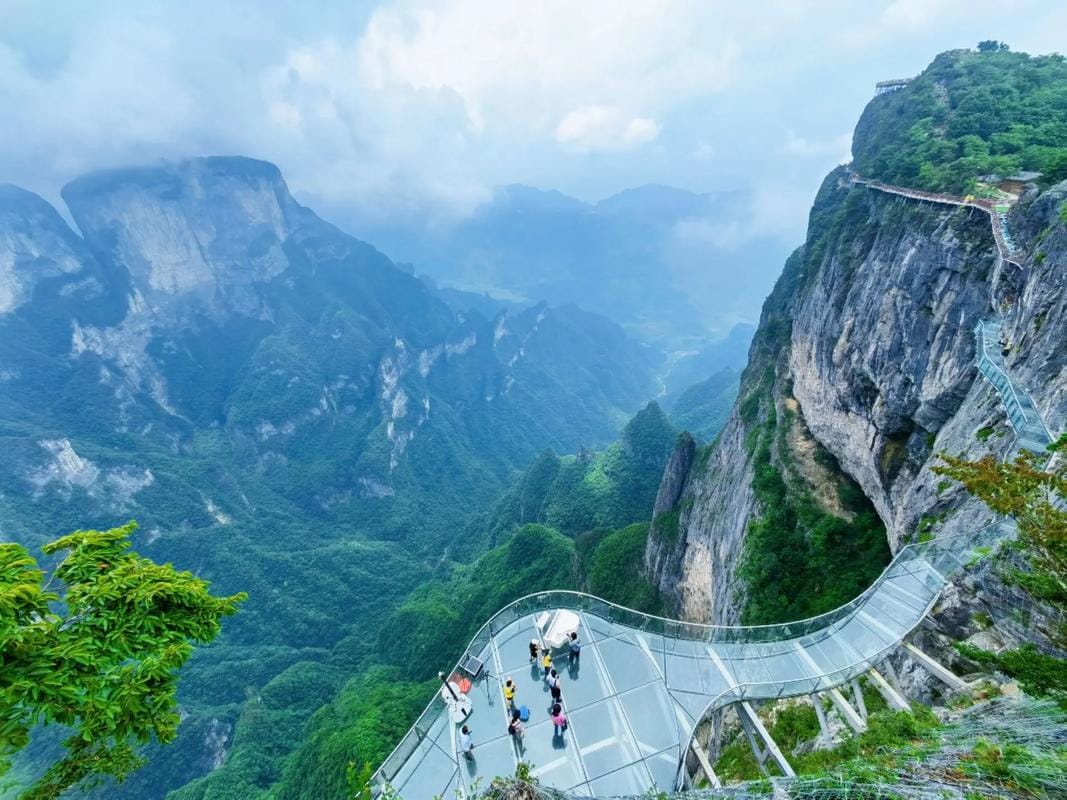
Most international visitors don’t know this exists. That’s partly because Seven Star Mountain (Qixing Mountain) is underrepresented in English content, and partly because its glass structures are newer and less famous than the Grand Canyon bridge.
Qixing Mountain sits about 13 km from Zhangjiajie city center. At 1,528.6 meters, it is actually 10 meters taller than Tianmen Mountain — the highest point in the entire city area. Its summit is a wide karst plateau with four sides dropping away in 500–700 meter cliffs.
The 1520 Sky Eye Glass Platform
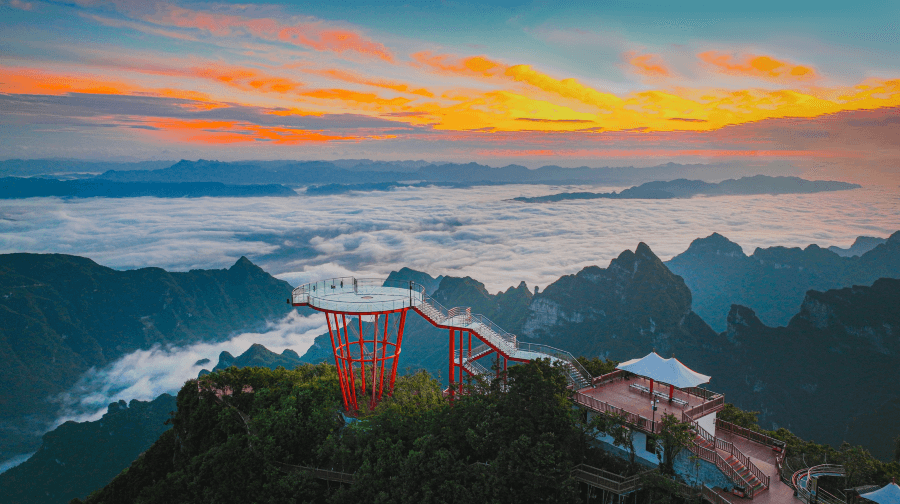
The signature glass structure here is the 1520 Sky Eye — a 360-degree glass-floored observation platform at 1,520 meters above sea level. On a clear day, you look directly across the gorge at Tianmen Mountain. Below you, the plateau cliffs drop hundreds of meters into forest. The platform is named Sky Eye because from above, its circular glass floor resembles an eye looking down into the valley.
The mountain also has a glass-floored sky bridge connecting sections of the summit circuit. The glass walkway costs ¥11 on-site. It’s not as exposed as the Grand Canyon bridge, but the altitude — 1,520 meters — is significantly higher, and on days when the valleys fill with cloud sea below you, the effect is unlike anything at the other glass structures.
Most people step onto the Sky Eye platform, look across at Tianmen Mountain, and go quiet before they say anything. The view across the gorge is unexpected — you’re looking at Tianmen from above its own elevation, which almost nobody has done before. One of our guides, Xiao Li, who has been taking groups up this mountain since it first opened, puts it this way: “In Wulingyuan you look across at the peaks. Here you look down at the world. They’re completely different feelings.”
Honest Assessment
For the glass experience specifically: it’s impressive, but the platform and bridge are not the primary reason most active travelers come here. The bigger draw is the Via Ferrata on the Big Rock Wall (大岩壁) — a genuinely serious climb with 168 meters of iron rungs at 1,480 meters and a 1,000-meter drop below. The glass structures are the sightseeing layer. The ferrata is the main event.
Weather matters more here than at the other glass attractions. When cloud covers the plateau, the glass platform looks into grey nothing. When it clears, the views across to Tianmen Mountain are exceptional. Check the forecast before making the trip.
Ticket: General scenic area + cable car is ¥186. The glass walkway is an additional ¥11 on-site.
Tickets and Prices
For full and current pricing across all Zhangjiajie attractions, see our Zhangjiajie Tickets Guide. Below is a focused breakdown for the glass structures.
Grand Canyon Glass Bridge
Ticket Option | Price |
|---|---|
Canyon only (A-line) | ¥60 |
Glass Bridge only (B-line) | ¥118 |
Canyon + Glass Bridge combined (B-line full) | ¥178 |
Children under 1.2 m | Free |
Students / seniors 60–69 | Half price |
Seniors 70+ | Free |
Buy the ¥178 combined ticket. The canyon-only A-line at ¥60 does not include bridge access — a point of confusion that sends people back to the ticket window mid-visit.
Tianmen Mountain
Ticket Option | Price |
|---|---|
Full ticket (cable car up + bus down) | ¥288 |
Full ticket (cable car up + cable car down) | ¥345 |
Children under 14 | Free |
Glass skywalks are included in the general admission. Shoe covers cost ¥5 on-site at the walkway entrance.
Qixing Mountain
Ticket Option | Price |
|---|---|
General scenic area + cable car | ¥199 |
Glass walkway (on-site add-on) | ¥11 |
Children under 1.2 m | Free |
What It Actually Feels Like: An Honest Account
We’ve brought thousands of international visitors to these attractions. Here’s what we consistently observe — not marketing copy, but patterns from hundreds of actual visits.
On the Grand Canyon Glass Bridge

Most people feel the strongest nerves in the first 30 meters. The moment you step from solid rock onto glass and see 300 meters of air beneath your feet, the brain reacts before reason does. Heart rate goes up. Some people slow down or grip the rail hard. This is normal and entirely universal — we’ve watched highly confident travelers do exactly the same.
By the midpoint, the majority have adjusted. The view takes over. People start taking photos. Some lean over the railing. Some sit on the glass. The return crossing is always calmer than the outbound one.
A small percentage don’t make it past the first 10 meters. They turn back, which is completely valid.
On the Tianmen Mountain Glass Skywalks

The sensation is more sustained. The Grand Canyon bridge is a crossing — five to ten minutes across and back. The Tianmen cliffside paths are longer, and the exposure is continuous on one side throughout. Mist often rolls in. When it does, you can’t see the valley below, and the experience becomes oddly peaceful — just a cliff walk in cloud. When the mist clears and the valley appears suddenly 1,400 meters below, the scale becomes very real very fast.
On the Qixing Mountain Glass Platform

Standing on a circular glass floor at 1,520 meters, on a plateau where cliffs drop away on all four sides, with Tianmen Mountain directly across the gorge — this is a different psychological experience from the other two. You’re not walking; you’re standing still. You’re not crossing a gap; you’re on top of the world. Some guests find this easier than the bridge precisely because there’s no movement involved. Others find the 360-degree exposure harder. The cloud sea effect, when the valleys fill with white mist while the plateau stays in sunlight, turns the platform into something else entirely.
Our honest take: The Grand Canyon Glass Bridge is the most famous and should be prioritised if you can only choose one. Tianmen Mountain is a more complete day-trip with more variety. Qixing Mountain offers the highest-elevation glass experience in Zhangjiajie and suits active travelers who want something fewer visitors have done. If your itinerary allows, treat each as a separate day.
If You’re Afraid of Heights
This section is for the person who typed “Zhangjiajie glass bridge afraid of heights” into Google at midnight. We see you.
First, practical honesty: acrophobia exists on a spectrum. Mild discomfort and clinical phobia are very different. Most people with mild to moderate height sensitivity successfully cross the Grand Canyon Glass Bridge. The railing is solid. The glass doesn’t move. The structure holds up to 800 people and has never had a structural safety incident.
What helps:
- Don’t look down for the first five steps. Look out at the canyon walls, not at the glass floor.
- Walk at your own pace. There’s no queue pressure or rushing on the bridge.
- Have a companion go first. Watching someone else cross normalises it faster than reasoning with yourself.
- Focus on the far cliff. Pick a point across the canyon and walk toward it.
What doesn’t help: watching YouTube videos of people screaming on the bridge the night before you visit.
The Tianmen Mountain Glass Skywalks can actually be easier for some acrophobics because the mountain is right beside you — not open-air in every direction.
If your fear is severe, none of these glass structures is likely to be enjoyable. And Zhangjiajie has extraordinary experiences that don’t require glass — the forest park pillars, Baofeng Lake, the Bailong Elevator (glass-fronted but enclosed), Yellow Dragon Cave. Don’t let one attraction define your trip.
Practical Tips From Experience
Book the Grand Canyon Glass Bridge ahead — this is the one non-negotiable. The daily visitor cap means weekend and public holiday tickets sell out, sometimes by mid-morning. Book via the Zhangjiajie Travel Assistant WeChat mini-program, or through Trip.com and Klook for international card payment. For Tianmen Mountain, the same mini-program works; morning cable car slots on weekends fill first.
Felt shoe covers are provided at the Grand Canyon bridge entrance and cost ¥5 on-site at Tianmen Mountain’s skywalks. You cannot step onto any glass surface without them — this is enforced, not optional. Wear shoes that covers slip over easily; very chunky soles make walking on glass awkward.
The canyon floor at the Grand Canyon runs noticeably cooler than the surrounding plateau, especially before 10 AM. We’ve watched July visitors in T-shirts arrive genuinely underprepared. Pack a light layer regardless of season.
For photography: midday sun on the Grand Canyon Glass Bridge creates glare that kills depth in photos. Early morning mist on the canyon walls, or late afternoon side light on the cliffs, is what you actually want. On Tianmen Mountain, the Coiling Dragon Cliff faces west — late afternoon is the right call. At Qixing Mountain, cloud sea shots only happen in the first hour after the cable car opens. After 10 AM the mist has usually burned off and the moment is gone.
Physical fitness is worth thinking about honestly before you go. The Grand Canyon trail is uneven but manageable for most people. Tianmen Mountain’s 999-step stairway to the cave is steep at altitude — it can be bypassed, but no version of Tianmen avoids sustained uphill walking. Qixing Mountain’s plateau circuit is relatively flat once the cable car deposits you at the top.
Tianmen Mountain has VIP fast-track options worth using in peak season — see our VIP Fast Track Guide for what’s actually included. The Grand Canyon entrance area has a few restaurants: functional, nothing more. Plan meals around the visit, not at it. Our What to Eat in Zhangjiajie guide covers where the food is actually worth your time.
FAQ
Is the Zhangjiajie Glass Bridge safe?
Yes. The bridge is triple-laminated tempered glass, 50mm thick, engineered to support far more weight than its daily visitor cap allows. There have been no structural safety incidents since the bridge opened in 2016. The 2016 closure was due to visitor overcrowding, not any engineering failure.
How long does the Glass Bridge visit take?
Allow 3 to 4 hours for the full Grand Canyon + Glass Bridge experience. The canyon trail takes 2 to 3 hours; the bridge crossing adds 15 to 30 minutes depending on how long you linger at the midpoint.
Can children visit the Glass Bridge?
Yes. Children under 1.2 m enter free. There are no age restrictions. We’ve taken families with young children across without issue — children tend to carry less accumulated fear of heights than adults and often cross more confidently.
Can I do the Glass Bridge and Tianmen Mountain in one day?
Technically possible but not enjoyable. They’re 60+ km apart, both require substantial time inside, and both deserve a proper visit rather than a rushed one. Dedicate a full day to each.
Are the Grand Canyon glass bridge and Tianmen glass skywalks the same thing?
No. Completely different structures in different locations on different tickets. The Grand Canyon Glass Bridge is a 430-meter suspension bridge over a valley. The Tianmen Mountain skywalks are cliffside walkways on a mountain face. The table at the top of this guide shows the full comparison.
What happens if it rains?
The Grand Canyon Glass Bridge stays open in light rain — felt shoe covers are always worn and the glass is treated. Heavy rain with lightning triggers a closure. Light rain in the canyon is actually atmospheric; the mist and wet green walls are more striking than clear blue-sky days.
Tianmen Mountain’s skywalks may close in strong wind or ice. Qixing Mountain’s cable car suspends in heavy fog or wind — check conditions on the morning of your visit.
Do I need a guide?
You don’t need a guide for any of these attractions — all are well-signposted. That said, if you’re combining multiple attractions and want to avoid the logistics problems we’ve described, a local guide manages transport, sequencing, and ticket booking so you don’t lose hours to the details.
When should I book tickets?
Grand Canyon Glass Bridge: 2 to 3 weeks ahead in July, August, and October Golden Week. One week ahead is usually sufficient for shoulder season weekdays. Tianmen Mountain: 3 to 5 days ahead for most periods; morning slots on weekends fill fastest. Qixing Mountain: Walk-up purchase with passport works on most days.
Can I bungee jump from the Grand Canyon Glass Bridge?
The bridge hosted a bungee jump experience in its early years and it became one of the most-viewed glass bridge videos online. It is not currently available to regular visitors — the bungee operation was suspended and has not been reinstated. If that changes, it will be announced through the official Zhangjiajie Grand Canyon channels. Don’t plan your trip around it.
Putting It Into Your Itinerary
If you’re structuring your Zhangjiajie days, our Zhangjiajie Itinerary Guide covers one to seven days in detail. For when to go, see our best time to visit Zhangjiajie guide. For getting between these attractions — the Grand Canyon is 60 km from Tianmen Mountain and there’s no public transport linking them — see our Zhangjiajie transportation guide before you finalise your dates.
A five-day visit might run: Day 1 at the National Forest Park (Wulingyuan); Day 2 at Baofeng Lake and Yellow Dragon Cave; Day 3 at the Grand Canyon and Glass Bridge; Day 4 at Tianmen Mountain; Day 5 at Qixing Mountain. That spacing lets each experience land properly rather than bleeding into the next.
For transport logistics, our Zhangjiajie Transportation Guide covers getting to Zhangjiajie from major Chinese cities and moving between attractions once you’re there.
If you’d prefer someone to handle the logistics — transport, tickets, sequencing, a local guide who knows all three glass structures firsthand — we offer customized Zhangjiajie tours built around your schedule and group size. Get in touch and we’ll put something together.
Travel China With Me has been operating inbound China tours for over 20 years, serving tens of thousands of international visitors. Our Zhangjiajie guides are written from direct field experience, not secondary research.