Zhangjiajie Grand Canyon & Glass Bridge: The Complete Visitor Guide
This is the most complete English-language guide to Zhangjiajie Grand Canyon and Glass Bridge you’ll find — verified ticket prices, both route options broken down step by step, honest advice on every activity, and what to expect on the bridge itself. We’ve been bringing international visitors to Zhangjiajie for over 20 years and have walked this canyon more times than we can count.
One thing most articles get wrong: the Grand Canyon is a completely separate scenic area from Zhangjiajie National Forest Park. It needs its own half-day. If you’re only planning to see the Forest Park, you’ll miss one of the best experiences in Hunan Province.
Table of Contents
1. Quick Facts
Detail | Info |
|---|---|
Chinese name | 张家界大峡谷 / 玻璃桥(云天渡) |
Location | |
Distance from Wulingyuan (Forest Park area) | ~30 km, 40-min drive |
Glass Bridge length | 430 m (some sources cite 536 m including approach walkways) |
Glass Bridge height above valley floor | ~300 m |
Opening hours | 07:30–17:30 (scenic area); B-line (Glass Bridge) 08:00–16:00 |
Recommended time on-site | 3–4 hours |
Best months | April–June, September–October |
Rating | National AAAA Tourist Attraction |
2. About Zhangjiajie Grand Canyon

Zhangjiajie Grand Canyon is a karst gorge in Cili County, carved over millions of years by the Suoxi River cutting through limestone. The canyon runs roughly 3 kilometres from end to end, with walls rising 100–300 metres on either side. At the bottom, a clear stream threads past waterfalls, caves, and subtropical forest so dense it blocks the sky.
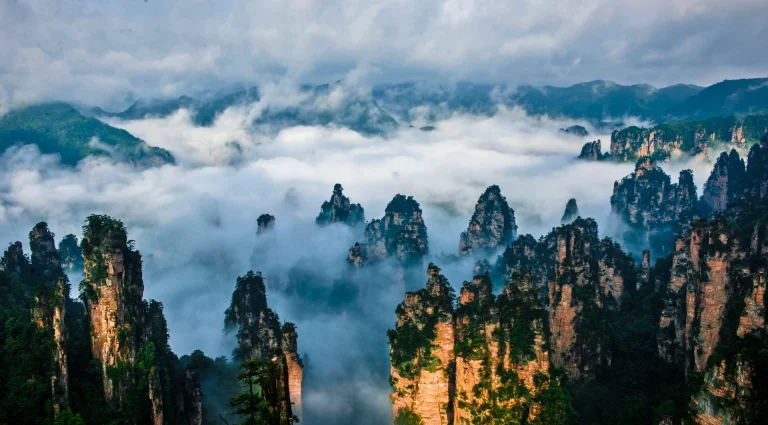
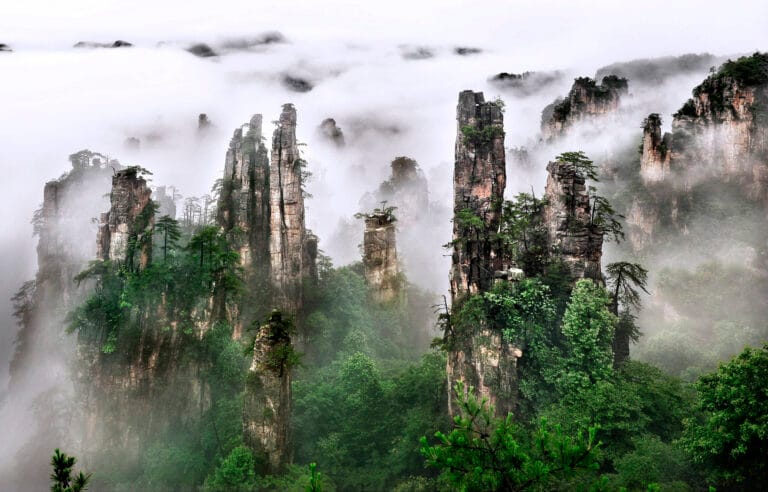
This is a different landscape from the sandstone pillar formations that made Zhangjiajie famous. The National Forest Park gives you vertical drama — pillars rising from a sea of green, the scenery that inspired Avatar. The Grand Canyon gives you something enclosed and intimate: walking along the canyon floor, the walls pressing in, waterfalls dropping into pools beside the path, egrets standing in the shallows. Guests who’ve spent two days looking up at the Forest Park often say the canyon feels like the exhale.
The Glass Bridge — which opened in 2016 and immediately became one of the most visited attractions in China — sits 300 metres above all of this. It’s the headline, and it deserves the attention. But the canyon beneath it is the reason the experience holds up over a full half-day.
3. About the Glass Bridge
The Engineering
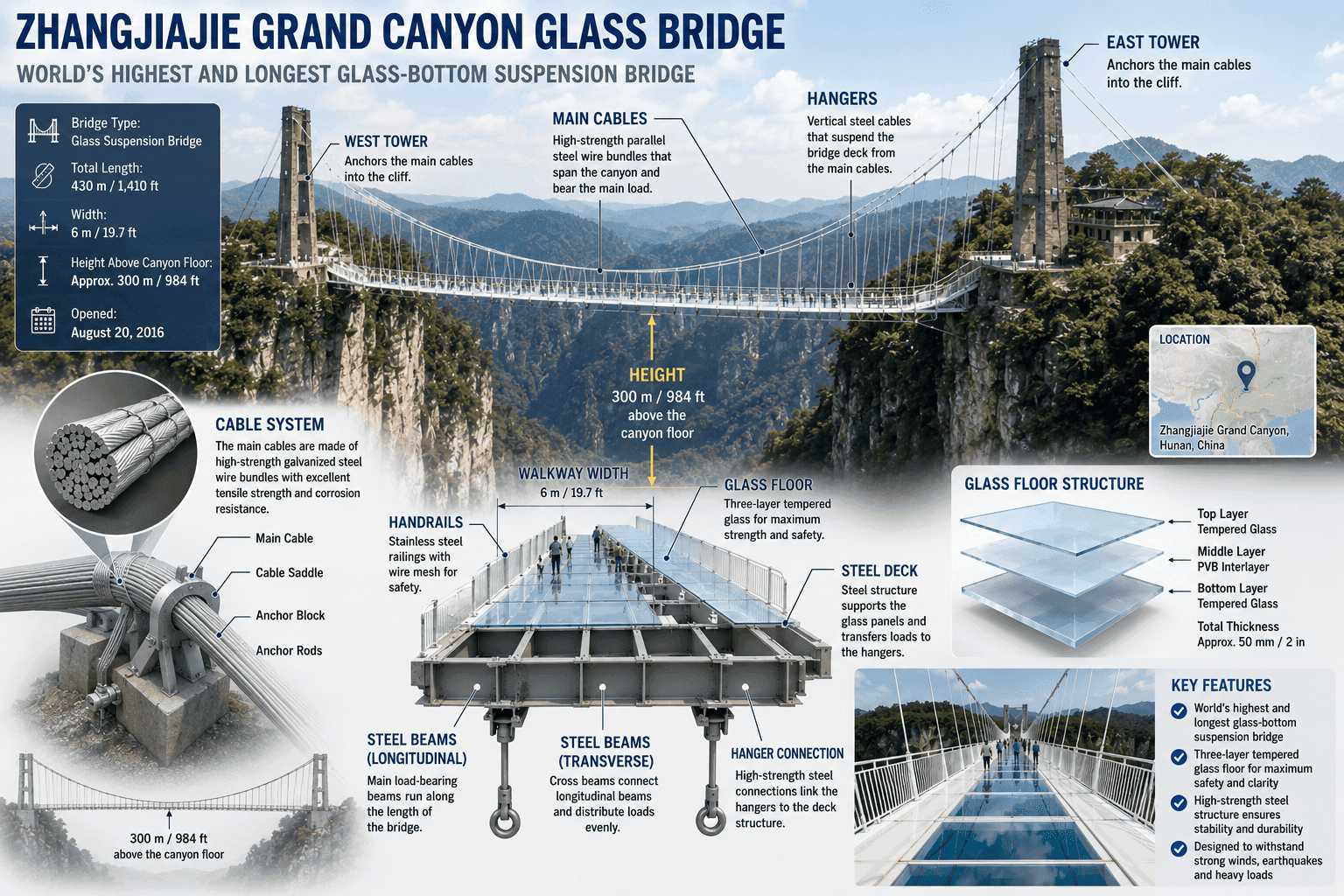
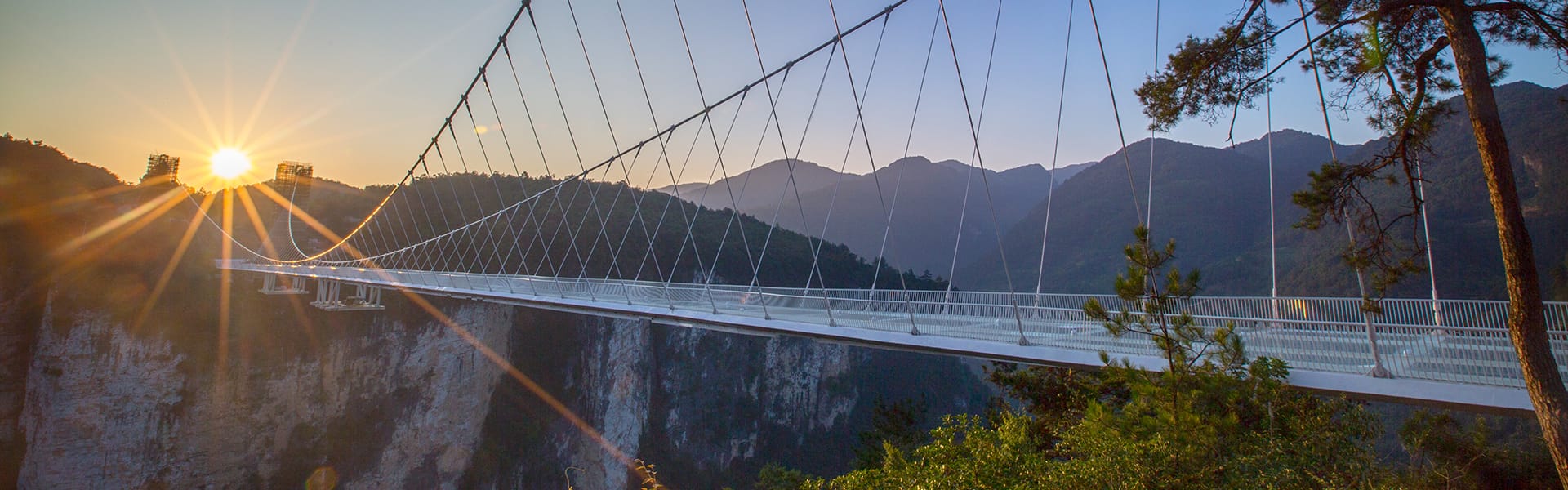
The bridge opened on 20 August 2016. It was designed by Israeli architect Haim Dotan, who described the intention as making the bridge “as invisible as possible — disappearing into the clouds.” The structure spans 430 metres, sits roughly 300 metres above the valley floor, and is 6 metres wide.
Before opening, engineers drove a 40-tonne truck across the bridge to demonstrate its load tolerance. The recorded deflection was 2.16 centimetres. The deck panels are triple-layer tempered glass, each roughly 305 cm × 442 cm and nearly 5 cm thick. The bridge is rated for 800 visitors simultaneously and engineered to withstand winds exceeding 50 m/s and an earthquake of magnitude 8.
When it opened, it set ten world records — including the longest and highest glass-bottomed pedestrian bridge at the time. Within three years, over 100 similar glass bridges had opened across China. This was the first.
The First 13 Days
Here is something worth knowing before you visit. The bridge opened on 20 August 2016 and was shut down on 2 September — thirteen days later. The management had anticipated roughly 8,000 daily visitors. Actual daily numbers reportedly exceeded 80,000. The site was closed to overhaul car parks, ticketing infrastructure, and visitor flow management. It reopened on 30 September 2016.
That context explains why the booking system today is strict, the daily quota is enforced, and the entry process involves real-name registration and time slots. It also tells you something about what the bridge became, almost immediately.
What the Name Means
The bridge’s official name is 云天渡 (Yúntiān Dù) — “crossing to where clouds meet sky.” On clear days, you see the full canyon below through the glass. On misty mornings — which are common in Zhangjiajie year-round — the far end of the bridge disappears into cloud. We’ve brought groups here on sunny days and foggy ones. The fog version is the one guests remember.
Is the Glass Bridge Safe?
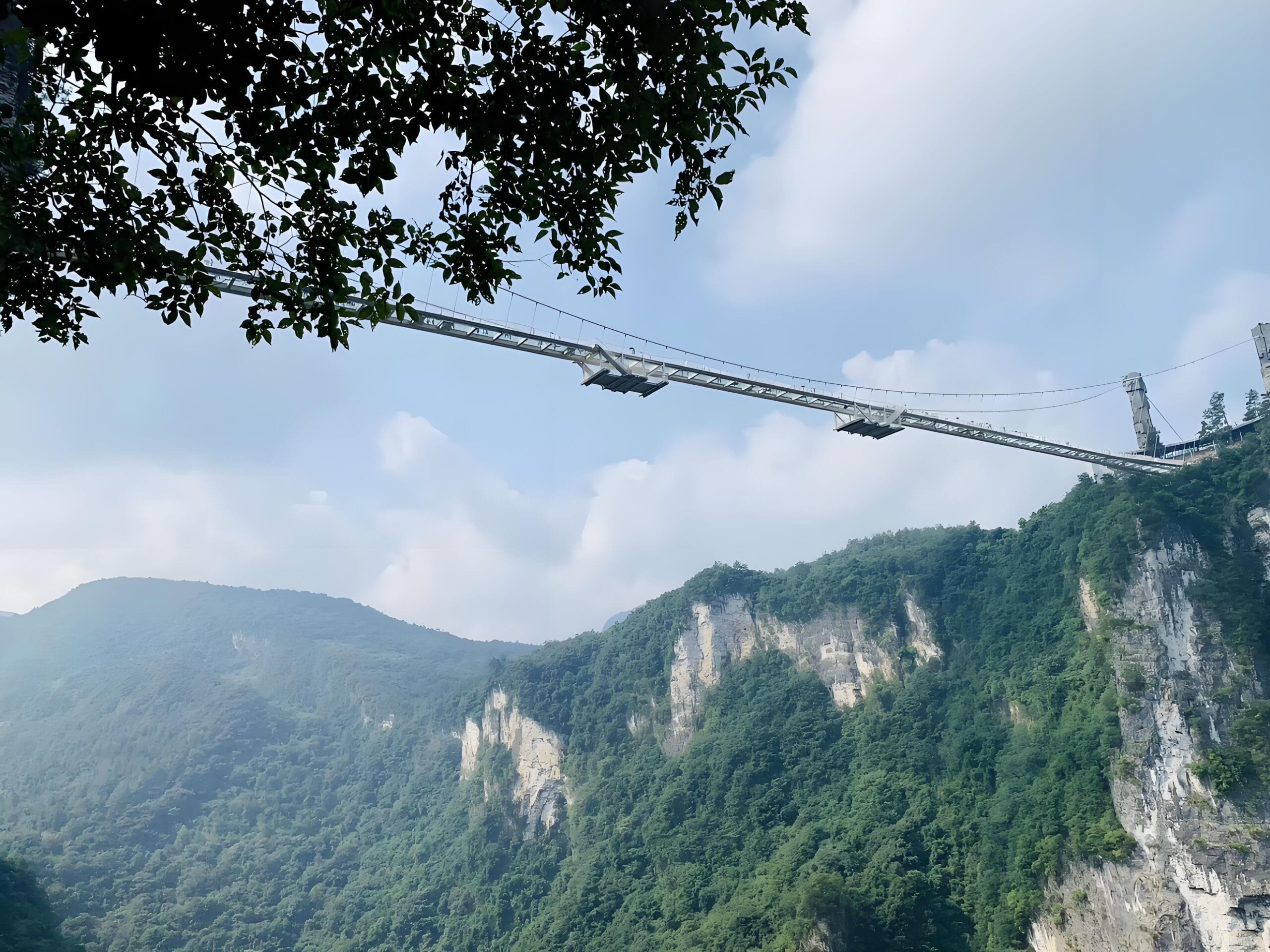
The short answer is yes — engineered to a standard that goes well beyond what the visitor experience implies.
The glass panels are triple-layer tempered composites. The structure is designed for a 50-year service life. Before opening in 2016, the operator ran a public demonstration in which a truck was driven across the bridge and workers struck the glass panels with sledgehammers. There have been no structural incidents since opening.
The bridge may close during heavy rain, strong wind, or ice. When it closes, that is a weather management decision — not a structural concern. Check the scenic area’s official WeChat account on the morning of your visit if the forecast looks uncertain.
One practical note: a small number of visitors are turned back at the bridge entrance each year because they cannot bring themselves to step onto the glass. There is no shame in this — the visual of 300 metres of open canyon directly beneath your feet is not something you can fully prepare for intellectually. If you have serious vertigo or a strong fear of heights, Route A is a complete and worthwhile alternative.
On the Bridge Itself

Visitors must wear the provided shoe covers before stepping onto the glass. This is non-negotiable. A pair of covers is supplied at the entry point — budget a few minutes for the queue. High heels and sharp-edged footwear are not permitted. The guards check.
Photography on the bridge: standing shots and downward shots work well from anywhere on the deck. For the flat-on-glass shot looking straight down, the midpoint gives you the cleanest view. For exterior shots of the full bridge span, wait until you reach the Glass Plank Road on the eastern side after crossing — the perspective from there shows the entire structure against the canyon.
4. Ticket Prices (2026)
International visitors almost always book through Trip.com, Klook, or a tour operator — and platform prices are lower than the official gate prices posted at the entrance. The table below shows platform prices first, with the official gate price in brackets. What you see on booking platforms is what you’ll actually pay.
Individual Ticket Prices
Item | Platform Price | (Gate Price) | Concession |
|---|---|---|---|
Grand Canyon only (Route A) | ¥60 | (¥91) | ¥46 |
Glass Sky Walk (Bridge only) | ¥125 | (¥125) | ¥63 |
Grand Canyon + Glass Bridge (Route B) | ¥178 | (¥216) | ¥108 |
Sightseeing Elevator (one way) | ¥30 | (¥30) | ¥15 (free in package) |
Treasure Hunt Elevator (one way) | ¥30 | (¥30) | ¥15 (free in package) |
Sculpture Elevator (one way) | ¥20 | (¥20) | ¥10 (free in package) |
VR Flying over Grand Canyon | ¥30 | (¥30) | — |
Zip Line | ¥50 | (¥50) | — |
King Wu Hillside Slide Way | ¥30 | (¥30) | — |
Sky Strip Slide (One-Line Sky) | ¥50 | (¥50) | — |
Rainbow Lake Cruise (round trip) | ¥20 | (¥20) | — |
Rock Climbing (manual guide) | ¥48 | (¥48) | — |
Rock Climbing (auto protection) | ¥38 | (¥38) | — |
Via Ferrata — Up path | ¥138 | (¥138) | — |
Via Ferrata — Down path | ¥138 | (¥138) | — |
Bungee Jump 260 m | ¥1,998 | (¥2,998) | — |
Package Options
Package | Platform Price | (Gate Price) | What’s Included |
|---|---|---|---|
Route B Standard | ¥178 | (¥216) | Grand Canyon + Glass Bridge + Sightseeing Elevator + Shenquan Lake boat |
Route B + 5 of 7 activities | ¥288 | (¥336) | Route B base + choose any 5 from the 7 activity items below |
The 7 activities eligible for the ¥120 add-on (choose 5): VR Flying (¥30), Zip Line (¥50), Sky Strip Slide (¥50), Sightseeing Elevator (¥30), Treasure Hunt Elevator (¥30), Sculpture Elevator (¥20), King Wu Hillside Slide Way (¥30).
Note: The 7 items split into two natural groupings. Adventure set: VR + Zip Line + Sky Strip Slide. Elevator set: VR + three elevators + one slide. Most of our younger guests go for the adventure set. Families and guests who want to save their knees tend to prefer the elevator set.
Discounts and Free Entry
Grand Canyon (Route A ticket)
Free entry:
- Children under 14 (not including age 14)
- Seniors 65 and above
- People with disabilities
- Firefighters, active military personnel, retired military officers
- All with valid ID; international visitors bring passport
Half-price:
- Ages 14–18 (not including 18)
- Seniors 60–65 (not including 65)
- Full-time undergraduate students and below
- All with valid ID
Glass Bridge, Sightseeing Elevator, Treasure Hunt Elevator, Sculpture Elevator
Free entry:
- Children under 1.2 m in height
Half-price:
- Ages 14–18 (not including 18)
- Seniors 60 and above (including age 60)
- People with disabilities
- Firefighters, active military personnel, retired military officers
- Full-time undergraduate students and below
- All with valid ID
Note for international visitors: bring your passport for all concession claims. The age thresholds above follow Chinese regulations and apply regardless of nationality.
Booking: Chinese nationals book via WeChat mini-program or official site with ID. International visitors should book through Trip.com, Klook, or a licensed China inbound tour operator. The system is fully real-name registered — tickets are tied to your passport number. Book 1–2 days ahead in regular season, 3–5 days ahead during July–August and national holidays. For a full breakdown of every Zhangjiajie attraction ticket in one place, see our Zhangjiajie tickets guide.
5. Routes: Which One Is Right for You
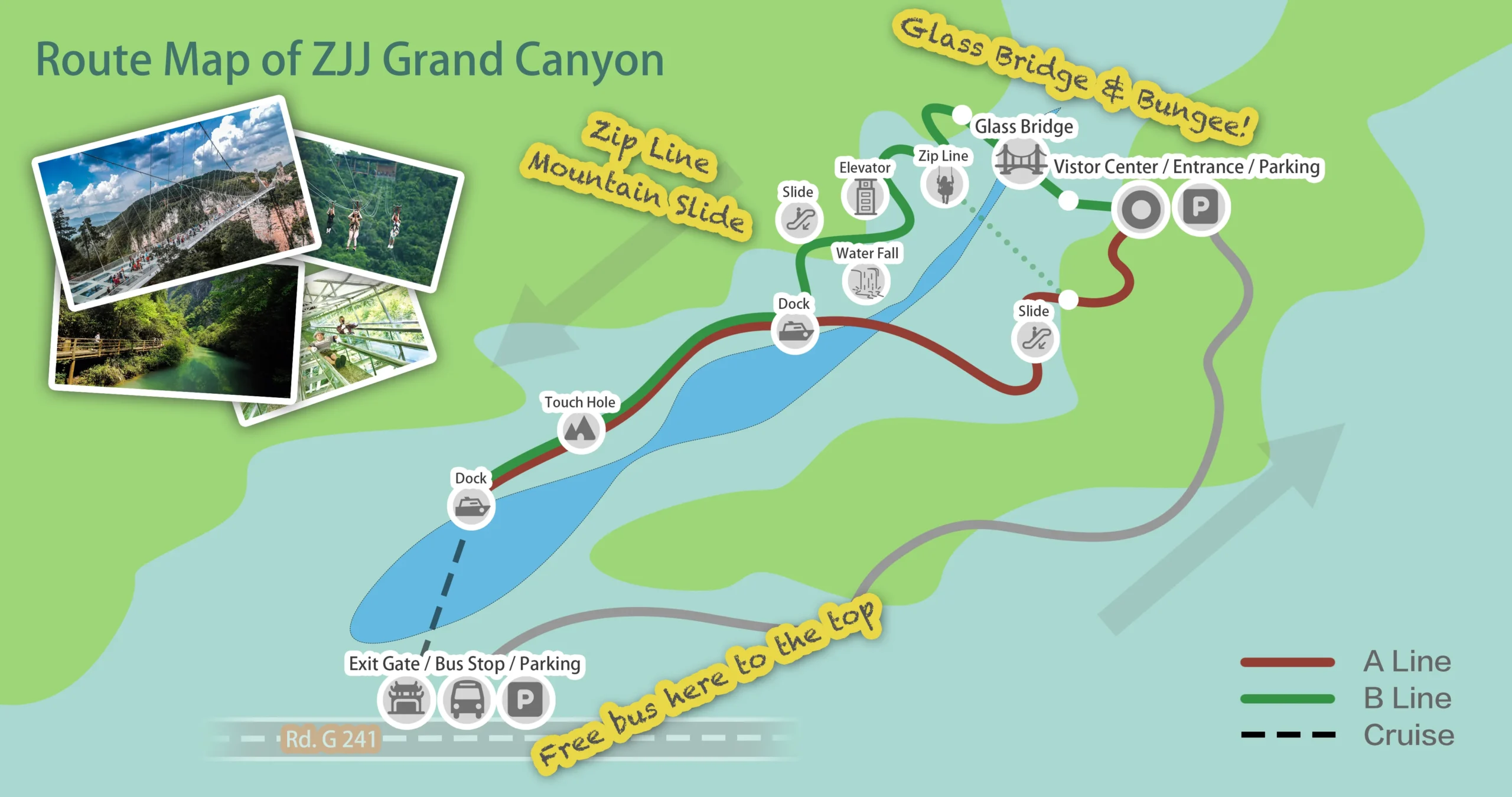
There are three official route options at Zhangjiajie Grand Canyon. Most international visitors choose Route B. Here’s how each one works and who it suits.
Our honest take: the Glass Bridge is the reason most people come, but the canyon trail is what they talk about afterward. Do Route B if you can. Route A is the right call for guests who’ve already done the bridge on a previous visit, anyone with knee or mobility concerns, and those who want a slower, quieter morning.
Route A: The Canyon on Foot
Visitor Center → One-Line Sky → Rainbow Plaza → Canyon trail → Touching Cave → Shenquan Lake boat → Exit
No Glass Bridge, no shuttle bus, no queue for shoe covers. At ¥60 on major booking platforms, Route A covers the full canyon floor experience — the trail, the waterfalls, the caves, and the boat exit across Shenquan Lake. It’s the quietest and most unhurried way to see the Grand Canyon.
Route B1: Bottom Up to the Bridge
Visitor Center → Sky Strip Slide → Rainbow Lake boat → Rainbow Plaza → Touching Cave → Sculpture Elevator → Treasure Hunt Elevator → (Sightseeing Elevator, VR Flying, Glass Walkway) → Bridge East Experience Center → Glass Bridge → Scenic Area Exit
Route B1 is the reverse of Route B — you start at the canyon floor and finish at the bridge. It’s less common and we don’t typically recommend it for most visitors, since the ascent is harder work and you end the day on the bridge rather than the relaxing boat exit. That said, it suits guests who want to build toward the bridge as a climax rather than start with it.
Route B: The Full Experience (The One We Recommend)
Visitor Center → Shuttle bus → Glass Bridge → Bridge East Experience Center → Glass Walkway → (VR Flying, Zip Line, Sky Strip Slide) or (VR Flying, Sightseeing Elevator, Treasure Hunt Elevator, Sculpture Elevator or King Wu Slide) → Rainbow Plaza → Touching Cave → Shenquan Lake boat → Scenic Area Exit
This is the route we recommend for almost every international visitor. It runs top to bottom — start at the bridge, descend through the canyon, exit by boat. At ¥178 on major booking platforms, it includes the bridge, sightseeing elevator, and the boat exit. The ¥288 package adds your choice of 5 activities from the list above.
1. Shuttle Bus to the Bridge
From the visitor center, a shuttle bus takes you up to the Glass Bridge entrance. Ride time is about 15 minutes. You present your ID at the bridge entry — the system is real-name registered, so your passport needs to match your ticket.
2. The Glass Bridge
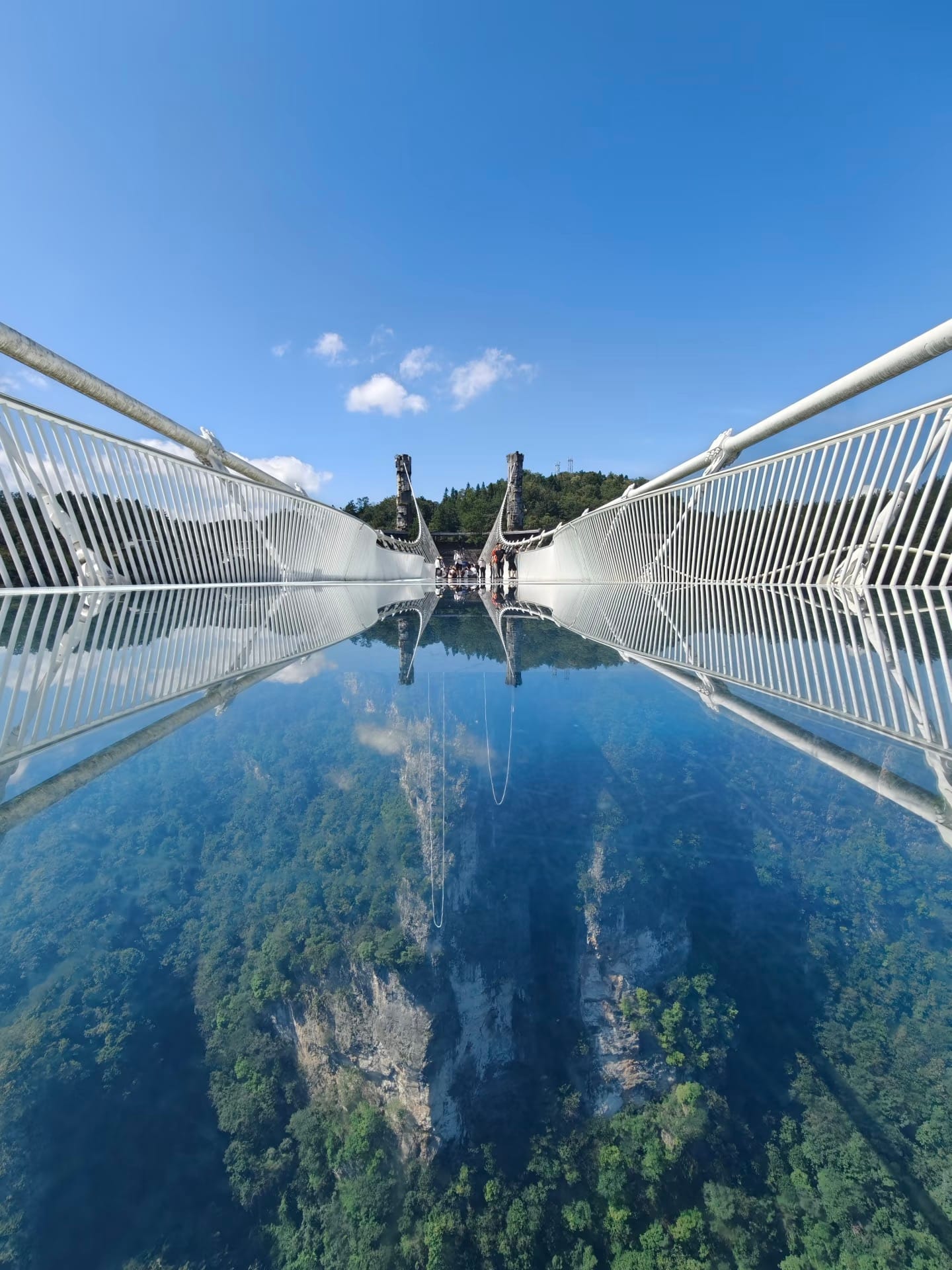
Cross the 430-metre bridge. On a clear day, the canyon floor is visible through the glass the entire way. Most guests take 20–40 minutes here, including photography. If you want the bridge to yourself, arrive at 08:00 opening. By 10:00 AM, tour groups from Zhangjiajie city start arriving.
3. Glass Plank Road and Bridge East Area
After crossing the bridge, you enter the eastern experience area. This is where you choose your descent into the canyon. Options:
- Sightseeing Elevator — included in Route B ticket. Fastest descent, glass-fronted, good views.
- Treasure Hunt Elevator — ¥30 separate or included in the ¥298 package.
- Sculpture Elevator — ¥20 separate or in package.
- King Wu Hillside Slide Way — ¥30. A marble slide that drops you down the hillside. Faster than it looks, fun, and easy on your knees.
- Sky Strip Slide — ¥50. A 200-metre glass slide. Bring a waterproof case for your phone and wear long trousers — the slide surface is abrasive on bare skin.
- Zip Line — ¥50. A 358-metre traverse across the canyon. Weight limit 35–95 kg. Takes under a minute and covers a lot of canyon in that time.
The VR Flying experience (爱享飞VR, ¥30) is the gentlest option in the package — a simulated canyon flight, suitable for guests who are elderly, have children, or are uncomfortable with heights but still want something memorable.
4. Rainbow Plaza
A flat rest area at the base of the descent, with a small food stall. If you brought snacks, this is a good place to eat them. The food stall is expensive and limited. We always tell guests to bring water and something to eat before entering the canyon.
5. The Canyon Trail (3 km)
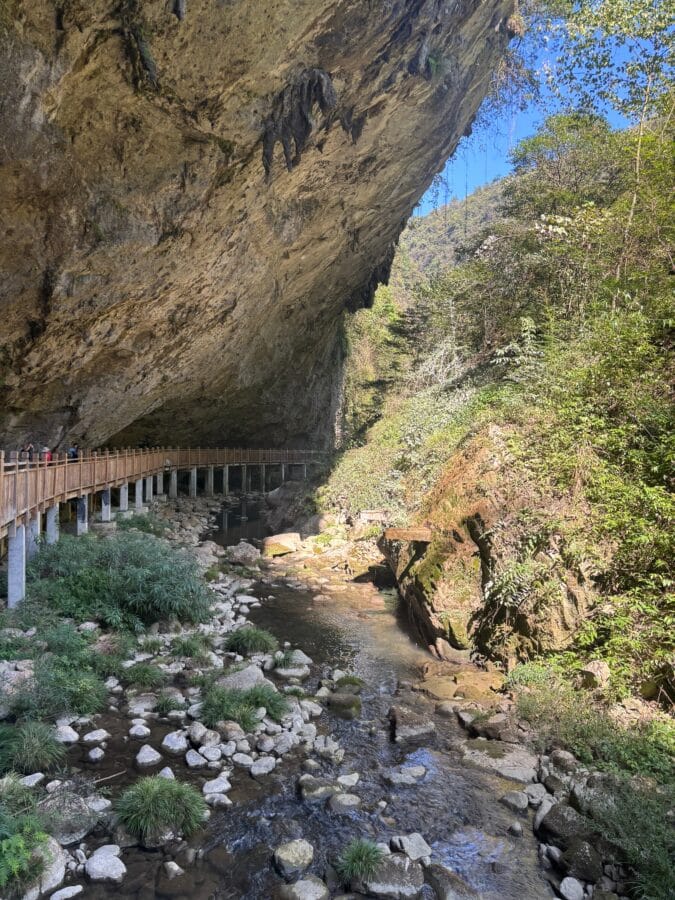
This is the section that surprises people most. Three kilometres along the canyon floor, following a clear stream, past waterfalls and into a couple of caves. Key stops:
- One-Line Sky — A narrow crack between two cliff faces. Standing inside it, you look up and see a thin sliver of sky between vertical walls of rock. The photo doesn’t convey the scale — you need to stand there.
- Touching Cave — A natural karst tunnel through the cliff. Cool and dark inside, with natural formations. Takes about 5 minutes to pass through.
- One Curtain of Dream Waterfall — A multi-tiered waterfall that drops into a pool beside the trail. In spring after rain, it runs strongly. In October, it’s lighter but the canyon colours around it are better.
- South Red Flag Canal — A section of water channel cut into the cliff face, which diverts stream water along the canyon wall. The engineering is surprisingly impressive for its era.
The trail is mostly flat with some uneven stone surfaces. Allow 1–1.5 hours at a comfortable pace.
6. Shenquan Lake and the Boat Out
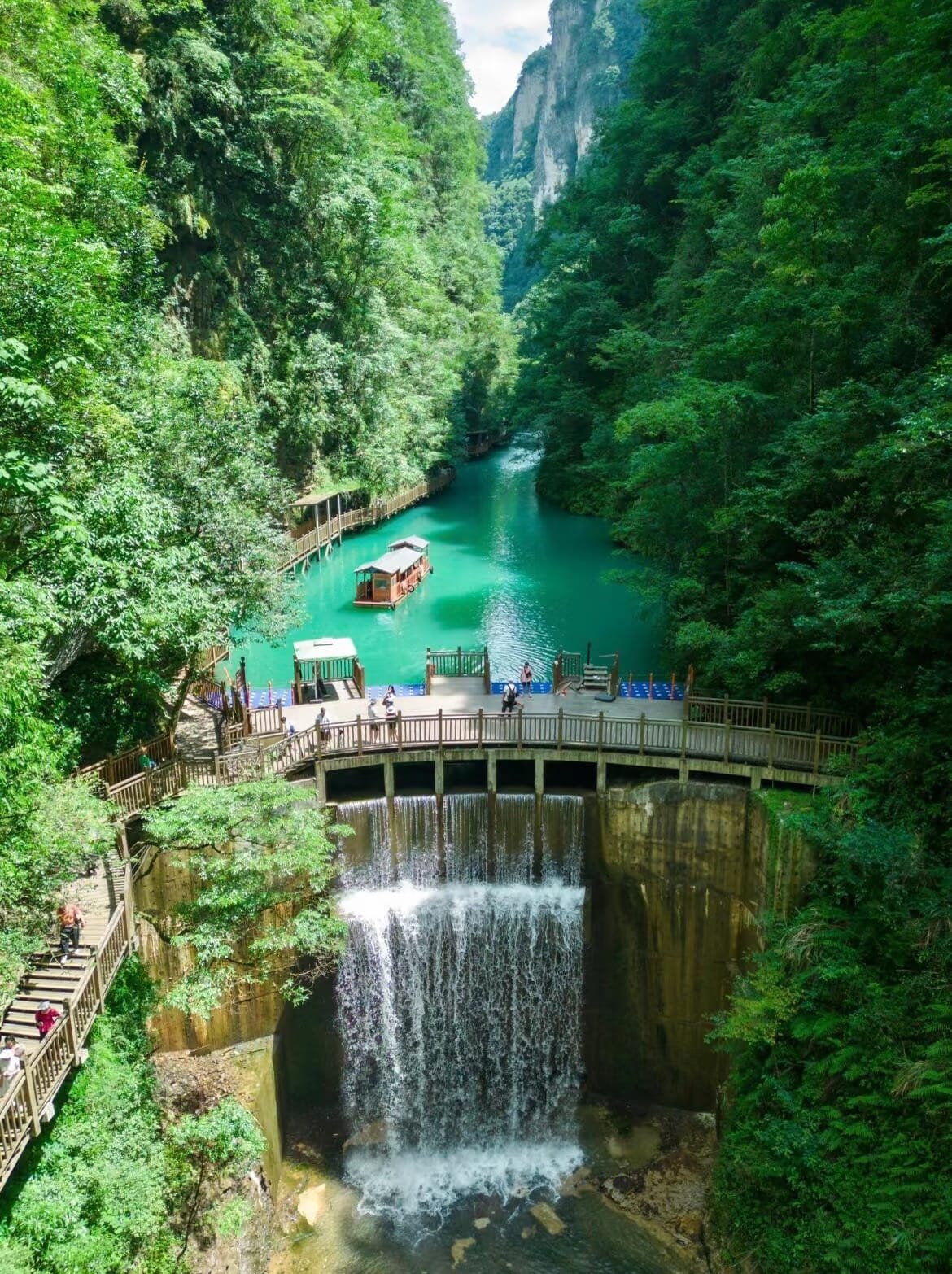
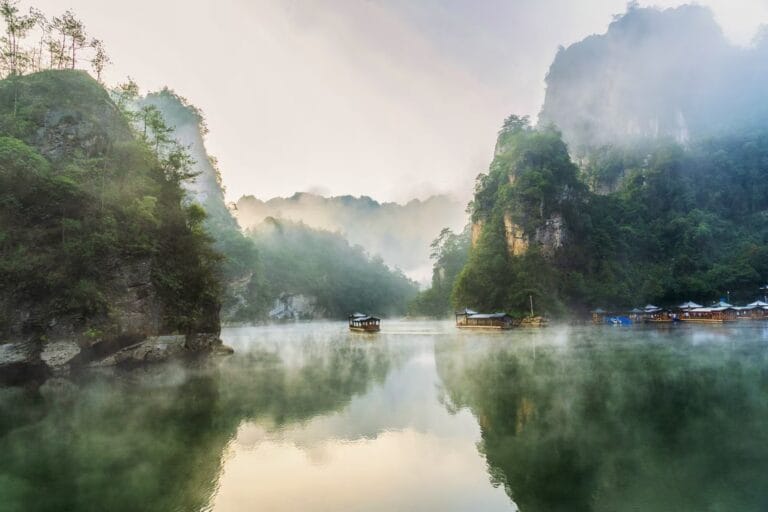
The trail ends at Shenquan Lake dock. A boat takes you across the reservoir in about 15 minutes, and from the far dock it’s a short walk back to the visitor center. The boat ride is included in the Route B ticket. This is where guests tend to exhale — the canyon is behind you, the lake is wide and calm, and the egrets are usually standing on the rocks near the shore.
6. Special Experiences
Beyond the two main routes, the Grand Canyon offers a serious menu of paid activities. Most are self-contained — you can add them on the day if slots are available, or book in advance through the ¥298 package.
Bungee Jump

Photo by Yan Yuan, Xinhua News Agency.
The platform sits at the midpoint of the Glass Bridge, 260 metres above the canyon floor. This is one of the highest commercial bungee operations in the world. The price on major booking platforms is ¥1,998 (official gate price ¥2,998).
The operator has strict eligibility rules. Cardiac conditions, pregnancy, hypertension, and certain spinal conditions are all exclusion criteria. Age minimum is 16. If you’re considering it, confirm your eligibility in advance and don’t assume on-site staff will catch every contraindication.
For guests who want height and adrenaline at a more approachable price point, the zip line (¥50) covers a lot of the same visual experience with far less commitment.
Via Ferrata

The Grand Canyon offers two sections of via ferrata — iron-rung cliff traverses bolted into the canyon walls, with a safety harness clipped to a fixed cable the entire time. No prior climbing experience is required. The lower section costs ¥138; the upper section is also ¥138. Both are self-paced and guided.
If the via ferrata at the Grand Canyon leaves you wanting more, Qixing Mountain is the place to go next. Located about 63 km from the Grand Canyon, Qixing Mountain has become one of the best-known via ferrata destinations in the Zhangjiajie area — the routes there are longer, more varied, and set against a very different karst landscape. We bring guests there regularly and consider it one of the most underrated half-days in Hunan Province.
READ ALSO: Zhangjiajie Outdoor Activity Guide: Via Ferrata, Bungee, Zip Line & More
Other Activities at a Glance
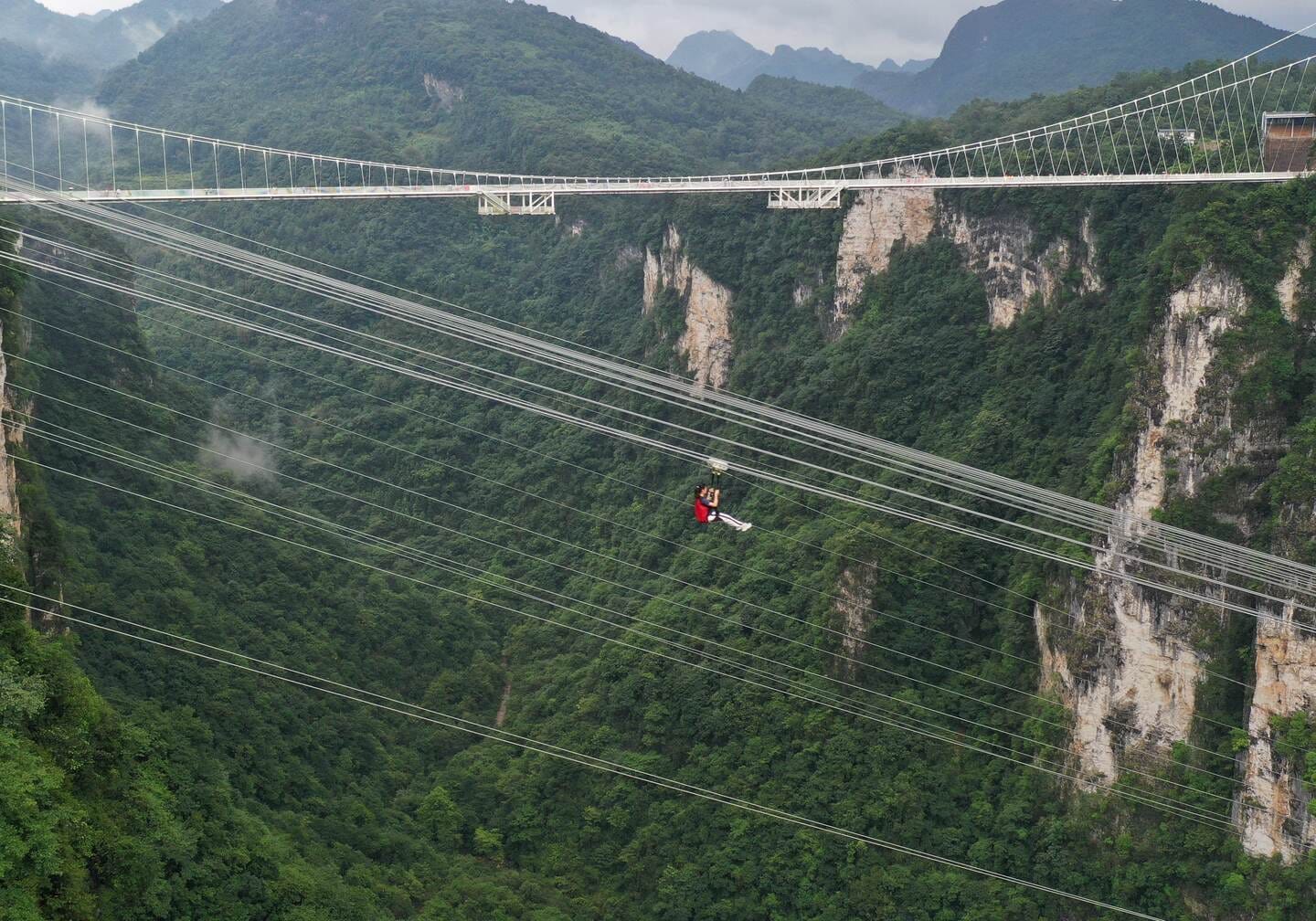
Activity | Price | Who It’s For |
|---|---|---|
Zip Line (高空滑索, 358 m) | ¥50 | Anyone wanting a quick adrenaline hit; weight 35–95 kg |
Sky Strip Slide (一线天滑道, 200 m glass slide) | ¥50 | Fun descent option; wear long trousers |
King Wu Hillside Slide Way | ¥30 | Easier descent, good for families |
VR Flying over Grand Canyon | ¥30 | Gentle; suitable for elderly, children, those with vertigo |
Rock Climbing (guided) | ¥48 | Beginners welcome |
Rainbow Lake Cruise | ¥20 | Relaxing; included in Route B boat exit |
7. Planning Your Visit
Best Time to Visit
Spring (April–June): The canyon vegetation peaks, waterfalls run strongly from winter rain, and temperatures sit between 15–25°C. This is when we bring most of our international groups.
Autumn (September–October): Clearer skies than spring, less rainfall, and canyon colours shifting toward amber by late October. Our second preference.
Summer (July–August): Hot and humid, with afternoon rainstorms possible. The canyon is noticeably cooler than the city. Domestic visitor numbers are highest — the bridge can reach its daily capacity before noon. If you visit in summer, arrive at the 08:00 opening.
Winter (November–March): Quiet. Snow on the canyon rim is striking. But some activities close due to ice, days are short, and the bridge closes in bad weather. For guests who want the canyon without the crowds and don’t mind the cold, winter is underrated.
Come in the morning. First entry at 08:00 gives you the bridge before the tour groups arrive. By 10:00–11:00 AM, the shuttle queues are longer and the bridge is fuller.
Avoid Golden Week (October 1–7) and Chinese New Year. These are the two periods when visitor numbers can overwhelm the site despite the quota system.
If you have an afternoon free after the Grand Canyon, Baofeng Lake is 30 km back toward Wulingyuan and makes a natural pairing — a quiet emerald lake with Tujia folk music performed on the water, a completely different mood from the canyon.
Getting There
The Grand Canyon is in Cili County, roughly 55 km from Zhangjiajie city center and 30 km from Wulingyuan Town.
From Wulingyuan (staying near National Forest Park)
By bus: Coaches depart from Wulingyuan Bus Station (武陵源汽车站) directly to the Grand Canyon Visitor Center. Journey time 40–50 minutes, fare ¥12 per person.
By taxi: ¥55–70, about 35–45 minutes. For a group of four, the per-person cost is comparable to the bus and considerably more convenient.
From Zhangjiajie City Center
By bus: Direct coaches from Zhangjiajie Central Bus Station (张家界中心汽车站). First departure 06:30, runs throughout the day as a flow service (leaves when full). Journey time approximately 1.5 hours, fare ¥22. The last departure back is around 17:30.
By taxi: ¥150–170, about 1 hour.
By private transfer: For groups, or anyone who values a fixed departure time, a private vehicle is the most practical option. It eliminates the uncertainty of finding the correct bus stop and allows flexible timing if you want to linger in the canyon.
Official route: Zhangjiajie Central Bus Station / Wulingyuan Bus Station → Grand Canyon Visitor Center → Shuttle bus (15 min) → Scenic area.
If you’re still deciding where to base yourself, our Zhangjiajie accommodation guide covers the tradeoffs between staying in Wulingyuan versus the city center — which matters a lot when the Grand Canyon is on your itinerary.
Practical Tips
Footwear matters more here than most places. The canyon walkways and stone steps are consistently wet from spray and seepage. Trail runners or hiking shoes with grip work well. Sandals are a poor choice. High heels are not allowed on the bridge deck.
Bring your own water and food. There is a small stall at Rainbow Plaza, but it’s limited and expensive. The canyon is a 3-kilometre walk and the full Route B takes 3–4 hours. You will want water.
Wear long trousers if you plan to use the slide. The Sky Strip Slide surface will graze bare skin.
Waterproof your phone before the canyon section. The trail passes close to several waterfalls and the spray reaches the path. It is not dramatic — nobody is getting soaked — but a phone in a pocket without a case takes a risk.
Allow buffer time for the shuttle. The shuttle bus from the visitor center to the bridge runs every 15 minutes. If you arrive late for a time slot, you may need to wait for the next departure. Build 20 extra minutes into your schedule.
The scenic area is entirely smoke-free except at designated points. This is enforced.
The whole route is essentially one-way on Route B. Once you descend into the canyon, you exit by boat. There is no convenient way to go back up if you’ve forgotten something at the bridge. Take everything you need into the canyon before you descend.
8. Frequently Asked Questions
Do I need to book in advance?
Yes. The bridge operates under a daily visitor quota with real-name time slots. On-the-day availability is not guaranteed, particularly in peak season. For weekdays outside of holidays, booking 1–2 days ahead is usually fine. In July, August, and during national holidays, book 3–5 days ahead.
Can I visit if I’m afraid of heights?
That depends on your fear. The bridge is 6 metres wide and has solid railings — it doesn’t feel like a plank. But you can see through the floor, and the canyon below is 300 metres down. Some guests walk across without a second thought. Some edge along the sides gripping the rail. A small number turn back at the entrance. Route A covers the canyon beautifully without any elevation. If you’re on the fence about it, don’t let the bridge be the reason you skip the whole area.
DIG DEEPER: Fear of Heights in Zhangjiajie: An Honest Guide for Nervous Visitors
Is the canyon trail physically demanding?
Route B involves a meaningful descent from the bridge level down to the canyon floor. The descent options (elevators, slides, zip line) handle most of the altitude change. The canyon trail itself is mostly flat. Route A is similar but without the elevation component. Neither route is suitable for guests with serious knee problems or limited mobility — there are stairs throughout, and the terrain is uneven.
Is this the same as Zhangjiajie National Forest Park?
No. The Grand Canyon is in Cili County and requires a separate ticket. It is a different landscape — a karst gorge, not sandstone pillars. The Wulingyuan Scenic Area and the Grand Canyon are roughly 30 km apart. Budget a separate half-day and don’t combine them on the same day unless you have significant energy to spare.
Can children do the Glass Bridge?
Yes. Children under 1.2 m enter free. The bridge is wide and the railings are solid — it’s not inherently unsafe for children. Kids often show less fear than adults. The sky strip slide and VR experience are both popular with children.
What if the bridge is closed due to weather on the day I visit?
If the scenic area closes the bridge due to weather, they generally offer to reschedule or refund. Confirm the policy at the time of booking. Check the official WeChat account on the morning of your visit — they announce closures there.
How does the Grand Canyon compare to Tianmen Mountain?
They’re different enough that most guests benefit from doing both. The Grand Canyon gives you the Glass Bridge plus a full canyon walk with activities — variety is the point. Tianmen Mountain is more purely about height and exposure: the cable car approach, the cliffside glass walkway, the 999 steps up to the natural arch. If you can only choose one, the Grand Canyon has more to do. If pure vertigo-inducing height is the goal, Tianmen wins. They’re 70 km apart, so most itineraries treat them as separate days.
I want to do more via ferrata in the Zhangjiajie area. Where should I go?
Qixing Mountain is the natural next stop. About 63 km from the Grand Canyon, it’s become well known specifically for its via ferrata routes — longer and more varied than what’s available at the canyon. We consider it one of the best half-days in the region for active travelers.
9. A Personal Note from Our Team
On a foggy April morning a couple of years ago, we brought a group of twelve to the bridge at opening time. The far end had disappeared entirely into cloud. One guest — she’d been travelling with us for two weeks and hadn’t shown any fear at anything — stopped at the midpoint, looked down through the glass at the canyon floor 300 metres below, and stood there without speaking for a long time. When she turned back, she said: “I thought I was fine with heights. Apparently that was never tested properly.“
The other end of the spectrum: a retired structural engineer in the same group spent the crossing pointing at the cable anchor points and explaining the load distribution math to anyone nearby. He was delighted.
That gap — between the person who is undone by it and the person who immediately starts analysing the engineering — is the range you see on this bridge, in almost every group. We haven’t found a reliable way to predict in advance which type any given guest will be.
The canyon below is a different mood entirely. The group always quiets down once they’re on the valley floor. There’s a stretch in the middle of the 3-kilometre trail where the only sounds are the stream and occasional birds, and the walls on either side rise above the trees. Several guests over the years have said it’s the part of the trip they remember best.
We’re happy to advise on how to fit the Grand Canyon into a Zhangjiajie itinerary — whether you have two days or five. Contact our team if you’d like specific recommendations for your travel dates.
Ticket prices are based on the official scenic area as verified in 2026. Prices, hours, and available activities are subject to change without notice. Confirm current information with the scenic area or us before visiting.