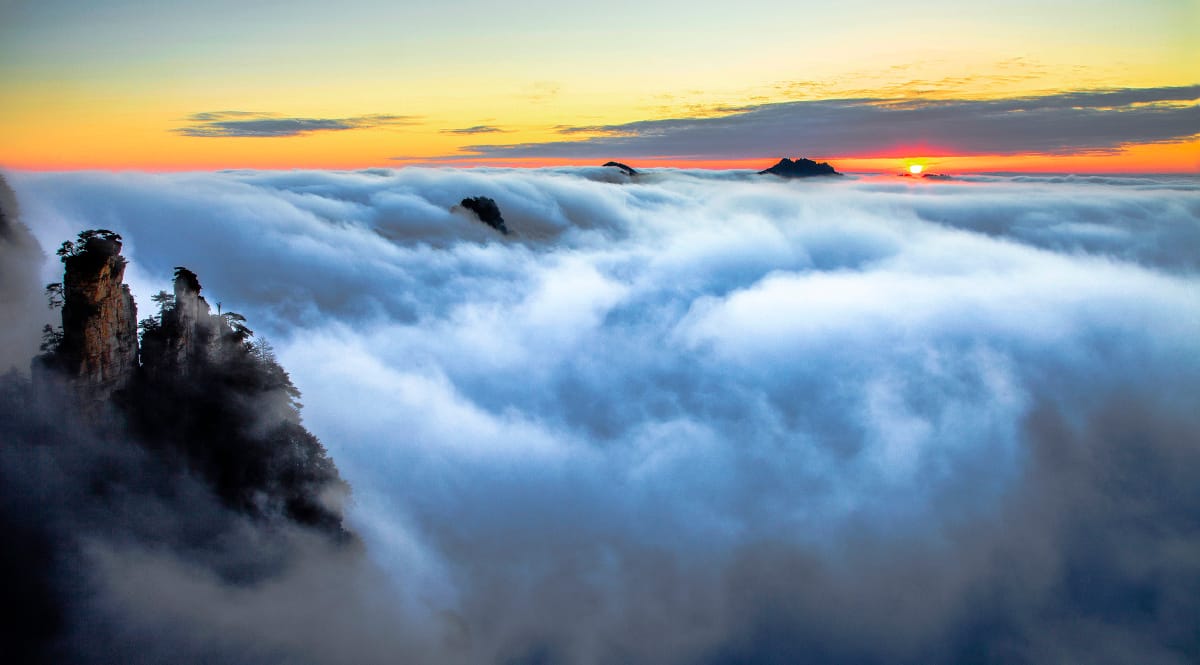
Sea of Clouds in Zhangjiajie: Best Viewpoint, Month & Time
Your best shot at the sea of clouds in Zhangjiajie: Tianzi Mountain, 1–3 hours after overnight rain stops, sometime between June and October. Nobody publishes an exact number for how many days a year it happens, so don’t trust anyone who gives you one. But the pattern itself is simple — rain overnight, a clear morning, the right viewpoint — and when those three line up, you have a real shot.
This guide covers everything that turns “maybe” into “likely”: which viewpoint, which month, which hour, how to read the forecast the night before, and what to do if you show up to fog instead of the real thing. It’s built from twenty years of watching this happen — and fail to happen — for our clients.
Best single viewpoint | Tianzi Mountain — Helong Park or Dianjiang Tai |
|---|---|
Elevation band where it forms | 600–800m — pillar tops above this line stay visible |
Best time of day | 6:30–9:00am, within 1–3 hours after rain stops |
Best months | June–October, with April–May and late autumn as secondary windows |
Reliability after overnight rain | High — most mornings after real overnight rain produce at least a partial cloud sea |
Duration once formed | Usually 1–3 hours before the sun clears it |
Table of Contents
1. What Is the Sea of Clouds, and Why Does Zhangjiajie Get It So Often?
The sea of clouds happens for a simple reason. Zhangjiajie’s valley floors sit around 400m, while its plateau tops climb to 1,000–1,262m — an 800-meter drop packed into a small area. When it rains overnight, the ground and lower air cool down fast, faster than the moisture in the gorges can evaporate. That moisture turns to fog, and the fog settles at a fixed height, usually 600–800m. Everything below that line disappears. Everything above it — including the pillar tops — stays clear.
Why it looks the way it does in photographs
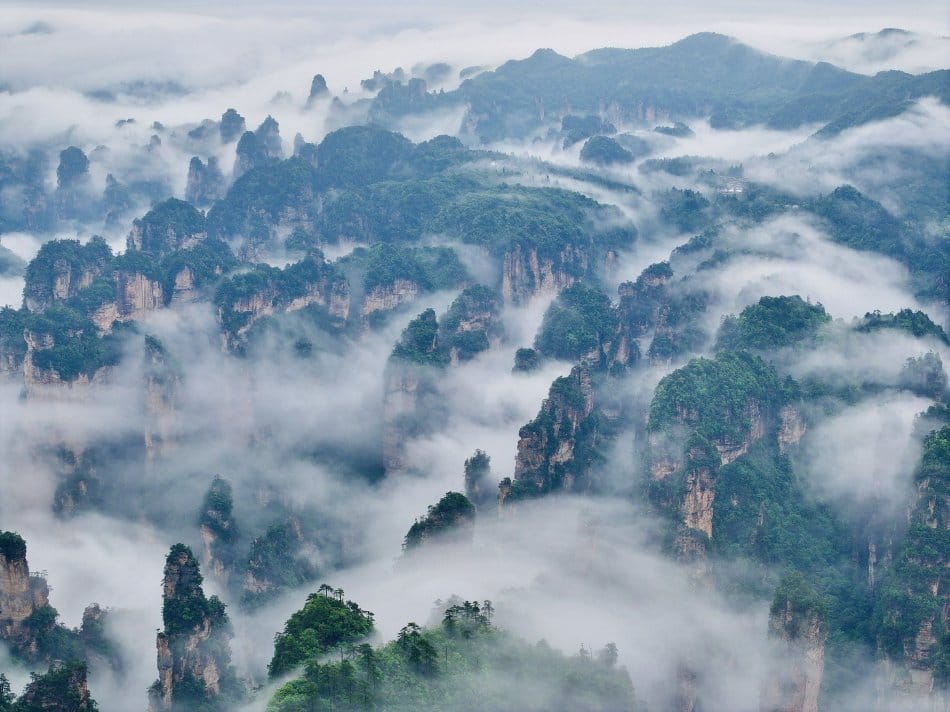
It’s not mist floating through a scene. It’s a flat, solid layer with rock towers rising straight out of it, like islands. Chinese visitors call this 波涛云海, “cloud waves,” because the fog really does move in waves as the air shifts underneath it.
You need two things for this to happen: overnight rain (or heavy dew with a sharp temperature drop), and a clear morning to reveal it. Miss either one, and there’s nothing to see — no matter which viewpoint you picked. That’s why viewpoint alone won’t get you there. Section 6 covers what to do if it rains but you still wake up to solid grey instead of a sea of clouds.
2. Which Viewpoint Gives You the Best Chance at the Sea of Clouds in Zhangjiajie?
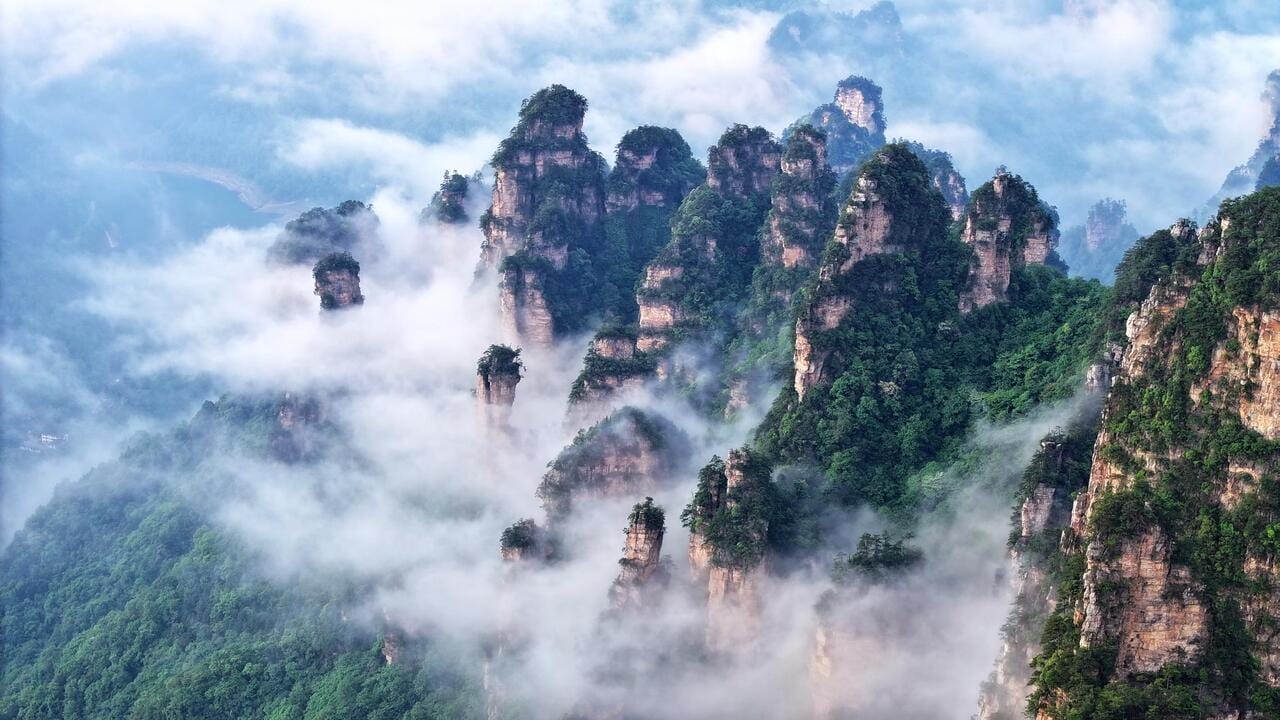
Knowing how the sea of clouds forms is only half the answer — where you stand is the other half. Not every viewpoint in Zhangjiajie National Forest Park works equally well: some put you above the fog, while others sit low enough that you’re stuck inside it.
Viewpoint | Elevation | Sea of Clouds Reliability | Why |
|---|---|---|---|
Tianzi Mountain | 1,262m | Highest | Broad, flat plateau above the densest pillar concentration in the park — the gorges below fill to a uniform level more consistently than anywhere else |
Huangshizhai | 1,080–1,200m | Very high | Horizontal sightlines at eye level with the peak forest give a wide, uninterrupted view of the fog layer forming below |
Yuanjiajie | 1,000–1,074m | Good | Lower elevation than Tianzi means the fog line sometimes sits above the platform itself, cutting visibility instead of revealing it |
Yangjiajie | 1,000–1,130m | Good, less crowded | Similar mechanics to Yuanjiajie, with far fewer visitors competing for the same platform space at dawn |
☁️ Sea of Clouds in Zhangjiajie by Viewpoint
Tianzi Mountain over Yuanjiajie, every time

If a client wants the sea of clouds, we send them to Tianzi Mountain, not Yuanjiajie. Both get the same weather. But Tianzi Mountain is higher and flatter, so it stays above the fog line. Yuanjiajie’s platforms are lower, and sometimes the fog swallows them instead. We’ve seen a full sea of clouds hold at Tianzi Mountain for close to three hours on a May morning. At the same time, a group at Yuanjiajie — just fifteen minutes away — saw nothing but grey. Elevation was the only difference.
Speed matters too. The first cable car of the day is nearly empty. By 8:30 or 9:00, the queue can run past 30 minutes — and that’s 30 minutes the sea of clouds might not have left. Go straight to the cable car station as soon as the gate opens. Don’t stop anywhere else first.
The named platforms worth the extra walk
- At Tianzi Mountain: Helong Park (贺龙公园) and Dianjiang Tai (点将台) face west across the densest part of the pillar field — this is where our guides set up first. Shentang Bay (神堂湾) is a steep-walled natural amphitheater nearby, worth the detour: the sea of clouds rising through its narrow opening is a distinct shot the open platforms don’t give you.
- At Yuanjiajie: Mihun Tai (迷魂台) — roughly “soul-losing platform” — is the specific spot, not the zone in general. A cantilevered lookout over the pillar forest, and the most photographed sea of clouds position in this part of the park.
- Between the two: Kongzhong Tianyuan (空中田园), near Laowuchang, is quieter — cliff-edge farmland with views across to the Bailong Elevator that most first-time visitors skip entirely because it’s off the main circuit.
DIG DEEPER: Tianzi Mountain in Zhangjiajie: The Complete Insider’s Guide
Tianmen Mountain Has Its Own Sea of Clouds
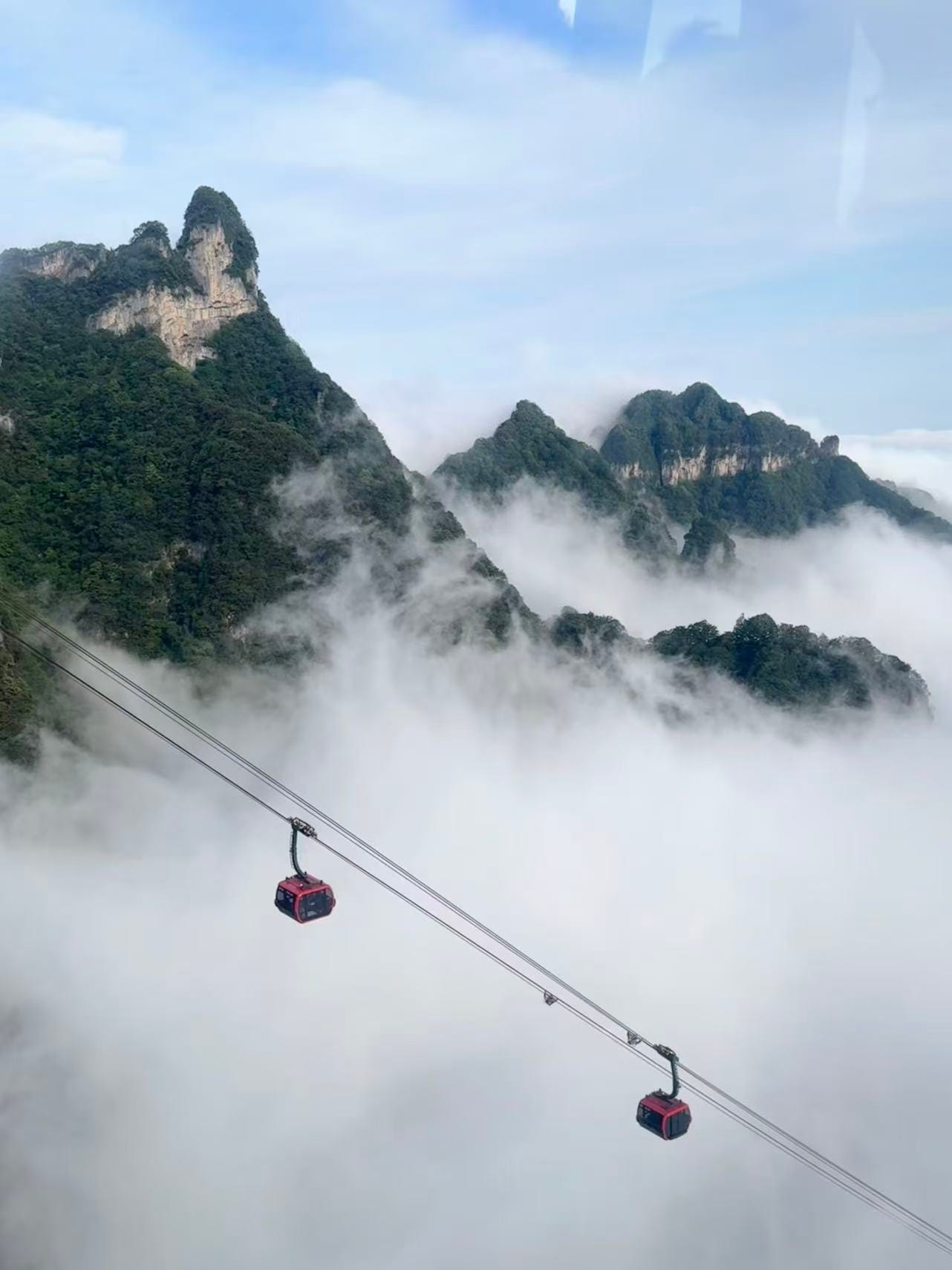
Everything above is inside Wulingyuan Scenic Area. Tianmen Mountain is a different park near Zhangjiajie city, with its own ticket and its own sea of clouds — arguably a more dramatic one. The Ghost Valley Plank Walk (鬼谷栈道) sits mid-cliff at roughly 1,400m, not on a flat plateau. You don’t look down at the sea of clouds here. You walk through the edge of it, with cloud filling the gorge on both sides of the walkway.
If your trip covers both parks, treat them as two separate chances, not one. A grey morning at Wulingyuan tells you nothing about what Tianmen will look like the same day.
3. What Month Should You Actually Plan Around?
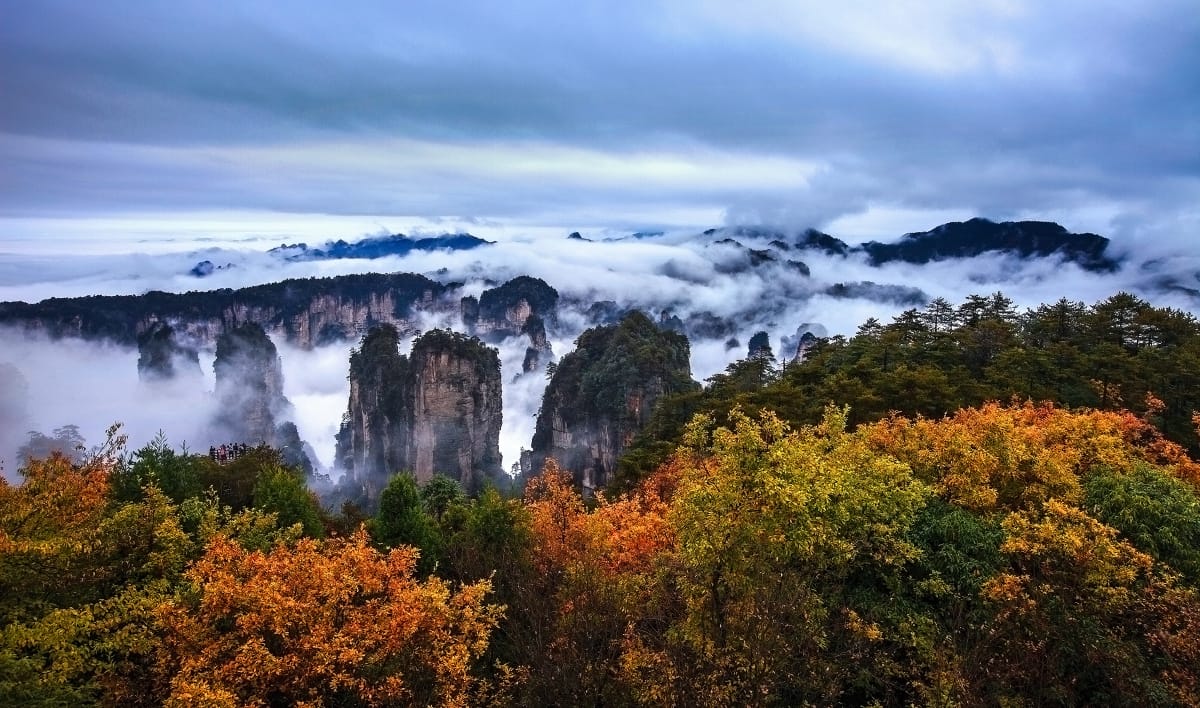
The right viewpoint only helps if the sea of clouds is likely to form that day. That likelihood changes a lot across the year. The park doesn’t publish a monthly count, so the table below is our best estimate, not a measured statistic. It’s based on rainfall: more overnight rain followed by clear mornings means more chances. That tracks the rainy season, not the temperature.
Period | Sea of Clouds Frequency | Trade-off |
|---|---|---|
June–August | Highest — near-daily afternoon thunderstorms followed by clearing produce frequent inversions | Peak heat (26–33°C), peak crowds, tightest reservation competition |
September–October | High, more stable | Better temperatures (16–26°C), but avoid Oct 1–7 (Golden Week) entirely |
April–May | Moderate-high | Rain is more frequent but less predictable in timing; cherry blossoms are a bonus |
Late October–November | Moderate | Autumn foliage overlaps with cooling temperatures; less frequent but clearer skies when it forms |
December–March | Low, but distinct | Snow replaces rain as the trigger; when it forms in winter, it often pairs with frost-rimed pillars — a different but equally striking version |
📅 Sea of Clouds in Zhangjiajie: Odds by Month
Frequency is a reasoned estimate based on rainfall patterns, not a measured statistic. Temperature shown is average daytime high.
June to August gives the best odds on paper, but with more heat and crowds. September and October come close on odds, with much better conditions. That’s why we point most flexible clients toward September.
DIG DEEPER: Best Time to Visit Zhangjiajie: Real Data from 20K+ Daily Visitors
4. What Time of Day Actually Matters?

The right month narrows your odds. The right hour is what puts you in front of the sea of clouds itself. The window is short — shorter than most visitors expect. It usually holds for one to three hours after the rain clears, between 6:30 and 9:00am. Then the sun burns it off from the edges inward. A solid white sea can shrink to wisps within an hour, and be gone by midday.
Where you sleep decides more than anything else on your itinerary
Gates open at 07:00. If you stay in Wulingyuan District, you can be at a Tianzi Mountain viewpoint by 7:15–7:30. If you stay in Zhangjiajie city, the 32km transfer alone eats most of the window — you’ll likely arrive after the fog starts clearing. We tell clients this directly: where you sleep the night before matters more than which viewpoint you pick.
No room right at the gate? Leave Wulingyuan town by car or taxi at 3:00–4:00am, timed to reach the gate for opening. It’s a rough start. But it beats losing the whole window to a city-to-park transfer.
DIG DEEPER: Where to Stay in Zhangjiajie
5. How Do You Know the Night Before Whether Tomorrow Is a Sea of Clouds Morning?

Being in position only matters if there’s something to see. You can’t know for certain the night before. But the signal is clear enough to act on. Check the forecast the evening before. Look for overnight rain followed by morning clearing — not all-day rain, not a dry night. The best pattern: rain overnight, a sharp temperature drop, then clear skies by dawn.
Reading the forecast correctly
Forecast shows | What it means |
|---|---|
Overnight rain, clearing by early morning | Best sign — set an early alarm |
Continuous rain through the next afternoon | Poor sign — heavy, sustained rain reduces visibility outright rather than lifting into a layer |
No overnight rain at all | Poor sign — no moisture or temperature drop to condense |
Check the forecast around 8 or 9pm the night before. See overnight rain followed by clearing? That’s your cue to set an early alarm. This is also when you should book tomorrow’s park entry. Since June 2025, Zhangjiajie National Forest Park requires a separate reservation for every entry day, even on a multi-day ticket. A perfect forecast at 9pm is worthless if tomorrow’s slots are already full. See Section 8 for how to book.
Staying inside Wulingyuan? Some guesthouses near Tianzi Mountain let guests in before the main crowds — worth asking if photography is your priority. For sunrise timing month by month, and more on overnight lodging, see our Zhangjiajie Sunrise & Sunset guide.
6. What Do You Do If You Wake Up and It’s Just Fog, Not a Sea of Clouds?
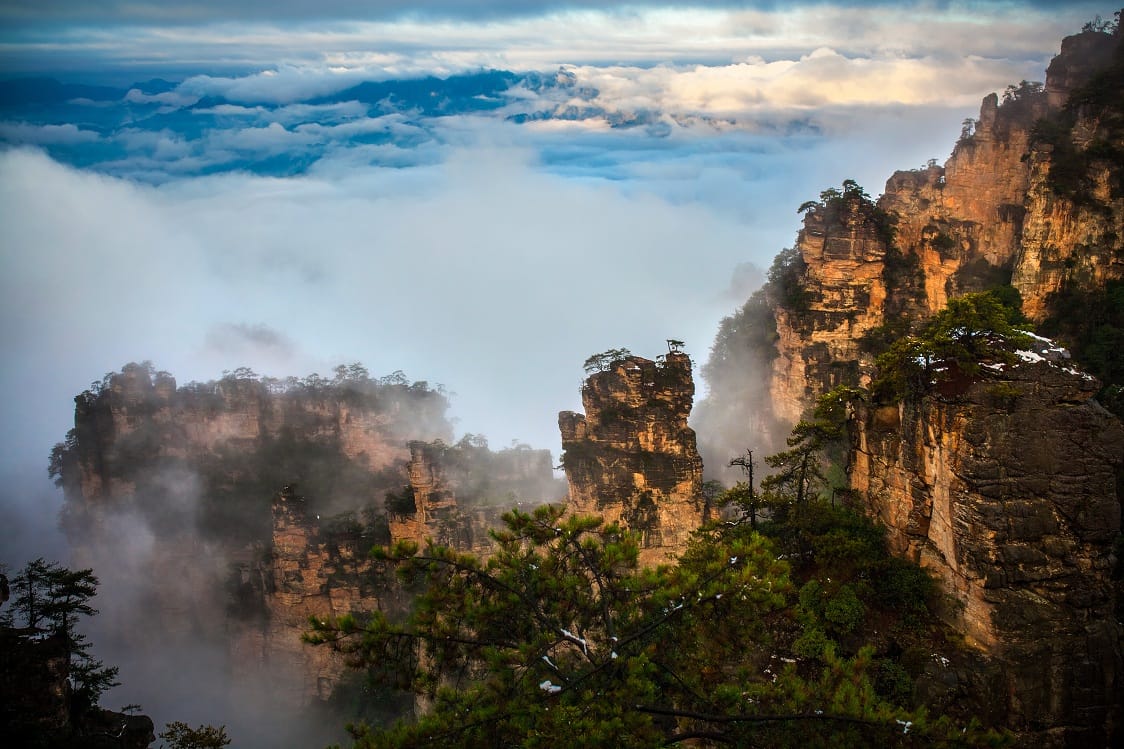
A good forecast doesn’t guarantee what you’ll actually find — and this is the one thing almost no guide tells you. Fog and sea of clouds look the same from a hotel window. At elevation, they’re completely different.
Telling the two apart
Fog is uniform — it sits at your elevation too, cutting visibility in every direction and showing you nothing, because you’re inside it. A sea of clouds is layered: it sits below the platform, and you stand in clear air looking down on it. The difference is simple — are you above the line, or inside it?
Can’t see more than a few meters at the viewpoint? You’re in fog, not a sea of clouds. The fix is elevation, not patience. Move to a higher platform if one’s nearby — Tianzi’s summit sits above where Yuanjiajie’s lower platforms often don’t. Or wait 30–60 minutes as temperatures rise and the fog compresses downward. We’ve watched a viewpoint go from zero visibility to a textbook sea of clouds in under 40 minutes, once the fog line dropped below the platform. If your schedule has room, the wait can pay off.
Don’t judge the day from the valley floor
In March 2026, we guided a group of American clients — Shalom’s group — through Zhangjiajie, well outside the official rainy season. Their first two days were overcast, with low cloud sitting on the valley. The night before their Yuanjiajie day, they messaged us expecting to see nothing.
Here’s what happened instead. They rode the cable car up into what looked like a solid grey wall — and came out above it. The cloud layer sat at roughly 1,000m. Above that line, Yuanjiajie and Tianzi Mountain were completely clear. Full sun, no obstruction at all. They stood at the Hallelujah Mountain overlook while the valley below stayed buried in mist for most of the day.
The lesson: what you see from a hotel window tells you almost nothing about conditions higher up. The two are often independent. Don’t cancel a summit morning because the ground looks grey. Get up there first. Let the viewpoint tell you what’s actually happening.
DIG DEEPER: Zhangjiajie Rainy Season: What to Expect & How to Plan
7. Is It Worth Restructuring Your Itinerary Around This?

Getting this right takes real effort — the viewpoint, the month, the hour, the forecast reading, telling fog from the real thing — and it’s never guaranteed to pay off. So is it worth it? That depends on your situation.
Your situation | Our recommendation |
|---|---|
2+ mornings in the park, rain forecast on one | Yes — treat that morning as the priority. Push other plans to the afternoon |
Flexible dates, sea of clouds is the main goal | Yes — build the trip around June–October and keep a buffer day |
Single day only, sea of clouds as a bonus | No — don’t restructure around it. A clear-sky, no-rain trip is a real possibility even in the best months |
Tight schedule, sea of clouds not a priority | No — Zhangjiajie is worth the trip on a clear day with no sea of clouds at all |
The honest trade-off
The pillar landscape and the Avatar connection stand on their own, sea of clouds or not. But clients who’ve seen both versions describe the sea of clouds morning as the one that stayed with them. That’s why, when the forecast lines up, we tell people to rearrange the day rather than stick to the original plan.
DIG DEEPER: Zhangjiajie Itinerary Guide: From 1 Day to 7 Days
8. A Route That Actually Chases the Sea of Clouds in Zhangjiajie
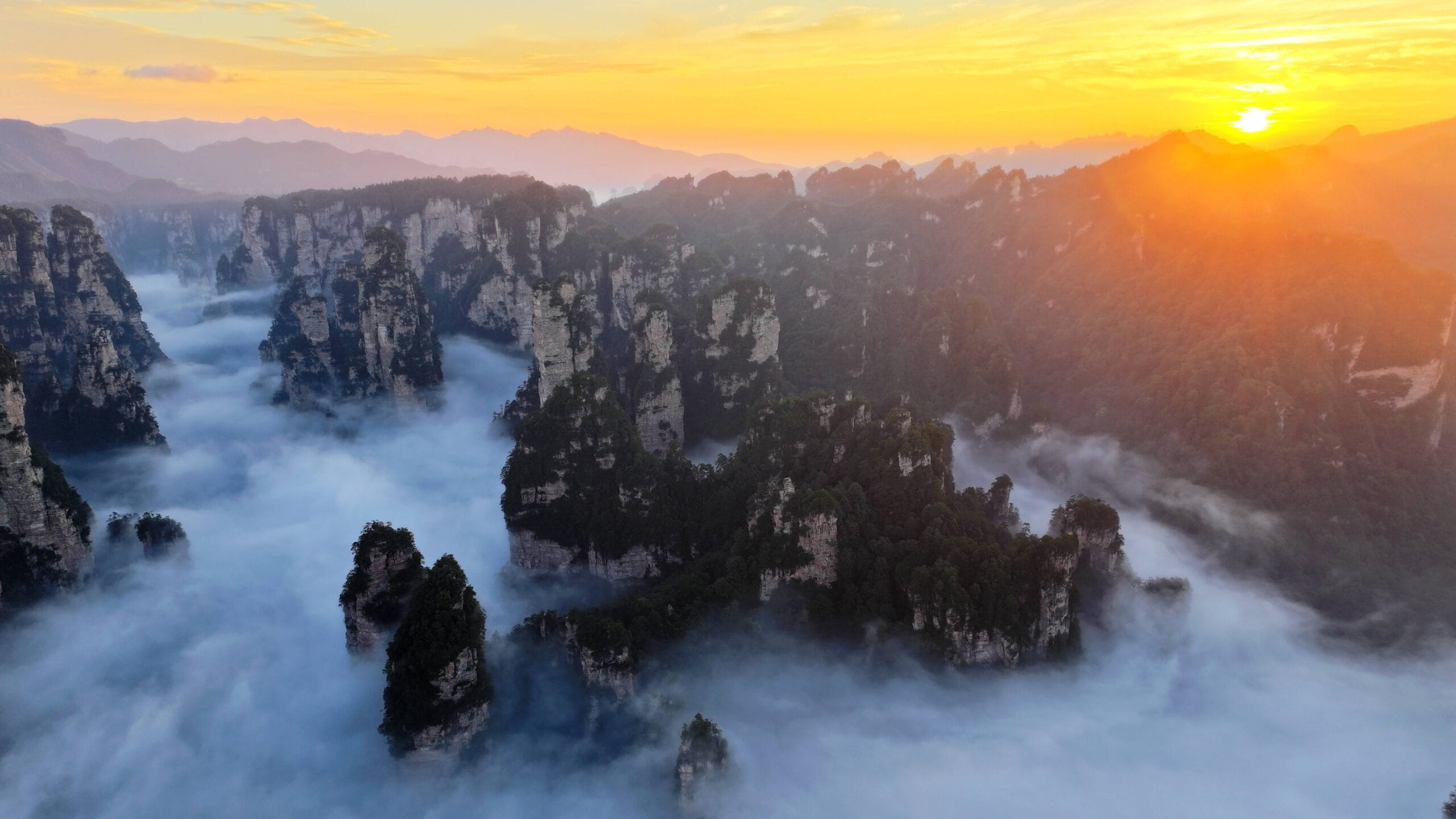
Decided the sea of clouds is worth building a morning around? Here’s how. Don’t spread your priority viewpoints across a normal sightseeing loop. Hit the highest-reliability ones first, and let everything else follow.
Book the day before you plan to chase it
Since June 2025, every entry day into Zhangjiajie National Forest Park needs its own advance reservation — even on a valid 4-day ticket. You can’t decide at breakfast and just walk in. Book tomorrow’s entry slot the night before, through the “张家界旅游小助手” WeChat mini-program, or ask your hotel or a local operator to do it. Do this before bed, right after you check the forecast. A perfect forecast means nothing if the slots are already full.
The single-morning route
Enter the East Gate and follow this order. It keeps you above the fog line for the whole window, and only brings you back down once the sea of clouds has usually cleared:
🗺️ Sea of Clouds in Zhangjiajie: The Single-Morning Route
Helong Park and Dianjiang Tai come first. They face the densest pillar field, where the sea of clouds shows earliest and holds longest. Shentang Bay is a short detour if it’s still forming, or if you want a different angle. Kongzhong Tianyuan is a quieter stop on the way to Yuanjiajie. Mihun Tai is your last viewpoint before heading down.
Spreading the risk across multiple days
No single morning is guaranteed. A grey morning at Tianzi Mountain tells you nothing about Tianmen Mountain the next day — the two parks sit far enough apart to get different weather. Treat them as two separate chances, not one.
Days available | Recommended split |
|---|---|
1 day total | Don’t build the day around the sea of clouds — treat it as a bonus if conditions align |
2 days | Day 1: Wulingyuan high-elevation route above. Day 2: Tianmen Mountain, weather permitting |
3+ days | One full day for the Wulingyuan route, one full day for Tianmen Mountain, with a buffer day to repeat whichever missed |
Splitting either single day thin across both parks usually means arriving too late at both to catch the window.
FAQ: Sea of Clouds in Zhangjiajie
What causes the sea of clouds in Zhangjiajie?
Overnight rain cools the air fast. Cold air sinks into the gorges and meets warmer, moisture-rich air still rising from the valley floor. The moisture turns to fog at a fixed height — usually 600–800m — leaving the pillar tops above that line clear.
Can you see the sea of clouds in winter?
Rarely, and it looks different when you do. Winter’s trigger is snow, not rain, so the frequency drops well below spring, summer, or autumn. When it does happen, it often pairs with frost on the pillars rather than the clean white layer you see in warmer months. If winter is your only window, don’t plan the trip around it — go for the snow-dusted peaks instead and treat any sea of clouds as a bonus.
I’ve read that July and August are bad months for the sea of clouds. Is that true?
That advice is outdated. It circulated a few years ago, likely based on a handful of unlucky trips, and it doesn’t match what we or most current sources see now: summer’s near-daily thunderstorm-then-clear pattern actually produces the sea of clouds often. What July and August do bring is real heat and the year’s biggest crowds — that’s the trade-off, not a lack of it.
How much walking is involved in getting to a good viewpoint?
Less than the reviews suggest, if you go straight to the right spot. From the Tianzi Mountain cable car’s upper station, Helong Park and Dianjiang Tai are both a short, mostly flat walk. The “long, difficult trek” some visitors mention usually means wandering the wider trail network rather than heading directly to these two platforms.
Some reviews say Tianzi Mountain is too commercial and crowded — should I go to Yuanjiajie instead?
Tianzi Mountain does get more photo-op congestion right at the main platforms, and that complaint is fair. But for the sea of clouds specifically, elevation is what matters, and Tianzi Mountain’s summit sits reliably above the fog line in a way Yuanjiajie’s lower platforms don’t always manage. If crowds bother you more than the extra reliability is worth, Yuanjiajie’s Mihun Tai is a solid second choice — just go in knowing you’re trading some odds for elbow room.
Is Zhangjiajie still worth visiting if I don’t see the sea of clouds?
Yes — the pillar landscape holds up on a clear day with no sea of clouds at all. Treat it as a bonus that rewards an early start and a flexible schedule, not a condition for a good trip.
Want help timing your Zhangjiajie mornings around the forecast? Get in touch with the Travel China With Me team — we’ll build your itinerary around the viewpoints and days that give you the best real chance.