Zhangjiajie National Forest Park Entrances: Which Gate Should You Use?
There are five entrance gates to Zhangjiajie National Forest Park, and picking the wrong one can quietly wreck your morning. We’ve taken hundreds of international travelers through this park. We’ve watched people arrive at the North Gate and spend 45 minutes waiting for a shuttle bus. We’ve seen tour groups queue for two hours at the East Gate elevator before 10am. And we’ve guided solo hikers who walked right in through the South Gate with almost no wait at all.
This article is specifically about the entrances — where they are, what you can access from each one, and which one fits your trip.
Table of Contents
First, a Quick Orientation
Zhangjiajie National Forest Park is the heart of the larger Wulingyuan Scenic Area. The park itself spans over 4,800 hectares. Its five gates sit at completely different points around the park’s perimeter — not clustered together. Choosing based on your hotel location and your planned route makes a real difference.
According to park data, about 45% of visitors enter through the South Gate and roughly 50% through the East Gate (Wulingyuan Sign Gate). The remaining 5% use the other three gates combined.
That statistic tells you something useful: most travelers are choosing between just two gates. But it also means you should understand why — because that 50/50 split reflects very different kinds of travelers making very different choices.
Gate | Chinese Name | Distance from City Center | Journey Time | Best For |
|---|---|---|---|---|
East Gate (Wulingyuan Sign Gate) | 武陵源标志门 | ~40 km | ~40 min by bus | Most first-time visitors; Yuanjiajie, Bailong Elevator, Tianzi Mountain, Ten-Mile Gallery |
South Gate (Forest Park Gate) | 张家界国家森林公园门票站 | ~32 km | ~30 min by bus | Hikers; Golden Whip Stream; Huangshi Village; avoiding crowds |
North Gate (Tianzi Mountain Gate) | 天子山售票站 | ~52 km | ~2 hrs by bus | Budget travelers skipping cable car costs |
West Gate (Yangjiajie Gate) | 杨家界售票站 | ~43 km | ~1.5 hrs by bus | Yangjiajie scenic area; adventurous hikers; repeat visitors |
Central Gate (Zimugang Gate) | 子木岗售票站 | ~37 km | ~25 min from Wulingyuan | Boutique inn guests; travelers wanting total seclusion |
The Five Gates: What Each One Actually Means For You
East Gate (Wulingyuan Sign Gate 武陵源标志门)

This is the main gate for foreign independent travelers, and it’s where most of our tour clients start. It sits in Wulingyuan district, which is where the majority of mid-range and international hotels are concentrated. If you’ve booked a hotel in Wulingyuan, you can often walk to this gate in 10–15 minutes.
The moment you’re inside, you face an important fork that most articles gloss over: you have to choose between eco-bus Route A and Route B, and they don’t connect mid-journey. Route A takes you toward Tianzi Mountain Cableway; Route B takes you toward Bailong Elevator. The two routes are not interconnected inside the park, so you need to decide before boarding which direction you’re heading.
East Gate Line A (Cableway up, Elevator down): Enter → Tianzi Mountain Cableway (ascend) → Tianzi Mountain → shuttle bus → Yuanjiajie → Bailong Elevator (descend) → exit East Gate
East Gate Line B (Elevator up, Cableway down): Enter → shuttle bus → Bailong Elevator (ascend) → Yuanjiajie → shuttle bus → Tianzi Mountain → Tianzi Mountain Cableway (descend) → exit East Gate
We always steer our clients toward Line A in the morning. The Bailong Elevator draws enormous queues between roughly 8:30am and noon. If you take the cableway first, you arrive at the elevator from above in the afternoon when lines are shorter. It’s a small tactical choice that saves significant time.
Ten-Mile Gallery is also accessible from the East Gate via a scenic shuttle. The Ten-Mile Gallery scenic train runs one-way at ¥38 per person, with a discount price of ¥19. If you’re trying to squeeze the gallery into a one-day East Gate visit, do it in the morning before crowds build up on the main routes.
Getting here: From Zhangjiajie West Railway Station, take the tourist bus to Wulingyuan Bus Station (¥13, ~30 minutes), then walk 15 minutes to the gate. From Zhangjiajie Central Bus Station, the tourist bus takes about 40 minutes (¥13). From the city’s Hehua Airport, take bus No. 4 to Central Bus Station, then transfer — total journey roughly 1 hour 50 minutes at around ¥15.
The honest downside: In peak season — especially Golden Week in October, May Day, and July–August — the East Gate area is genuinely overwhelming before 9am. Arrive at the entrance and start early, around 7:00am, when crowds haven’t yet arrived. After 9am on a holiday weekend, eco-bus queues can stretch 40–60 minutes.
South Gate (Forest Park Gate 张家界国家森林公园门票站)
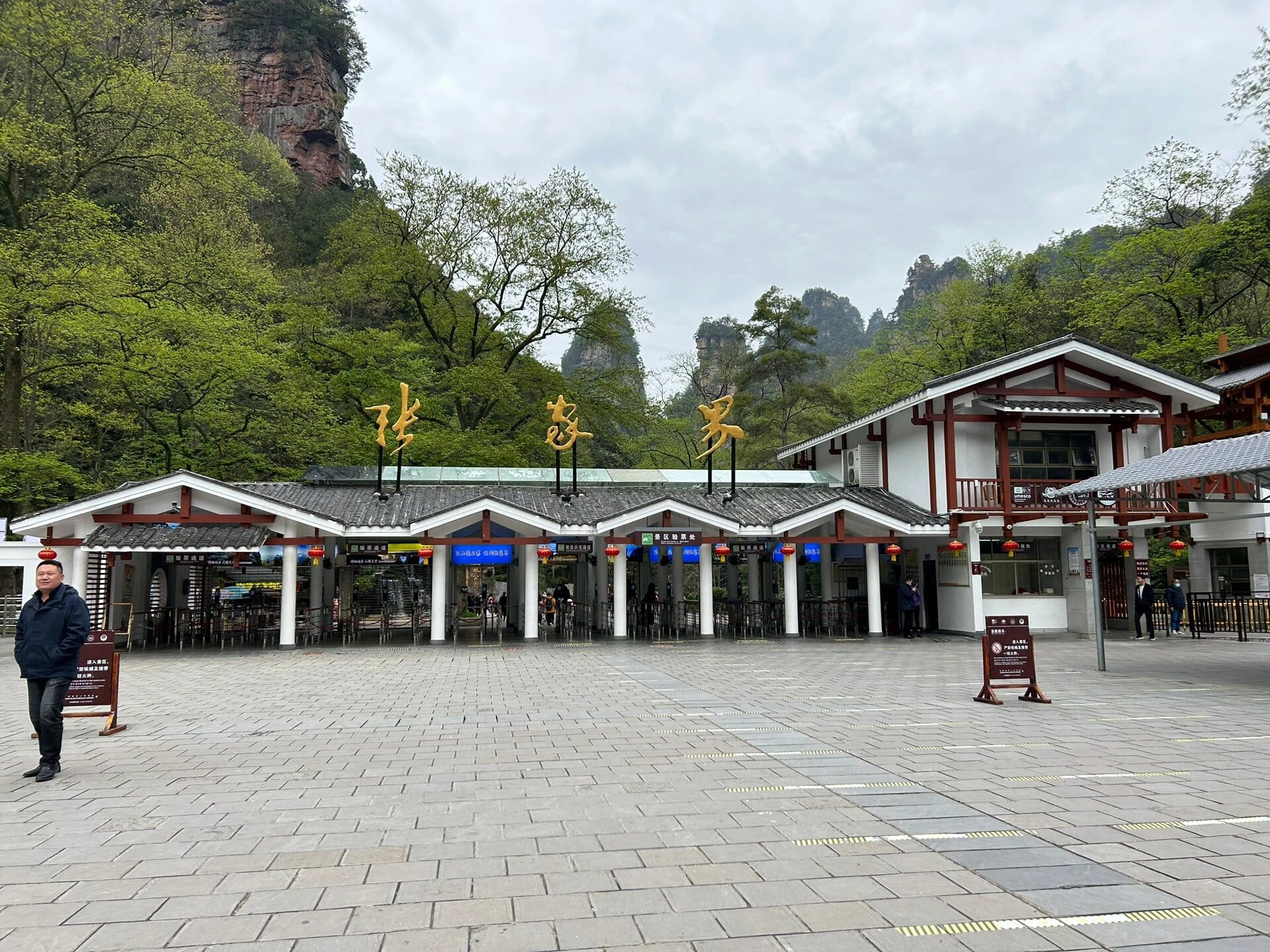
This is the original entrance — the gate that opened in 1982 when the park was first established. It’s the closest gate to Zhangjiajie city center, and getting here is straightforward. From the Central Bus Station, a direct tourist bus runs to the South Gate in about 30 minutes for ¥12. From West Railway Station, it takes roughly 40 minutes for ¥12.
The South Gate deposits you directly at the foot of the park — no eco-bus needed to reach the main trailheads. You can walk straight onto Golden Whip Stream, a flat 7.5 km trail along a mountain creek that’s genuinely one of the most beautiful walks in the park. Wild macaques appear along this trail with surprising regularity. The trail ends near the East Gate, so you can walk the full route without doubling back.
Huangshi Village is the other major draw from the South Gate. It has a cable car or a hiking trail to the summit. From the top, you get the widest panorama of the park — more expansive than the view from Yuanjiajie in our experience, and usually less crowded.
We specifically route clients who love hiking, who are visiting for two or more days, or who want a quieter start to their morning through the South Gate. It has fewer tour groups at the entrance, and the lower area of the park — Golden Whip Stream and Huangshi Village — doesn’t require the same eco-bus queue that the East Gate’s upper-mountain routes do.
One thing to know: There are far fewer hotels near the South Gate than near the East Gate. If you’re staying in Wulingyuan district (near East Gate), a day that starts at the South Gate adds 30 minutes of travel each way. Plan that in.
North Gate (Tianzi Mountain Gate 天子山售票站)

This gate is 52 km from the city center, and the road gets rough in the final stretch. By bus, it’s about 2 hours from downtown Zhangjiajie.
For visitors who do not want to pay to take the cable car to go up the mountain, entering from the North Gate is an option. The downside is that the North Gate is far from the city center, the road to it is quite bumpy, and the journey is more complicated and exhausting.
The North Gate puts you directly in Tianzi Mountain territory. Once inside, you take a free eco-shuttle to the scenic area — no cable car cost. That’s the only real reason to choose this gate, and it’s a legitimate one if you’re budget-conscious and specifically want Tianzi Mountain.
For most foreign independent travelers, this gate is not worth the journey unless you have your own car or a private driver. We’d estimate fewer than 2% of our clients use this gate.
West Gate (Yangjiajie Gate 杨家界售票站)

The West Gate serves Yangjiajie — the wilder, less-visited side of the park. It’s about 43 km from the city center and takes over 1.5 hours by bus. Yangjiajie has a distinct character: narrower paths, more dramatic cliff faces, and significantly fewer people than the main Yuanjiajie circuit.
Inside, you can take the Yangjiajie cable car to reach the mountaintop scenic area. The trail to the “One Step to Heaven” viewpoint is genuinely impressive and still relatively unknown among international visitors.
After visiting Yangjiajie, you can transfer by shuttle bus to go anywhere else in the scenic area. So this gate doesn’t trap you in one corner of the park — you can continue to other zones afterward.
We sometimes recommend the West Gate for repeat visitors, photographers looking for less-photographed compositions, or adventurous travelers with at least two days in the park who’ve already seen the main highlights.
Central Gate (Zimugang / Shuiraosimen Gate 子木岗售票站)

Located on a hillside about 25 minutes from Wulingyuan district, Zimugang is the smallest ticket station in Zhangjiajie National Forest Park. There’s essentially no queue all year — but that also means you need to wait for the eco-shuttle bus to fill up, which can take around 20 minutes.
Shuiraosimen is a junction point deep in the park where four streams converge. From here you can reach Bailong Elevator, Ten-Mile Gallery, and Golden Whip Stream on foot or by shuttle. A number of boutique mountain inns have opened in this area recently, making it appealing for travelers who want total seclusion and are staying overnight inside the park.
For everyone else — skip it. There’s no practical advantage for a standard day visit.
Which Entrance Should You Use?
After guiding travelers through this park thousands of times, here’s our honest recommendation:
Use the East Gate if: You have one day, you want to cover Yuanjiajie and Tianzi Mountain, you’re staying in Wulingyuan, or you’re on a guided group tour. Enter before 7:30am and take Line A (cableway first). Don’t arrive at 9am expecting a smooth experience.
Use the South Gate if: You’re visiting for two or more days, you prioritize hiking over cable cars, you want Golden Whip Stream as your starting point, or you’re staying in the city center. This is also the better choice if you find large crowds genuinely unpleasant — the South Gate area moves more like a real forest and less like an airport terminal.
Use the North Gate only if: Budget is the primary driver and you specifically want Tianzi Mountain without paying for the cable car. Arrange private transport if possible.
Use the West Gate if: Yangjiajie is specifically what you want, especially on a second day in the park when you’ve already done the main circuit.
Skip the Central Gate unless you’re staying at a boutique inn in that area.
READ ALSO: Zhangjiajie Itinerary Guide: From 1 Day to 7 Days
Our Recommended 2-Day Route
Day 1 — East Gate, Line A: Arrive before 7:30am → take Tianzi Mountain Cableway up → explore Tianzi Mountain (1.5–2 hrs) → shuttle bus to Yuanjiajie → see Hallelujah Mountain / Mihun Terrace → take Bailong Elevator down (afternoon, shorter wait) → exit East Gate → optional: Ten-Mile Gallery scenic train on the way out
Day 2 — South Gate: Arrive around 8am → walk Golden Whip Stream (7.5 km, approx 2–2.5 hrs) → take Huangshi Village cableway up → panoramic views from the summit → exit via East Gate (the stream trail ends near there)
This combination covers the park’s strongest experiences and avoids covering the same ground twice. If you only have one day, East Gate Line A remains our first choice — but set that alarm.
FAQ
Do I have to enter and exit through the same gate?
No. Your ticket is valid at all five gates throughout its 4-day validity. Walking from South Gate through Golden Whip Stream and exiting at East Gate is actually a common and logical route.
Is the ticket price different at different gates?
No. The price is identical at all five gates.
Do I need to book a specific gate in advance?
Yes, for your first entry. Since June 2025, your first visit must be reserved in advance with a specific gate and time slot. For each subsequent day inside the 4-day validity, you cannot book ahead independently — you must schedule your next entry with on-site staff after your first entry has been verified. This means: don’t show up on day 2 without having arranged it on day 1 before you left the park. In peak season, tell the staff your intended next date immediately after first check-in. Book your first entry as far ahead as possible — ideally 2–3 weeks before your visit during peak season.
Which gate has the shortest queues?
In peak season, the Central and North Gates have essentially no queues — but the journey and limited access make them impractical for most visitors. Among the main two gates, the South Gate generally has shorter queues than the East Gate, especially in the early morning.
Can I bring luggage into the park?
Luggage lockers are available at the East and South Gates. If you’re staying inside the park overnight (a few hotels exist near the East Gate area), contact your hotel in advance about luggage logistics.
Is there English support at the entrances?
Multilingual services are available at the entrance gates. Inside the park, English-speaking staff are sparse — perhaps one or two at major eco-bus stations. Eco-bus stop signage is in both Chinese and English, which helps considerably with navigation.
What time does the park open?
The main gates open at 7:00am year-round. Last entry is 17:00. During peak season, the park sometimes opens slightly earlier — arriving by 6:50am puts you at the front of the first wave.
We’re a family with young children. Which gate is easiest?
East Gate. It has the best facilities, clearest signage, most eco-bus options, and luggage storage. Line B (elevator first) is slightly easier with children since you avoid a cable car before the kids are warmed up. Note: children under 120cm enter free, and cable cars have level boarding designed to accommodate strollers and wheelchairs.
Travel China With Me organizes private tours to Zhangjiajie for international visitors. We book park tickets, arrange guides, private cars, and help you plan an itinerary that actually fits the time you have. Reach out if you need help planning.