Zhangjiajie Night Shows: Which One Is Worth It?
By Travel China With Me — Our guides Bree and Rex have taken international visitors to these shows countless times — Europeans, Australians, North Americans, first-timers and repeat China travelers alike. What follows is built from that experience, cross-checked against Chinese booking platforms and audience reviews. Not a press kit. Not a rewrite of someone else’s article.
Most visitors spend their days in Zhangjiajie chasing the Avatar mountains. That’s the right call. But Zhangjiajie night shows deserve just as much planning — because the evening performances here are unlike anything elsewhere in China.
There are currently three evening shows worth your time. One turns a real mountain canyon into a stage — 500 performers, ¥150 million in production cost, no roof, no walls, just cliffs and sky. Another has been running since 2000, seen by over 18 million people, and contains at least one segment that the show itself warns you about in the program notes. The third is a theme park-scale production that works especially well if you have children or a full afternoon to fill.
One show you may have read about elsewhere: Encounter Dayong (遇见大庸) at Dayong Ancient City. It still appears on older travel sites. Don't plan around it — the project accumulated over ¥1 billion in losses across four years and entered bankruptcy in September 2024. It's expected to reopen under new management sometime in 2026 at the earliest.
Here’s what’s actually running.
Table of Contents
1. The Three Active Shows at a Glance
Show | Location | Type | Season | Start Time | Duration |
|---|---|---|---|---|---|
Tianmen Fox Fairy | Downtown, Tianmen Mountain canyon | Outdoor landscape musical | Mar–Dec | 8:20 PM | 65–90 min |
Charming Xiangxi | Wulingyuan District | Indoor folk gala + outdoor acrobatics | Year-round | 7:30 PM | ~80 min |
Zhangjiajie Qianguqing | Wulingyuan District | Theme park + indoor show | Year-round | 3:00 PM (park), ~7–8 PM (show) | ~1 hr show |
2. Tianmen Fox Fairy (天门狐仙·新刘海砍樵)
What It Is
The full name is Tianmen Fox Fairy: The New Liuhai Chops Wood. It premiered September 17, 2009 — the world’s first performance to use a real mountain canyon as its stage, and still the only one of its kind in China.
The whole canyon from the Tianmen Mountain park entrance forms the backdrop: five kilometers long, over 1,100 meters of vertical drop. The main stage sits over a mountain stream. Tujia wooden houses are built into the cliffside. A glass platform the size of half a football field lights up from within. A 60-meter bridge spans the gorge. A giant movable moon rises above the peaks. Over 500 performers. Total build cost: ¥150 million.
The people behind it are not a local tourism committee. Director Mei Shuaiyuan invented China’s landscape performance genre and made Impression Liu Sanjie in Yangshuo. Music director Tan Dun has an Academy Award. Choreographer Yang Liping is one of China’s most recognized dancers. This is a serious production that happens to be staged on a mountain.
Read This Before You Go: The Story
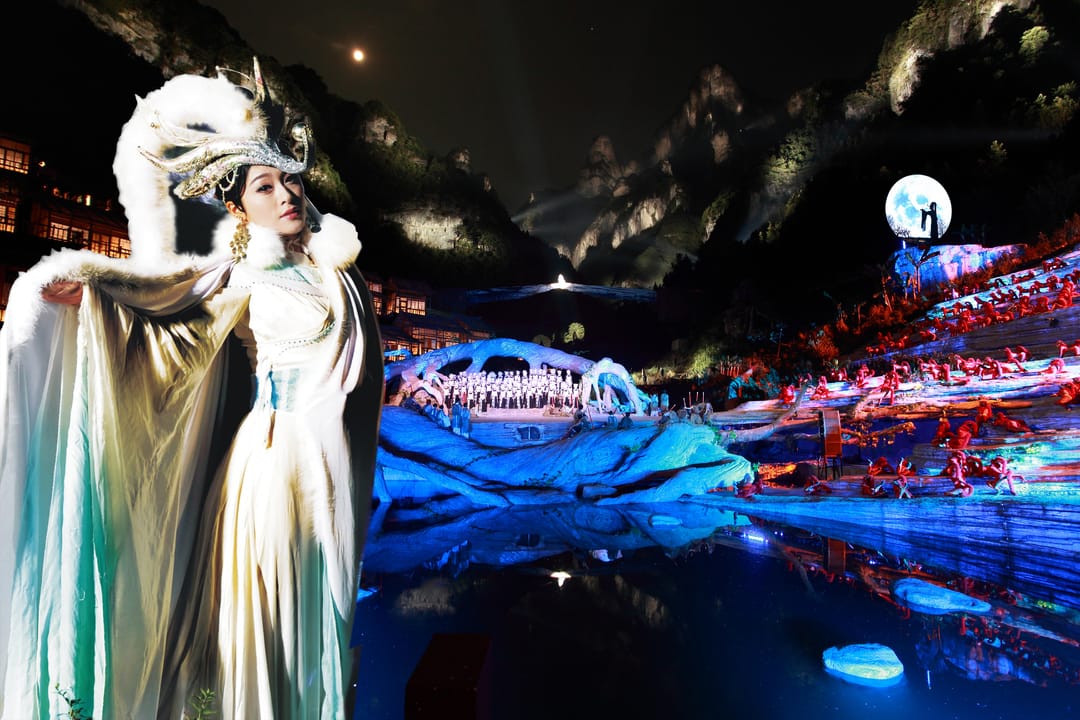
The show runs four acts, based on a Hunan folk legend.
Act 1 — The Fox King Selects a Consort: A fox kingdom on the clifftops. The Fox King wants a new queen. The white fox catches his eye — but she’s cultivated herself into something beyond animal nature, and his jewels and power mean nothing to her.
Act 2 — A Strange Meeting on the Sacred Mountain: The white fox takes human form. She meets Liu Hai, a woodcutter who once saved her life. A love story begins.
Act 3 — Betrayal Storm: The Fox King imprisons the white fox. Villagers seize Liu Hai, convinced a fox spirit has bewitched him. The white fox stands at a cliff edge. Liu Hai watches from across the valley.
Act 4 — Thousand-Year Vigil: Years pass. Their love moves something in the mountain itself. Stone forms a bridge. They cross it.
We tell guests this story before every show. Without it, the spectacle is still impressive — but the emotional logic is gone and it becomes just a very expensive light show.
There’s a reason this story was chosen over all the others in western Hunan folklore. The white fox didn’t start as a person. She became one — through will, through cultivation, through choice. The story asks whether that choice is honored or punished. That question lands differently than a conventional love story, and it’s why people who came for the mountain effects often leave talking about something else entirely.
Two Scenes Rex Can’t Stop Talking About
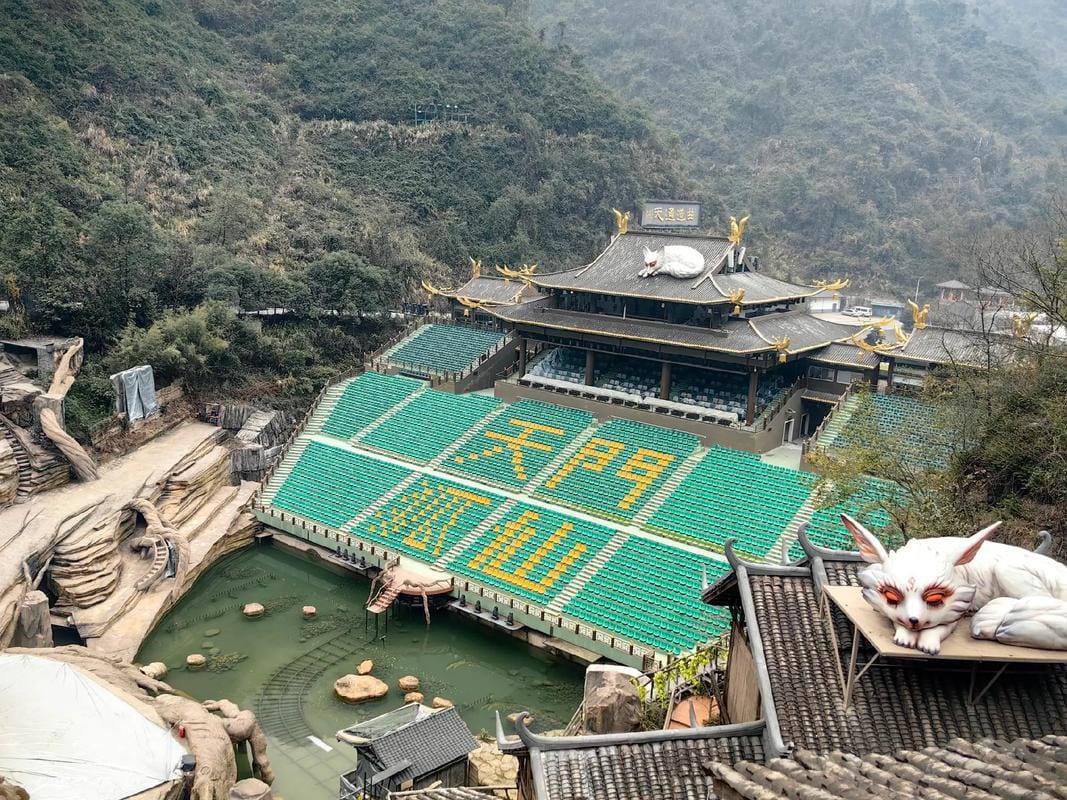
Rex has guided more guests through this show than he can keep track of. Ask him which moments still register after all that, and he gives the same two answers.
The battle between the humans and the fox spirits. The sound and lighting hit simultaneously at a scale the room isn’t prepared for — even people who’ve seen big productions elsewhere flinch. It’s not any single effect. It’s the combination, outdoors, in a real canyon, with no ceiling to contain it.
The final reunion. Every light in the theater shifts at once. Spotlights sweep across the mountain face above the audience. Five hundred performers are on stage, under a real sky. Rex’s point: a building can’t do that. The canyon is part of the show in a way that doesn’t translate to any indoor venue.
Guests come away stunned by the scale and, often, more moved by the story than they expected to be. The value-for-money surprise is consistent — almost no one leaves feeling they overpaid.
2026 Ticket & Seat Details
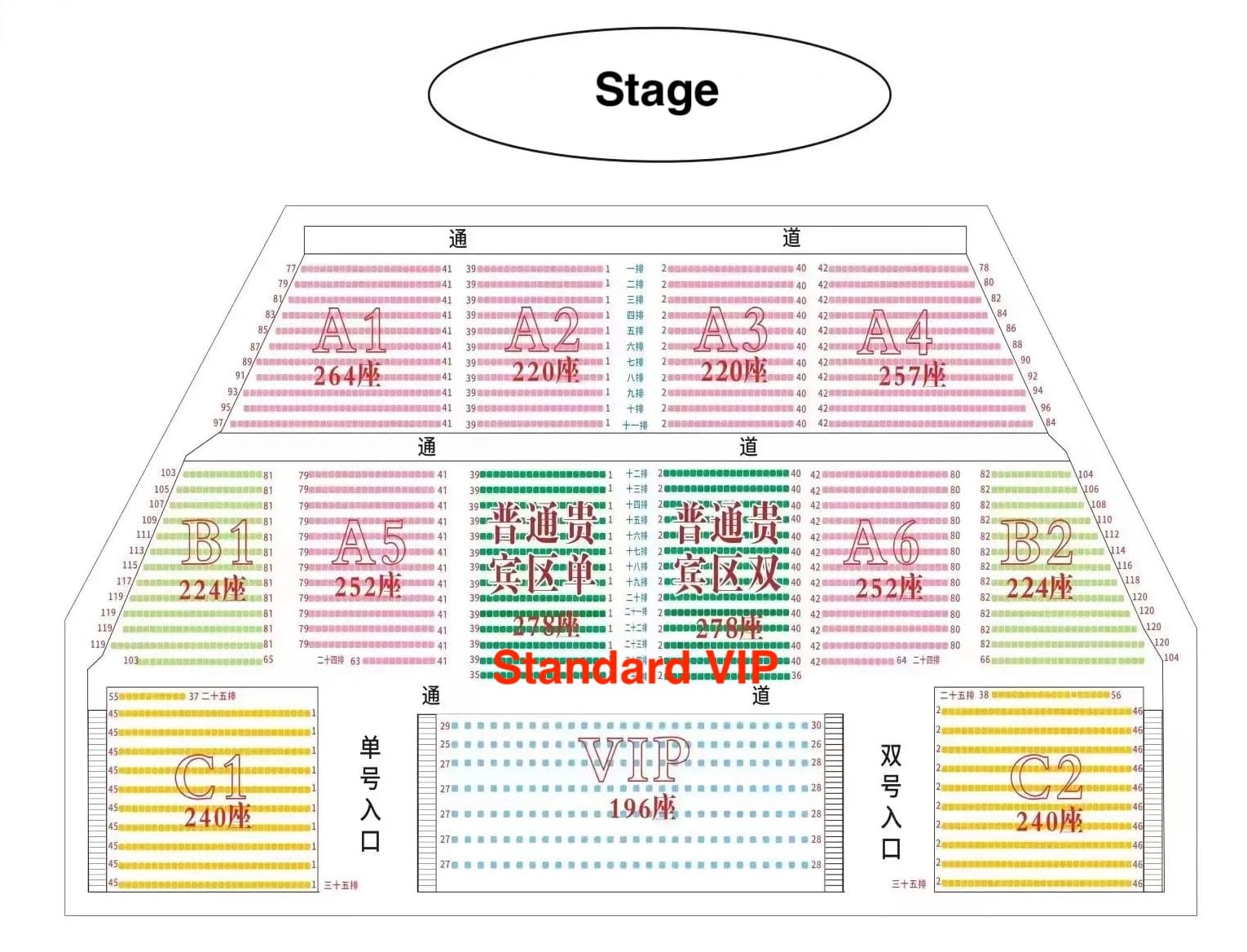
Runs nightly March 1 to December 31. Doors open 7:30 PM; show starts 8:20 PM. Duration 65–90 minutes.
Pricing:
- Standard A/B/C seats ¥178;
- Standard VIP ¥198
- VIP: First 2 Rows: ¥398; Rows behind: ¥288
Note: Performance ticket only — Tianmen Mountain scenic area not included. No student, senior, or military discounts. Children under 1.3 m enter free without a seat.
Which seats, from experience: Rex has sat in A2, A3, and A5. The theater is smaller than it looks on maps, so even standard seats put you close to the stage. A2 and A3 sit near the aisle and front row — after the show ends, performers sometimes come down for informal interaction, though it’s not guaranteed. A5 is elevated, with a wider view of both the stage and the subtitle screens.
Rex’s take: A2 and A3 hit harder emotionally. A full section around you, everyone reacting at the same time, pulls you in faster than sitting in a sparser VIP row.
For most tour groups, we book regular VIP. Guests leave satisfied. For guests who want to spend more, Super VIP has a roof over the seats — meaning you stay dry in rain without wearing a raincoat. It sounds like a small thing. On a wet night it isn’t.
On clear nights with a real moon above the canyon, Bree says the same thing every time: the mountain does half the director’s job.
One timing mistake we see constantly: Gates open at 7:00 PM for an 8:20 PM show. Guests coming from the Tianmen Mountain gondola often underestimate the descent time and arrive at 8:10, rushing through a lit canyon they should have been walking through slowly. The pre-show atmosphere — cliffs illuminated from below, mist, the scale of the stage before anything starts — is part of the experience. Don’t skip it.
Subtitles: Chinese, English, Korean, Japanese.
Getting there: Buses 4, 5, 6, or 10 from downtown to the Tianmen Mountain cableway station, then the dedicated show shuttle (¥5). Taxi from downtown around ¥30. Sort out your return before the show — the area empties fast.
Rain: Show runs regardless. Free raincoats at the venue. Coat rental ¥10 in cooler months. The actual inconvenience in rain is keeping your phone and notes dry. The atmosphere — mist off lit cliffs — is often better than a clear night.
3. Charming Xiangxi (魅力湘西)
The Show That’s Been Running Since 2000
Charming Xiangxi opened in March 2000. By 2021 it had seen over 18 million audience members — roughly one in every three people who visit Zhangjiajie. The 2,800-seat theater sits at the entrance of Wulingyuan District, and for a lot of Chinese visitors, it’s the show that defines the trip.
In 2017 it got a major overhaul. Film director Feng Xiaogang took over as chief director. Musician Liu Huan handled the music. The show’s name was written by artist Huang Yongyu. Theme songs were recorded by Song Zuying, Zhang Ye, and Chen Sisi — three of Hunan’s most prominent singers. Total production investment across the current form: ¥160 million.
One segment — Chasing Love (追爱) — performed on the CCTV Spring Festival Gala, which is watched by hundreds of millions of people. That’s not a small distinction for a regional folk show.
What’s In It
The show has two parts: indoor and outdoor. One ticket covers both.
Indoor:
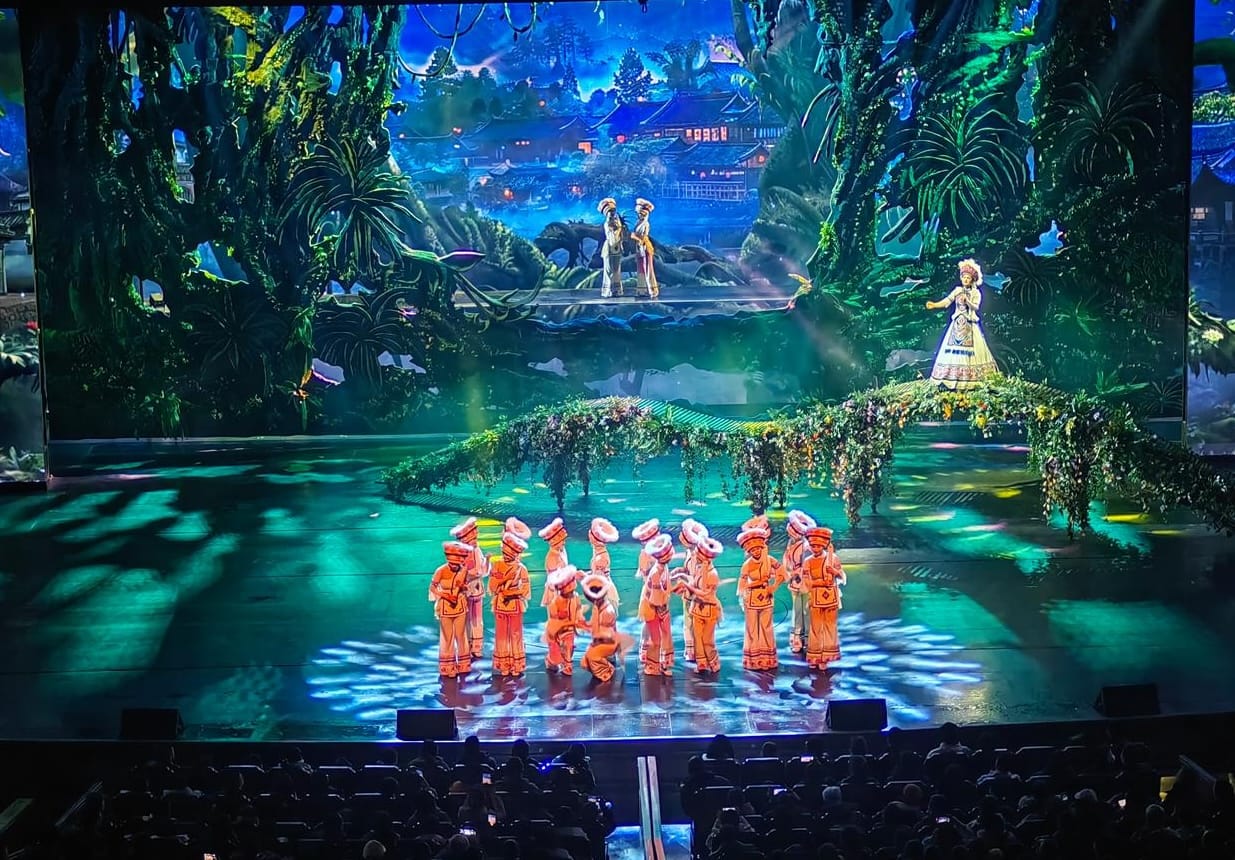
Chasing Love (追爱) — Based on a Yao courting custom called “climbing the building” (爬楼). When a girl comes of age, she moves to a balcony room. Young men come at night to sing and dance below, trying to catch her attention. The segment mixes folk music, acrobatics, and comedy. It works across cultures and ages.
The Crying Wedding (哭嫁) — A Tujia pre-wedding tradition. The bride weeps in a structured, melodic way before leaving her family — not grief exactly, but an expression of love, gratitude, and the weight of transition. It follows a real musical form in the Tujia language. International visitors who walk in expecting folk dancing often walk out having felt something they didn’t anticipate. We’ve watched this happen repeatedly. It doesn’t need translation.
Maogusi Dance (茅古斯舞) — A Tujia ritual from the first lunar month. Performers wear grass and straw costumes and reenact ancestral activities — hunting, farming, fishing — in an ancient Tujia dialect that some words can no longer be fully translated even by native speakers. It’s performed for outside audiences in very few places.
Closing Banquet (合拢宴) — A communal feast ceremony.
Ganshi — Walking Corpse (湘西赶尸) — Western Hunan has a tradition involving a practitioner who could guide corpses home on foot for proper burial. The theatrical version is staged with dark lighting, eerie sound design, and a deliberate unsettling atmosphere. The show’s own program notes carry a warning: due to frightening music and a gloomy atmosphere, please watch over elderly companions, children, and women in your group. We mention this so you’re not caught off guard, not to scare you off.
Outdoor:
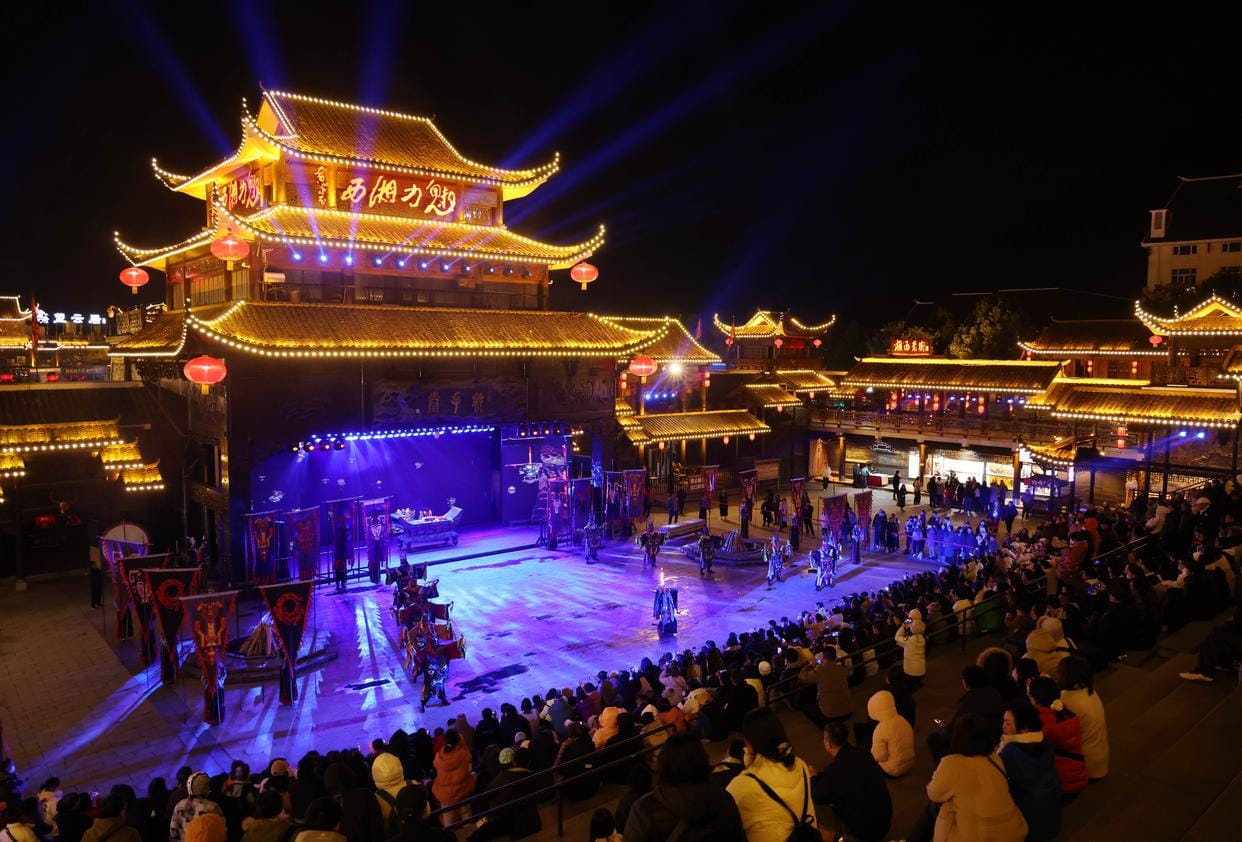
Tujia acrobatics — climbing a ladder of real sharpened sword blades bare-footed (audience members can test the blade before the performance), fire-walking over burning charcoal, hard qigong. Closes with a bonfire.
A Chinese audience member who went in skeptical: “I didn’t think I’d enjoy this kind of show. Thought it would be boring. But every segment has its own cultural story behind it, and together it becomes something completely different from what I expected.”
What Bree Tells Guests Before Walking In
Two minutes of context before the show starts changes everything. Bree covers the crying wedding (joy and grief at once, not just sadness), Maogusi (ancestor ritual, not a costume show), and Ganshi (a real folk belief about proper burial and the journey home). Once guests understand what they’re seeing, the performances stop being exotic and start being legible.
The most common question before this show: “What’s actually in it?” The most common reaction after: a pause, then “that was genuinely good.” Ganshi occasionally prompts questions — never panic, as long as people knew it was coming.
The word guests use most: authentic. These aren’t hired performers from a general audition pool. They come from Tujia and Miao communities. That comes through in a way that’s hard to fake and easy to feel.
2026 Ticket & Seat Details
Year-round. Standard start: 7:30 PM. Extra sessions at 9:00 PM and 10:30 PM during peak season (summer, national holidays).
Pricing:
- Standard C ¥168;
- VIP B ¥198; Super
- VIP A ¥228.
- Add ¥20 to any ticket for Green Channel access (priority entry, lounge area, tea service).
- Children 1.2 m and under enter free.
Seat breakdown:
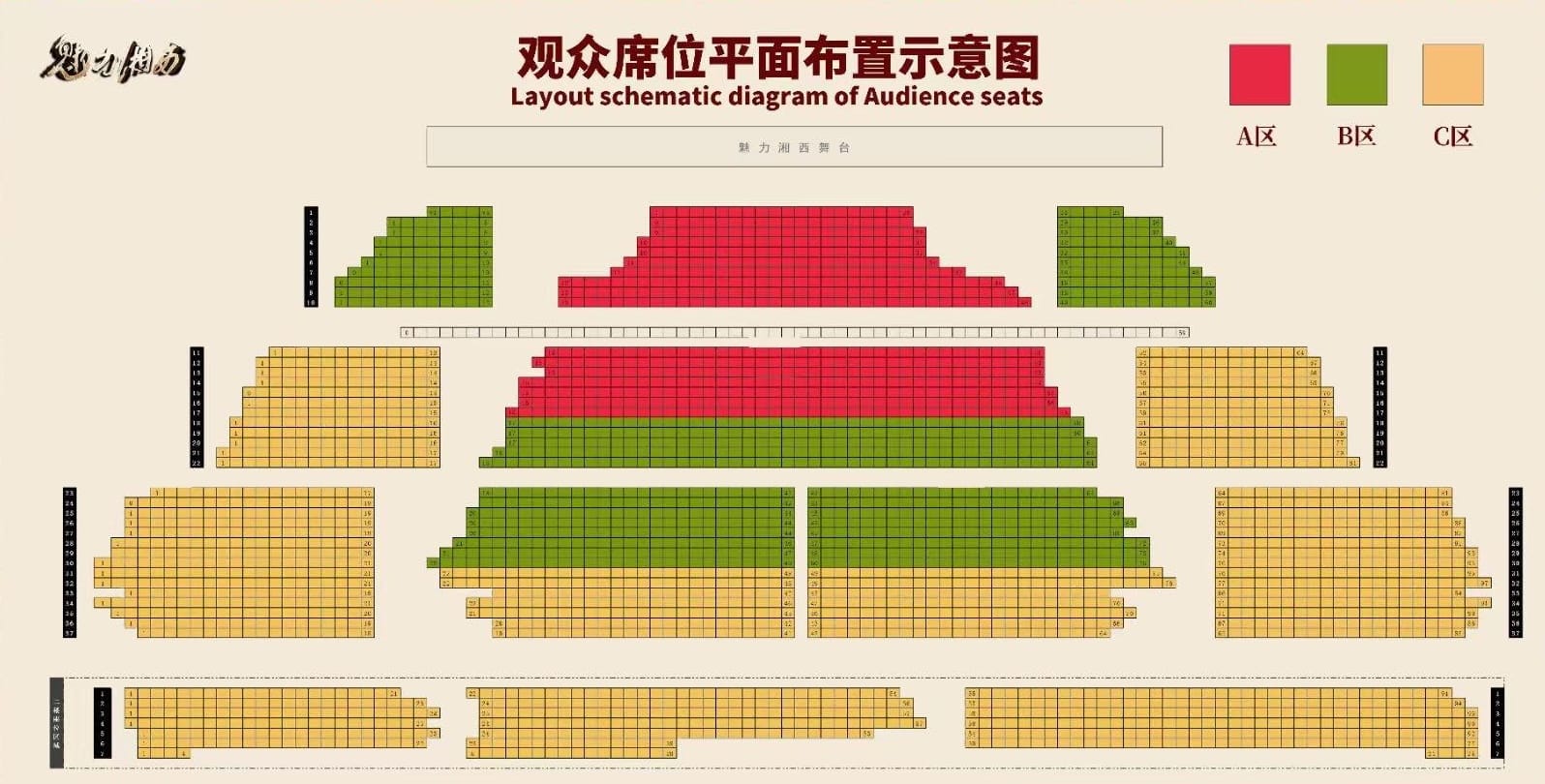
Three things worth knowing:
After the indoor show, the outdoor section includes acrobatics but also calligraphy auctions and traditional medicine sales from vendors set up in the area. The calligraphy is sold as “master works” — one show, dozens of copies. You can leave after the indoor portion if you prefer.
C zone rear corner seats have sightline problems. If you’re booking C, pick center rows.
If you’re on a guided tour, don’t purchase your own ticket. This show operates separate entry channels for tour groups and independent travelers. Buying independently while on a guided tour gets you turned away at the door with no refund. Your guide handles it.
Location: Charming Xiangxi International Cultural Plaza, Wulingyuan District. Next to the Pullman Zhangjiajie. About 1.5 km from the east gate of Zhangjiajie National Forest Park.
Children: Under 1.2 m free, no seat (must share with adult).
4. Zhangjiajie Qianguqing (张家界千古情)
More Than a Show
Operated by Songcheng Entertainment — the company behind the same-format productions in Hangzhou, Lijiang, and Sanya — this is the newest of the three major Zhangjiajie evening options, opening in 2019. On a May 2025 evening reported by Hunan Daily, the theater sold out completely. It has become a genuine anchor of the city’s evening economy.

The park opens at 3:00 PM and is worth treating as a half-day activity, not just a pre-show wait. Dayong Ancient Street has working craft demonstrations: Tujia brocade weaving, sugarcraft, rice cake pounding, nuo opera masks. The Peach Spring Realm area has a ghost house and a storm simulation room. There’s a central beach area that photographs well in summer. An amusement zone handles children well. Throughout the afternoon, unannounced performances break out — ethnic parades, a bonfire drum show, a comedy “lord recruitment” sketch, street acrobatics. One Chinese reviewer who came in low on expectations ended up on the rope bridge and, in her words, nearly traumatized in the ghost house. Not what she had planned.
The Evening Show

An hour-long performance across six acts: Shifting Sands and Seas (Zhangjiajie’s geological origins 380 million years ago, staged on a full-dome screen with aerial performers), Wuling Fairyland, The Legend of Tianzi Mountain, Small Town Memories (based on writer Shen Congwen’s portrayal of western Hunan), The Masang Tree (honoring the 40,000+ Zhangjiajie locals who died in the Red Army revolution), and Love in Western Hunan.
The moment that silences audiences: a practical flood sequence in which thousands of tons of water pour down the full stage face in seconds. The opening geological sequence, with aerial performers suspended above a full-dome projection, gets the same reaction. Chinese reviewers reach for “震撼” — thunderstruck — more than any other word.
What Audiences Say — Including the Criticism
Reviews split into two camps, and it’s worth knowing which you fall into before you go.
Those who rate Qianguqing above Charming Xiangxi point to the full-park experience: more to do, more value across an afternoon and evening, better for families, higher production technology. One viewer who’d seen both wrote directly that Qianguqing offered better value and she saw no reason to return to Charming Xiangxi.
Those who prefer Charming Xiangxi say Qianguqing covers western Hunan’s history broadly without going deep into any of it. The most pointed criticism: the second act, which centers on the Tujia hero Xiang Wangtianzi, contains a Korean drum dance sequence — apparently inserted for Korean market appeal. Audiences who caught it called it jarring. The commercial logic was understood. The artistic decision wasn’t.
Our read: both reactions are valid. Qianguqing delivers more total entertainment across an afternoon and evening. Charming Xiangxi delivers more cultural substance in a single sitting. For international visitors trying to understand western Hunan rather than just be impressed by it, that difference matters.
We don’t include Qianguqing in most of our guided tour itineraries — not because it falls short, but because the time and cost of Charming Xiangxi goes further for the cultural purpose we’re usually serving. For families with children, or for guests with a free afternoon and no interest in folk depth, the calculus flips.
2026 Ticket Details

Pricing:
- Regular seats ¥158;
- VIP ¥178;
- Super VIP ¥228;
- Luxury sofa seats ¥480.
- Children under 6 years old or under 1.2 m enter free.
Park opens 3:00 PM. Main show 7:00–8:00 PM depending on season. Park closes 30 minutes after the final show.
5. Which Show Should You See?

Staying downtown, one evening: Tianmen Fox Fairy. Nothing in China matches it for scale or originality. Getting there from Wulingyuan requires 45 minutes each way, so if you’re based there it’s a full evening commitment just in transport.
Staying in Wulingyuan, one evening: Charming Xiangxi. Walking distance or a short taxi from most hotels in the area. The indoor-outdoor structure gives you genuine cultural breadth without leaving the district.
Two or three evenings: See both Tianmen Fox Fairy and Charming Xiangxi on separate nights. They don’t overlap in what they offer. One is outdoor cinema on a living mountain. The other is live cultural variety inside a purpose-built theater. Every guest we’ve taken to both has been glad they didn’t choose.
Traveling with children: Qianguqing. The afternoon park gives families several hours of pre-show activity, and the main show works for all ages.
Fox Fairy vs. Charming Xiangxi — which is better? They’re not comparable in any useful way. Fox Fairy has no peer for visual scale. Charming Xiangxi has no peer for cultural depth. We’ve watched international guests tear up at both. The real question is where you’re sleeping and how many evenings you have.
6. Practical Tips From Our Guides
Booking timeline: For itinerary-based tours, Bree books Tianmen Fox Fairy 10 days ahead and Charming Xiangxi 3 days ahead. Independent travelers can usually book 1–2 days out in low season. During Golden Week and summer holidays, Charming Xiangxi sells out — don’t assume availability on the day.
Arrive before the mountain lights up. For Tianmen Fox Fairy, gates open at 7:00 PM for an 8:20 PM start. The canyon is illuminated before the show begins. Walking through it before taking your seat sets the scale in a way that arriving at 8:15 never will.
Rain isn’t a problem at Fox Fairy. The show runs in all weather. Raincoats are free. The practical nuisance is your phone and program notes. The atmosphere — mist dropping off lit cliffs — is often more striking than a clear night.
At Charming Xiangxi, context first. Read the show descriptions above before you arrive. Or find a guide who’ll give you the two-minute briefing. The gap between watching and understanding is real.
Outdoor section at Charming Xiangxi: Expect some standing time during the transition. Wear shoes you can be on your feet in. The bonfire area gets smoky depending on wind. The vendor section is easy to skip.
Chinese platforms are cheaper. Ctrip and Meituan both list these shows, usually at lower prices than English-language booking platforms. You’ll need your passport name and number to book — have it ready.
7. FAQ – Zhangjiajie Night Shows
Do the shows have English subtitles?
Tianmen Fox Fairy has subtitles in English, Korean, and Japanese. Charming Xiangxi and Qianguqing are predominantly visual and musical — you don’t need to understand the language to follow them.
Are they suitable for children?
All three, yes — with one caveat. At Charming Xiangxi, the Ganshi segment is designed to unsettle, and the show warns you in the program notes. The outdoor acrobatics use real blades and fire. We’d still take children, but we’d tell them what’s coming first.
What if it rains at Tianmen Fox Fairy?
What if it rains at Tianmen Fox Fairy? Show runs. Raincoats are free. Mist on the mountain is often better atmosphere, not worse.
Can I do Fox Fairy and Charming Xiangxi the same night?
Not really. They’re 45 minutes apart. Each runs over an hour. One per evening.
What happened to the Encounter Dayong show?
Dayong Ancient City, which housed Encounter Dayong (遇见大庸), went into bankruptcy in September 2024 after accumulating over ¥1 billion in losses. As of 2026, restructuring is underway with Hunan Broadcasting and the local government. Target reopening is sometime in 2026, but nothing is confirmed. Don’t factor it into your trip.
Is Qianguqing the same as the Hangzhou and Lijiang Romance shows?
Same operator, same format. The content is specific to Zhangjiajie, but if you’ve seen another Songcheng production, the structure will be familiar.
Do I need a guide for any of these?
No. All three are accessible independently. For Fox Fairy specifically, two minutes of plot context before the show starts makes a noticeable difference. If you’re going alone, the story summary above will do it.
Travel China With Me runs private guided tours to Zhangjiajie for international visitors. We can arrange tickets, evening transport, and a pre-show briefing for any of the shows above. Contact to let us know how can we help.