Where to See Wild Monkeys in China: Beyond the Tourist Trail
China is one of the best countries in the world to see wild monkeys in their natural habitat. We’re talking about rare golden snub-nosed monkeys with blue faces surviving at 4,000 meters altitude, bold Tibetan macaques that have mastered stealing from tourists, and critically endangered species found nowhere else on Earth.
We’ve guided dozens of wildlife-focused trips across China’s monkey habitats over the past 20+ years. This guide shares the 11 best locations to see wild monkeys—from the famous Mount Emei where success rates hit 95%, to lesser-known mountains like Shibao and Xichang Lushan that most English-language guides completely miss.
You’ll learn which locations are safe for families, which require serious hiking, where to see all five of China’s golden monkey subspecies, and the honest truth about aggressive behavior that other guides won’t mention. Whether you want guaranteed sightings in a weekend or a two-week expedition chasing the world’s rarest primates, this guide covers it.
What makes this different: We include locations rarely covered in English (Shibao Mountain, Xichang Lushan, Zhouzhi Reserve), real safety incidents with specific solutions, and honest assessments of what actually works versus what sounds good in theory.
Table of Contents
Understanding China’s Monkey Species

Tibetan Macaques: Largest macaques (up to 20kg), thick gray-brown fur, dog-like faces. Bold around humans, occasionally aggressive, extraordinarily intelligent. Found: Mount Emei, Huangshan, Xichang Lushan.

Rhesus Macaques: Smaller (6-10kg), brown fur, pink faces. Most adaptable to human environments. Found: Zhangjiajie, Shibao Mountain, throughout China.
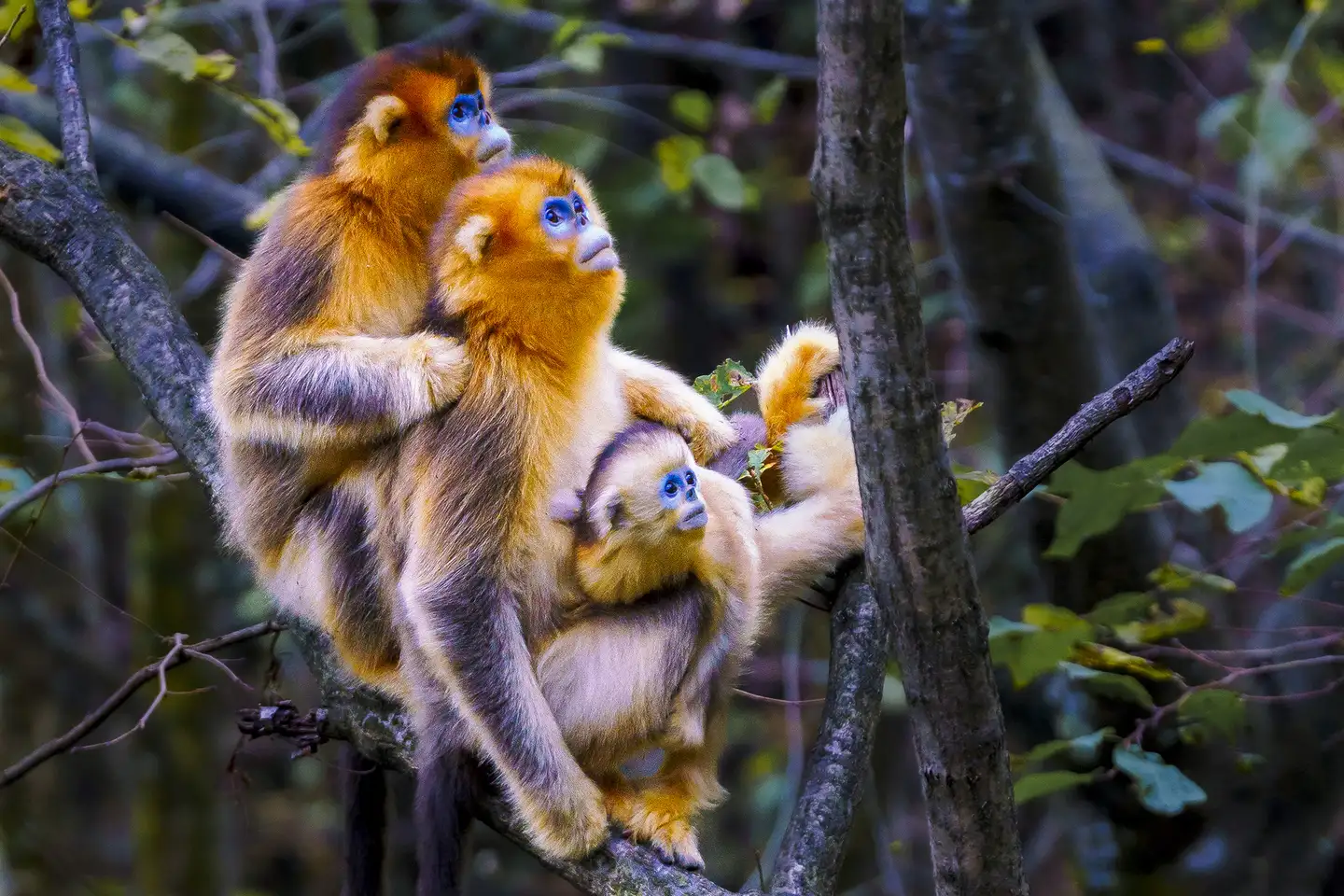
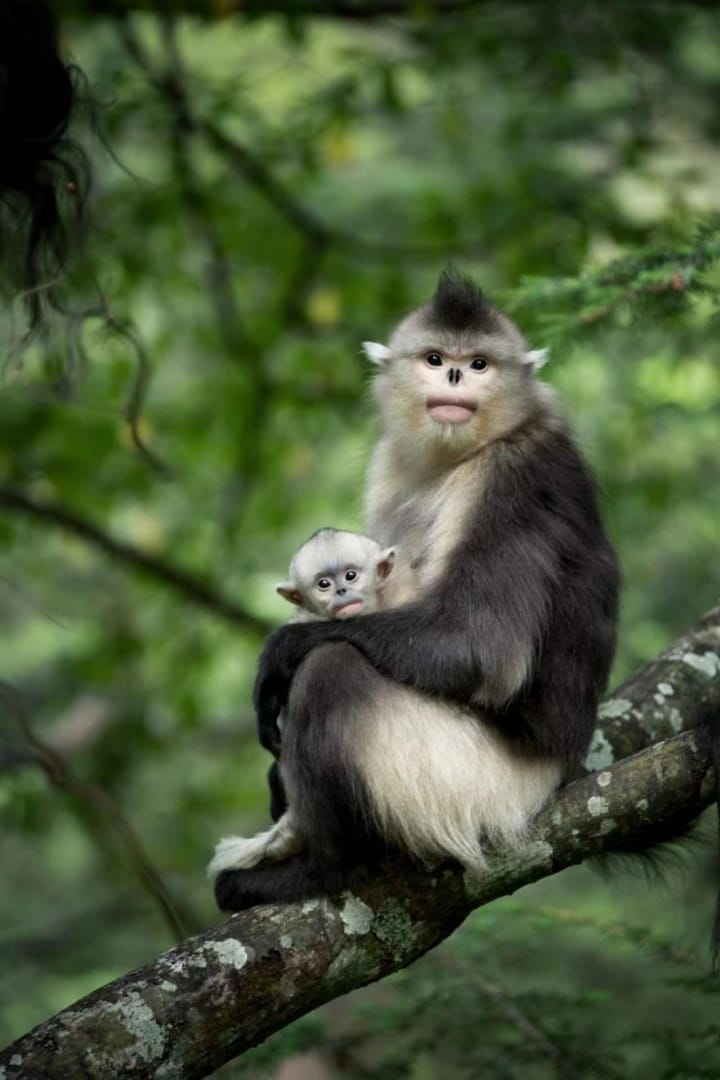


Golden Snub-Nosed Monkeys (three subspecies):
- Sichuan (R. r. roxellana): Golden fur, blue face, ~10,000 individuals. Found: Sichuan/Gansu mountains including Shennongjia (Hubei subspecies), Pingwu
- Qinling (R. r. qinlingensis): Shorter tail, larger head, ~2,000 individuals. Found: Shaanxi Qinling Mountains (Zhouzhi, Foping)
- Yunnan (R. bieti): Black-white fur, pink face, ~3,000 total. Found: Northwest Yunnan
- Guizhou (separate species): ~850 individuals. Found: Only Fanjing Mountain
All golden species face habitat loss and hunting pressure but conservation efforts are working—populations recovering in protected areas.
Quick Comparison Guide
Location | Monkey Type | Accessibility | Success Rate | Unique Feature | Who It’s For |
|---|---|---|---|---|---|
Mount Emei | Tibetan Macaque | Easy | 95%+ | Guaranteed sightings | First-timers |
Xichang Lushan | Macaque | Easy | 90%+ | Aggressive/dangerous | Adventure seekers only |
Zhangjiajie | Rhesus Macaque | Moderate | 80%+ | Avatar scenery | Scenery + wildlife combo |
Shibao Mountain | Rhesus Macaque | Easy | 70%+ | Hidden gem, authentic | Off-the-beaten-path travelers |
Jizu Mountain | Rhesus Macaque | Moderate | 70%+ | Buddhist pilgrimage + wildlife | Cultural + wildlife combo |
Shennongjia | Golden Snub-Nosed | Moderate | 70%+ | Best golden monkey experience | Serious wildlife watchers |
Zhouzhi, Shaanxi | Golden Snub-Nosed (Qinling) | Difficult | Variable | Largest population | Researchers/photographers |
Pingwu | Golden Snub-Nosed (Sichuan) | Moderate | 95%+ | Semi-wild guaranteed viewing | Families, guaranteed viewing |
Yunnan Baima | Yunnan Golden Monkey | Difficult | 60-70% | Rarest species, highest altitude | Hardcore wildlife enthusiasts |
Fanjing Mountain | Guizhou Golden Monkey | Moderate-Difficult | Research center: 100% | Rarest subspecies (850 total) | Conservation-minded travelers |
Huangshan | Tibetan Macaque | Easy | 70%+ | UNESCO scenery + endemic subspecies | Classic China + wildlife |
Overview: China’s Wild Monkey Destinations
1. Mount Emei, Sichuan: The Bold and the Brazen
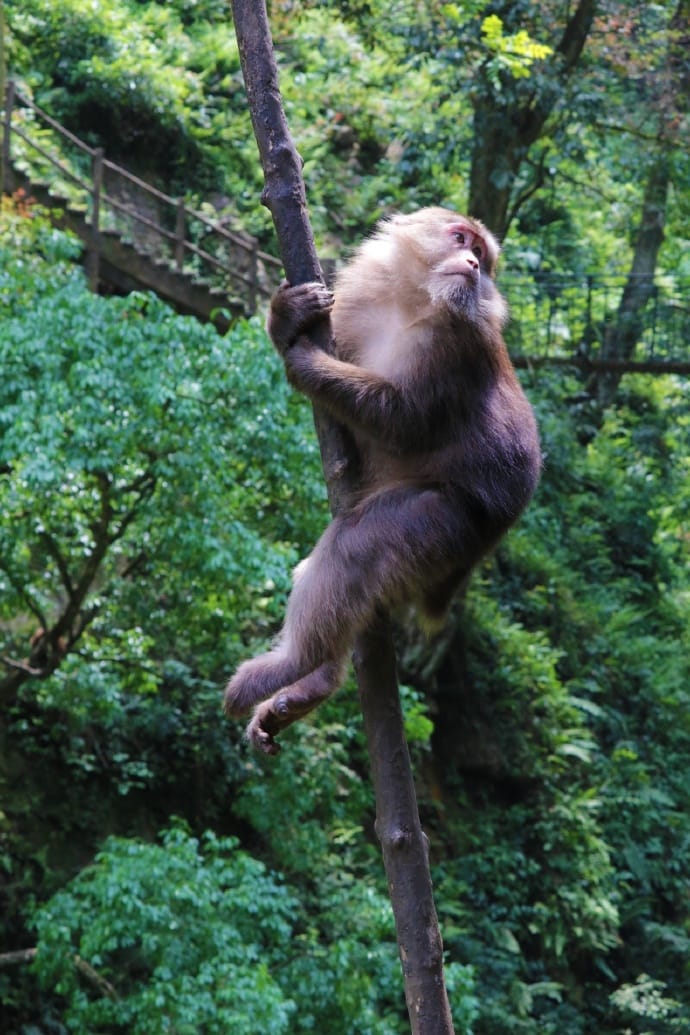
Mount Emei‘s Tibetan macaques have mastered human psychology. On the trail between Qingyin Pavilion and Hongchunping, troops of 20-40 monkeys control access like organized crime syndicates. One distracts while another raids bags. Juveniles practice theft on patient elders.
During a spring visit, we watched an adult male block a narrow trail section. He sat there, deliberately preventing passage, until every tourist gave him space. No aggression necessary—just quiet dominance. Once everyone passed, he moved on.
The reality: These monkeys bite more than any other population in China. Mount Emei recorded dozens of incidents last year alone. They’re not vicious, just conditioned. Visible food triggers feeding responses, and frustrated monkeys escalate.
What works: Arrive before 9 AM. Buy bamboo walking sticks (¥5-10) at the entrance—locals use them constantly. Wear cross-body bags with inward zippers. Hide all food, even sealed packages.
Cost: ¥160 entrance + ¥90 bus (round trip)
Success rate: 95%+
Best months: April-May, September-November
2. Xichang Lushan, Sichuan: The Dangerous Truth
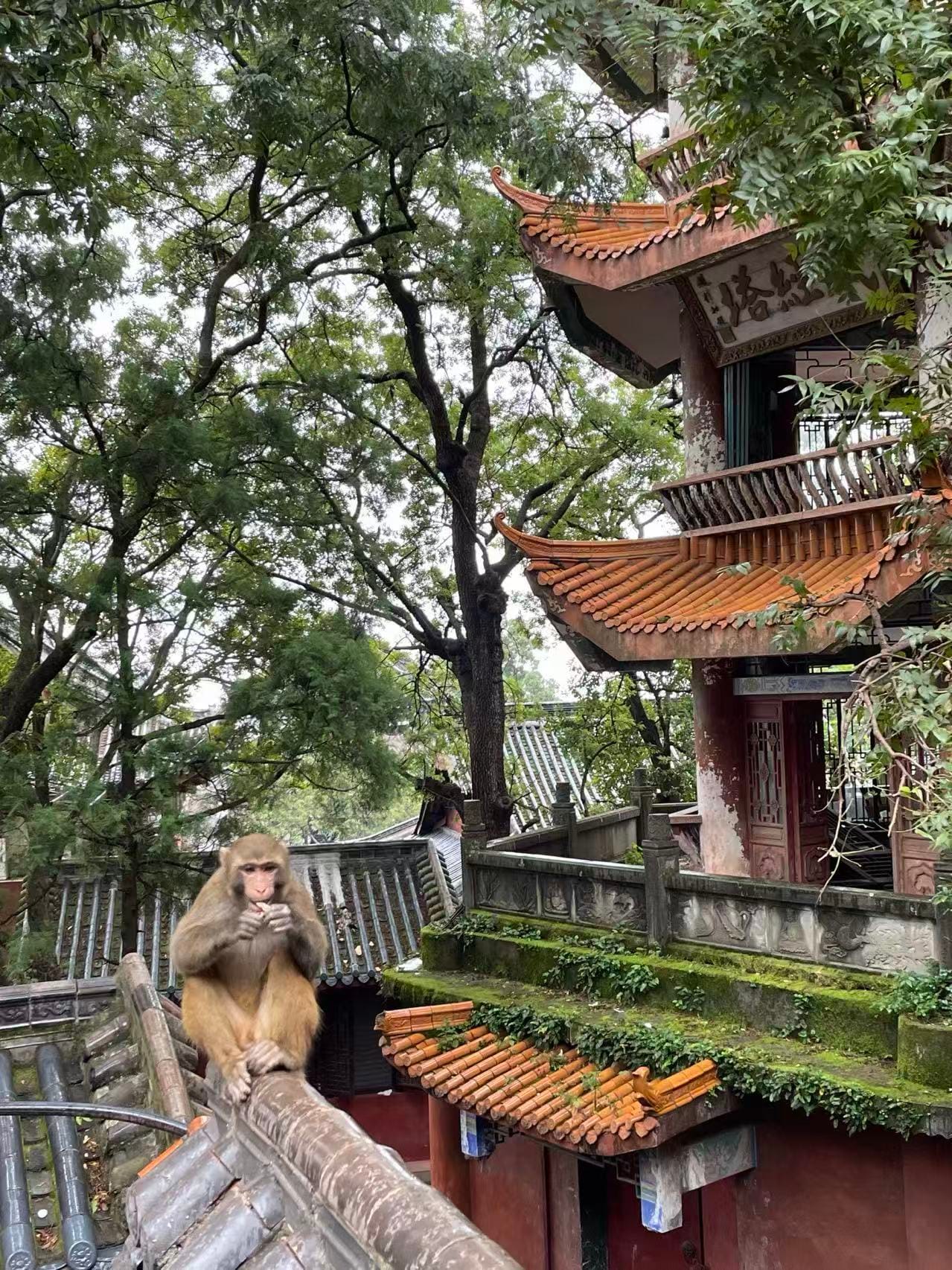
Lushan Mountain sits beside Qionghai Lake, 5km from Xichang city. It hosts over 200 macaques with a dangerous reputation that Chinese media covers but English guides ignore.
In 2018, monkeys chased a 65-year-old tourist down the mountain. He fell, struck his head, and died. From December 2017 to July 2018, more than 40 tourists reported injuries. We visited in 2024. The monkeys around Guangfu Temple are aggressive—particularly near the summit parking area.
What makes Lushan different? Decades of tourist feeding created dependency and aggression. One traveler described a monkey leaping onto her companion’s shoulder, grabbing food from an unzipped pocket, fleeing—all in seconds.
The mountain itself is beautiful. The summit offers panoramic lake views. Guangfu Temple dates to the Tang Dynasty. But monkey encounters feel desperate rather than wild.
Our take: If you’re risk-averse, skip it. If you’re comfortable managing unpredictable situations and want less-touristy locations, consider carefully.
Cost: Free entrance, ¥5 bus or ¥40 cable car
Risk level: High
Best avoided if: Traveling with children or elderly
3. Zhangjiajie, Hunan: Wild Encounters in Avatar Landscapes

Zhangjiajie‘s sandstone pillars inspired Avatar’s floating mountains. The rhesus macaques living among these peaks remain more naturally wild than Mount Emei’s habituated troops.
Golden Whip Stream delivers the most reliable sightings. The 7km trail follows pristine creeks through towering pillars. Multiple macaque troops claim territories along the route. We’ve watched them fishing in pools, teaching juveniles to navigate cliffs, grooming for hours.
What separates Zhangjiajie? Distance. These monkeys haven’t become completely habituated. They’re curious but cautious. You see natural behavior—foraging, social interactions, territorial disputes—without aggressive food-seeking.
The caveat: some monkeys have learned tourist patterns. In 2024, unprovoked bite reports increased, particularly in high-traffic areas. Secure bags, hide food, maintain distance.
Cost: ¥225 entrance (valid 3 days)
Success rate: 80%+
Combine with: Avatar glass bridge, stunning karst scenery
Time needed: 2-3 days minimum
4. Shibao Mountain, Yunnan: The Hidden Gem

Shibaoshan Mountain sits in Dali Prefecture near Shaxi Ancient Town. Most travelers visit for the 1,100-year-old Shizhongshan Grottoes. The wild macaques are an unexpected bonus.
Around Baoxiang Temple, built into cliff faces, a large rhesus troop has claimed territory. These monkeys arrived about 20 years ago and maintain more natural behavior than aggressive populations elsewhere.
We spent an afternoon watching them. Mothers groomed infants. Juveniles practiced acrobatic leaps. Adult males patrolled borders. They approached tourists but rarely aggressively—more curiosity than demand.
The combination: ancient grottoes, Buddhist temples, wild macaques, and authentic Bai minority culture makes this one of our favorite less-known destinations.
Cost: ¥45 entrance
Stay: Shaxi Ancient Town (remarkably preserved Bai settlement)
Best time: Late July during Bai folk song festival
Crowd level: Low
5. Jizu Mountain, Yunnan: Buddhist Pilgrimage Meets Wild Encounters
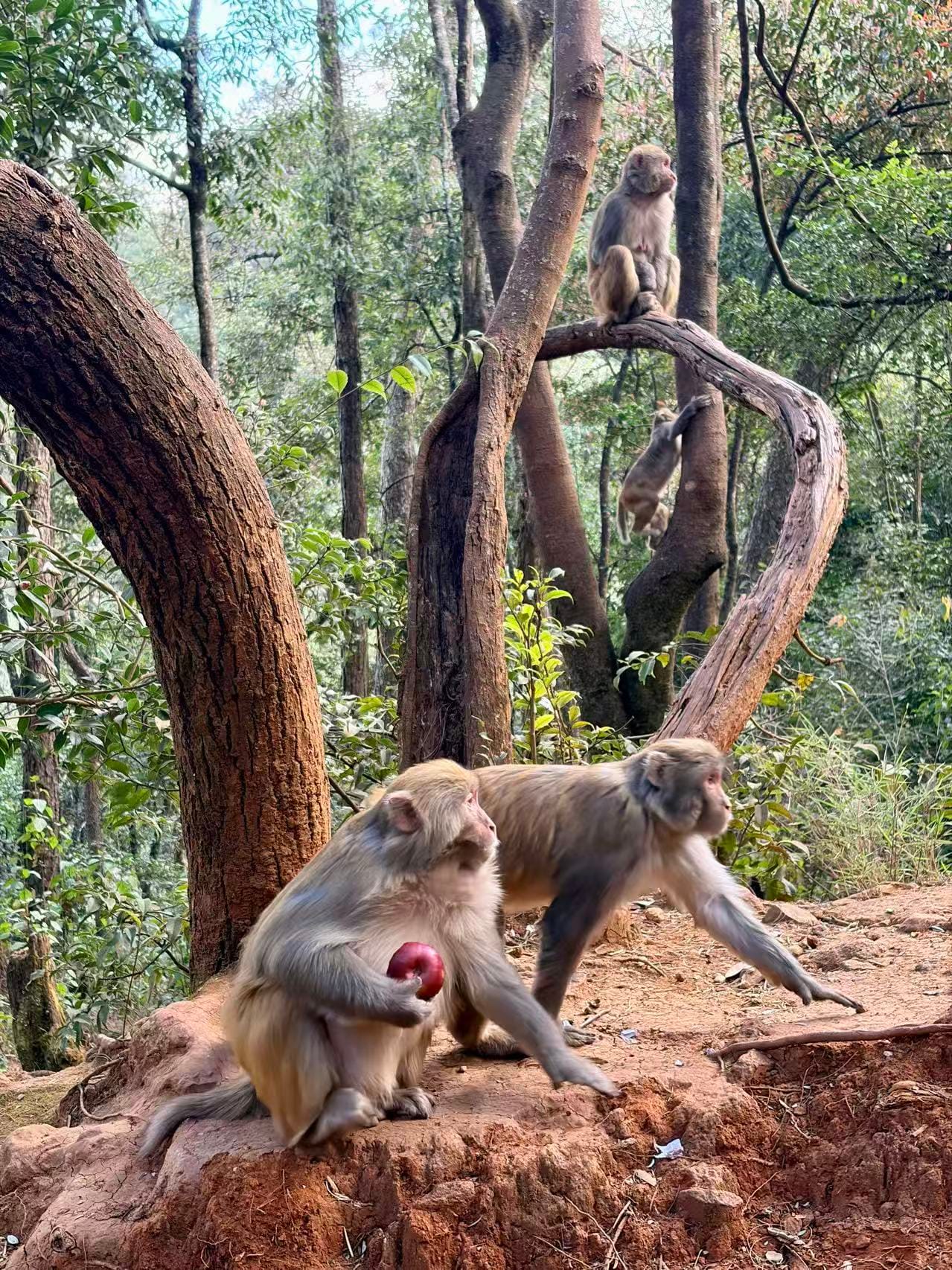
Jizu Mountain in Binchuan County near Dali is one of China’s most important Buddhist mountains. The 3,240-meter peak hosts dozens of temples and attracts Tibetan pilgrims who crawl and kowtow from base to summit. What most guides don’t mention: wild macaques live along the hiking trails.
The monkeys appear frequently on the path up to the Golden Summit (Jinding Temple). Recent visitors report encountering “little monkeys” throughout their hike, particularly between Zhusheng Temple and the upper sections. These are rhesus macaques that have learned to coexist with the thousands of pilgrims and tourists climbing the mountain.
Unlike aggressive populations elsewhere, Jizu’s monkeys seem more accustomed to Buddhist pilgrims than typical tourists. The atmosphere here is different—quieter, more spiritual. Tibetan worshippers pray continuously as they ascend, creating a reverent energy that seems to affect even the wildlife.
What makes it unique: The combination of serious Buddhist pilgrimage culture, stunning views (sunrise from the east, Erhai Lake to the west, Yulong Snow Mountain to the north), and wild monkey sightings. The famous “Monkey Staircase” near the summit got its name because the steps are so steep that even humans must scramble on hands and knees.
Practical notes: The mountain has experienced “touristification” in recent years. Food vendors now line the path to Jinding Temple. But the spiritual atmosphere persists, especially if you stay overnight at summit inns and watch sunrise.
Cost: ¥55 entrance
Access: 90-minute drive from Dali, direct shuttle bus from Dali Ancient Town (departs 8:30 AM)
Stay: Summit inns available for sunrise viewing
Warning: Large temperature differences between day and night, bring warm layers, don’t feed the monkeys
6. Shennongjia, Hubei: The Golden Ghost
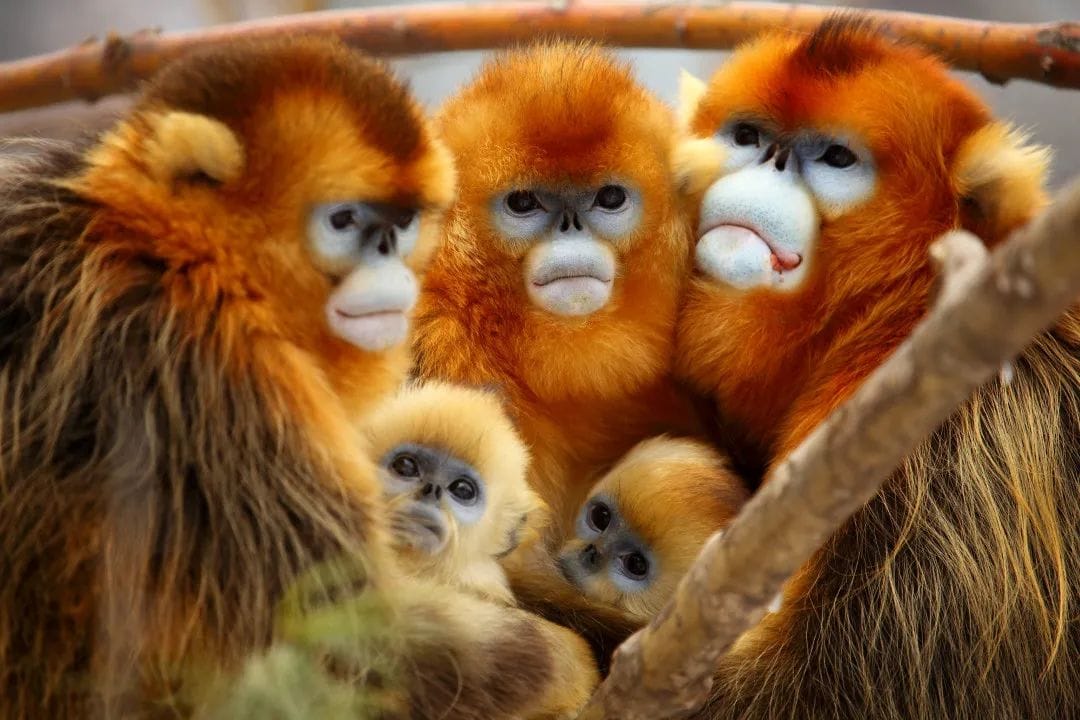
Dalongtan Research Base in Shennongjia National Park offers something unique—a habituated golden snub-nosed monkey troop studied since 2006. This isn’t captivity. The monkeys live wild in surrounding forest, descending to feeding stations when researchers call.
We arrived before dawn in October. Temperature: 2°C. The valley was silent except for wind through pines. At 8:30 AM, guttural vocalizations echoed through trees. Then they appeared.
Golden snub-nosed monkeys look bizarre. Thick golden fur covers their bodies. Pale blue faces, almost alien. Adult males reach 15kg. They leap 6-meter gaps between trees effortlessly.
What struck us most: social complexity. Adult males maintained perimeter positions, scanning for threats. Females clustered around infants. Juveniles engaged in elaborate chasing games. When one infant ventured too far, an adult female retrieved it with specific vocalizations—targeted communication, not general alarm calls.
The population has tripled from 500 (1990) to 1,618 (2025)—genuine conservation success.
Access: 3 hours from Shennongjia town, arrange transport through hotels
Cost: ¥159-299 depending on season
Best viewing: 8:00-11:00 AM when monkeys descend
What to bring: Warm layers (freezing at altitude), 200-400mm camera lens
Success rate: 70%+
7. Zhouzhi National Nature Reserve, Shaanxi: The Qinling Giants
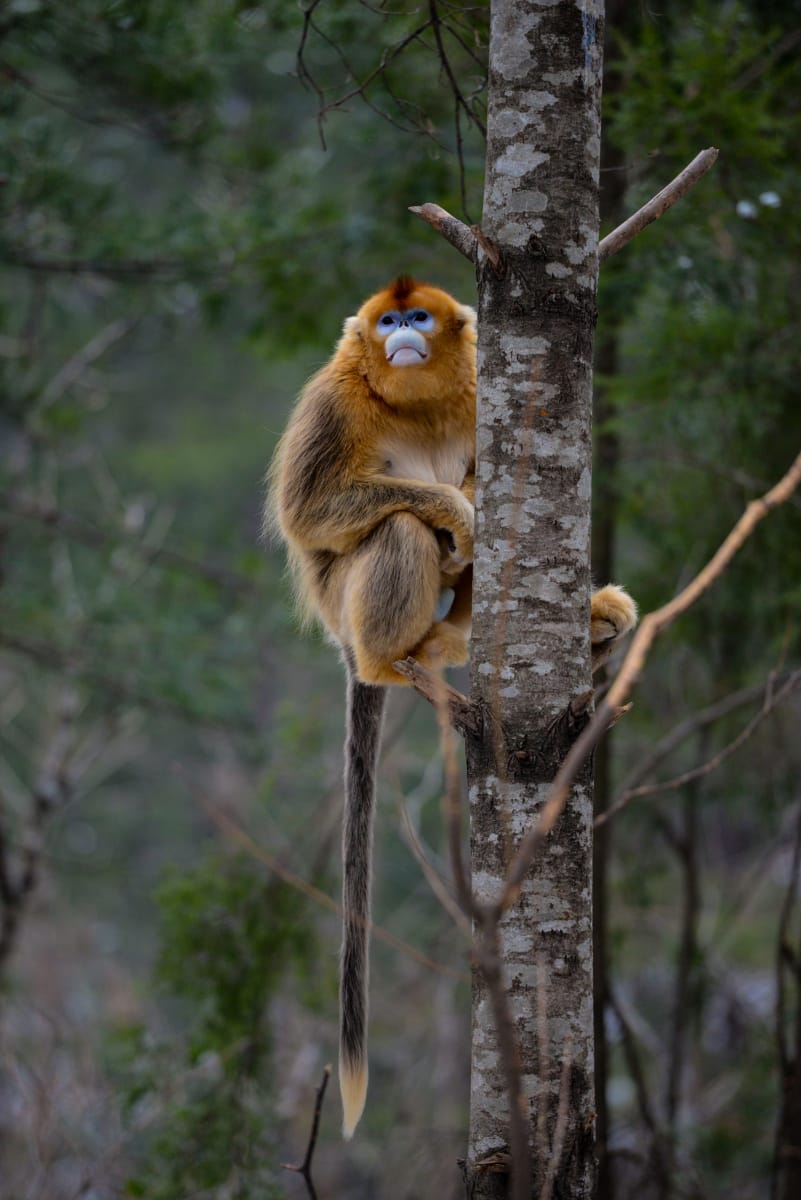
Zhouzhi in Shaanxi Province’s Qinling Mountains hosts China’s largest golden monkey population—approximately 2,000 individuals in 24 family groups. This is the Qinling subspecies, with shorter tails and larger heads than their Sichuan cousins.
Yuhuangmiao monitoring station attracts 270+ monkeys daily during spring-summer observation seasons. Researchers from Northwest University have studied this population for decades.
The challenge: Visiting isn’t straightforward. The reserve has restricted public access in recent years. Some travelers report being turned away even at Yuhuangmiao. Others successfully arranged visits through local contacts or nature photography groups.
Population: 2,000 individuals (increased from 1,200)
Distribution: Southern and northern Qinling slopes
Access: Complex—requires local contacts or official permits
Alternative: Foping National Nature Reserve (western neighbor, also has golden monkeys)
8. Pingwu, Sichuan: Semi-Wild Experience

Pingwu County in northern Sichuan operates a unique golden monkey viewing area within its nature reserve. It’s not captivity, not pure wilderness—something in between. Four families totaling 45+ monkeys live in an unenclosed forest area where they’re loosely kept for tourism.
Rangers move the troops within the area annually each May. Baby season runs March-April. The area involves 20-30 minutes walking on paved stairs through unmodified forest.
Perspective: This feels like “cheating” if you want pure wilderness. But it offers guaranteed close-up views of Sichuan golden monkeys—otherwise extraordinarily difficult to see wild.
Cost: ¥60 per person, stay all day
Hours: 9 AM – 4 PM
Combine with: Tangjiahe Nature Reserve for more wildlife
Access: 3-4 hours from Chengdu
9. Yunnan Snub-Nosed Golden Monkey National Park: The Highest Dwellers

Photo by Way Wang, 16 Apr 2020
North of Shangri-La, accessible via rough three-hour drive, Baima Snow Mountain protects the Yunnan golden monkey—the world’s highest-dwelling primate at 3,000-4,500m altitude.
Only 3,000 survive globally. These black-and-white monkeys with pink faces live where temperatures plunge below -20°C. Their primary diet? Lichens growing on old-growth trees—a food source requiring pristine, undisturbed forests.
Park authorities track troops daily, providing 9:30 AM feeding sessions encouraging monkeys to accessible elevations. Success: the local population tripled from 200 to 600 since 2000.
We visited in April. Morning temperature: 2°C. Breath fogged. When monkeys appeared, they moved silently through trees above us. One infant clung to its mother’s back, tiny pink face peeking from black fur.
Cost: ¥70 entrance + ¥50 shuttle cart
Success rate: 75%
Challenges: High altitude causes breathlessness, weather unpredictable, remote location
Time needed: 2 hours.
10. Fanjing Mountain, Guizhou: The Rarest of the Rare
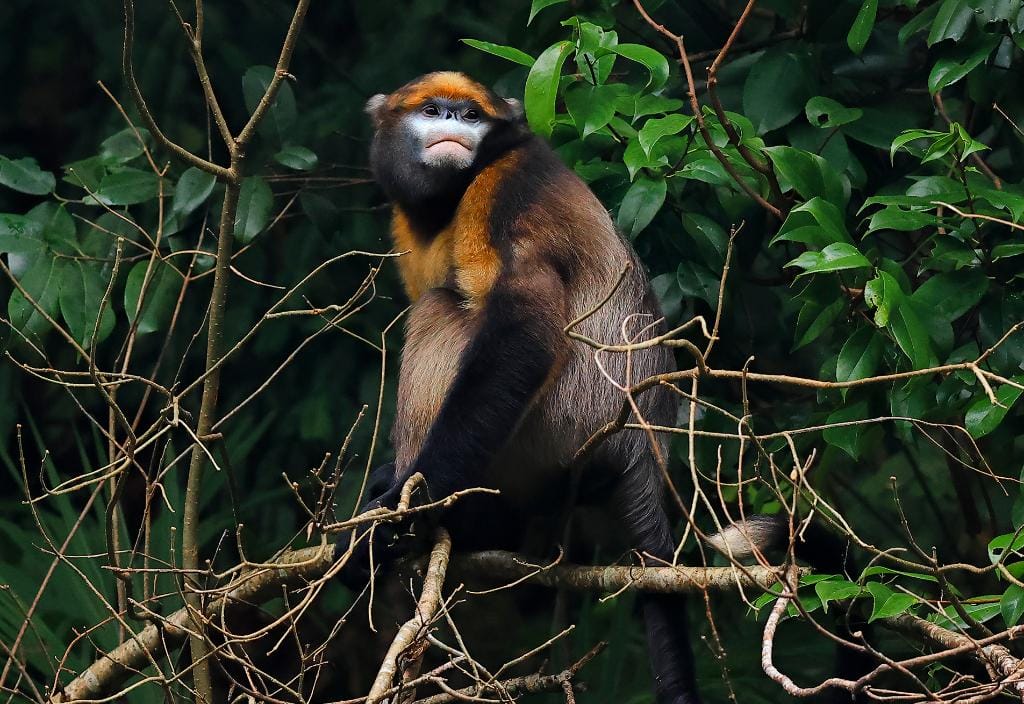
Photo by Xinhua News Agency reporter Yang Ying.
Fanjing Mountain in Guizhou Province made UNESCO World Heritage status in 2018. The 2,570m peak is a Buddhist holy mountain with temples clinging to impossible cliffs. It’s the only habitat for approximately 850 Guizhou golden snub-nosed monkeys—colloquially called “Fanjing Mountain ghosts.”
The Guizhou subspecies is rarest and least understood among golden monkeys. Wild sightings are extraordinarily rare. In February 2025, Fanjing opened its Golden Snub-Nosed Monkey Research Center to the public for the first time—the best opportunity most visitors will have to see this critically endangered species.
The center houses nine captive monkeys for breeding and research. The wild population roams Fanjing’s 282-square-kilometer core area between 600-2,200m elevation. Rangers track them with drones and infrared cameras.
What makes Fanjing special: The combination—ancient Buddhist heritage, bizarre geological formations (Red Cloud Golden Summit, Mushroom Rock), pristine wilderness, and fewer than 850 wild monkeys surviving anywhere.
Cost: ¥110-150 depending on season/cable cars
Time needed: Full day (strenuous hiking)
Highlight: Research center for guaranteed viewing
11. Huangshan: Monkeys Among Twisted Pines
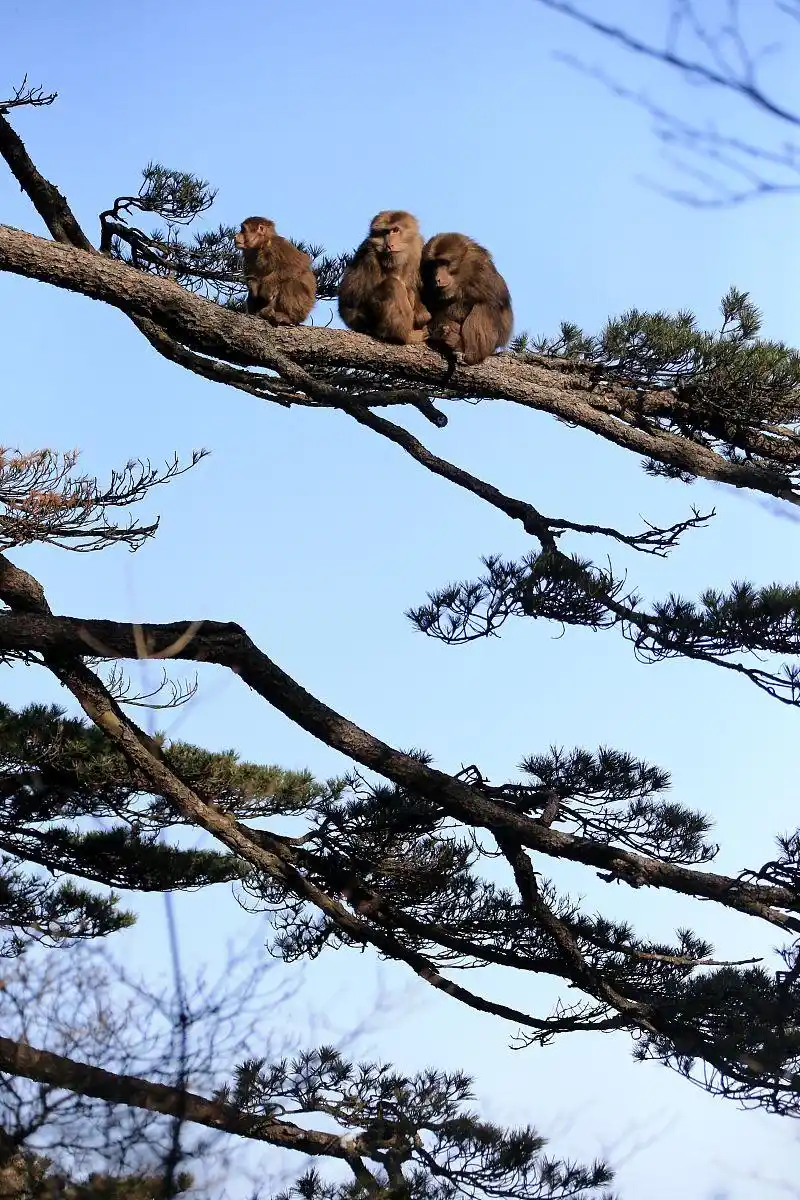
Yellow Mountain needs no introduction. Those granite peaks, twisted pines, and sea of clouds appear in countless Chinese paintings. The Huangshan short-tailed macaque—found nowhere else—lives here as an endemic subspecies.
The Valley of Wild Monkeys near the southwest entrance serves as a research base for international zoologists. Unlike Mount Emei’s aggressive troops, Huangshan’s monkeys maintain better boundaries. They’re habituated but less demanding. Bite reports are significantly lower.
We watched a grooming session near the valley entrance. An adult female carefully picked through an infant’s fur while others formed a loose circle. Males sat nearby, relaxed but attentive. When a tourist approached too close, one male stood up—just stood up—and the tourist immediately backed away. Body language sufficed.
Advantage: Easy to combine monkey watching with Huangshan’s famous scenery, sunrise over clouds, ancient temples.
Cost: ¥190 entrance (high season)
Accessibility: Cable cars reach most viewpoints
Best seasons: Spring (March-May), Autumn (September-November)
Safety: What Actually Works
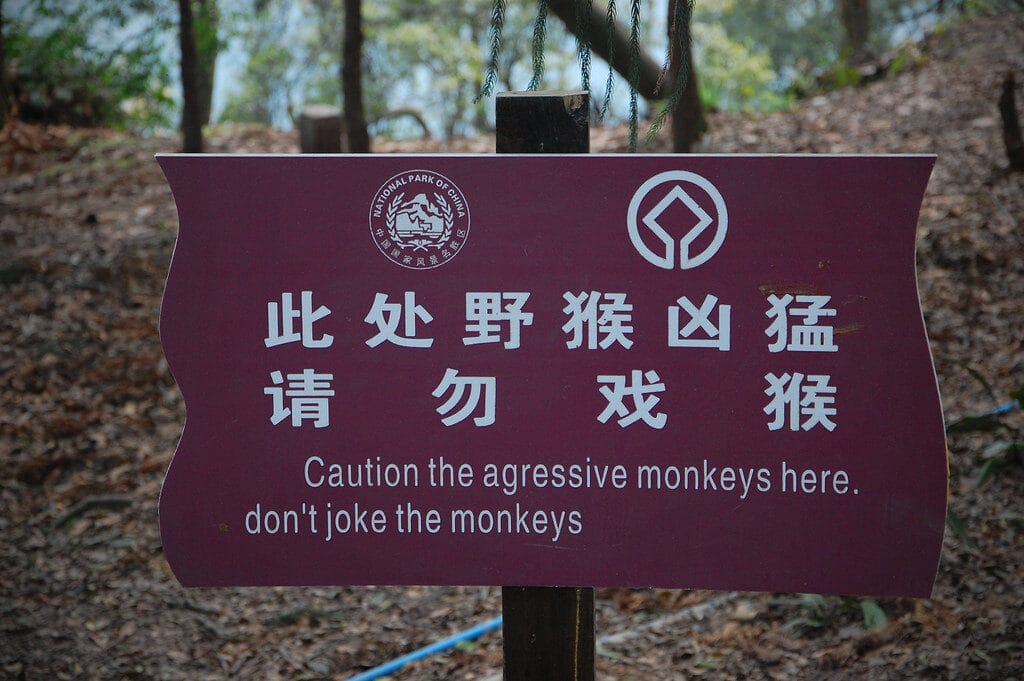
Wild monkeys can and do bite. Chinese hospitals near major sites stock rabies vaccines. Treatment costs ¥300-800.
The rules that actually prevent incidents:
Before you go:
- Cross-body bags with inward-facing zippers
- No visible plastic bags (monkeys associate them with food)
- Hide all food completely, even sealed packages
- Wear secure pockets
During encounters:
- Arrive early (before 9 AM reduces aggressive behavior dramatically)
- Buy bamboo walking sticks—hold between you and approaching monkeys
- Never stare directly at monkeys (it’s challenging/threatening in primate communication)
- Don’t reach toward monkeys, especially babies
- If approached: freeze, don’t run, back away slowly once interest passes
If bitten:
- Wash immediately with soap and water (15+ minutes)
- Find rangers or first aid
- Get to hospital within 24 hours for rabies prophylaxis
- Report to park authorities
Note: Chinese travel insurance often excludes animal attacks. Check your policy.
When to Visit
Autumn (September-November) is ideal. Clear weather, minimal rain, comfortable temperatures, monkeys actively feeding before winter, crowds drop after October Golden Week.
Spring (March-May) brings baby season (mothers with clinging infants), comfortable hiking temperatures, flowers blooming. April can bring rain.
Summer (June-August) means longer daylight, but peak domestic tourism, crowds, and afternoon thunderstorms.
Winter (December-February) makes golden snub-nosed monkeys easiest to see (they come to feeding stations), stunning snowy landscapes, lowest tourist numbers. But extreme cold at high elevations, many trails closed, macaques less active.
Avoid Chinese holidays: Spring Festival (February), Qingming (early April), Labor Day (early May), National Day (Oct 1-7). Prices double, crowds triple, monkey behavior becomes stressed.
FAQs: Wild Monkeys in China
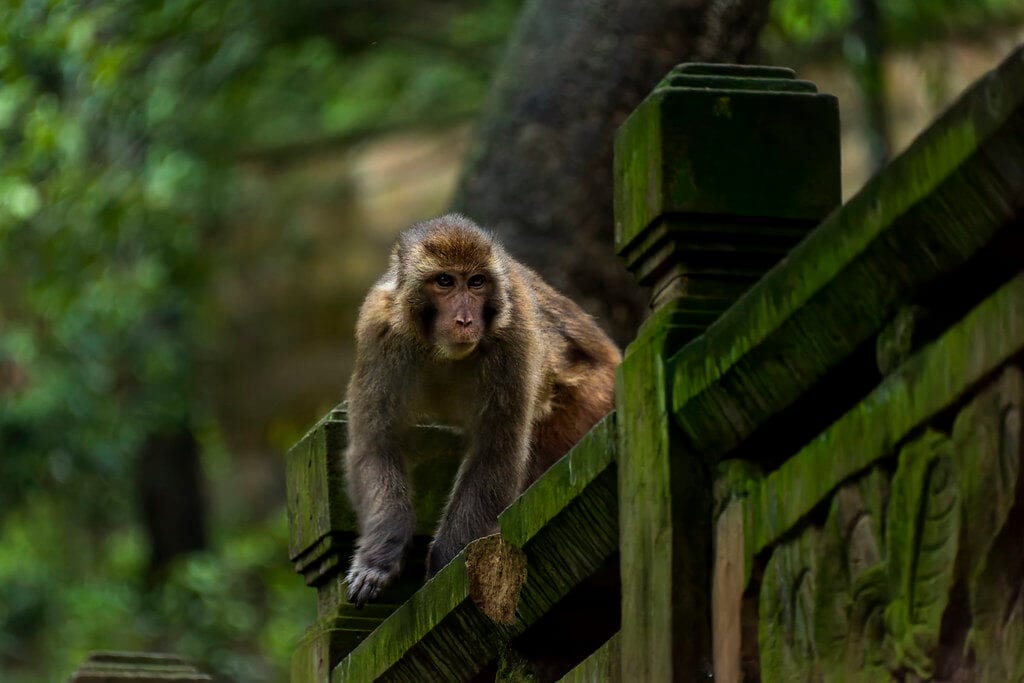
What’s the best location for first-timers?
Mount Emei. Near-guaranteed sightings, excellent accessibility, developed infrastructure. Just follow safety guidelines for aggressive behavior.
Can I see golden monkeys without going to remote locations?
Pingwu offers semi-wild guaranteed viewing closest to Chengdu (3-4 hours). Shennongjia is more remote but delivers the most authentic wild experience.
How dangerous are the monkeys really?
Mount Emei and Xichang Lushan report the most incidents. Follow safety rules—secure bags, hide food, maintain distance—and risk is manageable. Thousands visit safely yearly.
Is supplemental feeding at research bases ethical?
Controversial. Critics say it creates dependency. Proponents note it enables research and protects one habituated group while wild populations remain elsewhere. Chinese conservation scientists generally support the practice for study groups.
Best month overall?
Mid-to-late October. National Day crowds dispersed, weather reliably clear, comfortable temperatures, autumn colors peak.
The Bottom Line
China’s wild monkeys offer something increasingly rare—genuine wildlife encounters in spectacular settings. These aren’t tamed zoo animals. They’re wild populations surviving in changing environments.
Mount Emei delivers guaranteed sightings but aggressive behavior. Zhangjiajie combines stunning scenery with more natural monkey behavior. Shennongjia and other golden monkey locations require more effort but reward serious wildlife enthusiasts.
The conservation context matters. Your visits fund protection. Golden monkey populations are recovering—from near extinction to slow growth. That’s worth supporting.
Pack your camera. Bring patience. Follow safety guidelines. And prepare for encounters you’ll remember long after leaving China.
Planning a wild monkey adventure? We specialize in wildlife-focused itineraries combining multiple locations based on your interests, fitness level, and schedule. Contact Travel China With Me for trip planning that goes beyond guidebooks.