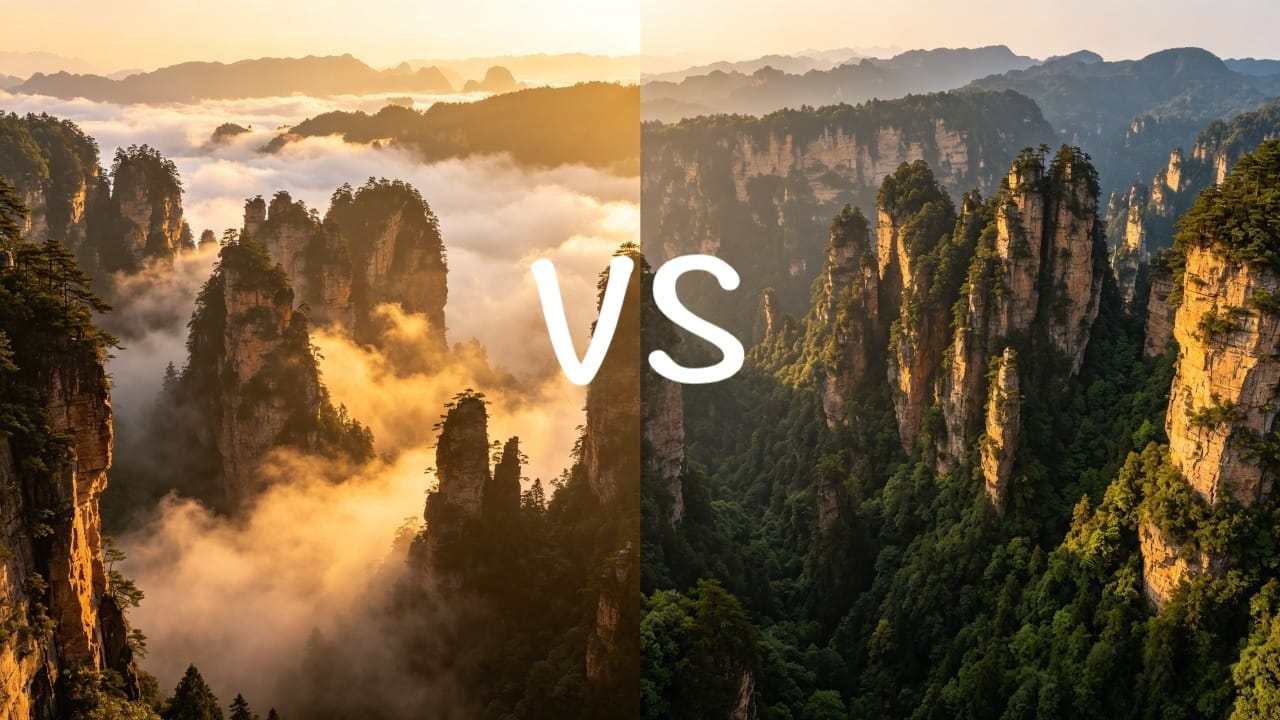
Yangjiajie vs Huangshizhai: Which Zhangjiajie Area to Pick
Inside Zhangjiajie National Forest Park, one area gets most of the attention: Yuanjiajie, home to the “floating Avatar mountains,” lands on nearly everyone’s must-see list by default. Yangjiajie and Huangshizhai are the park’s forgotten counterparts — just as rewarding, far less crowded, and usually skipped outright. Yangjiajie vs Huangshizhai deserves a real comparison, not a footnote.
Most visitors show up not knowing which one is worth the detour. The short answer: Huangshizhai is the easier, more reliable choice for most visitors; Yangjiajie is for those who want a real hike and don’t mind the effort. We’ve guided travelers through both since 2006 — here’s the full breakdown.
TL;DR: Yangjiajie vs Huangshizhai
- Choose Huangshizhai if: you want the best all-round panoramic view with the least physical demand, you’re traveling with anyone over 50 or under 10, or you have one day in the park
- Choose Yangjiajie if: you want a genuine hike with hands-on scrambling, crowds actively bother you, or you’re a photographer chasing the peak-wall compression shot most visitors never get
- Choose both if: you have 3+ days — they solve different problems and don’t compete for the same time slot
- Skip Yangjiajie if: anyone in your group has knee problems, a fear of heights, or can’t climb a vertical iron ladder using arm strength
- Avatar connection: neither was filmed for the movie, but Huangshizhai is credited with 3 of the park’s 10 official inspiration sites; Yangjiajie has none
Table of Contents
1. The Real Difference: Hiking vs. Viewing
Huangshizhai answers “show me the view.” Yangjiajie answers “give me an adventure.” Here’s what actually causes that split. For the full picture on either, see our complete Huangshizhai guide or complete Yangjiajie guide.
Plateau vs. peak-wall network
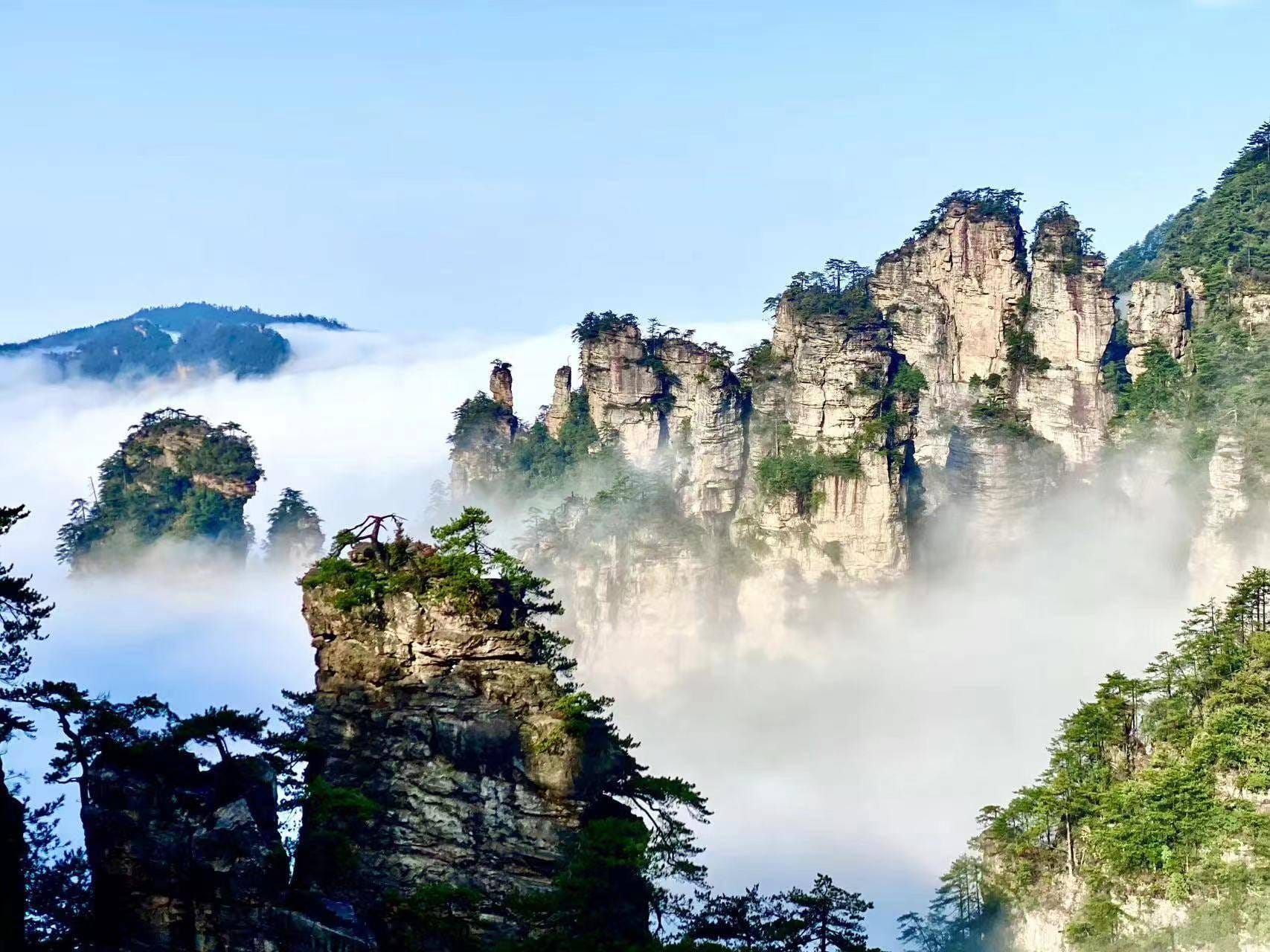
Huangshizhai is a 16.5-hectare tabletop plateau at 1,080–1,200m. You ride or hike up, then walk a paved loop trail around the rim, looking horizontally across at the surrounding sandstone pillars.
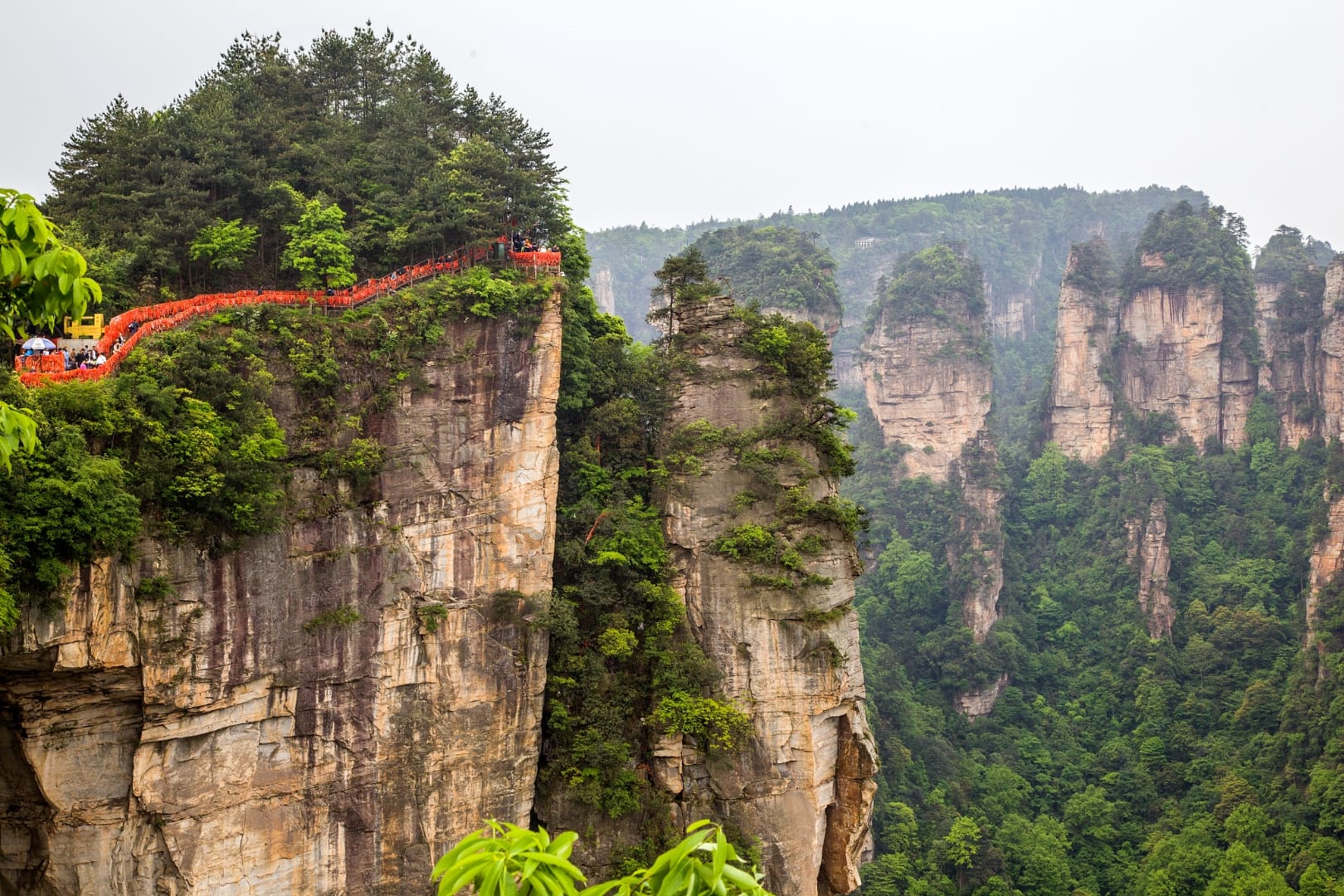
Yangjiajie is a 40-square-kilometer network of hiking trails through peak-wall formations at 900–1,130m. You move between named sites — Wulong Village, Tianbo Mansion, the Natural Great Wall — on unpaved paths, iron ladders, and rock scrambles.
Why the geology explains the experience
Huangshizhai is an early-stage “fangshan” table mountain that hasn’t yet eroded into separate pillars — you’re standing on one solid plateau. Yangjiajie’s peak walls formed from horizontal stratification, creating continuous ridge-like walls rather than isolated columns. This is also why Yangjiajie is the only area in the park where visitors regularly need their hands to climb.
2. Views: Different, Not Just Better or Worse
Most comparison guides describe both as “good views” without saying what’s actually different. They’re not interchangeable.
Huangshizhai: wide, reliable, horizontal
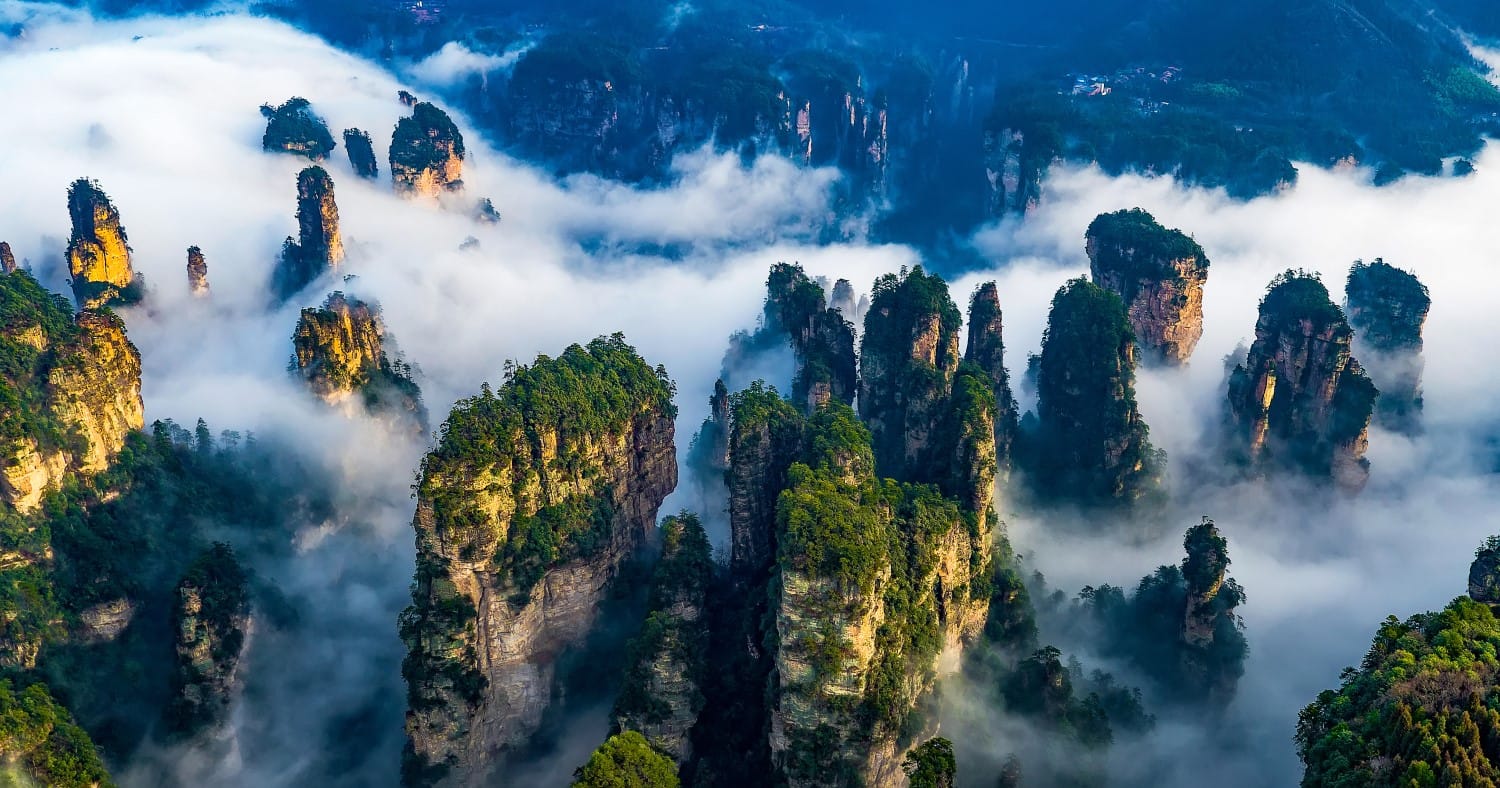
Huangshizhai’s plateau position gives horizontal sightlines. You’re at eye level with the pillar forest, rather than looking down into a valley or up at a peak — the perspective most first-time visitors expect from Zhangjiajie photos. The summit’s Six Wonders Pavilion gives 360-degree views. The plateau is also one of the park’s two best sea-of-clouds locations, with Tianzi Mountain, because its eastern exposure catches post-rain mist reliably.
Yangjiajie: narrow, dramatic, layered

Yangjiajie’s signature view — the Natural Great Wall — shows dozens of parallel stone walls receding into the distance. Landscape photographers call this effect “horizontal depth,” versus Yuanjiajie’s “vertical drama.” It rewards a telephoto lens (70–200mm) for compression shots that layer wall after wall. You won’t get this shot at Huangshizhai, where the pillars are discrete rather than layered.
Attribute | Huangshizhai | Yangjiajie |
|---|---|---|
View type | Horizontal, panoramic | Layered, compressed |
Best lens | Wide-angle | Telephoto (70–200mm) |
Signature spot | Six Wonders Pavilion | Natural Great Wall |
Sea-of-clouds odds | One of the park’s two best | Not a factor here |
Our take
If you’re carrying a wide-angle lens and want one spectacular panorama, Huangshizhai wins on ease and reliability. If you’re carrying a telephoto and want the compression shot most visitors never get, the Natural Great Wall is worth the extra travel time. It only takes 20–30 minutes round trip from the cable car station, so you don’t need to commit to the harder trails to get it.
Both views depend heavily on weather and season — fog and rain can make or break either visit. See our best time to visit Zhangjiajie guide before picking your dates.
3. Crowds, Not Equally Quiet
The margin isn’t the same size.
Huangshizhai: quiet for Zhangjiajie, not quiet in absolute terms
During a 2026 site visit, our team’s on-the-ground estimate: one-tenth the crowd density of Yuanjiajie’s Avatar Mountain viewing area. But it’s still a cable-car-accessible plateau with paved paths, restrooms, a pharmacy, and multiple shops — accessible enough that it draws a real crowd on weekends and holidays.
Yangjiajie: quiet by any standard
Yangjiajie is quieter still, and for a structural reason: the trails require actual physical effort to reach the far points. Even during National Day Golden Week — Zhangjiajie’s single busiest week — Yangjiajie sees only 2,000–3,000 daily visitors against Yuanjiajie’s 40,000+.
Most of those visitors also stop at the Natural Great Wall viewpoint near the cable car station. They never continue to Wulong Village or Tianbo Mansion, so the deeper you go, the emptier it gets. We’ve guided couples who had Tianbo Mansion’s summit platform entirely to themselves for twenty minutes.
The honest crowd math: Huangshizhai is quiet compared to Yuanjiajie, but not quiet on its own terms. Yangjiajie is quiet in absolute terms, and gets quieter the further you’re willing to walk.
4. Yangjiajie vs Huangshizhai: The Real Difficulty Gap
“Moderate difficulty” is how most listicles describe both. That’s not accurate for either.
Route | Area | Time |
|---|---|---|
Cable car up + summit loop | Huangshizhai | 1–1.5 hrs |
Full hike (steps only) | Huangshizhai | 1.5–2.5 hrs |
Natural Great Wall viewpoint only | Yangjiajie | 20–30 min |
Northern Route to Tianbo Mansion | Yangjiajie | 3–4 hrs |
Southern Route to Air Corridor | Yangjiajie | 5–6 hrs |
Huangshizhai: a hard hike or an easy walk, your choice
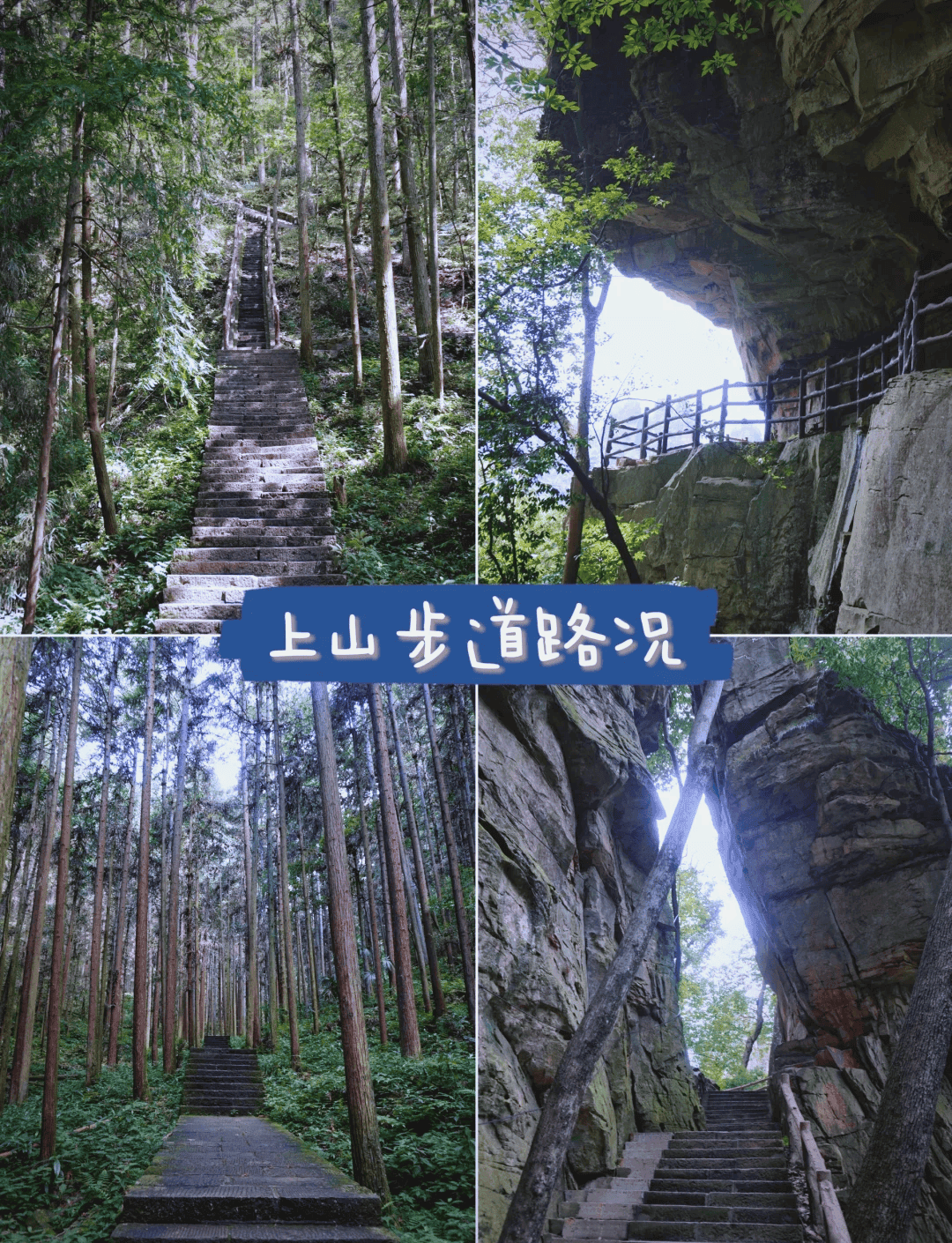
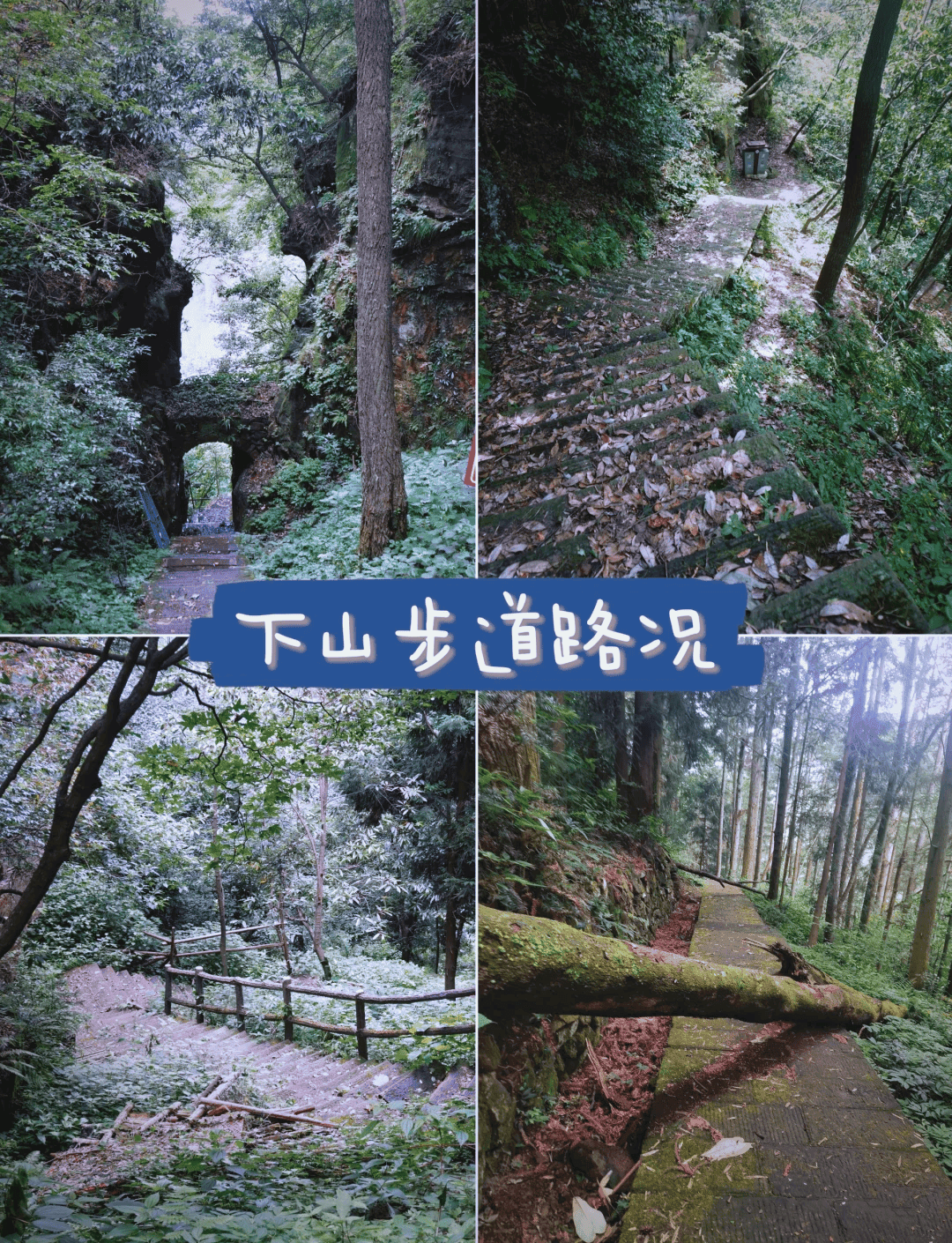
Hiking the full summit loop means 3,878 stone steps, 1.5–2.5 hours ascending, with sections at 60+ degree gradient. Handrails throughout. Our data on international tourists specifically shows a 40/50/10 split: 40% hike up, 50% hike down only, and 10% take the cable car both ways.
If you take the cable car up (8–10 minutes, ¥65 one-way), the summit loop itself is a manageable 1–1.5 hours on paved paths with handrails at every viewpoint. This is doable for a reasonably fit 60-year-old.
Yangjiajie: there’s no easy version beyond the entrance
 One Step to Heaven in Yangjiajie
 Air Corridor in Yangjiajie
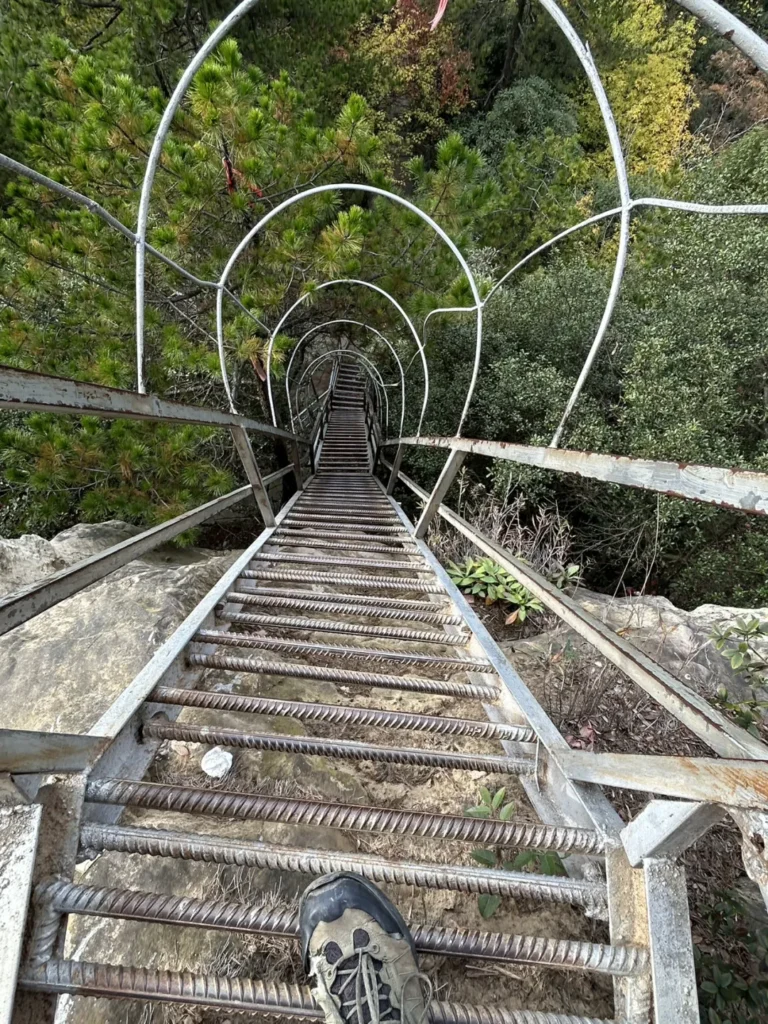
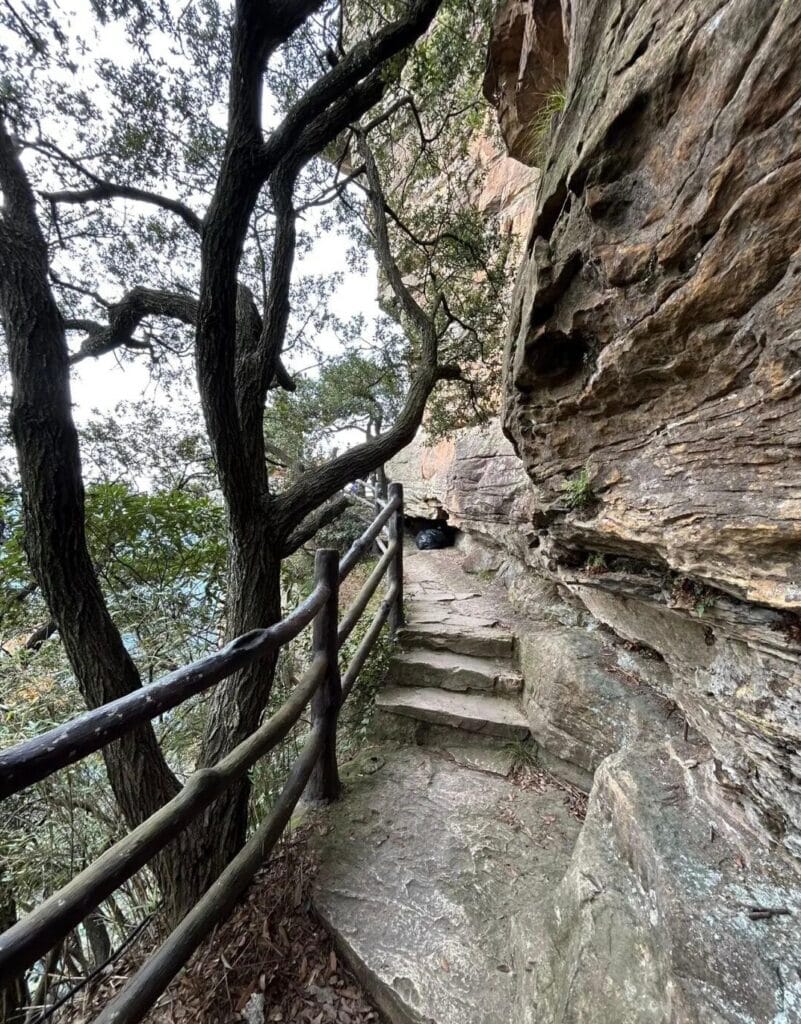
The Northern Route — Natural Great Wall → Wulong Village → Tianbo Mansion — takes 3–4 hours on an unpaved trail. Reaching Tianbo Mansion’s summit at 1,130m means a genuinely vertical iron ladder: 32 rungs, one person at a time. The narrowest passage, in the Thread Valley section, is 30cm wide. This is not a stroll with a view at the end; it’s a hike that happens to have a view at the end.
The Southern Route to the Air Corridor is harder again — 5–6 hours, “very challenging,” and explicitly not recommended for anyone without consistent cardio fitness.
Self-assessment for Yangjiajie’s Northern Route
Answer these honestly before committing:
- Can you hike 6–8km with elevation changes?
- Can you climb a ladder using mostly arm strength?
- Can you handle steep, uneven terrain without knee or balance problems?
If you answered no to any of these, stick to the Natural Great Wall viewpoint alone — 20–30 minutes, easy, right from the cable car station — and skip the rest.
Bottom line on difficulty
Huangshizhai’s hardest version (full hike, no cable car) is still less demanding than Yangjiajie’s easiest meaningful version (Northern Route to Tianbo Mansion). If physical capability is a concern for anyone in your group, that alone should decide this comparison.
5. Monkeys: A Real Difference
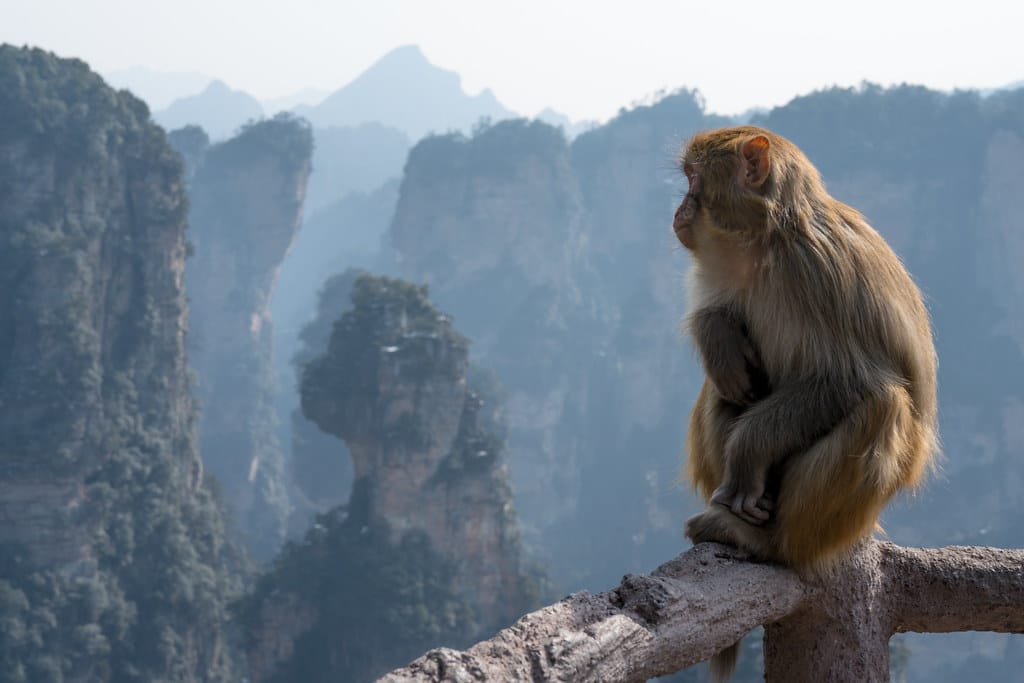
Both areas have wild macaque populations in similar numbers, but the behavior differs — and it’s worth knowing before you go.
At Huangshizhai, they back off once the food is gone
Monkeys congregate near the cable car stations and the main summit loop, where food traffic is highest. They’re bold but generally back off once you’ve secured your food.
At Yangjiajie, they don’t back off as easily
Our guides and multiple travelers describe more aggressive, coordinated behavior — the kind of thing most guides don’t mention when they write about China’s monkey-viewing spots. One couple fed a single monkey a cookie and had six monkeys surrounding them within 30 seconds.
If a monkey bites you
Wash the wound immediately, descend, and seek medical attention. Rabies post-exposure prophylaxis is standard precaution in China regardless of how minor the bite looks.
Practical rule for both areas: food sealed in interior backpack pockets before you reach either cable car station, not after.
6. Tickets, Cable Cars, and Getting There
Here’s what the Yangjiajie vs Huangshizhai choice actually costs, in money and time.
Park entrance
Neither Yangjiajie nor Huangshizhai requires a separate entrance ticket. Both are included in the standard Zhangjiajie National Forest Park pass: ¥227 peak season (March–November) or ¥115 low season (December–February), valid 4 consecutive days with unlimited re-entry via fingerprint verification. For booking channels and the advance-reservation rule now in effect, see our Zhangjiajie Tickets Guide.
Cable car comparison
 Yangjiajie cable Car
- Huangshizhai cable car
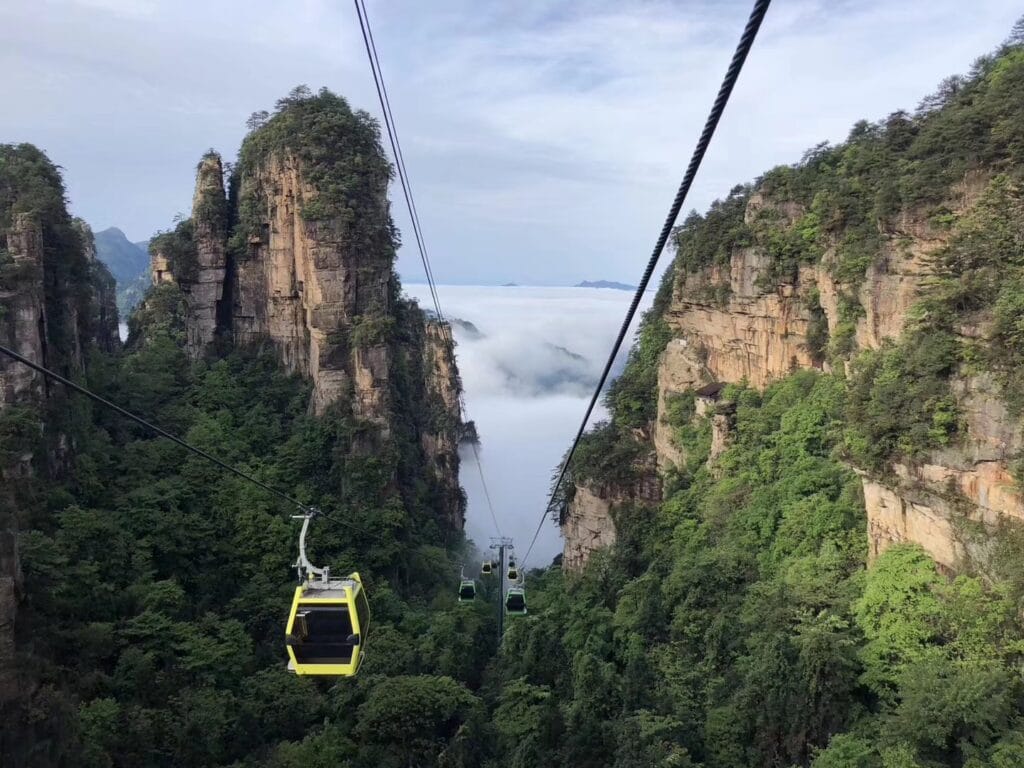
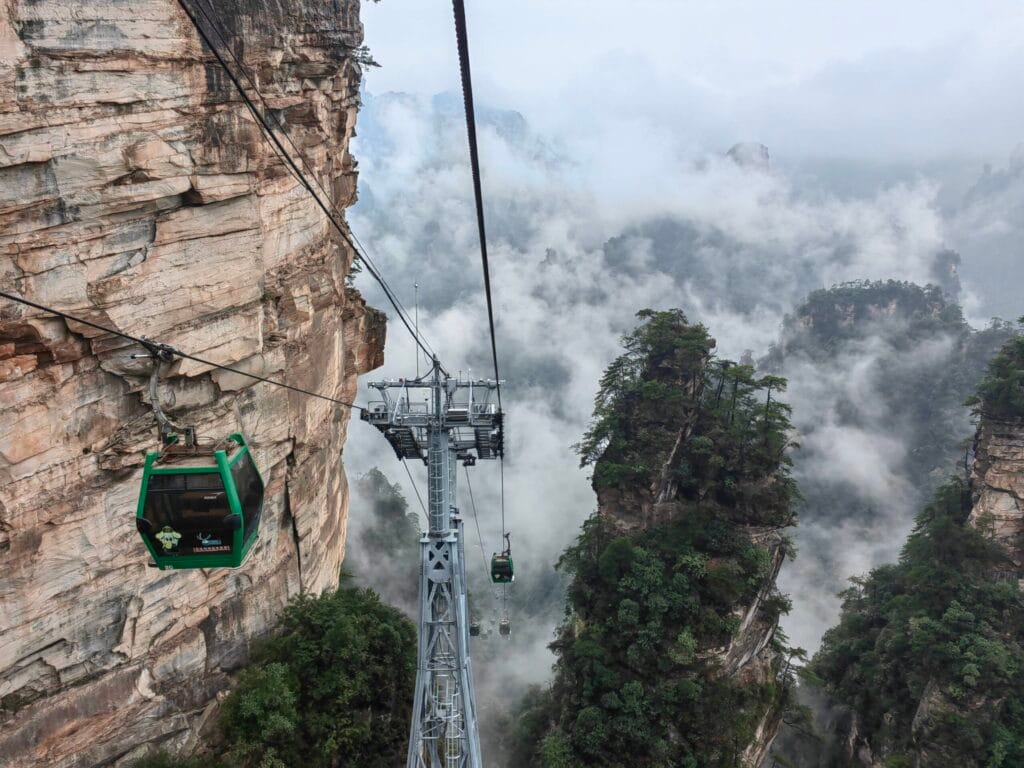
Cable cars are a separate fee at both:
Huangshizhai | Yangjiajie | |
|---|---|---|
Cable car one-way | ¥65 | ¥76 |
Cable car round-trip | ¥118 | ¥152 |
Ride duration | 8–10 minutes | 10 minutes |
Best entrance gate | South Gate (saves 20–30 min eco-bus time) | West Gate (Yangjiajie Ticket Station) — near-zero queue at 7:30 AM |
If you’re doing a combined multi-area trip, the all-inclusive transport pass (¥298–445 depending on season) covers the Bailong Elevator plus all three cable cars together. It’s worth it once you’re using three or more.
Getting between the two
Both connect to each other and to Yuanjiajie by free internal shuttle: Huangshizhai to Yangjiajie runs 20–25 minutes; Yuanjiajie to Yangjiajie is faster, at 10–15 minutes. Hikers sometimes ask about walking between the two instead — the terrain doesn’t really allow it. What exists is Bali Slope, a steep 2.2km footpath connecting Yangjiajie’s own cable car station to its upper scenic area — 1.5+ hours, often mossy and slippery after rain. It’s internal to Yangjiajie, not a trail between Yuanjiajie and Yangjiajie themselves. For that connection, the eco-bus is the only practical option.
See our Zhangjiajie National Forest Park Entrances Guide for which gate matches your specific itinerary, and the Zhangjiajie Cable Cars Guide for the no-queue strategy across all four cable systems in the park.
7. Doing Both in One Day
The Yangjiajie vs Huangshizhai one-day sequence
This works, but only as a full day for travelers in good shape. Start at Huangshizhai and finish at Yangjiajie, not the other way. Huangshizhai’s summit loop is easier to do fresh, and Yangjiajie’s Northern Route is more forgiving to rush through than to walk half-awake first thing.
Time | Activity |
|---|---|
7:00 AM | Enter South Gate |
7:15 – 9:45 AM | Huangshizhai summit loop |
10:00 – 10:30 AM | Shuttle to Yangjiajie |
10:30 AM – 2:00 PM | Northern Route |
By 5:00 PM | Head out |
We don’t recommend adding Yuanjiajie to the same day. That turns a demanding day into an exhausting one, and you’ll be too tired to enjoy either the views or the hike properly.
If you have two or more days
Split them — Huangshizhai first while you’re fresher, Yangjiajie second once you’re warmed up:
- Day 1: Huangshizhai, paired naturally with an afternoon walk along Golden Whip Stream
- Day 2: Yangjiajie, tackled first thing while you’re still fresh
This is also the sequence we recommend if you’re combining either with Yuanjiajie or Tianzi Mountain — see our full Zhangjiajie Itinerary Guide for day-by-day planning across 1 to 7 days in the park.
8. FAQ: Yangjiajie vs Huangshizhai
Is Yangjiajie or Huangshizhai better for someone with knee problems?
Huangshizhai, without question. Taking the cable car up removes almost all physical demand — the summit loop itself is paved with handrails, and you can complete just the short viewpoint section in under an hour. Yangjiajie’s meaningful sights beyond the Natural Great Wall viewpoint all require climbing an iron ladder using arm strength. That’s not an option to skip if you want to reach Tianbo Mansion.
Which one is better for kids?
Huangshizhai handles children better, especially ages 6 and up who can manage 2–3km of walking on the summit. Yangjiajie’s Natural Great Wall viewpoint alone (20–30 minutes, flat, easy) is fine for any age. The routes beyond it — narrow passages, vertical ladders — aren’t appropriate for young children, no matter how adventurous they are.
Was either area actually used to film Avatar?
No — no part of the movie was filmed in Zhangjiajie at all; production was entirely in California and New Zealand. What Zhangjiajie provided was visual reference during design. Of the ten sites Hunan’s tourism authority named as Avatar inspiration on December 15, 2025, three are in Huangshizhai: Star Picking Stand, Nine Layers of Fairy Palaces, and Relic Piers of the Heaven Bridge. See our guide to all ten locations for the rest. None are in Yangjiajie. The most iconic shot, the “Hallelujah Mountain” pillar, draws on Yuanjiajie — a separate area from both.
Is one more expensive than the other?
Individually, barely: Yangjiajie’s cable car is ¥76 one-way (¥152 round-trip) versus Huangshizhai’s ¥65 (¥118 round-trip), and both sit under the same park entrance ticket. If you’re doing several areas over multiple days, the math changes. The ¥298 unlimited transport pass covers both cable cars plus the Bailong Elevator and Tianzi Mountain cable car for 4 days, and pays for itself once you’ve taken 4–5 one-way rides total.
Which is better for photography?
Depends on your lens, not your skill level. Bring a wide-angle (16–35mm) for Huangshizhai’s panoramas and a telephoto (70–200mm or longer) for Yangjiajie’s compression shots — the same lens doesn’t do both well. Shoot Huangshizhai at sunrise for the best sea-of-clouds odds, and Yangjiajie’s Natural Great Wall in late afternoon, when side-lighting brings out the depth between the parallel walls.
Can beginners hike Yangjiajie without a guide?
Yes, for the Natural Great Wall viewpoint alone — signage is adequate for that short stretch. Beyond it, trail junctions are confusing (the network requires U-turns rather than a simple loop), and English signage is minimal. If you’re attempting the full Northern Route without China hiking experience, a guide adds real value here. That’s not true at Huangshizhai, where the summit loop is a single well-marked path.
Still deciding on Yangjiajie vs Huangshizhai — or how to fit either into your Zhangjiajie plan? Contact us — we build custom itineraries around your fitness level and time, not a generic must-see list.