Zhangjiajie 72 Strange Buildings (72 Qilou): The Complete Visitor Guide
Planning a Zhangjiajie trip and wondering whether the 72 Strange Buildings deserve a slot on your itinerary?
We’ve been running China inbound tours for over 20 years and have walked through this complex in every season, with guests from every kind of travel background.
This guide gives you a straight answer — including the parts that other travel sites leave out.
Table of Contents
Quick Facts
Chinese Name | 七十二奇楼 (Qīshí’èr Qí Lóu) |
Also Known As | 72 Qilou / 72 Wonder Towers |
Location | No. 1 Wulingshan Avenue, Yongding District, Zhangjiajie |
Opened | August 30, 2022 |
Main Tower Height | 109.9 m — Guinness World Record |
Opening Hours | 10:00 AM – 10:00 PM, year-round |
Daytime Ticket | CNY 48 (entry before 4:30 PM) |
Evening Ticket | CNY 88 (entry from 4:30 PM) |
Best Strategy | Enter before 4:30 PM on the CNY 48 daytime ticket, stay for the night show |
Distance from Zhangjiajie West Railway Station | ~4 km, ~10 min by taxi |
1. What Exactly Are the “72 Strange Buildings”?
The name trips up almost every first-time visitor, so let’s clear it up.
There are not literally 72 buildings. In the Tujia cultural tradition of western Hunan, “72” is symbolic — it means countless, as infinite as the mountain valleys. The full phrase comes from an old saying about the Wuling Mountain region: “Nine bows, eighteen stockades, seventy-two strange towers” (九弓十八寨七十二奇楼). These words described the soaring stilted towers Tujia communities built across the ridges over a thousand years — structures for ceremony, assembly, and defense.
“Strange” (奇, qí) doesn’t mean odd. It means extraordinary.
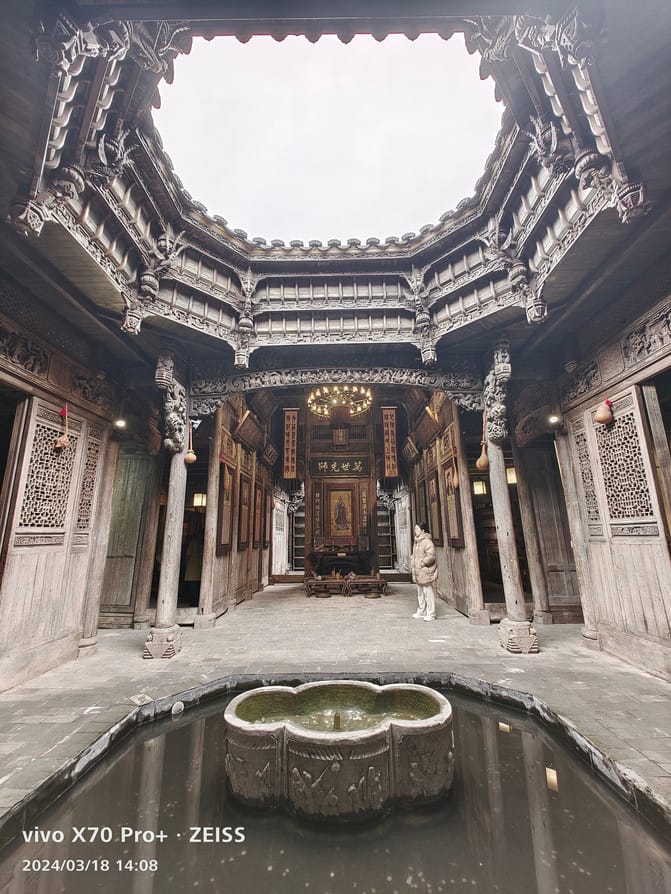
The complex you visit today is a modern development, opened August 2022. It doesn’t hide this. What distinguishes it from China’s many heritage-themed commercial projects is one specific construction decision: the 18 stilted houses suspended inside the main tower’s central cavity are genuine. They were sourced from Tujia villages facing demolition across western Hunan, dismantled, transported, and restored using the “restore old as old” (拆旧还旧) method under heritage architecture supervision. The towers around them are new. Those 18 houses are not.
2. History and Cultural Background
The legend behind the name starts around 67 AD. Each dynasty was said to have added a floor to a great communal tower — and each floor sank into the earth over centuries, until 72 layers lay buried beneath the ground. This myth later gave its name to the Chinese streaming drama The 72 Layers of Mystery (七十二层奇楼), which seeded the name recognition this attraction now builds on.
The Tujia people (土家族) have lived in the Wuling Mountain region for over a millennium. Their diaojiaolou (吊脚楼) — stilted buildings cantilevered out over steep hillsides — were engineering before they were aesthetics. Built above floodlines, with airflow beneath, on terrain that would otherwise be unbuildable.
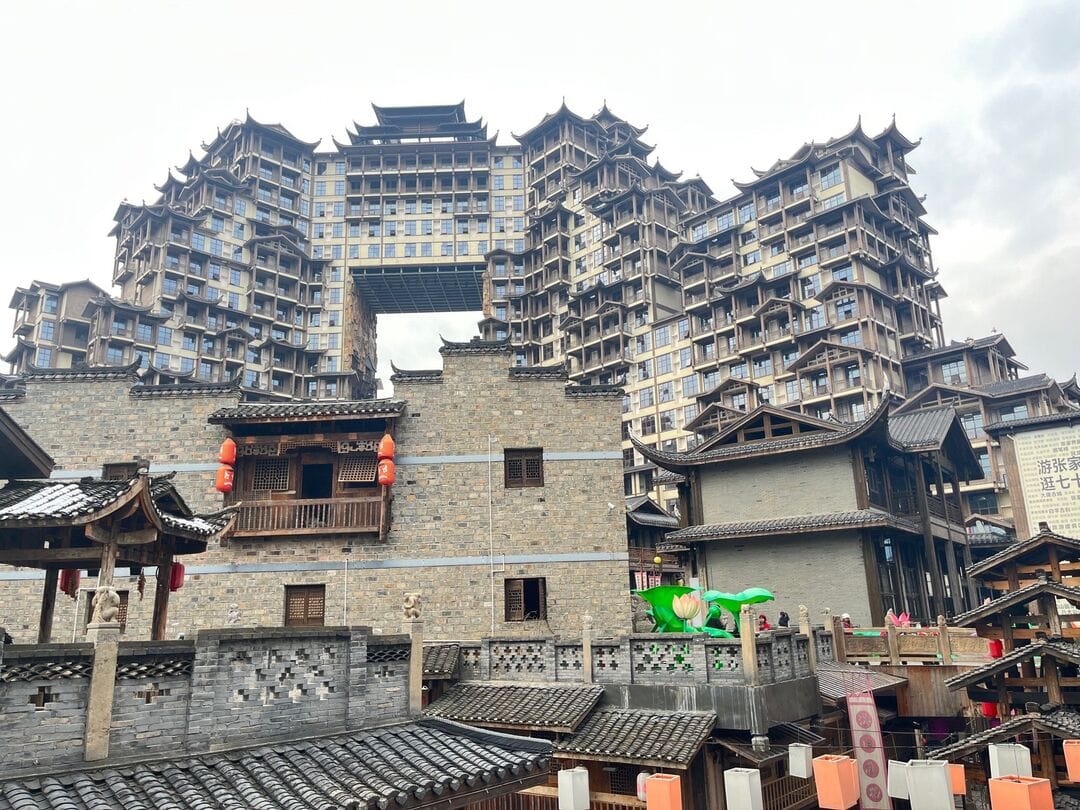
Two genuine heritage structures predate the 2022 development. The Zhuangyuan Building (状元楼) dates to the Qing Dynasty’s Jiaqing period — over 200 years old. The Dafu Di (大夫第) is a second Qing-era structure on the same site. In daylight, you can stand next to these buildings and compare their grain and patina to the surrounding new construction. It’s one of the more honest architectural moments on the site.
3. Is It Actually Worth It?
Some visitors on TripAdvisor have been direct: paying CNY 88 to walk through what feels like a “busy shopping mall” is not worth it. One review calls it “nothing spectacular.” That reaction is real, and it comes from real visitors.
The visitors who feel let down almost always have two things in common: they paid the full CNY 88 evening ticket, and they left before 9:30 PM. The light show activates around 7 PM, which is impressive, but the actual peak of the evening — the bonfire square, the full performance roster, the moment when several hundred people end up dancing together around an open fire — doesn’t happen until after 9:30 PM. Visitors who leave at 8:30 PM because they’ve “seen the lights” have missed the reason to come.
The CNY 88 ticket is harder to justify if you spend two hours, see the tower lit up, eat some food, and leave. Entered before 4:30 PM on the CNY 48 daytime ticket, given four to five hours, and staying through the bonfire event — that’s a genuinely good evening. Possibly the best evening available in Zhangjiajie city.
So the real answer: it depends entirely on when you arrive and when you leave.
4. What Most Visitors Get Wrong
Two decades of guiding international travelers here has made these mistakes predictable.
Going only during the day. The complex was designed for evenings. The light show, performances, bonfire square, and the full atmosphere of the food street only exist after dark. A daytime-only visit is structurally incomplete — like visiting a night market at noon.
Paying CNY 88 when the CNY 48 daytime ticket works. The daytime ticket (entry before 4:30 PM) has no exit time limit. Enter at 3:00 PM, spend four to five hours there, and stay through the 9:30 PM bonfire event. You pay just over half the evening price and see everything. This is not a loophole — it’s how the ticket system was designed. Almost no English travel article states it clearly.
Leaving before 9:30 PM. The light show starts around 7 PM. The bonfire square and peak performances don’t begin until 9:30 PM. Many visitors who “didn’t find it spectacular” left during the gap between those two things.
Trying to get a taxi from the main gate after the show. After 9:30 PM, the entrance area becomes a slow-moving queue. Walk 500 meters north along Wulingshan Avenue before opening DiDi. The wait drops from 20 minutes to three.
Trying to use the self-service ticket machine. The machines are in Chinese only and require a Chinese phone number. Foreign visitors should buy directly at the staffed ticket window. Bring your passport and CNY cash as backup, though WeChat Pay works at the counter too.
5. Inside the Complex: Three Zones
Tian Gong Qilou (天宫奇楼) — The Main Tower
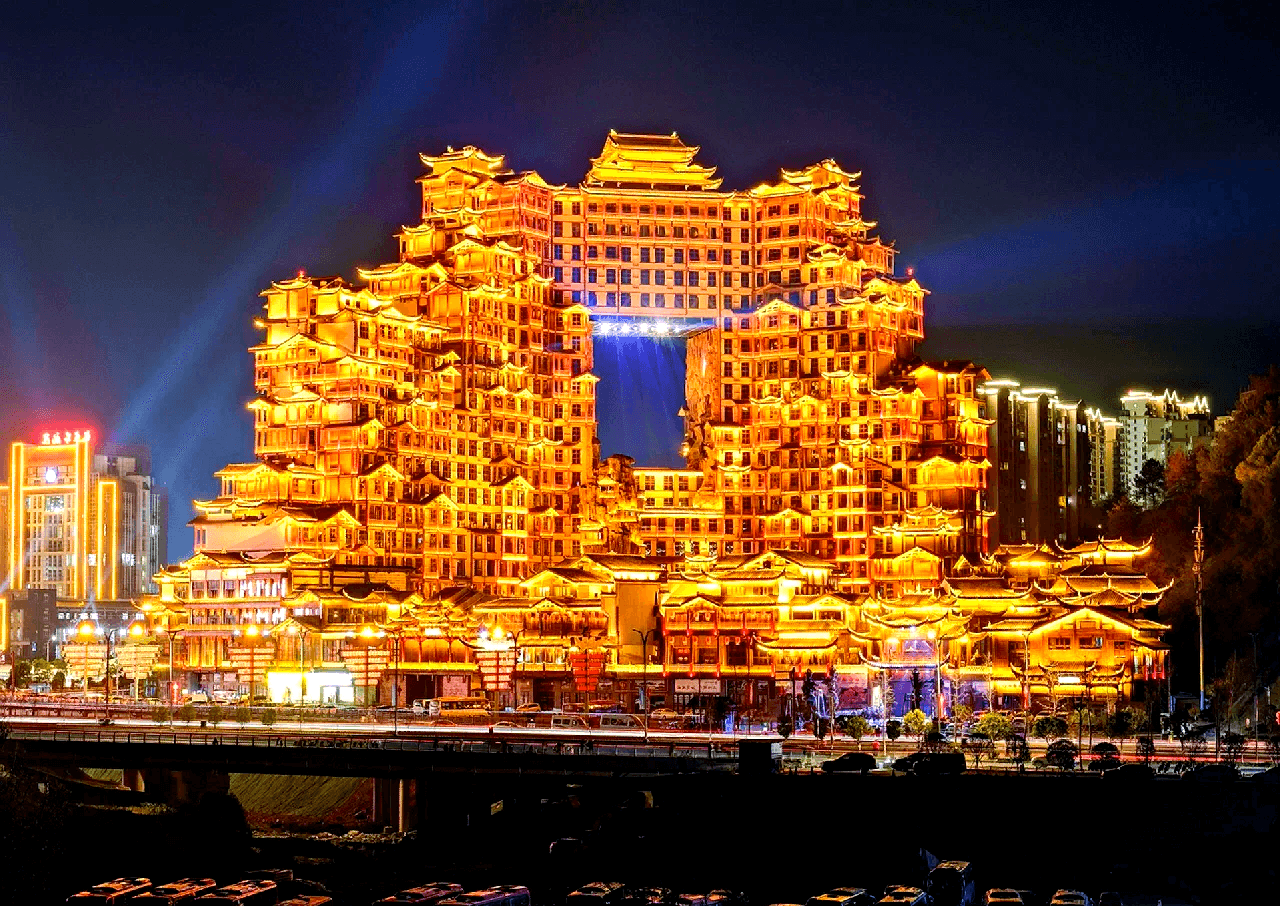
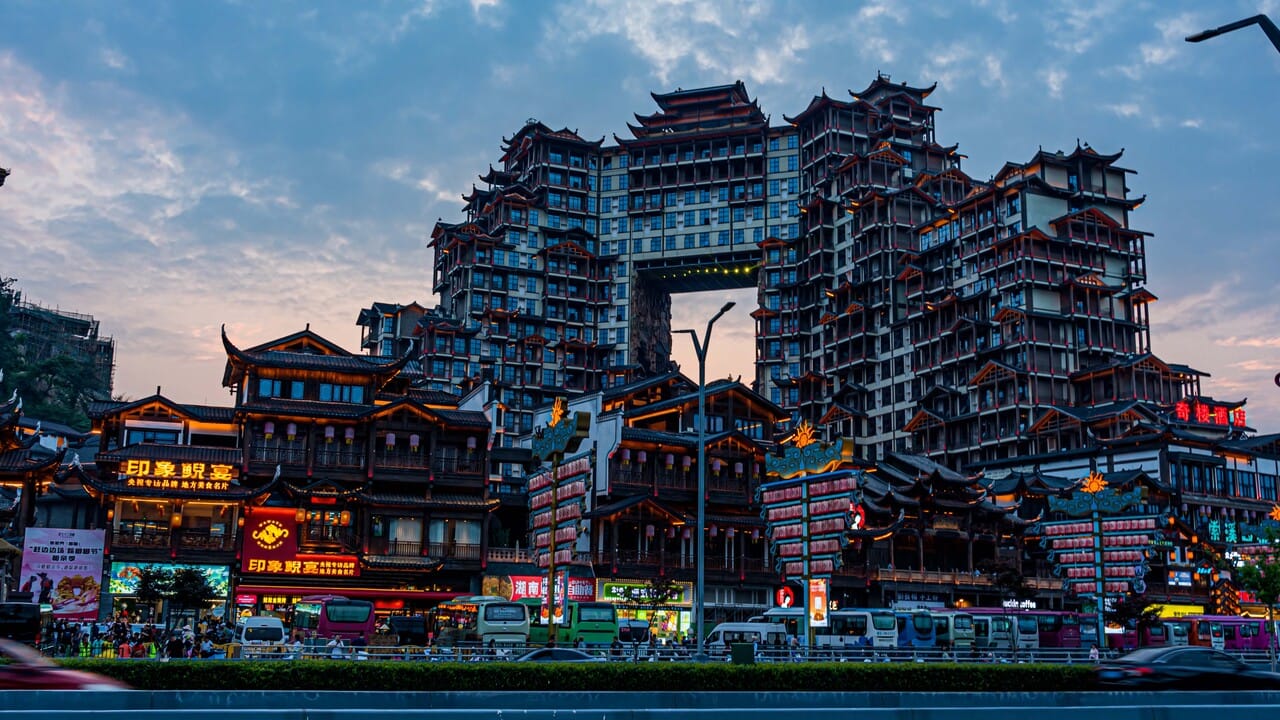
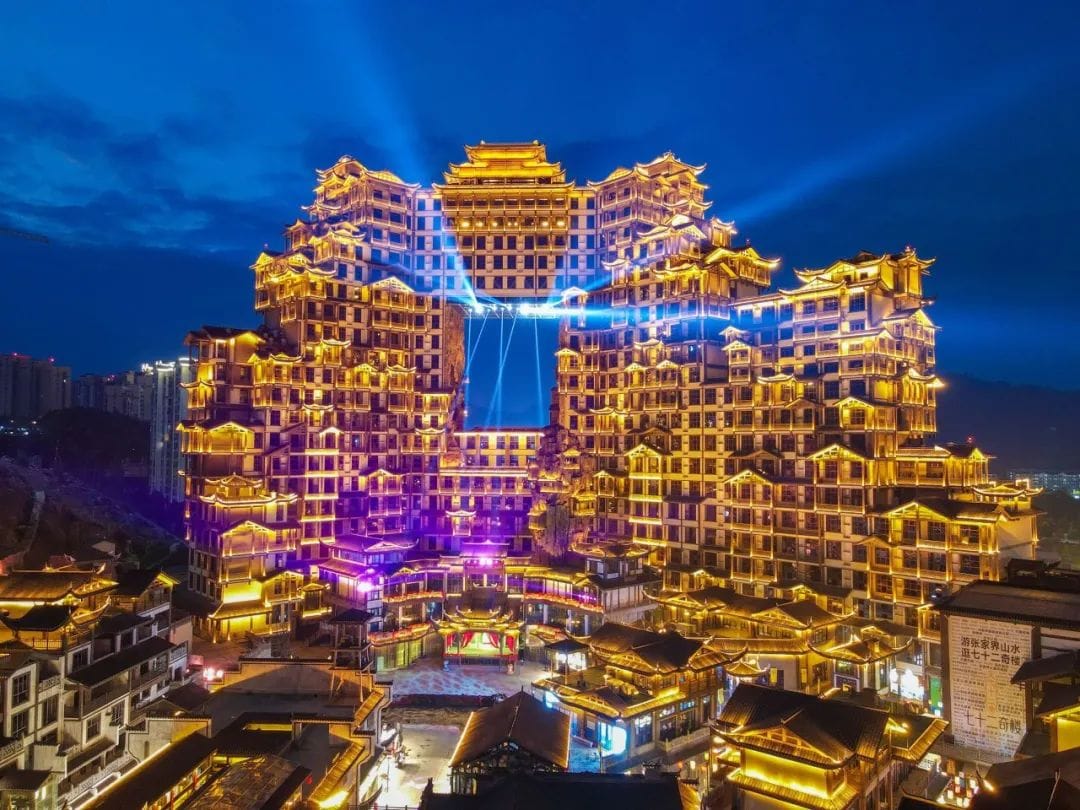
At 109.9 meters, this is the world’s tallest stilted-building-form structure. Its defining feature is the central hollow cavity — 38 meters high, 28 meters wide, 21 meters deep — with 18 original Tujia homes suspended on either side. The alignment of this opening toward Tianmen Cave on Tianmen Mountain is intentional, a design choice the architects called “dual caves in mutual gaze” (双洞互视).
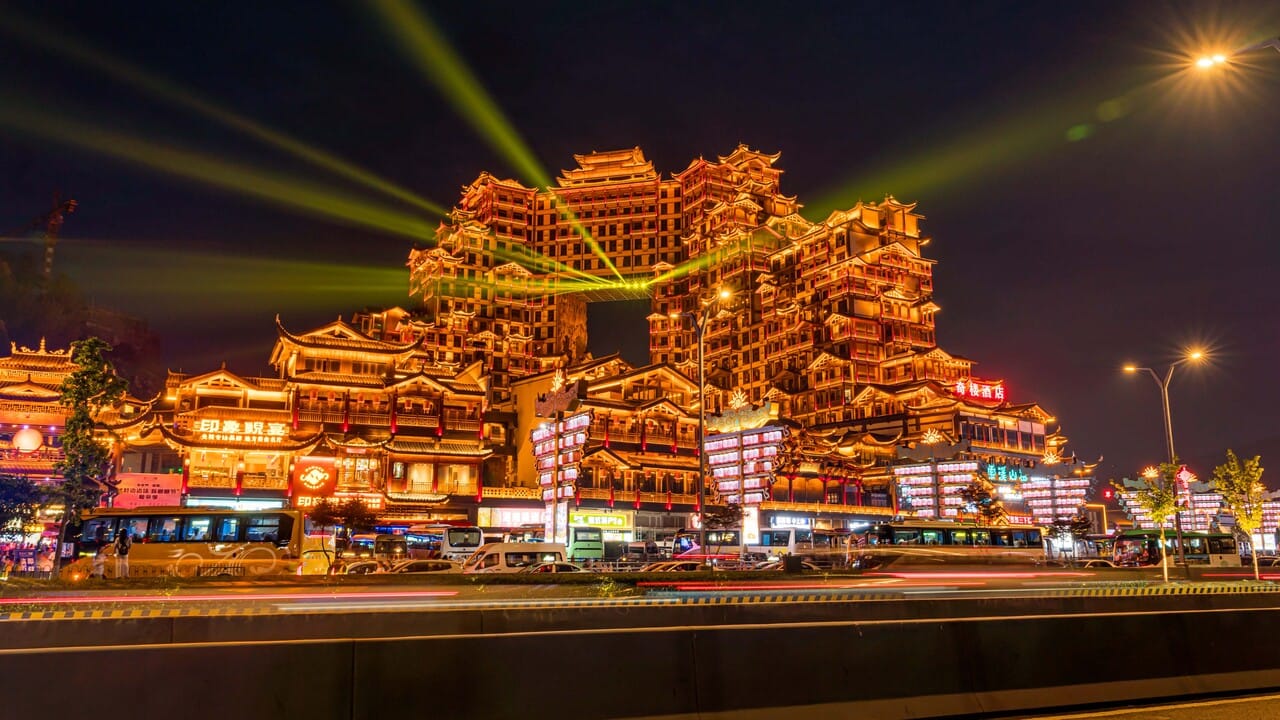
After dark, 36,000 RGBW lights activate individually across the facade, projecting 72 themed displays using holographic imaging. The sequence begins around 7 PM. When the full illumination hits — it takes about eight minutes to reach maximum — people on the plaza below tend to go quiet. It’s the kind of visual that doesn’t really translate in photographs.
The best full-tower photograph is not taken from inside. Cross Wulingshan Avenue to the opposite side of the road and walk about 100 meters north. The entire 109.9-meter structure fits in frame against the night sky from there. Almost nobody knows this spot.
Yanhuo Old Street (烟火老街) — Food and Craft
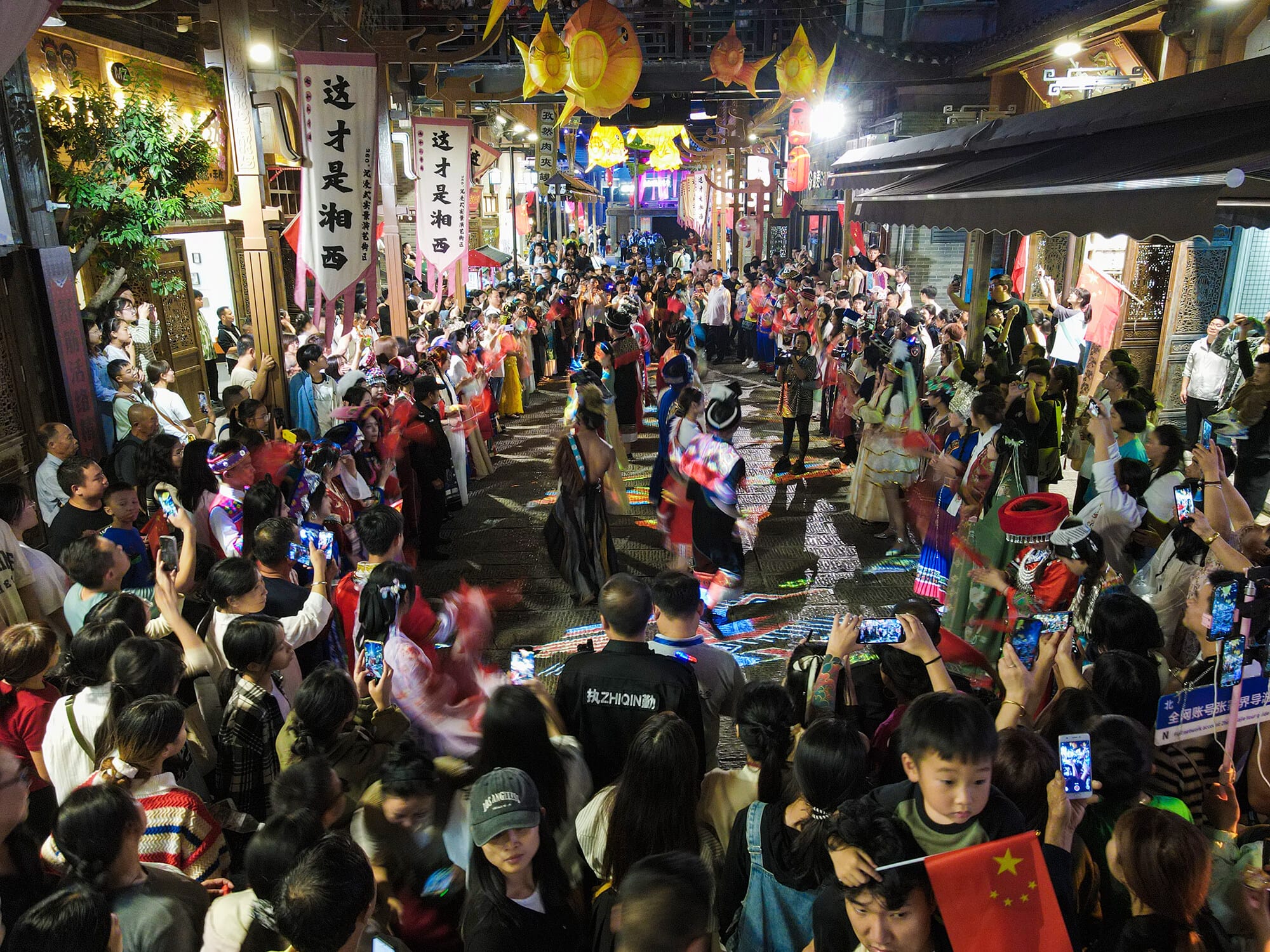
Over 160 food stalls representing regional specialties from across China: Tujia cured meats, blood rice cakes (血粑鸭), Hunan sour-spicy noodles, Xi’an flatbreads, Xinjiang skewers, Macao egg rolls. Most dishes cost CNY 10–30. This is street food at street food prices — budget travelers will feel at home.
One worth noting: the non-heritage tea house (非遗老茶馆), over 1,000 square meters, hand-carved entirely by a national intangible cultural heritage inheritor. It’s easy to walk past without realizing what you’re looking at. Worth slowing down for.
Craft workshops operate through the evening: Tujia brocade weaving (土家织锦), Miao silver forging, woodblock printing. These are working artisans, not demonstrations set up for tourists.
One honest note from multiple TripAdvisor visitors: the food options inside are heavier on snacks than sit-down meals, and the better restaurants are actually outside the gate. If your group wants a proper dinner, eat before entering or just after leaving.
72 Qizhai Folk Village (七十二奇寨) — The Quieter Zone
Lower buildings, narrower lanes, small heritage museums. Less dramatic than the main tower, but worth the walk if you have children or older travelers who want to absorb the architecture without crowd pressure. The Zhuangyuan Building and Dafu Di heritage structures are in this zone.
6. The Evening Performances
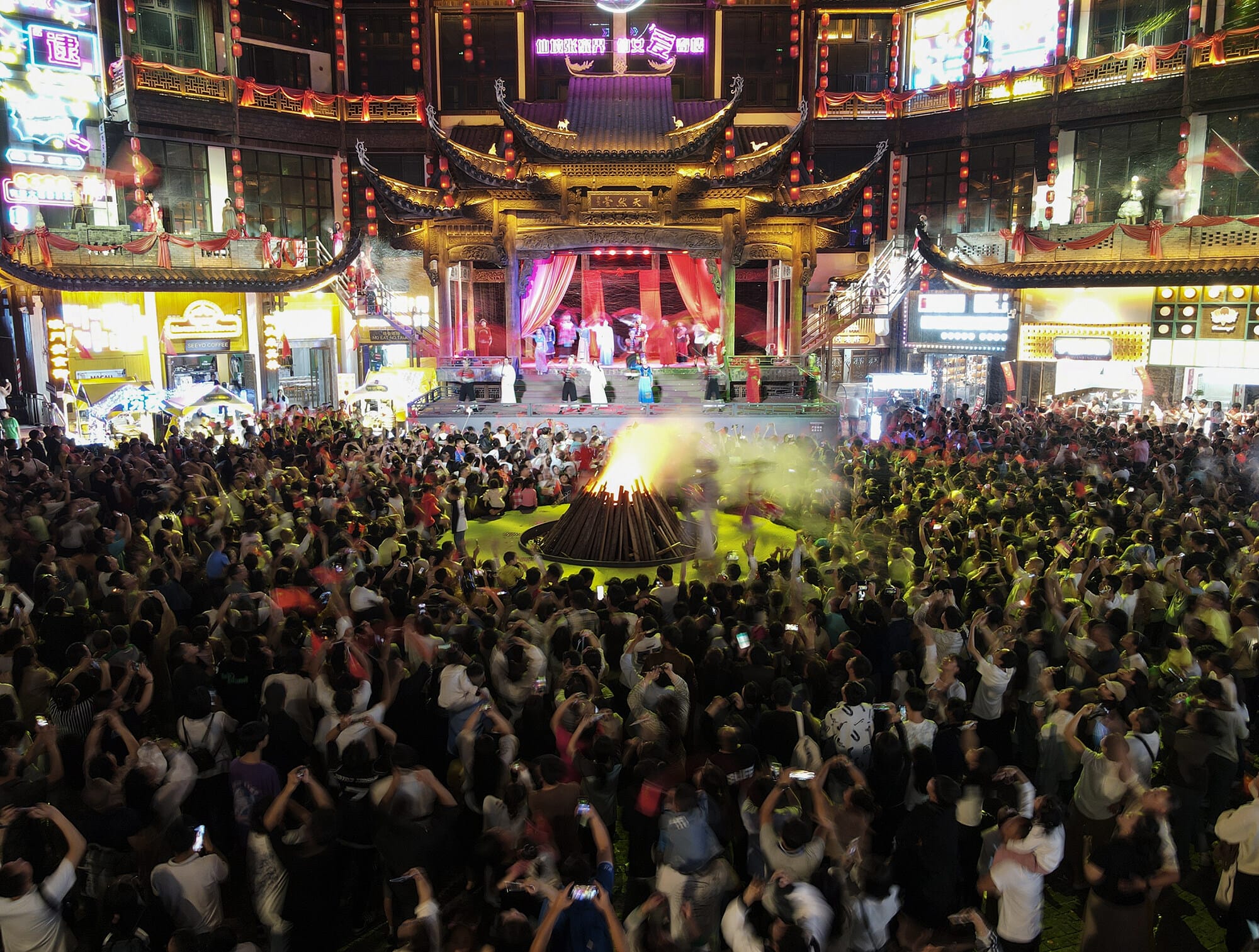
More than 20 live performances run through the complex every evening. They’re distributed across different spots rather than staged in one place — you encounter them as you walk. That format is the difference between watching and being in it.
Practical timeline:
Time | What Happens |
|---|---|
From ~17:30 | Scattered courtyard performances begin: folk music, Tujia Tima ritual |
~18:00 | Welcome fire drumming at main entrance |
~19:00–19:40 | Light show begins, reaches full illumination within ~8 minutes |
~21:00–21:30 | Bonfire Square (篝火广场): peak of the evening |
The bonfire square at 9:30 PM is worth being specific about. Performers lead people hand-in-hand around an open fire — folk songs first, then the rhythm shifts into something more contemporary. What starts as a staged performance becomes a few hundred people dancing together. Guests who’ve visited Fenghuang, Lijiang, and Pingyao — who’ve sat on stone walls watching river reflections — describe this as a completely different register of experience. Louder. Less refined. More alive.
All performances are visual. No Mandarin required.
Named performances include the Tujia weeping bride (土家哭嫁), the Yao minority courtship climb (瑶族小伙爬楼), and Tima shamanic ritual reenactments.
7. 72 Qilou vs. Other Evening Options
Visitors planning Zhangjiajie evenings often ask about the alternatives.
vs. Charming Xiangxi Show (魅力湘西): A large-format indoor theater production in Wulingyuan District — 2,800 seats, about 100 minutes, tickets at CNY 228–308. The show is polished and well-produced, with a clear narrative arc. The 72 Qilou is louder, more chaotic, and participatory in a way a theater show is not. If you have two evenings in Zhangjiajie, do both. One is not a substitute for the other.
DIG DEEPER: Zhangjiajie Night Shows: Which One Is Worth It?
vs. Fenghuang Ancient Town: Not a fair comparison — Fenghuang is 230 kilometers away and requires an overnight stay. But since the question comes up: Fenghuang’s evening atmosphere along the Tuojiang River is beautiful and genuinely old. The 72 Qilou is new, technologically ambitious, and built for participation. They serve different travel moods. We send some clients to both.
8. Best Time to Visit
Time of day: Evening. The complex exists for its evening format — arriving in daylight and leaving before 9:30 PM misses both the light show and the bonfire. Arrive before 4:30 PM on the daytime ticket, and stay through to 10:00 PM.
Day of week: Weekday evenings. Domestic tourism in China concentrates heavily on weekends. On a Thursday, you move freely and get photos without crowds. On a Saturday in peak season, the food street becomes a slow shuffle.
Season: Spring (April–May) and autumn (September–October) — comfortable temperatures, lower humidity, and the best photography light before the show starts. Winter evenings are cold but the full experience runs year-round with thin crowds. Summer evenings are warm and the energy is highest; tolerable after dark with a light layer.
Avoid: Chinese national holidays, especially Golden Week (first week of October) and May Day (first week of May).
9. Getting There and Tickets
Getting There
The complex sits at the north end of Wulingshan Avenue at its junction with Shadi Avenue — on the main road between the city center and the National Forest Park.
From | Distance | Approx. Time | Approx. Taxi Cost |
|---|---|---|---|
Zhangjiajie West Railway Station | ~4 km | ~10 min | CNY 12–15 |
Zhangjiajie Railway Station | ~8 km | ~20 min | CNY 20–25 |
Hehua International Airport | ~7 km | ~15 min | CNY 20–25 |
City bus: Routes 7, 16, and 17 stop at “Qilou Plaza” (奇楼广场). Fare: CNY 2. Bus stop at Tianmen Mountain cable car station connects directly — route 17 stops at both.
By car: South Gate car park (南门停车场), approximately CNY 5/hour.
Tickets
Ticket | Price | Notes |
|---|---|---|
Daytime Ticket | CNY 48 | Entry before 4:30 PM, no exit time limit |
Daytime Concession | CNY 30 | Children 12–18, adults 70+ |
Evening Ticket | CNY 88 | Entry from 4:30 PM, before 10:00 PM |
Evening Concession | CNY 60 | Children 12–18, adults 70+ |
Free Entry | CNY 0 | Children under 12, adults over 70, military, firefighters, journalists |
Buy at the staffed ticket window — not the self-service machine, which requires a Chinese phone number. Bring your passport. Cash accepted; WeChat Pay and Alipay also work.
On peak holiday evenings, advance reservation may be required through the official WeChat mini-program.
10. Practical Tips for International Visitors
Footwear: Cobblestone lanes and stairs across three to five hours. Comfortable walking shoes, not sandals.
Layers: Even in summer, Zhangjiajie evenings cool down after 9 PM. A light jacket matters if you’re staying through the bonfire.
Photography: The full-tower shot is from across the road, about 100 meters north of the main entrance (see Zone 1 above). Inside the complex, a phone with a decent night mode handles the food street. The view directly upward from the floor of the main tower’s central cavity — 18 stilted houses stacked above you — is the shot most visitors don’t think to take.
Payment: WeChat Pay and Alipay dominate inside. Set one up before your trip. Most vendors accept cash but prefer digital.
Drones: Not permitted.
Leaving: Walk 500 meters north before calling DiDi. The main entrance queue after the night show is long and slow.
11. Frequently Asked Questions
Is this an ancient site or a modern development?
Modern development, opened August 2022. The name and concept come from genuine Tujia history. Two buildings on site are over 200 years old. The 18 stilted houses inside the main tower are authentic structures relocated from demolished Tujia villages. Everything else is new construction built around those elements.
How much time do I need?
Three to five hours for the full experience. Arriving at 3:00–3:30 PM and staying through the bonfire event (around 9:30–10:00 PM) takes five to six hours. A focused visit entering at 5:00 PM and leaving after the light show takes about three hours — but you’ll miss the best part.
Is the CNY 88 ticket worth it?
Only if you’re arriving after 4:30 PM. The CNY 48 daytime ticket with an early arrival gets you the same complete experience at nearly half the price. One visitor on TripAdvisor put it plainly: arriving at 4 PM and staying to watch the lights come on “was totally worth it.” The CNY 88 reviews are more mixed.
The self-service machine looked easier — can I use it?
No, not as a foreign visitor. The machine requires a Chinese phone number for verification. Use the staffed ticket window.
Do I need Mandarin?
No. The light show, bonfire, and folk performances are visual throughout. You’ll miss some narrative framing in certain pieces — it doesn’t affect the experience.
Is it suitable for children?
Yes. The scale of the main building, the street food, and the performances all engage children effectively. Strollers will face some difficulty on cobblestone sections in the folk village zone.
I’ve been to Fenghuang — will this feel repetitive?
No. Fenghuang is a preserved historic town with a quiet evening atmosphere. The 72 Qilou is loud, modern in its technology, and designed for participation rather than reflection. Different places for different travel moods.
12. A Personal Note from Our Team
Zhangjiajie used to have a problem that locals joked about openly: “Watch mountains all day, hug your pillow at night.” The city closed at sunset. The forest park closed at dusk. Dinner done, there was nothing to do.
The 72 Qilou solved that problem when it opened in 2022, and it solved it faster than anyone in the industry expected.
What we didn’t anticipate, the first time we walked through with guests, was the bonfire square. By 9:30 PM, when the drums shift and a few hundred people are linked hand to hand around a fire they didn’t plan to stand next to, the experience stops feeling curated. Guests who’d spent the day at altitude in the forest park — physically tired, quieter than they’d been in days — found themselves dancing.
Some visitors find the commercial atmosphere off-putting, and we understand that reaction. This is not Fenghuang. It’s not trying to be. But most of our guests leave having done something they didn’t expect to do in Zhangjiajie — danced around a fire with strangers at 10 PM on a Tuesday.
If you’re planning a Zhangjiajie itinerary and want guidance on fitting this alongside the forest park and Tianmen Mountain, we’re here.