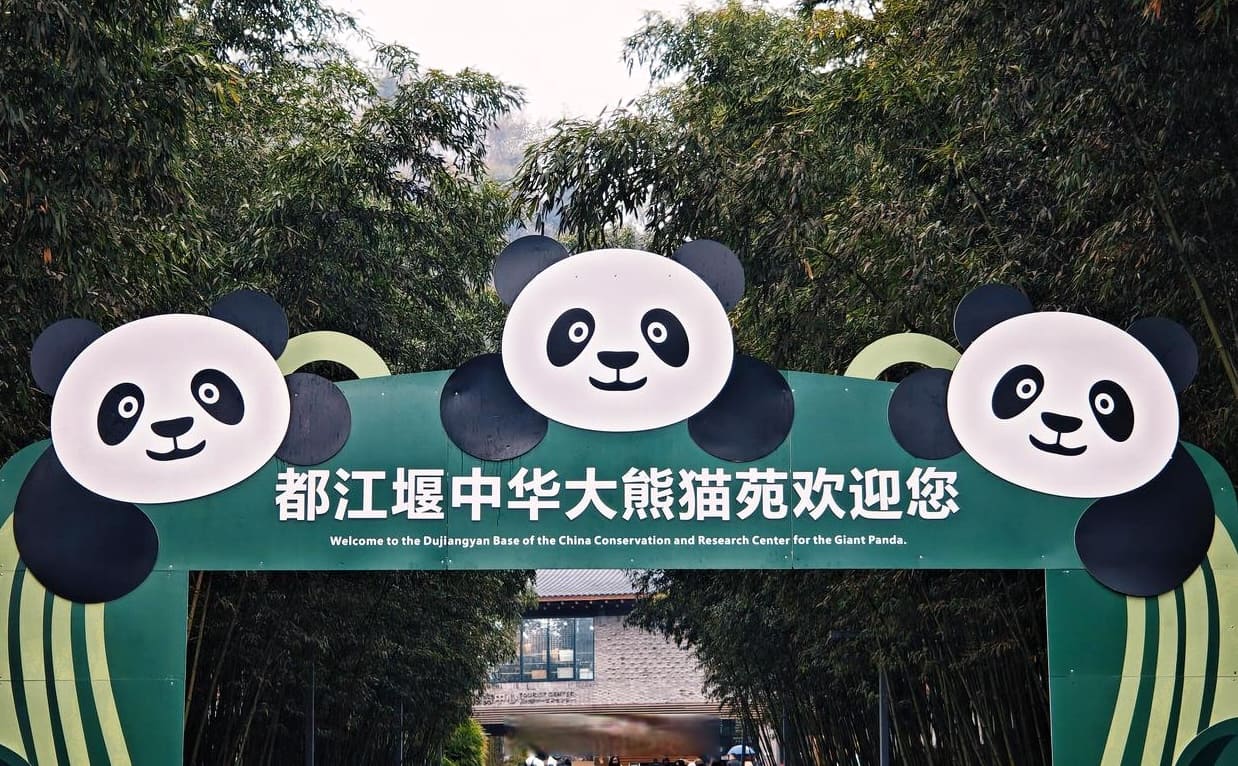
Dujiangyan Panda Base (China Giant Panda Garden): Visitor Guide
⚠️ Temporary closure: The base closed April 23, 2026 for renovation. No reopening date announced. We’ll update this page when that changes.
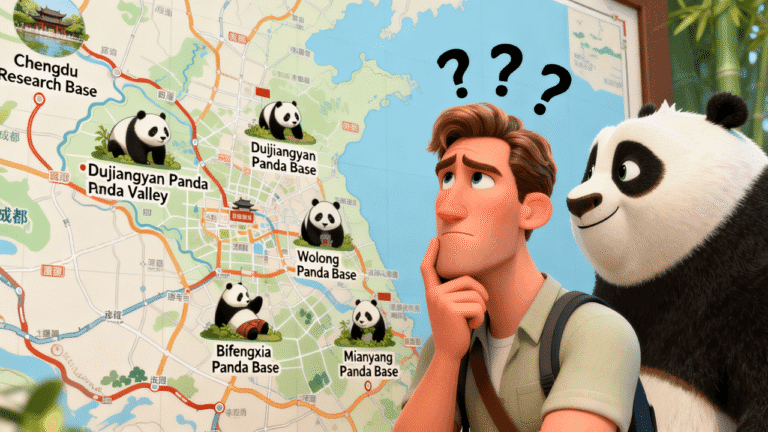
Dujiangyan has two separate panda facilities. This article covers the CCRCGP base (都江堰中华大熊猫苑) — the disease-control and rescue centre in Qingchengshan Town. If you’re looking for Panda Valley (熊猫谷), the wild-release training base in Yutang Town, see our Panda Valley guide.
The CCRCGP Dujiangyan Panda Base — known locally as Panda Paradise (熊猫乐园) — is the world’s only panda disease-control and rescue centre. Built with Hong Kong SAR government funding after the 2008 earthquake and opened in 2013, its residents skew older than any other base: some have lived in zoos on multiple continents, a few arrived injured from the wild and never left.
Official name | China Giant Panda Garden (都江堰中华大熊猫苑) |
Operator | CCRCGP |
Address | 789 Huaizhong Road, Shiqiao Village, Qingchengshan Town, Dujiangyan |
Opening hours | 08:30–17:00 (last entry 16:00) |
Admission | CNY 58 adult; CNY 29 student; free under 1.3m |
Shuttle bus | CNY 15 round-trip |
Arrive by | 09:00 — pandas are active 09:00–10:30, largely asleep after 11:00 |
Table of Contents
1. What Is the Dujiangyan Panda Base, and Why Is It Different?
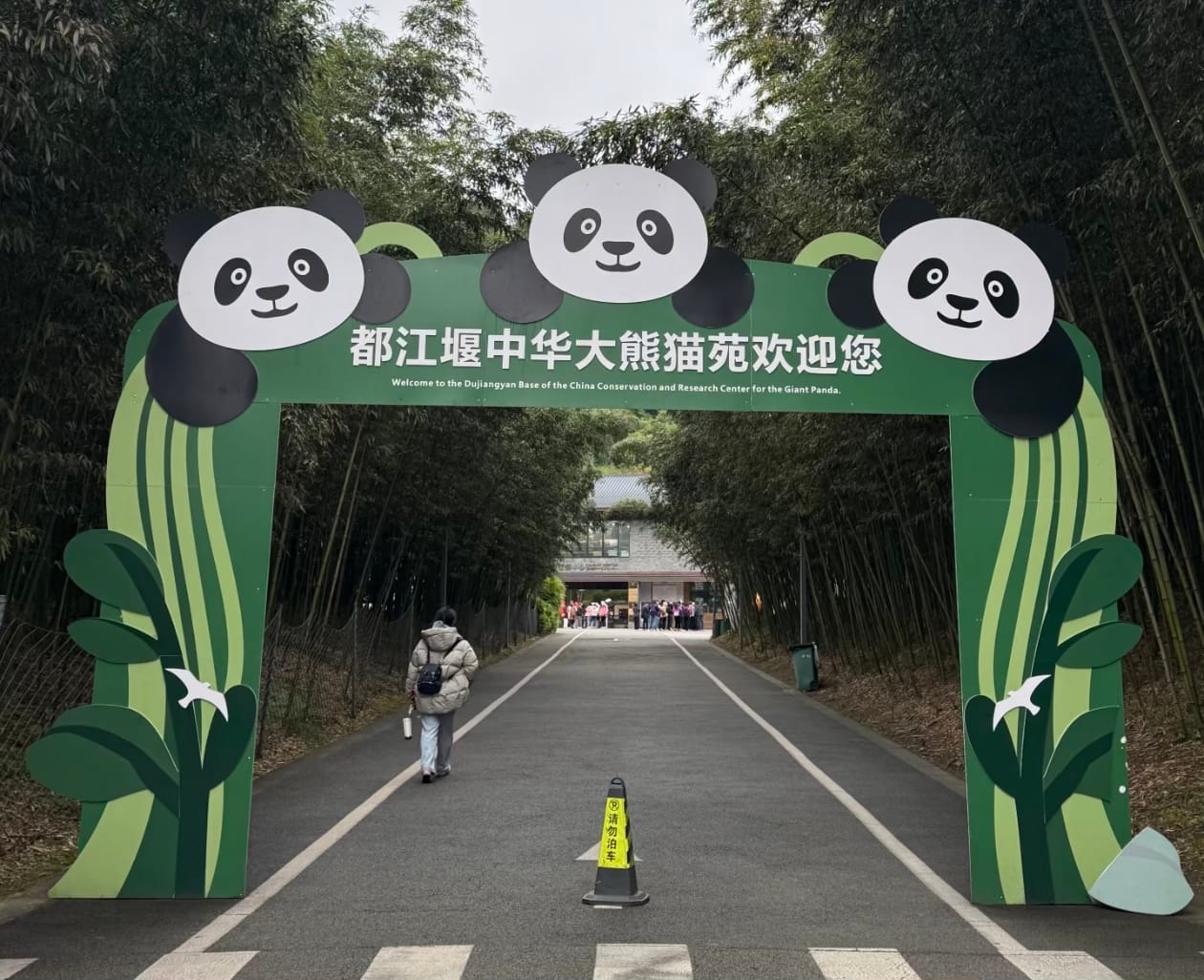
It’s not a breeding facility. The CCRCGP runs this base to do three things: rescue wild-injured pandas, conduct disease prevention and control research, and care for elderly pandas who’ve aged out of programmes elsewhere. The on-site nursing home takes residents aged 26 and older — at the panda-to-human age ratio of roughly 3.5:1, that’s a nonagenarian. Gao Gao spent his final years here. Bai Yun returned from 23 years at the San Diego Zoo and lived out her life in a quiet forested enclosure on this hillside.

The other thing that makes this base unusual is who else lives here. The CCRCGP uses it as the primary intake point for pandas returning from overseas loan programmes, which means it holds the world’s largest concentration of repatriated animals. Tian Tian and Mei Xiang — the Washington DC pair, two of the most-watched pandas in American zoo history — came back from the Smithsonian in 2023 and are now permanent residents. Su Lin and Zhen Zhen (both born at San Diego, daughters of Bai Yun), Le Le (Singapore), and animals returned from Belgium, South Korea, Malaysia, and the Netherlands have all lived here. An An and Ke Ke left for Hong Kong in 2024. If you’ve been following a specific panda for years through a foreign zoo’s live cam, there’s a real chance they’re here now.
On top of all this: Ruirui with her twins, Panwang with cubs, mother-cub groups that the Chengdu city base — with its tourist infrastructure and constant foot traffic — simply can’t replicate. On a good morning, the gap is obvious.
2. Should You Visit — and How Does It Compare to Other Bases?
Base | What it’s for | Pandas on display | Volunteer | From Chengdu | Crowds |
|---|---|---|---|---|---|
Breeding, cubs, education | 200+ | No | 10km, Metro | High | |
Dujiangyan CCRCGP (here) | Rescue, elderly care, overseas returnees | ~20 | Yes (aged 12–65) | 60km, train + bus | Low–medium |
Wild-release training | ~10 | No | 50km, train + DiDi | Low | |
Conservation, mountain habitat | ~20 | Yes (aged 12–65) | 130km, car only | Very low | |
Breeding, gorge setting | 30+ | Yes (aged 12–65) | 150km, car | Low–medium |
If you want the most pandas in the least time, the Chengdu city base is the answer — over 200 animals, 10 minutes by metro. If you want to see specific named pandas with documented histories — overseas returnees and elderly animals that have spent decades in American and European zoos — this is the only place in the world they live together. We recommend it as a second panda day for anyone already spending time in Chengdu, or as a first stop on a western Sichuan itinerary continuing to Wolong. As a standalone day trip it works, but the 90-minute journey each way is worth factoring in. For a broader look at all panda-watching options across China, see where to see giant pandas in China.
One thing to get straight before booking: the CCRCGP base and Panda Valley are in the same city but are entirely different operations — different institution, different location, different bus from the station. Getting them confused wastes an hour at minimum. We cover both in detail in our Dujiangyan Panda Base vs Panda Valley guide, and our panda organisations guide explains which national institution runs which facility. For a broader comparison of all five Sichuan bases, see our Chengdu panda bases guide.
3. What’s Inside, and How Do You Get Around?
Four enclosure complexes, one uphill path. At a steady walk, 20 minutes end to end — but allow two to three hours if you’re actually watching.
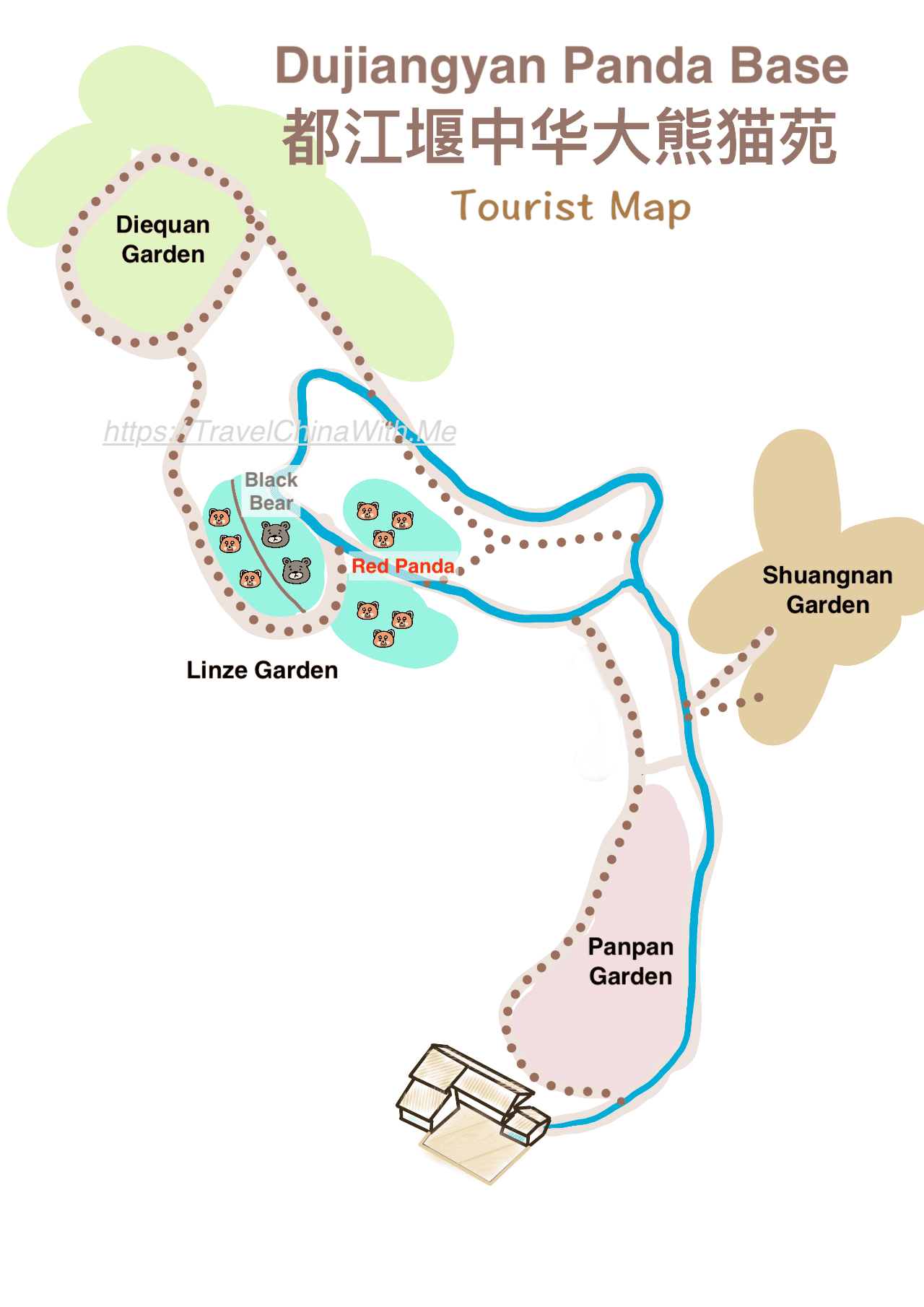
Recommended Walking Route
Entrance Gate 入口
Free luggage storage here. Arrive by 09:00.
Panpan Garden 盼盼园
Feeding starts here. Most active window: 09:00–09:30. Listen for Muye’s bleating.
Linze Garden 临泽园
Red pandas, black bears, pheasants. Terrain steepens — shuttle bus stop is here.
Diequan Garden 蝶泉园
Highest point. Calmest section. Mother-cub groups here — worth the climb.
Shuangnan Garden 双楠园
Downhill on the way back. Dense bamboo, good photography light by mid-morning.
Back to Entrance 回入口
Full loop — no backtracking. Total walking time: ~20 min; with watching, 2–3 hours.
Panpan Garden (盼盼园)
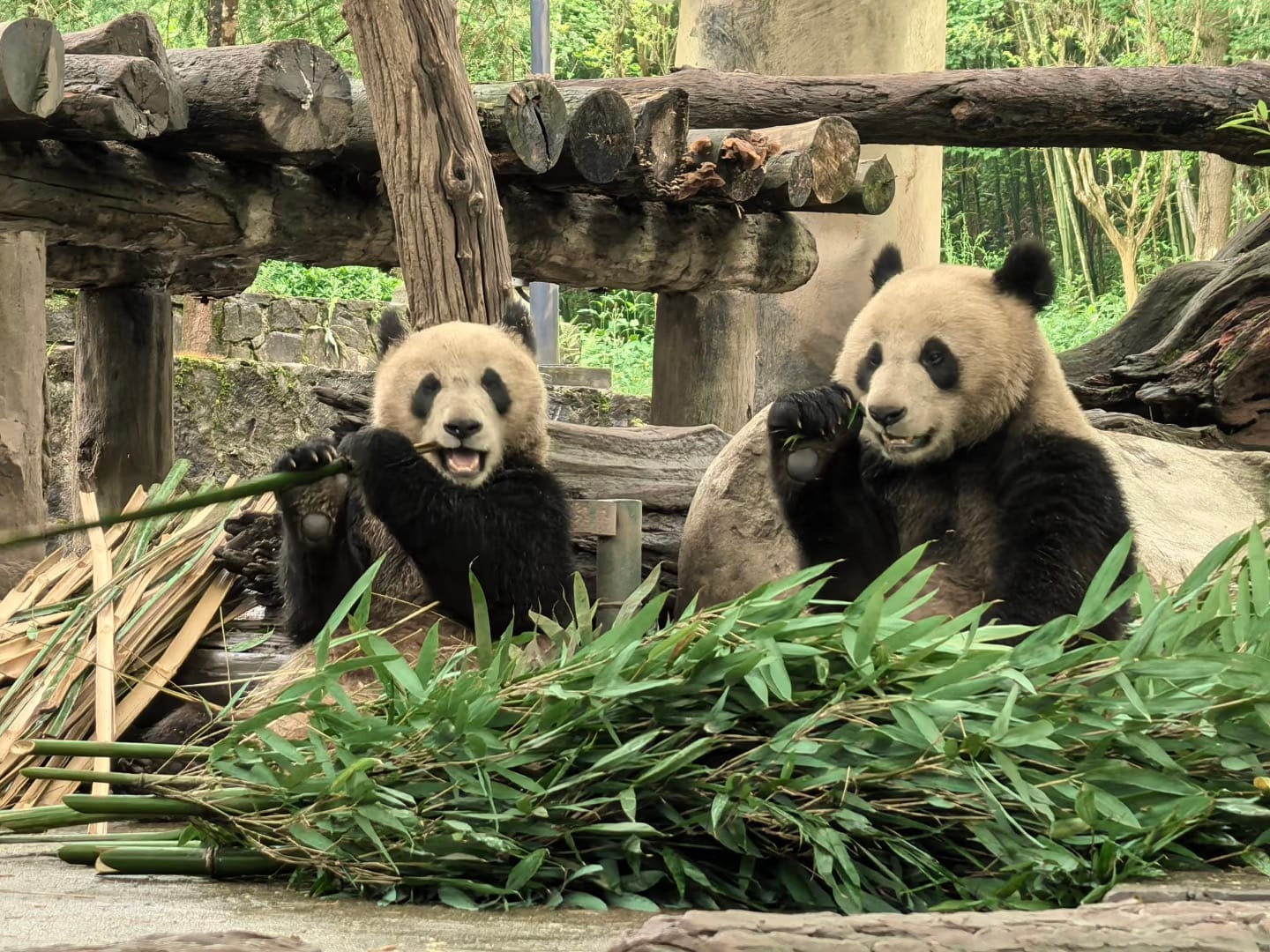
First stop after the entrance gate, and where feeding starts — the day’s most reliable activity is here. Muye (牧野) is a regular and has a habit of vocalising at visitors. Hearing a giant panda bleat catches most people off guard. Get here before 09:30.
Linze Garden (临泽园)
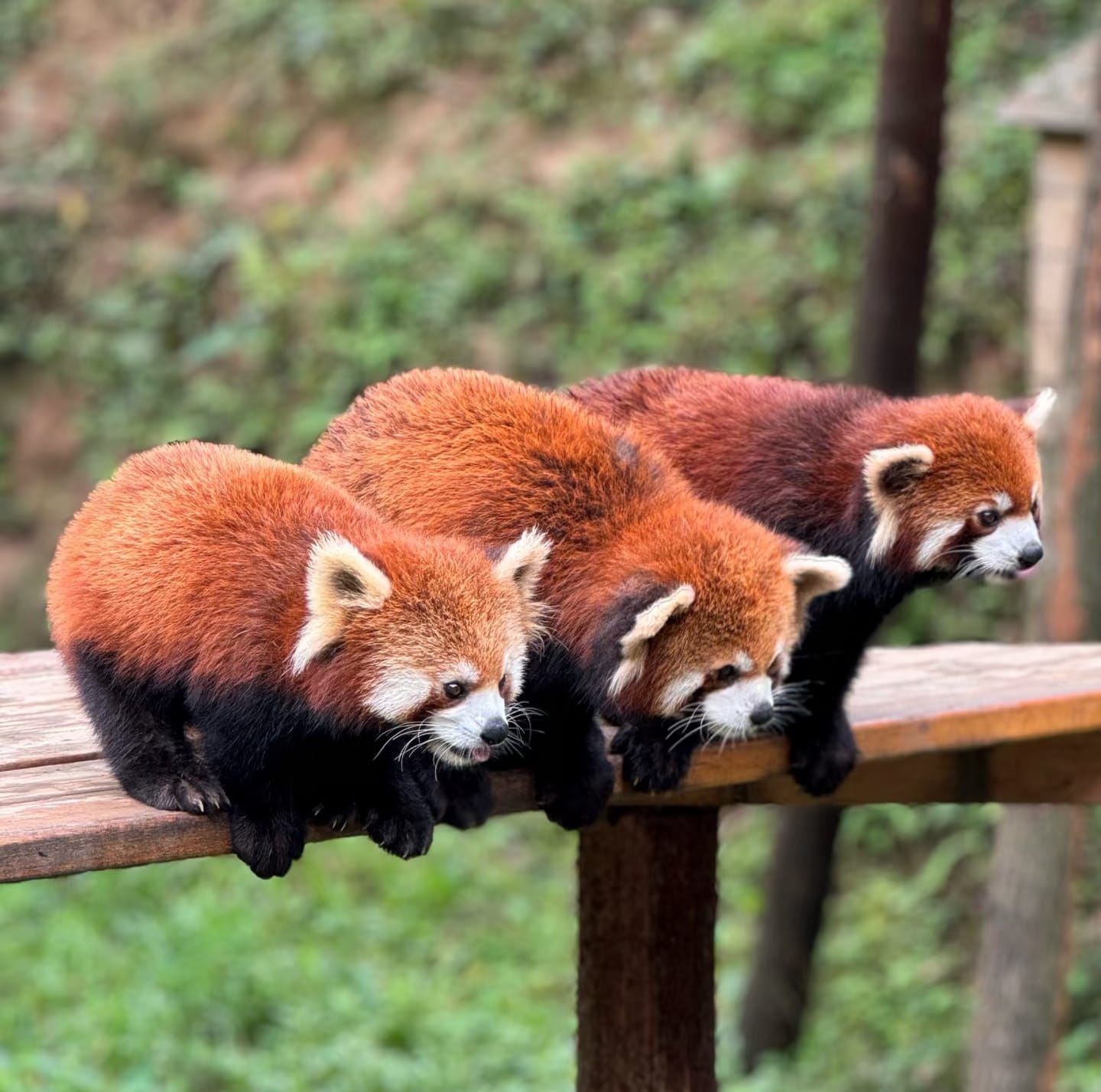
Red pandas, Asian black bears, golden pheasants, white pheasants. The red pandas are in fixed enclosures rather than the free-roam path at Panda Valley, but reliably visible. The terrain steepens through here — the shuttle bus stop is at this section.
Diequan Garden (蝶泉园)
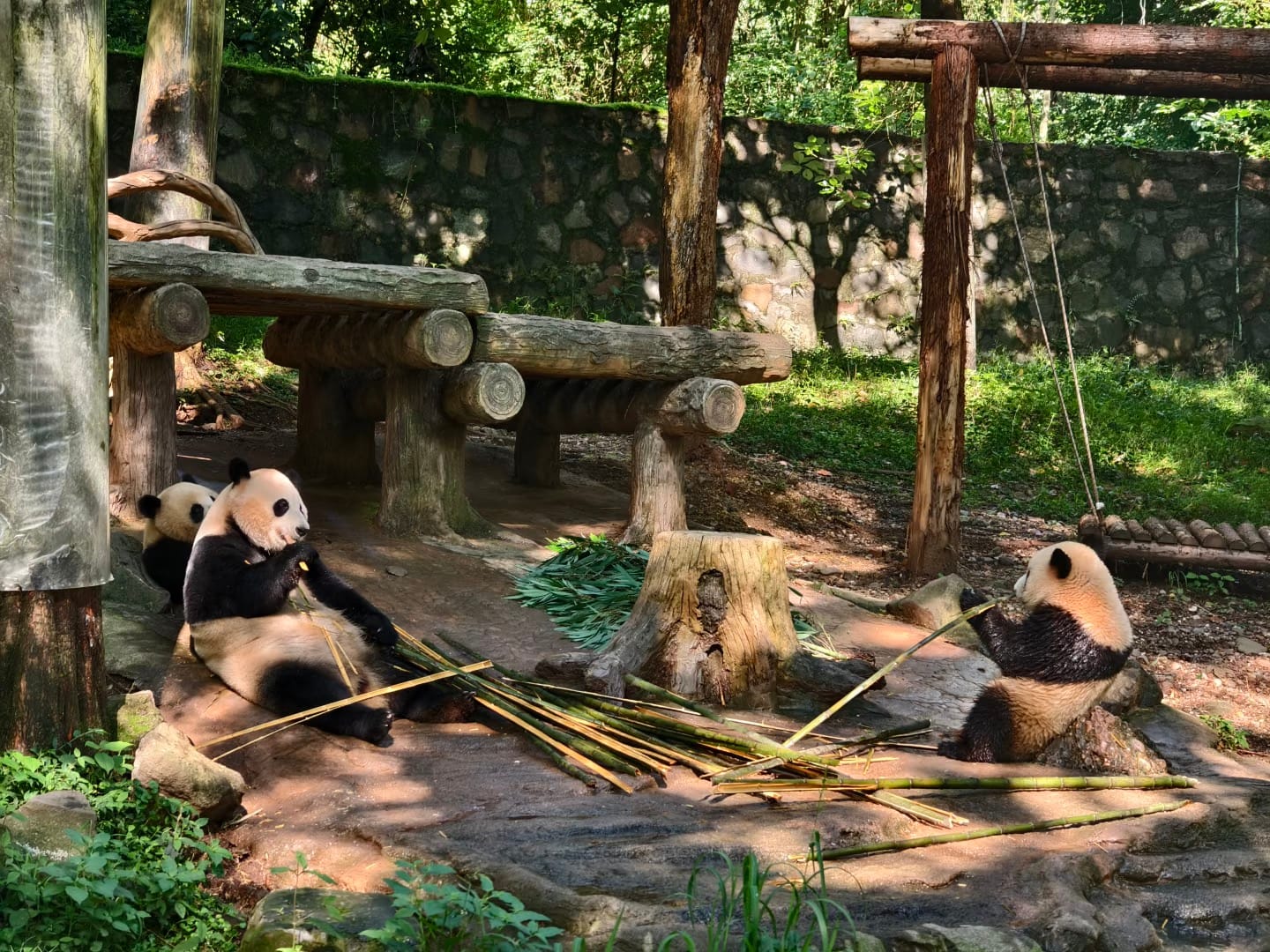
The top, and the calmest. Fewer visitors make it this far. Enclosures are larger and more open — mother-cub groups tend to be housed at this level. Ruirui and her twins have been up here: cubs trying to climb trees, Ruirui pulling them back down, the whole thing playing out close enough that you can hear it. The slurping of a cub drinking water at arm’s range is something you don’t forget.
Shuangnan Garden (双楠园)
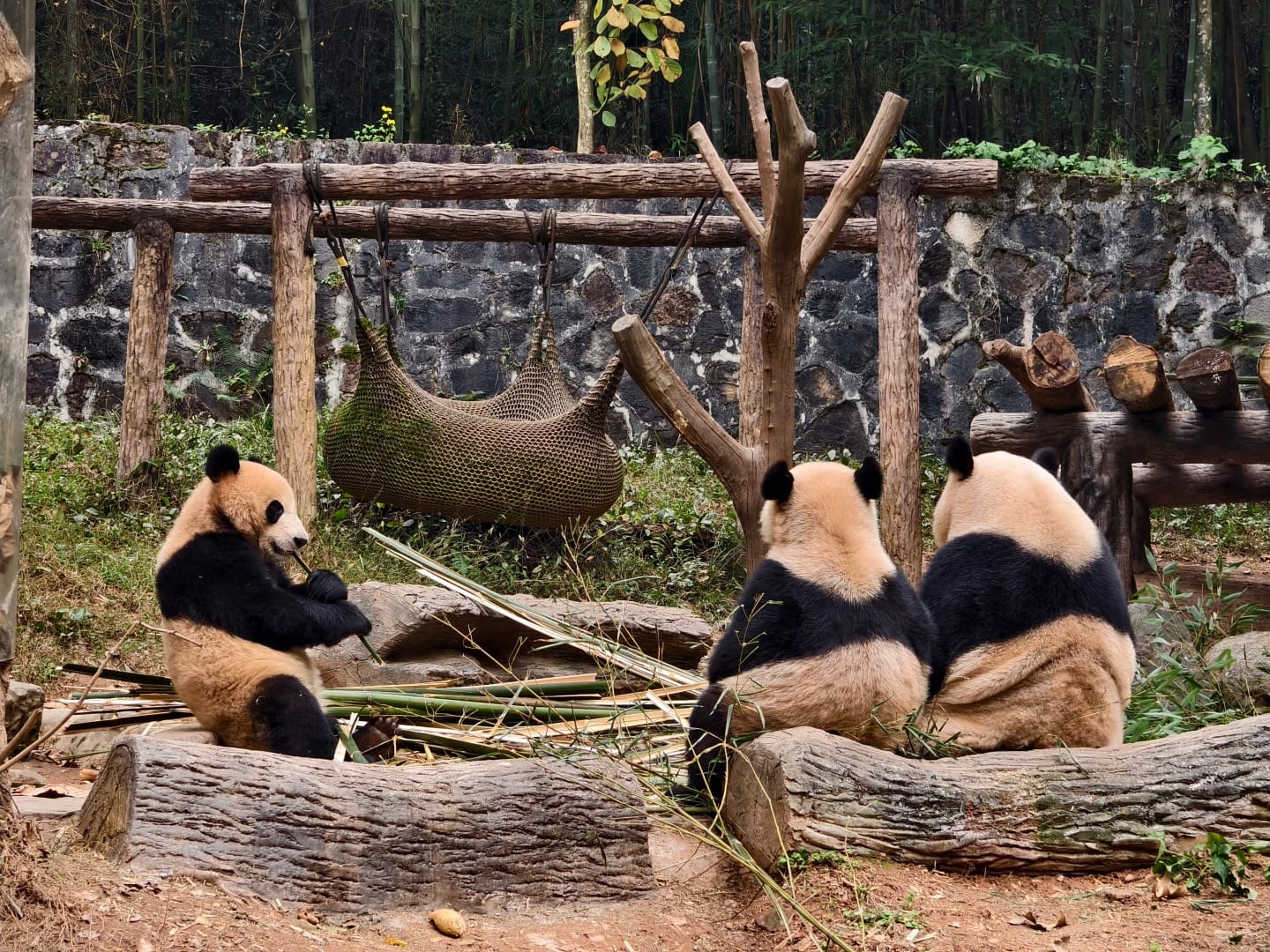
Denser bamboo, on the way back down. Su Mei (苏煤) and Tan (碳) live here and are, by all visitor accounts, aggressively indifferent to tidiness. Su Lin (苏琳), a San Diego returnee, has been spotted using her mouth to pull and crack bamboo with real force. Good spot for photography: the bamboo frames naturally and the enclosures sit at eye level.
Between 11:00 and 13:00, most pandas are flat. Don’t plan your visit around that window if you’re hoping to see movement.
4. When Is the Best Time to Visit?
09:00–10:30 is the only window that matters for active pandas. After 11:00, the day is essentially over from that perspective.
Season | Temperature | Notes |
|---|---|---|
Spring (Mar–May) | 14–22°C | Best overall — bamboo shoots in season, pandas outdoors more |
Summer (Jun–Aug) | 26–33°C | Mosquitoes, humidity; bring repellent and a small fan; pandas retreat indoors by 11:00 |
Autumn (Sep–Nov) | 13–22°C | Best for photography; clear light, comfortable temperatures |
Winter (Dec–Feb) | 4–12°C | Shorter hours; last entry 15:30; pandas surprisingly active in the cold |
Panda Activity by Month & Time of Day
Monthly Max. Temperature & Rainfall
Monthly max. temperature (°C) & precipitation (mm) · Source: climate-data.org, 1991–2021
Summer works if you arrive at opening and leave by 11:00. Water at the top runs CNY 5 a bottle — bring your own. Spring and autumn are the straightforward recommendation.
This base never gets loud in the way the Chengdu city base does on a holiday weekend. The noise issue is coach tours of domestic visitors arriving mid-morning — they cluster at Panpan Garden. If you’ve already worked your way uphill by then, you’ve missed most of it.
5. The Panda Volunteer / Keeper Experience
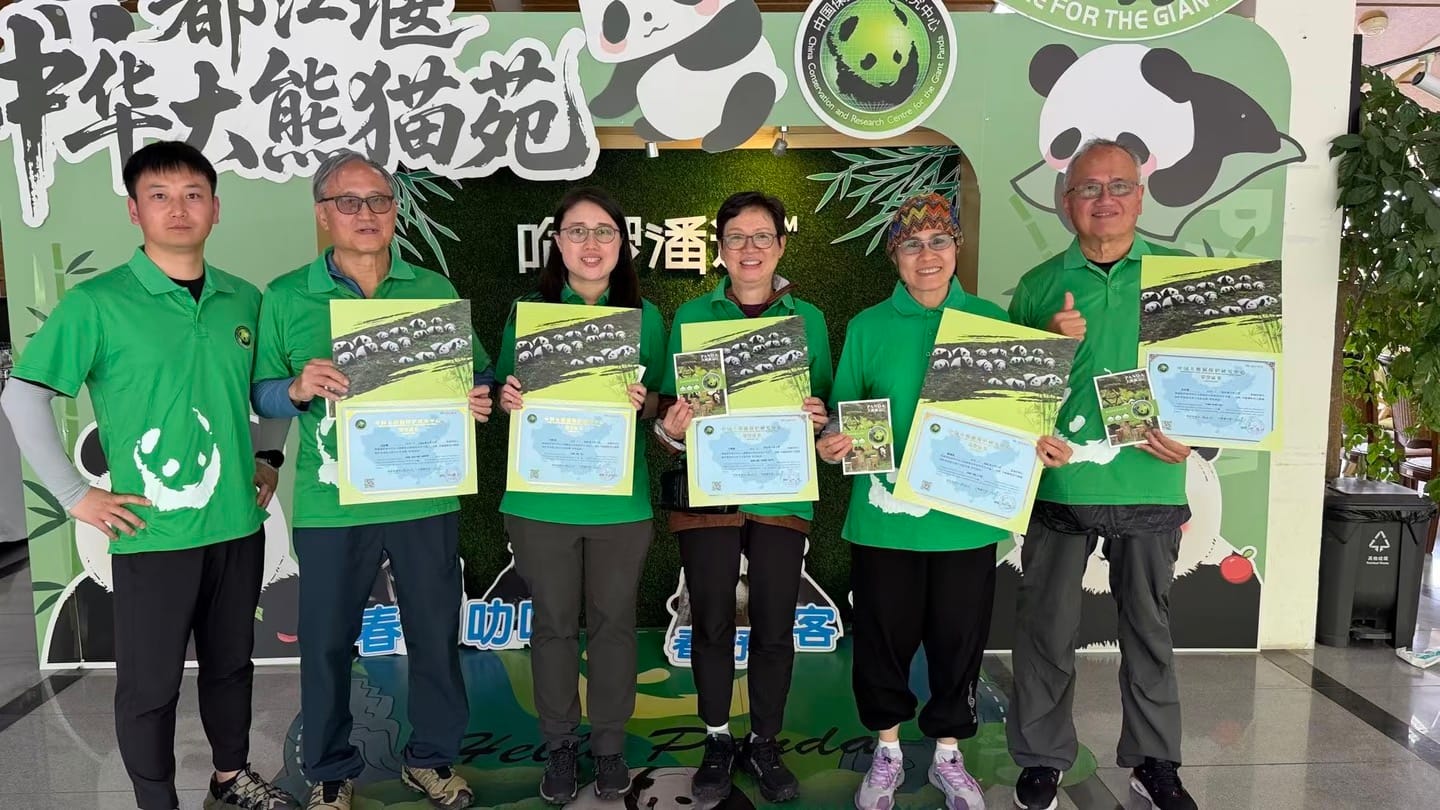
Panda Keeper Experience — Day Schedule
Assembly & orientation — Sign safety agreement, receive keeper uniform and gloves. Staff briefing on the day’s plan.
Enclosure work — Clean outdoor enclosures, collect old bamboo, remove waste. Then prepare fresh bamboo and panda bread (窝头) for the morning feed.
Indoor keeper area access — Masked and gloved, observe pandas eating through enclosure bars at close range. Photography prohibited in this section.
Lunch break — Canteen meal with staff. Free time to walk the public visitor areas.
Conservation documentary — Screening at the education centre.
Panda bread workshop — Make 窝头 (steamed corn-wheat buns) under keeper guidance. Learn the dietary differences between wild and captive pandas.
Certificate ceremony — Receive official keeper certificate and gift pack. Free to continue exploring the base.
It’s not a photo experience. No direct contact with pandas, no photography in non-public areas. What you get is several hours of real access — the kind that doesn’t exist on a standard admission ticket anywhere in China.
We’ve run this for clients who followed specific pandas from overseas zoos for years. In one session, a client who’d watched Bai Yun at San Diego Zoo stood a few metres from Su Lin — Bai Yun’s daughter, born at San Diego, now resident here — while she ate her morning bamboo. That’s not a tour product. That’s a coincidence made possible by knowing where these animals end up.
Participants must be aged 12–65. Book at least one week ahead; health documentation required. Availability can vary by season — check before planning around it. Contact us to arrange, and see our panda volunteer guide for a full comparison of keeper programmes across all CCRCGP bases.
6. How to Get to Dujiangyan Panda Base from Chengdu
The base sits in Qingchengshan Town, approximately 60km northwest of central Chengdu — about an hour by high-speed train and bus, or an hour by car. It’s in the same general direction as Qingcheng Mountain and Dujiangyan Irrigation System, making it easy to combine with either on the same trip.
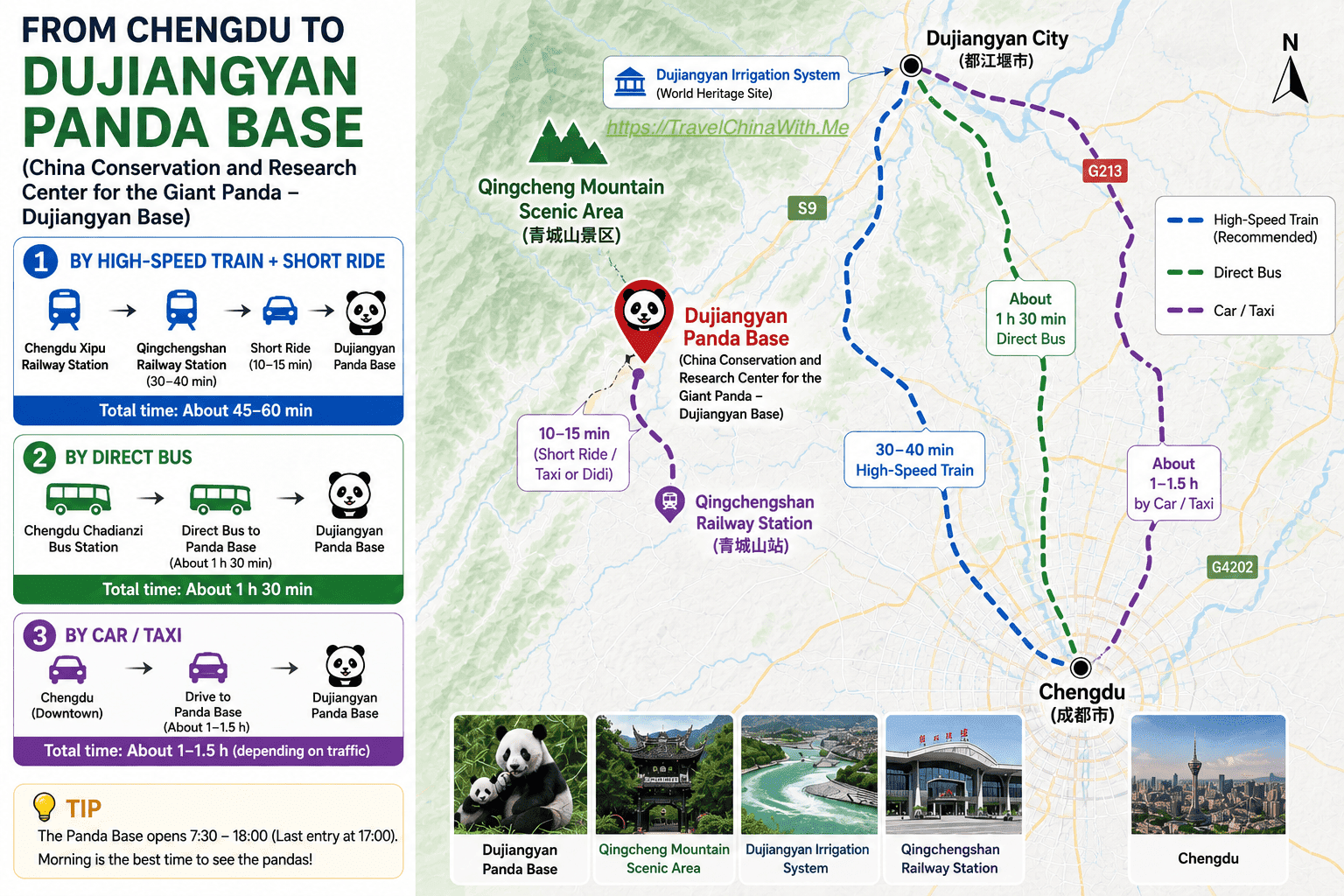
High-speed train + bus
Start at Xipu Station (犀浦站) — Metro Line 2 or 6. If you’re taking a taxi there, say 犀浦高铁站进站口 specifically. The drop-off is in a narrow lane and easy to miss; arriving at the wrong point means a long walk to the platform.
Take the intercity train to Qingchengshan Station (青城山站), not Dujiangyan Station. The journey is about 30–40 minutes, CNY 10. The first departure that gets you to the gate at opening is the 07:17 train — it reaches Qingchengshan around 07:45. Later trains sell out. Book on 12306 in advance.
Out of Qingchengshan Station, turn left. At the bus yard, take Bus 102 from Platform 3 or 4 toward Jiezigu Town (街子古镇方向) — CNY 2 via Alipay. Ask before you board: the 102 runs in both directions and you want the one heading away from the city. Nine stops, about 15 minutes, alight at 熊猫乐园.
From the station a taxi costs around CNY 15 and takes 15 minutes — faster, and worth it if you’re racing the 08:30 opening.
Private car
Chengdu–Guanxian Expressway, exit at Chongyi, then Pengqing Road toward Qingcheng Mountain — about 35 minutes from the exit, an hour from the Third Ring Road. Navigate to 熊猫乐园检票口, not 熊猫谷.
From central Dujiangyan city, DiDi runs around CNY 20.
For a door-to-door option from your Chengdu hotel, our charter car service covers this route and can be combined with other stops on the same day. If your itinerary includes Wolong, the drive from here to Shenshuping via the S303 is about 90 minutes — a natural two-day western Sichuan sequence.
7. What Else Is Nearby?
Qingcheng Mountain (青城山)
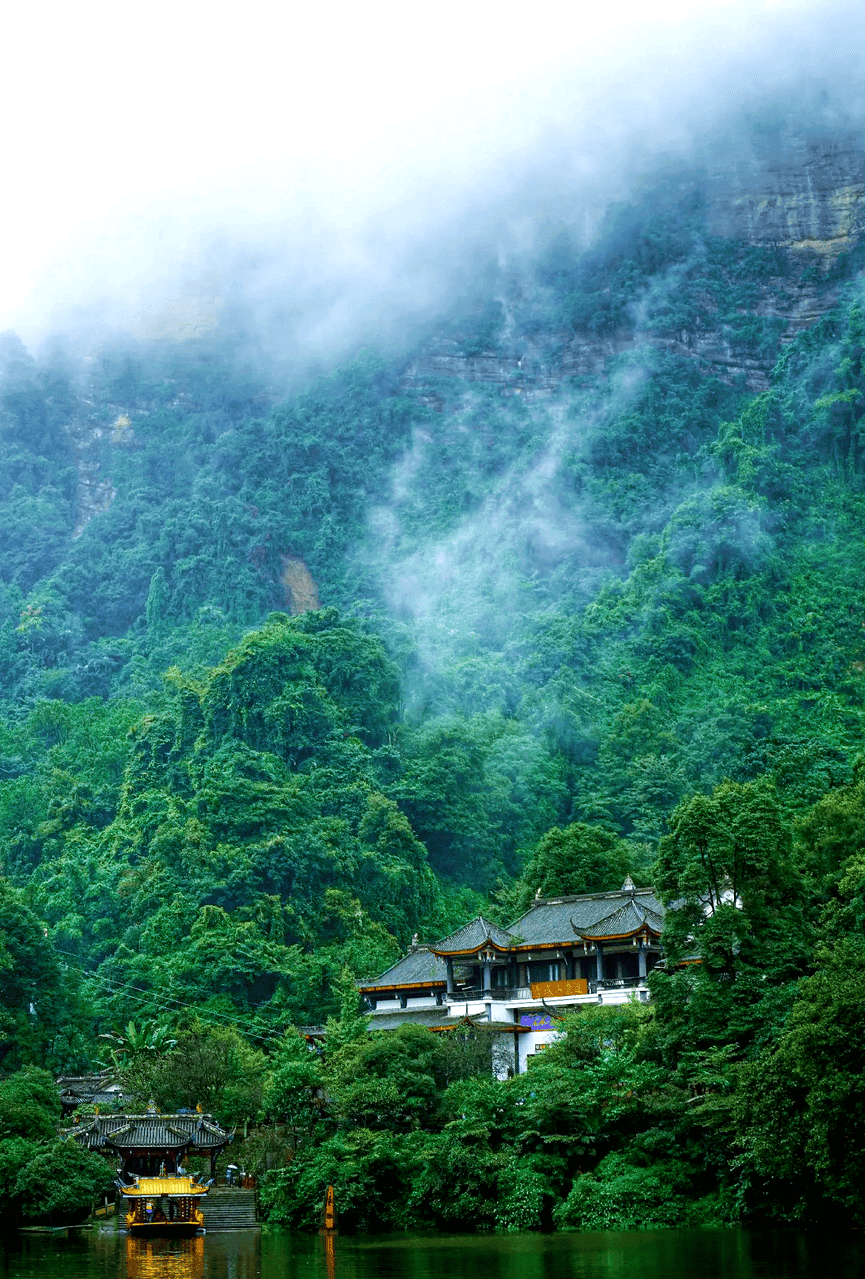
5km. Bus 102 connects both directly in about 20 minutes. Qingcheng is China’s most atmospheric Taoist mountain — old stone paths, bamboo forest, incense, temple complexes set into the hillside. A morning at the panda base and an afternoon on the front hill (前山) is a full day done well.
Dujiangyan Irrigation System (都江堰水利工程)
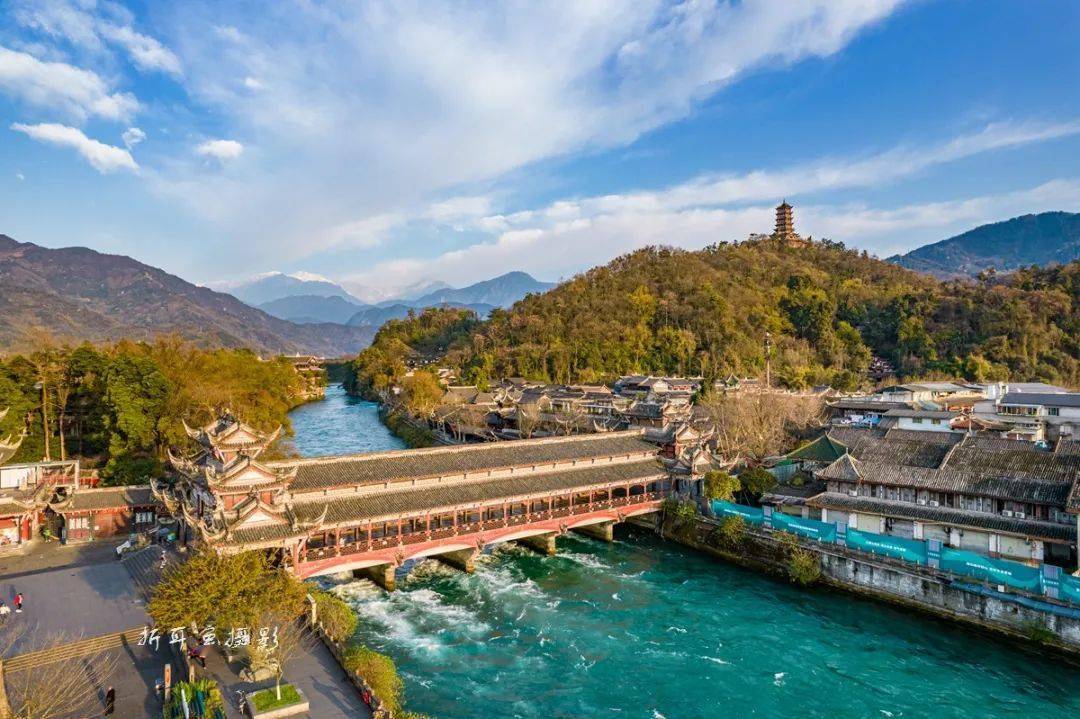
19km north. The 2,250-year-old system that made the Chengdu Plain farmable — still operating, UNESCO listed. Combining it with a panda visit is possible but rushed. We’d treat them as separate days. From the base, Bus 102 back to Qingchengshan Station then the train to Lidui Park Station (离堆公园站) takes about 45 minutes.
8. Practical Tips
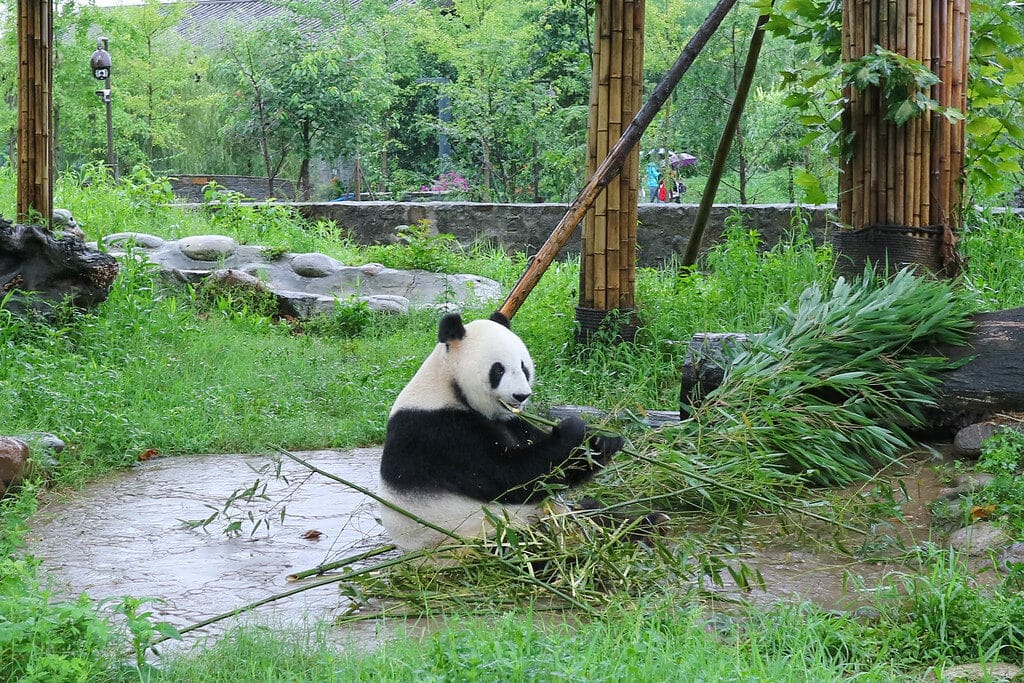
Free luggage storage at the gate. Leave bags before you go in — you’ll want both hands free on the climb.
Keep noise down. Pandas react to sudden loud sounds. The base gets noisy when coach tours arrive, usually mid-morning. Arriving at opening keeps you ahead of that. If a group is being loud near an enclosure, move — keepers may or may not intervene.
Summer: repellent is not optional. The bamboo-dense lower sections have real mosquito activity. Bring repellent and a small fan.
No flash photography, especially near cubs and older pandas. Enforced at the gate and throughout.
Don’t feed the pandas, don’t throw anything into the enclosures, don’t break the bamboo. The bamboo in the park is not for visitors. Pandas get measured rations; anything unauthorised is a health problem.
Tickets online only — no window at the gate. Book via the official WeChat account (都江堰中华大熊猫苑) with your passport number. Same for the 07:17 train from Xipu: book on 12306 ahead of time.
9. Frequently Asked Questions
Is the Dujiangyan Panda Base the same as Panda Valley?
No. Different institution, different location, different bus from the station, 19km apart. This base (CCRCGP, Qingchengshan Town) focuses on rescue, disease control, and elderly panda care. Panda Valley (Chengdu Research Base, Yutang Town) focuses on wild-release training. See our full comparison.
How many pandas will I actually see?
About 20 are on public display across the four enclosure complexes. The base holds around 40 total; the rest are in quarantine, medical care, or research areas. Linze Garden also has red pandas, Asian black bears, and several pheasant species.
Which famous pandas live here?

Tian Tian (Featured Image) and Mei Xiang — 23 years at the Smithsonian — returned in 2023 and are permanent residents now. Su Lin and Zhen Zhen (San Diego, daughters of Bai Yun), Le Le (Singapore), and animals returned from Belgium, South Korea, Malaysia, and the Netherlands have all been here. An An and Ke Ke left for Hong Kong in 2024. Gao Gao and Bai Yun both spent their final years here.
Is it worth visiting if I’ve already been to the Chengdu city base?
Yes, but for different reasons. The city base is built around volume — maximum pandas, maximum throughput. This one is built around specific animals with histories you can actually learn before you arrive. If you came to Chengdu to see pandas and left feeling like it was a conveyor belt, this is the answer to that.
Do I need to book in advance?
Yes. No tickets at the gate. Book via WeChat (都江堰中华大熊猫苑) with your passport number. The 07:17 train from Xipu sells out too — book both.
Is the terrain manageable with a pram or for older visitors?
The lower two sections — Panpan and Shuangnan Gardens — are relatively flat. Linze and Diequan involve a sustained climb. The shuttle covers that stretch for CNY 15. Downhill walk back is easy.
Planning a Sichuan panda itinerary? Contact our team — we’ve been organising panda visits and keeper programmes for international visitors since 2006.