Gaokao in China: What Every June Visitor Must Know
If you’re visiting China in June and something feels off — your hotel is full, the streets are unusually quiet, parents in red are gathered outside a school, or your phone signal just dropped near a building — the gaokao is almost certainly the explanation. The gaokao (高考, National College Entrance Examination) mobilizes 13 million students every June 7–10, shuts construction sites, fills hotels near schools, and deploys signal-blocking equipment around exam venues. It places no restrictions on foreign visitors whatsoever, but it reshapes the cities around you. We’ve been running tours across China since 2006 and have navigated gaokao week in Beijing, Chengdu, Xi’an, Zhangjiajie, and a dozen other cities. Here’s what actually matters for travelers — whether you’re still planning or already on the ground.
Exam dates (yearly) | June 7–8 nationwide; Beijing, Tianjin, Zhejiang, Shandong extend to June 9–10 |
Participants (2025) | 13.35 million students |
Noise restrictions | Construction, horn-honking, loudspeakers banned near all exam sites |
Hotel pressure | Properties within 1 km of exam venues book out 2–3 months in advance |
Entertainment closures | KTVs, internet bars, some live venues suspended in many cities |
Mobile signal near venues | Drone-based signal blockers deployed — expect WeChat and data disruption within 200m of exam sites |
Post-exam travel surge | Domestic bookings jump 88% the week after the exam ends — leisure destinations fill fast |
Best booking window | April for any June 5–25 city stay; early May for June 9–22 at leisure destinations |
Table of Contents
1. What Is the Gaokao — and Why Does It Stop Cities?
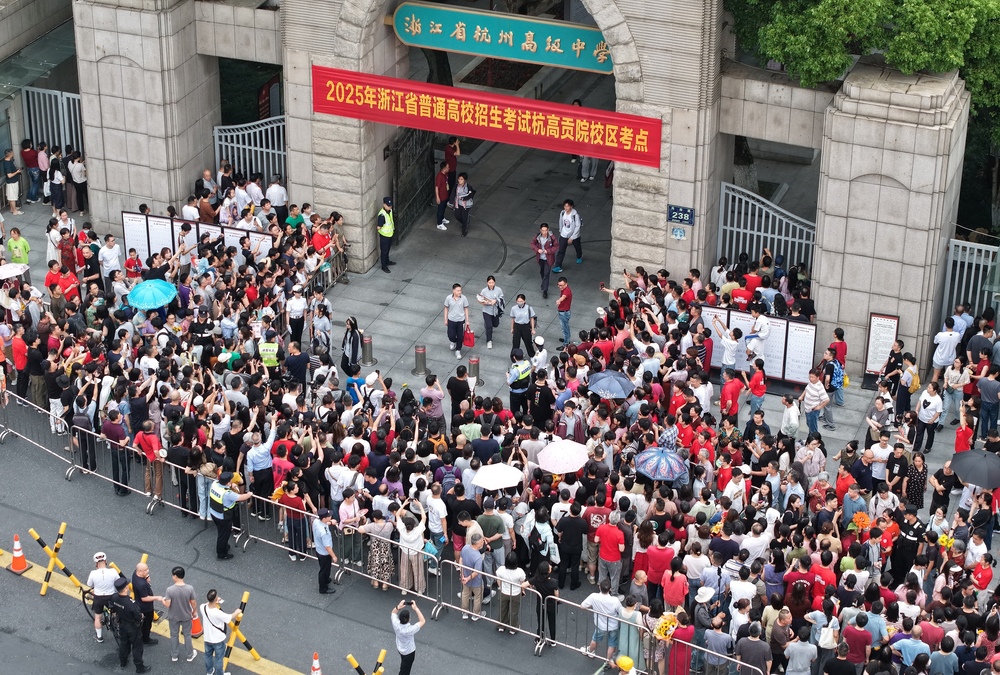
The gaokao (高考, literally “high exam”) is China’s National College Entrance Examination, the primary gateway to university for Chinese students. A single score determines which institution a student can attend — and by extension their career and social trajectory for life. The exam was first held in 1952 and suspended during the Cultural Revolution. It was reinstated in December 1977, the only year it has ever run in winter. The class of 1977 sat the exam on almost no notice, after a decade of cancelled university admissions. That cohort now includes some of China’s most prominent figures in academia, policy, and the arts. The weight of that history lives in the exam to this day.
The scale is what matters for travelers: 13.35 million students sat the 2025 exam simultaneously across every major Chinese city — down slightly from the 2024 record of 13.42 million, itself the highest figure since the exam was reinstated. The number has risen from 9.4 million in 2017 to above 13 million every year since 2023, a trajectory driven by near-universal secondary school enrollment. That’s the combined population of London and Paris at desks on the same morning. The mobilization — tens of thousands of venues, hundreds of thousands of invigilators, citywide noise enforcement, anti-cheating drones, police escort protocols — reshapes urban China for several days every June.
Gaokao Participants 2017–2025
Source: China Ministry of Education
One historical detail most travelers don’t know: the exam originally ran July 7–9. The Ministry of Education moved it forward to June in 2003 specifically because July heat in southern China was damaging student health, and summer flooding was disrupting transport to exam sites in southern provinces. That scheduling decision is why travelers encounter gaokao in early rather than peak summer.
2. When Does the Gaokao Run — and Does It Vary by Province?
The core national schedule is June 7–8, confirmed by the Ministry of Education each spring. Most provinces finish on those two days.
Provinces using the reformed “3+1+2” elective model run additional sessions for supplementary subjects. In 2025, Beijing, Tianjin, Zhejiang, and Shandong ran four consecutive exam days, finishing June 10. This is now standard for those provinces under ongoing reform.
Province Group | Duration | Ends |
|---|---|---|
Most provinces (national paper) | 2 days | June 8 |
Some provinces (extra electives) | 3 days | June 9 |
Beijing, Tianjin, Zhejiang, Shandong | 4 days | June 10 |
The 2026 national schedule (Ministry of Education documentation): June 7 — Chinese 9:00–11:30, Mathematics 15:00–17:00; June 8 — Physics or History 9:00–10:15, Foreign Language with listening 15:00–17:00; additional subject sessions June 9–10 for extended-model provinces.
Practical rule: If your itinerary includes any of the four extended provinces during the second week of June, treat June 7–10 as the full impact window. Traffic management, hotel pressure, and noise restrictions remain in effect until the last session ends.
3. How Does the Gaokao Affect June Travel Week by Week?
June in China isn’t a single event — it’s a sequence of overlapping pressure points, each with a distinct effect on travelers.
How Gaokao Affects China Travel: Late May to Late June
(from ~May 20)
Dragon Boat Festival date applies to 2026. Score release dates vary by province.
The window that our clients consistently underestimate is late May. The two weeks before the gaokao are one of the calmest periods in the Chinese travel calendar. Families with high school students don’t travel. Urban residents stay home. We have booked hotel rooms in central Beijing in late May at prices we haven’t seen since 2019. If your dates are flexible and you’re planning a June China trip, late May or June 11–18 are the two windows with the best value and lightest crowds.
4. How the Gaokao Affects Your Hotel
Hotels within 1 km of exam venues — almost always secondary schools embedded in residential neighborhoods — fill 2–3 months before the exam. According to Ctrip data, over 75% of gaokao families book hotels within 1 km of the exam site. More than 40% specifically target star-rated properties. They book early, pay a premium, and request quiet rooms facing away from the street.
How the Gaokao Squeezes Hotel Availability
Where gaokao families book — and how far in advance (Ctrip)
Post-exam travel bookings: week before vs. week after gaokao ends (Trip.com, 2025)
Sources: Ctrip via China Daily · Trip.com via Xinhua
Beijing gives a sense of the density involved: in 2025, the city had 114 test centers spread across 18 examination districts for 78,900 registered candidates. Each of those 114 locations generates its own bubble of hotel pressure, traffic management, and noise enforcement. Multiply that across Shanghai, Chengdu, Xi’an, Guangzhou, and every other major city, and the city-wide effect becomes clear.
Standard rooms near exam sites in Beijing and Shanghai have been documented at double the usual nightly rate. In 2022, CNY 5,000 per night rates appeared at five-star Shanghai hotels near exam sites — not because those properties were anything special, but because they were simply the last rooms available. One parent forum post at the time summarized it plainly: “I searched Ctrip for gaokao hotels and no vacancies came up for the whole weekend.”
Book by April — here’s why that cutoff matters
For any June 5–15 stay in Beijing, Shanghai, Guangzhou, Chengdu, Xi’an, Nanjing, or Hangzhou, the April booking deadline is real. The parents who snap up nearby rooms start in March. By May, anything walkable to a secondary school is gone or double-priced. Properties near business districts, tourist zones, and industrial areas are largely unaffected — the pressure is hyperlocal, concentrated in residential school neighborhoods.
The silver lining for light sleepers
During the exam days themselves, gaokao hotels enter enforced quiet mode. Construction stops. Outdoor vendor loudspeakers disappear. Horn-honking near the property is banned. Several clients over the years have told us June 7–8 mornings in Chinese cities were the quietest they’d experienced anywhere. It’s a genuine benefit, and it’s citywide in affected zones.
The post-exam surge: a second booking wave
When the exam ends, 13 million students who’ve been in study lock-down immediately travel. Trip.com recorded an 88% week-on-week jump in domestic bookings for June 9–11 departures in 2025. The Global Times documented the full scope of this spending surge — dubbed the 后高考经济 (post-gaokao economy) — in mid-June 2025: travel, high-end electronics (phones and laptops top the list), driving lessons, cosmetic procedures, and teacher appreciation banquets all spiked simultaneously. In Chongqing, the JD MALL store manager reported learning devices, digital notebooks, and wearable gadgets selling at 40–50% above pre-exam levels within days of the results. In Taiyuan, digital product stores were photographed packed with students and parents the morning after the exam ended.
For travelers, the directly relevant effect is on accommodation. Leisure destinations — Xiamen, Sanya, Yunnan’s Dali and Lijiang, Zhangjiajie, Guilin — absorb the student travel wave in mid-June. Add the Dragon Boat Festival holiday (June 19–21 in 2026) and you have two consecutive demand surges within 10 days. If your trip runs through mid-to-late June at any popular domestic destination, book accommodation 6–8 weeks out.
5. What Gets Shut Down for Noise During Gaokao?
China's Noise Pollution Prevention Law (Article 33) explicitly authorizes local governments to impose area-and-time restrictions on any noise-generating activity during college entrance examinations. Cities apply it with genuine force.
In Hangzhou, noise violations during gaokao carry fines up to CNY 50,000. Shanghai, Guangzhou, Nanjing, and Hangzhou each issued official orders suspending nighttime construction specifically for the 2025 gaokao. Xining's Cultural Tourism Bureau sent written notices to every entertainment venue in the city ahead of the exam — a pattern repeated in cities across China.
Activity | Status | Where |
|---|---|---|
Construction and renovation | Banned at night; often daytime too | Shanghai, Guangzhou, Nanjing, Hangzhou — citywide official orders |
Vehicle horn-honking | Banned near exam sites | All cities with exam venues |
Loudspeakers, outdoor audio | Banned near exam sites | All cities |
KTVs and karaoke bars | Suspended in many cities | Near-school zones; varies by city |
Internet cafés, gaming rooms | Suspended in some cities | Tier-2 and tier-3 cities notably strict |
Street performances, lion dances | Postponed | Jiangsu, Fujian, Henan — documented 2025 |
Live concerts | Rescheduled | Citywide where venue is within audible range of exam sites |
Theater and opera | Suspended near venues | Varies (Anhui Huangmei Opera Theatre: June 5–9, 2025) |
In 2025, concerts in Dongguan and Huizhou were rescheduled after parent complaints, even when acoustic testing confirmed negligible noise at the nearest school. The cultural pressure to protect gaokao students extends well beyond legal minimums.
For travelers: verify any KTV, live music, or performance venue before committing. In cities with exam sites distributed across the urban core — Xi'an's old city, Chengdu's inner ring — the effective quiet zone covers much of the center.
READ ALSO: Noise Pollution in China: What Travelers Should Know
6. Will the Gaokao Affect My Phone Signal?
Yes — within a few hundred metres of an exam venue during session hours. Here's the mechanism.
Gaokao security has escalated steadily. The exam papers are classified as state secrets and transported in vehicles with video surveillance, opened only with three separate keys. The Ministry of Education announced strengthened security measures for the 2025 gaokao: stricter entry checks, enhanced screening for phones and smartwatches, and radio signal blocking at every exam site nationwide. Anti-cheating technology at venues includes facial recognition entry systems, metal detectors, and AI cameras that flag irregular behavior in real time — Guangdong province deployed AI across 386 sites in 2024. Signal-blocking drones and vehicles are also deployed around exam buildings to prevent wireless transmission.
That last measure is the one that catches travelers. Within 200 metres of an active exam site on June 7–8, between 8:30 am and 5:30 pm, mobile data and WeChat connectivity degrade. The signal blockers are directional and temporary, but they are real. We've had clients in Beijing's Haidian District message us from outside a school saying their phones had gone effectively offline — they had unknowingly parked next to an exam site. Moving one block away restored connectivity.
Since 2016, gaokao cheating has been a criminal offense. Organized cheating carries sentences of 3–7 years in prison. The Supreme People's Court reported that between November 2015 and April 2024, over 11,000 people faced criminal penalties for cheating-related offenses including selling answers, impersonation, and running cheating rings. This context explains why the security presence — police, drones, signal vehicles — looks the way it does.
7. Will Gaokao Traffic Affect My Getting Around?
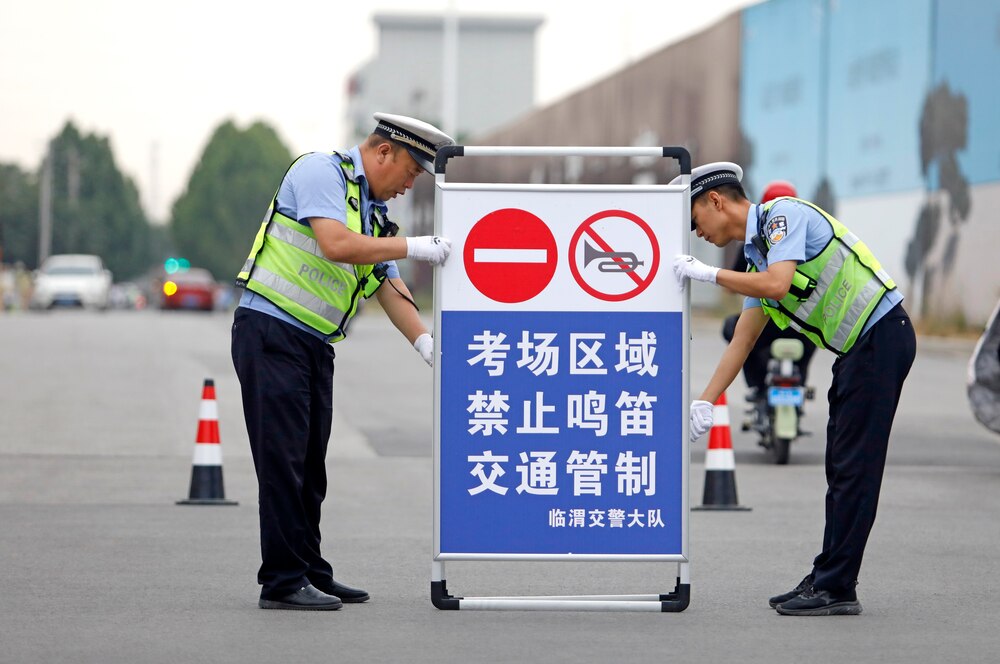
Traffic management around exam sites is coordinated at national level. The Ministry of Public Security deploys officers to key junctions by 6:00 am on exam mornings. Priority lanes are created for student transport. Several cities stagger office start times during exam days to reduce commuter overlap with student arrival.
What travelers actually experience
The disruption is local and time-specific. Between 7:30 and 8:30 am near exam sites, traffic slows as students, parents, escort vehicles, and deployed officers converge. In Beijing's Haidian District — which has dense exam site coverage near the university belt — and in Chengdu's second ring road area, we've experienced delays of 20–30 minutes beyond normal during this window. DiDi drivers are familiar with the pattern and usually reroute automatically without prompting.
Add 30 minutes to any morning transport on June 7–8 that crosses a residential school neighborhood. Airport transfers, morning train connections, early tour pickups — all of these warrant the buffer.
Long-distance transport: unaffected
High-speed rail runs on its standard timetable. Domestic flights are unaffected. Inter-city bus services run normally. Gaokao disruption is entirely local — concentrated within 1–2 km of each exam venue during the 90-minute pre-session arrival window. Once you're out of the neighborhood, conditions are normal.
8. What Does Gaokao Week Actually Look Like on the Street?
If you're already in China and wondering why the city feels different, this is what you're seeing.
Parents in red. Red signals luck and success in Chinese culture. On exam morning, the clusters of parents waiting outside school gates are almost uniformly wearing red — jackets, shirts, scarves. Some schools have entire parent cohorts in matching outfits. The visual of hundreds of adults standing in red against gray school walls, in near-total silence, is arresting in a way that photographs don't fully capture.
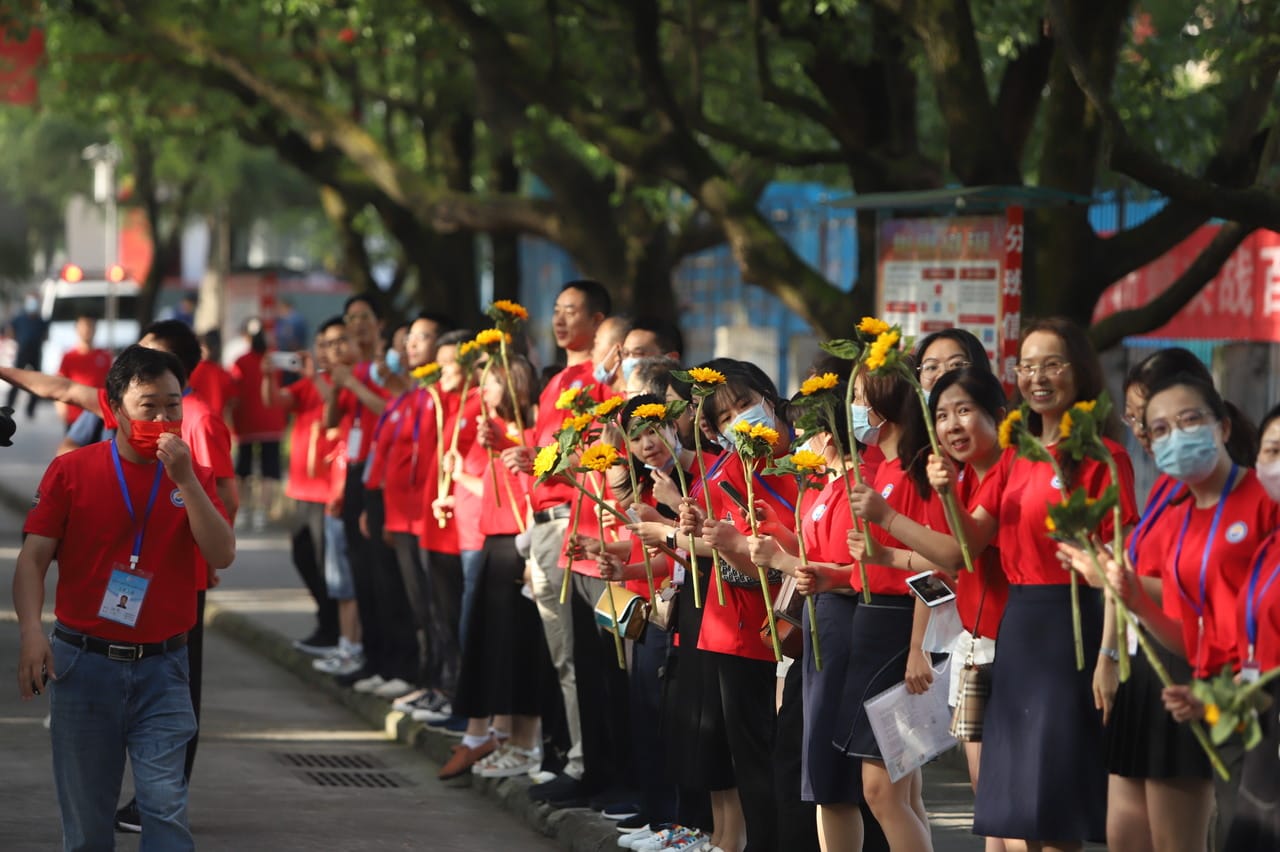
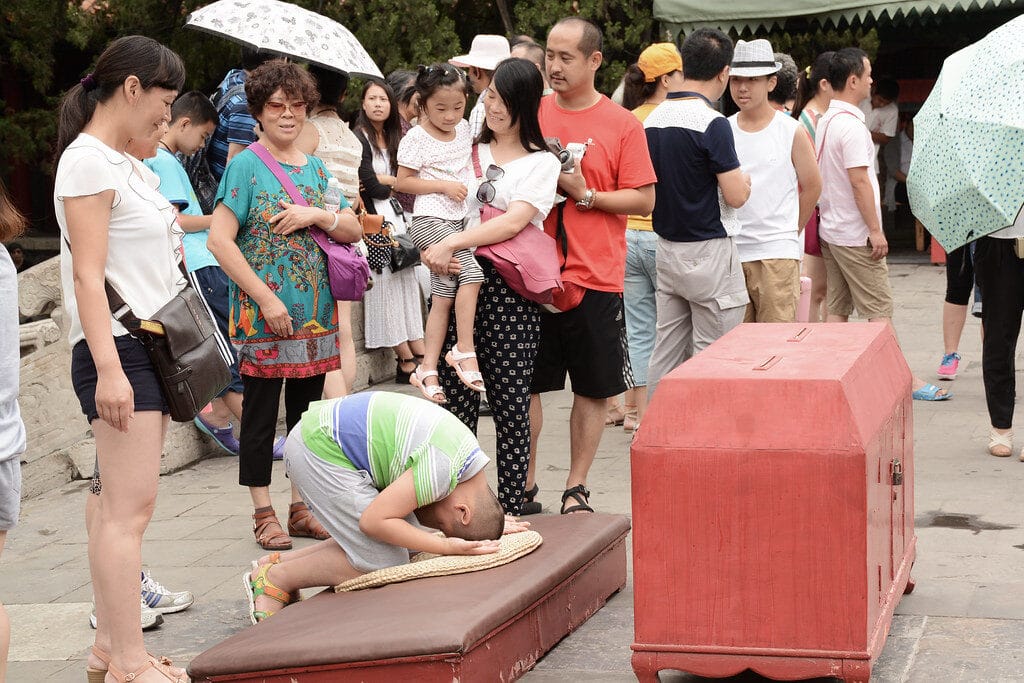
Flowers and last-minute temple visits. Florists in major cities run low on stock in the days before the exam. Sunflowers (向日葵) are the signature choice — their name in Chinese carries connotations of turning upward toward light. In Xi'an and Nanjing, parents bring students to temples dedicated to Wenchang (文昌帝君), the God of Scholarship, for a final offering before the exam. The Confucian Temple complex in Shanghai sees its highest annual visitor numbers in the week before the gaokao — if you visit in late May or early June, it will be conspicuously crowded with families carrying incense and laminated admission tickets.
Police high-fiving students. Officers posted outside school gates in Jiangsu and several other provinces extend their hands as students walk in. It has become a documented June ritual, photographed every year by state media and circulated on social media with captions that roughly translate as "the whole country has your back."
The essay question going viral. The gaokao Chinese essay prompt (作文题) is released the moment the session ends. Within minutes it is the top trending topic on Weibo, as tens of millions of Chinese adults — most of whom sat the exam themselves at some point — attempt it for argument, nostalgia, or amusement. On the afternoon of June 7, if you're watching any Chinese social media, you'll see the prompt and thousands of amateur answers simultaneously. It is a genuine national conversation.
One note on behavior: Keep your distance from exam venues and keep voices low. This exam represents 12 years of preparation and often a family's significant financial investment. It is not a tourist attraction.
9. Should You Avoid Traveling to China During Gaokao?
No. But timing within June matters.
The best windows inside June:
- Late May to June 6: domestic travel at its annual low. Hotels excellent value. No crowds. Warm weather. This is our most underrated recommendation for flexible travelers.
- June 11–18: exam finished, post-exam travel surge absorbed, Dragon Boat Festival not yet arrived. Clean window.
The windows requiring active planning:
- June 7–10: book hotels early, verify nightlife venues, add morning transport buffer in school districts
- June 9–18: leisure destinations (Xiamen, Sanya, Dali, Lijiang, Zhangjiajie, Guilin) see elevated occupancy from post-exam student travel
- June 19–21: Dragon Boat Festival national holiday — trains and tourist sites crowded; book ahead
Where gaokao impact is zero: Any natural attraction — Zhangjiajie, Guilin, Huanglong, Tiger Leaping Gorge, Jiuzhaigou, the Li River, any national park or rural destination. No exam sites, no noise restrictions, no hotel pressure. Countryside and small-city itineraries are untouched.
The quiet sightseeing window: Urban tourist sites — the Forbidden City, West Lake, the Chengdu panda base, the Terracotta Army — run measurably lighter on June 7–8 specifically. Families with high school students aren't sightseeing. On days that would otherwise be packed, exam mornings deliver shorter queues and emptier foregrounds. We've used this consistently for clients who need clean photographs at sites that are usually overrun.
10. FAQ - Gaokao in China
Does the gaokao affect or restrict foreign tourists in any way?
No. The gaokao places zero direct restrictions on foreign visitors. You can move freely, visit attractions, dine, and travel exactly as normal. The noise bans, hotel pressure, and signal-blocking equipment near exam sites are measures directed at the exam environment — not at tourists. The only ways the gaokao affects you are indirect: hotel availability near schools, entertainment venue suspensions in some areas, and morning traffic near exam sites on June 7–8.
When is the gaokao every year?
The gaokao runs annually starting June 7. Most provinces finish on June 8. Provinces using the reformed subject system — Beijing, Tianjin, Zhejiang, and Shandong — extend testing to June 9 or June 10. The Ministry of Education confirms exact dates each spring, typically in March.
How many students take the gaokao?
13.35 million students registered for the 2025 gaokao, per the Ministry of Education — the first year-on-year decline in eight years, down from the 2024 record of 13.42 million. The exam has exceeded 10 million participants every year since 2019. By participant count it is the largest single academic examination in the world. One measure of how much has changed: in 1977 only 5% of examinees were admitted to university; by 2023 the acceptance rate had risen to 85% — but competition for elite institutions remains ferocious, with top universities accepting under 1% of applicants from high-competition provinces.
Will my phone signal work near exam venues?
Possibly not, within a close radius. Drone-based and vehicle-mounted signal blockers are deployed around exam buildings on exam days to prevent wireless cheating. If you find yourself in a residential area near a school on June 7–8 and your data and calls have dropped, walk one block in any direction. The disruption is localized and temporary — active only during exam session hours.
Are KTVs and bars open during gaokao?
Depends on city and location. KTVs and internet cafés near exam sites are ordered to suspend in many cities. Bars and venues not adjacent to school zones generally stay open. In cities with exam sites distributed across the urban core — Xi'an, Chengdu — the affected area is larger. Check before you go.
Will the gaokao affect my hotel booking?
Yes, in cities and neighborhoods near schools, if you haven't booked early. Hotels within 1 km of exam venues fill 2–3 months in advance, per Ctrip data. CNY 5,000 nightly rates at Shanghai five-star properties near exam sites were documented in 2022 — purely from supply exhaustion. Book by April for any June 5–15 stay in a major Chinese city.
Does the gaokao affect trains or flights?
No. High-speed rail and domestic flights run on their normal timetables throughout the gaokao. Traffic disruption is local — within 1–2 km of exam venues during the 7:30–8:30 am window on June 7–8. Outside those zones and times, transport is unaffected.
Is gaokao week a good time to visit China?
It's workable with planning. Natural attractions are unaffected. Urban tourist sites run lighter crowds on exam days themselves — a genuine benefit at oversubscribed sites. Late May and June 11–18 are the best low-pressure windows inside this period. The main planning requirements are: book hotels early, verify nightlife venues, add morning transport buffer in school neighborhoods, and book leisure destinations ahead for late June.
What does gaokao mean in Chinese?
高考 (gāokǎo): 高 means high or advanced; 考 means examination. The full official name is 普通高等学校招生全国统一考试 — "National Unified Examination for Admission to Regular Institutions of Higher Education." The exam was first held in 1952, suspended during the Cultural Revolution (1966–1976), and reinstated in December 1977.
Why was the gaokao moved from July to June?
The State Council approved the schedule change in November 2001, effective from 2003. The official reasons: July heat across most of China was harming student preparation and health, and summer flooding regularly disrupted transport to exam venues in southern provinces. From 1979 to 2002, the exam ran July 7–9 without exception. The June date has held ever since, with one exception: COVID-19 caused a one-month postponement back to July 2020.
When are gaokao scores released?
Most provinces release scores around June 23–26, roughly two weeks after the exam ends. Shanghai and Anhui typically publish first (June 23); most other provinces follow on June 25–26. On release day, Weibo floods with reaction videos and Confucian temple areas see spontaneous gatherings. Restaurants near schools in major cities fill without reservations that evening — worth noting if you're dining out in a university district around June 25.
Planning a China trip in June? We've navigated gaokao week in dozens of Chinese cities since 2006 and know exactly how to route around every disruption. Contact us and we'll build an itinerary that works with the calendar.