Rize Valley, Jiuzhaigou: Route, 10 Stops, Timing & Mistakes
Rize Valley is the 18-km right branch of Jiuzhaigou’s Y-shaped park, running from the Virgin Forest at its top down to Mirror Lake near the Nuorilang junction. It holds the four attractions most people picture when they hear the word Jiuzhaigou: Five Flower Lake, Pearl Shoal Waterfall, Panda Lake, and Panda Lake Waterfall. If you only have time for one valley, this is it.
We’ve been running tours through Jiuzhaigou since 2006. Our Jiuzhaigou Valley overview already covers tickets, transport from Chengdu, altitude sickness, and the three-valley comparison. This guide skips all that. Instead: the walking order, what each stop actually looks like, and the photography windows that make or break your visit. Plus the mistakes we watch clients make every season.
Elevation range | 2,343–2,930 m |
|---|---|
Named lakes & waterfalls | 10 major stops, from Virgin Forest to Mirror Lake |
Signature stop | Five Flower Lake — 2,472 m, 5 m deep, 90,000 m² |
Best light | 9:30–10:30 am at Five Flower Lake, before wind breaks the surface |
Recommended plan | Ride to the top, walk downhill the whole way |
Time needed | 4–5 hrs (bus-and-photo pace) to 7–8 hrs (full walk from the top) |
Table of Contents
1. What Jiuzhaigou’s Rize Valley Is, and Whether It’s Worth Your Time
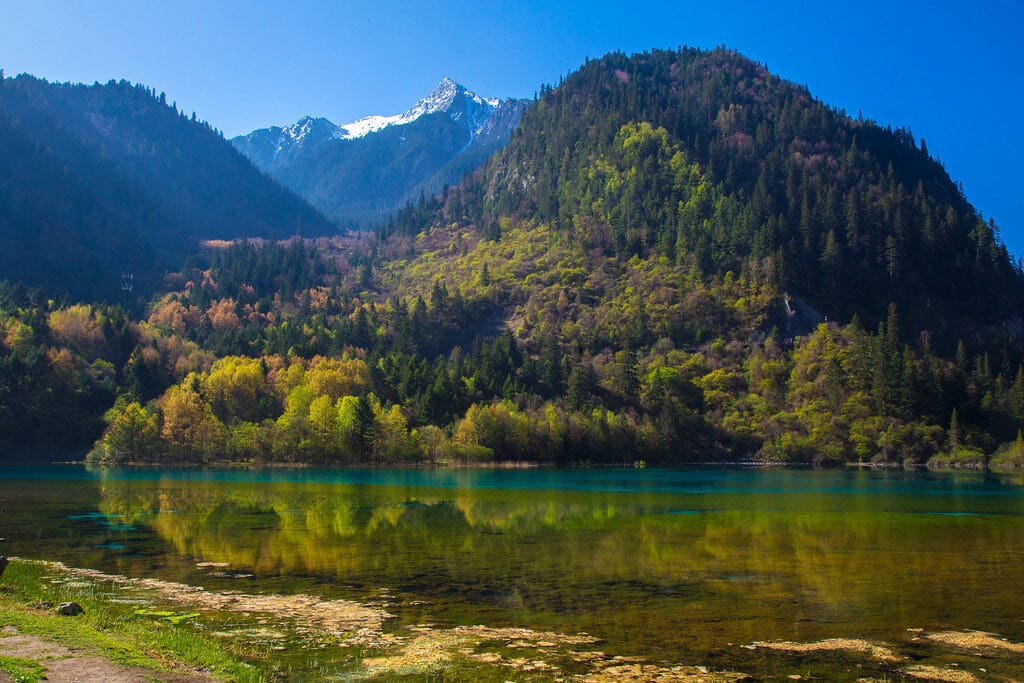
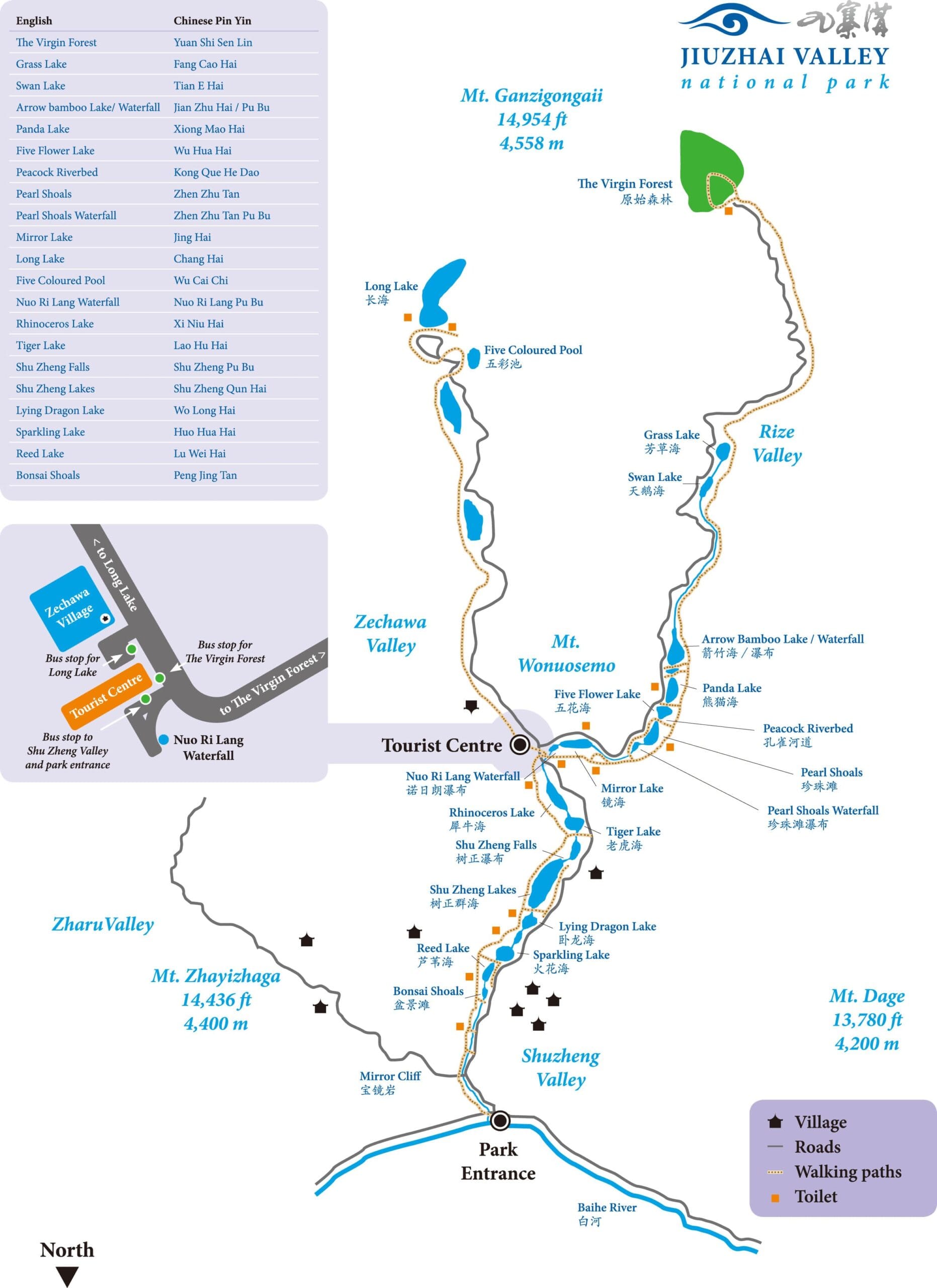
Rize is the right branch of Jiuzhaigou’s Y-shaped park: 18 km from the Virgin Forest at the top down to Mirror Lake. That’s the stop closest to the Nuorilang junction, where Rize meets Shuzheng Valley. It holds four of the park’s five most-photographed attractions: Five Flower Lake, Pearl Shoal Waterfall, Panda Lake, and Panda Lake Waterfall. Ten named stops sit along the route, spread across an elevation drop of nearly 500 m.
This is the one valley in Jiuzhaigou we tell every client not to skip. Shuzheng Valley has the Tibetan village and the terraced lake cluster; Zechawa Valley has the altitude and Five-Color Pond. Rize has the water. Five Flower Lake alone shows five distinct colour zones at once. Pearl Shoal Waterfall’s crescent-shaped drop lands on more Jiuzhaigou postcards than anywhere else in the park. If you’re building a one-day itinerary and have to cut a valley, this isn’t the one to cut.
The tradeoff is crowds and length. Because every visitor prioritises Rize, the boardwalks between Arrow Bamboo Lake and Pearl Shoal Waterfall get the heaviest foot traffic in the park during peak season. And at 18 km, walking the entire valley on foot from Virgin Forest to Nuorilang takes longer than most one-day visitors have to spare. Section 4 below covers how we route clients around both problems.
Best for: First-time visitors, photographers, anyone who wants the images that define Jiuzhaigou globally.
2. The Ten Stops, In Walking Order From the Virgin Forest
Coming down from the Virgin Forest at the valley’s top, this is the order you’ll reach them. The stops here spread across a longer stretch than in Shuzheng Valley. Most visitors ride between the upper points, then switch to walking at Arrow Bamboo Lake.
⛰️ Rize Valley: Elevation, Virgin Forest to Mirror Lake
Ride to the top, walk down — every stop from here is downhill.
Stop | Altitude | Size | Highlight |
|---|---|---|---|
1. Virgin Forest | 2,930 m | 2,000+ hectares | End of the valley, thickest air quality reading in the park |
2. Swan Lake | 2,905 m | 720 × 50–100 m | Semi-marsh lake, velvet-green water grass |
3. Grass Lake | 2,910 m | 540 × 4–20 m | Smallest and shallowest lake in Rize |
4. Arrow Bamboo Lake | 2,629 m | 1,184 × 144–268 m | Never freezes, even when Panda Lake is solid ice |
5. Panda Lake | 2,587 m | 90,000 m², 14 m deep | White stone patterns resembling a panda |
6. Panda Lake Waterfall | 2,574 m | 65 m high, 75 m wide | Highest drop of any waterfall in the park |
7. Five Flower Lake | 2,472 m | 90,000 m², 5 m deep | Five colour zones visible at once |
8. Pearl Shoal | 2,450 m | 112.3 × 189 m | Widest calcite shoal in Jiuzhaigou |
9. Pearl Shoal Waterfall | 2,433 m | 21 m high, 270 m wide | Crescent-shaped, filmed in 1986’s Journey to the West |
10. Mirror Lake | 2,367 m | 1,155 × 241 m, 31 m deep | Third-largest lake in the park, closes its reflection window by 9 am |
Altitudes and dimensions throughout this guide follow the figures published by the Jiuzhaigou Scenic Area Administration.
Virgin Forest
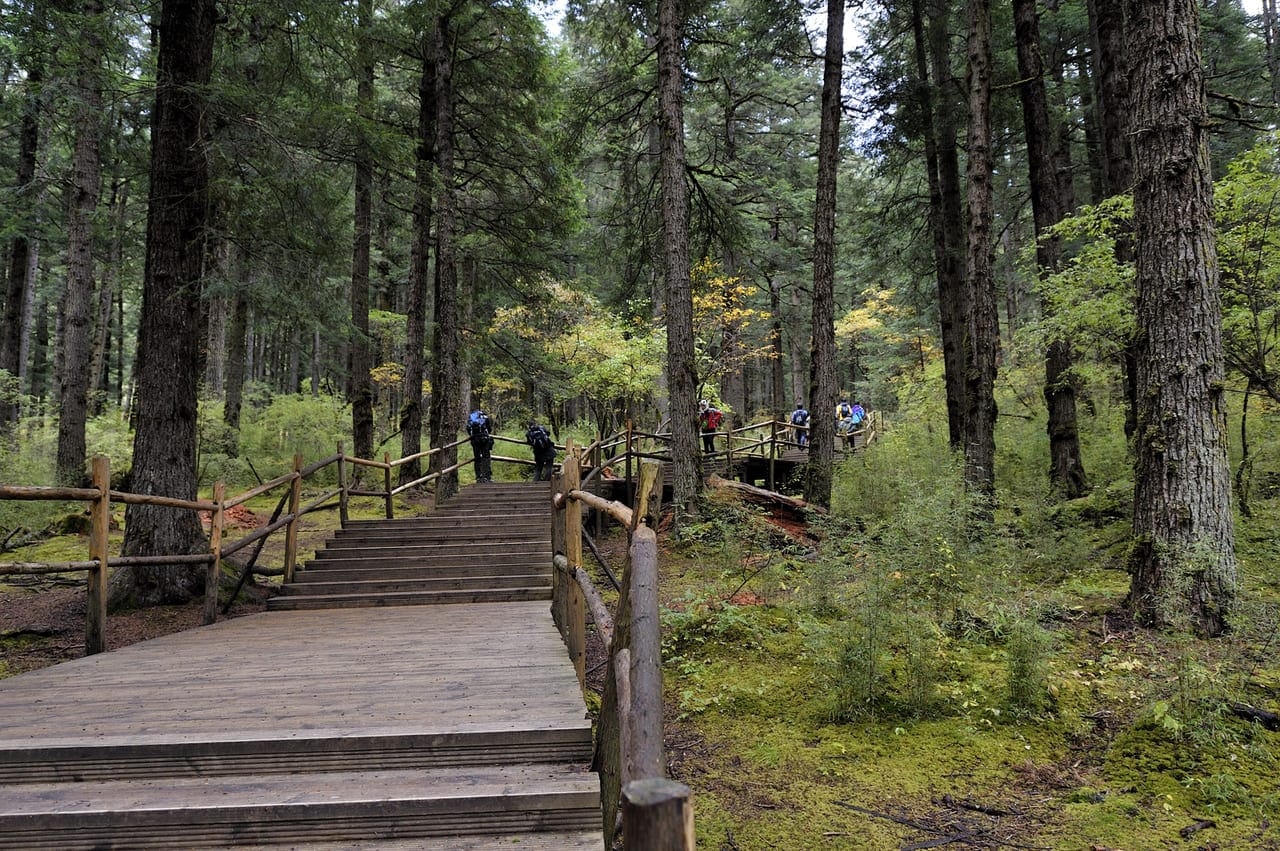
Virgin Forest sits at the valley’s dead end, 2,930 m up, and marks the true top of Rize. Fir and spruce here run centuries old, some pushing past a thousand years, with moss underfoot thick enough to muffle your footsteps. Negative-ion readings here reach 3,000 particles per cubic centimetre by the park administration’s own measurements, noticeably higher than the rest of the park. That’s where Jiuzhaigou’s “natural oxygen bar” reputation comes from — not marketing copy.
Most guides tell visitors to skip this stop outright, and for a rushed one-day visit that’s fair advice. The forest looks like ordinary mountain woodland to most people, and the extra shuttle ride plus stairs cost real time. But there’s a version worth knowing about. The 3-km boardwalk descent from Virgin Forest to Swan Lake runs entirely downhill, cutting through old-growth fir and shallow, quiet lakes almost nobody stops at. A client on her third visit to Jiuzhaigou, this time with more days to spare, told us it was the stretch she most regretted almost skipping.
We only send people up here if they’re on the first shuttle of the day with energy to spare. If you’re tight on time or already tired, boarding at Arrow Bamboo Lake instead loses you nothing essential.
Swan Lake
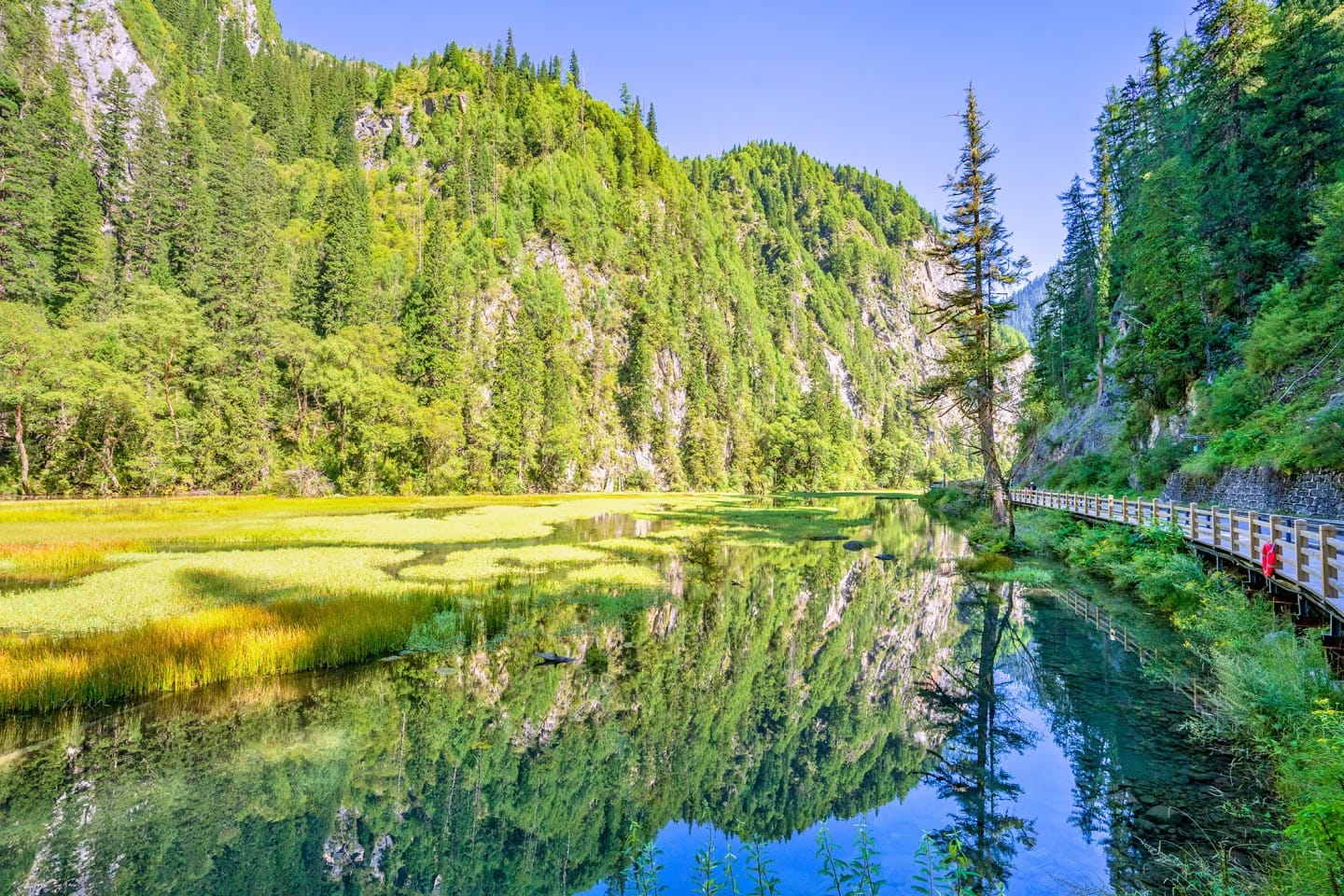
Swan Lake is a semi-marsh lake at 2,905 m, its wide surface mostly silted into shallow flats after centuries of sediment buildup. The water grass here has a velvet-like sheen, floating in patches of soft green rather than the deep blue you’ll see further down. Swans stop here occasionally, though wild ducks are the more reliable sighting. It connects downstream to Grass Lake, and the two are usually walked together. Traffic here is thin. Most buses run straight through without stopping, making it one of the few quiet spots left in Rize Valley during peak season.
Grass Lake
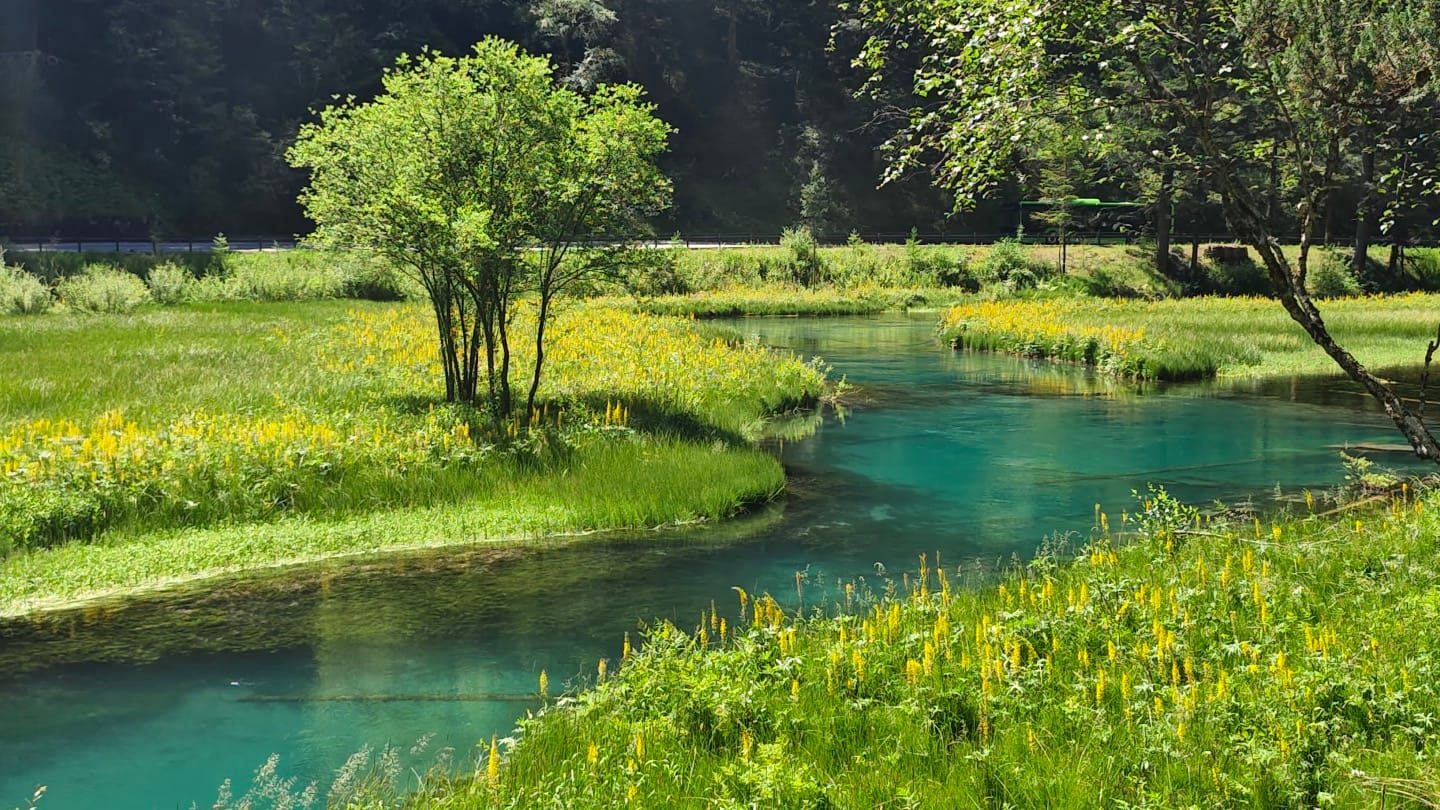
Grass Lake, just below Swan Lake at 2,910 m, is Rize Valley’s smallest and shallowest named lake — as little as 2 m deep in places. It’s fed mainly by upstream runoff and rainfall, with travertine funnels visible on the lakebed in the clearer sections. The colour palette changes hard by season. Green in spring, dense with wildflowers in summer, a wash of gold by late autumn, crystalline white in winter. We tell photographers chasing seasonal contrast to hit this stop specifically — it shows more visible seasonal change than any other lake in the valley. In the off-season (mid-November to March), Grass Lake closes along with the rest of the upper boardwalk. Arrow Bamboo Lake becomes your effective starting point instead.
Arrow Bamboo Lake
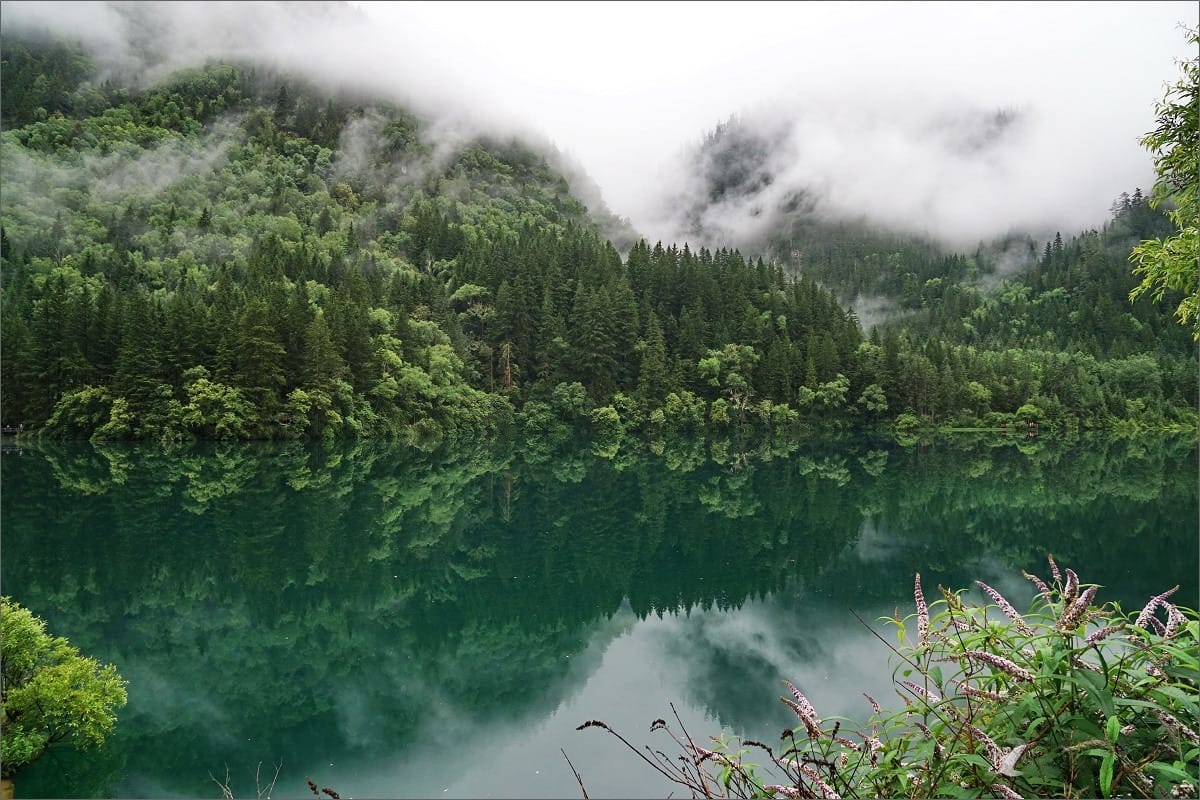
Arrow Bamboo Lake sits at 2,629 m and never freezes, even in the depths of winter when Panda Lake just below it turns solid. Stable underground spring water keeps the temperature steady year-round. The lake takes its name from the arrow bamboo growing thick along its banks, a giant panda’s primary food source. The pandas themselves stay well clear of the boardwalks. Zhang Yimou shot a sword-fight scene from Hero here in 2002, and the wide, glassy stretch of water still matches the film almost exactly. Look for the “regenerated trees” along the shallows: calcified deadwood with new saplings rooted directly into the old trunks.
How much of the loop to walk: you don’t need the full circuit. The first stretch, where you’re genuinely walking out over open water, is the part worth doing. We rate it above Panda Lake just downhill for reflection shots, since the water sits stiller here with less foot traffic. Past that, take the inland boardwalk toward the waterfall. The outer route along the shuttle road sits in direct sun most of the day and flattens out fast.
Panda Lake
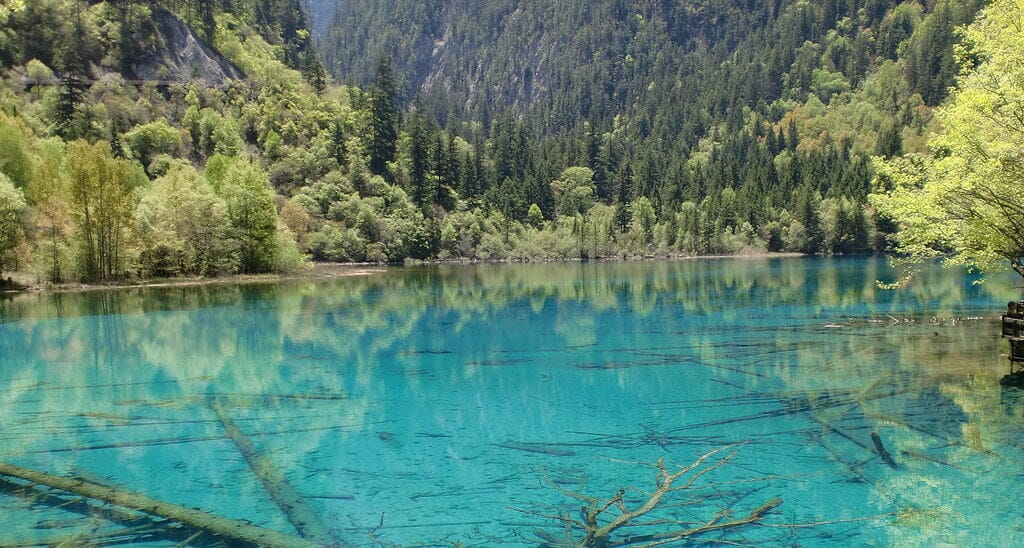
Panda Lake, at 2,587 m, runs 14 m deep with water clear to the bottom on a still day. A cluster of white stones under the surface carries black markings that vaguely trace a panda’s outline. That’s where the name comes from, not from actual panda sightings — though local guides say pandas once drank here. Look into the shallows for schools of highland naked carp, a native fish found through several of Rize Valley’s lakes. A group of them together makes one of the better overhead shots in the valley.
It sits just above Panda Lake Waterfall, so most visitors walk both in a single stop. We tell clients not to rush this one — five minutes standing still here shows you more than any photo taken while walking past.
Panda Lake Waterfall
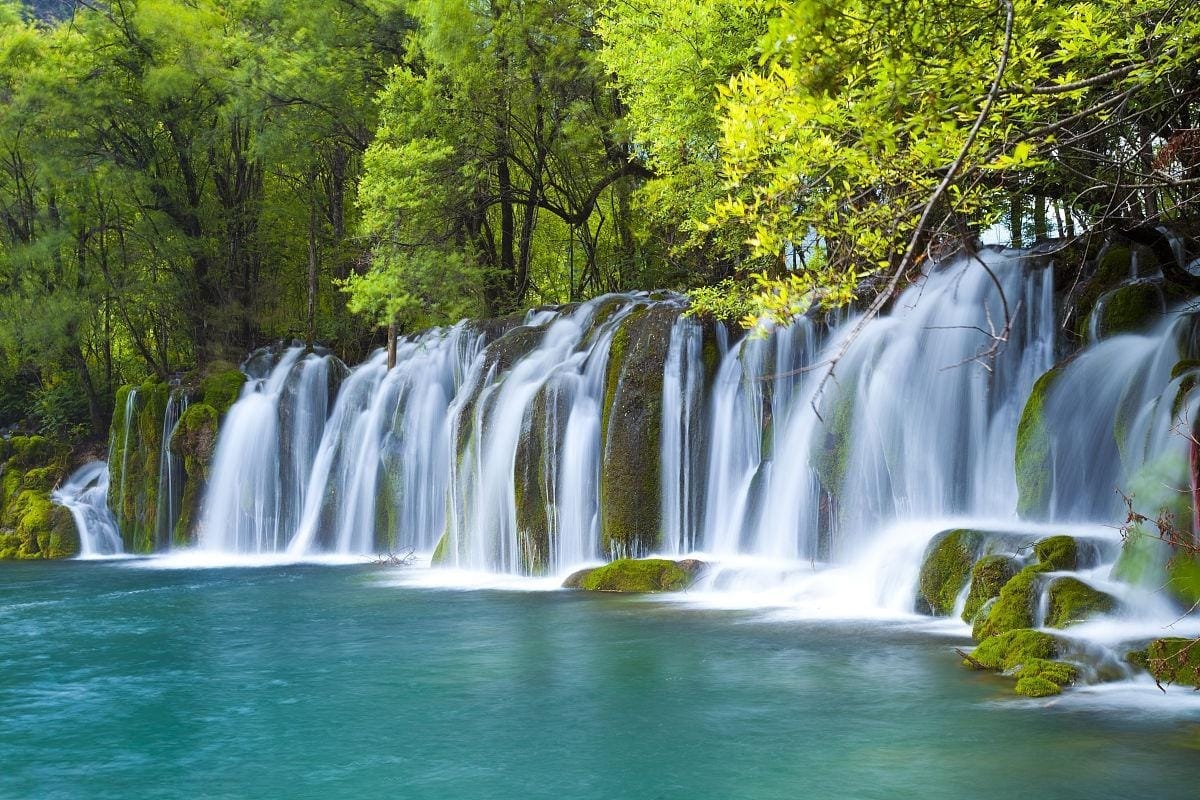
Panda Lake Waterfall drops 65 m over three distinct tiers, the steepest single fall anywhere in Jiuzhaigou. The water splits around exposed rock and boulders partway down, breaking one continuous drop into overlapping cascades rather than a single sheet. In winter it freezes solid into a wall of blue-white ice, one of the park’s most striking cold-season sights. We route clients to the walkway at its base rather than the upper viewing point. From below, you get the full three-tier drop in one frame; the top platform cuts it off.
Five Flower Lake
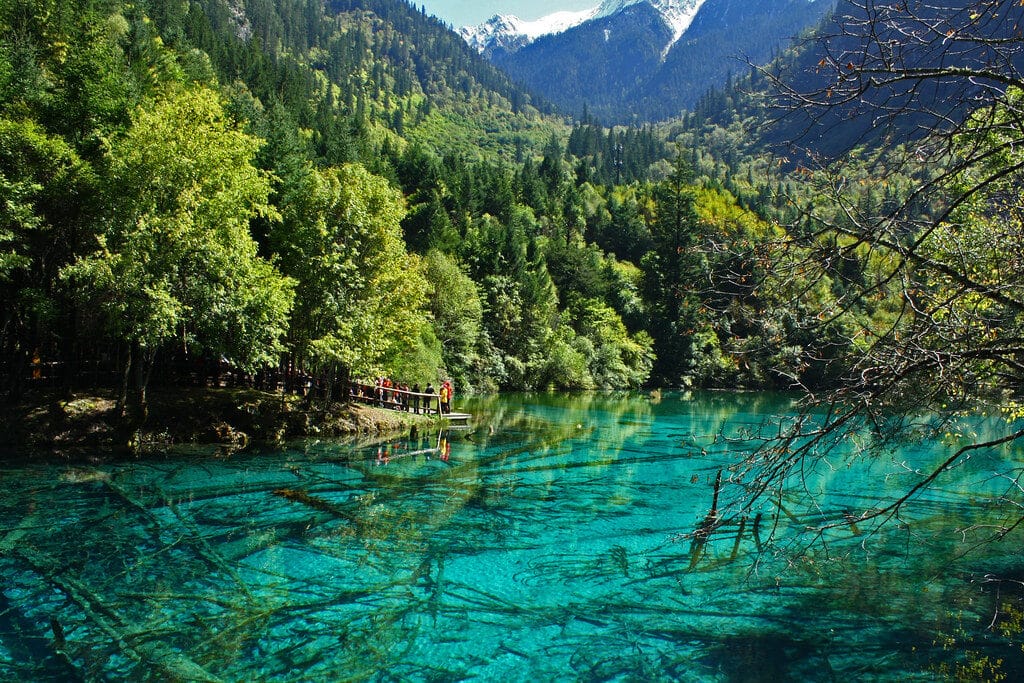
Five Flower Lake sits at 2,472 m, the acknowledged centrepiece of the entire park. See section 3 below for the full breakdown on timing and viewpoints — it earns its own section.
Pearl Shoal
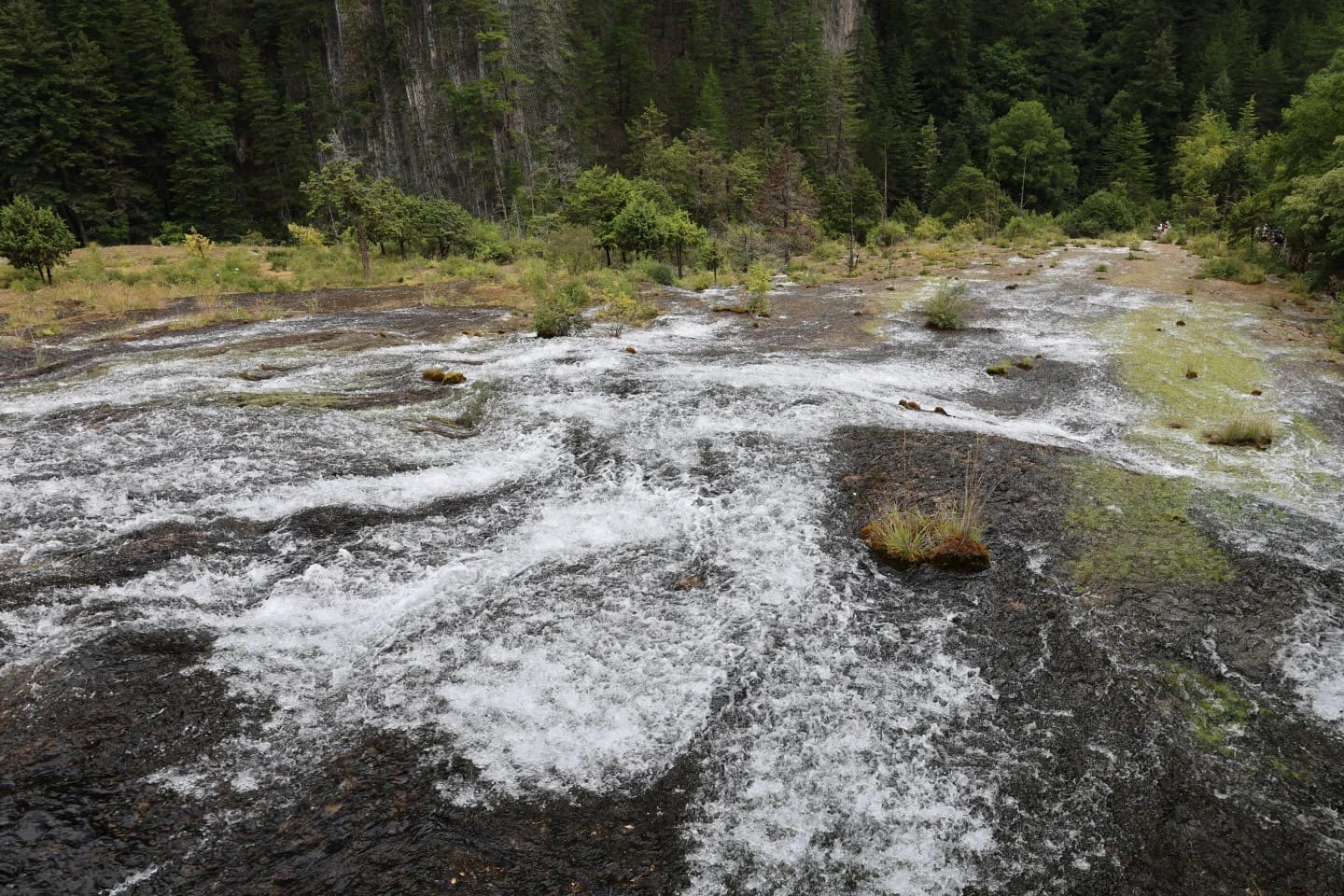
Pearl Shoal is a sloped travertine shelf, 112.3 m wide and 189 m long, angled at 20 degrees — the widest shoal formation in the park. Water runs down it in a shallow sheet, breaking into droplets that flash silver-white in direct sun, hence the name. This is also where the opening credits of the 1986 CCTV Journey to the West were filmed — the four pilgrims wading across with their horse. Many Chinese visitors recognise the spot on sight; most Western visitors don’t, until we point it out.
We slow clients down here rather than letting them walk straight through to the waterfall. The shoal photographs better in direct midday sun than almost anywhere else in the valley. That’s the opposite of what works for Five Flower Lake further up.
Pearl Shoal Waterfall
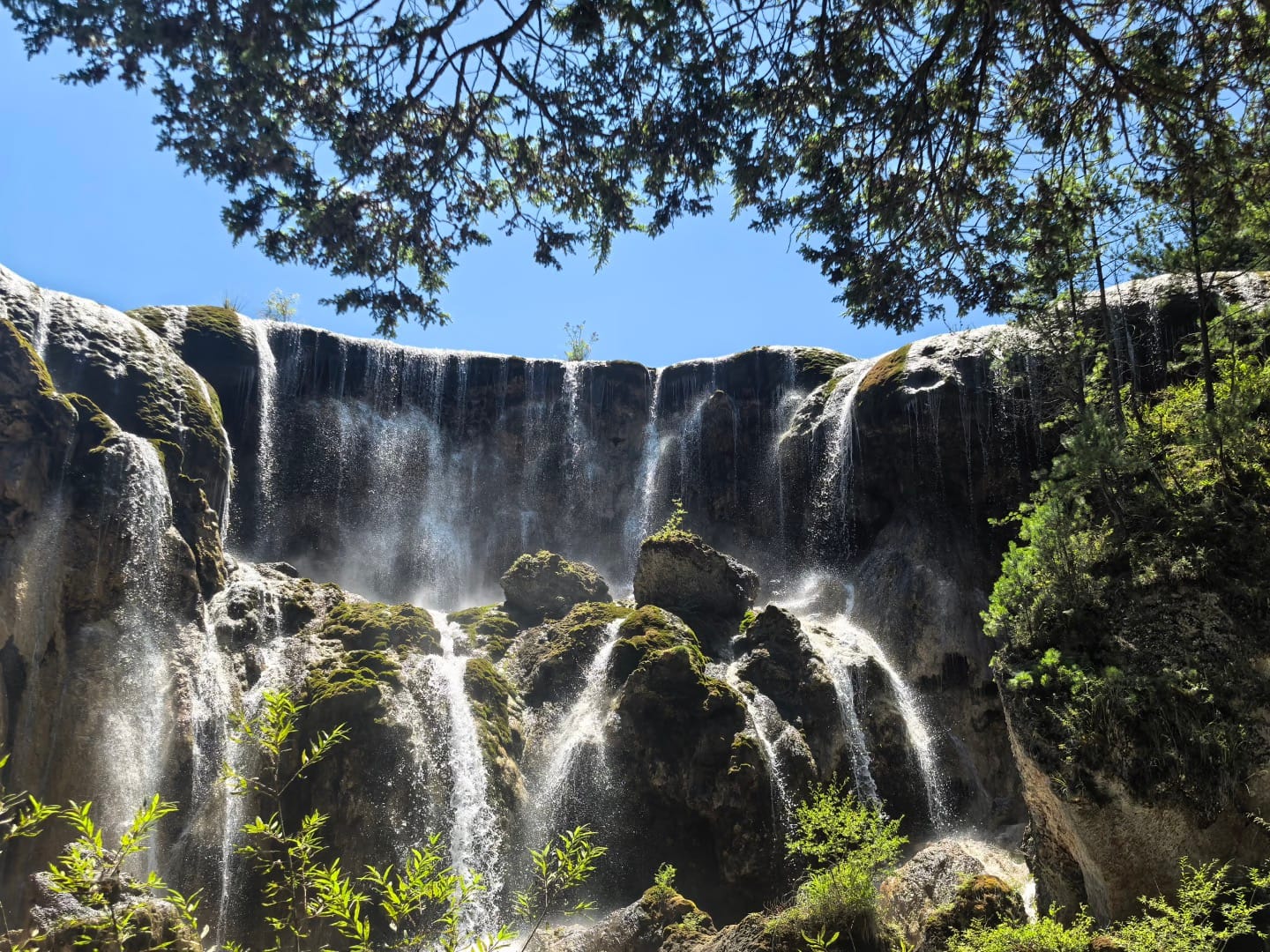
Pearl Shoal Waterfall drops 21 m over a 270-m-wide crescent-shaped lip, formed by Quaternary glacial moraine that later hardened through calcification. The curve isn’t decorative. It channels the flow so the water hits the pool below with unusual force. The constant spray carries some of the highest negative-ion readings in the park. A boardwalk runs along the left side of the churn, close enough that you’ll feel the mist on a windy day. We tell clients to shoot from below looking up, not from the top platform looking down. The water’s layering and the light on the spray both read stronger from underneath.
Mirror Lake
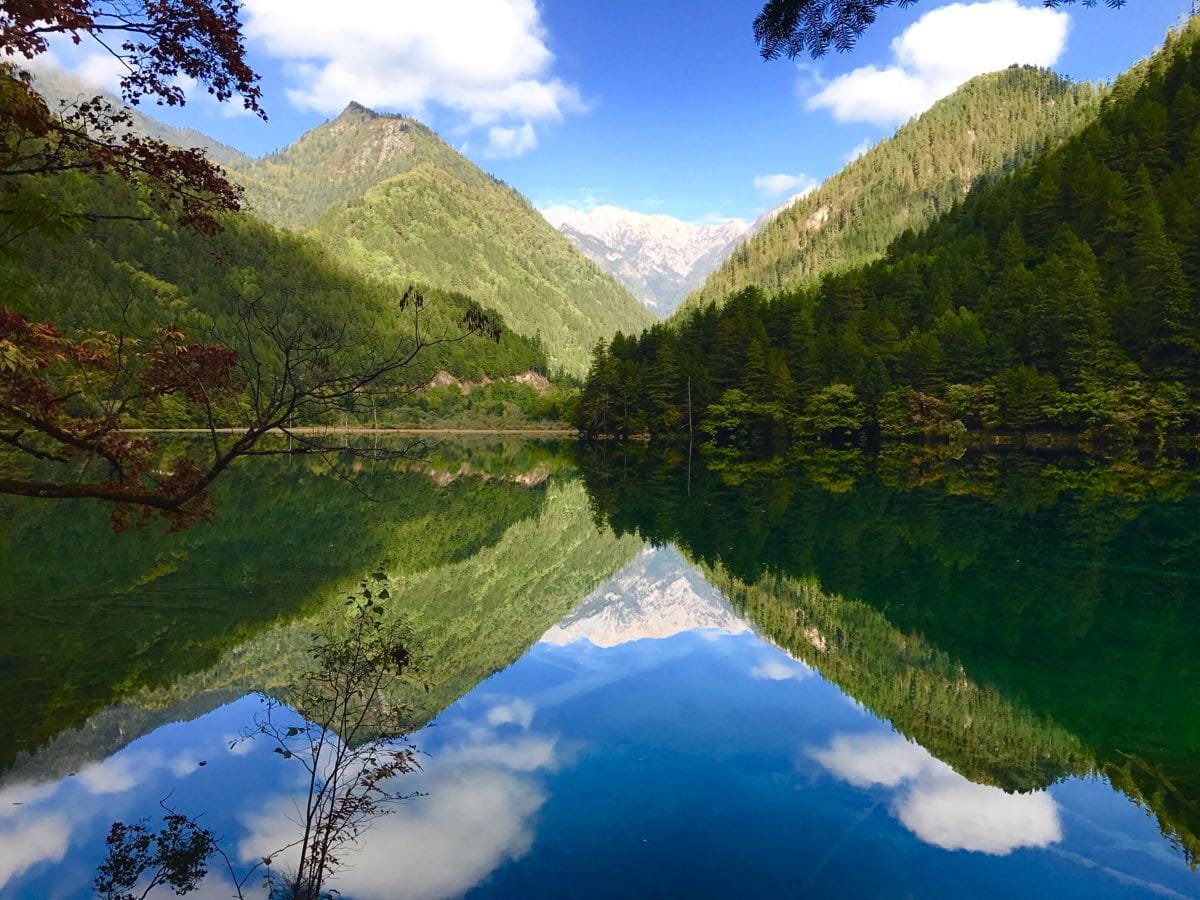
Mirror Lake sits at 2,367 m, running 1,155 m long and 241 m wide, 31 m at its deepest — the third-largest lake in the park. It’s the closest Rize Valley stop to the Nuorilang junction. Most visitors fold it into the end of their Rize walk rather than treating it as a separate trip. On a still morning, the surface holds a near-perfect reflection of the peaks and forest. Photos taken here regularly get mistaken for two images stitched together. That reflection only holds for a narrow window — 30 to 60 minutes after sunrise, before wind picks up and breaks the surface. Arrive after 9 am on a normal day and the mirror effect is usually gone; by afternoon, it almost never comes back.
3. Five Flower Lake: When to Go and Where to Stand
Five Flower Lake is why most people come to Jiuzhaigou in the first place. It earns a section of its own rather than a slot in the walking order above.
What Makes the Colour
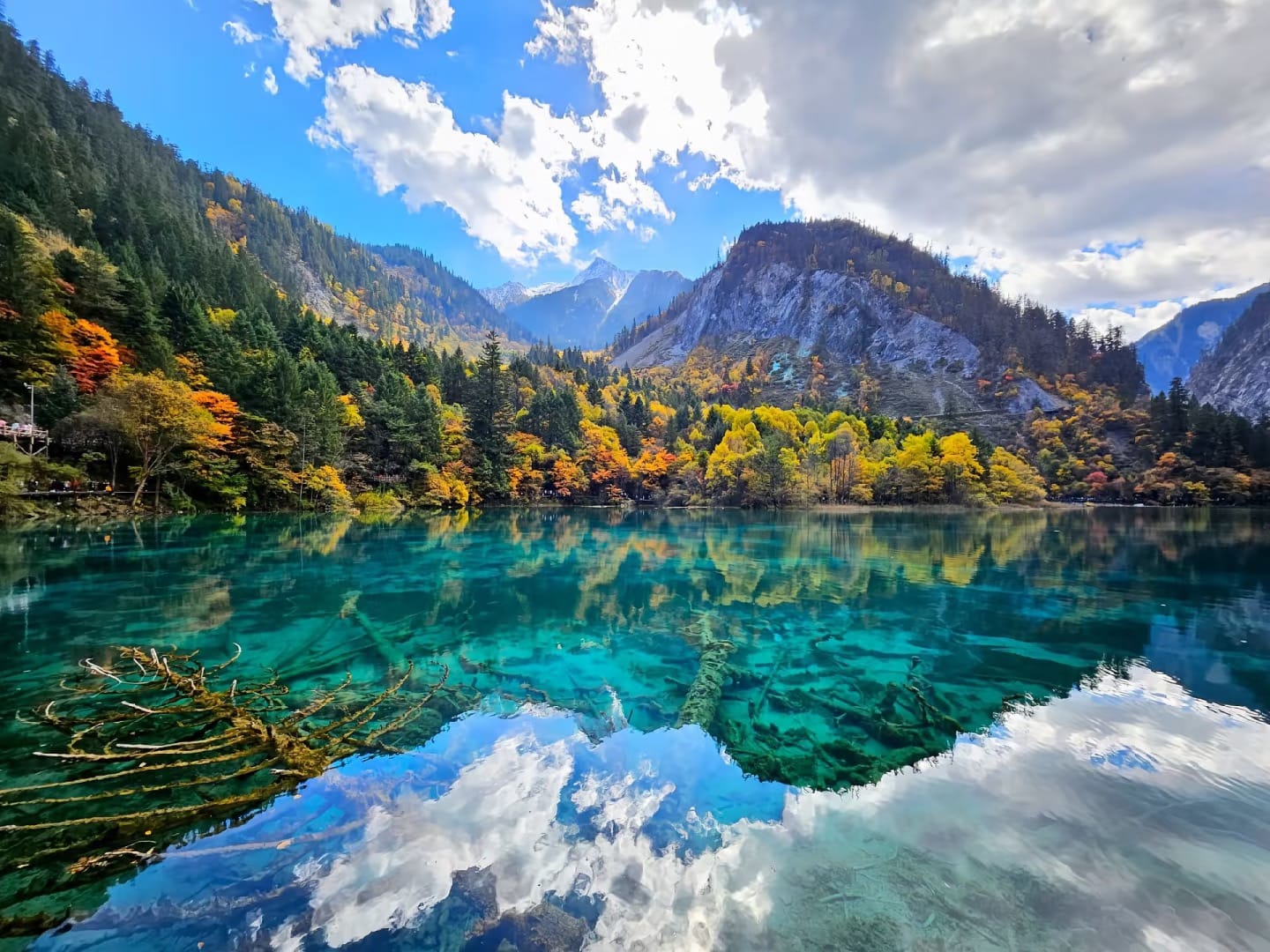
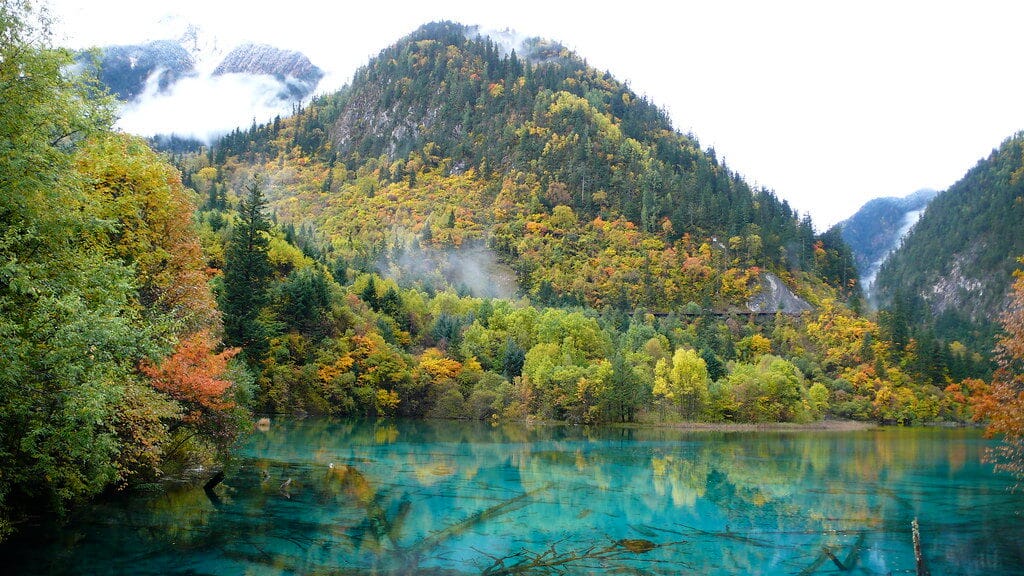
The lake sits at 2,472 m, averages 5 m deep, and covers 90,000 m². What sets it apart: five distinct colour zones visible at once — sapphire, turquoise, jade, amber, pale yellow — rather than a gradual shift between shades. The effect comes from travertine deposits, submerged tree trunks preserved by calcification, and algae at different depths. Each scatters light differently. Local Tibetan communities consider it a sacred lake, believing that wherever its water reaches, flowers and trees flourish.
The Best Time to Shoot It
The window that matters most is 9:30–10:30 am, when the sun is high enough to light the lakebed but the wind hasn’t yet broken the surface. Once the water ripples, the colour bands blur together and the effect is lost. In October, maples and birches around the shoreline turn red and gold and reflect into the lake. That combination makes autumn the most photographed season here. We’ve had clients arrive at midday in July, when the light is flat and the water’s already choppy. They leave disappointed that their photos don’t match what they saw online.
A polarising filter is worth packing here specifically — it cuts the surface glare that otherwise washes out the colour underneath. Phone shooters can get a similar effect with a clip-on polariser or a polarised shooting mode.
Where to Stand
The main viewing deck runs along the lake’s western boardwalk, giving you the full width of the water and the mountain backdrop behind it. You don’t need to walk the entire loop. The shorter, less crowded stretches reward you more than pushing through the full circuit.
For a genuinely different angle, look for Tiger Mouth viewpoint (老虎嘴). Walk back along the boardwalk toward the Panda Lake tunnel, then turn right off the main path onto the road for about 200 m. From up there, you see the whole lake at once, in the fanned shape locals compare to a peacock’s open tail. It’s a wider view than any of the main boardwalk decks give, and far fewer people make the detour to find it. This is also the view that ended up on Jiuzhaigou’s first admission ticket back in 1983.
4. The Right Way to Fit Rize Valley Into Your Day
How the Shuttle Gets You There
The park gate opens at 7:30 am in peak season. Getting there is its own topic — passport-based entry, where to stand, what the gate looks like. Our Jiuzhaigou Valley overview covers that in full, along with how the shuttle system works. The short version: going up, buses run largely non-stop to the top of the valley and won’t pick you up partway. Coming down, they stop at every marked platform, so you get on and off freely. This is the reason “ride up, walk down” isn’t just our preference — it’s how the system works.
From the gate, the shuttle carries you up through Shuzheng Valley to Nuorilang Centre, the junction where the park splits. That ride takes roughly 30–45 minutes, depending on how full the bus is and how many stops it makes.
Heading toward Rize Valley from Nuorilang, sit on the right side of the bus. The scenery sits mostly on that side; Zechawa-bound buses favour the left. This holds whether you’re riding up to Arrow Bamboo Lake or Virgin Forest, or working your way back down.
The buses also run recorded commentary at each stop, but between the engine noise and the sharp curves, it’s often hard to make out. Loading up stop descriptions on your phone beforehand is more reliable than counting on the onboard audio.
Why 7:30 am Matters More Than It Sounds
Enter right at 7:30 am and you’ll typically reach Nuorilang by around 8:00–8:15 am, comfortably before the crowd flow builds. At Nuorilang, staff direct visitors onto the left route (Zechawa Valley) or the right route (Rize Valley). That’s based on which line needs bodies, not on what you came for. Arrive after roughly 8:30 am and there’s a real chance you’ll get funnelled onto the wrong line. That means a second wait back at the junction, sometimes 30 minutes or more during peak season, before you can board toward Rize. The later you arrive at the gate, the less control you have over which valley you’re sent to first.
There are two ways our clients build the rest of the day from here. Pick the one that matches your time and energy.
Plan A: The Efficient Sweep (Recommended)
This is the order we send most first-time, one-day clients on. It skips Virgin Forest, Swan Lake, and Grass Lake — most one-day visitors find they add walking time without matching the payoff further down. What’s left front-loads the walk with the valley’s best-known stops:
🛡️ Plan A: The Efficient Sweep
- 🎋Ride the shuttle straight to Arrow Bamboo Lake
- 🐼Walk downhill to Panda Lake and Panda Lake Waterfall
- 🌸Continue to Five Flower Lake — budget at least an hour here alone
- 🏖️Walk to Pearl Shoal and Pearl Shoal Waterfall
- 🪞Finish at Mirror Lake before continuing on toward Nuorilang
This route gets you to Five Flower Lake in the morning light window before the crowds peak.
Beat the Crowd to Five Flower Lake
If you’re on one of the first buses of the day, don’t rush straight to Five Flower Lake. It’s the stop every bus load heads for first, so it fills up fastest. Spend those early minutes at Arrow Bamboo Lake and Panda Lake, where the crowd hasn’t caught up yet. Arrive at Five Flower Lake once the first wave has moved on. You still land inside the 9:30–10:30 am window; you just avoid sharing it with everyone who got off the same bus you did.
What to Cut If You’re Running Long
Most of the loop around Arrow Bamboo Lake beyond the first stretch of open-water boardwalk doesn’t add much — see section 2 above. Nuorilang Waterfall, just past where Rize meets Shuzheng Valley, tends to feel underwhelming after Pearl Shoal Waterfall. The walk from there down to Rhinoceros Lake in Shuzheng Valley is the better use of that time. And if the morning’s already running long, Mirror Lake is the one stop worth cutting first. Its reflection window closes by 9 am regardless, so arriving late here costs you nothing you hadn’t already lost.
Plan B: The Full Valley
If you have a second day or you’re chasing a quieter, less-photographed Jiuzhaigou, ride all the way to Virgin Forest first. Walk the 3-km boardwalk down through Swan Lake and Grass Lake before continuing on to Arrow Bamboo Lake and the rest of Plan A’s route. These upper three stops see a fraction of the traffic the lower valley gets, since most one-day itineraries skip straight to Arrow Bamboo Lake. The tradeoff is time. Budget an extra 60–90 minutes for the upper loop — and this only works if you’re on one of the first shuttles with energy in reserve.
How Long Rize Valley Actually Takes
Timing varies more here than in either of the other two valleys, because how much of the boardwalk you walk versus ride changes the total dramatically.
🕔 How Long Rize Valley Actually Takes
Most visitors land in the middle — budget 5.5–6.5 hours if you’re walking properly.
- Bus-and-photo-stop (4–5 hours): ride to Arrow Bamboo Lake (~40 min), ~20 min at each main stop, 30 min at Five Flower Lake.
- Normal pace (5.5–6.5 hours): walk part of the Five Flower Lake loop, take your time at Pearl Shoal Waterfall, pause properly at Panda Lake and Arrow Bamboo Lake.
- Full walking (7–8 hours): start from Virgin Forest, walk the full boardwalk down including most of the Arrow Bamboo Lake loop.
Normal pace is what most of our clients actually experience. Bus-and-photo-stop suits an afternoon slot or a day covering all three valleys; full walking is close to a day’s effort on its own.
Three things move that number most. Going up to Virgin Forest adds at least an hour with the shuttle ride and stairs. How much of the Five Flower Lake loop you walk matters too. The full 3-km loop takes 90 minutes; a short stretch covers the same view in 30. And peak-season bus waits commonly run 15–30 minutes per stop; the earlier you’re in the queue, the less of this you’ll hit.
Splitting one day across all three valleys? Budget around 5 hours for Rize. That covers the highlights without eating into Shuzheng or Zechawa.
Booking tickets and finding food inside the park work the same way regardless of which valley you’re in — our Jiuzhaigou Valley overview covers both in full.
5. Mistakes to Avoid in Rize Valley
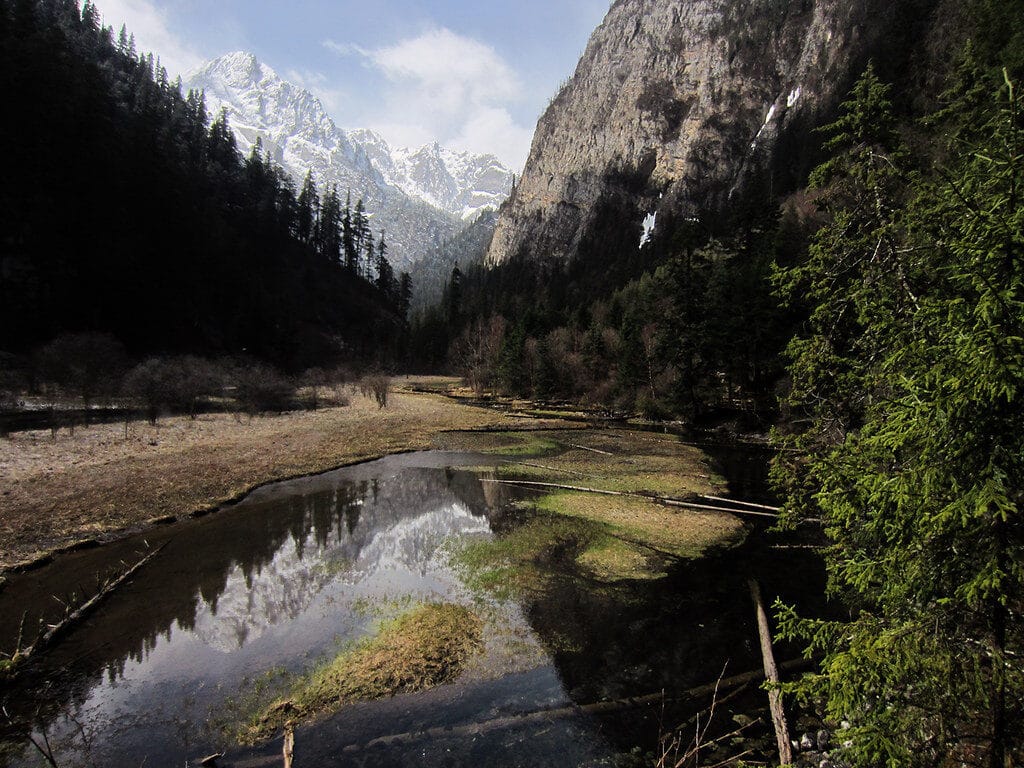
Don’t Arrive at Five Flower Lake Outside the 9:30–10:30 am Window
Once the sun climbs higher and wind picks up across the open water, the five distinct colour bands blur into a single, less impressive blue-green. If Five Flower Lake is the one photo you need, build your morning around this hour. Everything else in Rize Valley can shift later without real loss.
Don’t Skip the Base of Panda Lake Waterfall
Most shuttle stops only give you the upper viewing platform, which crops off the lower two tiers of the fall. Walk down to the base walkway instead. It’s a short detour, and it’s the only spot that shows the full three-tier drop in one view.
Don’t Try to Walk the Whole Valley on Foot From the Top
Eighteen kilometres on foot, entirely uphill if you start wrong, is more than most visitors want in a single day alongside Shuzheng and Zechawa. That holds even for fit walkers. Ride to your starting point, then walk downhill. Save your legs for the lakes, not the climb.
Don’t Assume Every Stop Has a Bus Stop Right at the Viewpoint
A few of the smaller lakes — Grass Lake and Swan Lake especially — sit a short walk from where the bus actually drops you. Budget a few extra minutes at each stop rather than assuming you can hop off and be standing at the water’s edge immediately.
Don’t Underestimate the Altitude Jump — or the Temperature Swing
Virgin Forest sits nearly 500 m higher than Pearl Shoal Waterfall at the valley’s bottom. If you’re heading to the top first, as we recommend, pace yourself on the walk down. The descent is where most clients start to feel the altitude, not the climb. The temperature drop matters just as much. The valley entrance can sit near 30°C in August while the upper elevations run noticeably cooler. Carry a light layer even on a warm-looking day.
Don’t Skip Sun Protection
UV exposure at this altitude is severe — we’ve had clients come back visibly sunburned after a single day without protection. A hat, sunglasses, and actual sunscreen — not just a token application — aren’t optional extras here.
Don’t Wear Slick-Soled Shoes Near the Waterfalls
The boardwalks turn slippery fast after rain, and the mist around Pearl Shoal Waterfall in particular keeps the wood damp even on dry days. Shoes with real grip do more for your visit here than any other piece of gear you could bring.
Don’t Miss the Shortcut Tunnel Between Panda Lake and Five Flower Lake
A 1.2-km tunnel connects the two, and it’s noticeably cooler than the open boardwalk in summer. On a hot day, or when the bus queue at either stop looks long, walking the tunnel is often faster than waiting for the next shuttle.
6. Frequently Asked Questions
Is Rize Valley or Zechawa Valley more worth visiting?
If you can only choose one, Rize Valley wins for most visitors. It holds Five Flower Lake, Pearl Shoal Waterfall, and Panda Lake — the images most associated with Jiuzhaigou globally. Zechawa Valley climbs higher and rewards visitors chasing altitude photography and Five-Color Pond specifically, but it’s a narrower payoff for a first-time visit.
Is Five Flower Lake still worth seeing on a cloudy or rainy day?
Yes, but the colours won’t match a clear morning. Overcast light flattens the contrast between the colour zones, and rain disturbs the surface the same way wind does. It’s still worth the stop — the water stays a striking blue-green either way. If your trip has flexible days, save Five Flower Lake for the clearest morning.
I only have 2–3 hours in Rize Valley — what should I actually see?
Ride straight to Arrow Bamboo Lake, then walk down to Panda Lake, Five Flower Lake, and Pearl Shoal Waterfall. Skip the walk to Mirror Lake and rejoin the bus instead. That covers the four stops most people come to Jiuzhaigou for, in the order that works best for light and crowds.
Can you see pandas at Panda Lake?
No. Giant pandas do not live in or visit the tourist areas of Jiuzhaigou. The name comes from white stone patterns under the water that vaguely resemble a panda’s markings. Older local accounts also describe pandas drinking here before the area was developed.
What’s the best month to see Five Flower Lake at its most colourful?
October gives the strongest combination. The lake’s colour zones are at their clearest, and the surrounding maples and birches turn red and gold, reflecting into the water. Spring (April–June) is the second-best window, with fuller water flow from snowmelt and greener surroundings.
Does Five Flower Lake freeze in winter?
No. Unlike Arrow Bamboo Lake’s neighbour Panda Lake, which freezes solid, Five Flower Lake’s mineral composition keeps it from freezing over even in the coldest months. It’s one of the few lakes in the park that stays liquid and photographable year-round.
Is the Rize Valley boardwalk wheelchair or stroller accessible?
The main boardwalk sections from Arrow Bamboo Lake down to Pearl Shoal Waterfall are flat and paved. Virgin Forest, Swan Lake, and Grass Lake at the top involve longer stretches between stops. Eco-buses stop close to each major lake, so wheelchair and stroller users can ride between stops rather than walking the full valley.
Is Rize Valley manageable with young kids or elderly parents?
Yes, if you lean on the shuttle rather than walking the full boardwalk. The main stops — Arrow Bamboo Lake, Panda Lake, Five Flower Lake, Pearl Shoal — sit close enough that you can ride between most of them. Walk only the short, flat stretches at each viewpoint. Save longer sections like the Five Flower Lake loop for when everyone has energy to spare.
Do I need a guide to visit Rize Valley, or can I do it independently?
You can do it independently — the boardwalks are well-marked and the shuttle stops are clearly signed. A guide adds most value for context you won’t get from signage: which viewpoint to prioritise when time is short, and details like Tiger Mouth that most visitors walk past. If you’d rather have that on the day, we arrange multilingual guides who meet you at the gate.
Is there a separate ticket for Rize Valley?
No. Rize Valley is part of the standard Jiuzhaigou Valley admission — there’s no separate entrance fee or ticket for this section specifically.
Planning your Jiuzhaigou route? Get in touch and we’ll help you build a walking order that matches how many days you actually have.