Dagu Glacier Travel Guide: Worth It? Costs & Routes

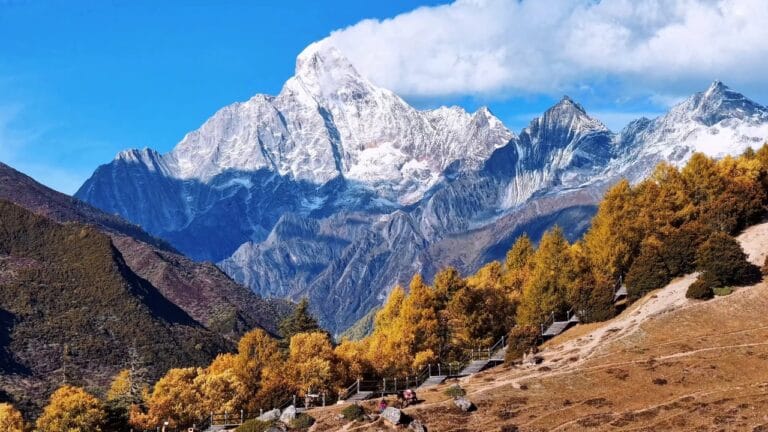
Dagu Glacier is in Heishui County, northwest Sichuan, 260km from Chengdu. Its summit sits at 4,860m, and a sightseeing bus plus a 15-minute cable car get you there — no hiking needed. The glacier itself wasn’t known outside the region until 1992, when Japanese scientists spotted it by satellite. A follow-up expedition that same year confirmed what they’d found: the world’s lowest-altitude, largest, and youngest modern glacier, and the one closest to any major city.
This guide covers what it actually costs, the ticket rules, the route, when to go, and what makes altitude sickness a real risk here. It also works through whether Dagu is worth the trip in the first place, and how it compares to China’s other glaciers if you’re still deciding.
Quick Facts
- Tickets: CNY 250–310 for the full combo at current promotional pricing (through Sep 2027), depending on season
- Best season: Late Oct–mid Nov (autumn colors) or Dec–Mar (snow)
- Getting there: 5–6 hours by private car from Chengdu
- Good to pair with: Jiuzhaigou or Mount Siguniang, rather than as a standalone trip
- Skip it if: You want dramatic glacier scenery, a tight budget, or altitude sensitivity
Table of Contents
1. Is Dagu Glacier Worth Visiting?

The case for going
No hiking, no acclimatization days, no technical gear — just a bus ride and a 15-minute cable car. No other high-altitude summit in Sichuan is this easy to reach, especially if you’re already routing through the region.
The case for skipping it
Reviews on Chinese travel forums are blunt about the tradeoff, and we think they’re worth taking seriously. A common complaint: you spend a full day and a few hundred yuan on transport and tickets, then reach the top and find there’s little left to actually do.
Weather makes this worse. Dagu sits high enough that cloud cover rolls in fast, and unlike Jiuzhaigou’s valley-floor lakes, there’s no other scenery to see if the summit is covered in fog. It’s common enough that it shows up repeatedly in visitor reviews: people who made the climb only to find the platform fogged in, with none of the view they’d seen in photos.
The blue-ice misconception
Dagu Glacier does not have blue ice. The blue-ice photos that circulate online and get attached to Dagu’s marketing are almost always from Laigu Glacier in Tibet, a different destination entirely. If blue ice is what you’re after, our glacier comparison further down this guide points you to where it actually is.
Our recommendation
Plan Dagu as one stop within a larger trip, not as the main destination. It works well as part of a broader northwest Sichuan trip — alongside Jiuzhaigou and Huanglong, or Mount Siguniang and Bipenggou. It works especially well in the October color season or after fresh winter snow, when the sea-of-clouds view from the cable car is more likely. As a dedicated day trip from Chengdu with nothing else nearby, it’s harder to justify the cost and the 10–12 hour round-trip drive.
2. Highlights in Dagu Glacier
The colorful forest on the way in

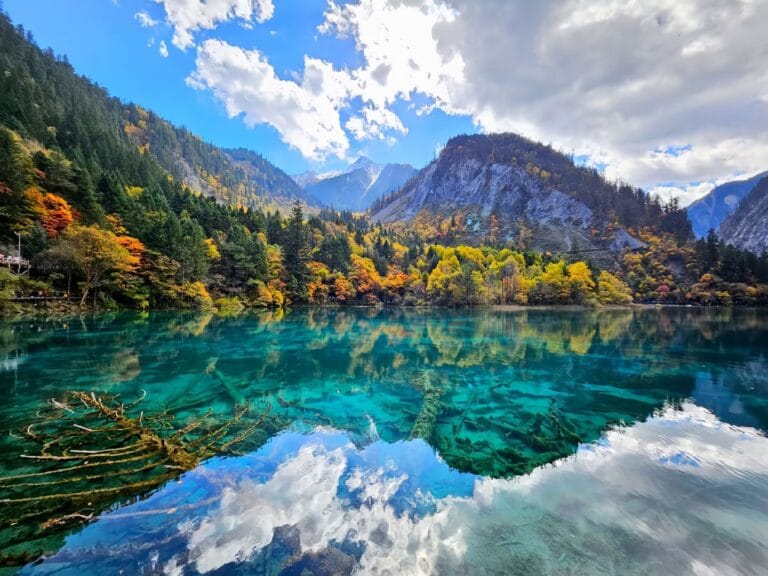
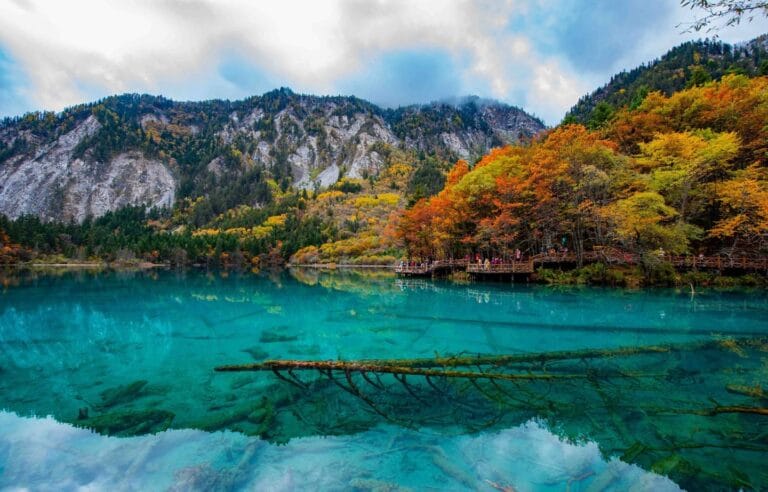
The drive in passes through Naizigou, known locally as the “80-li colorful forest,” before you reach the ticket gate. In late October and early November, this stretch turns the same red-gold-orange as the park’s own forest. Many visitors consider the approach one of the best parts of the trip in autumn.
The stops on the sightseeing bus route
The bus climbs through several named stops on the way up: Golden Monkey Lake, Zena Lake, Dagu Lake, and Luogesi, in that order, before reaching the cable car station.
Golden Monkey Lake (金猴海)


The first stop, a high alpine wetland where Tibetan macaques gather reliably, especially in winter. We tell clients not to rush this stop — it’s often the only wildlife sighting of the whole trip.
Zena Lake (泽娜措)

A wide mountain lake with a waterfall that freezes into ice in winter and reflects the surrounding peaks on a clear day. Nearby, Lingyun Waterfall drops 700m from Yincuo Lake at 4,300m — one of the largest single sights in the park, and it freezes into a solid 3m-thick ice sheet in winter, per park records. The stop also passes a Tibetan village, Zhong Dagu, with ties to the Red Army’s Long March through this valley in 1935.
Dagu Lake (达古湖)

Glacial meltwater at the base of the high pastures, with a spot known as Lovers’ Beach nearby — a traditional matchmaking site for Tibetan couples.
Luogesi (洛格斯)

The last stop before the cable car station, and a genuine pilgrimage site. Tibetan locals gather here to pray for blessings, and the route through it is known as the “path of pilgrimage.” It combines a visitor center (with a small bookstore) and a walking area through pasture, cliffs, and a rock-sheep valley, distinct in feel from the glacier above.
The summit itself


At 4,860m, the viewing platform looks out over white snow and glacier terrain against exposed rock and scree. The cable car’s upper station is certified by Shanghai Grand World Guinness as China’s highest-altitude passenger ropeway. The park has three glaciers, simply numbered I, II, and III, per official park records. Glacier No. 1 is the one the platform overlooks and the one visitors actually reach via the cable car. Glacier No. 2 sits alongside it — not directly accessible, but it holds an ice cave with visible ice pillars inside, a detail most English guides miss entirely. On a clear day, the cable car ride up passes over a sea of clouds with a ring of jagged peaks around you — it’s the moment clients photograph most. A short boardwalk from the platform leads to Tear Lake (泪湖), which freezes into a sheet of ice in winter.
The summit café


Marketed as “the world’s highest café,” it’s a glass-walled structure right at the platform, with floor-to-ceiling views and free oxygen for anyone who needs it. We tell clients to budget 10 minutes here even if they’re not tired — it’s the only heated stop at the summit, and worth it just to sit down.
3. Tickets, Booking, and Operating Hours
Ticket prices
Dagu Glacier runs a three-part ticket system: entrance, sightseeing bus, and cable car. All three are required to reach the summit — climbing on foot isn’t permitted, and the bus is mandatory even if you’d rather walk.
Prices below are per current park regulations, confirmed with the ticket office directly:
Item | Low season (Apr 1–Sep 30) | Peak season (Oct 1–Mar 31) |
|---|---|---|
Entrance ticket | CNY 80 | CNY 120 |
Sightseeing bus (mandatory) | CNY 70 | CNY 70 |
Cable car (round trip) | CNY 100 | CNY 120 |
Full combo | ~CNY 250 | ~CNY 310 |
This is a limited-time discount rather than a permanent price cut, so confirm current cable car pricing before you go if you’re reading this after September 2027 — the standard rate (CNY 150 low season, CNY 180 peak season) may return.
The park’s own “peak season” runs October through March — the opposite of what the name might suggest, since it covers the color-forest and winter windows rather than summer.
Booking and discounts
Tickets can only be booked online, through www.abatour.com or the “Aba Tourism” WeChat mini-program — both Chinese-language only. Phone bookings aren’t accepted, and real-name registration is required for everyone in your party. The park’s booking system allows reservations up to 14 days ahead and caps daily visitors at 5,000; popular dates do sell out, especially during the October color season or Golden Week.
Per current park policy, students and visitors aged 60–65 get the entrance fee discounted, but not the bus or cable car. Refunds are only accepted up to 7 days after your visit date, for unused tickets.
Extra costs worth planning for
- Parking is CNY 20/day — visitors have called it out as some of the steepest parking pricing of any scenic area in the country.
- Watch for the shoe-cover scam in the parking lot. People posing as staff sell “snow shoe covers” for CNY 25 a pair. We tell clients to walk past — you don’t need them. Non-slip shoes or your own ice cleats work fine.
- Summit café prices run high: a latte at CNY 68, tiramisu at CNY 38, based on client reports. Bring a thermos and snacks if you’d rather not pay resort prices at 4,860m.
- Oxygen canisters cost noticeably more inside the park than outside it. Buy one in Chengdu or at a pharmacy in Heishui before you go.
- There’s no single-direction cable car ticket — it’s round trip only, bundled into the combo.
- Cable car cabins are small. Leave large luggage at your hotel or in the car; there isn’t room for more than a day bag.
- Restroom facilities are basic. Multiple visitors have noted the toilets are not as well-maintained as the rest of the park — not a dealbreaker, just don’t expect Western-standard facilities.
Operating hours and maintenance closures
A few schedules are easy to conflate, so it’s worth separating them clearly. The hours below are from the park’s own published schedule:
Hours | |
|---|---|
Park entry | Opens 8:00, last entry 15:30, full closure 17:30 |
Cable car | 8:30–16:30 going up, until 17:00 coming down |
Ticket sales (peak season, Oct–Mar) | Cut off earlier than general closing, at 15:00 |
Weekly maintenance | Cable car closes ~2 hours every Tuesday for routine servicing |
Monthly maintenance | Fixed window on the 15th–16th, plus a separate inspection on a date that moves (Aug 2026: 26th; Sep: 24th). Ticket sales and entry cut off at 14:00 on maintenance days |
Confirm the current schedule on www.abatour.com or by calling 4000886969 (press 1) before you commit to travel dates.
4. Routes and Itineraries

The sightseeing bus route
Golden Monkey Lake → Zena Lake → Dagu Lake → Luogesi → cable car station
The bus runs one direction only, with these stops in fixed order, so you can’t backtrack on foot to one you skipped. Per the park’s official route map, transfers between the bus and each stop involve some walking: about 170m at Zena Lake, 750m at Dagu Lake, and 666m at Golden Monkey Lake. Factor that in if you’re managing altitude or mobility. The full ride from the visitor center to Luogesi, the last stop before the cable car, takes roughly 45 minutes if you don’t get off anywhere. On the way down, the bus only stops when flagged; it won’t pull in automatically at every station.
Luogesi is worth treating as a stop in its own right, not just a pass-through — it’s the park’s pilgrimage site, and locals still come here to pray. Between Luogesi and the cable car station there’s also a roughly 1,860m walking path, if you’d rather cover that stretch on foot.
One-day itinerary

If you’re doing Dagu in a single day, the local advice is consistent: get to the cable car station first, before stopping anywhere else. A typical schedule, based on a real visitor’s timing:
Two-day itinerary (what we usually recommend)
Given the drive from Chengdu, splitting the trip over two days makes for a much less rushed visit.
Day 1: Chengdu → Heishui County (5–6 hours) → overnight in Heishui, which sits noticeably higher than Chengdu. That gives your body a head start on acclimatizing before the summit the next day. If you arrive with daylight to spare, Yangrong Hade Tibetan village or Naizigou (the colorful-forest approach road) both make for an easy afternoon stop on the way in.
Day 2: Enter the park at 8:00 and take the full day at a comfortable pace, without also having to manage the drive.
Whichever itinerary you follow, dress in layers: a moisture-wicking base, a mid layer like fleece or a sweater, and a windproof or down outer shell. Temperature swings between the valley and the 4,860m summit are significant. The park’s own “Zhiyou Dagu” mini-program has a map showing restrooms and other facilities along the route. It’s worth opening once you’re inside if you’d rather not ask staff for directions.
Two walks worth adding if you have spare time
If you have time left over after the summit, two shorter walks cover parts of the park worth seeing on foot.
Luogesi light hike: visitor center → Luogesi entrance → Luobi Pasture → Feilong Cliff → Rock Sheep Valley → Sacred Spring → Heart-Leaning Rock and Worship Pine → Nvmu Lake → Luogesi exit. This threads through the pilgrimage area itself — pasture, cliffs, and a small lake — at a gentle pace.
Dagu Lake loop: lakeside boardwalk → Red Rock Beach → Lovers’ Beach → lakeside meadow → lake-end viewing platform. It starts right at a stop the bus already serves, and Lovers’ Beach carries the same local significance as a traditional Tibetan matchmaking spot.
5. When Is the Best Time to Visit?
Dagu changes character completely by season, unlike Jiuzhaigou, which holds visual interest year-round because of its lakes.
Late October to early November — the clear peak

If you can only pick one window, this is it: the forest along the bus route turns red, gold, and orange against the glacier’s year-round white, and the park runs its annual Colorful Forest Festival. Color typically peaks at 80–90% from late October through the first week of November.
December to March — the second-best window

Deep winter snow, frozen lakes, and the summit café’s “cloud” backdrop at its best — but the colorful forest is gone, and this window is peak pricing. Bring snow chains for icy roads, and layer up: summit temperatures can drop to -10°C to -15°C with strong wind.
March to May, and summer


Spring brings the last of the winter snow melting and rhododendrons blooming lower down — a real but secondary draw. Summer (June–September) is the one we’d steer clients away from: it’s the rainy season, roads get slippery, and most of the summit snow has melted, leaving exposed rock and scree instead of white ground.
Bottom line: late October into early November for the color-and-ice combination nowhere else in the region offers. Winter if you can't make those dates and want the most snow.
6. Altitude Sickness and Safety: What First-Timers Get Wrong
The summit sits at 4,860m, reached from the 3,620m cable car base in about 15 minutes. That altitude change is steep enough that many first-time visitors don’t expect the effect. We’ve had clients feel completely fine on the ride up, then get short of breath, dizzy, or nauseous within minutes of stepping onto the platform.
Before you go
- Consider altitude-sickness medication a few days ahead — hongjingtian (rhodiola) is the common local recommendation, available at pharmacies in Chengdu or Heishui. There’s no pharmacy inside the park, so bring this along with any other medication you might need.
- Skip the shower or hot bath the night before. Hot water dilates blood vessels and can make altitude sickness worse the next day.
- The park specifically advises caution for anyone with heart or lung conditions, diabetes, stage 3 hypertension, coronary disease, or a history of stroke — talk to your doctor before this trip if any of those apply to you, not just before China travel in general.
At the summit
- Move slowly. No running for photos, no jumping, no rushing between viewpoints — give your body time to adjust rather than pushing through discomfort.
- There’s a staffed first-aid station at the cable car’s lower station (not the summit itself), stocked with oxygen, common altitude medication, and basic emergency supplies.
- For anything more serious, call 120. The park’s own line (0837-6729988) is for park incidents and complaints, not medical emergencies.
- If you feel unwell at the summit, head for the café immediately. It has heating and supplemental oxygen, and is the fastest way to stabilize before deciding whether to continue or head back down.
- Buy an oxygen canister before you reach the summit, not after. We’ve seen clients try to shop for one at the top while already struggling to breathe — it’s available there, but at a markup, and it’s the wrong moment to be dealing with it.
There is no lodging at the summit — everyone descends the same day, so you’re never sleeping at high elevation.
Car sickness on the winding mountain road affects about as many people as altitude sickness does; if you’re prone to it, take medication before you leave.
7. How to Get to Dagu Glacier from Chengdu
Dagu Glacier has no train station and no nearby major airport — road is the only realistic option, and the road itself is part of the decision.

Private car
Two routes exist, both from Chengdu, per our drivers’ standard routing:
Route via | Distance | Time | |
|---|---|---|---|
Route 1 | Dujiangyan → Wenchuan → Maoxian → Heishui | ~260km | ~4.5 hours |
Route 2 | Dujiangyan → Wenchuan → Lixian → Hongyuan Rangkou exit → Heishui | ~360km | 5 – 6 hours |
Either way, plan for 5–6 hours door-to-door once you account for stops. This is the only option we recommend for winter travel. Hiring a car with a driver from us.
Some sections ice over, so if you’re self-driving rather than using a hired driver, bring snow chains and don’t plan a winter night drive. Signal also drops out on parts of the route, so download offline maps before you leave Chengdu.
Public bus
Buses run from Chengdu’s Chadianzi Bus Station to Heishui County on a daily schedule; from Heishui’s bus station, it’s a further 10km to the park entrance by local taxi. This works for budget travelers in good weather, but we don’t recommend it in winter.
High-speed train plus shuttle
Take the high-speed train from Chengdu to Maoxian (about 1.5 hours), then a custom shuttle service booked through the “Tianfu Xing” mini-program for the roughly 2-hour connection into the park.
We don’t recommend self-driving from Chengdu, particularly outside summer. For clients heading to Dagu, we route them through a private driver rather than a rental car for exactly this reason.
8. How Does Dagu Compare to Other China Glaciers?
If Dagu’s reviews have you reconsidering whether it’s the right glacier for your trip, here’s how it compares to the other major options. Figures below are drawn from each park’s published ticket pricing and our own research into typical visitor costs.
Dagu Glacier | Laigu Glacier (Tibet) | Hailuogou | Mingyong Glacier | |
|---|---|---|---|---|
Visual impact | Moderate | Highest — true blue ice | High | High, more varied |
Effort to reach | Lowest — cable car | Moderate — 4×4 required | Low — cable car | Moderate — 2–3hr hike |
Elevation | 4,860m | ~4,000–4,200m | 2,850–3,600m | ~3,200m |
Altitude sickness risk | Highest | Moderate | Lowest | Low |
Typical total cost | ~CNY 310 (promotional rate) | ~CNY 150–450 | ~CNY 200–400 | ~CNY 130 |
Laigu Glacier — for real blue ice

If dramatic blue ice is the actual goal, Laigu — near Ranwu Lake in Tibet — is where to find it. Its Yalong Glacier, one of six in the Laigu cluster, has the blue-ice caves and crevasses that show up in Dagu’s marketing photos, even though Dagu itself doesn’t have them. Getting there costs more effort: reaching the Yalong ice specifically requires an extra off-road vehicle fee, and the color itself is seasonal, at its best from December through February.
Hailuogou — the balanced choice

Hailuogou, also in Sichuan, is a middle option between convenience and visual impact. Its glacier terminus sits at just 2,850m — the lowest-altitude major glacier at this latitude in China. Altitude sickness risk is minimal, and visitors can walk directly onto the ice rather than viewing it from a platform. It also has natural hot springs at the base, which most other glacier destinations don’t.
Mingyong Glacier — for a real hike

Mingyong, near Meili Snow Mountain in Yunnan, is the pick if you’d rather hike than take a cable car. A 2–3 hour walk through old-growth forest leads to a viewpoint below Kawagarbo peak, with more scenery variation along the way than Dagu’s summit platform offers, at a fraction of the cost.
Our take
We send clients to Dagu when minimal effort matters most and it fits naturally into a Sichuan itinerary that already runs through Jiuzhaigou or Bipenggou.
For clients chasing dramatic visuals over convenience, we point them to Laigu or Mingyong instead.
And when someone wants to physically stand on a glacier without either extreme, Hailuogou is usually the one we recommend.
9. Where to Stay and Eat Near Dagu Glacier
Since Dagu is a real distance from Chengdu, a one-day round trip is tiring — we’d recommend spending at least one night nearby, which also fits naturally with the two-day itinerary above.
Where to stay
There’s no accommodation inside the park or at the summit. Visitors stay in one of three areas:
Area | Best for | Price |
|---|---|---|
Right by the park entrance | An early start the next morning | Mid-to-upper range, limited options |
Heishui County town (~10km away) | Widest choice of hotels and restaurants | CNY 150–400/night |
Yangrong Hade Tibetan village or nearby guesthouses | A more immersive, traditional-house stay | Mid-range and up |
Book ahead during the October festival window and Chinese Golden Week holidays — Heishui’s hotel stock is small relative to Jiuzhaigou’s, and it sells out faster than the park’s own visitor cap suggests it should. The Yangrong Hade guesthouses fill up fastest of the three, since they’re limited in number to begin with.
Where to eat
Heishui County town has both Tibetan and Sichuanese options, and you don’t need to plan far ahead — restaurants line the main street. These two come up repeatedly in visitor feedback, matching what we’ve seen recommended locally.
SheDe Tibetan Restaurant is a well-regarded choice for Tibetan food, known for its beef hotpot and Tibetan-style baked bread, served in private, Tibetan-styled rooms.
Dachu Meiwei, on Heishui’s main street, is the local default for Sichuanese comfort food — sautéed beef, pork knuckle soup, and fish-fragrant eggplant, at prices that make it popular with everyone. Even local taxi drivers tend to recommend it by default.
Frequently Asked Questions
Can I hike up instead of taking the cable car?
No, not really. There’s a boardwalk trail alongside the cable car route, but it climbs from 3,620m to 4,860m — a difficult high-altitude ascent even for fit hikers. The cable car ticket is required either way since it’s bundled into the combo.
Can I visit Dagu Glacier as a day trip from Chengdu and back?
Technically yes, but we don’t recommend it. The round trip alone is 10–12 hours of driving, on top of your time in the park. If your schedule allows it, one overnight in Heishui makes the visit far less rushed.
Is there an English-speaking guide?
Not typically. Most drivers and on-site staff speak Chinese only. If you’re traveling independently rather than with a private guide, expect to navigate ticketing and the bus/cable car system without English signage or support, or you can hire one from us.
How do I get from Jiuzhaigou or Huanglong to Dagu without going back through Chengdu?
There’s no direct public transit link. The practical option is a private car that routes through Songpan or Zoige. That’s why we usually build Dagu into a loop itinerary with a private driver rather than as a solo add-on from Jiuzhaigou.
Dagu Glacier or Bipenggou — which is more worth visiting?
It depends on what you want. Dagu delivers glacier and high-altitude scenery via the world’s highest passenger cable car. Bipenggou offers fairytale forests, meadows, lakes, and autumn color with easier logistics. We’ve written a dedicated Jiuzhaigou vs Bipenggou comparison if you’re weighing a third option too.
What should I pack that most guides don’t mention?
Bright-colored clothing helps for photos, since pale colors disappear against the snow. Bring a thermos, an oxygen canister bought in Chengdu or Heishui rather than at the park, and an adhesive phone hand-warmer, since cold drains batteries fast at 4,860m.
Planning a Sichuan itinerary around Jiuzhaigou, Mount Siguniang, or a glacier detour like this one? Get in touch and we’ll help you sequence it around the weather and your time.