Humble Administrator’s Garden: The Complete Guide to Suzhou’s Living Masterpiece
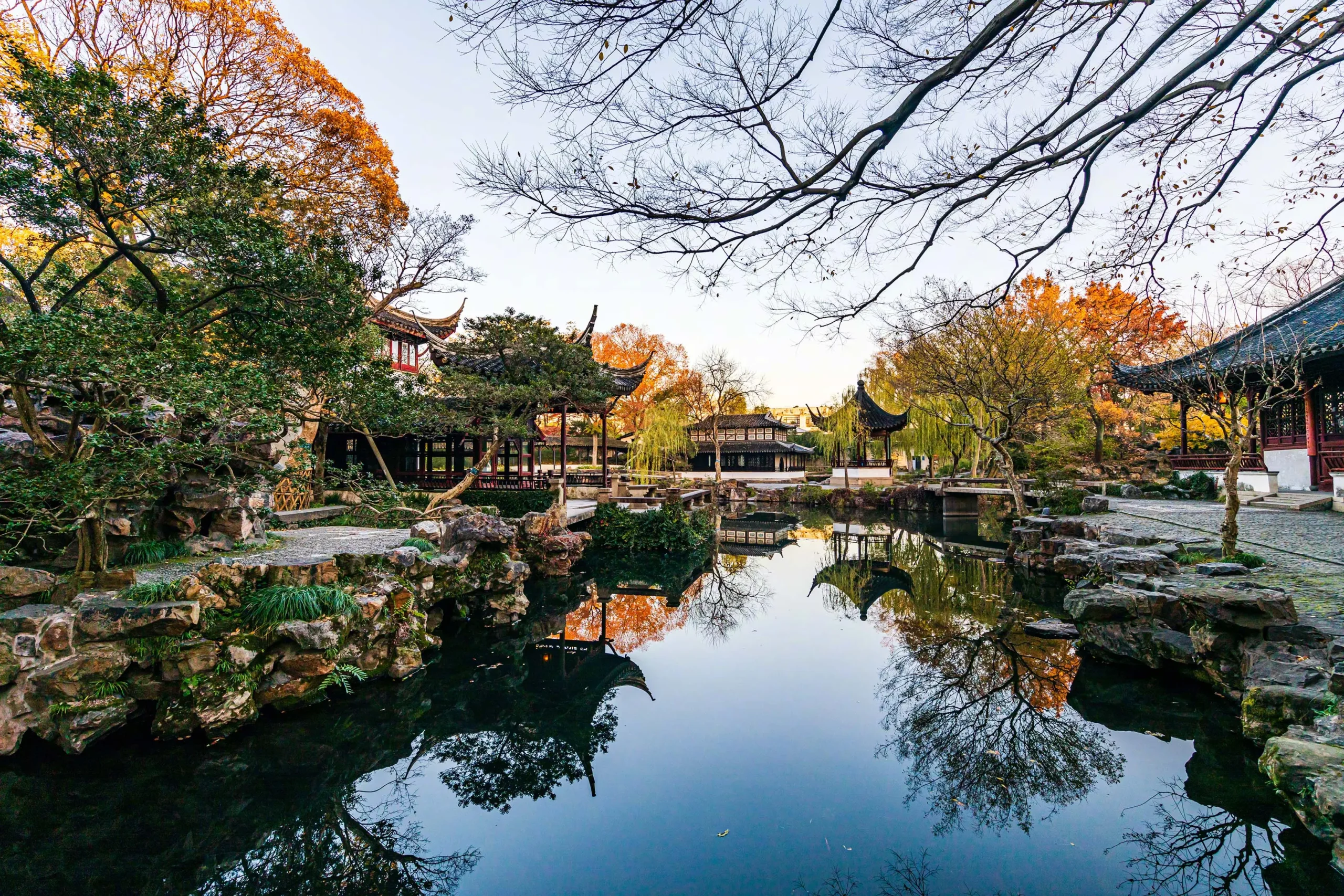
When we first walked through the moon gate at 7:32 AM on a February morning, the garden was ours alone. Frost clung to lotus leaves. Our breath misted in cold air. For twelve precious minutes, before the crowds arrived, we understood why Wang Xianchen spent 16 years creating this sanctuary.
That’s the secret other guides won’t tell you: timing transforms everything.
Quick Facts
Chinese Name: 拙政园 (Zhuōzhèng Yuán)
UNESCO Status: World Heritage Site since 1997
Construction: 1509-1525 (16 years)
Total Area: 52,000 m² (78 acres or 12.85 acres)
Water Coverage: Approximately 33% of total area
Location: 178 Northeast Street, Gusu District, Suzhou
Peak Season Fee: ¥80 (April-May, July-October)
Off-Season Fee: ¥70 (January-March, June, November-December)
Metro Access: Line 6, Humble Administrator’s Garden Suzhou Museum Station
Visitor Capacity: Electronic counter shows numbers; critically crowded above 3,000
Table of Contents
History and Cultural Significance: The Garden of a “Humble Administrator”
The garden’s name carries profound irony. Wang Xianchen, a former imperial censor who designed it as a retreat after being framed by rivals, chose the name from a Jin Dynasty verse suggesting that gardening and vegetable cultivation suited a “humble administrator” like himself—a retired official with political setbacks.
What makes this history fascinating is the garden’s turbulent ownership. Over centuries, it changed hands 16 times. Each owner left their mark. In 1860, it became the residence of Taiping prince Li Xiucheng, undergoing significant remodeling. The current layout we see today largely inherits design elements from this period.
We’ve walked these paths with landscape architects from five continents. They all point to one detail: the garden’s ability to create perceived infinite space within finite boundaries. This wasn’t accidental. Renowned artist and Suzhou native Wen Zhengming gave close attention to the garden, writing an essay and painting 31 paintings with poems to commemorate it.
There’s a literary connection few visitors know: Cao Xueqin, author of Dream of the Red Chamber, is supposed to have lived at the garden during his teenage years around 1735. Chinese scholars believe much of the garden scenery in his masterpiece novel drew inspiration from these very ponds and pavilions.
The Untold Story: Why This Garden Exists
Most articles repeat the same romanticized version. Here’s what actually happened.
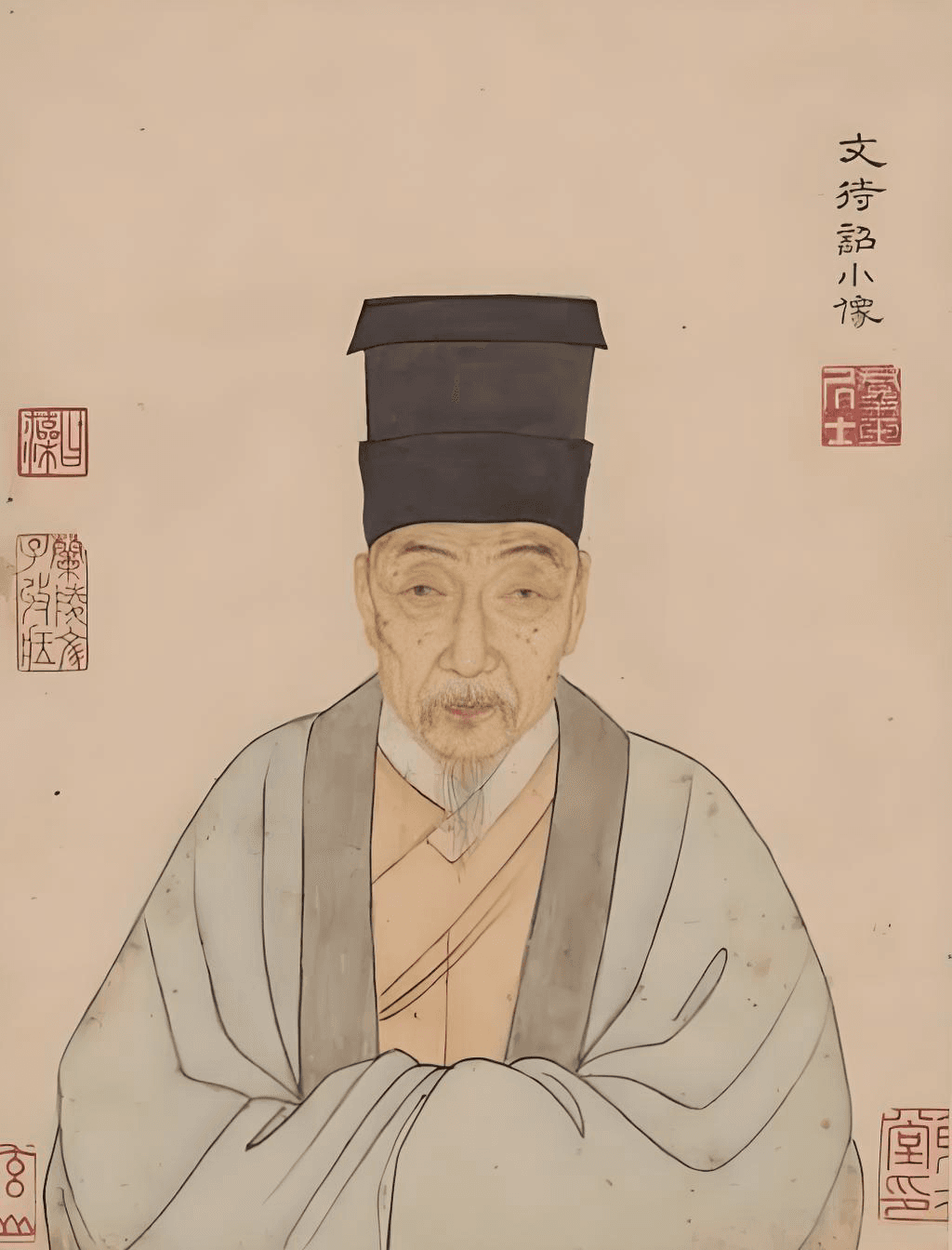
Wang Xianchen passed the highest imperial examination at age 24. Brilliant start. Then a powerful eunuch framed him. Wang was beaten, imprisoned, and exiled to a remote Fujian county. His father refused to compromise integrity by pleading for mercy. Political enemies multiplied.
At 40, broken by a tumultuous career of demotions and false accusations, Wang retired to Suzhou in 1510 when his father died. He purchased the ruins of Dahong Temple—a site that had been poet Lu Guimeng’s residence in the Tang Dynasty—and spent his savings building a garden.
Construction began in 1509 and took 16 years. Wang enlisted his friend Wen Zhengming, one of the Four Masters of Ming Dynasty painting, to design the space. Wen created 31 paintings with poems commemorating the garden, essentially publishing the first comprehensive garden documentation.
The name carries bitter irony. Pan Yue, a Jin Dynasty scholar, wrote about “humble administration” meaning simple tasks like planting vegetables and tending gardens. Wang adopted this name as self-mockery: the former imperial censor now did humble work after political failure.
Wang died shortly after completion. His son immediately gambled the garden away to the Xu family.
Over 500 years, ownership changed 16 times. Each owner reconstructed sections. The garden was divided, reunited, divided again. Taiping prince Li Xiucheng occupied it in 1860, turning the Mengyin Tower into his fortified office—designed with hidden upper floor access to prevent attacks.
The garden you see today reflects layers of Qing and Republican-era modifications, not Wang’s original vision. This reality makes it more interesting, not less. It’s a palimpsest of Chinese aesthetics across five centuries.
Why Humble Administrator’s Garden Demands Your Time: Three Reasons Competitors Miss
1. The Crowd Capacity Revelation
There’s an electronic display outside showing current visitor count. At 3,000 visitors, paths become shoulder-to-shoulder. Above 3,500, viewing any pavilion requires queuing.
Here’s what no other guide states clearly: the garden allows entry far past comfortable capacity. On a Sunday in May 2025, we documented 4,200+ visitors simultaneously—in a space designed for contemplative solitude.
One TripAdvisor reviewer captured it perfectly: “I went on a Sunday and the place was just jam packed, parts of the garden looked like they were about to collapse due to the sheer number of people standing on the bridge.“
The actionable solution: The electronic counter displays numbers before you purchase tickets. If the count exceeds 2,500, abort and visit Lingering Garden or return at 4:00 PM.
2. The Architectural Mathematics Most Visitors Never Notice
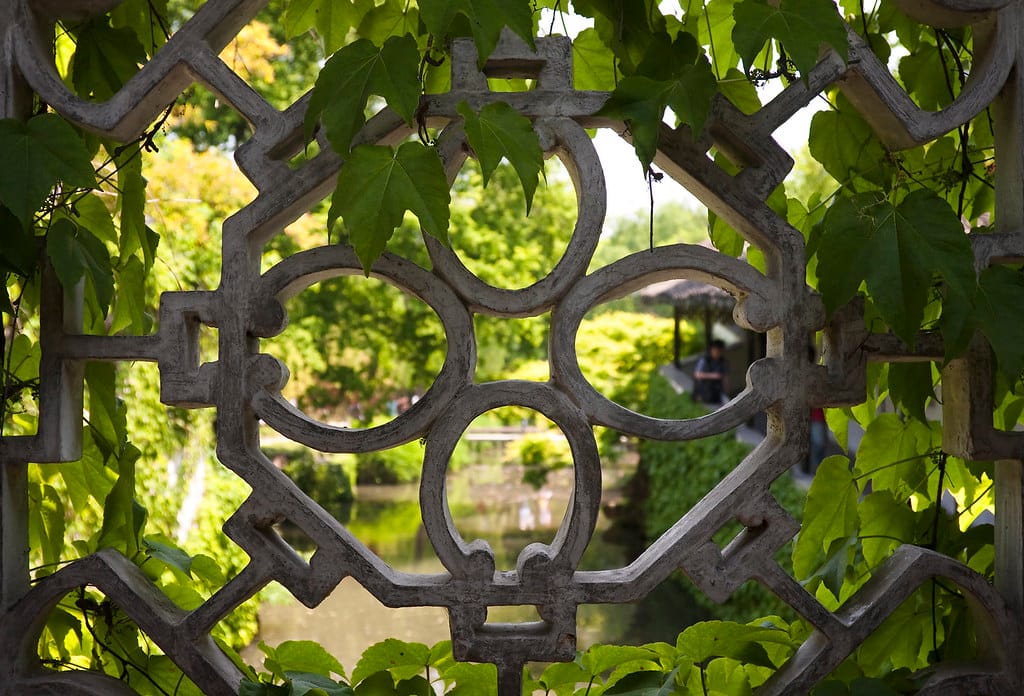
We’ve counted 48 distinct structures. Zero architectural repetition. Every pavilion serves a different viewing function based on cardinal direction, seasonal changes, and time of day.
The Hall of Distant Fragrance exemplifies this sophistication. Windows on all four sides, positioned at specific heights. Stand inside at 9 AM: eastern light illuminates lotus pads. Return at 5 PM: western sun gilds the water. Same structure, completely different aesthetic experience.
Chinese landscape architects study a concept called “framing precision” (框景精度). The Small Flying Rainbow Bridge—the only walkable bridge—creates exactly 11 distinct framed views depending on viewing angle and season. We photographed each one across four seasons. Not one composition repeats.
3. The Night Tour Program Nobody Explains Properly

The immersive night tour launched in 2024 integrates projection mapping with live Kunqu opera. Performers in period costume stage abbreviated operas on floating platforms in the central pond.
What makes this exceptional: the projections animate Ming Dynasty paintings on garden walls, showing how original owners would have experienced certain views. It’s essentially augmented reality using 500-year-old art as the source material.
Tickets cost ¥180-220 (significantly more than daytime admission) and sell out 2-3 days in advance during peak season. The program runs June-September only, with performances at 7:30 PM and 8:45 PM. Duration: 90 minutes.
We attended the July 2025 performance. The lotus pond staging was genuinely spectacular—lanterns floating, voices echoing off pavilions. However, the crowds were comparable to daytime. Still worth experiencing once if you’re passionate about classical Chinese opera.
Garden Layout: Understanding the Three-Part Structure
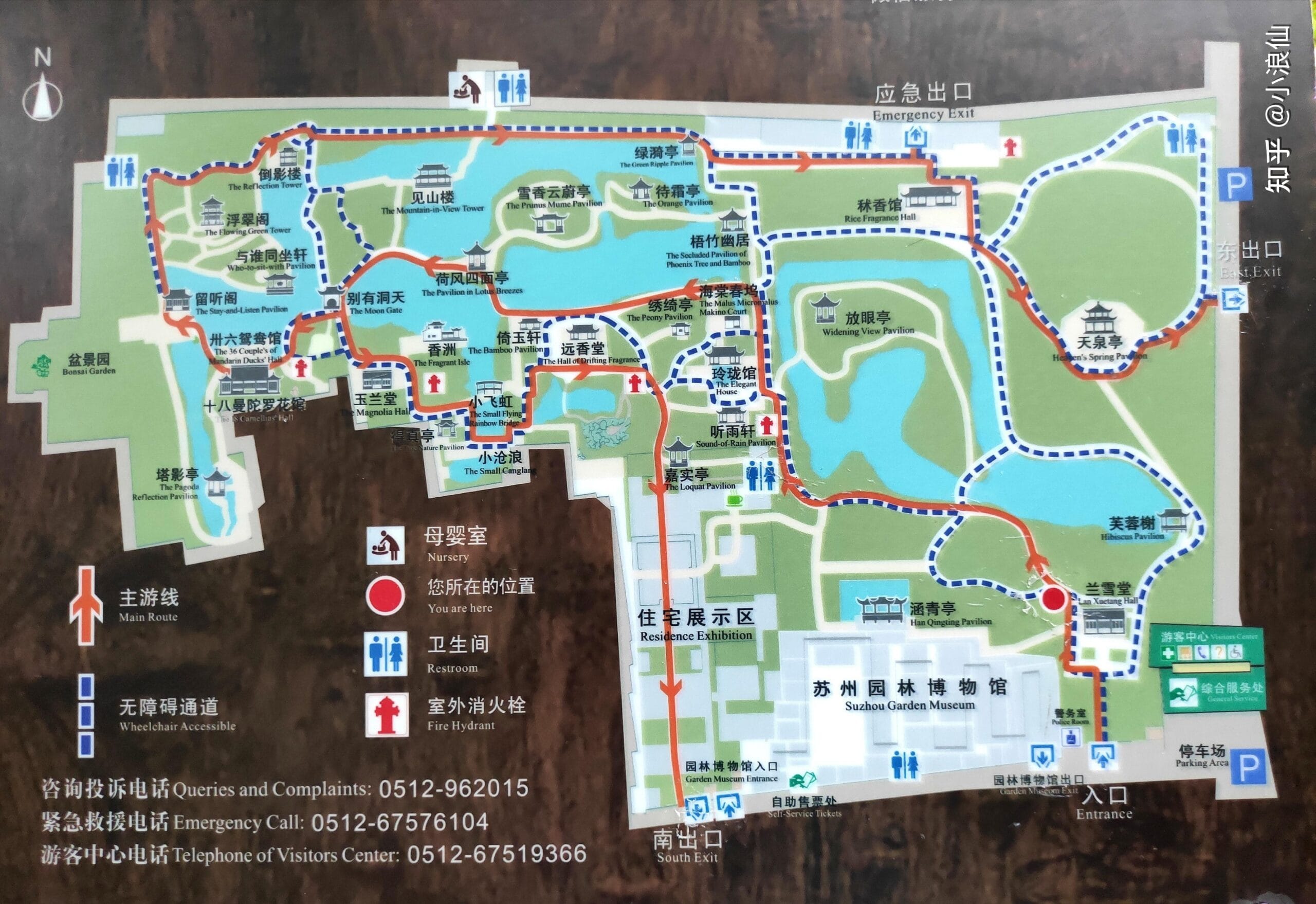
Eastern Garden (东园): The Rural Poetry Section
Coverage: 21,000 m² (largest by area)
Character: Wild and idyllic, deliberately rustic
Visitor Density: Lowest—many tourists skip this section
This area intentionally contrasts with the refined Central Garden. Only one pond, one hill, two halls, four pavilions. The rectangular pond dominates, surrounded by lawns uncommon in classical Chinese gardens.
Lanxue Hall (兰雪堂)

Entry point for most visitors. The south wall displays a complete panoramic map—study this first to understand spatial relationships. Named after Li Bai’s Tang poem: “Standing independent in the world, the clear wind scatters the orchid snow.”
Shuxiang Hall (秫香馆)
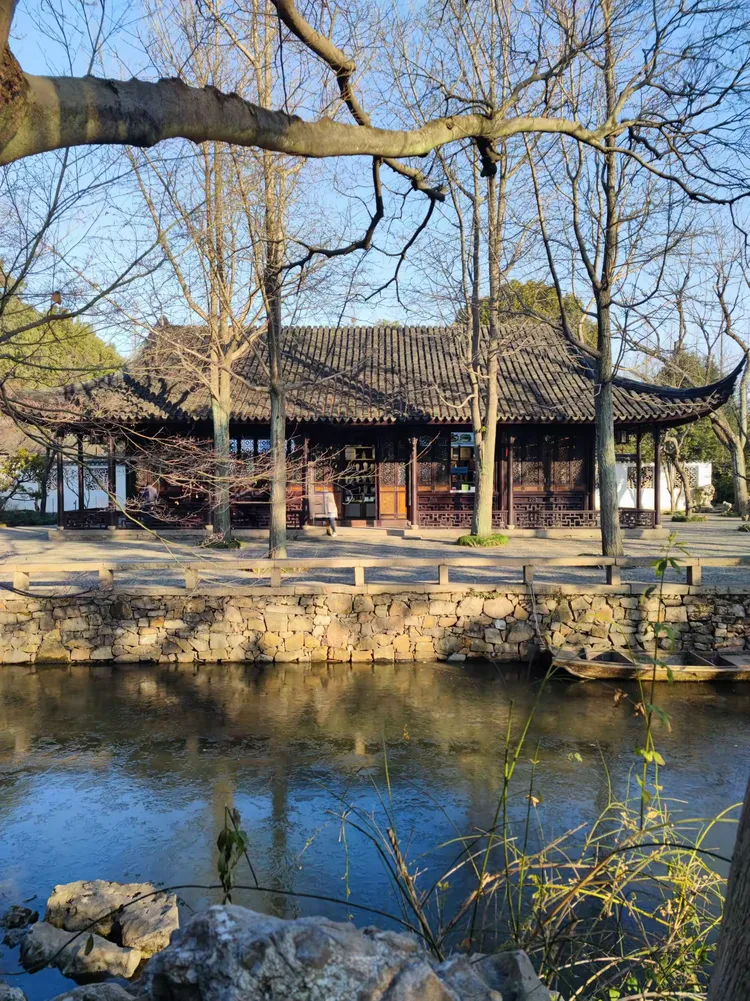
The main building in Eastern Garden, facing water with mountain behind. The name refers to the fragrance of rice and sorghum. Historically, farmland surrounded this area, and during harvest season, autumn winds carried grain fragrance into the hall—hence its name.
The hall features 48 boxwood carvings on window panels, each depicting different classical literary scenes with exquisite detail and rich layers. These floor-to-ceiling windows with intricate carvings give Shuxiang Hall an ancient, elegant character that many visitors photograph from outside but miss entirely when they don’t enter.
Hanqing Pavilion (涵青亭)
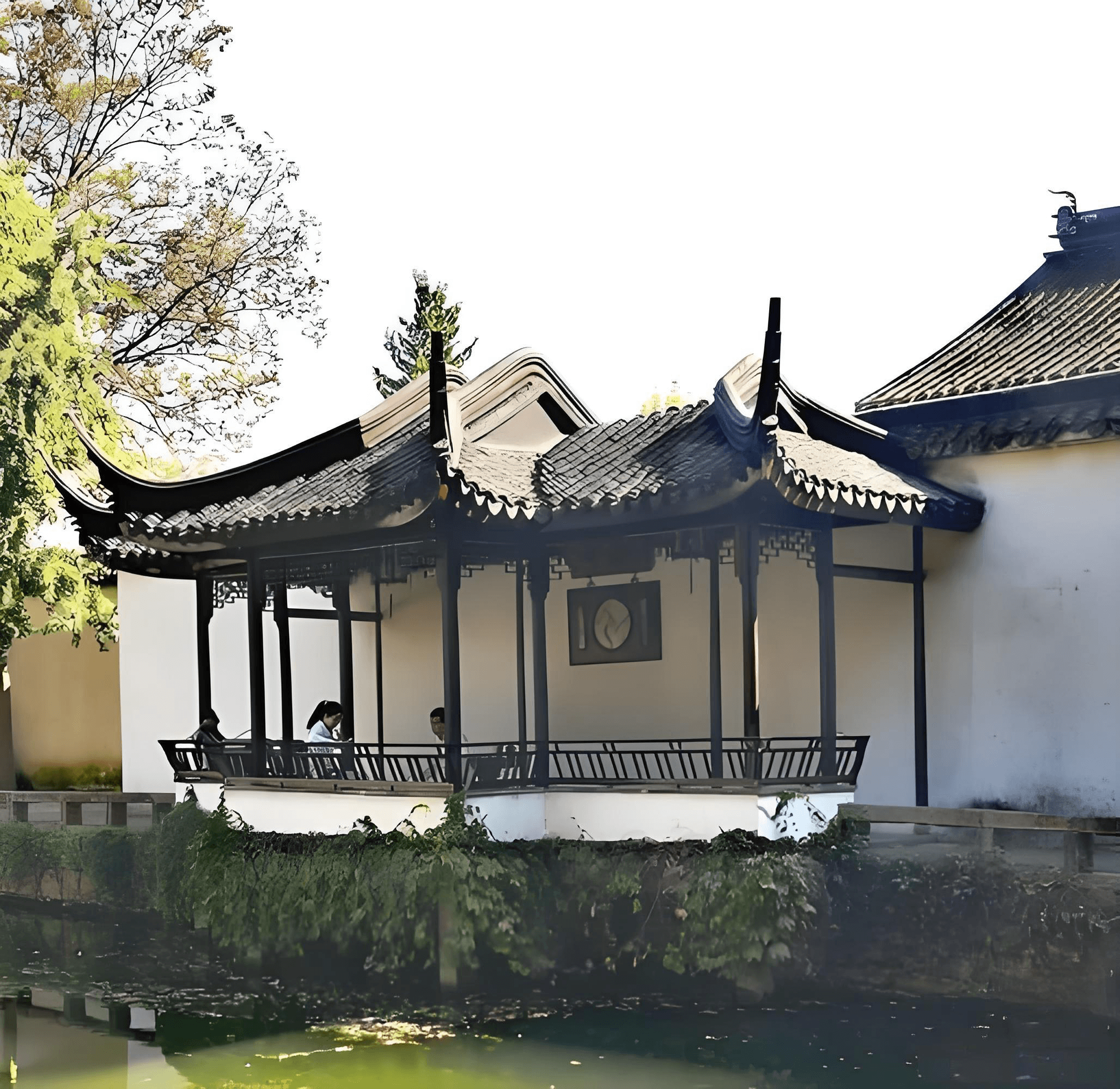
Located in a corner with limited spatial range, this pavilion exemplifies variation in traditional garden architecture. The entire pavilion resembles a phoenix with spread wings, adding dynamic movement to otherwise straight, monotonous walls. Lean against the beauty couch beside the pavilion to watch skylight and cloud reflections in water, with koi swimming among lotus.
Furong Pavilion (芙蓉榭)
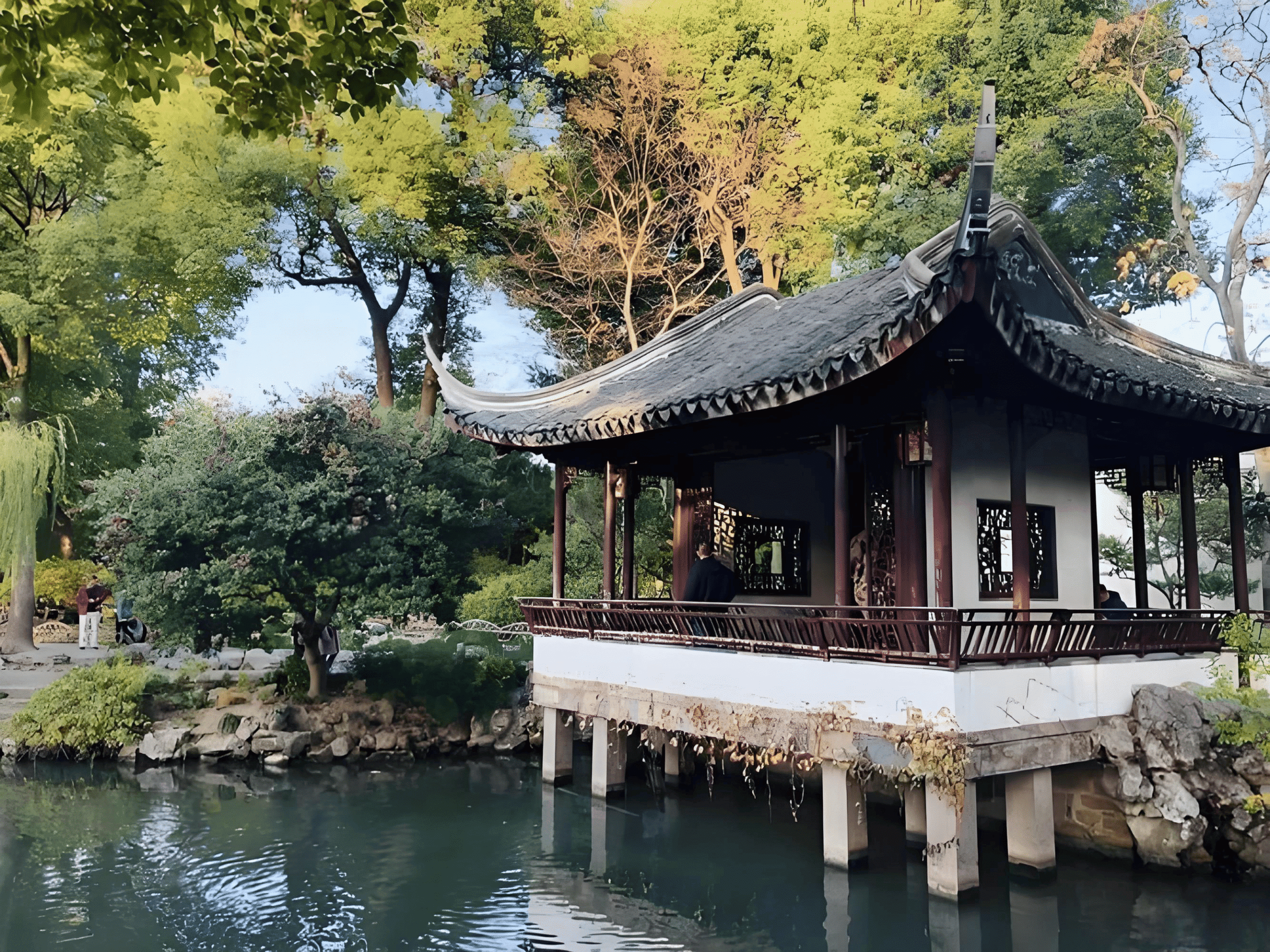
Water pavilion positioned at the eastern edge of the broad pool. Half built on shore, half extending over water—an elegant example of traditional pavilion architecture. This is the first waterside structure visitors encounter. The pavilion offers excellent views of the Eastern Garden’s water expanse, making it ideal for viewing lotus flowers in summer.
Tianquan Pavilion (天泉亭)
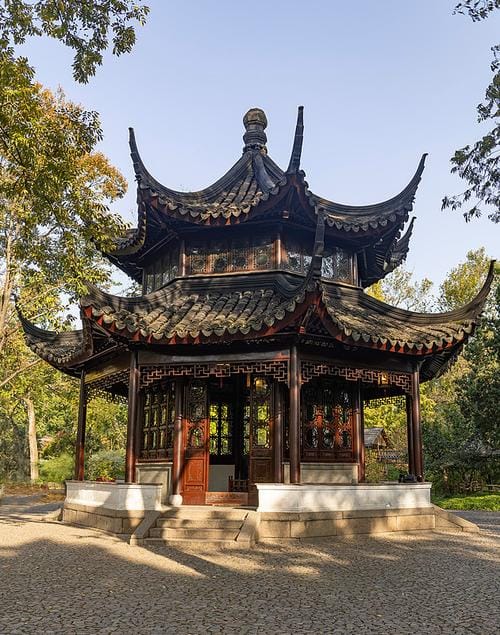
Houses an Yuan Dynasty-era well. The water tastes remarkably sweet—mineral composition differs from modern Suzhou tap water. Local belief holds this water is superior for tea preparation.
Central Garden (中园): The Architectural Essence
Coverage: 23,000 m²
Water Coverage: 33% of section area
Architectural Density: Highest in entire garden
Preservation: Closest to original Ming Dynasty design principles
This section represents the garden’s soul. Water as central organizing element, all structures positioned for specific viewing experiences.
Hall of Distant Fragrance (远香堂)
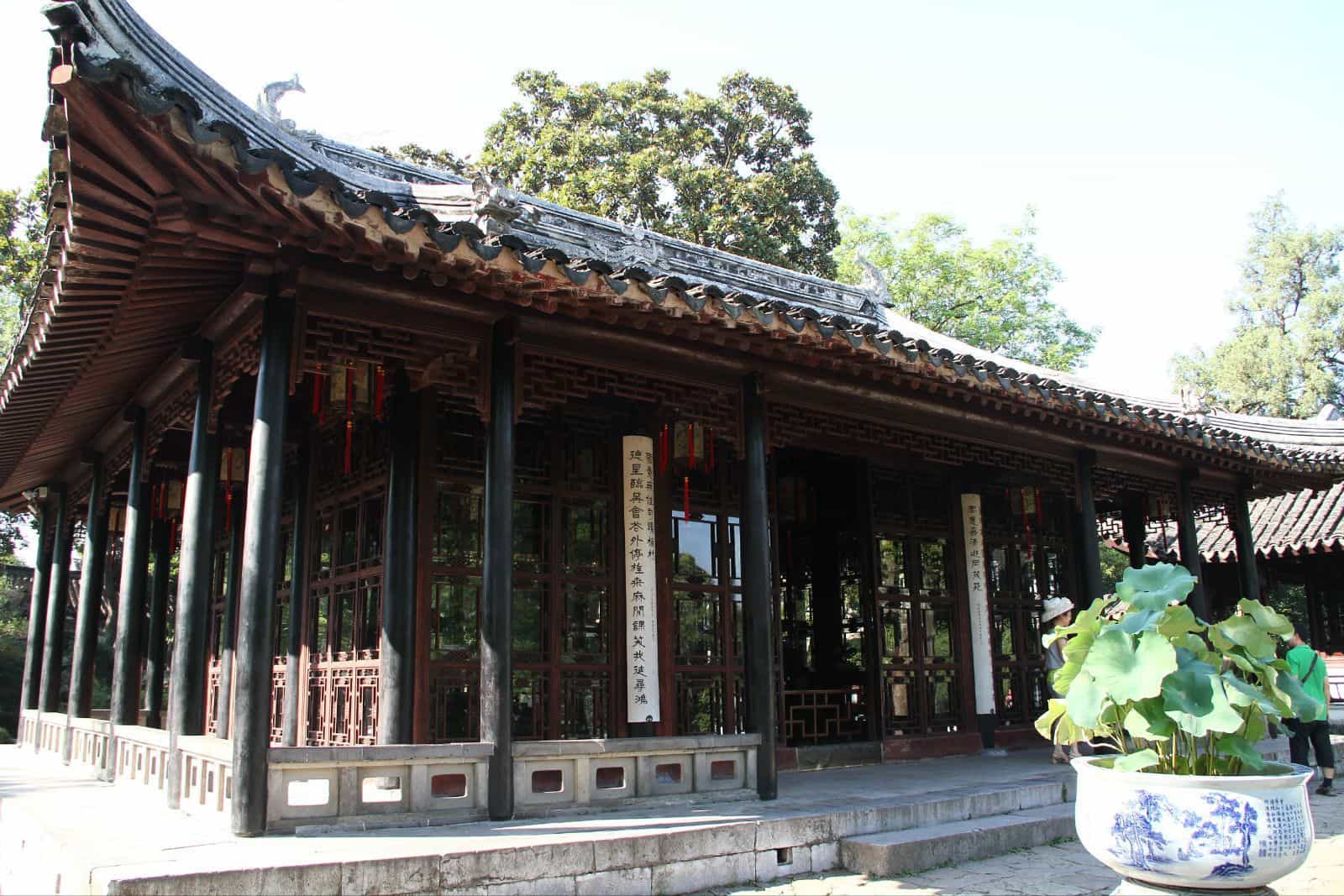
The garden’s ceremonial heart. Name references Zhou Dunyi’s famous essay on lotus: “Its fragrance becomes even more pure the farther it spreads.”
Positioned on the south bank with sight lines to eastern and western islands. Four-sided windows allow panoramic viewing. In summer, lotus fragrance genuinely permeates the hall—this isn’t metaphorical.
Stand in the hall’s center. Count the doorways and windows: 28 separate framed views from a single vantage point. This is “view multiplication” (景观倍增) principle at its finest.
Small Flying Rainbow Bridge (小飞虹)

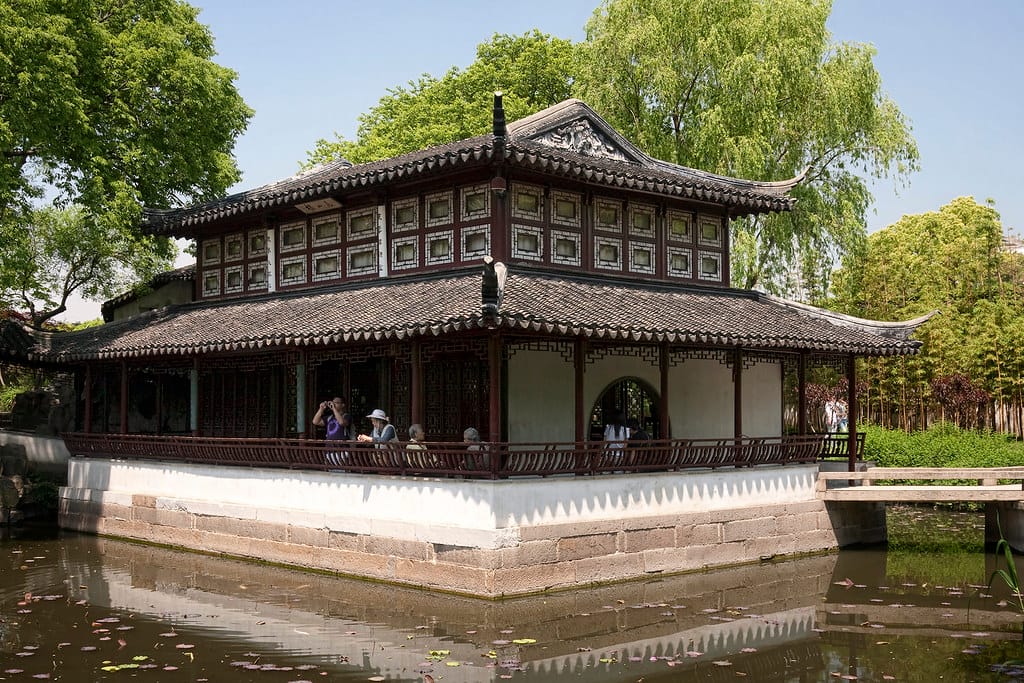
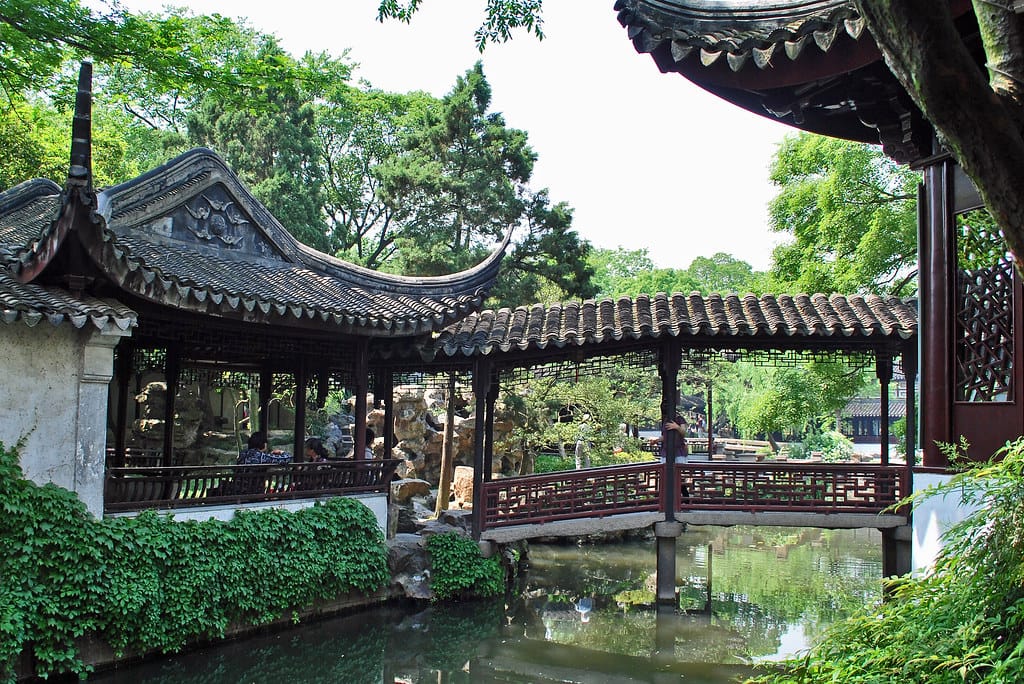
The garden’s sole walkable bridge, and a rare covered corridor bridge in Jiangnan garden design. Vermilion railings create striking reflections.
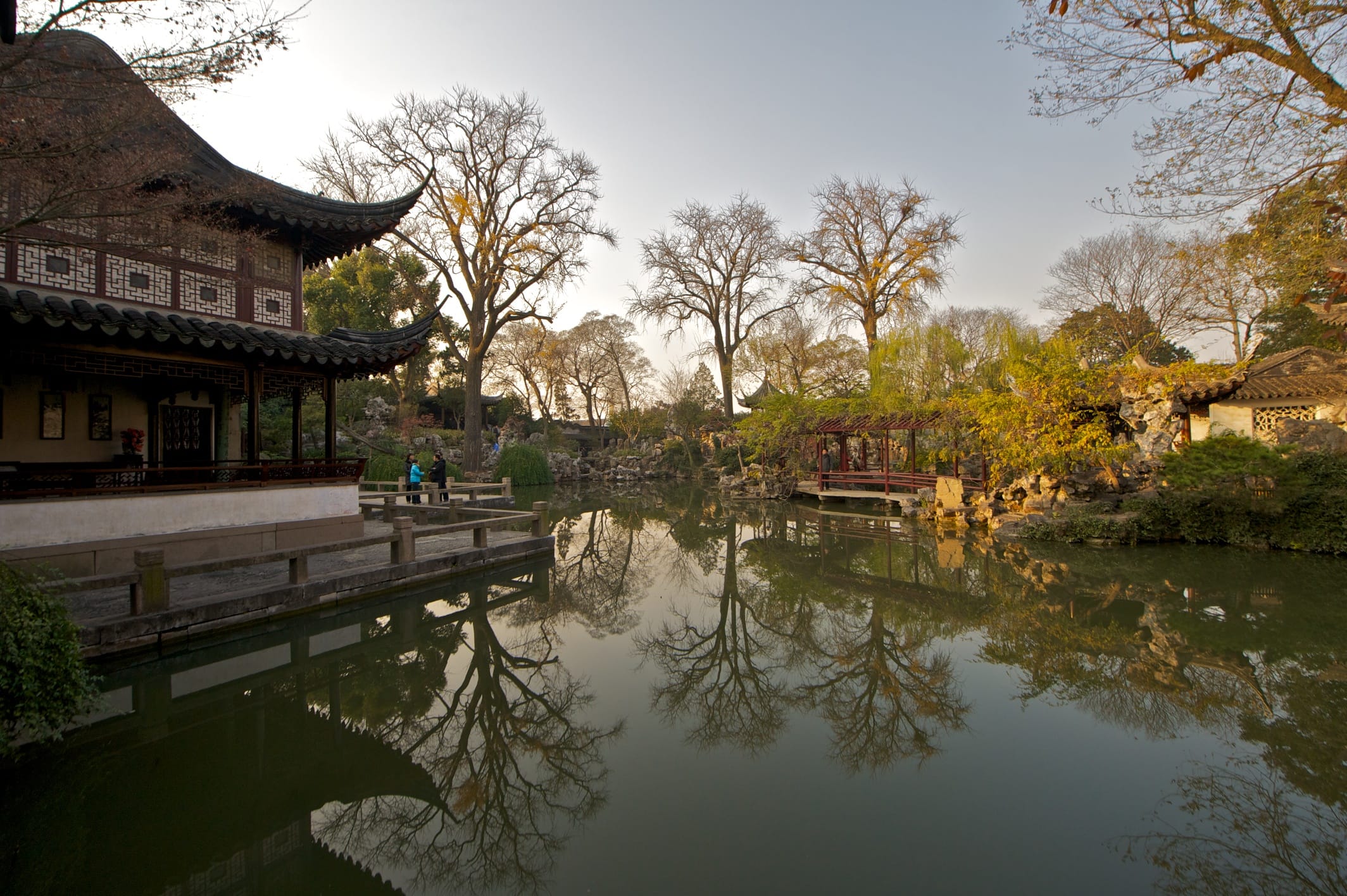
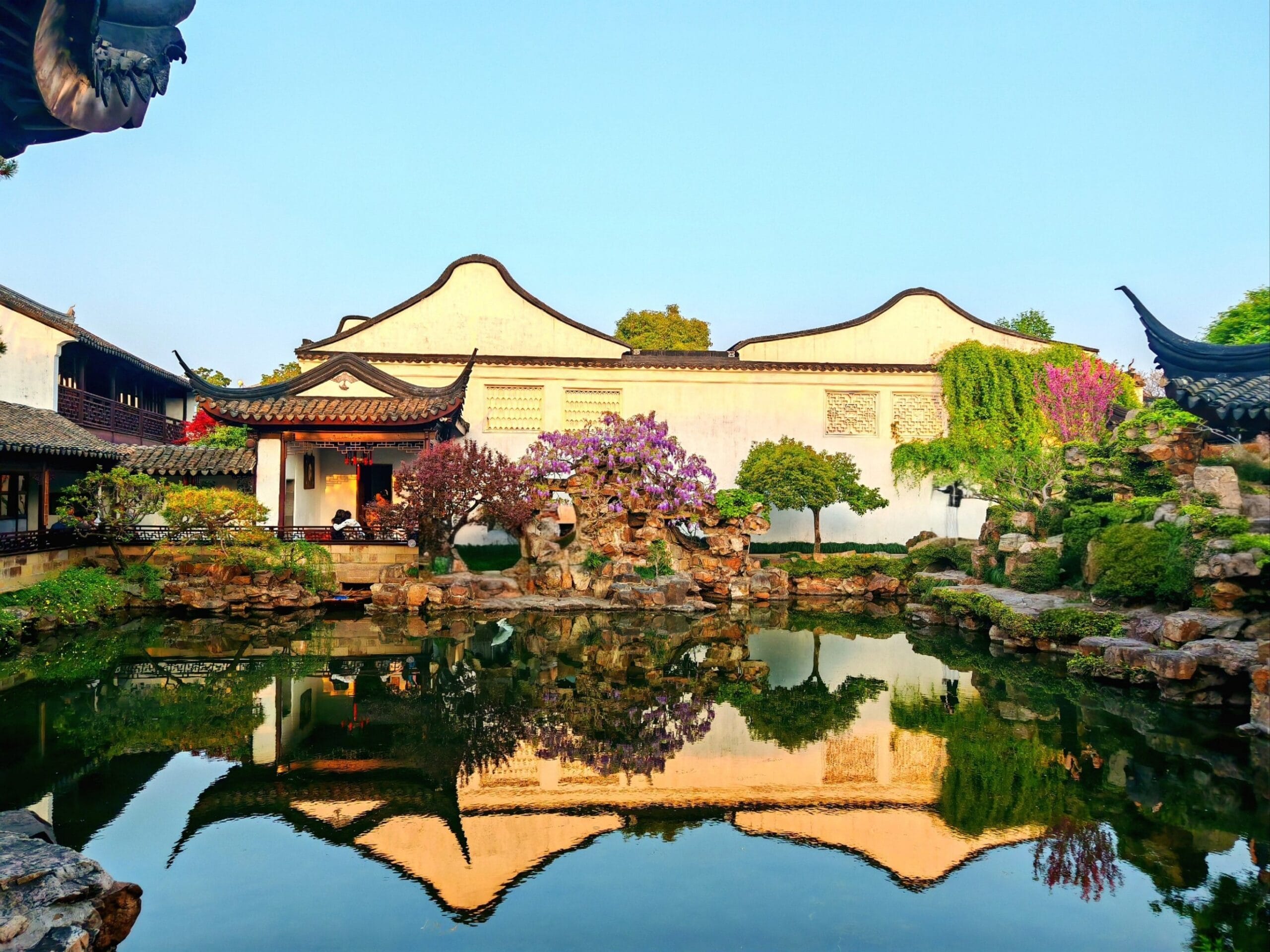
The bridge’s arch, when reflected in still water, forms a perfect circle—the “rainbow” in the name. Photograph this from Pavilion in Lotus Breezes at sunset between May-August when sun angle is optimal. The water must be perfectly calm; even slight wind destroys the effect.
Secluded Pavilion of Phoenix Tree and Bamboo (梧竹幽居)
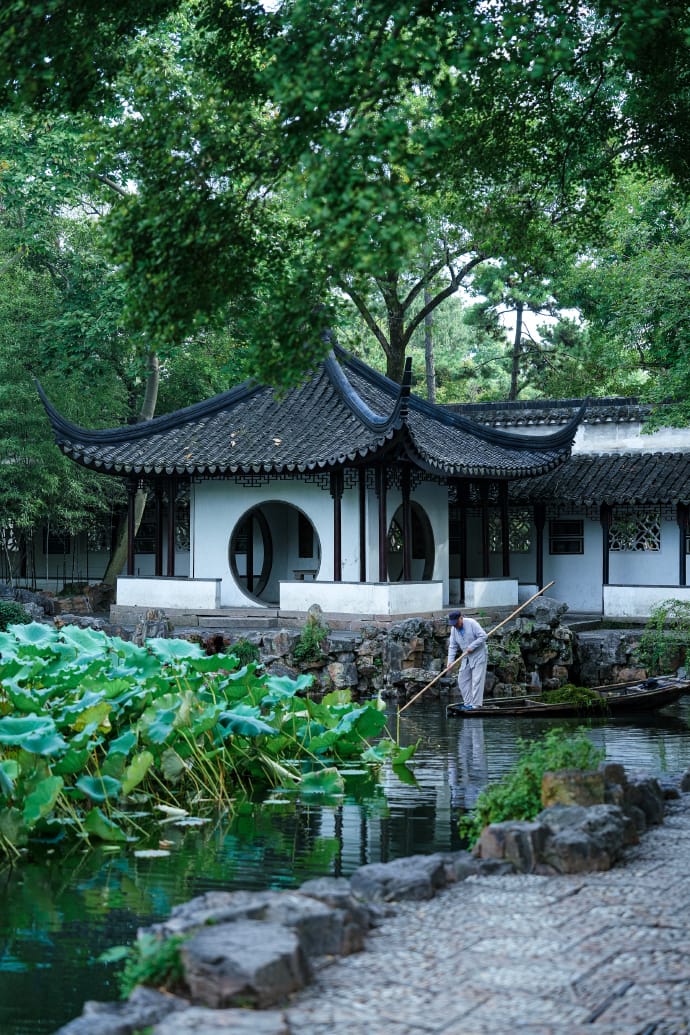
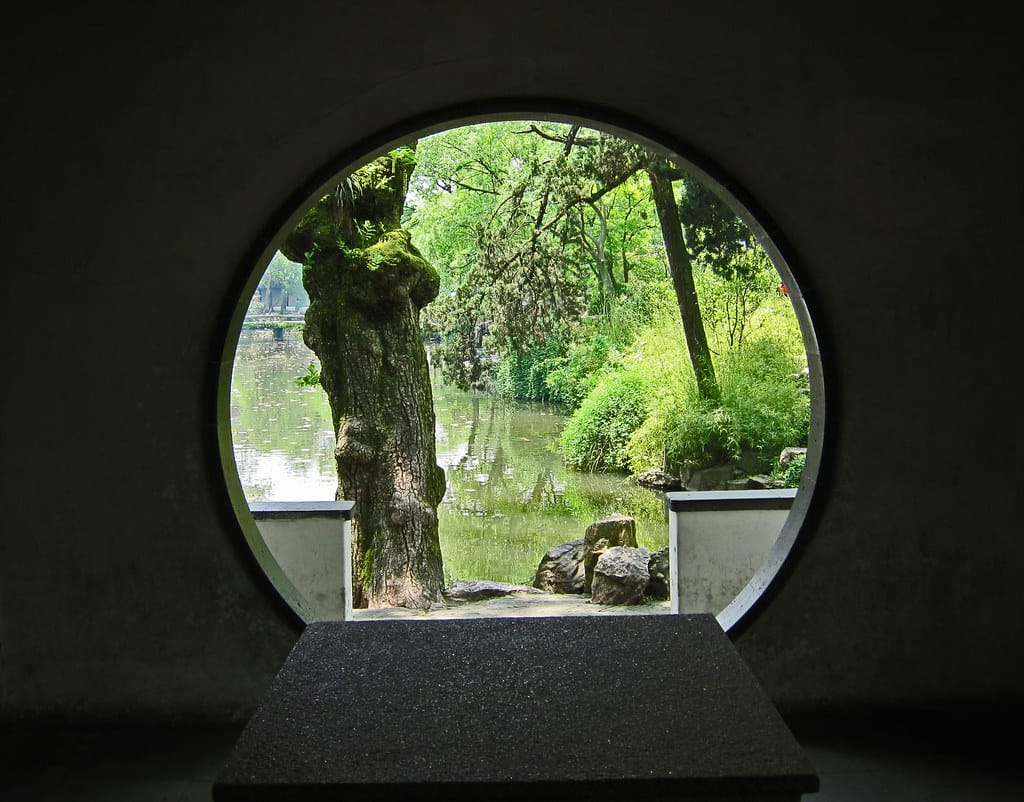
Four circular moon doors create layered depth perception. Phoenix trees (Chinese parasol) flank the north side, bamboo grows dense on the south. This deliberately unbalanced planting creates aesthetic tension.
The pavilion’s horizontal tablet preserves four characters in Wen Zhengming’s calligraphy: “梧竹幽居” (Secluded dwelling among phoenix trees and bamboo). Wen painted this garden 31 times; this is one of few pieces remaining in situ.
The moon doors exploit “selective seeing” (选择性观看): each door frames one specific view while deliberately obscuring alternatives. You physically cannot see all four framed views simultaneously—you must move, creating forced contemplation between viewpoints.
Western Garden (西园): The Qing Dynasty Addition
Coverage: Smallest of three sections
Character: Ornate architecture, elaborate rockeries
Historical Note: Heavily modified during Qing Dynasty; least “Ming” in aesthetic
Thirty-Six Mandarin Ducks Hall (三十六鸳鸯馆)

Actually two halls separated by decorative screen: 18 Camellias Hall (south) and 36 Pairs of Mandarin Ducks Hall (north).
In summer, view north windows: lotus-filled pond with actual mandarin ducks. In winter, south windows: camellia blooms and artificial hill. Same structure, seasonally opposed functions—rare in Chinese architecture.
The glass windows are notable. Original Ming gardens used paper screens; these windows represent Qing-era Western influence. The glazing technique, while anachronistic, creates exceptional light diffusion.
With-Whom-Shall-I-Sit Pavilion (与谁同坐轩)
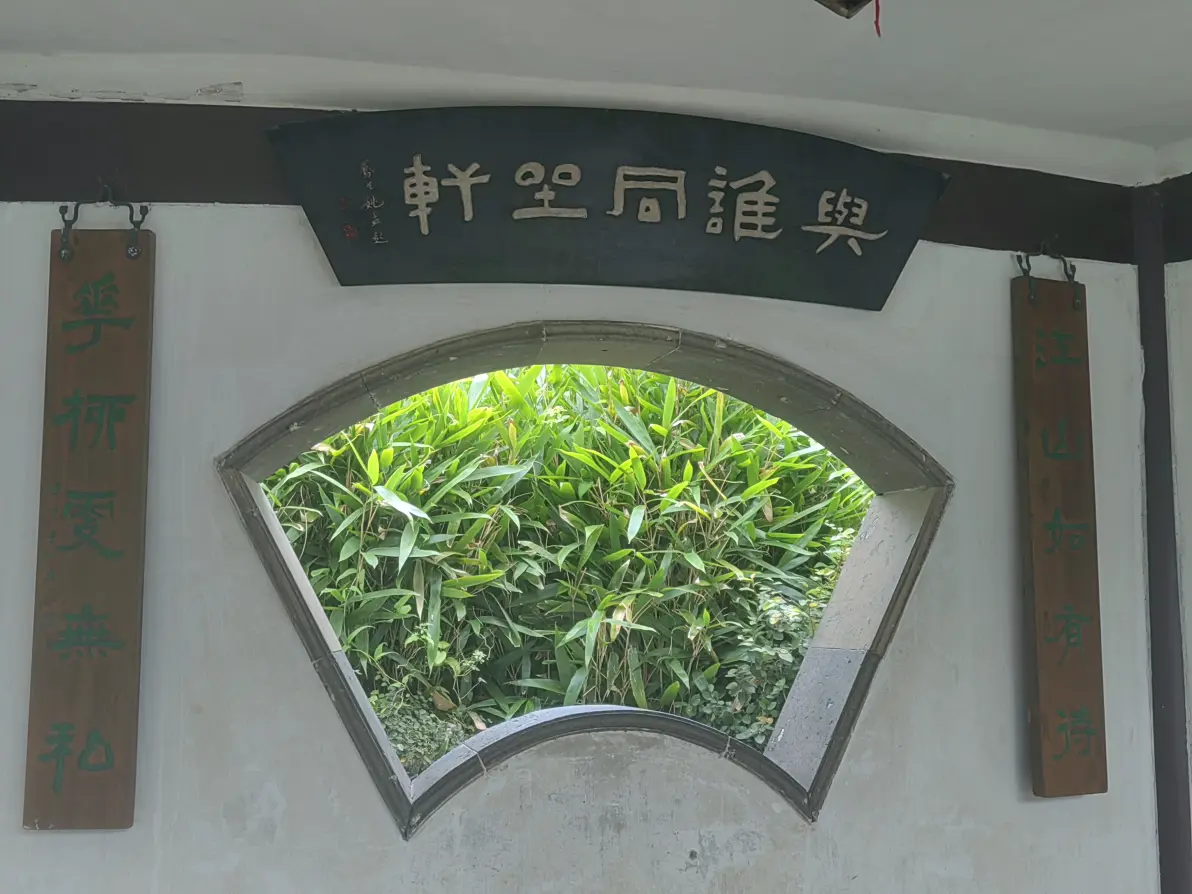
Fan-shaped pavilion named after Su Dongpo’s poem: “With whom shall I sit? Bright moon, gentle breeze, and myself.”
The structure shapes like an unfolding fan—roof, windows, stone table, benches all radiate from single point. From certain angles, the nearby Hat Pavilion appears painted inside the fan structure. This is “borrowed scenery within framed scenery” (框景中借景)—advanced compositional technique.
Photograph this from the western rockery at 4:30 PM in autumn. The sun angle positions the Hat Pavilion precisely within the fan’s frame while backlighting creates silhouette effect.
Pagoda Reflection Pavilion (塔影亭)
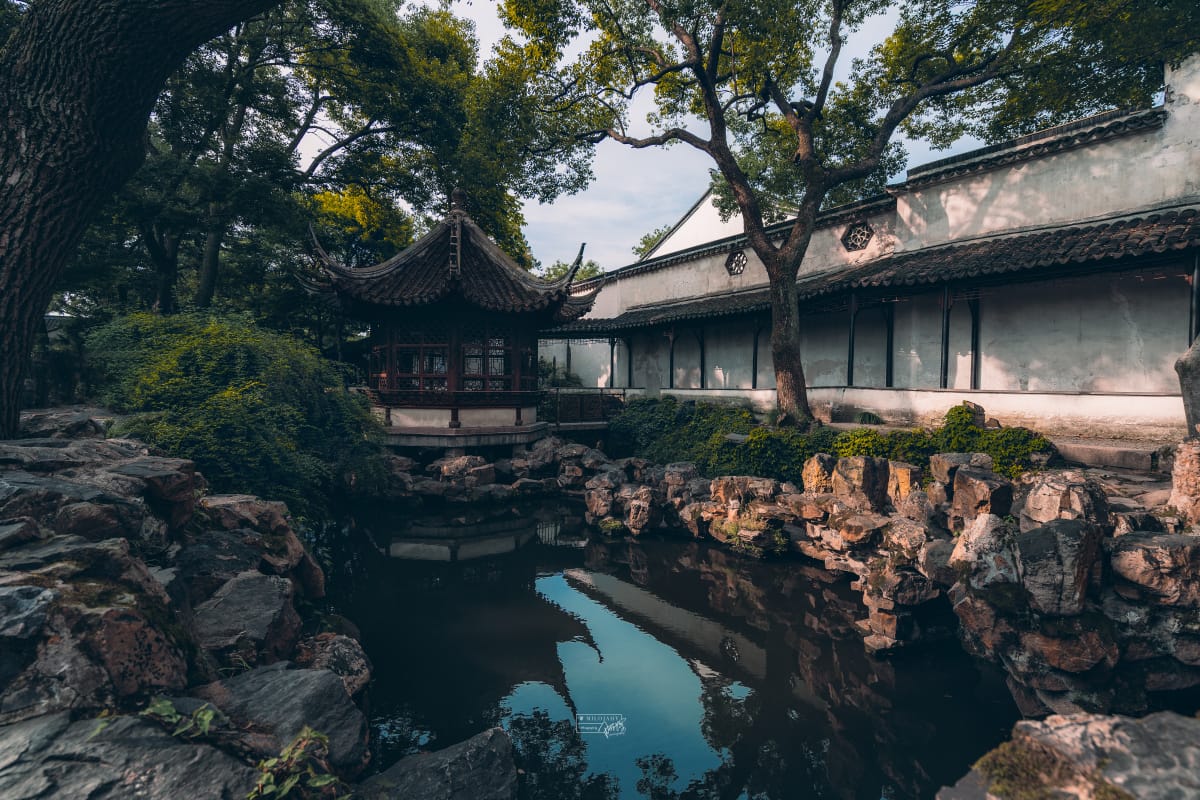
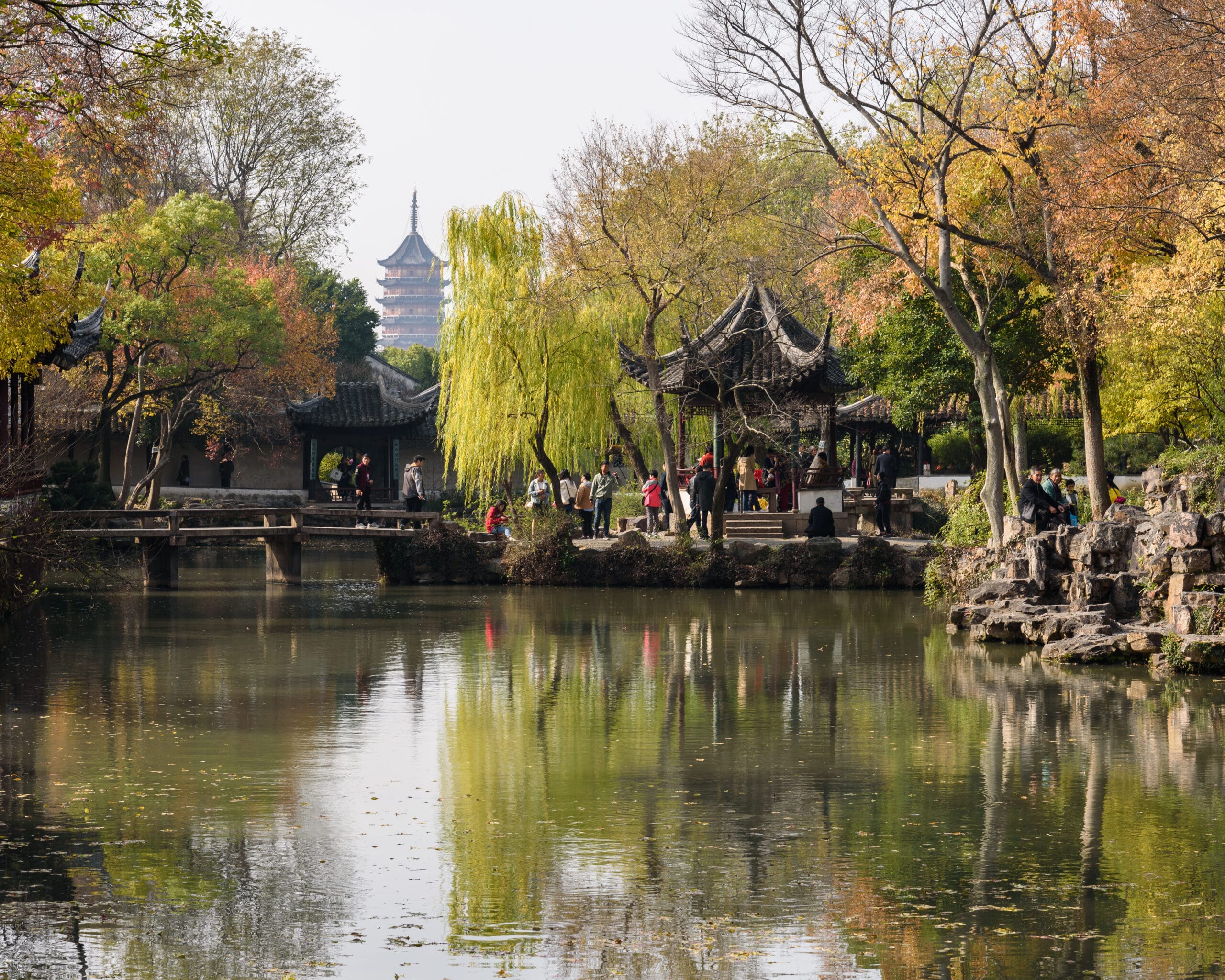
Octagonal pavilion positioned to reflect North Temple Pagoda visible beyond garden walls. This demonstrates “borrowed scenery” (借景) at urban scale—integrating external landmarks into internal composition.
However, modern buildings now partially obstruct the view. The pagoda reflection only appears clear from specific angles. Stand on the pavilion’s western corner, view northeast: the reflection emerges between tree branches.
Special Experiences: Beyond Standard Sightseeing
The Bonsai Garden Hidden in Western Section
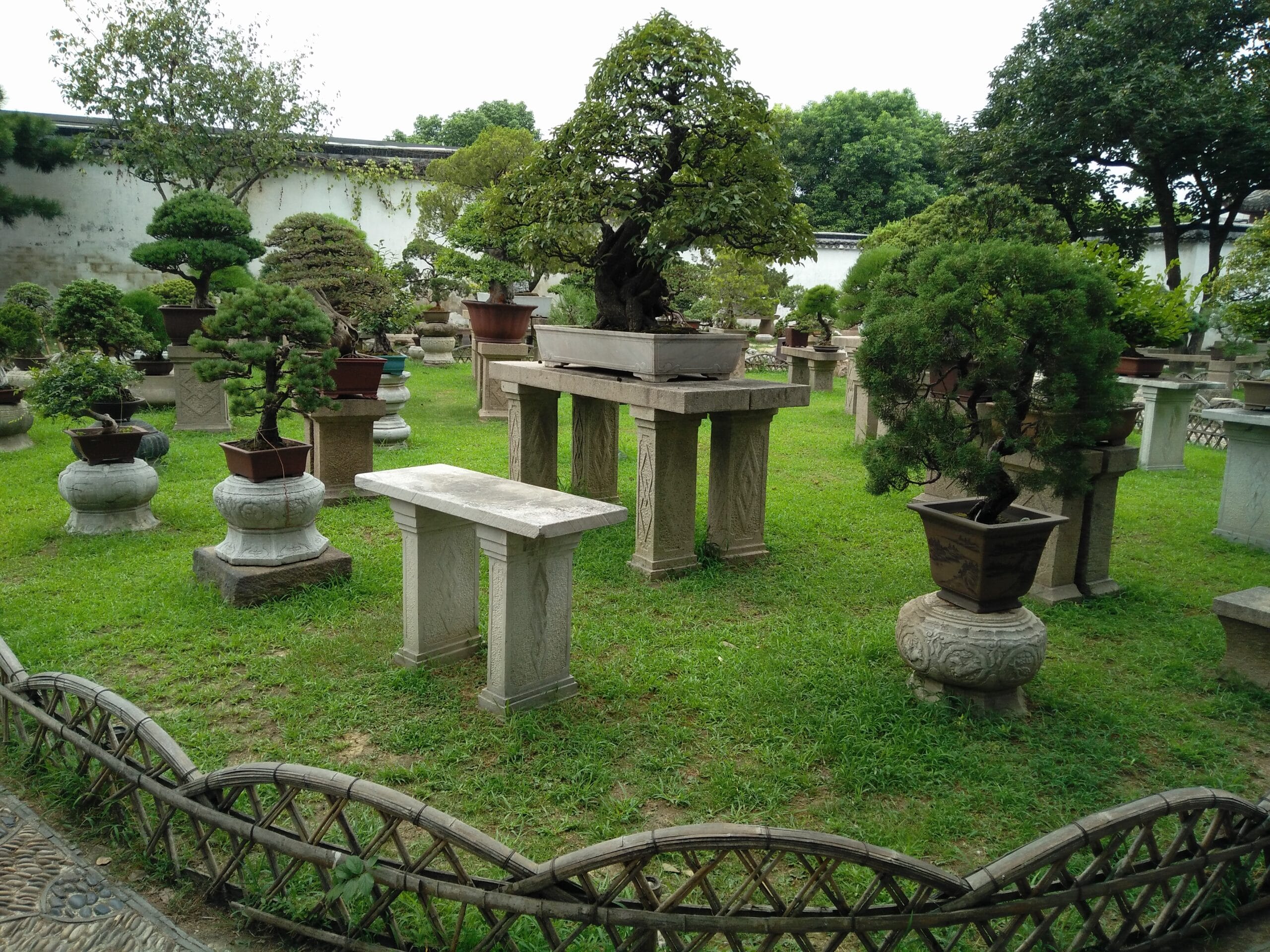
The Penjing Yuan (Bonsai Garden) houses China’s most significant public bonsai collection outside Beijing. One juniper specimen has been trained continuously for 300+ years—verified by dendrological analysis in 2018.
The collection includes 300+ specimens representing seven regional styles: Suzhou, Yangzhou, Sichuan, Lingnan, Shanghai, Anhui, and Hubei. Each style demonstrates distinct pruning philosophy and aesthetic emphasis.
Most tourists spend 3-5 minutes here. Bonsai enthusiasts should allocate 45+ minutes. The curator (present weekday mornings) offers impromptu explanations if crowds are light—ask politely about the ancient specimens’ training history.
Traditional Hanfu Photography Strategy
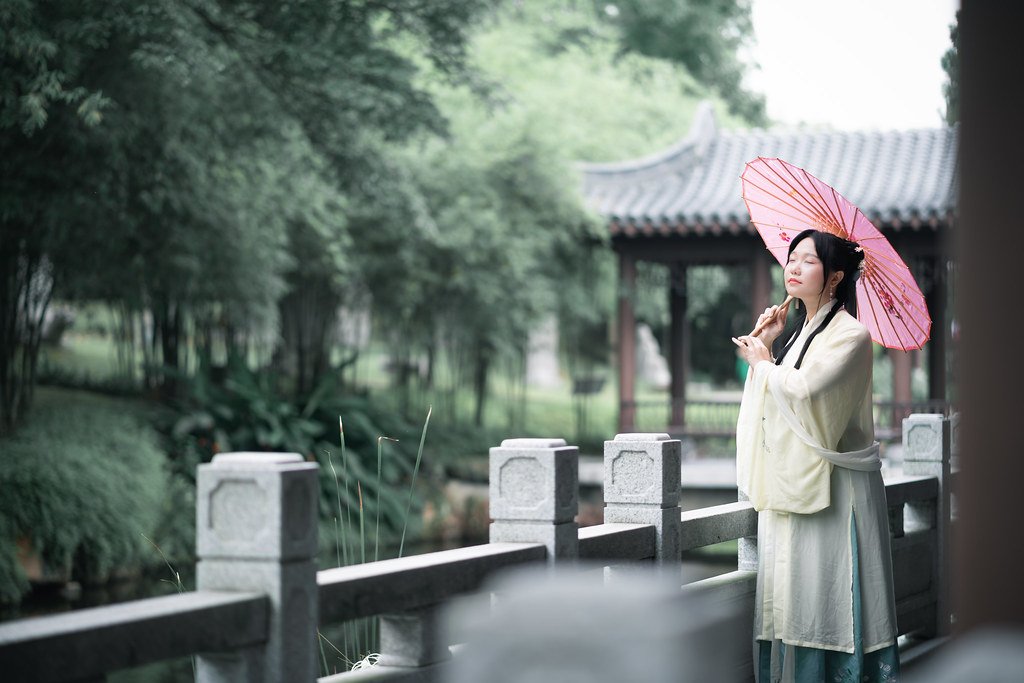
Aspect | Details |
|---|---|
Rental Cost | ¥80-150 for 4 hours (includes hair styling) |
Best Locations | Northeast Street shops (outside East Gate) |
Optimal Timing | Arrive 6:45 AM, complete rental by 7:15 AM, enter at 7:30 AM |
Window Duration | 30-45 minutes before crowds (7:30-8:15 AM) |
Top Photo Spots | Moon doors of Secluded Pavilion, Small Flying Rainbow Bridge, Pavilion in Lotus Breezes |
Light Consideration | Morning: east-facing locations; Afternoon (after 4 PM): west-facing locations |
Afternoon photography after 4:00 PM offers second-best window with golden hour advantages. However, rental shops close by 5:30 PM, requiring rushed returns.
The Garden Museum Most Tourists Skip
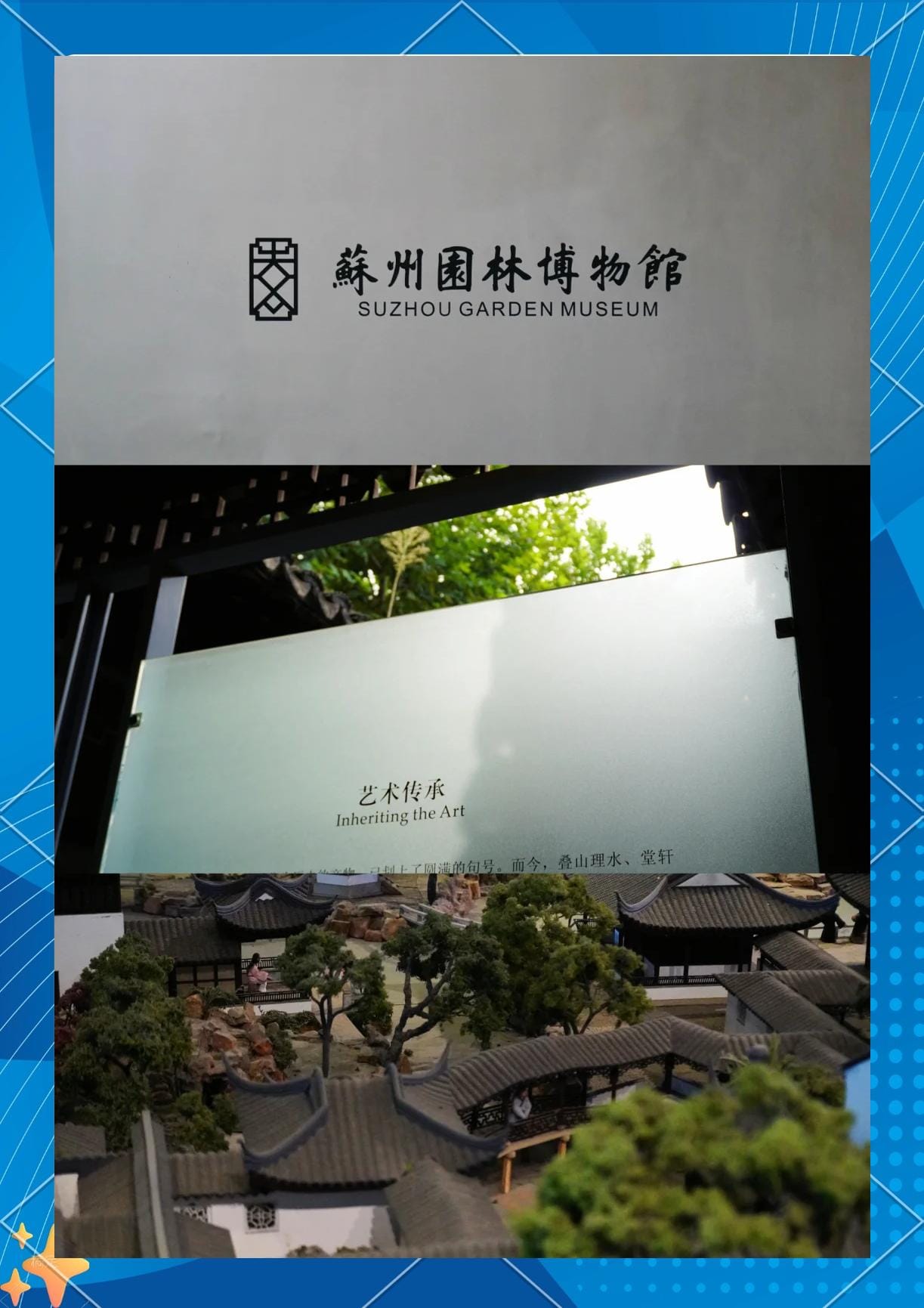
Located adjacent to main garden, this museum occupies the original residential quarters. First museum globally dedicated to classical Chinese garden design principles.
Five exhibition halls cover: garden history, architectural techniques, plant symbolism, stone selection, and regional variations. English explanations are limited but sufficient.
The architectural technique hall displays scale models showing construction methods for pavilions, rockeries, and water features. For anyone interested in how these gardens were actually built—not just aesthetic philosophy—this museum is invaluable.
Admission: Free with garden ticket
Time needed: 45-60 minutes for thorough visit
Design Principles: Decoding What You See
The Four Essential Elements Integration
Element | Percentage | Primary Function | Symbolic Meaning |
|---|---|---|---|
Water (水) | 33% of space | Creates depth, reflects sky, unifies sections | Yin energy, fluidity, life force |
Architecture (建筑) | 48 structures | Frames views, provides shelter, marks positions | Yang energy, human order, cultural refinement |
Plants (植物) | Four-season rotation | Temporal depth, seasonal change | Natural cycles, literary symbolism |
Stones (石) | Taihu limestone | Mountain symbolism, textural contrast | Permanence, strength, geological time |
Every composed view incorporates minimum three elements. The sophistication lies in element interaction, not individual merit.
Borrowed Scenery: The Urban Integration Technique
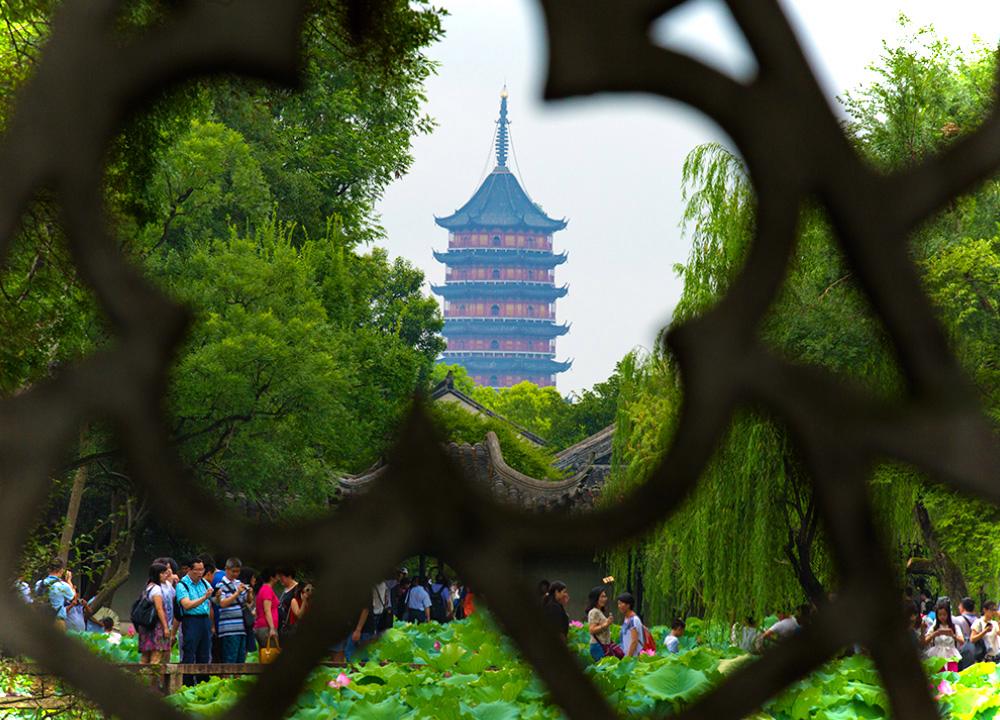
Classical Chinese garden design exploits “borrowed scenery” (借景)—integrating external views into internal composition. The Humble Administrator’s Garden borrows North Temple Pagoda, positioning it as distant focal point from multiple internal vantages.
Modern urban development has complicated this. High-rise buildings now intrude into sight lines. The garden management planted strategic trees in the 1980s and 1990s to screen buildings while maintaining pagoda views. This represents ongoing “borrowed scenery management”—the technique continues evolving.
Framed Views and Controlled Revelation

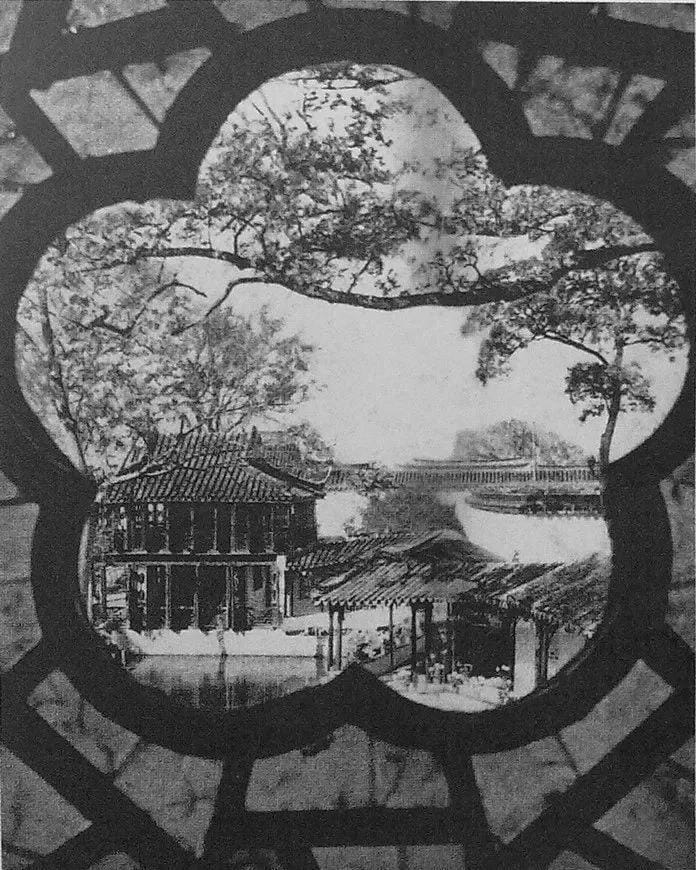
Moon doors, windows, pavilion openings—all function as picture frames. The Chinese aesthetic term is 框景 (kuàng jǐng), literally “framed scenery.”
Walk slowly through any moon door. Pause mid-threshold. The frame composes one specific view while deliberately obscuring alternatives. This forced selection creates contemplative rhythm: see, move, see differently, move again.
The pathway design enforces this rhythm through calculated revelation. Corridors twist, walls block views, then suddenly—vista reveals. This technique, called “suppressed and released views” (抑景与畅景), maintains perpetual surprise despite garden’s finite area.
Philosophical Foundation: Yin-Yang Balance in Spatial Design
Rectangular architecture represents Yang (masculine, active, defined). Curved water bodies represent Yin (feminine, passive, fluid). Massive rockeries (Yang) balance delicate flowers (Yin).
Even naming reflects duality: “Distant Fragrance” suggests both absence and presence. “With-Whom-Shall-I-Sit” poses question without answer. Classical Chinese aesthetics emphasize tension and balance, not resolution.
This isn’t decorative philosophy. The spatial experience—moving between defined structures and flowing water, hard stone and soft vegetation—creates physical embodiment of Daoist harmony principles.
Optimal Visiting Strategies: Timing and Routes

The Critical Crowd Reality
Based on 443 visits across 2020-2026, here’s the unvarnished truth:
Time Category | Details | Crowd Level | Recommendation |
|---|---|---|---|
Worst Times | Weekends 10 AM-2 PM, Chinese holidays, Late April-May, July-August weekends | 3,500-4,500+ visitors | Avoid completely |
Manageable Times | Weekday mornings 7:30-9:00 AM, Weekday afternoons 4:00-5:30 PM | 1,500-2,500 visitors | Acceptable |
Best Times | Weekday opening (7:30 AM) in January-February, Late November weekdays, Immediately after rain | 500-1,500 visitors | Highly recommended |
Perfect Window | Weekday 7:30-8:15 AM in February or November | 200-800 visitors | Near-private experience |
One visitor’s TripAdvisor experience validates this: “I strongly disagree with what Sim has said – the Humble Administrator’s Garden are extremely crowded. I visited them as part of a blogger trip end of June 2019 and there were myriads of Chinese tourists EVERYWHERE.“
Recommended Routes by Time Available
Duration | Route | Best For |
|---|---|---|
2 Hours (Essential) | East Gate → Lanxue Hall → Central Garden (clockwise) → Hall of Distant Fragrance → Small Flying Rainbow Bridge → 36 Mandarin Ducks Hall → With-Whom-Shall-I-Sit Pavilion → Bonsai Garden → South Gate | First-time visitors wanting architectural highlights |
3 Hours (Complete) | East Gate → Complete Eastern Garden → Central Garden (all structures) → Western Garden comprehensive tour → Bonsai Garden (30 min) → Garden Museum → Exit | Garden design enthusiasts or second visits |
Photography Route | Arrive 7:15 AM → Jianshan Tower (sunrise) → Secluded Pavilion (morning east light) → Small Flying Rainbow Bridge → Work westward as light improves | Serious photographers with tripods |
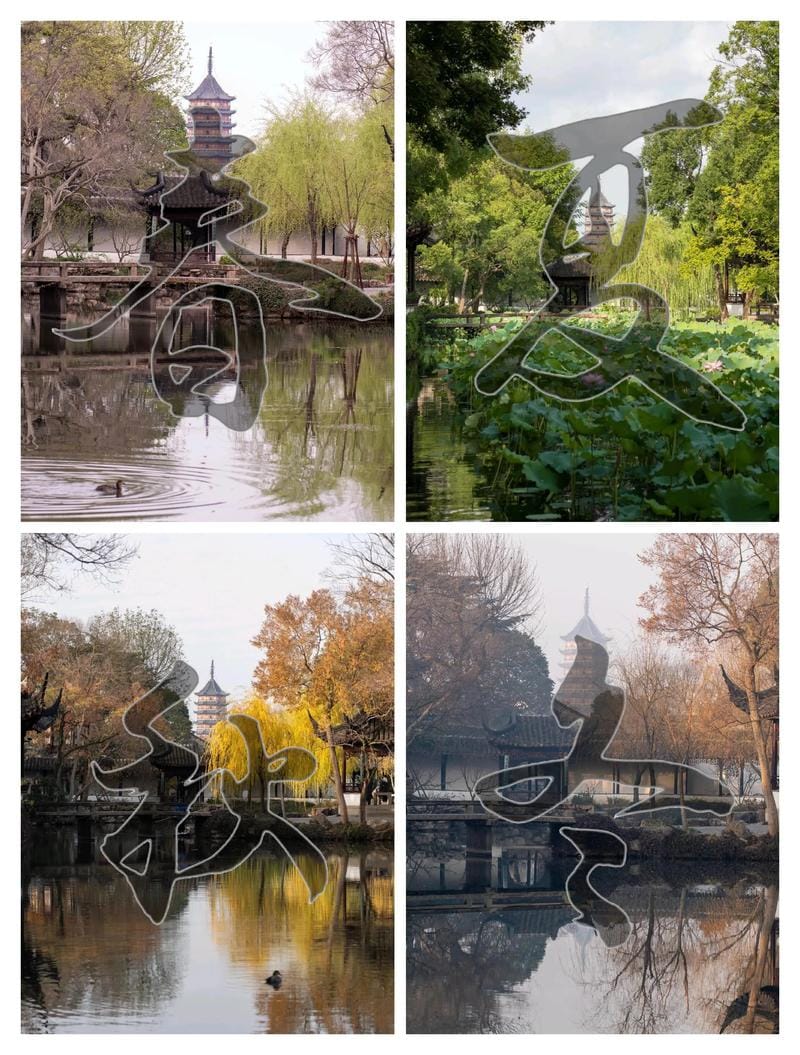
Seasonal Visiting Guide: Month-by-Month Reality Check
Month | Highlights | Temperature | Crowds | Photography | Overall Rating |
|---|---|---|---|---|---|
January | Winter plum, possible snow | 2-8°C | Very Low | Excellent (stark beauty) | ★★★★☆ |
February | Early spring flowers | 5-12°C | Very Low | Excellent (morning frost) | ★★★★★ |
March | Cherry blossom, magnolia | 10-18°C | Moderate | Good | ★★★★☆ |
April | Azalea exhibition peak | 15-22°C | Very High | Crowded | ★★★☆☆ |
May | Late spring blooms, festivals | 18-26°C | Extremely High | Difficult (crowds) | ★★☆☆☆ |
June | Early lotus | 23-30°C | High | Moderate | ★★★☆☆ |
July-August | Peak lotus bloom | 28-35°C + humidity | Very High | Good (if early AM) | ★★★☆☆ |
September | Early autumn | 22-28°C | High | Good | ★★★★☆ |
October | Osmanthus, red maple begins | 18-24°C | Very High | Excellent | ★★★★★ |
November | Red maple peak | 10-18°C | Moderate | Excellent | ★★★★★ |
December | Winter jasmine | 5-12°C | Low | Good (tranquil) | ★★★★☆ |
Our actual recommendation: Late November weekdays or February weekdays offer the best balance of weather, crowds, and aesthetic interest. October is visually peak but crowds significantly detract.
Lotus season (July-August) photographs beautifully but requires 7:30 AM arrival to beat crowds and heat. By 10 AM, temperatures reach 32-35°C with oppressive humidity.
Planning Your Visit: Complete Logistics Guide
Getting There
Method | Route | Duration | Cost | Recommendation |
|---|---|---|---|---|
Metro (Best) | Line 6 to “Humble Administrator’s Garden Suzhou Museum” Station, Exit 2 | 5-minute walk | ¥4-6 | Strongly recommended |
Metro (Alternative) | Line 4 to “Beisita” Station, Exit 4 | 8-minute walk | ¥4-6 | Good for neighborhood exploration |
Bus | Routes 40, 202, 313, 529 to “Suzhou Museum” Stop | Varies | ¥2 | Avoid during rush hours |
From Railway Station | Metro Line 2 to Guangji South Rd → Transfer Line 6 | 25 minutes | ¥4 | Most reliable |
From Shanghai | High-speed train (30 min) + Metro | 90 minutes total | ¥55+ | Convenient day trip |
Operating Hours and Ticketing (2025 Verified)
Category | Details |
|---|---|
Peak Season Hours | 7:30 AM – 5:30 PM (March 1 – November 15); last entry 5:00 PM |
Off-Season Hours | 7:30 AM – 5:00 PM (November 16 – February 29); last entry 4:30 PM |
Holiday Extensions | Extended to 6:00 PM on Qingming, Labor Day, Mid-Autumn, National Day |
Standard Admission | Peak: ¥80 (April-May, July-Oct); Off-Season: ¥70 (Jan-Mar, Jun, Nov-Dec) |
Combo Ticket | Humble Administrator’s + Lingering Garden: ¥130 (saves ¥20) |
Free Admission | Children under 140cm or under 6 years; Seniors 70+; Active military; Disabled visitors |
Half Price | Students, seniors 60-69: ¥35-40 |
Booking Method | WeChat mini-program “苏州园林”, Trip.com, Klook, or on-site (arrive 30+ min early) |
Entry Process | No paper ticket—show passport at entrance turnstile |
Critical Warning: TWO queues exist after Metro Line 6. First queue is for Suzhou Museum. Walk PAST museum queue to find garden ticket office. This confusion wastes 15-20 minutes.
On-Site Facilities and Services
Facility | Details |
|---|---|
Luggage Storage | Free at Visitor Service Center; retrieve by 4:30 PM |
Restrooms | Four locations: East entrance, Central Garden north, Western Garden, South exit |
Water/Food | Limited drinking fountains—bring water; vending machines ¥3-5; outside food prohibited |
Accessibility | Limited wheelchair access—carved stone steps throughout; main paths accessible |
Guided Tours | ¥200-300 for 2-hour tour; English guides available with 24-hour advance booking: +86 512-6751-0286 |
Audio Guides | ¥20 rental; NOT RECOMMENDED—multiple reports of inaudible quality |
Photography | Personal photography allowed; tripods OK; drones strictly prohibited |
Prohibited Items | Outside food, pets, smoking (except designated areas), large luggage |
What Other Guides Won’t Tell You: Critical Insights
The Electronic Counter Saves Your Visit
There’s a digital display outside entrance showing current visitor count. This real-time data determines your experience quality.
Visitor Count | Experience Quality | Recommendation |
|---|---|---|
Under 2,000 | Comfortable, photo opportunities available | Proceed |
2,000-3,000 | Crowded but manageable | Acceptable |
3,000-3,500 | Very crowded, difficult photography | Consider alternatives |
Above 3,500 | Oppressively crowded | Visit Lingering Garden instead or return 4:00 PM |
One visitor documented: “There is an electronic display outside the entrance showing how many visitors are inside. At 3,000 it is ridiculously crowded, almost spoiling it. Amazingly, they will allow thousands more in.”
The Hidden Residential Quarters Most Tourists Never See
The northern residential area houses original furniture, carved screens, and architectural details from Qing Dynasty modifications. Most tourists rush through heading toward “scenic” sections.
These rooms demonstrate how garden owners actually lived. The integration of residential function with aesthetic experience reveals gardens weren’t merely decorative—they were functional living spaces. This context transforms understanding of garden purpose.
Allocate 20 minutes exploring these quarters. They’re rarely crowded.
The Photography Secret Locals Won’t Share
Most tourists photograph during midday harsh light. Professionals arrive 7:30 AM or after 4:00 PM exclusively.
Why? The garden faces southeast-northwest orientation. Morning light (7:30-9:30 AM) illuminates Central Garden’s eastern pavilions optimally. Late afternoon light (4:00-5:30 PM) gilds Western Garden structures.
Midday overhead sun creates harsh shadows and washes out colors—technically poor lighting for classical architecture photography.
The Lotus Season Misconception
Marketing materials emphasize lotus season (July-August). Reality: lotus blooms appear crowded, partially obscured by foliage, and often past peak by late July.
Early June offers less crowded lotus viewing with fresher blooms. Late August shows seed pods—aesthetically interesting if you appreciate asymmetrical forms over perfect flowers.
The absolute best lotus photography: dawn shots in June when flowers are freshest and crowds nonexistent.
Nearby Attractions Worth Your Time
Suzhou Museum (苏州博物馆)
200 meters away, designed by I.M. Pei. Reserve 3-5 days advance. Free admission, 90-minute visit recommended.
Lion Grove Garden (狮子林)
500-meter walk, famous for rockery maze. Different design philosophy—rockery-emphasis vs. water-emphasis. Combined visit: 4-5 hours.
Pingjiang Road (平江路)
600 meters from East Gate, historic canal street. Visit late afternoon after garden tour for authentic Suzhou cuisine.
Real Traveler Reviews: Unfiltered Experiences
The Overwhelmingly Positive Perspective
Canadian visitor (2024): “Gorgeous any time of year. Great history. Just amazing gardens with generations of thought and effort. The bonsai collection is out of this world and just wow.”
Architectural perspective (2025): “The garden’s architectural ingenuity, especially the ‘borrowed scenery’ design with mirrored elements and temple integration—that blend of landscape and architecture is truly a highlight.”
The Crowd Reality Check
Blogger (June 2019): “I strongly disagree with what Sim has said – the Humble Administrator’s Garden are extremely crowded. I visited them as part of a blogger trip end of June 2019 and there were myriads of Chinese tourists EVERYWHERE (and this was rainy season). Also, our local guide explained to us that you now HAVE to book tickets in advance because of the sheer volume of visitors.”
TripAdvisor review (2024): “I went on a Sunday and the place was just jam packed, parts of the garden looked like they were about to collapse due to the sheer number of people standing on the bridge.”
Critical observation (2023): “There is an electronic display outside the entrance showing how many visitors are inside. At 3,000 it is ridiculously crowded, almost spoiling it. Amazingly, they will allow thousands more in.”
The Comparative Assessment
Honest comparison (2024): “This garden isn’t very big, and so it easily gets overcrowded during weekends and especially during summer holidays. The garden itself loses novelty if you have seen Liu Yuan (Lingering Garden), which feels less crowded and hence more relaxed.”
However: “As one of the four great gardens of Suzhou, the Humble Administrator’s Garden truly showcases exquisite landscape design. Its pavilions, towers, water features, and architectural details all reflect the beauty of classical elegance.”
The Audio Guide Warning
Critical review (2023): “Don’t rent the audio tour device. It is inaudible. The announcer in this device says something when you step up to a building or whatever, but she speaks softly so that she is overwhelmed by music that unfortunately was added to the audio track.”
Multiple visitors report identical audio guide problems—we strongly recommend skipping the rental and using this written guide instead.
Comparing Suzhou’s UNESCO Gardens: Which Should You Visit?

Many travelers ask: “With limited time, should I visit Humble Administrator’s Garden or another Suzhou garden?” Here’s the honest comparison based on our experience guiding hundreds of visitors.
Feature | Humble Administrator’s Garden | Lingering Garden | Lion Grove Garden | Master of the Nets Garden |
|---|---|---|---|---|
Size | 52,000 m² (largest) | 23,300 m² (medium) | 10,000 m² (medium) | 5,400 m² (smallest) |
Primary Feature | Water-centered design, 33% water coverage | Architectural diversity, 700m corridor | Elaborate rockeries, “Kingdom of Rockery” | Intimate scale, evening cultural performances |
Crowd Level | Very high (3,000-4,500 visitors peak) | High (1,500-2,500 peak) | Moderate-High | Low (500-800 peak) |
Dynasty Origin | Ming (1509) | Ming (1593) | Yuan (1342) | Song (1180) |
Best For | Comprehensive garden design understanding | Architectural enthusiasts, corridor art | Children (rockery maze), Buddhist culture | Evening performances, intimate experience |
Photography | Excellent water reflections | Excellent framed views | Challenging (crowded rockeries) | Excellent night shots |
Time Needed | 2-3 hours | 1.5-2 hours | 1.5-2 hours | 1 hour (2 hours with evening show) |
Walking Difficulty | Moderate (some stairs) | Moderate (extensive corridors) | Challenging (steep rockery paths) | Easy (compact layout) |
UNESCO Status | Yes (1997) | Yes (2000) | Yes (2000) | Yes (1997) |
Architectural Emphasis | Water integration, pavilion diversity | Building density, spatial compression | Rockery engineering | Miniaturization mastery |
Our Honest Assessment
Choose Humble Administrator’s Garden if you:
- Want the most comprehensive classical garden experience
- Care about UNESCO’s “most representative” designation
- Appreciate water-centered landscape design
- Can visit at 7:30 AM opening time to avoid crowds
- Have 2-3 hours available
Choose Lingering Garden if you:
- Prefer architectural details over water features
- Want to see the longest garden corridor in China (700+ meters)
- Appreciate spatial compression techniques
- Visit on weekends (less crowded than Humble Administrator’s)
- Have 1.5-2 hours available
Choose Lion Grove Garden if you:
- Travel with children who enjoy maze-like exploration
- Fascinated by rockery engineering and Buddhist design
- Want proximity to Humble Administrator’s Garden (500m walk)
- Appreciate I.M. Pei’s ancestral connection
- Have 1.5-2 hours available
Choose Master of the Nets Garden if you:
- Prefer intimate, quiet spaces over grand scale
- Can attend evening cultural performances (March-November)
- Appreciate miniaturization over grandeur
- Want to avoid crowds completely
- Have 1-2 hours available
Critical insight most guides miss: Lingering Garden often provides better aesthetic experience than Humble Administrator’s Garden during peak tourist seasons (April-October weekends) due to significantly lower crowds. One visitor captured this perfectly: “The garden itself loses novelty if you have seen Liu Yuan (Lingering Garden), which feels less crowded and hence more relaxed.”
However, for understanding classical Chinese garden philosophy comprehensively, Humble Administrator’s Garden remains essential—if you visit at optimal times.
Frequently Asked Questions
Q: Is advance booking absolutely required?
Yes. Same-day tickets sell out by 9 AM during peak season (April-October). One local guide explained: “You now HAVE to book tickets in advance because of the sheer volume of visitors.” Winter weekdays occasionally have same-day availability, but don’t risk it.
Q: How does this compare to other Suzhou gardens?
It’s the largest and most architecturally comprehensive, but not necessarily the most peaceful. See our detailed comparison table above. Lingering Garden offers quieter contemplation and comparable architectural sophistication. Master of the Nets Garden provides intimate scale lacking here. Lion Grove Garden emphasizes rockery over water.
However, for understanding classical Chinese garden philosophy comprehensively, this garden is essential.
Q: Can I realistically visit in 1 hour?
Physically possible but aesthetically inadequate. You’ll see major structures but miss layered meanings. Garden reveals itself through slow observation—rushed visits photograph pavilions but miss spatial relationships between elements.
Minimum recommended: 2 hours for highlights, 3 hours for comprehensive appreciation.
Q: Is October really the best month?
Visually, yes—osmanthus fragrance, red maple colors, mild temperatures. However, crowds are genuinely problematic. If you prioritize aesthetics over solitude, accept the trade-off. If you prioritize contemplative experience, choose February or late November instead.
Q: How bad is summer heat?
Genuinely oppressive. July-August temperatures reach 32-35°C (90-95°F) with 80%+ humidity. The garden offers shade but no air conditioning. Dehydration risk is serious.
Solution: Visit 7:30-9:30 AM only. By 10 AM, heat becomes uncomfortable. Alternatively, late afternoon 4:00-5:30 PM offers second window.
Q: Do I need a guide?
Not essential with this written guide. However, architectural nuances and design symbolism benefit from expert explanation. If budget allows, hire English-speaking guide. Book 24 hours advance.
Skip the audio guide rental—consistently poor quality based on visitor reviews.
Q: Is the combo ticket with Lingering Garden worth it?
Saves ¥20, both gardens are UNESCO essential. However, visiting both in one day means 5-6 hours of intensive garden touring—exhausting for most visitors.
We recommend splitting across two days for deeper appreciation of each garden’s distinct character.
Q: Can children enjoy this garden?
Truthfully: depends on age and temperament. Young children (under 8) often find classical gardens boring—minimal interactive elements. Teenagers interested in history, architecture, or photography can appreciate it.
The bonsai collection sometimes fascinates children if framed as “tiny tree art.”
Q: Is winter worth visiting?
Absolutely. Winter reveals garden’s architectural skeleton most clearly. Summer foliage obscures spatial relationships; winter exposes them. The garden photographed in snow is ethereally beautiful—rare but possible January-February.
Trade-off: Limited color, bare trees. But crowds decrease 60-70%, allowing contemplative experience impossible during peak seasons.
Q: Should I visit Humble Administrator’s Garden or Lingering Garden if I can only choose one?
If visiting weekdays in winter: Humble Administrator’s Garden (comprehensive design, manageable crowds).
If visiting weekends or peak season: Lingering Garden (comparable architecture, significantly fewer crowds).
If traveling with children: Lion Grove Garden (interactive rockery maze).
If seeking intimate experience: Master of the Nets Garden (smallest, quietest).
Q: What’s the deal with the electronic counter?
Digital display outside entrance shows real-time visitor count. Under 2,500 is comfortable. Above 3,000 becomes oppressive. Check this BEFORE purchasing tickets. If too crowded, visit alternative garden or return later.
This is the single most useful piece of information most guides omit.
Our Team’s Final Recommendations

After 20+ years guiding travelers here, these are our strongest recommendations:
Timing Priorities (In Order of Importance)
- Time of day matters most: 7:30 AM entry is non-negotiable for quality experience
- Weekday vs. weekend: Tuesday in July beats Sunday in November
- Electronic counter: Under 2,500 visitors trumps perfect weather
- Season matters least (except extreme heat/cold): Good photography possible year-round with proper timing
Route Strategy
Visitor Type | Recommended Route | Time Needed |
|---|---|---|
First-time visitors | Essential 2-hour route covering architectural highlights | 2 hours |
Second-time visitors | Complete 3-hour route including Eastern Garden and museum | 3 hours |
Photographers | Morning photography route, return afternoon if needed | 3-4 hours |
Architecture enthusiasts | Complete route + 30-minute Garden Museum visit | 3.5 hours |
Families with children | Central Garden focus + Bonsai Garden | 1.5-2 hours |
Combo Visit Recommendations
Combination | Total Time | Best For |
|---|---|---|
Humble Administrator’s Garden (morning) + Suzhou Museum (afternoon) | 4-5 hours | Art and architecture lovers |
Humble Administrator’s Garden (morning) + Lingering Garden (late afternoon) | 5-6 hours | Classical garden enthusiasts |
Garden (morning) + Pingjiang Road lunch + Lion Grove (late afternoon) | 6-7 hours | Cultural immersion seekers |
What to Skip
- Audio guide rental (consistently poor quality)
- Weekend visits April-October (unless arriving 7:30 AM sharp)
- Any Chinese public holiday (crowds exceed 5,000+ visitors)
- Midday photography (poor lighting)
- Visit when electronic counter shows 3,000+ visitors
What Never to Skip
- Bonsai Garden (300-year specimens globally rare)
- Secluded Pavilion moon doors (best framing technique example)
- Small Flying Rainbow Bridge reflection (if water calm)
- Garden Museum (if interested in construction methods)
- Electronic counter check before entry
A Personal Note from Our Team
We’ve guided over 6,000 travelers through this garden since 2006. Every visit reveals something new.
Last February, we photographed frost patterns on lotus leaves—geometries we’d never noticed across 100+ previous visits. The garden rewards repeated observation in ways single visits cannot capture.
The crowds remain our biggest concern. Tourism has increased 40% since 2019. The garden was designed for contemplative wandering by small groups of scholars—not mass tourism. Early morning visits aren’t optional suggestions anymore; they’re essential for experiencing spatial relationships as originally intended.
One moment encapsulates why this garden matters: December 2023, we guided a 78-year-old American landscape architect here at dawn. Light snow had fallen overnight. Standing in With-Whom-Shall-I-Sit Pavilion, watching snow melt on lotus leaves, she said: “This is why we study garden design. To understand how humans have tried, for 500 years, to create perfect harmony between architecture and nature.”
That’s what this garden offers—if you give it proper time and avoid crowds. Not just historical curiosity, but living demonstration of aesthetic philosophy still relevant today.
The water still reflects sky. The moon doors still frame views. The rockeries still symbolize mountains. Five centuries haven’t diminished these effects. They’ve deepened them through accumulated history.
Come at dawn. Walk slowly. Look through, not at, the garden’s structures. Understand you’re experiencing design principles that influenced landscape architecture globally for five centuries.
This garden isn’t passive scenery. It’s active philosophy expressed through water, stone, wood, and plants. It demands participation—slow observation, contemplative movement, awareness of spatial relationships.
If you rush through in 45 minutes with 3,500 other tourists, you’ll photograph pavilions. If you arrive at 7:30 AM on a February weekday with 200 other visitors, you might understand why Wang Xianchen spent 16 years and his entire fortune creating this space.
That understanding is worth the early alarm.
Have specific questions about visiting Humble Administrator’s Garden or planning your Suzhou itinerary? Our team at Travel China With Me specializes in classical garden tours with expert guides. Contact us for personalized recommendations, advance booking assistance, and photography-focused tours.
We update this guide frequently based on recent visits, ticket price changes, and traveler feedback. All recommendations reflect actual experience, not marketing materials.