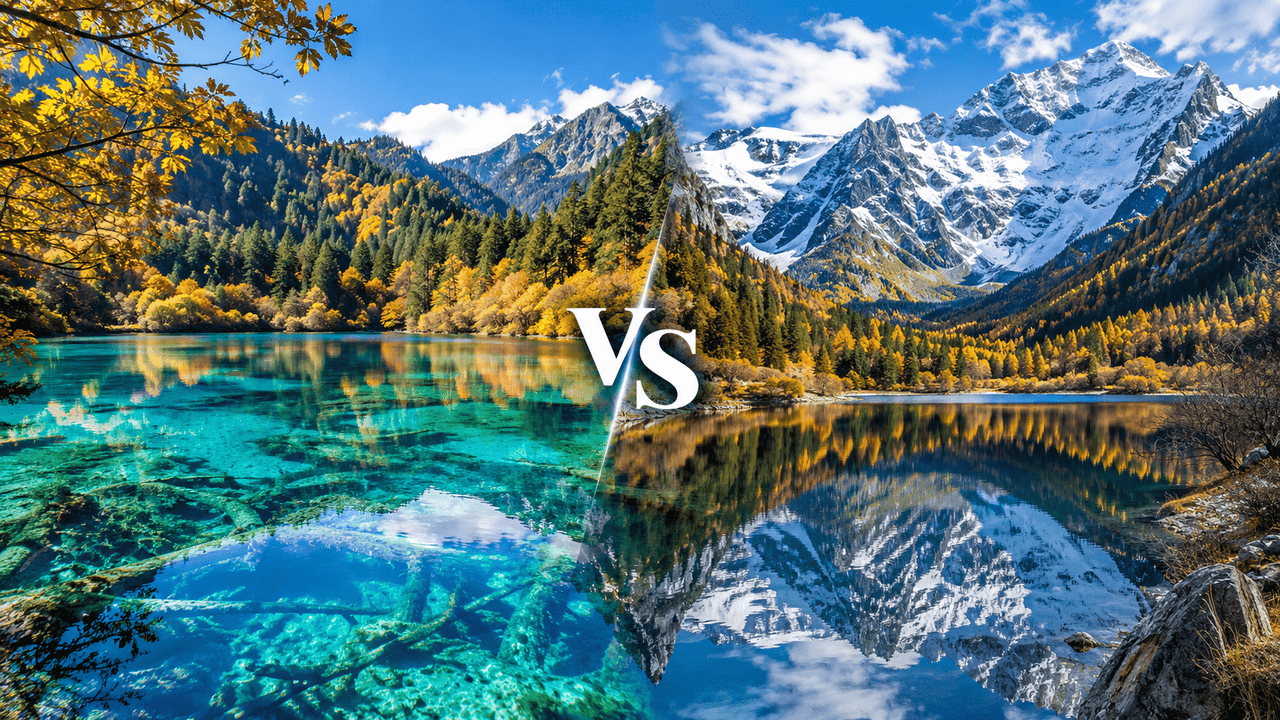
Jiuzhaigou vs Bipenggou: Which Should You Visit?
If you can only visit one, choose Jiuzhaigou — it’s the UNESCO-listed valley with lake color nothing else in China matches. Choose Bipenggou instead only if it already sits on a route through Mount Siguniang or Wolong; it isn’t worth a dedicated detour on its own.
We’ve been running tours through both valleys since 2006, and this is the same Jiuzhaigou vs Bipenggou question we get from clients every planning season. Jiuzhaigou is 330–350 km northeast of Chengdu; Bipenggou is 198–220 km northwest. They’re not two versions of the same trip — opposite directions, different scale, scenery that doesn’t overlap.
Jiuzhaigou | Bipenggou | |
|---|---|---|
Type | 3-valley UNESCO park, colored lakes & waterfalls | Single glacial valley, snow peaks & alpine lakes |
Distance from Chengdu | 330–350 km (NE) | 198–220 km (NW) |
Drive time | 4–5 hrs (was 7–9 before a 2025 highway upgrade) | 2.5–3.5 hrs, mostly expressway |
Time needed | 1–2 full days | Half day to 1 full day |
Peak-season ticket | ¥280 (¥190 entry + ¥90 bus) | ¥190 (¥70 entry + ¥60 bus + ¥60 cart) |
Altitude range | 2,000–3,101 m | 2,000–3,900 m |
Table of Contents
1. Jiuzhaigou vs Bipenggou: What’s Different
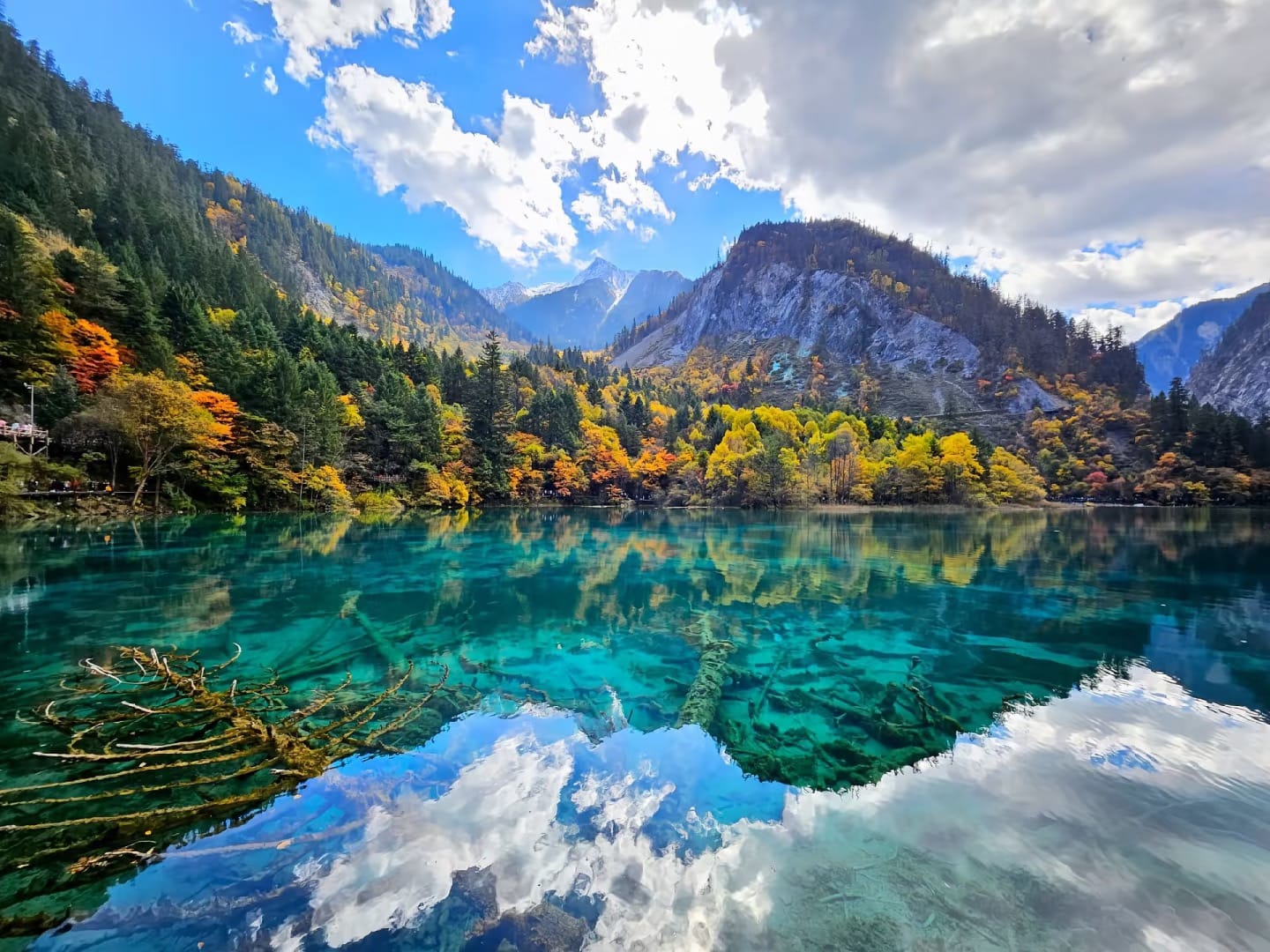
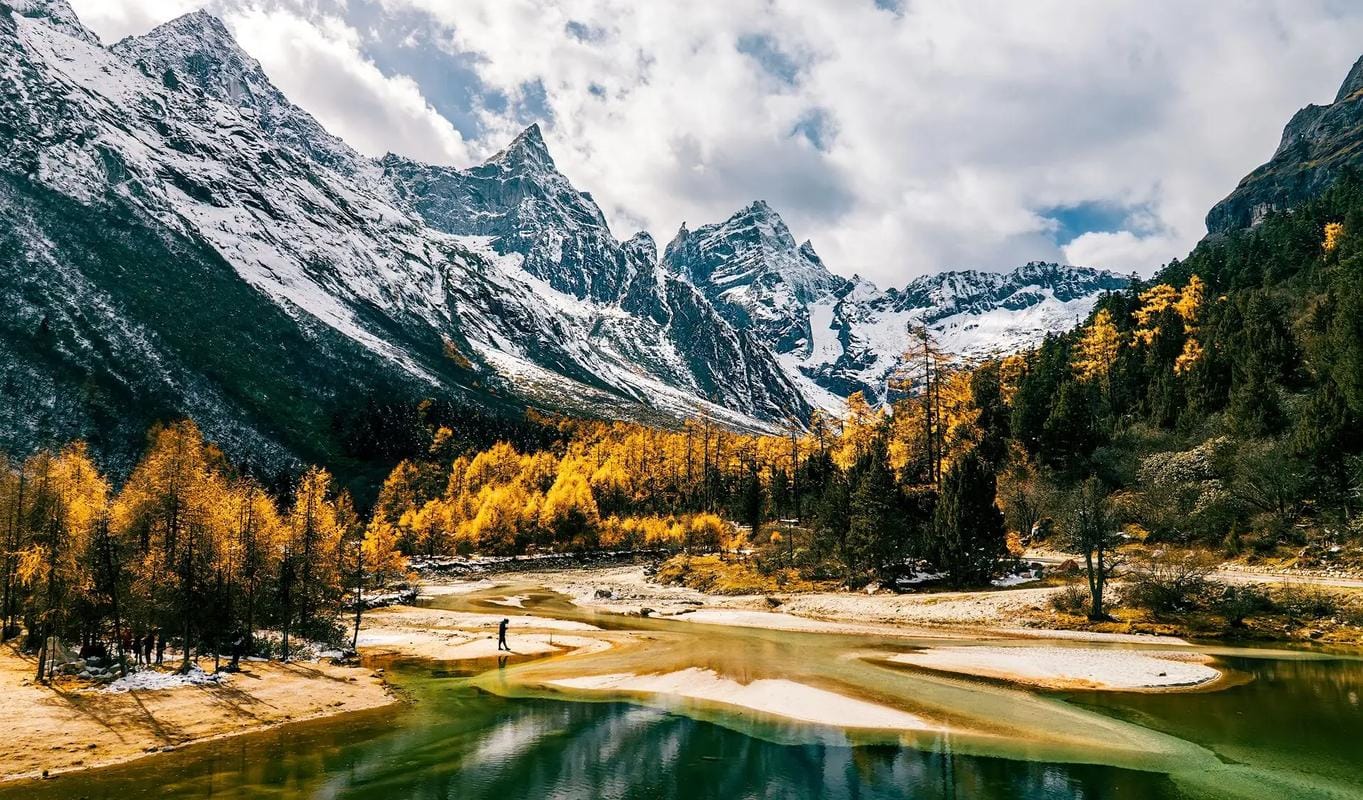
Search “Jiuzhaigou or Bipenggou” and what comes back is TikTok clips and a couple of Facebook Group threads with no answer in them. We see the same Jiuzhaigou vs Bipenggou question in our own inbox — the comparison doesn’t resolve cleanly, because the two places aren’t competing for the same slot in your itinerary.
Why people mix them up
Jiuzhaigou is about the water. Bipenggou is about the mountains. Jiuzhaigou is a destination. Bipenggou is a side trip with a name recognizable enough to be mistaken for one. Some of that comes from Bipenggou’s own marketing, which uses “Little Switzerland” and “the beautiful back of Siguniang” language that implies a scale it doesn’t have.
How different the scale actually is
Jiuzhaigou | Bipenggou | |
|---|---|---|
Layout | 3 branching valleys | 1 road, out-and-back |
Area / length | 45 km round trip | |
Elevation gain | 2,000 → 3,101 m | 2,000 → 3,900 m |
With those numbers, “which one is better” isn’t the useful question. “Does Bipenggou fit what I’m already doing” is.
2. Distance From Chengdu
Opposite directions from Chengdu. This is why most plans to combine them don’t work.
Jiuzhaigou pairs naturally with Huanglong, 110–144 km further along the same northeastern corridor — see our Jiuzhaigou vs Huanglong comparison if you’re weighing that leg too.
Bipenggou pairs naturally with Mount Siguniang and Wolong Panda Reserve, all within about two hours of each other on the northwestern side.
The two clusters don’t touch: the ~330 km between Jiuzhaigou and Bipenggou runs through mountain terrain with no direct connecting road, so getting from one to the other means routing back through Chengdu.
By road
Bipenggou is road-only — no rail link at all — but the road is mostly expressway, 2.5–3.5 hours.
Jiuzhaigou’s drive time is shorter than most guides suggest. A new expressway connecting Chengdu to Jiuzhaigou County finished in late 2025, cutting the drive from roughly 8 hours to 4–5. Sichuan’s official transport authority confirmed the new travel time when the road opened. If you’re seeing 7–9 hours quoted anywhere, that’s the pre-2025 number.
By rail
Jiuzhaigou also has an option Bipenggou doesn’t: the high-speed line to Huanglongjiuzhai Station, 1 hour 39 minutes from Chengdu East at its fastest, plus a roughly 2-hour transfer bus to the park gate — call it 3.5–4 hours door-to-door once you add the connection. It won’t beat driving on the new expressway, but we still book it for clients who get carsick on mountain roads — it’s worth the transfer.
If you want to see both
Not on the same leg — the two clusters described above don’t connect. On a longer trip, they work as separate stops rather than a combined route:
Trip length | Route |
|---|---|
5–6 days | Chengdu → Bipenggou (1 day) → Mount Siguniang (1–2 days) → back to Chengdu → fly or rail to Jiuzhaigou (2 days) → Huanglong |
7+ days | Same shape, with Wolong Panda Reserve or Dagu Glacier folded into the Bipenggou/Siguniang leg |
We’ve seen itineraries try to string all four — Bipenggou, Siguniang, Jiuzhaigou, Huanglong — into a single week. Every one of them ended up cutting a full day somewhere: usually Jiuzhaigou’s second day, which is the one day in the whole trip that’s hardest to shorten without losing a full valley. For most people weighing Jiuzhaigou vs Bipenggou as part of a longer trip, two separate legs beats one crowded loop. Our China tour itinerary hub has full multi-day route templates if you’re building this out from scratch.
3. Bipenggou’s Weather Gamble
Clear sky, the trip pays off. Overcast, it mostly doesn’t. This is the one risk unique to Bipenggou — Jiuzhaigou’s lakes don’t depend on the sky the same way, so this section is about Bipenggou alone.
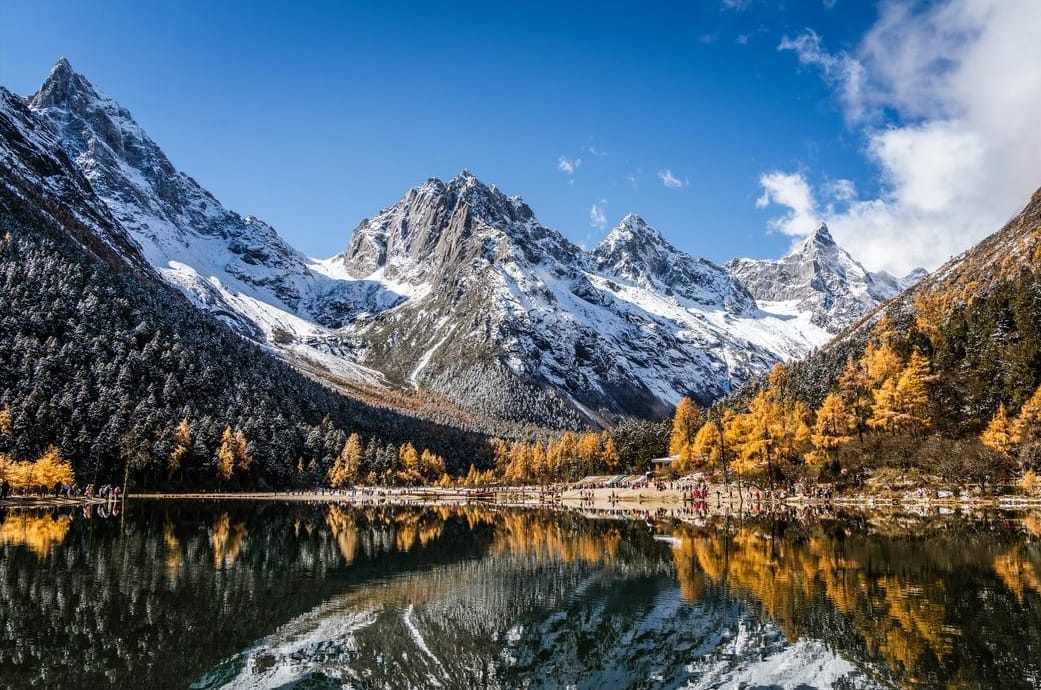
Bipenggou’s main view is Mount Siguniang’s snow-capped back face reflected in Panyang Lake at 3,676 m, water still enough to double the peak almost exactly. That reflection is the entire visual case for the trip. Our Bipenggou guide has the full stop-by-stop route.
On a clear day
This is the shot Bipenggou is known for. Morning is more reliable than afternoon — cloud tends to build over the peaks as the day warms up.
On an overcast day
The same lake is a grey pool in a grey valley. No reflection, no second act — the trip’s entire payoff depends on that one shot.
A mistake we’ve corrected: we used to assume autumn color would carry a cloudy Bipenggou day even without the reflection. It doesn’t. A group we ran in late October two years ago hit three straight overcast mornings — full color on the trees, no reflection at the lake — and stopped taking cameras out by day three. We didn’t check forecasts before confirming Bipenggou dates back then. We do now.
By August the snow at the peaks is often gone entirely too, reflection or not, so if that’s the reason you’re going, August isn’t your month regardless of weather.
4. Altitude Risk Compared
Bipenggou’s altitude risk is meaningfully higher than Jiuzhaigou’s.
The numbers
Jiuzhaigou | Bipenggou | |
|---|---|---|
Highest accessible point | 3,101 m (Long Lake) | ~3,900 m (Yanziyanwo) |
Comparable to | — | Lhasa (3,650 m) |
Time to reach peak elevation | Gradual, over a full day | ~30 min by scenic bus |
Symptoms we see regularly | Rare | Headache, breathlessness, fatigue |
Most visitors, including older travelers, feel nothing across a full day at Jiuzhaigou — the highest point, Long Lake in Zechawa Valley, tops out at 3,101 m. At Bipenggou, the climb happens faster than most bodies adjust to comfortably — every itinerary we run assumes mild symptoms at the upper stops, not hopes around them.
Who should be careful
Bipenggou gets sold as an easy Chengdu day trip — and physically, in terms of walking, it is one; the buses and carts do the climbing for you. But “easy on your legs” and “easy on your body at 3,900 m” are different claims, and the second one is false for anyone with heart, blood pressure, diabetes, or respiratory conditions. Treat the upper valley with the same seriousness you’d give an actual high-altitude destination, because that’s what it is.
5. Ticket Prices Compared
Bipenggou is cheaper at peak season, roughly on par off-season since its pricing doesn’t shift by month.
Jiuzhaigou | Bipenggou | |
|---|---|---|
Peak season | Apr 1 – Nov 15 | year-round pricing |
Entrance | ¥190 | ¥70 |
Shuttle bus | ¥90 (mandatory) | ¥60 (mandatory) |
Electric cart | — | ¥60 (two segments, effectively required to reach the top) |
Peak total | ¥280/person | ¥190/person |
Off-season | Nov 16 – Mar 31 | same year-round |
Entrance | ¥80 | ¥70 |
Off-season total | ¥160/person | ¥190/person |
Booking
Both require advance online booking through Chinese-first systems — no walk-up counters at either gate. Book both through trip.com/t/vBagSXBOsP2″>Trip.com; it’s the practical route with a foreign passport. The one detail we always confirm before travel day: both parks check the booking against the exact passport used at purchase, so a name mismatch — a common issue with couples booking under one account — can mean a rebooking at the gate instead of a quick fix.
6. Crowds During Golden Week
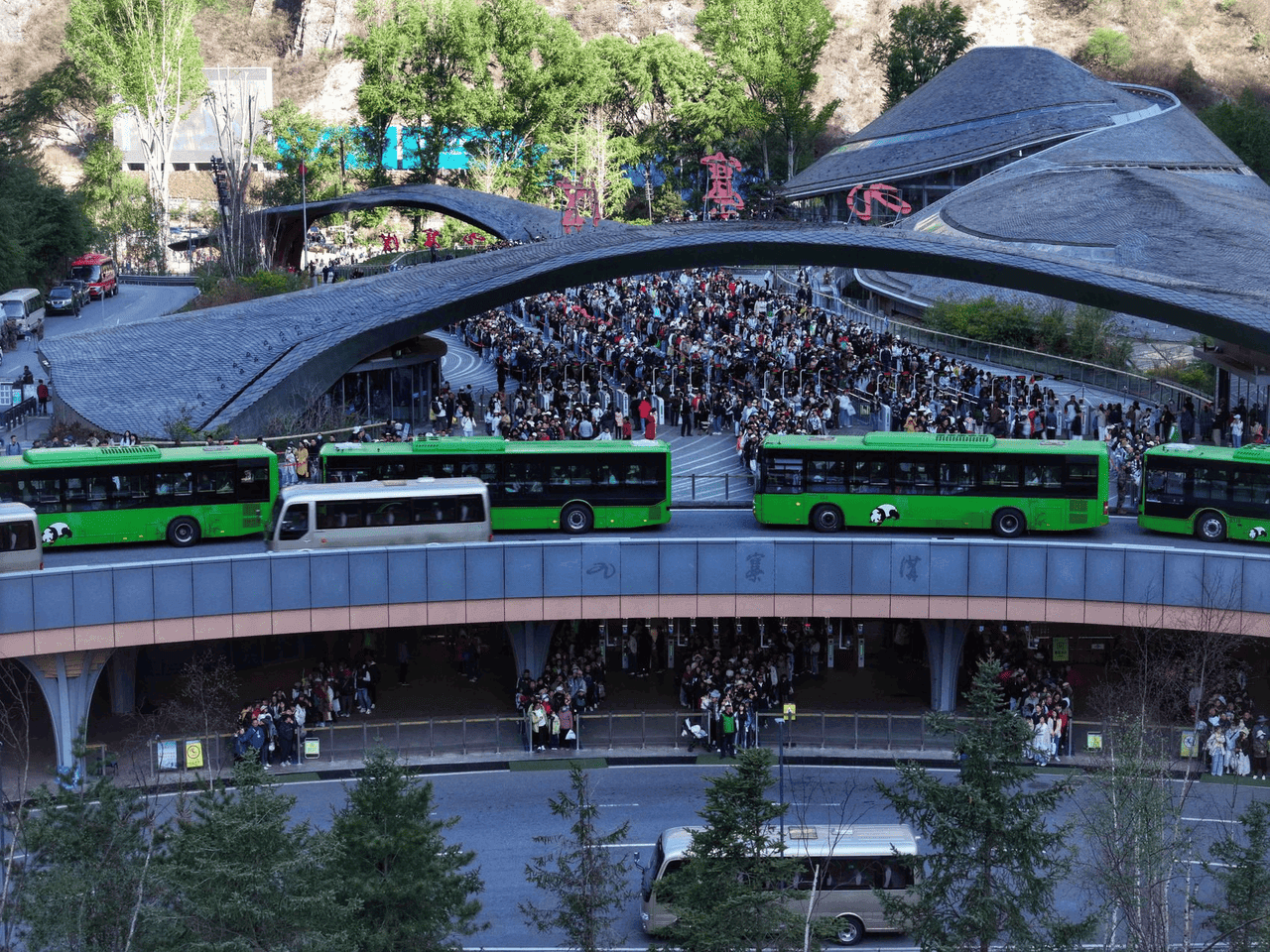
Both parks sell out fast during National Day — but Bipenggou’s single-road layout makes the crowding worse than Jiuzhaigou’s. It’s the one part of the Jiuzhaigou vs Bipenggou comparison where the smaller park is actually the harder one to navigate.
At Jiuzhaigou
Sells out fast but absorbs the crowd well.
The 41,000-person daily cap sells out fast during National Day — sometimes within hours — but the park’s own scale absorbs the crowd reasonably well. Three valleys and 720 square kilometers means peak-day visitors don’t feel as packed in as the raw numbers suggest, even though shuttle queues lengthen at the popular stops.
At Bipenggou
Sells out fast and bottlenecks badly.
It’s a single road, so every visitor funnels through the same scenic bus and the same two cart transfer points — there’s nowhere for the crowd to spread. Clients have described genuinely long waits for the return bus during National Day, one group standing over two hours in cold wind after the day’s sightseeing was already done. If a Golden Week visit is unavoidable, get there right at opening and start down before the mid-afternoon surge; that’s the only real mitigation we’ve found that works.
Our standing advice: shift either visit to late September or the back half of October and you get nearly the same foliage with a fraction of the crowd at both parks. This is the advice we give most often and the one clients ignore most often, usually because their flights are already booked around the holiday.
7. Physical Demand
Neither park requires real fitness — but altitude and temperament matter more than the walking distance suggests.
How much walking is involved
Jiuzhaigou needs almost no physical effort — standing, short boardwalk stretches between shuttle stops. Bipenggou is gentler than its altitude suggests on paper too: boardwalks and carts get you to nearly 3,900 m without a real hike.
This runs into the same altitude issue covered in Section 4 — flat terrain doesn’t make the air any thicker. A fit 30-year-old and an unfit 60-year-old breathe the same thin air at Yanziyanwo.
Who actually complains
Serious hikers and photographers are the ones who complain to us that Bipenggou’s boardwalked route feels too managed — not the older travelers you’d expect to struggle, who tend to appreciate exactly what the carts do for them. Jiuzhaigou draws the identical complaint from the identical type of traveler. If you want to set your own pace and wander off the fixed route, both parks will frustrate you the same way.
8. Jiuzhaigou vs Bipenggou: Which to Choose
As a standalone destination, Jiuzhaigou is the better choice by a wide margin. That’s the short answer to Jiuzhaigou vs Bipenggou as a pure “which is better” question.
But most people asking this question are really asking something narrower: not “which destination is better,” but “which one fits the trip I’m already planning.” That second question doesn’t have one answer — it depends on your route.
Go with Jiuzhaigou if:
- This is your one trip to northwest Sichuan
- You’re traveling with anyone who can’t safely handle a day above 3,500 m
- You want the destination people mean when they say “Sichuan lakes”
Go with Bipenggou if:
- Mount Siguniang or Wolong is already on your route
- You want one alpine day without committing two full days and a long drive
- You’ve done Jiuzhaigou before and want different scenery this time — with your dates checked against the forecast, since that’s the one condition that changes everything above
This is the same logic we walk clients through when they email us with exactly this question — the answer almost always comes down to what else is already on the route, not which park photographs better.
FAQ: Jiuzhaigou vs Bipenggou
Is Bipenggou as good as Jiuzhaigou?
Bipenggou vs Jiuzhaigou is not a comparison of equal scale. Bipenggou is a single valley covered in a day, Jiuzhaigou a three-valley park that fills one to two full days. Bipenggou’s snow-peak reflection is genuinely striking on a clear day, but Jiuzhaigou’s colored water is a larger, more reliable spectacle that most first-time Sichuan visitors should prioritize.
Can Jiuzhaigou be done as a day trip the way Bipenggou can?
Not really. Bipenggou’s single road is built for a one-day round trip from Chengdu. Jiuzhaigou’s three valleys need at least one full day just inside the park, before travel time — a same-day round trip from Chengdu would mean arriving late morning and leaving before the far valleys, missing most of what the park is known for.
Can I visit both on the same trip?
Not directly — there’s no bus route between them, and travelers who’ve asked this on forums are usually told to charter a car back to a rail station or return to Chengdu first. Most treat them as separate legs: Bipenggou with Mount Siguniang or Wolong, Jiuzhaigou with Huanglong.
Is Bipenggou worth it if I’ve already been to Jiuzhaigou?
Yes, if you want different scenery and can time it around clear weather. Bipenggou’s snow-peak reflections don’t repeat anything Jiuzhaigou offers — but if your dates are fixed and overcast, the payoff largely disappears, which isn’t true at Jiuzhaigou.
Which is easier to reach from Chengdu?
Bipenggou: 198–220 km, mostly expressway, 2.5–3.5 hours. Jiuzhaigou: 330–350 km, now 4–5 hours by road after a 2025 highway upgrade (it was 7–9 hours before), or 3.5–4 hours door-to-door by high-speed rail to Huanglongjiuzhai Station plus a transfer bus.
Does Bipenggou carry the same altitude risk as Jiuzhaigou?
No — meaningfully higher. Jiuzhaigou tops out at 3,101 m and most visitors feel nothing. Bipenggou’s core viewing area runs 3,600–3,900 m, comparable to Lhasa, reached in about 30 minutes by scenic bus.
Which is better for families with young children?
Jiuzhaigou. Its altitude is manageable for nearly all children, and the shuttle-boardwalk system requires minimal walking. Bipenggou’s upper elevation is a genuine concern for kids, whose instinct to run and play burns oxygen faster than adults account for.
Which trip costs less overall, not just the ticket?
Bipenggou. Its ¥190 ticket beats Jiuzhaigou’s ¥280, and budget lodging near the gate runs ¥100–300 a night against ¥200+ in Jiuzhaigou’s gateway town. Jiuzhaigou also usually needs a second night to cover the full park, which widens the gap further.
Which is less crowded during Golden Week?
Neither is uncrowded, but Jiuzhaigou’s scale spreads the crowd across three valleys while Bipenggou’s single road concentrates everyone at the same transfer points — visitors have reported multi-hour waits for the return bus there during National Day specifically. Late September or late October avoids the worst at both.
Weighing where Jiuzhaigou and Bipenggou fit into a western Sichuan trip? We’ve routed this exact combination for clients more times than we can count. Tell us your dates and we’ll put together a specific proposal.