Huanglong Scenic Area: The Complete Visitor Guide
Huanglong is one of the most visually striking places in China — and one of the most misunderstood. Most visitors treat it as a half-day add-on to Jiuzhaigou. We’ve been running tours through Sichuan for over 20 years, and we’ll tell you plainly: that half-day can be the highlight of a week-long trip, or it can leave you gasping for breath at 3,500 meters with a headache and no plan. This guide gives you what you need to make it the former.
Huanglong Scenic and Historic Interest Area sits in northern Sichuan’s Aba Tibetan and Qiang Autonomous Prefecture. It holds a UNESCO World Natural Heritage listing since 1992. The core attraction is a 3.6-km valley of calcite-terraced pools, waterfalls, and snowcapped peaks — unlike anything else in China.
Table of Contents
1. Quick Facts
Location | Songpan County, Aba Prefecture, Sichuan Province |
Altitude Range | 3,230 m – 3,576 m (Huanglong Valley); peaks up to 5,588 m |
UNESCO Status | World Natural Heritage Site (1992) |
Total Area | 700 sq km |
Main Valley Length | 3.6 km (boardwalk route) |
Peak Season Ticket | ¥170/person |
Low Season Ticket | ¥60/person |
Cable Car Up | ¥80/person |
Cable Car Down | ¥40/person |
Opening Hours | 8:00 – 18:00 (Apr–Oct); 9:00 – 17:30 (Nov–Mar) |
Nearest High-Speed Rail Station | Huanglong-Jiuzhai Station (~30 min by car) |
Nearest Airport | Jiuzhai Huanglong Airport (JZH, ~50 km — altitude 3,448 m) |
Best Season | Mid-October; late September; July–August for water levels |
2. Why Huanglong Is Not Just a “Side Trip”

Almost every tour package sells Huanglong as a half-day detour from Jiuzhaigou. That framing undersells it. Jiuzhaigou is about colorful lakes. Huanglong is about something different: a geological phenomenon found at this scale almost nowhere else on Earth.
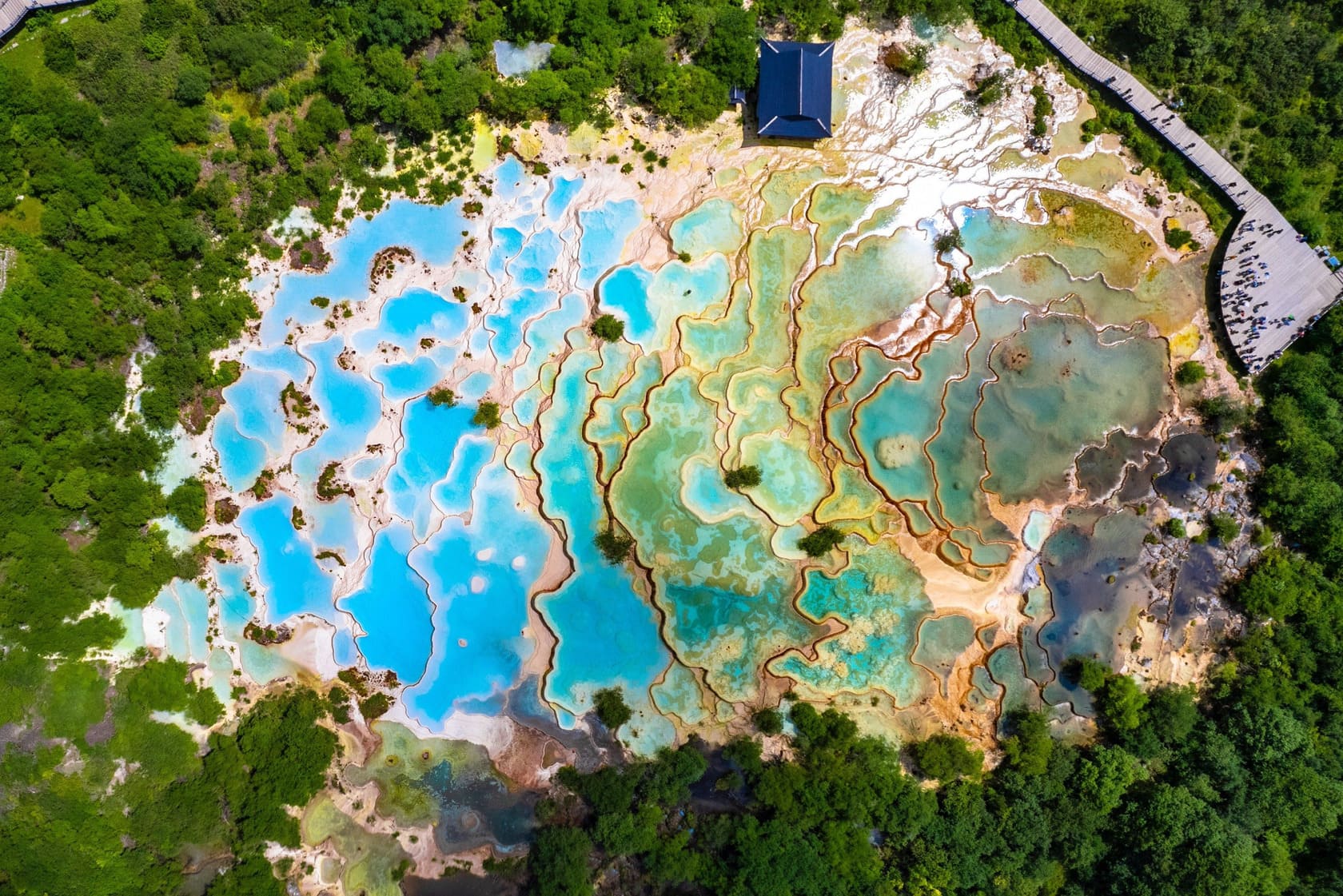
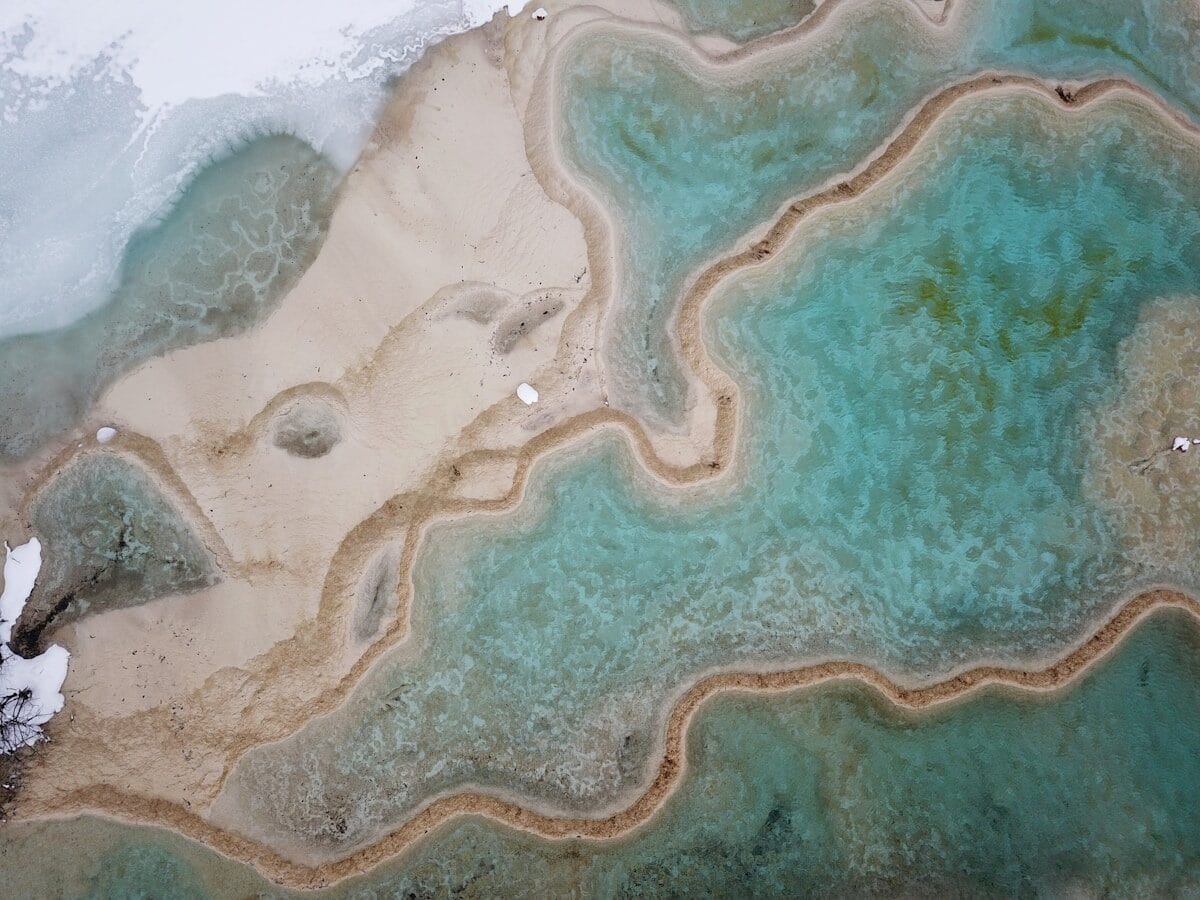
More than 3,400 calcite-terraced pools cascade down a 600-meter elevation gain inside a single valley. The water shifts through turquoise, jade-green, gold, and deep cobalt depending on season, time of day, and mineral concentration. The Chinese name means “Yellow Dragon” — look at the valley from above and you see why. A sinuous ribbon of pale gold travertine winds through dense forest, its pools like scales on a dragon’s back, ending at the Five-Color Ponds near the top, which locals liken to the dragon’s head.
What Jiuzhaigou lacks is exactly what Huanglong has: the terraced pool formations. Turkey’s Pamukkale is the closest analog worldwide, but Huanglong’s pools sit 2,000 meters higher and are embedded in old-growth forest, not an open hillside. The comparison stops working quickly once you’re there.
One thing worth knowing before you go: the travertine is under real pressure. Peer-reviewed studies published in journals including ACS Omega and Carbonates and Evaporites document that calcite deposition rates at Huanglong have fallen by 65–90% since the early 1990s, driven largely by phosphate pollution from tourism and by climate-linked changes to spring water flow. Between 2004 and 2020, six of the nine main pool clusters shrank in area. The 25,000-person daily cap and the strict no-stepping-off-boardwalk rule exist for reasons that are scientifically documented, not bureaucratic. Visit while it looks like this.
3. The “Four Wonders” — What They Look Like on the Ground
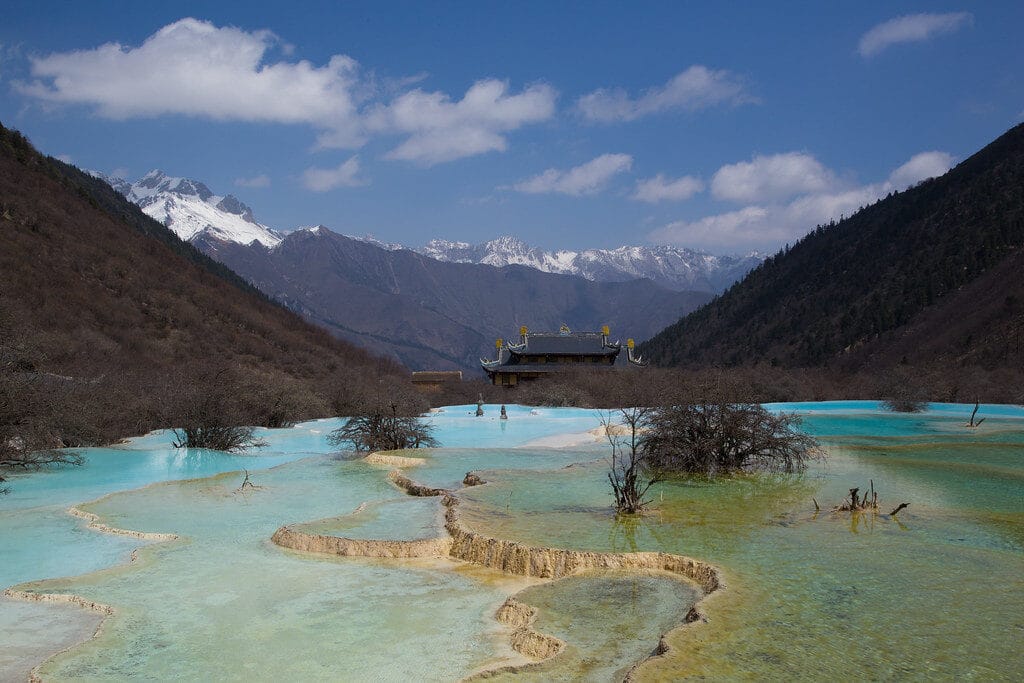
Chinese literature lists Huanglong’s “Four Wonders” as colorful ponds, snow-capped mountains, canyons, and forests. Three more get added — travertine shoals, ancient temples, and local folk customs — making a “Seven Wonders” set. This isn’t marketing language. Each represents a genuinely different layer of what you encounter on the walk.
Colorful ponds. The pools change color based on water depth and light angle. The shallowest appear bright gold from the travertine bottom. Mid-depth pools go turquoise. The deepest pools, including the Five-Color Pond at the top, hold a cobalt-blue that photographs better than it sounds. In high water (July–October) the colors are most vivid. In dry season (April–May) many lower pools are dry, but the Five-Color Pond is a year-round exception — more on that below.
Snow-capped mountains. The main peak, Xuebaoding, rises to 5,588 meters and frames the valley’s upper end. You see it clearly only from the top section. On clear autumn days, the contrast between golden larch, multicolored water, and white peaks is what people come back from and struggle to describe.
The canyons are not incidental backdrop. Danyun Gorge and the broader Minshan Mountain system create the valley’s walls, and the geology that forms the gorge is the same calcite precipitation process creating the pools below — the landscape is one continuous system, not a collection of separate attractions.
Forests. The forest here is old-growth in a way most high-altitude Chinese scenic areas are not. Fir, spruce, and birch dominate, with the floor largely undisturbed. In autumn the canopy goes amber and copper above the pools. Several boardwalk sections pass through forest so dense you can’t see more than ten meters to either side. Giant pandas and Sichuan golden snub-nosed monkeys (川金丝猴) still live here — sightings are rare, but this is live habitat, not a viewing enclosure.
4. Key Highlights Inside the Valley
Five-Color Pond (五彩池) — the Reason You’re Here
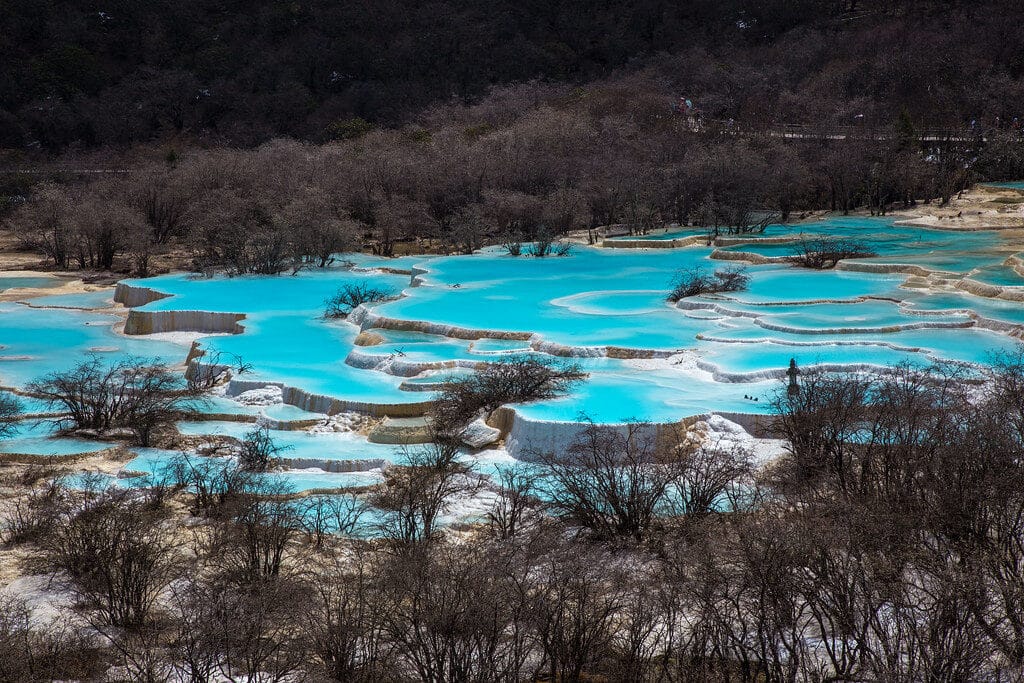
The Five-Color Pond sits at 3,576 meters at the very top of the valley. It covers 21,000 square meters across 693 individual pools — the world’s largest open-air travertine-colored pond cluster at this altitude. From the viewing platform, the pools fan out in every shade from snow-white to deep turquoise to violet-blue, arranged with the geometric precision of a rice terrace but the organic irregularity of coral.
Two paths branch off just before the temple and rejoin at the main viewing platform. The left path runs alongside the pools at ground level and gives you a close, saturated view of the water — colors appear more intense from here. The right path climbs slightly higher and delivers a panoramic view looking down across the full pond system. Both take roughly the same time. Go up on the left, come down on the right. You get the immersive pool experience on the way up and the aerial perspective on the return.
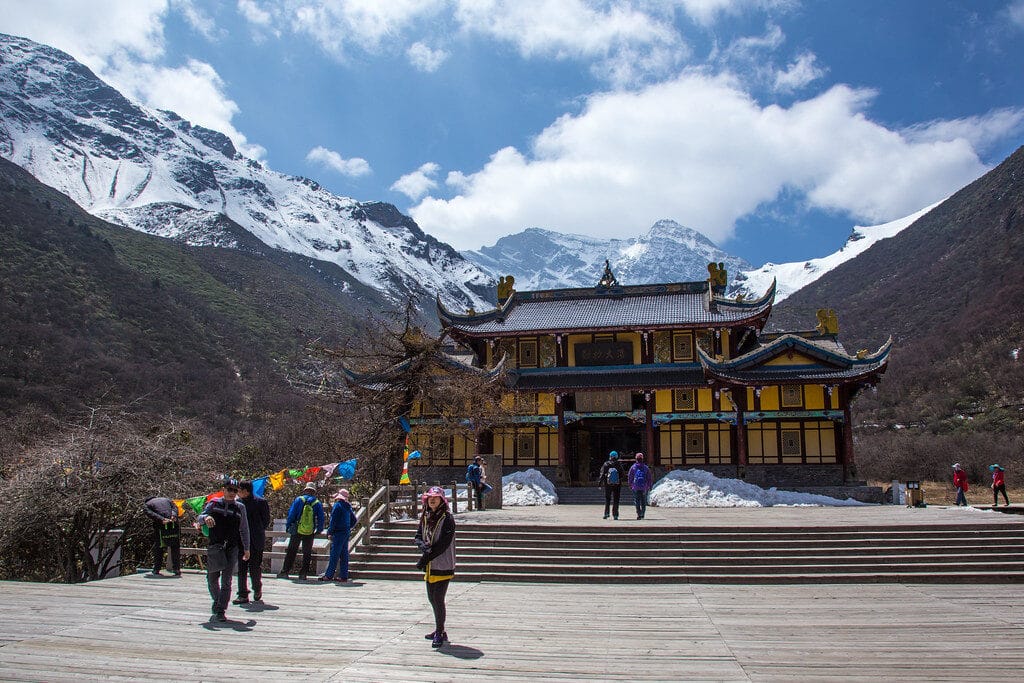
At the pond’s edge stands Huanglong Ancient Temple, built in the Ming Dynasty. The temple blends Taoist and Tibetan Buddhist elements, reflecting the dual cultural heritage of the Tibetan and Qiang peoples who consider Xuebaoding a sacred mountain. Each summer — on the 15th day of the sixth lunar month — thousands of Tibetan and Qiang pilgrims climb here in traditional dress for the Huanglong Temple Fair. It’s a genuine cultural event, nothing to do with tourism, and worth planning around if you happen to be in the area in July.
Most visitors arrive at the Five-Color Pond and feel the altitude for the first time — a brief dizziness, the heartbeat quickening for no reason. Sit down at the platform edge and give yourself ten minutes before taking any photos. The light is better for it, and so is everything else.
Yingbin Pool (迎宾池) — the Opening Statement
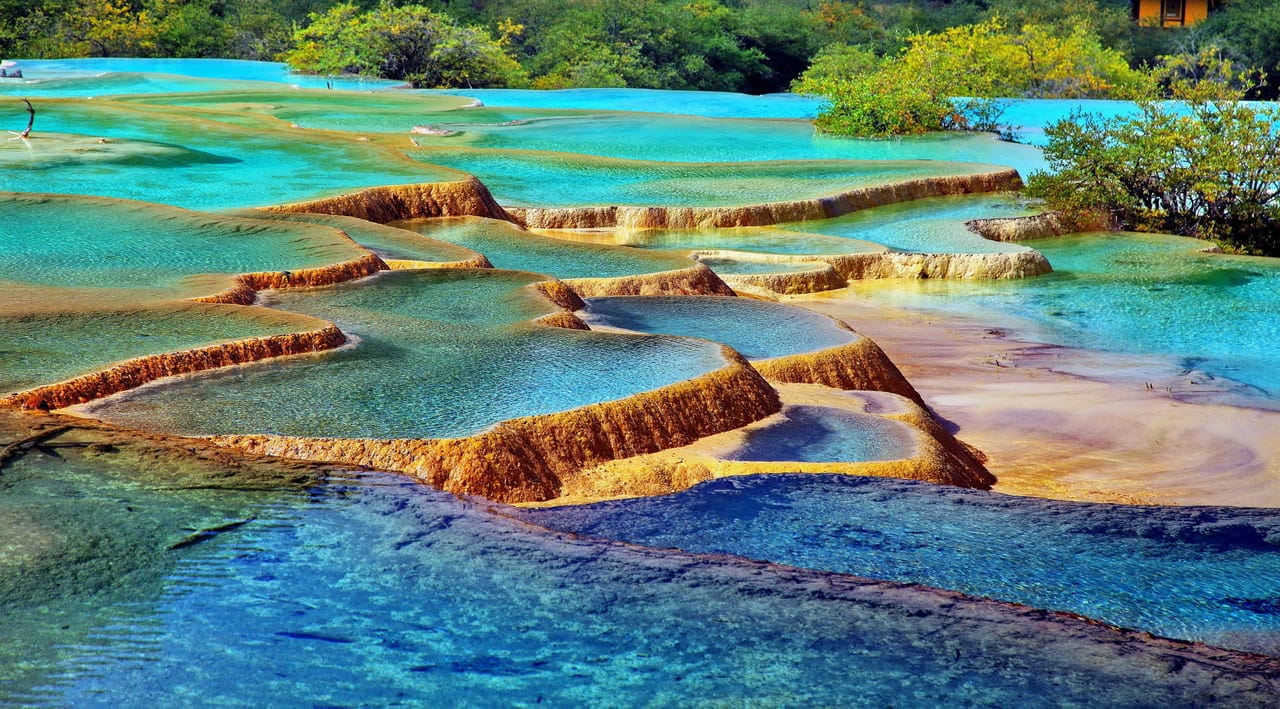
The Welcome Pool near the valley entrance is a cluster of 350 small pools stacked into each other, the water spilling from one level to the next in a continuous murmur. The travertine here is bright gold. In morning light with mist still in the valley, this is where most photographers set up first. Don’t rush past it.
Flying Waterfall (飞瀑流辉) and Lotus Waterfall (莲台飞瀑)
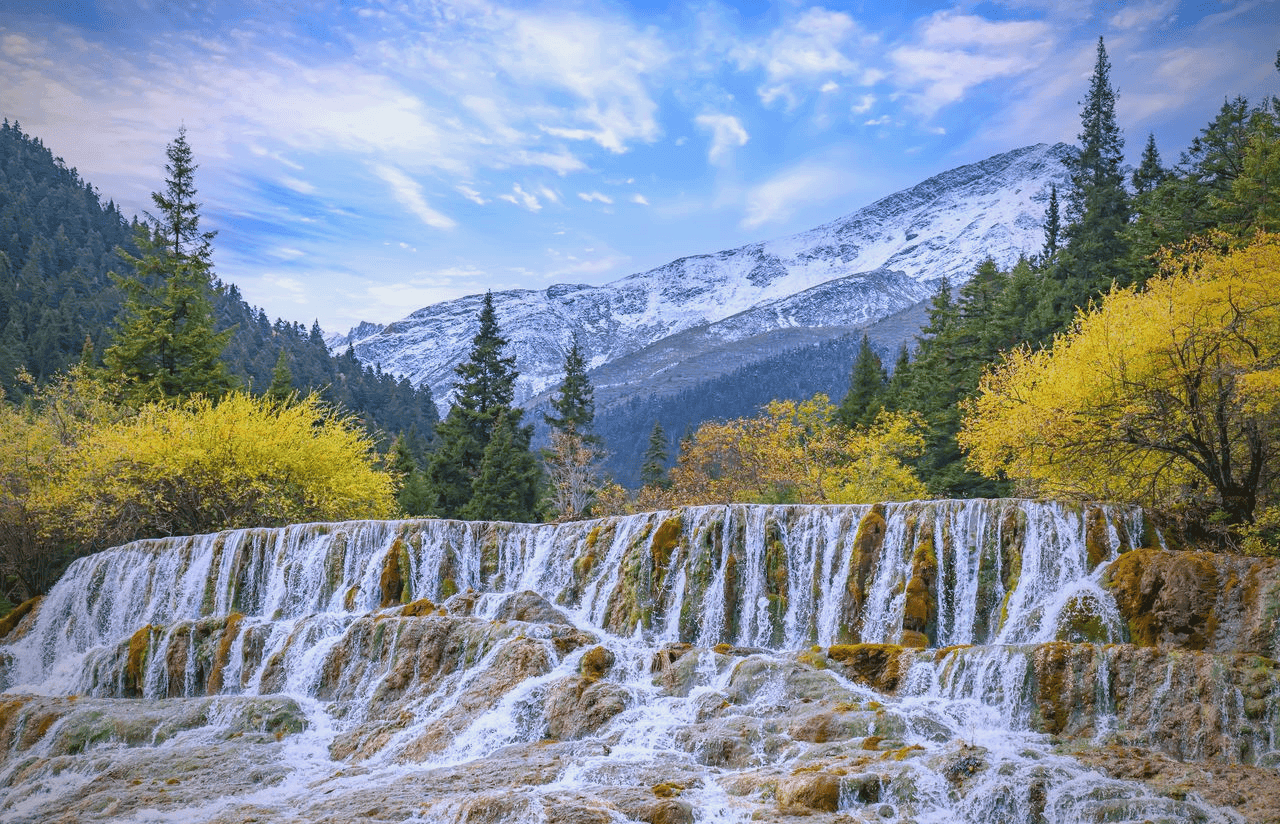
The Flying Waterfall drops across a tiered yellow travertine slope just minutes from the Welcome Pool. In good water levels, dozens of separate cascades fan out across the slope simultaneously, catching light in ways that make the spray appear to glow. The Lotus Waterfall — 167 meters long — drops over a slope shaped like a lotus throne. Both are at their best in August and September when water volume peaks.
Xishen Cave (洗身洞) — “Washing Body Cave”
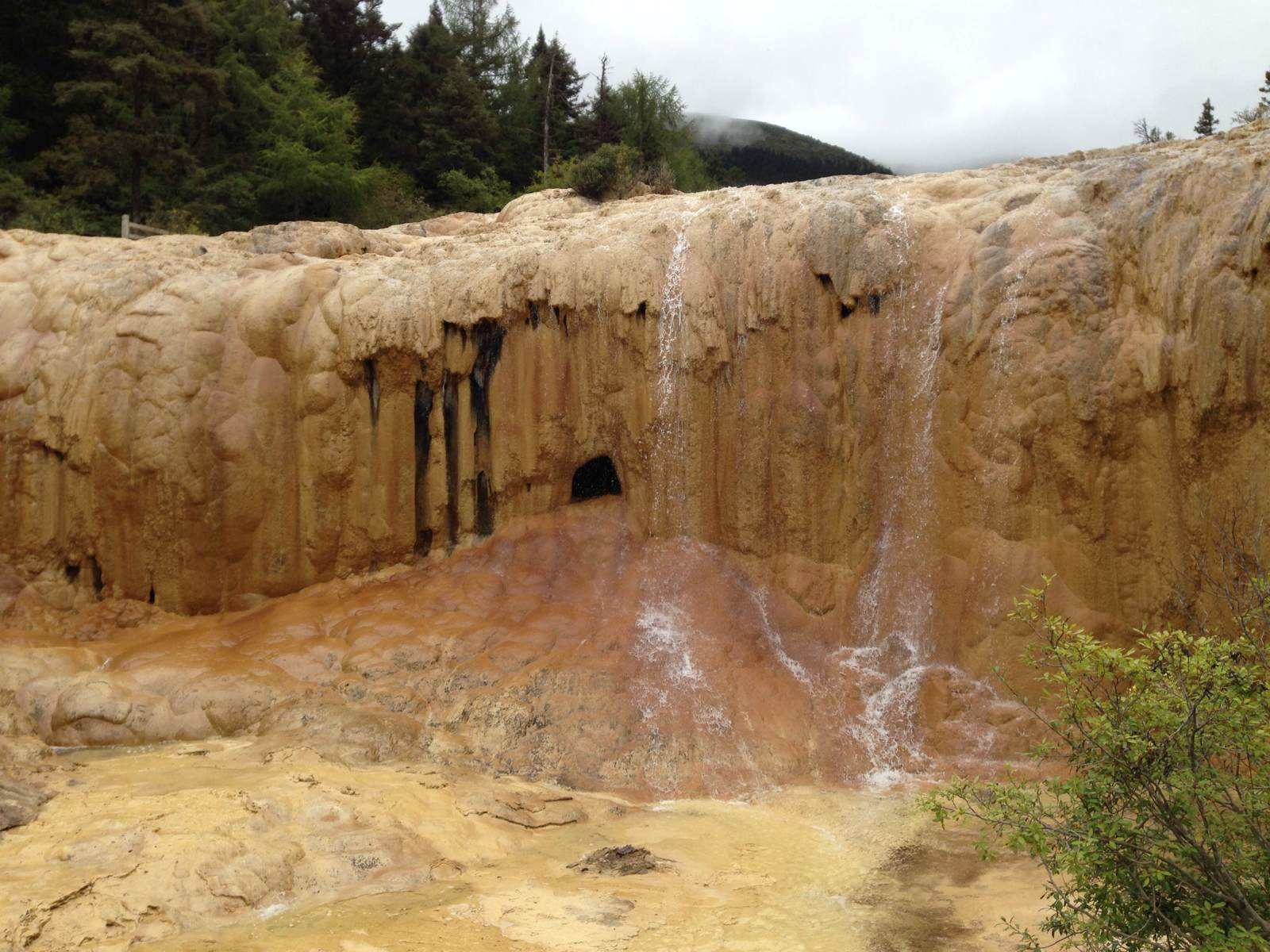
Partway up the valley, water streams off the cave ceiling in a thin curtain across the path. Local legend holds that walking through the water purifies the body — pilgrims traditionally pass through it on the climb to the temple. In practice it is one of the more intimate moments of the walk, where the boardwalk narrows and the forest closes in from both sides. Most visitors experience it as a moment of unexpected quiet.
Bonsai Pond (盆景池)
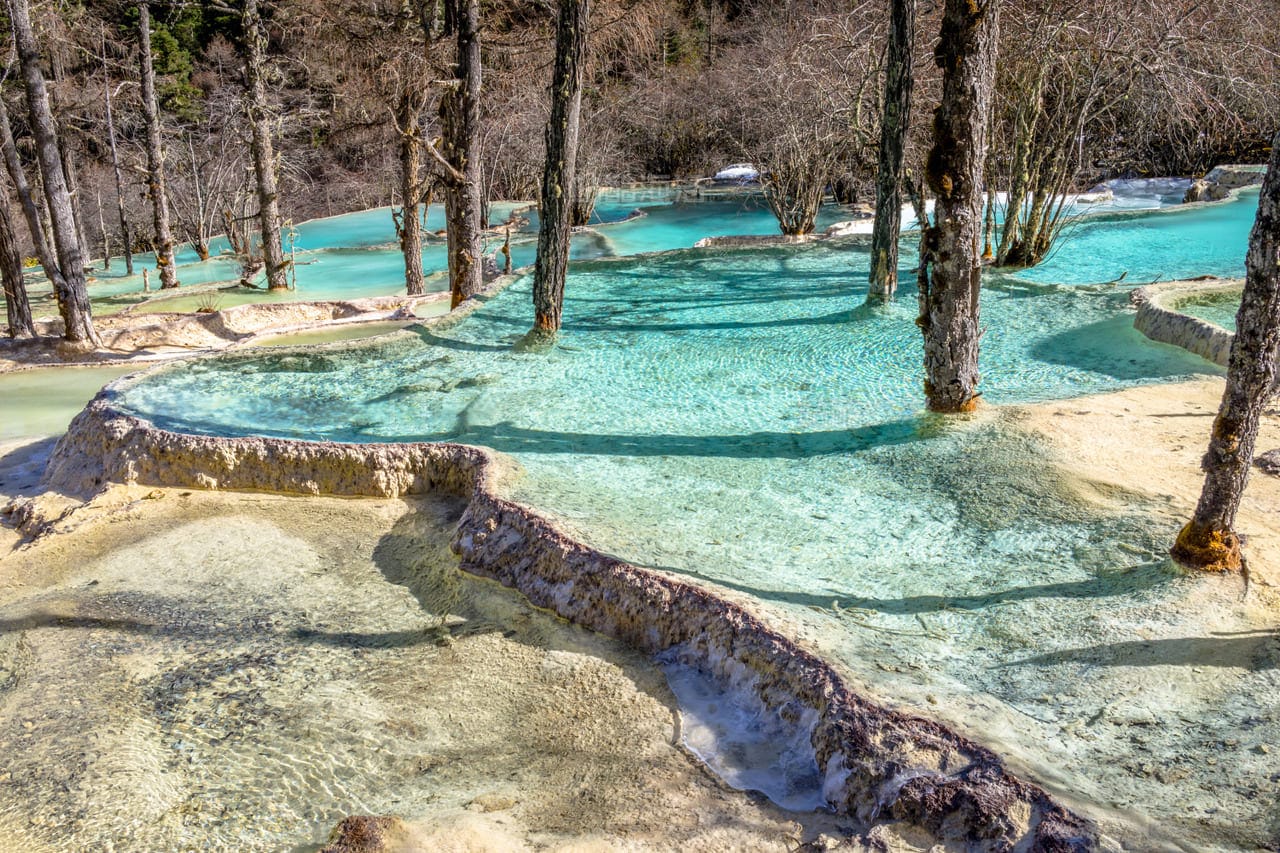
The Bonsai Pond earns its name from the small trees and shrubs that grow directly from the travertine formations between the pools — their roots embedded in calcite, trunks twisted into compact shapes by altitude and wind. It looks precisely like a traditional Chinese penjing garden placed in the middle of a waterfall. The effect is too unlikely to photograph convincingly. You need to stand there.
Jinsha Pudi (金沙铺地) — “Golden Sand Spreading the Ground”
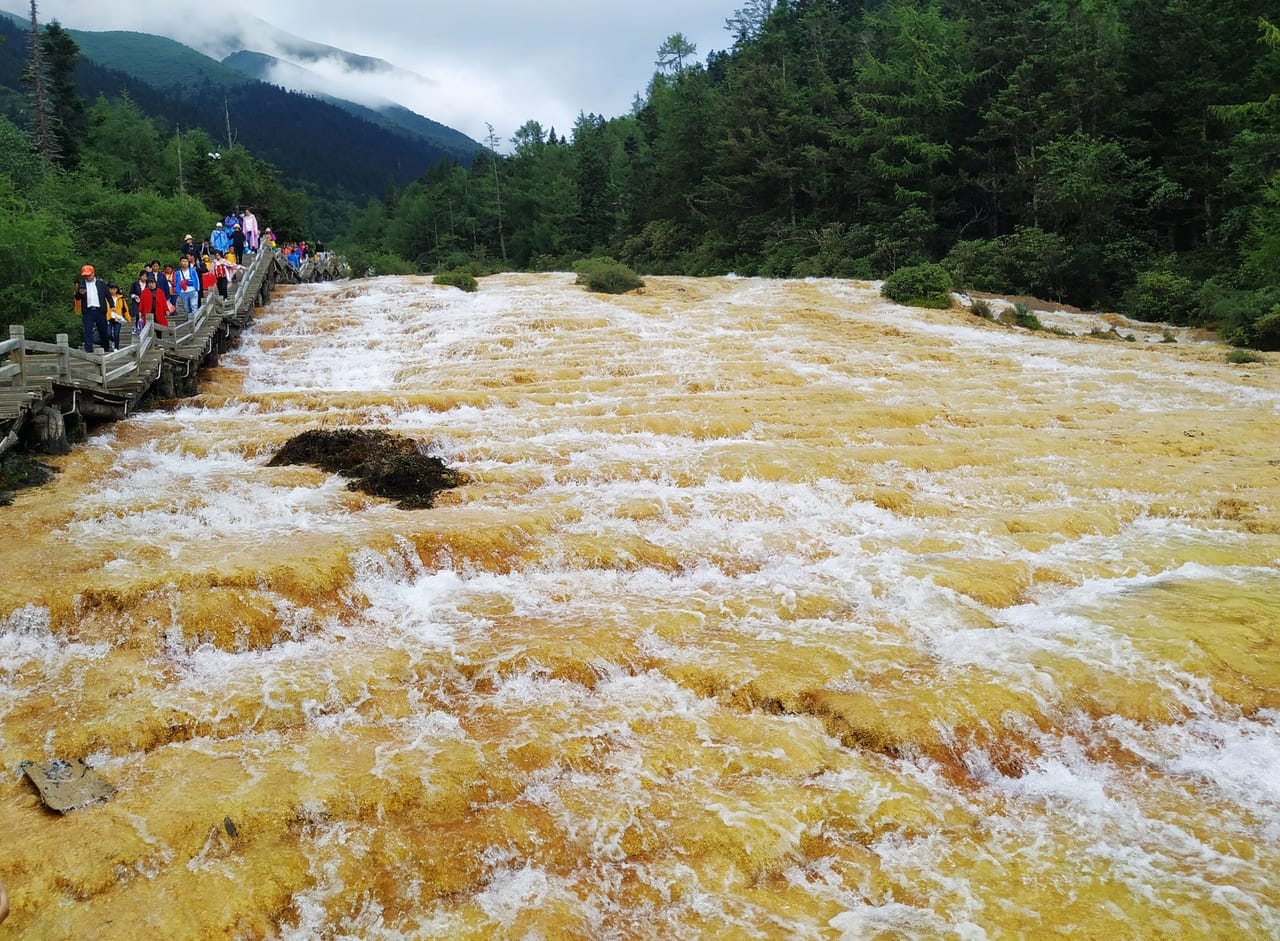
A broad, flat expanse of travertine with a thin layer of clear water flowing across it. The calcite bottom glows gold in sunlight. Adults stop here longer than they plan to.
Lianyan Lake (潋滟湖)
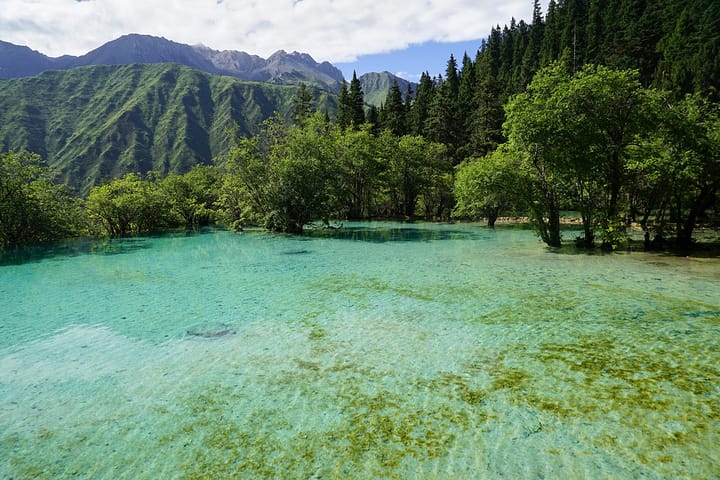
At 3,251 meters, Lianyan Lake is the only true lake inside Huanglong Valley, covering just over 2,000 square meters. On calm mornings the surrounding fir trees reflect off the surface so cleanly that the image reads as a second, upside-down forest. Most visitors walk past without realizing what they’re looking at. It deserves five minutes.
Competing Glamour Pools (争艳彩池)
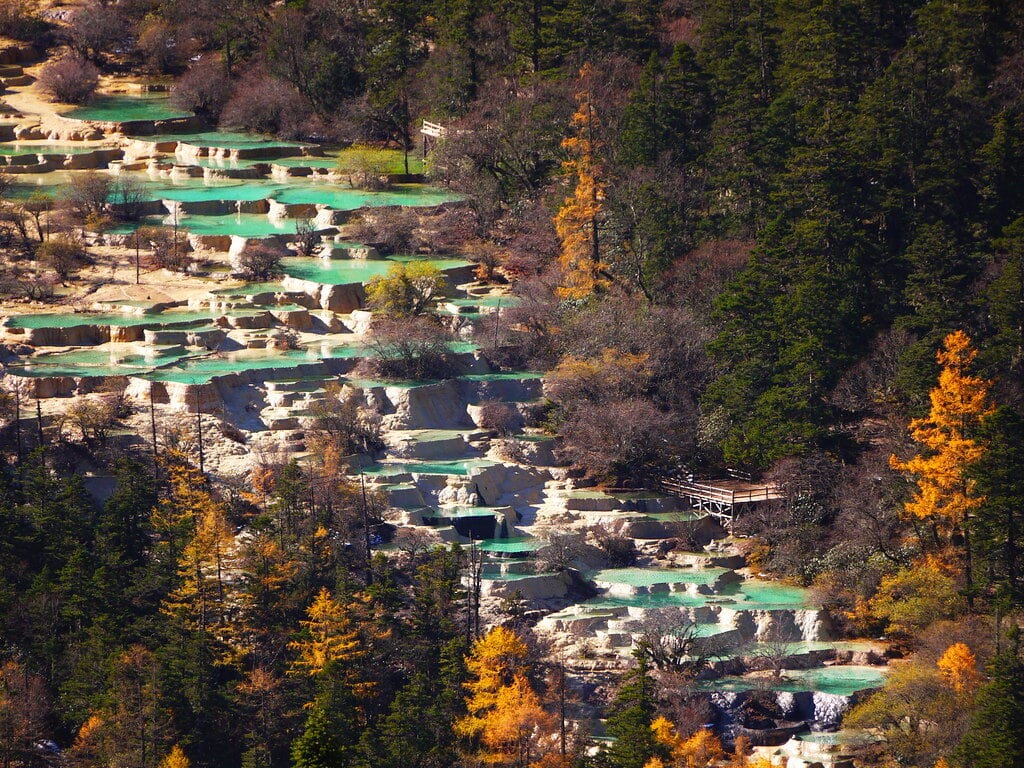
About halfway up, these pools form one of the densest concentrations of multi-colored terraces. Each pool varies slightly from its neighbor — the mineral concentration and depth conspiring to make every step reveal a different shade. This is where the dragon’s “scales” metaphor becomes obvious.
5. What’s Different About Huanglong in Each Season
One of the questions we get most often: should I visit in autumn or summer? The honest answer depends on what you want to see and your altitude tolerance.
Scores are relative indicators from 20+ years guiding at Huanglong. Avoid October 1–7 (Golden Week) regardless of scores shown.
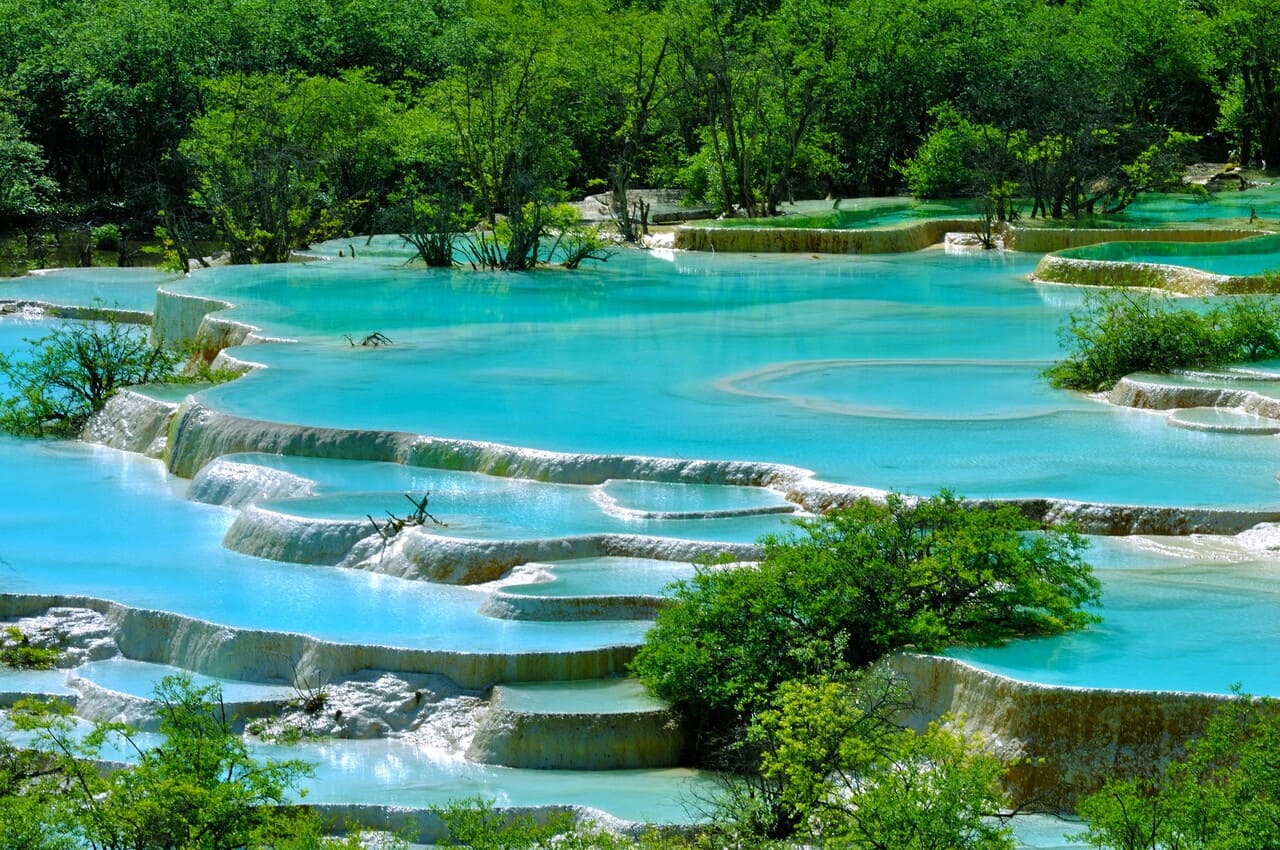
Summer (July–August): Water levels peak. Every pool is full. The colors are vivid. The downside is crowds — Chinese school holiday season — and daily afternoon rain. Flash flood warnings occasionally close the access road. The forest is deep green. Best time for the pools if you can accept the volume of visitors. Wear a light long-sleeved shirt, a fleece layer, and a waterproof jacket. Shorts are fine at the entrance but cold by the Five-Color Pond.
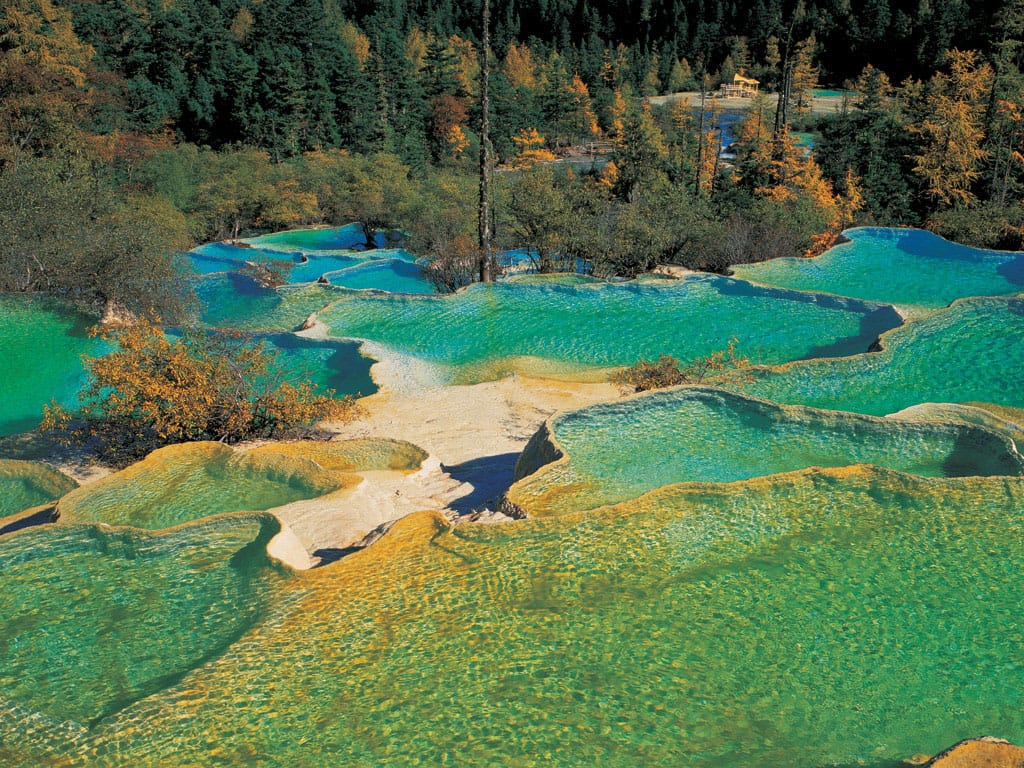
Autumn (September–October): September holds summer water levels but with thinning crowds. Mid-to-late October is the peak for the forest — larch turns amber, birch goes gold. The pools are still full in early October but falling by late October. The combination of autumn foliage and colored water is the image most Huanglong photographs capture. For overall experience, mid-October is our strongest recommendation — but avoid Golden Week (October 1–7) without exception. The park becomes unmanageable that week. Dress like mountain hiking in 5–10°C: down jacket or thick fleece, windproof layer, warm hat. The first frosts can arrive in late October.
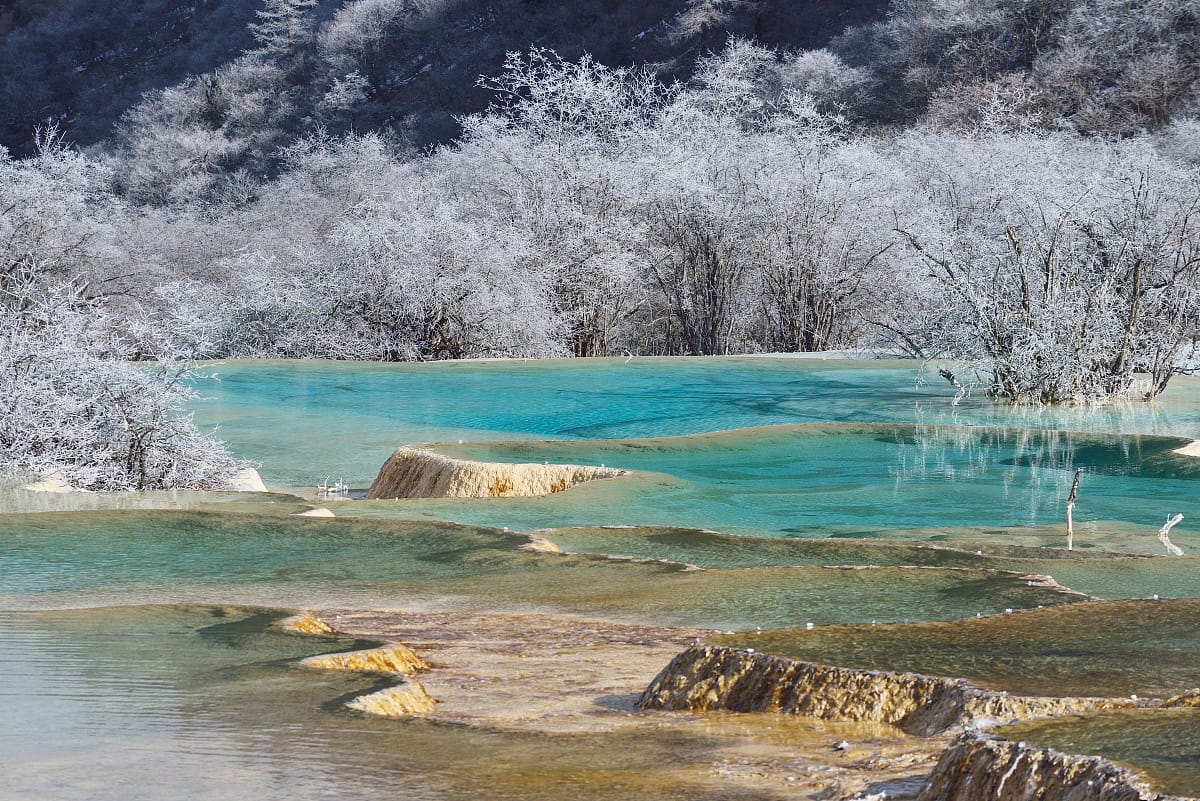
Spring (April–May): Dry season for the lower pools. Many travertine formations are exposed, which has its own stark beauty. Alpine azaleas bloom along the uphill route. What most guides don’t tell you: in April, the Five-Color Pond shifts to its most concentrated color of the year — a deep Tiffany blue that’s actually more intense than in summer, precisely because the reduced water volume increases mineral density. If the Five-Color Pond is your primary goal, April is underrated. The rest of the valley is quieter and costs ¥110 less in admission. Dress similarly to autumn, with one addition: residual snow on the upper boardwalk is likely, so waterproof hiking boots are worth it over trail runners.
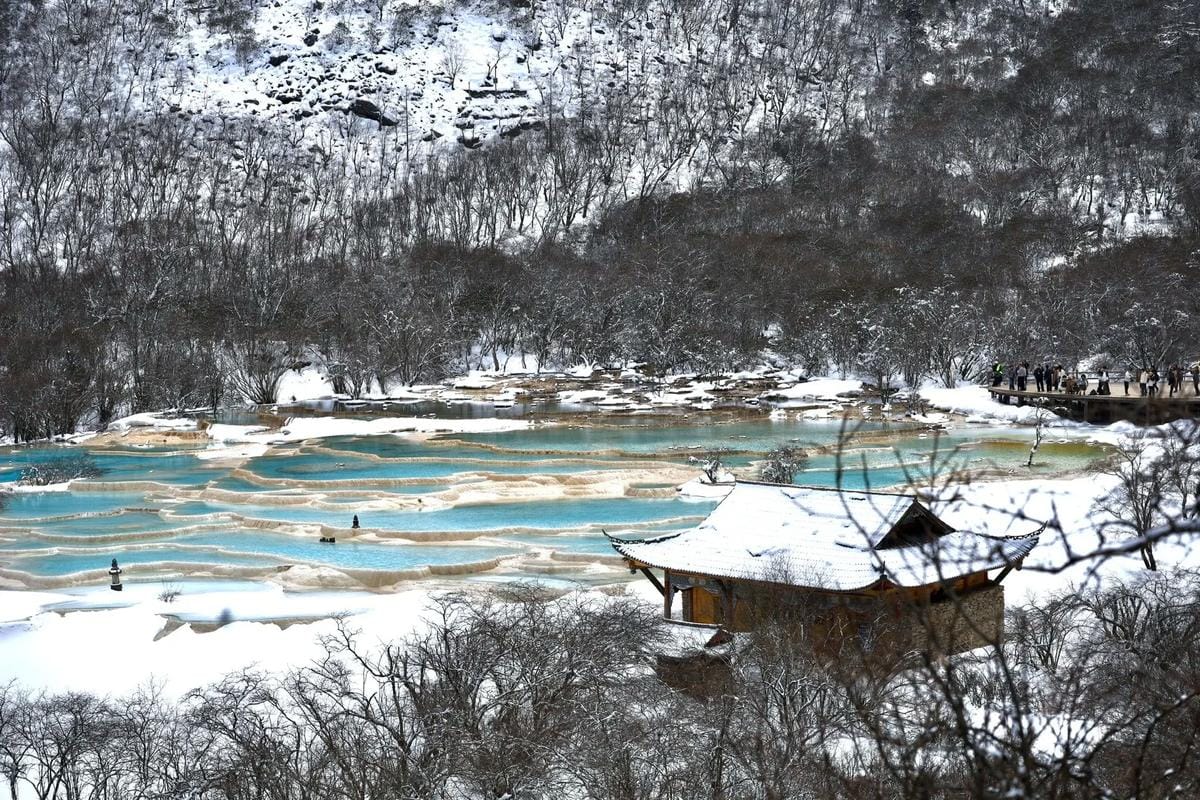
Winter (November–March, partial closure): The cable car and eco-bus stop by mid-December. The valley is walkable for fit, well-equipped hikers. Half the pools freeze to milky white; the rest deepen in color by contrast. Frozen waterfalls form over the travertine. Almost no crowds. For experienced travelers returning to Huanglong, winter is a different place entirely. Not recommended for first-timers. Bring full winter gear — thick down jacket, thermal base layers, waterproof boots with grip. The boardwalk is icy, and temperatures can drop below −10°C.
6. The Altitude Problem — and How to Manage It
This is the part most guides understate. Read it before booking transport.
Huanglong’s boardwalk runs from 3,230 meters at the entrance to 3,576 meters at the Five-Color Pond. Here’s what most English-language articles miss: Jiuzhai Huanglong Airport itself sits at 3,448 meters. If you fly in, your body is already at high altitude the moment you step off the plane. There’s no gradual adjustment. Travelers arriving by high-speed rail experience a much slower ascent — the train station sits at around 2,500 meters, giving you several hours to begin adjusting before you reach the park.
At 3,500 meters, many visitors experience rapid heartbeat, shortness of breath, headache, dizziness, tinnitus. Some feel nothing. A few feel everything. Altitude sickness has no meaningful correlation with fitness level — we’ve seen fit 30-year-olds struggle more than 65-year-olds. Don’t assume.
Flying in: Chengdu (500 m) → JZH Airport (3,448 m) in ~1 hr — a near-3,000 m gain with no acclimatisation. By train: gradual ascent over several hours.
The single most effective step is taking the cable car up rather than walking from the entrance. Walking the full valley uphill takes 2–3 hours and significantly raises the risk of symptoms. The cable car covers most of the elevation gain in 7 minutes, and from the upper station a fairly level boardwalk leads to the Five-Color Pond in about 40 minutes. We route almost all our clients this way, regardless of their fitness level.
Once inside the valley, pace matters more than fitness. Walk slowly, stop often, and breathe deliberately — the temptation to push through the upper section quickly is exactly what causes problems. Buy oxygen canisters at the ticketing office (¥15–30 each, meaningfully cheaper there than at stalls inside), and carry one or two per person as insurance. The gate is where you want to buy them, not when you’re already feeling unwell halfway up.
If you have a week before your trip, consider Rhodiola Rosea (红景天) — a high-altitude herb widely used across the Tibetan plateau and well-established in Chinese sports medicine. Taking it for 5–7 days beforehand reduces symptoms for a meaningful proportion of visitors. It’s available at Chinese pharmacies (药店) in Chengdu. It won’t help everyone, but the downside is minimal. Consult a doctor if you have existing health conditions.
Two things that make it worse: a heavy meal before entering (raises your body’s oxygen demand), and alcohol or caffeine the day before (both accelerate dehydration at altitude). And the signs asking visitors not to run are not decorative — sudden exertion at 3,500 meters is the fastest route to a headache that ruins the afternoon.
One client — a German traveler in her mid-40s who ran regularly and considered herself fit — had a debilitating headache and had to be helped back from the Five-Color Pond in 2023. She’d flown from sea level to Chengdu, stayed one night, then flew to Jiuzhai Huanglong Airport the next morning. Her body had no adjustment window. The lesson: arriving by high-speed rail is better for acclimatization than flying, and a night in Jiuzhaigou first (which sits at 2,000–3,100 m) gives your body a gentler gradient before Huanglong’s 3,576 m.
The park’s medical facility is 50 meters from the main gate. That location tells you something about how seriously the management takes this.
If you have a history of heart disease, uncontrolled hypertension, severe diabetes, or serious prior altitude sickness, talk to a doctor before planning this trip.
7. How to Walk the Valley — Step by Step
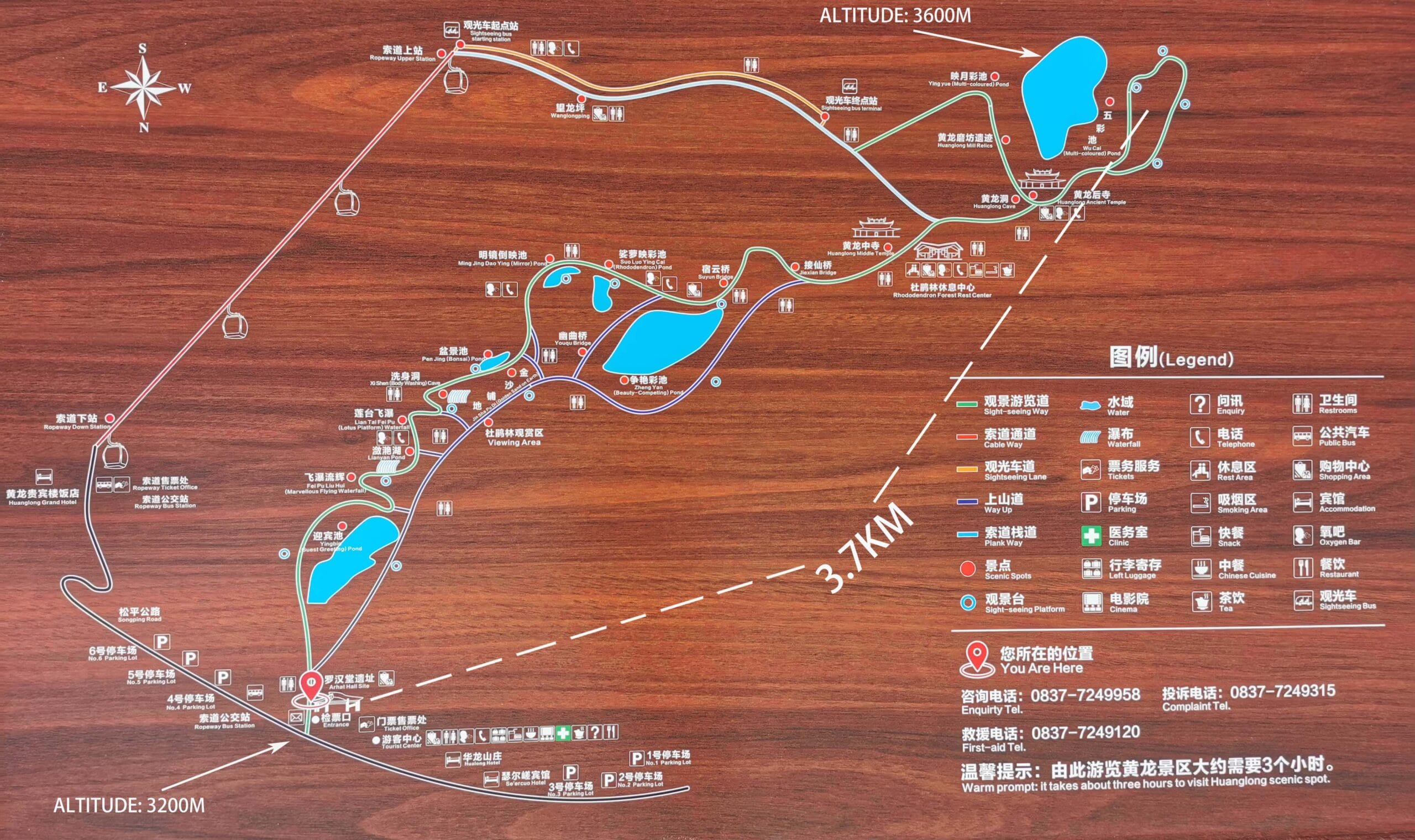
This is what the route actually looks like on the ground, in order.
Our recommended direction: cable car up, walk down.
After the cable car (7 min) and eco-bus shuttle (5 min), you arrive near the Five-Color Pond. Start there. Use both the left path and the right path around the pond system — left for the close-up, saturated view of the water at ground level; right for the panoramic overview. Then descend.
The order going down: Five-Color Pond → Huanglong Ancient Temple → Competing Glamour Pools (争艳彩池) → Bonsai Pond (盆景池) → Xishen Cave (洗身洞) → Lianyan Lake (莲艳湖) → Jinsha Dadi (金沙铺地) → Lotus Waterfall (莲台飞瀑) → Flying Waterfall (飞瀑流辉) → Welcome Pool (迎宾池) → exit at Parking Lot No. 2.
The most visually dense section is from Bonsai Pond down to the Welcome Pool — roughly the lower two-thirds of the valley. Don’t rush the upper section, but know that the further down you walk, the more you see.
Total distance on foot from cable car exit to park exit: approximately 3.6 km. With stops, plan 2.5–3 hours.
8. What Does a Trip to Huanglong Actually Cost?
Ticket prices alone don’t tell the full story. Here’s what a realistic per-person total looks like.
¥ RMB per person. HSR is one-way 2nd class Chengdu East → Huanglong–Jiuzhai. Car transfer is shared estimate. Food is one meal outside the park. Flights to JZH not included.
Adding it up: peak season all-in runs roughly ¥590 per person (entrance + cable car both ways + train + car transfer + oxygen + food outside park). Low season drops to roughly ¥480, with the ¥110 ticket saving being the main difference. The cable car price is fixed year-round — that ¥120 round trip costs the same in October and in January.
These figures don’t include accommodation or flights to Chengdu.
9. Getting to Huanglong
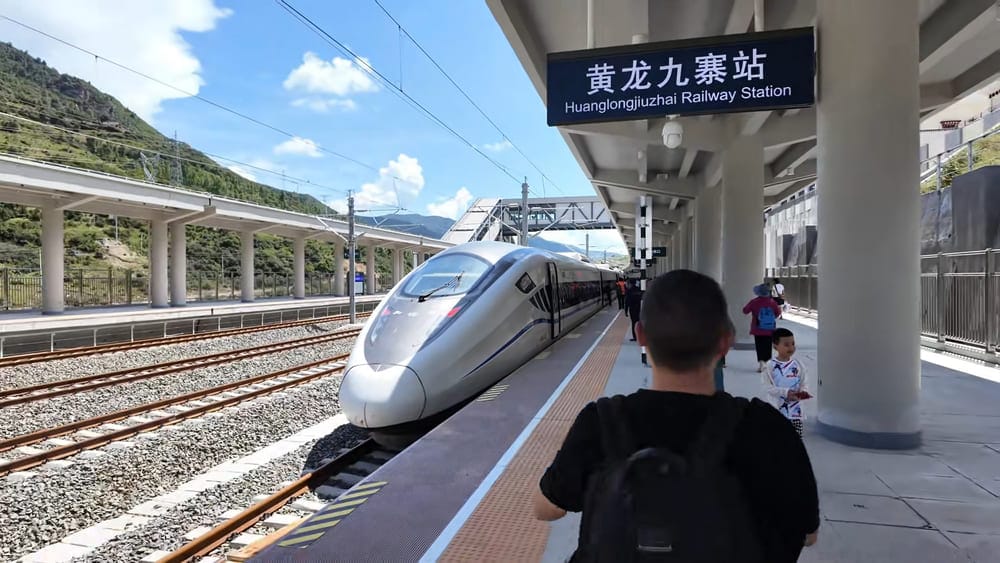
Getting to Huanglong Scenic Area by High-Speed Rail (Recommended)
Take the bullet train from Chengdu East Station (成都东) or Chengdu South Station to Huanglong-Jiuzhai Station (黄龙九寨站). Journey time: approximately 1.5–2.5 hours.
From the station, a public shuttle bus runs directly to Huanglong Scenic Area — fare ¥28 per person, journey about 40–50 minutes. Buses depart roughly 40 minutes after each train arrives. Taxis and private cars are also available; private car costs around ¥100–150 and makes sense for groups of three or more, or anyone prone to car sickness on winding roads.
By Air to Jiuzhai Huanglong Airport (JZH)
The airport sits roughly 50 km from the scenic area, at 3,448 meters altitude. Flights operate from Chengdu (~40 min), Chongqing, Beijing, and other cities. Bus or taxi from the airport takes about 1 hour.
Two points to understand before you book a flight: landing at JZH means you’re immediately at high altitude with no adjustment period. And the airport sits in a valley prone to fog and low cloud, particularly November through March — weather delays are common. If you have a connecting flight elsewhere after leaving Huanglong, build at least three hours of buffer.
From Jiuzhaigou
Direct shuttle buses run from near the Jiuzhaigou entrance to Huanglong (about 2.5 hours). Taxis cover it in roughly 2 hours. The standard pairing is two nights at Jiuzhaigou, then Huanglong on the departure morning before your onward train or flight.
Doing Jiuzhaigou first is our recommendation. Your body gets a gentler altitude introduction (2,000–3,100 m) before tackling Huanglong at 3,576 m.
10. Tickets and Opening Hours
Entrance Tickets
Period | Full Price | Concession |
|---|---|---|
Peak Season (June 1–Dec 15) | ¥170 | ¥85 |
Low Season (Dec 16–May 31) | ¥60 | ¥30 |
Low season occasionally comes with a buy-one-get-one offer — check abatour.com before arrival.
Free entry: children under 1.2 m, seniors over 70, people with disabilities, active military. All require valid documentation at the gate. Discounts do not apply to cable car or eco-bus tickets.
Cable Car
Direction | Price |
|---|---|
Up | ¥80/person |
Down | ¥40/person |
Last upward run around 16:30. Cable car and eco-bus operations suspend from mid-December.
During peak season — especially October — the cable car queue at mid-morning can run 1 to 2 hours. Arriving at the cable car boarding area before 8 AM cuts that wait to almost nothing. This is the single most practical reason to stay overnight nearby rather than traveling from Jiuzhaigou the same morning.
Booking
The park runs a real-name reservation system with a daily cap of 25,000 visitors. Book in advance on the “Beautiful Aba” (美丽阿坝) app or at abatour.com. During peak season, slots sell out days ahead. Bring your passport for identity verification at the gate.
Opening Hours
Period | Hours | Last Entry |
|---|---|---|
April 1 – October 31 | 8:00 – 18:00 | 16:00 |
November 1 – December 15 | 8:30 – 17:30 | 16:00 |
December 16 – March 31 | 9:00 – 17:30 | 15:00 |
11. Practical Tips
Food and drink. No full restaurants inside the park until the visitor center. A small stall near the travertine shoals sells basics. Bring your own snacks and water — it’s cheaper and gives you flexibility. The visitor center restaurant serves hot meals if you need something substantial before entering or after exiting.
Photography. Best light is before noon. Cloud cover improves the pool colors — harsh midday sun bleaches them. A polarizing filter makes a visible difference on clear days. For the Five-Color Pond specifically: the left path gives saturated close-up color; the right path gives panoramic depth. Shoot both.
Shoes. The boardwalk is mostly well-maintained but gets slippery when wet. Hiking shoes or trail runners throughout the year. In spring and winter, waterproof footwear matters.
Sun protection. UV radiation at 3,500 meters is significantly stronger than at sea level — this applies even on overcast days. Sunscreen, sunglasses, and a hat are not optional at any time of year. Sandals are a poor choice regardless of season.
Luggage storage. Lockers are available at the visitor center. If arriving direct from the rail station, leave bags there before entering.
Eco-bus shuttle. The electric shuttle between the cable car exit and the Five-Color Pond area saves 30–40 minutes of walking at altitude. It costs ¥15 per person one way and is worth taking going up. Walk back down — the scenery on the descent is the point.
Mobile signal. Patchy inside the valley. Download offline maps before entering. WeChat Pay and Alipay work at stalls and the visitor center.
No pets. No open flames. Both are strictly prohibited.
12. Baishuitai vs. Pamukkale vs. Huanglong: How Do They Actually Compare?
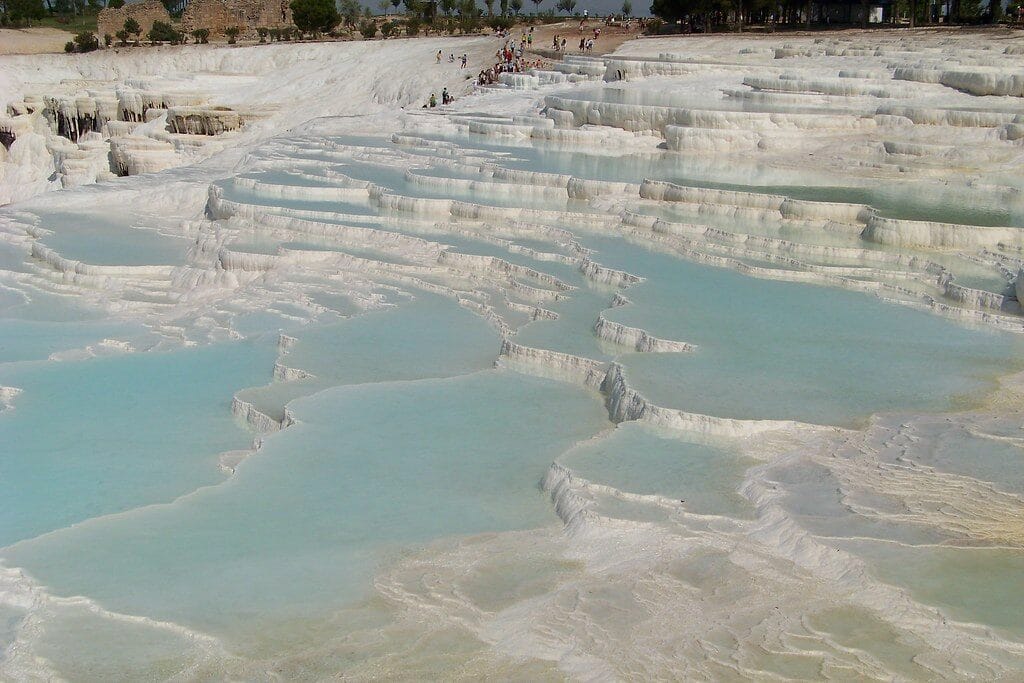
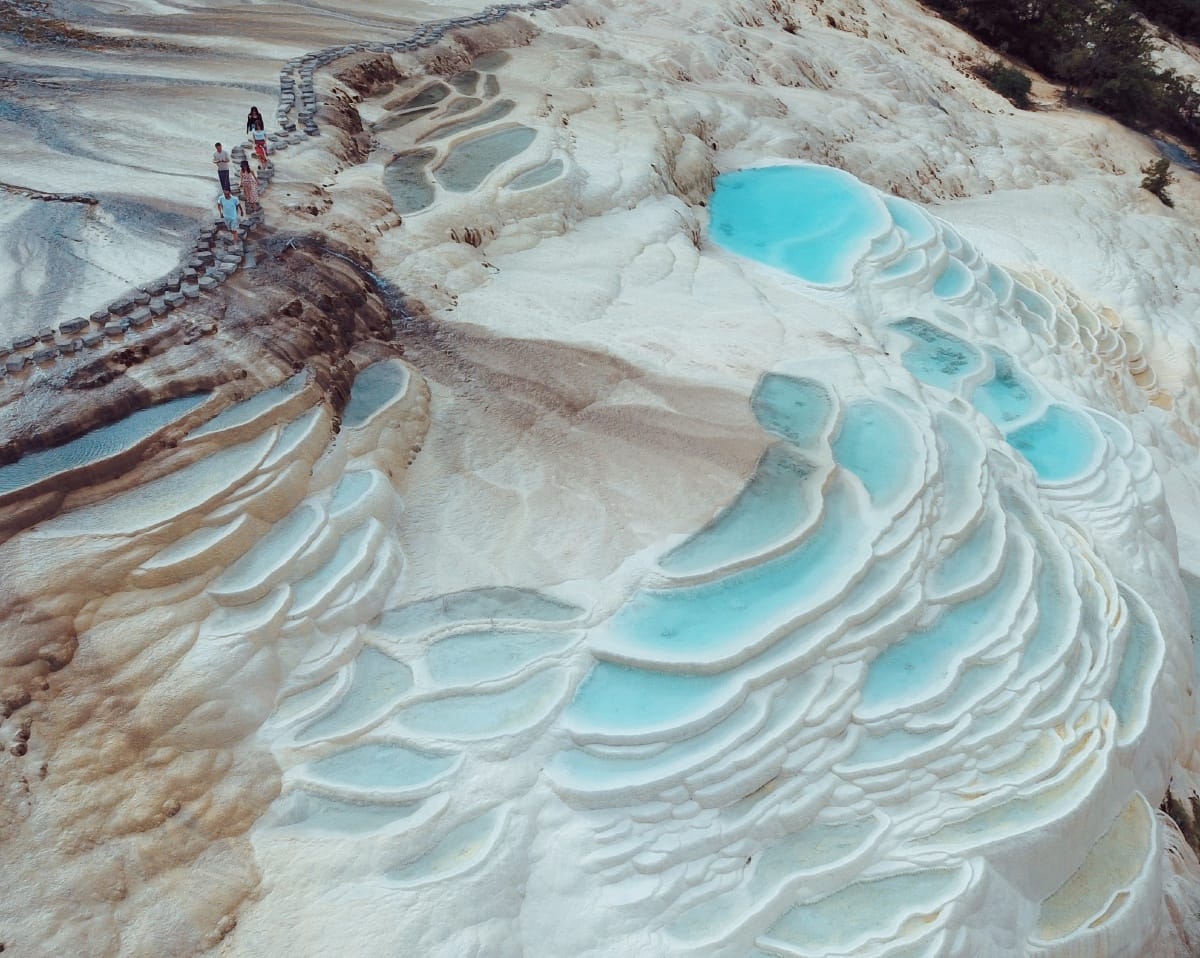
All three are travertine sites — calcium carbonate formations built by mineral-rich water — but arriving at each feels nothing alike. We’ve brought guests to Baishuitai and Huanglong both; the differences below are drawn from those visits and from the travelers who’ve done all three.
Baishuitai (China) | Pamukkale (Turkey) | Huanglong (China) | |
|---|---|---|---|
Water source | Freshwater spring (2°C–10°C) | Thermal hot springs (35–100°C) | Freshwater mountain springs |
Terrace size | 140m × 160m (intimate) | 2,700m long × 600m wide (vast) | 3.6 km valley corridor |
Altitude | 2,380m | ~350m (sea-level climate) | 3,500–3,800m |
Pool colors | White, blue-green, pale gold | Brilliant white, turquoise | Vivid turquoise, jade green, gold |
Can you swim? | No | Yes (designated sections) | No |
Annual visitors | Tens of thousands | 2+ million | 1–2 million |
Crowds | Low — genuinely quiet | Very high, especially summer | High; strict daily quota |
UNESCO status | No (National 4A) | Yes — with Hierapolis ruins | Yes (1992) |
Cultural layer | Deep — Naxi Dongba birthplace | Greco-Roman ruins (Hierapolis) | Tibetan Qiang minority culture |
Entrance fee | CNY 30 (~€4) | €30 (~CNY 235) | CNY 170 peak / CNY 60 off-peak (cable car ¥80 extra) |
Getting there | Remote; 2–3 hrs from Shangri-La | Easy; buses from Denizli | Remote; fly to Jiuzhaigou airport |
Best for | Off-the-beaten-path, culture, quiet | Swimming in pools, archaeology | Pure visual spectacle, photography |
Our honest take: If you want to swim in thermal pools under the Anatolian sun alongside Roman ruins, Pamukkale is the right choice. If you want the single most visually overwhelming travertine spectacle in China, Huanglong wins on sheer scale and color intensity. Baishuitai sits in its own lane: smaller, colder, culturally richer, and significantly less visited. It’s the choice for travelers who want the experience over the Instagram post.
One detail that has stuck with us after years of visits: the Naxi women around Baishuitai wear plain rectangular woven capes — not the embroidered dress most people recognize from Lijiang. The two communities speak dialects different enough to cause genuine communication difficulty. If you’ve been to Lijiang, Baishuitai shows you a different face of the same culture. For a full side-by-side breakdown of the two Chinese travertine sites, see our Huanglong vs White Water Terrace guide. You can also find a detailed comparison of two travertine landscapes in China and abroad through Huanglong vs Pamukkale: An Honest Comparison guide.
13. Combining Huanglong With Jiuzhaigou
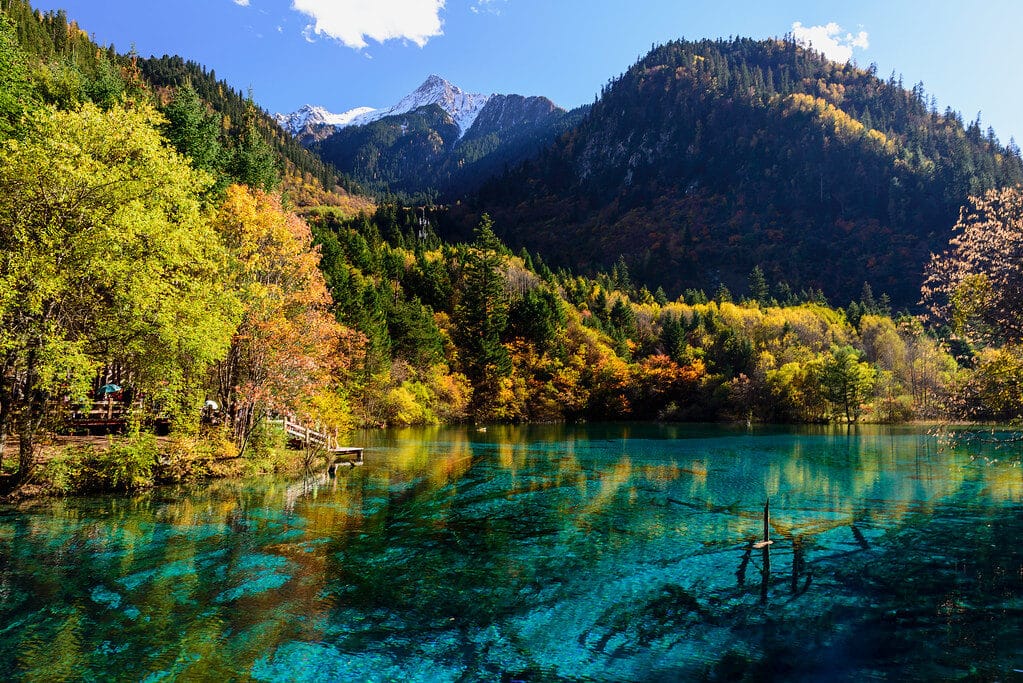
Almost everyone pairs Huanglong with Jiuzhaigou, 100 km away. The two complement each other without overlapping — Jiuzhaigou is lakes and waterfalls across multiple valleys, needing 1–2 full days; Huanglong is one valley of terraced pools, done properly in a focused half-day.
The standard itinerary:
- Day 1: Chengdu → Huanglong-Jiuzhai Station → Jiuzhaigou (arrive, settle in, acclimatize)
- Day 2: Jiuzhaigou full day
- Day 3 morning: Huanglong → afternoon, return to Chengdu by train
This works cleanly. The altitude benefit of doing Jiuzhaigou first is real.
If you want to extend: Songpan Ancient Town sits between the two and makes a half-day wander through its old walls and market. Mounigou Valley (牟尼沟), part of the Huanglong Scenic Area, contains Zhaga Waterfall (扎嘎瀑布) — the world’s tallest open-air calcite waterfall at 104 meters high. Almost no international visitors go there. Worth a fourth day if you have it.
If you’re planning a broader Sichuan itinerary, see our China tour itinerary guide and how to plan a trip to China.
14. Frequently Asked Questions
Is Huanglong worth visiting if I only have half a day?
Yes — with one condition: make it a morning visit. Take the cable car up, use both paths to the Five-Color Pond, and walk down in 1.5–2 hours. Where half-day visits go wrong is arriving at 1 PM: the cable car has queued up, afternoon cloud has moved in, and the Five-Color Pond is in flat grey light. Start before 9 AM.
Can I visit Huanglong without a guide?
Yes. The boardwalk is clearly marked and the descent route is straightforward. English signage exists at major points. For visitors who want context about the geology, the ecology, and the Tibetan cultural significance of the temple, a guide adds a different layer. We offer private guide hire throughout Sichuan — contact us here.
Is Huanglong suitable for elderly visitors?
With caveats. The cable car handles the ascent. The descent is 3.6 km on boardwalk — uneven in sections, with steps — taking 1.5–2 hours. For fit, healthy seniors this is manageable. For anyone with limited mobility or significant health conditions, speak to a doctor first. The park is not wheelchair accessible.
Will I definitely get altitude sickness?
No. Many visitors feel nothing at all. But the condition is genuinely unpredictable and has no correlation with fitness. Take precautions regardless, and keep your evening schedule light.
What is the difference between Huanglong and Jiuzhaigou?
Different places, different experiences. Jiuzhaigou is a system of lakes and waterfalls spread across multiple valleys at slightly lower altitude — it needs a full day and rewards slow walking. Huanglong is one valley of calcite-terraced pools, geologically unique, done well in a focused half-day. They don’t overlap. See both if you have the days.
Huanglong vs Jiuzhaigou: which should I visit first?
Jiuzhaigou first, Huanglong second. Jiuzhaigou’s main attractions sit at 2,000–3,100 meters — lower than Huanglong’s 3,576-meter peak. A day or two there gives your body a gentler altitude introduction before you tackle Huanglong. The practical itinerary is: arrive at Jiuzhaigou on Day 1, explore on Day 2, then do Huanglong on the morning of Day 3 before your train back to Chengdu. This order also works logistically — the departure route from Jiuzhaigou passes Huanglong.
Can I buy tickets at the gate?
During peak season, often not — or the queue is very long. Book online in advance on the Aba Tourism platform. Bring your passport.
What should I eat near Huanglong?
Inside the park: snacks and instant noodles from the stall, hot meals from the visitor center restaurant. Outside in Songpan County: yak meat, zanba (roasted barley flour — a Tibetan staple), butter tea, local mushroom dishes. Eat well in Chengdu before and after; this is not a food destination.
Is Huanglong open year-round?
Yes — the scenic area itself has no official closure months. What changes in winter is the cable car and eco-bus, which suspend operations from around mid-December. From that point until roughly late March or early April, you walk the full valley on foot. The park’s daily visitor cap and real-name booking system remain in place year-round.
Does Huanglong close in winter?
The cable car and eco-bus suspend from mid-December. The park stays open but you walk the full valley. Tickets drop to ¥60. In some years icy conditions close sections of boardwalk — check the official WeChat account before a winter visit.
Should I stay overnight near Huanglong?
Most visitors stay in Jiuzhaigou and make a day trip to Huanglong, which works fine. But if you’re visiting in peak season and want to avoid the cable car queue, staying overnight in Chuanzhusi Town (川主寺, about 15 minutes from the park entrance) lets you reach the cable car before 8 AM when there’s almost no wait. Chuanzhusi has basic hotels and guesthouses at lower prices than Jiuzhaigou. It’s not a destination in itself, but it makes peak-season logistics significantly easier.
Should I plan around the Huanglong Temple Fair?
If you happen to be in the area in mid-July, yes. The fair falls on the 15th day of the sixth lunar month. Thousands of Tibetan and Qiang pilgrims climb to the temple in traditional dress. It is a genuine religious and cultural event, not a tourist performance. The crowds are significant, but the atmosphere is unlike any other day in the park.
15. A Personal Note From Our Team
We’ve been bringing international visitors to this part of Sichuan since long before the high-speed rail reached Jiuzhai. We’ve walked Huanglong in October sun, in November cold, and once in a heavy August thunderstorm that turned the whole valley silver-grey.
What we notice, visit after visit, is how many people stop at the Five-Color Pond without saying anything. Not because they have nothing to say — because they don’t have language for it. The pools hit differently in person. The altitude, the forest, the cold smell of the air, and those colors conspire into something that no photograph assembles correctly.
The altitude will work on you. The logistics take real planning. But Huanglong is worth both.
If you’d like us to handle the details — transport from Chengdu, guide hire, coordination with a Jiuzhaigou itinerary — our team is ready. We’ve been doing this since 2006. Huanglong is one of the places we’re always glad to take people back to.