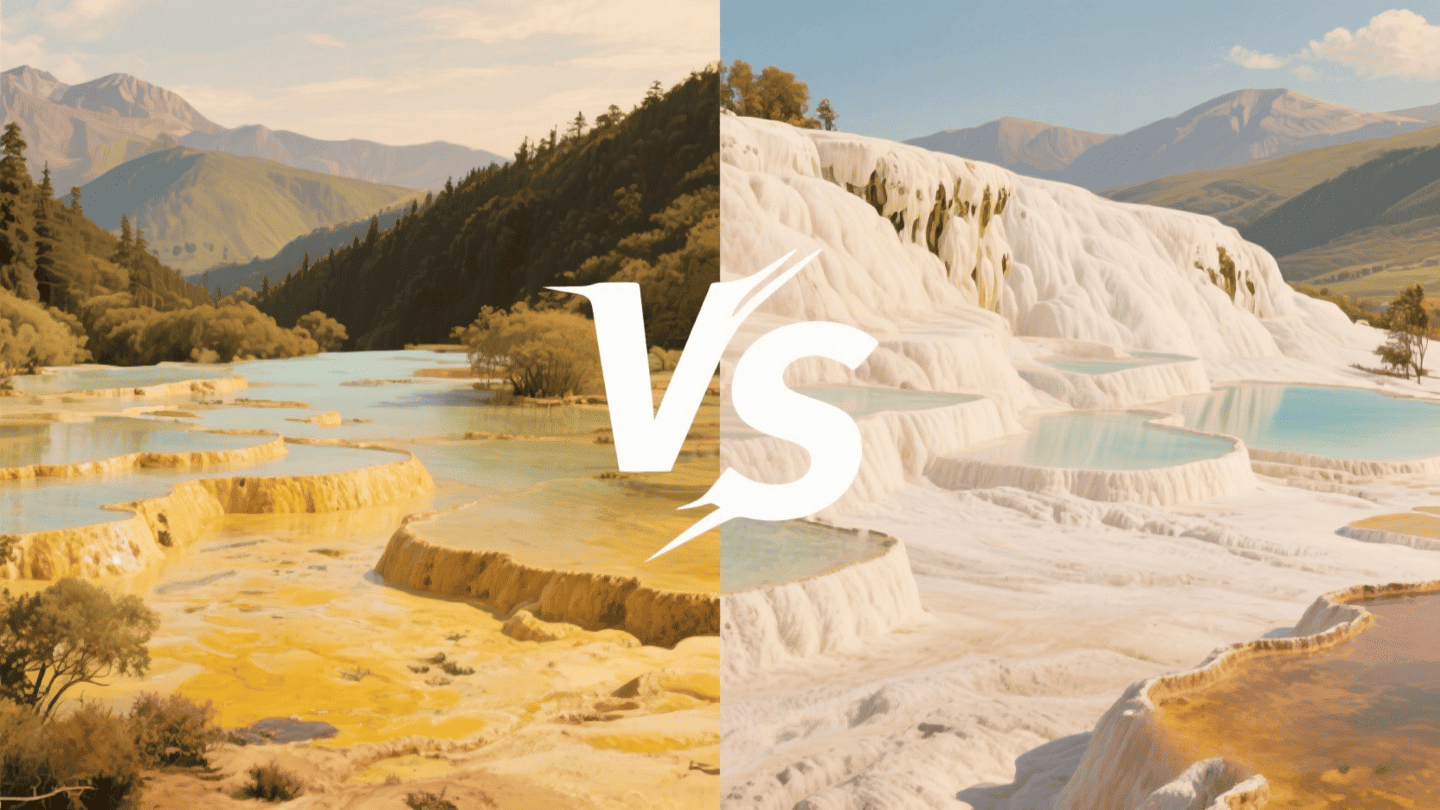
Huanglong vs Pamukkale: An Honest Comparison
is Huanglong really just China’s Pamukkale?
This Huanglong vs Pamukkale question comes up constantly in our inbox. Both sites are UNESCO World Heritage Sites built from calcium carbonate deposits left by mineral-rich springs. Both appear on every “world’s most spectacular natural wonders” list. The comparison feels obvious.
We’ve been bringing international visitors to Huanglong Scenic Area for over 20 years. What we’ve learned: the comparison is much lazier than it looks, and travelers who arrive at one site expecting the other tend to be disappointed. Here’s what the two places actually share, where they diverge completely, and how to decide which one belongs in your itinerary.
Table of Contents
1. What Are Huanglong and Pamukkale, Actually?
Both sites are travertine formations — landscapes built over thousands of years as mineral-laden water deposits calcium carbonate. That geological process is the only thing they reliably share.
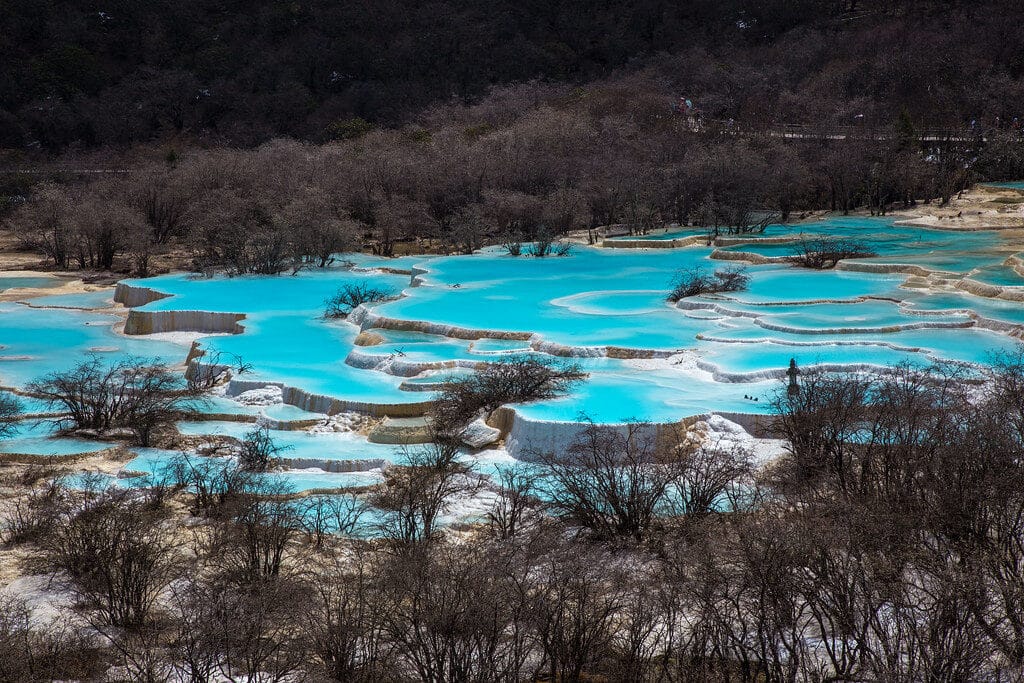
Huanglong (黄龙, Yellow Dragon) is a UNESCO-listed scenic valley in the Aba Tibetan and Qiang Autonomous Prefecture of Sichuan Province, northwestern China. It sits inside a glacially carved mountain range. The visitor trail runs from the valley entrance at approximately 3,230 meters up to the Five-Color Pool at 3,576 meters above sea level. The valley floor is lined with more than 3,400 colorful travertine pools — the largest concentration of calcite pools anywhere on Earth. UNESCO inscribed it in 1992, ranking its travertine formations among the three most outstanding examples globally.
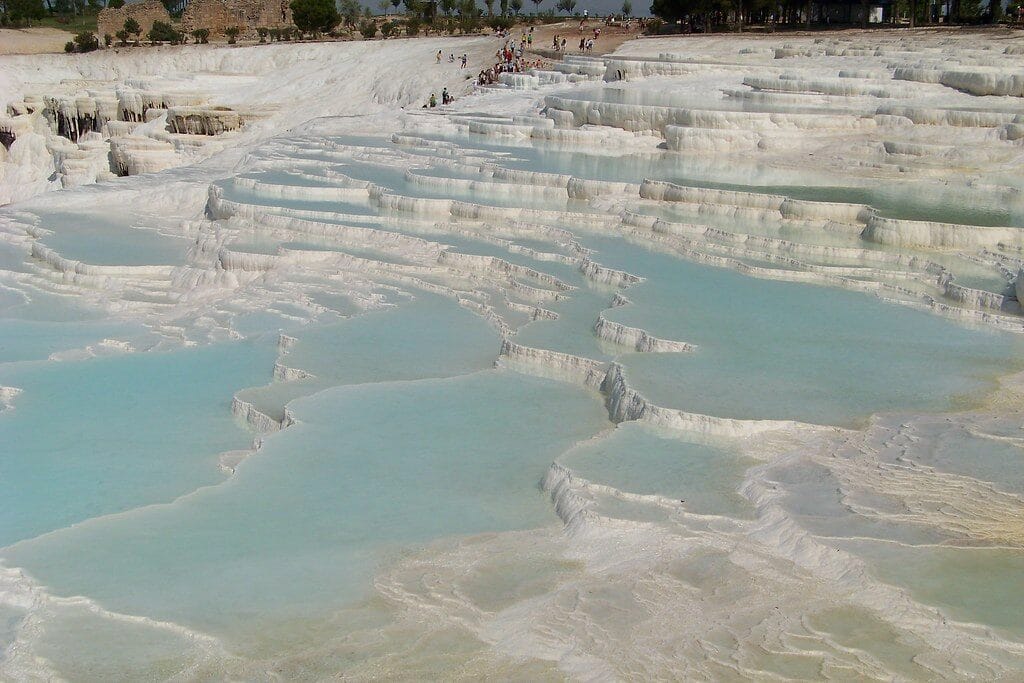
Pamukkale (meaning “Cotton Castle” in Turkish) is a travertine hillside in Denizli Province, southwestern Turkey. Seventeen natural hot springs with temperatures ranging from 35°C to 100°C have deposited calcium carbonate down a cliff face roughly 2,700 meters long and 160 meters high. UNESCO inscribed it in 1988 alongside the ruins of the ancient city of Hierapolis, built directly on top of the formation.
The geology is similar. Almost everything else is not.
2. The Visual Reality: What You Actually See
This is where the comparison gets uncomfortable — and where we feel obligated to be direct with our clients.
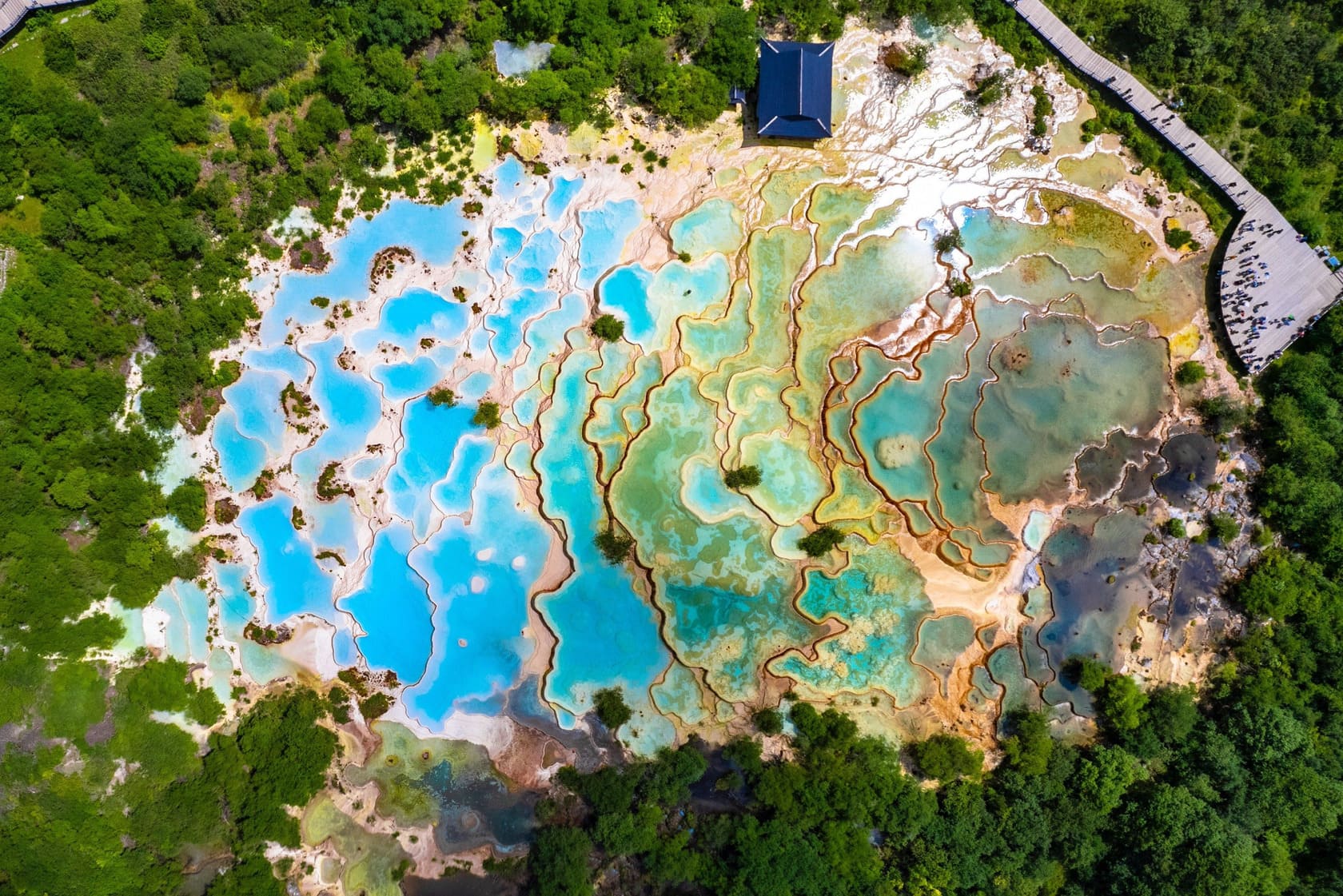
Huanglong delivers what its photographs promise. The Five-Color Pool (五彩池) at the top of the valley genuinely shimmers in deep turquoise, emerald, amber, and gold. Even the IUCN’s technical evaluation — which does not hand out praise easily — explicitly rated Huanglong’s travertine scenery as superior to Pamukkale’s. The pools hold water reliably across all open seasons. What you see in promotional photos reflects what’s actually there.
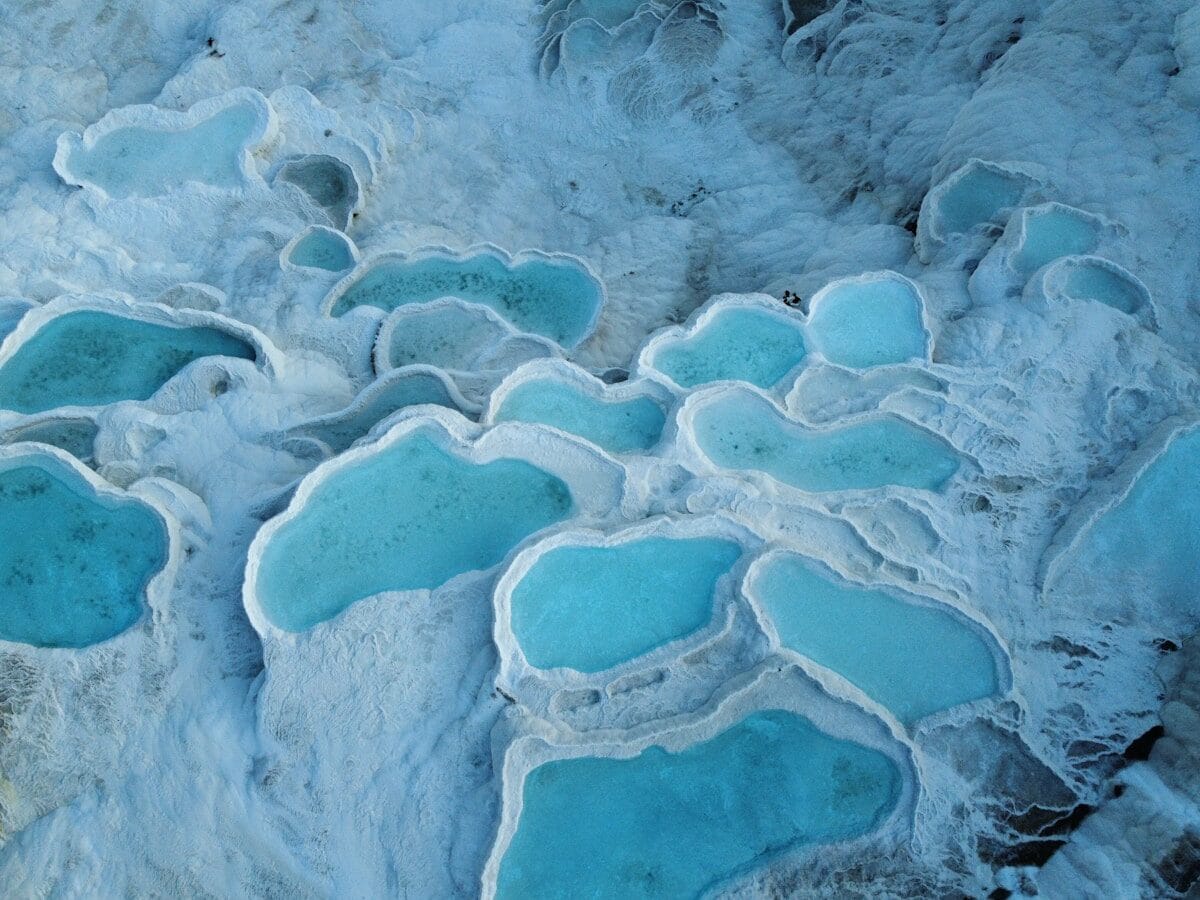
Pamukkale has a more complicated story. Decades of hotels diverting spring water, tourists bathing freely in the terraces, and infrastructure built inside the park caused serious damage. Today, only roughly 5–10% of the travertine surface holds water at any given time. Management rotates water flow between sections to allow recovery. The iconic social media images — those gleaming white pools cascading down a brilliant hillside — are often 20 to 30 years old. Arriving visitors are frequently surprised to find large sections dry and grey. One experienced travel writer described the current state honestly: the scenery is “far from ideal” compared to historical conditions.
Pamukkale still has genuine moments of beauty, particularly at sunrise and at Cleopatra’s Pool. But it requires realistic expectations. Huanglong does not.
One more honest note on Huanglong: the pools depend on light. On a grey, overcast day the colors flatten significantly — the turquoise turns murky, the gold disappears. Several visitors who arrive on cloudy mornings via the cable car report an anticlimactic first impression. This isn’t a reason to skip it; it’s a reason to check the forecast and, if the morning is cloudy, wait it out. The light usually improves by mid-morning. Plan for flexibility rather than a fixed arrival time.
3. Scale and Immersion
Huanglong Valley stretches 3.6 kilometers from the lower entrance to the Five-Color Pool at the top. The elevation gain across that distance is roughly 350 meters. You move through the landscape on a continuous boardwalk, stopping at distinct pool clusters — the Welcome Pools, Flying Waterfall, Competing Beauty Pools, Zhengyan Pool, and finally the Five-Color Pool — each one a separate visual world. The experience takes 4–6 hours. Snow-capped Xuebaoding Peak (5,588m) frames the upper section. Ancient cypress trees line the boardwalk. The Huanglong Temple sits partway up the valley. There is no city noise, no beach chairs, no commercial food court.
Elevation gain at Pamukkale is effectively zero — the travertines sit on a flat hillside at 350 m.
Huanglong’s 346 m climb over 3.6 km is what makes altitude preparation essential.
Pamukkale is more compact and more urban. The travertine formation takes 4–5 hours to fully explore, including the Hierapolis ruins and Cleopatra's Pool. The setting is a hillside above a Turkish provincial town. The ruins of Hierapolis above the terraces are worth several hours on their own — the 15,000-seat Roman theatre still has most of its seating intact, and the necropolis stretching north of the city is one of the largest in the ancient world. But the immersive wilderness quality that Huanglong offers simply isn't there.
4. The Key Differences at a Glance
Factor | Huanglong | Pamukkale |
|---|---|---|
Country | China (Sichuan) | Turkey (Denizli) |
UNESCO inscription | Yes (1992) | Yes (1988) |
Altitude | Valley trail: 3,230–3,576m (park overall: 1,700–5,588m) | ~350m |
Pool count | 3,400+ colorful pools | 17 hot springs; ~5–10% surface active today |
Pool water status | Reliable year-round | Significantly reduced vs. historical levels |
Pool colors | Multi-color (blue, gold, green, amber) | Turquoise/white when active |
Water temperature | Cold mountain springs | 35–37°C (warm/hot) |
Can you swim? | No | Yes — designated areas + Cleopatra's Pool |
Cultural layer | Tibetan/Daoist temples, Ming Dynasty | Ancient Greek/Roman city of Hierapolis |
Altitude sickness risk | High | None |
Closed season | December–March | Open year-round |
Visit time | 4–6 hours | 4–5 hours |
Crowd level | Moderate–high in peak season | Very high (2M+ visitors/year) |
Entrance fee | ¥170 peak / ¥60 off-season + ¥80 cable car up or ¥40 cable car down | €30 adults (travertines + Hierapolis); Cleopatra's Pool ~€6 extra |
IUCN quality verdict | Superior travertine | Significant, but degraded |
5. Altitude: The Factor Most Travelers Underestimate
- Entrance — 3,230 m
- Flying Waterfall — 3,270 m
- Competing Beauty Pools — 3,400 m
- Huanglong Temple — 3,558 m
- Five-Color Pool — 3,576 m
- Pamukkale — ~350 m above sea level
Huanglong trail: 3.6 km, 346 m elevation gain • Oxygen at 3,576 m is ~65% of sea level.
This is the single biggest practical difference between the two sites — and the one most travel articles gloss over.
The Five-Color Pool sits at approximately 3,576 meters. That's higher than the summit of the Zugspitze, Germany's highest peak. At that elevation, oxygen levels are roughly 65% of what you'd breathe at sea level. Many visitors notice rapid heartbeat, light-headedness, or fatigue on the uphill section — even fit travelers with no prior altitude history.
Our standard advice after 20 years of running these tours: take the cable car up (¥80), walk down. Buy oxygen canisters at the entrance (¥15–30 each). Give yourself at least one acclimatization night at altitude nearby — ideally after a day at Jiuzhaigou Valley first, which sits lower and eases the transition considerably.
Pamukkale requires zero altitude preparation. At roughly 350 meters, you are below the altitude of most European cities. The only physical challenge is bare feet on uneven travertine — occasionally slippery in wet sections.
6. Observe or Swim?
This is a philosophical divide as much as a practical one.
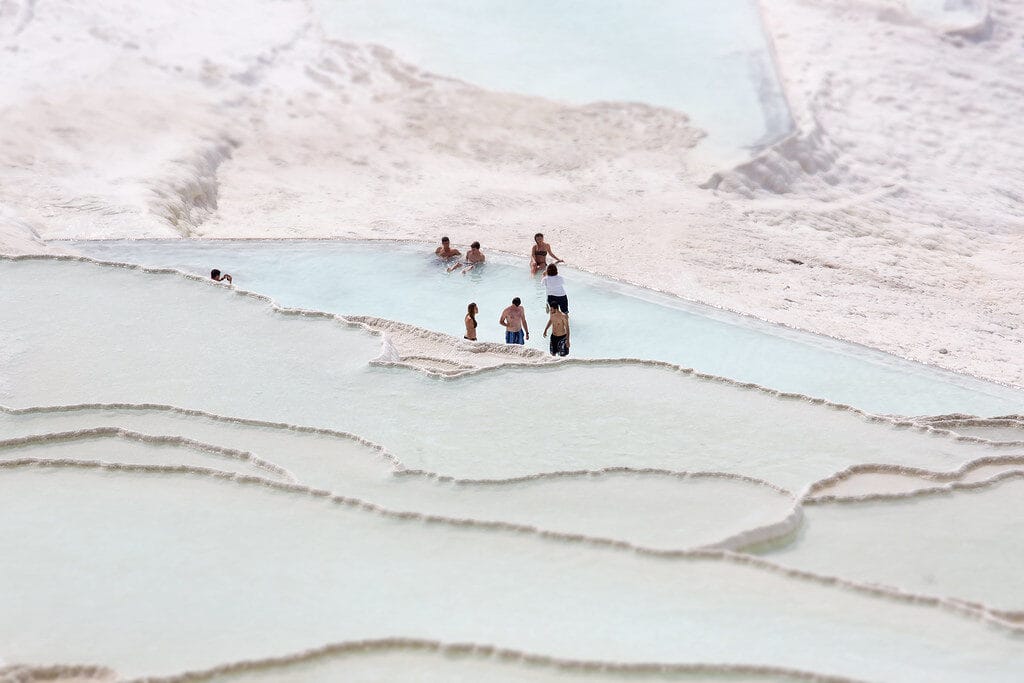
At Pamukkale, you take off your shoes and wade through the warm thermal pools. You can swim in Cleopatra's Pool (extra fee) among ancient submerged Roman columns. The water is warm, the experience is tactile. You become part of the landscape rather than an observer of it. For many travelers, this is Pamukkale's most memorable quality — and it's something Huanglong simply cannot offer.
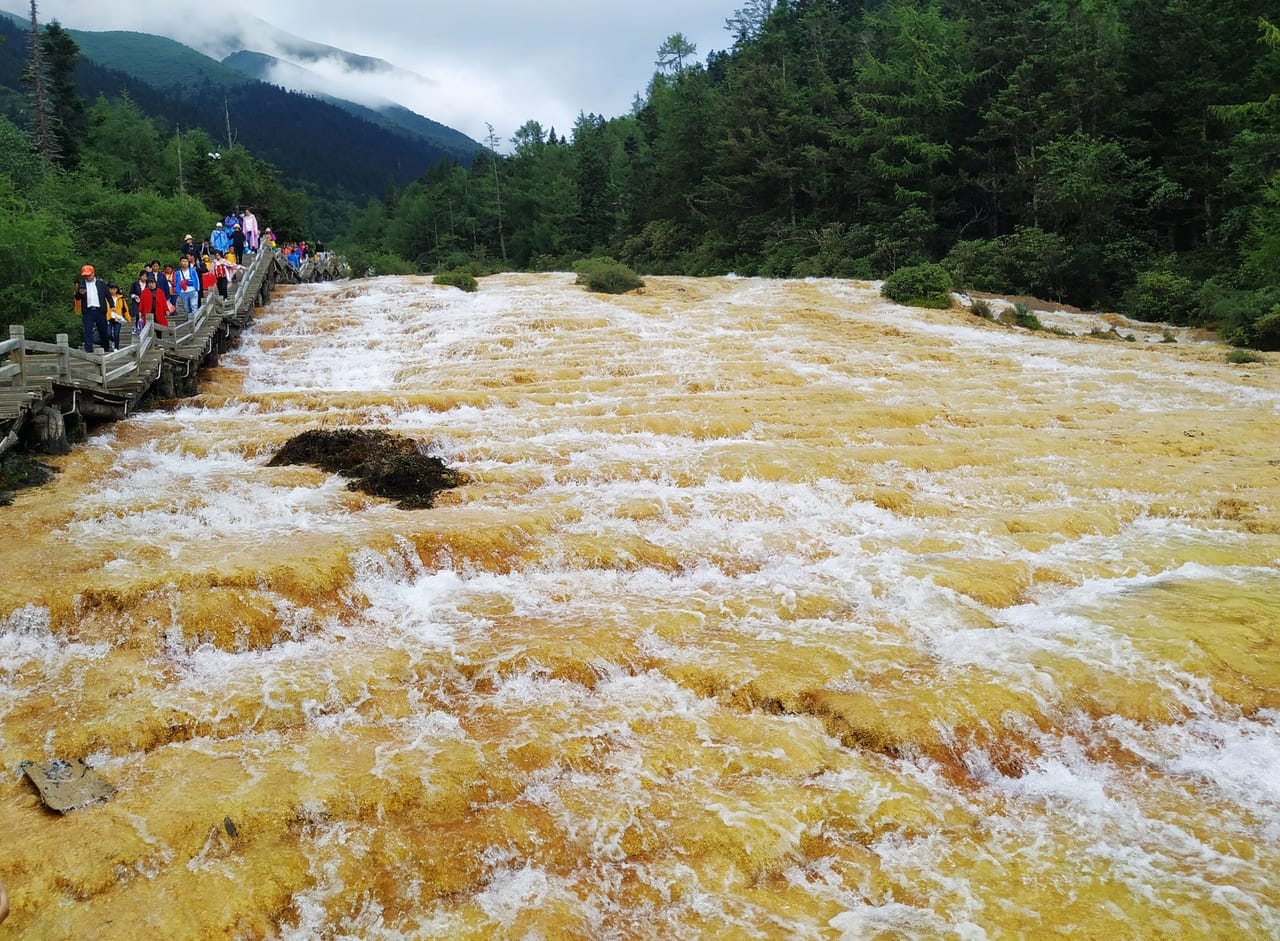
At Huanglong, you do not enter the pools. The entire visit is conducted on a boardwalk. The colors and clarity of the water are extraordinary precisely because they are undisturbed — the pools are cold, the ecosystem is fragile, and access is restricted to protect what makes them beautiful. You observe Huanglong the way you'd observe a painting: up close, from every angle, for as long as you like — but without touching it.
You observe Huanglong. You inhabit Pamukkale. Knowing which experience you're after is worth thinking about before you book.
7. Getting There
Huanglong has become significantly more accessible since the high-speed rail connection between Chengdu East Station and Jiuzhai Huanglong Station opened — the journey takes roughly 90 minutes (mostly through tunnels). From the station, it's about 30 minutes to the scenic area by shuttle or private car. Alternatively, fly directly to Jiuzhai Huanglong Airport (JZH), with connections from Beijing, Shanghai, Guangzhou, Chongqing, and other major Chinese cities. The valley closes December to March.
Pamukkale is 20 km from Denizli, the regional capital. The nearest airport (Denizli Çardak, DNZ) connects to Istanbul and other Turkish cities. From Istanbul, it's a direct domestic flight or 6+ hours by car. A minibus from Denizli Bus Terminal takes about 20 minutes. Open year-round.
8. The Cultural Dimension
Both sites carry significant cultural weight beyond their geology — in completely different directions.
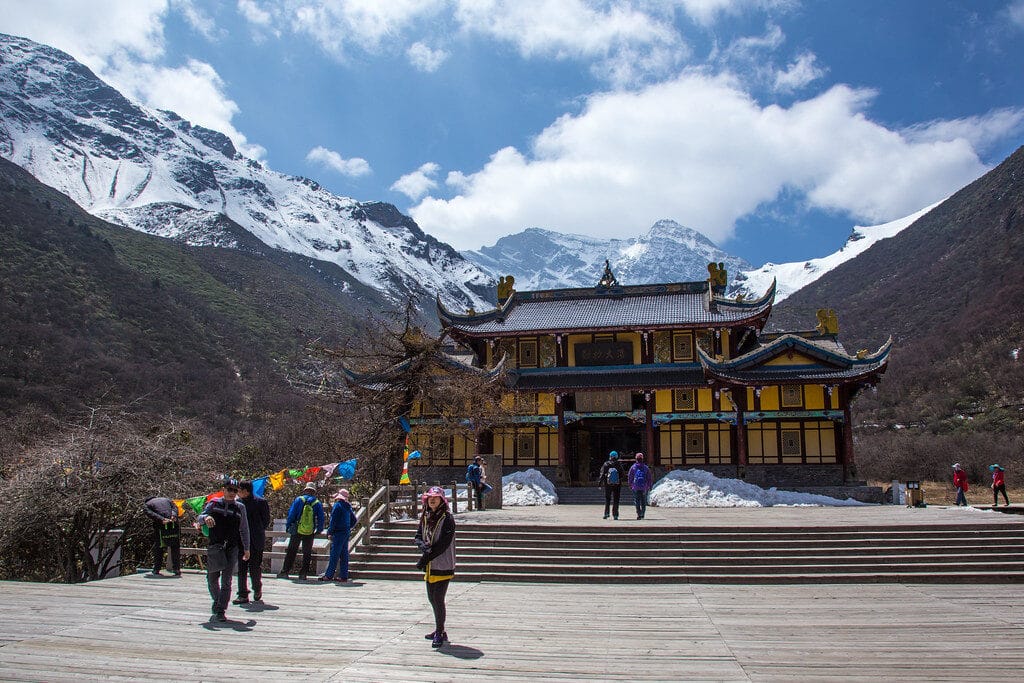
Huanglong's valley has been considered sacred for centuries. The Huanglong Temple, a Ming Dynasty structure combining Taoist and Buddhist elements, sits at 3,558 meters halfway up the valley. Every year during the Huanglong Temple Fair (usually mid-June), Tibetan, Qiang, and Han pilgrims gather from across the region for rituals and traditional dance. It is one of the few high-altitude temple fairs in China that international visitors can realistically attend. The valley takes its name from the Daoist legend of the Yellow Dragon, said to have helped the mythical Emperor Yu control floods.
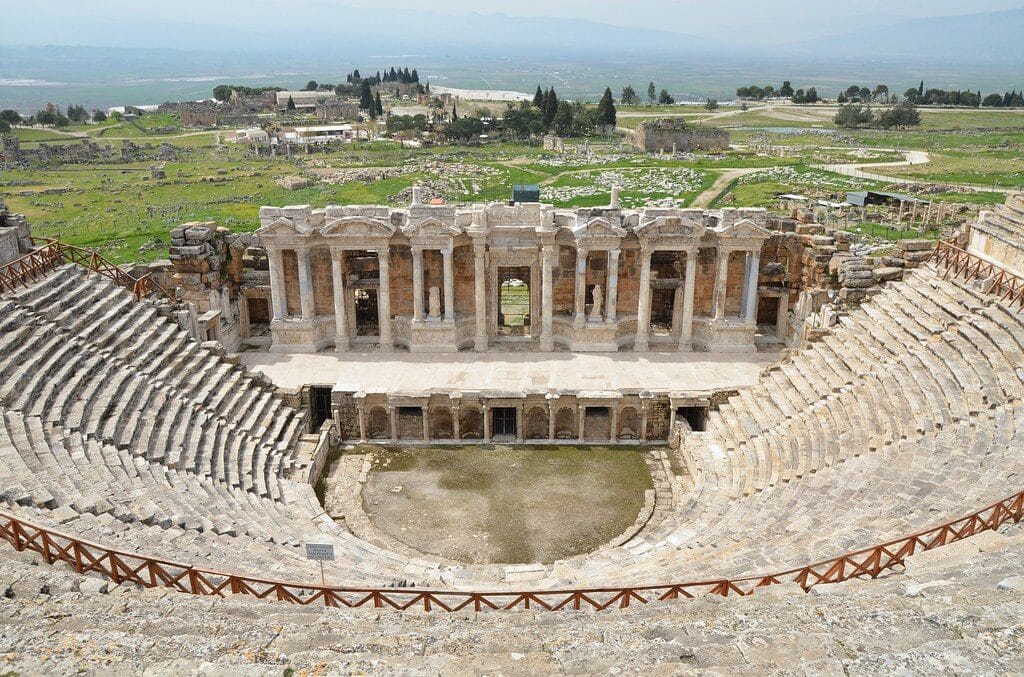
Pamukkale's cultural layer is the ancient city of Hierapolis, founded around 190 BC and developed heavily under Roman rule. The 15,000-seat theater is among the best-preserved in Turkey. The city's position above hot springs made it a major health and pilgrimage destination in antiquity. Recent excavations (2024) unearthed over 5,000 artifacts and striking Scylla sculptures. For visitors who want to combine natural scenery with deep classical history, Hierapolis is hard to rival.
If what you're after is wilderness, solitude, and a living Tibetan pilgrimage tradition at 3,500 meters, Huanglong has no rival among travertine sites. If Roman ruins and ancient spa culture matter as much as the natural scenery, Pamukkale's Hierapolis tips the balance its way. Most travelers are after one more than the other — figure out which one you are before you book.
9. A Note on China's Other "Pamukkale"
Before we get to the verdict — a note worth making for travelers planning a China itinerary.
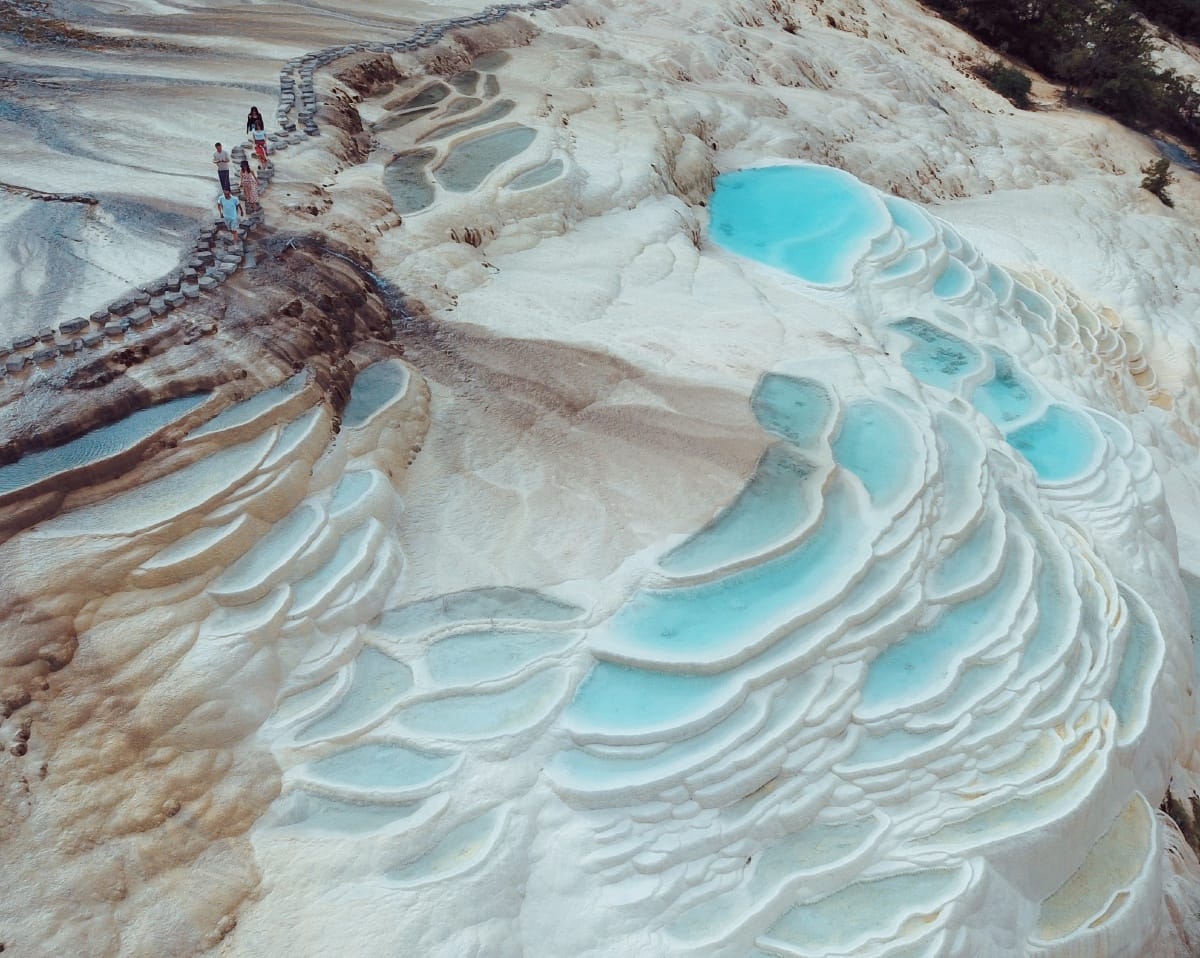
Huanglong isn't the only Chinese site regularly called "China's Pamukkale." White Water Terrace (白水台, Baishuitai) in Shangri-La, Yunnan carries the same nickname. It's a milky-white travertine formation at 2,380m in the foothills of Haba Snow Mountain — smaller and lower-key than Huanglong, with almost no crowds, a ¥30 entrance fee, and a remarkable cultural backstory as the sacred birthplace of the Naxi people's Dongba religion.
If you're deciding between those two Chinese sites specifically, we've written a dedicated Huanglong vs White Water Terrace comparison. The short version: Huanglong is more visually overwhelming; Baishuitai is more personally surprising and fits naturally into a northwest Yunnan route through Lijiang and Shangri-La.
For the Huanglong vs. Pamukkale question — which is really asking whether China's most dramatic travertine landscape measures up to the world's most famous one — the comparison below gives you the answer.
10. When to Visit Each
Huanglong closes December–March. Score reflects combined landscape quality, crowd levels, and weather.
Avoid Huanglong the first week of October (China National Day — peak crowds).
Huanglong is best in autumn (September–October) when changing foliage combines with full pools and vibrant color contrasts. Avoid the first week of October (China's National Day golden week), when crowds peak severely. Summer (June–August) is the rainy season — fog can obscure views, though the Five-Color Pool remains striking. The April–May dry season sees many lower pools empty; the Five-Color Pool at the top remains reliable but other sections disappoint. The valley closes December to March.
Pamukkale is best in spring (April–June) and autumn (September–October). Spring snowmelt increases water flow rates, giving the best chance of seeing active pools. Avoid midsummer — temperatures exceed 40°C, crowds peak, and the white travertines reflect intense heat and light. Winter is genuinely atmospheric: almost no crowds, cool air against warm pool water, and Hierapolis largely to yourself. Cleopatra's Pool maintains normal hours year-round.
11. Which Should You Choose?
Scores reflect genuine visitor experience across six dimensions, not marketing claims.
Neither site dominates — they serve different travellers.
If you are building a China itinerary and considering a natural highlight in Sichuan, Huanglong is one of the most extraordinary landscapes on Earth — and one of the most underrated, because it sits in the shadow of the more famous Jiuzhaigou. We have guided thousands of international visitors through Huanglong over 20+ years, and the response is consistently the same: disbelief that something this visually striking exists, and frustration that they didn't know about it sooner.
If you are building a Turkey itinerary, Pamukkale is still worth visiting — but go with current expectations, not photographs from the 1990s. Choose spring or autumn, arrive at opening time, and spend your afternoon in Hierapolis. Cleopatra's Pool, for all its commercialization, is genuinely atmospheric.
Choose Huanglong if you want untouched high-altitude wilderness, multicolor pools that look exactly like the photographs, Tibetan cultural context, and you are physically capable of managing real altitude.
Choose Pamukkale if you want to swim in warm thermal water, you're combining it with a Turkey itinerary, you want a strong archaeological layer alongside the natural wonder, or altitude is a health concern.
We've brought clients to both. When someone asks us to pick one — and they're fit, altitude-ready, and have no pre-existing health concerns — we point them to Huanglong every time. Pamukkale is famous. Huanglong is extraordinary. The gap between those two things is real.
FAQ
Is Huanglong better than Pamukkale?
For sheer visual impact, yes — and that's not a promotional claim, it's what the IUCN's own technical evaluation says. Huanglong's pools are reliably full, reliably multicolored, and reliably look like the photographs. Pamukkale's active pool area has shrunk dramatically due to decades of overuse; the famous images online are mostly 20–30 years old. That said, Pamukkale offers something Huanglong can't match: warm thermal water you can actually wade in, and 2,000 years of Greco-Roman history directly above the pools.
Are Huanglong and Pamukkale the same type of site?
Same geological process, completely different experience. Both are built from calcium carbonate deposits left by mineral-rich springs — that's where the similarity ends. Huanglong is a cold-spring mountain valley above 3,000m where you walk a boardwalk and observe. Pamukkale is a warm-spring hillside at 350m where you take your shoes off and wade in. Same rock, different planet.
Can you swim at Huanglong?
No. The pools at Huanglong are strictly off-limits to protect the fragile ecosystem and mineral formations. The entire visit is conducted on a boardwalk. Only Pamukkale permits wading and swimming in designated areas.
Is Huanglong worth visiting without Jiuzhaigou?
Yes, though most visitors combine the two. Huanglong's Five-Color Pool alone justifies the trip. If you can only visit one, Jiuzhaigou offers more variety; Huanglong offers a more singular, concentrated visual impact.
Do you need to worry about altitude at Huanglong?
Yes. The main pools sit at approximately 3,500m. Altitude sickness is common, especially on the uphill section. Take the cable car up, walk down, and buy oxygen canisters at the entrance. People with heart or respiratory conditions should consult a doctor before visiting.
What time of year should I visit Huanglong?
September to October for the best color and fullest pools. Avoid early October (National Day holiday crowds). The valley closes December through March. April and May see many lower pools dry; the Five-Color Pool remains beautiful but other sections are less impressive.
Is Pamukkale as beautiful as in the photos?
Most photos online are either heavily edited or were taken decades ago when water flowed freely through the terraces. Today only about 5–10% of the travertine surface holds water at any given time. The site is still worth visiting — go in spring for the best water flow — but managing expectations before you arrive matters.
What is the difference between Huanglong and White Water Terrace?
Both are Chinese travertine formations, but very different experiences. Huanglong is a large UNESCO-listed valley with 3,400+ multicolored pools at over 3,000m, requiring a half-day visit and altitude management. White Water Terrace is a smaller, lower-altitude (2,380m) milky-white formation near Shangri-La in Yunnan, taking 1.5–2 hours, with almost no crowds and deep Naxi Dongba cultural significance. See our full Huanglong vs White Water Terrace comparison for a detailed breakdown.
Can I visit both Huanglong and Pamukkale on the same trip?
Not practically — they're on different continents. Huanglong is in Sichuan, China; Pamukkale is in southwestern Turkey. Most travelers visit one as part of a China itinerary and the other as part of a Turkey itinerary, typically years apart. If you're deciding which to prioritize, the rest of this article gives you the answer. If you're building a China trip, Huanglong pairs naturally with Jiuzhaigou as a 3–4 day Sichuan combination.