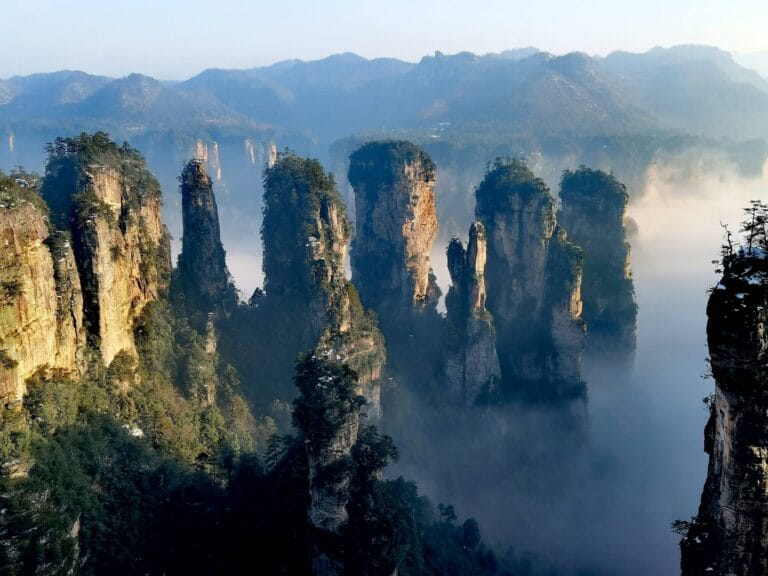
Jiuzhaigou vs Huanglong: Which One Should You Visit?
Jiuzhaigou is China’s most spectacular valley park — lakes, waterfalls, and Tibetan forest spread across three valleys over a full day. Huanglong is a 3.6km geological corridor you climb up to see, with terraced mineral pools that exist almost nowhere else on earth. They’re different enough that doing both beats choosing between them — but if you can only pick one, your answer comes down to altitude tolerance and timing.
We’ve been running tours in these area since 2006. This is the comparison we give our own clients.
Jiuzhaigou | Huanglong | |
|---|---|---|
Type | Valley park — 3 branching valleys | Single corridor — 3.6 km gully |
Time needed | 1–2 full days | Half a day (4–6 hours) |
Altitude | 2,000–3,100 m | 3,200–3,576 m |
Altitude sickness risk | Low for most people | Moderate to high |
Peak season | Late Sept – Oct (foliage) | June – Nov (pools full) |
Avoid | March–May (low water levels) | April–May (pools nearly dry — a common trap) |
Daily visitor cap | 41,000 (peak) | 25,000 (peak) |
Ticket cost (peak) | ¥280 (entrance + bus) | ~¥270 (entrance + cable car + cart) |
Foreign booking difficulty | High (Chinese app, phone required) | High (same system) |
Table of Contents
1. What You’re Actually Looking At
Most comparison articles treat these two parks as variations on the same theme — colorful high-altitude lakes in Sichuan. They’re not even close.
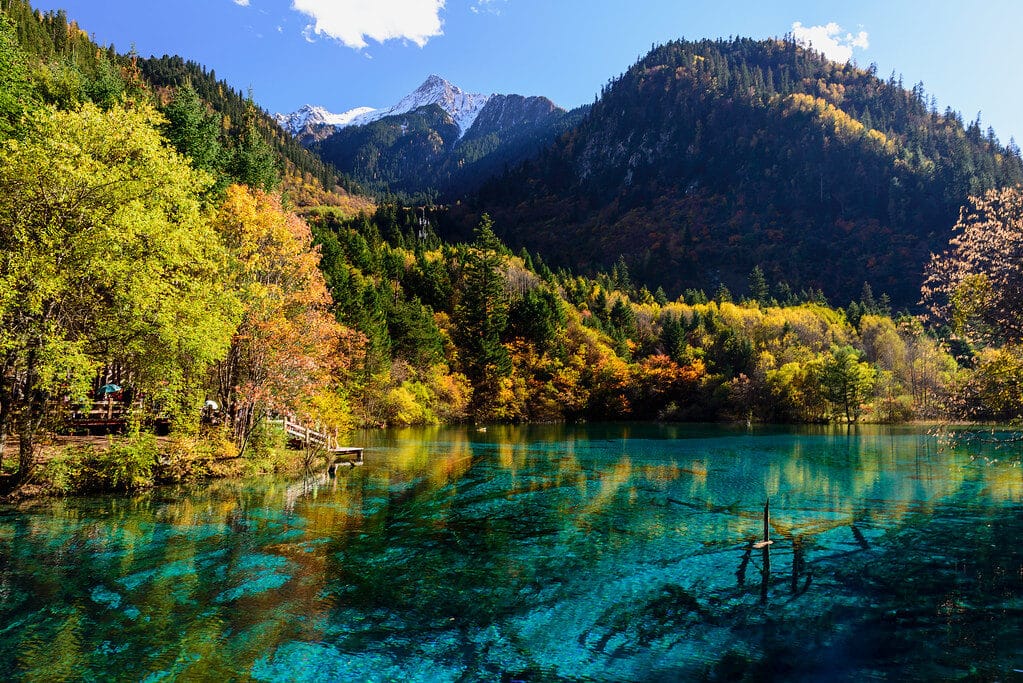
Jiuzhaigou is an immersive landscape you move through. Its three valleys — Shuzheng, Rize, and Zechawa — cover 720 square kilometers. You spend a full day on shuttle buses and boardwalks, moving between waterfalls, turquoise lakes, bamboo groves, and Tibetan villages. The light changes. The crowds thin. Around 10am at Five-Flower Lake, when the mist has just lifted and the bankside maples haven’t started reflecting yet, there’s a specific quality to the water that doesn’t photograph the way it looks. That’s Jiuzhaigou.
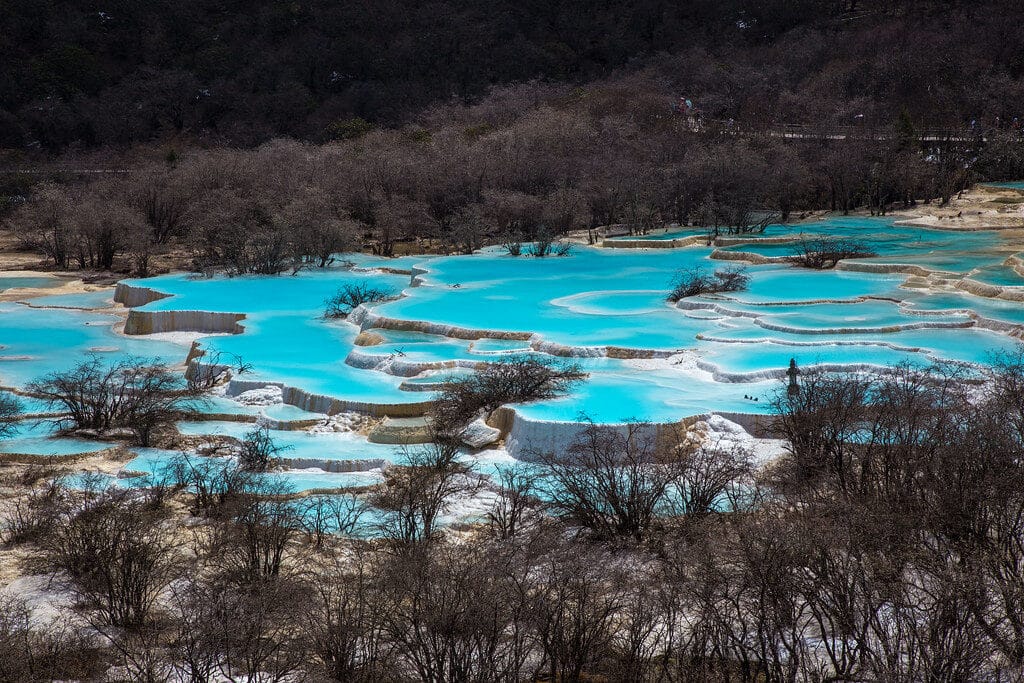
Huanglong is a geological phenomenon you climb up to see. A single valley, one trail, one direction. Spring water supersaturated with calcium carbonate loses CO₂ as it slows and cools, depositing limestone rims that grow millimeter by millimeter over centuries — the same mechanism as cave stalactites, but in open mountain air. After thousands of years of this, the result is 3,400 terraced pools stacked on top of each other, their water running blue, green, white, and gold depending on depth, algae density, and the angle of the sun on the limestone floor. At the top, the Five-Color Pond holds 693 individual pools at 3,576 meters. Nothing in Jiuzhaigou looks anything like this.
2. Altitude: Where Huanglong Earns Serious Caution
Altitude at key points — shaded band marks the 3,000 m+ altitude sickness risk zone
We’ve never had to arrange a medical evacuation from Jiuzhaigou for altitude sickness. We’ve had clients turn back at Huanglong.
Jiuzhaigou’s entrance is at 2,000 meters. The highest accessible point — Long Lake in Zechawa Valley — reaches about 3,100 meters. Most people feel nothing unusual. Older clients, clients with no altitude experience, people with mild respiratory issues — almost all of them manage a full day here without incident.
Huanglong sits at 3,200–3,576 meters throughout. The cable car drops you at around 3,400 meters. You still walk uphill from there. The altitude gain is constant and the air noticeably thinner. We see mild symptoms in roughly one in three clients: headaches, shortened breath, dizziness. We’ve watched ultra-marathoners struggle at Huanglong while their out-of-shape travel companions walked straight to the top.
Oxygen canisters are sold inside the park (¥15–30 each). Oxygen rooms along the trail offer free breathing for ¥2.5 per tube — use them. They work.
Anyone with heart disease, high blood pressure, diabetes, or respiratory conditions should not go to Huanglong without medical clearance. The warning sounds routine. At 3,576 meters, it isn’t.
Our standing rule: If you’re combining both parks, visit Jiuzhaigou first. Spend at least one night at Zhangzha Town altitude before you tackle Huanglong. And never do what package tours sometimes schedule — fly into JZH airport (elevation: 3,400 m) and go directly to Huanglong the same afternoon. The airport is already at altitude. Your body has not caught up.
One more risk nobody mentions: the Huanglong cable car closes when wind speed exceeds a threshold. It happens without warning, typically in late afternoon. If it closes while you’re near the top, the descent is roughly 1,000 steps, around 90 minutes of downhill walking at altitude. Brief yourself on this before you go in.
3. Scale and Time
Jiuzhaigou genuinely needs two days to do it properly. One long day is achievable, but rushed. The logic is specific: enter at 7:30am when the gate opens, take the shuttle to the far ends of Rize and Zechawa first, work downhill through the morning while crowds are still building at the entrance end. Our Jiuzhaigou Valley guide has the exact no-backtracking route.
Huanglong is a half-day. Take the cable car up, ride the golf cart the final stretch to Five-Color Pond, walk the boardwalk down. Four to six hours including all queuing. There is no reason to stay overnight near Huanglong.
4. Crowds: Where They Actually Hit You
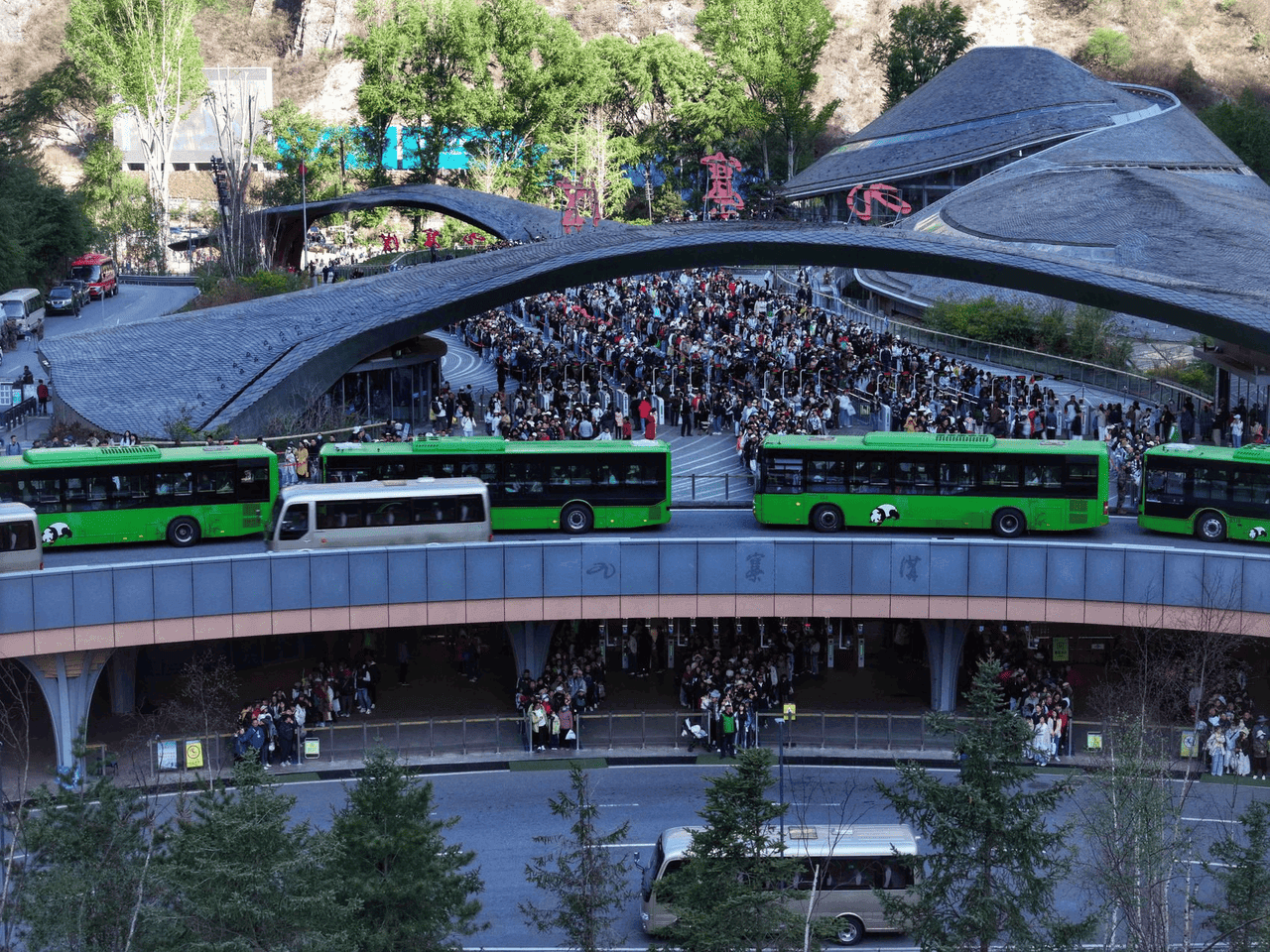
October at Jiuzhaigou is genuinely crowded — tens of thousands of domestic tourists, shuttle buses queuing, the most popular viewpoints feeling organized but dense.
Here’s our honest recommendation: late September beats October. Foliage is about 80% there. Crowds are roughly half. The air is slightly warmer. Our clients who visit late September consistently say they preferred it over what they’d been told about October’s peak.
At Huanglong, the crowd problem is specific: the cable car. On busy October mornings, the wait can reach 90 minutes. Getting there before 8am when the cable car opens makes an enormous difference. A client on one of our October tours queued at 7:45am and walked straight on. A colleague on a different tour arrived at 9am and waited over an hour for the same car.
5. Ticket Costs (2026)
Jiuzhaigou | Huanglong | |
|---|---|---|
Peak season | Apr 1 – Nov 15 | Jun 1 – Dec 15 |
Entrance | ¥190 | ¥170 |
Shuttle / cable car (up) | ¥90 (mandatory) | ¥80 (optional) |
VIP Shuttle | ¥300 (optional) | N/A |
Golf cart | — | ¥20 (limited, sells out) |
Peak total | ¥280 / person | ~¥270 / person |
Off-season | Nov 16 – Mar 31 | Dec 16 – May 31 |
Entrance | ¥80 | ¥60 |
Shuttle / cable car (up) | ¥80 | ¥80 (unchanged) |
Off-season total | ¥160 / person | ~¥140 / person |
The Jiuzhaigou sightseeing bus is mandatory — the full route cannot be walked. A second day in peak season costs another full ¥280; off-season re-entry is ¥20. At Huanglong, the downward cable car is purchased separately on-site.
The foreign visitor booking problem: Both parks require online advance booking. No walk-up counters. The official apps are in Chinese only, require a Chinese mobile phone number, and don’t accept foreign payment methods without workarounds. During October, Jiuzhaigou’s 41,000 daily cap fills weeks ahead. We’ve seen clients turn up without tickets and be turned away. Book through us or through a licensed agency that handles this; don’t rely on sorting it out at the gate.
6. Best Time to Visit Each Park
Month | Jiuzhaigou | Huanglong |
|---|---|---|
Jan | OK — frozen waterfalls, almost no crowds | ✕ Closed (ice) |
Feb | OK — cold, quiet, beautiful | ✕ Closed (ice) |
Mar | Avoid — low water, weak colors | ✕ Closed (ice) |
Apr | Avoid — lakes still low | ✕ Avoid — pools nearly dry |
May | OK — water refilling, light crowds | ✕ Avoid — still dry season |
Jun | Good — lush, full waterfalls | Good — pools filling |
Jul | Good — vivid; afternoon rain possible | Good — full pools; enter early |
Aug | Good — peak summer, some crowds | Good — full pools; enter early |
Sep ★ | Excellent — best value: 80% color, half the crowd | Excellent — full pools, early autumn |
Oct | Excellent — peak foliage, very crowded | Excellent — full pools + autumn; busy cable car |
Nov | Good — colors fading, crowds dropping | OK — early Nov still fine; closes mid-Dec |
Dec | OK — cold, frozen, empty | ✕ Closed (ice) |
Our pick: late September. Both parks are at their best and neither is at its worst for crowds. The October foliage hype is real — but late September gets you 80% of the color at half the people.
Jiuzhaigou in summer is underrated. Most clients who visit in July are as stunned as October visitors; they just don’t tell as many people because October has better PR. Bring a waterproof layer for afternoon showers.
Never visit Huanglong in April or May. We have seen the pools in late April — limestone terraces with only a thin sheen of water, the colors nearly gone. Visitors expecting the photos they’ve seen online are disappointed every time. Almost no travel article states this clearly enough, so we will: don’t go to Huanglong in spring.
Huanglong typically closes mid-December through March. Winter closure is standard — don’t plan around exceptions.
For complete Sichuan seasonal planning, our Sichuan weather guide and China travel seasons overview go deeper on month-by-month conditions.
7. Where to Stay
For Jiuzhaigou: Zhangzha Town, 1–2 km from the park entrance. Staying close to the gate matters more than people expect — a 30-minute taxi ride at 7:00am costs you the first hour of the park’s best light. The Banyan Tree Jiuzhaigou is the most upmarket option in a genuinely useful location. Mid-range Tibetan boutique hotels inside Zhangzha give you a more grounded experience than the international chain properties further out.
For Huanglong: There are no real hotels near the park. Most visitors do Huanglong as a day trip from Jiuzhaigou or from Chuanzhusi. The exception: if you’re visiting in peak season and need to queue at the cable car before 8am, spending one night in Chuanzhusi (25 km away, by the train station) removes the early morning transfer pressure.
Chuanzhusi is the practical hub for this whole region. The high-speed train station and the airport are both nearby. If you’re doing Huanglong first and Jiuzhaigou second, one night here on arrival makes the logistics clean.
8. Which One Should You Visit?

Start with Jiuzhaigou if you’re on your first trip to northwest Sichuan, traveling with family including older members or children, or carrying any altitude concerns. It’s also the right call if you only have time for one park. Nothing here requires you to be physically exceptional. The valley is accessible, well-organized, and enormous — a full day barely covers it.
The question for Huanglong is simpler: can you handle 3,400 meters and a real uphill walk? If yes, go — particularly if you’re visiting between June and November when the pools are full. It’s a half-day that punches well above its time cost. One thing no English article seems to mention: Huanglong feels genuinely free in a way Jiuzhaigou doesn’t. Jiuzhaigou is managed — fixed bus stops, prescribed routes, crowds concentrated at the same viewpoints. At Huanglong, it’s one trail, your own pace, and the option to linger at any pool you want. For travelers who find Jiuzhaigou’s organization slightly suffocating, Huanglong is the antidote.

There’s also a cultural layer most visitors miss entirely. Huanglong Temple, at the top of the valley near Five-Color Pond, is a Taoist temple over 600 years old. Every year around the fifteenth day of the sixth lunar month, Tibetan, Qiang, and Han pilgrims gather here for the Huanglong Temple Fair — one of the region’s oldest religious festivals. If your visit coincides with it, the atmosphere at the top of the valley is unlike anything in the parks below.
Do both if you have 4–5 days and are physically fit. The two parks offer completely different experiences — one doesn’t substitute for the other.
Our recommended combined route:
Day | Plan |
|---|---|
Day 1 | 🚄 Morning train from Chengdu East (~2 hrs) → 🏔 Huanglong in the afternoon (cable car up, walk down, ~4–5 hrs) → 🏨 overnight in Chuanzhusi |
Day 2 | 🌊 Full day in Jiuzhaigou — Rize & Zechawa valleys. Enter at 7:30am, go far first, work downhill. 🏨 Overnight in Zhangzha Town (stay close to the gate) |
Day 3 | 🌊 Second day in Jiuzhaigou — Shuzheng Valley & Five-Flower Lake in morning light. Depart afternoon |
Huanglong on arrival day means you go there fresh, before the cumulative fatigue of mountain days sets in. The acclimatization buffer you need for Jiuzhaigou builds naturally over the next two days.
See our China tour itinerary hub for complete Sichuan routes that fold in Chengdu and the panda bases.
9. Getting from Jiuzhaigou to Huanglong (and Back)
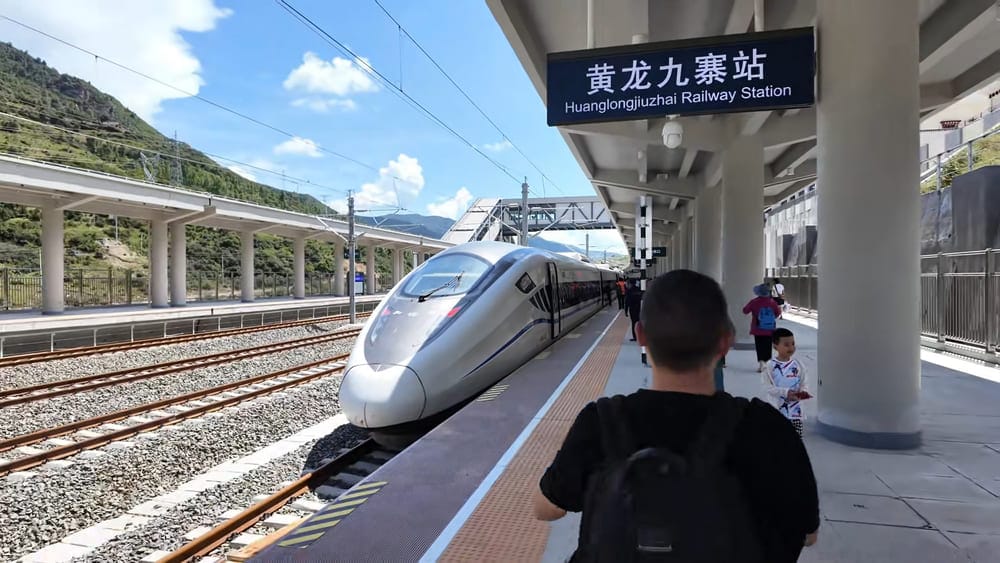
The parks are 110–144 km apart by road — 2.5–3 hours each way on winding mountain roads. Sit in the front if you’re prone to motion sickness.
Public shuttle bus | Private charter | High-speed train | |
|---|---|---|---|
Departure | 08:30 / 08:50 / 09:20 from JZG | Flexible | Multiple daily from Chengdu East |
Duration | ~2.5–3 hrs | ~2.5 hrs | ~2 hrs |
Cost | ¥62 | ¥200–400 | Varies |
Notes | Return buses until ~15:00 only | Best flexibility | Most reliable; JZH airport closes for weather |
The private charter is worth it on the Jiuzhaigou–Huanglong leg specifically. The road between the two parks is scenic, and a private car lets you stop at the Minshan mountain viewpoints along the way.
Flying into Chengdu first? Our Chengdu airport guide covers the Shuangliu vs. Tianfu decision. The panda bases guide helps you decide if a base day fits before heading northwest.
Explore all Sichuan attractions if you’re building a longer itinerary across the province.
FAQ – Jiuzhaigou vs Huanglong
What is the difference between Jiuzhaigou and Huanglong?
Jiuzhaigou is a large valley park — three branching valleys, 108 lakes, waterfalls, and Tibetan villages spread across 720 km², explored over one or two full days. Huanglong is a 3.6km mountain gully with terraced mineral pools stacked vertically up a single trail, done in half a day. The scenery types have almost nothing in common. Both are UNESCO World Heritage Sites.
Is Huanglong worth visiting?
Yes — with two conditions. Visit between June and November when the pools are full, and take the cable car rather than hiking the entire route up. Under those conditions, the Five-Color Pond at the top is one of the most unusual natural sights in China. In April or May, the pools are largely dry and it isn’t worth the trip.
Can you visit both Jiuzhaigou and Huanglong in one day?
It’s logistically possible but we don’t recommend it. The drive between the parks is 2.5–3 hours each way — add 6–8 hours of park time and you’re running from dawn to dark, doing neither place properly. Split them across two days.
Which park is better in autumn?
Both peak in autumn. Jiuzhaigou’s foliage is most vivid from late September through mid-October. Huanglong’s pools are full June through November and the mountain scenery is best in autumn light. If you have to choose a single window, late September covers both: Jiuzhaigou foliage is coming in, the pools at Huanglong are still full, and crowds at both parks are notably smaller than in October.
Is Huanglong suitable for elderly travelers?
Health matters more than age here. The altitude (3,200–3,576 m) is the real variable, not years. Fit seniors with no heart, blood pressure, respiratory, or diabetes issues manage fine when they take it slowly, use the cable car, and carry oxygen. Anyone with those conditions should not visit Huanglong without asking their doctor first. Jiuzhaigou’s altitude (up to 3,100 m) is much more manageable and accessible for nearly all seniors.
Where should I stay when visiting both parks?
Base yourself in Zhangzha Town, 1–2 km from Jiuzhaigou’s entrance — staying close to the gate matters for early entry. For Huanglong, nobody stays inside the park; it’s done as a day trip. If you’re visiting Huanglong on arrival day from the train station or airport, one night in Chuanzhusi (near the station, about 25 km from Huanglong) makes the logistics cleaner.
When should I avoid Huanglong?
April and May for obvious reasons — the pools drain. But there’s a second timing trap people miss: don’t enter late in the afternoon, especially in summer. Huanglong sits at over 3,500 meters and afternoon thunderstorms roll in fast, often by 3pm in July and August. When the boardwalk gets wet, it gets genuinely slippery. The cable car also stops operating in strong wind, which tends to pick up in the afternoon. Start early — ideally through the gate by 9am — so you’re walking downhill and approaching the exit well before the weather turns.
Do I need a tour guide at either park?
Neither park requires a guide. That said, a guide at Jiuzhaigou is worth having — the park’s valley logic isn’t obvious, and knowing which direction to start, which lakes to catch at which time of day, and when specific viewpoints clear of crowds makes a real difference. Huanglong is a single trail and navigates itself.
If you’re trying to fit both parks into 4–5 days from Chengdu, that’s a route we’ve run with clients more times than we can count. The train from Chengdu East, the Huanglong-first sequencing, the private transfer between parks — we know where the logistics get messy and how to make them clean. Tell us your dates and we’ll put together a specific proposal.