
Xingping Travel Guide: Both Riverbanks, Ferries & What to Do
This Xingping travel guide covers both sides of the Li River, since most visitors only ever see one. The near bank — Xingping’s own side — holds the old town, the 20 RMB viewpoint, and Laozhai Hill, all free or cheap and walkable. Across the river sits a separate cluster of viewpoints: Xianggong Mountain, Qianli Jiangshan Tu, and a few spots not worth the detour. No bridge connects the two sides. What follows covers both sides, the ferries between them, and how to route a visit — half a day, a full day, or two.
Table of Contents
1. How Xingping Actually Breaks Down

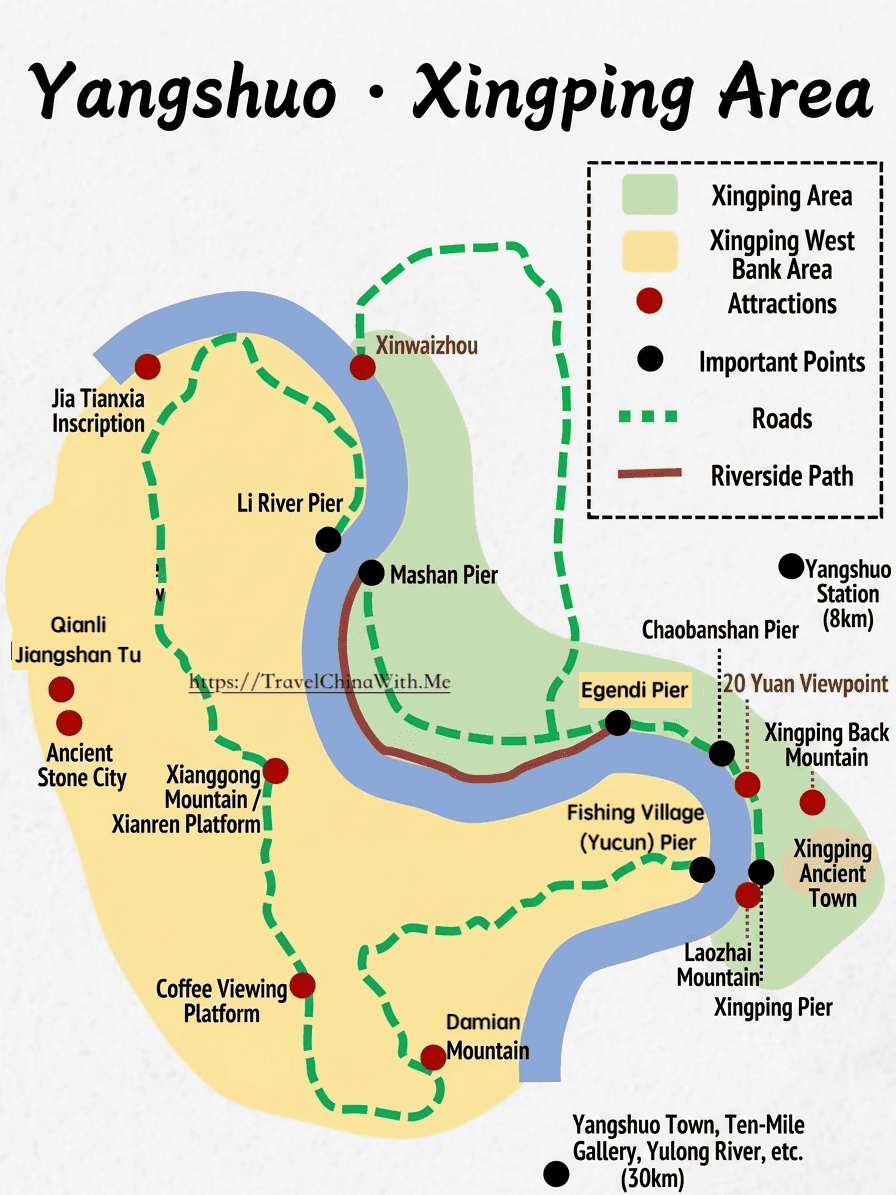
Everything in this guide sits along one stretch of the Li River, split into two sides with no bridge between them. The near bank runs north from Laozhai Hill, past the old town, the 20 RMB viewpoint, and the main piers — compact, mostly free, and walkable. The far bank holds Xianggong Mountain, Qianli Jiangshan Tu, and a few minor spots. All are ferry-only, and spread too far apart to walk between.
We route clients through the near bank first, almost always. The far bank rewards the effort: better light, thinner crowds, a tighter angle on the river’s big bend. But it takes real planning. There’s no bridge, the ferries run on no fixed schedule, and the viewpoints sit far enough apart that a car matters.
One thing worth knowing before you go: the riverside road near the wharf gets genuinely crowded and dusty during peak season. If your time in Xingping is short, we’d rather flag that now than have you discover it on arrival.
2. Things to Do in Xingping
This is the core of the Xingping travel guide — everything worth doing on both banks, roughly in the order most visitors reach it.
Xingping Ancient Town
Xingping Ancient Town is free to enter. A full loop of its old streets takes 30 minutes at walking pace, or 1.5–2 hours if you actually stop to look. That gap is where most first-timers go wrong, treating the town as a 15-minute stop between the bus and the wharf.
The three streets

The old town runs along three parallel streets. Old Street (老街) holds the genuinely old buildings — grey brick, grey tile, worn flagstone. New Street (新街) is “new” only by local standards, its wooden-fronted houses a century old rather than several. Hunan Street (湖南街), the least visited, is named for a long-vanished merchant guild hall. Nothing marks its original site today beyond an inscribed stone in the pavement.
The Wannian Stage
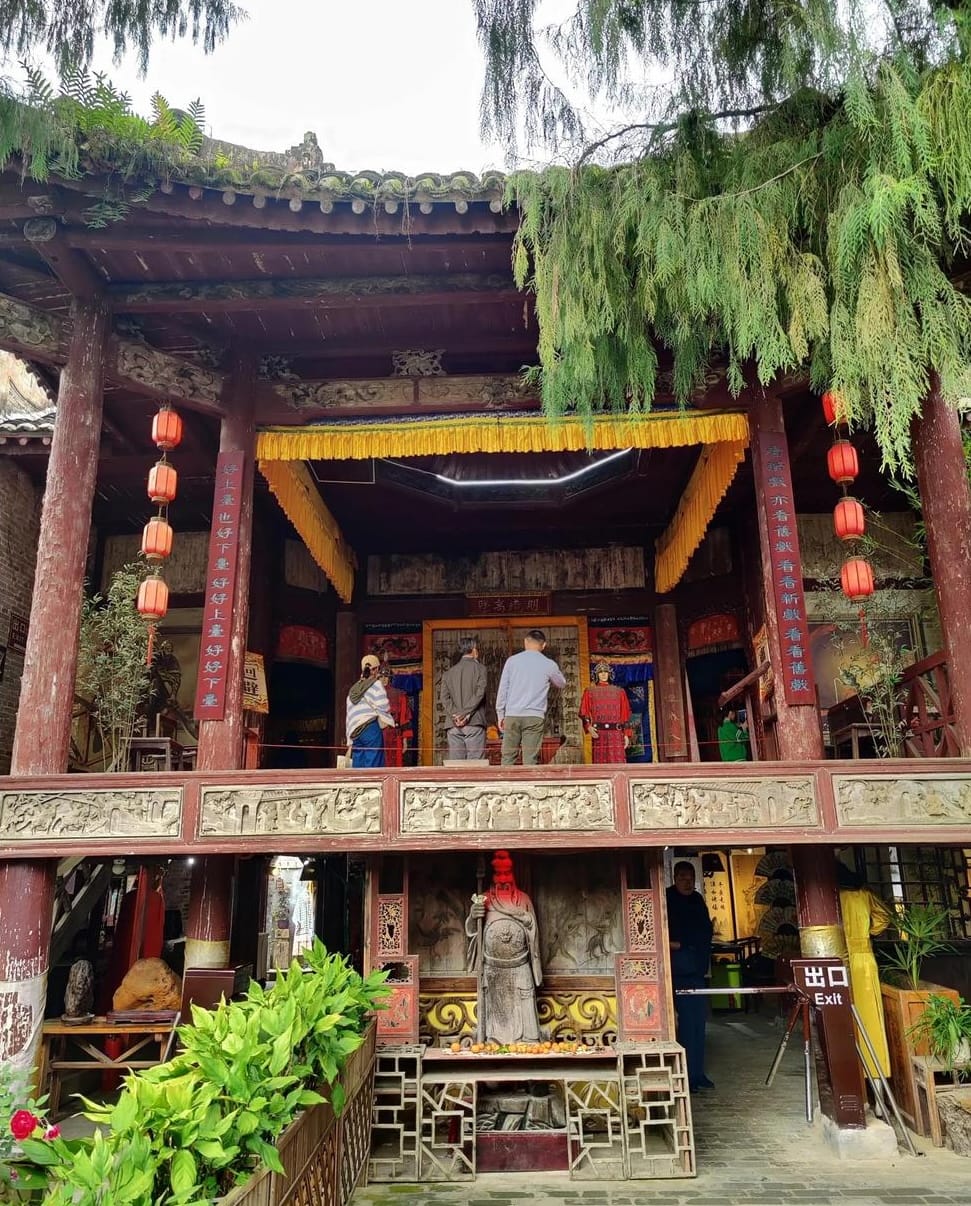
On Rongtan Street stands the Wannian Stage, a brick-and-timber opera stage built in 1739, the fourth year of the Qianlong Emperor’s reign. The carved pillars show real slash marks from prop weaponry used across centuries of Gui opera and Peking opera performances. Captions inside are Chinese-only, so this rewards knowing the background before you arrive. An elderly caretaker sometimes collects a token CNY 1 donation for photos — a long-standing local custom, not an official fee.
What we’d skip, and the history behind the town
The main drag has grown more commercial each year — souvenir stalls and photo-studio Hanfu rentals now dominate the storefronts closest to the wharf. Turn off into the smaller side lanes instead. The crowds thin fast, and you’ll find working bamboo-craft workshops and residents going about ordinary mornings — none of it staged.
Xingping’s history explains why the town feels denser than a typical riverside village. It was established as the seat of Xiping County in 265 AD, during the Three Kingdoms period, and governed the wider Yangshuo area until 590 AD. This was a town built to administer territory, not one that simply grew up around river trade.
The 20 RMB Viewpoint

The scene on the back of China’s 20 yuan note is Yellow Cloth Shoal (黄布倒影). It’s a stretch of river near Xingping’s wharf where karst peaks reflect onto pale, gold-toned shallows. It’s a 15–20 minute walk from the old town — just follow the crowds toward the pier.
The roadside viewpoint everyone stops at is fine, if crowded, but it isn’t the exact banknote angle. That angle requires being on the water, which is what the bamboo raft below is for. The scenic area’s own managed platform near the dock charges a fee for its unobstructed photo spot. Walk further along the public riverbank instead and the view is free — just not the exact roped-off framing.
Best light is early morning (6:00–7:00) or late afternoon (16:00–17:00) — midday sun flattens the mountains and blows out the reflection. Misty spring and autumn mornings produce the ink-wash effect the scene is known for.
Li River Bamboo Rafting
Getting on the water is what turns Xingping from a photo stop into an actual half-day. It’s also the piece most first-timers underbudget, after the old town and the 20 RMB viewpoint have already eaten a morning.
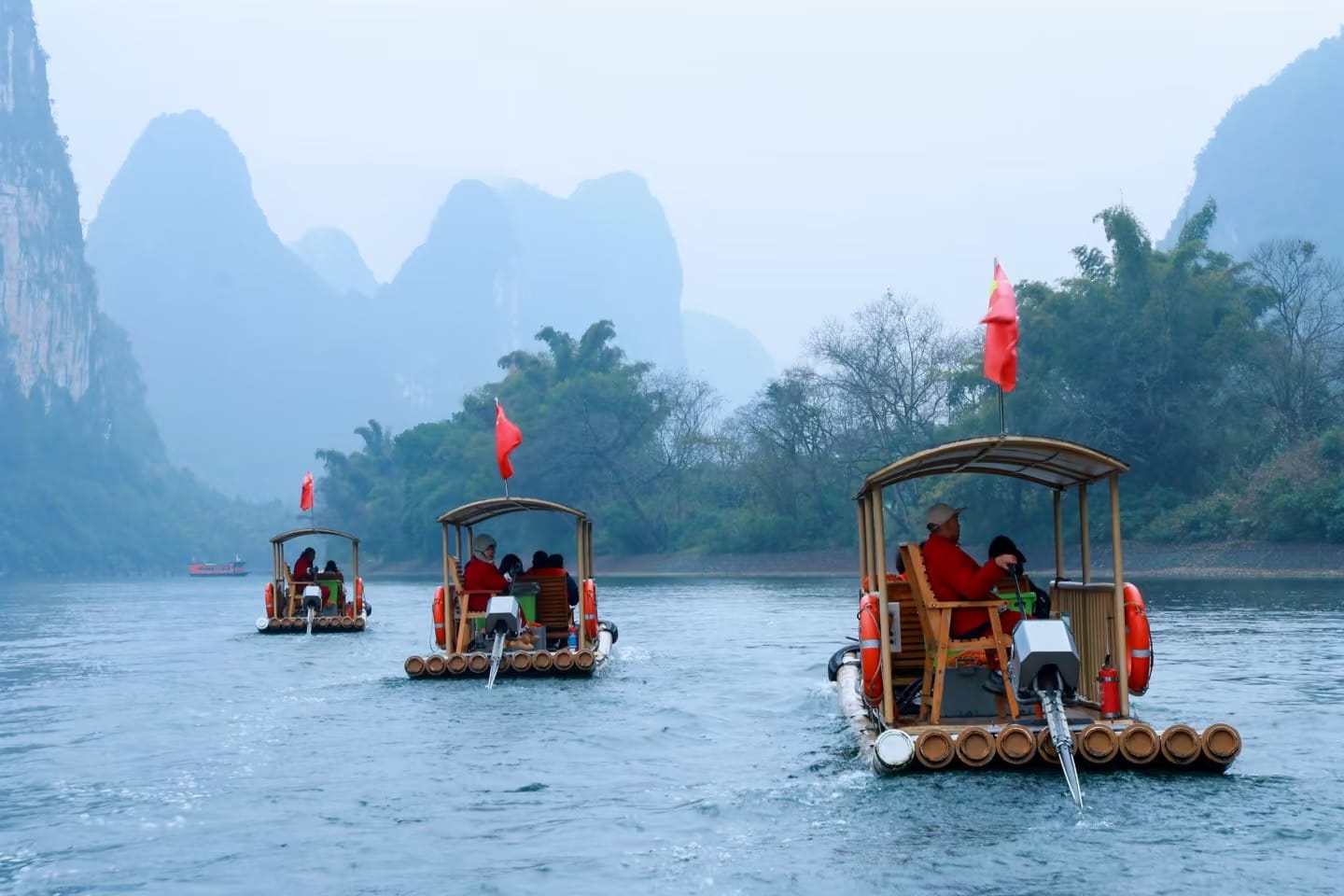
Two routes, two piers
Xingping–Jiuma (return) | Xingping–Yangdi (one way) | |
|---|---|---|
Price | CNY 140/person | CNY 225/person |
Duration | ~40–60 min | ~2 hours |
Departs from | Chaobanshan Pier, Xingping | Chaobanshan Pier, Xingping |
Route | Out to Nine Horse Fresco Hill and back | The full 14km “essence section” upriver to Yangdi |
Covers | The 20 RMB angle and Nine Horse Fresco Hill | Yellow Cloth Shoal, Nine Horse Fresco Hill, and the named karst formations along the way |
Both leave from Chaobanshan Pier at the edge of Xingping — a different dock from Xingping Wharf, where the sightseeing cruise and the village ferries load. Piers run 8:00–17:00, with ticket sales stopping at 17:00. The same routes can also be run in reverse from Yangdi Pier, a 40–60 minute road transfer upriver from Xingping.
Three things that catch people out
- Height and age limits. Small children and older travelers may not be able to board — exact cutoffs vary by operator, so confirm before you pay.
- The empty-seat fee. Rafts seat four and only depart full. Couples and solo travelers may pay extra for unused seats unless a group booking pairs you up.
- Weather closures. Rafts are open-topped and can’t run in storms, a real risk in the June–August rainy season.
If any of these could affect your trip, the Xingping Fishing Village Cruise has none of these restrictions and is the standard fallback. → Our full Li River Bamboo Rafting guide covers the exact height cutoffs, current empty-seat pricing, and how to avoid it.
Which one to book
For most visitors the Xingping–Jiuma return raft is enough: it covers the 20 RMB angle and Nine Horse Fresco Hill in under an hour, at CNY 140. Take the one-way run up to Yangdi (CNY 225, ~2 hours) if the river itself is the point of your day and you haven’t done the Guilin–Yangshuo cruise. It covers the full essence section, but you finish at Yangdi and need transport back. Don’t confuse either with rafting on the Yulong River — a different, calmer tributary further south near Yangshuo town, covered in our separate Yulong River guide. → Our full Li River Bamboo Rafting guide covers every route, current pricing by segment, and booking mechanics.
Laozhai Hill
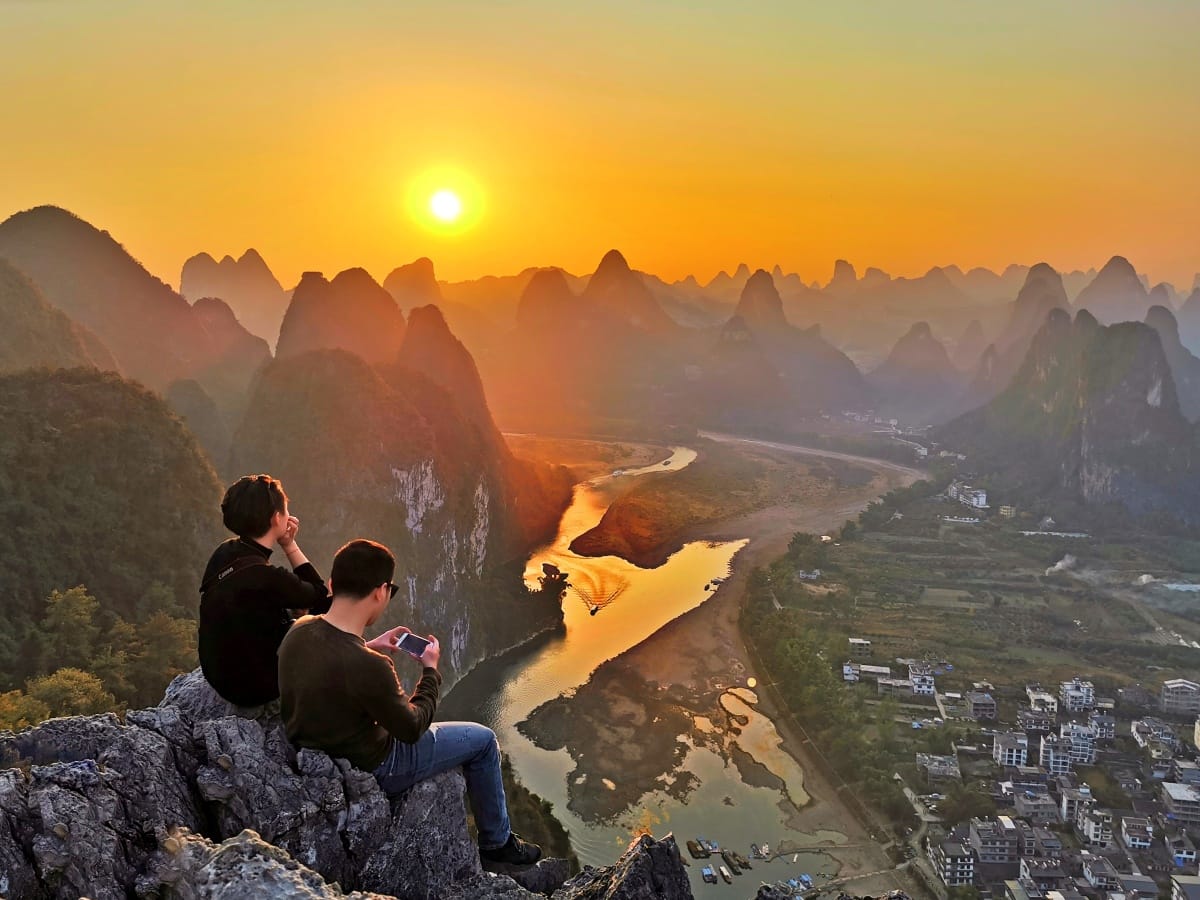
Laozhai Hill is the one genuinely free, high vantage point on the near bank, its trailhead a short walk from the wharf near Wuqi Coffee. The full return trip runs about 1.5 hours, and the trail is genuinely steep — this isn’t a casual stroll.
Arrive by 5:30–6:00 for sunrise if you want summit space; it fills fast on clear mornings, and Golden Week or Spring Festival can mean a scramble even for the small pavilion at the top. Sunset draws noticeably fewer people for a similar view.
→ Our full Laozhai Hill guide covers the climb stage by stage, what to wear, and where the exposed sections are.
Three Far-Bank Viewpoints: Xianggong Mountain, Damian Mountain & Qianli Jiangshan Tu
These three viewpoints are the reason to cross the river at all. They show genuinely different things — worth knowing before you commit a pre-dawn wake-up to one.
Xianggong Mountain

Xianggong Mountain sits between Yellow Cloth Shoal and Nine Horse Fresco Hill, directly overlooking what’s often called the Li River’s first great bend. The public ferry between Mashan Pier and Lijiang Pier doesn’t run before roughly 8:00 — well after sunrise — so which route gets you there depends entirely on what time you’re going.
During the day, cross on the public ferry, then take the official sightseeing cart from Lijiang Pier to the ticket office — CNY 40/person round trip. Budget CNY 105 per person all in: CNY 5 ferry, CNY 40 cart, CNY 60 ticket.
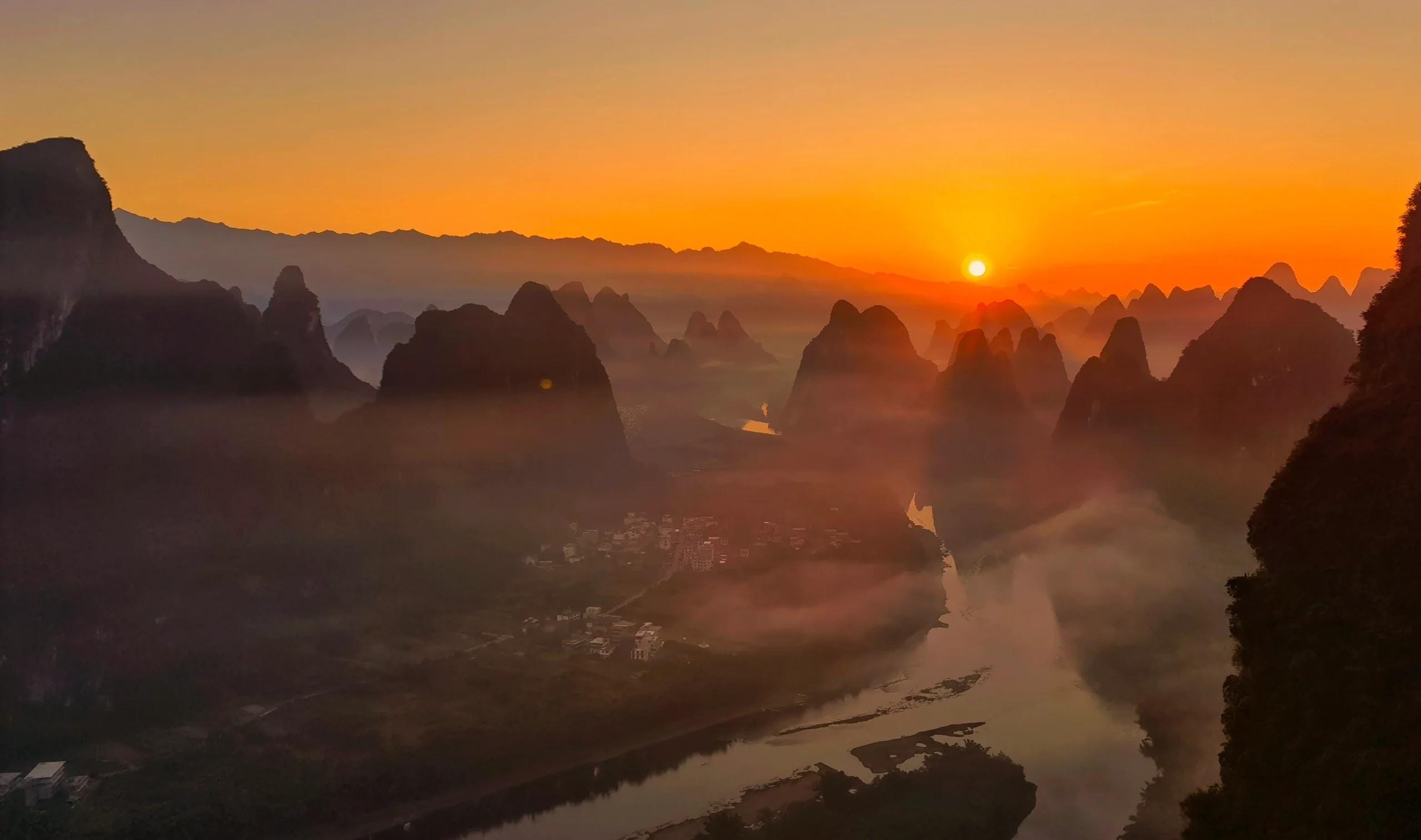
For sunrise, the public ferry isn’t an option. The standard approach is a private car-pool service arranged directly with a local driver. The driver meets you at Xingping Wharf around 4:30–5:00am, takes you across by private boat, then drives you to the ticket office. This runs CNY 50/person, ferry and cart included, plus the CNY 60 ticket separately. A private charter, useful for larger groups, runs from Mashan Pier instead — around CNY 110 for the boat and car combined, ticket not included. This can work out cheaper than a Xingping Wharf quote, but you’re negotiating the price yourself. Either way, book the night before: spots fill fast in high season, and the ticket office itself sees queues from 5:00am, with the best photo positions gone within minutes of the gate opening. We generally arrange this for clients rather than have them negotiate a pre-dawn price with a stranger at the pier — worth asking us to handle if a Xianggong Mountain sunrise is on your list.
This is the tighter, more dramatic angle of the two — the river coiling close beneath sharp karst peaks. Most visitors come for sunrise, when mist still sits on the water, though the scenic area also runs an official sunset shuttle package, so it’s not purely a sunrise spot. → Our full Xianggong Mountain guide covers the climb and photography timing in detail.
Damian Mountain

Most visitors to Xingping never cross the river to find this one, which is exactly its appeal. Damian Mountain looks straight down onto the Li River’s 180-degree “sickle bend” — a wider, more dramatic angle than Xianggong Mountain, from a summit with no cableway and no managed crowd system.
The trade-off is the climb: a steep, unmaintained trail with iron ladders near the top, no railings on much of the summit’s open rock face. This isn’t for families with young kids or anyone uneasy with exposure — Xianggong Mountain, with its managed steps and railings, is the better call for that. But for hikers and photographers who’ve already done Xianggong and want a quieter, wider version of the same river bend, this is genuinely one of the best views in the area.
Getting there mirrors Xianggong Mountain’s logistics: ferry across from Xingping Wharf to Dahebei Village (CNY 5), then a private cart to the trailhead (CNY 20–40 return), then a CNY 20–30 village trail fee. Budget CNY 50–80 per person all in, plus 60–80 minutes of steep climbing — noticeably harder than Xianggong’s 15–20 minutes. → Our full Damian Mountain guide covers the trail stage by stage, including the ladder section.
Qianli Jiangshan Tu (千里江山图)

Qianli Jiangshan Tu — “A Thousand Miles of Rivers and Mountains” — is free and shows the opposite kind of view. Distant, layered mountain silhouettes fade toward the horizon like a folding screen, closer to a classical ink-wash landscape than a close river bend. It’s a short walk or e-bike ride from Lijiang Pier, with no ticket booth and no fixed hours. → Our Qianli Jiangshan Tu guide covers access and timing in full.
A free alternative sits nearby: Xianrentai, an unofficial viewpoint that skips Xianggong Mountain’s CNY 60 ticket entirely for a near-identical view of the same bend. It’s not marked or maintained, so it won’t suit everyone, but budget-conscious travelers who don’t need the official platform’s railings and signage can save the ticket price here.
Which to pick
If it’s your first viewpoint on the far bank, start with Xianggong Mountain. It’s the easier climb, and the scenic area runs both a sunrise and a sunset shuttle package if you want to try either. If you’ve already been and want the same river bend from a wider, quieter angle, Damian Mountain is the upgrade, provided the iron ladders don’t rule it out for your group. Qianli Jiangshan Tu is worth adding for a calmer, no-climb sunset alternative.
What’s Not Worth the Detour
Not everything on the far bank earns the trip, and we’d rather say so directly than let clients burn half a day finding out.
The “Guilin’s Scenery Is Best Under Heaven” stone (甲天下石碑) is a small roadside monument near Lijiang Pier, popular as a photo backdrop. It’s a recent, unremarkable structure, and the surrounding scenery doesn’t differ from any other stretch of nearby riverbank. Only worth a stop if it’s directly on your route to somewhere else.
Gushicheng (古石城) is an abandoned stone village, built entirely from stacked stone, with no clear historical record of when or why. It’s a genuine curiosity but a real detour. Drive to the relocated new village along the road, then walk uphill 20 minutes with no marked trail, often asking locals for directions. A resident may ask a small informal fee, commonly cited at CNY 10, to let you through. This isn’t an official charge and isn’t consistent — treat it as a possibility rather than a fixed cost. Worth it only if you’re already self-driving nearby with time to spare.
Houshan (兴坪后山) sits directly behind the old town, a minor and little-visited viewpoint. The outlook is real but less dramatic than Laozhai Hill, which is closer to town and free. We don’t route clients here unless Laozhai is closed or unusually crowded.
A coffee-shop terrace nearby offers a similar view over the peaks while you sit and order. It’s a relaxed way to take in the scenery if you’re already in the area, often paired with a Xianggong Mountain trip since it’s close by.
3. Crossing to the Far Bank
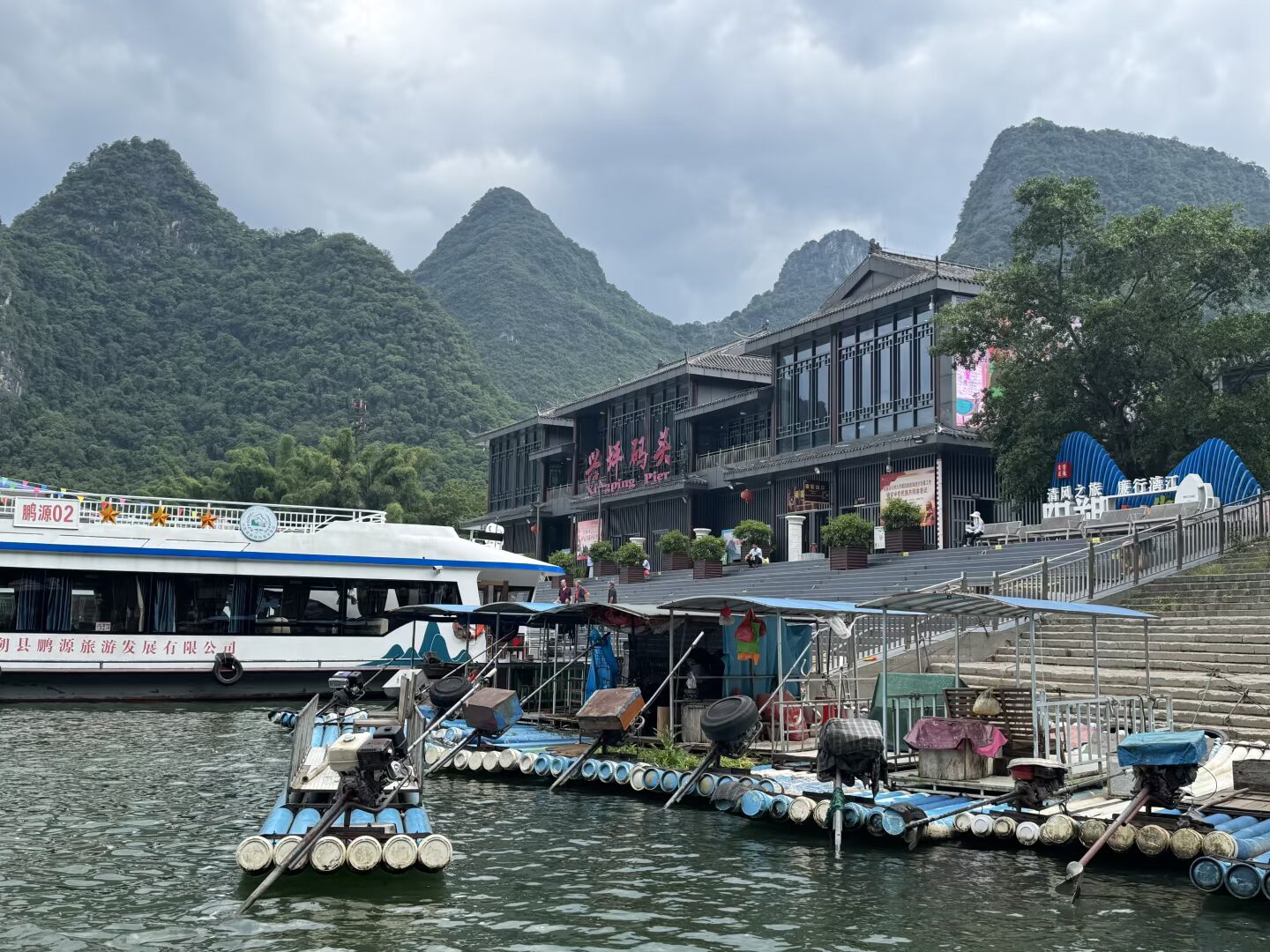
No bridge crosses the Li River anywhere near Xingping, which is the single fact that shapes how the far bank actually gets visited. Getting across means a private ferry — not a scheduled boat, but one that runs whenever there are passengers waiting to justify the trip. The crossing itself takes about 2 minutes; the only land alternative is a 1.5–2 hour drive looping around by road, which is why almost nobody does it that way.
Self-driven cars can’t board the ferry — only passengers, e-bikes, and small carts cross. If you’re driving yourself, plan the near and far banks as separate outings on separate days, or park and cross on foot.
Near-bank pier | Far-bank pier | Fare | Connects to |
|---|---|---|---|
Xingping Wharf | Dahebei Village | CNY 5/person, CNY 10/e-bike | Xingping Fishing Village, Damian Mountain |
Mashan Pier | Lijiang Pier | CNY 5/person, CNY 10/e-bike | Xianggong Mountain, Qianli Jiangshan Tu |
Xingping Wharf is actually two adjacent docks, easy to mix up. The larger one handles the sightseeing cruise boats; the smaller one, a short walk further along the bank, is where the private passenger ferries actually load.
Once across, the far bank has its own transport layer for reaching Xianggong Mountain and Qianli Jiangshan Tu. Options include rental e-bikes at either landing (CNY 30–50), or a private car from a local driver — CNY 40–50/person round trip for one viewpoint, CNY 50–70/person for both, generally negotiable. Prices are similar at both landings.
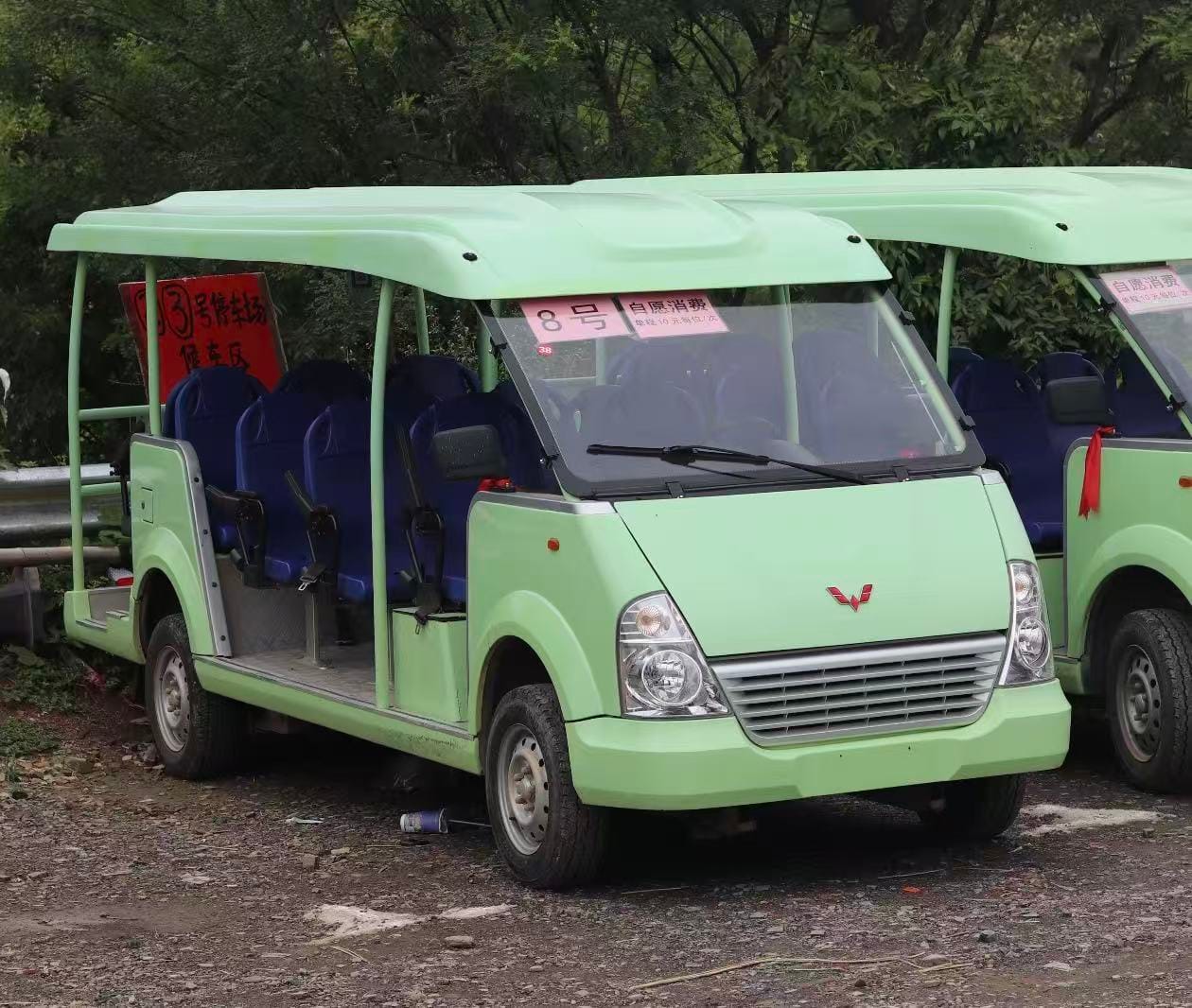
During holidays and summer, a ferry is essentially always waiting at both crossings — but not before roughly 8:00am. If sunrise on the far bank is the goal, the public ferry won’t get you there in time; see the Xianggong Mountain section above for how that’s actually arranged.
A 4km paved riverside path runs north from Mashan Pier, walkable or ridable by rented e-bike. Egendi Pier sits about halfway along this stretch, where the path first reaches the riverbank proper. Bamboo lines one side, open river the other, and it draws noticeably fewer people than the old town. From Mashan Pier back to Xingping Ancient Town, the official sightseeing shuttle runs CNY 15–20/person over 5.5km. Shorter hops along this stretch are quoted at the same flat rate, so walking is often better value unless you’re carrying luggage.
4. Getting to Xingping, and What’s Nearby
Four routes reach Xingping, and which one makes sense depends on where you’re starting and whether time or scenery matters more.
From | Method | Cost | Time |
|---|---|---|---|
Yangshuo West Street | Bus from Yangshuo Bus Station | CNY 10–16/person | 40–90 min |
Yangshuo West Street | Taxi/ride-hailing | CNY 60–80 | 25–40 min |
Yangshuo Railway Station | Direct shuttle bus | CNY 5–10/person | 15–36 min |
Yangshuo Railway Station | Taxi/ride-hailing | CNY 20–35 | 15–30 min |
The Yangshuo high-speed rail station sits inside Xingping township — 8km from Xingping Ancient Town, but 30km from Yangshuo’s West Street in the opposite direction. Travelers arriving by train expecting to step directly into Yangshuo town are routinely caught out by this. We route arriving clients through Xingping first when it fits their itinerary, rather than backtracking to cover the same distance twice.
Paying for things in Xingping
Xingping runs on mobile payment more completely than most foreign visitors expect. The village ferries, the sightseeing carts on the far bank, and the smaller old-town shops all default to WeChat Pay or Alipay, and some will have no cash float to break a large note. Set up mobile payment before you arrive, and carry small notes as backup — CNY 5, 10 and 20 cover the ferry, the carts, and street snacks. Foreign cards work at the larger scenic-area ticket windows but not reliably anywhere else.
English is thinner here than in Yangshuo town. Ticket windows at Xianggong Mountain and the raft piers manage basic transactions, but the ferry operators, cart drivers, and most restaurants do not. A translation app that works offline is worth having, since mobile signal drops on parts of the far bank.
If your trip extends into Yangshuo proper
Two more activities regularly get grouped with a Xingping visit but actually sit near Yangshuo town, not Xingping itself, and are worth knowing about even though they’re outside the scope of this guide. Yulong River bamboo rafting launches from piers well south of Xingping, near Yangshuo — see our dedicated Yulong River guide for routes and pricing; it’s a separate river from the Li River raft covered above. Impression Liu Sanjie, Zhang Yimou’s open-air night show staged on the Li River itself, performs at a theater closer to Yangshuo town. → Our guide to Zhang Yimou’s Impression shows covers what to expect and how it compares to his other productions.
5. Best Time to Visit Xingping
Spring and autumn are the two windows worth planning around. March–May brings the mist that produces the ink-wash effect on the river, along with the highest chance of a sea of clouds from Xianggong Mountain after overnight rain. September–November is drier and clearer, with the most reliable sunrise conditions and comfortable temperatures for climbing.
June–August is hot, humid, and the peak of the rainy season — this is when raft closures and sudden downpours are most likely, though high water also makes the river fuller and greener. Winter brings low water levels, which affects some boat operations, and thinner crowds everywhere.
Xingping Climate by Month
30-year averages, 1991–2020
Source: weather-and-climate.com — Yangshuo climate averages (Foreca / Copernicus C3S)
The numbers make the case clearly. June is both the hottest lead-up and the wettest month (341mm of rain), while January is coldest and December driest (64mm). Every month from May to September stays warm, but May and June alone bring nearly a third of the year’s total rainfall. April and October sit in the gap — warm enough for comfortable sightseeing, past the heaviest spring rain, and short of summer’s peak downpours.
Avoid Chinese public holidays entirely if you have the choice. During October Golden Week and Spring Festival, Laozhai Hill’s summit becomes standing-room only, ferries queue, and the riverside road fills with traffic control. → Our Guilin-Yangshuo rainy season guide covers month-by-month rainfall and what actually gets cancelled.
6. Where to Stay in Xingping

Should you stay overnight?
Stay overnight if a sunrise matters to you. Xianggong Mountain sunrise means a 4:30–5:00am pickup by car-pool, and Laozhai Hill’s sunrise climb starts in the dark — both are impractical as day trips from Yangshuo town, 25km away. Xingping also empties out after the day-trippers leave in late afternoon, and the old town at dusk is a genuinely different place from the one people photograph at midday.
Skip the overnight if you’re only after the 20 RMB viewpoint and a walk through the old town. Yangshuo town has far more choice for dinner, nightlife, and accommodation, and a half-day trip out to Xingping covers the essentials comfortably.
Which side to book
Accommodation in Xingping itself is mostly small guesthouses and family-run places rather than international hotels, with a handful of mid-range options near the wharf. Rooms with genuine river or karst views command a premium and book out first in peak season.
Two location decisions matter more than the property itself. Staying inside the old town puts you within walking distance of the 20 RMB viewpoint, the Laozhai Hill trailhead, and Xingping Wharf, where the pre-dawn car-pool to Xianggong Mountain picks up. This is the right choice for either sunrise or sunset plans. Staying on the far bank, near the ferry crossing, only makes sense if you’re not chasing an Xianggong Mountain sunrise, since the car-pool departs from the near bank regardless of where you sleep.
7. What to Eat in Xingping

Beer fish (啤酒鱼) is the dish Xingping and Yangshuo are both known for. Live Li River carp is fried in local tea oil, then braised with Guilin beer until the sauce reduces to something worth spooning over rice. Several kitchens on New Street trace their cooks back to the chefs who established the technique.
The practical advice is about where, not what. Restaurants facing the wharf with English menus and photo boards are priced for tour groups who won’t return. Walk a block back into New Street or the residential lanes, look for places filled with Chinese families rather than tour groups, and both the price and the cooking improve noticeably.
Two things are worth trying beyond the fish. Sour pickled fruit and vegetables (酸嘢) are sold from glass jars at street stalls — green mango, guava, radish and papaya, tossed with chili, salt and licorice powder. They taste sharply refreshing in Guangxi’s summer heat. Pine flower candy (松花糖) is a local sweet, best eaten in town rather than packed home.
If you’re staying overnight, the morning market near the wharf runs 6:00–9:00 and sells breakfast at local prices, before the day’s tour buses arrive.
8. A Real Two-Day Itinerary
Everything in this Xingping travel guide comes together in a real route. This is close to what we ran this March for an American family: Shalom, his wife, and their 10-month-old son, on a multi-day Guilin-Yangshuo trip. Shalom is a photographer, and Xingping’s sunrise and sunset viewpoints were the specific reason this leg of the trip was built around two full days rather than a rushed single stop.
Day one — near bank
Arrive in Xingping late morning, walk Old Street and New Street, stop at the Wannian Stage, and reach the 20 RMB viewpoint by early afternoon. Late afternoon, climb Laozhai Hill for sunset — the free option and the easier climb with a young child in tow. Overnight in Xingping.
Day two — far bank
A car-pool driver picked the family up at Xingping Wharf around 4:45am, crossed by private boat, and drove them straight to the Xianggong Mountain ticket office for sunrise. In spring conditions, arrive by 5:00–5:30 to claim platform space before the crowd. After breakfast back in town, add a shorter stop at Qianli Jiangshan Tu on the way back across — reachable that day by the public ferry, since by then it’s running. The free viewpoint requires far less climbing than Xianggong, which suits a family still recovering from a pre-dawn start.
We recommend this two-day structure whenever sunrise and sunset both genuinely matter to a client. Compressing both into a single day means skipping one entirely, and the ferry and shuttle timing rarely cooperates with that kind of rush.
late morning
early afternoon
sunset
4:30–5:00am
sunrise ~5:00–5:30
back in town
FAQ: Xingping Travel Guide
Is Xingping Ancient Town free to enter?
Yes, walking the old town costs nothing — there’s no ticket booth and no admission fee. What costs money in Xingping is getting onto the water or across it: the bamboo raft, the sightseeing cruise, the ferry, and the CNY 60 ticket at Xianggong Mountain on the far bank.
Can I take the ferry to Xianggong Mountain for sunrise?
No — the public ferry between Mashan Pier and Lijiang Pier doesn’t start until around 8:00am, well after sunrise. Getting there for sunrise means a private car-pool arranged the night before, typically picking up at Xingping Wharf around 4:30–5:00am and covering the boat crossing and the ride to the ticket office together. We arrange this directly for clients rather than have them negotiate a pre-dawn price with a local driver at the pier.
Is Damian Mountain better than Xianggong Mountain?
They suit different travelers. Xianggong Mountain has a managed trail, railings, and a 15–20 minute climb — the right choice for first-timers or families. Damian Mountain shows a wider angle on the same river bend, but the trail is steep and unmaintained, with iron ladders near the summit. It suits hikers who’ve already done Xianggong and want a quieter, more dramatic version of the same view.
Is Xianggong Mountain better than Laozhai Hill?
They aren’t real substitutes. Laozhai Hill is free and sits at the edge of the old town, looking over the bend from the near bank. A daytime visit to Xianggong Mountain works out to CNY 105 once ferry and cart are counted. A sunrise visit costs more, since the public ferry doesn’t run early enough and a private car-pool is required instead. Photographers often do both on separate mornings rather than choosing.
Which viewpoint is best for sunset?
Xianggong Mountain does both — the scenic area runs an official sunset shuttle package alongside its sunrise one, though most visitors go for sunrise. Laozhai Hill on the near bank and Qianli Jiangshan Tu on the far bank are both good sunset options too, and Qianli Jiangshan Tu has the advantage of requiring almost no climbing.
Can I do Xingping as a day trip from Yangshuo?
Yes for the near bank — old town, 20 RMB viewpoint, and a short raft fit comfortably into a day trip, with the bus or a taxi taking 25–90 minutes each way. Sunrise on either bank does not work as a day trip from Yangshuo, since the climbs start in the dark and the public ferry to Xianggong Mountain doesn’t run until well after sunrise.
What’s the difference between the Li River raft and the Yulong River raft?
They’re on different rivers. The Li River raft near Xingping is motorised and passes Nine Horse Fresco Hill and Yellow Cloth Shoal — the scenery on the 20 RMB note. The Yulong River raft is hand-poled on a calmer, greener tributary near Yangshuo town, 25km away, with no connection to Xingping’s landmarks.
DIG DEEPER: Li River Rafting vs Yulong River Rafting: Which to Book?
Can families with babies or grandparents still get on the water at Xingping?
Often not on the bamboo raft. The scenic area sets 90cm as the minimum height, with children 90–130cm needing an on-site child ticket, but some operators apply a stricter 1.2m minimum and turn away passengers over 70. Pregnant travellers are excluded throughout. Confirm with your specific operator rather than a general listing. If anyone is near either line, the Xingping Fishing Village Cruise carries no such restrictions and is the option we book for mixed-age groups.
Do I need cash in Xingping?
Carry some, but expect to use your phone. Village ferries, the far-bank sightseeing carts, and small shops run on WeChat Pay or Alipay, and often can’t break a CNY 100 note. Small denominations cover the ferry and carts. Foreign cards work at major scenic-area ticket windows only.
Is the Yangshuo high-speed rail station actually in Xingping?
Yes — the station named “Yangshuo Railway Station” sits inside Xingping township, 8km from Xingping Ancient Town but 30km from Yangshuo’s West Street in the opposite direction. Travellers expecting to arrive in Yangshuo town are routinely caught out.
This Xingping travel guide is part of a larger Guilin-Yangshuo itinerary for most of our clients. If you’re planning a trip that covers both riverbanks, get in touch and we’ll help you route the ferries, viewpoints, and timing around your dates.