Li River Hiking Guide: Latest Routes & Ferry Reality
This is a practical guide to Li River hiking between Yangdi and Xingping — the most scenic stretch of one of China’s most iconic landscapes. It covers the classic full route, shorter alternatives, how transport actually works, what the trail feels like hour by hour, and where to eat at the end.
One thing upfront: a lot of information online about this hike is WRONG, particularly about ferry closures. We’ll address that directly at the start.
Table of Contents
The Classic Route: Yangdi to Xingping (18 km, 7 hours)
The full sequence: Yangdi Pier → ferry crossing → Langshi Village → ferry crossing → Quanjiazhou Village → Nine Horse Fresco Hill → Lengshui Village → ferry crossing → 20-yuan note viewpoint → Xingping Ancient Town
This is the route that covers everything: three river crossings, two major scenic landmarks, a string of authentic villages, and the arrival into Xingping through the landscape printed on China’s 20-yuan banknote. It’s 18 km and takes most people 7-8 hours of walking plus stops.
Ferry Status: What’s Actually True in 2026
A number of websites claim the Yangdi and Langshi ferry crossings are permanently closed. This is not accurate. We hiked this full route in Feb 2026 and crossed all three ferries without issue. The Yangdi Pier ferry costs ¥5, takes 3 minutes, and carries up to 30 people per crossing.
Here’s the honest picture for each crossing:
Ferry | Status | Cost | Notes |
|---|---|---|---|
Yangdi Pier | ✅ Operating | ¥5 | 3 min crossing, up to 30 people |
Langshi Village | ✅ Operating | ¥5–10 | Normal operation |
Quanjiazhou | ⚠️ Inconsistent | Varies | Call the number posted at the pier if no one’s there |
Lengshui | ✅ Operating | ¥10–15 | Stops at 5:00 PM — plan accordingly |
The Quanjiazhou crossing is the one to watch. Some days it runs smoothly; other days the boatman isn’t there. An AllTrails reviewer confirmed: calling the number posted on a board at the pier and waiting 20 minutes worked fine. But another hiker who started from Xingping and reached Quanjiazhou from the south found no ferry operating at all and had to turn back. Always ask your accommodation the night before whether it’s currently running.
The Lengshui ferry’s 5pm cutoff is a harder constraint. If you start late from Yangdi, you risk arriving at Lengshui after the last crossing. Most hikers starting the full route should be at Yangdi pier no later than 9:00 AM.
The Route in Detail
Yangdi Pier to Langshi Village (4.9 km)


From the Yangdi ferry, you step onto a stone path along the river’s west bank. The trail here is unpaved in sections, with karst peaks rising immediately from the water on both sides. Two scenic landmarks mark this stretch: Carp Hanging Wall, where red rock at the cliff base resembles a hanging carp, and Boy Worshipping Guanyin, two peaks of unequal height forming a silhouette of a boy in prayer. These are quieter, less-visited spots that the cruise boats note but don’t stop at.
Langshi Village itself is worth a pause. The ancient buildings and the sound of white water washing over shallow rocks — 浪石 literally means “wave stones” — give the village its name and character.
Langshi to Quanjiazhou (3 km)


Take the second ferry from Langshi across to the east bank. From here, the path continues south through open farmland. The karst peaks become more dramatic. You’ll start seeing the formations that define the Li River’s most famous section. Some hikers find the trail harder to follow in places between Langshi and Quanjiazhou — stay close to the river and follow the worn path rather than any vehicle track.
Quanjiazhou Through Nine Horse Fresco Hill (3 km)
Quanjiazhou is larger and more prosperous-looking than the villages to the north. When we visited in spring, a wedding was underway — the whole village cooking, relatives arriving, the smell of steamed fish and braised pork coming from open kitchens. This is the Li River that exists independently of tourism.
South of Quanjiazhou, the trail narrows through a shaded bamboo corridor before opening onto the riverbank. The path can be confusing at junctions here — follow the river, not the road, and check your GPS if you’re uncertain.

The “Jia Tian Xia” stone marker appears in this section — “the finest landscape under heaven,” the phrase attached to Guilin’s scenery for over a thousand years. Most hikers queue briefly to photograph it.
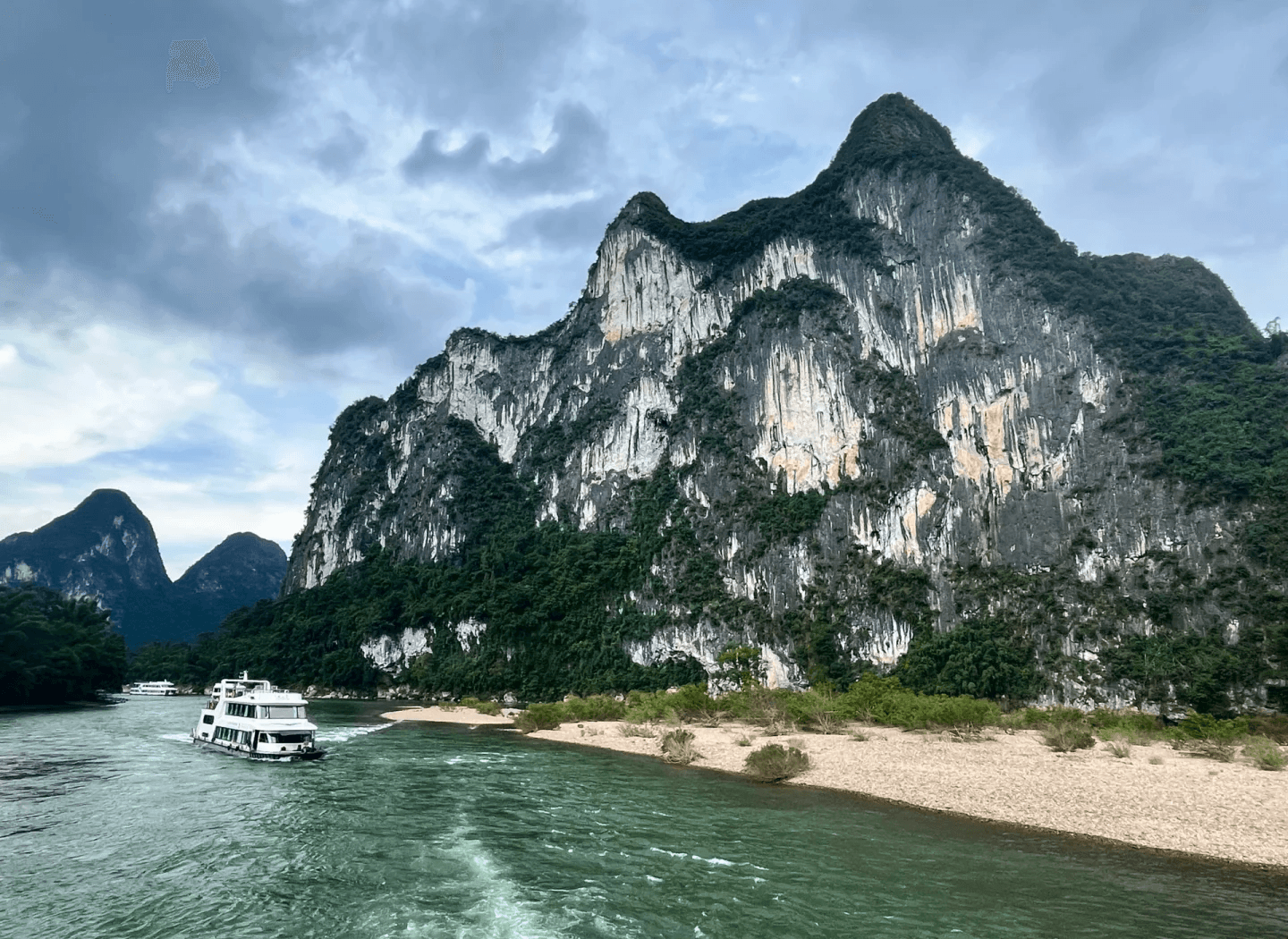
Nine Horse Fresco Hill arrives at roughly the 9 km mark. The cliff face is extraordinary up close — much larger than it appears from cruise boats. Erosion has carved shapes that tradition says include nine horses. Most people find six or seven. Take your time here: the light changes the patterns significantly, and what looks like nothing at one angle resolves into something clear from slightly further back.
Heavy campers often stop here overnight. Local families nearby charge ¥10–20 as a site/sanitation fee. There’s food and coffee available in the village just behind the camping area.
Nine Horse Fresco Hill to Lengshui

From Nine Horses, the trail continues south on a paved path to the Lengshui crossing. This section is straightforward. Allow 30–40 minutes.
Critical timing note: The Lengshui ferry stops at 5:00 PM. This is a fixed cutoff, not approximate. Hikers doing the full route from Yangdi need to manage their pace to arrive before 5pm. If you’ve been slow through the northern section, this is where it catches up with you.
Lengshui to Xingping (5 km)
Cross the Lengshui ferry (¥10–15), step onto the east bank, and the trail south to Xingping feels immediately different — more developed, with electric carts and small vendors appearing. The tourism infrastructure of Xingping begins here.
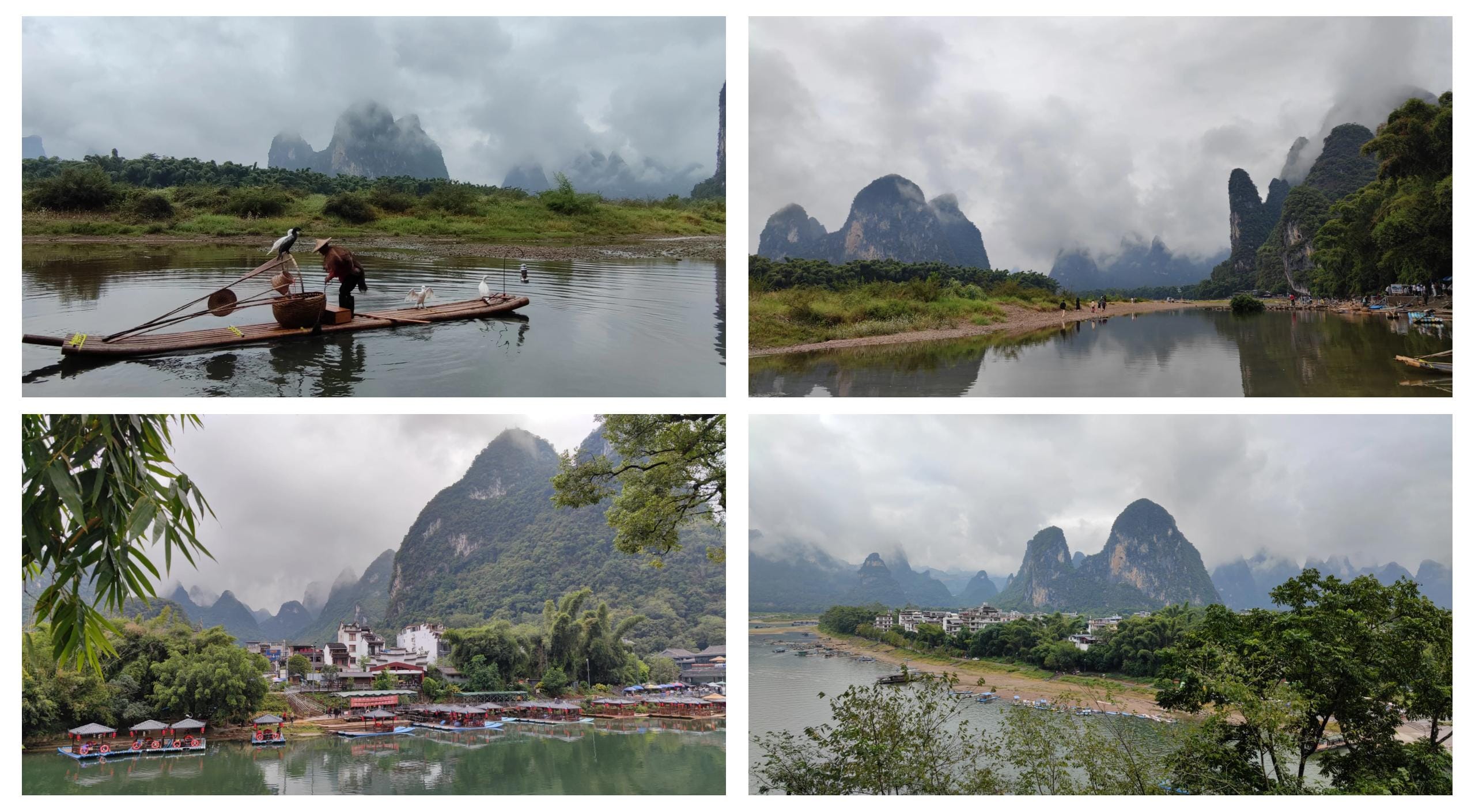
Yellow Cloth Shoal (黄布滩) is roughly 15 minutes south of the crossing. When the Li River runs low and clear, the large flat stones on the riverbed show through the water like a yellow cloth — hence the name. The reflection of the karst peaks in the still water is the 20-yuan note image. It looks exactly like the banknote. Arriving before the cruise boats disturb the surface (before 9–10 AM) or in the late afternoon golden hour gives you the best conditions.

From Yellow Cloth Shoal, it’s another 3 km into Xingping. If you’re exhausted, golf carts run from Mashan Pier directly to town for ¥15. No shame in it.
Shorter Alternatives
Quanjiazhou to Xingping (12 km, 5-6 hours) — Best for Most People
Skip Yangdi and start from Quanjiazhou. This covers the most scenic southern section of the full route and avoids the Quanjiazhou ferry question entirely — you only cross at Lengshui. Most people doing a day hike without strong reasons to see the northern section should consider this their default.
Transport to Quanjiazhou: No direct public bus. Taxi from Yangshuo costs ¥120–150 (45 min). Arrange through your accommodation the night before.
Xianggong Hill to Xingping (12 km, 4–5 hours) — Best Views Per Effort

Start at Xianggong Hill (相公山) for the panoramic view, then descend to join the riverside trail south to Xingping via Lengshui.
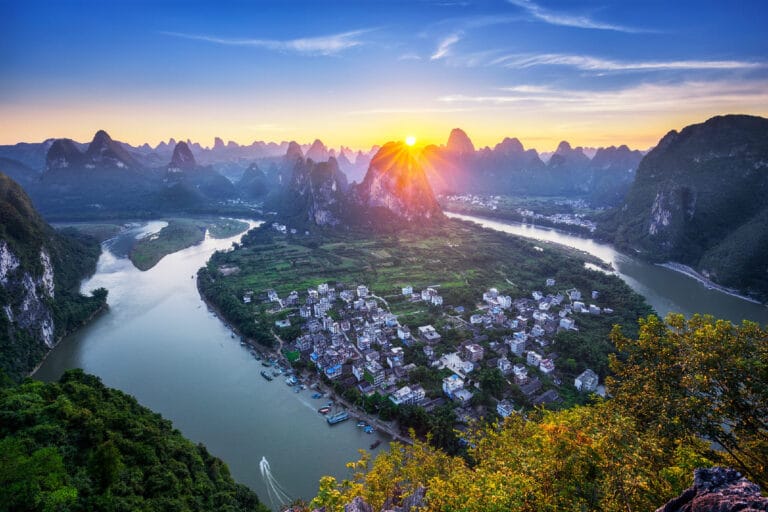
Xianggong Hill puts you above the valley looking down at the Li River’s S-bend before you walk through it. The summit takes 15–20 minutes up stone steps. Entrance fee ¥60. Opens at 5:00 AM (May–October) and 5:30 AM (November–April). The left side of the summit platform gives the best angle on the river bend.
For sunrise, arrive at the summit by 5:30 AM in summer and 6:00 AM in winter. From Yangshuo, that means leaving by 3:30–4:00 AM. A round-trip private car from Yangshuo costs about ¥300. From Xingping, take the 5-minute ferry across (¥5) then a shuttle to the hill base (~¥20 return) — cheaper and easier if you’re based in Xingping.
Sea of clouds — the dramatic cloud-filled valleys in photography — requires rain the day before followed by clear skies. Check the evening forecast. Without that combination you’ll still get the full panorama and sunrise colors, just no clouds.
Xingping Circular via Laozhai Mountain (7 km, 2.5–3.5 hours) — Half-Day Option

Starts and ends in Xingping. Walk south along the river to the 20-yuan viewpoint, continue to the base of Laozhai Mountain (老寨山), and climb stone steps to the summit (300+ meters, no guardrails on most sections, allow 40–60 minutes up). The summit looks north at the full first bend of the Li River from above — a different angle from everything else on this list, and underrated. Bring small children only if they’re confident on steep, unrailed paths. Descend before dark; there are no lights on the trail.
Getting There

From Guilin to Yangdi: Bus from Guilin South Bus Station: departures at 09:00 and 11:40, about 1 hour, ¥22.
From Guilin to Xingping (arriving end-point): High-speed train to Yangshuo (Xingping) Station: ~30 minutes, ¥30. Then local bus or 5-minute walk to Xingping town. This station is geographically closer to Xingping than to Yangshuo — useful to know.
From Yangshuo:
- Bus to Xingping: every 20–30 minutes, ¥10, 45 minutes
- Taxi to Xingping: ~¥50, 30 minutes
- Taxi to Yangdi: ¥100–130, about 1 hour
- Taxi to Quanjiazhou: ¥120–150, 45 minutes
Returning from Xingping: Bus to Yangshuo every 20–30 minutes (¥10, 45 min), or high-speed train from Yangshuo (Xingping) Station to Guilin (¥30, 30 min).
Costs
Item | Cost |
|---|---|
Yangdi Pier ferry | ¥5 |
Langshi ferry | ¥5–10 |
Quanjiazhou ferry (when operating) | Varies |
Lengshui ferry | ¥10–15 |
Xingping–Mashan ferry | ¥5–10 |
Ferry Xingping to west bank (for Xianggong) | ¥5 |
Xianggong Hill entrance | ¥60 |
Shuttle Xingping side → Xianggong Hill | ~¥20 return |
Golf cart Mashan Pier → Xingping | ¥15 |
Bus Guilin → Yangdi | ¥22 |
Bus Yangshuo ↔ Xingping | ¥10 each way |
Taxi Yangshuo → Quanjiazhou | ¥120–150 |
Private car Yangshuo → Xianggong Hill (round trip) | ~¥300 |
Camping fee at Nine Horse Fresco Hill | ¥10–20 |
Village snacks along the trail (per item) | ¥3–5 |
No entrance fee to hike the trail on foot.
What the Trail Feels Like

The first section after the Yangdi crossing is paved in parts, rough river pebble in others. The pebbles are harder going than they look — uneven underfoot and slow. The views compensate immediately: karst peaks rise directly from the water on both sides and the river bends reveal new formations every few hundred meters.
Langshi Village is quiet and genuine. Locals who’ve lived here long enough to have watched the hiking boom arrive have started selling homemade snacks at the roadside — artisanal rice cakes, glutinous dumplings, sweet potato, roasted corn — at ¥3–5 each. This is not staged for tourists; it’s a small income stream for elderly residents who have the time and the recipes. Stop and buy something.
The stretch between Langshi and Quanjiazhou passes through open farmland with the river on one side and peaks on the other. February brings oil rapeseed flowers and radish blossoms. October brings golden light on the harvest. The karst geometry — vertical cliffs rising from flat water — makes no geological intuitive sense and never stops being striking.
South of Quanjiazhou, as the path narrows through bamboo, you start to feel the scale of what’s coming. Nine Horse Fresco Hill builds slowly as you approach, getting taller and more detailed until you’re directly below it looking up. Cruise passengers photograph this cliff from the water; at river level and close up, the scale is completely different.
After the Lengshui crossing, the trail enters the tourism orbit of Xingping. Vendors appear. Electric carts offer rides. The ancient town is close. Walking into Yellow Cloth Shoal in the late afternoon — the peaks reflecting in still water, the light going gold — is one of those moments that makes you understand why this particular stretch of river has been considered exceptional for a thousand years.
Xingping: Where to Eat

The town has developed fast in recent years. The main pedestrian street (新街步行街) is now commercial enough that choosing carefully matters.
Beer fish (啤酒鱼) is the dish — fresh Li River fish simmered in local beer with peppers and tomatoes, then finished with noodles cooked in the remaining broth. Every restaurant makes it. Quality varies.
These specific places have consistent track records on trip.com/moments/theme/destination-xingping-ancient-town-2140857-restaurant-993134/”>Trip.com and TripAdvisor:
- Jixiang Restaurant (吉祥饭店), No. 70 Xinjie — reliable beer fish and pot-fried pork (锅烧肉), good value, no frills
- Zuijiangyuan Private Kitchen (醉江源私房菜), No. 111 Xinjie — bamboo tube chicken is the standout dish, per capita around ¥55
- Yuelu Private Kitchen (月鹿私房菜), Xinjie Pedestrian Street 3rd–4th floor — the upper floors have open views over Xingping’s tiled rooftops with the karst peaks behind, a hidden perspective almost nobody outside local review platforms knows about; the five-fingered ginseng bamboo tube chicken soup is the order
Budget ¥40–70 per person for a full meal. Avoid restaurants directly adjacent to the 20-yuan viewpoint — highest prices, lowest quality.
The 20-yuan viewpoint is 10 minutes south of the pier on foot. Follow signs for 20元观景台. Best before 7 AM or in the hour before sunset. Midday in peak season it’s dense with people photographing through banknotes.
Best Time to Go
October–November is the best season overall. Dry, clear, temperatures in the low-to-mid 20s Celsius, golden afternoon light on the peaks. If you have flexibility, aim here.
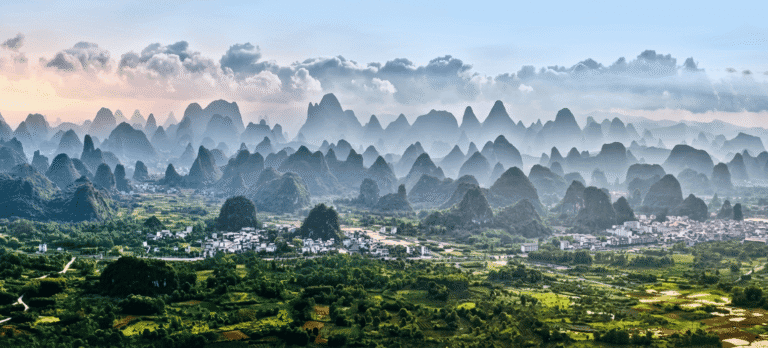
March–April is the season for photographers specifically. Morning mist settles into the valley most days before 9 AM and lifts by 10. Low cloud clinging to karst peaks is one of the defining images of Guilin — and it’s not guaranteed but it’s common. Some rain but manageable.
June–September: hot and humid with typhoon risk. Flooding can affect trail sections and ferry operations. If summer is your only option, start before 7 AM, carry extra water, and check conditions the night before.
December–February: cold but genuinely atmospheric. Winter fog over the karst peaks in the early morning is beautiful in the way that black ink on white paper is beautiful — spare and precise. Tourist numbers drop sharply. The trail is quiet in a way summer and autumn rarely allow.
Season | Weather | What’s Special | Verdict |
|---|---|---|---|
Spring (Mar–Apr) | Mild, some rain | Morning mist on karst peaks | Great for photography |
Summer (Jun–Sep) | Hot, humid, storm risk | Vivid green, full rivers | Only if no other option |
Autumn (Oct–Nov) | Clear, dry, perfect | Golden afternoon light | Best overall |
Winter (Dec–Feb) | Cold, quiet | Ink-wash fog, empty trail | Best for solitude |
Practical Notes

Start by 8:00 AM at the latest for the full route. The Lengshui ferry stops at 5:00 PM. Factor in stops, lunch, and slower sections. For the shorter Quanjiazhou–Xingping route, 9:00 AM start is fine.
Download offline maps before you leave your accommodation. AllTrails carries GPS tracks for the route. Your phone will run low from photos long before Xingping — bring a power bank.
Carry ¥150 cash in small bills. Ferry operators, village snack sellers, and the golf cart at Mashan don’t always take Alipay or WeChat Pay.
Wear trail shoes. Paved sections are easy in anything. The northern stretches have river pebble, broken stone, and washed-out sections that need grip. Sandals are a bad idea for the full route.
If the Quanjiazhou ferry isn’t running: Look for a phone number on a board at the pier. Call it. Wait. This has worked for multiple recent hikers. If still nothing, ask locals — someone nearby usually has an informal arrangement or can point you to alternatives.
Supplies along the way: Food and drinks are available in every village. There’s no need to carry more than a day’s water. The trail is not remote.
FAQ
Do I need to buy a scenic area ticket to start at Yangdi?
No. Independent hikers on foot are not required to purchase a ticket. Walk to the pier and take the ¥5 ferry directly.
Can I hike from Xingping northward toward Yangdi instead?
Yes. Several hikers do this direction, walking north from Xingping to Nine Horse Fresco Hill or all the way to Quanjiazhou, then returning or arranging transport back. The Quanjiazhou ferry question remains the same in either direction — verify in advance.
How fit do I need to be?
The full Yangdi–Xingping route is 18 km of mostly flat terrain with no significant elevation. Someone who can walk 5–6 hours comfortably will manage. The shorter routes are easier. Laozhai Mountain is steep but short.
Can I do this with children?
The Quanjiazhou–Xingping route works for children 10 and up who can manage 4–5 hours of walking. The golf cart option at Mashan is a useful bailout. Laozhai Mountain has no guardrails and should be treated carefully with young children.
Is there phone signal on the trail?
Mostly yes in the southern section. The northern stretch between Yangdi and Langshi has weaker coverage. Download your maps before starting.
Should I stay in Xingping or Yangshuo?
Xingping for the hike — closer to the trailhead, quieter, and better positioned for an early start. Yangshuo for more accommodation options, transport connections, and nightlife. One night in each is the combination that works well for most itineraries.
Can I camp on the trail?
Yes, at Nine Horse Fresco Hill. Local families collect a ¥10–20 sanitation fee. There are food and facilities in the village immediately behind the camping spot.
Travel China With Me specializes in inbound tours across China. Route and ferry information in this guide reflects current conditions as of 2026.