Li River Cruise Guide: Ships, Prices, Piers & Pitfalls
The Li River cruise runs 60 kilometers from Guilin to Yangshuo, takes 3.5 to 5 hours depending on water speed, and the official boat ticket costs ¥215 for 3-star and ¥360 for 4-star per person. It is the single most famous way to see Guilin’s karst mountains, and for most first-time visitors, it is worth doing exactly once. We’ve put clients from all over the world on this river, through our partner team on the ground in Guilin, more times than we can count. This guide covers everything about the cruise itself — the route, the timing, the price, how to book it, and what happens once you’re on board.
Route | Guilin (Mopanshan or Zhujiang Pier) → Yangshuo |
Distance | 60 kilometers |
Duration | 3.5–5 hours, varies by water speed (shorter in low water Jan–Mar, occasionally suspended in high water May–Jul) |
Departure | 9:00 AM–12:05 PM, one-way only |
Official ticket price | ¥215 (3-star), ¥360 (4-star) — booking through an operator adds a service fee |
Best months | September–November for the most reliable water levels and clearest views |
Table of Contents
1. What Is the Li River Cruise?
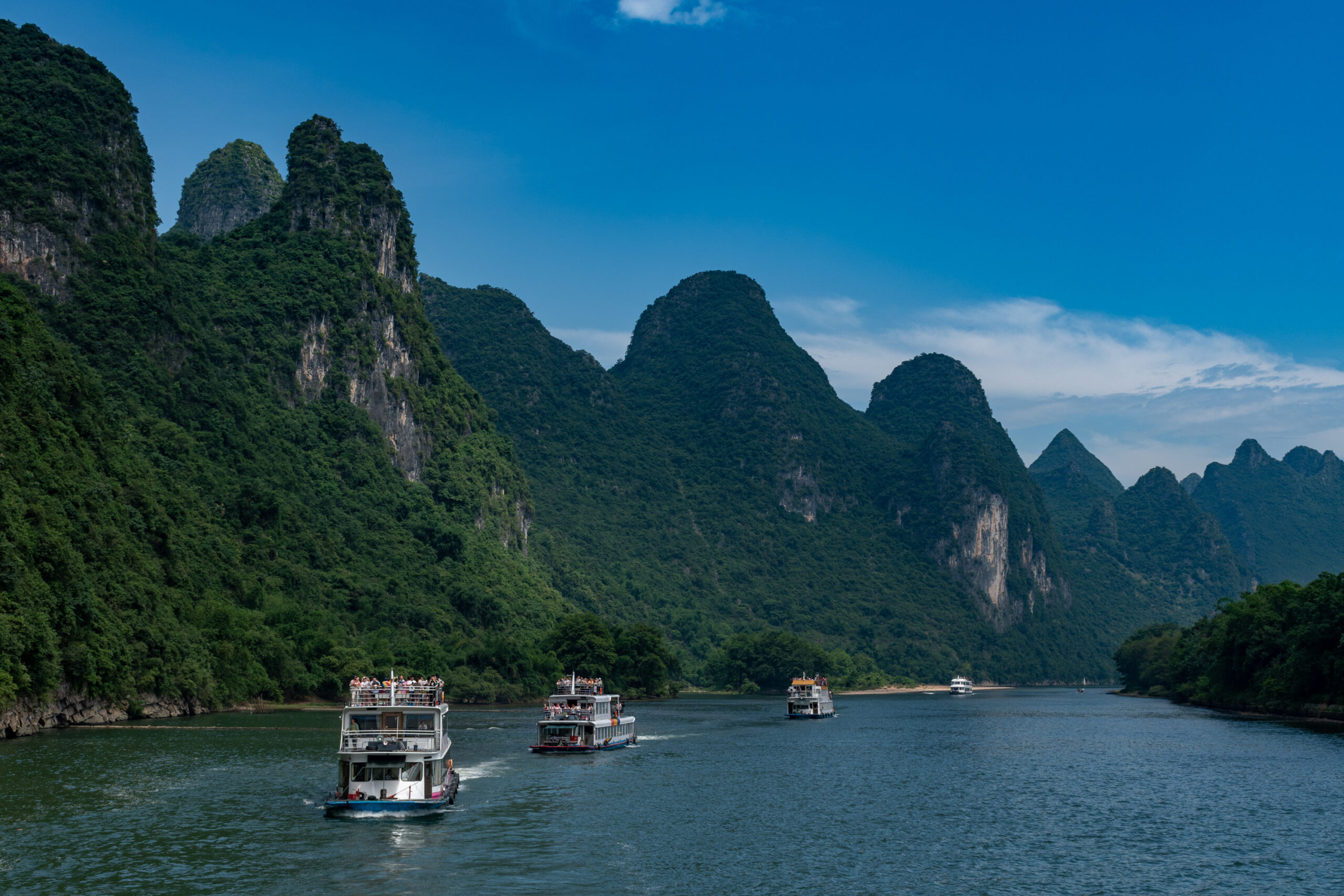
The Li River cruise is a one-way boat trip down the most scenic stretch of the Li River, from a pier outside Guilin to a pier in Yangshuo. It is not a round trip, and it is not a leisure cruise with cabins or overnight stays. You board in the morning, sail for most of the day, and disembark in Yangshuo by early-to-mid afternoon.
Two Boat Classes, Two Different Piers
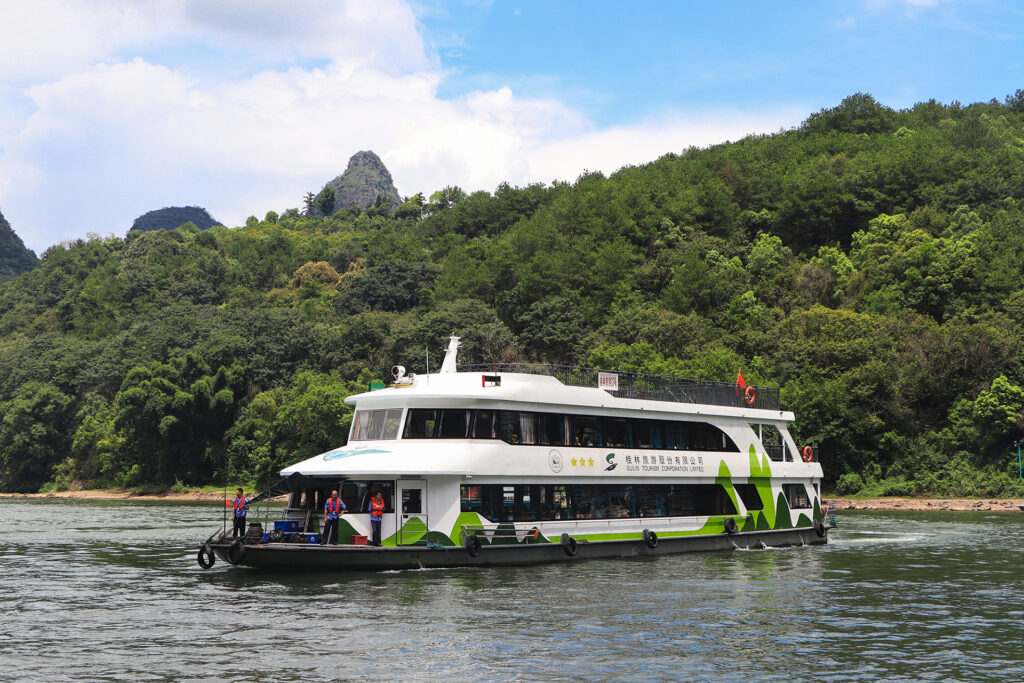
3-star and 4-star boats both cover the identical scenic section of the river, but they leave from different piers. This trips up more travelers than almost anything else about the cruise.
3-Star | 4-Star | |
|---|---|---|
Departure pier | Mopanshan Pier | Zhujiang Pier |
Distance from Guilin Railway Station | 27 km | 28 km |
Same road as the other class? | No | No |
Check your ticket confirmation for which pier it names, and book your car or transfer to that exact pier. Showing up at the wrong one on the morning of your cruise is a common and entirely avoidable mistake.
Comfort, seating, and lunch differ between the two classes — not what you see out the window. We cover that comparison in full detail in our 3-Star vs 4-Star guide; this article focuses on the cruise itself.
 Li river cruise 3-star
 Li river cruise 4-star

Why This Specific Stretch of River Is Famous
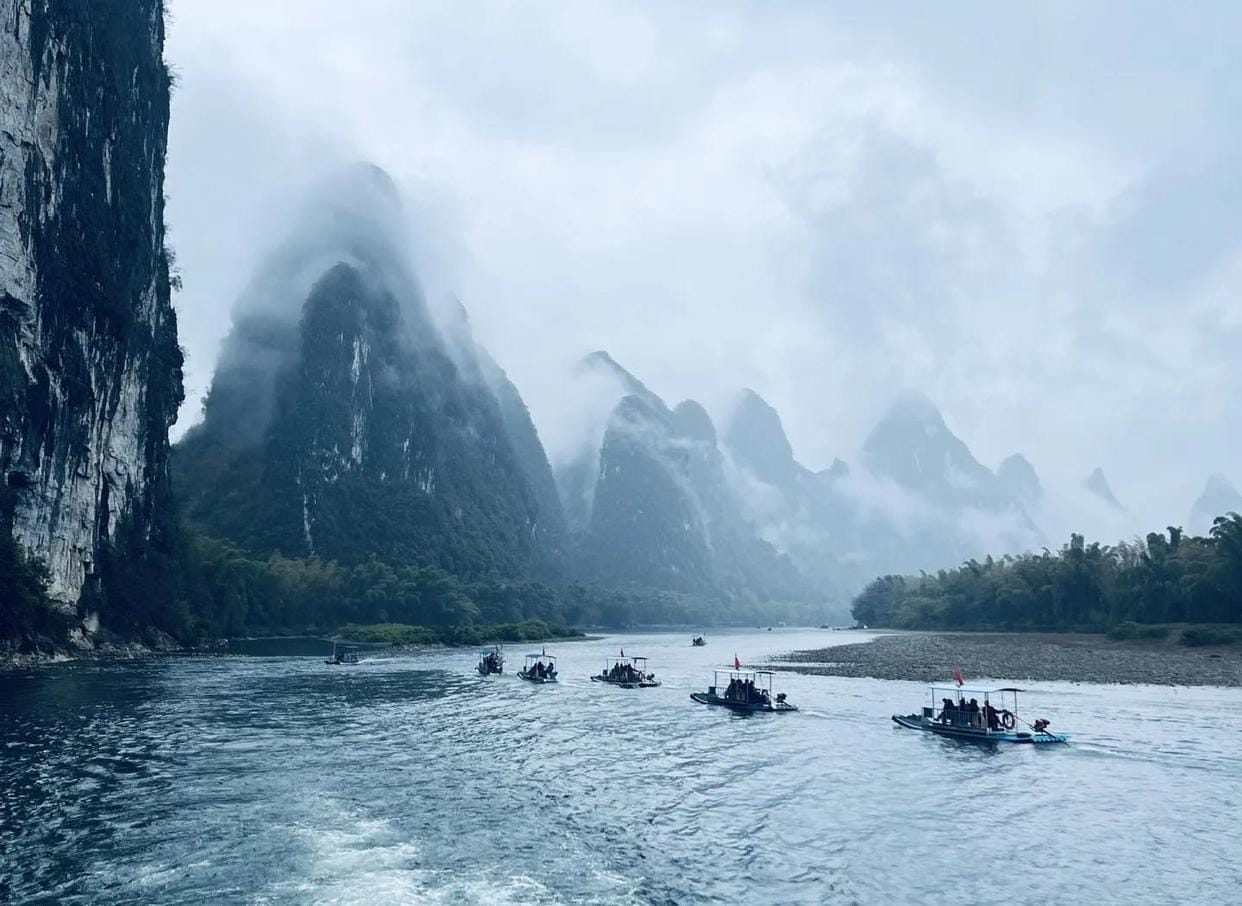
The cruise exists because this 60-kilometer stretch of river is regarded as the most beautiful section of karst landscape in China. It inspired the “shan shui” (mountain-water) style of Chinese ink painting for over a thousand years. The scene on the back of the ¥20 note — Yellow Cloth Shoal, near Xingping — sits inside this route. The classic “essence section” strings together landmarks that show up repeatedly in Chinese travel writing about this river. Before arriving at Xingping, the route passes the ¥20 note scene, Yellow Cloth Shoal, Nine Horse Fresco Hill, Crown Cave, and the scenery around Yangdi and Langshi, among other named peaks and shoals.
Both Mopanshan and Zhujiang piers send boats along this full essence section to Yangshuo. Some cheaper tickets sold under the same name cover only part of the route. Confirm which pier you board and disembark at before paying, so you’re not sold a partial cruise as the full one.
2. The Route: What You Actually See, Section by Section
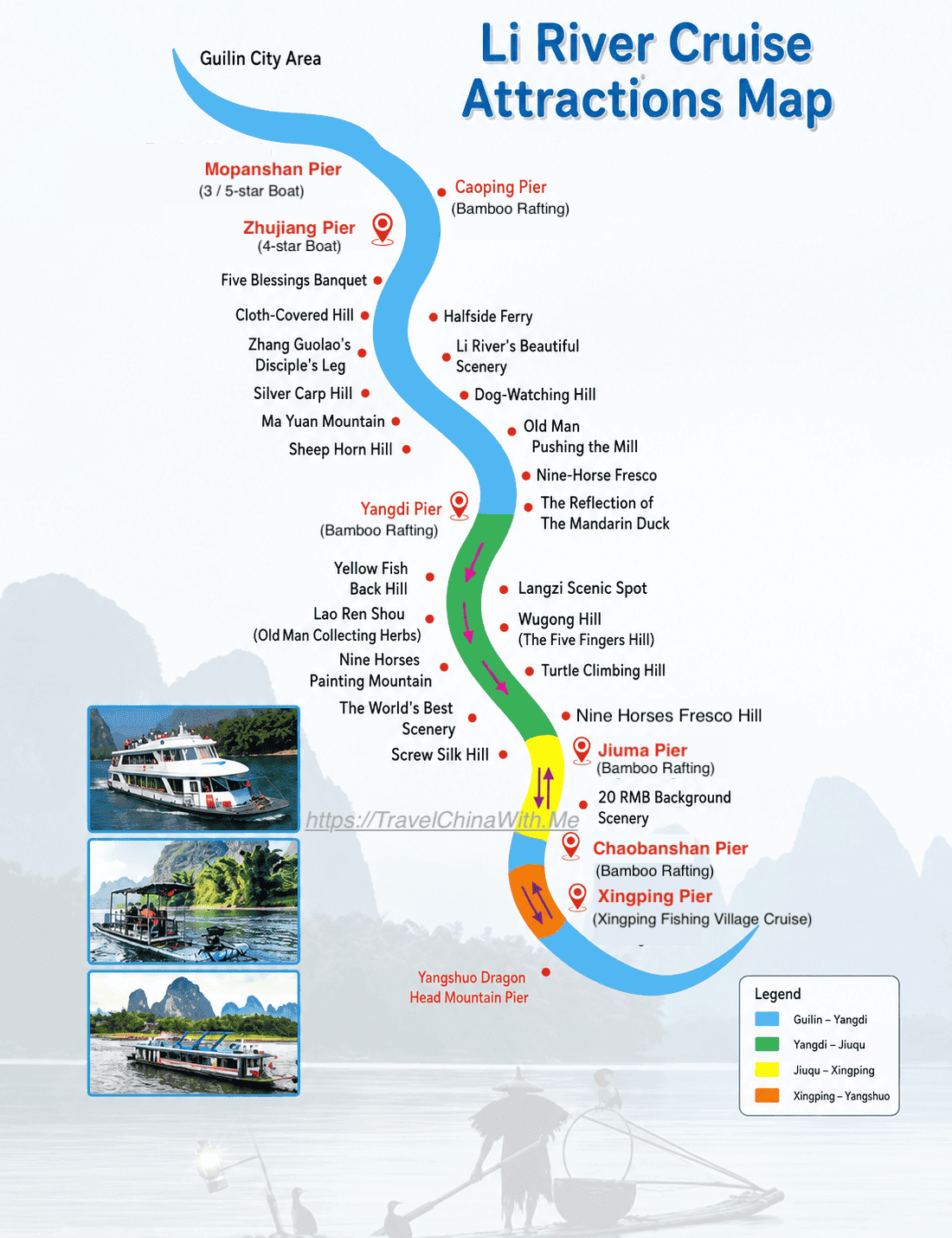
The 60-kilometer route breaks into three distinct sections, and they are not equally scenic. Understanding this changes how you experience the day.
Guilin to Yangdi: the warm-up (first 1.5–2 hours)
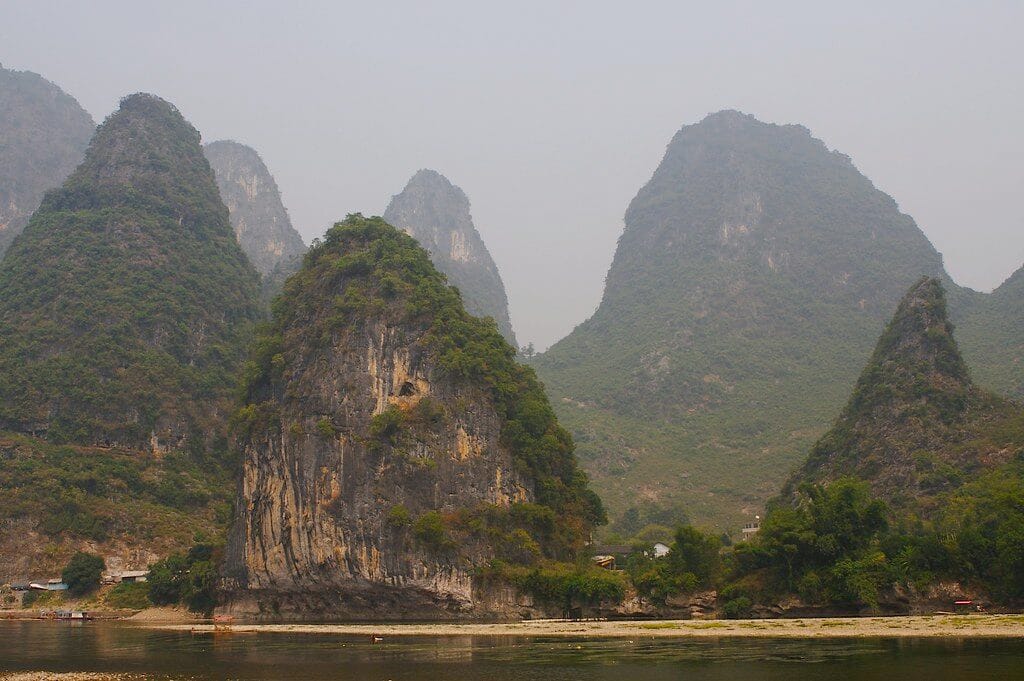
The boat pulls away from Mopanshan or Zhujiang Pier and passes wider, gentler scenery — low hills, farmland, occasional water buffalo. It’s pleasant but not the postcard shot. Most first-timers are surprised by how ordinary this stretch looks. We tell our clients not to judge the cruise by the first hour.
Yangdi to Xingping: the essential section
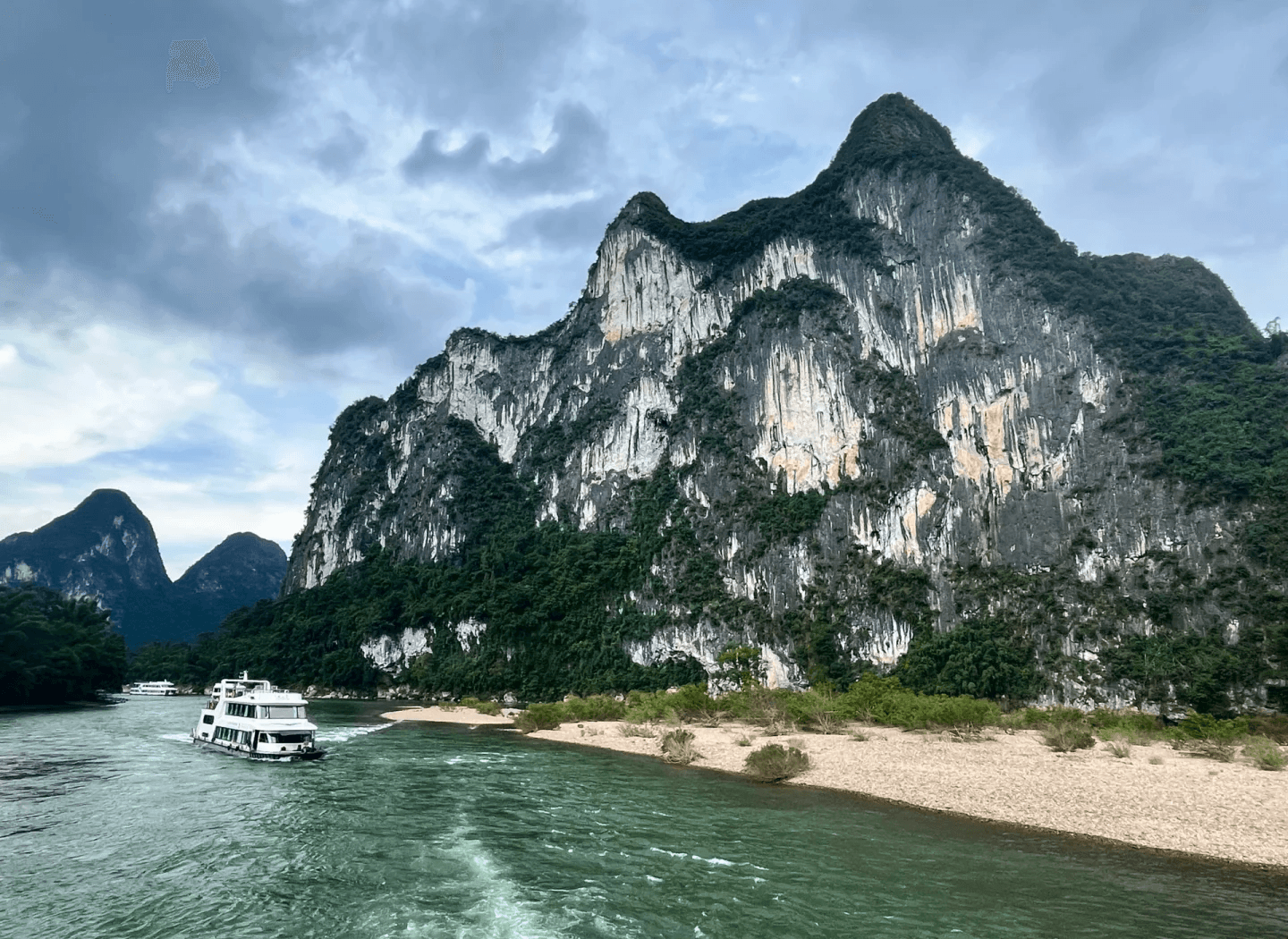


This is the 20-kilometer stretch every photo of the Li River actually shows. The karst peaks close in on both sides, the river narrows, and the formations start appearing one after another. Nine Horse Fresco Hill is a sheer cliff face where locals claim you can count nine horse shapes in the rock patterns. Yellow Cloth Shoal is the exact scene on China’s ¥20 banknote, where the river runs shallow and clear enough to create a near-perfect mirror reflection of the peaks above.
If you only have patience for one part of the cruise, this is it. Nearly everyone on board moves to the open upper deck here, and it gets crowded fast — arrive early if you want a clear spot at the railing.
Xingping to Yangshuo: the wind-down (final hour)
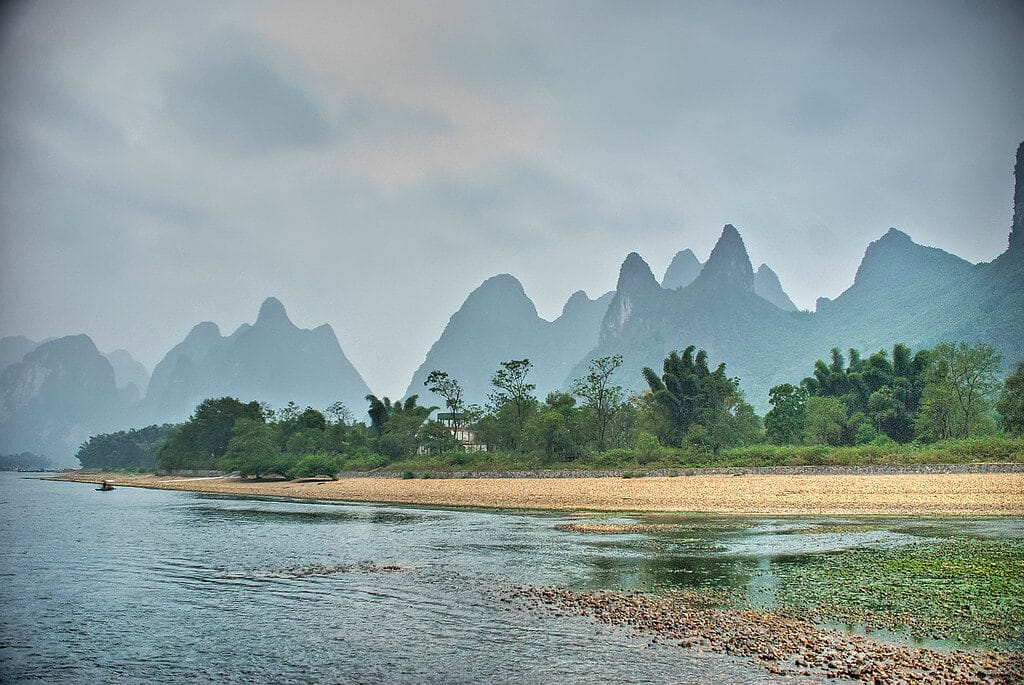
After Xingping, the karst density drops off and the last stretch into Yangshuo is comparatively flat. Most passengers return to their seats, eat, or nap. This is by design — cruise operators schedule lunch service here because there’s genuinely less to see.
3. How Long Does It Take & What’s the Timing?
Peak Season (Apr–Oct) | Dry Season (Jan–Mar) | |
|---|---|---|
Duration | 3.5–5 hours, varies by water speed | 2.5–3 hours |
Route | Full 60 km, Guilin to Yangshuo | Shortened: Yangdi to Hua Mountain and back |
3-star departure | Morning to midday, Mopanshan Pier — exact times shift seasonally | Departs Yangdi (road transfer from Guilin required) |
4-star departure | Morning, Zhujiang Pier — exact times shift seasonally | Departs Yangdi (road transfer from Guilin required) |
Arrival | Longtoushan Pier, Yangshuo, early-to-mid afternoon | Back to Yangdi, not Yangshuo |
Peak Season (April–October)
Departure times shift with demand — as of July 2026, 3-star runs three sailings (9:00, 10:30, 12:00) and 4-star runs two (9:30, 10:00), with extra midday slots sometimes added during summer holidays and National Day. This is why you might see different departure times listed online. Arrival time also varies with water speed rather than being fixed: 3.5–4 hours in faster high-summer water, up to 5 hours when it’s slower.
Dry Season (January–March)
Water levels drop enough that the full 60-kilometer route often isn’t navigable, so boats depart from Yangdi instead of Guilin, sail to Hua Mountain, then turn back. This is the standard winter pattern, not a worst-case exception — you’ll need a separate road transfer from Guilin to Yangdi, which we build into any winter itinerary we arrange, so it’s one less thing to coordinate yourself.
No Return Cruise
Every boat runs one-way, downstream only — the river’s current and width make a return trip impractical. For the return to Guilin, take the train, bus, or a car (covered further down).
High-Water Risk: Rainy Season Can Suspend the Cruise Too

Low water isn’t the only seasonal risk. During heavy rain, usually May through July, water can rise too high for safe navigation, and operators shorten or suspend routes for the opposite reason they do in dry season. In June 2026, Guilin Maritime closed one route as the river rose, then closed the flagship route entirely days later as levels kept climbing — a smaller echo of the 2024 flood, which suspended the cruise for several days.
Most rainy-season trips never come close to this — a rainy morning with normal water levels runs fine. If you’re booking April through July, build in a flexible date and check the cancellation terms before you commit; if you’re travelling with us, we monitor water levels and can shift your booking without the back-and-forth. Our Guilin-Yangshuo rainy season guide covers month-by-month risk and the 2024 flood in detail.
4. How Much Does It Cost?
Official Ticket Prices
The official boat ticket is ¥215 per adult for 3-star and ¥360 per adult for 4-star. This is the base price for the boat ticket itself, verified against the official channel and cross-checked with third-party platforms including Trip.com and GetYourGuide, where listed prices consistently match this range. Both classes may adjust slightly around major holidays.
Height | Ticket | Price (3-star) | Price (4-star) |
|---|---|---|---|
Under 1.2m | Zero-cost ticket (still required) | ¥0 | ¥0 |
1.2m–1.5m | Child ticket | ¥108 | ¥180 |
1.5m and above | Adult ticket | ¥215 | ¥360 |
What Adds to the Base Price
A few things move the total above the base ticket price. Booking through a local operator or travel agency adds a service fee over the official price (more on what that buys you in the next section). Lunch, if not already included in your ticket type, is typically an extra ¥30–50 per person, and hotel pickup or pier transfer, if included, adds to the base fare. Chinese national holidays (especially Golden Week in early October) can also push prices above the standard rate as availability tightens.
Be Cautious of Unusually Low Prices
If you see tickets advertised well below ¥215, be cautious. These are almost never full-route Guilin-to-Yangshuo tickets. They’re typically short local boat trips on a different, less scenic part of the river, or tickets missing mandatory fees that get added at the pier. For the specifics of what separates a 3-star ticket from a 4-star one — seating, lunch quality, deck space — see our full comparison guide.
5. How to Book Your Tickets
Three practical paths exist for international visitors.
Official WeChat Channel
The cruise operator sells tickets through the official WeChat mini-program “i游漓江” (i-Travel Li River). It offers a language toggle for Chinese, English, Japanese, Korean, Vietnamese, and Thai — enter your passport number, name, and nationality, all mandatory. Seat assignment is random; land on the second floor and you get a better view and fewer people around you.
Scan the QR code below for the official “漓江售票处” (Li River Ticket Office) WeChat account, then tap “我要购票” (I want to buy tickets) in the bottom-left menu. That opens the “i游漓江” mini-program, where you book.

As of July 2026, 3-star sails three times daily (9:00, 10:30, 12:00) and 4-star twice (9:30, 10:00). Book everyone in your group on the same order — split payments get assigned to different boats, the single most common booking mistake we see.
Only children under 1 travel with no ticket at all. Everyone 1 and older must be ticketed — including children on the “zero-cost” allowance below, whose tickets cost nothing but are still mandatory to book. This isn’t a formality: the zero-cost ticket is how the cruise company counts every passenger onboard against the boat’s safety capacity, so a child without one isn’t on the manifest at all.
Age / height | Ticket | Notes |
|---|---|---|
Under 1 | None needed | Only group that travels with no ticket |
1–6, or under 1.2m | Zero-cost, no-seat | Must still be booked with the child’s passport; free for up to 2 per adult |
3rd child in that age group, or needs a seat | Half-price | Applies beyond the free allowance |
6–14, or 1.2–1.5m | Half-price | Always required, regardless of number |
⚠️ If you don't purchase a child's zero-cost ticket at the time of booking, you cannot buy one later at the pier. Boats operate under a fixed passenger quota, so there's no mechanism to add a child on to a booking once it's placed. If this results in the child being denied boarding, that responsibility falls on the traveler, not the cruise company. Always declare every child's ticket, even the free ones, at the moment you book.
At the Pier
Walk-up tickets exist but sell out fast in peak season (April–November), with same-day tickets often gone by mid-morning.
Ticket office | Hours | Phone |
|---|---|---|
Foreigner ticket hotline | 07:00–19:00 | 19167711091 |
Daxinjie flagship store, Guilin | 09:00–17:00 | 0773-2881088 |
Gaoxin flagship store, Guilin | 07:00–19:00 | 0773-8287688 |
Mopanshan Pier (3-star) | 08:00–12:30 | 0773-3900890 |
Zhujiang Pier (4-star) | 08:00–10:00 | 0773-3909230 |
Passport Required at Boarding
Your original passport is required to board — not a photo or photocopy. It gets checked twice: at the self-service ticket machine (now bilingual Chinese/English) where you print your physical ticket, and again at the boarding hall where your ID is swiped. Arrive at least 30 minutes early to allow time for both.
If You Need to Cancel
Time before departure | Fee |
|---|---|
More than 72 hours | Free |
72–15 hours | 10% |
15–3 hours | 30% |
Inside 3 hours | 50% |
The final cutoff depends on ticket status: a collected paper ticket must be cancelled at the counter before departure, while an uncollected online order can still be cancelled up to 48 hours after departure, still at 50%. Weather-related suspensions are different — if the operator cancels for high water, you get a full refund regardless of timing.
6. Getting to the Pier
Once your ticket is booked, you still need to get yourself to the right pier — and this trips up more travelers than the booking itself.
Local Operator or Travel Agency
Booking through us or another operator with an on-the-ground team in Guilin adds a service fee over the official price. It removes the hassle of arranging your own transfer and typically has a driver waiting for you at your hotel, timed to your ticket’s departure slot.
Official Shuttle Bus to the Piers
Guilin Bus Group, together with Guangxi Lisheng Tourism Development, runs a dedicated shuttle bus from downtown Guilin directly to both piers — a cheaper alternative to a taxi, with 47-seat coaches built for this route. You don’t need to board at the starting point; any of the five stops below works, and the WeChat booking flow lets you pick whichever is closest to your hotel.
Tiexi Bus Yard (铁西车场) | Guilin Railway Station (桂林站) | Xicheng Crossing (西城路口) | Shizi Street (十字街) | Sanli Dian Square (三里店广场) | Zhujiang Pier (竹江码头) | Mopanshan Pier (磨盘山码头) |
|---|---|---|---|---|---|---|
7:00 | 7:05 | 7:10 | 7:15 | 7:25 | 7:55 | 8:25 |
7:20 | 7:25 | 7:30 | 7:35 | 7:45 | 8:15 | 8:45 |
8:00 | 8:05 | 8:10 | 8:15 | 8:25 | 8:55 | 9:25 |
8:30 | 8:35 | 8:40 | 8:45 | 8:55 | 9:25 | 9:55 |
9:00 | 9:05 | 9:10 | 9:15 | 9:25 | 9:55 | 10:25 |
10:30 | 10:35 | 10:40 | 10:45 | 10:55 | 11:25 | 11:55 |
Times are estimates based on the published schedule — actual arrival can shift slightly with traffic.
Fare is a flat ¥20 per person regardless of stop, and the full route takes roughly 1 hour 20 minutes. Book through the “漓江售票处” WeChat account, selecting your pickup stop, time slot, and destination pier. Arrive at your stop 10 minutes before departure and show your QR code to board; the bus won’t wait past its scheduled time.
Cancellation is straightforward: full refund if you cancel 12+ hours before departure, a 50% fee inside 6–12 hours, and no refund inside 6 hours. Cancellations due to severe weather or flooding are fully refunded regardless of timing. For questions, call 0773-3860887 (8:30–12:00, 14:00–18:00) or 0773-2268062 (8:30–12:00, 14:00–17:00).
If You’re Driving Yourself
Both piers have paid on-site parking (Mopanshan: ¥7/day, ¥15 overnight; Zhujiang: ¥7.5/entry, double after 20:00). Since the cruise is one-way, your car stays in Guilin — you’ll need a separate driver to bring it to Yangshuo. Park at Yangshuo Tourist Parking rather than outside Longtoushan Pier itself, which is heavily monitored for illegal parking, and walk the 2.3 kilometers in. Third-party driving services operate at the pier if you need one on the spot. Or we can arrange a driver for you as part of your itinerary, so the car and your luggage are already waiting in Yangshuo when you arrive. No luggage storage or pets onboard.
7. Best Time of Year (and Time of Day) to Go
March to November is the reliable window for the full 60-kilometer route with good water levels.
Season | Conditions | Watch for |
|---|---|---|
Spring (Mar–May) | Rain and mist — closest to the ink-painting look the river is known for | Pack a light rain layer |
Summer (Jun–Aug) | High water generally, but June is the wettest month on record | Highest suspension risk in June; crowds and heat in Jul–Aug |
Autumn (Sep–Nov) | Clearest water, best visibility, cooler and more comfortable | Our first recommendation for first-time visitors with flexible dates |
Winter (Dec–Feb) | Dry season, shortened Yangdi–Hua Mountain route, lower water | Still worth it if these are your only dates |
For timing within the day, book the earliest departure slot available — morning light is softer, the upper deck less crowded, and you’ll reach Xingping while conditions are calmer. A light-rain morning in spring is genuinely the best combination for the misty “ink painting” look, not a compromise.
For rainy-season planning across the wider Guilin-Yangshuo area, see our rainy season guide.
8. What to Bring & What to Expect Onboard

Before You Board
Your original passport is mandatory — a photo or photocopy will not get you through the boarding hall. Beyond that, a light jacket or windbreaker is worth packing even on a warm day, since the open river generates wind and the upper deck can be noticeably cooler than the dock. Bring a power bank too — you’ll take more photos than you expect through the Yangdi–Xingping section, and outlets aren’t a given onboard.
Meals Onboard
This only applies to 3-star tickets — the meal there is a separate add-on, and our advice is to skip it. Quality is inconsistent and priced well above what it’s worth; free hot water and luo han guo (monk fruit) tea are available onboard regardless, so bring your own self-heating rice, instant noodles, or snacks and you’ll eat better for less. 4-star tickets are different: a proper buffet lunch is already included in the ticket price, not an optional add-on, so there’s nothing to skip.
Where to Sit for Photos
The route has two main scenic sections, each announced over the boat’s speaker system as you approach. Nine Horse Fresco Hill comes first, followed by Yellow Cloth Shoal (the ¥20 note view) about 20 minutes later. For photos, the best angle on Nine Horse Fresco Hill is from the front deck, left side. The best angle on Yellow Cloth Shoal is from the stern, right side. Knowing this in advance saves you from scrambling across a crowded deck when the announcement comes.
Luggage
Luggage travels with you. There’s a designated storage area on the lower deck, and it’s safe to bring your bags if you’re continuing on to Yangshuo or beyond that day. If you’d rather not deal with your bags at all, some travelers arrange for their Guilin hotel to forward luggage directly to their Yangshuo hotel through a local courier. If you’re travelling with us, our private car handles this directly — your luggage goes straight to your next stop while you’re on the boat, so there’s nothing for you to carry or arrange.
9. Common Mistakes & What Other Guides Get Wrong
Assuming the Whole Cruise Looks Like the Brochure Photos
The Guilin-to-Yangdi stretch is genuinely unremarkable. Travelers who don’t know this sometimes think they’ve been misled by the marketing — they haven’t. The scenic payoff is real; it just doesn’t start until about 90 minutes in.
Paying for the “Upper Deck Upgrade”
On the way to the pier, some tour guides will offer to sell you an upgrade to the second-floor upper deck for around ¥50 per person. They frame it as the only way to get a better view. There is no upgrade to buy — seat assignment on both boat classes is random once you’ve booked.
Buying Photos From Onboard Photographers
Staff photographers circulate during the scenic sections offering printed photos, typically around ¥100 each. Some travelers find their repeated pitches genuinely disruptive to the sightseeing. You’re free to ignore them entirely and take your own photos — nothing about the cruise requires buying these.
Not Checking Which Pier Your Ticket Uses
3-star and 4-star boats depart from two different piers — Mopanshan and Zhujiang, as covered in Section 1. Confusing them is common and entirely avoidable. Confirm the pier name on your ticket before booking transport, and check it again the morning of departure.
Not Checking the Season Before Booking
Several third-party sites treat the dry-season route change as a minor footnote rather than the operational default it is for three months of the year. If you’re booking December through February, confirm whether you’re getting the full route or the shortened Yangdi–Hua Mountain version, and price accordingly — a 2.5-hour cruise shouldn’t cost the same as a 5-hour one.
Believing “Better Scenery” Claims Between Boat Classes
Both 3-star and 4-star boats sail the identical route. An agent implying one class sees more or better scenery than the other is selling comfort, not sightseeing.
Underestimating Pier Logistics
The piers are 40 to 80 minutes from downtown Guilin with no direct public transit. Arrange your transfer — a booked car, a tour package with us, or a very early taxi — the night before, not that morning.
Getting Talked Into an Overpriced Taxi at the Yangshuo Pier
After disembarking, there’s a set of stone steps up from the pier. Touts frequently approach arriving passengers claiming the walk out is far and exhausting. This is a pitch to sell an inflated ride, sometimes priced per person rather than per car. The actual walk to a normal taxi pickup point is 5–6 minutes. A legitimate car for a group of up to 8–9 people should run closer to ¥200 total, not per person. Ride-hailing apps work reliably from the convenience store near the pier exit if you’d rather skip the negotiation — or if you’ve booked your onward transfer with us, your driver is already waiting at the pier, no negotiation needed.
10. Li River Cruise vs Other Ways from Guilin to Yangshuo

The cruise is one of several ways to cover the 60 kilometers between Guilin and Yangshuo. It is not the fastest or the cheapest — it’s the only one built around the river itself.
Method | Time | Approx. Cost | What You See |
|---|---|---|---|
Li River Cruise | 3.5–5 hours | ¥215–360 | The full scenic river corridor |
High-speed train | 20–47 min | ¥25–35 | Almost nothing — underground/elevated track |
Long-distance bus | 1.5 hours | ¥27–40 | Highway, occasional glimpses |
Private car/taxi | 1–1.5 hours | ¥200–400 | Highway, flexible stops if arranged |
Hiking (Yangdi–Xingping) | Full day | Free (no entry fee) | River-level views on foot, no crowds |
Train and Bus: Fast, But No River
The train and the bus are transport, full stop. They get you from one city to the other with no meaningful river view, and most travelers use them for the return leg from Yangshuo, since no cruise runs that direction.
Private Car: Flexible, Still a Road Trip
A private car is flexible and can detour for photo stops, but it’s still a road trip along the highway, not the river corridor.
Hiking: The One Real Alternative
Hiking the Yangdi–Xingping stretch on foot shares actual river-level scenery with the cruise, just far slower and far less crowded. You’re on the same riverbank the boats pass, at walking pace, for as much of the day as you want to give it. It’s a completely different kind of day: no schedule, no boat noise, and the option to stop wherever the light is good. If that appeals to you more than a boat deck full of other travelers, our Li River hiking guide covers the routes and river ferries you’ll need to cross. It also covers what the trail conditions are actually like in 2026.
11. Full Cruise vs Short Xingping/Yangdi Cruise
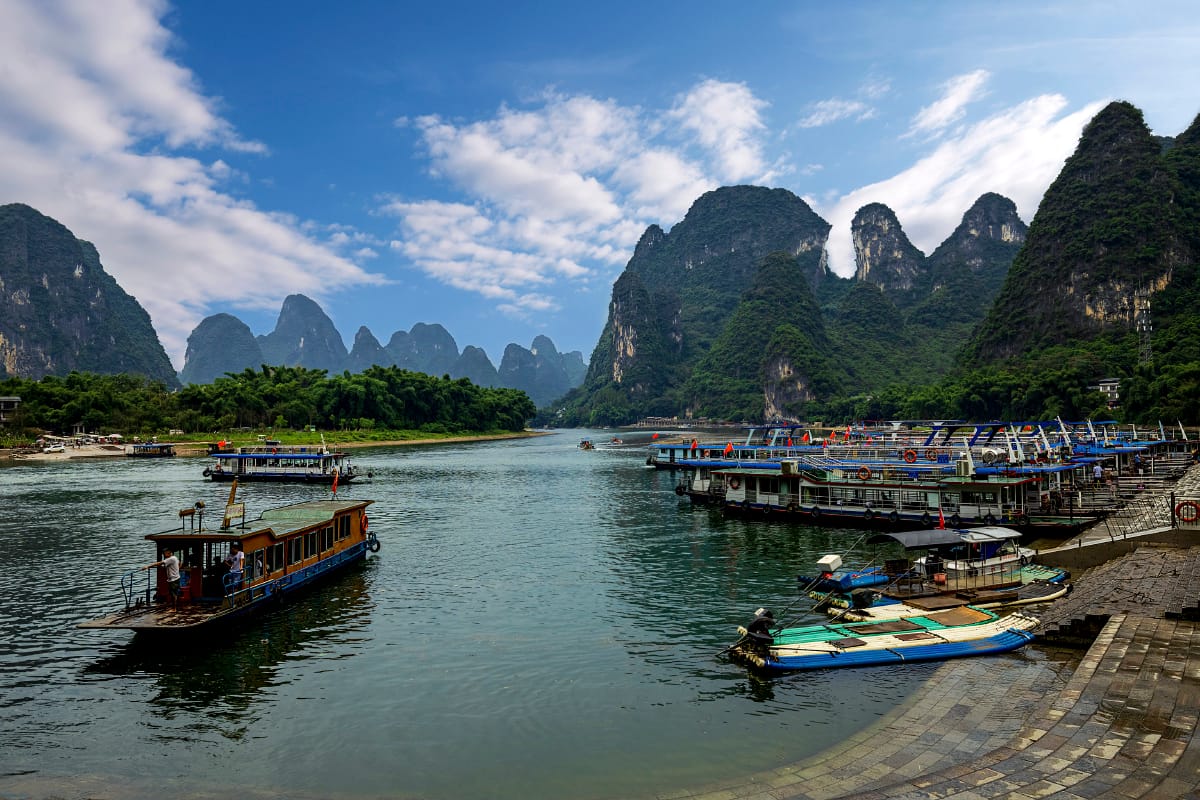
Beyond the full 60-kilometer Guilin-to-Yangshuo cruise, there’s a shorter option: the Yangdi-to-Xingping motorized bamboo raft, 1.5 hours, covering only the best section of the river at close to water level. Pricing runs ¥216 per person for the boat, plus a charge for any empty seats if you’re not filling all four spots on the raft.
Take the Full Cruise If
It’s your only or first visit to Guilin. The “boring” first hour is a real part of the experience, not a flaw — it’s a slow transition into the landscape that most first-timers end up glad they had. One of our clients traveling with family booked the 4-star VIP section for a group of eight — a small 12-seat area on the upper deck near the back. They had clear water despite rain in Guilin the day before. Between the photo stops, onboard mahjong, and the buffet lunch, the 3.5-hour sail passed quickly, and the group called it well worth doing with children along.
Take the Short Raft Instead If
You’re short on time, based in Yangshuo rather than Guilin, or you’ve already done the full cruise and want the highlights without the four-hour commitment. It skips the unremarkable opening stretch and puts you closer to the water.
Our honest take, after years of putting clients on this boat: the full cruise earns its reputation, but it rewards patience more than most first-timers expect. Choosing the shorter version isn’t settling — it’s the right call for a specific kind of trip.
DIG DEEPER: Li River Cruise vs Bamboo Rafting: An Operator’s Honest Take
FAQ: Li River Cruise
How long is the Li River cruise?
The full route from Guilin to Yangshuo takes 3.5 to 5 hours in normal water conditions (April to November), depending on water speed. During the dry season (January to March), cruises typically run a shortened route from Yangdi to Hua Mountain and back, taking 2.5 to 3 hours.
Can I cruise from Yangshuo back to Guilin?
No. The Li River cruise runs one direction only, downstream from Guilin to Yangshuo. For the return trip, take the high-speed train (20–47 minutes), a long-distance bus (1.5 hours), or a private car.
Is the Li River cruise worth it?
For a first visit to Guilin, yes — it’s the only way to see the full scenic corridor from the water, and the Yangdi-to-Xingping section genuinely earns its reputation. If you’ve done it before or have limited time, the shorter Yangdi-to-Xingping raft covers the same highlights in a fraction of the time.
How much does the Li River cruise cost?
The official ticket price is ¥215 for 3-star and ¥360 for 4-star per adult. Booking through a local operator or travel agency adds a service fee over this base price, which typically covers pier transfer and passport/booking assistance.
Do I need to book in advance?
Yes, especially April through November. Tickets for both 3-star and 4-star boats sell out during peak season, sometimes weeks ahead around Chinese national holidays. Booking at least a few days ahead, and a month ahead for holiday periods, is the safer approach.
What do I need to bring to board?
Your original passport is mandatory — photocopies aren’t accepted at the boarding hall. Beyond that, bring layers for the open deck and a power bank for photos. If you’re on a 3-star ticket, pack your own snacks or a self-heating meal too, since the optional onboard meal add-on is expensive for what you get — 4-star already includes a proper buffet in the ticket price.
Is the scenery different between the 3-star and 4-star boats?
No. Both classes sail the identical route and pass the same landmarks, including Nine Horse Fresco Hill and Yellow Cloth Shoal. The difference is comfort — seating, deck space, and meal quality — not what you see.
The Li River is the reason most people come to Guilin in the first place, and the cruise remains the classic way to experience it. Whichever version fits your trip — the full day on the water, the shorter Xingping run, or a day on foot along the bank — reach out to us. We’ll help you plan it around the rest of your itinerary.