Reed Flute Cave: Prices, Hours & What to Expect
Reed Flute Cave is worth visiting for most first-time Guilin travelers — a 240-meter illuminated limestone cave 5 km from downtown, built around the vast Crystal Palace chamber. Plan on 1–2 hours. It’s not for everyone: the lighting is heavily saturated and theatrical rather than natural, and the souvenir gauntlet on the way out annoys most visitors who go through it. We’ve been operating tours in Guilin since 2006, and what follows is what we actually tell clients before they go — the ticket price that applies now, the entrance that trips up nearly every first-timer without a guide, and what changed when the cave relit its main hall this June.
Ticket price | CNY 90 on-site · CNY 82 online |
Opening hours | 07:30–18:00 (May–Oct) · 08:30–17:00 (Nov–Apr) |
Visit duration | 1–2 hours |
Distance from downtown | 5 km, 15–20 min by taxi |
Cave length | 240 m one-way, ~500 m total walking route |
Best for | First visit to Guilin, rainy days, summer heat |
Table of Contents
1. Is Reed Flute Cave Worth Visiting?
What it is
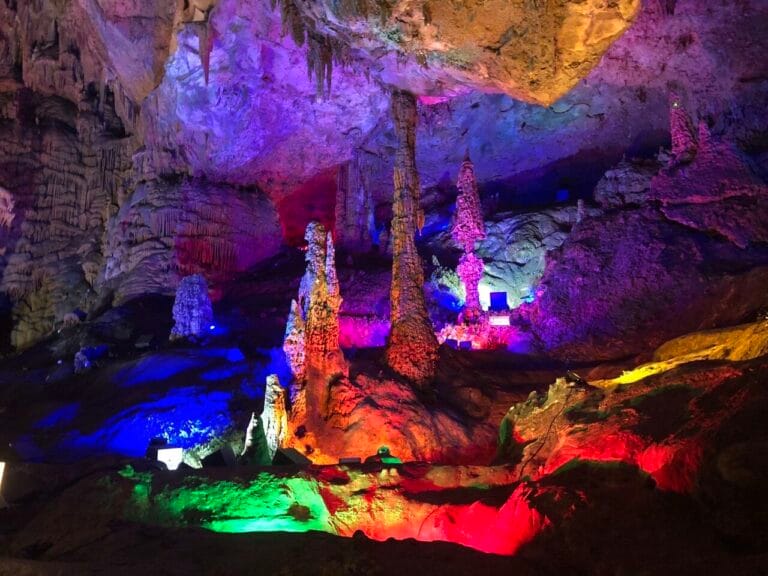
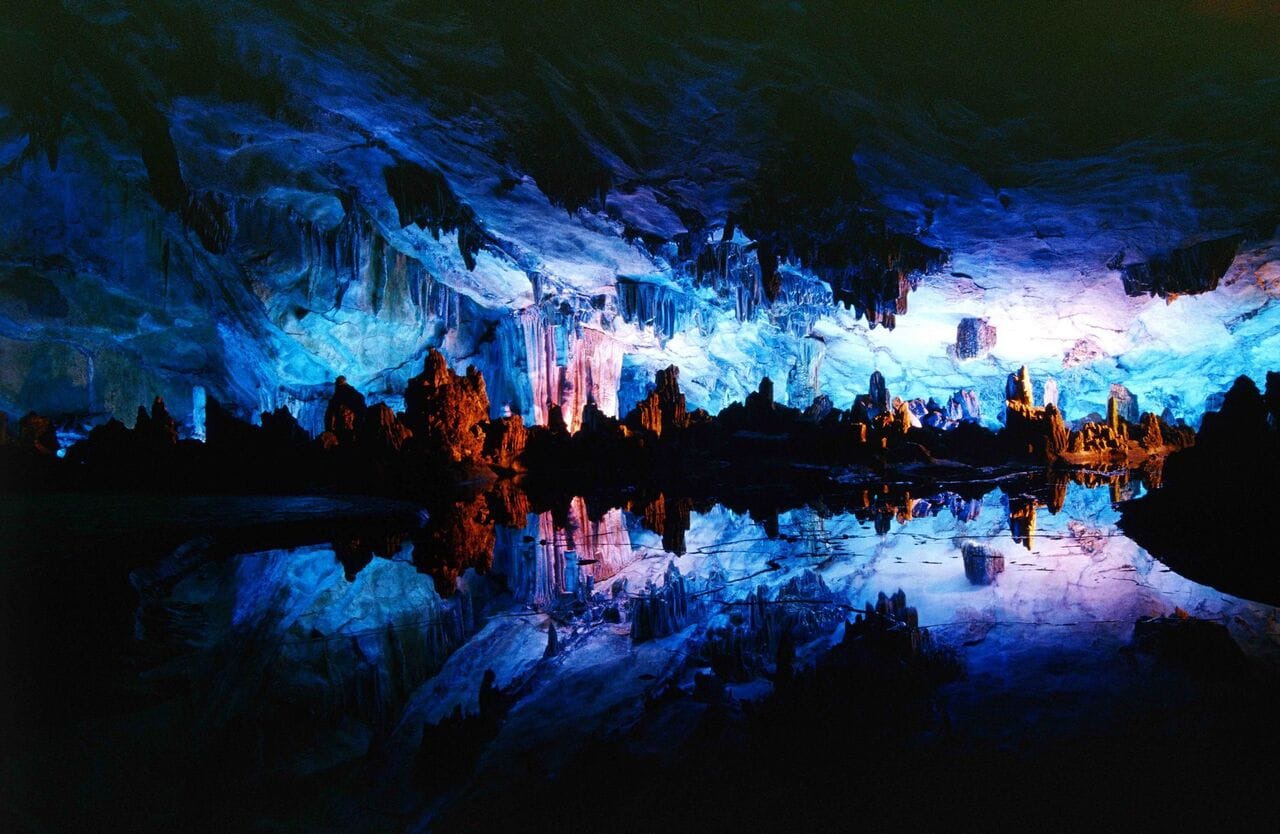
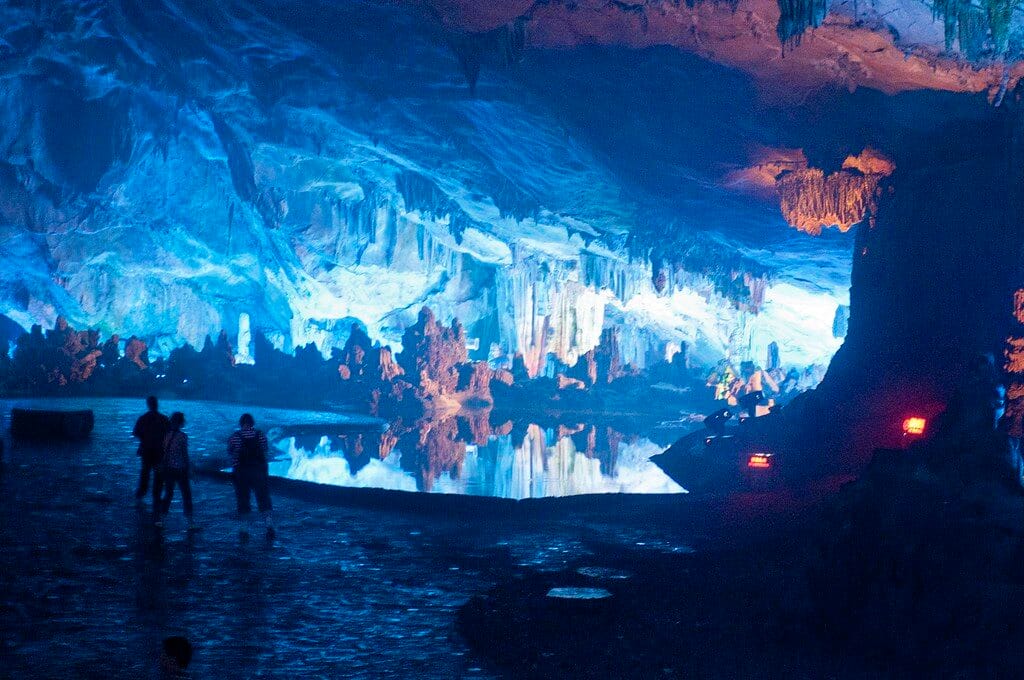
A 500-meter walking route through a limestone cave 5 km northwest of Guilin, lit in color and built around more than 30 named rock formations — stalactites and stalagmites shaped over hundreds of thousands of years into recognizable forms: a lion catching a sunrise, a snow-dusted pine, a dragon coiled around a pagoda. The route ends at the Crystal Palace, a chamber roughly 3,000 square meters, 93 meters wide and 18 meters high, and spacious enough to have once hosted state banquets — the visual high point most people remember afterward. Section 4 walks through the formations in order.
It’s not China’s largest cave (Beijing’s Shihua Cave and several in Guizhou run longer), but it’s one of the closest to a city center, and one of the most historically documented — more than 300 foreign heads of state have visited since it opened on February 4, 1962, including Richard Nixon, who walked the full route with his wife on February 28, 1976. The cave has recorded more than 45 million visitors since opening, and its oldest wall inscription dates to 792 AD.
Worth it for most first-time visitors
The Crystal Palace alone is worth the trip, and it’s a solid indoor option when Guilin’s weather doesn’t cooperate. Skip it if you dislike heavily saturated artificial lighting (this cave leans hard into it), you’d rather spend your one Guilin morning on the Li River, or slow crowds test your patience — the route runs one direction only, so there’s no passing a group ahead of you.
Reed Flute Cave vs. Silver Cave
Silver Cave, near Yangshuo, is the other cave most visitors weigh this against.
Reed Flute Cave | Silver Cave | |
|---|---|---|
Location | 5 km from Guilin | Near Yangshuo, ~1 hr from Guilin |
Standout feature | Crystal Palace, 3,000 m² | Underground river you partly walk beside |
Our take | Better fit for a Guilin-based day; nothing in the city matches its scale | Worth adding on if you’re already spending a day in Yangshuo — not worth a special trip back |
2. Tickets and Opening Hours
Prices and hours at a glance
Adult ticket (on-site) | CNY 90 |
Adult ticket (online) | CNY 82 — book by midnight the day before your visit |
Concession | ~half price — ages 6–18, full-time students, seniors 65+ (ID checked at gate) |
Free entry | Under 1.2 m or under 6 years old |
Opening hours | 07:30–18:00, May 1–Oct 31 · 08:30–17:00, Nov 1–Apr 30 |
Last entry | 30 min before closing |
4D show pause | Daily, 12:00–13:00 |
Prices and hours per the operator’s official WeChat notice, issued April 30, 2026.
Book online through the cave’s official WeChat channel, its mini-program, or an authorized OTA like Trip.com or Meituan — other resellers aren’t guaranteed to scan at the gate. The Guilin Reed Flute Scenic Area Management Office (桂林市芦笛景区管理处) announced a change to the online booking window on March 8, 2026, via its official WeChat account: tickets now need to be booked before midnight the day before your visit, replacing the previous one-hour-ahead rule. At the gate, scan your QR code or check in with your ID directly — no separate ticket exchange needed.
Extras that cost more
Extra | Price | Our take |
|---|---|---|
Qianlong Yuan light show (潜龙渊) | CNY 38, ~20 min | Honestly, skip it — a separate short installation that doesn’t add much to what’s already inside. Kids sometimes love it, though |
Sightseeing train (小火车) | CNY 35 | Skip — see Section 3 |
Bamboo raft on the pond | Now charges separately (used to be free with cave admission) | Skip it here — if you want a real bamboo raft experience, the Yulong River near Yangshuo is the better version of this |
Sedan chair | ~CNY 300 | Nobody’s actually needed one in our experience — the path just isn’t that demanding |
Parking | CNY 10/hour | There’s a free lot too, via a side turnoff before the main gate |
3. The Entrance Most Visitors Get Wrong
Do not navigate to “Reed Flute Cave Visitor Center” (游客中心) — that drop-off is the ticket counter for the sightseeing train, and it looks closer on a map than it actually is, which is exactly why drivers leave you there. What you actually want is “芦笛岩洞口售票处” (Reed Flute Cave entrance ticket office), or just tell your driver to head for the police post (警务室) on the road — the stairway right across from it takes you up to the real entrance in a handful of steps. This is the exact pin we send our own clients, every time.
How to get there
Method | Details |
|---|---|
Taxi / ride-hail | 15–20 min from downtown, ~CNY 15–20 |
Bus 3 or 213 | Direct to Reed Flute Cave stop; bus 3 also passes several other Guilin sights |
From Guilin South Railway Station | Bus 3, ~6 km, CNY 1, runs 06:30–21:50 every ~10 min |
From Guilin Qixing (North) Railway Station | ~8 km, taxi is the practical option |
From Guilin Liangjiang Airport | ~25 km, taxi or private transfer — allow 40–50 min depending on traffic |
Private car | We’ll route this into a multi-stop day — ask us |
Carrying luggage? Storage is available at the visitor center (CNY 10/hr small bag, CNY 20/hr large) or more cheaply near the sightseeing-train ticket office closer to the entrance.
4. What Will You See Inside the Cave?
Entry happens in timed batches — a guide takes a group in every 15–20 minutes and stays with them for the full route, narrating in Mandarin as you go. If you lose track of your guide, just fall in with the next group passing through; nobody checks. English narration isn’t routinely scheduled, and this is one of the more frequent requests we get from clients once they realize it — a Mandarin-only guide reading off a script isn’t much use if you can’t follow along. → We can arrange a private English-speaking guide for the cave alone or built into a full Guilin day. The path is gently graded throughout, with no backtracking — manageable for older visitors and small children.
Crystal Palace
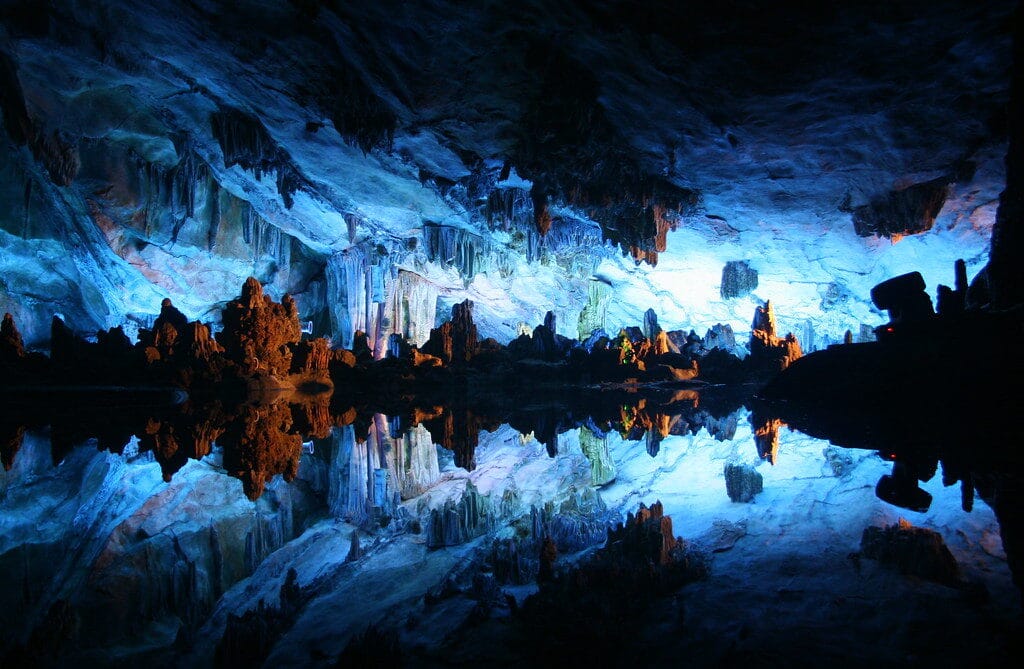
At roughly 3,000 square meters, 93 meters wide and 18 meters high, this is the cave’s centerpiece — flat-floored and high-ceilinged enough that it hosted state banquets in the 1960s, with acoustics good enough for occasional unamplified concerts. It comes about two-thirds of the way through the route, right when groups are tired and guides tend to speed up — don’t let yours rush you through the one room worth slowing down for. This is also where the June 2026 lighting relight is concentrated.
Flower and Fruit Mountain
Named for the Monkey King’s home in Journey to the West, and honestly, on your own it just reads as a jagged rock cluster — the resemblance isn’t obvious without help. It’s the story that does the work here — once a guide tells the tale, most people stop and actually look instead of walking past, and it’s usually the point in the tour where a group’s energy visibly picks up.
Virgin Forest (原始森林)
A dense stand of stalagmites that, from a few steps back, genuinely reads like a forest canopy — the density here is different from anything earlier on the route. This is one of the darker stretches of the cave, and it’s tempting to hurry through it — don’t. Give your eyes a second to adjust and there’s more detail in the individual formations here than the lighting first suggests.
Lion Rock and Sunrise
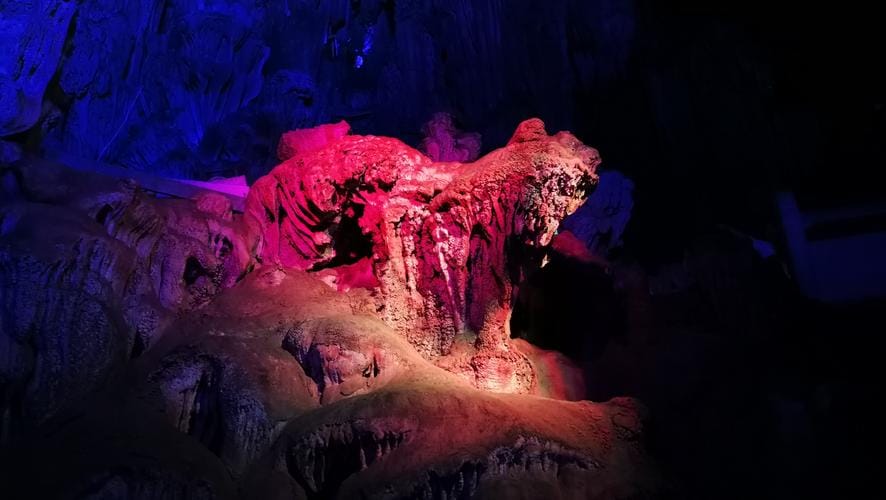
You hit this early, before the route really opens up — a cluster of stalactite “lions” lit to look like they’re catching a sunrise, one of the first set pieces designed to make an impression before the path narrows again. Most write-ups treat it as a warm-up act before the “real” formations further in, but it’s worth pausing here rather than treating it as something to walk past on the way to the Crystal Palace — the color work on the rock face is some of the most detailed on the whole route.
Pines in the Snow (塔松傲雪)
Two formations side by side: one a calcite “snowman,” the other a stalagmite shaped like a pine dusted in snow. Of everything on the route, this is the one where you don’t need the guide’s story to see it — it just looks like what it’s named. It’s also weathered every round of lighting changes basically unchanged, since the “snow” is the mineral itself, not a trick of colored light.
Dragon Pagoda (盘龙宝塔)
Tall, tiered, and near the end of the route — it’s the formation that shows up on the most postcards. Which formation is actually the highlight is genuinely a matter of taste among our own guides, let alone visitors; don’t let any single “best photo spot” ranking, ours included, decide your pace. Bring a steady hand if you want a shot here — the light’s dim enough that most phones need bracing against the railing.
The lighting, briefly
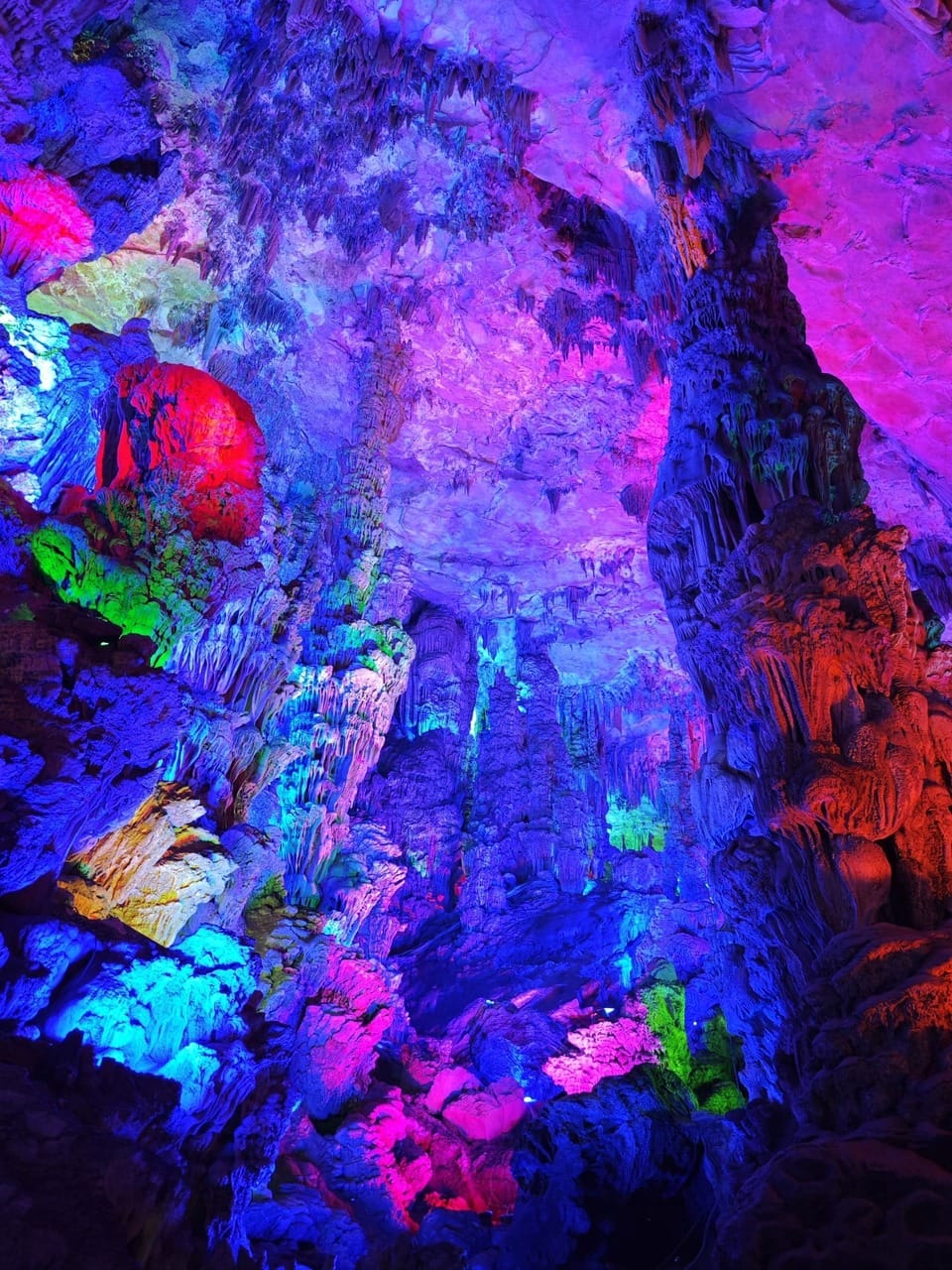
If it’s been a few years since you last saw photos of this cave, the lighting looks different now. The cave has gone through three generations of lighting since opening to tourists — from basic bulbs, to the saturated multicolor LED look most existing photos show, to the current system, which syncs with music and projects moving imagery onto the walls. The most recent step was a Crystal Palace relight completed in June 2026, adding a 4D projection show across the chamber’s dome. If lighting technology isn’t something you care about, the short version is: expect the colors and effects to look different from what you’ve seen online, and expect it to be more elaborate, not less.
5. Photos and the Exit Shops
Getting a photo: bring a steady hand
Even after the 2026 relight, the ambient lighting isn’t bright enough for most phones without stabilizing against a railing. A free keychain-sized photo is available at no cost. Paid options escalate from there:
Option | Price |
|---|---|
Free keychain photo | Free |
Larger print, taken in-cave | CNY 20 |
Same print, laminated at exit | CNY 35 |
None of these are necessary — one workaround is angling your own phone to catch the light from the professional photographer’s setup at a formation like the Crystal Palace, without paying for their print.
The exit shops: skip them
The exit route runs through shops selling medicinal herbs and crystals. It’s a common source of pressure-sale complaints, and neither purchase nor close inspection is required to reach the exit — walk through at a normal pace and nobody stops you.
6. When Should You Go?
Best time of day: morning
Get there at opening, or within the first hour, if you can. Crowds build steadily through the morning and peak around 2 p.m. Can’t manage an early start? Midday works better than you’d think, right before that afternoon crunch — pair it with lunch after at Lujia Village (鲁家村), a small tofu-focused village 1.7 km away. The difference at the Crystal Palace specifically is noticeable — mornings, you can actually stand still there for a minute.
Best time of year: April, May, September, or October
If you can steer clear of Chinese New Year and the first week of October, do. The route only runs one way, so once it backs up, it stays backed up — a slow group anywhere ahead of you holds up everyone behind. April, May, September, and October are the easiest months for the city outside the cave. Inside, none of it matters — 18–20°C, every day of the year, rain or shine, peak season or not.
7. Outside the Cave
The boardwalk and Fanglian Pond
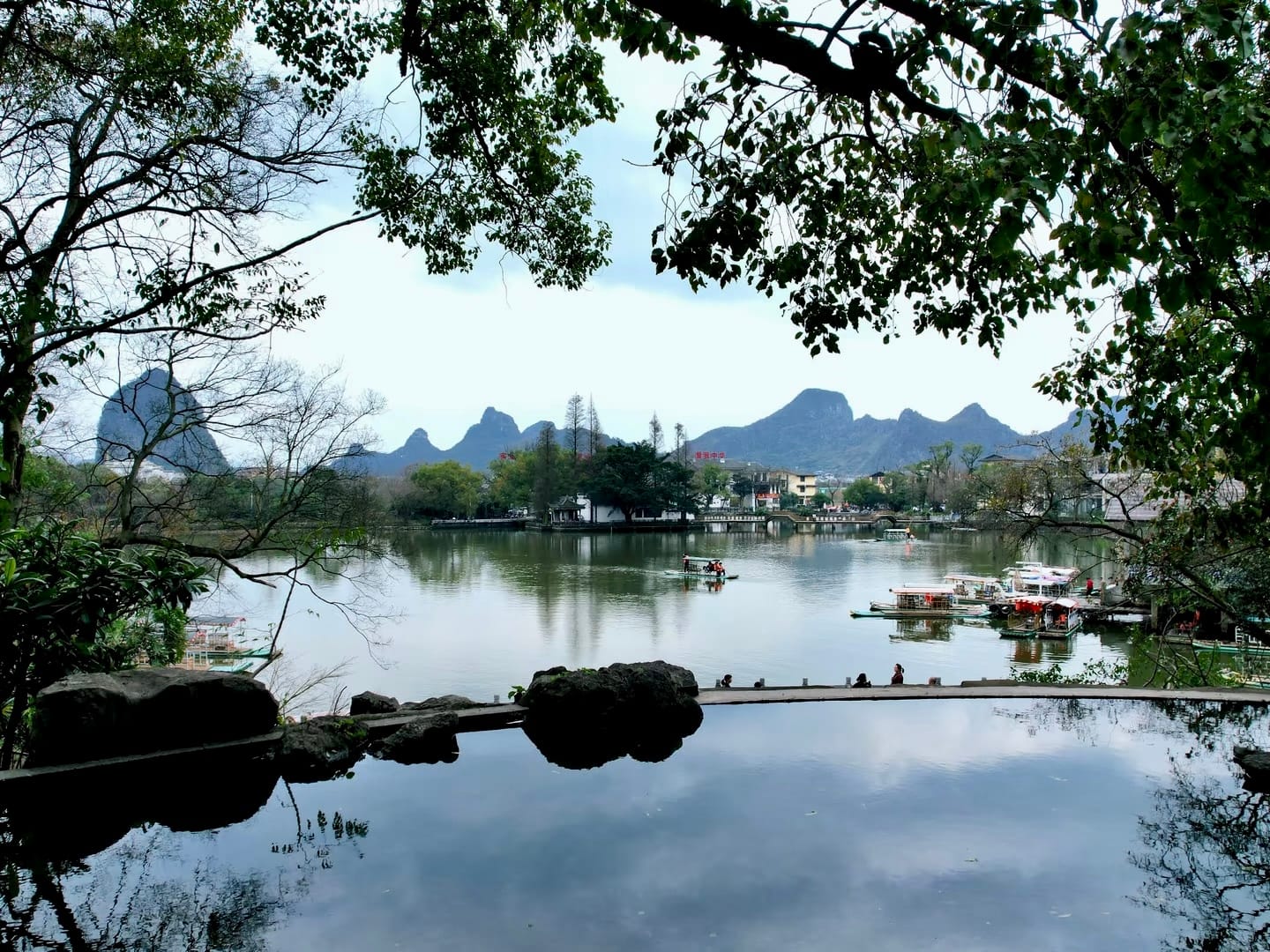
You come out blinking a bit — an hour of cave light does that — onto a wooden boardwalk that follows the water back toward the parking area and bus stop. It’s a nice reset: open sky, the karst hills you actually came to Guilin for, Fanglian Pond (芳莲池) sitting off to one side, plus a small waterfall and water-curtain grotto further along the grounds that kids tend to enjoy.
Reed flute souvenirs
There are vendors near the exit selling actual reed flutes, a few yuan each — the thing the cave is named after, if you didn’t already know that. Haggle a little; the first price is never the real one.
None of this is a separate stop you need to plan around. It’s ten minutes, maybe fifteen, on the way to the exit.
8. Combining It With the Rest of Guilin
If you have a half-day
Reed Flute Cave pairs naturally with a half-day loop of Guilin’s in-town sights. → See our Elephant Trunk Hill guide for the city’s other signature landmark, a short taxi ride away. Diecai Hill and Fubo Hill both sit along the Li River closer to downtown and can be folded into the same afternoon. → See our Diecai Hill guide and Fubo Hill guide
If you have a full day
We typically place Reed Flute Cave first thing in the morning — before the heat and before the crowds build — and save the afternoon for a Li River cruise or Yao Mountain’s cable car for elevated karst views. This is the sequencing we default to for most clients unless their flight times force a different order. → See our Li River Cruise: 3-Star vs 4-Star guide and Yao Mountain guide
9. Frequently Asked Questions
Is Reed Flute Cave worth visiting?
For most first-time Guilin visitors, yes — the Crystal Palace chamber is the largest indoor attraction in Guilin’s city limits, and it’s been open to the public since 1962. It’s a weaker choice if you dislike heavily colored artificial lighting or only have time for one Guilin attraction and would rather prioritize the Li River.
How old is Reed Flute Cave, and how many people have visited?
The cave opened to the public on February 4, 1962, though the oldest inscription on its walls dates to 792 AD, in the Tang Dynasty. Since opening, the cave has recorded more than 45 million visitors and hosted over 300 foreign heads of state and government, including Richard Nixon, who visited in 1976.
How much does it cost?
CNY 90 on-site, CNY 82 online if booked by midnight the day before. Concession (~half price) for ages 6–18, students, and seniors 65+. Free under 1.2 m or under 6.
How long does the visit take?
1 to 2 hours, at the pace set by your assigned guide group. The route is roughly 500 m total.
Should I take the sightseeing train?
No — the walk from the visitor center to the actual entrance takes only a few minutes on foot, and the train charges CNY 35 for that distance. Navigate to the cave entrance directly to skip it.
Can I take my own photos inside?
Yes, but the lighting is dim enough that phone photos often come out dark or blurred without bracing against a railing. A free keychain photo is available; paid prints run CNY 20–35.
Is it suitable for kids or older travelers?
Yes — the path is paved and gently graded, though damp in places, so wear non-slip shoes. Sedan chairs exist but are rarely necessary.
What changed at the cave in 2026?
A Crystal Palace lighting relight completed in June 2026, adding bare-eye 4D projection and a new sound-and-light program — the latest step in three generations of lighting upgrades since the cave opened to tourists.
What should I wear?
A light layer, even in summer — the cave holds 18–20°C year-round. Closed, non-slip shoes, since the path can be damp.
Planning a Guilin trip around Reed Flute Cave and the Li River? We’ve been handling ground logistics in Guilin since 2006 — get in touch and we’ll take care of the driving, timing, and guides around your dates.