Ruyi Peak Yangshuo: Cable Car, Glass Bridge & Tickets
Ruyi Peak is the highest point in Yangshuo, and the only spot in the county you can reach by cable car instead of your own legs. We’ve been bringing groups up here since the cableway opened. The question we get asked most isn’t “is it beautiful” — it clearly is, on a clear afternoon. It’s why the ticket price seems to change depending on who you ask, and there’s a real reason for that. This guide walks through every landmark on the route and what the ticket actually costs depending on how you book it. It also covers a couple of sales tactics worth knowing before you go, and our honest take on whether Ruyi Peak deserves a slot on your Yangshuo itinerary over Xianggong Hill.
Chinese Name | 如意峰 |
Address | Mengcun Village, Gaotian Town, Yangshuo County, Guilin (off National Road 321, near Xingtianle Resort) |
Hours | Ticket sales 08:00–18:00; open until the last visitor returns |
Summit elevation | 499 meters (Ruyi Cloud Top) |
Ticket price | ¥170–220 depending on booking channel |
Recommended visit time | 2–3 hours inside the scenic area |
Best time of day | After 15:00 for sunset and cloud-sea conditions |
Table of Contents
1. What Is Ruyi Peak, and What Will You See There?
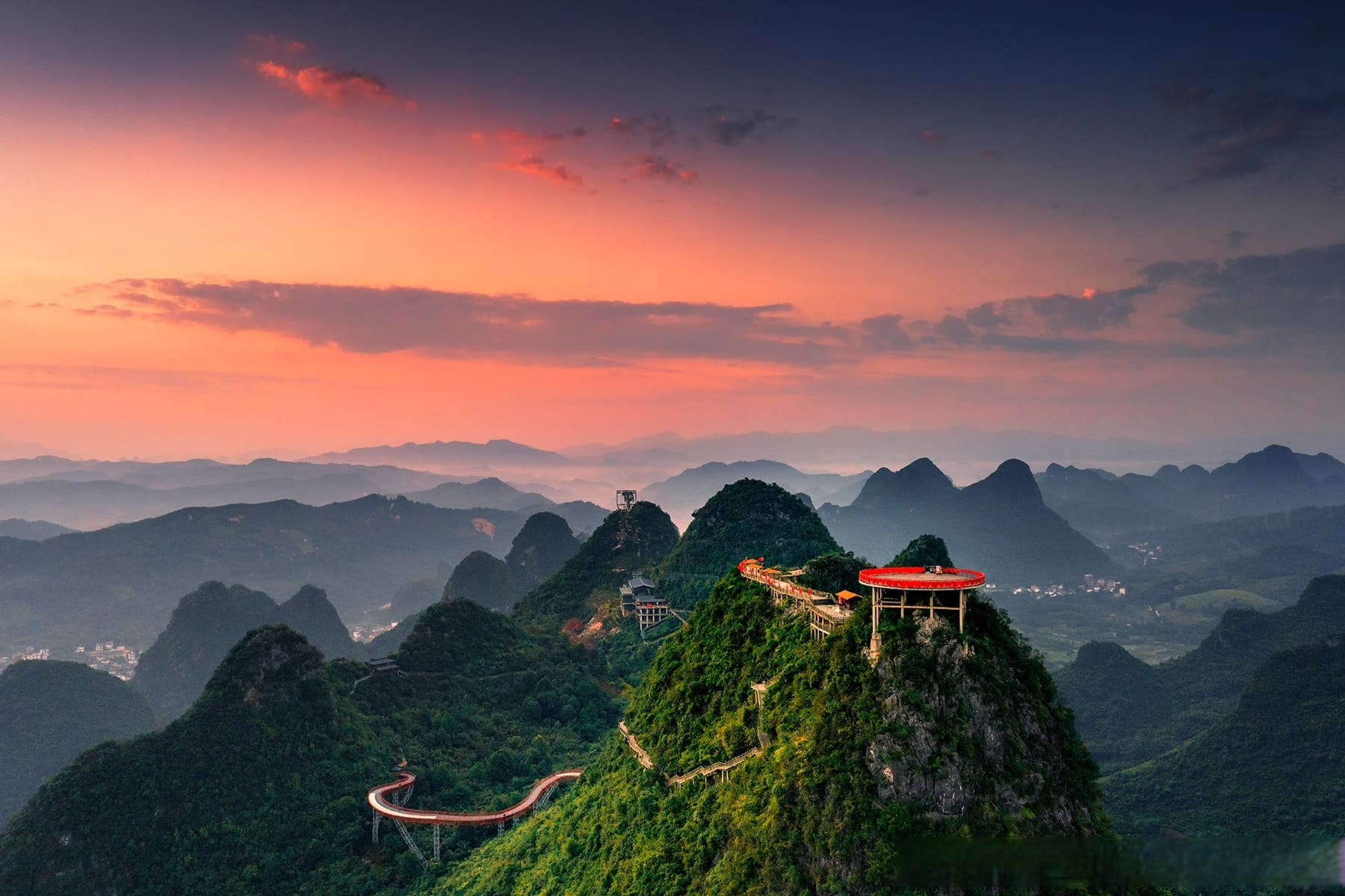
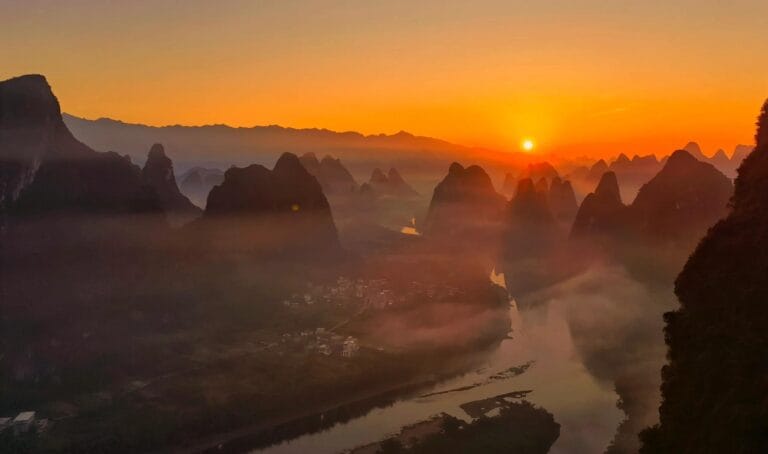
The scenic area sits on what locals call “three peaks, two valleys” — Yuanbao Peak, Ruyi Peak, and Necklace Peak, with Caixi Valley and Baihua Valley running between them. Ruyi Peak gets its name from its ridgeline, shaped like a ruyi, the traditional scepter-shaped good-luck symbol carved into temple roofs across China. As the tallest point in the county, it’s the only spot where you get a full 360-degree look at Yangshuo’s peak forest without committing to a multi-hour climb. It’s also a young attraction, which is part of why some of our own clients have stumbled onto it by accident while exploring on a rental scooter.
Cable Car and Yuanbao Peak
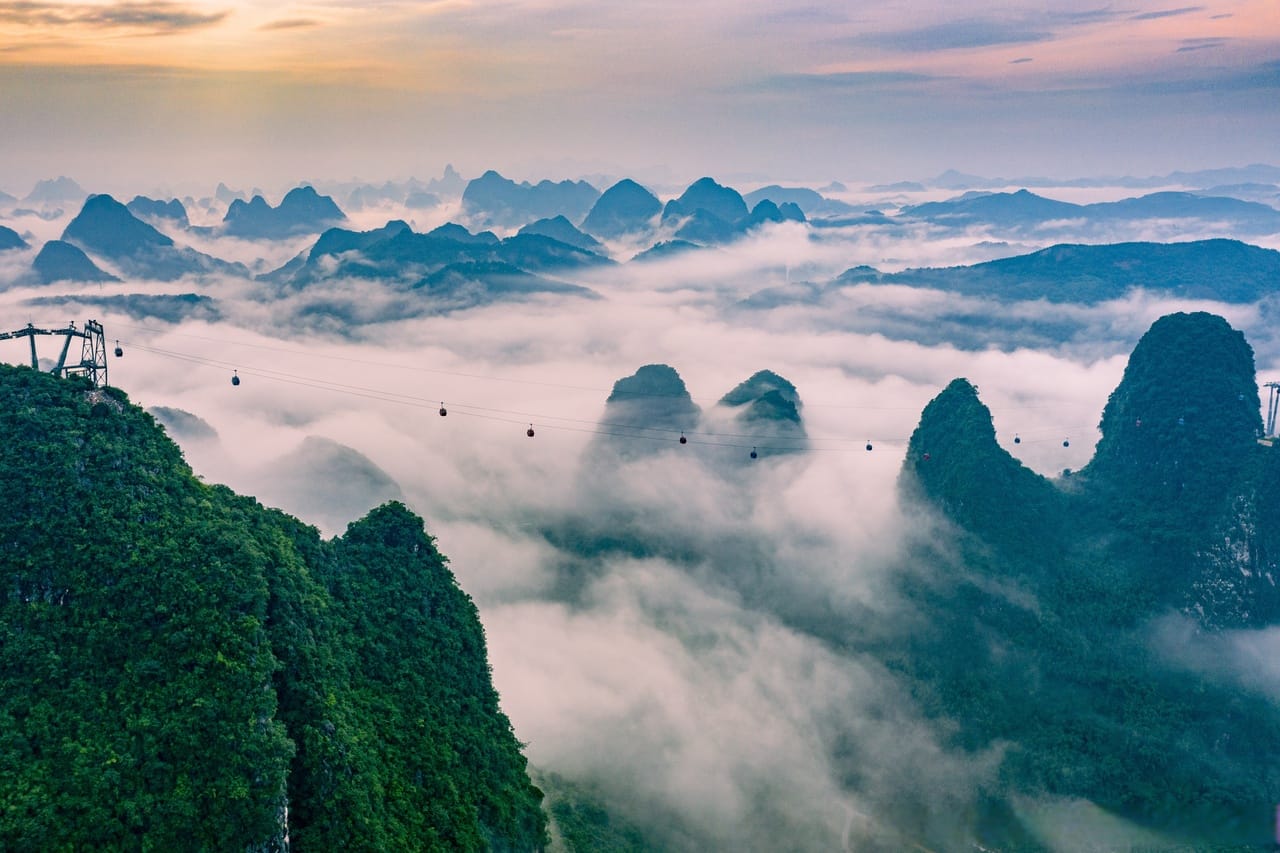
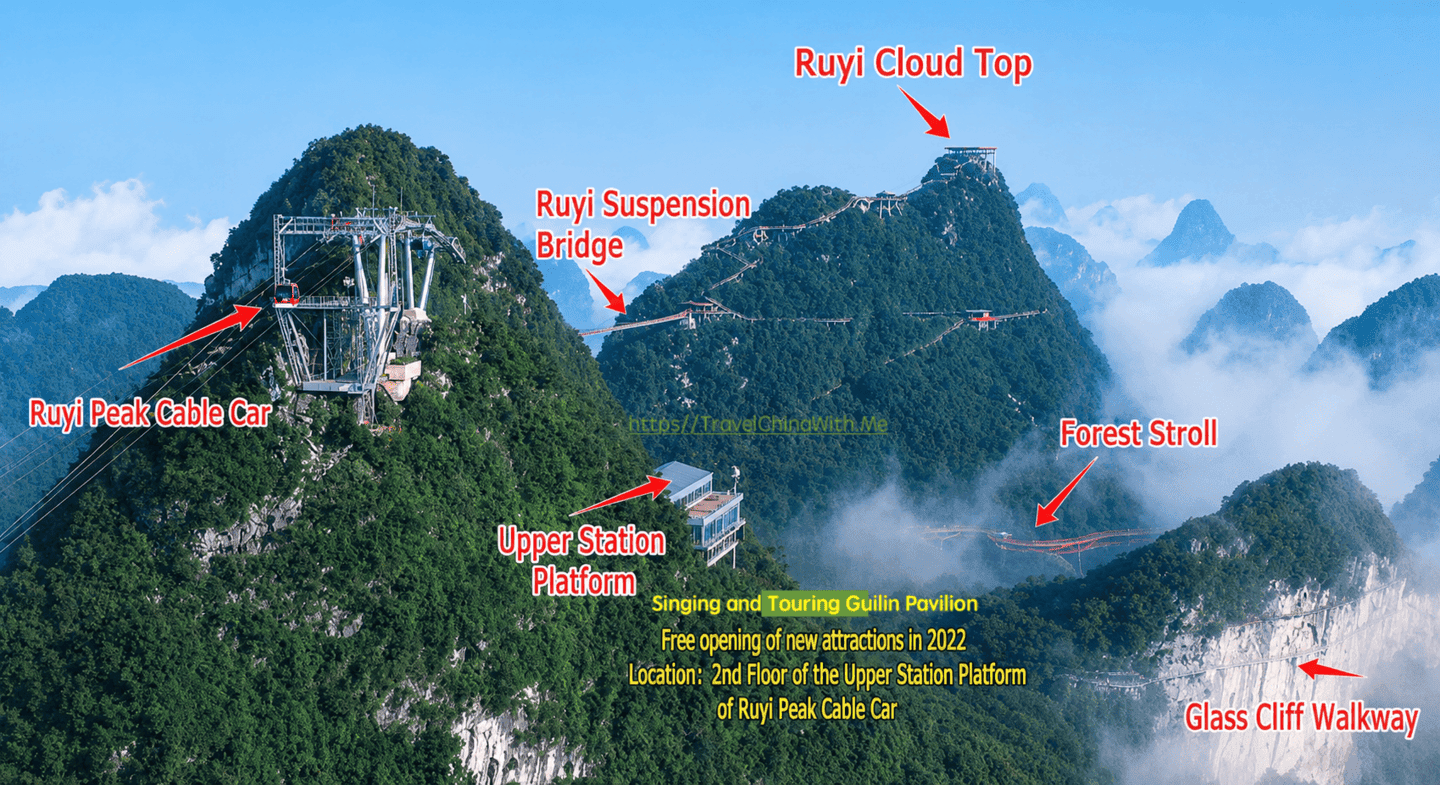
The cable car covers 2,012 meters of horizontal distance and a 241-meter elevation gain in about 10 minutes, dropping you at Yuanbao Peak — the first proper viewpoint on the route, and where most people realize how high up they actually are. The peak takes its name from its shape — yuanbao are the boat-shaped gold ingots seen in Chinese New Year decorations, and the ridge genuinely curves that way. It’s a brief stop rather than a destination, mainly useful for orienting yourself before the bridge.
Ruyi Suspension Bridge
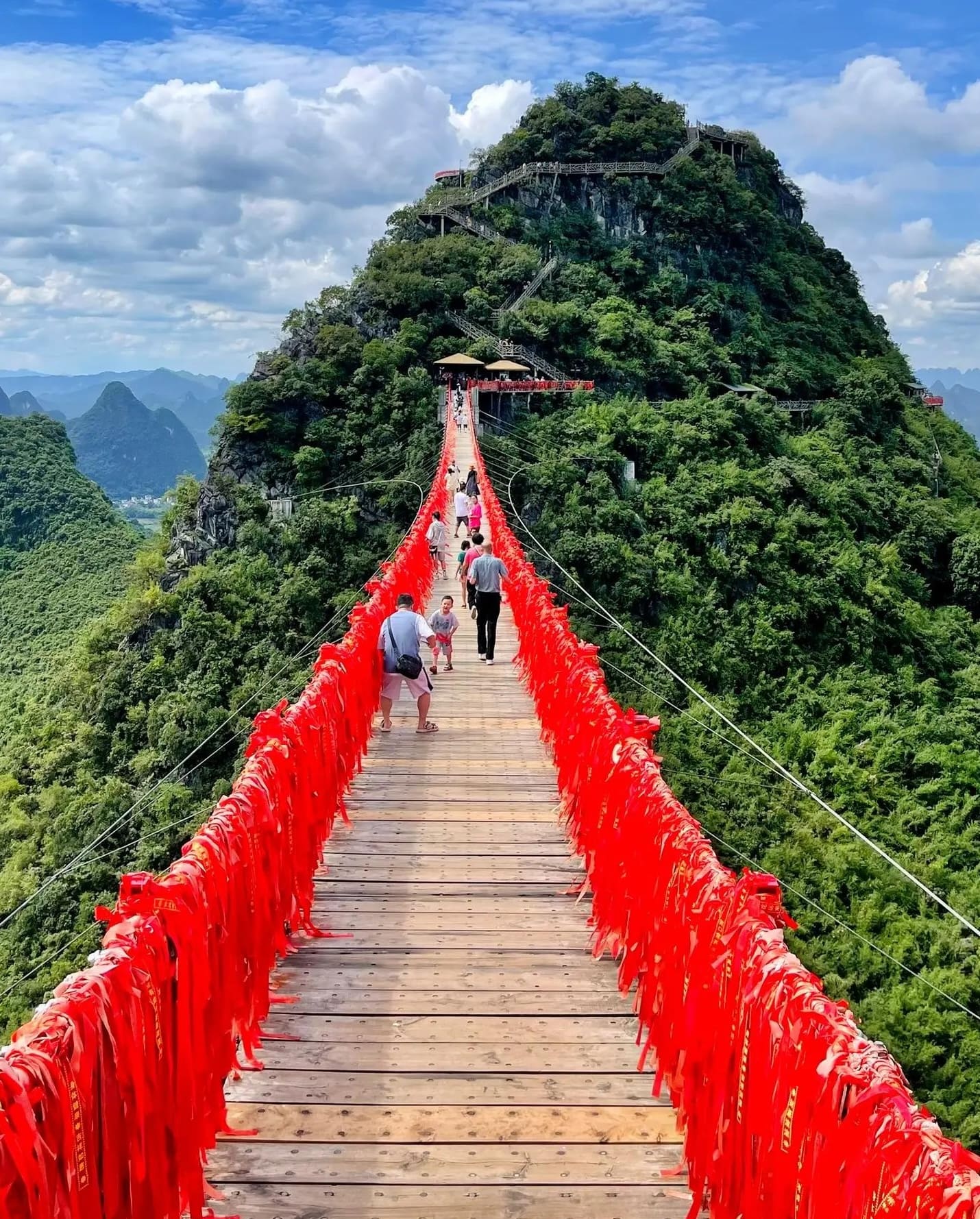
The bridge behind almost every social media post about Ruyi Peak: 142 meters of red-railed walkway between Ruyi Peak and Yuanbao Peak. It runs 58 meters above the valley floor, lined with red wish ribbons from visitors before you. It sways more than photos suggest, but it’s a sturdy structure — the movement is part of the appeal. Shalom, an American photographer, brought his wife and their 10-month-old son here this past March after spotting the bridge on social media. He carried his son in a front carrier the whole way across while his wife held the rail.
Just past the bridge, the path crosses a second, shorter glass-floored section before climbing toward the summit — easy to confuse with the main glass walkway near Necklace Peak later in the route.
Ruyi Cloud Top
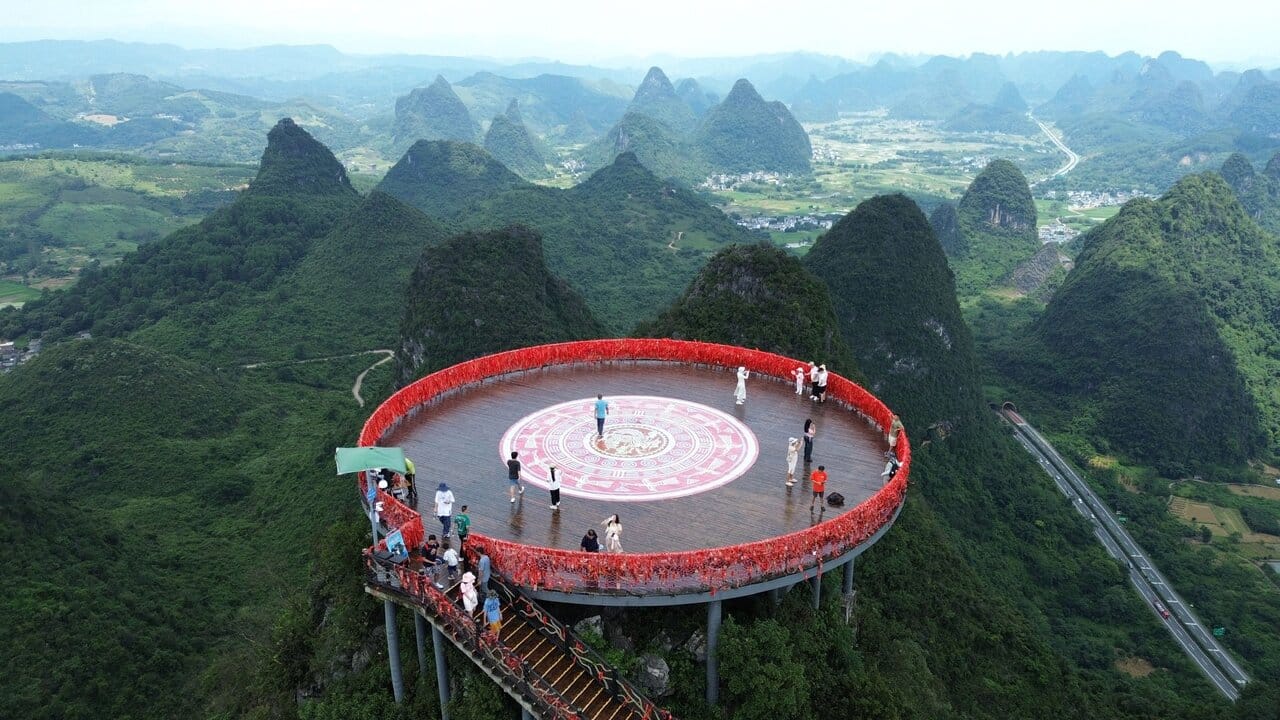
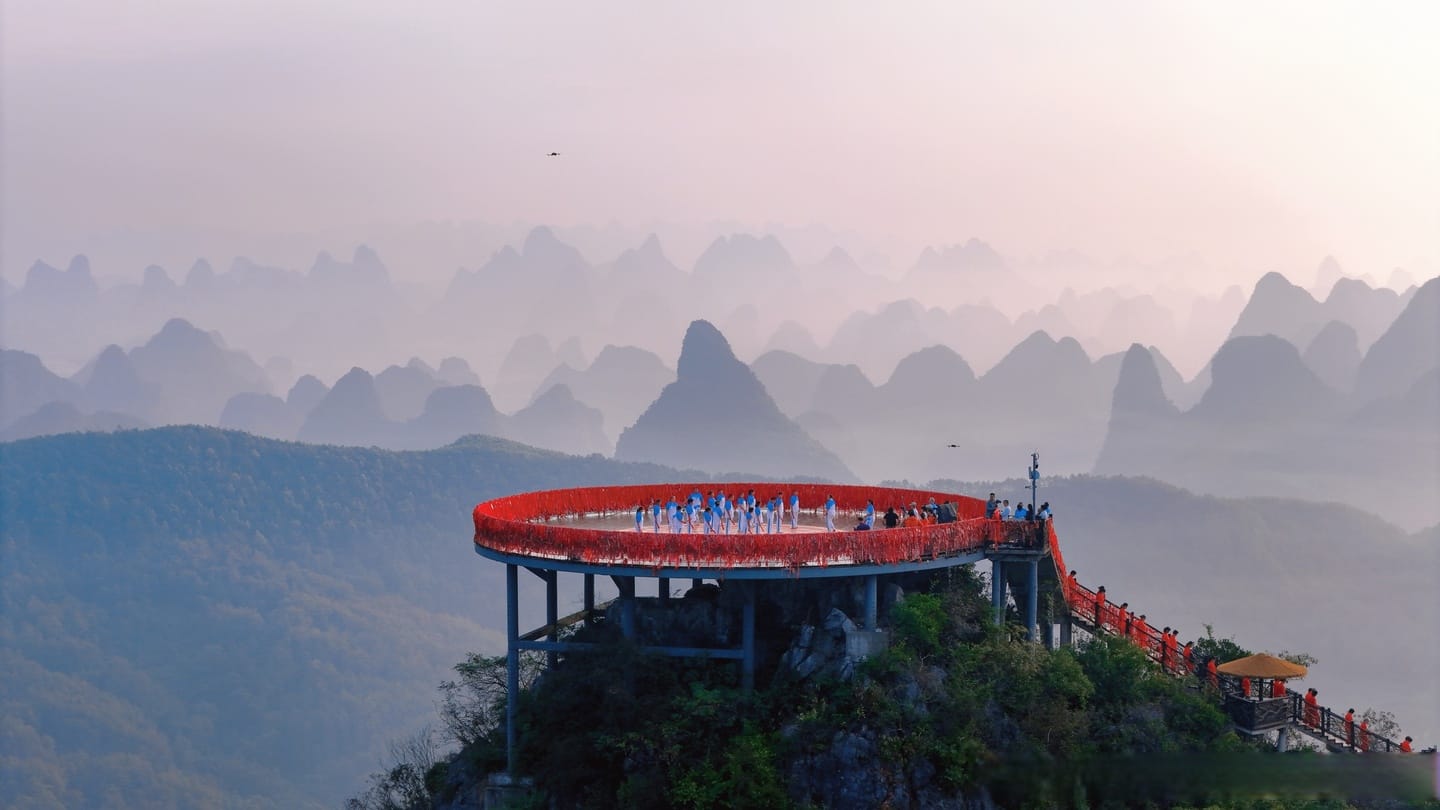
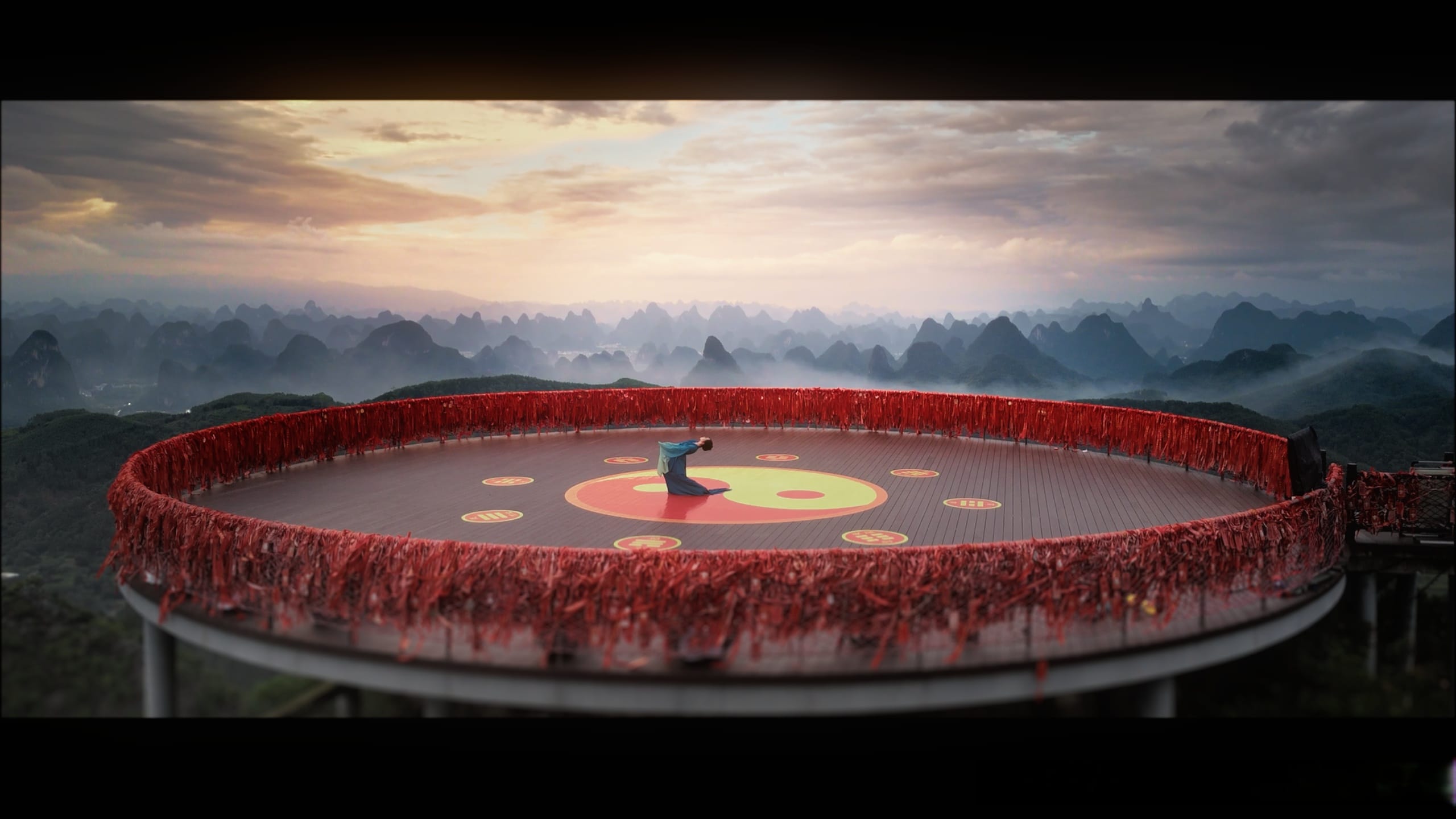
The summit platform, and the actual payoff of the trip. If you’ve done Zhangjiajie before Yangshuo, this will feel familiar. It’s the same basic idea as the 1520 Sky Eye on Qixing Mountain, a circular glass-and-steel viewing deck at the top of a cable car line. The comparison stops there: Qixing Mountain’s platform sits at 1,528.6 meters, against 499 meters here, and looks out over sandstone pillars instead of karst peaks — different geology entirely, even if the architecture rhymes. On a clear day at Ruyi Cloud Top, you get a genuine 360-degree view of Yangshuo’s peak forest with nothing in the way.
→ See our Qixing Mountain guide if you’ve been comparing the two regions.
Forest Walkway
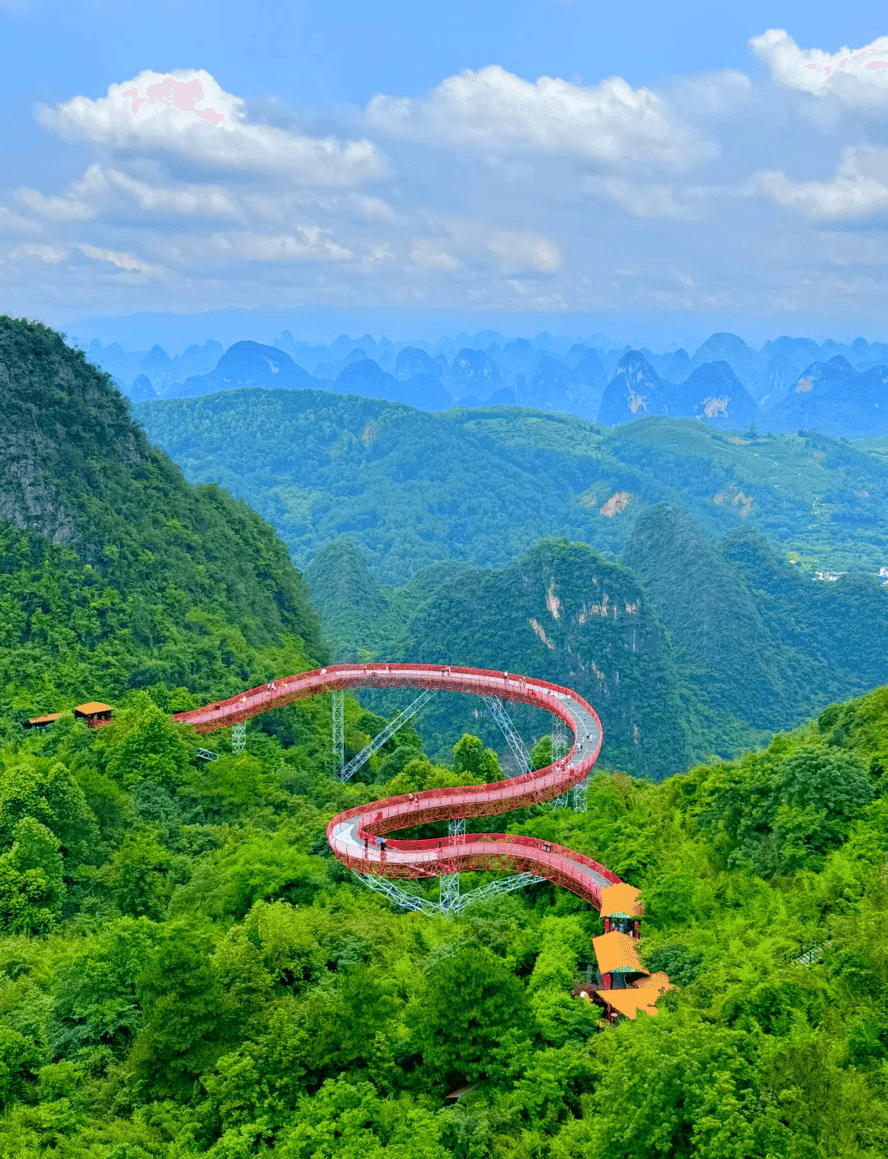
A 246-meter elevated path connecting Ruyi Peak to Necklace Peak, running through the tree canopy at up to 32.5 meters above the ground. This section is shadier and noticeably cooler than the open platform, a welcome stretch on a hot afternoon. It’s also where you’ll pick up your free shoe covers for the glass walkway ahead — put them on here and keep them on.
Glass Walkway
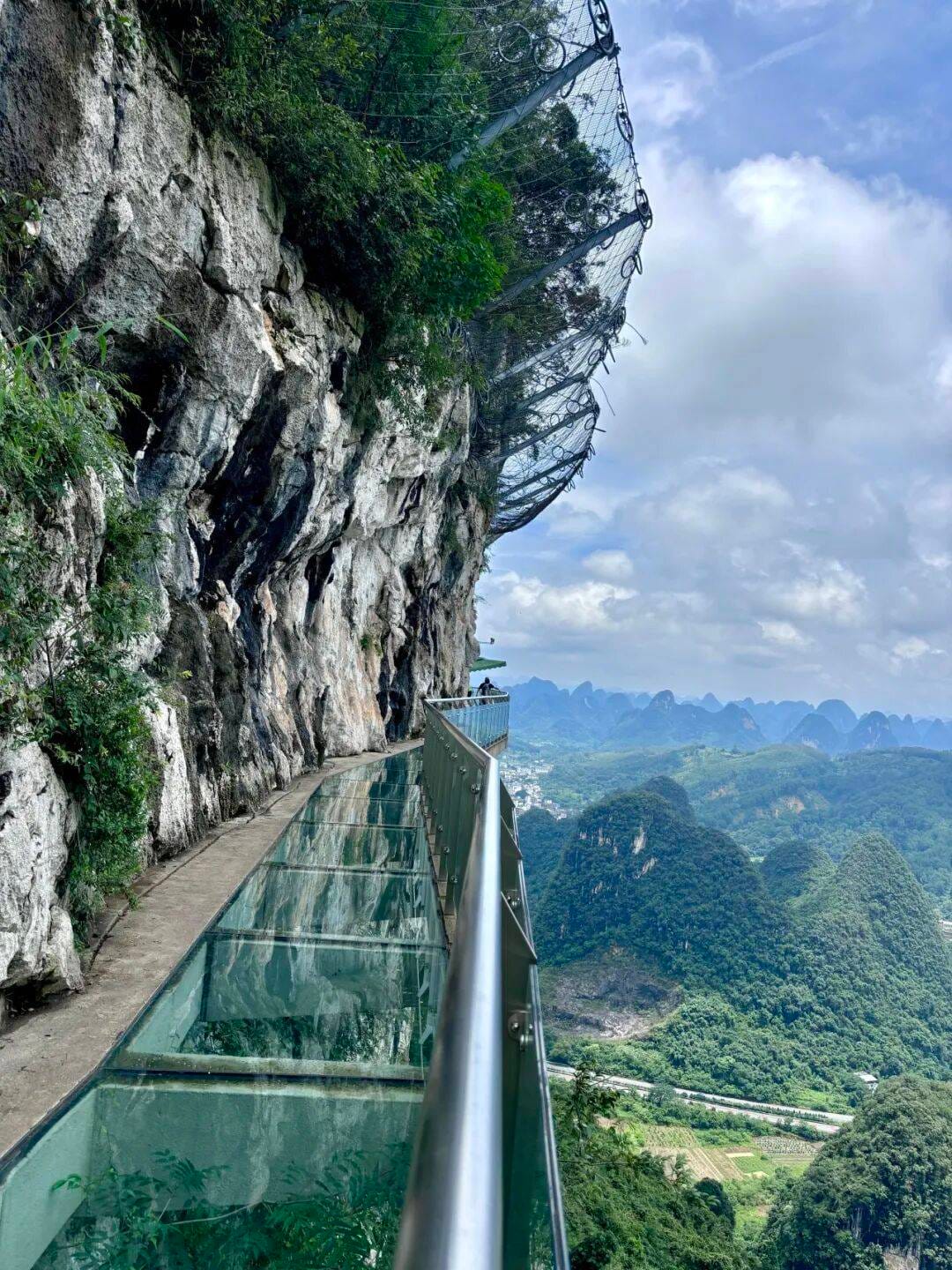
The main event for anyone chasing a thrill: 138 meters of tempered glass paneling suspended along Necklace Peak’s cliff face, with nothing but air and a straight drop beneath your feet. It’s not a long crossing, but it gets the strongest reactions from first-timers, good or otherwise — noticeably more exposed than the curved glass section you crossed earlier near the suspension bridge.
Singing and Touring Guilin Pavilion
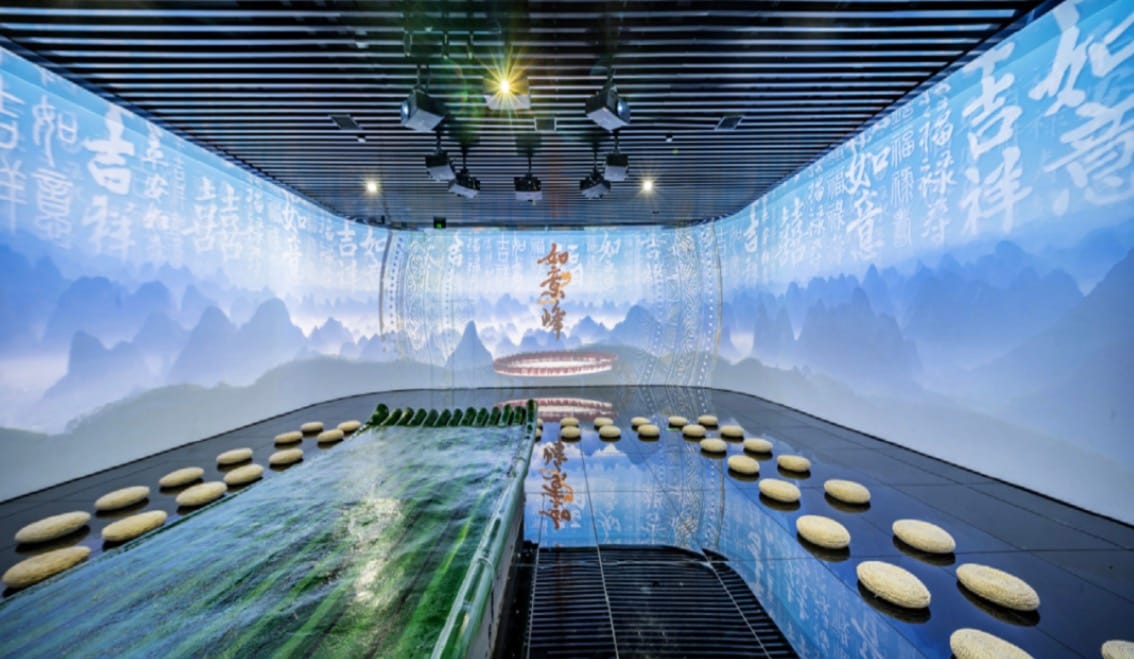
A digital exhibition at the upper cable car station, built mainly for a domestic audience. There’s no English content to speak of, and it adds time without adding much for an international visitor — worth skipping if you’re tight on the clock. Like the glass and forest walkways, it requires shoe covers, which is worth knowing if you’ve already taken yours off.
2. The Standard Route, Stop by Stop
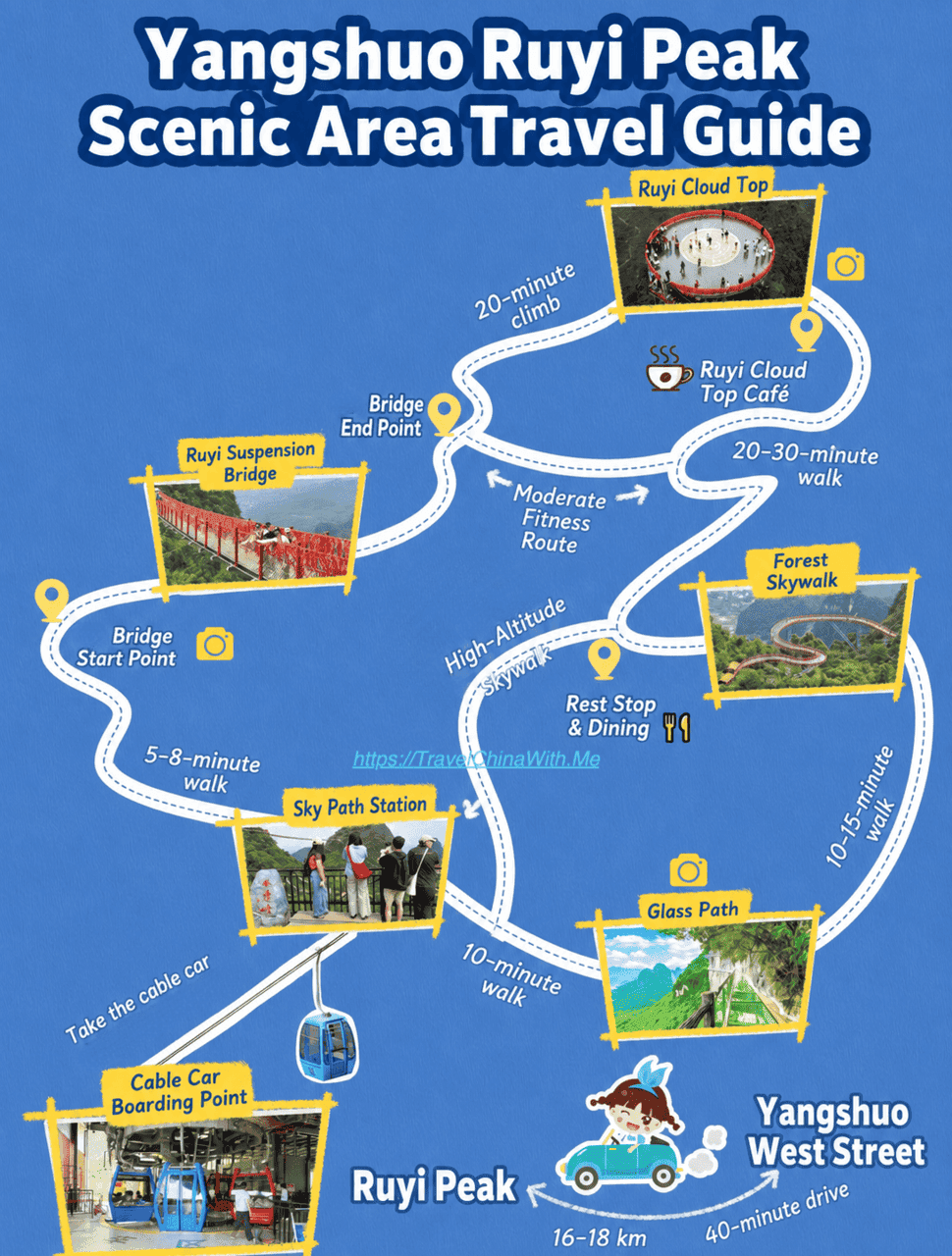
The scenic area runs as a one-way loop, so you’re never backtracking over ground you’ve already covered. The figures below come from the scenic area’s own posted specifications:
3. How Much Do Ruyi Peak Tickets Actually Cost?
Price tier | Cost | Where to get it |
|---|---|---|
Gate / official | ¥220 | Walk-up ticket window |
International booking platforms | $55 USD (¥395) | Viator and similar listings |
Online travel agencies | ¥208–220 | Trip.com, Ctrip |
Local distributor | ¥170–180 | Yangshuo guesthouses, social media channels |
The official adult price now dropped from ¥260 to ¥220, with a ¥130 concession rate for eligible visitors with ID — treat these as the current baseline. International platforms haven’t caught up: Viator still lists the ticket from $55 per person, well above even the old gate price. The Trip.com, Ctrip, and local-guesthouse figures above predate this change, so we’d confirm them again before relying on them.
Every tier covers the same thing: the round-trip cable car and full access to the route. Children 6 and under, or under 1.2 meters tall, get in free.
4. How Do You Get to Ruyi Peak from Yangshuo or Guilin?
Method | Cost | Time | Notes |
|---|---|---|---|
Taxi or private car from Yangshuo | Metered fare | 20–30 minutes | Navigate to “如意峰索道景区” directly, not a generic pin |
Public bus from Yangshuo | ¥10 | 50 minutes | Gaotian–Ruyi Peak line (高田-如意峰专线), runs 08:00–17:00, roughly every 30 minutes; flag it down anywhere along the route |
Bus from Guilin (via Yangshuo) | ¥25 | 1.5 hours | Guilin South Bus Station to Yangshuo’s bus terminal, then transfer to the local Ruyi Peak line |
Bus from Guilin (via Lipu) | ¥35 | 1.5 hours | Guilin South Bus Station to Lipu, passing directly by the scenic area — get off there |
Rental e-bike from Yangshuo | ¥20–30/day | 45–60 minutes each way | 15 km one-way from Yangshuo West Street via the Ten-Mile Gallery road; parking at the scenic area is free, but there’s no charging service on site |
Private car from Guilin city | — | 1.5 hours | 80 km via the Baomao Expressway; Gaotian exit is 5 km from the entrance. We arrange this as a charter car for clients who’d rather skip the bus stations. |
Which of these makes sense depends mostly on where you’re starting from — Yangshuo town, Guilin city, or somewhere in between. One thing worth flagging: we route clients onto the Gaotian–Ruyi Peak bus line rather than letting them flag down the drivers who approach outside the Yangshuo bus station with a “direct” fare. It’s cheaper and goes straight there without the negotiation.
For that 80-kilometer stretch from Guilin, we also arrange charter cars — door-to-door from your hotel, no transfers, and considerably faster than any of the transportation methods mentioned above.
Once you arrive, the official car park charges ¥5 an hour, with the first 30 minutes free — worth remembering for the next section.
5. Sales Tricks to Watch For at the Gate and on the Mountain
None of these are dangerous, just mildly annoying — and knowing about them in advance takes the sting out completely.
Parking Misdirection
We’ve had drivers call us mid-trip asking whether the roadside lot they’d just been waved into was legitimate. It usually isn’t. Village residents near the entrance sometimes direct arriving cars into informal lots instead of the official one. They charge a flat ¥30 for the day — far more than the official lot’s ¥5-an-hour rate (with the first 30 minutes free) for a typical two-to-three-hour visit, and the lots have nothing to do with the scenic area itself. Stick with your navigation pin for “如意峰索道景区” and drive past anyone waving you off course until you actually reach the gate.
The “Free Photo” Upsell
We warn clients about this one specifically, because it catches even seasoned travelers off guard. Staff at the glass walkway entrance will often offer you a free 3-inch print as you start the crossing. By the time you reach the other end, the pitch has shifted to a high-resolution 8-inch version or a keychain, priced well above what either is worth. There’s zero obligation here — say no and use your own phone. The light on the glass section is good enough that you won’t miss the professional version.
The Shoe-Cover Deposit
Free shoe covers are handed out at the forest walkway entrance — put them on there and leave them on. The glass walkway entrance is further ahead at a fork in the path, and you can’t cross without them. Some vendors near that fork will frame the covers as a ¥5 refundable deposit instead of free, or offer a ¥10 buyout. If you take the deposit option, hang onto the receipt. You’ll need it to get your money back, and since the route crosses two separate glass-floored sections, the same receipt sometimes lets you reuse the covers on the second one instead of paying twice.
6. How Long Should You Plan to Stay, and How Bad Are the Queues?
Queue Reality on Busy Days
Visitors who go on a weekend or national holiday routinely describe waiting close to an hour for a cable car ride that takes 10 minutes. We’ve seen it ourselves — the line backs up well before the loading platform on a busy Saturday. Weekday mornings are a different world, with waits closer to 15–20 minutes.
How Long to Budget
Budget 2 to 3 hours for the full loop — it’s not a large site. Stick closer to 3 if you’re stopping for photos at every landmark or visiting on a day when the cable car queue runs long.
7. What to Bring and Know Before You Go
Footwear
We’ve turned clients away from the glass walkway in sandals before. There’s more stair climbing here than the photos suggest, around the bridge, the platform, and both walkways. Closed-toe sports shoes are non-negotiable.
Phone Battery
There’s nowhere on the mountain to rent a power bank, and the viewpoints come at you one after another. Charge up before you leave the hotel, not in the cable car queue.
Sun Protection
The walkways and the summit platform sit completely exposed, with no shade anywhere along the route. We’ve had more clients regret skipping sunscreen here than at almost any other attraction we cover. Bring a hat, sun sleeves, and an umbrella too — the open sections heat up fast.
Food, Water, and Toilets
Snack stands appear only at the bridge ends, the cable car stations, and one platform partway along the forest walkway, and everything there costs more than it would in town. Bring your own water and something to eat. Toilets follow the same spread-out pattern — use the ones near the cable car station before you start, since you won’t pass another for a while.
Families and Older Travelers
This is one of the more forgiving routes in the Guilin region — most of it is flat or gently sloped rather than a real climb. That’s part of why we send families and older clients here more confidently than we would to most karst peaks. Shalom’s family managed the full loop with a 10-month-old in a front carrier without any real trouble. Stairs are still unavoidable around the bridge and the glass walkway, so it’s not effortless, just easier than the alternative. Bring a carrier as a backup, not a plan A — you can always turn back to the nearest cable car station if someone’s had enough.
Drones and Rain
Leave the drone at the hotel — flights aren’t permitted anywhere in the scenic area. Don’t write off a rainy day, either. A misty Ruyi Peak looks more like a Chinese ink-wash painting than a washout. The glass walkway can close temporarily in heavy rain, though, so check conditions if that’s the section you’re most looking forward to.
8. The Best Time to Visit
Weather and Season
Spring (March–May) and autumn (September–November) give you the clearest skies and the most comfortable temperatures up top. We see the most washed-out visits during the wettest stretches of summer, when rain cuts visibility or forces a temporary walkway closure.
→ For the wider seasonal picture across the region, see our China Travel Seasons guide.
Time of Day
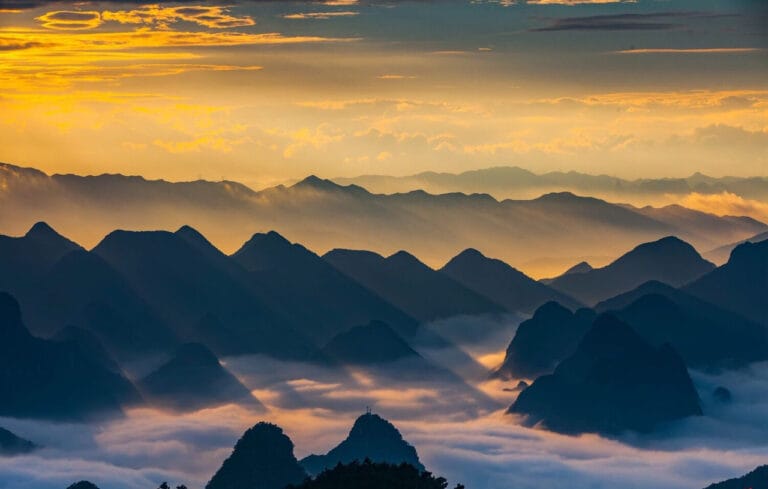
Aim to arrive after 15:00 if sunset light is what you’re after. Watch for cloud-sea conditions, which we’ve seen form most reliably after overnight rain clears into a bright afternoon. Midday brings harsh light and the biggest crowds — not a combination worth chasing.
9. Is Ruyi Peak Worth It, or Is Xianggong Hill the Better Choice?
Honestly, it depends on what you’re after. Ruyi Peak gives you a cable car, a suspension bridge, two glass-floored crossings, and a 360-degree view from the highest point in Yangshuo, for somewhere between ¥170 and ¥220 and several hours of your day. That’s a thrill-and-photo package no natural hike in the area can match.
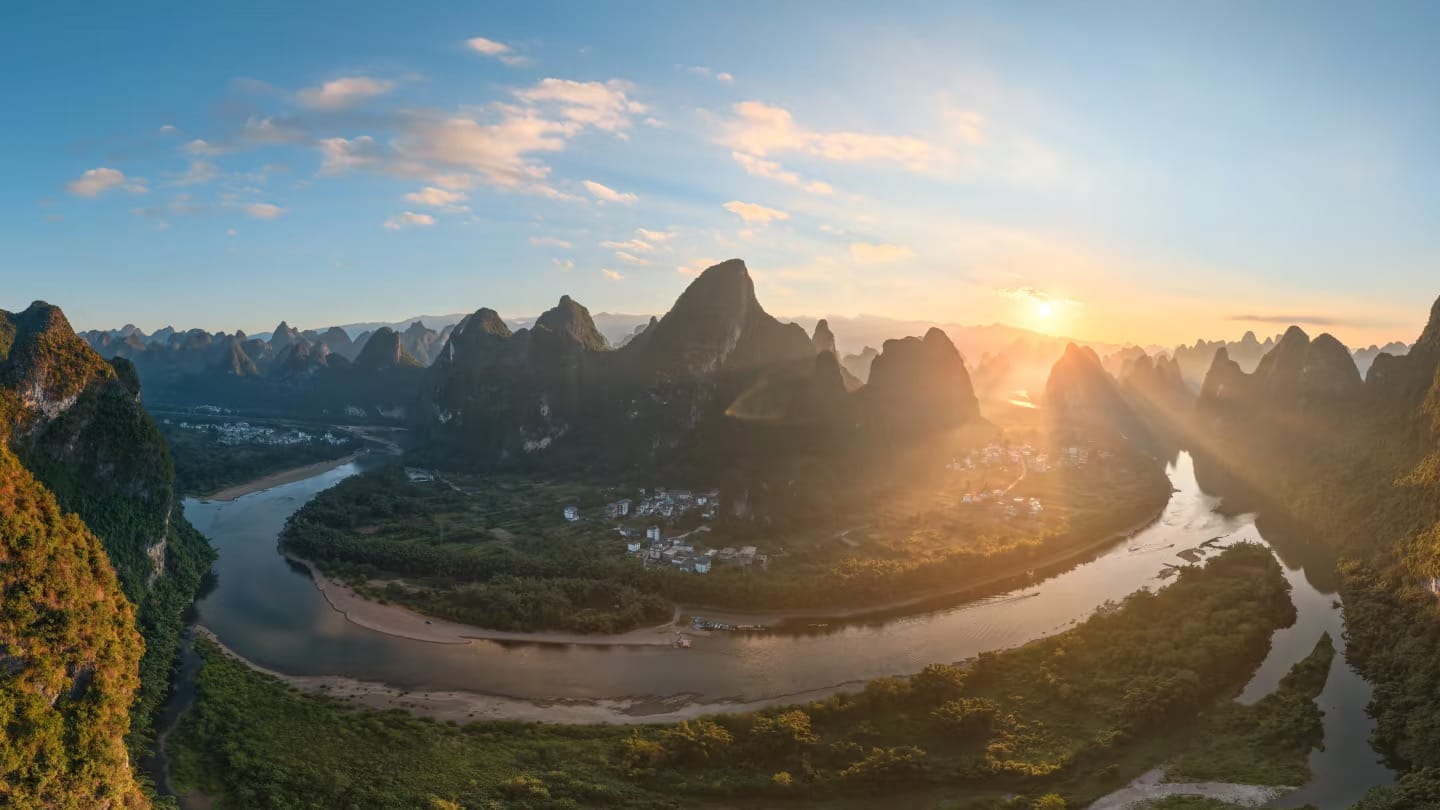
→ The alternative: Xianggong Hill, a natural 350-meter karst summit on the Li River. It costs ¥60, takes 15–20 minutes to climb on your own two feet, and puts you in front of the Li River’s S-bend — the same view printed on China’s 20-yuan banknote. No cable car, no manufactured infrastructure, nothing standing between you and the scenery.
If the cable car and the glass walkways are what you’re after, Ruyi Peak earns the trip. If you want the single best return on your time and money for one Guilin-region viewpoint, Xianggong Hill takes that contest. We rarely recommend doing both on the same trip unless you have at least three full days here — they satisfy a similar urge, and the second one tends to feel like déjà vu.
Frequently Asked Questions
Is Ruyi Peak the same as Xianggong Hill or Moon Hill?
No — three separate attractions. Ruyi Peak is a built cable car and bridge complex across three karst summits. Xianggong Hill is a natural 350-meter hill on the Li River, climbed on foot. Moon Hill is a different natural karst peak known for its arch-shaped summit.
Can you hike up Ruyi Peak without the cable car?
The whole route is designed around the cableway, and there’s no maintained walking trail to the summit that we’d send anyone up. If climbing under your own power is the point for you, Xianggong Hill or Moon Hill are the better choice.
Is Ruyi Peak suitable for elderly visitors or young children?
Yes — it’s flatter than most Guilin-area peaks, with only a few unavoidable stair sections at the bridge and glass walkway. It’s one of the more manageable options in the region for visitors with limited mobility.
Is Ruyi Peak free for children?
Children 6 and under, or under 1.2 meters tall, enter free. Minors between 1.2 and 1.5 meters get a discounted rate with ID.
Is Ruyi Peak crowded?
Only at weekend and holiday peaks, when the cable car line can stretch close to an hour. Weekday mornings are noticeably quieter.
Can I fly a drone at Ruyi Peak?
No. Drone flights are banned throughout the scenic area, so don’t build a trip around aerial photography here.
Is the glass walkway scary?
For anyone uneasy with heights, it can be. The 138-meter walkway runs along a cliff face with a straight-down view through the glass, and there’s a second, shorter glass-floored crossing earlier on the route that catches some visitors off guard. Free shoe covers are handed out at the forest walkway entrance. If you’re nervous, hold the handrail and stay toward the inner side, away from the edge.
Planning a Guilin and Yangshuo trip and want help deciding which karst viewpoints are worth your time? Contact us — we’ve guided this region since 2006.