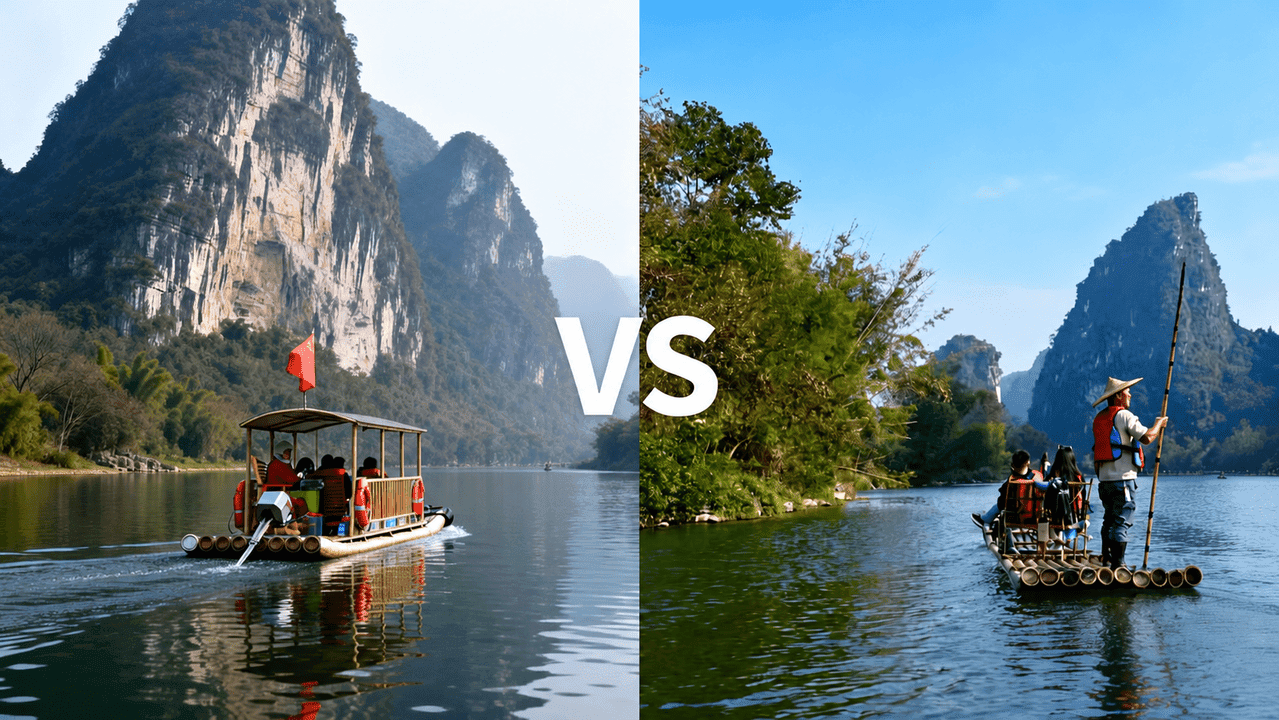
Li River Rafting vs Yulong River Rafting: Which to Book?
Li River rafting vs Yulong River rafting comes down to one question: have you already done the Li River cruise? If yes, skip the Li River raft — it covers the same core stretch the cruise already showed you, just louder and more crowded. Add Yulong River rafting instead; it’s hand-poled, quieter, and the only one of the two with real weir drops for speed and splash. If you haven’t got time for the cruise at all, the Li River raft works as a faster substitute.
✅ QUICK DECISION — LI RIVER RAFTING VS YULONG RIVER RAFTING
🚢 Done the Li River cruise already?
Skip the Li River raft. Add Yulong River rafting — no overlap, plus the weir drops.
⏱️ No time for the cruise at all?
The Li River raft works as a faster substitute — 50–100 min vs. 4–5 hrs.
👩❤️👨 Couples?
Yulong River’s private double raft
🎋 Want the one almost everyone should add?
Yulong River rafting — hand-poled, no overlap with either Li River product.
📅 Standard one-day pairing
Li River cruise in the morning, Yulong River raft the same afternoon.
🧑🧒🧒 Families with kids or seniors?
Yulong River’s flexible leisure floats or Li River raft.
Table of Contents
1. Li River Rafting vs Yulong River Rafting: What’s the Difference?
The confusion is understandable — same “bamboo rafting” name, same general stretch of Guangxi, completely different products.
Side-by-side comparison
Li River raft | Yulong River raft | |
|---|---|---|
Power | Electric motor, PVC pontoon styled as bamboo | Hand-poled, genuine bundled bamboo |
River | Li River, Yangdi–Xingping section | Yulong River, a Li River tributary |
Scenery | Grand karst peaks, the region’s signature postcard view | Smaller, rural — rice paddies, water buffalo, old bridges |
Thrill factor | None — steady motorized cruise, no drops | Weir crossings — a quick drop and splash, up to 9 per route |
Routes | 8 official routes | 21 official routes |
Crowd | Busy — large domestic tour volume on a narrow stretch | Quieter, spread across 21 separate routes |
Capacity | 4 per raft, usually shared with strangers | 2–8 per raft depending on route |
Price | 90–255 RMB depending on route | 180–320 RMB per raft, or 45 RMB/person on leisure floats |
Duration | 50–100 minutes | 30–70 minutes |
Why the comparison exists in the first place
The Li River raft covers part of the same water the Li River cruise does — the Yangdi-to-Xingping “essence” stretch. The Yulong River is a separate river entirely, joining the Li River further downstream near Pingle. That’s the core of the decision: one raft repeats ground the cruise already covers. The other doesn’t overlap with anything, and adds a physical thrill neither Li River product has.
What each one gives you that the other can’t
Strip away the overlap question, and each raft still holds one card the other can’t match. The Li River raft’s card is scale. Nowhere else on either river do you get karst peaks this size, this close, at water level. It’s the shot every “Guilin scenery” postcard is built on.
The Yulong River’s card is the weirs, plus a different kind of photo — rice paddies, old stone bridges, water buffalo, the quieter side of Yangshuo that never shows up in the postcard shots. No drop, no splash, no burst of speed exists anywhere on the Li River raft, motorized or otherwise. If either of those specific things is what you’re after, that raft is non-negotiable — nothing substitutes for it.
Don’t read too much into the route count
The route count gap looks bigger than it is. Yulong River’s 21 routes mostly slice the same stretch of river into different entry and exit points. That’s more booking flexibility, not 21 distinct landscapes.
The Li River’s 8 routes cover more geographic variety per route, since each one spans a longer, more distinct section of karst scenery. Route numbers measure booking options, not scenery variety.
Budgeting for a combined day
The Li River cruise runs 215 RMB (3-star) to 360 RMB (4-star) separately — → see our Li River cruise guide for class-by-class pricing. For a same-day cruise-plus-Yulong pairing, budget 260–680 RMB per person and a half to full day of your itinerary. The wide range comes down to two variables: cruise class (3-star vs. 4-star) and Yulong raft size.
A shared 8-person leisure float costs less per person than a private double raft. Swapping in the Li River raft instead of the cruise brings the day’s total down to 135–415 RMB per person. The trade-off is a shorter trip covering less ground.
2. Li River Rafting: What It Is, and Who It’s For
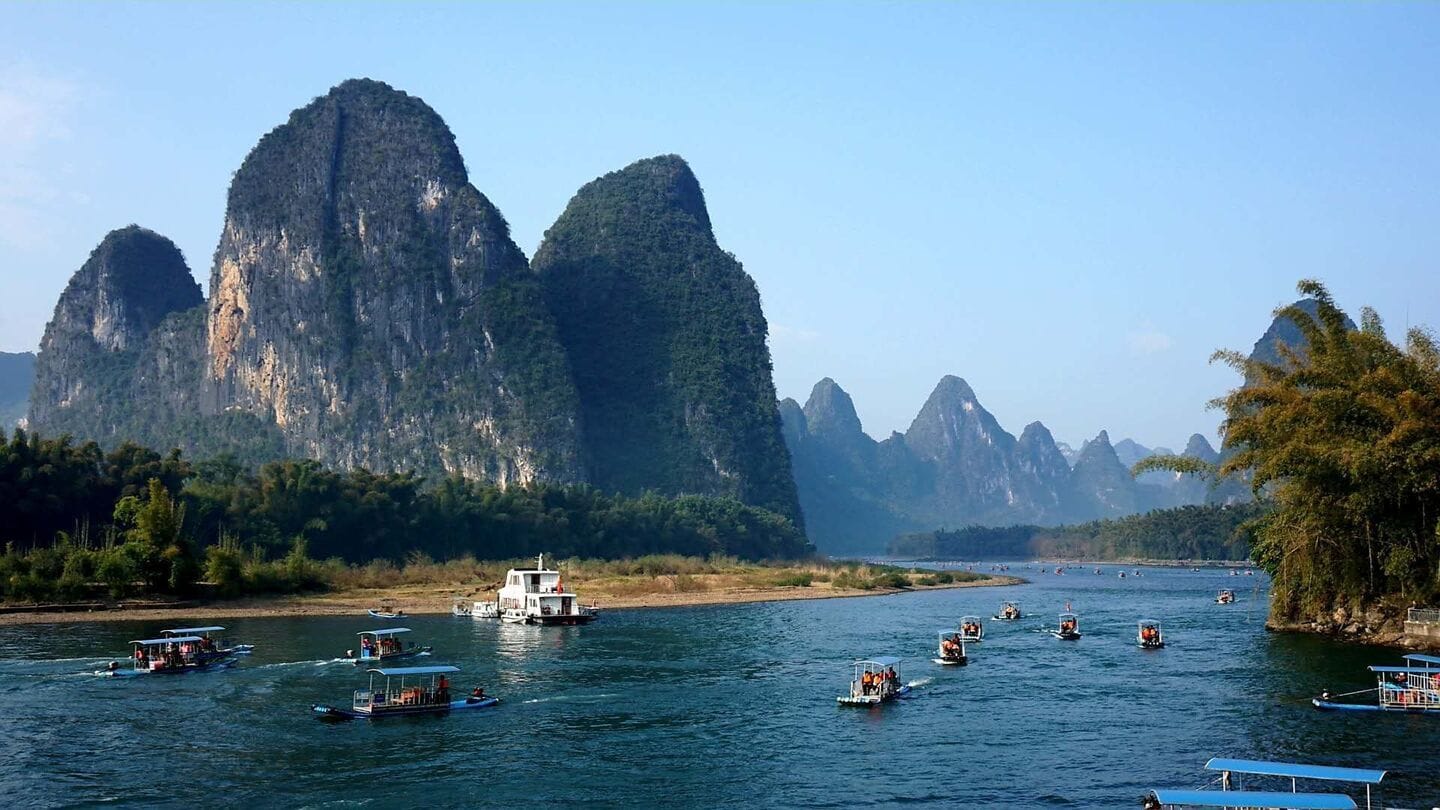
The Li River raft is a 4-person electric boat on the Yangdi-to-Xingping stretch. It’s the same water that made Guilin’s scenery famous, the exact view on the back of China’s 20-yuan note. Nine Horse Fresco Hill, Yellow Cloth Shoal, working fish traps, grazing water buffalo along the bank. This is the biggest, most dramatic scenery either river offers. You see it from water level instead of a cruise deck. That’s why it stays busy: the demand is earned, not manufactured.
Pros and cons
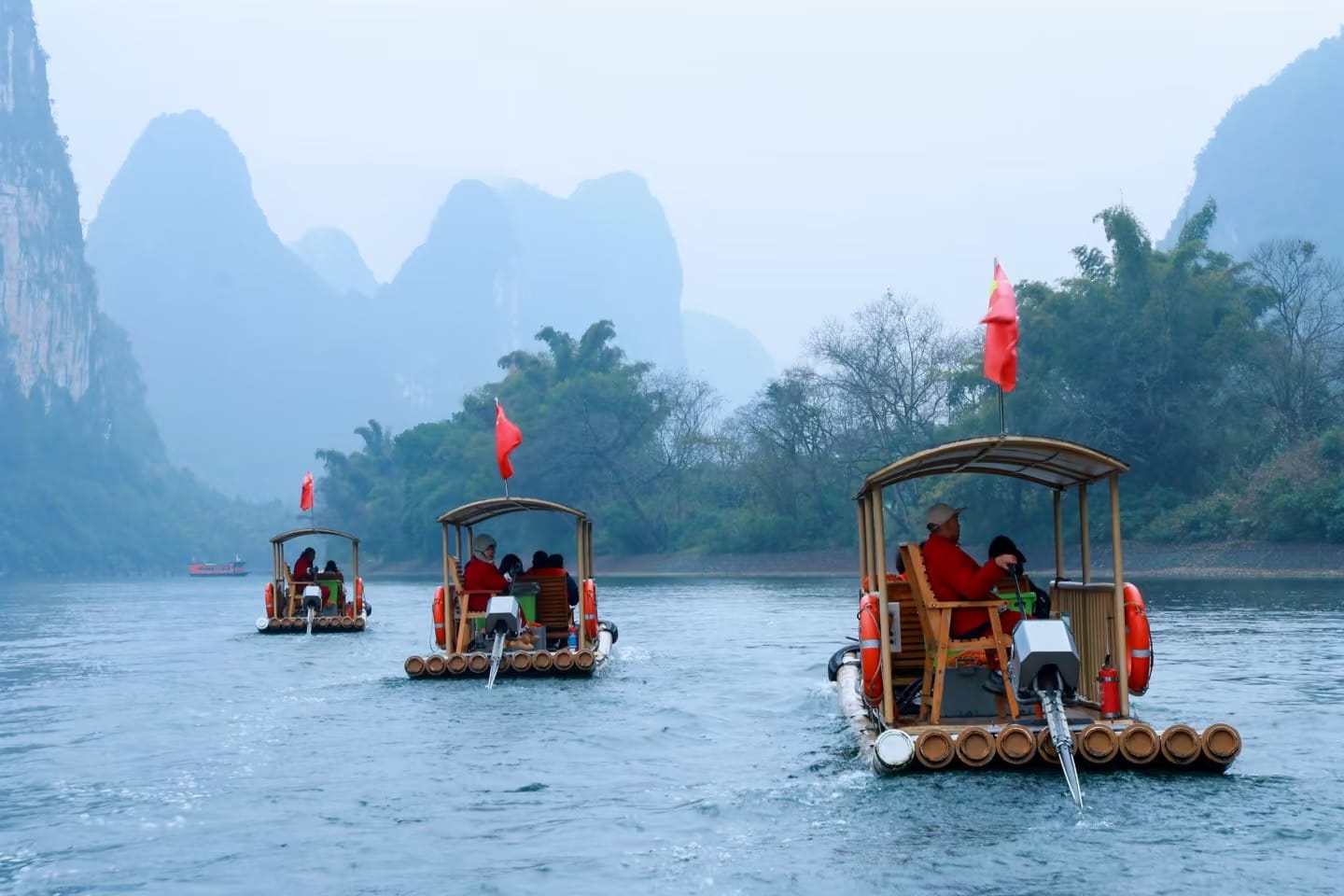
Grand, postcard-famous karst scenery, seen from a lower seat than the cruise, at a shorter and cheaper trip. Set against that: it’s motorized, not hand-poled. No real “bamboo” is left on the water. It runs busy with domestic tour groups on a narrow stretch. No weirs, no drops, just a steady glide.
Who it’s best for
Guests who haven’t got time for the full cruise and want the region’s signature scenery in under two hours. Anyone who specifically wants that low, close-to-the-water angle fits here too. Not minding the crowd helps. → See our Li River bamboo rafting guide for the full route breakdown and 2026 prices.
3. Yulong River Rafting: What It Is, and Who It’s For
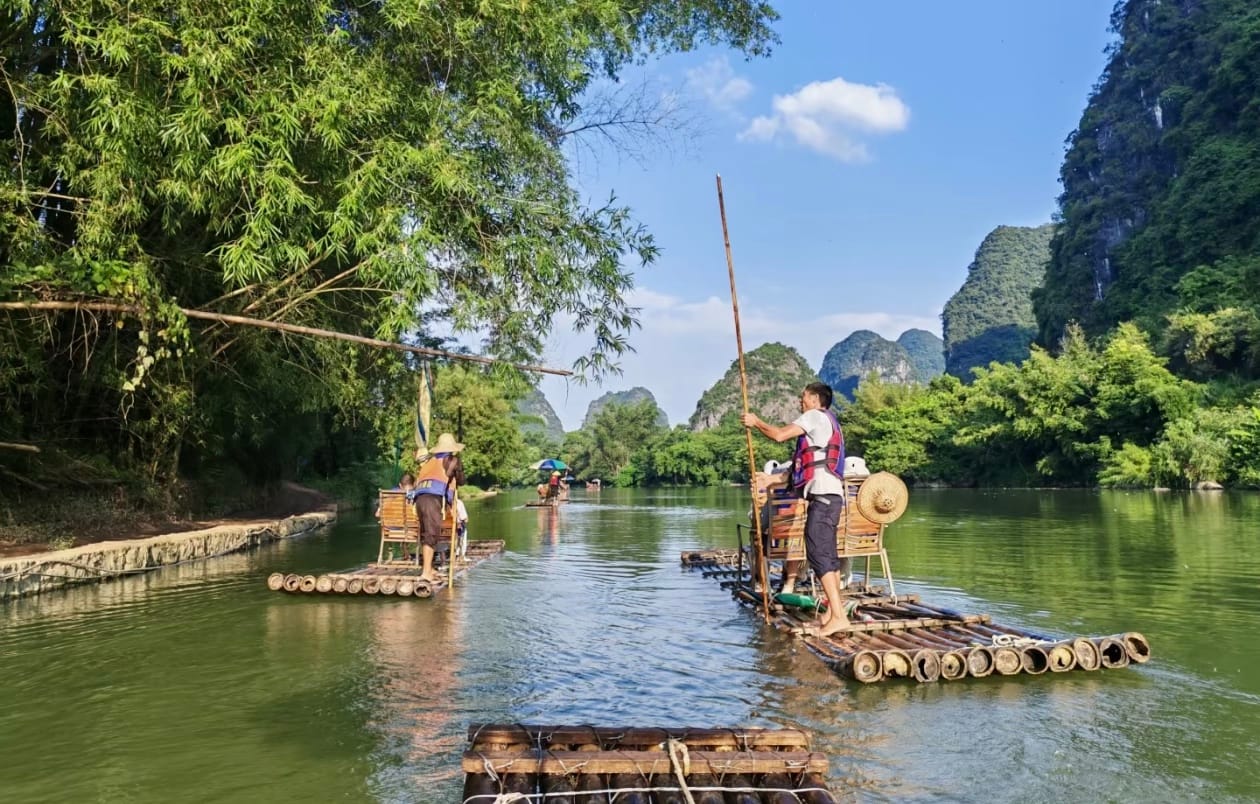
The Yulong River is a Li River tributary joining near Pingle. It runs through five townships and more than 20 villages on its own 43.5km course. The rafts are real bundled bamboo, hand-poled by a local boatman — no motor anywhere on the water. The scenery leans rural: rice paddies, old stone bridges, water buffalo, villages going about an ordinary afternoon.
The weirs — the one thrill the Li River raft doesn’t have
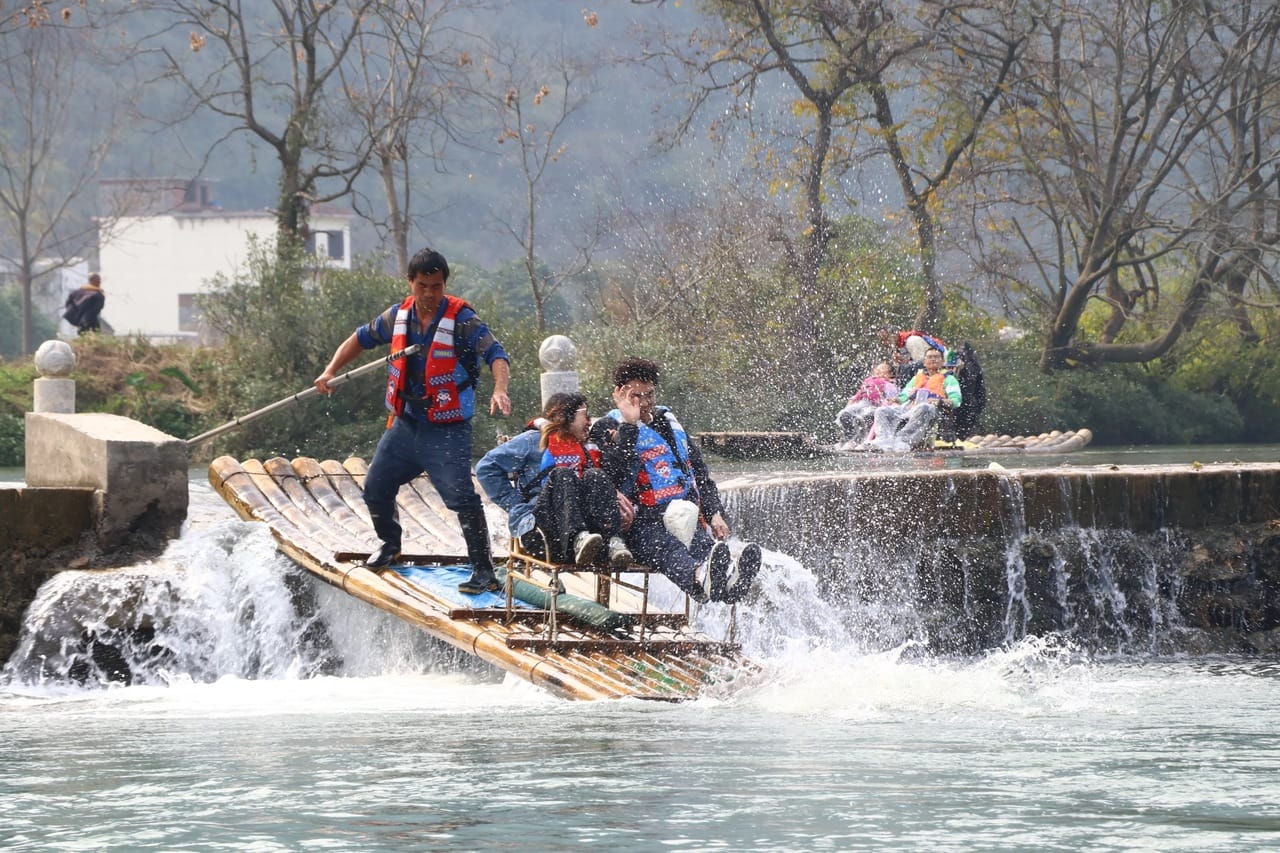
The one thing most comparisons miss: the weirs. Every so often the raft crosses a low, man-made dam, usually under a meter tall. It slides down fast, with a hard splash over the bow. Some routes cross up to nine in one trip. It’s the only real speed or spray on either river; the Li River raft has nothing like it. Guests consistently tell us it’s the part they talk about afterward. Lift your feet, hold your phone tight, expect to get wet.
Pros and cons
Genuine hand-poled bamboo, quiet rural scenery with no overlap with either Li River product, and weir drops for real thrill and splash. There are 21 routes to choose from, so it’s easy to dodge crowds. Set against that: smaller-scale, less dramatic scenery than the Li River’s karst core. Booking is Chinese-only and releases at 20:00 the night before, and some popular routes queue heavily on weekends.
Who it’s best for
Nearly everyone — it’s the one product on this page we’d call close to universal. Couples get an extra reason: the standard double raft seats two, making it a private ride rather than a shared one. Compare that to the Li River raft’s fixed 4-person boats. It’s worth adding whether you’ve done the cruise, the Li River raft, both, or neither. → See our Yulong River bamboo rafting guide for all 21 routes and current prices.
4. Which One Should You Book?
Three situations cover almost every guest we book for.
Already booked the Li River cruise? Skip the raft
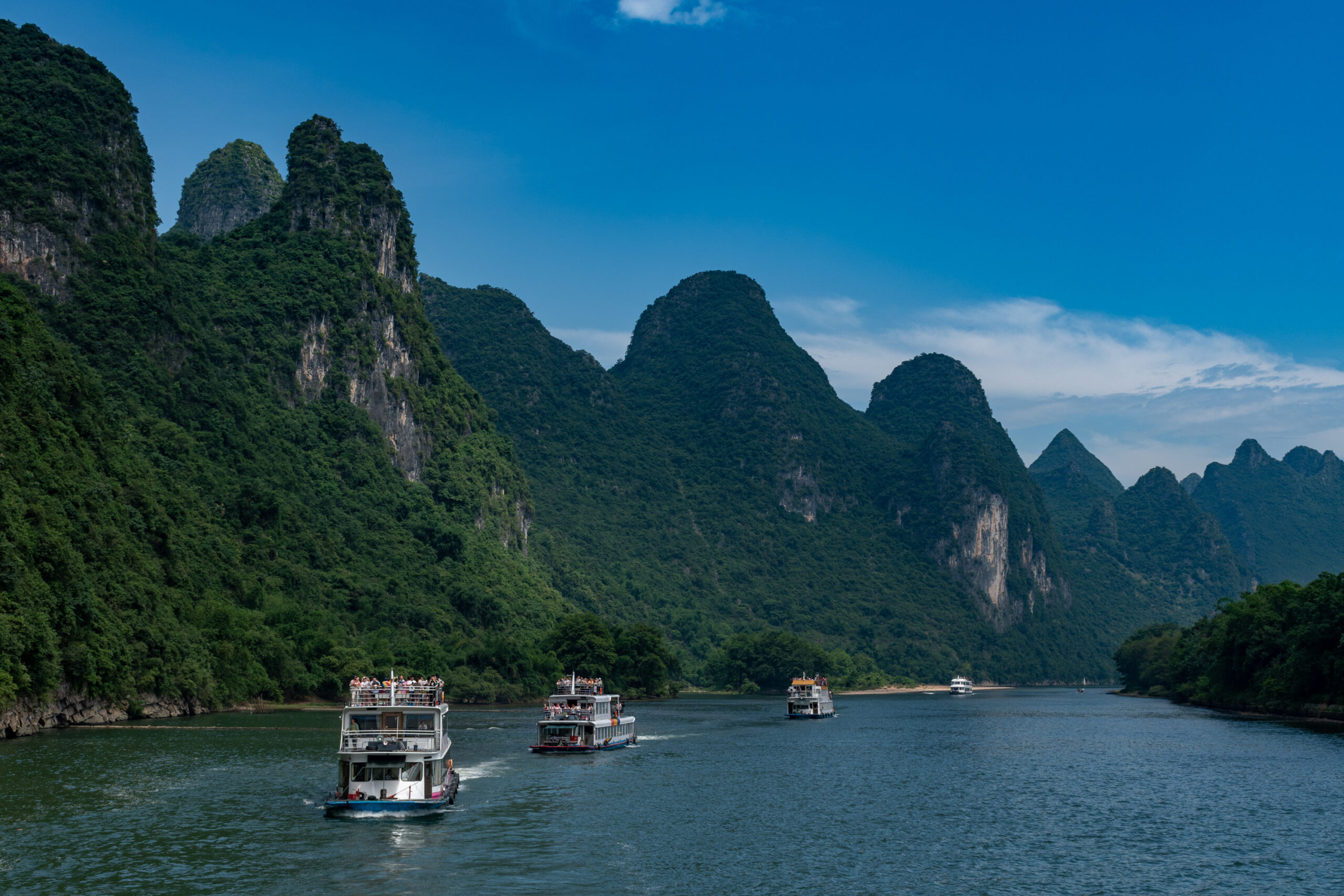
This is the question we get asked most once a guest has the Li River cruise booked. Our answer is usually no. The Li River raft runs on the same Yangdi-to-Xingping section the cruise sails through, just a smaller slice of it. The raft fleet also went fully electric in 2025: all 1,210 tourist rafts on this stretch now run on a motor, not a pole. Same-day domestic tour groups pack the same short run. You’d trade the cruise’s calm for a busier version of scenery you’ve already seen. Add Yulong River rafting instead — it never overlaps with the cruise, and brings the weir drops the cruise doesn’t have.
DIG DEEPER: Li River Cruise vs Bamboo Rafting: An Operator’s Honest Take
No time for the cruise at all
This is where the Li River raft earns its keep. If your Guilin-Yangshuo window is tight — a transfer day, a single free afternoon — the raft still works. It delivers the region’s signature karst scenery in 50–100 minutes. Compare that to the cruise’s 4–5 hours. We book this combination often for guests connecting straight through from Guilin to Yangshuo by road. They stop at Yangdi or Xingping along the way rather than adding a separate cruise day. Add Yulong River rafting afterward if there’s any time left. The two never compete for the same slot, so stacking them costs nothing in redundancy.
Full day or two, and you want the complete picture
Cruise in the morning, Yulong River raft the same afternoon — this is the pairing we default to for most first-time Guilin-Yangshuo guests. It comfortably fits inside a single day (see section 5 for the timing). With a second day free, add a half-day countryside bike or e-bike ride around Yangshuo. It’s the natural next addition — flatter roads than either river route, and a completely different pace again.
5. Can You Do Both Rivers in One Day?
Yes, comfortably — one day is plenty, not two.
The standard flow
The Li River cruise from Guilin typically lands in Yangshuo by early afternoon. Several Yulong River docks are a short taxi ride from town, and most routes run 30–70 minutes. Cruise in the morning, raft by mid-afternoon, done well before dinner with time to spare. Substituting the shorter Li River raft for the cruise makes the pairing even easier.
If you have extra time

A half-day countryside bike or e-bike ride around Yangshuo fits naturally into a second day. Rice paddies, small villages, quieter roads than either river — either that same afternoon or the following morning works.
Weather cuts both ways
The Li River cruise and raft both need adequate water depth and can suspend in the winter dry season. The Yulong River works the opposite way for moderate rain — it actually rafts better with more water, since the current needs the extra depth. Heavy rain is a different story. Both rivers suspend everything during severe storms. The Yulong River’s hand-poled rafts are less sensitive to water level swings than the Li River’s electric fleet. Extreme flooding still closes both regardless. → See our Guilin-Yangshuo rainy season guide for the month-by-month breakdown.
Frequently Asked Questions
Can I do Li River rafting and Yulong River rafting on the same day?
Yes. The Li River cruise typically reaches Yangshuo by early afternoon, leaving time for a Yulong River route the same day. Pairing the shorter Li River raft with Yulong is even easier, since the raft itself only takes 50–100 minutes.
I already did the Li River cruise — is the Li River raft still worth it?
For most guests, no. It covers part of the same scenery on a fully electric fleet with heavier crowds on a shorter stretch. Yulong River rafting is the better add once the cruise is already booked.
Is the Yulong River raft really hand-poled bamboo?
Yes. The Li River’s motorized “bamboo” rafts are actually PVC pontoons, not the real thing. The Yulong River rafts are built from genuine bundled bamboo poles, with a local boatman poling each one by hand the entire route. No engine anywhere on the river.
Does the Li River raft have any weirs or drops like the Yulong River?
No. The Li River raft runs a steady motorized glide with no weirs, drops, or splash. The Yulong River is the only one of the two with that thrill — some routes cross up to nine weirs in a single trip.
Which is better for families with kids or older travelers?
Li River raft: no children under 1.2m, no adults 70 or over, no exceptions. Yulong River’s standard double raft sets a lower 1m threshold, but its four and eight-person leisure floats allow both younger children and guests 70 and over with a guardian. For families with young kids or older travelers, Yulong River’s larger rafts are the more flexible option — the Li River raft has no equivalent workaround.
Should I choose based on the weather forecast?
It’s worth factoring in. The Li River cruise and raft both depend on adequate water depth and can suspend during the winter dry season or heavy flooding. The Yulong River rafts better with moderate rain, since the current needs the depth, though severe storms shut down both rivers regardless.
Will doing both rafts feel repetitive?
No. The two rafts don’t overlap at all — that’s the whole basis of this comparison. The Li River raft is grand, motorized, and busy; the Yulong River is quiet, hand-poled, and rural, with weir drops the Li River doesn’t have. The only redundancy to watch for is pairing the Li River raft with the Li River cruise, since those two do cover the same stretch.
Do I need to book both in advance?
Book the Li River cruise and Li River raft ahead of time, especially in peak season. Both can sell out days in advance around holidays. Yulong River tickets release online at 20:00 the evening before. Same-day planning works outside peak season, but popular routes still sell out within minutes when they do release.
Planning a Guilin-Yangshuo itinerary and want the cruise, both rafts, or some combination timed correctly around your schedule and the weather? Get in touch with our team — we’ve been routing guests through both rivers since 2006.