
Weishan Ancient Town: Sights, Food & Day Trip From Dali
Weishan Ancient Town (also listed as Weishan Ancient City) is a 600-year-old walled county town 22 minutes by high-speed train south of Dali. It’s a living old town: residents still fill its lanes, commerce is light, and food is cheap. Half a day covers the sights. We recommend staying one night if your schedule allows.
Plan your visit around Weishan’s hours. Its best breakfast shops close at noon, and the streets empty by 8 PM. This guide covers what we’d tell a guest planning the trip. You’ll get the five paid sights (CNY 75 in total), where and when to eat, and a timed half-day route. Then come three ways to fill a full day and what to check before booking a room. It will help you decide between a day trip and an overnight stay.
Location | Weishan County, south of Xiaguan, Dali Prefecture, Yunnan |
|---|---|
From Dali | 22 minutes by train from Dali Station |
Entry | Free to walk; five paid sites total CNY 75 |
Time needed | Half a day for the old town; one night if you can |
Watch out | Nanzhao Museum closes on Mondays |
Eat early | The best breakfast shops close at noon |
Table of Contents
1. Weishan Ancient Town at a Glance
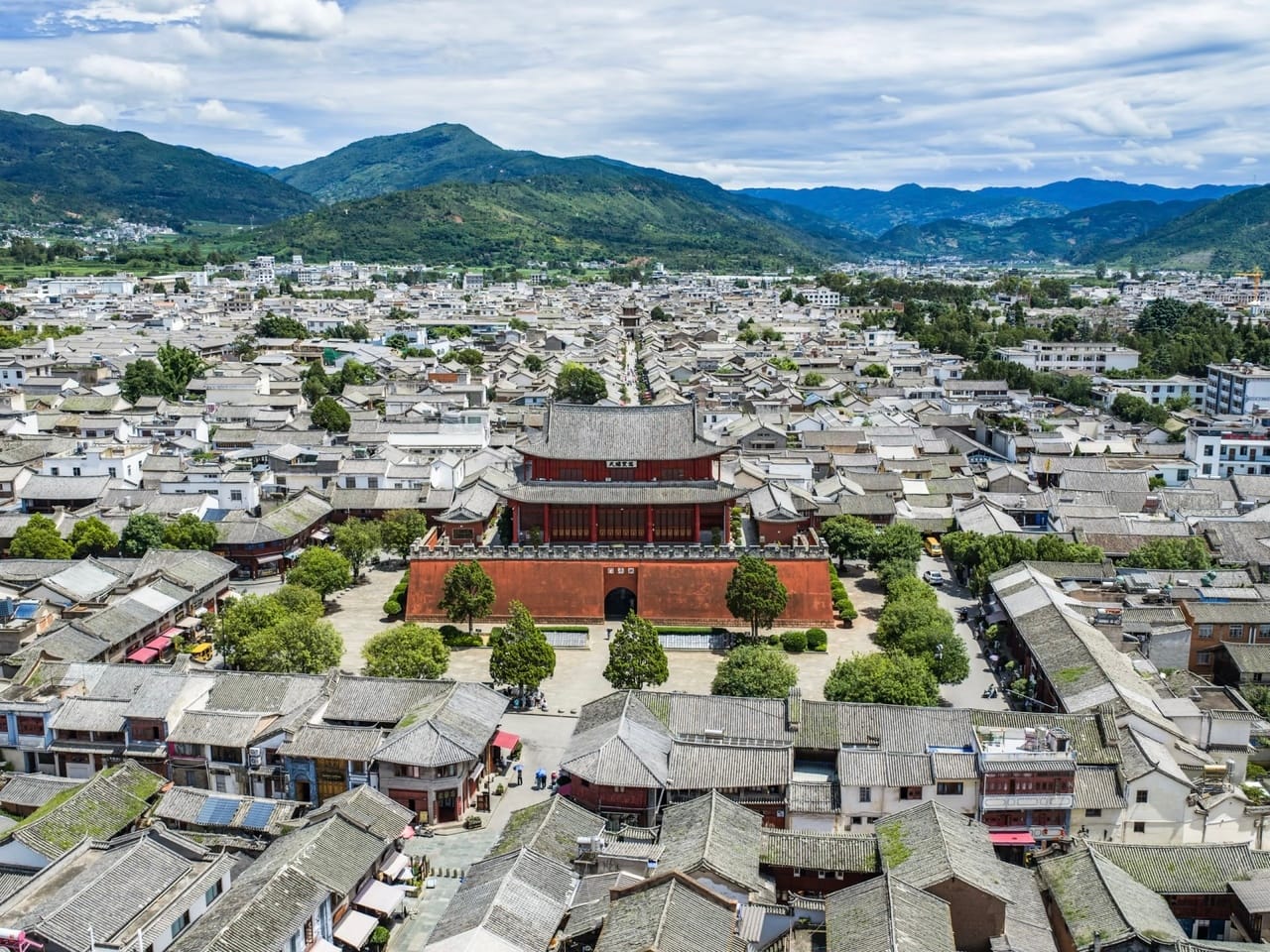
Weishan Ancient Town is the walled core of Weishan Yi and Hui Autonomous County, known as Menghua until the 1950s. Gongchen Tower, the north gate, dates to 1390. Inside, 24 streets and 18 lanes keep the Ming chessboard grid. The State Council named Weishan a National Famous Historical and Cultural City in 1994.
Weishan is best known as the birthplace of Nanzhao. The Mengshe chiefdom that grew into the Nanzhao Kingdom started in the Weishan basin in the 7th century. Nanzhao did not stay here: the court moved its capital north to Taihe, near today’s Dali, in 739.
Weishan is still mainly lived in by locals. Ninety percent of the people inside the old town are original residents, according to a 2025 report in People’s Tribune. On a walk you’ll pass family homes, schools and small neighborhood shops, with few souvenir stores among them.
Under the Ming and Qing, Weishan was a stop on the Tea Horse Road, the caravan network that carried tea and goods across southwest China. Look closely at the grid and you’ll see the streets don’t run perfectly straight. Their slight slant was designed to break the cold north wind in winter, as CGTN reported.
Gongchen Tower’s timber upper storeys burned on January 3, 2015. The county rebuilt them in 180 days to the original design, and the tower reopened on October 1, 2015.
2. Weishan vs Dali Old Town: Is It Worth the Trip?
Weishan is worth it if Dali Old Town felt too busy for you. If you came to Yunnan for bars, night markets and craft shopping, Weishan will bore you.
Here’s how the two compare, from our time in both:
Weishan Ancient Town | Dali Old Town | |
|---|---|---|
Crowds | Almost empty on weekdays, light on weekends | Packed on holidays, busy most days |
Commerce | Light; residents still live here | Dense bars, restaurants and guesthouses |
Size | Small; half a day covers it | Much larger; one street can take half a day |
Prices | A bowl of ersi costs under CNY 20 | Comparable meals cost 30–50% more |
Pace | Slow; sit and watch the street | Fast; shopping and nightlife |
After dark | Quiet; streets empty after 8 PM | Bars and night stalls until late |
Weishan doesn’t replace Dali Old Town. The two complement each other, and the 22-minute train makes it easy to do both.
In our itineraries, Xizhou and Zhoucheng go on the Dali-to-Lijiang travel day because they sit on the road north. Weishan lies the other way, south of Xiaguan. It needs its own day or its own night in your Dali plan.
Who loves Weishan, and who doesn’t
Our guests either love Weishan or find it dull. Guests who like to slow down, with little to tick off, often rank it above every other old town in Yunnan. Guests who want sights, nightlife and polish tend to leave disappointed.
The praise we hear most is that Weishan feels easier than Dali Old Town. Christian, our guest from the US, put it this way: “Yesterday we went to Dali Old Town: crowds, e-scooters, the same shops over and over. It didn’t feel like a holiday at all. Weishan is relaxed, cheap, and has far fewer e-scooters.“
Victor, our guest from the UK, said it took him a while to like it: “At first it’s not impressive at all. But the longer you look, the more it grows on you.” Dimitris, our guest from Greece, said Weishan was the highest-rated stop of his whole Yunnan trip, adding that “locals still outnumber tourists.“
Not everyone comes round. Ariel, our guest from Israel, found it boring: “Three hours there and back from Dali, and we’d seen everything in one or two hours.” If a slow afternoon over tea sounds like wasted time, give Weishan a half day at most. Or skip it.
3. Getting to Weishan From Dali
The train is the easiest option for most visitors.
Option | Time | Details |
|---|---|---|
High-speed train | 22 minutes | Dali Station to Weishan Station; CNY 15–20 second class |
Shuttle bus | 1.5 hours | Xiaomakeda (小马可达) from Dali Old Town’s bus station |
Private car | 43 minutes from Xiaguan | 49.9 km on the Dali–Lincang Expressway; the old town is car-free |
Dali Station is in Xiaguan, not in Dali Old Town, so allow for the transfer: 17.3 km, 50 minutes by car in traffic, or a city bus. Weishan Station is 1.8 km from the old town, a 10-minute taxi ride. Trains on this line are far fewer than on the Kunming–Dali line, so book your return before you go.
A private car makes sense if you want to link Weibao Mountain, Daxiao Temple and Donglianhua on your own schedule (see Section 7). Our charter car service covers Weishan, and like all our private tours it has no shopping stops. Contact us for a quote for your dates.
4. What to See and What It Costs
All the sights sit on a walking loop of 2.5 km. Walking the streets is free. Five sites charge a small fee:
Site | Ticket | Notes |
|---|---|---|
Gongchen Tower | CNY 5 | Climb to the gate tower |
Xinggong Tower | CNY 5 | Separate ticket from Gongchen Tower |
Confucian Temple (Wenmiao) | CNY 5 | Free with any student card, or a passport showing age 70+ |
Residence of Miss Liang | CNY 20 | Guided explanation included |
Wenhua Academy | CNY 40 | |
All five | CNY 75 |
Nanzhao Museum is free, though a museum guide costs CNY 100 per session. We list Weibao Mountain, outside town, under the full-day routes in Section 7.
Gongchen Tower
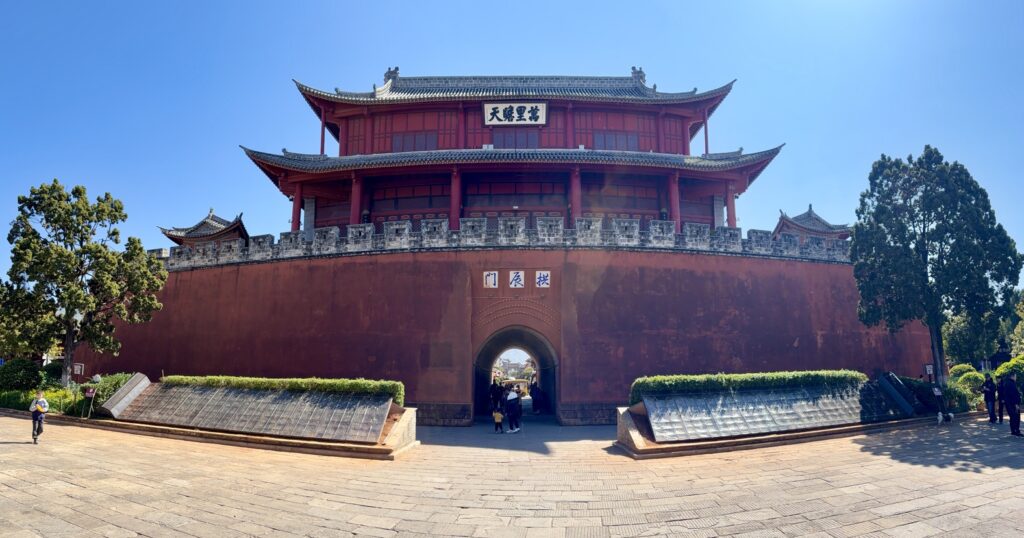
Gongchen Tower is the north gate and the town’s landmark, with the plaque “魁雄六诏” (foremost of the six zhao) above the arch. Su Laosan’s noodle shop sits in the alley beside it, so most visitors start their walk here. The CNY 5 climb gives you the view over the grey-tiled roofs of the whole old town. The plaque photographs best with side-backlight, early morning or near sunset.
Xinggong Tower
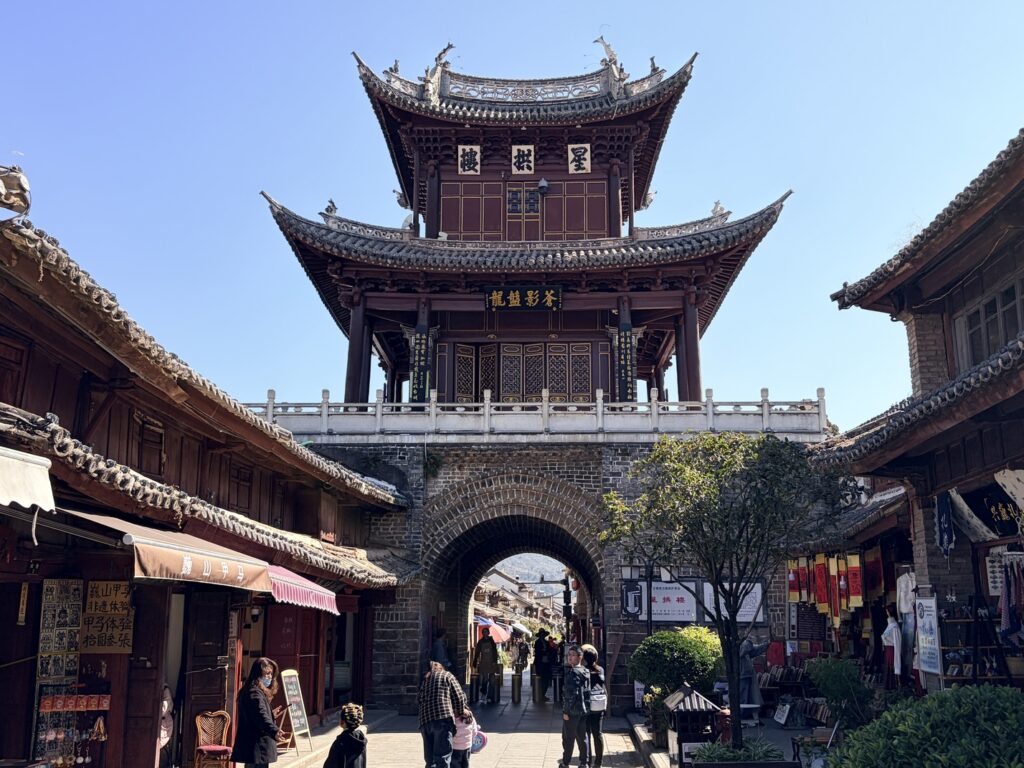
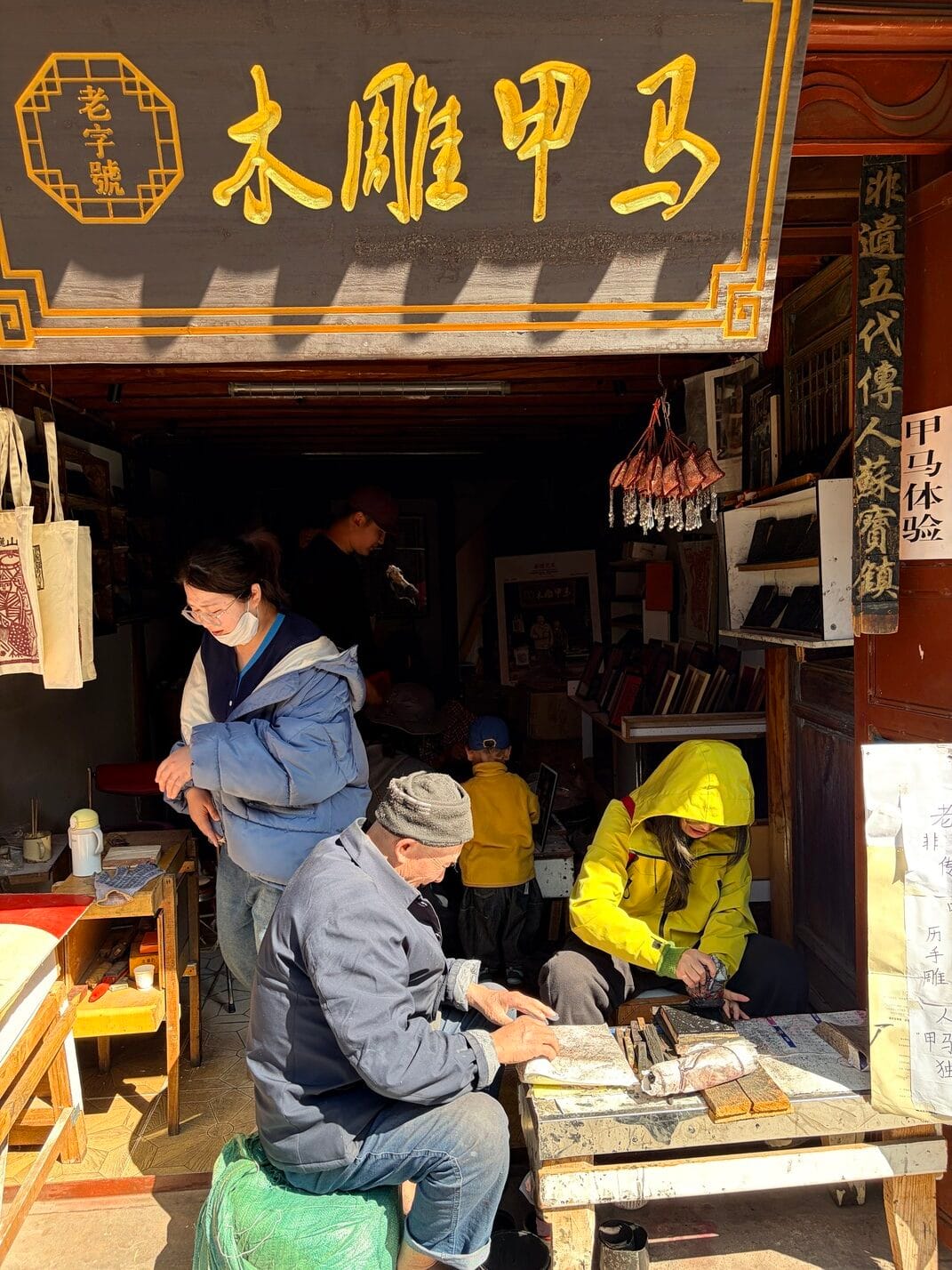
Xinggong Tower stands where the north, south, east and west streets meet, in the middle of the grid. It has its own CNY 5 ticket, but you don’t need to climb it; the best view is from the street below. Lanterns light up from 6 PM. The lane beside it has the shops for jiama woodblock printing (see Section 6).
Nanzhao Museum
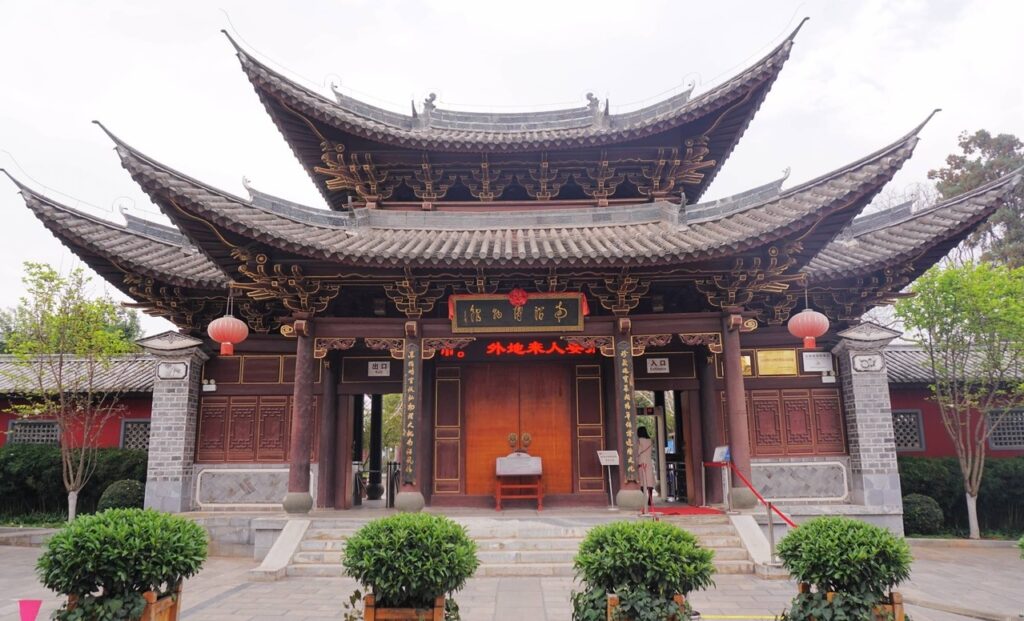
Nanzhao Museum occupies the Dengjue Temple complex, whose twin pagodas are one of the town’s best photo spots. Its seven halls hold more than 3,700 objects. One hour gives you an outline of Nanzhao history; all seven halls take 2–3 hours. It closes every Monday.
The paid guided tour is in Chinese only (CNY 100 per session, up to 10 people, 50 minutes). Key exhibits such as the Nanzhao Dehua Stele carry Chinese and English labels, so you can follow the main story alone. For the full story in English, we can arrange a private guide.
Pioneer Bookstore (Chongzheng Academy)
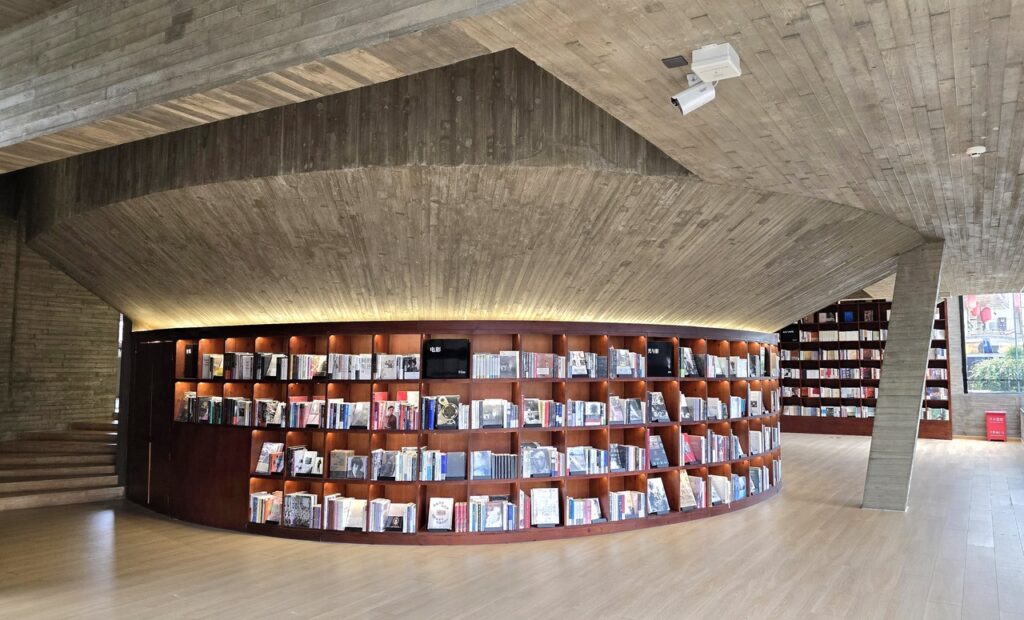
Pioneer Bookstore is the third Librairie Avant-Garde branch in Yunnan. It fills the former Chongzheng Academy, a Ming-era school damaged many times over 500 years that kept its courtyard layout. A 330-year-old banyan stands at the gate, and the tree against the red wall is one of Weishan’s favorite photo spots. Entry is free. Order a coffee if you want to sit in the courtyard for a while.
Residence of Miss Liang
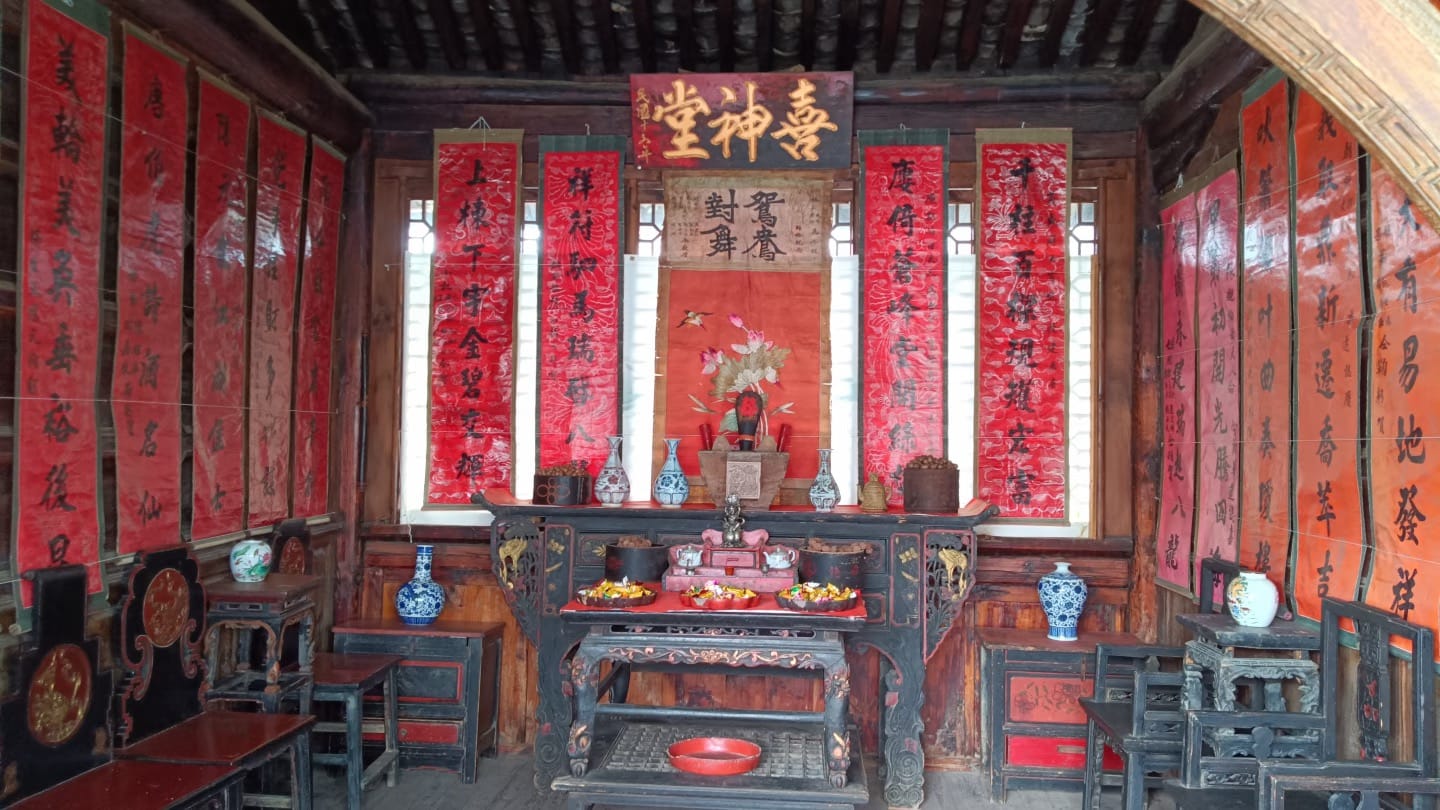
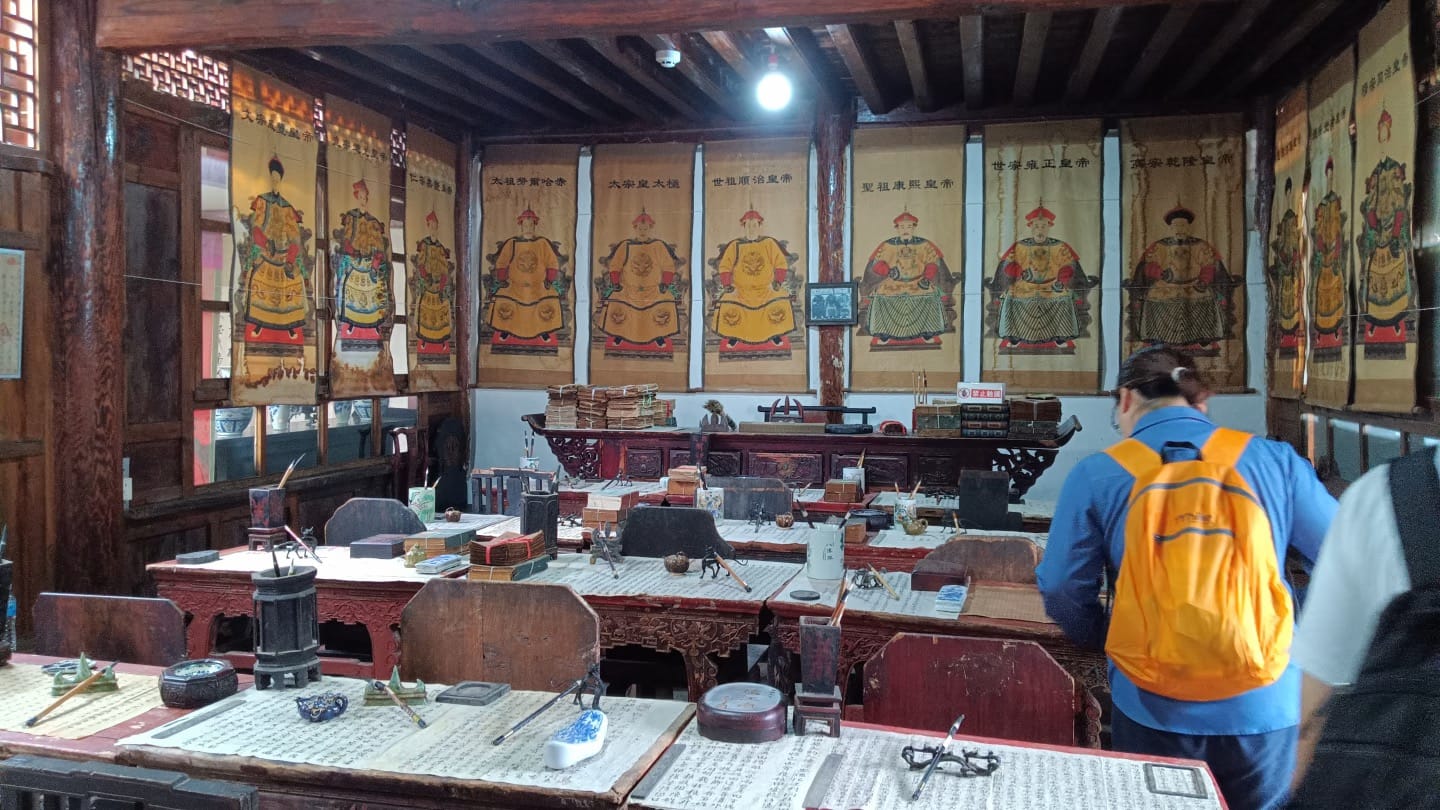
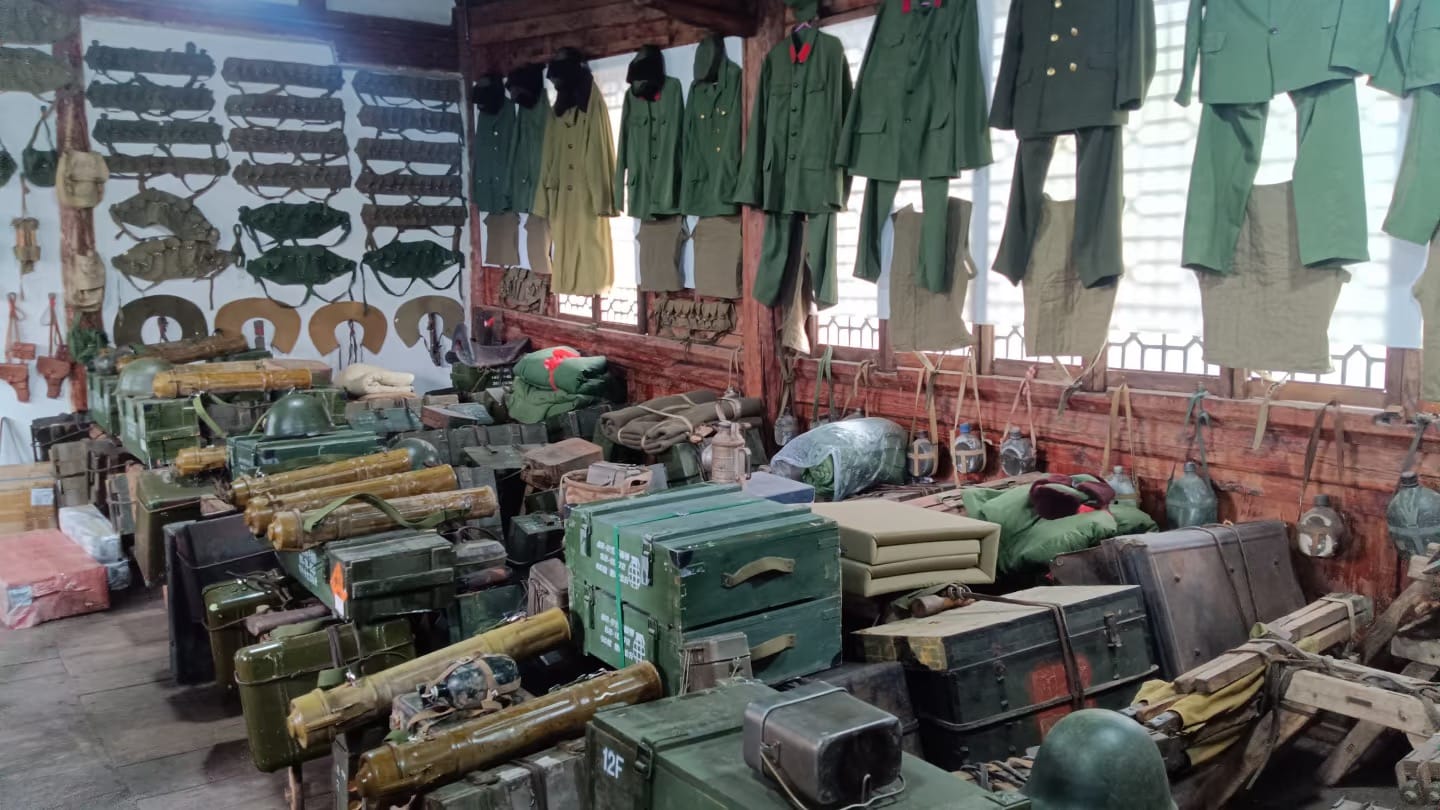
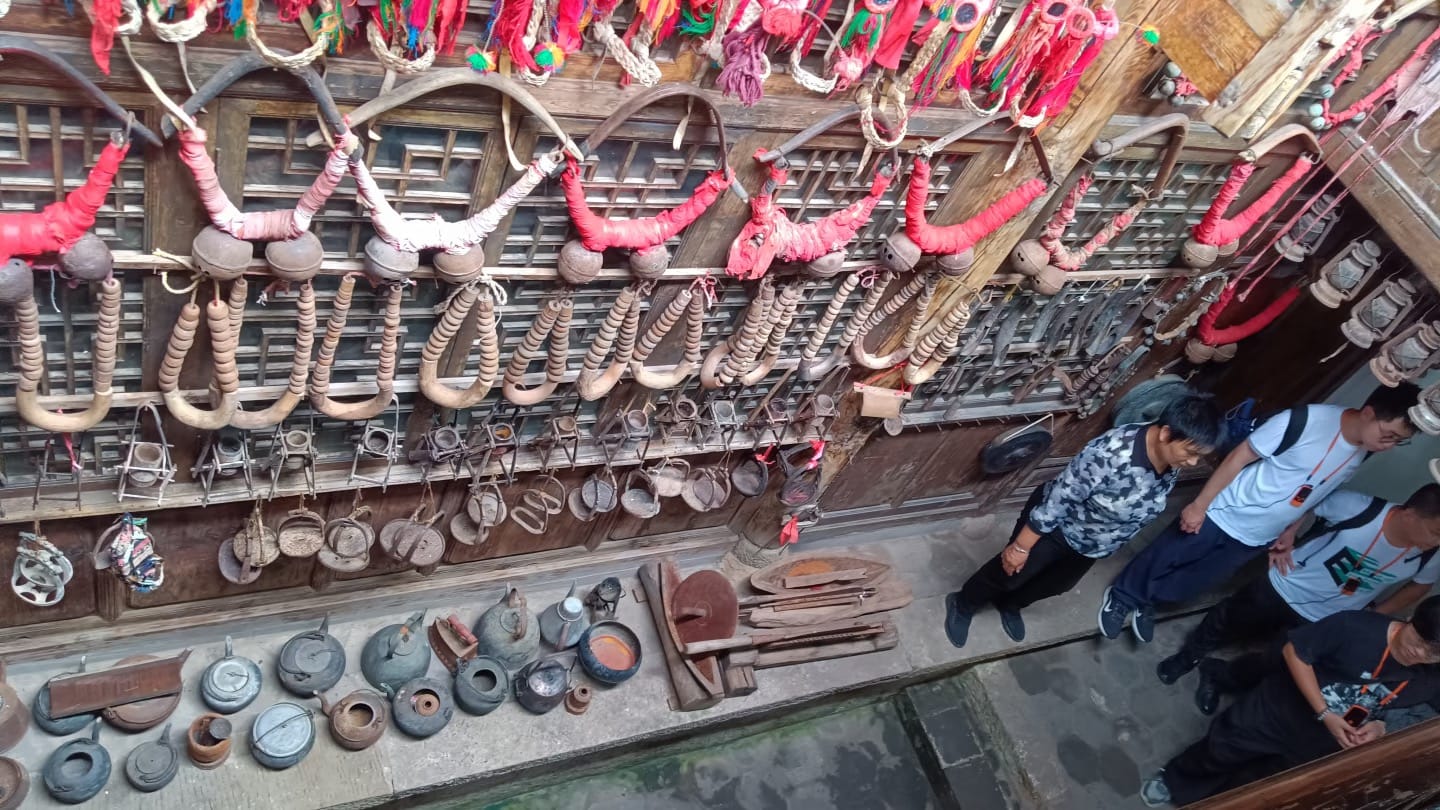
The Residence of Miss Liang (梁大小姐宅院) on Renwen Lane was the Republican-era home of Liang Meisheng’s eldest daughter. Liang’s was one of Weishan’s four leading families. The gate and screen wall use triangles and other geometric shapes, showing the Western influence fashionable then. Today it’s a folk museum of more than 20,000 objects: caravan saddles, Yi embroidery, jiama blocks, land deeds, old weapons. You can handle many of them.
The CNY 20 ticket includes a tour by a family member or staff, in Chinese only, but the hands-on objects need no translation. Most visitors think it’s underpriced.
Wenhua Academy
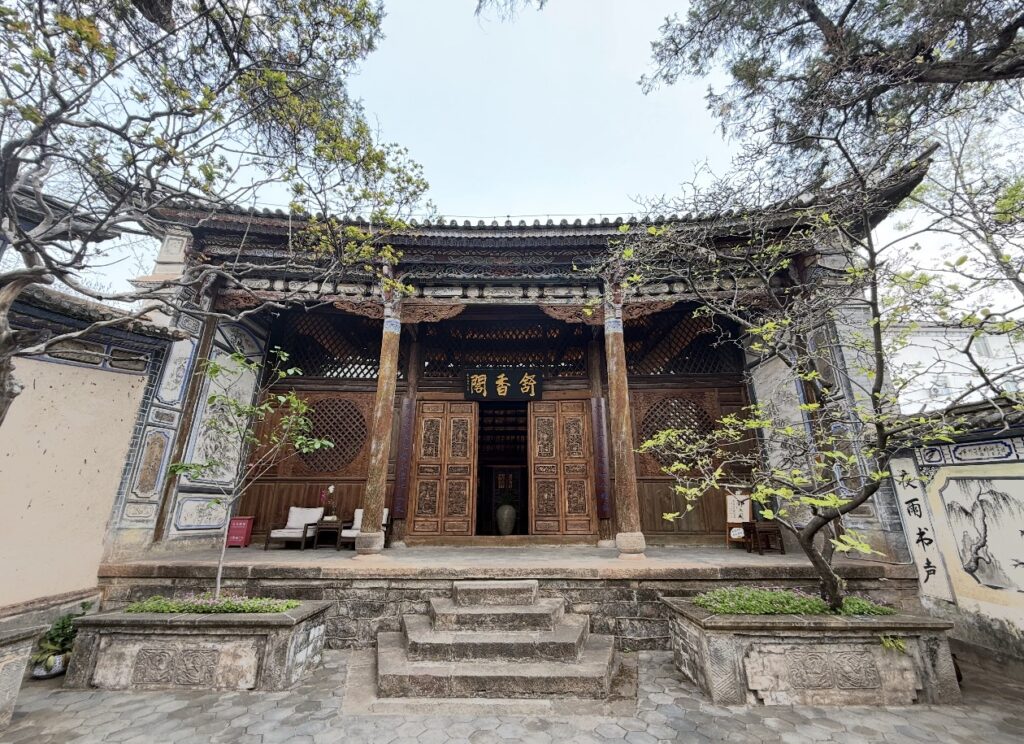
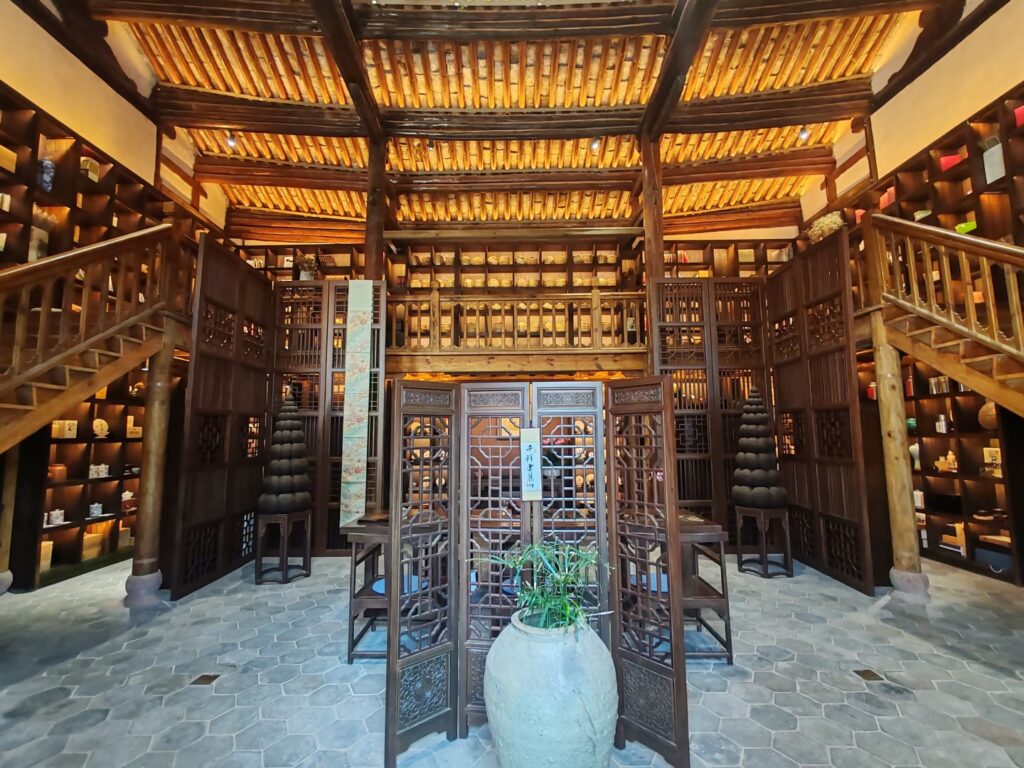
Wenhua Academy (文华书院) is Weishan’s most expensive ticket and its most divisive. Built in 1875 and now a national-level protected site, it joins Xiaogong Shrine, the academy and Yuhuang Pavilion across 16,000 square meters. You come for the buildings: Kuixing Pavilion’s bracket sets, the library’s carved doors and Yuhuang Pavilion’s eaves.
Fans of the CNY 40 ticket get a near-empty courtyard and stay two or three hours. Critics find the restoration heavy-handed and are done in 20 minutes. If you only have time for one, choose Residence of Miss Liang.
Confucian Temple and Mengyang Park
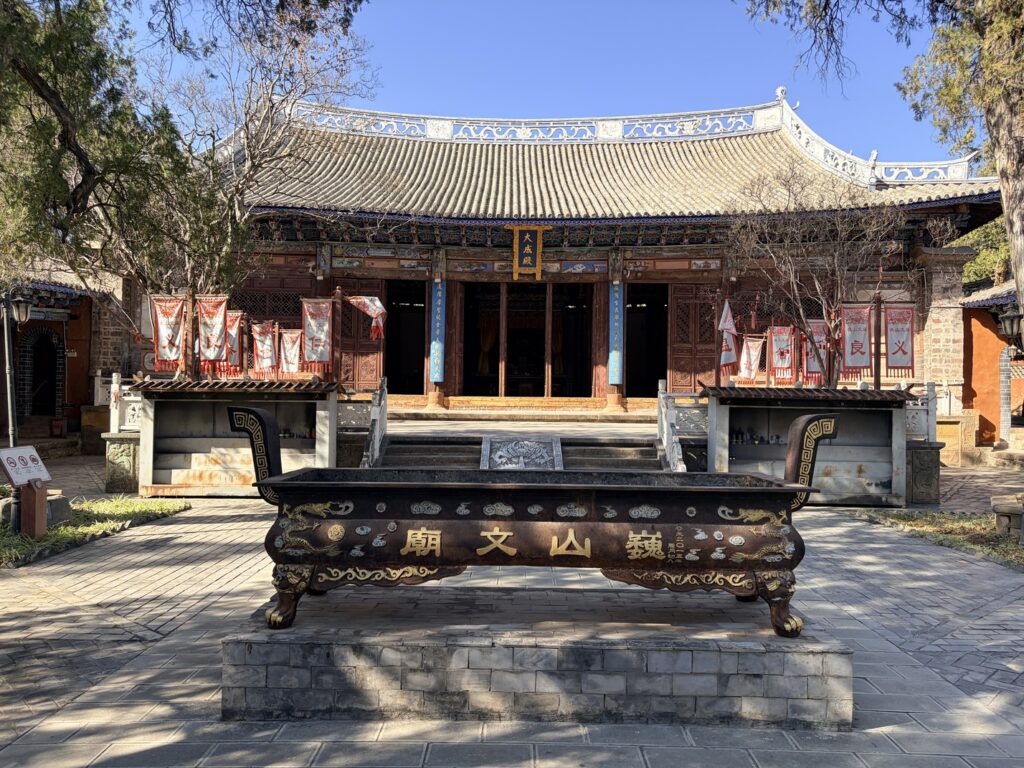
The Confucian Temple is small and quiet, with old trees and few visitors. The CNY 5 ticket is waived with any student card, or for visitors 70 and over. Mengyang Park next door is free, with bougainvillea and public toilets. Treat both as rest stops on the loop.
5. What to Eat in Weishan
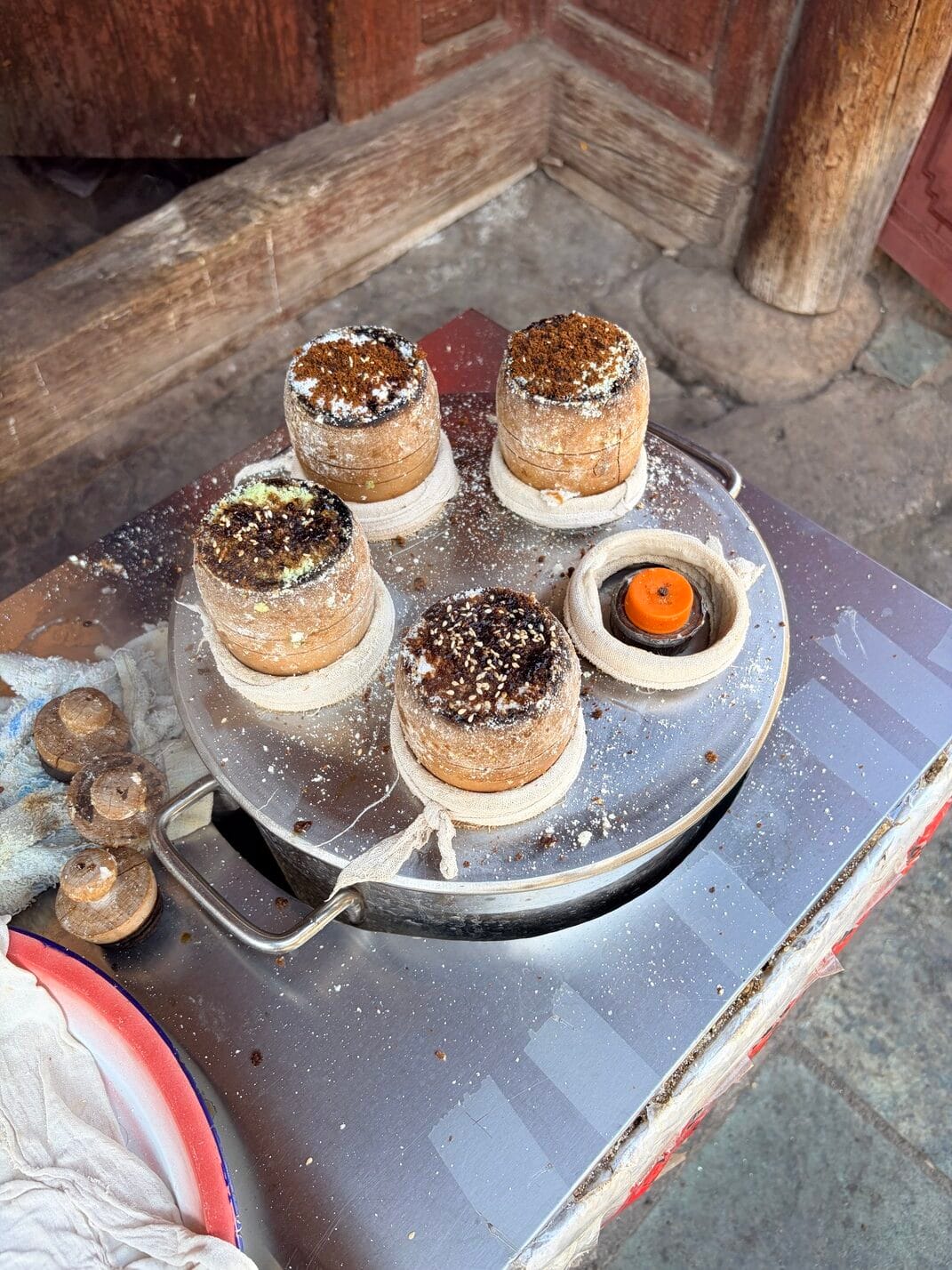
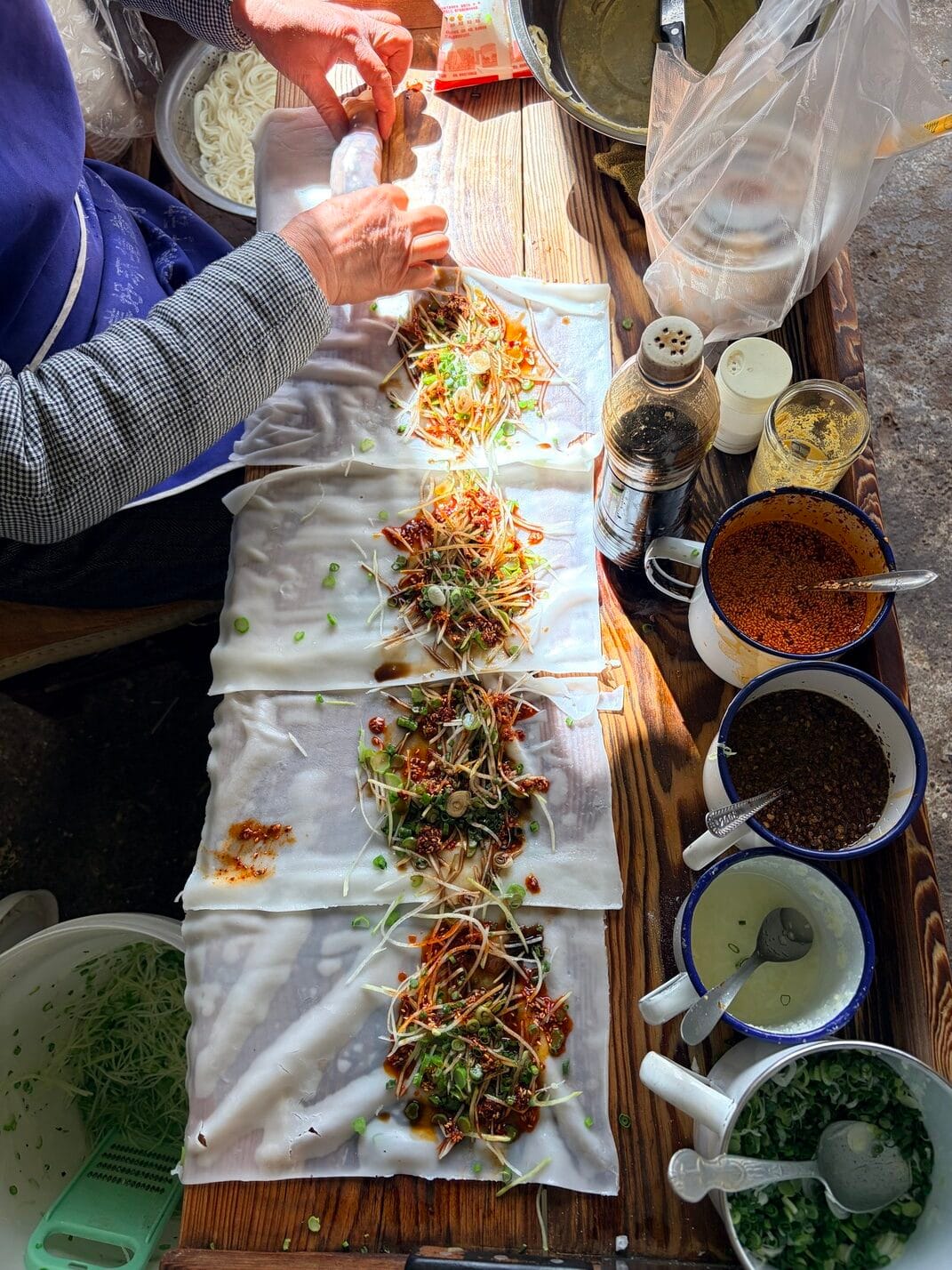
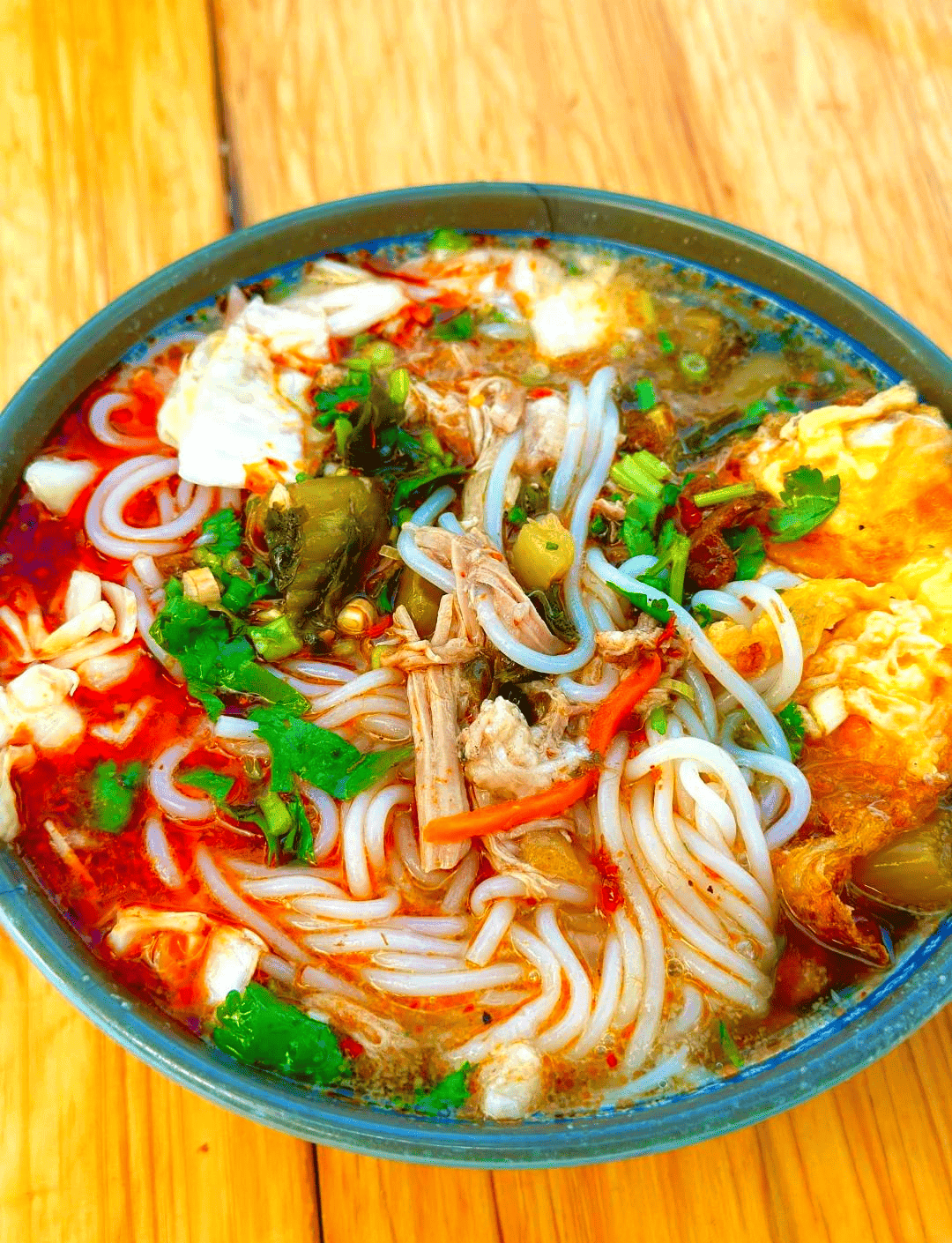
In our experience, Weishan has the best snack food in Dali Prefecture, and plenty of Yunnan locals come just to eat. The two most famous breakfast shops close at noon, and many snack stalls pack up by 3–4 PM.
Where | What to order | Know before you go |
|---|---|---|
Lao Wang Guojiang Ersi (老王过江饵丝) | Barou ersi: soft rice noodles cooked in braised-pork broth | Open until noon; sells out |
Su Laosan Yigu Mian (苏老三一古面) | Yigen mian: one unbroken noodle per bowl, CNY 10–11 | Alley near Gongchen Tower; closes at noon |
Dabing Jia (大兵家火烧肉米线) | Rice noodles under fire-roasted pork belly, charred tomato broth | Spicy |
Kun Shifu (昆师傅) | Home-style dishes; try su ji song zhen (素鸡松针) | Open kitchen; strong dipping sauce |
Qingfang Restaurant (清芳餐厅) | Laonai yangyu (老奶洋芋), zaola rou (糟辣肉) | Three dishes for two adults and a child: CNY 80 |
Shangshi Milk Bar (上食鲜奶吧) | Double-skin milk pudding, ice cream | For dessert |
Su Ji Mi Gao (苏记米糕) | Mi gao: steamed rice cake filled with brown sugar, peanuts and sesame | Outside Su Laosan; firm and not too sweet |
Xiaozeng Hegao (小甑合糕) | Mi gao steamed to order in wooden steamers, CNY 2 | Yuehua Street No. 170 (月华街170号); no sign |
Show the Chinese names to your taxi driver or to a passer-by; few of these shops have English signs.
The two breakfast classics
Barou ersi is the town’s signature: noodles made from glutinous rice, cooked in the broth of slow-braised pork. At Su Laosan, the cook pulls and swings a single noodle into your bowl. In March 2011, a 1,704-meter Weishan noodle was entered in the Shanghai Great World Guinness records as China’s longest. It’s a Chinese record, NOT a Guinness World Records title.
Street snacks
Eat mi gao warm. Other stalls near Gongchen Tower also use the Xiaozeng Hegao name, so check the address. Street stalls also sell shao erkuai (grilled rice-cake wraps with sauce) for a few yuan, and roasted rushan cheese.
What our guests think
Food gets the most consistent praise from our guests, especially barou ersi, fire-roasted pork rice noodles and yigen mian. Kevin, our guest from the US, said: “My friend lives for chili and I can’t handle any spice, but we both agreed Weishan’s food was excellent.” Not every guest agrees. Weishan’s flavors divide people.
For the rest of the region’s dishes, see our guide to what to eat in Dali.
6. Teahouses, Cafés and Small Things to Do
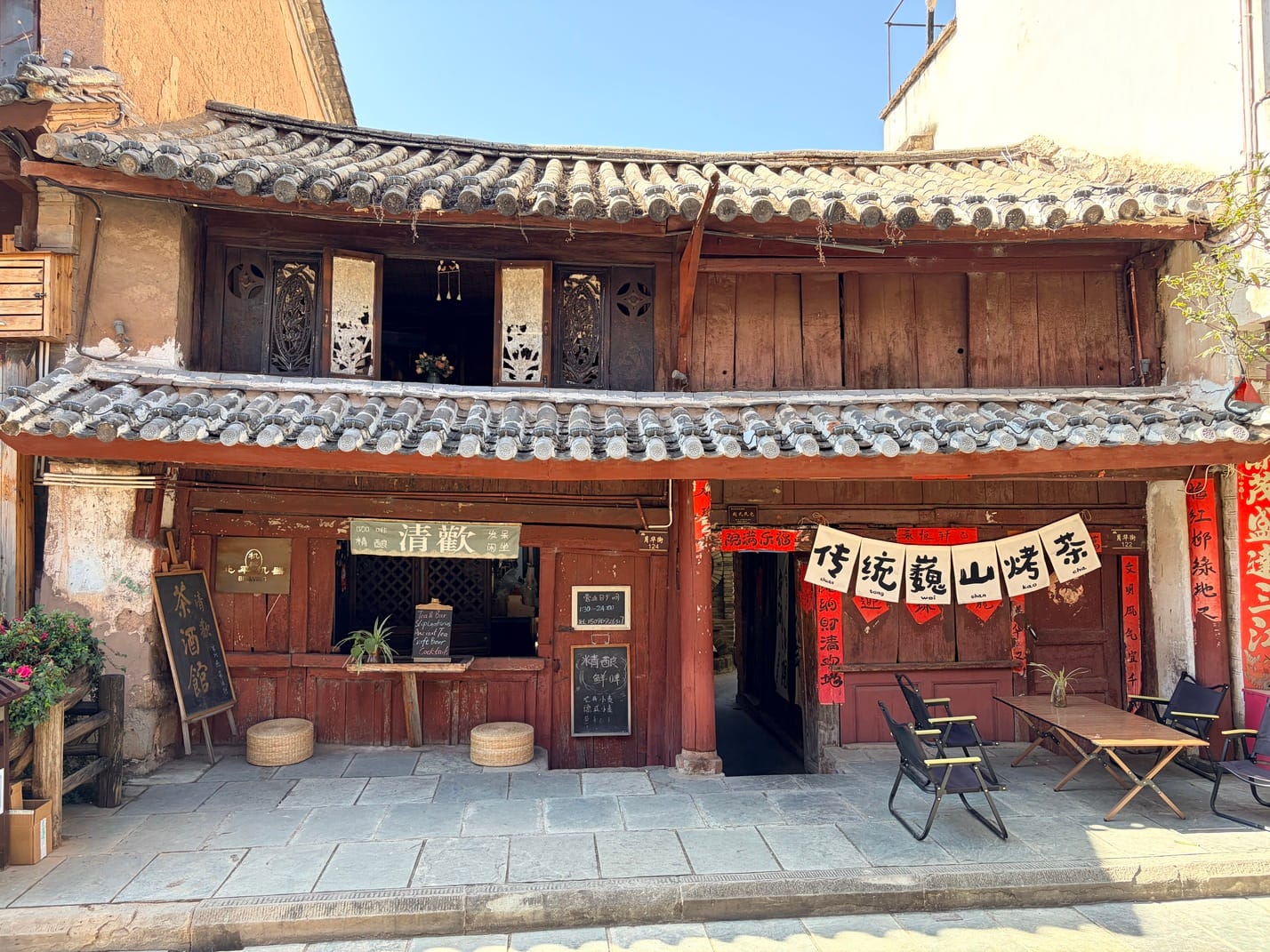
Our favorite thing to do in Weishan is nothing much. Find an old teahouse and order a pot of roasted tea (烤茶, kaocha) for CNY 10–20, with hot water refills at no charge. Bainian Chaguan Qichafang (百年茶馆棋茶坊) is the cheapest we know: CNY 5 a cup, CNY 30 a pot.
The coffee in Weishan surprised us. It’s better made than at many of Dali’s photo-spot cafés. Ruzuo Shitang (入座食堂) roasts its own beans, and its medium-roast latte is the one to order. Beigui Kacang (北归咖仓) serves a pistachio latte and chocolate-filled bagels in an old courtyard. Tugou Coffee (土狗咖啡) has the photo with Xinggong Tower behind you. These small cafés close for a day off without notice, so have a second choice ready.
Hands-on things to do, all inside the old town:
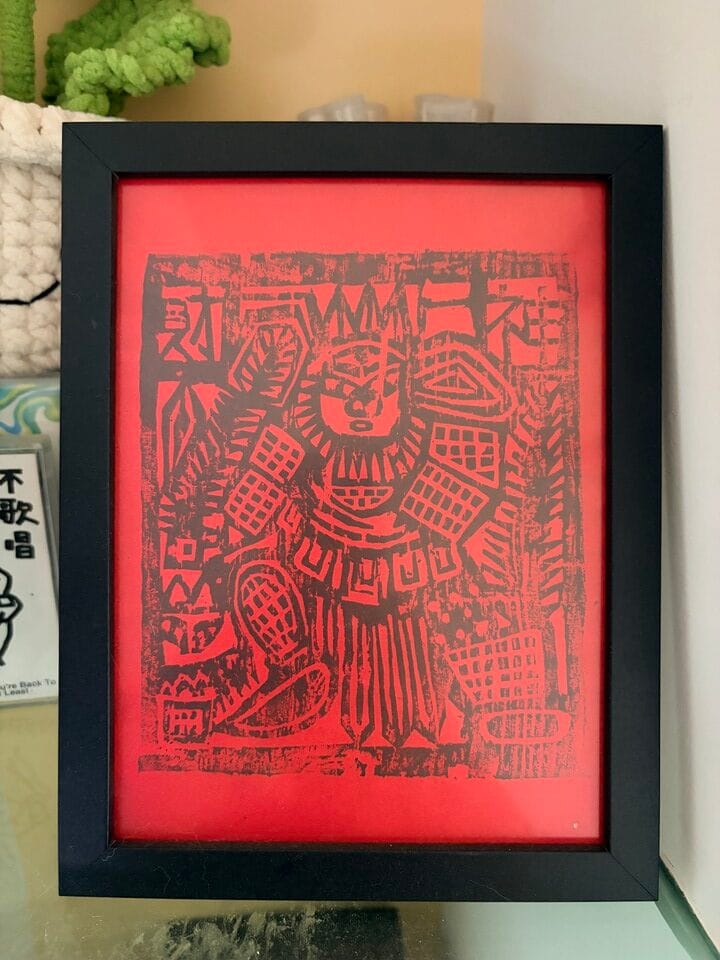
- Jiama woodblock printing: pick a folk-deity block and ink your own print for CNY 5–10. A mounted print costs CNY 20.
- Tie-dye: a DIY piece to take home costs CNY 30.
- Herbal foot soak: CNY 10 in a back lane; the owner keeps topping up the hot water.
- Yi costume rental: CNY 50 per outfit for photos.
For souvenirs, buy preserved fruit and pickles at the market south of the old town, where they cost less than inside the walls.
7. Half-Day and Full-Day Routes
The old town alone takes half a day. Take the early-morning train from Dali Station and you’ll be eating breakfast in Weishan by 8 AM. Plan the rest of the day around these hours:
Half-day route
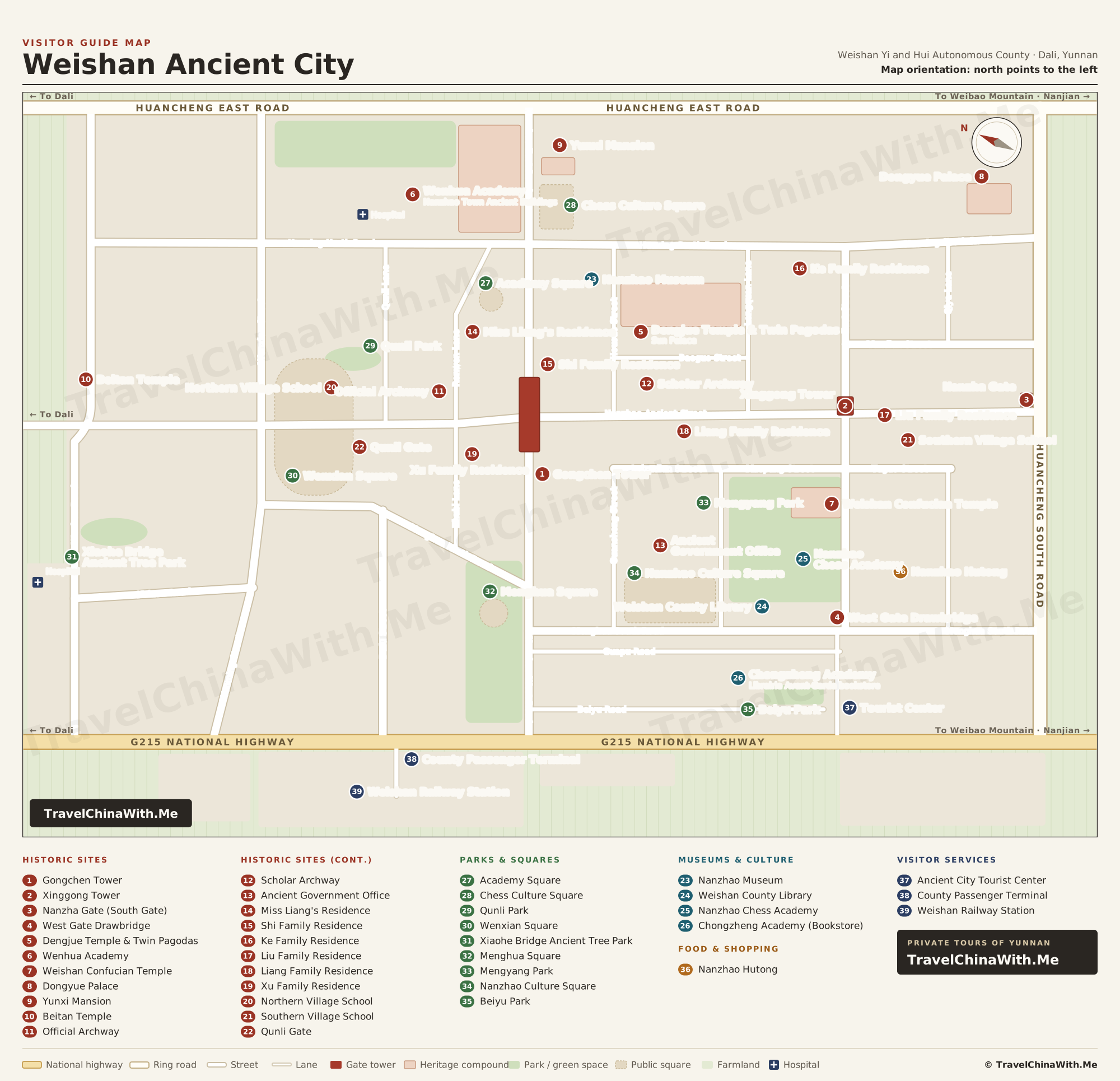
This route doesn’t double back, and it gets you to the noon-closing breakfast shops in time. If you’re carrying luggage, drop it first near Gongchen Tower (see Section 9):
The route gives Nanzhao Museum one hour; add another hour or two if you want all seven halls.
Full day, option A: tea at Daxiao Temple
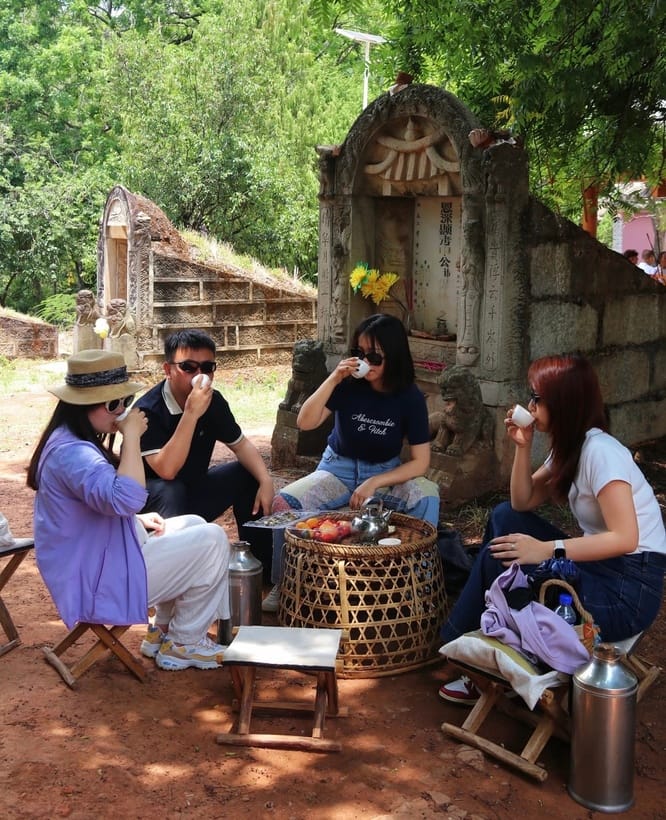
Follow the half-day route, then take a taxi 20 minutes to Daxiao Temple (大小寺) at 2–3 PM. Local families drink tea on the hillside here, beside the martyrs’ cemetery, looking out over the valley. It’s a local custom, not a tourist site, so keep your voice down and ask before photographing people. Come back at 5–6 PM for the Xinggong Tower lanterns and a pot of roasted tea.
Full day, option B: Weibao Mountain
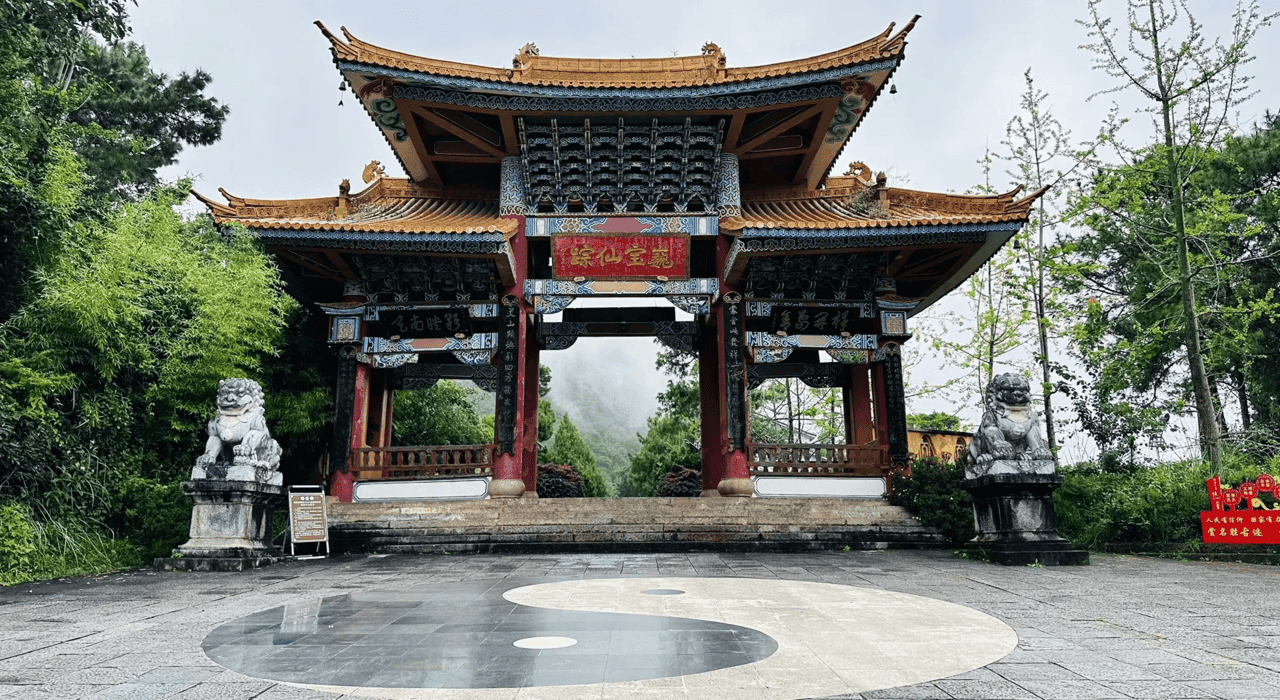
Weibao Mountain (巍宝山) is a Taoist mountain with temples spread through shaded forest, 10 km south of the old town. Changchun Cave and Wenchang Palace hold its best-known Taoist murals. The ticket is CNY 40, and entry before 8 AM is free. That makes option B an early start:
- 7:00 AM: bus No. 1 or a 30-minute taxi from the old town to the mountain gate.
- 7:30–11:30 AM: take the downhill path to Changchun Cave first; it’s the highlight and takes one hour. Then climb back up to Wenchang Palace, Taizi Hall, Qingxia Palace and Yuhuang Pavilion.
- 12:00 PM: lunch back in the old town, then the half-day route in the afternoon.
Option B means you’ll miss the noon-closing breakfast shops unless you eat there before 7 AM.
Full day, option C: add Donglianhua Village
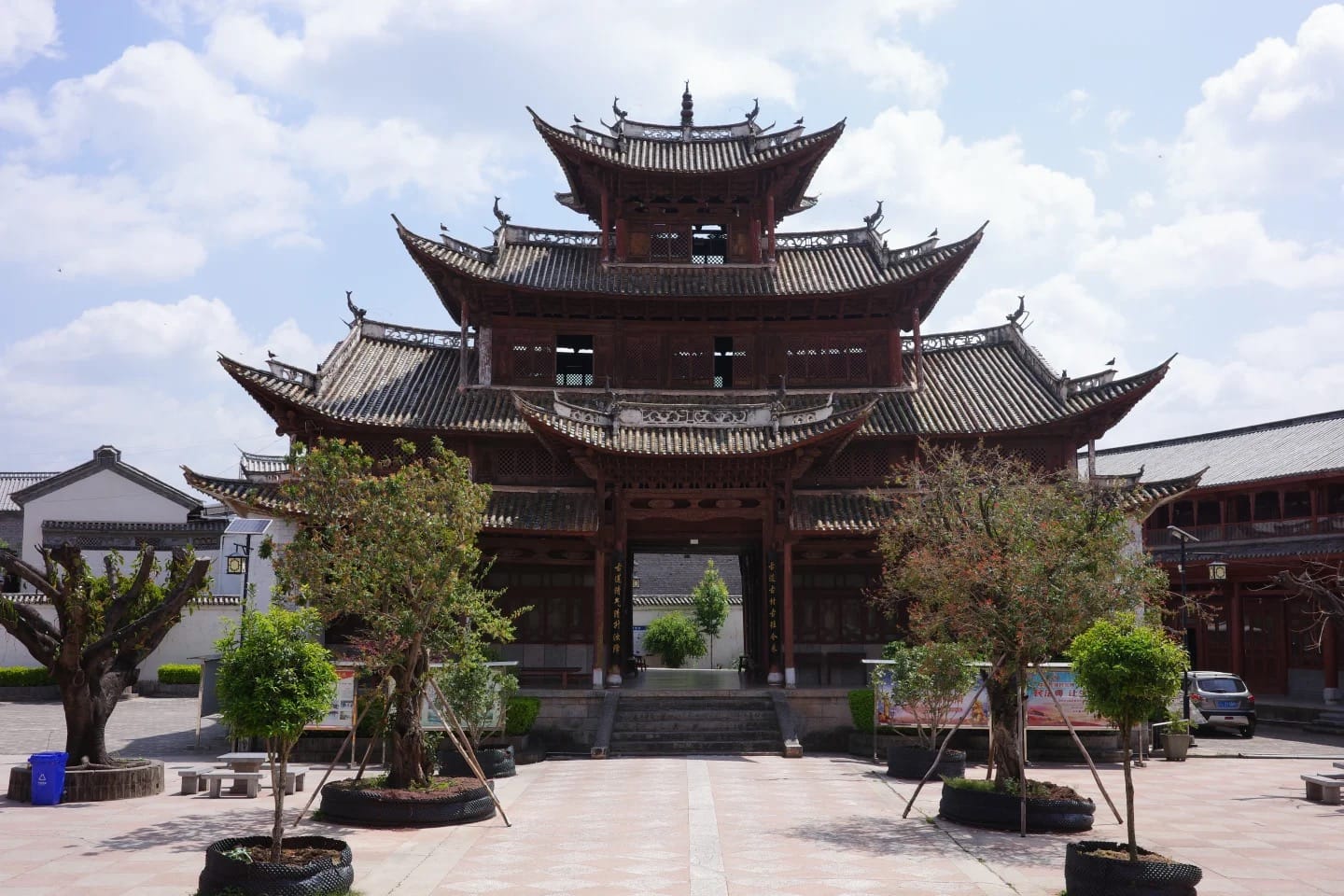
Donglianhua (东莲花村) is a Hui Muslim caravan village in Yongjian Township, on one of the two roads between Dali and Weishan. Its families ran mule caravans on the Tea Horse Road. In the early Republican era, the village kept 350 mules and horses. It was named a Chinese Historic and Cultural Village in 2008.
The reason to stop is the Ma Family Compound (马家大院), built in 1941 by the caravan leader Ma Ruji. Some English guides call it “Menghua Old House”. Its layout packs one watchtower, two courtyards, three gates, four pavilions, five halls and six skywells into one compound, mixing Han, Bai and Islamic styles. Ma Ruji’s two brothers built compounds of their own, but only Ma Ruji’s is open to visitors.
Entry | Village free; Ma Family Compound + Horse Caravan Culture Museum CNY 20 |
|---|---|
Discounts | Free for 70+; half price for 60–69 |
Time needed | 1–2 hours |
Arrive | After 10 AM; the compound has no fixed opening time |
Outside the compound and the mosque, the rest of the village is ordinary. Stop on the way; don’t make a separate trip for it.
You don’t need a private car. Bus No. 2 runs between Weishan Station and Donglianhua every 30 minutes, 7:00 AM–6:30 PM, for CNY 10, and takes 40 minutes. Board it in the old town at the Wenhua Academy stop. The last bus back leaves at 6:30 PM. A taxi from the old town covers the 27.3 km in 35 minutes and costs CNY 30–40.
Two roads link Xiaguan and Weishan. The Dali–Lincang Expressway takes 43 minutes for 49.9 km. The road through Donglianhua is 46.1 km and takes 50 minutes, plus a short detour into the village itself. With a car, take the Donglianhua road, stop for 1.5–2 hours, and drive on to Weishan Ancient Town with no backtracking. A car also lets you link Donglianhua with Daxiao Temple and Huiming Temple (惠明寺) in one afternoon. Dress modestly near the mosque.
8. Is Weishan Worth an Overnight Stay?
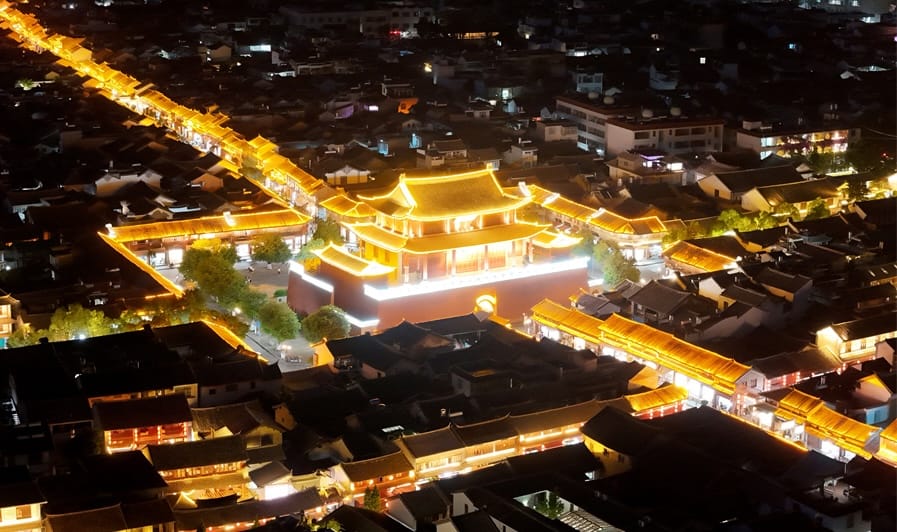
Yes. Evenings and early mornings are the best times in Weishan, and day-trippers miss both.
Three things only overnight guests get. After dusk, both towers are lit and the main street is down to locals and a few guests. In the morning, you reach the breakfast shops before the noon cut-off without an early train. And there’s time for a slow pot of roasted tea, which a day trip rarely allows.
Where to stay
The old town has many guesthouses in converted courtyard houses. They’re the best choice if you want to sleep in a traditional home. Off-season rates run CNY 150–300 a night and rise in peak periods. Budget chain hotels outside the old town start just over CNY 200 off-season, with parking and a short walk to the walls.
Prices jump during Chinese national holidays, including the early-October Golden Week. If your dates are flexible, avoid them.
Check these before you book
- Street-facing rooms. We once stayed at a roadside hotel just outside the old town. Our room faced the street, trucks passed all night, and none of us slept. Ask for a room away from the road.
- Soundproofing. Wooden courtyard houses carry sound. Pack earplugs.
- The school side. Weimin Primary School (为民小学) sits by the old town, and mornings get noisy on that side.
- Water pressure. Low water pressure is common across Weishan, so don’t expect a strong shower anywhere.
To compare options, search Trip.com for “Weishan ancient town”, sort by rating, and check recent guest photos of the room itself, not only the courtyard.
9. When to Go and Practical Tips
When to go
Any ordinary weekday outside Chinese national holidays is a good time for Weishan. Two dates are worth planning around:
- Snack Festival: held on the 8th day of the 2nd lunar month, in February or March. Weishan fills with food stalls, and Yi ancestor-worship rituals take place on Weibao Mountain.
- Torch Festival: Weishan calls itself the home of Yi dage (打歌) dancing, and its Torch Festival in the 6th lunar month brings bonfires and circle dances, as Xinhua reported. Rooms book out.
On the ground
- Sun: the midday sun in Weishan is strong. Walk in the shade, or enter the old town after 4 PM.
- Mosquitoes: in summer they’re worse than in Kunming or Dali. Bring repellent.
- Dry air: one of our guests from the Netherlands called Weishan “extremely dry, unbearable”. Pack lip balm and moisturizer, and drink more water than you think you need.
- Silver jewelry: some visitors have bought silver that was well under its stated weight and carried no purity stamp. If you buy silver, ask for the weight on a scale and look for the 925 or 足银 stamp.
- Public holidays: Golden Week and Spring Festival bring crowds, closed shops and service that can’t keep up. Some visitors have also hit power cuts. Visit on ordinary weekdays if you can.
- Luggage: Weishan Station has NO left-luggage office, and stone-paved lanes make wheeled cases miserable. On a day trip, drop your bags first at Meishi Meike convenience store (美时美刻便利店) near Gongchen Tower. We’ve used it: CNY 5–10 per case. Nanzhao Museum has also held bags for visitors, collected before 4 PM. Many guesthouse and restaurant owners in the old town will mind a case if you ask, especially if you eat there.
10. FAQ: Weishan Ancient Town
Is Weishan Ancient Town free to enter?
Yes. Weishan Ancient Town has no entrance gate or ticket, and walking its streets costs nothing. Only individual sites inside charge, with tickets from CNY 5 to CNY 40.
Can I visit Weishan without speaking Chinese?
Yes, with preparation. Menus and shop signs in Weishan are almost all in Chinese, so save the names of the dishes you want and use a translation app. Most shops take Alipay or WeChat Pay, which foreign visitors can link to an international card.
Is Weishan good for families with young children?
Weishan’s car-free lanes are easy for children to walk. The old town has no baby-care rooms, so plan feeding and changing stops. Strollers work on the main streets but bump on the stone-paved lanes.
Can I see Weishan and Dali Old Town on the same day?
Yes. Spend the morning in Weishan, when its breakfast shops are open, and take the 22-minute train back to Dali Station after lunch. That leaves the afternoon and evening for Dali Old Town.
Is Weishan the same as Weishan Lake?
No. Weishan Lake is a freshwater lake in Shandong Province, in eastern China, and shares only the romanized name. Weishan Ancient Town is in Dali Prefecture, Yunnan, and is written 巍山 in Chinese.
Want Weishan built into your Dali days, as a day trip or an overnight? Tell us your dates and we’ll plan the route.