Shaxi Ancient Town Guide: Route, Friday Market & Tips
Shaxi Ancient Town is the old market village of Sideng in Jianchuan County, Dali Prefecture, on the road between Dali and Lijiang. Its restored square, Ming-dynasty temple and Friday market make it the most complete Tea Horse Road trading town left in Yunnan. The town is free to enter. Visit it on the Dali–Lijiang transfer, not as a round trip.
We stop in Shaxi several times a month, almost always on that transfer in one direction or the other. Many of our guests don’t even sleep there. The old town is small enough to see in a morning. Whether to stay comes down to timing. Shaxi is far quieter than the old towns of Dali or Lijiang. It’s quietest early in the morning and after dark, though, and a daytime stop misses both. This guide gives you our guides’ stop-by-stop route, how the Friday market works, the two ways up Shibaoshan and the traps that cost visitors money. It also compares Shaxi with Dali, Xizhou and Lijiang. By the end you’ll know whether to stop or stay, and in what order to see things.
Location | Sideng village, Shaxi Town, Jianchuan County, Dali Prefecture; over 2,000 m altitude |
|---|---|
Entry | Town, Xingjiao Temple and Ouyang Courtyard all free; Xingjiao registers your passport |
Getting there | No train; 2 hours by car from Dali, 1 hour 15 minutes from Lijiang |
Time needed | A morning on the Dali–Lijiang road; one night for dawn at Yujin Bridge |
Market day | Every Friday, 08:00–18:00, outside the old town |
Best months | Autumn (September–November), then spring (March–May) |
Table of Contents
1. Shaxi Ancient Town at a Glance

Shaxi is the name of a valley and a township. The “ancient town” visitors mean is Sideng (寺登), the village at the valley’s centre on the west bank of the Heihui River. Shaxi Town administers 14 village committees, and 10 of its villages are on China’s national list of traditional villages. Most residents are Bai, with Han, Yi and Lisu neighbours.
Sideng grew rich as a stop for caravans carrying tea, salt and goods between southern Yunnan and Tibet. It went quiet when trucks replaced the mule trains. The World Monuments Fund put the market area on its 2002 World Monuments Watch. The Shaxi Rehabilitation Project then restored it with the original timber and earth walls instead of rebuilding. That’s why Sideng’s walls still look old, unlike the rebuilt shopfronts of Dali Old Town.
→ For the wider trade route Shaxi sat on, see our Tea Horse Road guide.
Is Shaxi Touristy Now?
Less than most Yunnan old towns. Shaxi had 1.28 million visitors in 2019, China Daily reported. Xinhua put the 2024 figure at 3.12 million, with much of the growth coming after the TV drama Meet Yourself (去有风的地方) was filmed here. The crowds stay on Sideng Street and Yujin Bridge, mostly at midday over the national holidays and in July and August.
Tom, one of our guides, has been coming here since 2017. His verdict: “Next to the noise of other old towns, Shaxi is almost too quiet.” Before mid-morning and after dark the streets are close to empty, which is why our route starts at 07:30.
2. Shaxi vs Dali, Xizhou and Lijiang
Most Yunnan trips pass through Dali and Lijiang anyway, so the real question is which other old town gets your time.
Dali Old Town | Xizhou | Shaxi | Lijiang Old Town | |
|---|---|---|---|---|
What it is | Ming walled city, founded in 1382 | Bai merchant village on the Erhai plain | Tea Horse Road market village | Naxi trading town, UNESCO World Heritage since 1997 |
Buildings | Walls, gates and most shopfronts rebuilt | Original Bai merchant houses; on China’s first list of traditional villages (2012) | Original, restored with traditional materials | Much rebuilt after the 1996 earthquake; most houses are now shops and inns |
Crowds | Busy all day, packed on holidays | Day-trippers from Dali, busiest at midday | Quiet; busy only at midday on holidays and in summer | The busiest of the four, especially in summer and on holidays |
From Dali Old Town | — | 18–20 km, 30–40 minutes | 132 km, 2 hours | 2.5 hours |
Time needed | Half a day | Half a day | A morning, or one night | Half a day |
Best for | A base, with the most hotels and food | Bai architecture on a half-day trip | A lived-in old town without the crowds | Nightlife, and a base for Jade Dragon Snow Mountain and Tiger Leaping Gorge |
Based in Dali with half a day to spare? Go to Xizhou; our Xizhou guide has the walking route. Travelling between Dali and Lijiang? Stop in Shaxi on the way. Half a day is enough for Lijiang Old Town itself; the time you save is better spent in Shaxi.
3. Stop-Off or Overnight?

The one plan we’d steer you away from is a round trip from Dali. It costs 4 hours in the car and misses the early morning and the evening, which is when Shaxi is at its best. Shaxi sits on the road between Dali and Lijiang, so make it part of that transfer instead.
How long to stop depends on what you want from it:
- A stop on the transfer day. This is what most of our guests do. Our guides’ route covers the square, temple, Ouyang Courtyard and main street in 3 hours at an easy pace. Then you carry on to Lijiang or Dali.
- One night in Shaxi. Worth it if you want Yujin Bridge at dawn, Shibaoshan on foot, or the old town after dark. That’s when the lanes go quiet and many are barely lit. Sleep there on a Thursday and you add the Friday market.
- Two nights. Only for walkers who want both Shibaoshan and the valley villages without rushing.
4. Getting There and Around
Shaxi has no train station. Your options from Dali and Lijiang:
Option | Time | Who it suits |
|---|---|---|
Private car | 2 hours from Dali (132 km), 1 hour 15 minutes from Lijiang (99 km) | Most foreign travellers, especially with luggage |
Bus or shared car from Lijiang | 1.5–2 hours (details below) | Travellers based in Lijiang |
Bus to Jianchuan (CNY 35 from Dali), then a CNY 15 minivan | 2 hours or more to Jianchuan, then 40 minutes | Budget travellers who read some Chinese |
Drive times are navigation figures for clear roads; allow extra over the national holidays. Self-driving needs a Chinese licence, so few of our guests consider it.
A private car is the realistic choice for most foreign travellers: one booking covers the whole Dali–Shaxi–Lijiang day. We’ve arranged private cars across Yunnan since 2006 and don’t publish prices, since they depend on vehicle, group size and season. Ask us for a quote or read how our charter car service works.
Between Shaxi and Lijiang Without a Car
Two services run each way on the expressway, so they work for getting in and out.
- Direct bus (CNY 50, 1.5–2 hours): Lijiang Jiaoyun (丽江交运) runs it between Shaxi’s visitor centre and Lijiang Old Town’s North Gate. Scheduled times are 09:25, 10:25, 14:55 and 15:55. Book on the 丽江交运 WeChat account or in DiDi’s Station Bus (站点巴士) section; the booking page shows which end your bus leaves from.
- Shared car (from CNY 80): hourly from 08:00 to 18:00, with pickup at your guesthouse and drop-off anywhere in Lijiang, including Sanyi Airport. Ask your guesthouse to book it at least 2 hours ahead.
Don’t rely on an ordinary DiDi out of Shaxi. Few drivers accept the long trip, and some who do then ask for more money.
The Yellow-Cart Trap
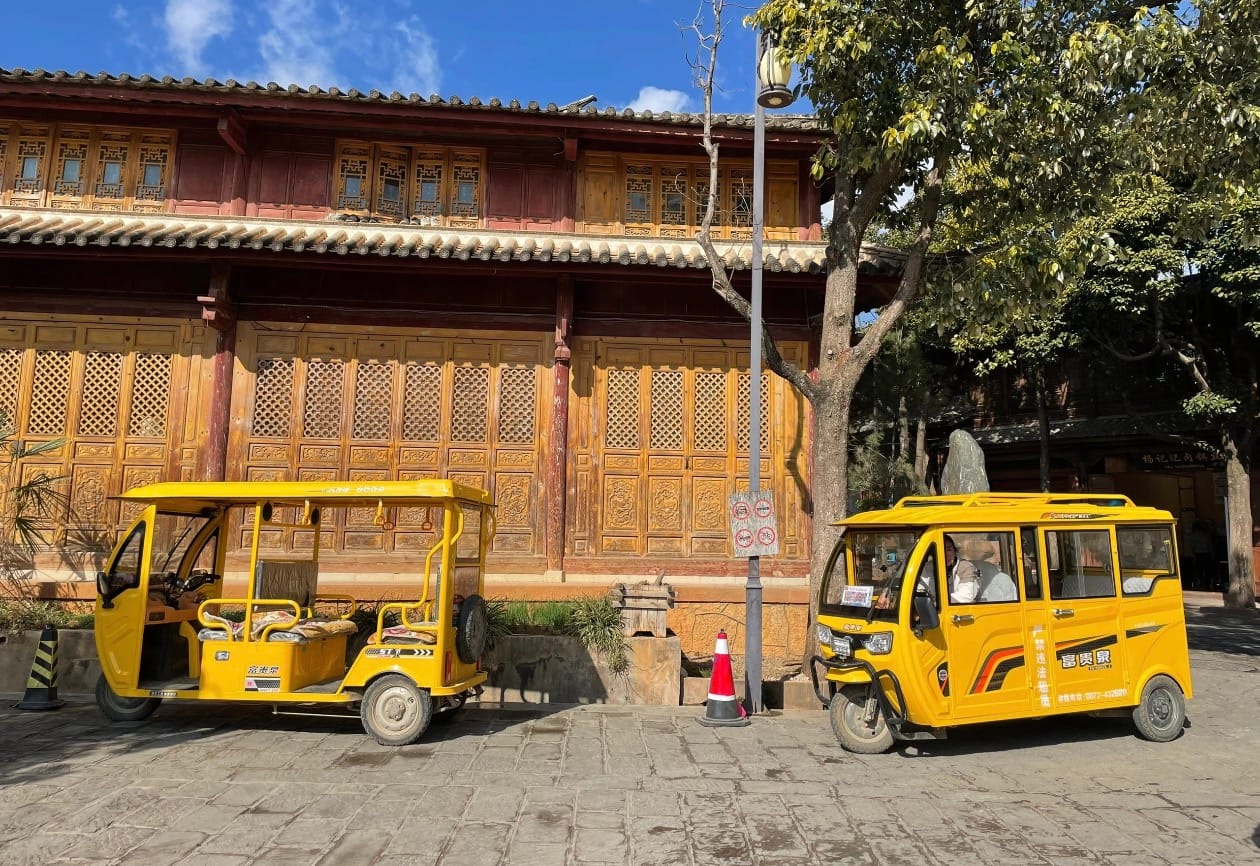
The yellow carts at the old-town entrance run to the Pioneer Bookstore for CNY 5–10 per person. Some drivers sell the same trip there and back as a CNY 100–120 “tour”. One of our Malaysian guests put it plainly: “They asked 120, I bargained to 100 and they agreed at once. I thought I’d got a deal. I’d been had.” A DiDi to the bookstore costs CNY 6.9.
5. A Day in Shaxi, Stop by Stop
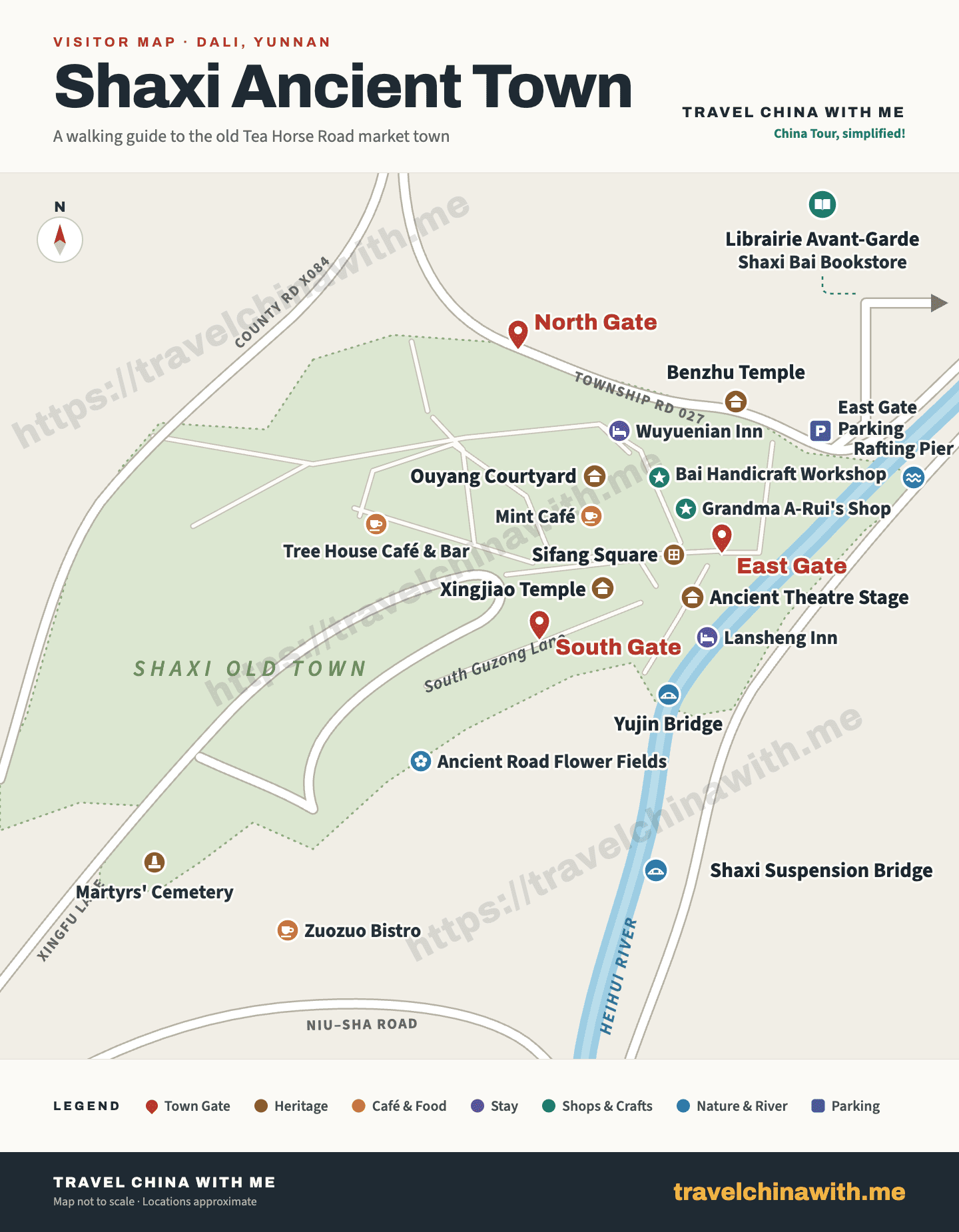
This is the route our guides walk with guests who sleep in Shaxi. It reaches each photo stop at its best light, and everything except the bookstore is on foot. If you’re stopping on the Dali–Lijiang road instead, start at the square and follow the same order from there.
07:30 Yujin Bridge

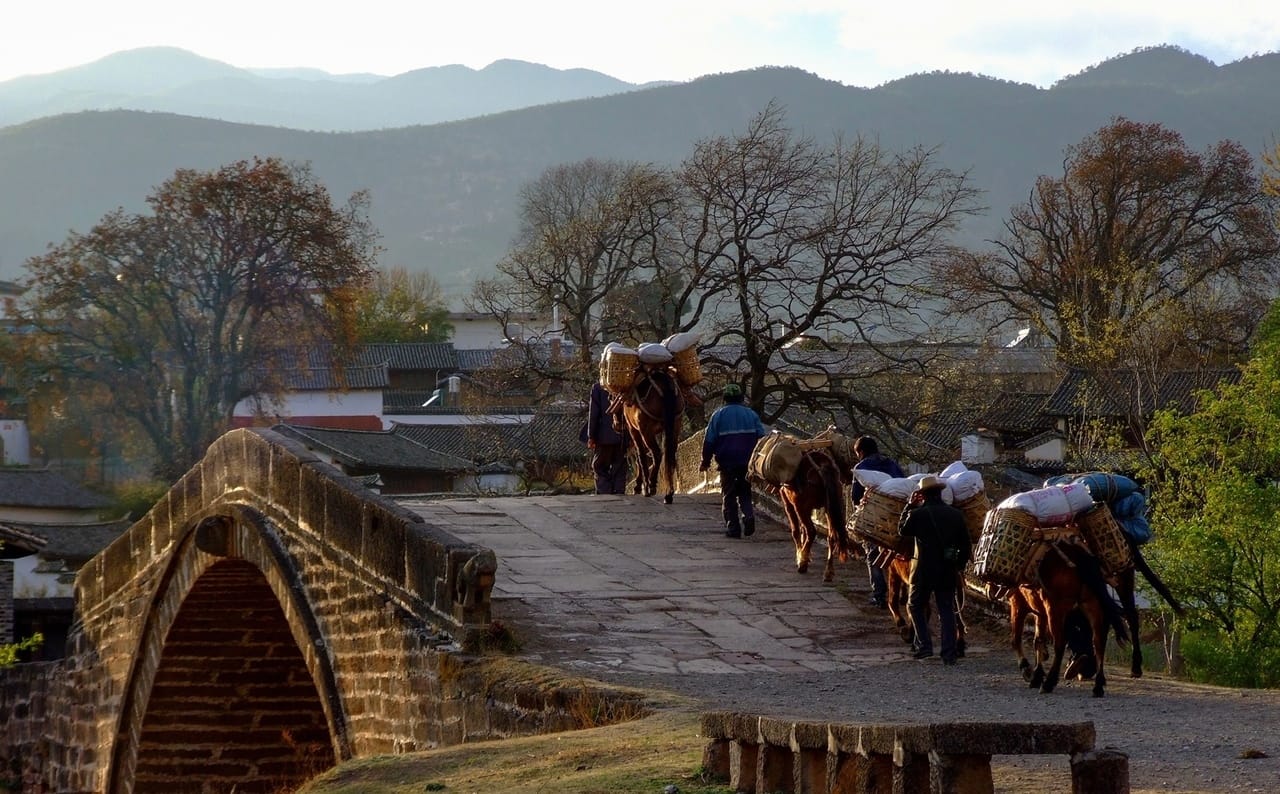
Start at Yujin Bridge, the stone arch over the Heihui River on the old caravan road south to Dali. Early morning is when river mist is most likely, especially in late autumn, and villagers often drive goats across. It’s the best photo in Shaxi. In peak season, photographers claim the spots on the bank between 07:00 and 08:00, so be early.
08:15 East Gate
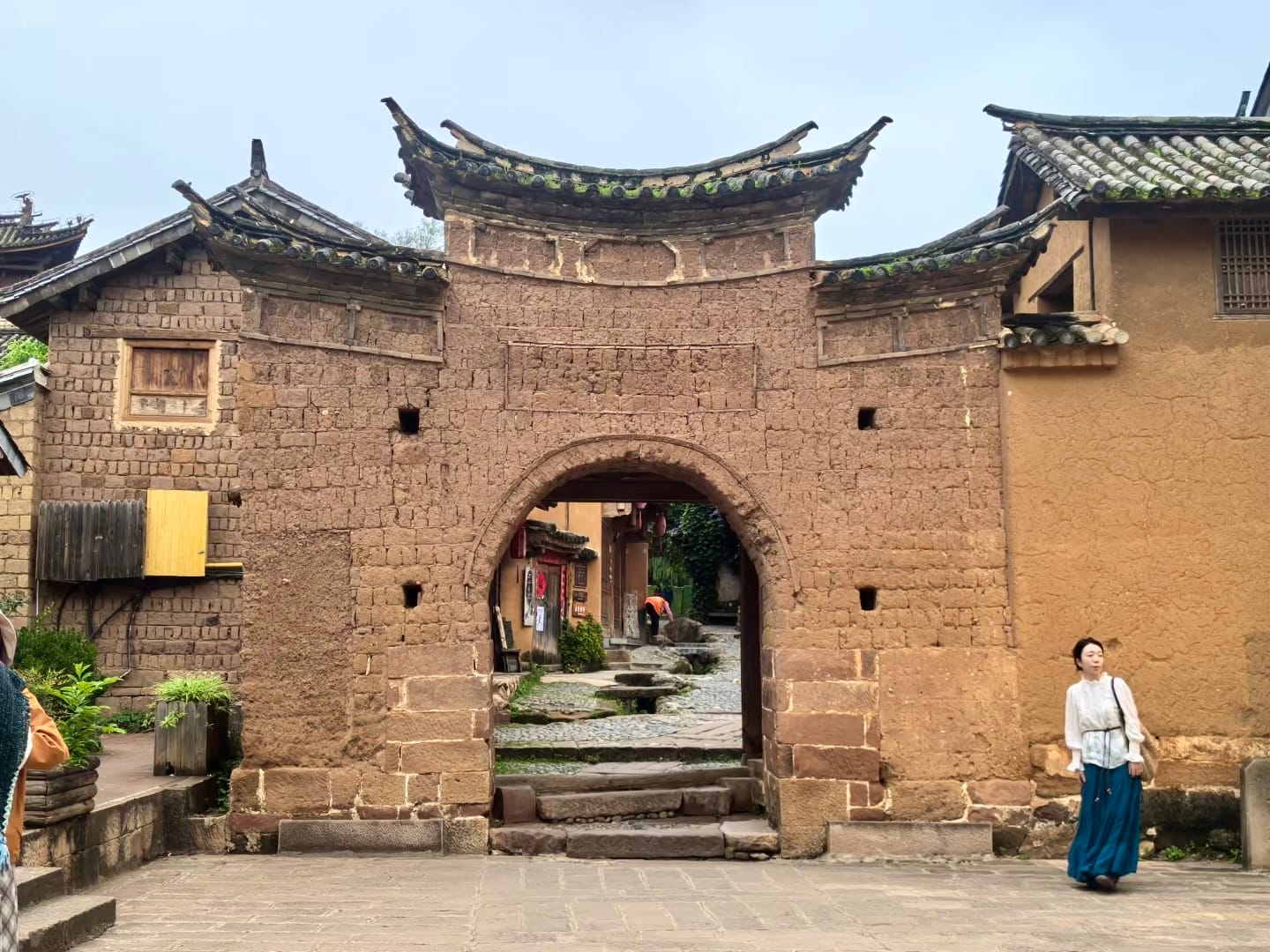
Walk back towards the village through the restored East Gate. At this hour the sun comes straight through the gateway, which makes it the place for silhouettes.
08:30–09:30 Sideng Street and Ouyang Courtyard
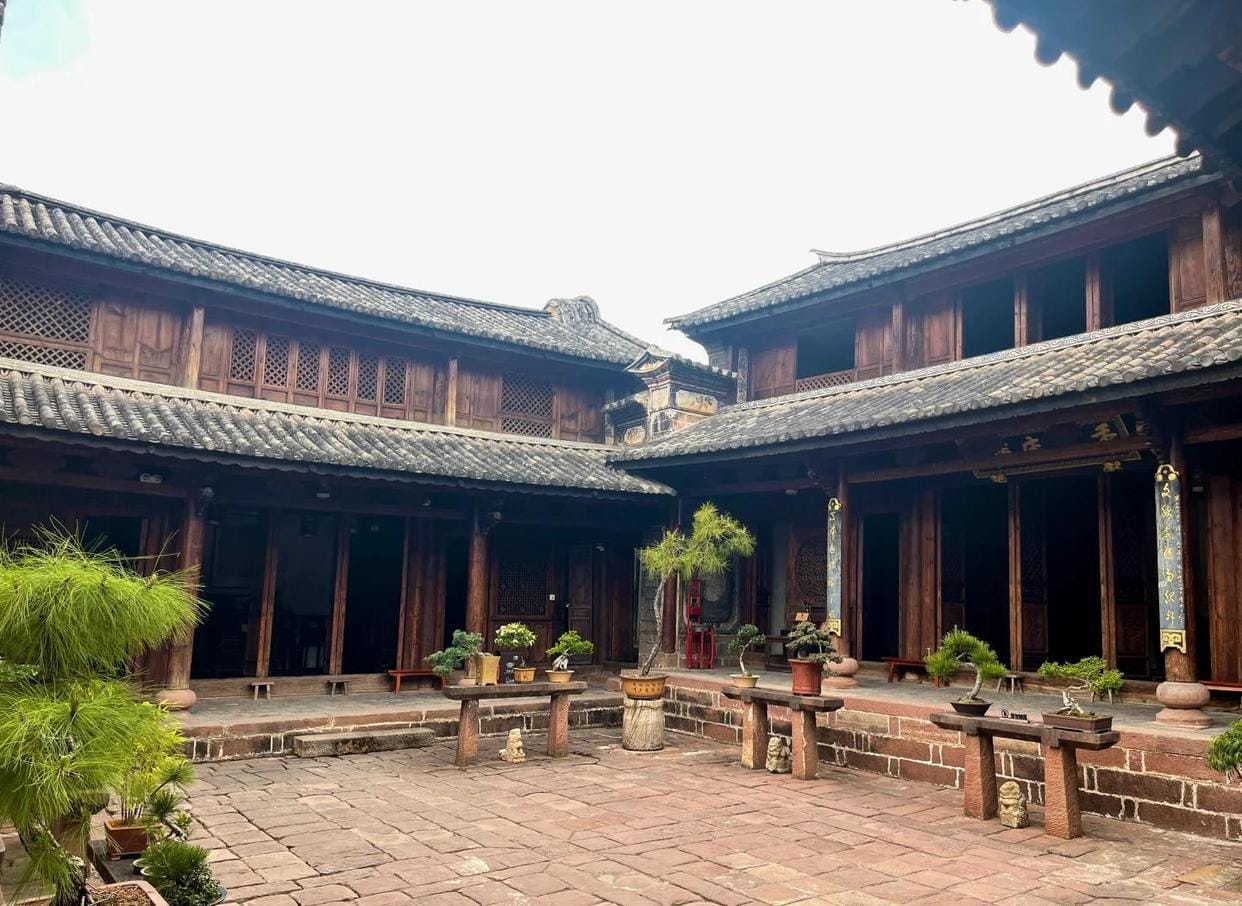
Walk the main street slowly. It’s lined with small shops and craft stalls. At the fork, turn left into the Ouyang family compound (欧阳大院). It’s a Qing-dynasty Bai merchant house in the “three wings and a screen wall” layout. Take time over the woodcarving; it’s the best in town. Entry is free, and part of the house now works as a craft workshop.
10:00 Sideng Square, the Stage and Xingjiao Temple
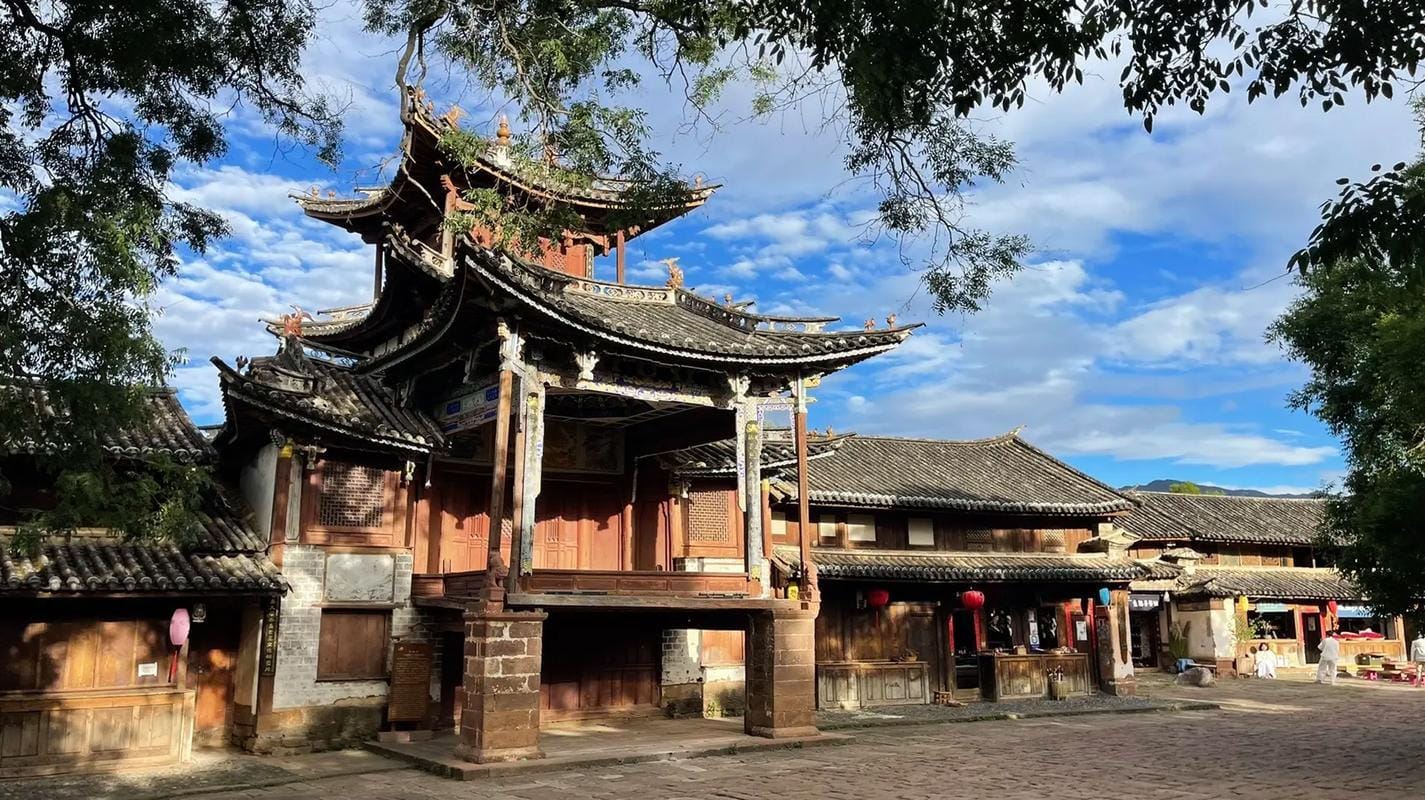
The square is the old trading floor, paved in red sandstone and shaded by Chinese scholar trees. It’s still quiet at 10:00. The building that dominates it is a three-storey Kuixing Pavilion from the Qing Jiaqing era, with an opera stage built onto its front.
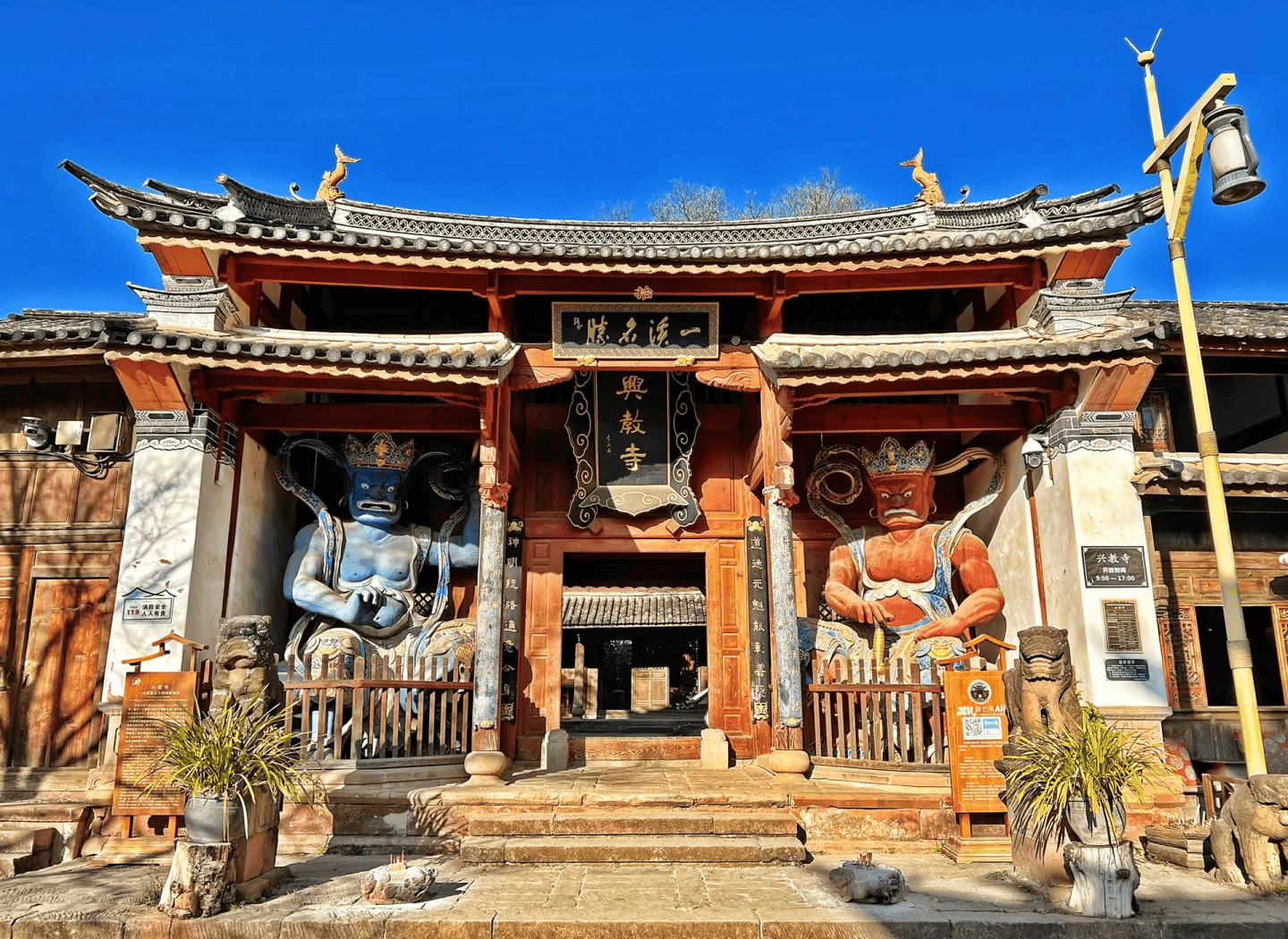
Facing it, Xingjiao Temple (兴教寺) dates to 1415. It belongs to the Azhali (Acharya) school, the esoteric Buddhism of the Bai, and very few Ming temples of that school still stand. Entry is free, but the gatekeeper registers your ID, so carry your passport. Go in to see the Ming murals in the main hall. They’re faded, but worth ten minutes.
10:30 Coffee by the Stage
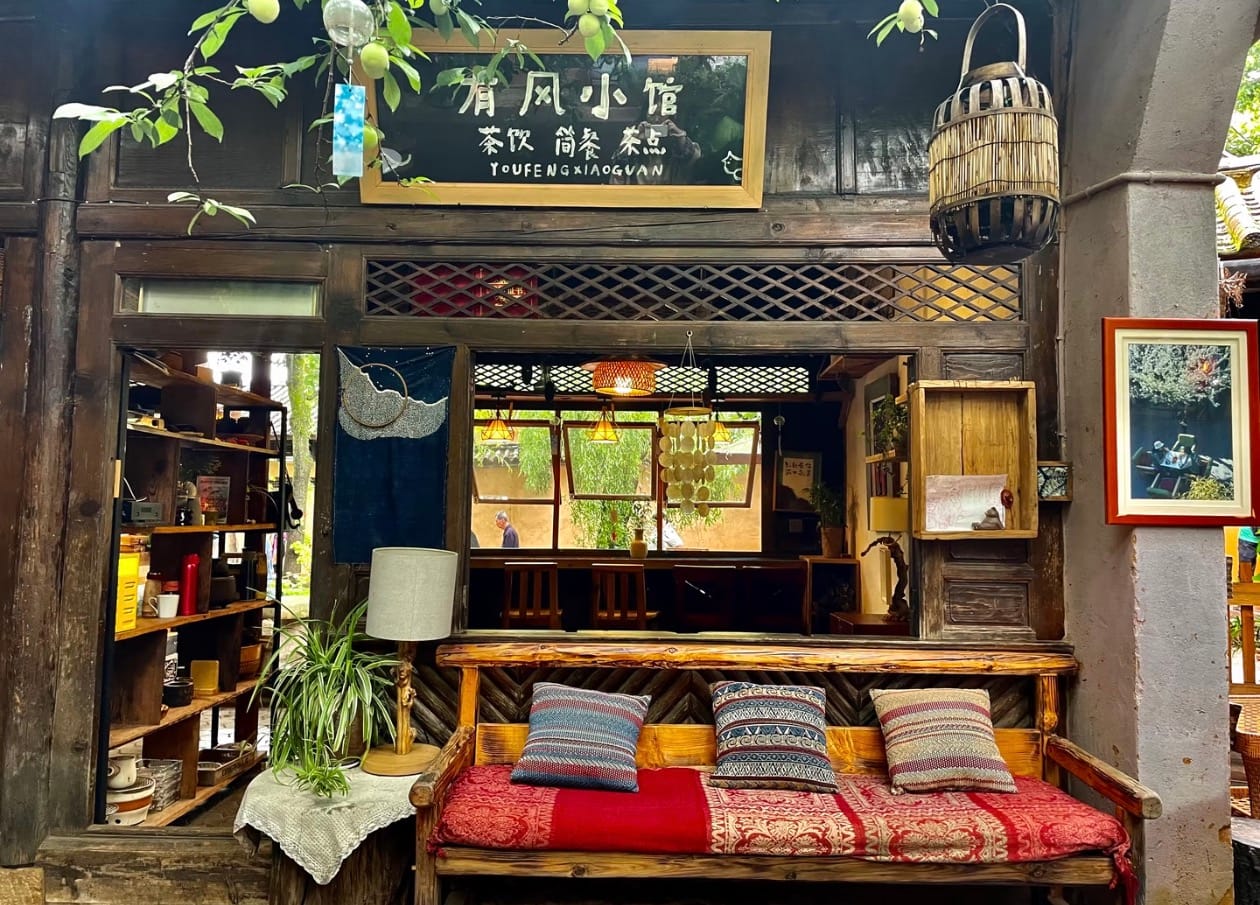
Take a break at Bohe Café (薄荷咖啡馆) or Youfeng Xiaoguan (有风小馆) right beside the stage, and sit in the courtyard. Youfeng Xiaoguan is the real-life model for the restaurant in the TV drama Meet Yourself. The drama’s inn is in Fengyangyi village near Dali, not in Shaxi.
11:00–12:00 Lunch
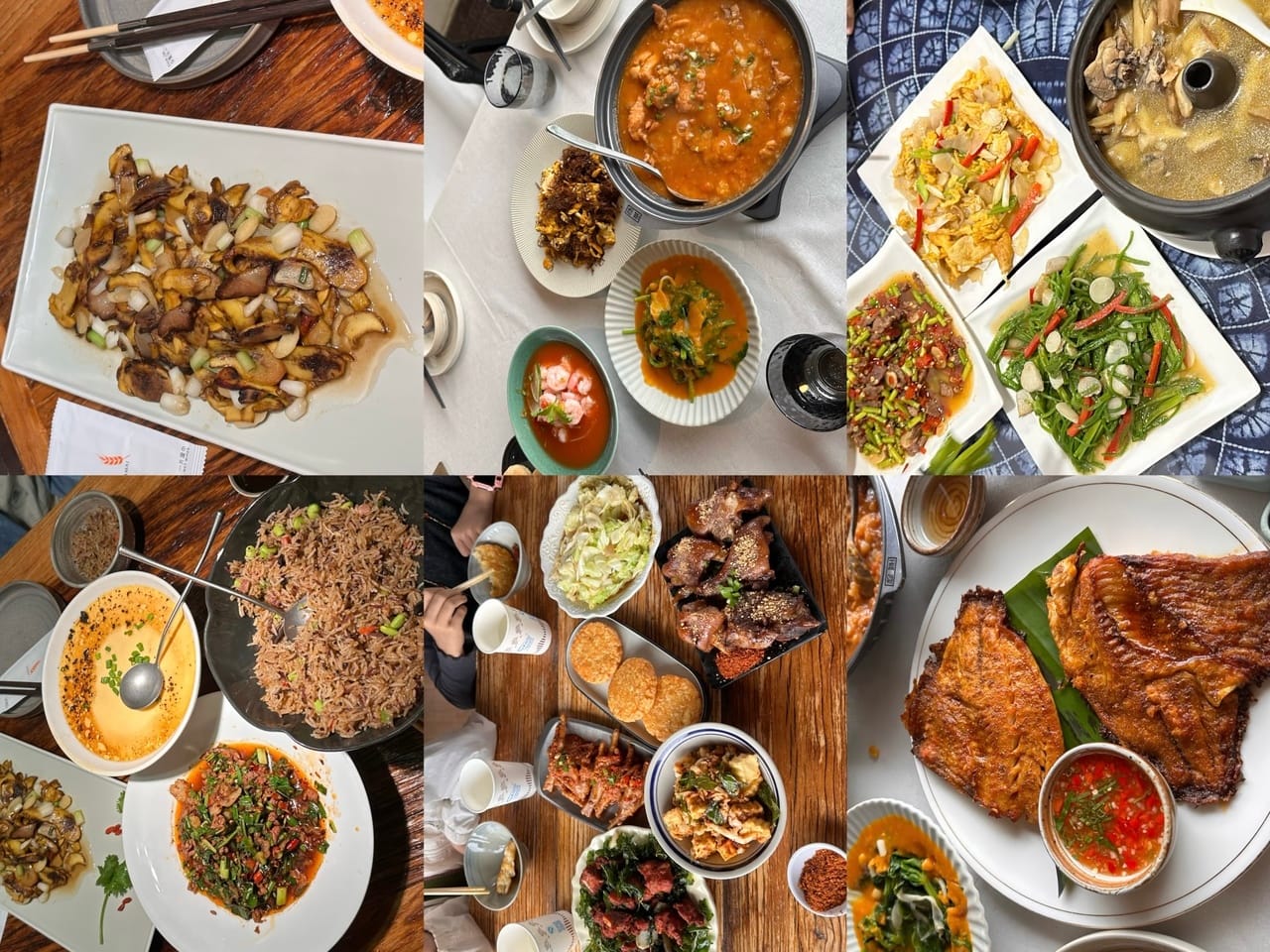
Where we’d eat (one is enough):
- Buwan Xiaochi (不晚小吃): porcini fried rice, quick and cheap.
- Sanniang Shifang (三孃食坊): crispy-skin potatoes and mint pork ribs. There’s a queue at mealtimes, so arrive before 11:30.
- Dazhong Fandian (大众饭店): herbal clear-broth fish. Portions are big; two light eaters won’t finish one.
12:30 Nan Guzong Lane to the South Gate
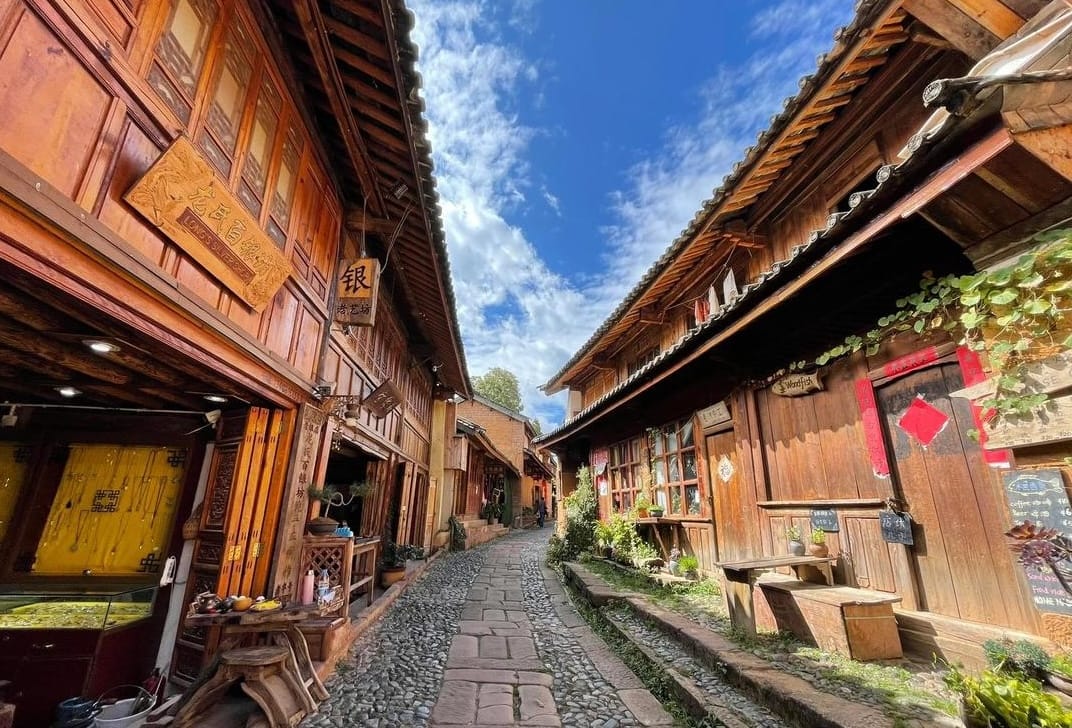
Head south down Nan Guzong Lane (南古宗巷), a long, narrow lane that photographs well. It ends at a century-old banyan, and just past it is the South Gate, the setting for a horse scene in Meet Yourself.
13:00 Pioneer Bookstore and the Poetry Tower
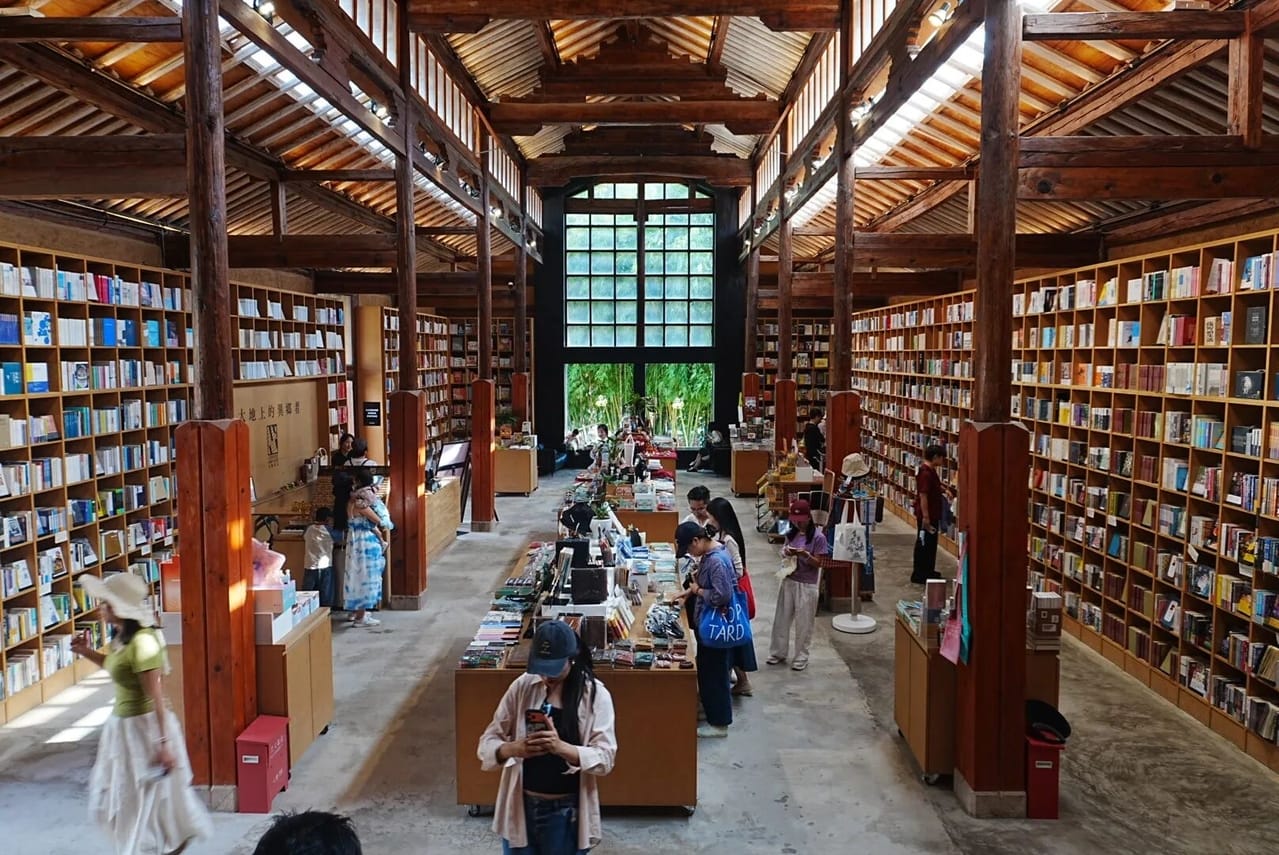
Go back to the old-town entrance and take a ride to the Pioneer Bookstore (先锋沙溪白族书局), 2.2 km away in Beilong village. It’s a 30-minute walk if you’d rather stretch your legs. The bookstore is a converted grain store, good for an hour of reading and doing nothing. Across the road, the Poetry Tower’s spiral stairs lead up to a view over the whole valley. The tower closes at 17:30, so an afternoon visit fits.
15:00–16:00 The Rice Fields
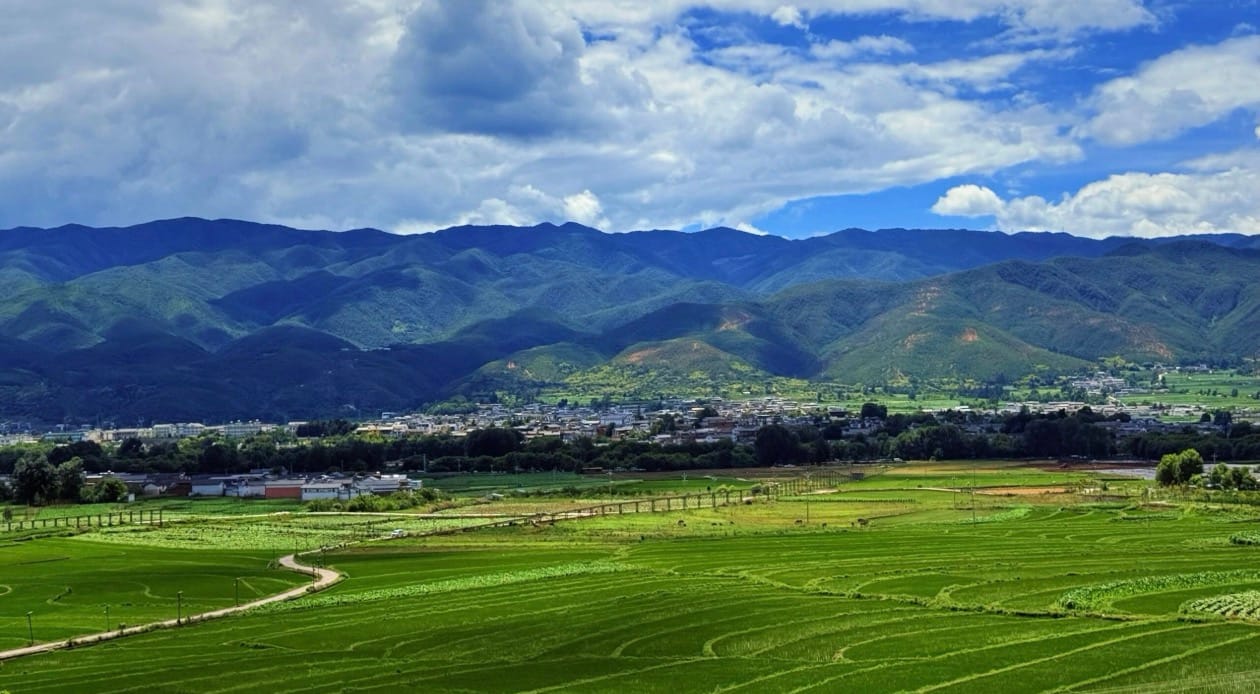
The bookstore sits at the edge of the valley’s rice fields, which turn gold in October. There’s nothing left to rush to. Find a field ridge, sit down and wait for the light to soften.
With a second day, rent a bike from your guesthouse and ride the valley villages, such as Diantou with its restored Pear Orchard Temple.
If It’s a Friday
Go to the market after lunch, before the bookstore. The best stalls start packing up after 16:00, and most are gone by 17:30.
6. The Friday Market
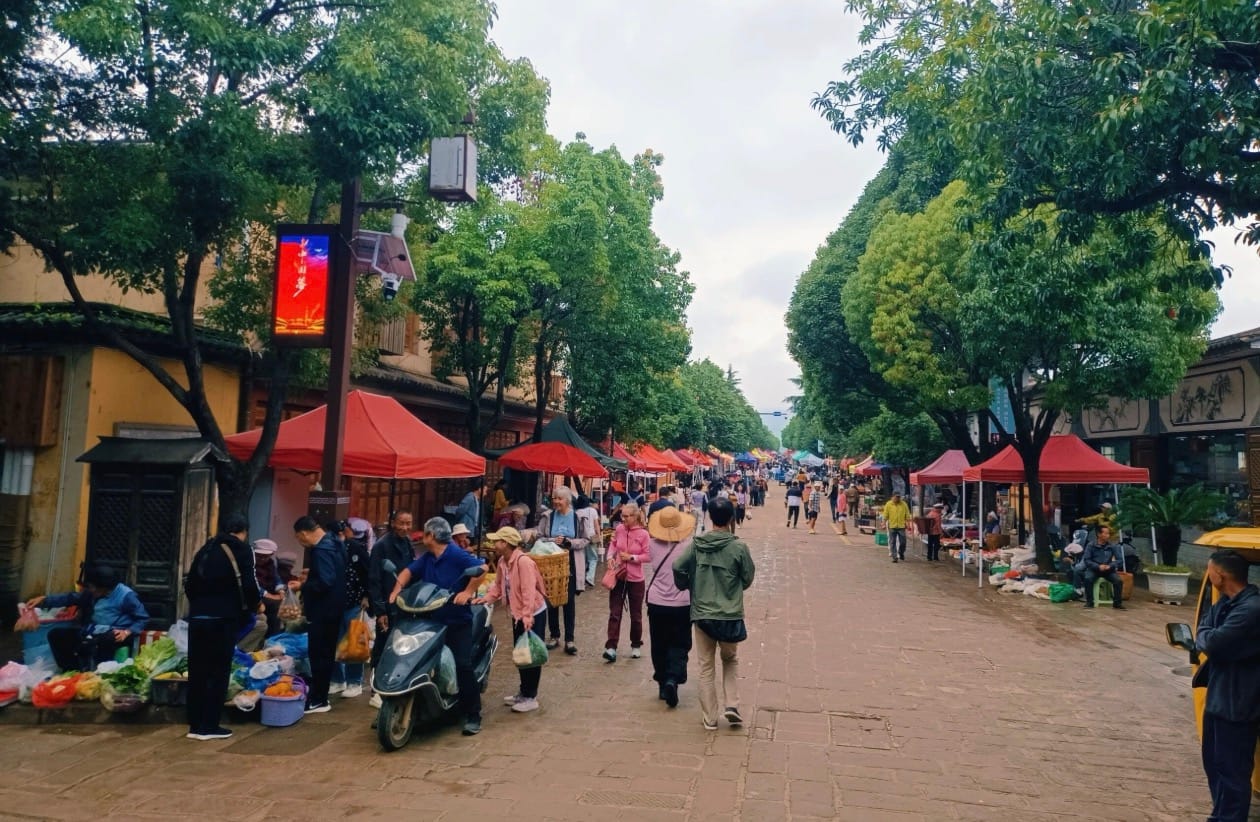
Shaxi’s Friday market does not take place on Sideng Street or the old square, despite what many guides say. It fills one long street between the township government and the police station. Search “沙溪镇政府” or “沙溪派出所” in your map app. Start at the police-station end, where the market begins, and walk the length of it.
Stalls go up at daybreak and come down at dusk. 08:00–18:00 is the usual answer, and summer days run earlier and later. How we’d time it:
Time | What you get |
|---|---|
09:00 – 10:00 | Everything is laid out and crowds are manageable |
14:00 | Best time to bargain: sellers start dropping prices, and the good stock hasn’t sold out yet |
After 16:00 | Good stalls start packing; fruit goes cheap |
It’s a working market for Bai and Yi villagers, not a craft fair, so it helps to know a few things:
- Bring small notes. Many of the older women selling vegetables don’t use phone payments.
- Taste fruit before you buy. That’s the custom, so don’t feel awkward.
- For mushrooms, wild honey or beef jerky, ask your guesthouse owner to help you choose. The gap between tourist and local prices is wide.
- Wild mushrooms come in during the summer rains. By October there are only a few left.
7. Best Time to Visit Shaxi
Spring (March–May) and autumn (September–November) are the best seasons for Shaxi, and autumn is the one we’d pick if your dates are flexible.
Autumn (September–November): Our First Choice
In autumn the valley changes week by week:
- September to mid-October: the rice starts turning, the poplars change colour, and there’s the odd misty morning. By October the fields are gold.
- Late October to early December: the most autumn colour, and the best chance of thick morning mist on the Heihui River. Clear days in this stretch are the best of the year for photos.
Days are warm enough for a T-shirt, but the temperature swings more than 10°C between noon and night, so carry a jacket.
Spring (March–May): Blossom Season
Pear trees flower beside the old stage, rapeseed flowers in the fields, and the mild weather suits long walks. Bloom dates shift every year, so treat the flowers as a bonus rather than the reason to book.
Summer (June–August): Cool but Wet
Shaxi stays cool in summer, and on clear nights the stars are bright. This is the rainy season, though. Mountain roads and trails get slippery, landslides are a risk on the drive in, and the river below Yujin Bridge can run muddy. It’s also wild mushroom season, which is the one strong reason to come.
Winter (December–February): Quiet Shaxi
Winter’s advantage is the small number of visitors; outside Spring Festival, it’s the quietest time of year. The Friday market still runs, and sunny days are warm, but mornings and evenings are cold. The fields are bare, so there’s less to look at than in spring or autumn.
Best Times of Day
Time | Where to be |
|---|---|
07:00–08:00 | Yujin Bridge, for river mist and villagers driving goats across |
16:00 to sunset | Sideng Square in soft light, then sunset at Yujin Bridge |
After dark | The old town: quiet lanes, many of them dimly lit, and bright stars over the square |
For the rest of the province, month by month, see our Yunnan seasons guide.
Festival Dates Worth Planning Around

Shaxi’s biggest local festival is Taizihui (太子会), on the 8th day of the 2nd lunar month, when processions and performances fill the square. The Torch Festival, on the 25th day of the 6th lunar month, brings music to the stage in summer. The Shibaoshan Song Festival runs from the 27th day of the 7th lunar month to the 1st of the 8th. It draws Bai singers from across Dali Prefecture to the mountain above Shaxi. All three follow the lunar calendar, so their Gregorian dates move every year.
8. Where to Stay, Eat and Shop
Stay inside Sideng or right beside it if you’re spending the night. You’ll want to walk to the bridge before breakfast, and that’s easy only from the old core.
Almost every guesthouse is an old wooden house with no lift, and Sideng’s paving is rough on roller suitcases. Ask for a ground-floor room or confirm staff will carry bags. Book 10 days ahead in the low season and at least a month ahead for national holidays, when prices double. Booking platforms usually list rooms 10% above what owners charge by phone, which helps if you or your guide speak Chinese.
We don’t name hotels, because Shaxi’s guesthouse scene changes fast. On trip.com/t/vBagSXBOsP2″>Trip.com, search “Shaxi Sideng” and keep to places a few minutes’ walk from the square. Trust guest photos and reviews from the last 3 months.
Eating Well
Ask your guesthouse owner where to eat, or follow the locals to whichever place is full. Skip the trendy Western cafés. One of our guests called a CNY 100-per-head brunch “really not worth it.” The dish to order is wild mushroom and yellow beef hotpot. Order whatever mushrooms are in season, at least three kinds, and expect CNY 70 per person. Also try rubing (乳饼), a firm goat’s-milk cheese pan-fried in slices.
Bargaining
Haggle over local products, tie-dye and scarves; much of it is wholesale stock. One of our guests hesitated over a scarf marked CNY 40–60, and the owner chased her down the street offering it for CNY 20.
What to Pack
- Flat, non-slip shoes. Slippers and heels are what visitors regret most on Sideng’s uneven red sandstone.
- Sun protection. At over 2,000 m the UV is stronger than it feels, and you can burn on a cloudy day.
- A jacket. Evenings turn cold even when the afternoon was warm.
- Some cash, drawn before you arrive. Mobile payment works in restaurants and guesthouses, but not with every market seller. Take out cash in Dali or Lijiang rather than counting on a foreign-card ATM in Shaxi.
9. Side Trip: Shibaoshan
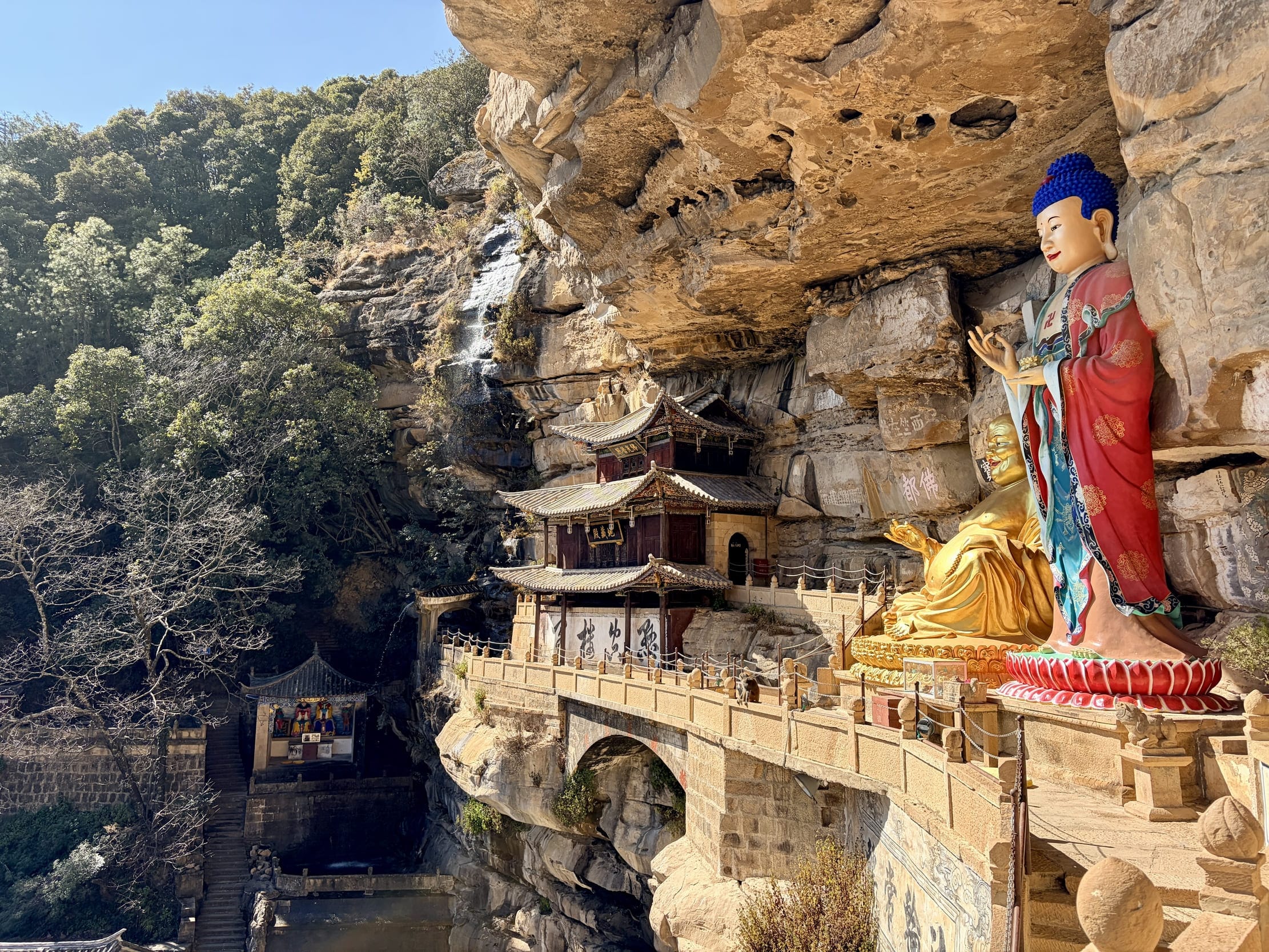
Shibaoshan is the mountain above the valley. It holds the Shizhongshan grottoes, carved under the Nanzhao and Dali kingdoms, and Baoxiang Temple, built into a cliff face. If you’re fit, walk up the old caravan trail and ride down. The prices and timetables below are from our guides’ visits in September and October 2026.
Walking Up: The Shadengqing Trail
- Start: search your map app for “沙登箐石窟林区入口” (Shadengqing grotto forest entrance), 2.5–3 km from the old town. Register your details at the gate; there’s no ticket check there, but the grotto area needs a ticket.
- Route: climb 400 m past red-sandstone cliffs to the Shizhong Temple grottoes, then take the scenic shuttle on to Baoxiang Temple.
- Distance and time: 3.5–4 km, 3 hours with stops. Leave Shaxi at 08:00 and you’re at the grottoes by 10:30.
Riding: Direct Bus and Scenic Shuttle
The Shaxi visitor centre sells a CNY 93 combined ticket: entry 45, scenic shuttle 40 and direct bus 8 return. The direct bus takes 30–40 minutes on a mountain road.
Direct bus | Departures |
|---|---|
Shaxi → Shibaoshan | 09:30, 12:00, 14:30 |
Shibaoshan → Shaxi | 11:00, 13:30, 16:00, 17:30 |
Arrive 5–10 minutes early to get a seat, and don’t miss the 17:30; nothing else runs off the mountain. The bus paused briefly in 2025, so check it’s running before you go. Up top, ride the shuttle to Shizhong first, work back to Baoxiang, and bring water.
→ Driving in from Dali or Lijiang instead? Go straight up by car and walk down; our Shibaoshan guide covers that route, the temples and the monkey rules.
10. Frequently Asked Questions
Is Shaxi Ancient Town the same as Shaxi in Taicang?
No. Shaxi Ancient Town is in Jianchuan County, Dali Prefecture, Yunnan, on the old Tea Horse Road. Taicang’s Shaxi is an unrelated Jiangnan water town near Shanghai. Search results and hotel listings mix the two up all the time, so check the province before you book.
How do I get to Shaxi from Kunming?
Go to Dali or Lijiang first; Shaxi has no train station or airport. The fastest high-speed trains take under 2 hours from Kunming to Dali and 3.5 hours to Lijiang. From there it’s 2 hours by road from Dali or 1 hour 15 minutes from Lijiang. Coming from Kunming, the smoothest plan is to arrive in Dali, stop in Shaxi on the way north and fly home from Lijiang.
Can I go from Shaxi straight to Tiger Leaping Gorge or Shangri-La?
Yes, by car, and you don’t need to go back through Lijiang. Upper Tiger Leaping Gorge is 1 hour 50 minutes from Shaxi (127 km), and Shangri-La is 2.5 hours (210 km). Without a car, take the direct bus or a shared car to Lijiang and change there. Heading north, a sensible order is Dali, Shaxi, Tiger Leaping Gorge, then Shangri-La; see our Tiger Leaping Gorge guide for the trail.
Can I visit Shaxi without speaking Chinese?
Inside Sideng, yes. The old core is small enough to walk without directions, and your phone can show menus and signs in translation. The hard parts are the bus transfer at Jianchuan, the Friday market and the Shibaoshan trail registration. A private car or a local guide removes all three.
Is Shaxi suitable for travellers with limited mobility?
Partly. Sideng’s lanes are uneven red sandstone, which is hard going for wheelchairs and walking frames. The visitor centre car park is close to the old core, though. Shibaoshan’s grottoes involve steep steps even with the shuttle.
Driving between Dali and Lijiang? Tell us your dates and we’ll fit a Shaxi Ancient Town stop, or a night, into the day. Like all our private tours, it comes with no shopping stops.