Zhoucheng Village, Dali: Tie-Dye Workshops, Village Life & Day Route
Zhoucheng Village is the largest Bai village in Yunnan, 23 km north of Dali Old Town. Bai tie-dye is still made in its family courtyards. Most visitors come to dye a scarf or a dress, then walk the banyan square and its old opera stage. Plan 2–3 hours, and pair it with Xizhou.
Pick the workshop with care, because the price mostly tells you the dye. In our experience, a dress under CNY 100 is almost always chemical-dyed, whatever the sign says, and plant indigo starts at CNY 120. TCWM has run private Yunnan tours from Kunming since 2006, and the notes below come from our own visits to the village.
Location | Xizhou Town, Dali City, on the G214 highway just north of Xizhou |
|---|---|
Entry | Free — the village and the Puzhen Tie-Dye Museum |
Time needed | 1.5–2.5 hours for a workshop, plus 30–45 minutes for the village square |
Workshop prices | CNY 20–35 for a small scarf, CNY 69–120 for a dress in most workshops |
Best time | Weekday mornings; Torch Festival night (25th day of the 6th lunar month) |
Getting there | Taxi or Didi, CNY 70–80 one way from Dali Old Town |
Table of Contents
1. Zhoucheng Village at a Glance
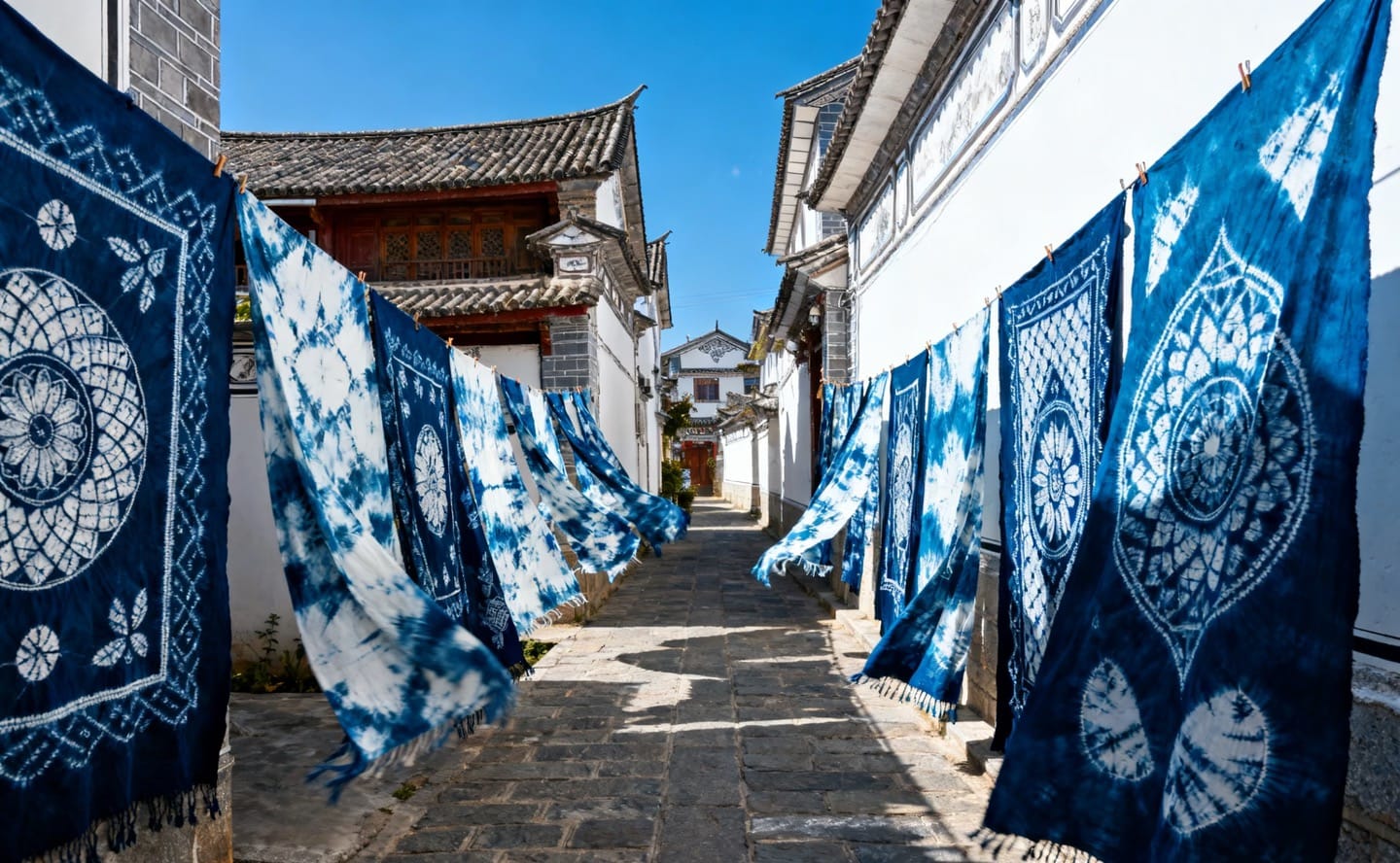
More than 10,000 people live in Zhoucheng, and 99% of them are Bai. More than 200 tie-dye businesses operate in the village, employing over 4,000 people.
China’s Ministry of Culture named Zhoucheng a “Home of Ethnic Tie-Dye Art” in 1996. In 2006, Bai tie-dye technique entered China’s first national list of intangible cultural heritage.
Is Bai tie-dye UNESCO heritage?
Bai tie-dye is NOT on UNESCO’s intangible heritage lists. The 2006 listing above is China’s own national list, not an international one.
Is Zhoucheng tie-dye batik?
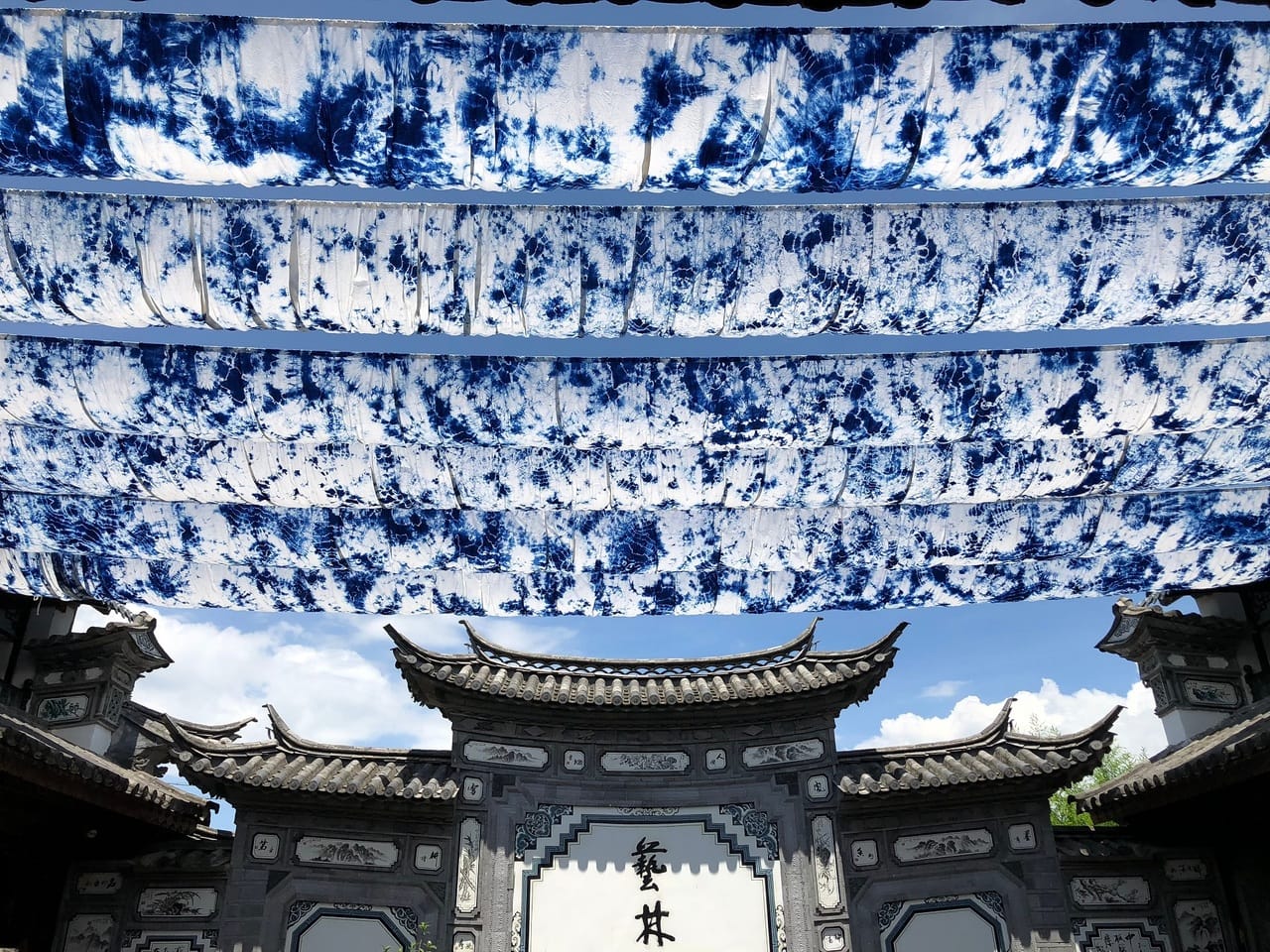
Zhoucheng tie-dye is NOT batik. Batik blocks dye with wax. Zhoucheng artisans block it with stitched thread: they sew a pattern into white cotton, pull the stitches into tight knots, and dip the cloth in indigo. Locals call the result “knot cloth” (疙瘩布).
Is Zhoucheng worth the trip?
Zhoucheng is worth the drive for the tie-dye and the village square, and not much else. It isn’t a day on its own, except on Torch Festival night (section 7). In our itineraries, Zhoucheng usually falls on the Dali-to-Lijiang travel day: Xizhou first, then Zhoucheng, then north (see section 9).
→ Planning the wider trip? Start with our Dali travel guide.
2. Which Tie-Dye Workshop Should You Choose?
Pick by what matters most to you, and remember that the price mostly tells you the dye (section 4). A family courtyard gives the best atmosphere for the money, usually with chemical dye. Dali Blue guarantees plant indigo and explains every step. The Puzhen Tie-Dye Museum has the biggest dye works and a museum on the craft’s history.
Puzhen Tie-Dye Museum | Dali Blue | Family workshops | |
|---|---|---|---|
Dress price | Up to CNY 298 | CNY 120 | CNY 69–89 |
Dye | Plant and chemical (2017) | Plant only | Usually chemical at this price |
Best for | Traditional process and history | Full explanation of the process | Atmosphere, one-on-one teaching |
Watch for | Rushed sessions when busy | Weaker sessions in peak season | Limited Mandarin, price confusion |
These are 2026 prices from our own visits, and they vary with the design and tying method.
Puzhen Tie-Dye Museum (璞真扎染博物馆): most traditional, priciest class
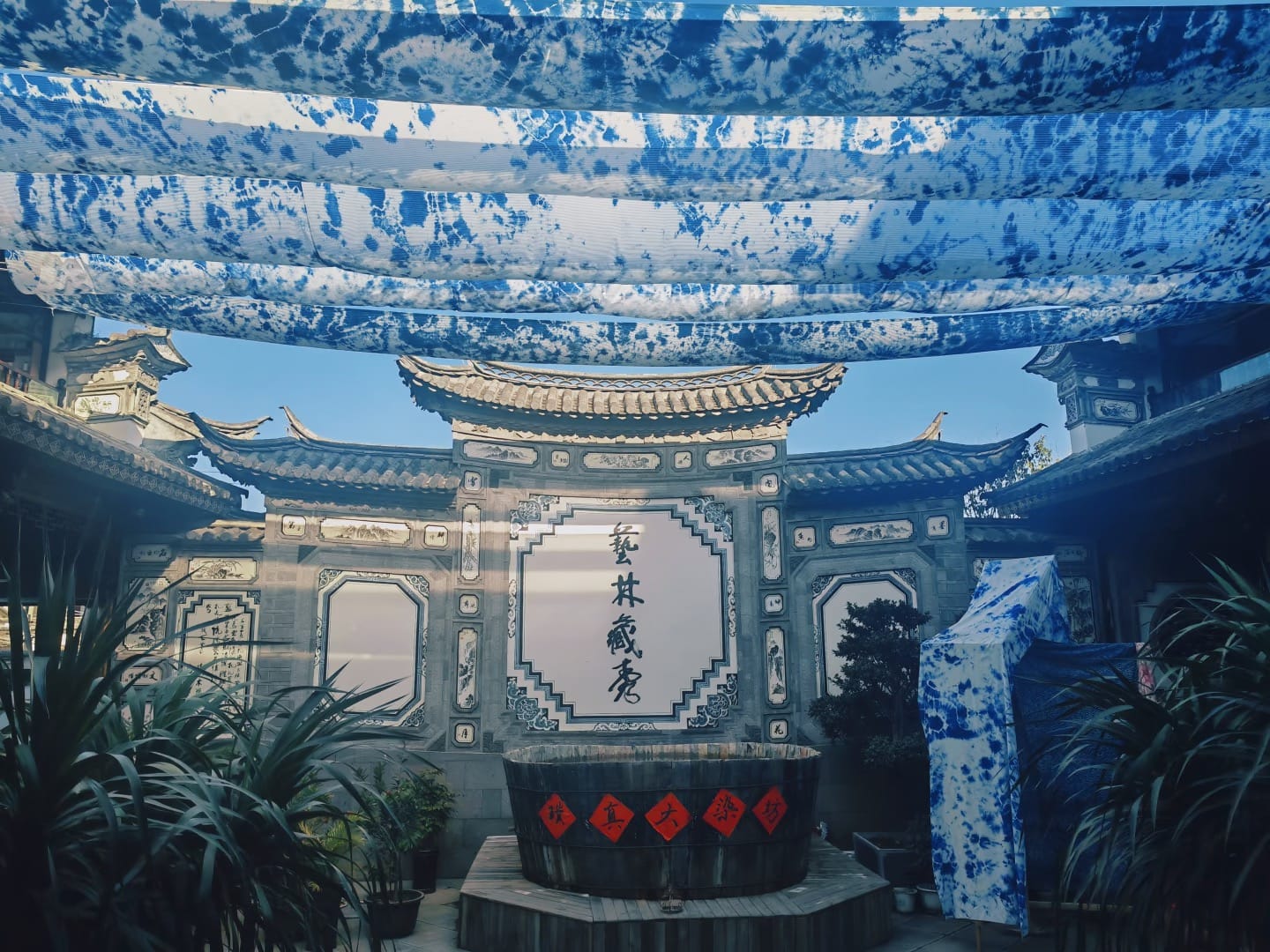
The Puzhen Tie-Dye Museum belongs to one of Zhoucheng’s largest dye houses, and entry is free. National-level tie-dye inheritor Duan Yinkai and her husband Duan Shukun built it in an old dye factory as China’s first tie-dye museum. Come here for the most traditional version of the craft. The class is the priciest in the village, and on busy days it ends in under 20 minutes. Go on a weekday morning, and ask for plant dye by name.
Dali Blue (蓝续, Lanxu): the best teaching, at a higher price
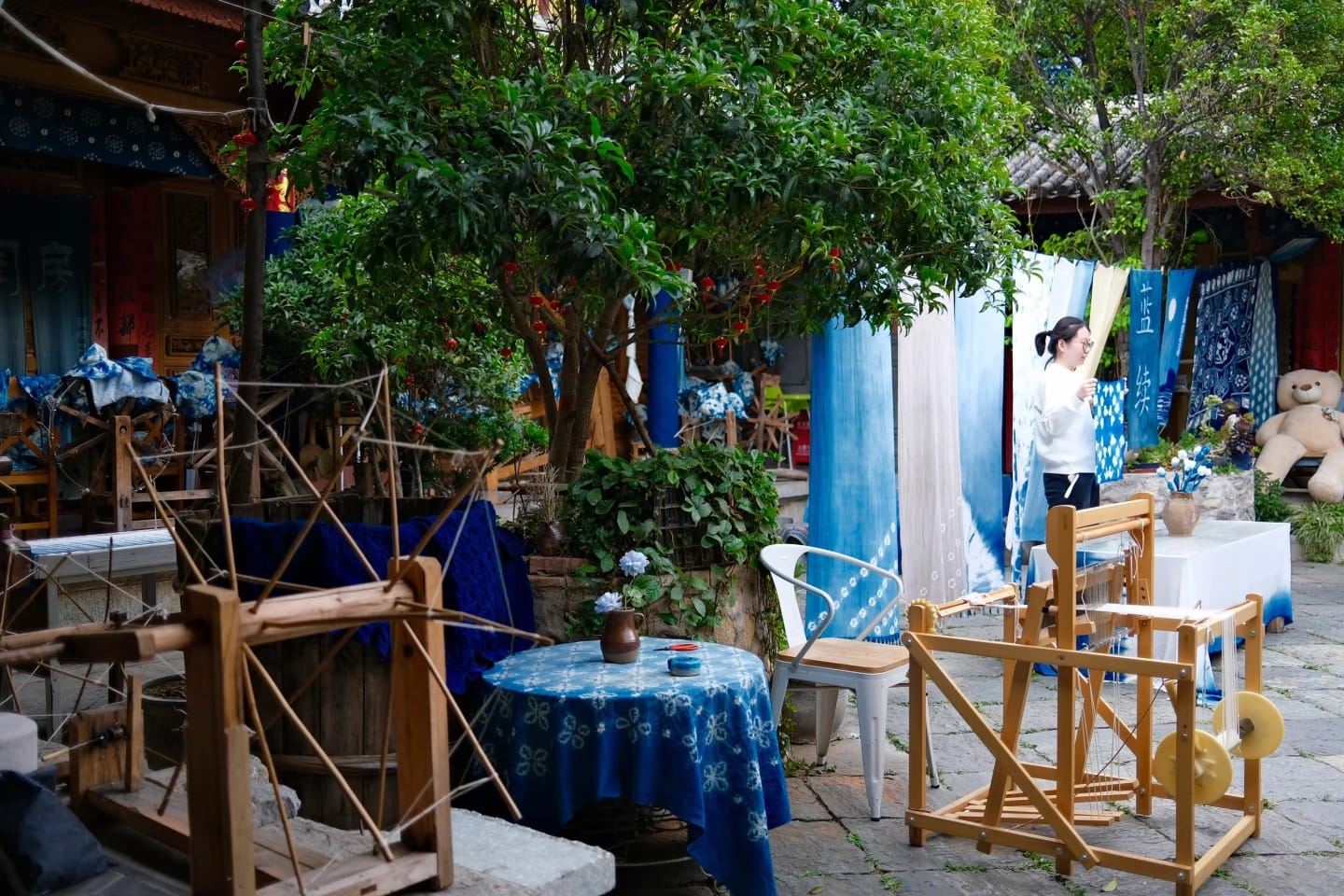
Zhoucheng native Zhang Hanmin founded Dali Blue in 2013. It works from a century-old courtyard at No. 84 Dachong Road, up the signed lane beside Puzhen. Dali Blue is the one workshop in the village with a documented plant-only record: it grows and ferments its own banlangen, as The Paper reported in 2017. Its teachers explain every step and will run a class for one or two people.
A dress costs CNY 120. In our experience, sessions are good on quiet mornings and weaker at peak times. Colors other than blue need booking through Dali Blue’s WeChat mini-program. A second branch sits beside the Xizhou rice fields.
Family workshops worth choosing
 German guest tie-dye experience at Yidianlan
 Zhoucheng Ajie’s Dyeing Table
 Zhoucheng Yirange
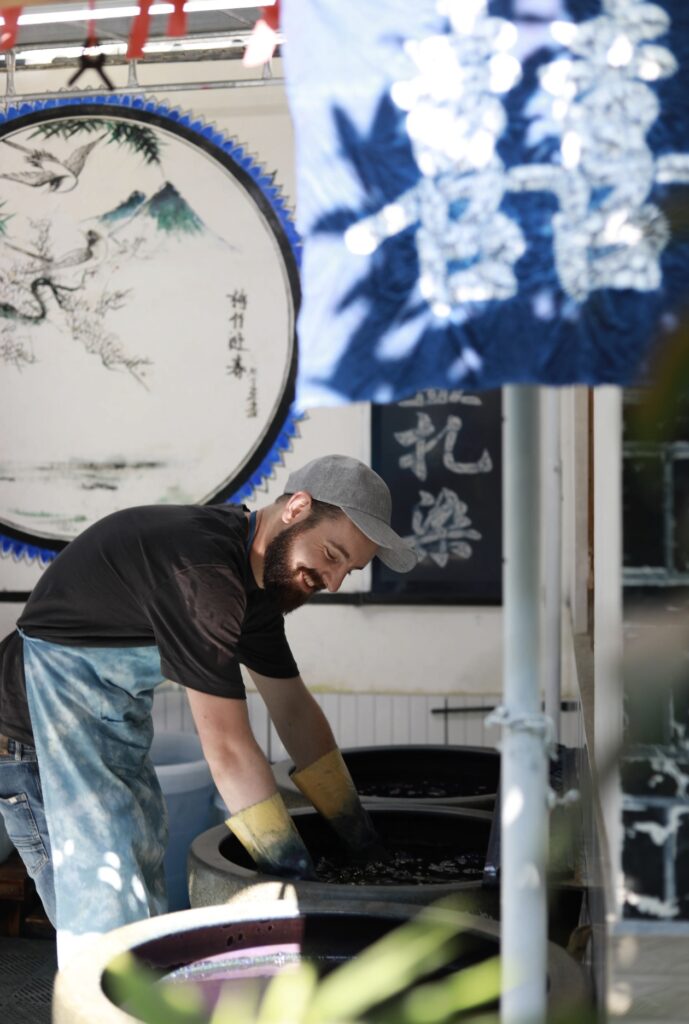
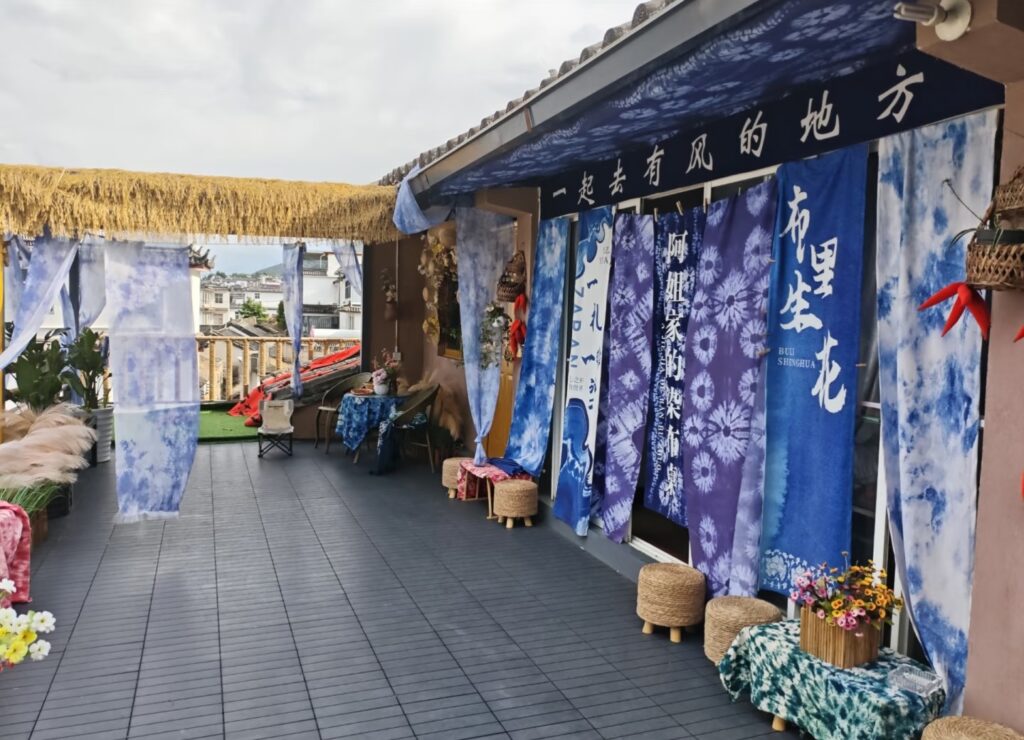
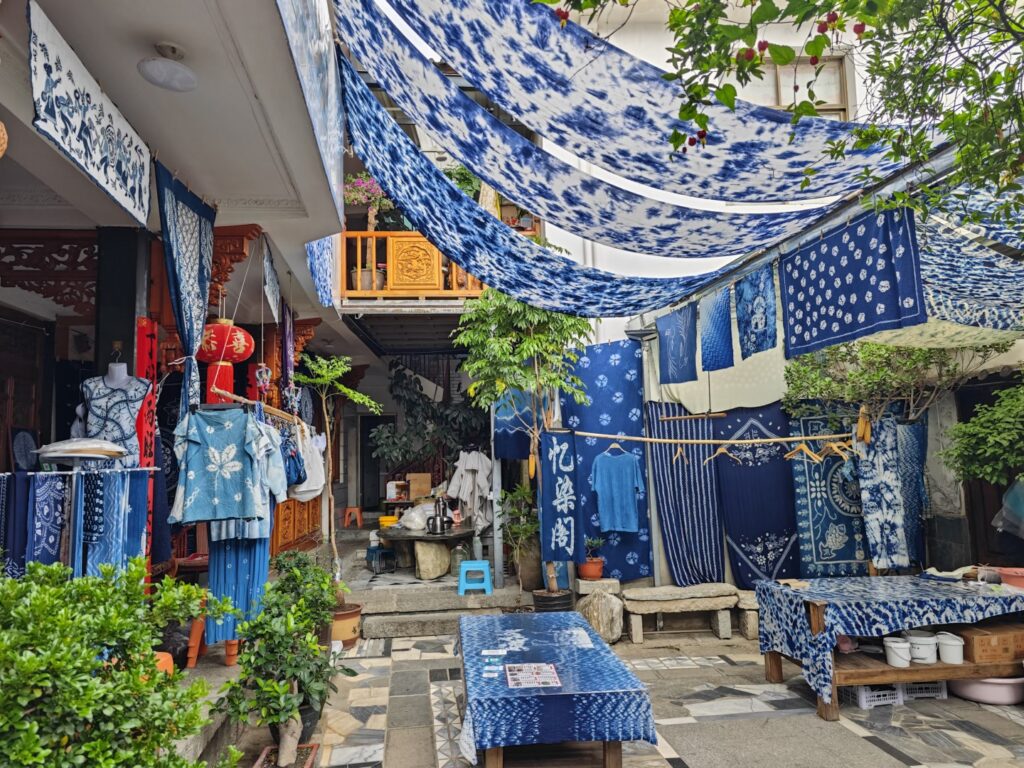
These workshops get their customers by word of mouth, not through street touts. Look around and choose for yourself. None has an English sign, so search the Chinese name in your map app.
Workshop | Best for | Good to know |
|---|---|---|
Yidianlan | Atmosphere | The most photogenic courtyard of the group, hung with blue-and-white cloth. Patient teachers let you change your design freely. Straight ahead as you enter the old village |
Sujie | Needle stitching | Teaches needle, clip and hand tying. Dress CNY 90, or CNY 160 with a headscarf. Has a fitting room. Not on map apps: search 忆染阁 and go next door. Confirm the price before you start |
Yiranage | Widest range of designs | Dresses CNY 80–140 depending on fabric, on the pricier side |
Ajie’s Dyeing Table | The view | Third- and fourth-floor views over Cangshan and Erhai. At the far end of a long lane |
Duanjialou | Value | A grandmother guides the whole session, at low prices |
Sujie’s needle-stitched pieces are the best we’ve seen from a visitor class. Yidianlan is the easiest all-round choice.
3. What Does Tie-Dye Cost in Zhoucheng?
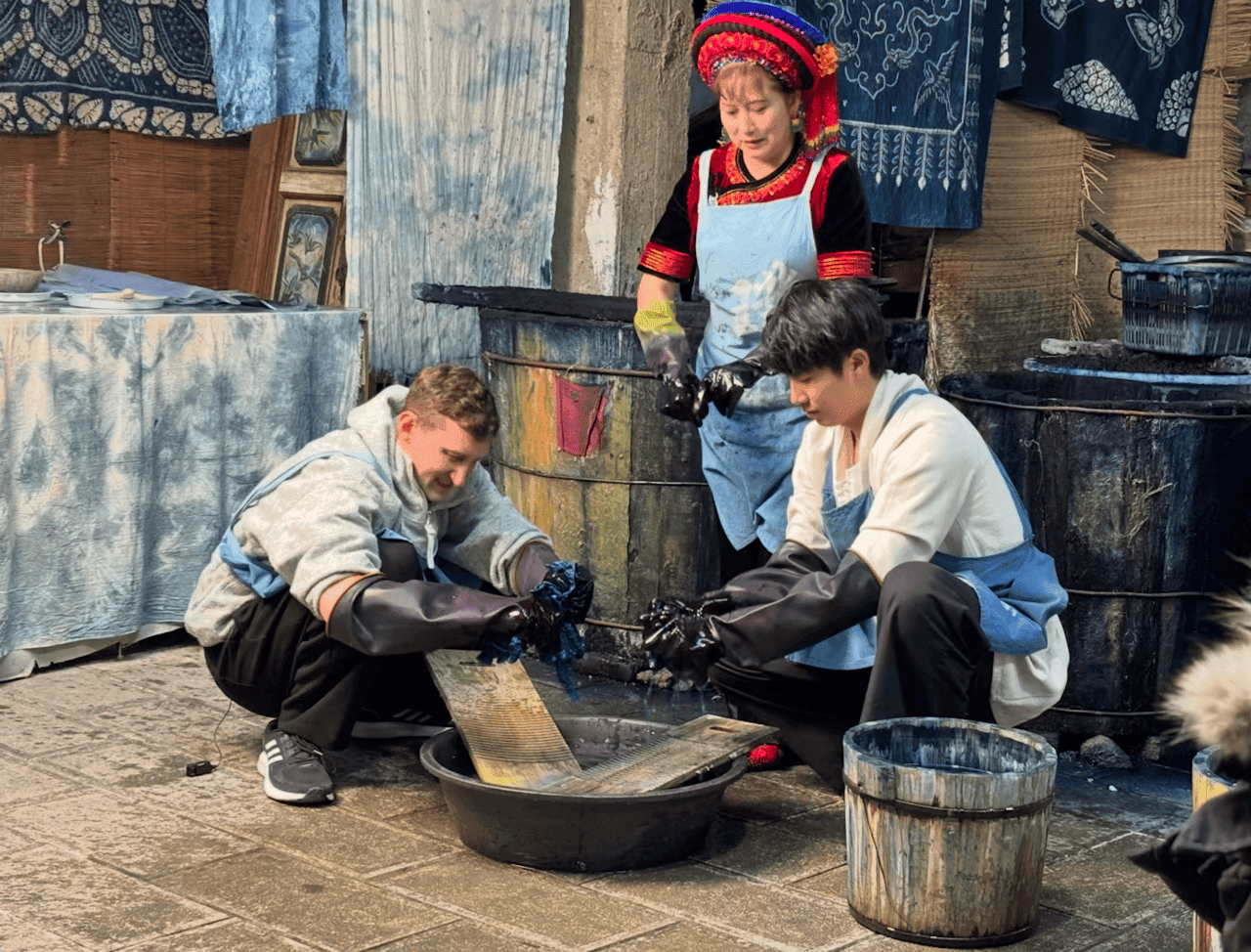
In a family workshop, expect CNY 20–35 for a small scarf and CNY 69–120 for a dress, with cloth, dye and teaching included. At the bottom of each range, the dye is chemical. These are 2026 prices from our own visits.
Item | Price (CNY) |
|---|---|
Hair scrunchie | 10 |
Small square scarf | 20–35 |
Canvas tote bag | 35–60 |
Dress | 69–120 |
T-shirt | 70–100 |
Your own garment (labor only) | 30–40 per piece |
The price follows the dye: under CNY 100, a dress is usually chemical-dyed
Hands-on prices from our own visits, in CNY. Bars show the top of each range. 🌿 Green: plant-only dye. Confirm your price before you start.
4. Plant Indigo or Chemical Dye?
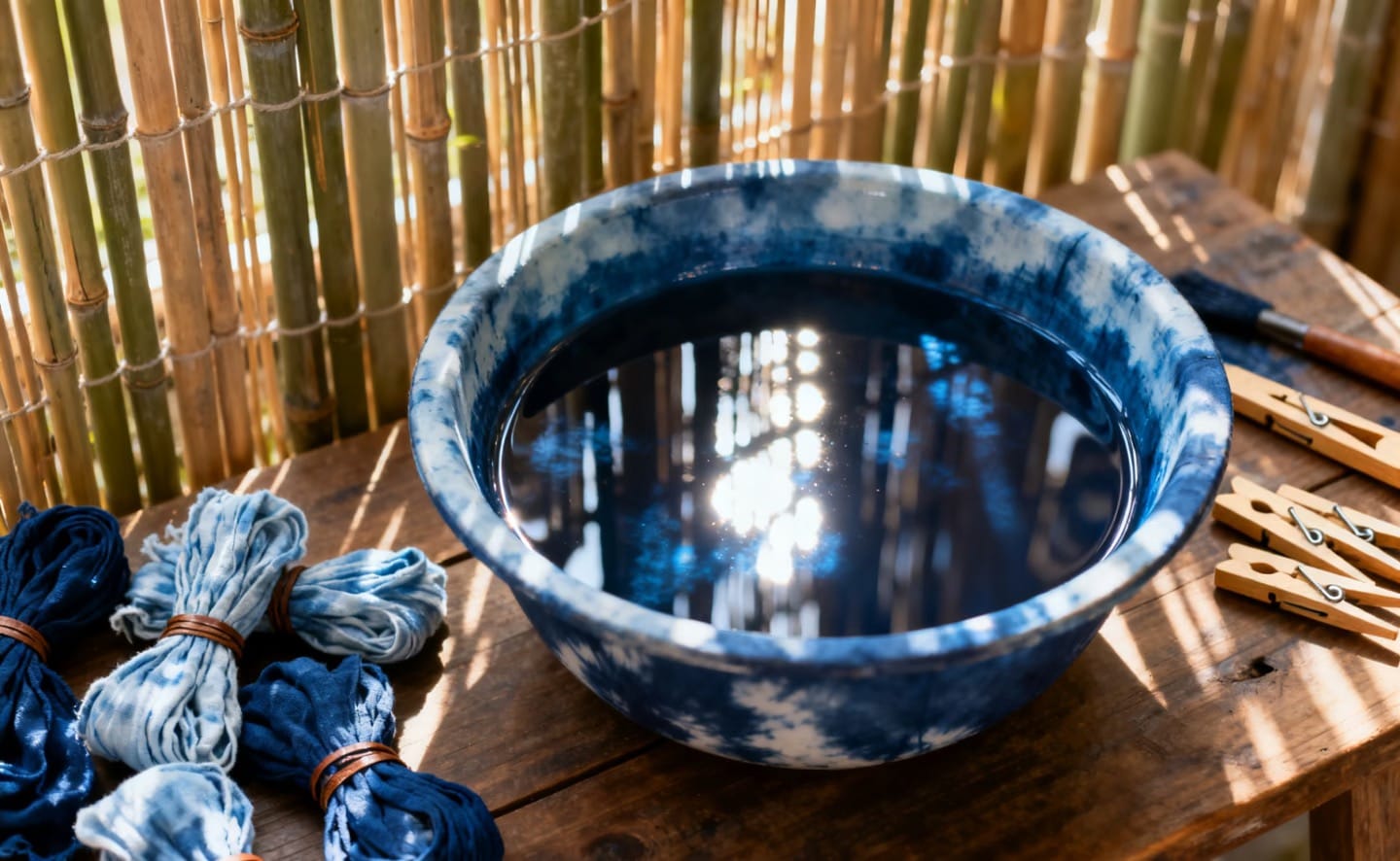
Zhoucheng tie-dye is NOT all plant-dyed, whatever the sign says. In our experience, most small workshops use chemical dye. The reason is cost. Duan Shukun told The Paper that 1 kg of chemical dye colors 500 kg of cloth. The same cloth needs 10 kg of banlangen paste, at twice the price per kilo. That’s a 20-fold cost gap. Banlangen also takes weeks to ferment and dyes only blue.
Chemical dye isn’t a scam in itself. Dali Prefecture’s heritage center director told the same reporters it’s an acceptable substitute when the hand process stays intact. Paying plant-dye prices for it is the problem, and so is wearing it against sensitive skin.
How to check before you pay
- Ask by name. “Bǎnlángēn háishì huàgōng?” (板蓝根还是化工?) means “banlangen or chemical?” Some owners answer honestly when asked directly.
- Look in the vat. A plant-dye vat has the fermented leaves and stems in it, and a plant-dye workshop is glad to show you.
- Check the price. Plant indigo costs more to make. A dress under CNY 100 is almost certainly chemical-dyed.
- Check the fabric. Plant dye takes properly only on cotton and linen, Duan Shukun said. A silk or polyester piece in deep blue points to chemical dye.
- Smell it. Plant indigo smells earthy and grassy. Chemical dye smells sharp, like solvent.
Color alone doesn’t tell you. Duan Shukun at Puzhen dyes yellows and reds from gardenia, saffron and sappan wood, all plant sources.
5. How a Tie-Dye Session Works
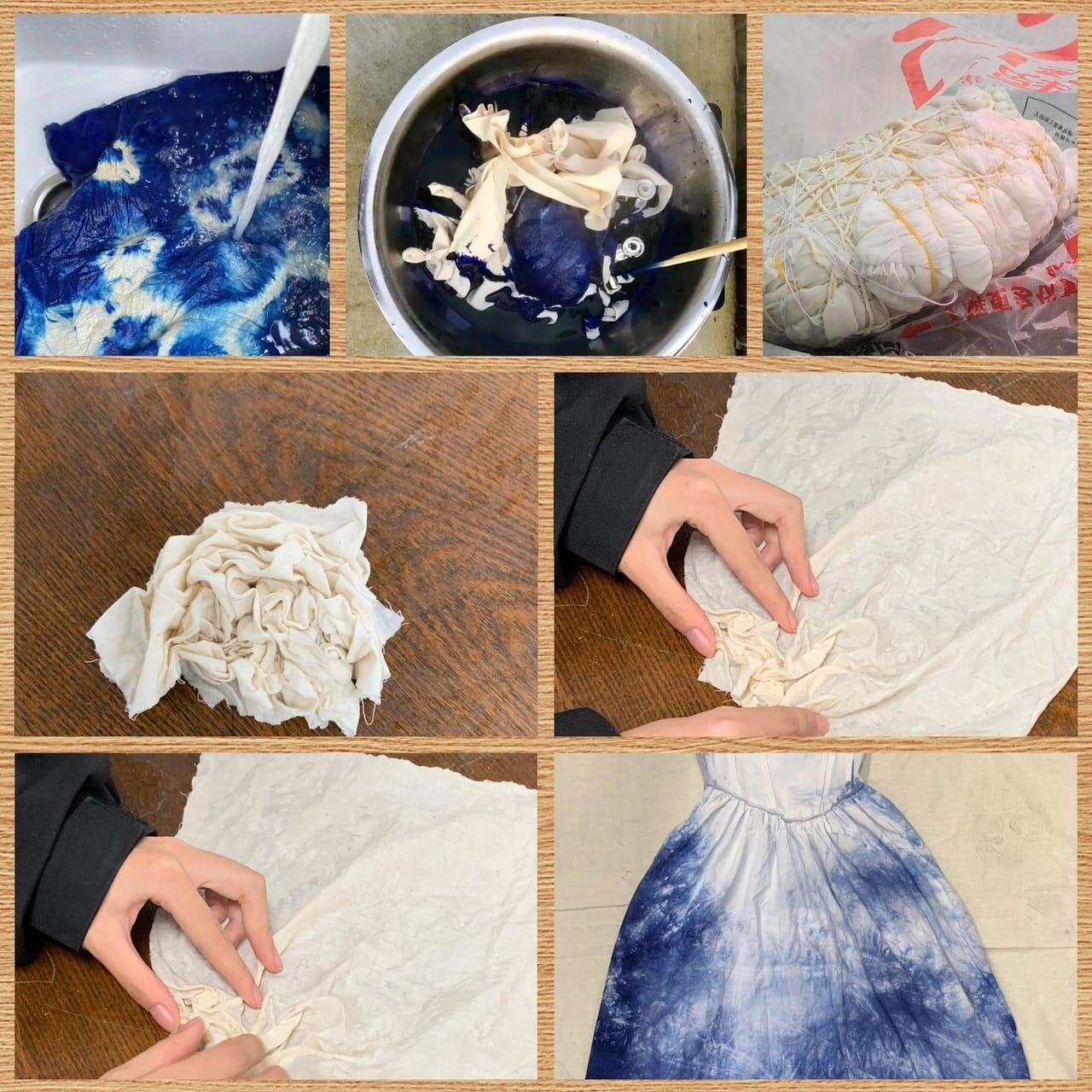
Traditional Bai tie-dye runs through eight stages, from drawing the pattern to pressing the finished cloth. A visitor session covers the middle of that process. The dye house prepares the cloth before you arrive and finishes it after you leave.
✋ You do this in a session🏠 The dye house does this
The pattern is printed onto plain white cotton or cotton-linen.
Needle and thread gather the pattern into tight knots. Tighter knots give cleaner white lines.
The knotted cloth is soaked in clean water so the dye takes evenly.
Repeated dips in the indigo vat. Each dip makes the blue one shade deeper.
The cloth is hung in the courtyard, knots still in.
Cutting the threads reveals the white pattern. Cut carefully: a torn cloth is ruined.
Loose dye is washed out. Watch that your piece isn’t dropped in a dark vat.
Stock cloth is pressed flat under a stone roller. Visitor pieces usually skip this.
Stages: Yunnan Intangible Cultural Heritage Network. Which steps visitors do varies by workshop; family workshops often let you rinse too.
Stitching is the skill. The tighter you pull the knots, the cleaner the white pattern. It’s also why your piece is small. A 1.65 × 2 m tablecloth takes a Zhoucheng woman 1–2 weeks to stitch and more than a month to dye. A scarf in a class takes an hour or two.
Ask to see the pattern book before you choose a design. Bai tie-dye once had more than 2,000 patterns, but at one point the market had shrunk to 17 designs that sold well. The shops repeating the same butterfly on every item are working from that short list.
Needle, clip or hand tying?
Needle stitching gives the finest patterns, the butterflies and flowers you see in the museum, and it’s slow. Not every workshop offers it, so ask when you walk in. Clip tying makes clean geometric shapes and suits children and anyone with long nails. Hand tying, with string or rubber bands, is the fastest and gives the loosest, most random result.
Choosing the fabric
Pick 100% cotton. It shrinks slightly, so take one size up. Check white dresses against the light before you commit, because some styles are see-through once worn.
What to wear and carry
Wear dark clothes, because indigo splashes and doesn’t wash out. Your piece leaves the vat wet and heavy, so bring a plastic bag. Cloth dries slowest in the June–July rains, as our Dali weather guide notes. Ask the workshop to wring it well if you’re moving on that day.
Aftercare: why plant-dyed cloth fades
Plant indigo bleeds in the first few washes. That’s normal, not a defect, and an owner who promises it won’t fade isn’t telling you the truth. Before the first wear, soak the piece in salt water for 10 minutes to set the color. After that, wash it alone in cold water and dry it in the shade.
6. Traps to Avoid in Zhoucheng
Touts on the main road
This is the most common complaint. Women on the main road call out or take your arm and lead you to specific shops. Prices there move once you’ve started. A scarf quoted at CNY 35 can climb to CNY 48 halfway through. Decline politely and keep walking. Reporters who visited repeatedly found that the women simply walk away when refused.
Shops your driver recommends
Skip any workshop a Didi or taxi driver suggests. Drivers earn a commission on these shops, the same trick behind the hidden shopping stops on China group tours. At one, dresses were priced at CNY 300–400, while the same designs sold for a few dozen yuan down the lane.
Prices that rise mid-session
The pattern is common: a low starting price, then a surcharge once you’ve chosen a design, for “better cloth” or a “harder pattern”. In one case, a scarf quoted at CNY 20 became CNY 80 once a cartoon design was chosen. Confirm the final price after you’ve picked the pattern, and before anyone starts stitching.
The first shop you see
The workshops nearest the village entrance are usually the most expensive. Walk the lanes on your own, look at three to five shops, and compare price, the vats, and how the owner treats you. A good online rating is no guarantee either. Some well-rated shops give rushed sessions, while unmarked courtyards nearby often have more designs at lower prices.
Bringing your own clothes
Workshops charge CNY 30–40 per garment for labor only. Your garment earns the shop little, and some owners show it. Expect a cooler welcome, and check the rinse: white areas on your own clothes can come back stained, with no refund. If you bring clothes, agree the price and the process first.
The final rinse
Finished pieces need a rinse to wash out loose dye. Stay and watch it. Don’t let staff drop your piece into a dark-blue vat with other cloth. It picks up color where it should stay white.
The language gap
Price disputes in Zhoucheng have two causes. Some are genuine misunderstandings, since many owners are older Bai women whose Mandarin is limited, and almost none speak English. Others are deliberate surcharges, as above. Agree the price for the specific item and method before any cloth is cut. Type the number into your phone calculator and show it.
A Mandarin-speaking guide removes the problem. TCWM’s private tours include no shopping stops, hidden or otherwise. You choose the workshop; our guides translate the price and the stitching instructions as the owner teaches. → See our private tour guide hiring options.
Keep your expectations realistic, too. A first-timer’s stitching won’t match a Zhoucheng grandmother’s. Treat the piece as a souvenir, not a showpiece.
7. Village Life and the Torch Festival
The village square and temples
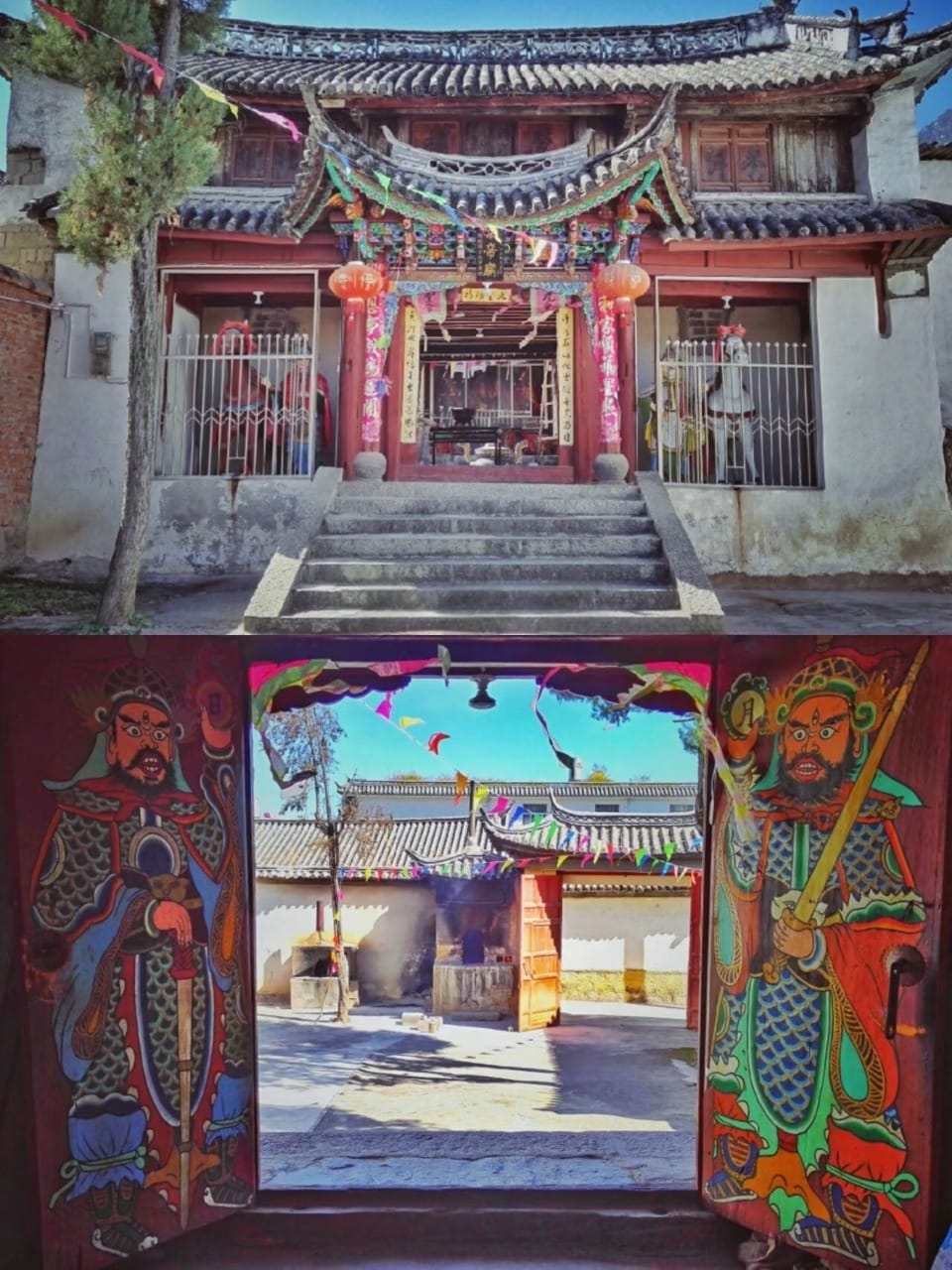
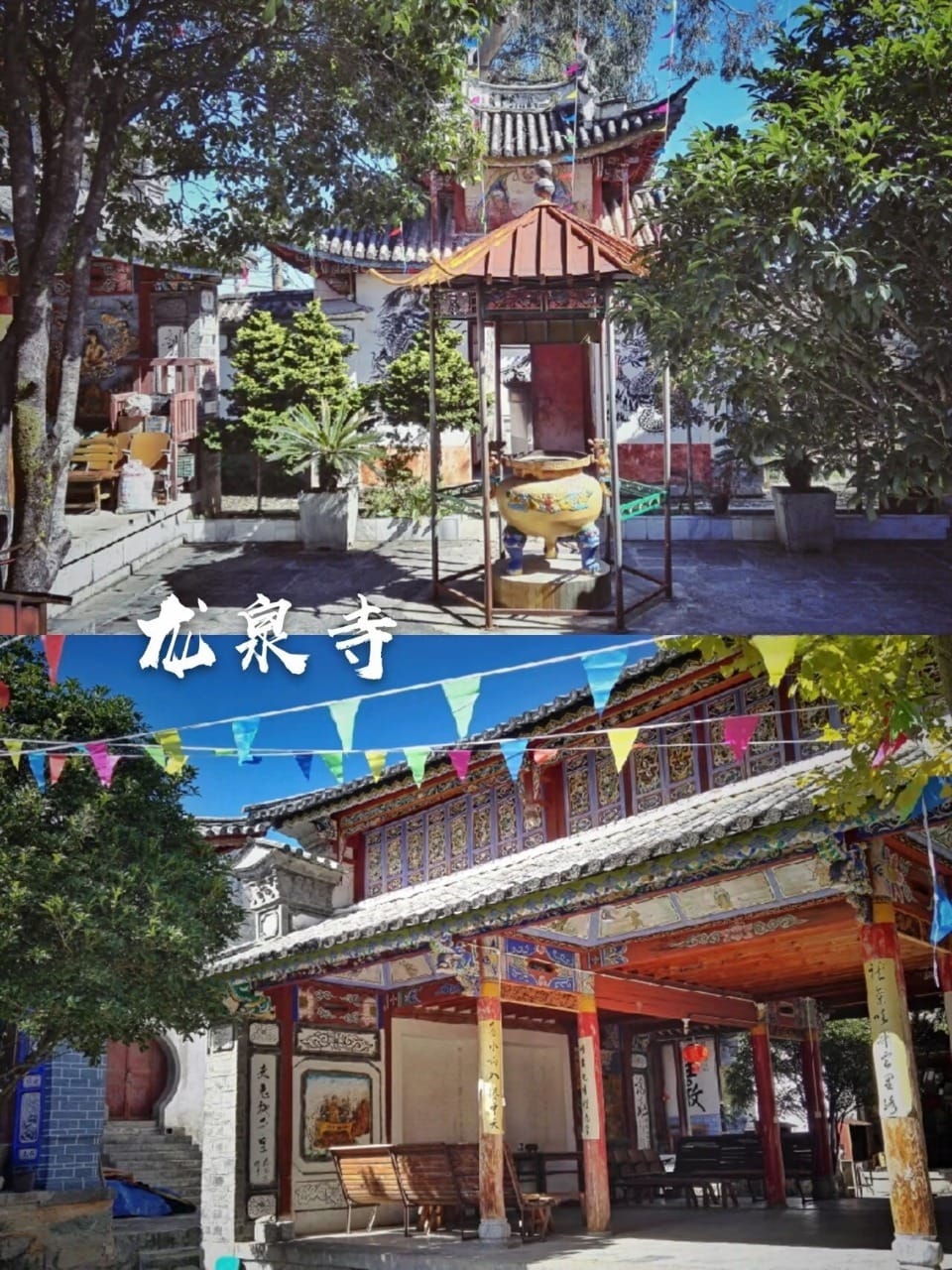
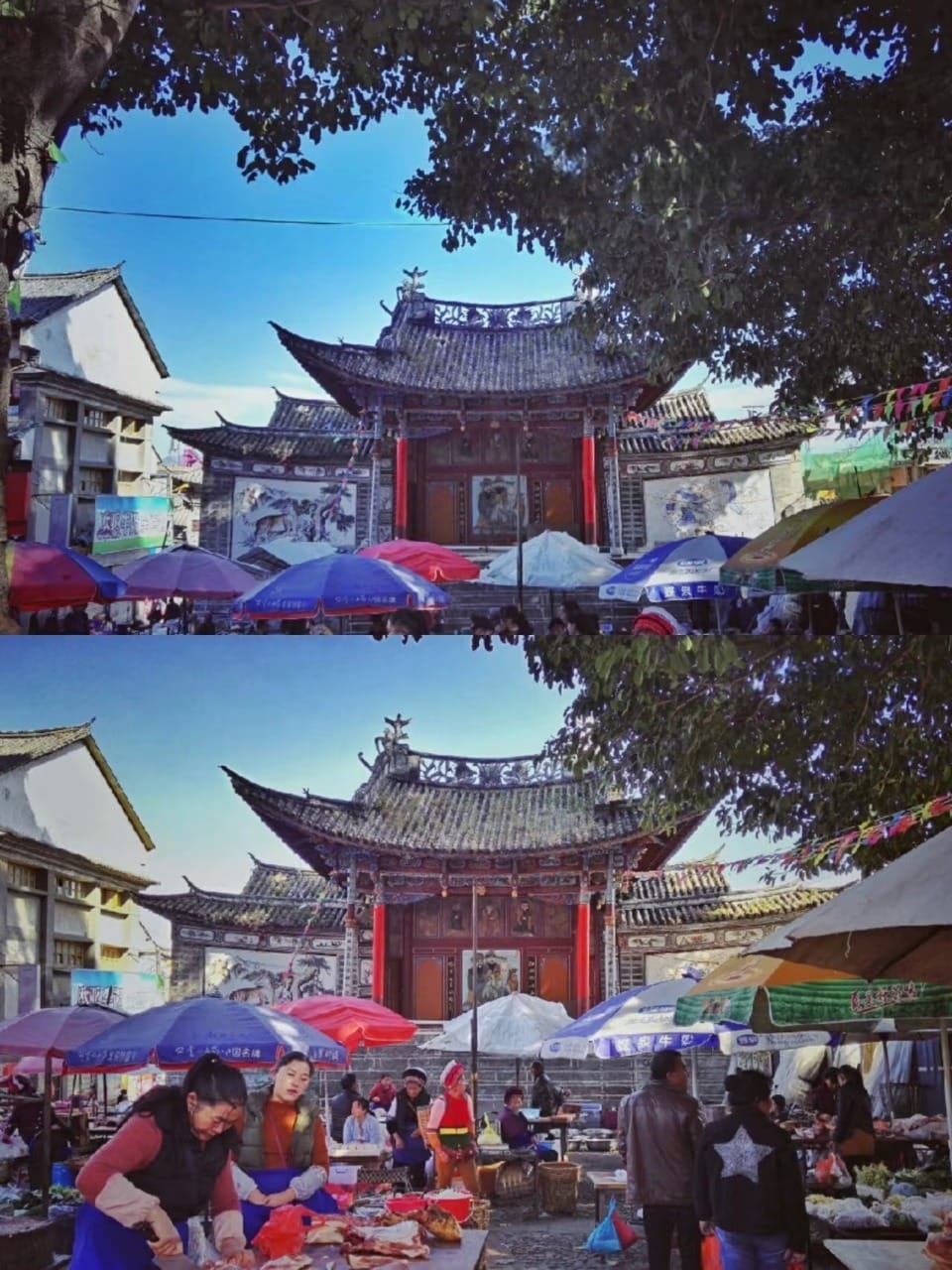
Outside the workshops, Zhoucheng has a village square, old lanes and its temples, and they take 30–45 minutes. The center of the village is a small square under two huge banyan trees (大青树). It faces an old opera stage that Dali City protects as a cultural relic. The square is the village market on ordinary days and the stage for festivals.
Stone lanes run off the square, with mountain water running along the walls. The houses follow the Bai courtyard plan, with a white screen wall facing the main hall. Most Zhoucheng Bai are Buddhist and worship at Yinxiang and Longquan temples. The village also keeps two temples to its benzhu, the local patron gods. Lingdi Temple honors Du Chaoxuan, the hero who killed the python at Butterfly Spring.
The Torch Festival: how the day runs
 Torch Festival at Zhoucheng, 8 Aug 2026
 Torch Festival at Zhoucheng, 8 Aug 2026
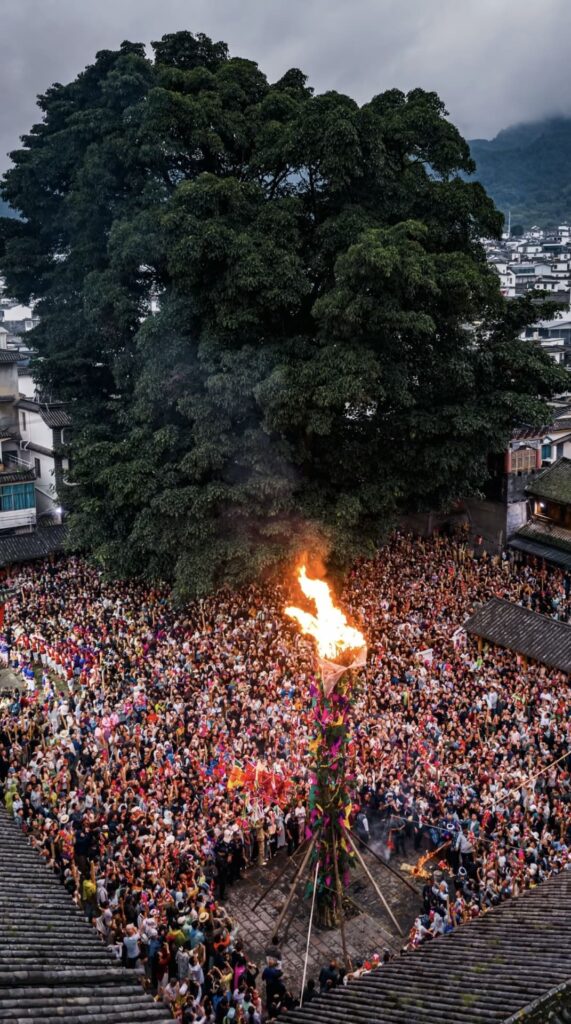
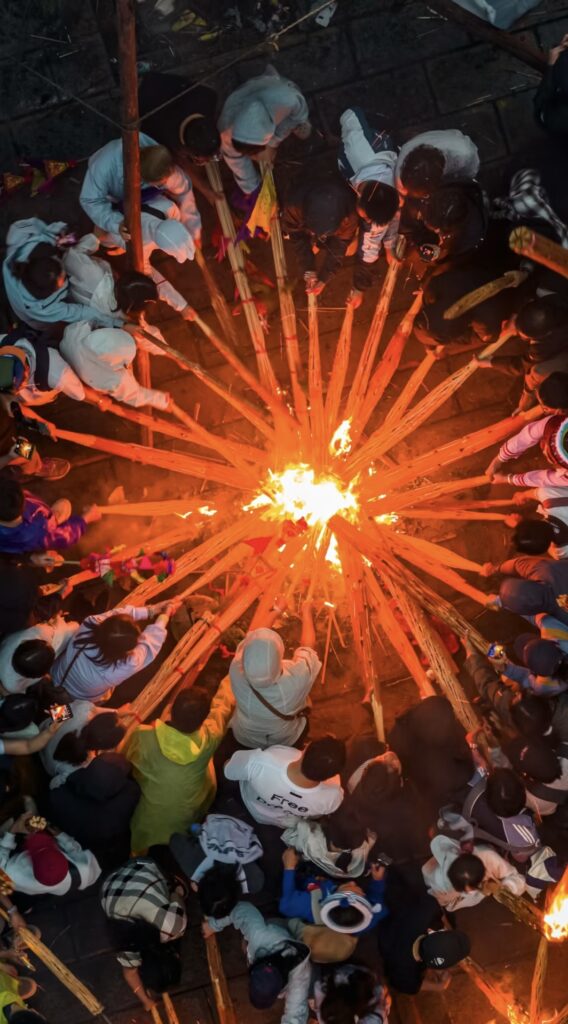
Zhoucheng’s Torch Festival falls on the 25th day of the sixth lunar month, between late July and mid-August. Of the Torch Festivals around Dali, it’s the one we rate as the least staged. Each village team builds its own giant torch, bound in layers of pine, wheat straw and bamboo and hung with flags, apples and crabapples. A wooden grain measure (升斗) sits on top, and the finished torch stands more than 10 m tall. Each one needs more than 100 people to raise. China Daily counted 11 in 2023, and there were 11 again in 2026. This is the schedule we’ve seen on our visits:
Time | What happens |
|---|---|
15:00 | Coming-of-age ceremony for 18-year-olds in Bai dress, in front of the opera stage |
17:00–18:00 | Teams raise their torches around the village |
19:30 | The village’s top gaokao student carries the flame to the torch, and it goes up in seconds |
19:30–21:30 | Small torches, bawangbian (霸王鞭) dancing, sanxian music, and rosin thrown into the flames for bursts of sparks |
After 21:30 | The fires burn down and people head home |
The day starts in mid-afternoon, hours before the lighting. An American client who came just to see the blaze told us afterward that the festival had already begun hours before anyone lit a torch. Clients remember the dancing most. Strangers link arms in circles around the fire, and a Brazilian client called it the happiest festival they’d ever been to.
Plan for the crowd. By 19:00 the square is packed, sparks fly in every direction, and people carry lit torches through the crowd. On one visit, we took our group out early for that reason. The lighting also comes late, so expect sore legs from standing, sparks in your hair and smoke in your clothes. With children, watch from the edge and leave before the dancing peaks.
Torch Festival tips
Our advice | |
|---|---|
Arrival | By 17:00 if driving; parking fills and the roads jam. An e-bike is easier |
Clothes | Long sleeves, long trousers, sneakers. No synthetics, no white |
Hair | Tie it back and wear a hat; sparks and rosin powder land on everyone |
Cost | Small torches CNY 10–20; rosin a few yuan a bag |
Rosin | Throw it into the fire from upwind, never toward faces |
After | Taxis are scarce. Stay the night in Zhoucheng or Xizhou, not Dali Old Town |
Zhoucheng has no face-blackening custom, unlike some Torch Festival celebrations elsewhere. Keep your phone and bag close in the crowd, but the mood is friendly.
8. How to Get to Zhoucheng
Taxi or Didi is the simplest way from Dali Old Town. Minibuses cost a tenth of the taxi fare but are slower. Fares below are 2026 prices.
At the north end of Erhai Lake’s west shore, on the G214 highway between Dali Old Town and Lijiang
Schematic, not to scale. Blue: other stops covered in this guide.
Taxi or Didi. CNY 70–80 one way from Dali Old Town. Get a Didi quote before you take a street taxi.
Minibus. Eryuan-bound minibuses leave from the Sanyuejie (三月街) area west of Dali Old Town and stop at Zhoucheng for CNY 7–8. Tell the driver “Zhōuchéng” and get off at the village market.
Self-drive. The Puzhen Tie-Dye Museum car park charges CNY 10 per entry and is a 5-minute walk from the workshops. For free parking, search “喜洲镇中心幼儿园东门” (east gate of Xizhou Town Central Kindergarten); it’s a 2-minute walk to Puzhen.
Private car. Our charter car service covers the whole west-shore day, with pickup at your hotel. Contact us for a quote.
Don’t make a special trip from the east shore. Driving over from Shuanglang on the expressway costs more than CNY 100 in fuel and tolls. That’s poor value for a morning in the village. Zhoucheng suits travelers based on the west shore or already heading to Xizhou.
9. Pairing Zhoucheng With Nearby Stops
Zhoucheng sits at the north end of the Erhai west-shore road, on the G214 highway toward Lijiang. Which way you’re heading next decides the route.
Heading on to Lijiang: our standard routing
In our itineraries, Xizhou and Zhoucheng usually share the Dali-to-Lijiang travel day. We stop at Xizhou first, then Zhoucheng, then drive north. Zhoucheng is 6 km north of Xizhou on the same road, so neither stop costs a detour. The tie-dye session also breaks up the drive.
Returning to Dali Old Town: a west-shore loop
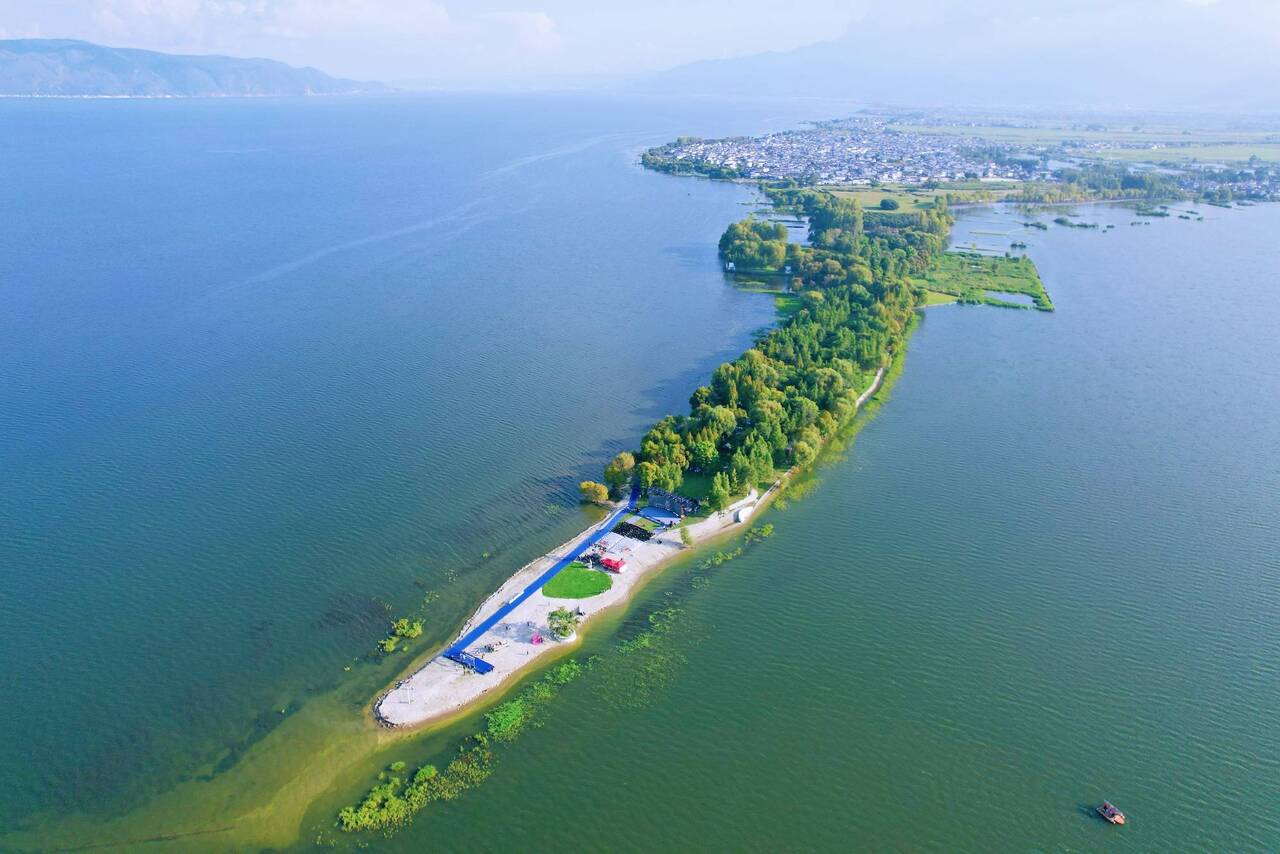
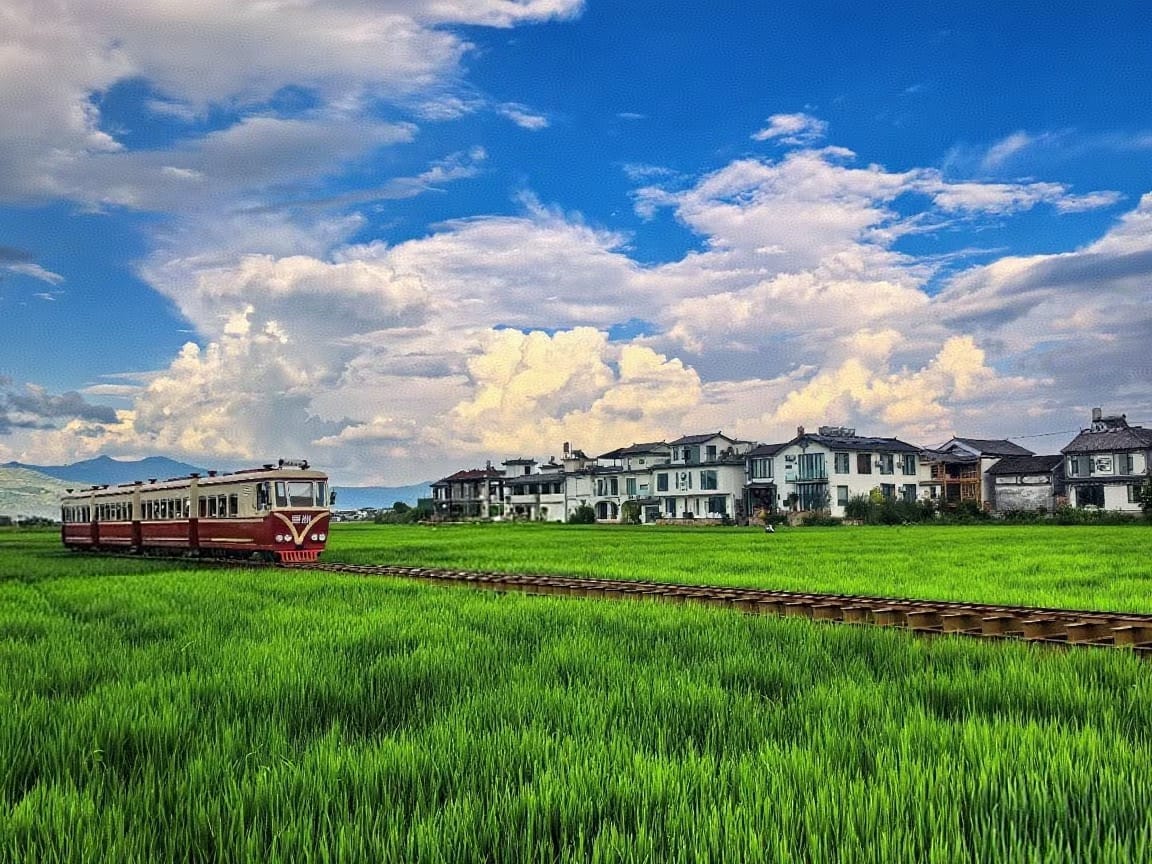
Visitors often suggest Zhoucheng → Langqiao → Haishe → Xizhou, but that order doubles back twice. Starting at the north end and working south avoids it:
- Zhoucheng, morning. Walk through the Puzhen Tie-Dye Museum courtyard, then spend 1.5–2.5 hours in a family workshop.
- Lunch in Zhoucheng. Bai stir-fry at the small restaurants near the village market.
- Haishe Park, early afternoon. A peninsula surrounded on three sides by Erhai Lake. Free entry requires booking through the “爱在海舌蜜月半岛” WeChat mini-program, which releases the next day’s slots at 18:00. They go fast in peak season. No booking? The lakeshore by the “Couple Trees” outside the park is still worth the stop.
- Xizhou, late afternoon. The old town’s heat has eased by now, and the snack stalls are busy.
- Langqiao, sunset. An old stone irrigation channel of arches running out into Erhai at Xiangyangxi Village, Wanqiao Town, south of Xizhou. The arches frame the lake, and a lone tree nearby is the other photo stop. The light is softest from 17:00 to 19:00. The stones under the arches are mossy, so wear shoes with grip.
Start at the village, work south along Erhai’s west shore, and finish near Dali Old Town at sunset
Free. See the old dye vats and pattern boards.
Compare 3–5 shops first. Agree the price, then start.
Bai stir-fry near the village market.
Book at 18:00 the evening before. No slot? Stop at the Couple Trees outside.
Bai mansions and snack stalls once the heat eases.
Stone arches into Erhai at sunset. Wear shoes with grip.
Worth a separate trip, or skip
Shuanglang. The largest town on Erhai’s east shore, with better lake views than the west and a good sunset. It needs its own half-day; see our Nanzhao Customs Island page for the Shuanglang side of the lake.
Butterfly Spring and Tianlong Cave. Both sit just north of Zhoucheng, and we don’t recommend either. Wild butterflies are now rare at the spring, and Tianlong Cave is heavily commercialized. Stop only if you’re driving past anyway.
Dali Old Town. Your likely base. Our Dali Ancient Town guide covers what’s worth seeing inside the walls.
10. Frequently Asked Questions
Is Zhoucheng the only place that still makes Bai tie-dye?
No. Bai tie-dye is also still practiced in Dacang and Miaojie in Weishan County, south of Dali. Zhoucheng is the best known and has the most workshops open to visitors. For a hands-on class, Zhoucheng is the practical choice.
Is Zhoucheng or Xizhou better to visit?
They offer different things. Xizhou has the better-preserved Bai mansions, the rice-field views and the food. Zhoucheng has the tie-dye workshops and a working village square. Do both on the same day, Xizhou first, since Zhoucheng lies 6 km north of it on the same road.
Is tie-dye in Zhoucheng good for kids?
Yes, and children are a large share of the customers. Dali Blue built its early business on parent-and-child classes, and Puzhen’s teaching area mostly served children when reporters visited. A small scarf keeps the session short enough to hold their attention.
How is Bai tie-dye different from Western tie-dye?
Western tie-dye twists the cloth and binds it with rubber bands, so every piece comes out as a loose, multicolor swirl. Bai tie-dye starts from a drawn pattern, which is stitched into the cloth before dyeing. The same butterfly or flower can repeat across a whole tablecloth. The color is traditionally a single indigo blue. Because every motif is stitched by hand, a Bai piece takes hours rather than minutes.
Can I buy tie-dye in Zhoucheng without doing a workshop?
Yes. Shops along the main road and in the lanes sell scarves, bags, tablecloths and clothing. Quality varies house to house, and finely stitched large pieces cost several hundred yuan. Ask whether a piece is plant-dyed, and check the fabric, before you buy.
Want Zhoucheng, Xizhou and the Erhai west shore on one day with a guide who translates at the workshop? Contact TCWM and we’ll plan it around your dates.