Dali Old Town: Tickets, Layout & What to Skip
Dali Old Town is free to enter, with no ticket needed at any of its four gates. But only part of what’s inside is worth your time. Much of it is rebuilt shopfront selling the same marble carvings and tie-dye scarves you’ll see in every old town from here to Lijiang. We’ve walked groups through Dali since 2006, and this guide covers where that experience actually points you: a walking route past the genuine wall sections and residential lanes. It also covers where to eat, where to stay, and the specific scams to watch for.
Entry | Free — old town itself has no ticket, and nothing inside it charges either |
|---|---|
Opening hours | 24 hours (individual sites like Jiang Gong Ci keep their own daytime hours) |
Recommended time | 3–4 hours (half day with a wall section and a real meal) |
Best time of year | March–May or September–November |
Best base for a stay | Inside or just outside the walls, not Xiaguan |
From Dali Airport | Taxi ~45 min, CNY 80–120; airport shuttle CNY 25–30 |
Table of Contents
1. What Is Dali Old Town, and Is It Worth Visiting?

A Brief History
Dali Old Town (大理古城), sometimes called Dali Ancient City, sits at 1,978 meters elevation. It’s wedged between the Cangshan mountains to the west and Erhai Lake to the east. That location made it the capital of the Nanzhao Kingdom in the 8th century. It remained the capital of the Dali Kingdom through the 13th. It held that position for roughly 500 years before the region came under Ming control. The current walls date to 1382, early Ming dynasty, and originally enclosed a 7.2 km perimeter.
Most of what stands today isn’t that old. A magnitude-7 earthquake in 1925 destroyed much of the historic core. The city was rebuilt again through the 1990s and 2000s as tourism took off. The “old” grey-tile buildings lining Fuxing Road and Renmin Road are recent construction made to look old. These are the two streets most visitors see.
Is It Worth Visiting?
If you arrive expecting a preserved Ming city and only walk Fuxing Road and Renmin Road, you’ll be disappointed. That’s a rebuilt shopping street, no different from a dozen other old towns across China. We’ve walked groups through Dali since 2006, and the guests who leave unimpressed are almost always the ones who never got past those two streets.
A few minutes’ walk from that commercial core, there’s more worth seeing: original wall sections, quiet residential lanes, a rooftop viewpoint, an overlooked church, an arts district, and a free heritage museum. All of it is covered stop by stop in the walking route below. Working that full route, rather than just the main streets, is the only way to know what Dali is actually like.
Most visitors find a day trip enough to hit the highlights. But staying at least one night is what repeat visitors tend to recommend — the atmosphere changes once the day-tour buses leave. Either way, we tell clients not to schedule the old town too tightly. It works better with some unstructured time built in, especially if the same day also includes Xizhou, Shuanglang, or Cangshan.
Do You Need a Ticket?
The old town itself has no entrance ticket at any of its four gates. Every site inside it is free as well: Wuhua Tower, the South Gate tower, the Dali Municipal Museum, and the Intangible Heritage Museum at Jiang Gong Ci. The one paid attraction nearby is the Three Pagodas and Chongsheng Temple. It’s 1.5 km north and technically outside the old town, and it charges CNY 75. See our Three Pagodas guide for that site specifically.
2. Dali Old Town Layout: A No-Backtrack Walking Route
Dali Old Town is small enough that you don’t need a plan. A route just saves you re-walking the same block twice. Enter from the South Gate and exit at the North Gate. It’s walkable in one direction without doubling back, and covers the old town properly in 3–4 hours.
South Gate → Sheet Factory Art District → Wuhua Tower → Honglongjing → Dali Catholic Church → Yu’er Park → Foreigner Street → Renmin Road → residential lanes → Jiang Gong Ci → North Gate
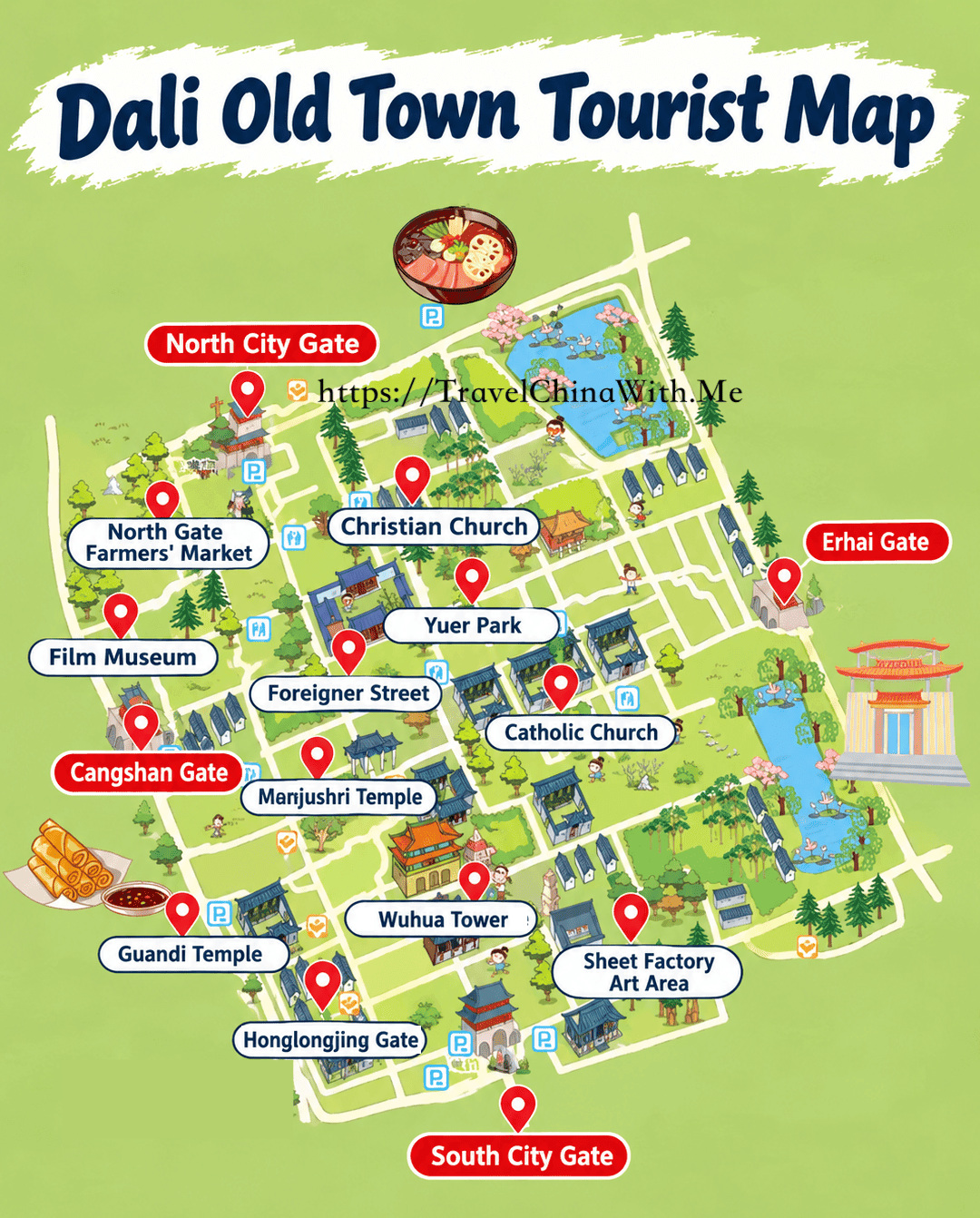
🚶 Dali Old Town: the no-backtrack route
South Gate to North Gate, 3–4 hours
South Gate
“大理” gate tower, best early morning
Sheet Factory Art District
Galleries, real souvenirs
Wuhua Tower
Best rooftop view, free to climb
Honglongjing
Quiet stream-side lane
Dali Catholic Church
Bai-style, Xinmin Rd No. 6
Yu’er Park
Free local pocket park
Foreigner St. & Renmin Rd
Commercial core, evening bars
Residential lanes
Guangwu → Huguo → Yin’cang Rd
Jiang Gong Ci
Free heritage museum, live music
North Gate
Route complete
Follow the numbers in order — one direction, South Gate to North Gate, no doubling back.
South Gate (南门)
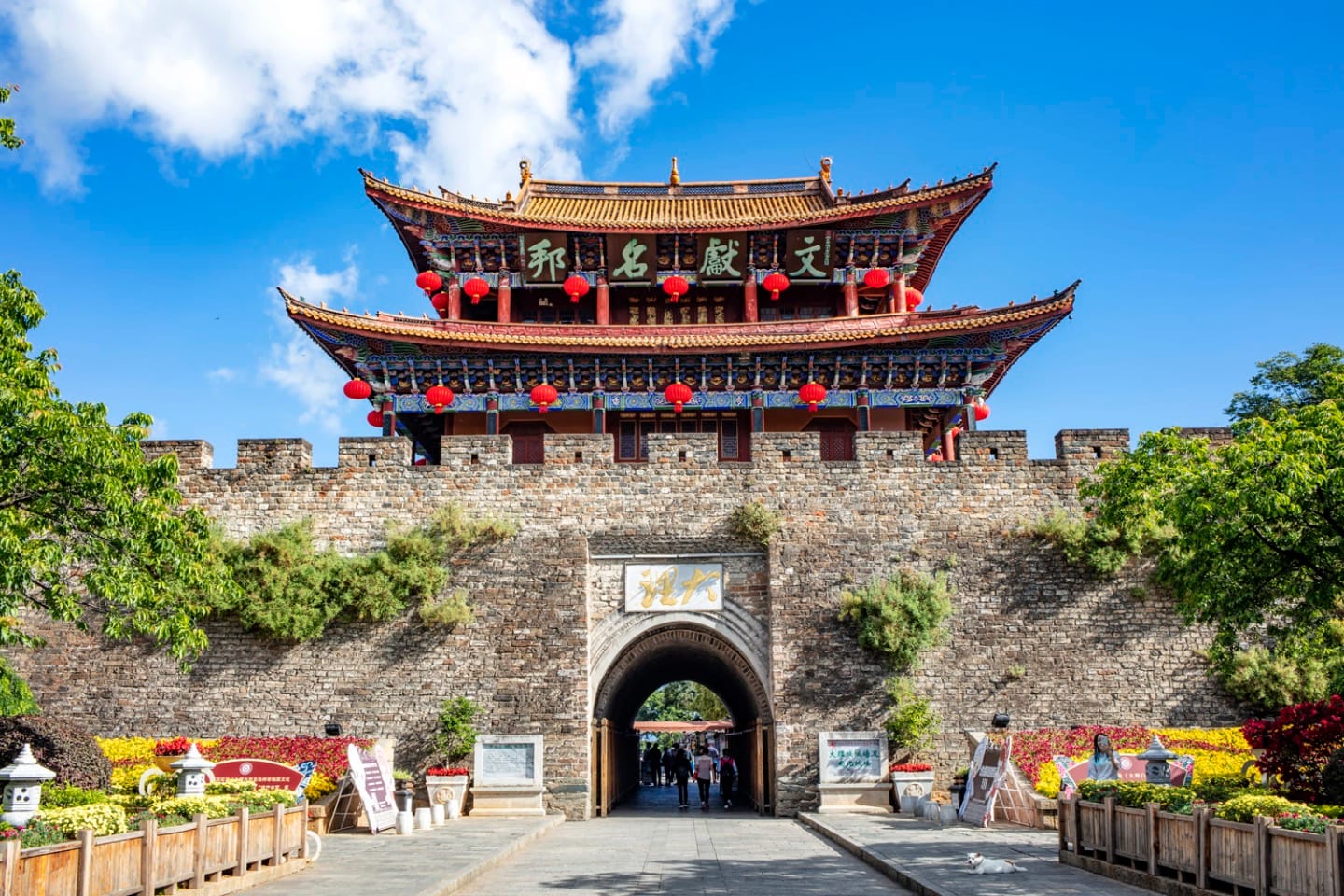
The signature entrance and classic photo spot. The “大理” characters on the gate tower are Guo Moruo’s calligraphy, added in 1961. Go early morning for soft light and fewer people. This gate gets crowded fast by mid-morning. It’s the busiest single spot in the old town for tour groups.
Sheet Factory Art District (床单厂艺术区)
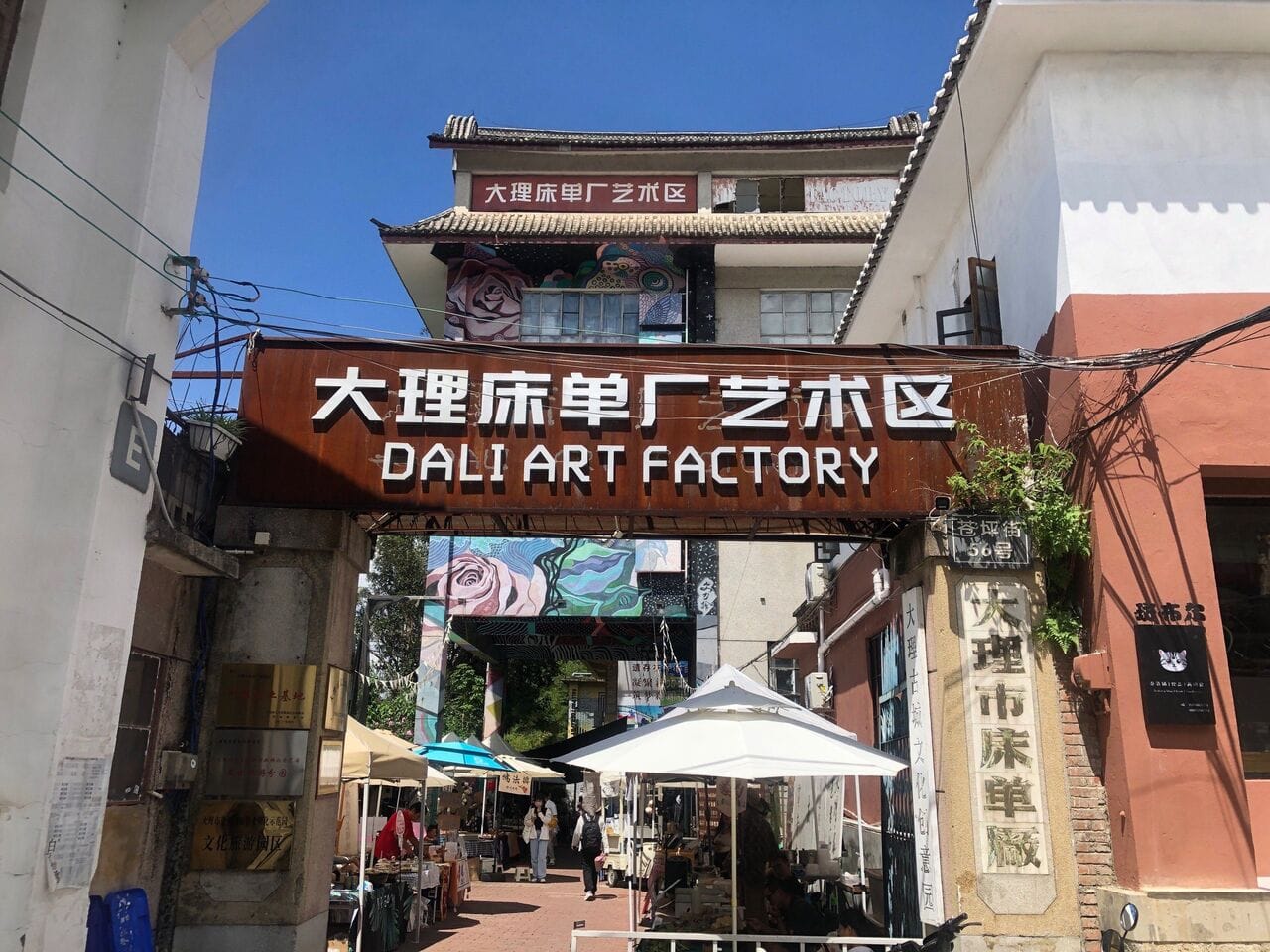
A converted factory space just off the South Gate: bookstores, small galleries, and a handicraft market. A better source for an actual souvenir than anything sold on Fuxing Road. An easy first stop before the crowds build.
Wuhua Tower (五华楼)
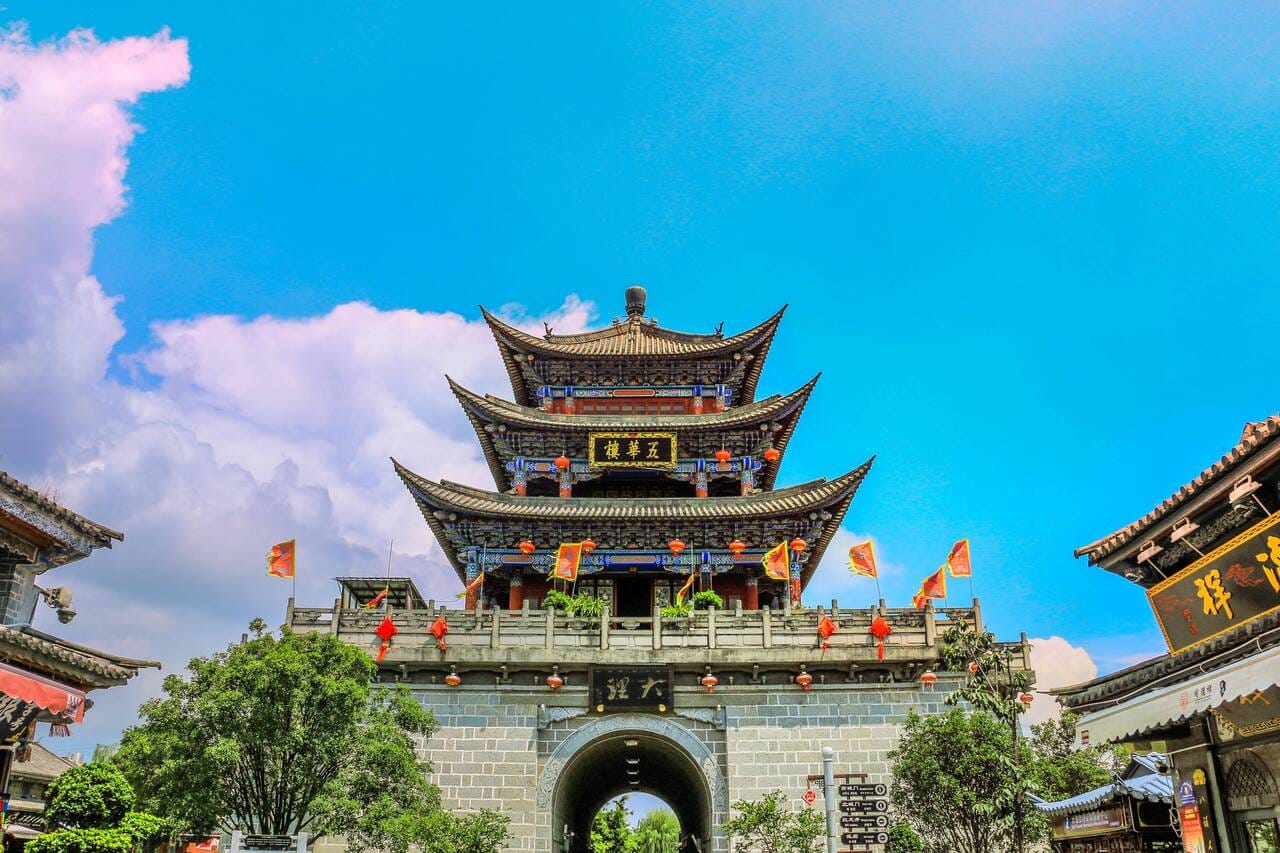
The high point of the old town — the tallest structure inside the walls, and the best rooftop view of it. The view takes in the grey-tile roofs of the whole old town, with Cangshan behind them. It’s the single best vantage point inside the walls, and it’s free to climb.
Honglongjing (红龙井)
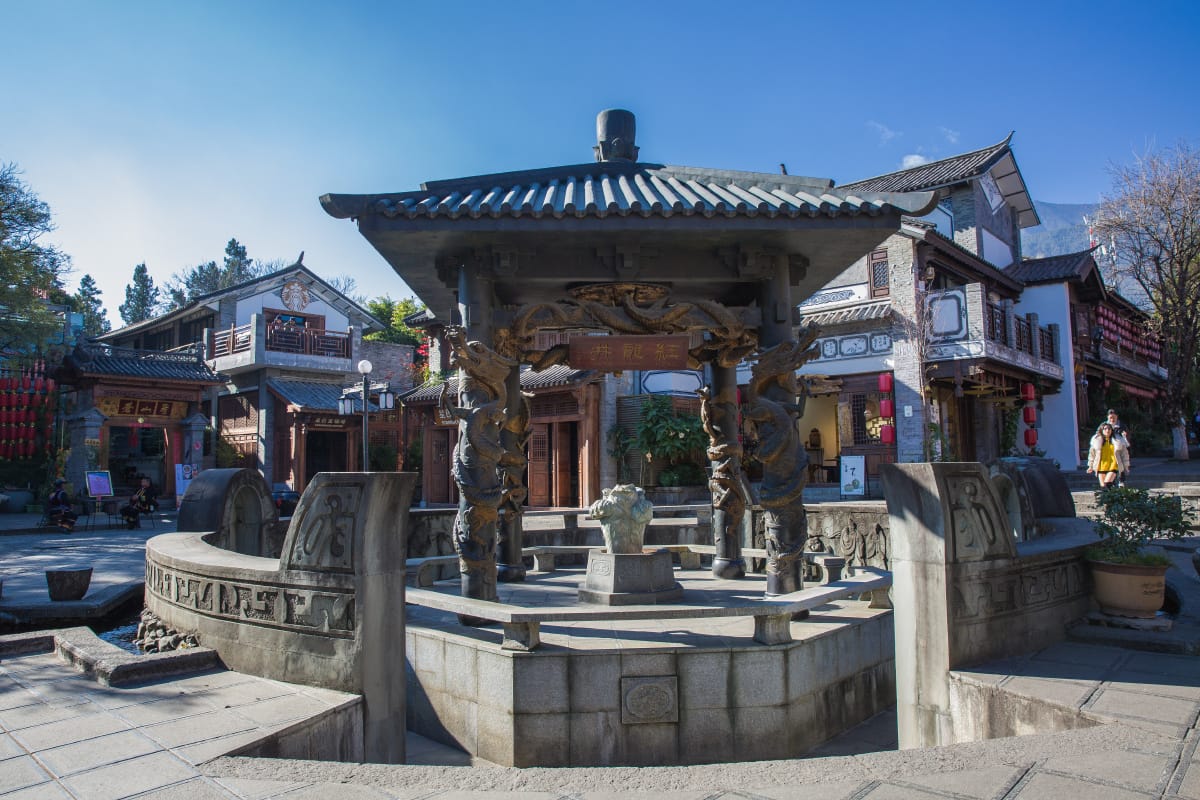
A quiet lane with a small stream running through it, a few minutes off the main route. Far calmer than the two commercial streets, with more greenery lining the water. Worth the detour to slow down for ten minutes before rejoining the crowds.
Dali Catholic Church (圣三堂)
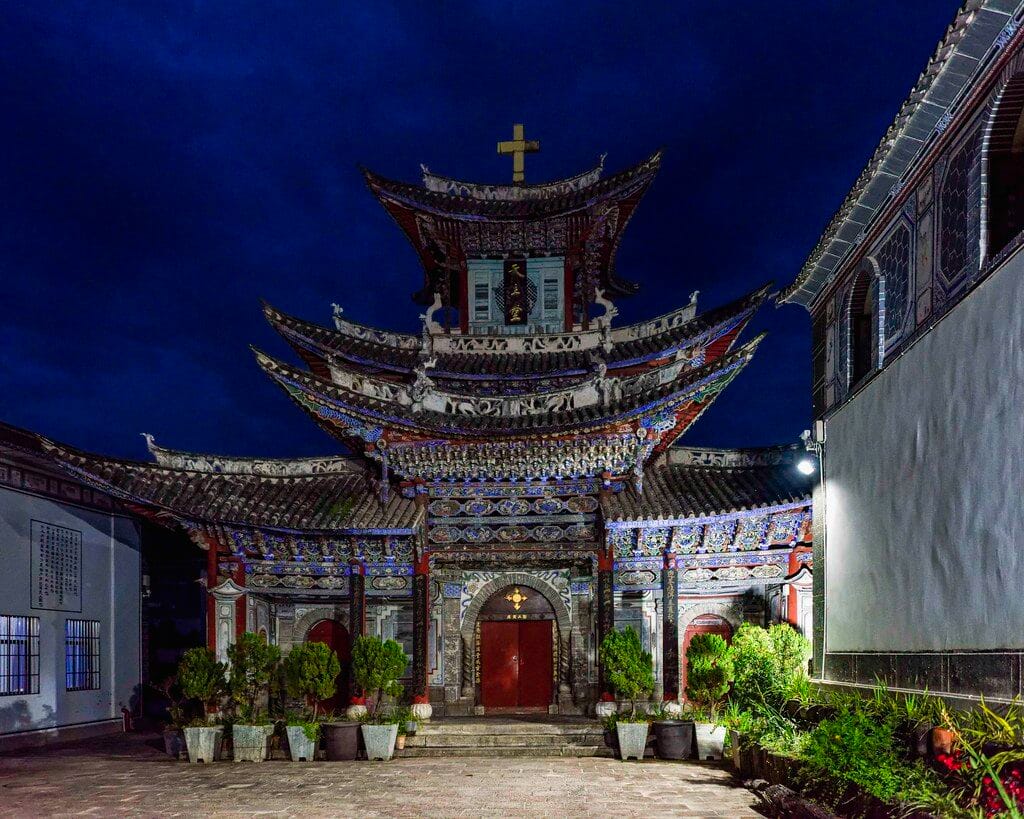
Tucked into a small alley at Xinmin Road No. 6, off Renmin Road, this is the old town’s most overlooked building. Most visitors walk right past the alley entrance. French missionaries built it in the early 20th century, blending Bai style with a Catholic interior: upturned eaves and red pillars outside, small painted stars across the blue ceiling inside. The courtyard café serves coffee traceable to Zhukula village in Binchuan County — Yunnan’s original small-bean coffee source.
Yu’er Park (玉洱园)
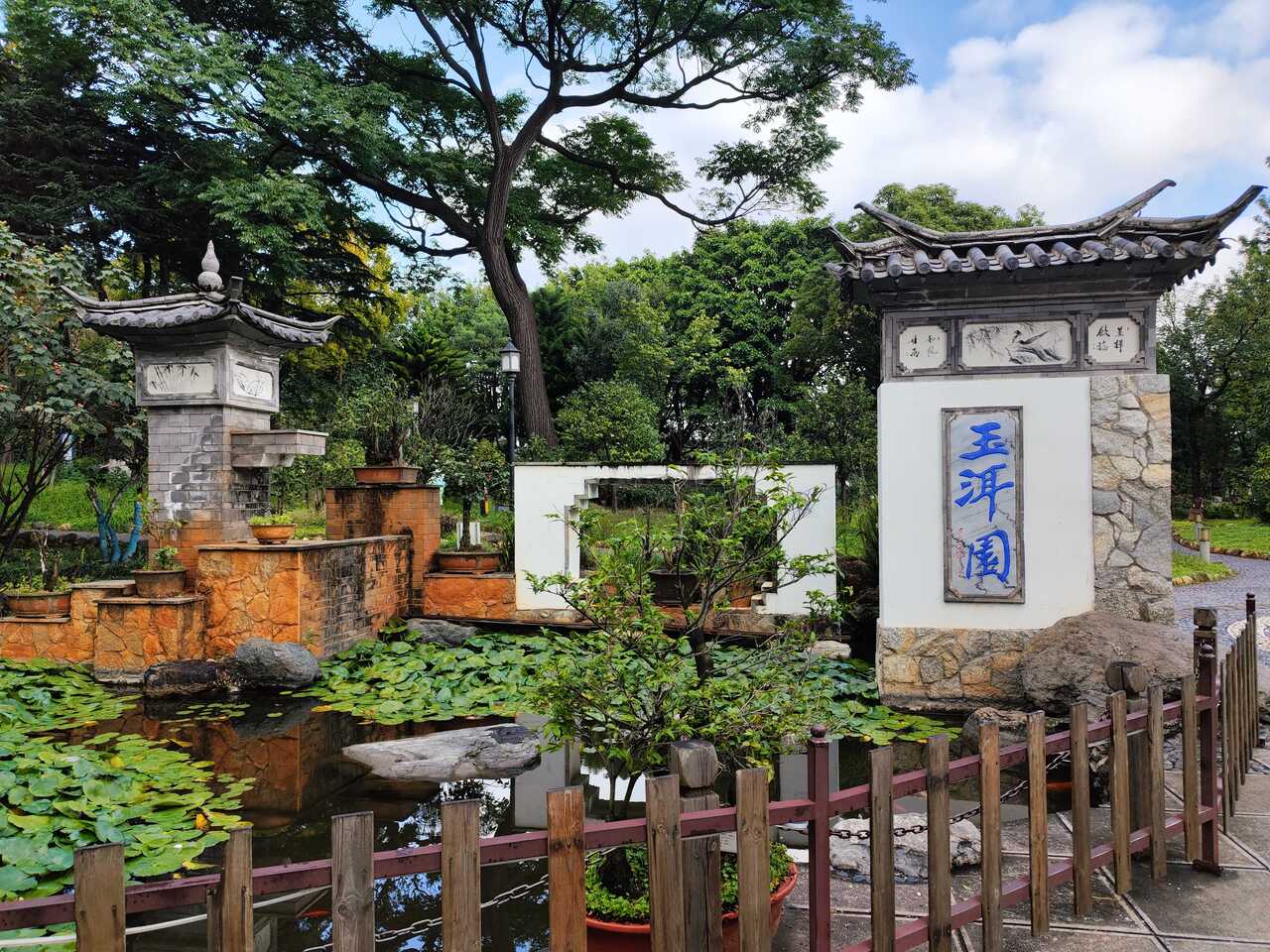
A free, local-only pocket park most tourists never find, just a few minutes from the church. A small Bai-style gate, ponds, camellias, squirrels around, and elderly residents playing chess. A five-minute stop if you want a break from the crowds without leaving the walls.
Fuxing Road & Renmin Road (复兴路 & 人民路)
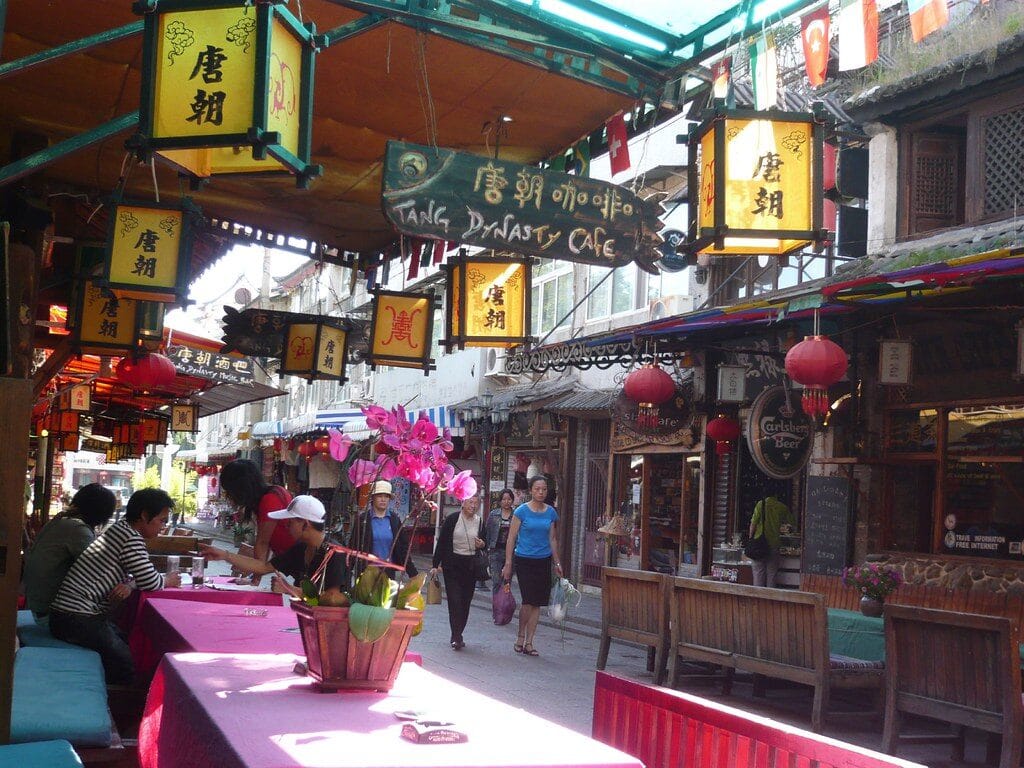
The rebuilt commercial core: marble shops, tie-dye scarves, and skewered snacks, one every few steps. After dark, bars play loud music on what’s called Foreigner Street (Yangren Jie) — worth an evening if that’s what you want. By day, before around 8pm, it’s mostly just a shopping street with little atmosphere.
Residential Lanes
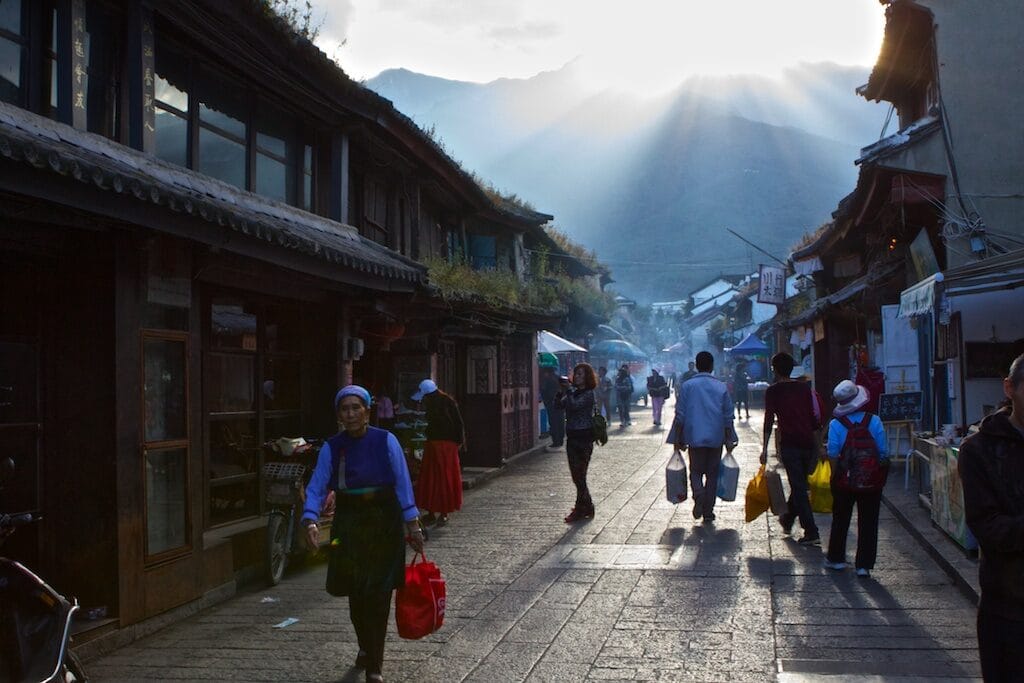
Two blocks off Renmin Road or Fuxing Road, everything is different: Bai-style courtyard houses, small canals still running past front doors, elderly residents sitting in doorway shade. Guangwu Road, then Huguo Road, then Yin’cang Road are where most residents actually live and shop. We route clients through here before Renmin Road, since seeing it first changes how they react to the commercial streets afterward.
Jiang Gong Ci (蒋公祠)
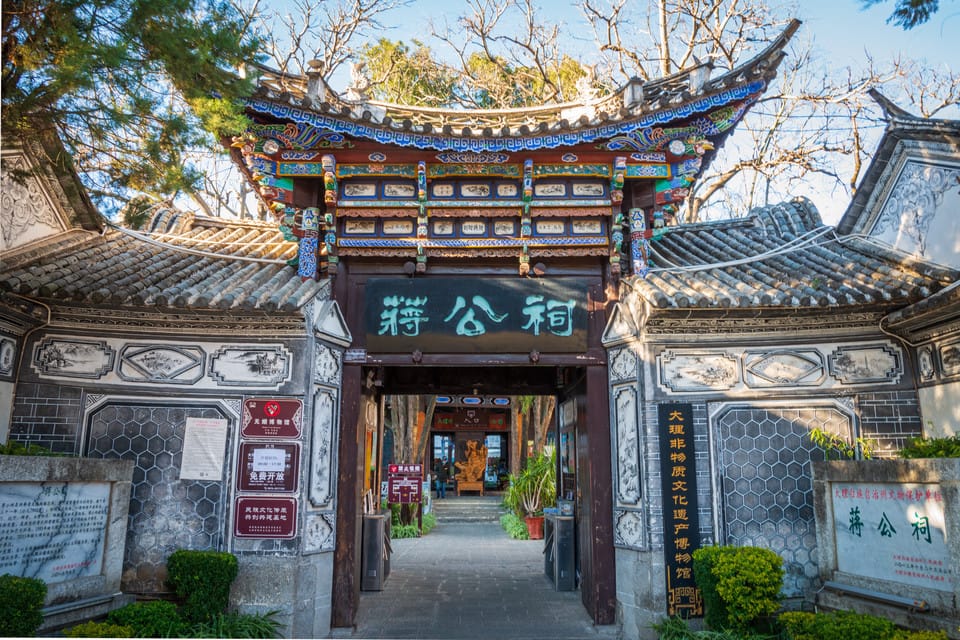
A Qing-dynasty memorial hall for a local military commander, near the North Gate. The courtyard hosts free daily performances of Bai folk music: dabenqu singing from 9:30–11:30am, traditional dongjing music from 1:30–4:30pm. Inside, a free Intangible Heritage Museum covers Bai tie-dye, woodblock talismans, and the Three-Course Tea ceremony, with staff on hand to explain each craft.
North Gate (北门)
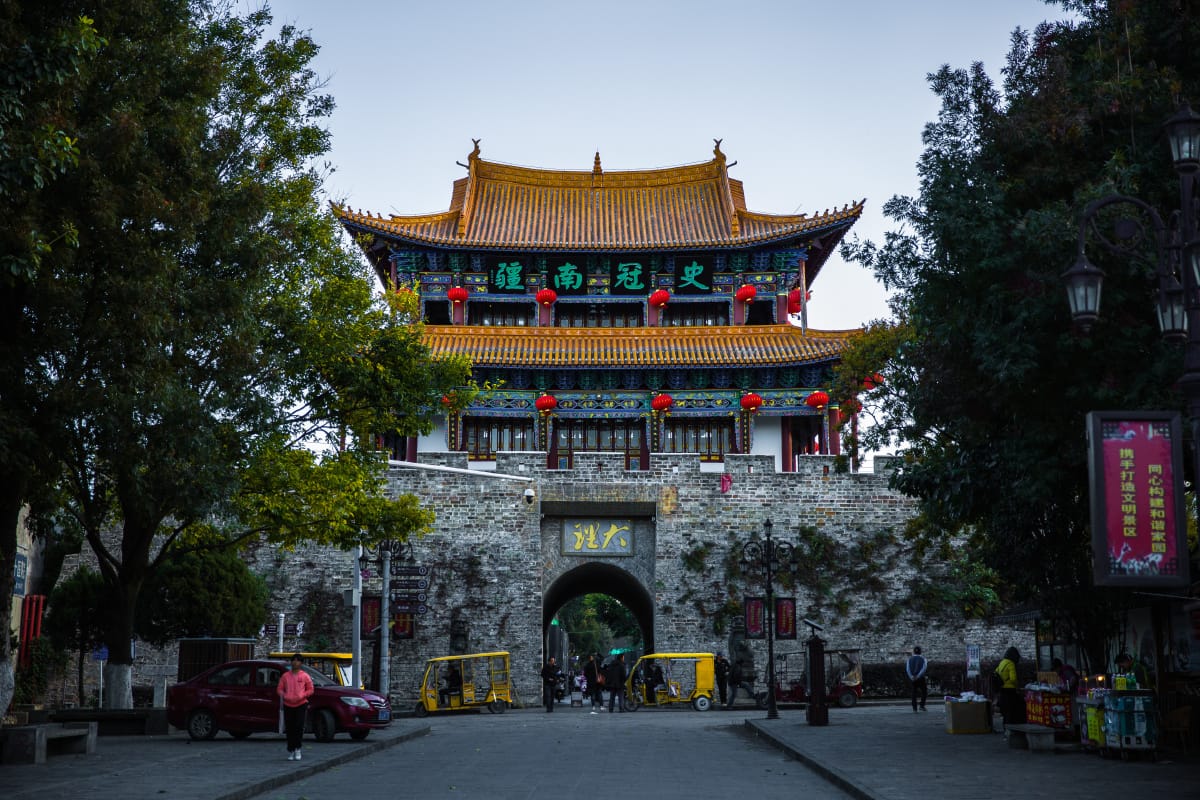
Also known as Santa (three pagodas) Gate, the north gate is one of the town’s historic gateways. It features a traditional city gate tower and well-preserved walls. Compared with the busier South Gate, the North Gate area is quieter and offers a more relaxed way to explore the old town and its historic atmosphere.
3. Where and What to Eat
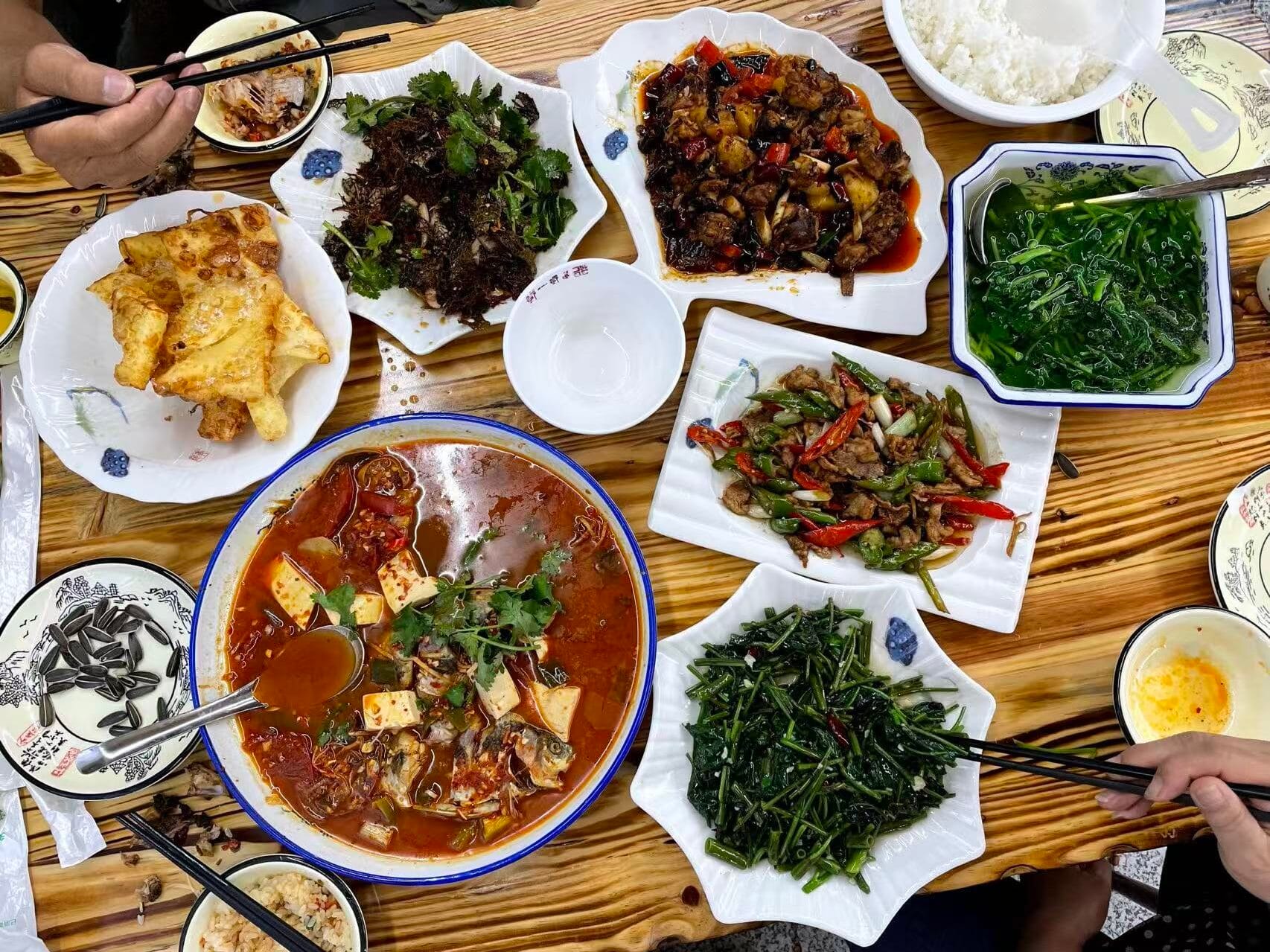
Skip the restaurants directly on Renmin Road and Fuxing Road inside Dali Old Town. Foot traffic, not quality, sets their prices. A “wild mushroom hot pot” there routinely runs over CNY 100 for a middling bowl. Several well-reviewed spots near the center have also drawn repeat complaints about underseasoned, forgettable dishes once you actually sit down.
The better food is a few minutes off the main streets, especially around Yeyu Road and the North Gate market. Get there before 8am if you want to see the old town at its most local. This is also when the market is busiest with residents, not tourists.
For a sit-down meal, three spots consistently outperform the tourist-strip restaurants. All three sit inside restored courtyard buildings — a look at old Dali architecture most day-trippers never step inside.
- Fire Pit Impression (火塘印象·野生菌庭院火锅) — a Bai-style courtyard hot pot restaurant near the South Gate, serving wild mushrooms sourced daily in season
- Jinshan Century Courtyard (尽善百年古院餐厅) — inside the historic Wang family residence, known for its passionfruit sour-and-spicy fish
- Meiziqing Restaurant (梅子井酒家) — an old-school Yunnan kitchen that’s been serving the same tile-grilled meats and cold rice noodle salad for decades
Dish | What it is |
|---|---|
Grilled rushan (烤乳扇) | Thin sheet of Bai-style cheese, grilled over charcoal until soft, brushed with rose sauce — milky and faintly floral |
Xidoufen with youtiao (稀豆粉油条) | Local breakfast: smooth pea-flour porridge with a crisp fried dough stick |
Xizhou baba (喜洲粑粑) | Sweet or savory flatbread, best fresh off the griddle with a crisp exterior |
Cold chicken rice noodles (凉鸡米线) | Sour-sweet and appetizing, a good palate-cleanser between stops |
Wild mushroom hot pot (野生菌火锅) | Yunnan essential, June–October; make sure it’s simmered long enough before eating |
For the full range of Bai and Yunnan dishes worth trying beyond these five, see our what to eat in Dali guide.
4. Where to Stay in Dali Old Town: Inside or Outside the Walls
Inside the walls | Just outside the North or South Gate | |
|---|---|---|
Atmosphere | Evening street life, everything walkable | Quieter, still a short walk from the old town |
Access | Cobblestone streets — cars can’t reach most guesthouse doors, luggage is a hassle | Vehicle drop-off right at the door |
Noise | Nightlife noise carries; soundproofing in older buildings is inconsistent | Away from Renmin Road’s bars |
Price | CNY 200+/night should mean a real view or courtyard, not just proximity to Renmin Road | Mid-range chain hotels run CNY 100–150/night |
Staying inside is what actually makes a Dali visit work for most travelers. It’s worth the luggage hassle for one or two nights. If those tradeoffs don’t appeal, especially with kids, heavy bags, or light sleepers, a chain hotel just outside the gates gets you the same walking access without them. Guesthouses near Yu’er Road or the quieter eastern lanes are the middle ground: still inside the walls, but a five-minute walk from Renmin Road buys a much better night’s sleep. Worth checking before you book either way: “Dali Old Town” on a hotel listing doesn’t guarantee a car can reach the door. Confirm the exact location if you’re arriving straight off a flight or train with luggage.
Avoid Xiaguan (Dali’s modern new city, 13 km away) altogether unless you have a specific reason to be there. It has little for a short-stay traveler and adds a 30–45 minute commute each way.
5. How to Get to Dali Old Town
From | Option | Cost | Time |
|---|---|---|---|
Dali Airport (DLU), ~13 km | Taxi | CNY 80–120 | 40–50 min |
Dali Airport (DLU), ~13 km | Airport shuttle bus | CNY 25–30 | ~40–60 min, roughly hourly |
Dali Railway Station (Xiaguan) | Bus No. 8 | CNY 2–3 | 45–60 min |
Dali Railway Station (Xiaguan) | Taxi | CNY 40–50 | ~30 min |
For the airport, agree on a taxi price or confirm the meter before you leave the curb. The shuttle is the better option if you’re not in a hurry.
Inside the walls, the core is compact enough to walk end to end — North Gate to South Gate. That takes about 30 minutes at a steady pace. Most visitors take longer once they’re weaving through crowds, so build in more buffer than a map suggests. Don’t bother trying to taxi within the walls during peak season (the May and October holiday weeks). Traffic inside barely moves. Electric bike rental (roughly CNY 50/day) is the standard way locals and longer-staying visitors reach Erhai Lake or Xizhou without a car.
6. Best Time to Visit
Season | Avg. Daily Temp | Avg. Monthly Rainfall | Verdict |
|---|---|---|---|
March–May | 14–19°C (57–66°F) | 28–83 mm | Best overall — clearest Cangshan views, flower season |
September–November | 12–18°C (54–65°F) | 25–157 mm | Best overall, quieter than spring |
June–August | 20–21°C (68–70°F) | 131–220 mm | Workable, pack a light rain layer |
December–February | 9–11°C (48–52°F) | 11–29 mm | Fine for the old town itself, less ideal for Cangshan hikes |
Data: Wikipedia climate normals for Dali City, 1991–2020 averages.
🍂 Dali Old Town: temperature & rainfall by month
1991–2020 averages
Dali Old Town sits at nearly 2,000 meters, so sun protection matters even on cloudy days. The UV here is strong year-round. Mornings and evenings can be noticeably cooler than midday regardless of season, so bring a light layer whenever you go.
One more timing factor worth checking: Dali’s market runs on the lunar calendar’s 2nd, 9th, 16th, 23rd, and 30th days each month. It’s livelier than an ordinary afternoon if your dates line up. Locals also keep late hours here, so the old town stays fairly quiet until mid-morning. An early start rewards you with empty lanes rather than empty shops.
How much of this actually matters depends on what you came for. We ask every client the same question before building a Dali day: are you here for the history and architecture, or for Cangshan and Erhai? Clients chasing mountain views care about the June–August cloud cover a lot more than clients who mainly want to walk the old town and eat well. For the second group, the season makes far less difference to the trip.
7. Practical Tips We Give Every Dali Old Town Client
Watch for these common scams:
- “Free” photos or hair-braiding from roadside vendors almost always add a charge afterward — decline up front.
- Tea-tasting stalls along the main streets often serve samples sweetened well beyond what’s in the priced product, then charge by weight. Ask the price before you taste. Some of these work out to several hundred CNY per jin once weighed.
- A driver who volunteers a visit to a “family herbalist” selling powdered remedies is using a routine we’ve seen in tourist towns across China. Walk away.
- “Tree grapes” sold from small stalls are ordinary grapes coated in oil and dye — check for an oily residue before buying fruit this way.
- Fruit-stall scales are commonly rigged, on top of inflated prices. Buy fruit at a proper shop instead.
Shopping without overpaying: For marble, tie-dye, or silver, compare a few stores before buying. A tie-dye scarf priced well above what a second or third shop quotes is worth walking past. None of this merchandise is unique to Dali. The same “original design” clothing sold in the old town for several hundred CNY often turns up in other cities at half the price.
Know the difference between the two old-town shuttles before you board. One costs a few CNY; the other costs 40. The vehicles look similar enough that visitors regularly board the wrong one.

Self-service shuttle | Wamao Hao sightseeing car | |
|---|---|---|
Duration | — | 50–60 minutes, about 10 minutes per stop |
Route | South line: Wenxian Tower → South Gate. | Bo’ai Gate → Honglongjing → Renmin Rd/Foreigner St → Cangshan Gate → Jiang Gong Ci → Erhai Gate → South Gate → Bo’ai Gate |
Purpose | Point-to-point transport | Guided loop with commentary |
Fare | CNY 1–3 | CNY 40 |
Commentary | None | Yes, full narration |
Board at | Marked stops along the route | Bo’ai Gate |
Hours | 7:00am–7:30pm | 9:00am–6:00pm |
The self-service shuttle is the one to flag down if you’re hauling luggage or just need to cover ground fast. Look for a bus with red scrolling text on the front and a driver in a blue vest — that’s the CNY 1–3 shuttle, not the tour car. Either way, confirm the fare before boarding.
Rent bikes only from Meituan or Qingju. A similar-looking brand called Youzi Huixing (柚子慧行) has cropped up, easy to mistake for Qingju at a glance. It has a confusing top-up process and a CNY 30 minimum charge.
Frequently Asked Questions
How long do you need at Dali Old Town?
Three to four hours covers the old town itself properly. Add a full extra day if you’re combining it with the Three Pagodas, an Erhai Lake cycle, or a Cangshan hike. Each of those is its own half-day.
Are the Three Pagodas inside Dali Old Town?
No. The Three Pagodas and Chongsheng Temple sit 1.5 km north of the old town walls, on separate grounds with their own CNY 75 entrance fee.
What’s the difference between Dali Old Town and Dali City?
Dali Old Town (also called Dali Ancient City) is the historic walled district most visitors mean by “Dali.” Dali City’s modern center, Xiaguan, is a separate area about 13 km south. It has the train station and airport access roads, but little else of tourist interest.
Should I stay inside Dali Old Town or outside it?
Inside gives you evening atmosphere and walking access to everything, but cobblestone streets, no car access to most doors, and inconsistent soundproofing are real tradeoffs. A hotel just outside the North or South Gate gets similar convenience with an easier, quieter stay.
Is Dali Old Town safe to walk around at night?
Yes. It’s a well-lit, heavily trafficked area with a strong police and security presence, especially along Renmin Road and Foreigner Street. The usual pickpocket caution in any crowded tourist area applies, but violent crime against tourists here is not a common concern.
Is Dali Old Town or Shaxi Ancient Town better?
They serve different trips. Dali has far more infrastructure, food, and nightlife. Shaxi — a smaller Bai-Yi market town about two hours north of Dali — is quieter and much less commercial, closer to what Dali may have felt like decades ago. Most visitors see Dali first and add Shaxi only if they have time to spare.
Planning a Yunnan trip around Dali? Get in touch and we’ll build an itinerary around what you actually want to see — not just the two streets every tour bus stops at. For pairing the old town with the rest of Dali, see our guides to Erhai Lake, Mt. Cangshan, and Dali Butterfly Spring, or our Dali vs. Lijiang comparison if you’re still deciding between bases in northern Yunnan.