Cangshan Mountain, Dali: Complete Visitor Guide
Cangshan Mountain (苍山) is the 19-peak range that rises straight behind Dali Old Town, with Erhai Lake at its feet. It is a UNESCO Global Geopark, and its highest summit, Malong Peak, reaches 4,122m. Most visitors ride one of three cable cars up to Jade Belt Road. It’s a flat 18 km trail past temples, streams and wide views over the lake.
This guide covers the mountain’s background and highlights, the best months to go, and how to choose between the cable cars and walking up. It also passes on what our clients have run into on the mountain: touts, altitude and sudden weather closures.
TL;DR
- Worth it if: you have half a day free and want views over Erhai Lake and the Old Town
- Skip or shorten if: you have one day in Dali and haven’t seen the Old Town or Erhai Lake yet
- Fastest good visit: ride up, short walk, ride down, 2 to 3 hours in total
- Full hike or summit: budget a full day and start early, because the weather turns by afternoon
- The mistake our clients report most: letting a taxi driver choose the cable car for them
Table of Contents
1. What Is Cangshan Mountain?
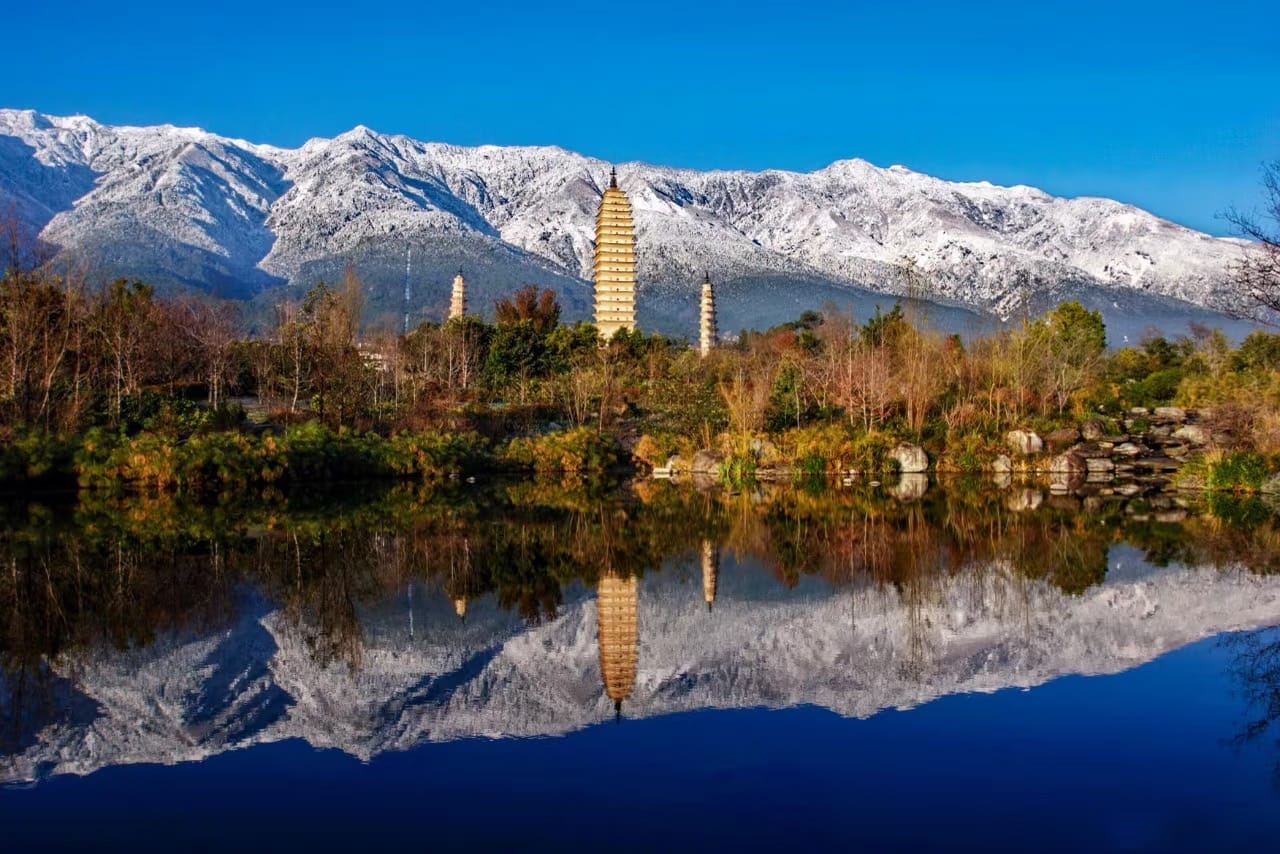
Cangshan Mountain (苍山), also known as Mt. Cangshan or Diancang Mountain (点苍山), is the range that forms the western wall of the Dali basin. It runs along the western shore of Erhai Lake. Geologically, it is the southern tail of the Yunling range, part of the Himalayan orogenic belt. That wall of rock is why Dali Old Town sits on a narrow strip of flat land between mountain and lake.
Location | Directly west of Dali Old Town, Yunnan, at 25.65°N, 100.10°E |
|---|---|
Size | |
Tickets | CNY 35 geopark entry plus a cable car fare of CNY 60–300 round trip; children under 1.2m and adults over 60 enter free |
Peaks / streams | 19 named peaks, 18 streams flowing into Erhai Lake |
Highest peak | Malong Peak (马龙峰), 4,122 m |
UNESCO status | Global Geopark since September 23, 2014 |
Rock age | Metamorphic rock up to 2 billion years old |
Even the gentlest ride up Cangshan Mountain climbs fast. Zhonghe rises from 2,120m to 2,596m in a 19-minute ride. Our clients are often surprised by how much colder the air is at the top.
Butterfly Spring sits at the range’s northern foot, but it works as a separate trip. See our Butterfly Spring guide if it’s on your list.
The Three Pagodas of Chongsheng Temple stand at the foot of Yingle Peak, just northwest of the Old Town. They pair easily with a Cangshan morning.
UNESCO Geopark status and the geology behind it
Cangshan joined the UNESCO Global Geopark Network on September 23, 2014. It became China’s 31st Global Geopark and Yunnan’s second, after Stone Forest. The range’s rock record goes back 2 billion years. Metamorphic rock makes up more than 60% of its mass.
Its marble gave Chinese its word for the stone: dali yan (大理岩), or “Dali rock.” The range also named the Dali Glacial Period, a Quaternary ice age. Its cirques, moraines and U-shaped valleys are treated as a textbook example.
A brief history
In the 8th century, the Nanzhao Kingdom made Cangshan the “Central Sacred Peak” (中岳) of its Five Sacred Peaks. The Tang-era Manshu (c. 860 CE) and the Yuan-era Yunnan Zhilue (1303–1304) both record the title. Temples such as Zhonghe and Gantong still stand on its slopes. Local legend adds Wangfu Yun (望夫云): a Nanzhao princess whose spirit is said to gather as cloud over Yuju Peak each autumn and winter.
2. Is It Worth the Time?
This is the question we hear most from clients planning 2 to 4 days in Dali. Whether Cangshan Mountain earns a slot depends on what else is on your list.
Your time in Dali | Our recommendation |
|---|---|
3+ days | Give Cangshan a half-day to full day, after the Old Town and Erhai Lake |
2 days | One day for town and lake, one day for the mountain, starting early |
1 day | Put the Old Town and a short Erhai Lake visit first; a rushed Cangshan visit skips the best stops |
Afternoon fog and wind are common, so we never plan Cangshan as an afternoon add-on.
What tips the decision in Cangshan’s favor is the view. Looking down on Erhai Lake and the Old Town rooftops is a perspective you can’t get at lake level. Even a short walk on Jade Belt Road takes you into forest and streams that look like a green wall from town.
3. Highlights on the Mountain
Jade Belt Road
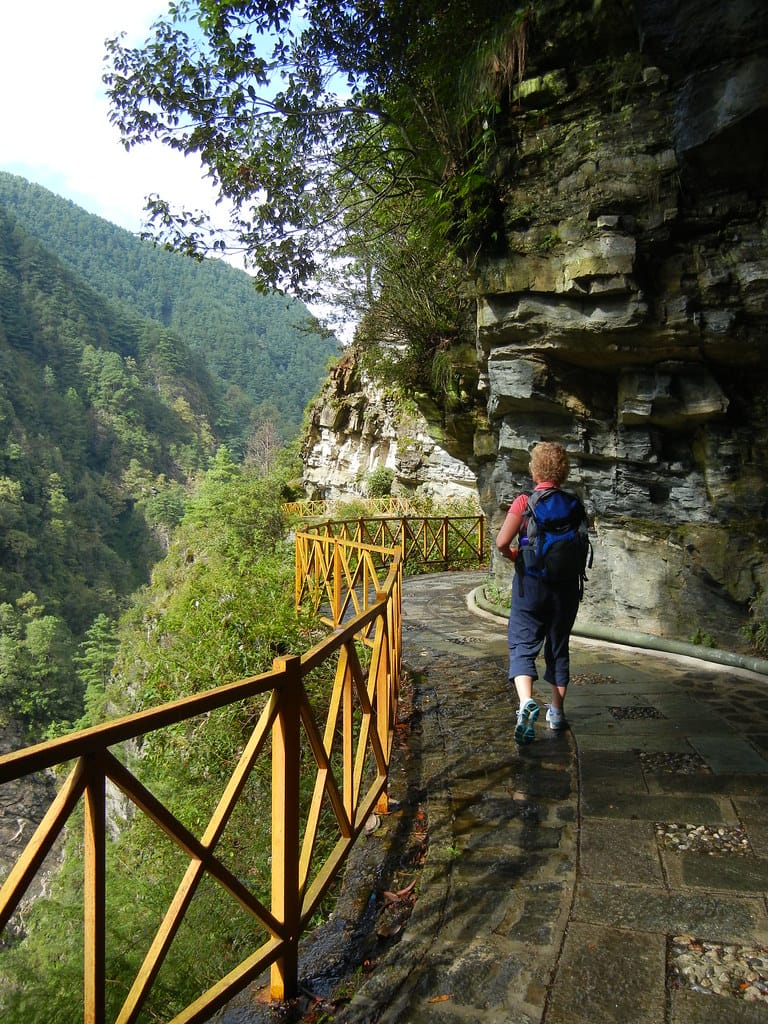
Jade Belt Road (玉带云游路) is an 18-kilometer paved trail across the mountainside. It passes the Zhonghe top station at 2,596m and is a flat walk by mountain standards. Nearly every hiking route on Cangshan Mountain uses part of it. Most of our clients walk a 4–5 km stretch between two cable car stations.
Bring water and snacks. Our clients report one supply point on the whole trail: a vending stall near Seven Dragon Girl Pool, selling instant noodles for CNY 20.
Zhonghe Temple
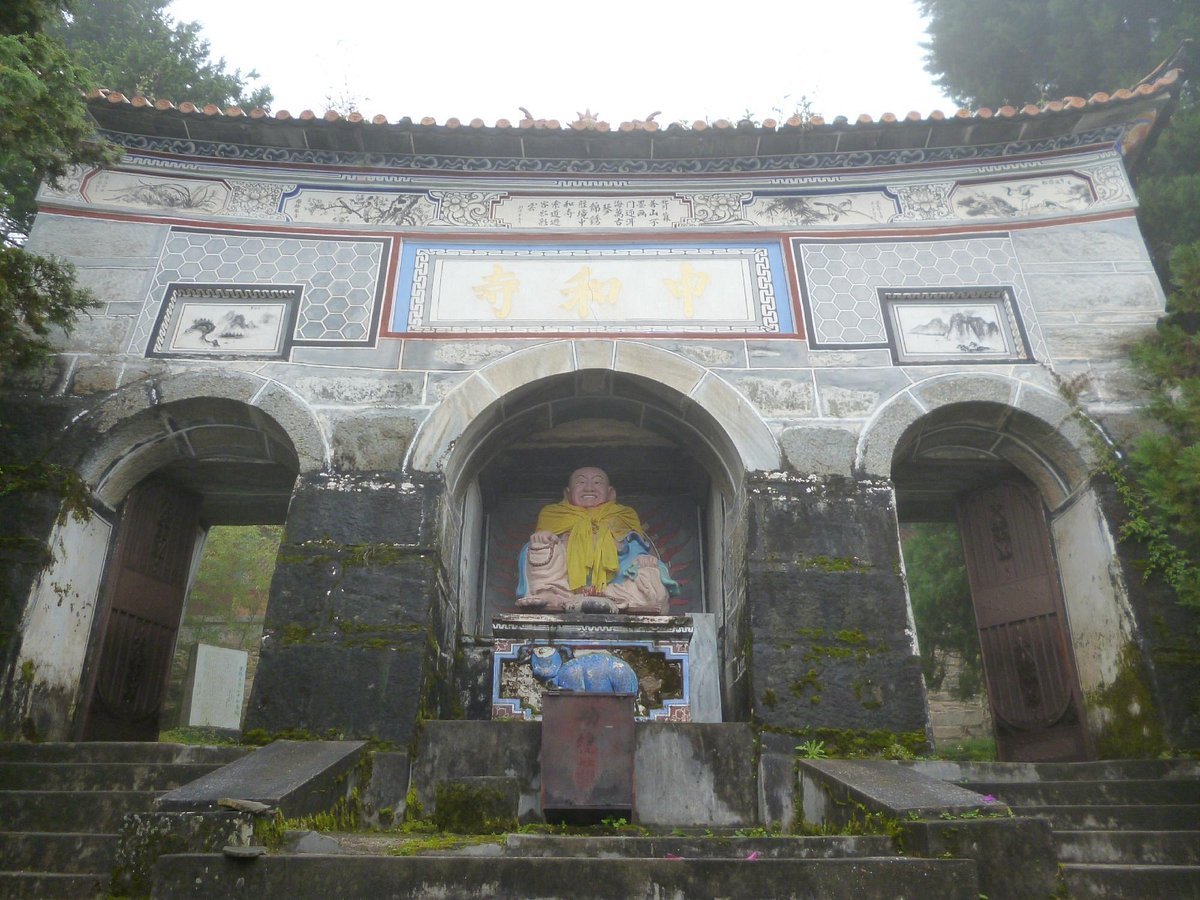
Zhonghe Temple (中和寺) stands beside the Zhonghe top station. Its small square looks straight down on Erhai Lake and the Old Town. The temple kitchen serves a vegetarian lunch from 11:30am, CNY 20 per person when our clients ate there. Several trails start here too.
Gantong Temple and Jizhao Nunnery
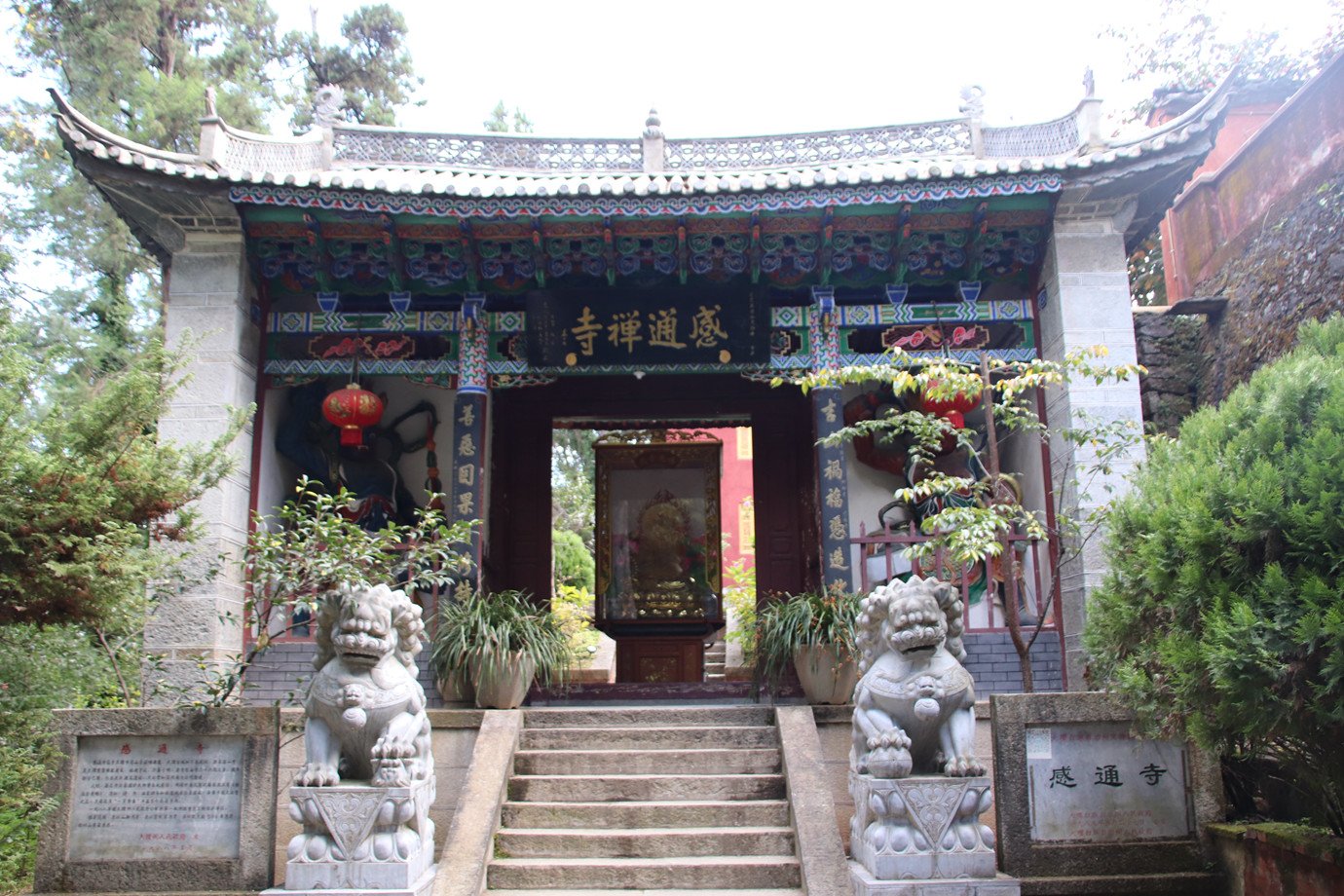
Gantong Temple (感通寺) sits lower, on the slopes of Shengying Peak, beside the Gantong line’s 2,260m base station. Jizhao Nunnery (寂照庵) is a 20-minute uphill walk above it. It’s known for hydrangeas that peak in June and a succulent-lined stairway.
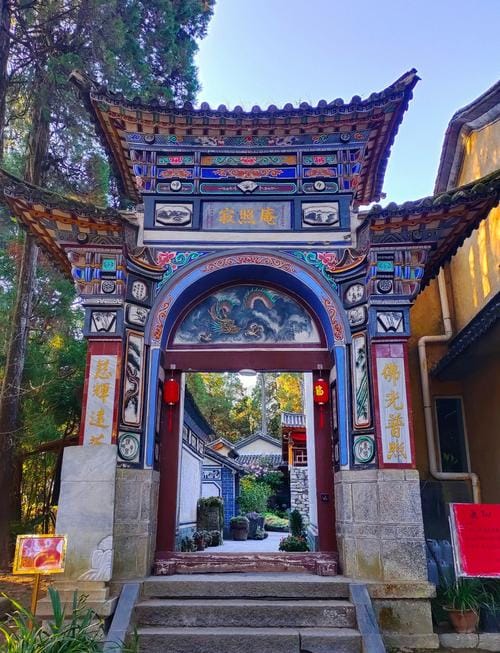
Jizhao’s vegetarian lunch costs CNY 20, cash only, served from 11:30am. Queues grow fast after noon. Our clients who arrive by 10:30am get seated without a long wait.
Qingbi Stream vs. Seven Dragon Girl Pool
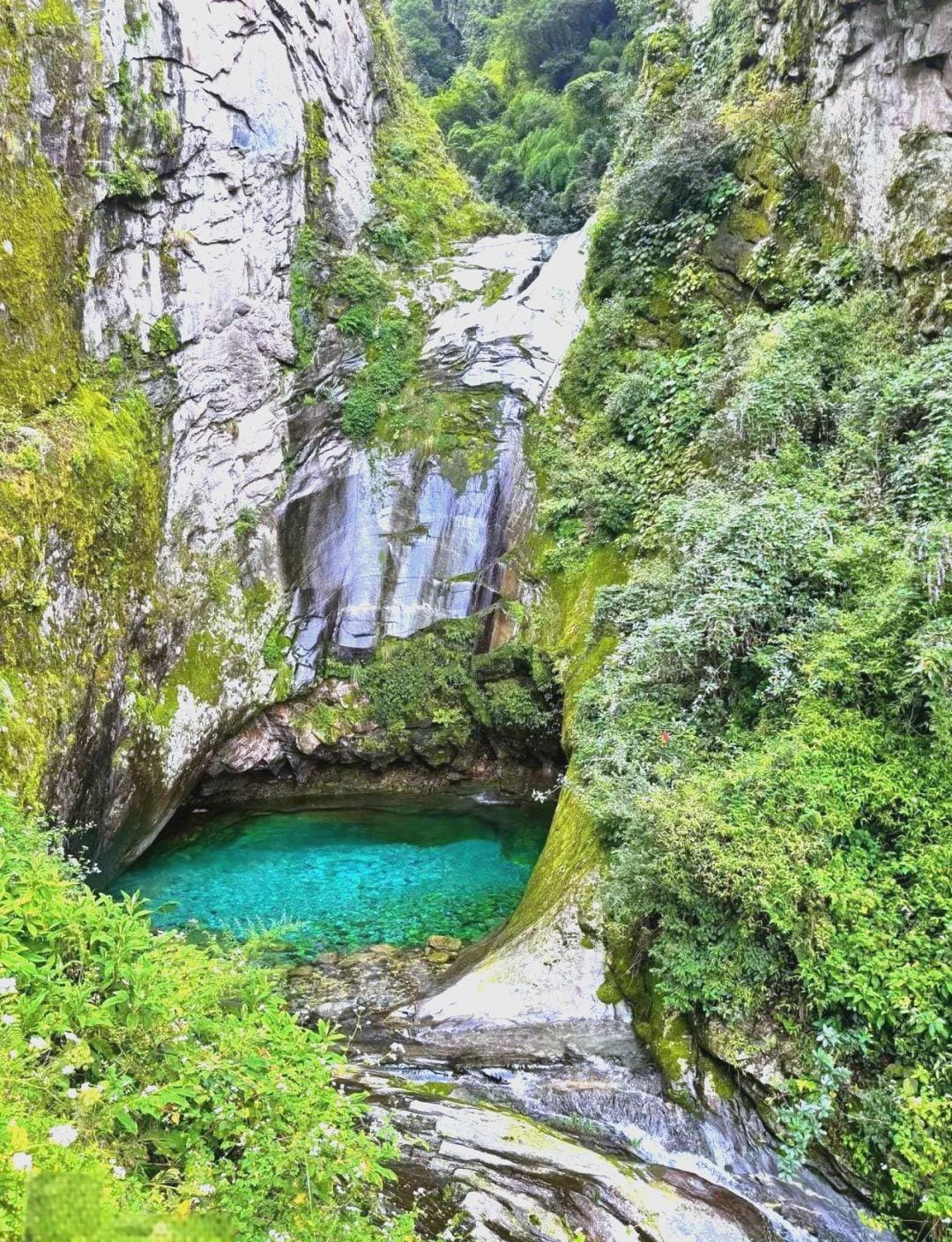
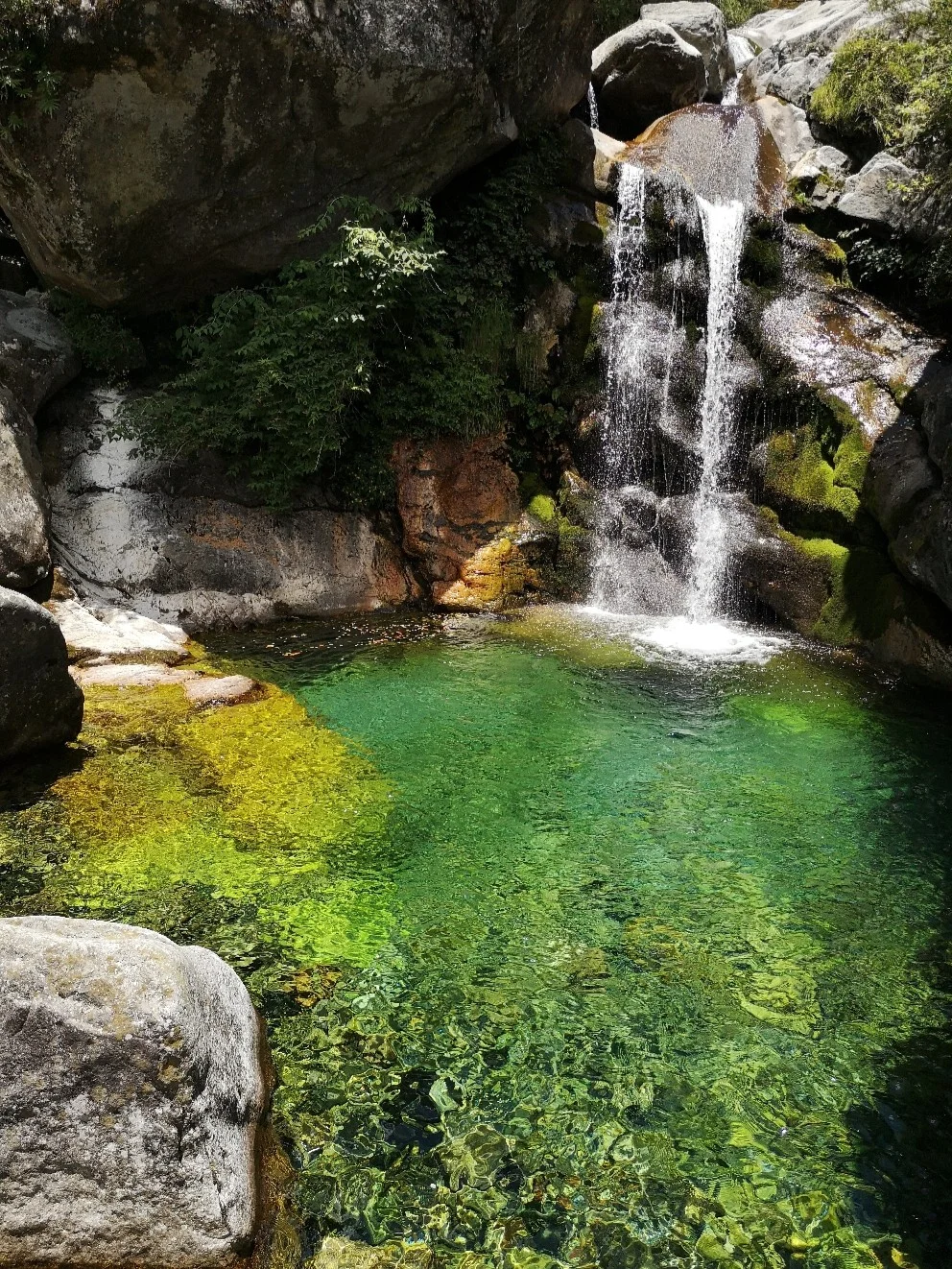
Both sit just off Jade Belt Road, and clients ask about both:
- Qingbi Stream (清碧溪) is a short walk from the Gantong top station: three tiered pools of jade-green water. It’s on your way, so see it.
- Seven Dragon Girl Pool (七龙女池) sits in the Heilongxi valley, off Jade Belt Road. Reaching its seven linked pools means a detour down steps. The Ximatan mid-station stands above it at 2,800m. If time is short, the first two or three pools are enough.
Ximatan and the summit
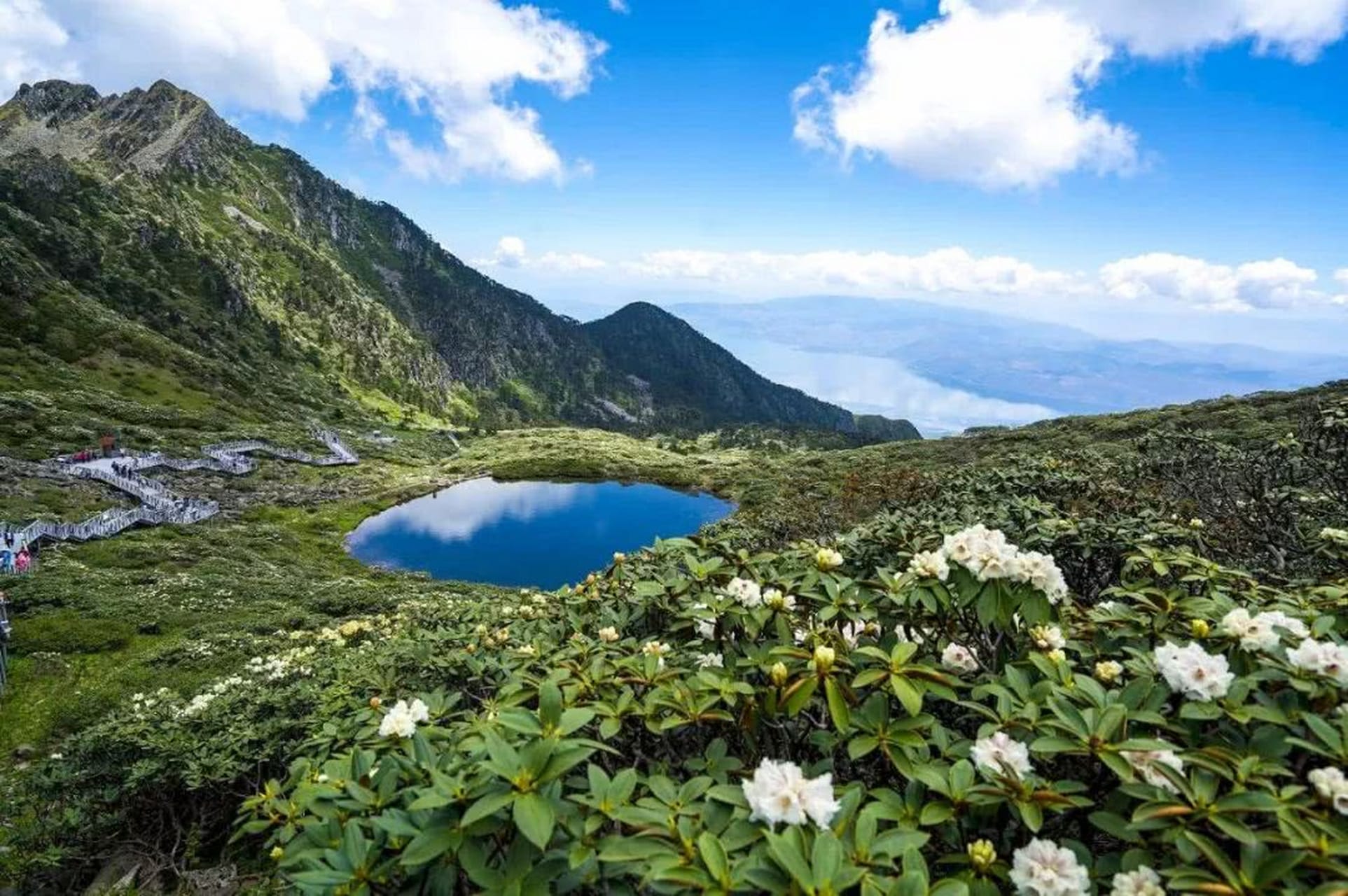
Ximatan (洗马潭) is a glacial lake on Yuju Peak at 3,966m. The Ximatan cable car’s top station sits just below it at 3,900m. The name means “horse-washing pool”: local legend says Kublai Khan washed his horses here while crossing Cangshan to take Dali.
From late spring into early summer, yellow, white and red rhododendrons bloom along the ridges. Malong Peak, the true high point at 4,122m, has no cable car. Ximatan is as high as most visitors go.
Cangshan Snow
Snow on the upper peaks is one of Dali’s “Four Scenic Wonders.” You can see it from town as a white ridgeline above the Old Town’s grey roofs. The table below shows when to catch it.
4. Best Time to Go
Season | What you’ll see | Our take |
|---|---|---|
November–February | Dry season, clearest skies, snow on the upper peaks | Best views and snow; wind closures more likely |
March–April | Still dry, mild, azaleas building | Comfortable hiking under clear skies |
May–June | Rains begin in May; rhododendrons peak around Ximatan; hydrangeas peak at Jizhao Nunnery in June | Best window for flowers |
July–August | Heaviest rain of the year | Rain can close cable cars with little warning |
September–October | Rain eases; the rainy season ends in October | Views improve as October goes on |
Dali’s rainy season runs from May to October and brings 83–95% of the year’s rain. Within it, rainfall peaks in mid-June and again in early August.
🌸 What's happening on the mountain, month by month
Mountain weather changes fast in every season. Treat any day on Cangshan Mountain as a morning plan and start by 9 or 10am. Cloud and wind build through the afternoon, and Ximatan is the first cable car to close on windy days.
5. Getting There
Cangshan Mountain rises directly behind Dali Old Town. Take a taxi or DiDi to your specific station. A vague search like “Cangshan scenic area” can drop you at the wrong entrance.
Cable car | Where it starts | Search this in DiDi |
|---|---|---|
Zhonghe | Beside the Sanyuejie racecourse, just west of the Old Town | 中和索道停车场 |
Gantong | Gantong Temple gate, the farthest of the three from the Old Town | 苍山感通索道 or 大理苍山世界地质公园 |
Ximatan | West side of the Tianlong Babu film studio | 洗马潭索道 |
A bike covers the flat ride toward the mountain, but not the climb up to the stations.
Arriving by air or rail:
Starting point | Taxi to Dali Old Town |
|---|---|
Dali Airport | 30 km, CNY 100–110 |
Dali Railway Station (Xiaguan) | 10 – 19 km, CNY 60–80 |
These are the published reference fares. Agree the fare before you ride if the driver won’t use the meter.
A warning about ticket touts
This is the complaint we hear most from clients who did Cangshan on their own before booking with us. A driver or tout tells them their line has a two-hour queue, or that their trail is closed. They get steered to a pricier cable car that pays the driver a commission.
Decide your cable car and ticket office before you get in the car. The official Gantong ticket office shows in maps as 大理苍山世界地质公园. Our clients found that other “visitor centers” and “ticket centers” nearby were commission operations.
6. Cable Car or On Foot?
Three cable cars run up different parts of Mt. Cangshan. All three are run by the same Dali Tourism Group branch, but each has its own ticket office and car park. Picking the wrong one is the planning mistake we see most. Our clients report it can mean an extra 8 km of walking to correct.
Our Cangshan cable car guide has full prices, route combinations and transfer details. The short version is below.
The three cable cars at a glance
🗺️ Where the three cable cars go, north to south
Ximatan | Gantong | Zhonghe | |
|---|---|---|---|
Round trip (plus CNY 35 entry) | ¥160 to mid-station / ¥300 to summit | ¥80 | ¥60 |
Top station | 2,800m mid / 3,900m top | 2,523m, then a 10–20 minute stair climb to Jade Belt Road | 2,596m, directly on Jade Belt Road |
Cabin | Enclosed 8-seat gondola | Enclosed 6-seat gondola | Open-air two-seat chairlift |
Last ride | Weather-dependent; first to close | 17:00 | Last ride up 16:30 |
Best for | Summit, rhododendrons | Relaxed half-day, Jizhao lunch | Budget, families |
Round-trip prices are per person. Closing times are what our clients found on the day; check again before you go.
💰 Round-trip price by cable car (before the ¥35 geopark fee)
📏 Top-station elevation by cable car (meters)
Half-day on foot: walk up to Jizhao Nunnery
You can skip the cable cars entirely. Park at the Gantong car park (search 苍山感通索道停车场) and walk up. Jizhao Nunnery is 20–30 minutes away. Our clients didn’t need a geopark ticket for this walk.
Eat lunch at 11:30, then walk back down. With energy to spare, keep climbing to Jade Belt Road and Qingbi Stream. One client group reached Jizhao at 10:19, left after lunch at 12:07 and reached Qingbi Stream at 14:01. They bought a one-way ticket and rode the Gantong cable car down.
Easiest and cheapest: Zhonghe only
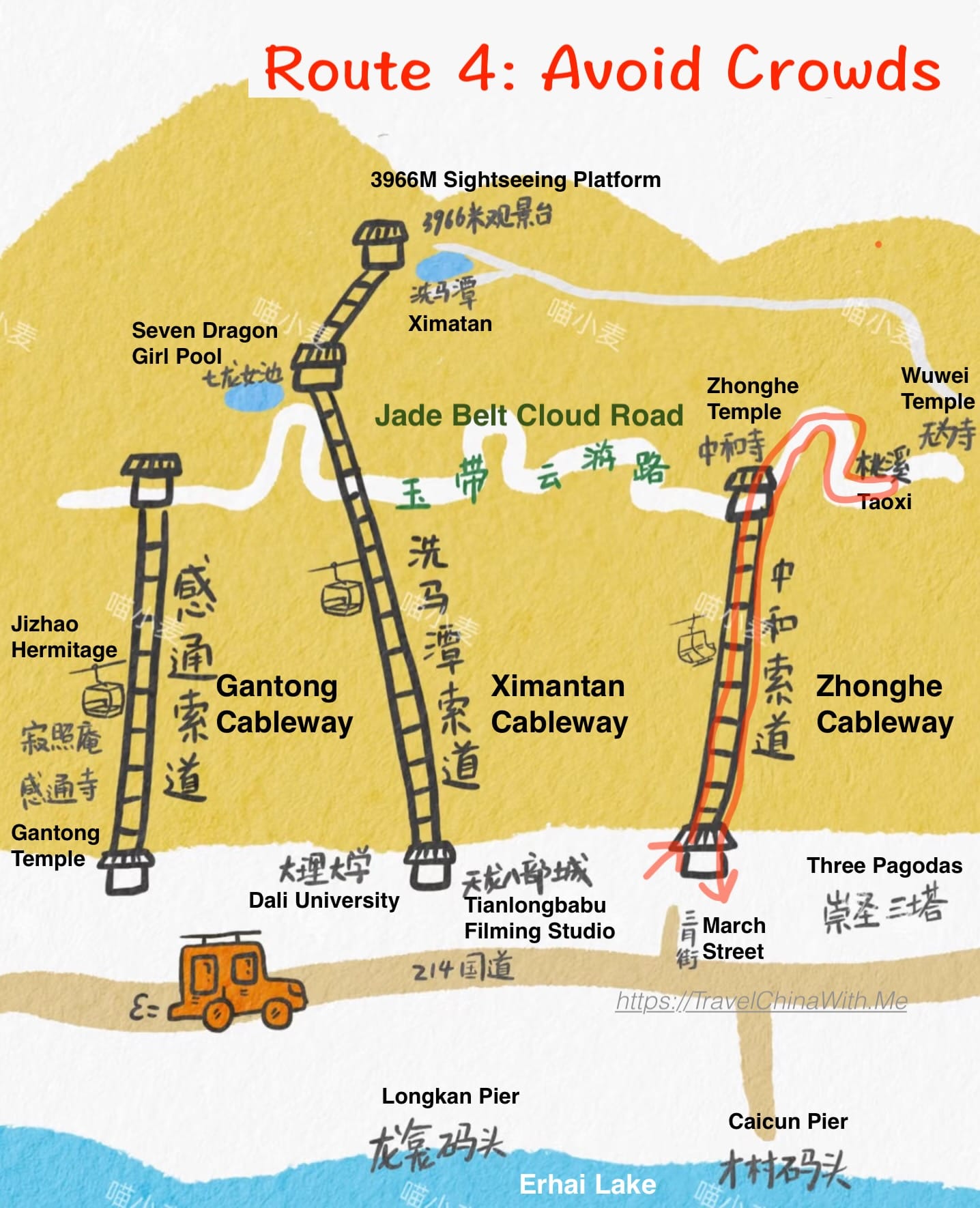
For older travelers, young kids or anyone who’d rather not walk far, ride Zhonghe alone. It’s the cheapest of the three. The open chairlift runs through pine forest and faces Erhai Lake on the way down. Lunch at Zhonghe Temple is usually far less crowded than at Jizhao.
Afterwards, walk a short stretch of Jade Belt Road. Or take the 2.8 km round trip into Peach Creek, which takes our clients an hour.
Know before you ride: the hillside under the Zhonghe line is a local cemetery, visible from the chair. Most riders don’t mind. If you would, take Gantong instead.
Zhonghe up, Gantong down: the classic full day
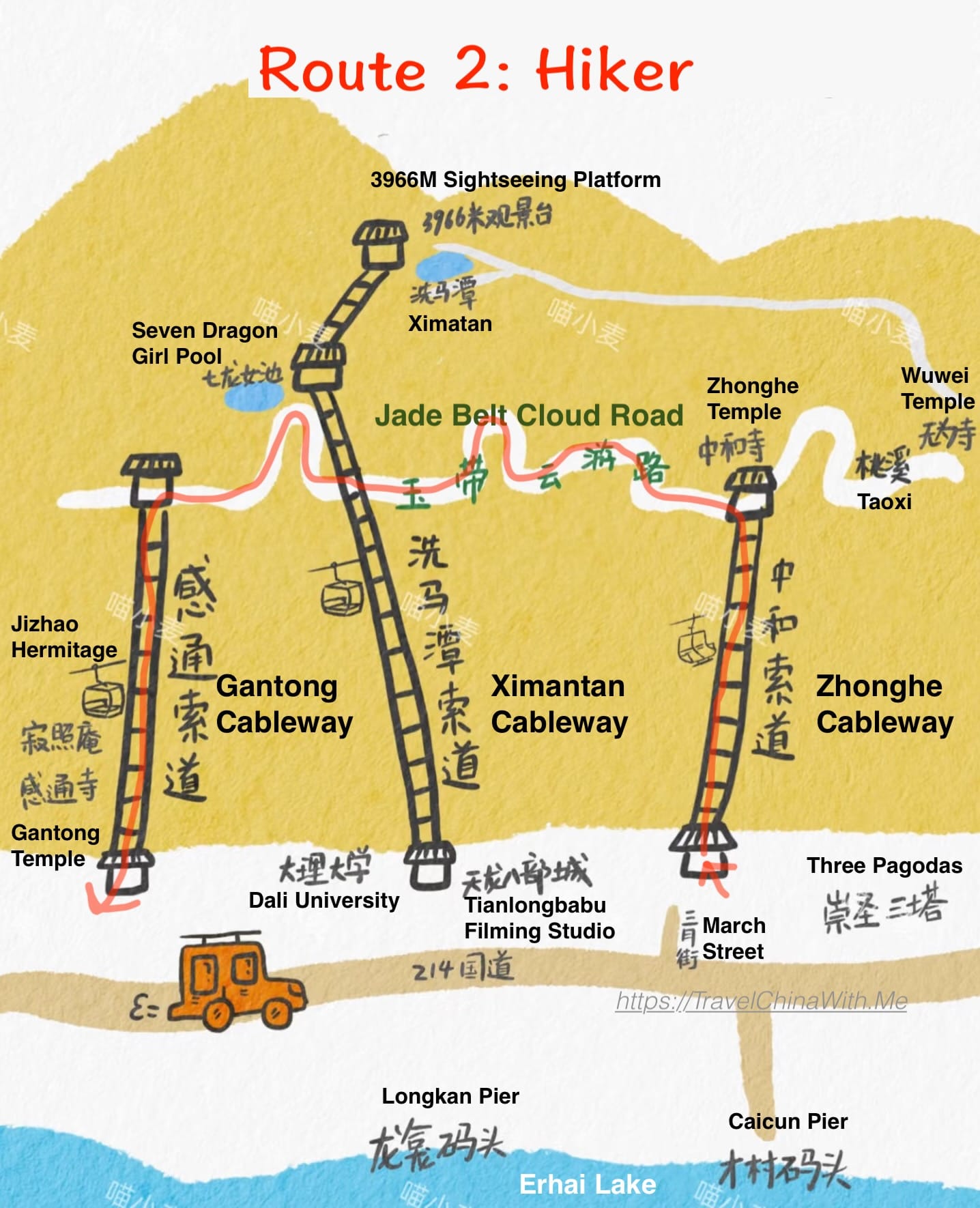
This is the route we give most fit clients. Ride Zhonghe up, turn left onto Jade Belt Road and walk 11.5 km south to Gantong. Heading south keeps Erhai Lake on your left the whole way. The only stairs come at the end, down to the Gantong top station.
Tell the Zhonghe ticket staff you’re transferring to Gantong. That unlocks a CNY 20 transfer fare: CNY 30 up, CNY 20 transfer, CNY 50 down and CNY 35 entry, CNY 135 in total.
The walk itself takes 4–5 hours. With lunch and photo stops, budget 5–7 hours door to door. One of our client groups walked the same stretch in reverse, from 10:35 at Gantong to 16:10 at Zhonghe. Gantong’s last ride down is at 17:00, so start by 10am.
Should you try for the Ximatan summit?
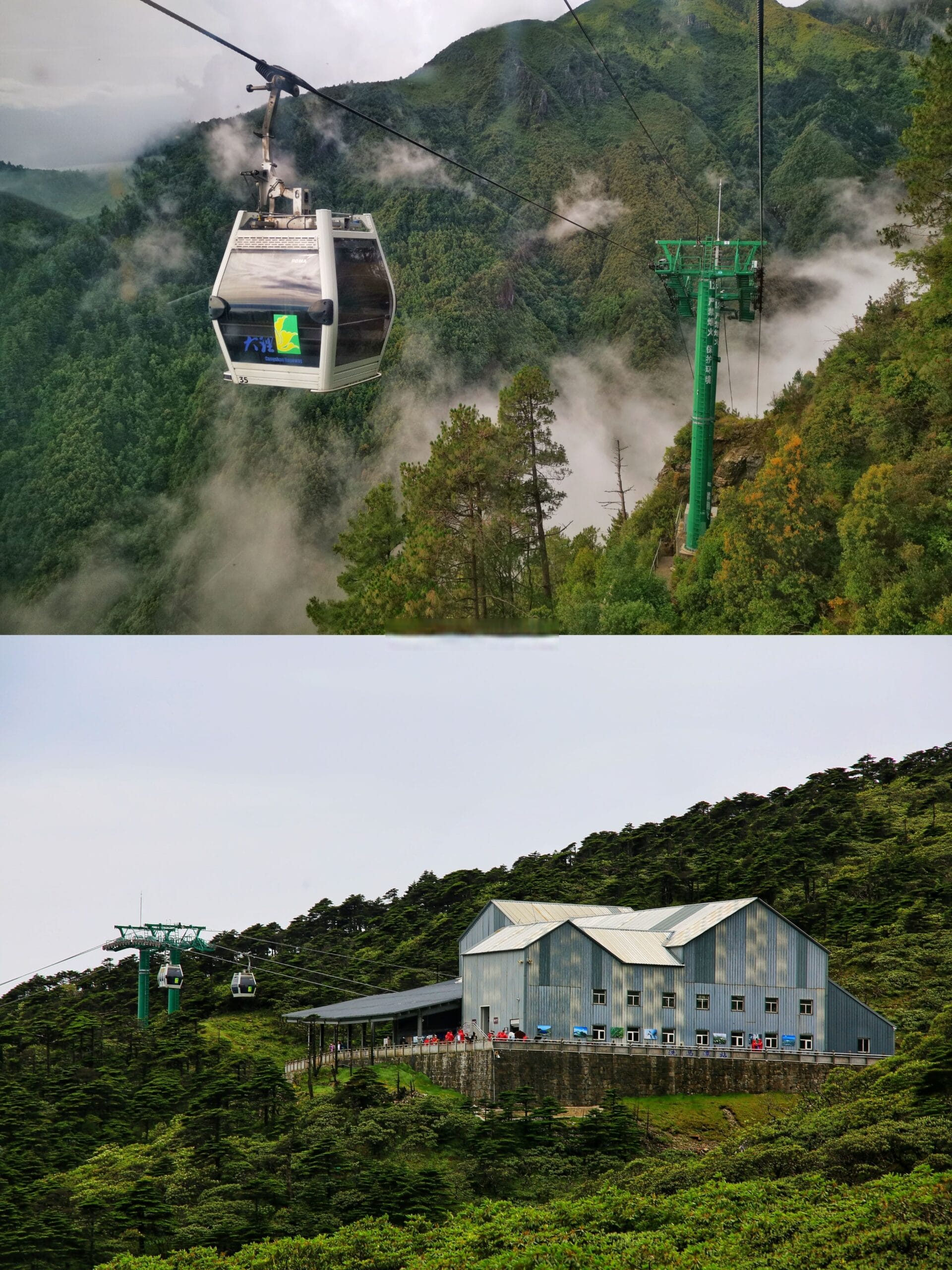
Only if the summit is the point of your trip. Ximatan is the most weather-dependent of the three and can close at short notice in high wind. Our clients check at the staffed ticket window at 8:50am, then buy once it’s confirmed open.
From the top station to the No. 9 viewing platform is a 30–40 minute climb at altitude. Some of our clients have turned back halfway with headaches. Wind at the top is strong, so bring a proper jacket in any season.
On a cloudy day, you may see nothing but white fog. Go only if you can try again on a clearer day.
Don’t ride two separate cable cars in one day
A traverse that rides one line up and another down works well. Two separate round trips in one day don’t. Most of the day goes on queues, transfers and extra tickets. Pick one route and commit to it.
If you miss the last cable car
Don’t walk down from Zhonghe Temple. Clients who tried it describe a narrow, steep, unmarked trail over loose gravel. It passes grave shrines, with nobody else around. If you must walk down, use the Gantong side.
7. Practical Tips
Altitude
⛰️ Cangshan elevation, from Erhai Lake to the summit
Most sights on Cangshan Mountain sit between 2,120m and 2,800m, which rarely troubles visitors. The Ximatan summit at 3,900m is different. Headaches and breathlessness are common enough that we see them in our own clients.
If you want a backup, carry one oxygen canister. A former Cangshan ticket-office worker told us village stalls at the base sell them for CNY 15–20. Inside the scenic area, the same canister runs CNY 40–80. Old Town pharmacies charge CNY 20. One canister is enough for most people.
Weather and safety
Rain and wind can close all three lines with little warning. If the summit matters to you, go early in your trip so you have a spare day.
Our clients report the top can be 15°C colder than the base. One client got soaked by rain, sweated on the climb and came down with a fever. Pack a waterproof jacket even in summer. Start early enough to be down well before dark. Don’t treat an unmarked side path as a shortcut.
Footing and gear
Jade Belt Road’s stone paving grows moss and turns slippery after rain. Wear grip-soled hiking shoes; canvas sneakers slide on wet stone.
Food and water
Beyond the two temple lunches, food means snack stalls near the stations. On the trail itself, there’s only the stall near Seven Dragon Girl Pool. Carry 1.5 liters of water per person for a half-day and 2 liters for the full traverse. Bring your own snacks too.
Booking tickets
Our clients found online booking through Meituan or the operator’s official channel CNY 20–30 cheaper than the window. It also cuts queuing in peak season. Check whether a listed price is one-way or round trip before you pay.
Driving yourself
The three car parks aren’t connected. For the Zhonghe-to-Gantong traverse, park at Gantong first, then take a taxi to Zhonghe. You finish at your car after one taxi ride.
Signal and navigation
Mobile signal drops out in places, and our clients found China Mobile held up best. Download an offline map and screenshot your route before you go. Groups should stay together, since you may not be able to call each other.
We warn clients that leaving the marked trail for the core protected zone can bring a CNY 1,000–5,000 fine. It’s also the easiest way to get lost.
FAQ: Cangshan Mountain
Is Cangshan Mountain worth visiting?
Yes, for most Dali visitors with half a day to spare. The mid-mountain views over Erhai Lake and the Old Town are the main reward. The temples and geology add depth. With only one day in Dali, see the Old Town and Erhai Lake first.
How long do you need at Cangshan Mountain?
A short ride up and a walk to the nearest temple takes 2–3 hours. The Zhonghe-to-Gantong traverse takes 4–5 hours of walking, or 5–7 hours door to door. Our clients report a Ximatan summit trip takes 3.5 hours from base and back.
Which Cangshan cable car should I choose?
Choose Gantong for a relaxed half-day with lunch at Jizhao Nunnery. Choose Zhonghe if budget or ease matters most. Choose Ximatan only if the summit is your goal and you can accept the weather risk.
Is the geopark entrance fee included in the cable car price?
No. A CNY 35 geopark entrance fee is added to every fare, and you pay both at the same window. Children under 1.2m and adults over 60 enter free. Our clients who walked up to Jizhao Nunnery from the Gantong car park didn’t need to pay it.
When is the best time to see the Cangshan azaleas?
May and June are the peak months. The best displays are around Ximatan, near the 3,900m top station. Yellow, white and red rhododendrons bloom there from late spring into early summer.
Is Jade Belt Road hard to walk?
No. It’s paved stone and mostly level along its 18 km. The hard parts are altitude and mossy stone after rain.
What should I watch out for on Cangshan Mountain?
Watch for taxi drivers and touts who push a different cable car from the one you planned. They usually claim a long queue or a closed trail, then earn a commission on the switch. Decide your cable car before you get in the car, and don’t change plans on a stranger’s advice.
Planning Dali and not sure how to split your time between Cangshan Mountain, Erhai Lake and the Old Town? Contact us. We’ve planned Yunnan trips from our Kunming base since 2006.