
Does It Snow in China? Cities, Seasons & What to Expect
We’ve been guiding international travelers through China since 2006. One of the most common questions we get before winter trips: Does it actually snow in China?
Yes, it snows in China — reliably in the northeast, occasionally in Beijing and central cities, rarely in Shanghai, and never in the tropical south. Where and when depends entirely on which part of China you’re visiting. The country spans five climate zones across a territory the size of Europe.
What follows comes from two decades of guiding tours through Chinese winters — clients who planned their entire trip around snow, and clients who had no idea what they were walking into.
Table of Contents
1. Quick Reference: Does It Snow Where You’re Going?
The table below covers the main destinations international travelers ask about. We’ll go deeper on each region below.
City / Region | Snow Season | Avg. Winter Temp | How Reliable |
|---|---|---|---|
Harbin (Heilongjiang) | November – March | −25°C to −9°C | Guaranteed |
Changchun (Jilin) | November – March | −15°C to −5°C | Guaranteed |
Urumqi (Xinjiang) | November – March | −15°C to −5°C | Reliable |
Altay (Xinjiang) | October – April | −20°C to −5°C | Reliable, longest season |
Shangri-La (Yunnan) | November – March | −10°C to 5°C | Reliable |
Beijing | December – February | −10°C to 0°C | Occasional (~14 days/year) |
Huangshan (Yellow Mountain) | December – February | Below 0°C at altitude | Reliable at altitude |
Lhasa (Tibet) | Light, Dec – Feb | −10°C to 10°C | Occasional, city light |
Zhangjiajie (Hunan) | Mid-January – late February | 3°C to 10°C | Possible, not guaranteed |
Xi’an (Shaanxi) | December – February | Around 0°C | Light, occasional |
Shanghai | January | 0°C to 5°C | Rare (1–2 events/year) |
Chengdu city | December – February | 3°C to 10°C | Very rare |
Guilin / Guangzhou | Rarely | 8°C to 15°C | Very rare |
Sanya (Hainan) | Never | 22°C to 28°C | None |
Temperature data sourced from China Meteorological Administration historical averages.
Average Snow Days per Month — Key China Destinations (Oct–Mar)
Sources: weather-and-climate.com; climatestotravel.com; Weather Atlas. Altay from CMA Xinjiang records. Normals 1991–2020.
2. Where to Go: Month-by-Month
China’s snow season runs nearly six months from north to south. The table shows where to go for snow in each month — and the logic shifts significantly as the season progresses.
Month | Where to Go for Snow |
|---|---|
October | Altay (Xinjiang), Harbin, Changchun, Inner Mongolia (Hulunbuir), Shangri-La mountains |
November | All of Northeast China; Shangri-La town; Beijing (rare early flurry) |
December | Northeast (heavy, festival prep begins); Shangri-La; possible in Beijing, Xi’an, Huangshan |
January | Peak month — Northeast guaranteed, Ice Festival open, Zhangjiajie mountains possible, CNY cold waves building |
February | Zhangjiajie and Huangshan most likely; Northeast still frozen; Shangri-La still good |
March | Harbin extending into spring; Shangri-La still possible; most other regions thawing |
Annual Snowfall by Destination — Approximate Season Total (cm)
Sources: China Meteorological Administration; weather-and-climate.com. Altay ~300 cm/season from Xinhua 2026. Huangshan figures represent summit station (~1,800 m). Values are approximate climatological normals.
The best single month for snow travel in China: January. Guaranteed snow in the northeast, the Ice Festival at full scale, Chinese New Year energy building across the country, and the highest statistical chance of rare snow events in central and southern destinations.
Inner Mongolia’s Hulunbuir grasslands — a vast frozen steppe where January lows hit −28°C — are worth flagging for travelers who want something genuinely off the beaten path. The annual Ice and Snow Naadam Festival draws visitors from Russia and Mongolia as well as domestic tourists. Infrastructure for international visitors is thin, but it’s one of the most distinctive winter landscapes in China.
3. Where It Definitely Snows: Northeast China
Northeast China — Heilongjiang, Jilin, and Liaoning — is where winter gets serious. This is Siberian air territory. If you’ve ever doubted whether China gets real snow, come here.
Northeast China — Avg. Snow Days per Month (Oct–Mar)
Source: weather-and-climate.com; climatestotravel.com. Normals 1991–2020. Changbai Mountain data from Changbai county station (~700 m); summit conditions are more severe.
Harbin: China’s Ice City

Harbin is in a category of its own. First snow typically falls in mid-November. By January, the average low hits −24°C (−11°F) and the Songhua River freezes solid. Annual snowfall totals around 100 cm, and the snow doesn’t melt — it just accumulates.
This is why the Harbin International Ice and Snow Sculpture Festival works. Ice carved from the Songhua River in December stays intact well into February. The engineering is only possible because of the cold. The 2025–2026 edition of Harbin Ice and Snow World spanned 1.2 million square metres — its largest footprint ever — drawing an average of 47,000 visitors per day, with peaks of 120,000. For a full overview of what to see beyond the Ice Festival, see our Harbin attractions guide.
Peng Li’s family from Singapore came in December 2024. What got them wasn’t the aesthetics — it was the fun. The slides, the performances, the physical energy of the place. They told us it was the highlight of their entire China trip — not the Great Wall, not the Forbidden City.
Delphine’s group from France visited in January 2026. What surprised them most was the technology: a fully integrated app with real-time maps, wait times, and lighting schedules — visual-first, no Chinese required. Delphine called it a theme park from the future. France has plenty of winter. They’d never seen anything like this.

People who go — including people from countries with real winters — come back saying they’ve never experienced winter tourism like it.
January 5 is the official festival opening, but Ice and Snow World opens from around December 17. For the full festival atmosphere plus guaranteed snow, aim for early January. If you prefer fewer crowds with the same scenery, late December works just as well.
The China Snow Town (中国雪乡) sits about 280 km southeast of Harbin near Mudanjiang. Snow accumulation reaches 2 metres. The mushroom-shaped snow caps on the village rooftops are unlike anything we’ve seen elsewhere in China. It’s one of the few places left in the country where a winter village still looks the way it has for a century.
Changchun and Jilin City

Changchun averages around 50 cm of snow annually. It’s the gateway to Jilin City, where you can see rime ice (雾凇) — a natural phenomenon where river mist freezes onto tree branches, coating them in crystalline white. The Songhua River embankment in Jilin at sunrise, lined with ice-covered willows, is one of the most underrated winter scenes in China.
Shenyang gets around 40 cm of snow per year. It anchors a northeast circuit well, though it’s primarily a working city rather than a snow tourism destination.
Changbai Mountain, Jilin
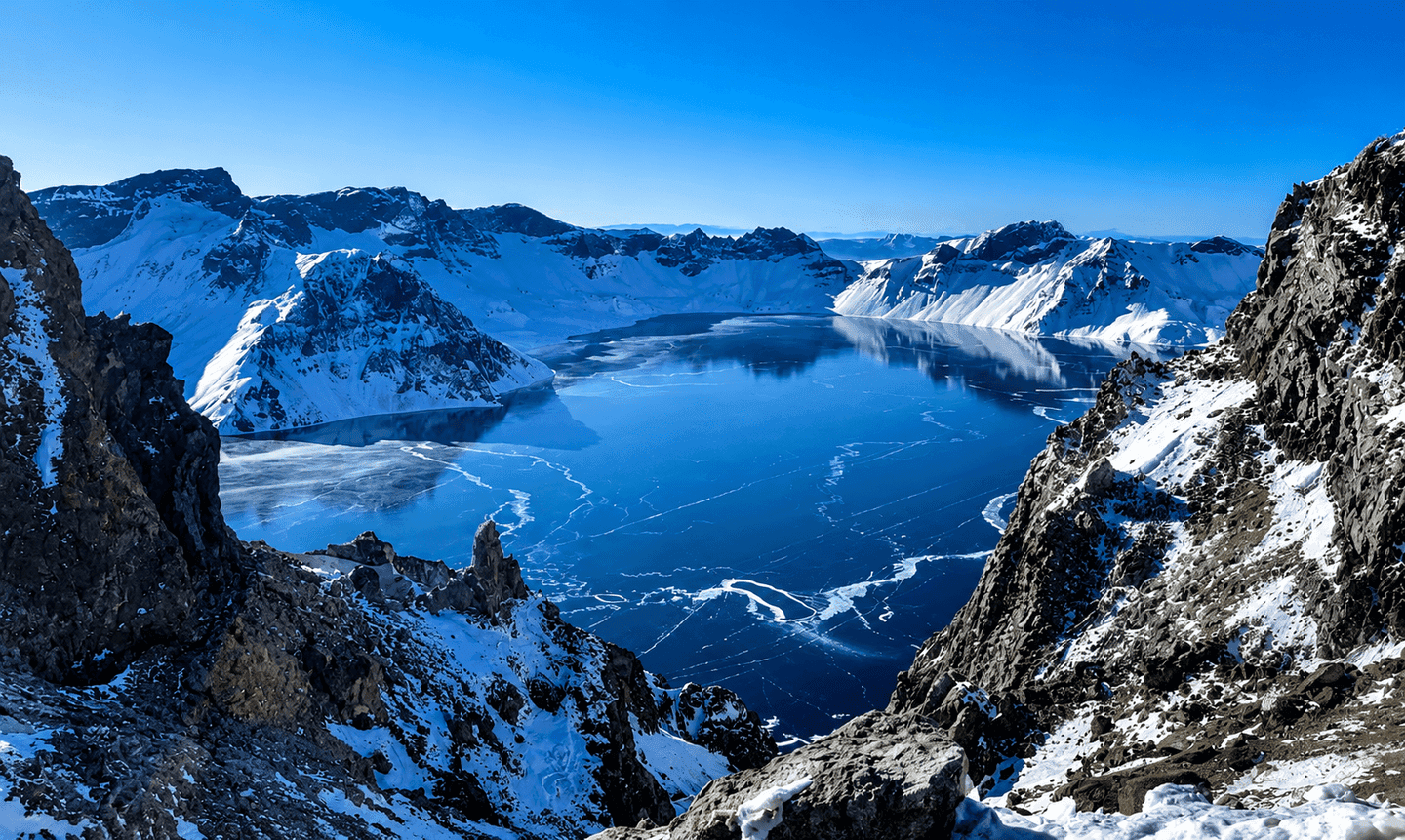
Changbai Mountain sits on the North Korean border, with its main peak at 2,744 metres. In winter the Tianchi crater lake partially freezes, and the valley below fills with rime-frosted forest and steam from geothermal vents. The combination of deep snow, hot springs, and primeval conifer forest is unlike anything in the Harbin lowlands. The ski resort at the north slope runs from November to April. Winter visits require careful logistics — the mountain is genuinely remote and access roads can close — but for travelers willing to plan ahead, it’s one of the most striking winter landscapes in the northeast.
4. Beijing: Snow Exists, But Don’t Bank on It
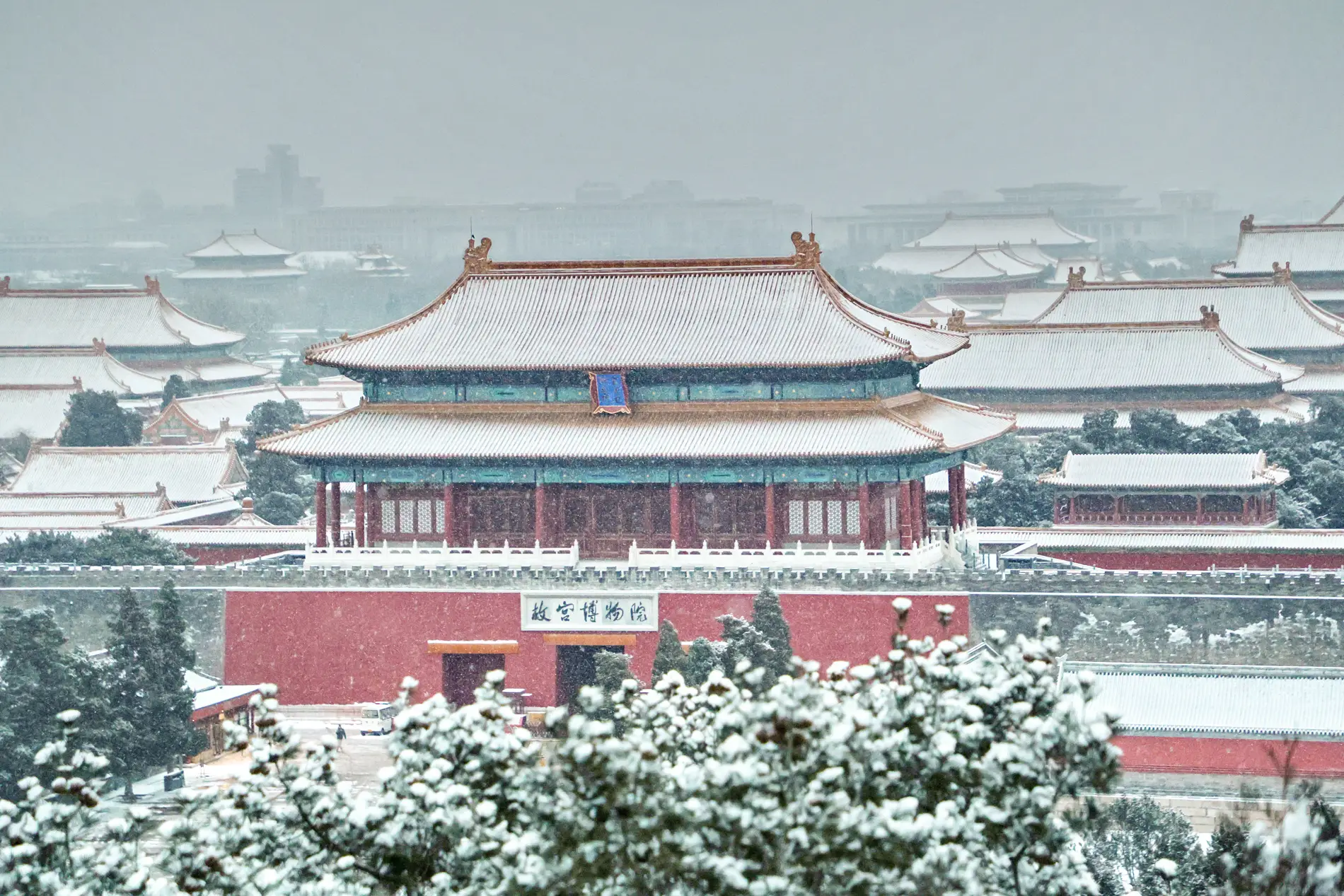
We have to be direct here. We’ve had clients arrive in Beijing expecting a snow-covered Forbidden City and find clear, dry, freezing sky. Beijing’s winter is cold — but it’s also dry. The average annual snowfall is only about 8.4 mm, spread across roughly 14 days, most of them light dustings.
Beijing’s geography partly explains this. It sits inside what meteorologists describe as the “Beijing Bay” — a concave topographic basin that blocks moisture-carrying winds. Cold air arrives from the northwest without enough water vapor to produce much snow.
Beijing — Avg. Snow Days & Min Temp (Oct–Mar)
Bars = snow days · Line = avg. min temperature (°C)
Source: weather-and-climate.com. Jan avg. 2 snowy days, 4 mm snowfall. NMIC 1951–2019: avg. 0.4 heavy-snow days/year.
When it does snow, it is extraordinary. We had a guest stand at Jingshan Park after a January snowfall and go completely quiet. Red walls of the Forbidden City, gold rooftops, everything white. She’d been to Beijing three times before and said it felt like a different city.
Statistically, significant snowfall is genuinely rare. Data from the National Meteorological Information Center covering 1951–2019 shows Beijing averaged just 0.4 heavy-snow days per year. January 18, 2026 brought the capital’s first proper snow of that year — enough to send hundreds of photographers sprinting to Jingshan.
If you’re in Beijing between December and February and snow starts falling, drop everything. Go to Jingshan Park for the Forbidden City view, or head to Mutianyu Great Wall if you have transport. The window is short. Beijing snow often melts within a day or two.
5. Zhangjiajie: The Snow Scene No One Talks About Enough
We’ve operated in Zhangjiajie since before the region became internationally known. The snow-season story here has always been under-told.
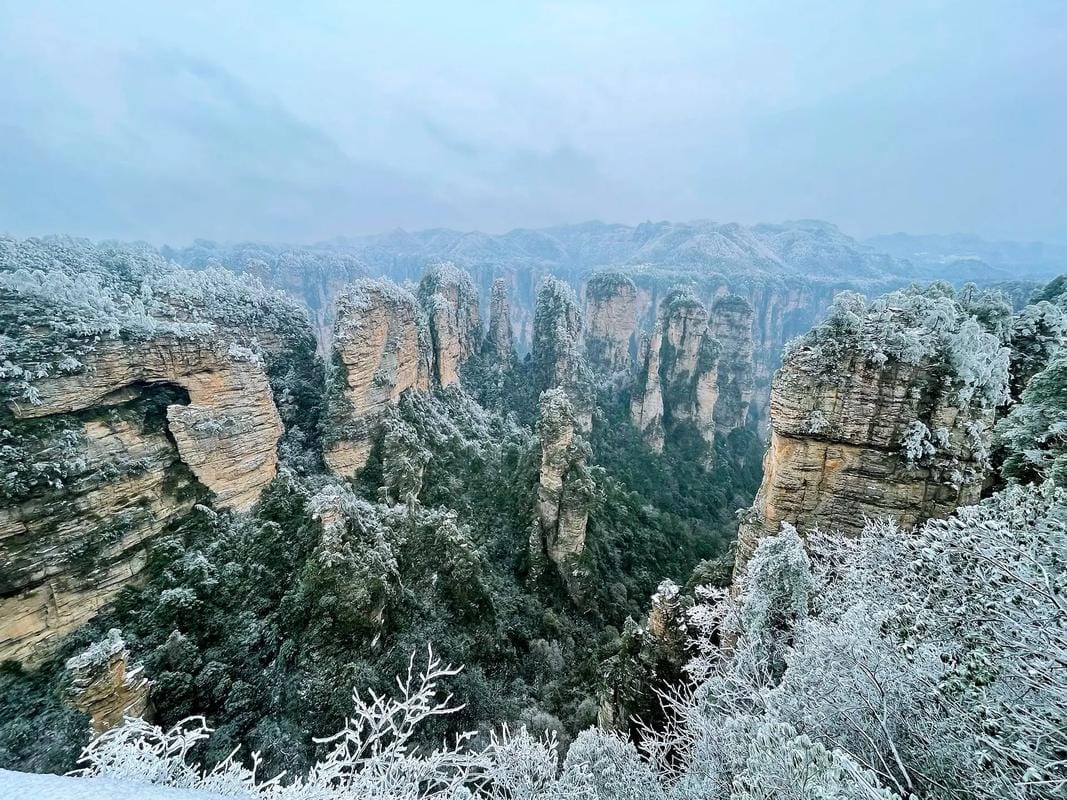
Zhangjiajie sits in Hunan Province, central-south China. The valley floor stays mild in winter — 3°C to 10°C, easy to manage. But the peaks of Tianzi Mountain and the upper reaches of Zhangjiajie National Forest Park sit well above 1,000 metres. When cold air pushes south — typically mid-January through late February — those sandstone pillars get coated in snow and rime ice.
The effect is unlike any other snow destination in China. The towering rock formations draped in white, mist threading between them, blue sky above — there is no equivalent image in Chinese winter travel. In February 2025, a sudden cold wave brought snowfall to the Tianzishan Scenic Area. China Daily covered it. The cable cars still ran. People who happened to be there that day witnessed something very few international visitors ever see.

On New Year’s Eve 2025, Carmen’s group from Mexico stood looking at Tianmen Mountain lit against a snow-covered sky. Carmen grew up where winter means a light jacket. She told us she didn’t know how to place what she was seeing. Her group went quiet.
For many of our clients from tropical countries, Zhangjiajie in winter is their first real snow — inside one of the most extraordinary landscapes on the planet.
Zhangjiajie — Avg. Snow Days & Min Temp (Oct–Mar)
Bars = snow days · Line = avg. min temperature (°C)
Source: Weather Atlas. Valley station: ~10.3 snow days/year total; Jan peak 4.2 days. Mountain viewpoints (Tianzishan, Yuanjiajie) experience more snowfall than the valley floor.
Snow is most likely between mid-January and late February, bracketing Chinese New Year. The average valley temperature of 3°C to 10°C is manageable — nowhere near Harbin cold. Snowfall at the peaks doesn’t always reach the valley floor, so position yourself at mountain viewpoints rather than the valley base. And check weather forecasts 3–5 days ahead; long-range winter forecasting in Hunan is unreliable.
Winter is also Zhangjiajie’s off-season. Crowds drop to roughly one-third of peak summer. We’ve walked through Yuanjiajie in near silence, stood at the cliff edge without a queue. That alone is worth the trip, snow or no snow.
DIG DEEPER: Snow in Zhangjiajie: Season, Best Spots & What to Expect
6. Central and East China: The Complicated Middle
This belt — Shanghai, Nanjing, Wuhan, Xi’an, and the Yangtze River basin — routinely catches international visitors off guard. The reason is a policy dating back to the 1950s: the Qin-Huai Line, running roughly along the Qinling Mountains and Huai River at latitude 33°N. North of it, cities have government-subsidized centralized heating piped into buildings. South of it, they don’t. Shanghai, Hangzhou, Nanjing, Chengdu — none of them have central heating in most buildings.
Central & East China — Avg. Snow Days per Month (Oct–Mar)
Sources: climatestotravel.com. Huangshan data represents peak station (~1,800 m).
In practice this means restaurants, hotel lobbies, and budget guesthouses in this zone heat themselves with air-conditioning units, if at all. We’ve had clients arrive in Shanghai expecting the cold to be the outdoor cold — 5°C, manageable. Instead they find themselves sitting in a restaurant at 3°C with their coats on. The felt temperature is often worse than the thermometer suggests, and that discomfort compounds if it rains.
Shanghai
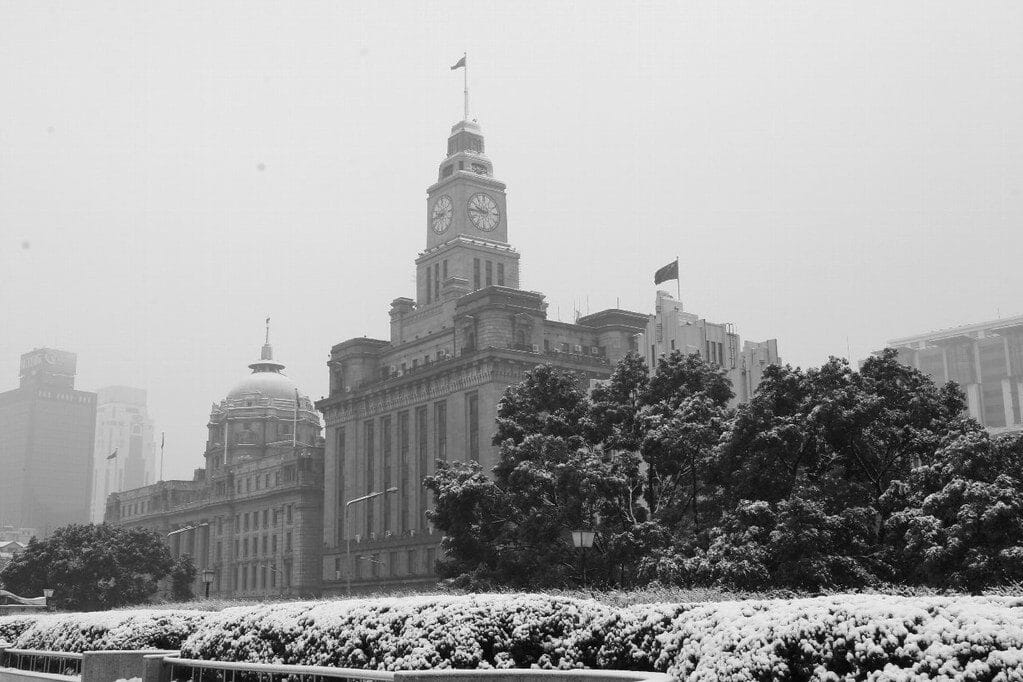
Shanghai gets snow roughly once or twice a year, usually in January. Events are brief — typically under 12 hours — and snow rarely accumulates more than a few centimetres. January 20, 2026 brought what one long-term foreign resident described as only his second real snow in 7 years of living there. Even a partial snowfall stops the city. People flood the Bund and Yuyuan Garden to photograph it.
You can’t plan a trip around Shanghai snow. But if you’re there in January and it happens, it’s worth witnessing.
Xi’an
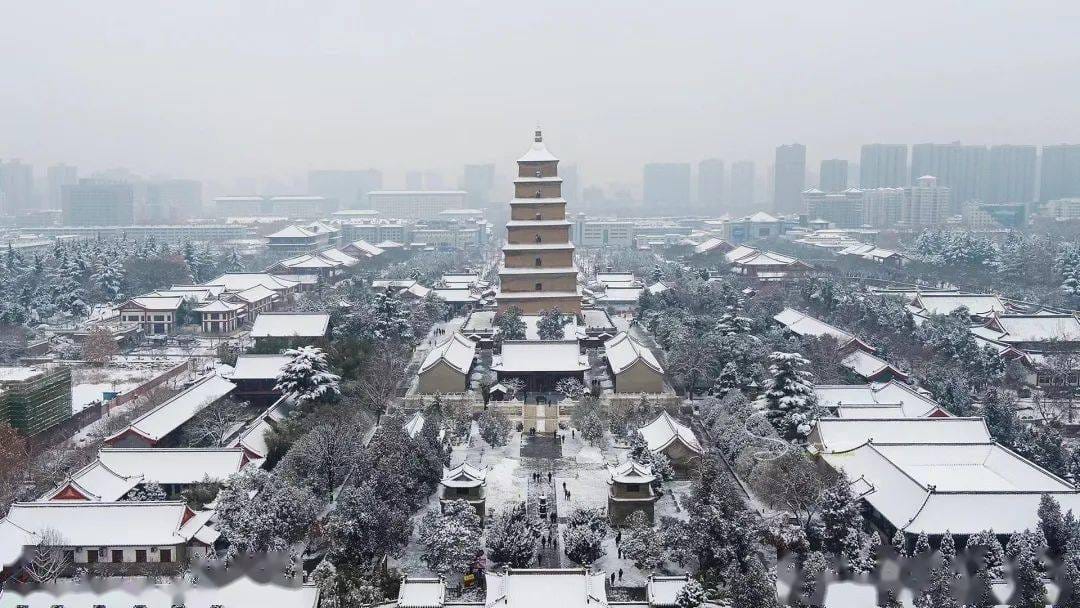
Xi’an typically sees light snow in December–February, with temperatures hovering around 0°C. The snowfall is rarely heavy, but the city’s Tang and Ming Dynasty landmarks transform when it falls. The City Wall — 14th century, 13.7 km, still fully intact — carries a clean line of white along its battlements and watchtowers, and in winter you can walk or cycle the full perimeter in near silence. The Bell Tower and Drum Tower at the city centre, with snow on their glazed tile rooftops and red lacquer columns, look exactly like a classical Chinese painting — because architecturally, they are. The Big Wild Goose Pagoda, built in 652 AD at the end of a long ceremonial avenue, has a stillness in winter snow that the summer crowds make impossible.
Huangshan (Yellow Mountain)
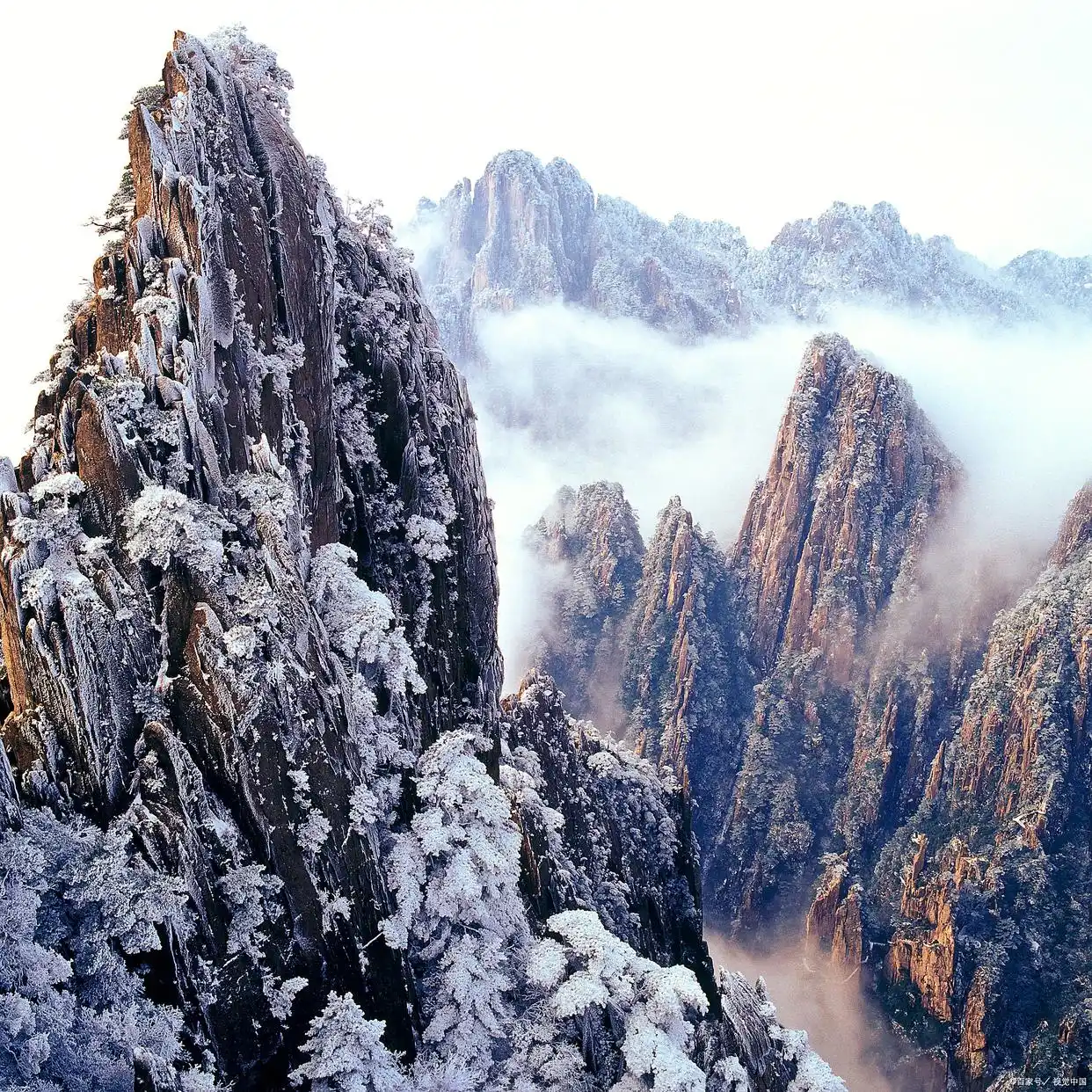
Huangshan is one of the best-kept winter secrets in eastern China. The mountain tops 1,800 metres and regularly gets significant snowfall December–February. Snow-covered pine trees, ink-wash mist, granite peaks — it’s the direct visual source of the classical Chinese landscape painting tradition. In winter, crowds thin dramatically and cable car queues disappear. The mountain in winter shows a version of itself that the summer tourist never sees.
7. Northwest, Southwest, and the High Plateau
Northwest, Southwest & High Plateau — Avg. Snow Days per Month (Oct–Mar)
Sources: Altay — CMA Xinjiang records; Urumqi — weather-and-climate.com; Jiuzhaigou — weather-and-climate.com; Shangri-La — WeatherSpark; Lhasa — weather-and-climate.com; Kunming — climatestotravel.com. Normals 1991–2020.
Altay, Xinjiang: China’s Longest Snow Season
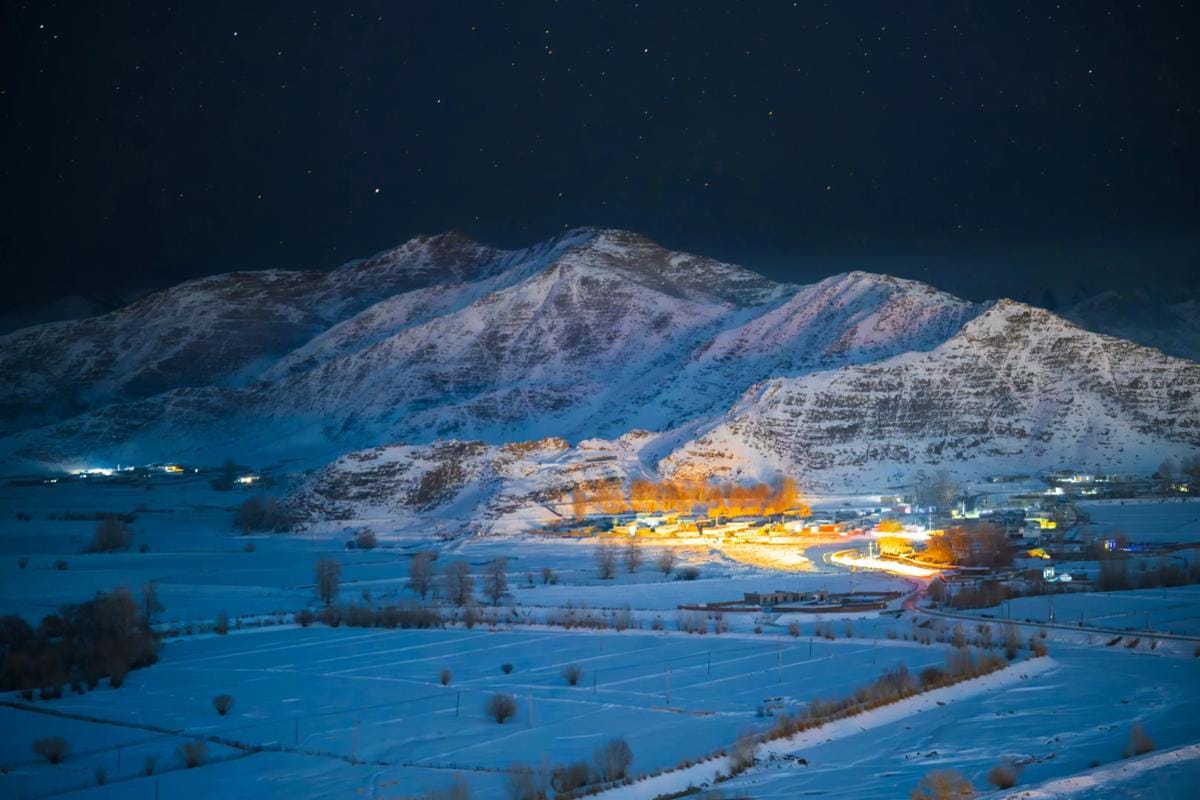
Altay is the sleeper destination of Chinese winter travel. Tucked in the far northwest on the southern slopes of the Altai Mountains — which span China, Russia, Mongolia, and Kazakhstan — it holds a record that few tourists know about: the longest ski season in China, running from October to April. Average snow depth exceeds 1.5 metres. In 2025, Jiangjunshan International Ski Resort received 1.12 million visits, up 30 percent from the previous year.
What makes Altay different from Harbin is the combination of serious snow with a landscape that feels genuinely Central Asian. The Kanas Lake area in winter — frozen turquoise water, rime-frosted spruce forests, Tuvan wooden lodges under deep snow — looks nothing like any other Chinese winter destination. The local Kazakh communities still practice ancient fur-ski traditions here, and visitors can watch fifth-generation craftsmen make horsehide skis by hand.
Certain areas in Xinjiang have specific entry regulations for international passport holders, and logistics are more complex than in northeast China. Altay Airport has direct flights to 13 major Chinese cities including Beijing and Guangzhou, but this remains a destination that rewards advance research and careful planning.
Shangri-La, Yunnan
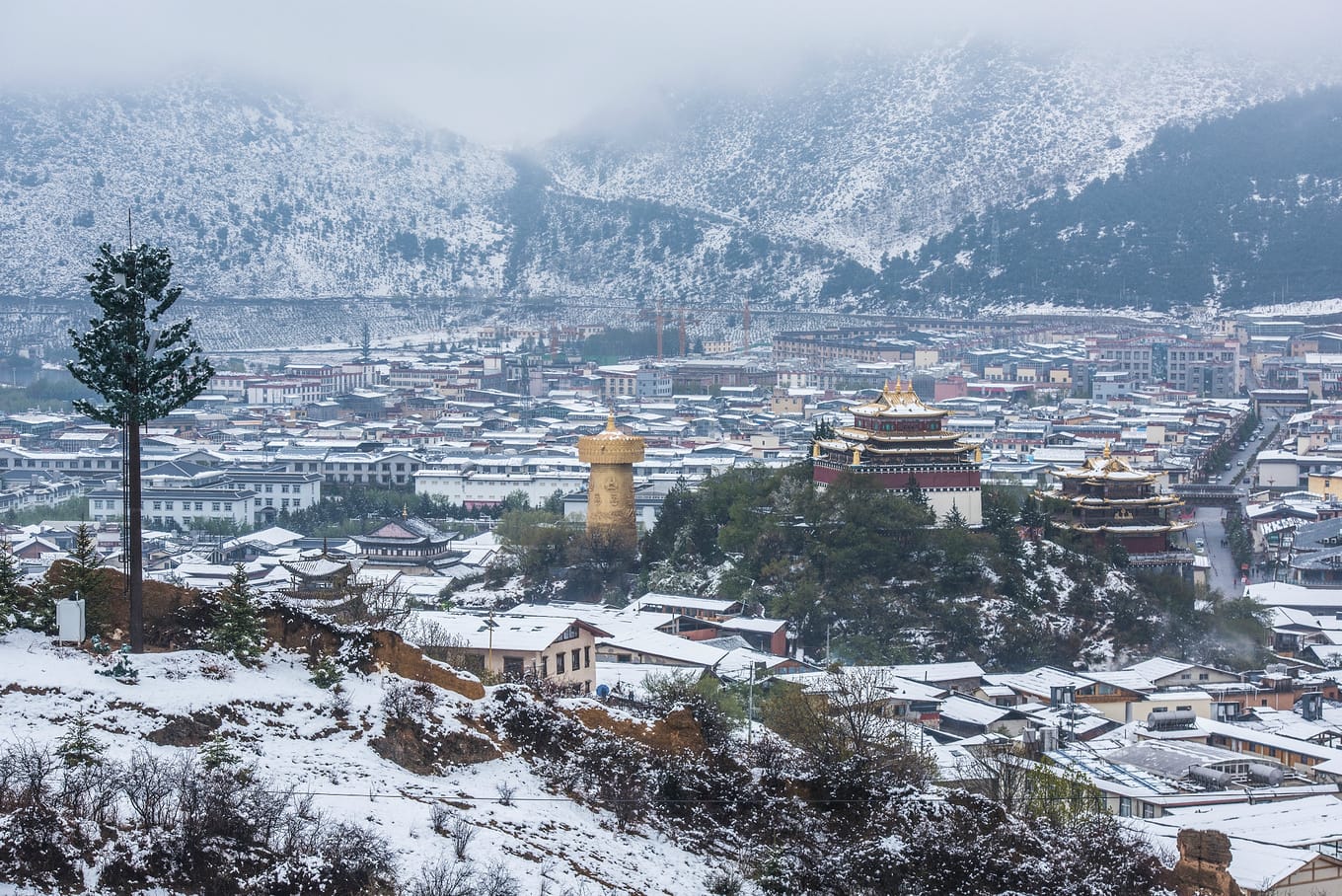
Shangri-La sits at 3,450 metres on the southeastern edge of the Tibetan Plateau, in the Diqing Tibetan Autonomous Prefecture of northern Yunnan. At this altitude, winter is real. November through March brings regular snowfall to the town and surrounding mountains. Nighttime temperatures drop to −10°C or below, while days can stay around 5°C and — crucially — often stay sunny and clear, which is Shangri-La’s winter signature.
White ground, blue sky, golden light on the Ganden Sumtseling Monastery, Meili Snow Mountain visible on the horizon — it’s a quieter snow destination than Harbin, without the festival infrastructure, but more atmospherically Tibetan. The Gedong Festival, a major Tibetan Buddhist ceremony at Songzanlin Monastery, takes place in late December by the Tibetan calendar and draws pilgrims from across the plateau.
A practical note: road access to some surrounding areas can be restricted after heavy snowfall, and altitude sickness is a genuine concern at 3,450 metres. Acclimatise for at least a day before doing anything strenuous.
Tibet: Snow Surrounds Lhasa, But Rarely Lands in It
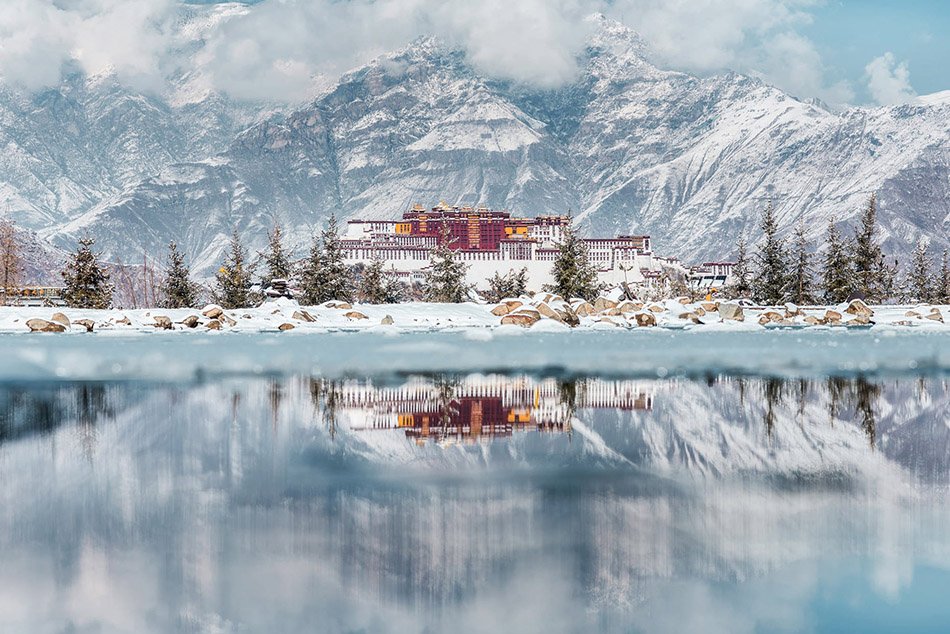
Most visitors expect Lhasa to be buried in snow. The reality is that the city itself sees only occasional light snowfall in winter — sometimes none at all. The plateau climate is dry and precipitation is low. What you do get is snow-capped mountains framing every view of the Potala Palace, and occasionally a dusting that transforms the city overnight. Yamdrok Lake freezes in winter. Mountain passes above 4,000 metres accumulate significant snow and sometimes close. Western Tibet sees heavier snowfall than Lhasa.
In practical terms: winter in Lhasa means daytime temperatures of around 5–10°C, clear blue skies, minimal tourists, lower hotel prices, and Tibetan pilgrims on the Barkhor circuit in numbers you won’t see in summer. The Potala Palace in low winter sun, with snow-covered peaks behind it, is genuinely one of the great photography moments in China. You just can’t guarantee snow in the city itself.
Note: Tibet requires a Tibet Travel Permit in addition to a standard Chinese visa, regardless of your nationality. This applies even to visa-free nationalities. Plan accordingly.
Jiuzhaigou Valley, Sichuan
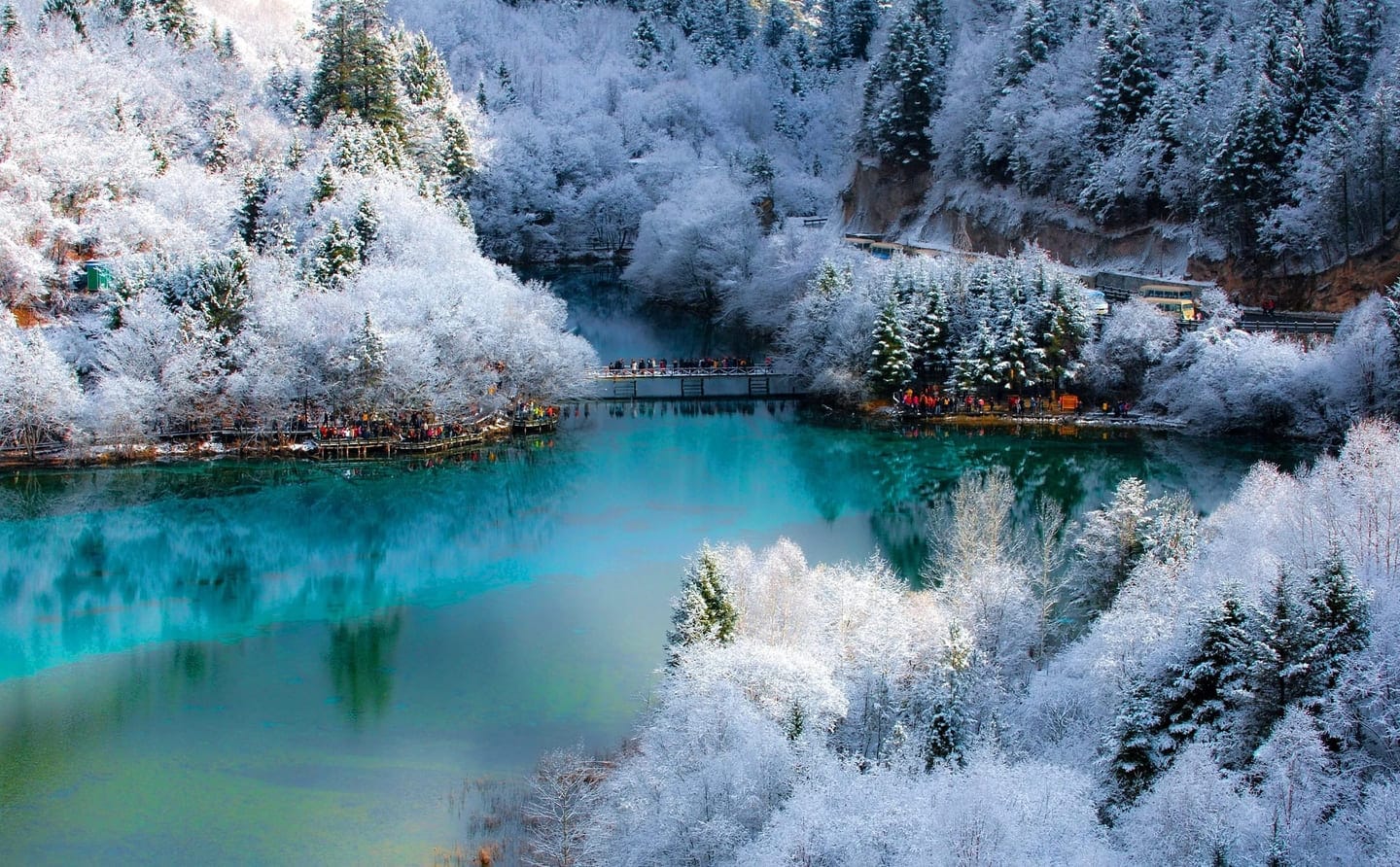
Jiuzhaigou sits at 2,000–4,500 metres. In winter, lake surfaces partially freeze and waterfalls slow to icicles. The contrast between frozen turquoise water and white snow is unlike anything at lower altitudes. Check road conditions before visiting — high-altitude access can close after heavy snow.
Lijiang and Chengdu
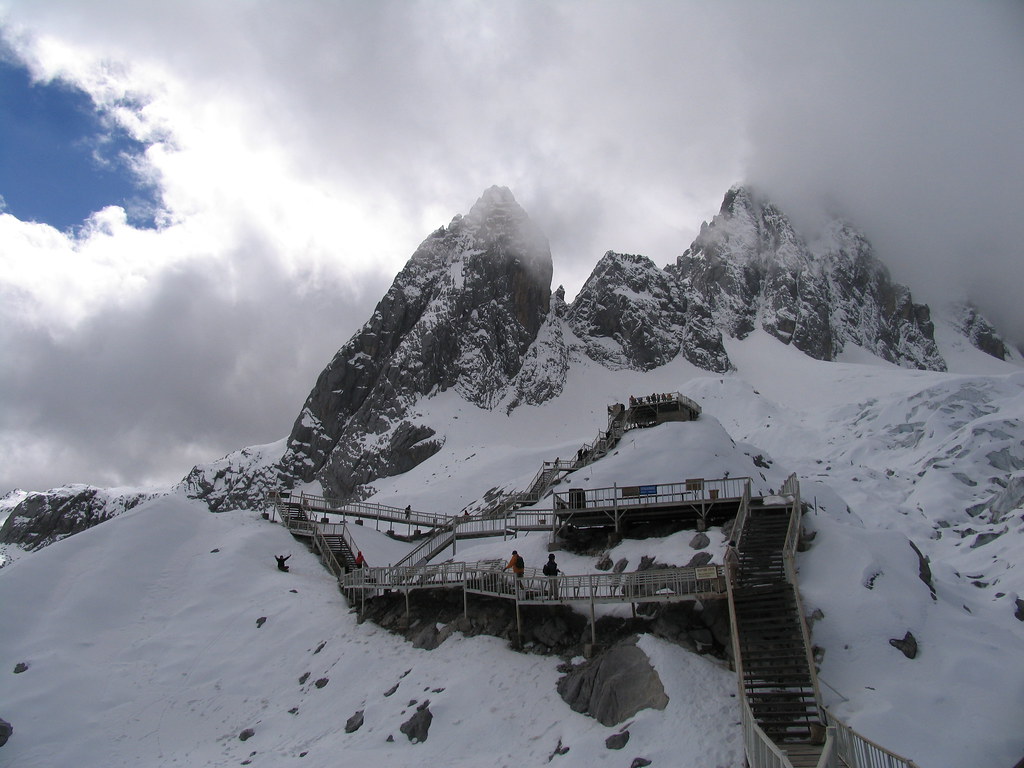
Lijiang in Yunnan has Jade Dragon Snow Mountain permanently capped at 5,596 metres. The old town rarely gets snow but sits at 2,400 metres with mountain views in every direction. Chengdu almost never sees snow in the city. But it’s the gateway for mountain snow destinations in western Sichuan, and arguably the best Chinese city for grey winter days — the teahouse culture and hotpot scene were built for exactly this weather.
8. Chinese New Year and Snow: The Connection Most Guides Miss
Chinese New Year falls between late January and mid-February depending on the year. In 2025 it was January 29. In 2026, February 17. In 2027, February 6.
For snow travelers, this matters in two ways that pull in opposite directions.
First, crowds spike sharply. Domestic tourism during CNY Golden Week fills Harbin’s hotels months in advance and turns the Ice Festival into a genuinely overwhelming crowd experience. Booking 2–3 months ahead in January is not optional.
Second — and this is the counterintuitive point — CNY timing often correlates with the best chance of snow in central and southern China. The same cold waves that lock the northeast in permafrost push moisture-laden air south into Hunan, Anhui, and Sichuan. Zhangjiajie and Huangshan see their most reliable snow events during exactly this window. On January 18, 2026, the first major cold wave of the year swept south across the country, bringing snow to Hunan, Henan, and Guizhou simultaneously.
For central/southern snow seekers, the week just before CNY is often the sweet spot: cold air building, crowds not yet at peak, statistical window open for snow.
Frequently Asked Questions
Does it snow in Kunming?
Rarely in the city itself. Kunming is known as China’s “Spring City” for a reason — its average January temperature stays around 8°C. Occasional cold snaps can bring brief frost or light snow, but it’s not something to plan around. The surrounding mountains are a different story: Jiaozi Snow Mountain, about 70 km north of the city, gets reliable winter snowfall and has ski facilities. Kunming is best treated as a mild-weather winter base, not a snow destination.
Does it snow in Chengdu?
Almost never in the city itself. Chengdu has a mild, humid climate and sits below the altitude where winter precipitation becomes snow. It does get cold and grey — typically 3°C to 8°C in January — but actual snowfall in the urban area is rare enough to make local news when it happens. If you want snow near Chengdu, the mountains to the west — Xiling Snow Mountain (西岭雪山, about 90 minutes away) — are a reliable option in winter.
Which is the snowiest city in China for tourists?
Harbin. Around 100 cm of annual snowfall, a snow season running roughly 6 months, and the world’s largest ice and snow festival all in one city.
Does it snow in Hong Kong?
Extremely rarely. A handful of recorded events in the city’s entire modern history. The subtropical climate keeps it wet and cool in winter, not snowy.
Does China use artificial snow?
At ski resorts, yes — the 2022 Beijing Winter Olympics relied almost entirely on machine-made snow. This doesn’t affect sightseeing destinations like Harbin, Zhangjiajie, or Huangshan, which depend on natural snowfall.
Does it snow in Guilin?
Rarely, and even then lightly. Guilin has a subtropical climate, and while temperatures drop to 5–10°C in January, actual snowfall is unusual. The Li River and karst peaks are genuinely beautiful in cold weather — mist sits on the water, light is soft, crowds are minimal — but it’s a winter landscape without snow. If you want snow in the south, Huangshan or Zhangjiajie are better bets.
We’ve organized China winter tours since 2006 — from Harbin ice festival circuits to first-snow experiences in Zhangjiajie for clients who’d never seen winter before. If you’re planning a trip and want an honest read on timing and conditions, get in touch.