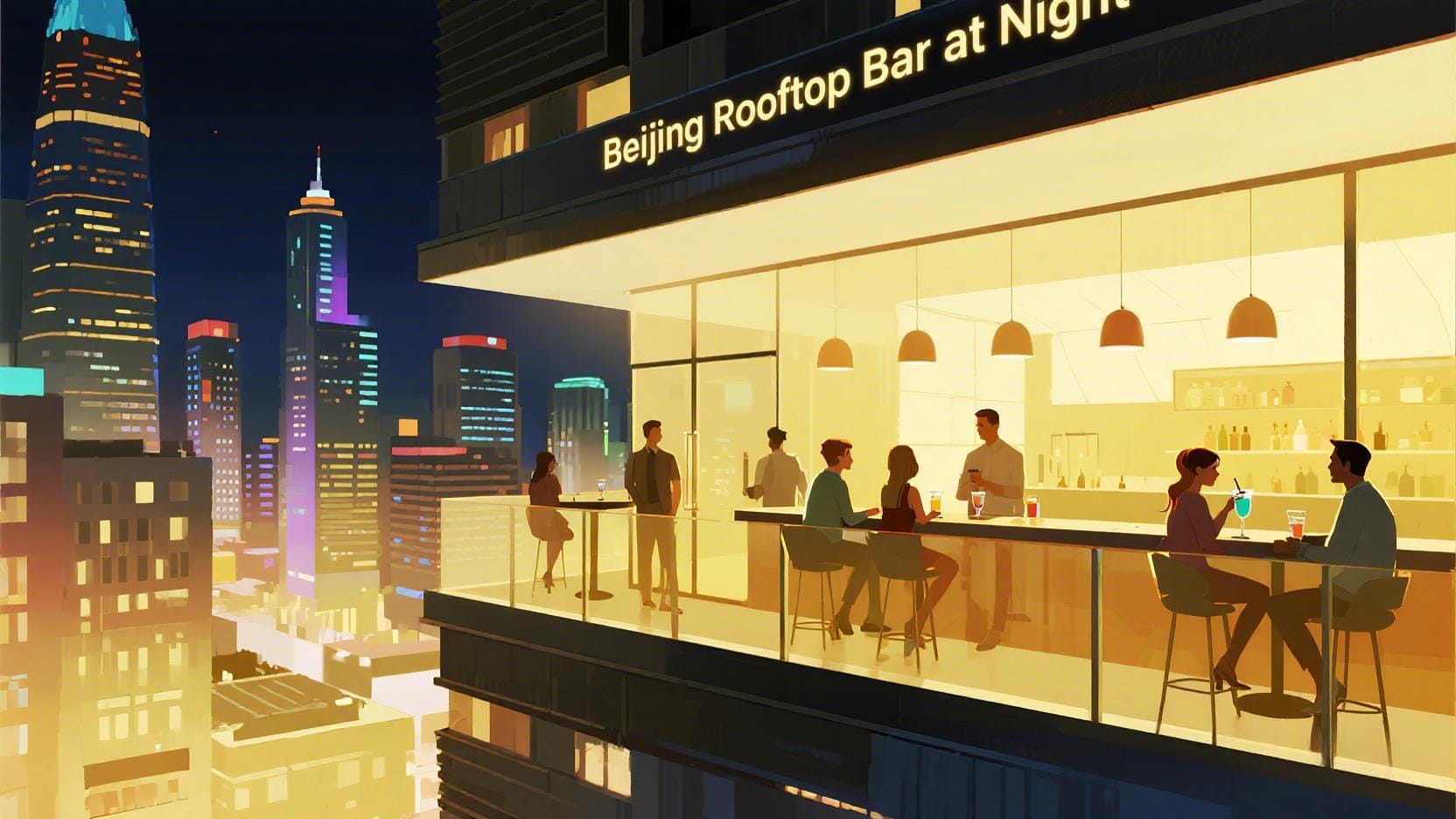
Beijing Nightlife: 10 Best Things to Do After Dark
People often tell us Beijing is the “serious” capital — culturally rich by day, quiet by night. Shanghai is where you go for nightlife, the story goes. We’ve heard this for twenty years. It’s wrong.
Beijing after dark operates on a different register than Shanghai, not a lesser one. Shanghai sells you a skyline and a cocktail. Beijing gives you a 600-year-old watchtower lit against a winter sky, the smell of mala broth drifting down a lantern-lined alley at midnight, and the sound of an erhu drifting across a lake where emperors once boated. These are not comparable experiences. They’re not competing. But if you arrive in Beijing thinking the evenings are just recovery time between temples, you’ll leave having missed half the city.
We’ve been running private English-language tours in China since 2006. Our guides have walked these evening routes with thousands of international visitors, made the mistakes, learned the shortcuts, and watched people’s faces at the exact moment Beijing nights stop being “interesting” and start being unforgettable. This guide is built on that — not search results compiled into a list, but a genuine answer to the question: what should you actually do with your evenings here?
2026All prices, hours, and logistics are verified for 2026.
Table of Contents
1. Simatai Great Wall Night Tour — The One Evening You Cannot Skip
Every city has nightlife. Only one city has this.
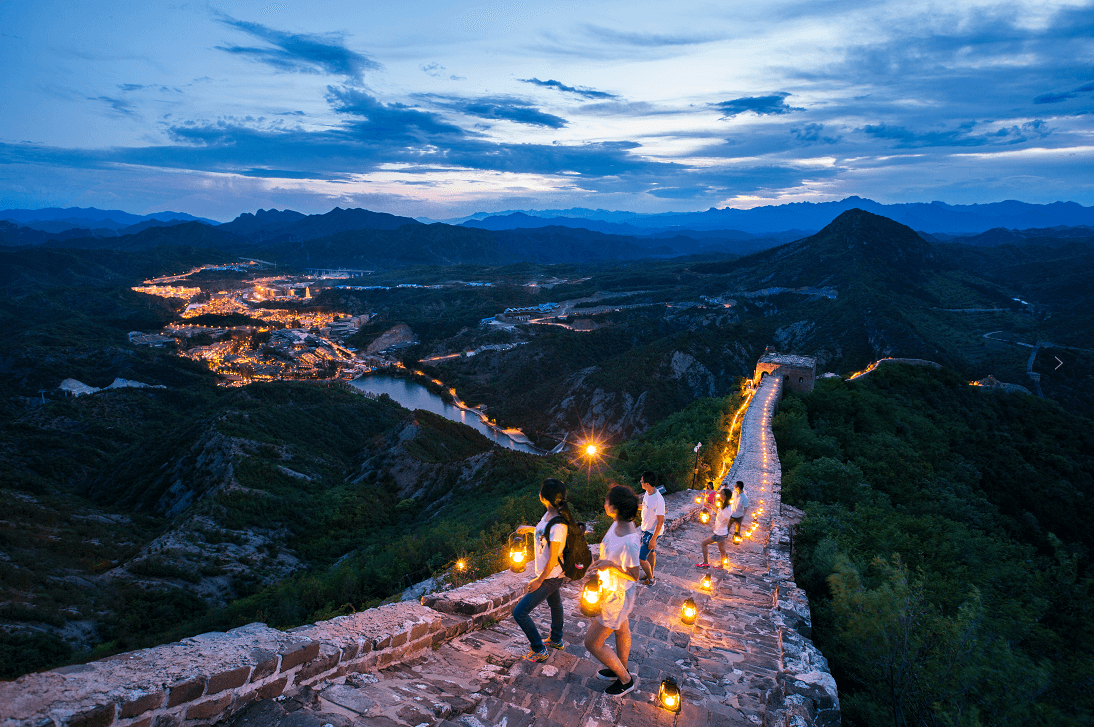
Simatai is the only section of the Great Wall open after dark, and it is the only section that has fully retained its original Ming-style fortification features. That combination — authentic, unrestored, illuminated at night — produces something no other experience in Beijing comes close to matching.
We’ve brought dozens of clients to Simatai at night. The moment that stays with us is not the cable car ride up, though the view is extraordinary. It’s the first five minutes on the wall itself: the silence, broken only by wind, and the watchtowers rising out of the dark at intervals along the ridge. Below, the lights of Gubei Water Town reflect off the canal. The sky, away from the city, actually shows stars. People stop talking. We’ve noticed this every time. Something about standing on a military fortification built in the 1370s, at night, with no crowd and no noise — it resets something.
The night tours run year-round. Hours vary by season:
Season | Weekdays | Weekends |
|---|---|---|
May – October | 17:30 – 21:10 | 17:30 – 21:40 |
November – April | 17:30 – 20:10 | 17:30 – 20:40 |
Simatai is 120 km northeast of Beijing — about a 2.5-hour drive each way. Don’t attempt this independently on your first trip. The ticketing system and transport logistics are genuinely complicated, and combining the wall with a walk through Gubei Water Town beforehand is worth the planning. We arrange this for our travelers as a half-day evening departure from central Beijing.
Book well ahead for weekends between May and October. Visitor numbers are capped, and popular dates sell out.
→ Full logistics, ticket prices, and photography tips: Simatai Great Wall guide | Great Wall Night Tour Guide
We arrange private evening tours from central Beijing that combine Gubei Water Town and the Simatai night tour as a single departure — transport, tickets, and an English-speaking guide included. Get in touch here if you’d like us to build this into your itinerary.
2. Peking Opera at Liyuan Theatre — Skeptics Welcome

We ask clients before they arrive whether they want to see Peking Opera. Most say some version of “maybe, if it’s not too long.” We book it anyway for the ones who seem open to it. The conversion rate — people who say “maybe” beforehand and then sit bolt upright during the face-change scene — is high.
One client — a retired engineer from Canada, not someone who sought out cultural experiences — told us before the show he’d come because his wife insisted. Forty minutes in, during a combat scene where two performers moved across the stage in a kind of controlled slow-motion that shouldn’t have been as tense as it was, we looked over and he was leaning forward with his elbows on his knees. He didn’t say much afterward. His wife did the talking. That’s a reasonably typical outcome.
Liyuan has largely removed the barrier that makes foreign visitors nervous about opera. The English subtitle screens beside the stage are well-synced and genuinely helpful. The excerpts — usually three or four pieces from different operas — are chosen for visual impact, not narrative complexity. Arrive 30 minutes early and you can watch performers applying the elaborate makeup backstage. Watching a face transform from ordinary to mythological in real time tends to reset expectations before the curtain rises.
Detail | Info |
|---|---|
Show time | 7:30 PM – 8:40 PM |
Schedule | Wed–Sat (Jan–Jun, Sep–Dec); nightly Jul–Aug |
Tickets | ¥120–¥380; book online for discounts |
Location | 1/F Qianmen Jianguo Hotel, Xicheng District |
Metro | Line 7, Hufangqiao Station, Exit C — 8-minute walk |
The ¥380 VIP table seats include tea and Beijing snacks. Budget seats at ¥120 have adequate sightlines. The mid-range ¥180–¥280 zone is where we tend to put clients who care about comfort without needing front-row placement.
If your dates fall on a day when Liyuan is dark (Monday, Tuesday, Sunday outside summer), Huguang Guild Hall and TianleYuan Theatre are solid alternatives with comparable quality.
→ Our team’s honest comparison of every major Beijing opera venue: Best Beijing Opera Theaters
If you’d like us to handle the booking and coordinate it with the rest of your Beijing evening, let us know — it’s one of the most common requests we get.
3. Houhai Bar Street — The Version of Beijing Nightlife That Only Exists Here
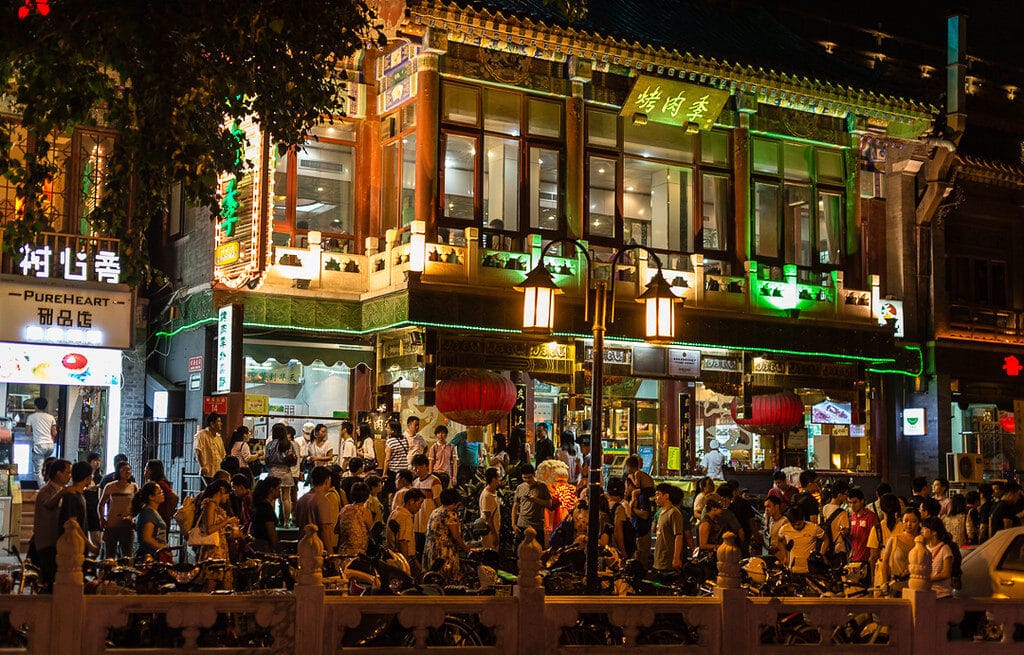
When clients ask for a bar recommendation, we almost always say Houhai. Not because it’s the coolest nightlife district in the city — Sanlitun has better cocktails and more international energy — but because Houhai is specifically, irreducibly Beijing in a way that Sanlitun is not.
The lake district sits in the old imperial city, surrounded by hutong alleys and courtyard houses that date back centuries. Bars occupy converted boathouses and old residential courtyards. In summer, every lakeside terrace fills up after 8 PM, and the reflections of red lanterns on the water, the sound of live music bleeding out from half a dozen venues at once, the smell of lamb skewers from the street stalls — it doesn’t feel like a nightlife district. It feels like a neighborhood that happens to have bars in it.
We’ve never had a client complain that we took them to Houhai instead of Sanlitun.
A few things to know before you go. The main lakefront promenade has aggressive promoters who offer “cheap drinks” and try to steer you into specific bars where they get a cut. Ignore them. Walk two minutes back into the hutong lanes behind the waterfront and you’ll find the same atmosphere, better prices, and actual locals rather than other tourists. Drinks on the main strip run ¥60–¥100. In the side alleys, ¥40–¥60 is normal.
Getting there: Metro Line 8 to Shichahai Station, Exit A2. Five-minute walk to the lake.
Payment: Most Houhai bars accept WeChat Pay and Alipay linked to international cards. Carry some cash (¥200–¥300) for street food stalls and smaller courtyard venues.
4. Guijie (Ghost Street) — Where Beijing Eats at Midnight
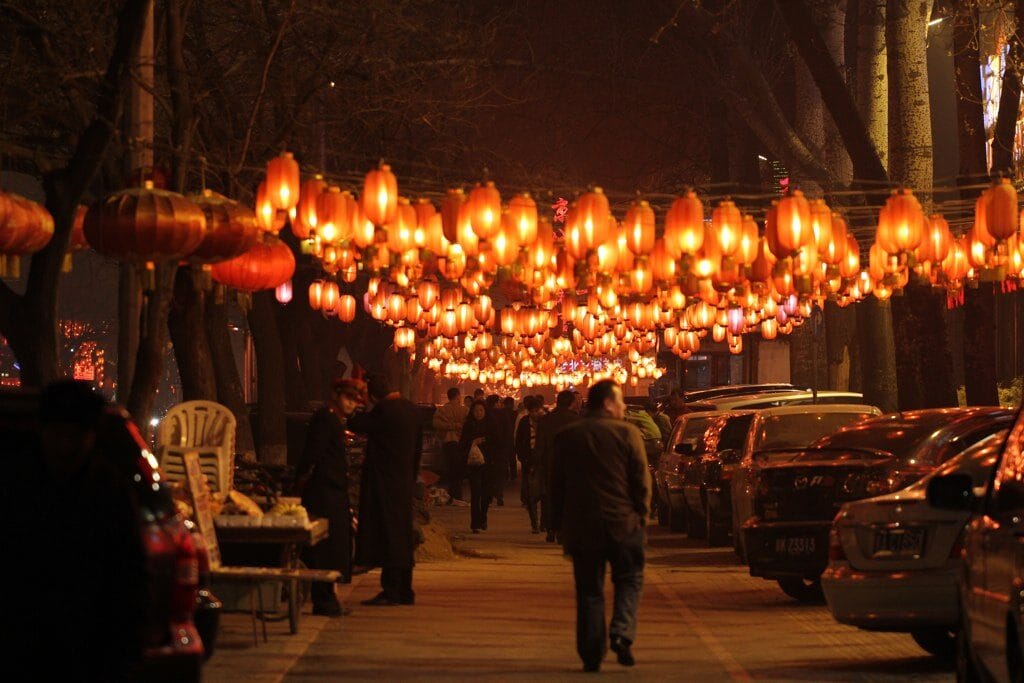
Guijie is a 1.4-km stretch of restaurants in Dongcheng District that operates, essentially, around the clock. The name Ghost Street comes from its history: before the street had electricity, vendors lit candles that made the strip glow eerily at night, which locals said looked haunted. The red lanterns that now line every inch of the street are a deliberate continuation of that aesthetic — there are hundreds of them, and when they’re fully lit after dark, the visual effect is genuinely dramatic.
The food here is not tourist food. This is where Beijing locals eat late. Ninety percent of the restaurants are focused on everyday prices and quick service. The street’s signature dish is spicy crayfish — 麻辣小龙虾, ordered by weight, arriving in a metal basin glazed with chili oil, garlic, and a spice mix that varies by restaurant. Guijie is also strong on Sichuan hot pot, mala grilled fish, and the kind of late-night lamb hot pot that makes Beijing winters bearable.
Arrive before 8 PM and you’ll find tables easily. After 9 PM on a Friday or Saturday, popular restaurants have queues. The street is at its fullest and most alive between 9 PM and midnight, and it runs until 4 AM. We’ve ended more than a few long days here, sometime after midnight, with a cold Yanjing beer and crayfish shells piling up on the paper tablecloth.
What to order: Spicy crayfish (麻辣小龙虾) is non-negotiable. Order the medium-spice or garlic version if you can’t handle serious heat. Mala hot pot with a self-selected ingredients bar is a good group option. Grilled fish (烤鱼) takes 20–25 minutes but is worth waiting for. Lamb skewers (羊肉串) work well as a starter while the main dishes cook.
Getting there: Metro Line 2 or Line 5 to Beixinqiao Station.
5. Hutong Walk After Dark — The Free Evening Most Visitors Miss

The hutongs around Nanluoguxiang and Gulou are almost always framed as daytime experiences. That’s reasonable — the cafes and boutiques lining Nanluoguxiang itself are closed by 10 PM. But the alleyways, the older residential lanes that branch off the main street, are genuinely different after dark. Quieter. More local. The pace drops, neighbors sit outside on folding stools, and restaurants with no English menus and no tourist markup fill up with families eating dinner.
This is the Beijing that’s hardest to access as a short-stay visitor, and evening is when it’s most visible.
We recommend the following loop, which takes two to three hours at a relaxed pace and ends with a drink by the lake. Start at Nanluoguxiang around 7 PM — have a drink or try zhimazhi ice cream while the street is still lit and active. Turn north into the connecting residential lanes toward Beiluoguxiang, which is quieter and more residential than its famous neighbor. Walk west toward the Drum Tower, which is illuminated at night and visible from several blocks away. Then head south to Houhai for a final drink by the water.
The Drum Tower area at night — with the illuminated tower rising above the old grey hutong rooftops — is one of those images that doesn’t make it into many travel articles. It should.
→ For background on the hutong neighborhoods: How to Explore Beijing Hutongs
6. Jingshan Park at Dusk — The ¥2 View You’ll Remember Longest
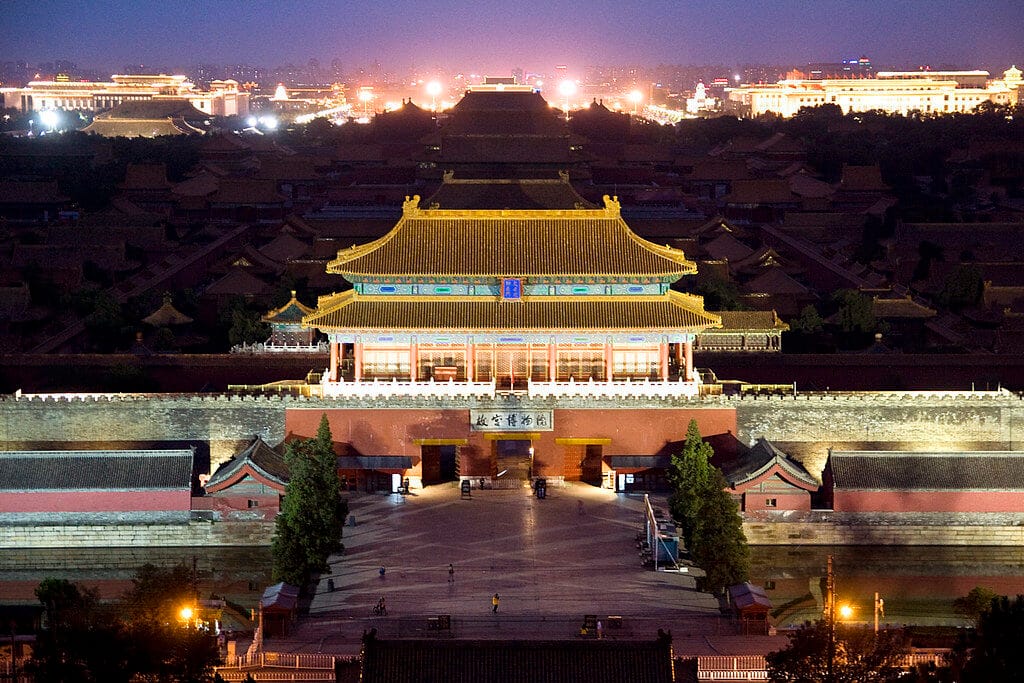
Jingshan Park charges ¥2 for entry. For that, you get the best view of the Forbidden City in existence — the full palace complex laid out directly below, the central axis of imperial Beijing visible from end to end, the gold of the roof tiles catching the last hour of afternoon sun.
The park is open until 9 PM between April and October, and until 8 PM between November and March. Arriving 45–60 minutes before closing puts you at the summit during golden hour with a fraction of the midday crowds. The light at that hour is flattering to the architecture in a way that midday sun simply isn’t. The shadows deepen, the colors shift, and the scale of the palace complex becomes emotionally legible in a way that the ground-level view inside never quite achieves.
Jingshan Park is a short evening activity — 60 to 90 minutes including the climb and descent. It pairs well before dinner at Guijie or a walk down to Houhai. If you’ve spent the day inside the Forbidden City, ending the evening here is a satisfying full stop.
One detail worth knowing: the park has a small local culture in the evening. Older residents practice tai chi on the lower terraces. There’s sometimes informal choral singing near the south gate — a Beijing tradition that no tourism article seems to mention, but that we’ve encountered consistently over the years when visiting close to closing time.
7. Sanlitun — Modern Beijing Nightlife at Full Volume
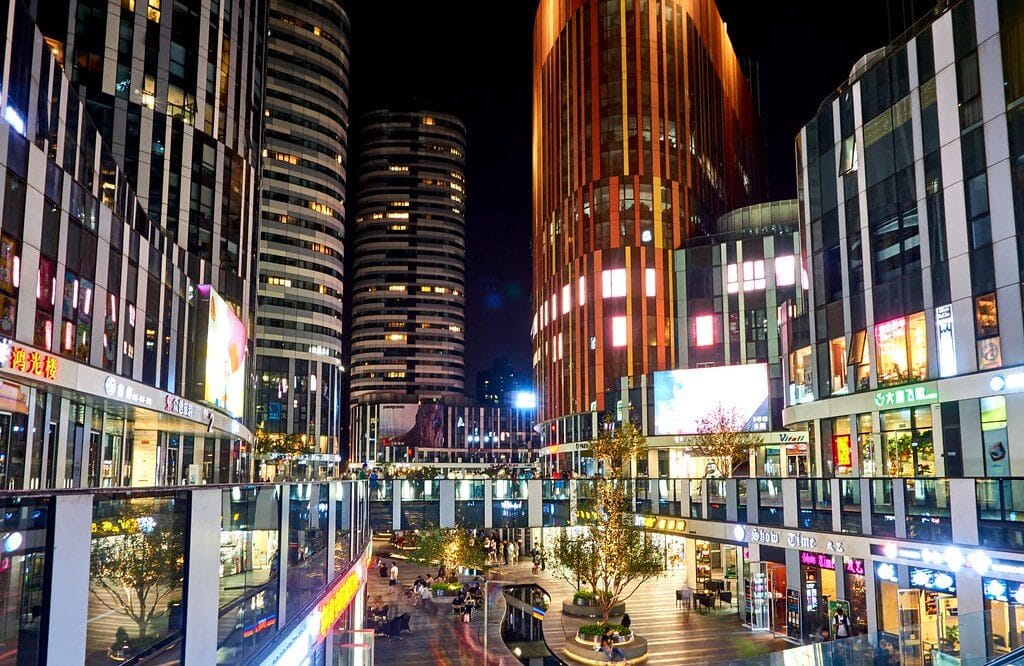
Everything said about Houhai being more Beijing is true. And there are still nights when you want a proper bar, a well-made cocktail, a DJ, and a crowd that’s there specifically to have a good time. Sanlitun is where you go for that.
The Chaoyang District hub is built around Taikoo Li, an open-air complex of 19 buildings with international brands, restaurants, and bars. The earlier part of the evening — 7 to 10 PM — works well for dinner and browsing. After 10 PM, the energy shifts toward the clubs and bars in the surrounding streets. The Workers’ Stadium (Gongti) area, a short walk away, is the dedicated clubbing district. BEEN is the largest club on the strip, running house and electronic music from domestic and international DJs.
Expect ¥80–¥150 per drink and possible cover charges of ¥50–¥100 on weekends at the larger clubs. We took a group of six there on a Thursday last autumn — the kind of travelers who’d spent three days in hutongs and temples and wanted one night of uncomplicated fun. Taikoo Li at 9 PM on a weeknight was exactly right for that. Busy enough to feel alive, quiet enough to actually talk.
Factor | Sanlitun / Gongti | Houhai |
|---|---|---|
Vibe | High-energy, modern, international | Atmospheric, lakeside, cultural |
Music | DJ sets, EDM, pop | Live bands, folk, jazz |
Price per drink | ¥80–¥150 | ¥40–¥80 |
Best for | Clubbing, cocktails, late nights | Atmosphere, conversation |
Honest take | Could be Tokyo or London | Could only be Beijing |
Payment note: Sanlitun venues generally accept WeChat Pay linked to international Visa/Mastercard. Most larger clubs also accept international credit cards directly — lower payment friction than many other Beijing nightlife areas.
8. Kung Fu Show at Red Theatre — The Practical Early-Evening Option
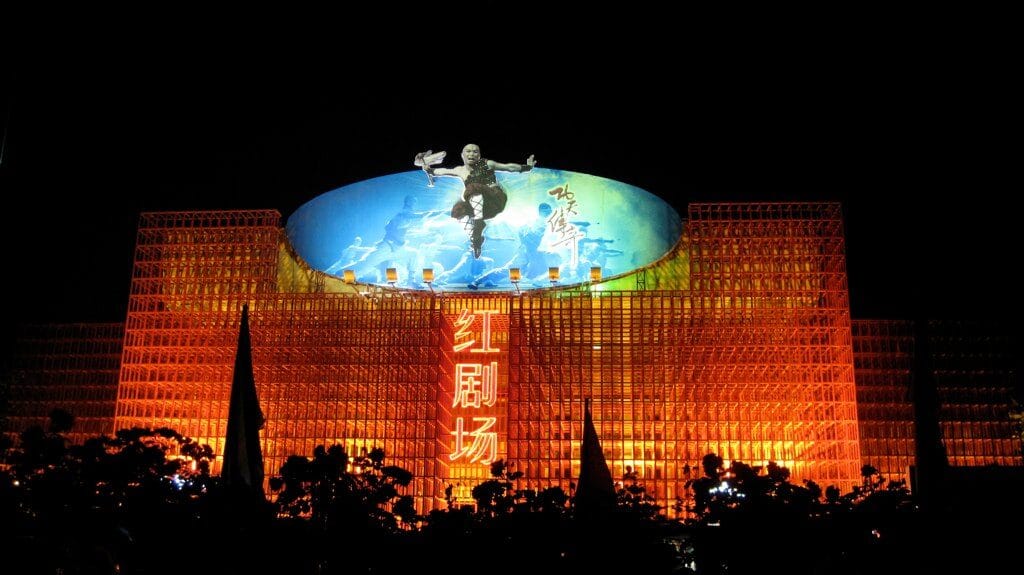
The Peking Opera is the more artistically significant cultural experience. But the kung fu show at Red Theatre has one specific advantage: it starts at 5:30 PM and finishes around 7 PM. That makes it the only major cultural show that ends early enough to leave time for dinner and further evening activities.
“The Legend of Kung Fu” tells the story of a young monk’s martial arts journey through choreography combining acrobatics, traditional martial arts, and dramatic staging. It requires no knowledge of Chinese or cultural context to follow. Families with children under 12 consistently find it more accessible than Peking Opera — there’s more movement, more spectacle, and less reliance on vocal performance as the primary medium. We tend to recommend Peking Opera to adults who are genuinely curious about Chinese classical arts, and the kung fu show to families or travelers whose primary interest is an entertaining evening rather than a cultural deep-dive.
After the show finishes around 7 PM, you’re well-placed for dinner at Guijie (15 minutes by Didi) or a walk to Wangfujing.
Detail | Info |
|---|---|
Show time | 5:30 PM – approximately 7:00 PM |
Tickets | ¥220–¥540 (book online for discounts) |
Location | 44 Xingfu Dajie, Dongcheng District |
Metro | Line 5, Tiantan Dongmen Station |
9. Wangfujing at Night — Worth 90 Minutes, Not an Evening
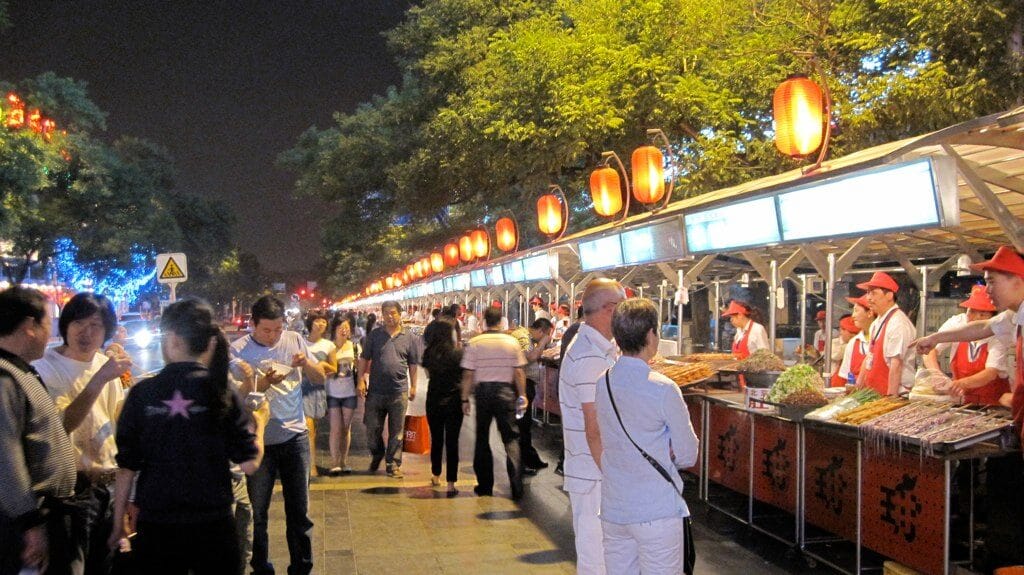
Wangfujing (王府井) is Beijing’s oldest and most-visited commercial street. By night, the illuminated storefronts and pedestrian crowds create a lively atmosphere that works well as an orientation for visitors on their first evening in the city.
We’ll be direct about what it is and isn’t. The stalls near Wangfujing are well-known for skewered scorpions, starfish, and other items sold as exotic Beijing street food. These are primarily props for tourist photos. Locals don’t eat them. If you want actual Beijing street food, Guijie is 15 minutes away by Didi and is operating on a completely different level.
What Wangfujing does well: it’s central, safe, easy to navigate, and has genuine energy on any evening. Tanghulu (candied hawthorn skewers) from the legitimate vendors are actually good and worth trying. For a first night in Beijing — jet-lagged, still calibrating to the timezone, not ready for a two-hour cultural experience — it’s a perfectly reasonable 90-minute walk. After that, head to Guijie for a proper meal, or back to the hotel. You’ve seen enough to feel oriented.
10. Badaling Great Wall Night Tour — The 2026 Alternative
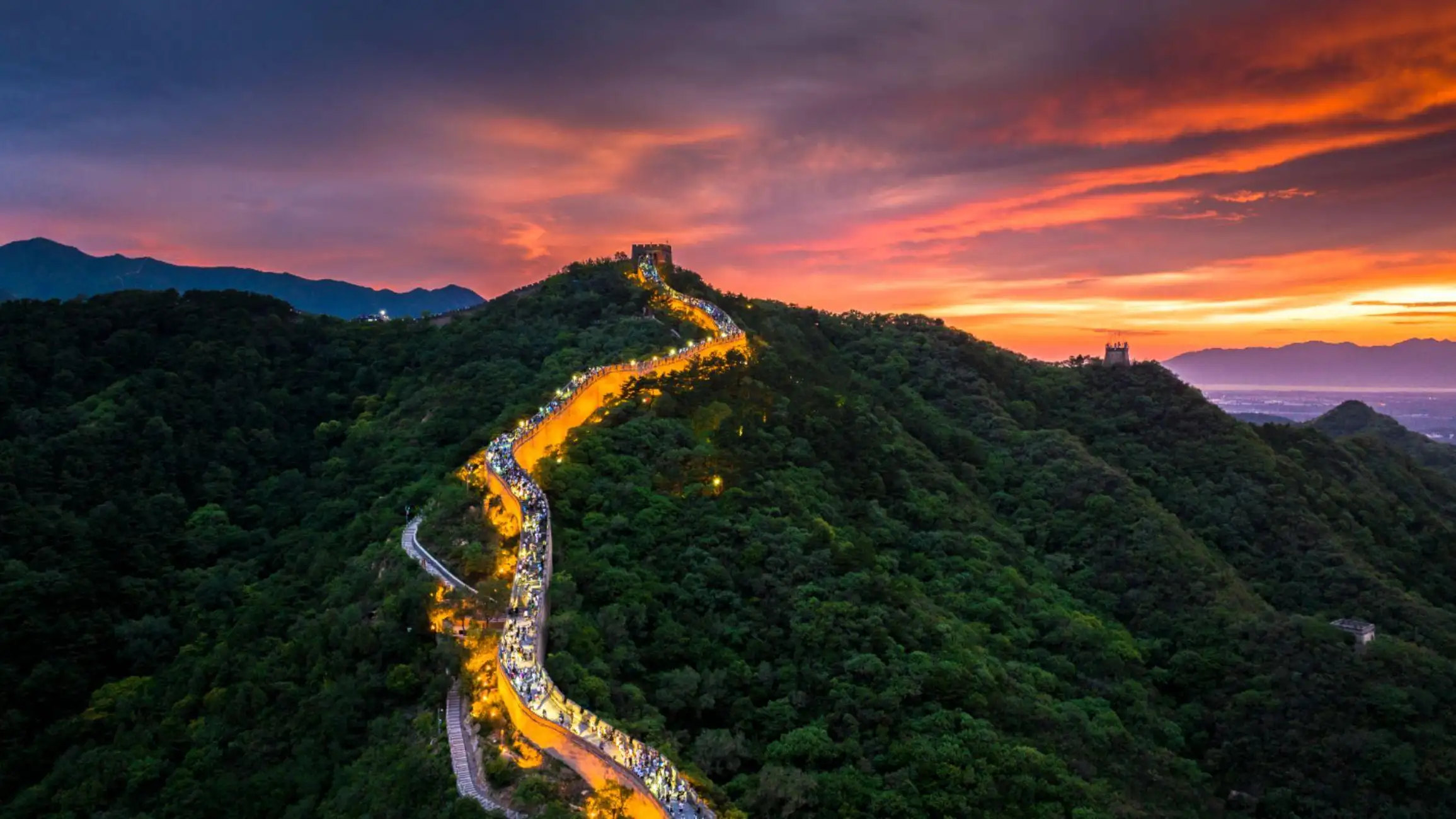
For travelers who want the Great Wall at night but cannot manage the 2.5-hour drive to Simatai, Badaling now offers a seasonal alternative.
The Badaling night tour runs from April 30 to October 7, 2026, from 7:00 PM to 10:00 PM. Tickets cost ¥80 and include illuminated wall viewing and night cable car access. Badaling is 70 km from central Beijing — about 90 minutes by car — and considerably more accessible than Simatai.
The honest comparison: at Badaling, the wall is well-lit, the cable car runs smoothly, and you’ll be back in the city by 10 PM. At Simatai, the wall is unrestored, the crowd is thin, and at some point on the ridge you’ll realise the nearest other person is three watchtowers away. If the logistics are manageable, Simatai is the one worth making the effort for. If not, Badaling’s night tour is a genuine alternative — not a consolation prize.
→ Full breakdown of every Great Wall section at night and by day: Best Part of the Great Wall to Visit | Great Wall Night Tour Guide: Sections, Timing & How to Do It Right
How to Plan Your Beijing Evenings
One framework we use when building itineraries: assume three evenings in Beijing and allocate them deliberately.
Evening | Our recommendation |
|---|---|
First evening | Jingshan Park at dusk → dinner at Guijie |
Second evening | Peking Opera at Liyuan → hutong walk → Houhai drink |
Third evening | Simatai Great Wall night tour + Gubei Water Town |
If you have a fourth evening, Sanlitun fills it well. If you only have two, keep the first two and drop the rest. For families with children, swap Peking Opera for the Red Theatre kung fu show on the second evening.
Traveler type | Suggested evenings |
|---|---|
First-time visitor | Jingshan → Guijie → Liyuan Opera |
Culture-focused | Hutong walk → Houhai → Opera |
Adventure-seeker | Simatai + Gubei Water Town |
Families | Kung Fu show → Wangfujing snacks |
Nightlife-focused | Sanlitun / Gongti clubs |
Food-focused | Guijie → Nanluoguxiang bar crawl |
Practical Notes for Foreign Visitors
Payment is the question we get most often before clients arrive. Beijing’s bar and restaurant scene has moved almost entirely to mobile payment — WeChat Pay and Alipay. Both now link to international Visa and Mastercard without a Chinese bank account. Set this up before your first evening out. It takes about 15 minutes and removes every friction point. For Guijie food stalls and small hutong bars, carry ¥200–¥300 in cash as backup. For Sanlitun clubs and Liyuan Theatre, international credit cards are accepted directly.
Getting around after midnight: The subway covers most nightlife areas and runs until roughly midnight. After that, Didi works exactly like Uber, accepts the same mobile payment setup, and a crosstown ride rarely exceeds ¥40. Avoid trying to hail street taxis near bar areas late at night — use the app.
One scam to know about: In tourist-heavy areas like Houhai and Wangfujing, well-dressed locals occasionally approach foreign visitors with invitations to a “traditional tea ceremony” or a “special bar.” These lead to inflated bills. The risk is low but the pattern is documented. Stick to venues you’ve found independently.
Seasonal differences: September and October are the best months for outdoor Beijing nightlife — cool evenings, low humidity, clear skies. Summer terraces at Houhai are peak atmosphere despite the heat. Guijie operates at full intensity year-round. Simatai under snow, for the handful of clients we’ve taken there in January or February, is in a category of its own.
For where to stay to maximize access to evening activities, our Beijing accommodation guide covers all the main areas. Our broader Beijing travel guide has full practical context for the city.
FAQ
Is Beijing nightlife good compared to Shanghai?
Different, not lesser. Shanghai nightlife is more internationally oriented — world-class clubs, a famous bar scene on the Bund. Beijing has things Shanghai doesn’t: a Great Wall night tour, Peking Opera in its home city, a lake district inside a hutong neighborhood that dates back centuries. For travelers interested in Chinese culture, Beijing evenings are consistently the stronger experience.
What time does nightlife start in Beijing?
Cultural shows start between 5:30 PM and 7:30 PM. Restaurants and bar areas are lively from 7 PM. Bars peak between 9 PM and midnight. Clubs in Sanlitun and Gongti don’t fill up until 11 PM or later. Guijie runs until 4 AM.
Is Beijing nightlife safe and foreigner-friendly?
Yes. Beijing has low crime rates and international visitors are common in all the areas listed in this guide. English is spoken in most tourist-facing venues in Houhai, Sanlitun, and Liyuan Theatre. Setting up WeChat Pay or Alipay with an international card before you arrive removes the main practical friction point.
What do I need to book in advance?
Liyuan Theatre and Simatai Great Wall night tours both require advance booking — particularly on weekends between May and October. Houhai bars, Guijie restaurants, and Wangfujing need no reservation. Red Theatre can usually be booked one to two days ahead without difficulty.
Can I visit Tiananmen Square or the Forbidden City at night?
Tiananmen Square is accessible until around 10 PM and worth a short evening visit — the scale reads differently without daytime crowds. The Forbidden City closes to visitors, but the view from Jingshan Park at dusk is arguably better than any view from inside.
What is the best area for Beijing nightlife?
Depends entirely on what you want. Houhai for atmosphere. Guijie for late-night eating. Sanlitun for clubs and cocktails. Simatai for something with no equivalent anywhere else on earth.
How do I get back to my hotel late at night?
Didi. Available in English-language mode, works 24/7, rarely more than ¥40 for a crosstown ride. The subway covers most areas until around midnight if you’re heading back earlier.
Travel China With Me has been running private China tours since 2006. Our team has personally guided thousands of international visitors through Beijing’s evenings — from first-time Peking Opera experiences to Simatai night hikes in January snow. If you’d like help building a Beijing itinerary that makes the most of your time after dark, contact us here.