Baishuitai vs Pamukkale: What Nobody Tells You Before You Choose
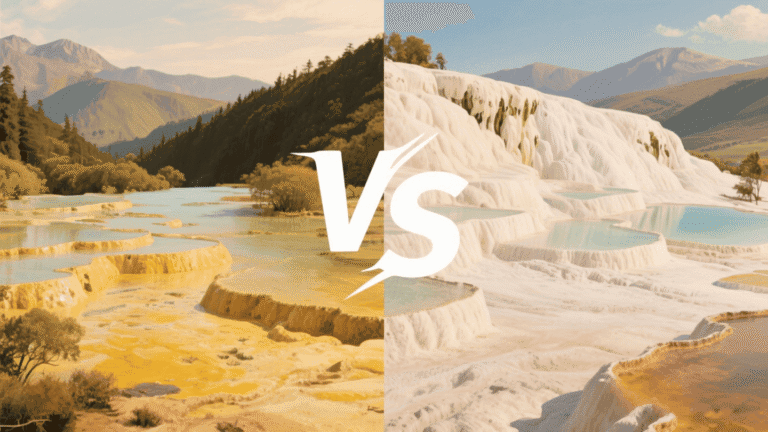
Baishuitai — also known as White Water Terrace (白水台) — and Pamukkale are built from the same geology: calcium carbonate terraces formed by mineral-rich spring water. That is where the similarity ends. One is hot and swimmable; the other is cold and silent. One draws two million people a year; the other barely registers on most international itineraries. The choice between them is not actually difficult once you understand what each one is.
We’ve been running inbound China tours since 2006, taking tens of thousands of international travelers through Yunnan. Baishuitai is one of those places we keep bringing guests back to — not because it’s on every tourist checklist, but precisely because it isn’t. Several of those guests had already visited Pamukkale in Turkey before coming to China. Their verdict, without exception: the geology felt familiar, but the experience was entirely different.
Table of Contents
1. What Are Baishuitai and Pamukkale, Actually?
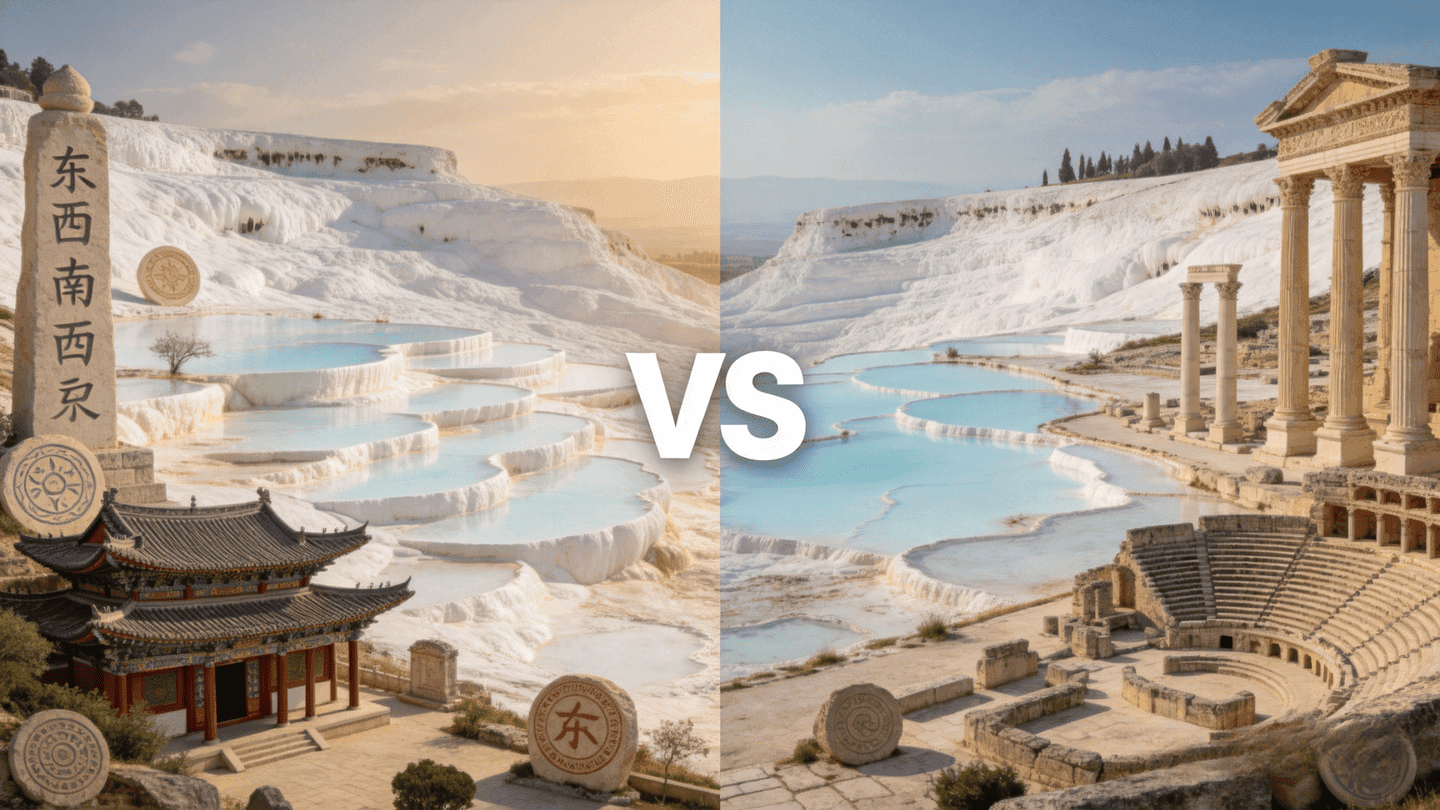
Both are travertine terrace formations — natural structures where calcium-carbonate-rich water flows downhill, cools, and deposits layers of white limestone over thousands of years. The visual result is strikingly similar: tiered white pools with turquoise-blue water, carved into a hillside like a staircase built by a glacier. The geology is the same. Almost everything else is not.
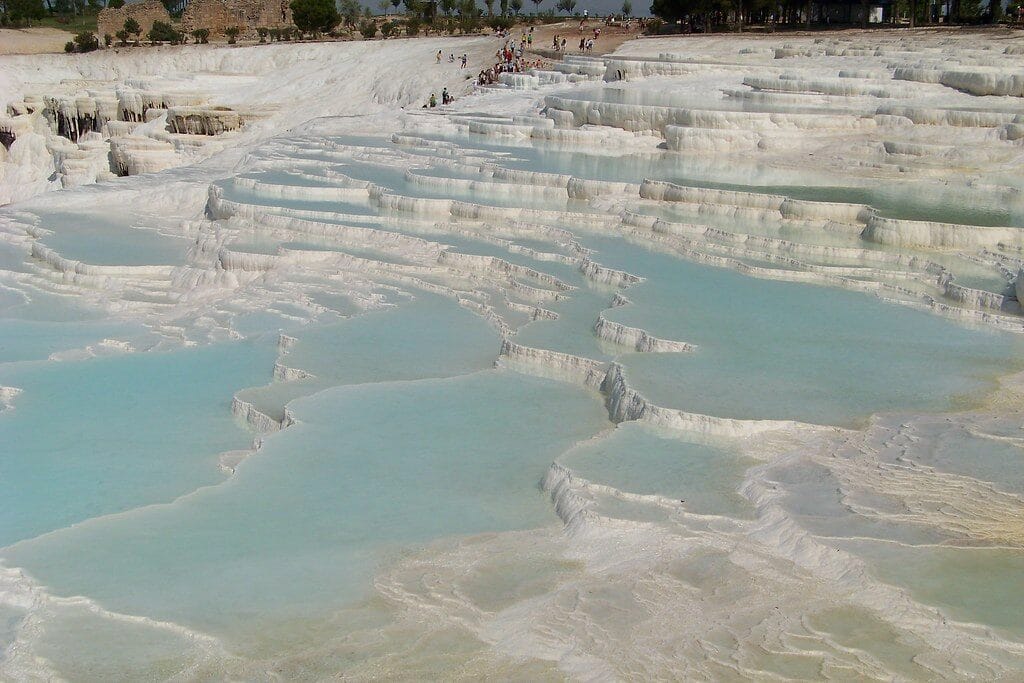
Pamukkale’s travertine formation is approximately 2,700 metres long, 600 metres wide, and 160 metres high, sitting in Turkey’s Denizli Province. It was built on by the ancient Greek city of Hierapolis and has been drawing visitors since classical antiquity.
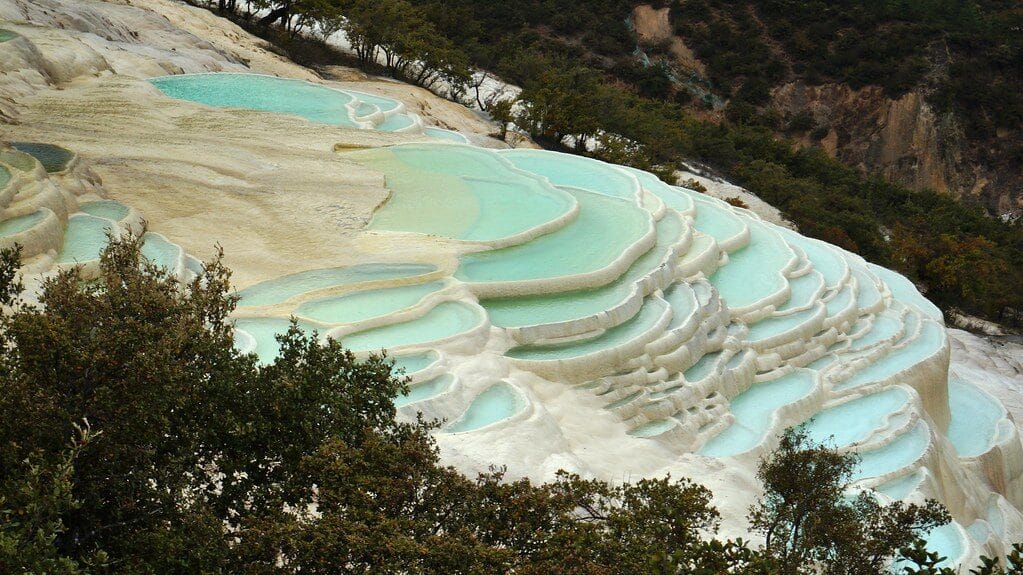
Baishuitai is far more intimate. It sits at an altitude of 2,380 metres, covers three square kilometres, and is the largest travertine terrace of its kind in China. The formation measures 140 metres from base to top and 160 metres in width. It is not a world-famous UNESCO site. It doesn’t have Roman ruins. What it has is silence, altitude, and a 300,000-year-old landscape almost entirely to yourself.
2. The Big Difference: Scale and Crowds
Pamukkale’s formation runs 2,700 metres. Baishuitai’s runs 140. That size difference is part of what drives everything else — including the crowd numbers. Pamukkale receives 1.5 million visitors per year, over 4,000 on an average day. In peak summer, the terraces become a slow-moving queue of tour groups. You will share every photo frame.
Baishuitai sees a fraction of that. If you search Baishuitai on TripAdvisor, “beautiful and empty” comes up again and again. When we bring guests there, they are often the only foreigners at the site. The peace is part of what makes the place.
If you’ve visited Pamukkale and felt let down by the crowds, four thousand people a day is why. And if you’re still deciding whether Turkey or China is worth the detour, this gap matters more than any photo comparison.
Each bar = 100% of the two sites combined. Visitor numbers are estimates; entrance fee at approximate current rates.
3. The Geology: Same Process, Different Character
Both sites form through the same chemical process: calcium-bicarbonate-rich spring water flows over a hillside, CO₂ evaporates as the water cools, and white calcium carbonate crystallizes into terraced pools over centuries.
But the source conditions differ significantly.
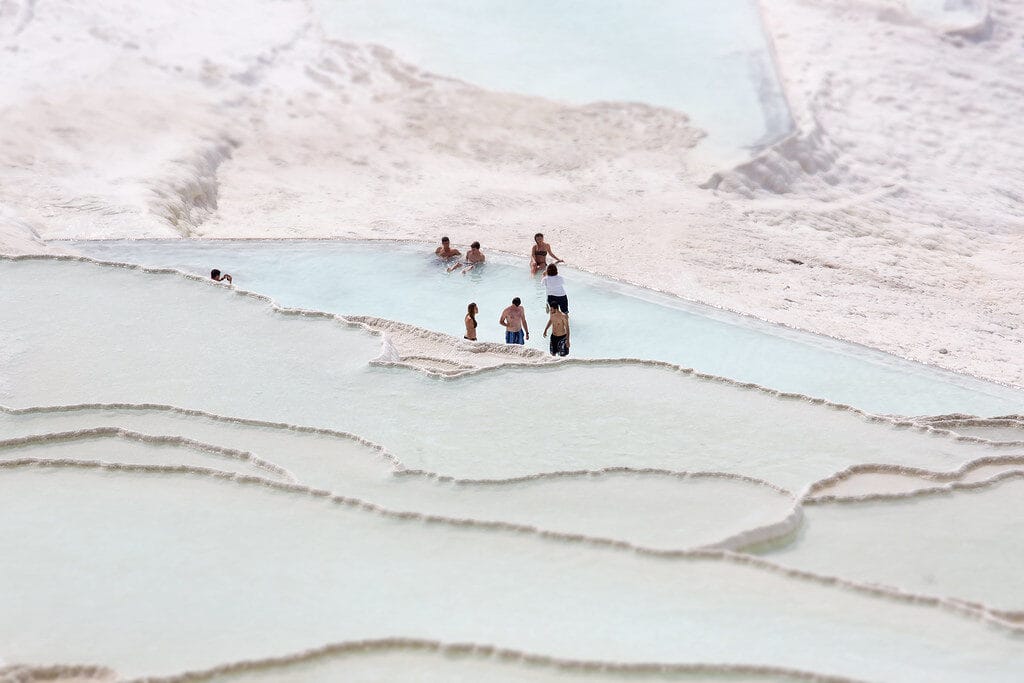
Pamukkale’s geothermal waters emerge from a fault scarp at temperatures exceeding 35°C, sourced from deep underground circulation through limestone bedrock. The water is hot. You can — within designated areas — actually soak in it. The thermal water at Pamukkale reaches a pleasant 36°C and is said to have healing properties for rheumatism and circulatory conditions.
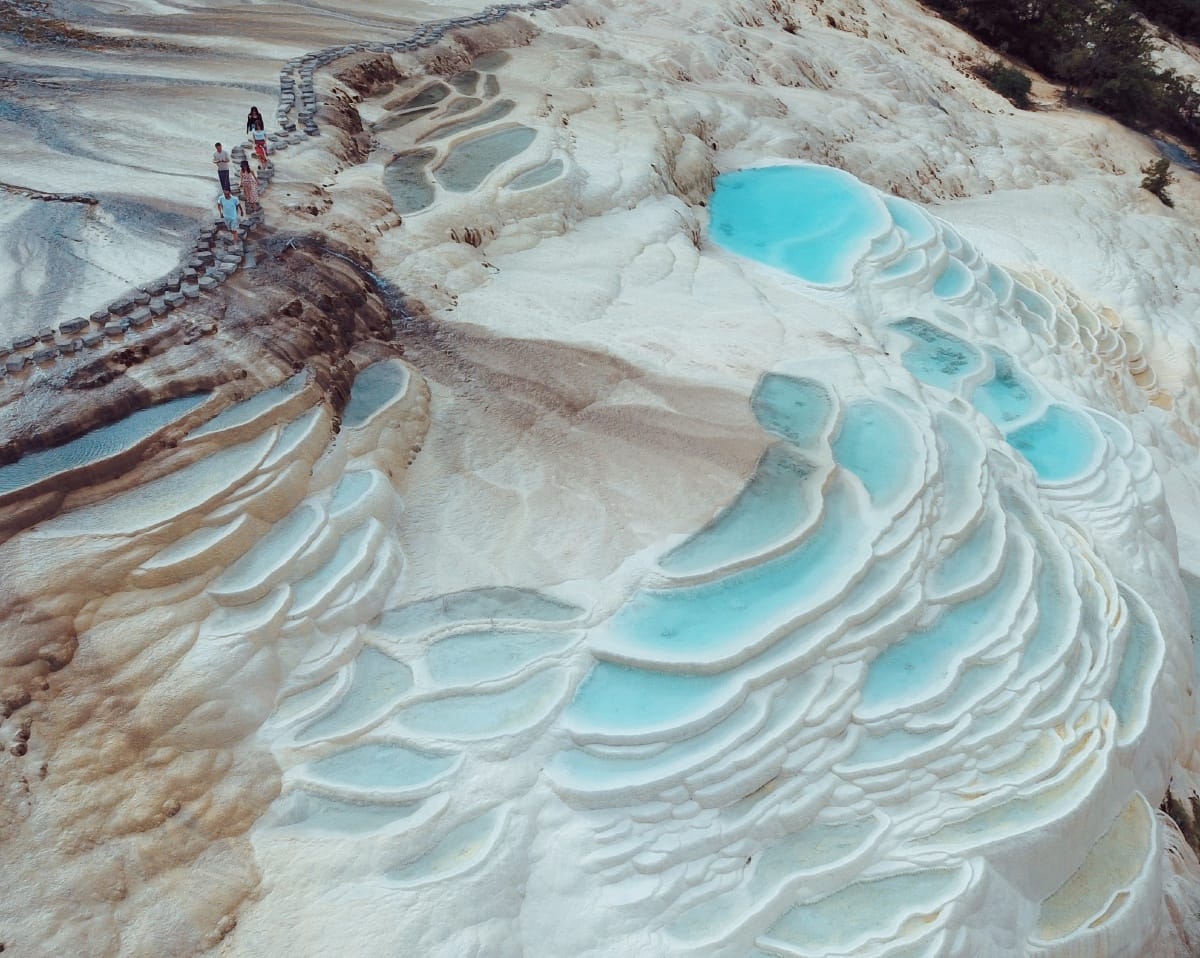
Baishuitai’s springs are cold mountain water, fed by snowmelt from Haba Snow Mountain. There is no soaking here. The terraces are cool, clear, and entirely off-limits to wade through — the pools are for looking, not bathing. Rich in calcium bicarbonate, the spring water evaporates under the sun and forms white calcium carbonate deposits that accumulate year after year.
The core practical difference: at Pamukkale you get into the water. At Baishuitai you do not. Whether that matters to you is the first question worth answering before you choose.
4. Side-by-Side Comparison Table
Feature | Baishuitai (China) | Pamukkale (Turkey) |
|---|---|---|
Location | Shangri-La, Yunnan, China | Denizli Province, Turkey |
Altitude | 2,380 m | ~350 m |
Formation size | 140 m × 160 m | 2,700 m × 600 m × 160 m high |
Water temperature | Cold (snowmelt) | 35–100°C (geothermal) |
Swimming/bathing | Not permitted | Yes, in designated areas |
UNESCO status | No | Yes (since 1988) |
Annual visitors | Very low (tens of thousands) | 1.5–2 million+ |
Entrance fee | ¥30 (~US$4) | ~800–1,000 Turkish Lira (verify current rate; TRY fluctuates significantly) |
Cultural layer | Naxi Dongba religion birthplace | Hierapolis ancient Roman ruins |
Crowd level | Very quiet, largely undiscovered | Very crowded, especially summer |
Best visited | Clear sunny day, May–Oct | Spring or autumn, at sunrise |
Getting there | Private car from Shangri-La (1.5–2 hrs) | Bus/taxi from Denizli |
5. Cultural Depth: Which Site Has More to Offer?
Most comparison articles stop at geology and crowds. The cultural layer is where the two sites diverge most sharply — and where Baishuitai consistently surprises people who arrived expecting a geology trip.
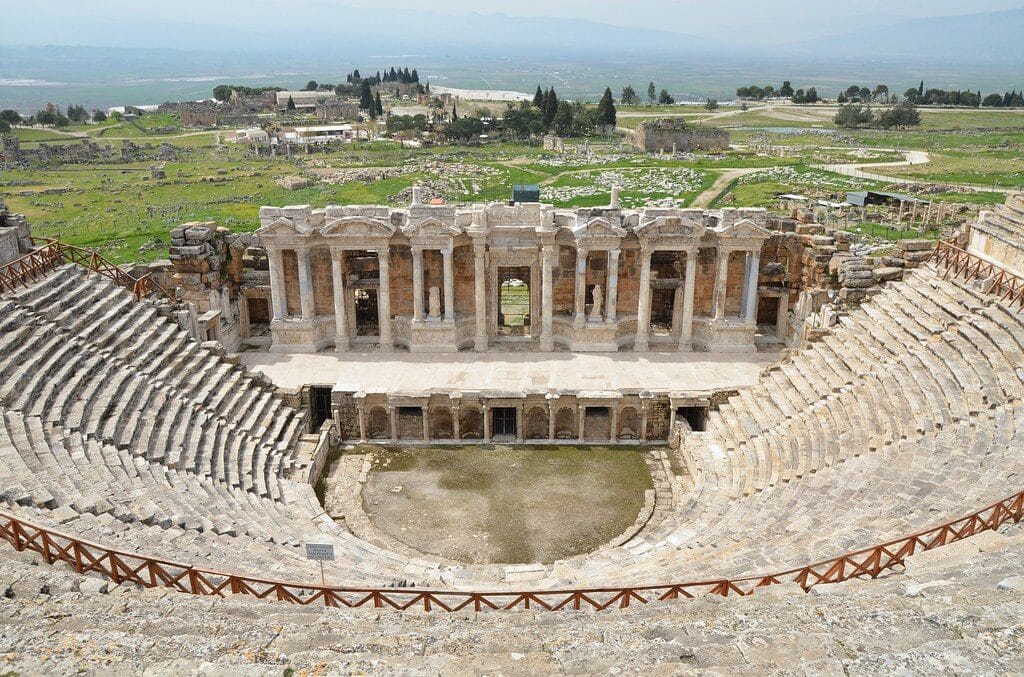
Pamukkale pairs its geology with archaeology. The ancient city of Hierapolis was built on top of the travertine formation, and the ruins include a large amphitheatre, temples, baths, and a necropolis. You can spend 4–5 hours moving between the terraces and Roman ruins. The Cleopatra’s Pool, where you can swim among submerged ancient Roman columns, is one of the most unusual thermal experiences in the world.
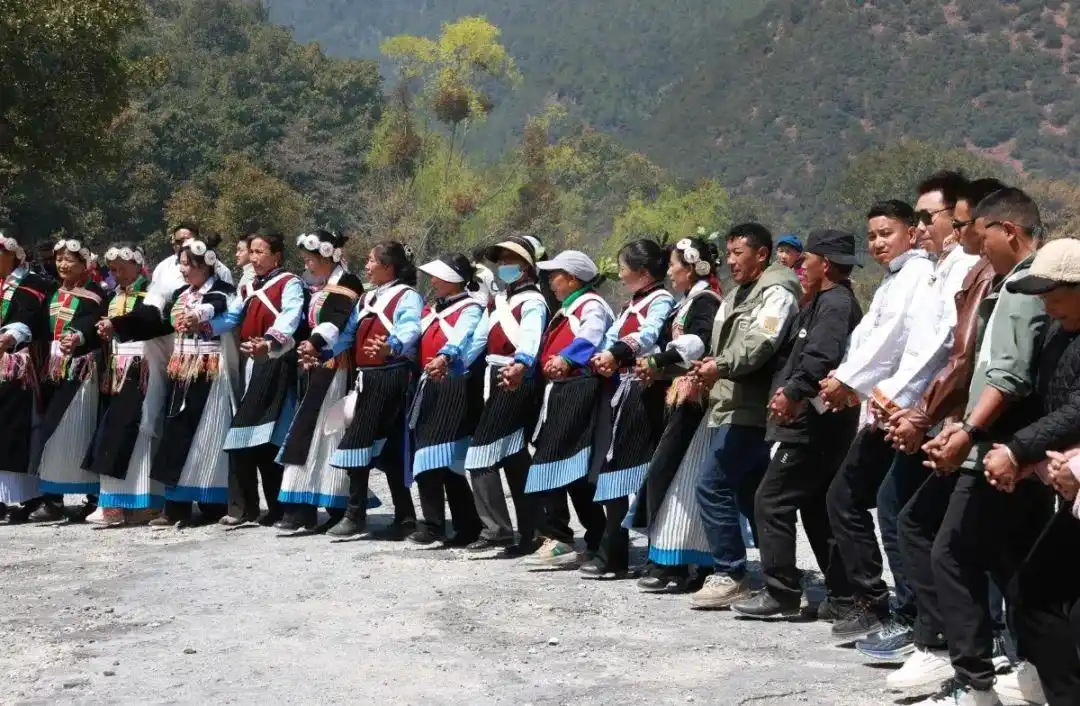
Baishuitai has a different kind of cultural depth — older, less visible, and arguably more moving if you know what you’re looking at. It is the birthplace of the Dongba religion of the Naxi ethnic minority, the only pictographic writing system still in active use in the world. Legendary accounts say Dingbashiluo, the first sacred ancestor of the Dongba religion, was captivated by the beauty of Baishuitai on his return from Tibet, and stayed to establish an altar here.
Every year on the eighth day of the second lunar month, Naxi people from surrounding villages gather at Baishuitai for the “Chao Baishui” pilgrimage — singing, dancing, and performing offerings to the Mountain God. It has been happening for over a thousand years. In 2026, that date falls on March 27. Most tour buses don’t include Baishuitai on their itineraries, and this festival is not marketed to outside visitors. The people there are there because their parents brought them, and their parents before that. If your visit coincides with it, adjust your itinerary — it’s the real thing.
That’s a distinction no Roman amphitheatre can match.
6. The Honest Assessment of Pamukkale Today — and a Note on Baishuitai
Here is what Pamukkale actually looks like in 2026, which differs from what most photographs show.
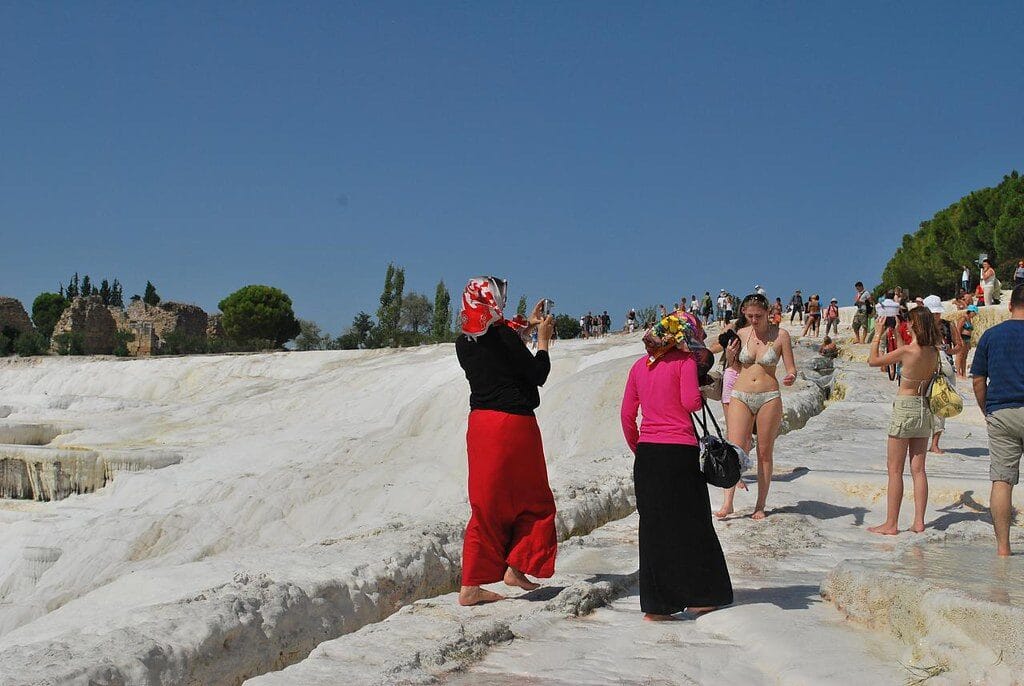
Today, the terraces are partly managed and partly artificial. The thermal water at Pamukkale has been diverted through a manually controlled irrigation system to allow the terraces to recover from past overuse, and whether they will return to their former glory is genuinely uncertain. Many pools visible in photographs are artificial basins built along a former road. The natural formations themselves are largely behind barriers, and visitor access to the natural terraces is restricted to protect them.
Mass tourism — the diversion of spring water to hotel pools, mechanical damage, and constant bathing — caused the travertines to turn grey over decades. UNESCO and Turkish authorities have made significant restoration efforts, and conditions have improved. But what many visitors expect based on older photographs no longer fully exists.
Baishuitai nearly suffered the same fate.
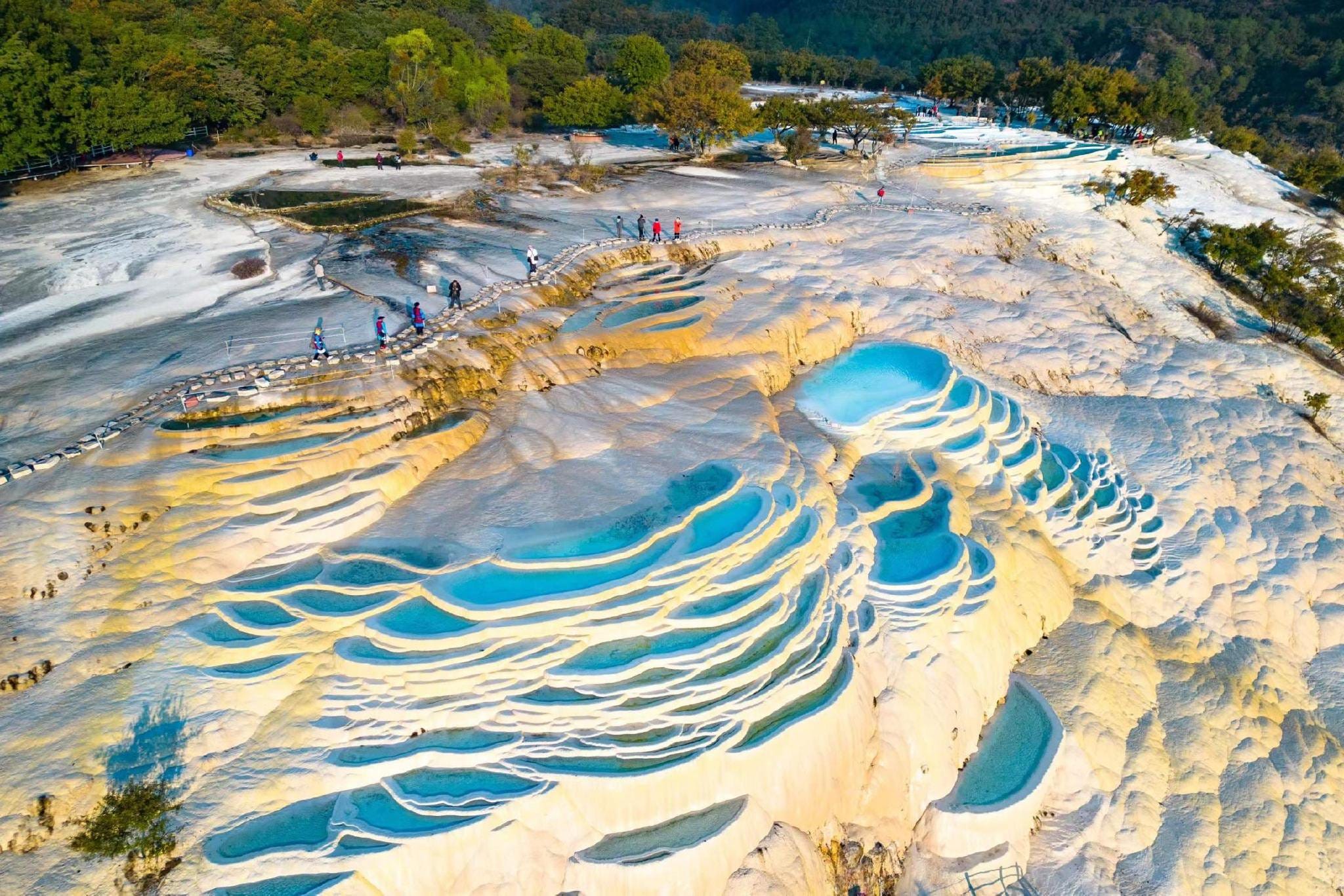
Between 2002 and 2005, poor management by a private operator allowed the entire Baishuitai travertine surface to turn yellow. The site was described at the time as “on the verge of abandonment.” In 2008, the Diqing government stepped in, revoked the operating license, and invested CNY 150 million to restore the area. The recovery worked. In November 2024, Baishuitai was officially upgraded to a National AAAA (4A) scenic area — its first major national recognition.
Neither site has been immune to human damage. The difference today is that Baishuitai came back, and its visitor numbers have stayed low enough that the surface continues to form naturally. Pamukkale is still fighting a harder battle.
7. Which One Should You Visit?
Visit both if you’re doing a serious multi-country trip and the same geological phenomenon interests you in different cultural contexts. The scale difference alone is worth seeing side-by-side — Pamukkale is vast and tactile; Baishuitai is intimate and still. Photographers who visit both consistently say the contrast sharpens what each one does well.
For our guests coming to Yunnan, we nearly always include Baishuitai as a day trip from Shangri-La, combining it with Haba Snow Mountain or the Tiger Leaping Gorge approach. It adds a full layer of wonder to a trip that already has plenty.
If you’re also comparing China’s two travertine sites against each other — Baishuitai versus Huanglong in Sichuan — we have a dedicated breakdown: Huanglong vs White Water Terrace. And if Huanglong is the one you’re weighing against Pamukkale instead, that comparison is covered in full here: Huanglong vs Pamukkale.
8. Practical Information for Baishuitai
Location: Baidi Village, Sanba Township, Shangri-La City, Yunnan Province. About 101 km from Shangri-La county seat.
Getting there: The best option is a hired private car from Shangri-La via the East Ring Route (东环线). As of 2024–2025, the main road surface has been significantly improved — visitors report a smooth tar road throughout. The drive takes approximately 1.5–2 hours. Public buses run from Shangri-La Bus Station at approximately 9:00 AM and 2:00 PM, costing around ¥30–35 per person.
Entrance fee: ¥30 per person. Entry closes at 16:30 (last entry).
Scenic area rating: Upgraded to National AAAA (4A) in November 2024.
Time needed: 2 to 3 hours to explore properly. Add an hour for Baidi Village.
Best time to visit: May to October for the clearest skies and most vibrant blue color. Go on a sunny day — cloud cover makes the pools turn grey and eliminates the visual impact almost entirely. Check the 72-hour forecast before you make the drive.
Best time of day: Morning light hits the southwest-facing terraces with more dimension and color contrast. Arriving by 9–10am gives you the best conditions and the fewest visitors. The left-side viewing platform near the top of the circuit gives the widest angle across the full terrace.
Altitude note: Baishuitai sits at 2,380 metres — lower than Shangri-La city (3,160m). If you’re already acclimatized from Shangri-La, you’ll be fine.
Horse riding: Around ¥50 one way. Most guests who’ve done both say the boardwalk walk is more rewarding — the horse path bypasses much of what you came to see.
For the full Shangri-La context, our Shangri-La travel guide covers the city, and the complete Shangri-La attractions list includes everything nearby worth combining with this trip.
9. Photography Notes
The two sites photograph differently, and knowing that before you arrive changes how you plan your morning.
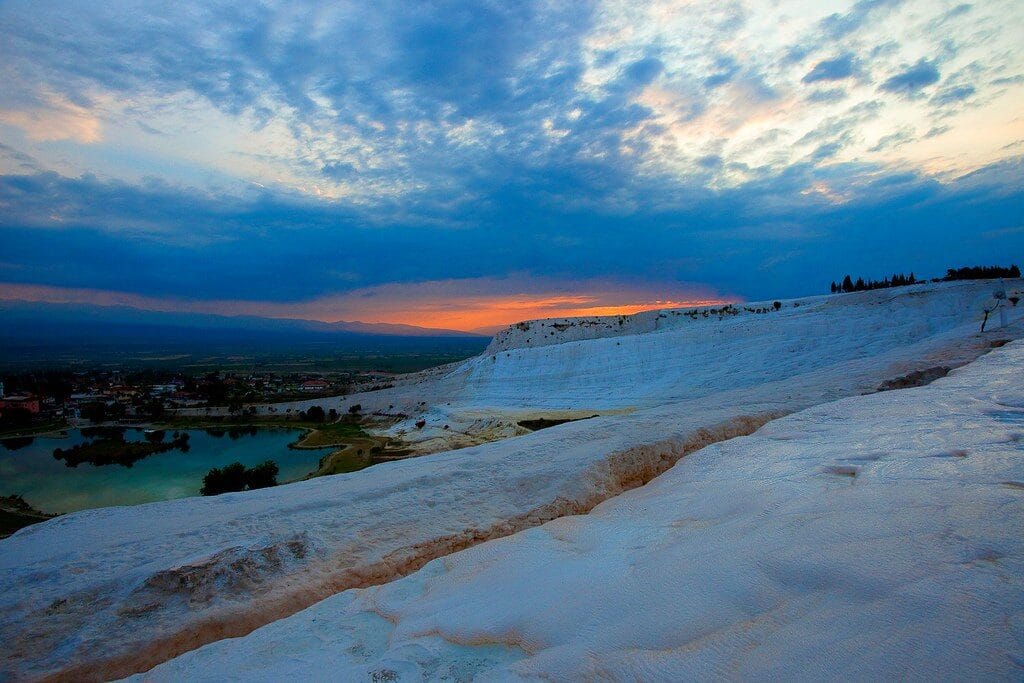
At Pamukkale, the sheer scale means you can always find a composition without other tourists — if you arrive at sunrise. The white-and-turquoise contrast is dramatic and easy to capture in most light conditions.
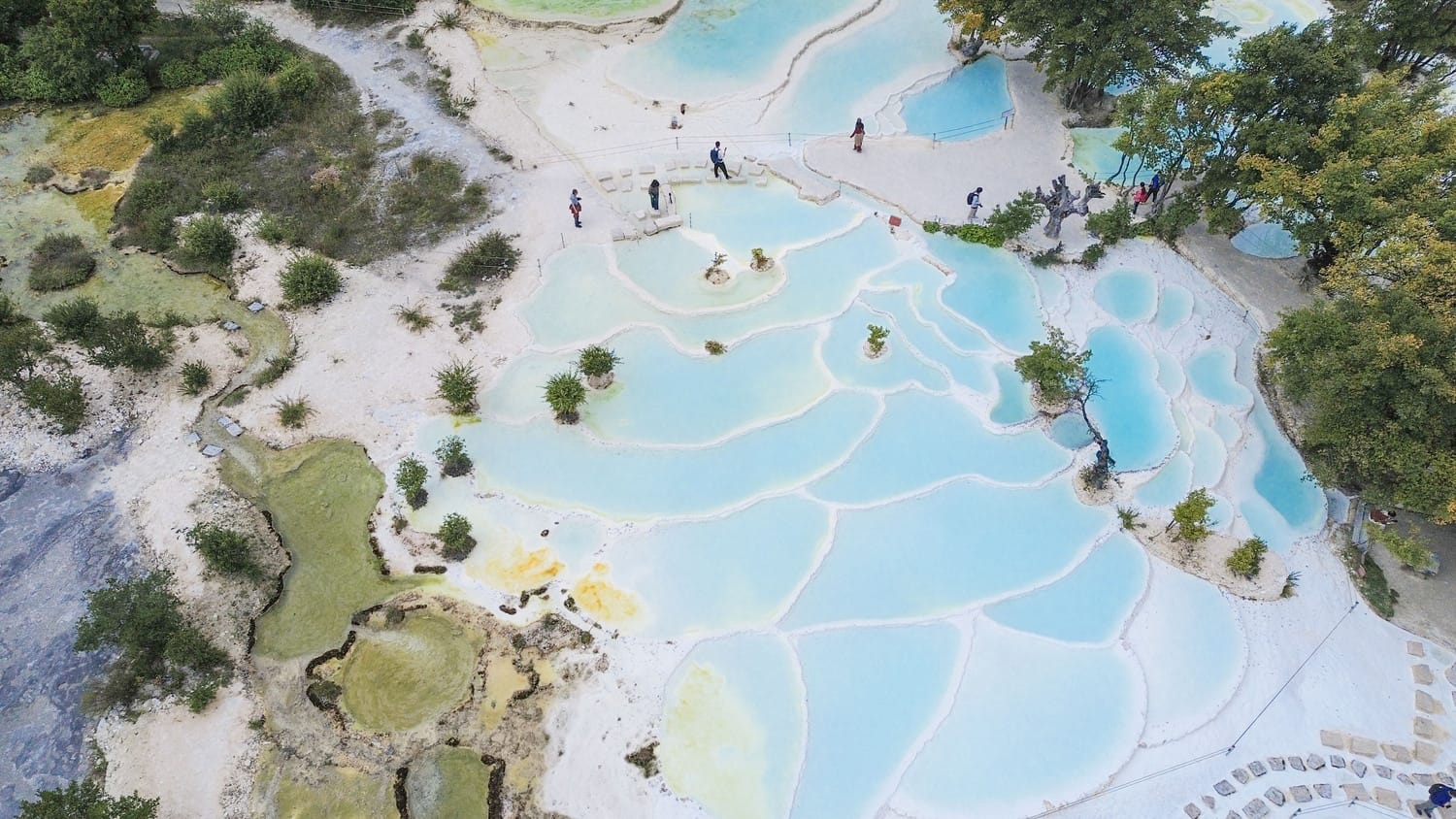
At Baishuitai, the formation is smaller, so the entire site fits in a single wide-angle frame from the top viewing platform. From the highest viewpoint, the terraced formations resemble Pamukkale in Turkey, but raw, serene, and far less crowded — photos hardly need any editing when the sun is out.
The background at Baishuitai matters: green forested mountains frame the white terraces, and on clear days the sky above Shangri-La is a deep, unpolluted blue. White calcium, blue sky, green mountain — three clean colors that don’t need a filter.
One thing that often surprises guests: the color of the water changes depending on the angle of light and the time of day. Early morning produces a milky jade tone. Midday sun turns the pools turquoise. Late afternoon casts a warm golden tint over the calcium deposits.
10. FAQ: Baishuitai vs Pamukkale
Is Baishuitai the same as Pamukkale?
No. Both are travertine terrace formations created by calcium-rich spring water, but they differ in scale, temperature, cultural context, and visitor numbers. Pamukkale is a UNESCO World Heritage Site with adjacent Roman ruins and thermal bathing; Baishuitai is a cold-spring terrace in the Tibetan plateau region of Yunnan, sacred to the Naxi people, largely untouched by mass tourism.
Is Baishuitai the best Pamukkale alternative in China?
It depends on what you’re looking for. Baishuitai is China’s closest equivalent in terms of visual appearance — white calcium terraces with blue pools. But if sheer spectacle is your goal, Huanglong in Sichuan is larger, more colorful, and UNESCO-listed, though it sees far more visitors and costs significantly more to enter. Baishuitai wins on solitude, cultural depth, and accessibility from the Lijiang–Shangri-La route.
Can you swim at Baishuitai like at Pamukkale?
No. Bathing or wading in Baishuitai’s pools is not permitted, to protect the natural formations. At Pamukkale, bathing is allowed in designated areas, and the water is warm (around 36°C).
Which is bigger, Baishuitai or Pamukkale?
Pamukkale is dramatically larger — 2,700 metres long compared to Baishuitai’s 140 metres. Baishuitai is the largest travertine terrace in China, but it is a fraction of Pamukkale’s scale.
How do I get to Baishuitai from Lijiang?
From Lijiang, the drive takes approximately 3 hours via private car. There is limited public bus service from Lijiang. The route passes through Tiger Leaping Gorge and along the Haba Snow Mountain foothills — the drive itself is one of the best scenic roads in Yunnan.
Is Baishuitai worth visiting if I’ve already been to Pamukkale?
Yes — and the prior visit helps. If you’ve seen Pamukkale, you’ll immediately recognize what you’re looking at at Baishuitai. But the experience is completely different. The solitude, the Tibetan mountain backdrop, and the Naxi cultural layer make it feel like you’ve found what Pamukkale once was before mass tourism arrived.
What is the best time to visit Baishuitai?
May to October, on a clear sunny day. The blue sky reflecting in the calcium pools is what produces the characteristic color. Overcast days significantly reduce the visual impact.
How much does Baishuitai cost to enter?
¥30 per person (approximately US$4 at current exchange rates).
We’ve been taking international guests to Yunnan since 2006. Tom, one of our guides who grew up in the region, once described Baishuitai like this: “It’s a place where you can hear the mountain thinking.” We’ve repeated that to guests more times than we can count — it’s the most accurate thing anyone has said about it.
For the full practical guide — opening hours, ticket details, what to do inside, how to combine Baishuitai with Tiger Leaping Gorge and Haba Snow Mountain — see our White Water Terrace complete visitor guide. If you’d like to include it in a private Yunnan itinerary, contact our team.