Mount Qingcheng: Front & Back Mountain, Tickets & Routes
Mount Qingcheng is worth visiting for Taoist temples, quiet forest hiking, or a cool escape from Chengdu’s summer heat. This guide tells you which side to choose and what you will see on each one. We cover the Front Mountain’s temples, the Back Mountain’s gorges, ticket prices, cable cars, transport from Chengdu, and the seasonal conditions that most visitors forget to plan for.
Front Mountain ticket | CNY 80 (adult) |
|---|---|
Back Mountain ticket | CNY 20 (adult) |
Front Mountain hours (Apr–Oct) | 08:00–17:30 (last ticket 17:00) |
Front Mountain hours (Nov–Mar) | 08:30–17:00 (last ticket 16:30) |
Time needed | A full day per side, 5 to 7 hours walking |
Latest entry for the Back Mountain | 13:00, or you won’t get down before dark |
Table of Contents
1. What Is Mount Qingcheng and Is It Worth Visiting?
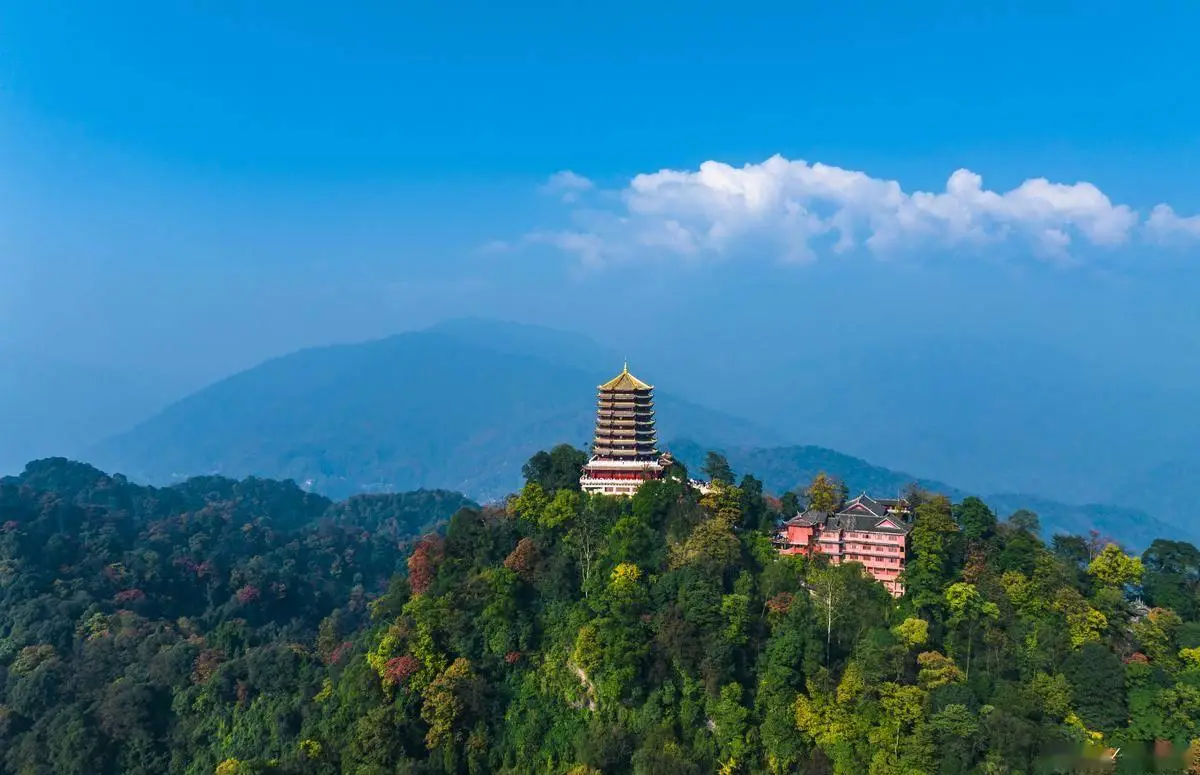
Mount Qingcheng sits in Dujiangyan City, 68km southwest of Chengdu, split into two separate scenic areas: the Front Mountain and the Back Mountain. It is one of the four sacred mountains of Taoism in China. UNESCO inscribed it as a World Heritage Site in 2000 under cultural criteria (ii), (iv), and (vi), alongside the neighbouring Dujiangyan Irrigation System. UNESCO’s listing credits that irrigation system with still controlling the Minjiang River 2,200 years after construction began.
The two sites sit within the wider Sichuan travel circuit and are commonly visited together. We send clients to Qingcheng more than almost anywhere else near Chengdu. The two sides offer completely different experiences, and most visitors only ever see one of them.
Why It’s Called “The Most Secluded Mountain Under Heaven”
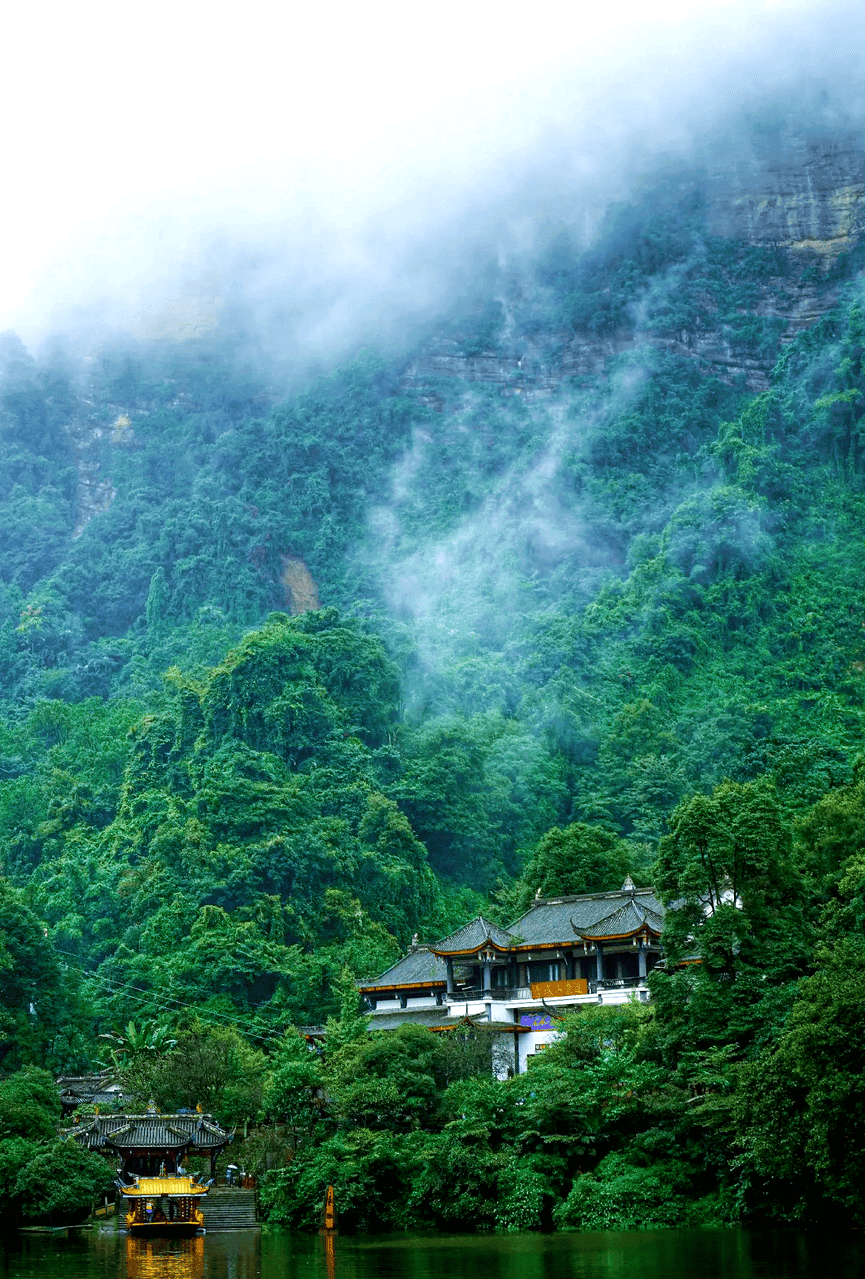
The Chinese saying 青城天下幽 means Qingcheng is the most secluded place under heaven. It comes from the mountain’s dense forest cover. Every peak stays green year-round, which is where the name Qingcheng, or “green city”, comes from.
Zhang Daoling arrived on the mountain in 143 AD to preach what became organised Taoism. Tianshi Cave on the Front Mountain still holds a Sui Dynasty stone statue of him. Britannica identifies Zhang as founder and first patriarch of the Way of the Celestial Masters, the Daoist movement he established in Sichuan. That makes Qingcheng an actual birthplace of organised Taoism, not a temple mountain that adopted the religion later.
Is It Worth Your Time?
Yes, if you care about Taoist architecture, Chinese religious history, or a forested hike within easy reach of Chengdu. Lower your expectations if you are hoping for dramatic mountain scenery like Jiuzhaigou or Huanglong. Qingcheng is quiet and gentle rather than spectacular.
We’ve watched first-time visitors leave the Front Mountain slightly underwhelmed after expecting a “wow” moment. Several of those same clients later told us the Back Mountain was the real highlight of their Chengdu leg.
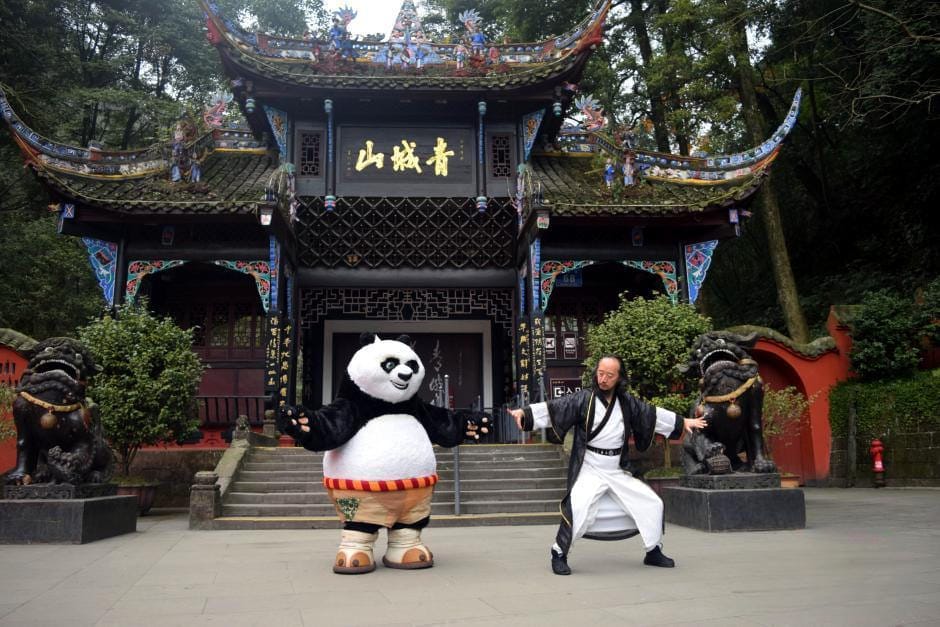
Families often ask us whether this is “the Kung Fu Panda mountain”. Close enough to be worth knowing: DreamWorks researched Mount Qingcheng in 2008, and Panda Village in the third film was designed from what they saw here. The Front Mountain also appeared in the classic Chinese television version of Journey to the West. Chinese visitors recognize it instantly. Foreign ones have usually never heard of it.
2. What’s on the Front Mountain?
The Front Mountain is the main scenic area. It covers 15 square kilometres and holds the mountain’s most important temples. When people simply say “Qingcheng Mountain”, this is the side they mean.
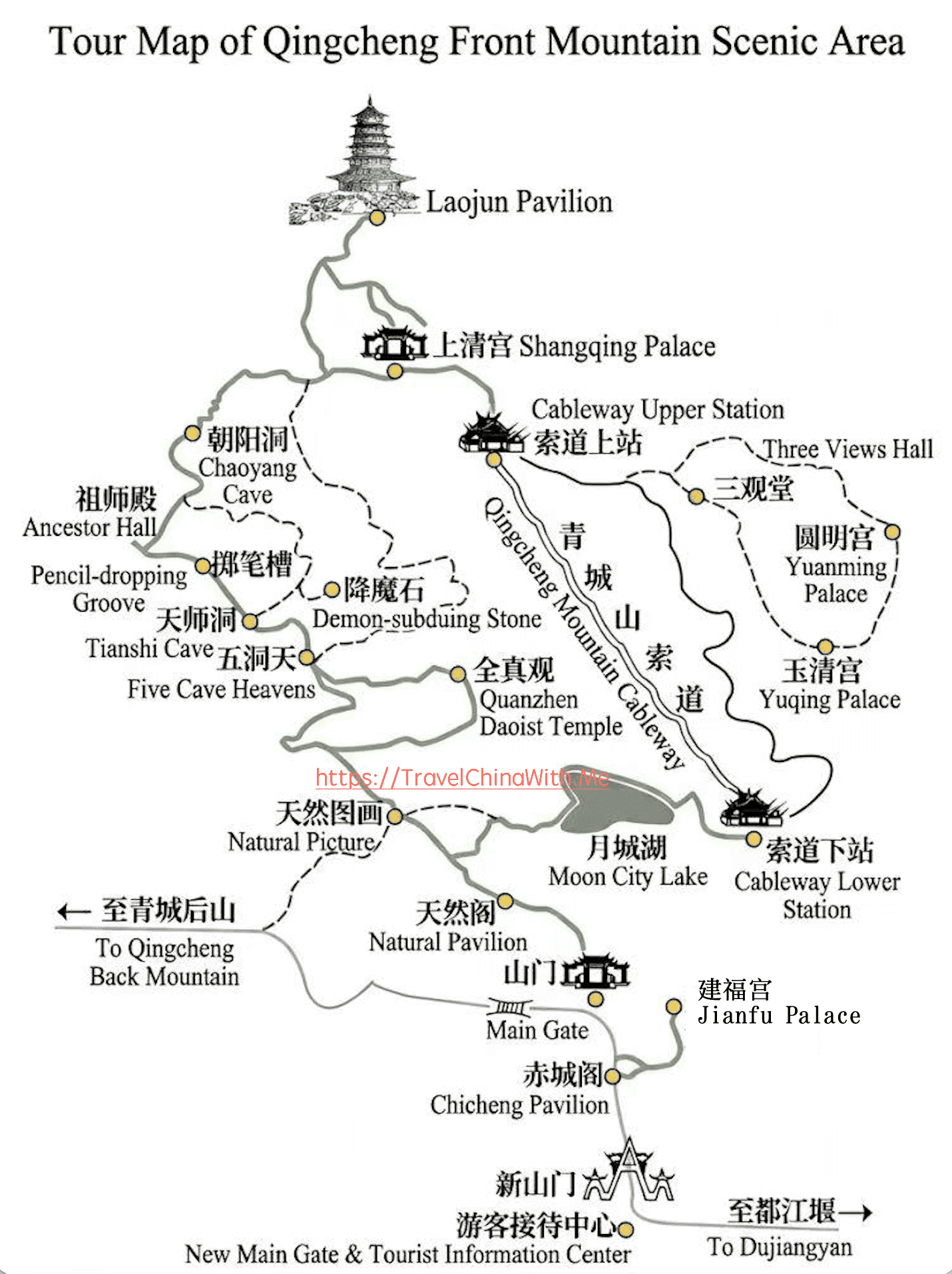
Laojun Pavilion
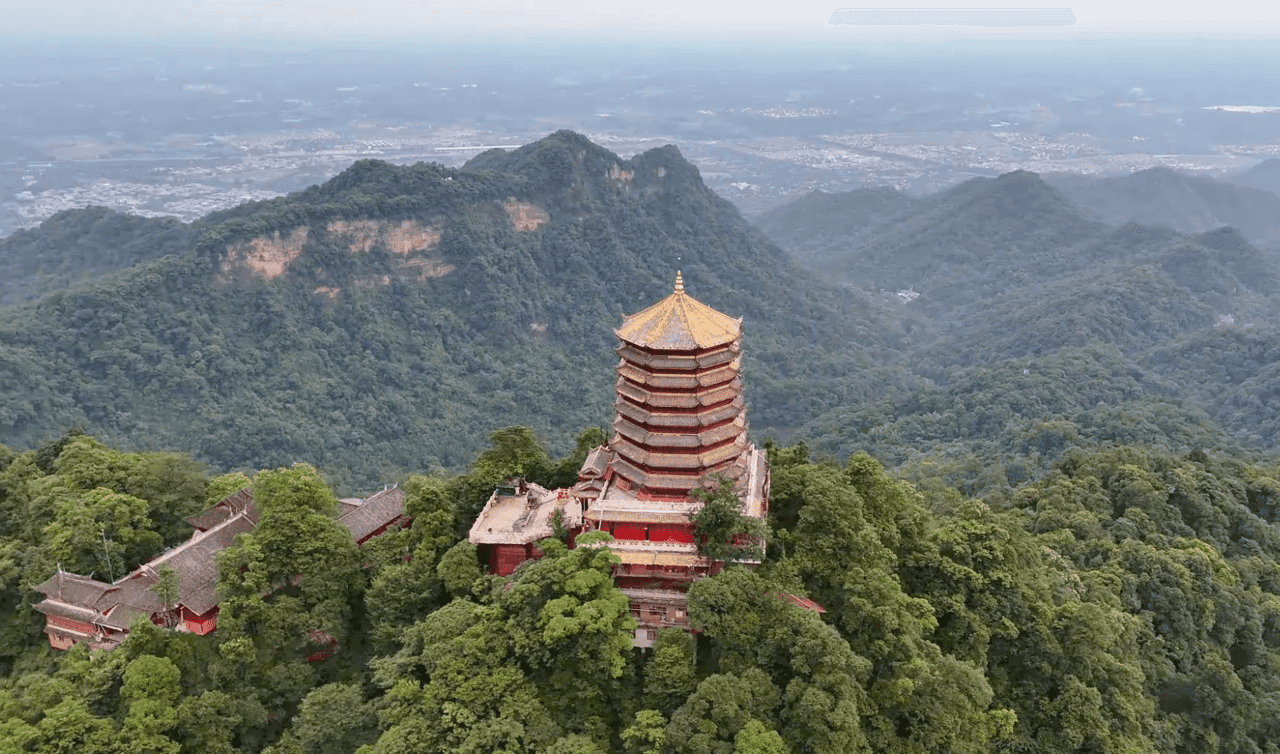
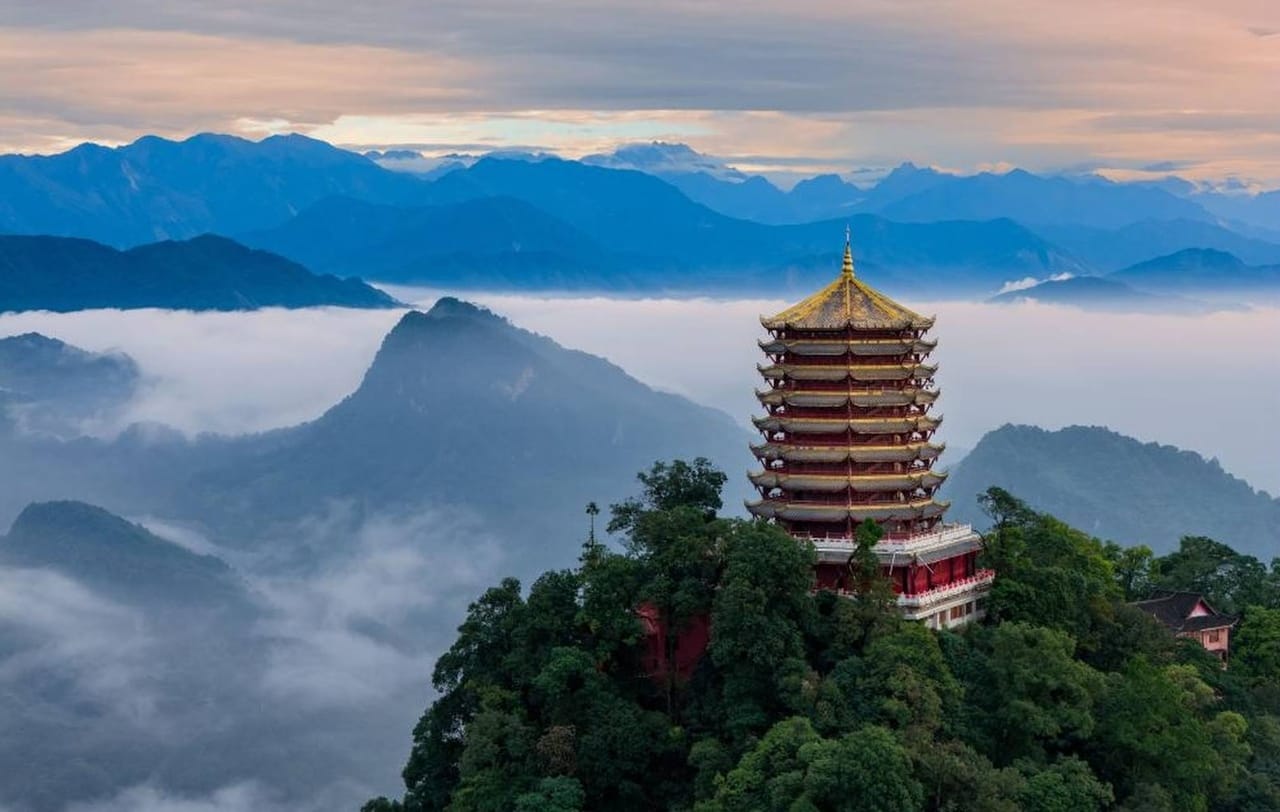
Laojun Pavilion sits at 1,260 metres on Pengzu Peak, also called Laoxiao Peak. That is the Front Mountain’s highest point. The pavilion rises 33 metres over six floors, though only the ground floor currently opens to visitors, and the exterior has recently been under restoration. On a clear day the platforms give views toward Dujiangyan city.
Yuecheng Lake
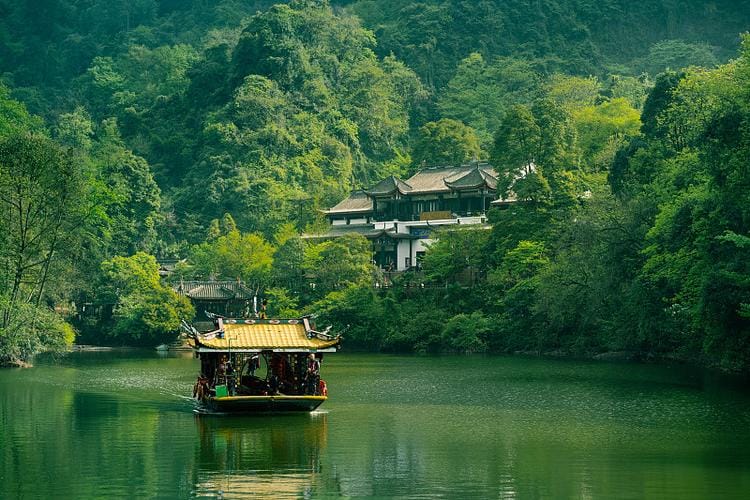
This lake is the only natural body of water inside the Front Mountain scenic area. Everything else here is temples and forest. A boat crosses it for CNY 5 per person, connecting to the trail toward the cable car station. We find this part stays quiet even on busy days, because most tour groups pass through it quickly.
Tianshi Cave
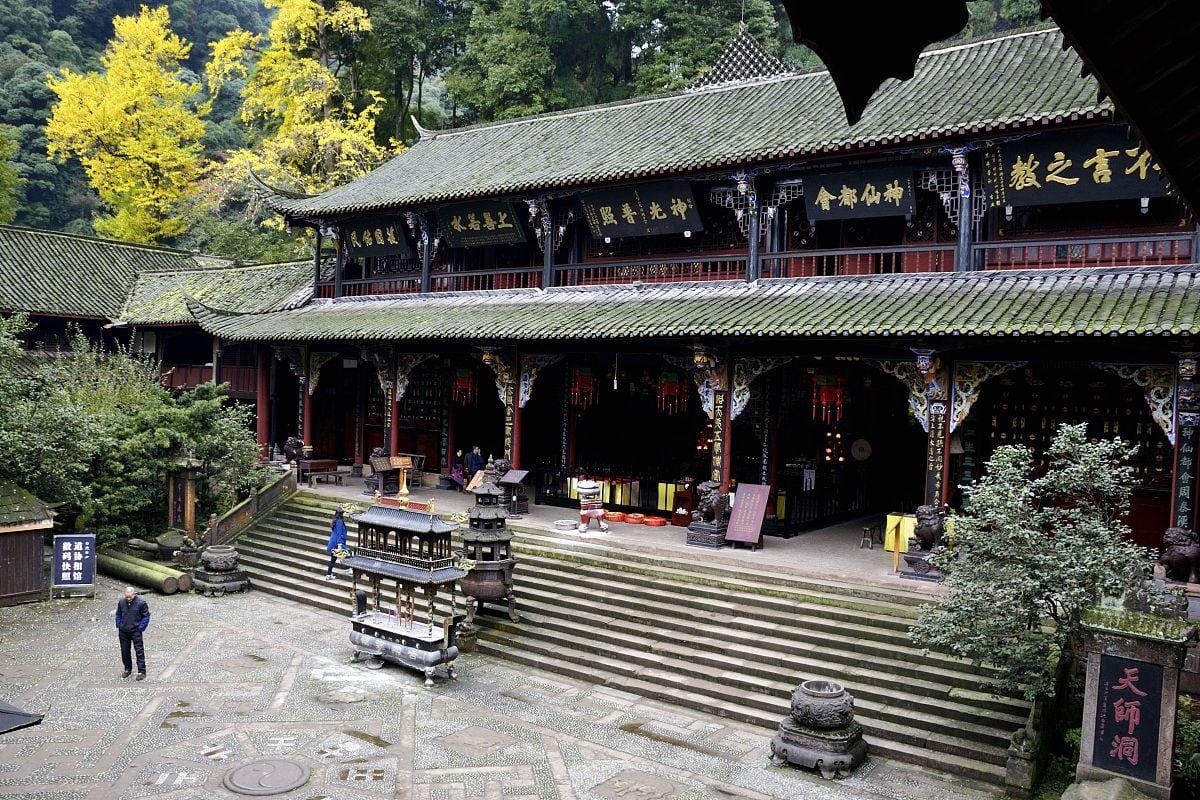
Tianshi Cave is the spiritual centre of the Front Mountain. Inside sits the Sui Dynasty stone statue of Zhang Tianshi. Three surrounding halls — Sanhuang Palace, Sanqing Palace, and Huangdi Temple — worship different tiers of Taoist deities. This is the one place on the Front Mountain we tell our clients not to rush.
Shangqing Palace
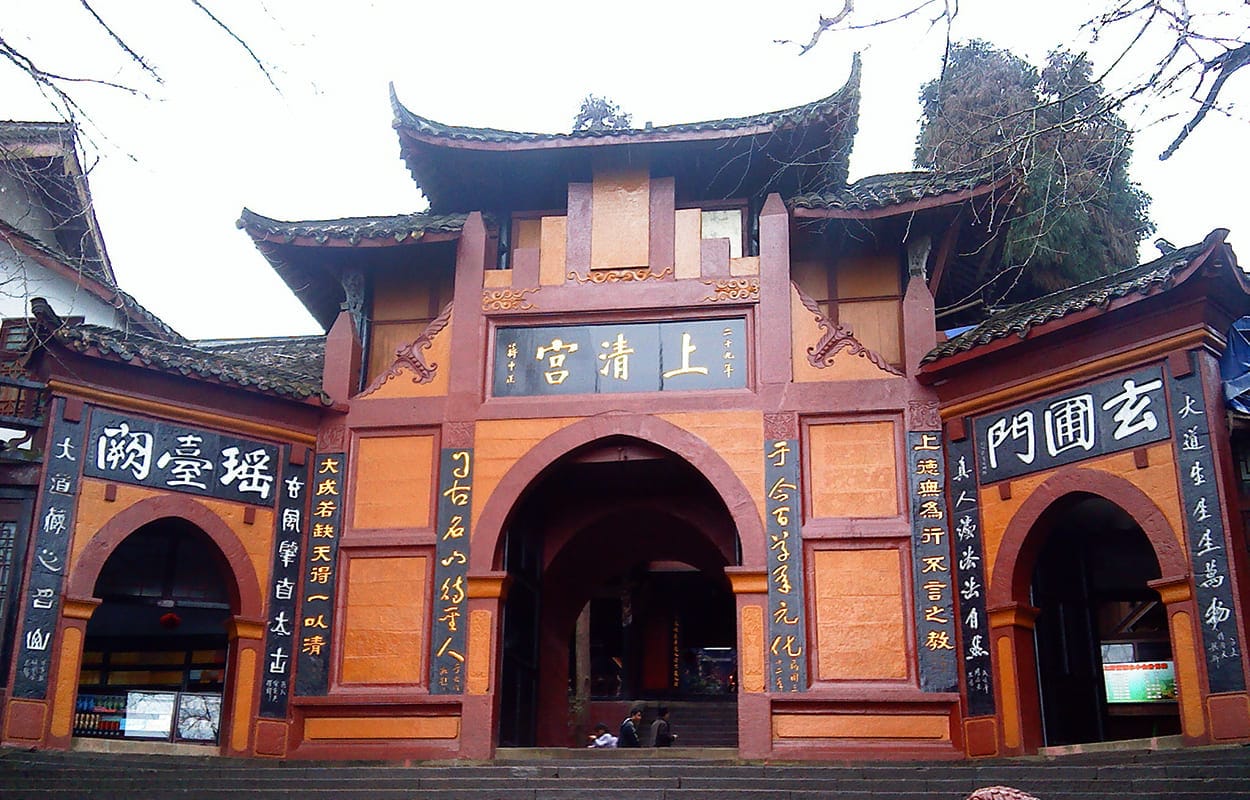
Shangqing Palace was first built during the Jin Dynasty. What stands today mostly dates to the Qing Dynasty. It sits higher up the mountain. It is also the traditional viewing spot for the “holy lamps” phenomenon covered in Section 6.
Jianfu Palace
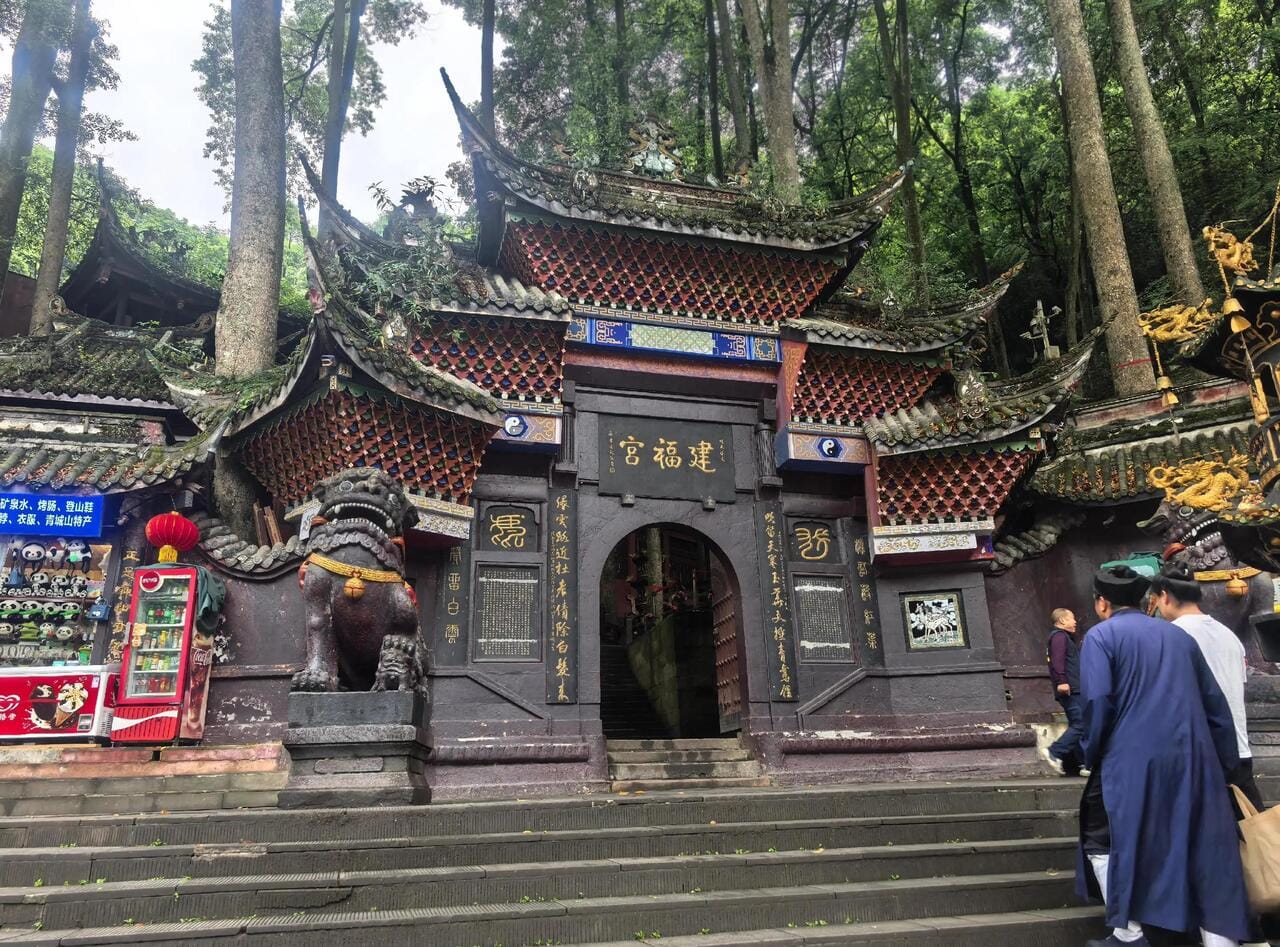
Jianfu Palace was built in the Tang Dynasty (618–907) and restored repeatedly since. It sits outside the ticket gate, so entry is free and you can leave it until you come back down. Most visitors walk straight past it on the way in and never return. Its 394-character couplet is locally considered the finest thing on the mountain.
Recommended Front Mountain Route
Walk up and ride the cable car down. Two reasons. Descending wet stone steps is where people slip and where knees suffer. And the queue runs 1 to 1.5 hours going up in peak season, but barely exists coming down.
The full loop, in order:
🗺️ Front Mountain Route
Walk up, cable car down — 5.5 to 7 hours
Take the cable car up only if a two-hour climb is unrealistic for your group — expect to queue for it.
Allow 5.5 to 7 hours, the range the scenic area’s booking notice gives and what our clients report back. Don’t plan on “2 to 3 hours and done”. Take the cable car up only if a two-hour climb is unrealistic for your group, and expect to queue for it.
Snacks Along the Way
Vendors along the trail sell yacon, cucumbers, and local sausage. Sausage runs CNY 10 to CNY 15 based on our clients’ recent trips. Bottled water runs CNY 5 to CNY 8. There is a stall every few hundred metres, so you do not need to carry much water.
3. What’s on the Back Mountain?
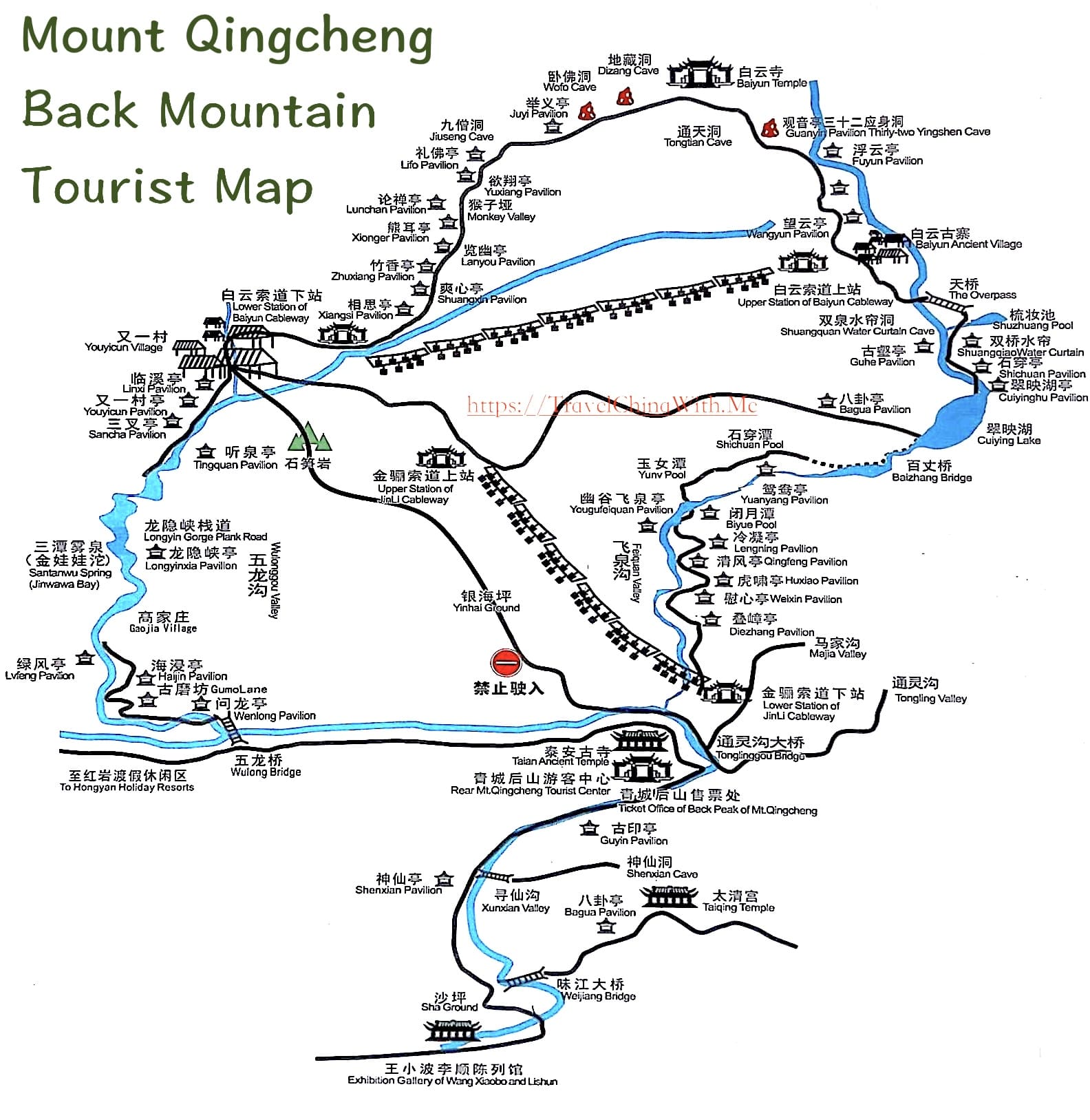
The Back Mountain covers 100 square kilometres. It receives far fewer visitors than the Front Mountain. It borders the Wolong Nature Reserve, part of the Sichuan Giant Panda Sanctuaries. UNESCO listed those sanctuaries in 2006 and describes them as home to more than 30% of the world’s wild giant pandas. Instead of temples, this side has gorges, streams, and old forest.
Clients who ask us for “somewhere quiet near Chengdu” almost always mean this side, even when they arrive knowing only the Front Mountain by name. We warn them the trade-off is real: fewer temples, more walking, and a longer day than the Front Mountain demands.
Wulong Gully
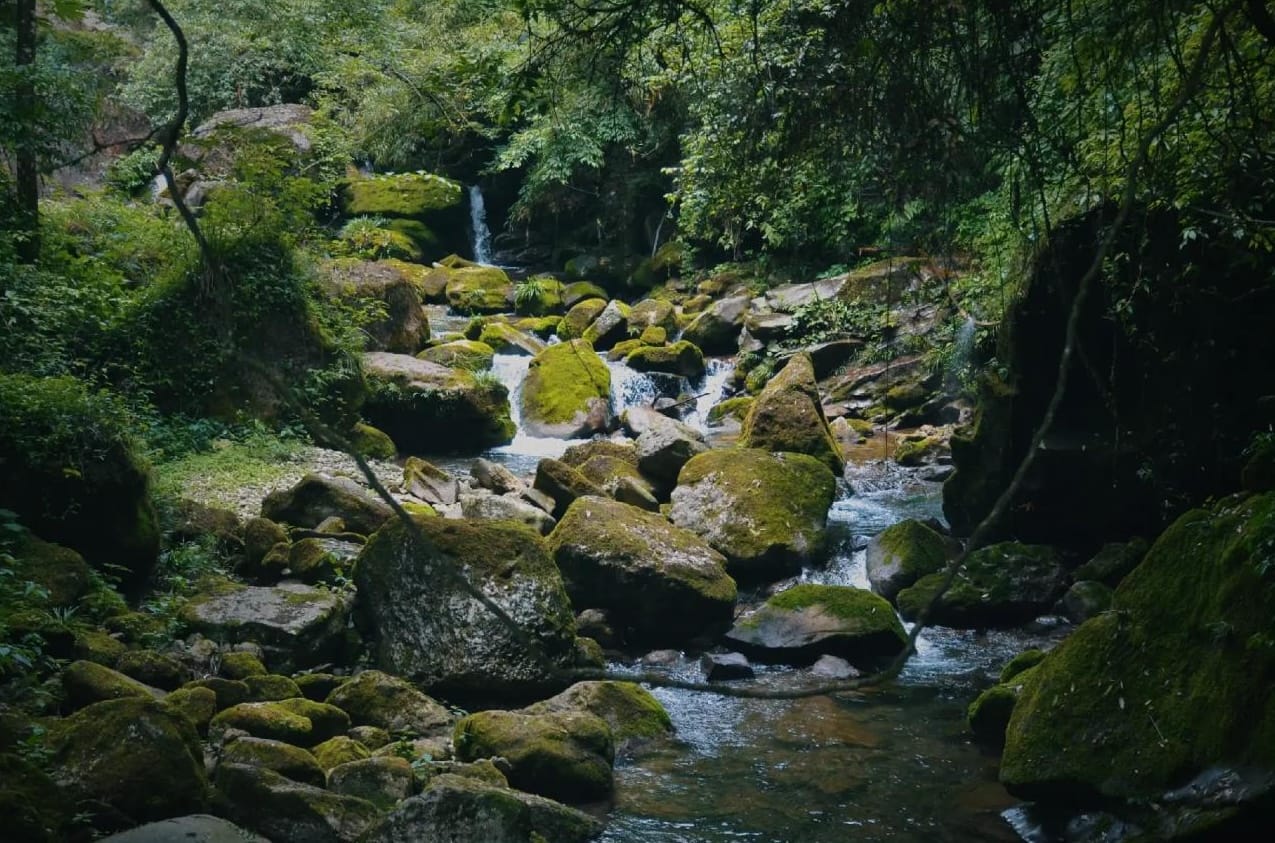
Wulong Gully, or Five Dragon Gully, takes its name from a legend of five dragons hiding within it. It stretches 8 kilometres with steep cliffs on either side. This is the main hiking route on the Back Mountain, and you will spend most of your walking time here.
Tai’an Ancient Town
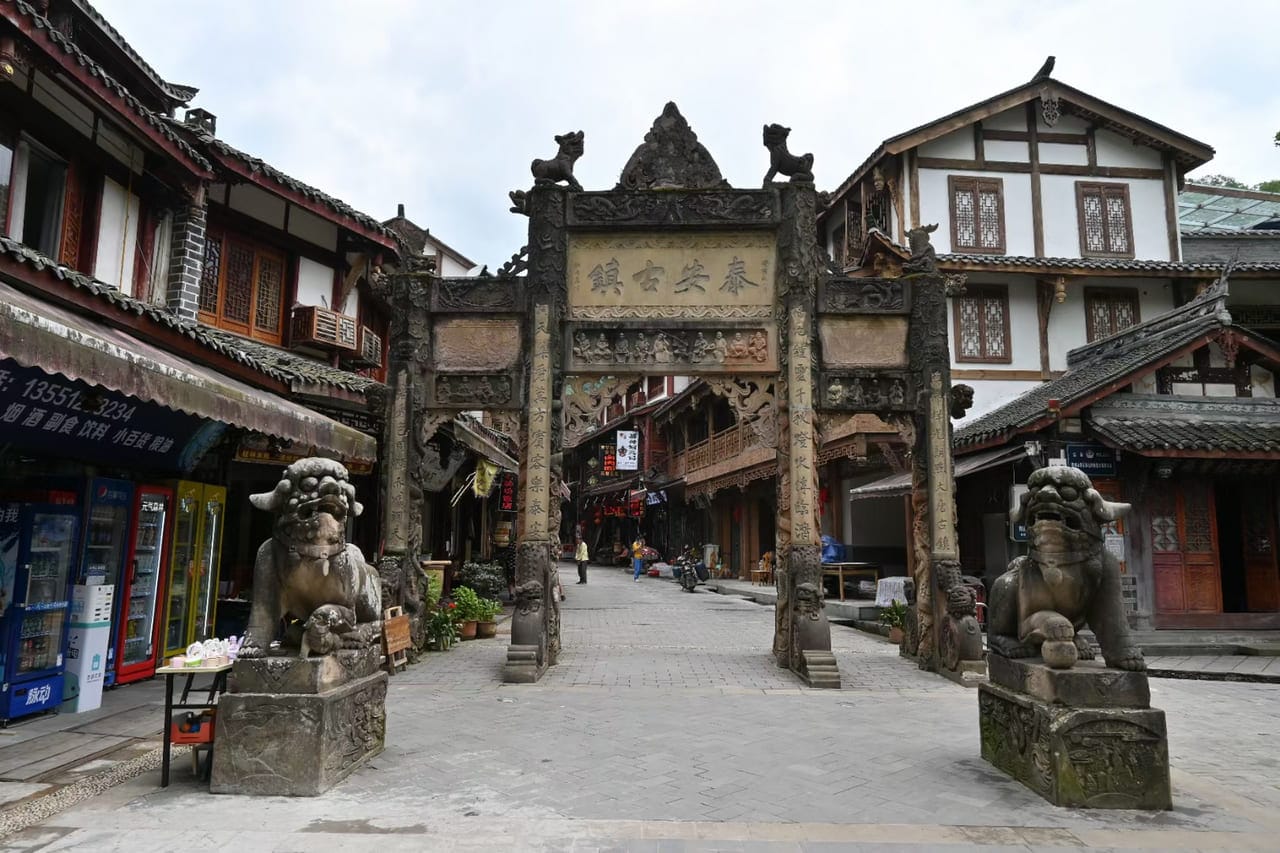
Taian Ancient Town sits at the base of the Back Mountain. It holds an old temple, Taian Temple, and a handful of local restaurants. It is not a major sight on its own. It works well as a rest stop before or after the gorge hike, and it’s one of the few places on this side to get a proper meal.
Shuangquan Water Curtain Cave and Baizhang Bridge
 Shuangquan Water Curtain Cave
 Baizhang Bridge
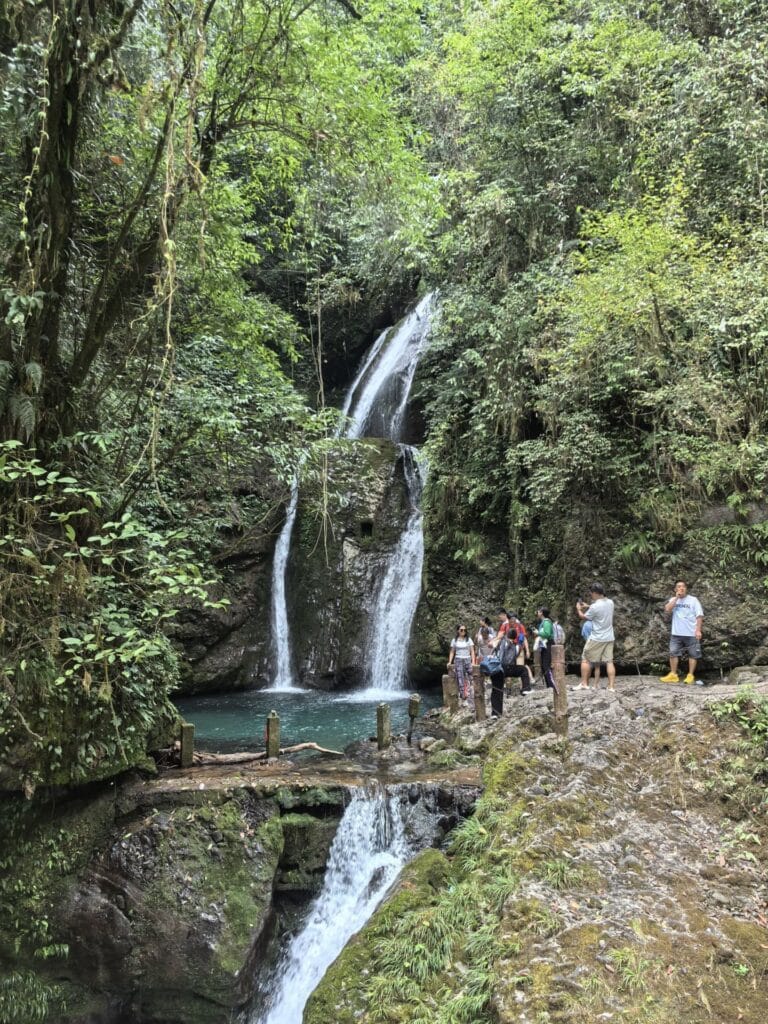
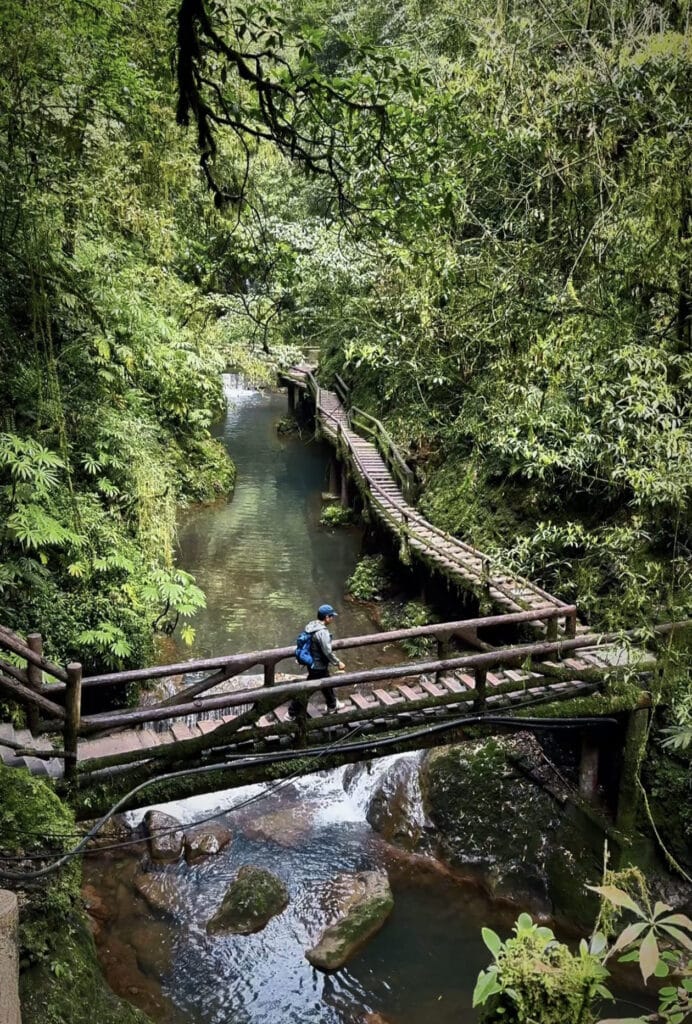
Twin springs feed a cave behind a natural water curtain. Spray reaches the path here, so the stone stays wet even on dry days. Baizhang Bridge, a long wooden plank bridge, connects it to the trail. That bridge has become a minor attraction for the gorge views in both directions.
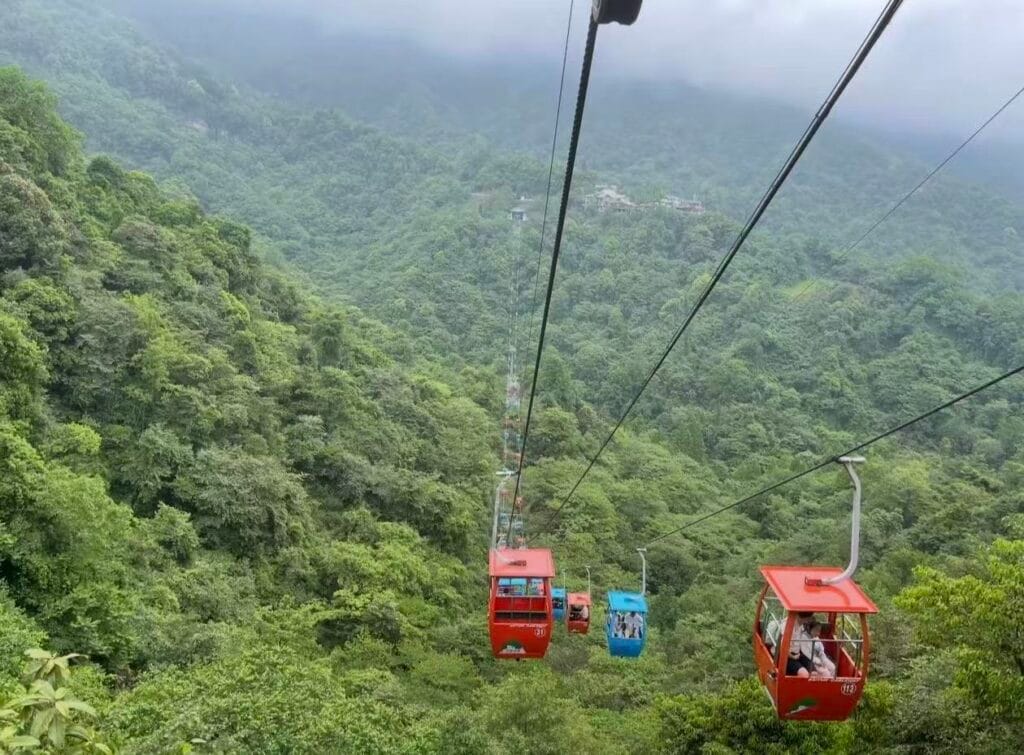
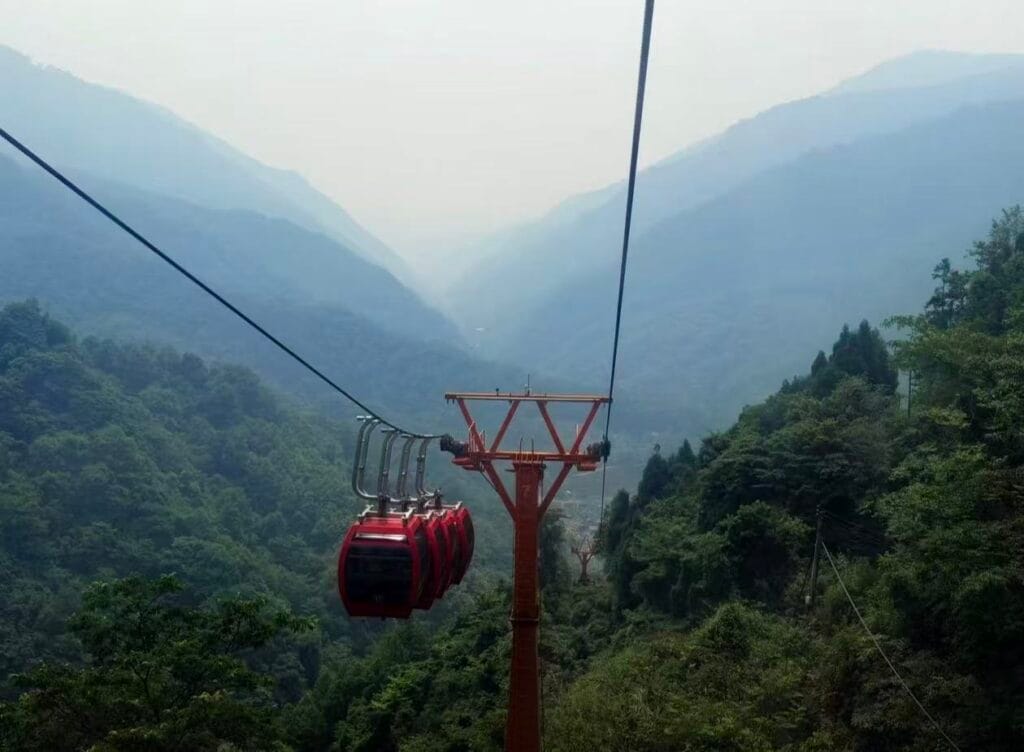
Cable Cars and Cuiying Lake
Two separate cable cars serve different sections of the climb.
 Baiyun Ropeway, back mountain of Mount Qingcheng
 Qingcheng Mountain back mountain, Jinli Cableway
Line | Runs between | One-way |
|---|---|---|
Jinli (金骊) | Feiquanfang → Shisun Tang | CNY 30 |
Baiyun (白云) | You Yi Cun → Baiyun Temple | CNY 35 |
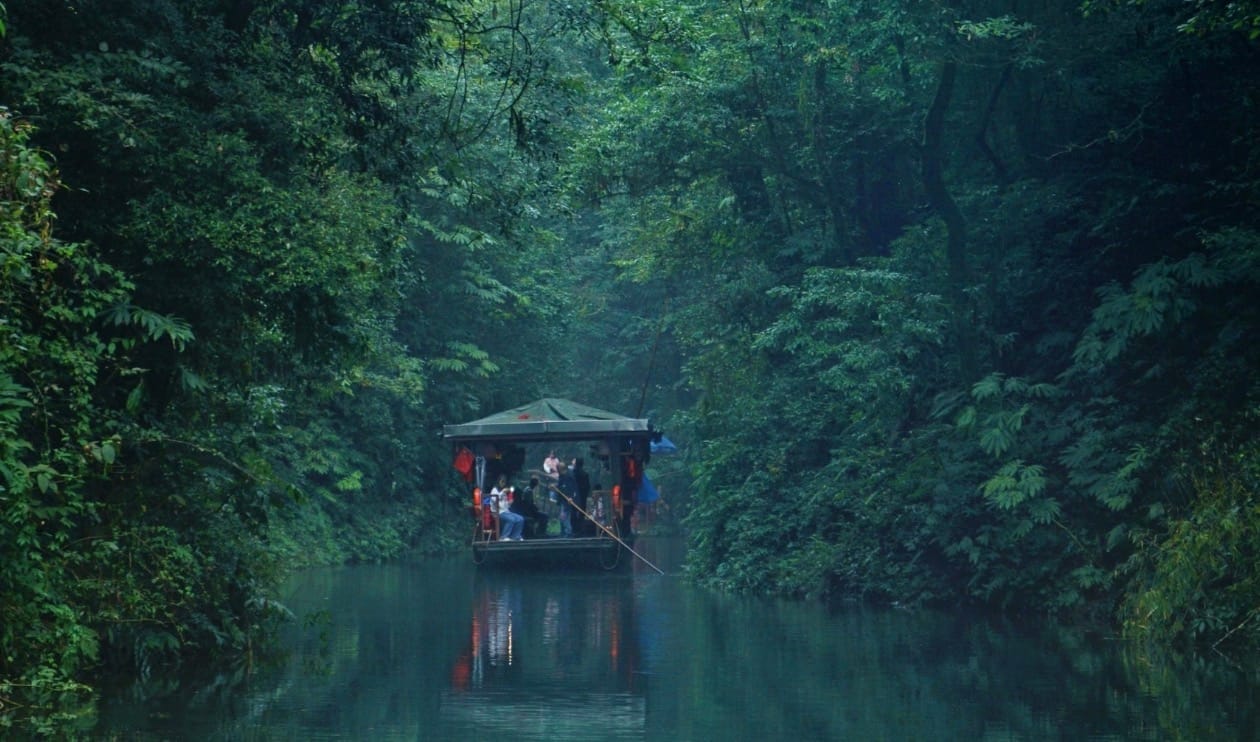
Cuiying Lake sits along the upper trail. A small ferry crosses it for CNY 2 per person if you’d rather not walk around.
Recommended Back Mountain Route
Go up Feiquan Gully and down Wulong Gully. This is the standard local loop, and it keeps you walking alongside water most of the day rather than repeating the same path.
🗺️ Back Mountain Route
Up Feiquan Gully, down Wulong Gully — 6 to 7 hours on foot
You must be through the gate by 13:00 — 6 to 7 hours on foot leaves no margin for a later start.
Walking the whole loop takes 6 to 7 hours. Riding a cable car in one direction brings that down to about 5. Short on time? Skip the climb to Baiyun Temple at the top, which saves 2 to 3 hours and keeps you in the best gorge scenery anyway.
Those 6 to 7 hours mean you must be through the gate by 13:00. See Section 5 for the full cable car cutoffs.
Why Locals Come Here in Summer
Qingcheng’s annual average temperature is 15.2°C, according to China Weather, the national weather service portal. July and August average 24°C there. The Back Mountain runs cooler than the Front Mountain because of denser canopy and higher water content. This is where Chengdu residents go to escape summer heat. The Front Mountain gets far more sun exposure and far more visitors.
4. Front Mountain or Back Mountain? Which Should You Pick?
Pick the Front Mountain for temples and history. Pick the Back Mountain for hiking and quiet.
The Comparison
Front Mountain | Back Mountain | |
|---|---|---|
Best for | Taoist temples, history, first-time visitors | Hiking, quiet, summer heat escape |
Crowds on the trails | High, especially weekends | Low to moderate |
Cable car queues | Long going up, short coming down | Long in both directions |
Physical demand | Moderate, cable car available | Higher, longer trails |
Standout feature | Tianshi Cave, Laojun Pavilion | Wulong Gully, water curtain cave |
Typical visit time | 5.5 to 7 hours | 5 to 7 hours |
Our Take
Go Front Mountain if this is your only mountain stop in Sichuan and you care about Taoist culture. Everything is closer together there, and it is simpler to organise. Choose the Back Mountain if you’ve seen plenty of temples elsewhere in China. Choose it too if you’re visiting in July or August and want somewhere cool. We’ve had clients who saw the Front Mountain on a group tour years earlier return specifically for the Back Mountain, because nobody had told them it existed.
One Thing Nobody Tells You
Don’t assume the Back Mountain means shorter cable car queues. It doesn’t.
The Front Mountain’s queue is long going up — 1 to 1.5 hours in peak season — but short coming down. The Back Mountain queues in both directions, and the Baiyun cable car often passes 60 minutes at weekends. Its narrow gorge walkways jam up too, with uphill and downhill traffic blocking against each other.
5. Can You Visit Both in One Day?
One day covers both mountains, but it makes for a demanding day rather than a relaxed one. We’ve had clients do it. One logged over 53,000 steps: the Back Mountain fully on foot in the morning, the Front Mountain in the afternoon, finishing near 6pm. Split the two mountains across separate days if you aren’t an experienced hiker.
A Realistic One-Day Timeline
Time | Activity |
|---|---|
7:30am | Arrive at Qingchengshan Station, head to Back Mountain first |
8:00am–12:00pm | Taian Ancient Town → Wulong Gully → You Yi Cun |
12:00–12:30pm | Lunch at You Yi Cun |
12:30–1:00pm | Car transfer to Front Mountain (CNY 20) |
1:00–5:00pm | Front Mountain: cable car up (queue permitting), walk down past Shangqing Palace, Laojun Pavilion, Tianshi Cave |
5:30pm | Shuttle bus back to the train station |
That totals 10 to 12 hours door to door, based on the trips we’ve run this way. The weak point is the afternoon. Arriving at the Front Mountain at 1pm leaves too little time to walk up, so you join the uphill cable car queue at its worst hour. Want to shave time off? Skip the walk up to Baiyun Temple on the Back Mountain and stay in the lower gorge sections, which saves 2 to 3 hours.
The Times That Decide Your Day
Both mountains close earlier than people expect, and the cable cars stop before the gates do.
Front Mountain | Back Mountain | |
|---|---|---|
Gate hours (summer) | 08:00–17:30 | 08:00–17:30 |
Gate hours (winter) | 08:30–17:00 | 08:00–16:30 |
Cable car stops | 17:30 | 17:30 Jinli, 17:00–17:30 Baiyun |
Be in the queue by | 17:00 | 16:30 |
Latest entry | Midday | 13:00 |
Miss the last car on the Front Mountain and you walk down. The trail stays open after dark but has no lighting, so allow 1.5 to 2 hours and a phone torch.
Missing it on the Back Mountain is worse. The steps are narrower and slicker, and signal is poor. One visitor ran the descent by phone torch and it still took over an hour. If you’re walking the Back Mountain loop rather than riding down, turn back by 15:30 regardless of where you’ve got to.
When to Stay Overnight Instead
Stay one night near the mountain to see both sides properly, including sunrise or the “holy lamps”. Tianshi Cave and Shangqing Palace both offer monastery lodging on the Front Mountain. This is the most atmospheric choice, but the rooms are very simple compared with a hotel.
6. Best Time to Visit Mount Qingcheng
☁️ Mount Qingcheng Climate
Average temperature and rainfall by month
Source: China Weather and Dujiangyan municipal scenic area planning data
Spring and Autumn
March through May and September through November bring the mildest weather. Spring adds wildflowers along the Front Mountain trails. Autumn brings better visibility from Laojun Pavilion. We book most of our Qingcheng day trips in these months. The reason is practical: dry stone steps mean older clients can walk down instead of riding the cable car both ways.
Summer
June through August is peak season for the Back Mountain specifically. Chengdu locals come to escape the heat. Expect more weekend crowds, and mosquitoes in the gorge areas, so bring repellent. Traffic to the Back Mountain entrance also backs up badly on summer weekends. Waits of two hours or more on the approach road are common. Go on a weekday, or arrive before 8am. We steer summer clients here and away from the Front Mountain’s exposed upper steps, where the climb turns punishing in July humidity.
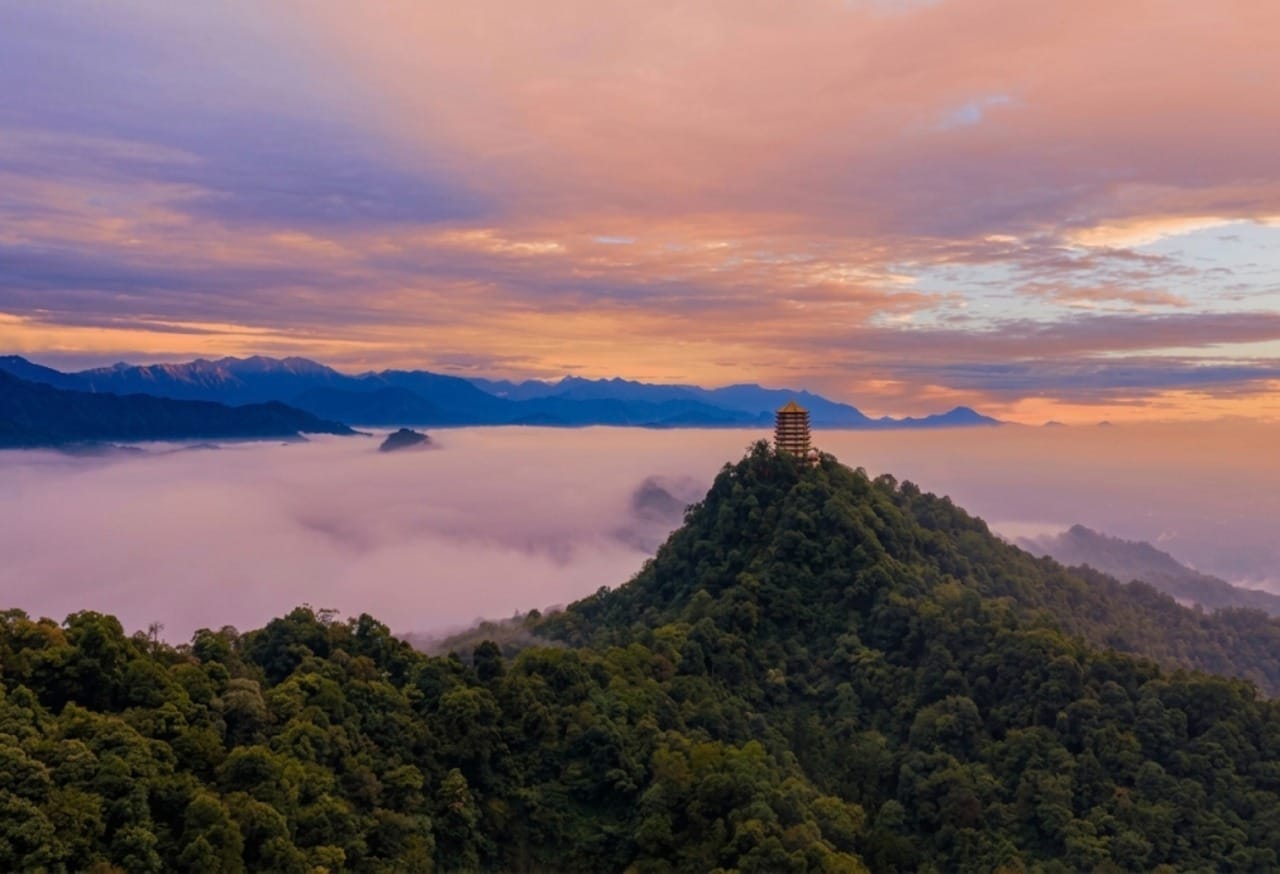
The Three Natural Wonders
Qingcheng is known for three sights that depend entirely on the weather.
Where to watch | What it needs | Your odds | |
|---|---|---|---|
Sea of clouds | Laojun Pavilion and the upper trails | Damp weather clearing overnight | Best of the three |
Sunrise | Laojun Pavilion, the summit | A clear morning, and an overnight stay | Moderate |
Holy lamps | Shengdeng Pavilion, by Shangqing Palace | A summer night after rain clears | Rare |
The holy lamps are the strangest of the three. Points of light flicker and drift across the valley at night, sometimes three or five, occasionally hundreds. Taoist tradition treats them as a sacred sight.
We’ve arranged over a dozen client trips with an overnight stay specifically to try for one of these. The sea of clouds is the one people actually see. July and August deliver it more reliably than the drier autumn months. We don’t promise any of the three on a single-day trip.
Avoid National Holidays
Chinese national holidays bring the heaviest crowds. Peak periods like Labour Day and National Day require advance online booking rather than walk-up purchase. Avoid these dates entirely if your schedule allows any flexibility.
7. What Does It Cost?
Entrance Tickets
Price | |
|---|---|
Front Mountain (adult) | CNY 80 |
Back Mountain (adult) | CNY 20 |
Ten Thousand Buddha Cave (inside Back Mountain) | CNY 5 |
Crystal Cave (inside Back Mountain) | CNY 10 |
Cable Cars
One-way | Round trip | |
|---|---|---|
Front Mountain | CNY 35 | CNY 60 |
Back Mountain Jinli | CNY 30 | CNY 55 |
Back Mountain Baiyun (up / down) | CNY 35 / CNY 30 | CNY 60 |
Boats and Sedan Chairs
Price | |
|---|---|
Yuecheng Lake boat (Front Mountain) | CNY 5 |
Cuiying Lake ferry (Back Mountain) | CNY 2 |
Sedan chair (滑杆, per carrier, per li) | CNY 15 |
Sedan chairs follow the board posted at the boarding point. They aren’t negotiated on the spot.
Discounts
Who | What they pay |
|---|---|
Students (full-time, to undergraduate) | Half price |
Aged 65 and over | Free |
Aged 60 to 64 | Free on ordinary days, half price on national holidays |
Children under 1.3m or under 6 | Free with an adult |
Active military, veterans, emergency responders | Free with valid ID |
Bring the physical passport for whichever category applies. Staff check it at the gate.
How to Actually Buy Your Ticket
Book online in advance for national holidays, summer weekends, and any weekend in spring or autumn. Same-day tickets sell out on those dates. An ordinary weekday is fine to buy at the gate.
Book through the official 青城山-都江堰 WeChat account, or Trip.com. Tickets are name-registered, so bring the passport you booked with. Front and Back Mountain are separate tickets at separate gates — doing both in one day means booking both before you set off.
Is the Combo Ticket With Dujiangyan Worth It?
The Front Mountain and Dujiangyan sell a combined ticket at CNY 120 to CNY 180 depending on channel. Buying separately costs CNY 160 to CNY 170. The saving reaches CNY 20 at most. Combo tickets also require both sites on the same calendar day, which makes for a ten-hour day once you add the travel time between them. We recommend buying separately and splitting the visits across two days unless your schedule genuinely demands otherwise.
Combining them in one day? Budget CNY 300 to CNY 400 per person, covering both entrance tickets, cable cars, and local transport.
8. How Do You Get There From Chengdu?
By Metro and Intercity Rail
Take Metro Line 2 or Line 6 to Xipu Station (犀浦站), not Chengdu North. The intercity platform is inside the same station — follow signs for 城际铁路 instead of exiting. The ride to Qingchengshan Station takes 25 to 35 minutes and costs CNY 10. Bring your passport, as tickets are name-registered. Book ahead on 12306 for weekends and holidays.
Leave your hotel by 7:00am to reach the gate around 9:00. Central Chengdu to Xipu takes 40 minutes to an hour on the metro, plus the train and the shuttle at the far end.
From Qingchengshan Station to the Gate
The scenic shuttle bus leaves from a booth across the road from the station exit, not from the taxi rank most people head for. One-way costs CNY 20, round trip CNY 35. Walking takes 40 minutes. A separate minibus runs to the Back Mountain entrance at Taian Ancient Town for CNY 20.
By Self-Drive
Driving takes one hour via the Chengguan Expressway. Ignore your map app’s default car park — it’s far from the gate and you’ll still need the shuttle. Park near Feixian Guan (飞仙观) instead, where farmhouses charge CNY 20 a day much closer in. Arrive by 8am at weekends. Touts offering “CNY 50 straight to the gate” are just driving you to Feixian Guan, where you’ll pay the CNY 20 anyway.
By Private Car With a Driver
We arrange a driver for clients doing both mountains in one day, since the two entrances sit far apart with little public transport between them. The same works for pairing Qingcheng with the Dujiangyan Irrigation System or a Chengdu panda base.
9. Practical Tips
What to Bring
- Anti-slip shoes — the one thing that matters most. Stone steps turn slick after rain, and smooth soles are what get people into trouble
- Mosquito repellent — for the gorge sections in summer
- Snacks and a light layer — food inside the scenic area costs more than in town, and the mountain runs cooler than Chengdu
Footwear is the item we chase clients about before every Qingcheng trip, and it’s still the thing people get wrong most often.
On rainy days, avoid Feiquan Gully (飞泉沟) on the Jinli cable car side. It runs closest to the water and is the most slippery route on the mountain. Take Wulong Gully’s main path instead.
Walking Sticks
Bamboo sticks cost CNY 3 to CNY 5 at the bottom, CNY 5 further up. Buy at the bottom if you want one, and pass it to someone heading up when you finish.
Bathroom Planning
There are few toilets along the longer trails, especially on the Back Mountain. Some guesthouses along the route will let you use theirs for a small fee if you can’t find a public one.
If You Lose the Trail
Signs thin out on the Back Mountain’s upper paths, and signal drops in the gorge and near Baiyun Temple. Download an offline map before you go — Amap (高德地图) covers these trails better than Google Maps.
Unsure at a junction, head for the nearest cable car station rather than an unmarked side path. Both are staffed and both get you down. If you’re walking alone, tell someone your route and expected return time.
Visiting With Children or Older Parents
The Front Mountain works for both, with planning. Take the cable car in at least one direction and budget 4 to 5 hours rather than the full 7. Turn back at Shangqing Palace instead of pushing on to Laojun Pavilion, since that last stretch is the steepest part of the climb.
The flat walk from Yuecheng Lake to the cable car station makes a good first hour for seeing how everyone copes before committing to the climb.
Skip the Back Mountain with under-8s or anyone unsteady on their feet. The gorge walkways are narrow, wet, and long, with no short way out once you’re in.
Motion Sickness
The road to the Back Mountain entrance has many sharp bends, and local bus and shuttle drivers drive it quickly. Take medication before the ride if you’re prone to motion sickness, rather than after symptoms start.
Frequently Asked Questions
Is Mount Qingcheng the same mountain from Kung Fu Panda?
Panda Village in Kung Fu Panda 3 is animated rather than a filmed location, but the connection is real. DreamWorks’ art team visited Mount Qingcheng in 2008 to research the film. The moss-covered roofs and misty green scenery in Panda Village were designed from what they saw here. A local tai chi teacher’s movements were also used to choreograph one of Po’s fight scenes in the second film.
Should I take the cable car or hike up Mount Qingcheng?
The best combination on the Front Mountain is walking up and riding the cable car down. Some sections are steep and the stone steps stay wet after rain, so descending on foot is where people slip and where knees suffer most. The queues favour this direction too: going up runs 1 to 1.5 hours in peak season, while coming down rarely has a wait. Walking from the gate to the summit takes 2 to 2.5 hours.
Can I see wild pandas at Mount Qingcheng?
No. Mount Qingcheng is a Taoist mountain rather than a panda reserve, and visitors don’t realistically encounter wild pandas here despite the Kung Fu Panda association. Pair your visit with a Chengdu panda base if seeing pandas is the goal. Several are close enough to Mount Qingcheng to visit on the same day.
Do I need a guide to visit Mount Qingcheng?
Not really. The signs on the Front Mountain are clear enough to follow. The Back Mountain holds more trail junctions and less signage, so a guide or careful pre-planning helps you avoid backtracking on the longer routes.
Is Mount Qingcheng slippery or dangerous to hike?
Stone steps turn slick after rain on both sides, and the Back Mountain’s longer trails have more loose and wet ground. Feiquan Gully runs closest to the water and is the worst of them. Anti-slip shoes are the single thing that matters most here, more than fitness. Ordinary trainers or smooth-soled shoes are what get people into trouble on wet stone.
Is it worth buying the combo ticket with Dujiangyan?
Usually not, unless your schedule requires both sites the same day. The Front Mountain plus Dujiangyan combo runs CNY 120 to CNY 180 depending on booking channel, against CNY 160 to CNY 170 bought separately. That saves CNY 20 at most and forces a long, rushed day. We recommend booking separately and splitting the two across different days.
Planning a Chengdu itinerary that includes Mount Qingcheng? Get in touch and we’ll help you build a route around it, including how it pairs with pandas and Dujiangyan.