Dujiangyan Irrigation System: All in One Visitor Guide
The Dujiangyan Irrigation System is a dam-free water diversion project, more than 2,250 years old, on the Minjiang River 60km northwest of Chengdu, and it still irrigates the Chengdu Plain today. It’s part of the Mount Qingcheng and Dujiangyan UNESCO World Heritage Site. We’ve routed clients through it for two decades, and the real planning questions aren’t “what is it” — they’re which gate to use, how long to budget, and whether to stay past dark.
Admission | CNY 80 (adult) / CNY 40 (student or under 18) / free under 6 and over 65 |
Hours | 8:00–18:00 (summer) / 8:00–17:30 (winter, last ticket 17:00) |
Entry | Real-name booking online in advance (official WeChat account, or Trip.com/Ctrip if you don’t have a Chinese phone number); scan your passport at the gate |
Time needed | 2 hours on the easy route, up to 3.5 hours on the full walking route |
Distance from Chengdu | 60km; 20–30 min by intercity train from Xipu Station to Lidui Park Station |
Table of Contents
1. What Is Dujiangyan?

Dujiangyan is the name of an ancient water-diversion system on the Minjiang River, right where it comes down out of the mountains onto the Chengdu Plain, 60km northwest of central Chengdu. Built without a dam, it’s the oldest irrigation project of its kind still functioning anywhere in the world — and it’s the reason the Chengdu Plain became known as Sichuan’s “Land of Abundance” instead of the flood-prone region it used to be. It’s also still genuinely popular: the site drew 7.8 million visitors in 2024, up 12.6% year-on-year, according to Sichuan’s provincial water resources department.
Dujiangyan the Site vs. Dujiangyan the City
“Dujiangyan” actually refers to two different things, and it trips up more visitors than you’d expect. There’s the irrigation system itself — the attraction this guide is about — and there’s Dujiangyan City (都江堰市), the county-level city under Chengdu’s administration where it sits. We still get clients who book a “Dujiangyan” hotel assuming it’s a small village by the gate, only to land in a city of more than 700,000 people. The city was called Guanxian (灌县) until 1988, when it was renamed after the irrigation system to capitalize on the name’s fame — which is why “Guanxian Old Town” (灌县古城), the old quarter by Nanqiao, still carries the pre-1988 name.
That’s the basic identity. The genuinely clever part is how it actually moves water without a dam.
2. How Does the System Actually Work — and Why Is There No Dam?
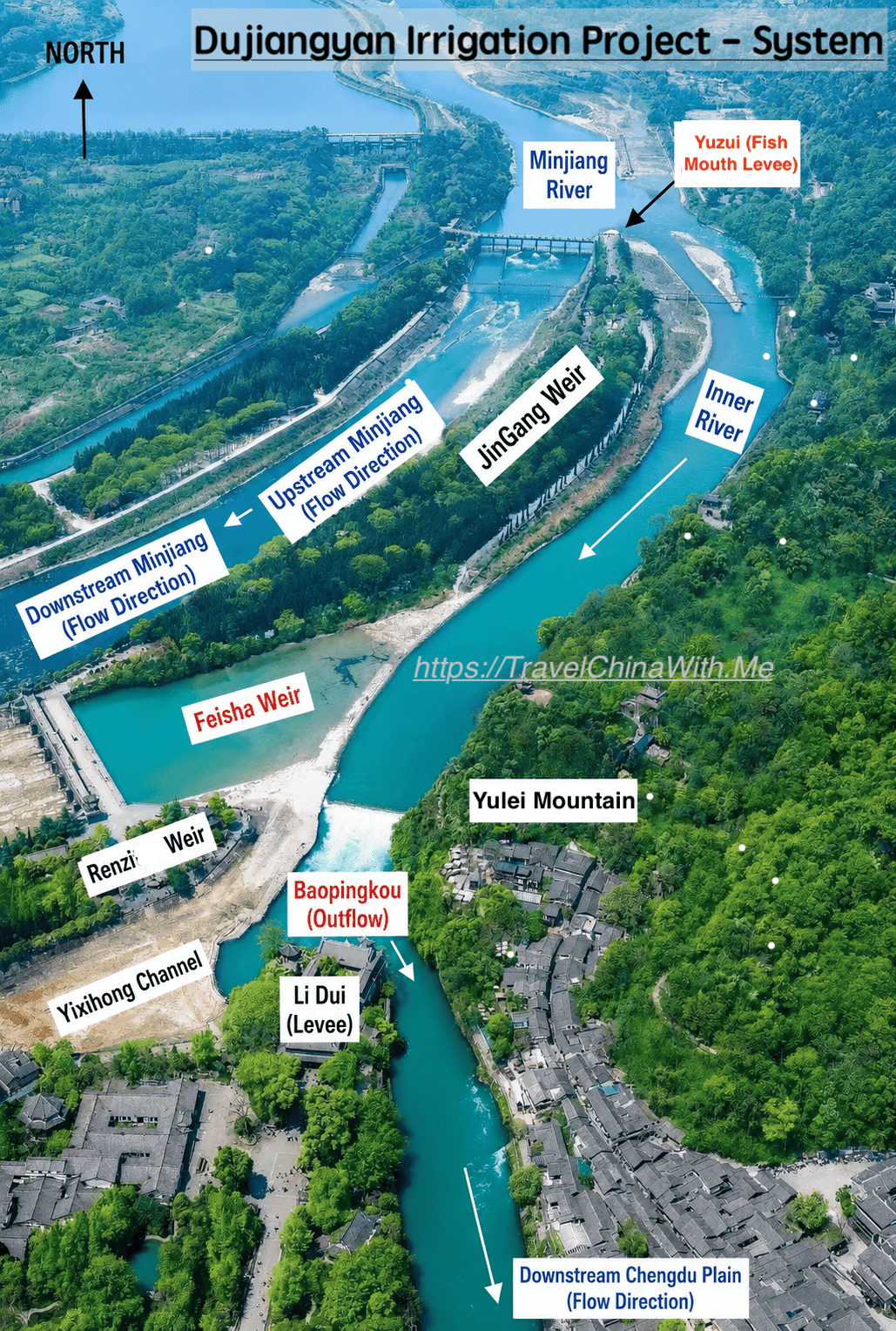
The Three Components
Component | Chinese | What it does |
|---|---|---|
Yuzui (Fish Mouth Levee) | 鱼嘴 | A fish-head-shaped levee that splits the Minjiang into an inner channel (irrigation) and an outer channel (downstream flow) |
Feishayan (Flying Sand Weir) | 飞沙堰 | The spillway just past Yuzui — drains floodwater and flushes silt out of the inner channel |
Baopingkou (Bottle-Neck Channel) | 宝瓶口 | A narrow gap cut through Yulei Mountain that meters exactly how much water reaches the Chengdu Plain |
Li Bing and the 256 BC Origins
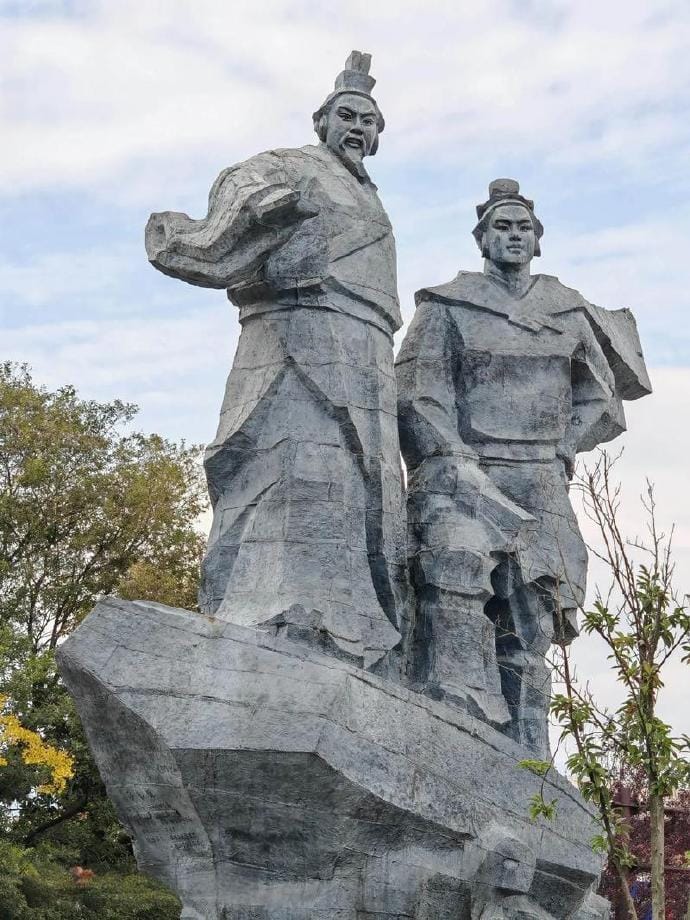
Li Bing, a Qin Dynasty official, built the original system starting in 256 BC, using the region’s natural slope — high in the northwest, low in the southeast — to move water by gravity instead of damming it. In the dry season, 60% of the river’s flow goes through the inner channel for irrigation; that ratio reverses in flood season, according to The Paper’s breakdown of the engineering. According to UNESCO, the system now irrigates 668,700 hectares of farmland. The headworks themselves survived the 2008 Wenchuan earthquake essentially intact, even as the quake devastated Sichuan’s heritage sites elsewhere — Erwang Temple, just downstream, took the worst damage of any of the province’s 83 national heritage sites and became the government’s top reconstruction priority, reopening in 2011, according to Tsinghua University’s account of the restoration. It’s the one part of the visit clients still mention weeks later, long after they’ve forgotten the ticket price.
That’s the mechanism. Whether it’s worth working into a short Chengdu trip is the next thing people actually ask us.
3. Is Dujiangyan Worth Visiting?
Yes — especially if you’ve already seen China’s better-known monuments like the Great Wall or the Forbidden City. Dujiangyan isn’t a monument; it’s working infrastructure that has run continuously for over two millennia, and visitors interested in engineering history consistently tell us it’s more compelling than they expected.
One full day covers it properly — you don’t need to set aside two, whatever some itineraries suggest. The real trade-off is which day: if your whole Chengdu stop is a single day, most travelers are happier spending it with the pandas instead. Once you’ve got two days or more in the city, there’s no reason not to fit both in.
Assuming Dujiangyan made the cut, here’s what actually fills that day once you’re through the gate.
4. The Eight Sights Worth Your Time
Sight | Chinese | One-line take |
|---|---|---|
Yuzui (Fish Mouth Levee) | 鱼嘴 | The river-splitting divider itself |
Feishayan (Flying Sand Weir) | 飞沙堰 | The spillway — best after summer rain |
Baopingkou (Bottle-Neck Channel) | 宝瓶口 | The water inlet, viewed from above |
Anlan Suspension Bridge | 安澜索桥 | The signature swaying photo spot |
Qinyan Tower | 秦堰楼 | Highest viewpoint; closes at 17:30 |
Erwang Temple | 二王庙 | Li Bing temple, Journey to the West filming spot |
Yulei Pavilion | 玉垒阁 | Rooftop panorama, reached by escalator |
Fulong Temple | 伏龙观 | Quieter alternative view of the core works |
Eight stops carry the visit. Here’s what you’re actually looking at when you reach each one.
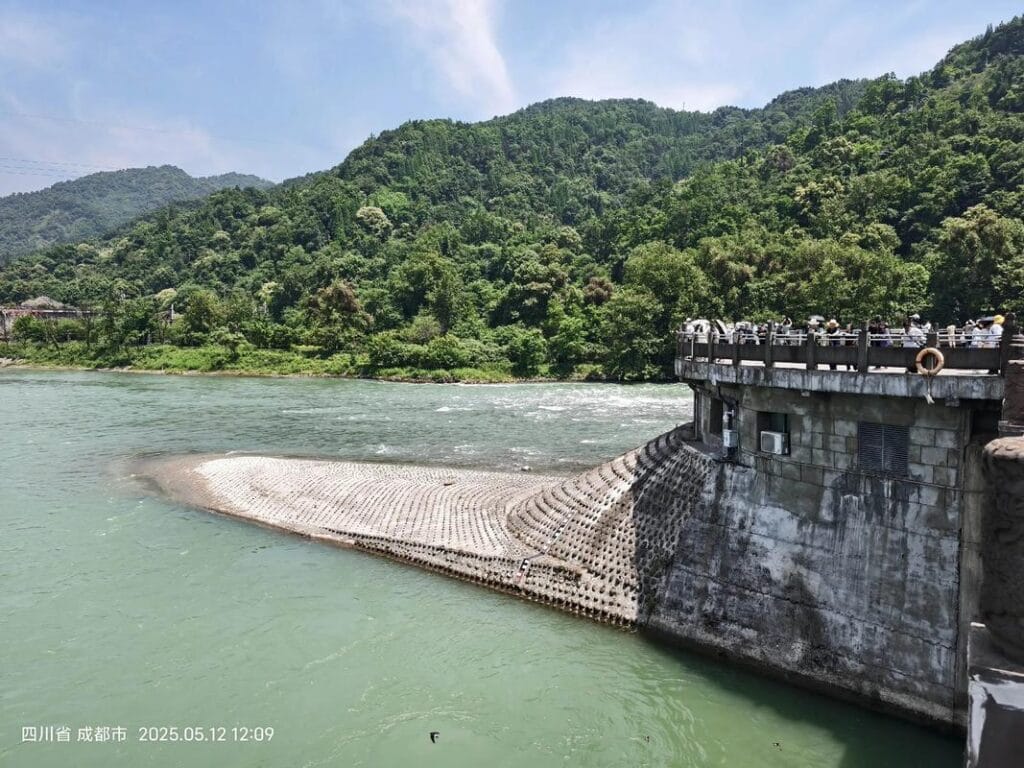
Yuzui (Fish Mouth Levee, 鱼嘴)
The fish-mouth divider itself, and the easiest place to physically see the inner/outer river split happening in front of you. Most people expect a dam here and are surprised there isn’t one.
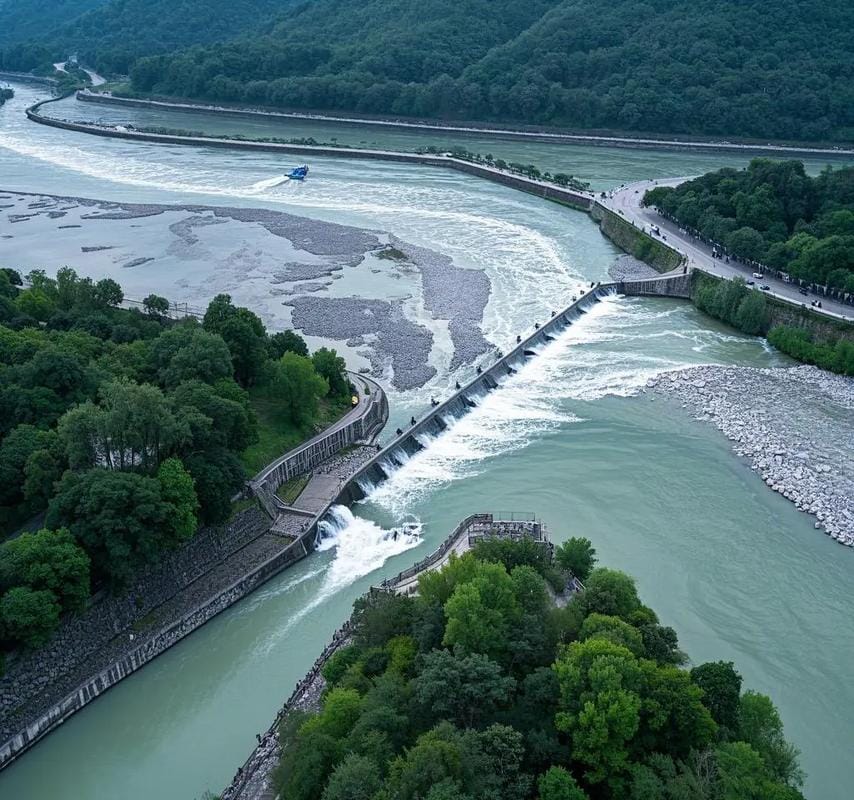
Feishayan (Flying Sand Weir, 飞沙堰)
The spillway, a few minutes’ walk from Yuzui. It looks unremarkable on a dry day and genuinely dramatic after summer rain, when you can watch it flush sediment out in real time.
Baopingkou (Bottle-Neck Channel, 宝瓶口)
The “bottle-neck” inlet that controls how much water actually reaches the Chengdu Plain. Best viewed from the Fulong Temple pavilion just above it, which frames the whole cut in one shot.
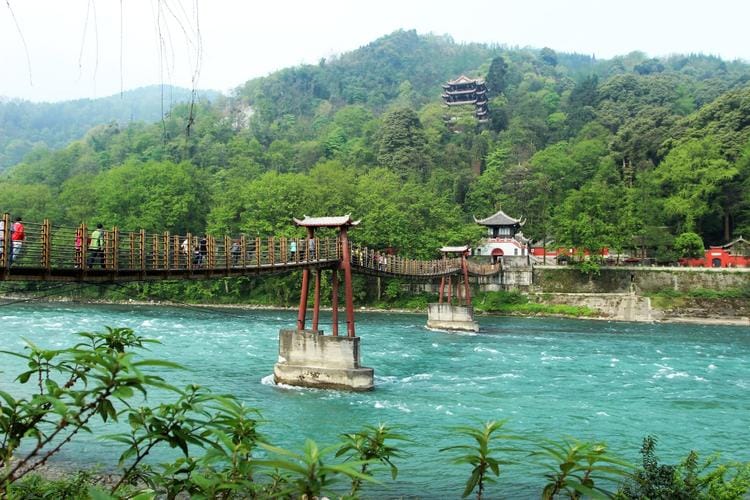
Anlan Suspension Bridge (安澜索桥)
A swaying cable bridge over the Minjiang, locally nicknamed the “couple’s bridge.” This is the photo everyone takes, and it earns the reputation — the sway is real, not just for show.
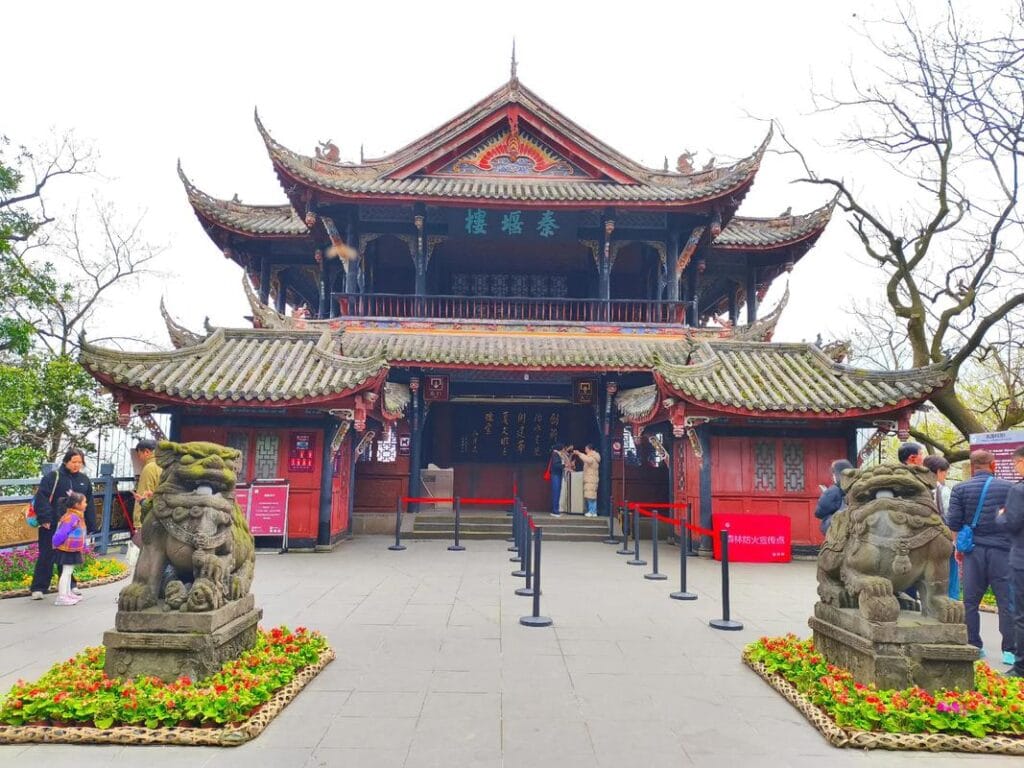
Qinyan Tower (秦堰楼)
The highest viewpoint over the whole layout, and the only spot where the Yuzui–Feishayan–Baopingkou logic clicks into place at a glance. Closes at 17:30, half an hour before the rest of the park.
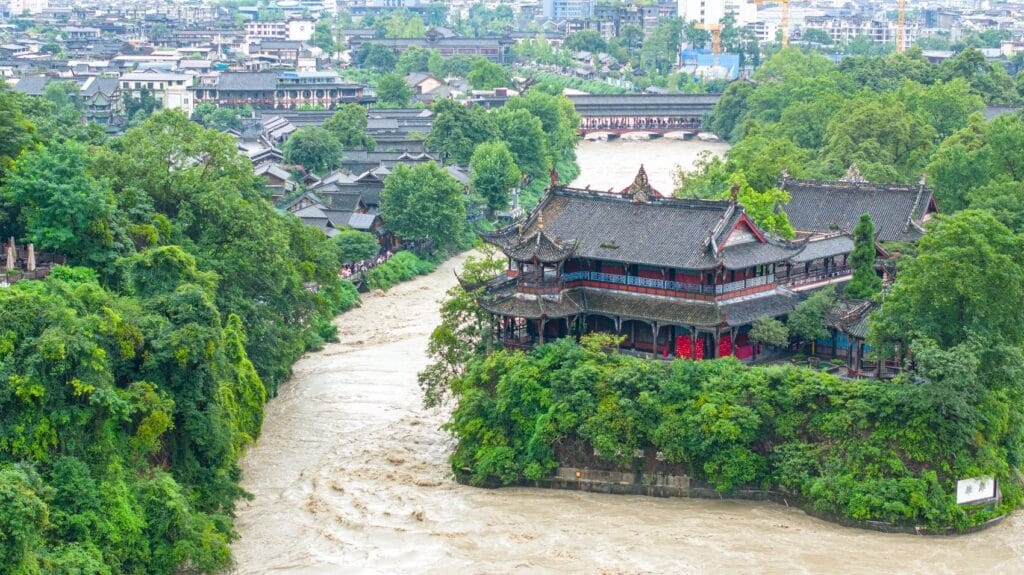
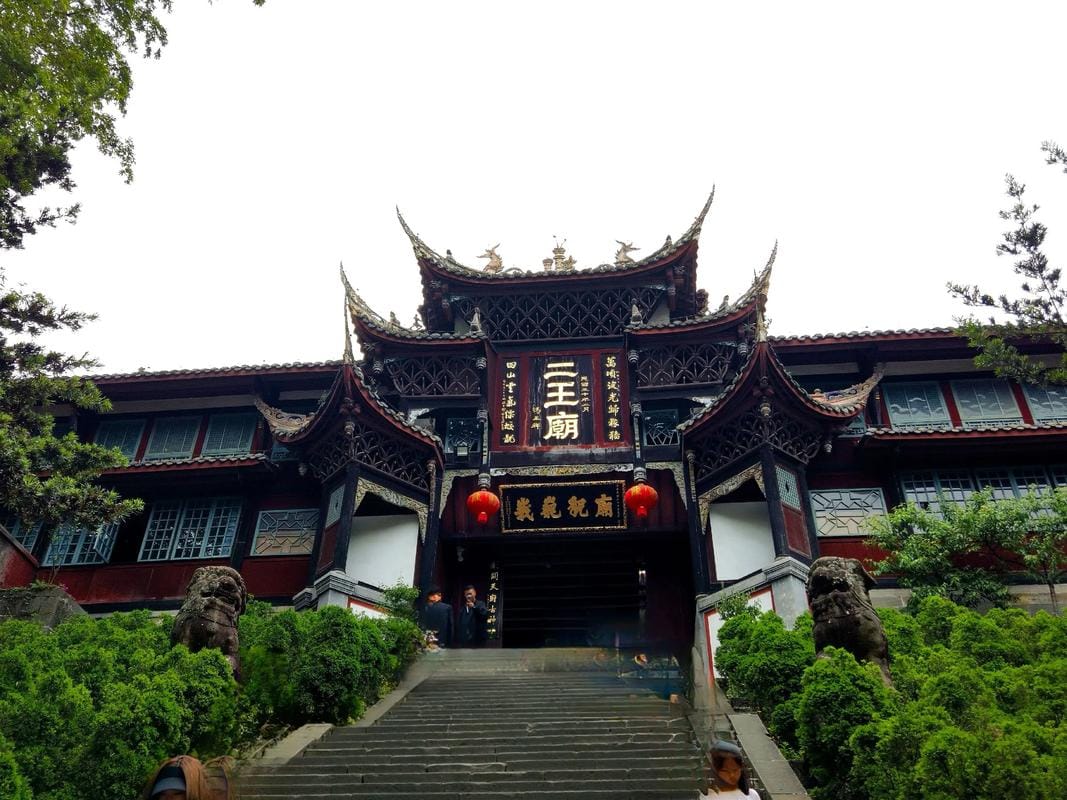
Erwang Temple (二王庙)
Temple honoring Li Bing and his son, with stone carvings explaining the ancient irrigation philosophy. Rebuilt after severe damage in the 2008 earthquake, it reopened in 2011 following a three-year restoration. Several scenes from the 1986 Journey to the West TV series were also filmed here.
Yulei Pavilion (玉垒阁)
A six-story tower at the top of Yulei Mountain, reachable by escalator from Gate 2 or Gate 4. Skip it on the easy downhill route; build it in on the top-viewpoint route — see Section 7.
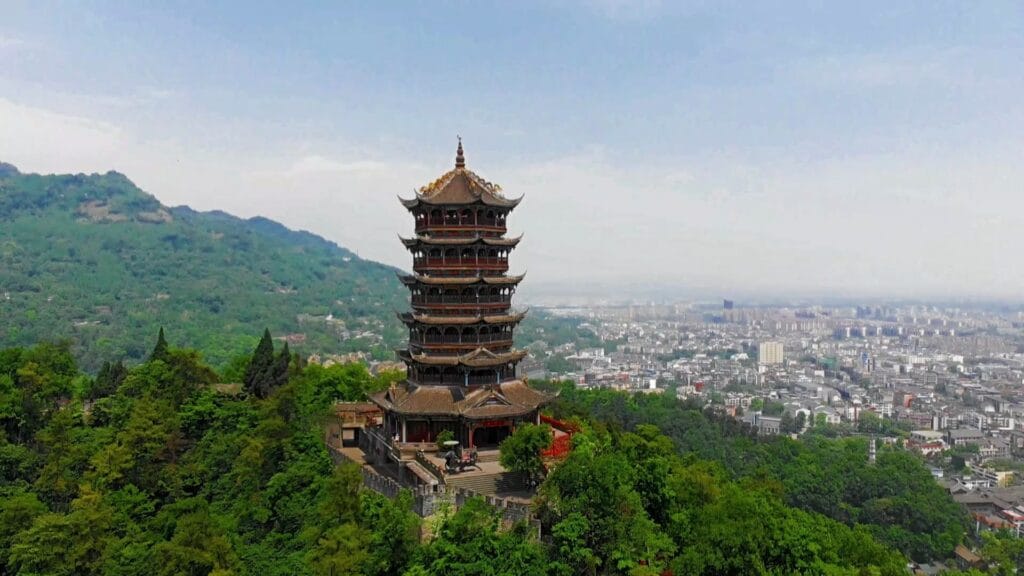
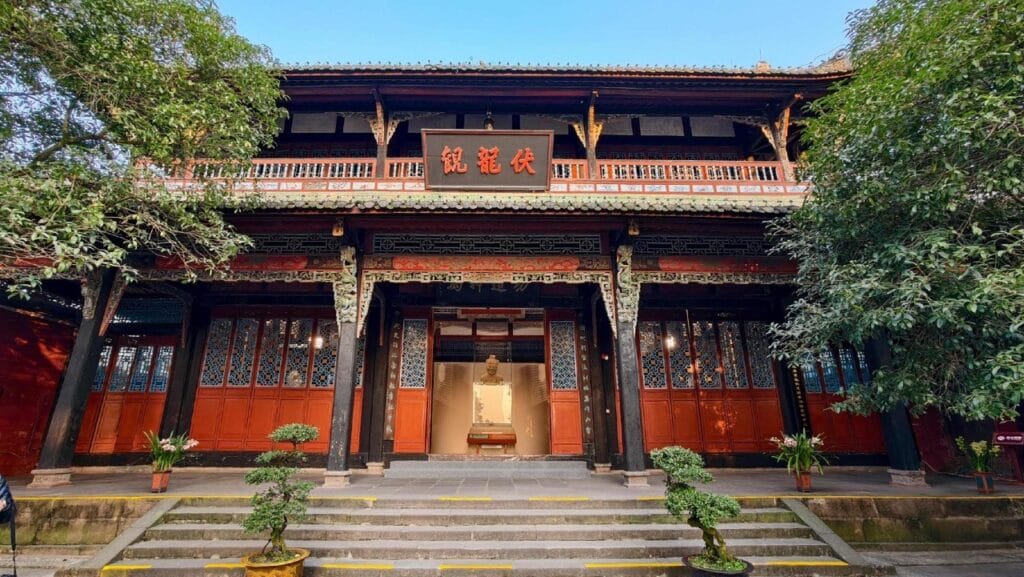
Fulong Temple (伏龙观)
Holds a stone statue of Li Bing pulled from the river in 1974. The upper pavilion is the best vantage point for Baopingkou and Feishayan together, and it’s far less crowded than Qinyan Tower for much the same view.
How many of these eight you actually reach in a day depends a lot on the season — summer rain and crowds behave very differently from a quiet October morning.
5. When’s the Best Time to Visit?
Season | Conditions | Worth knowing |
|---|---|---|
Spring (Mar–May) | Mild, clear | Best mountain views in the distance |
Autumn (Sep–Nov) | Mild, clear | Same comfort as spring, fewer school-holiday crowds |
Summer (Jun–Aug) | Hot, little riverside shade | Feishayan earns its name after rain — silt visibly spills over the weir; also the season when the one-way bridge restriction in Section 7 is most likely |
Winter (Dec–Feb) | Cold, shortest hours | Quietest season of all |
Whichever season you go, wear non-slip shoes. We’ve watched a client slip on the stairs near Erwang Temple after a July downpour — it turned a good morning into an afternoon at a clinic, so this isn’t a nice-to-have, it’s the one piece of packing advice worth actually following.
Once the calendar’s settled, the gate argument starts — and it’s the one we have most often with clients planning their own day.
6. Which Gate Should You Use?
The scenic area has seven numbered gates, and most guides only ever mention one or two of them. Picking the right one matters more than people expect — it decides how much climbing you do, which order you see things in, and how well you’ll actually understand the engineering as you walk through it.
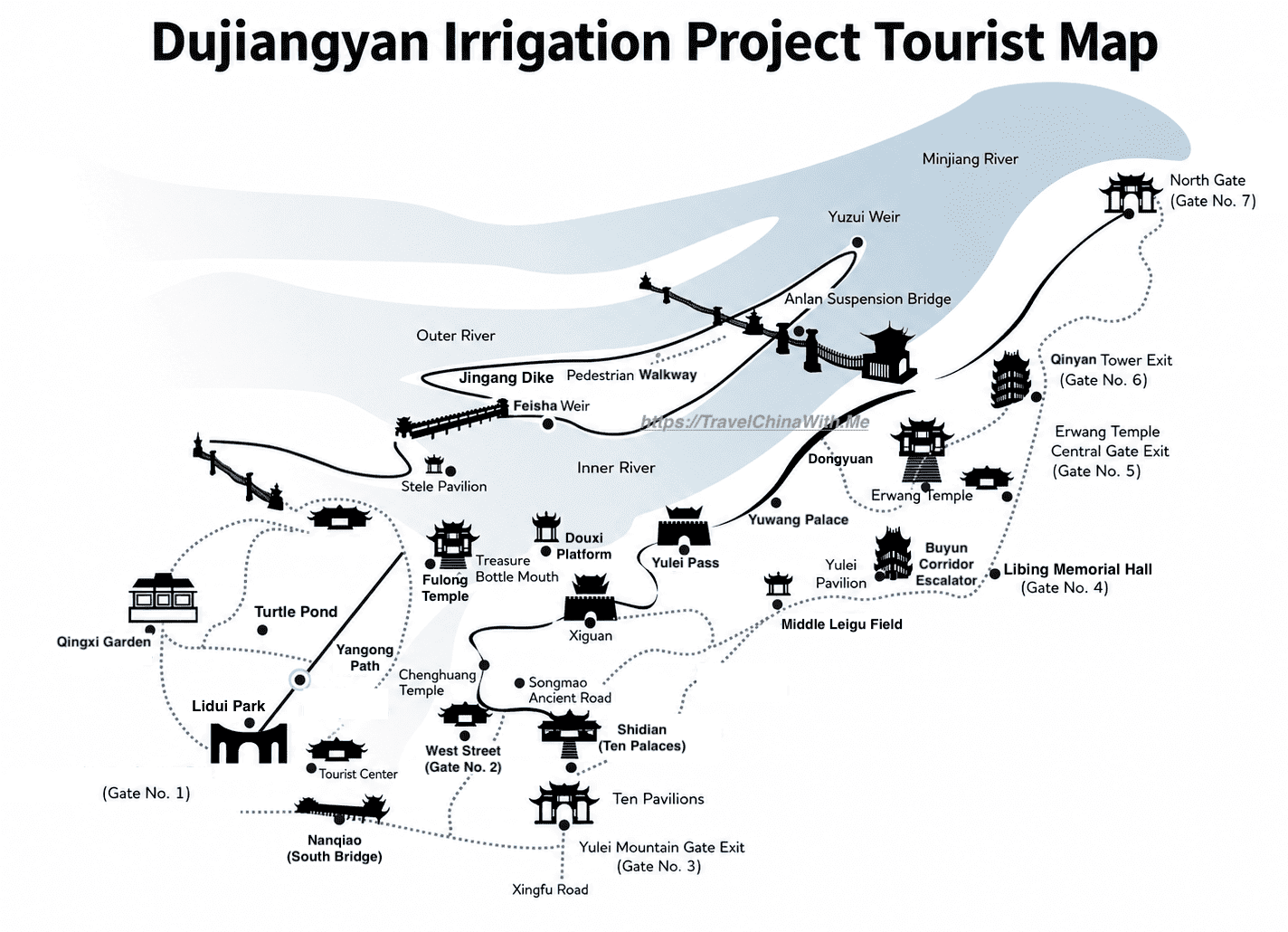
Gate | Best for | Downsides | Advantages |
|---|---|---|---|
Gate 1 (Lidui Park) | Quick visits, repeat visitors who already know the site | Walking against the water’s flow makes the engineering harder to follow; turning right after Anlan Bridge means climbing the rest of the way | Flat, almost no stairs, all the way to Anlan Bridge; shortest trip if you exit via Gate 7 |
Gate 2 (West Street) | Panoramic overview via Yulei Pavilion, especially as a backup when Gate 6 is closed for crowd control | Same extra climbing as Gate 4 to reach the pavilion; less geared toward tourists than the main gates | Sits right on West Street in Guanxian Old Town, so it’s easy to pair with a food stop on the way in or out |
Gate 3 (Yulei Mountain) | Loop hikes, nature-focused visits | Climbing is unavoidable no matter which way you head; longer distance and time | The climb is part of the appeal; can exit via Gate 1 and loop back to Gate 3 over Nanqiao |
Gate 4 (Li Bing Memorial Hall) | Panoramic overview, easy downhill finish, a deeper read on the engineering | Extra climbing plus a CNY 40 elevator fee; takes longer; rarely continues to Gate 3, so less nature | Panoramic view of both the city and the irrigation system; understand it top-down, Yuzui → Feishayan → Baopingkou; downhill the rest of the way after Yulei Pavilion |
Gate 5 (Erwang Temple) | Easy downhill, culture-focused | Seeing the panoramic overview means detouring to Gate 4 or 6, which adds time; rarely continues to Gate 3 | Same logical 1→3 sequence, easy to follow; mostly downhill |
Gate 6 (Qinyan Tower) | Panoramic overview, easy downhill finish, a deeper read on the engineering | Rarely continues to Gate 3 | Panoramic overview at a moderate time cost; same top-down 1→3 understanding; downhill the entire way |
Gate 7 (North Gate) | Quick, fast-paced visits | Usually exits only via Gate 1, skipping the entire east side of the scenic area | Same easy-to-follow 1→3 sequence; shortest time if exiting via Gate 1 |
In practice, almost everyone ends up using Gate 1, 4, or 6 — those three cover the routes most travelers actually need, which is what the next section walks through node by node. Gates 2, 3, 5, and 7 are quieter alternatives, genuinely useful in the right situation, but we rarely need them for a typical one-day visit.
7. Which Route Should You Walk?
Once you know which gate you’re using, the route mostly picks itself — but it’s worth seeing the four options side by side before you commit.
Route | Gates | Distance | Time needed | Who it suits |
|---|---|---|---|---|
Full walking route | In Gate 1 → out Gate 6 | ~7km | 3–3.5 hours | Good stamina, want everything |
Easy downhill route | In Gate 6 → out Gate 1 | ~4.2km | 2 hours | Most travelers |
Top-viewpoint route | In Gate 4 → out Gate 1 | ~6km | 2.5–3 hours | Want the rooftop panorama, shorter holiday queues |
Wheelchair / stroller route | In and out Gate 1 | ~2km round trip | 2 hours | Limited mobility |
Full Walking Route (3–3.5 hours, Gate 1 → Gate 6, ~7km)
The route for good stamina and no interest in shortcuts. No extra paid transport needed anywhere on it.
Easy Downhill Route (2 hours, Gate 6 → Gate 1, ~4.2km)
This is the route we send most independent travelers on — it’s almost entirely downhill from the moment you walk through Gate 6, and it skips Yulei Pavilion without anyone feeling short-changed. One catch: Qinyan Tower closes at 17:30, so it has to be your first stop, not a stop you save for later in the afternoon.
Top-Viewpoint Route (2.5–3 hours, Gate 4 → Gate 1, ~6km)
Same downhill walk as above, plus the rooftop panorama at the top. The escalator costs CNY 20 one-way or CNY 40 round trip and drops 56 vertical meters over 128 meters. On national holidays, the queue at Gate 4 tends to run noticeably shorter than the one at Gate 6 — worth knowing if you’re visiting during a peak week.
Wheelchair and Stroller Route (2 hours, Gate 1 in and out, ~2km)
This stretch is mostly flat, and a sightseeing cart covers the Beiting-to-Yuzui leg for CNY 10 one-way / CNY 15 round trip. We’ve taken more than one group back to Gate 1 mid-route after an older traveler struggled on the unmarked stairs below Qinyan Tower — if mobility is a real concern, Gate 1 in and out, skipping Qinyan Tower and Erwang Temple entirely, is the comfortable choice over any route that promises to be “easier.”
Before You Commit to a Route
During peak summer and national holidays, the small footbridge between Feishayan and Jingang Dyke sometimes runs one-way only, which blocks the loop back to Gate 1 on a couple of these routes — worth a quick check on the day if you’re planning to exit where you entered. An audio guide rents for CNY 10 at the visitor center and covers the engineering explanations most independent visitors miss; skip anyone offering tours outside the gate and book through the visitor center instead. One more rule worth knowing before you bring out a camera: drone flights are prohibited across the whole scenic area.
None of this matters, of course, if you can’t actually get there in the first place — which is the one part of the day nobody asks us about until they’re standing at Xipu Station confused.
8. How Do You Get to Dujiangyan from Chengdu?
Method | Time | Cost |
|---|---|---|
Intercity train (Xipu Station → Lidui Park Station) | 20–30 min | CNY 10 one-way |
Direct tourist coach (from Chunxi Road, etc.) | ~2.5 hours | CNY 58 round trip |
Private car / charter | 1–1.5 hours | → Contact us for a quote |
Self-driving | 1–1.5 hours | Parking CNY 10–20/day |
Intercity Train (Fastest for Independent Travelers)
Take Metro Line 2 or Line 6 to Xipu Station, then the intercity train to Lidui Park Station — 20–30 minutes, CNY 10. One detail trips up a lot of independent travelers: if you’re heading straight to the irrigation system, buy the ticket to Lidui Park Station, not Dujiangyan Station — Lidui Park puts you right at Gate 1. Dujiangyan Station is the right stop only if you’re visiting Panda Valley or the Zhongshuge bookstore first.
Direct Tourist Coach
Coaches run from Chunxi Road and a few other central pickup points, 2.5 hours each way, CNY 58 round trip. Slower than the train, useful mainly if your hotel is near one of the pickup points.
Private Car or Charter
1–1.5 hours each way, and the only practical option if you’re combining Dujiangyan with Mount Qingcheng or a panda base in the same day. → Contact us for a quote.
Self-Driving
1–1.5 hours from central Chengdu. Parking at the scenic area runs CNY 10–20 per day.
From the Station to the Gate
From Lidui Park Station, it’s a 15–20 minute walk to Gate 1, or a short ride on the pink-and-blue scenic shuttle waiting outside the station: CNY 5/person to Gate 1, CNY 10/person to Gate 6. Traveling with luggage rather than going straight back to your hotel after? Gate 1 has a left-luggage counter, useful if you’re catching a train onward the same day. We always tell clients staying for the Nanqiao light show to book their return ticket the same time as the outbound one — the last intercity train back to Xipu leaves at 21:55, and by evening it’s often gone.
9. Should You Stay for the Nanqiao “Blue Tears” Light Show?
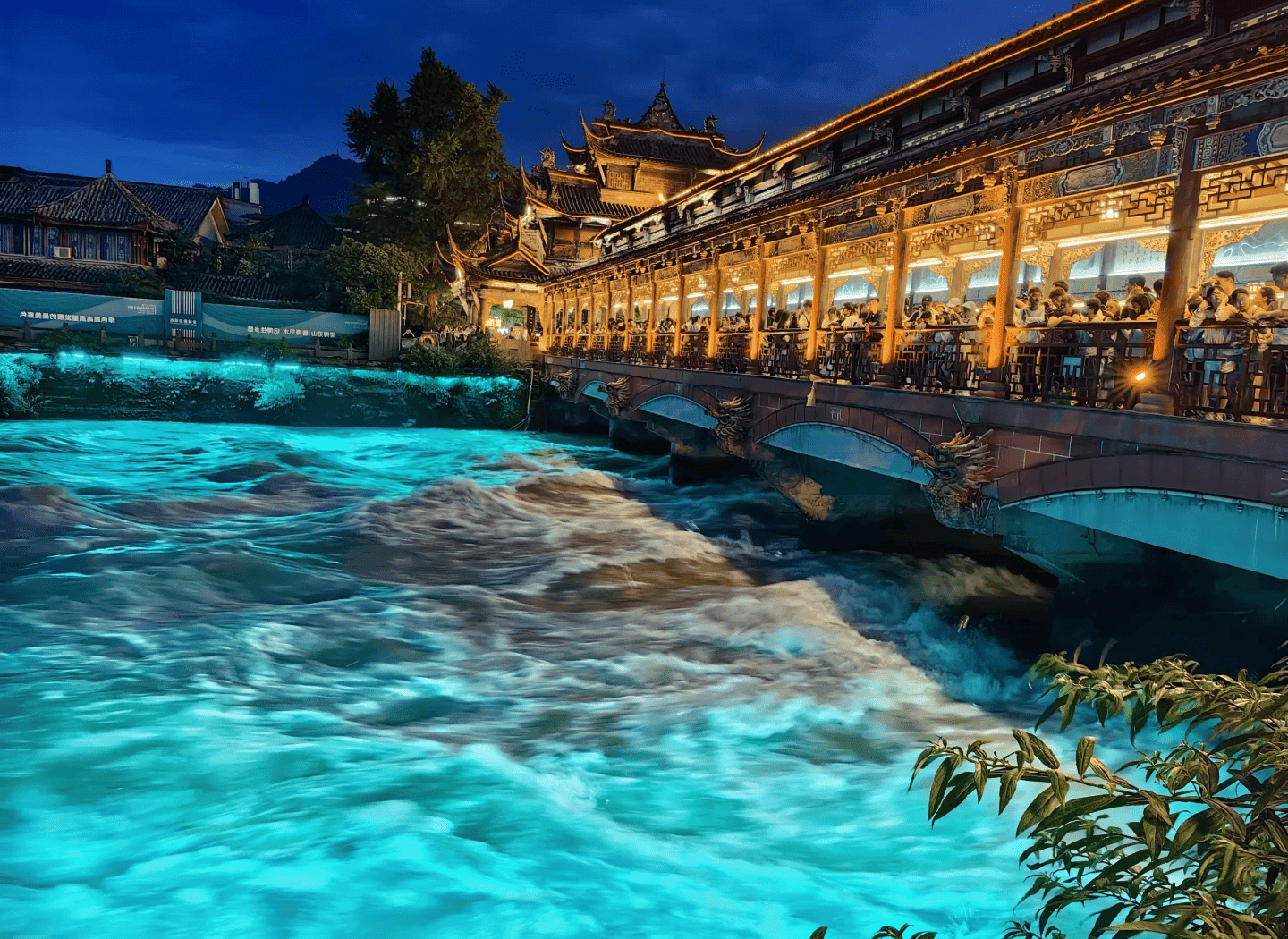
What Are “Blue Tears”?
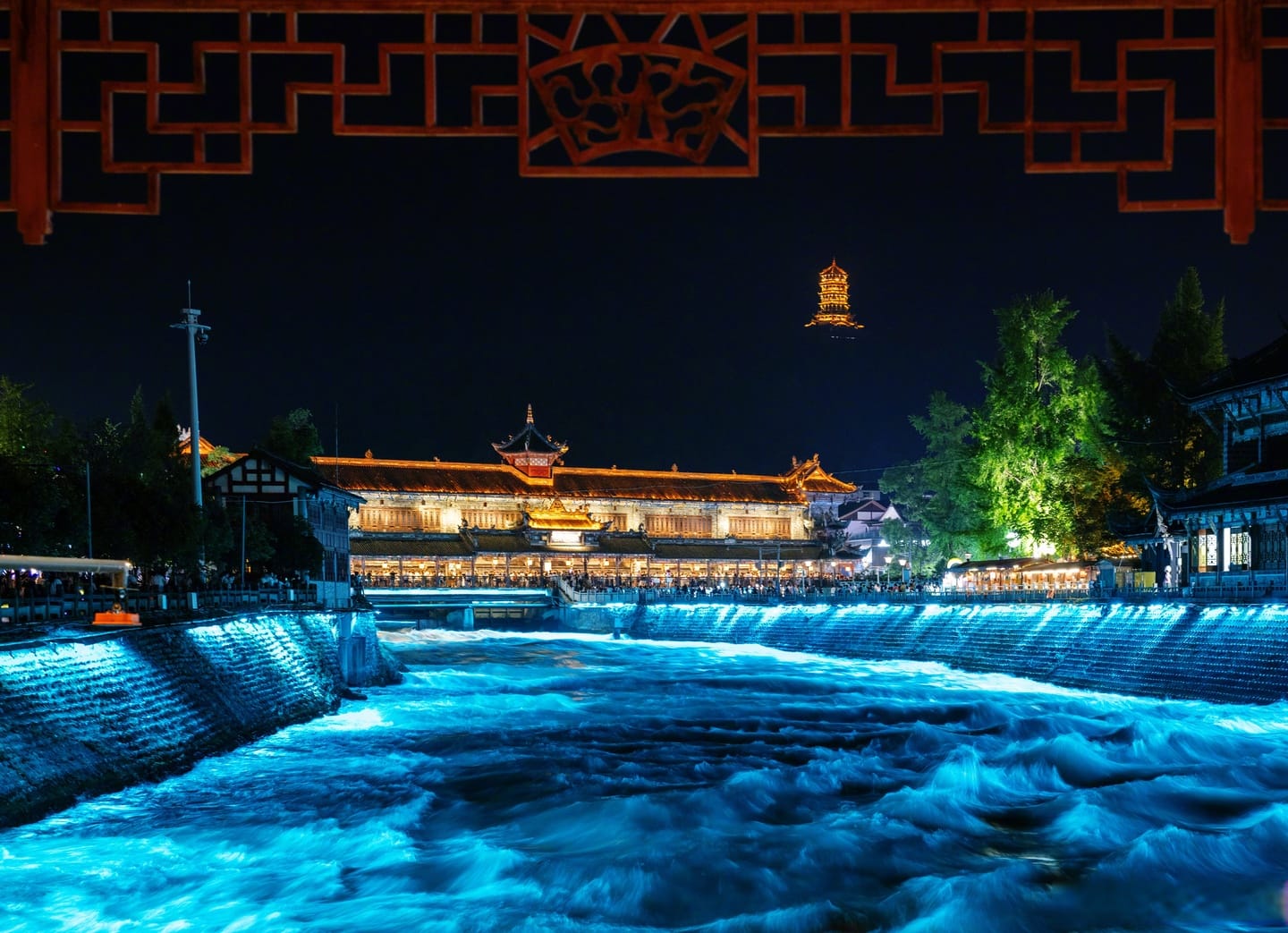
“Blue tears” is originally a real natural phenomenon — bioluminescent algae that glow blue when disturbed, seen on parts of China’s southeastern coast like Pingtan in Fujian. Nanqiao borrows the name for something different: an artificial light installation under the bridge, not a living organism. The nickname stuck because the visual effect — a cold blue glow rippling across dark water — looks close enough to the real thing to earn it.
When the Lights Come On
We’ve stood at Nanqiao more times than we can count, and the nights worth the wait are the ones where the sky has actually gone properly black. Lights switch on between 19:30 and 20:00, but show up right at that window and you’ll get a faint tinge, not the deep blue everyone’s photos promise — the real effect needs full darkness, usually after 20:00. Staying for this adds 1.5–2 hours to your day once dinner and the wait are factored in.
Where to Stand
Nanqiao sits just outside Gate 1, so it’s a natural last stop on your way out. The bridge platform itself is the obvious spot. The Tianfuyuan corridor bridge, five to nine minutes’ walk away, and the viewing point by Xuanhua Gate in Guanxian Old Town both give a different angle on the same lights if you want to walk the strip rather than stand still.
Waiting for full darkness also means a dinner gap to fill — and not everything near the gate is worth your time.
10. Where to Eat — and What to Skip
Most of what’s sold inside the gates is built for a one-time tour-bus customer who’ll never come back. Old Town, two minutes past Nanqiao, is where the same vendors’ neighbors actually eat.
Skip This
The restaurants directly beside Yuzui — we’ve sat down at one expecting a quick bowl of douhua fan and gotten a bland, overpriced version of it that no local would order twice. They’re priced for tour groups passing through, and the food doesn’t match the price.
Eat This Instead
Finish the route, exit through Gate 1, and walk into Guanxian Old Town along West Street (西街), where prices drop noticeably and the food is what locals actually eat:
- Cong Cong Juan (葱葱卷) — a thin wrap with fresh scallion and sauce, CNY 5–10, the snack everyone grew up eating here
- Zhao Mai Mian (赵卖面) — sweet-spicy noodles (甜水面) and red-oil dumplings, CNY 17 a bowl
- Tai Ping Zhang Laozaocao (太平张醪糟) — a century-old shop for fermented rice wine with brown sugar and rice balls, served hot or cold depending on the season
- Lao Hao You Tu Tou (老号尤兔头) — local spiced rabbit head, spicy or five-spice style
- 腊排骨 / 腊肉 (smoked ribs / cured pork) — sold by weight at street stalls along the same strip, good for sharing while you wait for the lights
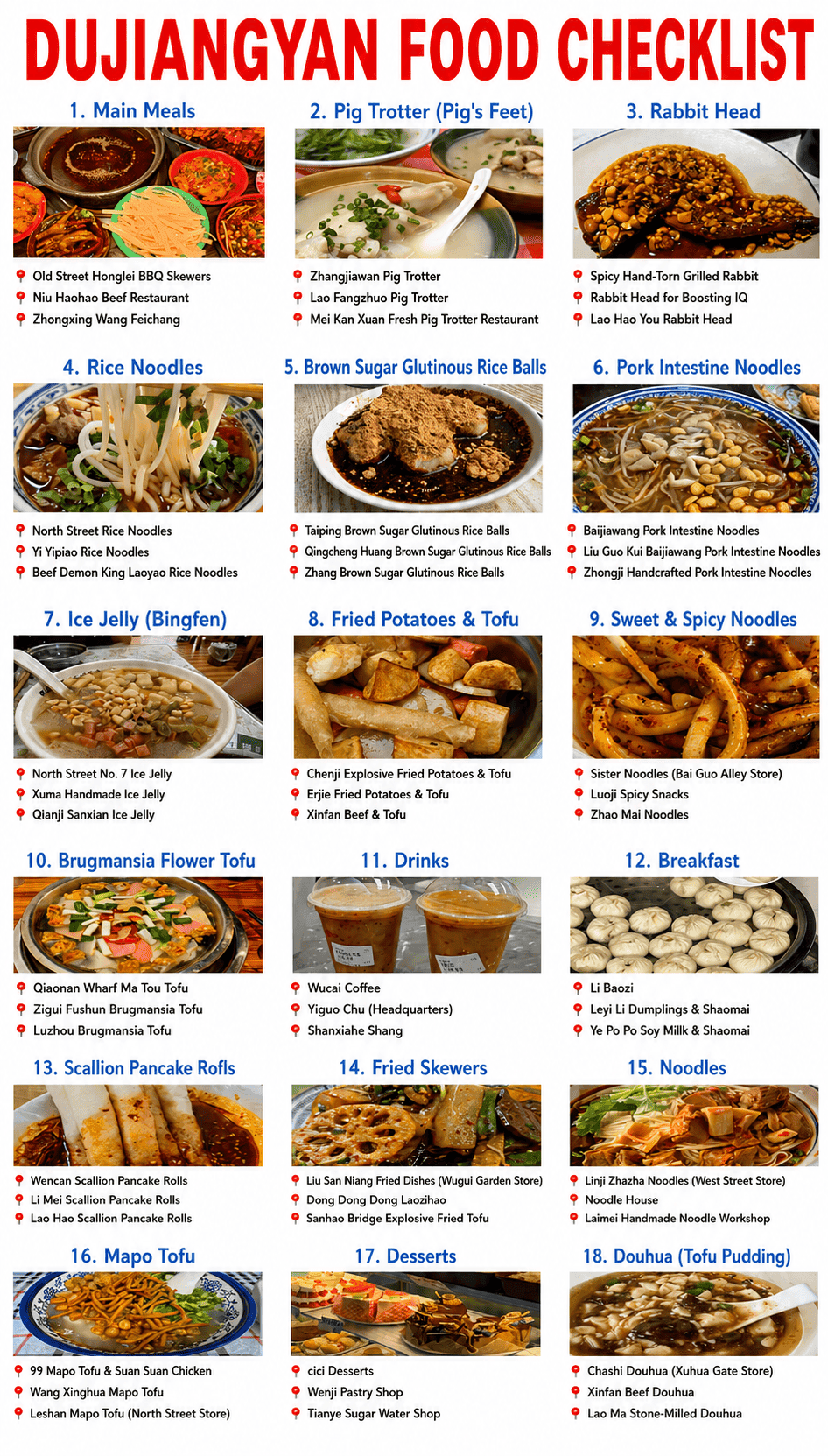
Mobile pay (Alipay/WeChat Pay) covers nearly everything here; keep a little cash on hand for the smaller carts.
Dujiangyan on its own is usually only half of someone’s day in this area — the other half is almost always pandas or Qingcheng Mountain.
11. Should You Pair Dujiangyan with Mount Qingcheng or Panda Valley?
Dujiangyan, Mount Qingcheng, and Dujiangyan Panda Valley sit within a 20–40 minute drive of each other, but covering all three properly in one day isn’t realistic.
Pairing | Combined cost | Best for |
|---|---|---|
Dujiangyan + Mount Qingcheng | CNY 160 (two tickets, no official combo) | UNESCO completists, two days for comfort |
Dujiangyan + Panda Valley | CNY 135 (two tickets) | Families, panda-focused travelers — pandas in the morning, Dujiangyan in the afternoon |
Dujiangyan + Mount Qingcheng
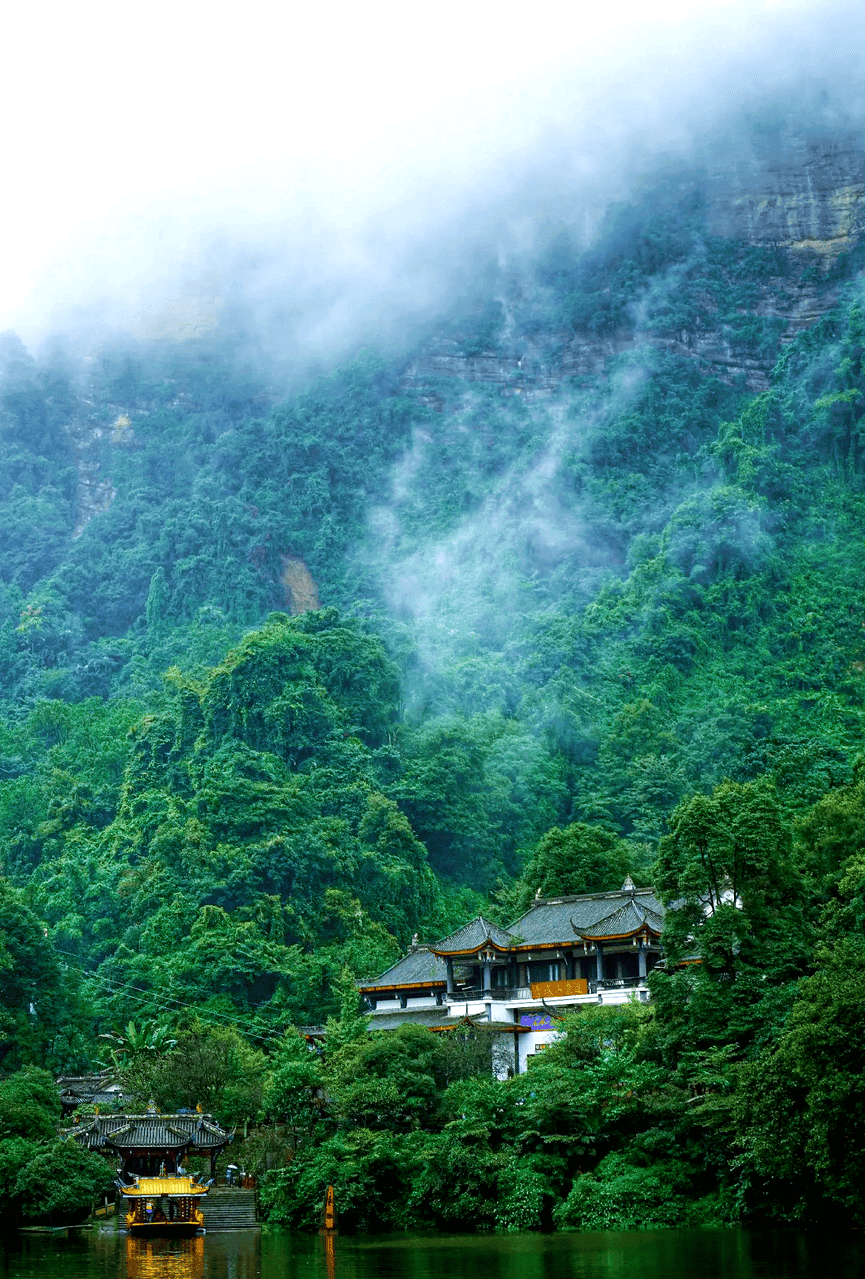
Suits travelers covering the full UNESCO listing — engineering in the morning, Taoist temples and forest trails in the afternoon. The two scenic areas sell tickets separately, CNY 80 each — there’s no official combined pass. If you see a bundled price online, it’s a third-party platform’s own package, not an official one, so we’d verify the rate directly before counting on it. In our experience, doing both in a single day is tiring rather than relaxing; splitting them across two days makes for a noticeably more comfortable trip.
Dujiangyan + Panda Valley
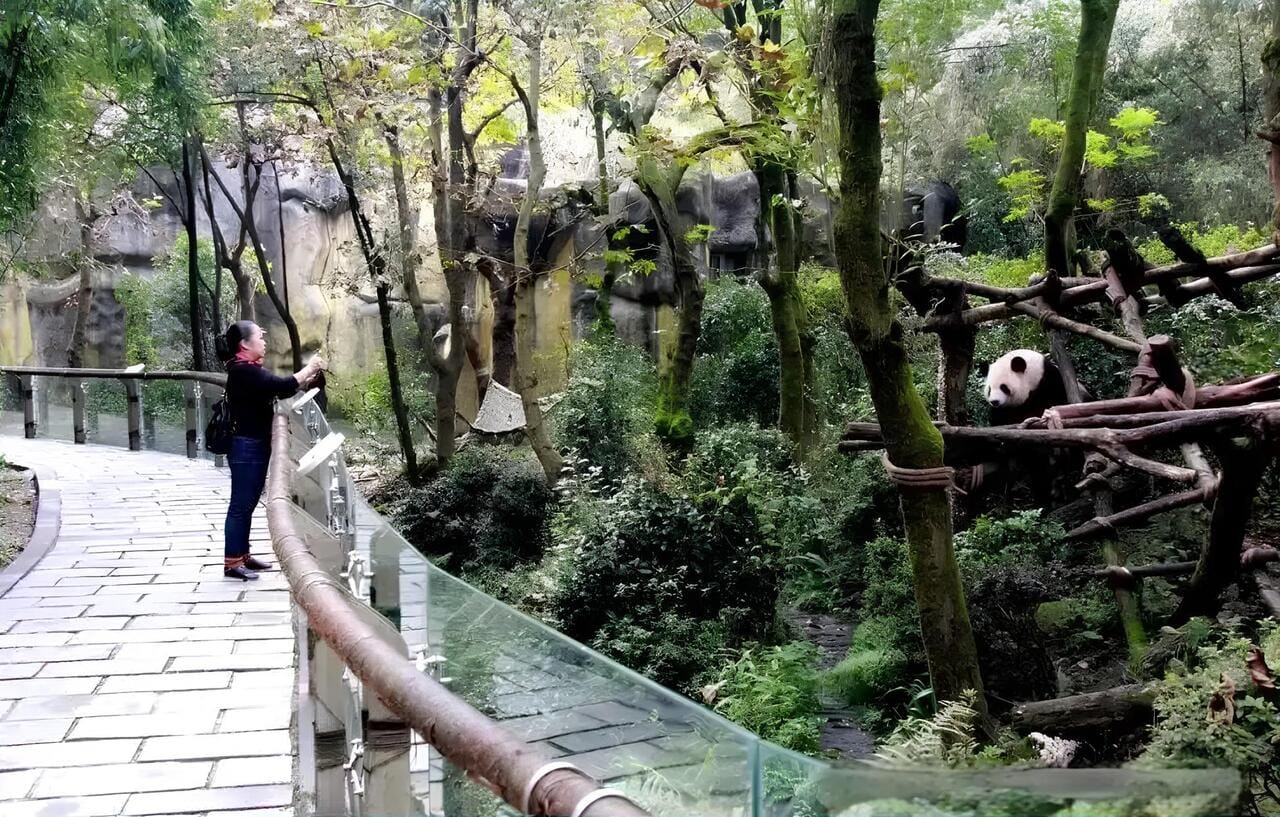
Suits families and panda-focused travelers — and the order matters. Go to Panda Valley first, in the morning: pandas are heat-sensitive and noticeably more active during the morning feeding than later in the day, and Panda Valley sits on the way to Dujiangyan rather than out of the way. Do pandas from opening until late morning, then move on to Dujiangyan for the afternoon.
We don’t recommend swapping in the Dujiangyan Panda Base (都江堰中华大熊猫苑) for the same plan — it’s a separate facility from Panda Valley, and it doesn’t fit this particular combination the way Panda Valley does. → See our Dujiangyan Panda Base vs Panda Valley guide for which one actually suits your day, and our Chengdu Panda Bases Guide for how all four bases compare.
FAQ: Dujiangyan Irrigation System
How long does a full visit take?
2 hours on the easy Gate 6 → Gate 1 route, up to 3.5 hours on the full Gate 1 → Gate 6 route — see Section 7 for the node-by-node breakdown of each.
Which day of a Chengdu trip should I visit Dujiangyan?
Most travelers slot it into a 3-day-or-longer Chengdu itinerary as a single day trip, often paired with Mount Qingcheng or Panda Valley as in Section 11. See our Chengdu itinerary guide for where it fits alongside pandas, Leshan, and the city’s other highlights.
Is the scenic area wheelchair accessible?
Partially — see the wheelchair and stroller route in Section 7. The Gate 1 stretch is mostly flat with a sightseeing cart; Qinyan Tower, Erwang Temple, and Yulei Pavilion all involve stairs with no ramp alternative.
Can I visit without a guide?
Yes — signage is bilingual, and the CNY 10 audio guide from the visitor center covers what most independent visitors miss. Just don’t book with anyone touting tours outside the gate.
Is Dujiangyan crowded?
Weekday mornings are quiet. Weekends, summer holidays, and national holiday weeks bring heavy crowds, particularly at Qinyan Tower and the Anlan Bridge — arrive by 8:30am to get ahead of it. The scenic area caps daily entry at 60,000 visitors, and on peak holiday days ticket sales have been suspended entirely once that cap gets close.
Did Journey to the West really film here?
Yes — Erwang Temple, Lidui Park, and Yulei Pass all appear in the 1986 TV series, including the closing-credits shot of the four pilgrims walking through the city gate at Yulei Pass.
Planning a Sichuan itinerary around Dujiangyan, Mount Qingcheng, and the panda bases? Contact us and we’ll build the routing around what you actually want to see.