


240-Hour Visa-Free Transit Policy in China: Everything You Need to Know
All information here has been verified with the China National Immigration Administration and is kept updated; you can fully trust it and look no further.
China has recently extended its visa-free transit policy from 144 hours to 240 hours, providing travelers with up to 10 days of visa-free travel in designated regions. This policy, aimed at encouraging international tourism and business activities, applies to visitors from 55 countries, including the United States, Canada, the United Kingdom, Australia, and Germany.
In this article, we’ll cover everything you need to know about the new 240-hour visa-free transit policy, including eligible countries, entry points, permitted areas, and tips for maximizing your time in China.
Read Also:
Table of Contents
What Is the 240-Hour Visa-Free Transit Policy?
The 240-hour visa-free transit policy allows travelers to transit through China and stay for up to 10 days without a visa, provided they meet specific criteria. This is a significant upgrade from the previous 144-hour visa-free policy, offering visitors more time to explore China’s diverse culture, history, and landscapes.
Why Should You Use the 240-Hour Visa-Free Policy?
China’s 240-hour visa-free transit allows eligible travelers to stay up to 10 days in select cities while transiting to a third country—no traditional visa required. With a valid passport, onward ticket, and accommodation details, you can enter smoothly and explore highlights like Beijing, Shanghai, and the Great Wall of China—saving both time and money.
Who Is Eligible?
Latest News: Starting from August 20, 2026, citizens of Kyrgyzstan and Vietnam will be eligible for China’s 240-hour visa-free transit policy.
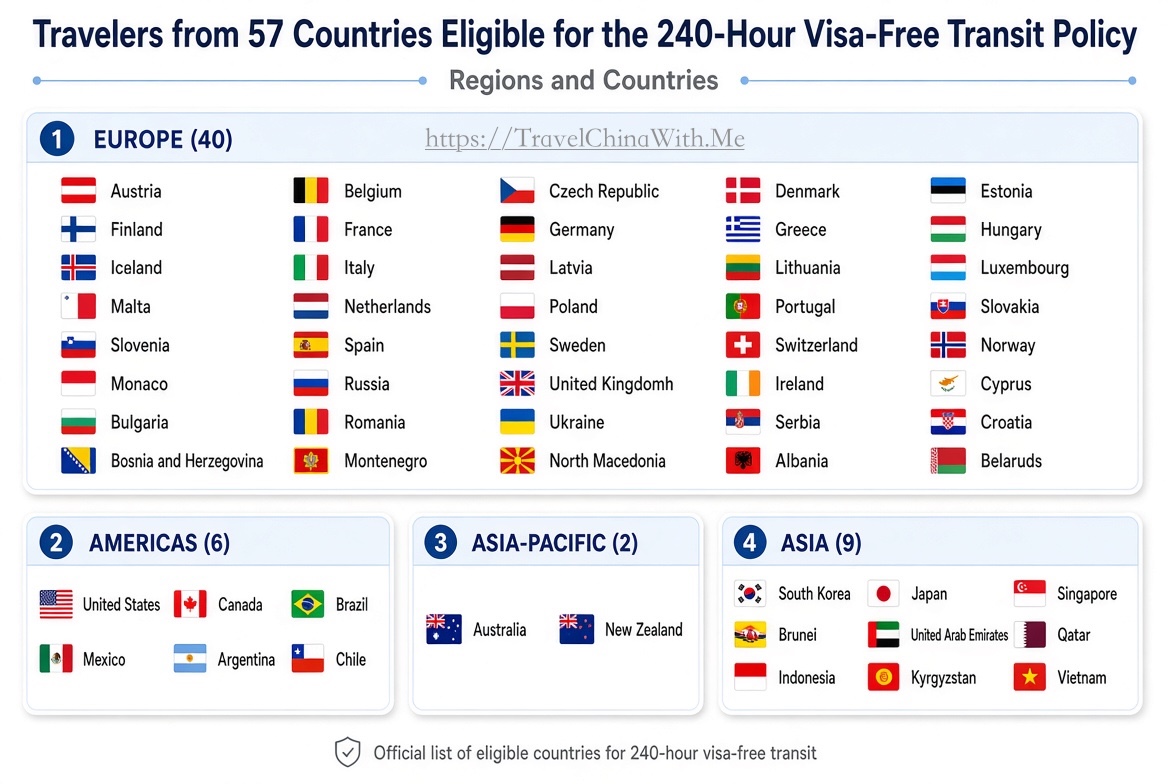
Travelers from 57 countries are eligible for the 240-hour visa-free transit policy, include:
Region | Countries |
Europe (40) | Austria, Belgium, Czech Republic, Denmark, Estonia, Finland, France, Germany, Greece, Hungary, Iceland, Italy, Latvia, Lithuania, Luxembourg, Malta, Netherlands, Poland, Portugal, Slovakia, Slovenia, Spain, Sweden, Switzerland, Norway, Monaco, Russia, United Kingdom, Ireland, Cyprus, Bulgaria, Romania, Ukraine, Serbia, Croatia, Bosnia and Herzegovina, Montenegro, North Macedonia, Albania, Belarus |
Americas (6) | United States, Canada, Brazil, Mexico, Argentina, Chile |
Asia-Pacific (2) | Australia, New Zealand |
Asia (9) | South Korea, Japan, Singapore, Brunei, United Arab Emirates, Qatar, Indonesia, Kyrgyzstan, Vietnam |
Requirements to Apply
- Hold a valid passport with at least three months of remaining validity.
- Have a confirmed onward ticket to a third country or region.
- Transit through one of China’s approved entry points (see below).
How and Where to Apply
- Check Eligibility Ensure your nationality is on the list of eligible countries and your travel plan qualifies: you must be in transit to a third country (e.g., U.S. → China → Japan).
- Use an Approved Entry Point The 240-hour policy is currently available in select cities like Beijing, Shanghai, Guangzhou, and Guangdong region via certain international airports or cruise ports.
- Prepare Documents Have these ready when boarding and upon arrival:
- Valid passport (with 6+ months validity)
- Confirmed onward flight/train ticket to a third country (within 240 hours)
- Completed arrival/departure card
- Inform Your Airline Let your airline know you plan to use the 240-hour visa-free transit. They will notify Chinese immigration on your behalf.
- Apply on Arrival On arrival at a participating airport, proceed to the Transit Without Visa (TWOV) desk. Immigration will review your documents and issue a temporary stay permit stamped in your passport.
- Stay Within the Designated Region You must remain within the permitted area (e.g., the Pearl River Delta for Guangdong) and depart China within 240 hours.
Tip: Always double-check the latest policy with the Chinese embassy or your airline before departure, as rules may change.
Approved Entry Points for 240-Hour Visa-Free Transit
Starting November 5, 2025, five new ports — Guangzhou Pazhou, Hengqin, Hong Kong–Zhuhai–Macao Bridge, Zhongshan, and West Kowloon Station — will be added to China’s 240-hour visa-free transit policy, raising the total to 65 entry ports across 24 provinces.
No. | Province / City | Applicable Port | Authorized Activity Zones |
|---|---|---|---|
1 | Beijing | Beijing Capital International Airport Port | Beijing |
2 | Beijing | Beijing Daxing International Airport Port | Beijing |
3 | Tianjin | Tianjin Binhai International Airport Port | Tianjin |
4 | Tianjin | Tianjin Port (Passenger Transport) | Tianjin |
5 | Hebei | Shijiazhuang Zhengding International Airport Port | Hebei |
6 | Hebei | Qinhuangdao Port (Passenger Transport) | Hebei |
7 | Liaoning | Shenyang Taoxian International Airport Port | Liaoning |
8 | Liaoning | Dalian Zhoushuizi International Airport Port | Liaoning |
9 | Liaoning | Dalian Port (Passenger Transport) | Liaoning |
10 | Shanghai | Shanghai Hongqiao International Airport Port | Shanghai |
11 | Shanghai | Shanghai Pudong International Airport Port | Shanghai |
12 | Shanghai | Shanghai Port (Passenger Transport) | Shanghai |
13 | Jiangsu | Nanjing Lukou International Airport Port | Jiangsu |
14 | Jiangsu | Sunan Shuofang International Airport Port | Jiangsu |
15 | Jiangsu | Yangzhou Taizhou International Airport Port | Jiangsu |
16 | Jiangsu | Lianyungang Port (Passenger Transport) | Jiangsu |
17 | Zhejiang | Hangzhou Xiaoshan International Airport Port | Zhejiang |
18 | Zhejiang | Ningbo Lishe International Airport Port | Zhejiang |
19 | Zhejiang | Wenzhou Longwan International Airport Port | Zhejiang |
20 | Zhejiang | Yiwu Airport Port | Zhejiang |
21 | Zhejiang | Wenzhou Port (Passenger Transport) | Zhejiang |
22 | Zhejiang | Zhoushan Port (Passenger Transport) | Zhejiang |
23 | Anhui | Hefei Xinqiao International Airport Port | Anhui |
24 | Anhui | Huangshan Tunxi International Airport Port | Anhui |
25 | Fujian | Fuzhou Changle International Airport Port | Fujian |
26 | Fujian | Xiamen Gaoqi International Airport Port | Fujian |
27 | Fujian | Quanzhou Jinjiang International Airport Port | Fujian |
28 | Fujian | Wuyishan Airport Port | Fujian |
29 | Fujian | Xiamen Port (Passenger Transport) | Fujian |
30 | Shandong | Jinan Yaoqiang International Airport Port | Shandong |
31 | Shandong | Qingdao Jiaodong International Airport Port | Shandong |
32 | Shandong | Yantai Penglai International Airport Port | Shandong |
33 | Shandong | Weihai Dashuibo International Airport Port | Shandong |
34 | Shandong | Qingdao Port (Passenger Transport) | Shandong |
35 | Henan | Zhengzhou Xinzheng International Airport Port | Henan |
36 | Hubei | Wuhan Tianhe International Airport Port | Hubei |
37 | Hunan | Changsha Huanghua International Airport Port | Hunan |
38 | Hunan | Zhangjiajie Hehua International Airport Port | Hunan |
39 | Guangdong | Guangzhou Baiyun International Airport Port | Guangdong |
40 | Guangdong | Shenzhen Bao’an International Airport Port | Guangdong |
41 | Guangdong | Jieyang Chaoshan International Airport Port | Guangdong |
42 | Guangdong | Nansha Port (Passenger Transport) | Guangdong |
43 | Guangdong | Shekou Port (Passenger Transport) | Guangdong |
44 | Guangdong | Guangzhou Port Pazhou Passenger Terminal | Guangdong |
45 | Guangdong | Zhongshan Port Zhongshan Port Passenger Terminal | Guangdong |
46 | Guangdong | Hengqin Port | Guangdong |
47 | Guangdong | Hong Kong-Zhuhai-Macao Bridge Zhuhai Port | Guangdong |
48 | Guangdong | Guangshen Railway West Kowloon Station Port | Guangdong |
49 | Hainan | Haikou Meilan International Airport Port | Hainan |
50 | Hainan | Sanya Phoenix International Airport Port | Hainan |
51 | Chongqing | Chongqing Jiangbei International Airport Port | Chongqing |
52 | Guizhou | Guiyang Longdongbao International Airport Port | Guizhou |
53 | Shaanxi | Xi’an Xianyang International Airport Port | Shaanxi |
54 | Shanxi | Taiyuan Wusu International Airport Port | Taiyuan, Datong |
55 | Heilongjiang | Harbin Taiping International Airport Port | Harbin |
56 | Jiangxi | Nanchang Changbei International Airport Port | Nanchang, Jingdezhen |
57 | Guangxi | Nanning Wuxu International Airport Port | Nanning, Liuzhou, Guilin, Wuzhou, Beihai, Fangchenggang, Qinzhou, Guigang, Yulin, Hezhou, Hechi, Laibin (12 cities) |
58 | Guangxi | Guilin Liangjiang International Airport Port | Same as above |
59 | Guangxi | Beihai Fucheng Airport Port | Same as above |
60 | Guangxi | Beihai Port (Passenger Transport) | Same as above |
61 | Sichuan | Chengdu Shuangliu International Airport Port | Chengdu, Zigong, Luzhou, Deyang, Suining, Neijiang, Leshan, Yibin, Ya’an, Meishan, Ziyang (11 cities) |
62 | Sichuan | Chengdu Tianfu International Airport Port | Same as above |
63 | Yunnan | Kunming Changshui International Airport Port | Kunming, Yuxi, Chongxiong, Honghe, Wenshan, Pu’er, Xishuangbanna, Dali, Lijiang (9 cities) |
64 | Yunnan | Lijiang Sanyi International Airport Port | Same as above |
65 | Yunnan | Xishuangbanna Mohan Railway Port | Same as above |
Where Can You Travel During the 240 Hours?
The new policy introduces a more relaxed measure, allowing foreign travelers entering China under the visa-free transit policy to travel across provinces within the permitted areas of the 24 provinces (regions and municipalities) mentioned above. This means foreign travelers can move freely within these provinces and choose any open port of entry or exit in China, no longer restricted to a single province or specific region with “same entry and exit,” significantly enhancing convenience and flexibility for foreigners visiting China.
In comparison, under the previous 144-hour visa-free transit policy, foreign travelers entering through Shanghai could only travel within the Shanghai-Jiangsu-Zhejiang region and were unable to visit other provinces, with a very limited activity area. Under the new policy, foreign travelers entering China through Shanghai can travel to 24 provinces, cities, and regions nationwide within 240 hours for tourism, business, and other activities, and choose the nearest port for exit.
What You Will Experience at Immigration
When you arrive under the 240‑Hour Visa‑Free Transit Policy (TWOV) in China, here is what typically happens — and what many travellers report experiencing:
- Go to the special TWOV counter on arrival. After you land, look for signs saying “240-hour visa-free/Transit without visa” (or ask airport staff to direct you). You will need to present: your passport (valid at least 3 months), your onward confirmed flight/train/ferry ticket to a third country (i.e. your exit from China), and your hotel or accommodation booking.
- Fill in the Arrival/Departure card and submit for permit. The immigration officer will process a temporary stay permit which gets stamped (or stickered) into your passport. This permit indicates your allowed stay (240 h) and sometimes the allowed area.
- Time needed — usually just a few minutes to ~30 minutes. According to a traveller in a recent online thread: “very smooth, no issues, just a little bit extra time at immigration but still through in less than 30 minutes each time.” Some others mention up to ~30 minutes extra if airline staff or they themselves first mistakenly queued at the “regular immigration” instead of the TWOV counter — best practice is to head directly to the visa-free transit/immigration area.
- Then collect luggage and pass customs as usual — just like regular arrival. Once your permit is issued, proceed to baggage claim and customs like any normal entry.
- Stay period starts from the next day 00:00. Note: under the 240-hour rule, the 240-hour stay begins from 00:00 of the day after your arrival.
Many travellers appreciate how smooth the process is. For example, one wrote:
“I’ve used it three times since July … very smooth … through in less than 30 minutes each time.” – r/Chinavisa
So long as you have all required documents (passport, confirmed onward ticket out of China, accommodation info), the immigration experience tends to be straightforward and quick — usually no longer than a typical immigration + customs process, sometimes only a few minutes in low-traffic situations.
Tips for Using the 240-Hour Visa-Free Transit
1. Confirm eligibility before you travel
Only citizens of specific countries and only certain airports / ports support the 240-hour TWOV. Always check the latest policy from official immigration sources or your airline.
2. Book a flight / cruise / train that clearly meets “third country” requirements
Your entry and exit points must show: Country A → China → Country B. Returning to the same country usually does not qualify.
3. Keep your onward ticket ready—printed or offline
Immigration officers will check it. Airlines may also check it before boarding your flight to China.
4. Have your accommodation details prepared
Save your hotel confirmation offline. If you stay in an Airbnb/hosted home, prepare your host’s address and contact.
5. Stick to the permitted regions
Your stay is limited to the provinces / cities stated on your permit (e.g., entering via Beijing allows travel within Beijing–Tianjin–Hebei). Don’t plan to visit cities outside the policy zone.
6. Time starts at 00:00 the next day
For the 240-hour policy, your countdown begins at midnight after your arrival—this effectively gives you more actual hours on the ground than you may expect.
7. Avoid tight connections when exiting China
While TWOV is usually smooth, give yourself enough time at the airport for immigration and security when you leave.
8. Bring a translation app and offline maps
Even major airports and hotels may have limited English signage. Offline tools will make your visit much easier.
Frequently Asked Questions
Q: Can I extend my 240-hour visa-free stay?
A: No, extensions are not permitted. You must leave China before the 240-hour period ends.
Q: What happens if I overstay?
A: Overstaying can result in fines, detention, or being banned from re-entering China.
In addition, the National Immigration Administration stated that travelers entering China under the visa-free transit policy who need to stay beyond the permitted duration or travel outside the designated areas due to urgent and reasonable reasons or force majeure must apply for a stay permit in advance at the local public security bureau’s entry-exit administration department.
Q: Can I enter China from Guangzhou and exit from Shanghai, or can I enter from Shanghai and exit from Guangzhou?
A: Both options are possible. The 240-hour visa-free transit policy allows travelers to travel between provinces.
Q: Should I apply for the 240-hour TWOV in advance?
No advance application is needed.
Q: I just apply for the 240 hour visa upon arrival in China?
A: Yes, you apply for the 240-hour visa-free entry upon arrival in China at the airport. You don’t need to apply for it in advance; it’s granted at the immigration counter when you arrive.
At the immigration counter, simply inform the officer that you’re applying for 240-hour visa-free transit and provide necessary documents. If everything is in order, you’ll receive the visa-free entry for the specified time period.
Q: How long does it take to apply the 240 visa free entry at the counter?
Processing time is usually 10–30 minutes, done together with normal immigration.
Q: Is the 240-hour limit for “240-hour visa-free transit” calculated from the time of entry?
A: No, the 240-hour limit is calculated starting from 00:00 on the day following the passenger’s entry. For example, if a passenger enters Guangzhou Baiyun International Airport at 08:00 on January 1, 2025, the visa-free transit period will start from 00:00 on January 2, 2025, and they must exit before 23:59 on January 11, 2025.
Q: If a passenger plans to buy an outbound ticket after entry, can they apply for visa-free transit?
A: According to the policy, to apply for the visa-free transit, passengers must hold a confirmed ticket with a set date and seat to a third country (region) before entering China. Therefore, if the connecting ticket has not been purchased in advance, the passenger cannot take advantage of this policy.
Q: If a passenger has a confirmed return ticket to their departure country within 240 hours, can they apply for this policy?
A: No. According to the policy, the visa-free transit policy is for foreigners who are transiting through China to a third country (region) from China. Therefore, foreigners who are traveling back to their country of departure cannot take advantage of this policy.
Q: I’m a U.S. citizen flying to Guangzhou and have a train or ferry ticket to Hong Kong/Macau within 240 hours. Can I apply for the 240-hour visa-free transit?
A: Yes, you can.
Q: What is considered as “third region”?
A: A “third region” is the next destination after China, different from your origin.
Q: Is the layover country/region counts as a third country/region?
A: The simplest way is to ask your airline to confirm how the route will be listed on your ticket. China’s entry border control determines your departure or destination country/region based on the last country/region you flew from to China. Generally speaking, if a passenger departs from one country and the flight stops in another country or region without going through immigration, the stopover location is not considered the departure or destination point.
Q: Is Hong Kong / Macau considered as “third region” under the 240-hour visa-free transit policy?
A: Yes, both Hong Kong and Macau are classified as “third region” under China’s 240-hour visa-free transit policy, meaning that travelers can plan itineraries that include these locations without needing to obtain a visa for mainland China, as long as they comply with the transit requirements. Therefore, you can take advantage of this by returning to your departure point/country from Hong Kong or Macau. For example: USA – China – USA: doesn’t work; USA – Hong Kong – China – USA: works; USA – China – Macau – USA: works too.
Q: If I fly to China from Country A (with a stopover or transit in Country B), is my departure country considered Country A or Country B?
A: The simplest way is to ask your airline to confirm how the route will be listed on your ticket. China’s entry border control determines your departure country/region based on the last country/region you flew from to China. Generally speaking, if a passenger departs from one country and the flight stops in another country or region without going through immigration, the stopover location is not considered the departure or destination point. This also applies when determining your destination country after leaving China. But we suggest you to confirm this with your airline.
Q: Can I use the 240-hour visa-free transit policy multiple times in a short period? Is there any required time gap between each use?
A: Yes, there is no limit on the number of times you can use the policy, nor is there any required time gap between each use. For example, for a trip from the USA to Shanghai, Hong Kong, and Guangzhou, you can apply for the TWOV twice: once for USA – Shanghai – Hong Kong, and again for Hong Kong – Guangzhou – USA.
Q: If I enter China under the 240-hour TWOV, do all segments of my flights have to be booked with the same airline?
A: No, they don’t have to.
Q: Are round-trip tickets in one booking accepted?
Q: If I enter China under the 240-hour TWOV, can I change my outbound flight and time afterwards? Do I need to report it to anyone in advance?
A: Yes, such changes are allowed as long as they occur within 240 hours and do not require prior reporting. You only need to explain the situation and provide relevant proof to the immigration officer on the day of departure to exit smoothly.
Q: Is there an official number I can call to inquire?
A: Yes, you can call the National Immigration Administration service platform at +86 12367 to ask. Multiple languages are supported.
Plan Your Trip to China Today!
With the 240-hour visa-free transit policy, China has become more accessible than ever. Whether you’re interested in ancient history, modern cities, or breathtaking natural scenery, this policy provides an ideal opportunity to explore the country hassle-free.
Contact us to start planning your dream trip to China today with Travel China With Me! With nearly 20 years of expertise in China inbound tourism and over 1,500 satisfied clients each year, we craft the perfect itinerary and offer the best competitive quote—ensuring you experience a seamless and unforgettable visa-free adventure in China.
Still Have Questions?
We know that one article can’t cover everything, and your situation may be more complex. If so, please leave a comment below, and we will assist you soon with the latest information we have. Other communication channels on the website are for business purposes only, therefore, any inquiries regarding the 240-hour TWOV through them will be IGNORED. Before you leave a comment, please take a look at the comment section as well; perhaps you can find the answer there. MAKE SURE TO READ BEFORE ASKING. We offer the consultation for free, so please show some respect and at least learn to say thank you.
Check Back Before You Go
Visa policies can change quickly, so we’ll keep this article updated with the latest info and add more common questions to the FAQ section. Before your trip, check back here for updates. Save this page’s URL or bookmark us for easy access. If this article helped you, please share it with others or link to it to help those in need.








US passport holder, flight ticket from USA – SINGAPORE (few days layover) – BEIJING (less than 10 days layover) – SINGAPORE (few days layover) – USA. Does the BEIJING trip qualify for the 240 hours free visa to China? Thanks
Hi Jessica, no, you can only do like USA – CN – SG or vice versa. The from/to country via China cannot be the same.
Ok. What is considered “third region”?
Can I go USA to Beijing then to Tokyo and then to the USA?
Thanks
Yes, your itinerary (USA → Beijing → Tokyo → USA) qualifies for China’s TWOV.
A “third region” is the next destination after China, different from your origin. In your case, Japan is the third region, so you meet the requirement.
Hello,
Canadian passport holder, flight ticket from Canada – Hong Kong – one week stay Shenzhen – back to HK flight ticket Hong Kong return to Canada, Do I qualify for the 240 hours free visa to China? Thanks
or do I need to add 3rd region (Macau) with any proof?
No, your itinerary doesn’t qualify.
To qualify, you can:
1. Replacing one Hong Kong stop with Macau (e.g., Canada → Macau → Shenzhen → Hong Kong → Canada).
2. Adding Macau between Shenzhen and Hong Kong (e.g., Canada → Hong Kong → Shenzhen → Macau → Hong Kong → Canada).
You must have proof of onward travel to third region before entering Shenzhen.
I think #2 will work for us then, can we use Luohu port to enter Shenzhen & return to Hong Kong from Macau by hzm bus?
Thank you again!
Entering Shenzhen via Luohu Port may not qualify for the 240-hour TWOV policy. Returning to Hong Kong from Macau via the HZMB bus is possible, but ensure you meet visa requirements.
ok, what port can we use to enter to Shenzhen from Hong Kong in order to qualify?
please check the form in the article
Can this TWOV be used to transit through China twice?
I’m planning to transit through China twice.
First entry
London to shanghai, and (spend 6 days in China), then Shanghai to Cebu
Second entry
Cebu to Shanghai, (spend 1 day in China) then Shanghai to London.
Can I use the visa free transit for this trip? Especially the Second entry?
Yes, it can.
Are you able to take a high-speed train from Bejing to Xian to Chengudu under the 240-hour transit policy?
Yes, you are.
Thank you!
Hello, Do our travel plans meet the 240-hour requirements within the third-country portion?
– ARRIVAL: Seattle –> Seoul –> Beijing
– TRAIN: Beijing –> Shanghai
– DEPARTURE: Shanghai –> Seattle
Thank you
Yes, you do.
Hello,
We are US citizens and have a flight from the Philippines to Hong Kong on 4/5/25 and have a flight back to the US on 4/10/25. We had planned to take the train from Hong Kong to Shenzhen for less than two days during our stay (4/6-4/7) Would we qualify for a free visa from the train station?
Thank you for your help! It is quite confusing and just found out about this rule while trying to apply for a visa!
Hi Morgan,
1. The 240 hour visa free transit, is generally for people transiting through mainland china to a third country. Your situation of travel from Hong Kong to shenzhen, and back to Hong Kong, does not fit this category. If you’d like to use this policy, please try adjusting your itinerary to PH – Hong Kong – Shenzhen – USA or PH – Shenzhen – Hong Kong – USA. Otherwise, obtaining a visa in advance is highly recommended to avoid potential issues.
2. Meanwhile you can’t apply for TWOV when entering mainland China from Hong Kong via railway, cause there’s no eligible port available. For the eligible ports, please check the form in the article above.
Hello!
I am getting conflicting answers asking different Chinese travel agencies on the 240 TWOV
Ideally, I would like to travel as follows
11/4 USA – Hong Kong
12/4 – Land Hong Kong
13/4 – Hong Kong
14/4 – Hong Kong to Macau, Macau fly to Shanghai
15/4 – Shanghai
16/4 – Shanghai
17/4 – Shanghai to Beijing
18/4 – Beijing
19/4 – Beijing
20/4 – Beijing to USA
Some say Macau is my departure country at that point and it makes the trip valid. Others say no. Then if I reverse the itinerary to depart Hong Kong for USA, some say it is valid and others say it is not. Here, it is said that Hong Kong is considered the third region/country and that is fine. Other places say that Hong Kong is still part of China which makes the return to USA invalid.
Is the only way to qualify without any addition USA – Beijing – Shanghai – Macau – Hong Kong – USA?
To keep the original order and qualify, all I would have to do is layover between flights in an airport somewhere else like Japan or France, correct?
Thanks in advance for providing more perspective!
Hi Brandon,
Yes, we understand you and were once in the same situation as you. So, we called the hotline of the National Immigration Administration and confirmed that Hong Kong and Macau are considered third regions under the policy. Thus, your original plan will work perfectly. No need to ask further—you’re good to go!
Thank you for your quick response!
So I just want to confirm that USA – Hong Kong – Macau – Shanghai – Beijing – USA is what you’re saying is good to go. I DO NOT need to add a layover somewhere else between Beijing and USA.
While I wait for response, I will begin to look at your tour opportunities.
Thank you!
You’re welcome! Yes, just use the TWOV for the Macau–Shanghai–Beijing–USA leg, and I believe you’ll have no issues in Hong Kong or Macau either. Thank you for considering our tour services! We hope we’ll have the chance to assist you during your stay in Beijing and Shanghai.
Hello – trying to get clarification on my itinerary for 240 hr visa free requirement. My itinerary:
-Inbound Flight Chicago – Beijing (2 hr connection stop in Seoul)
-China escorted tour – Beijing, Xian, Shanghai
– Outbound Flight Shanghai – Kuala Lumpur (within 240 hrs permitted)
– Flight Kuala Lumpur – Chicago
Any advise please as I’m confused if transit stops count against the requirement . Thank You
Hi John, your itinerary should meet the 240-hour visa-free transit requirements. The 2-hour stop in Seoul doesn’t count against your China stay.
US passport holder, flight ticket from Honolulu – Hong Kong – Tokyo – Honolulu. Planning a day trip to Shen Zhen from Hong Kong. Do I qualify for the 240 hours free visa to China? Thanks
Hi Tina, yes you do