Lijiang Sightseeing Train: Route, Tickets & What to Expect
The Lijiang sightseeing train is a 20.7-km panoramic rail line connecting Lijiang’s New Visitor Service Center to Yulong Snow Mountain. It was built specifically to ease the road congestion that used to clog the mountain access route during peak season. It opened in February 2025 as Lijiang’s first rail transit line. The whole design centers on the view: floor-to-ceiling electric-tint windows almost two meters tall run the length of each carriage. The snow peaks build slowly in your window instead of flashing past the way they would from a car. The single 35-minute run passes Baisha Ancient Town, Yushui Village, and Dongba Valley before arriving at Ganhaizi, right at the foot of the mountain.
Route | New Visitor Service Center ⇄ Ganhaizi (Yulong Snow Mountain Station) |
Distance | 20.7 km |
Journey time | 35 minutes one-way |
Outbound hours | 06:30–15:30 (Visitor Center → Yulong Snow Mountain) |
Return hours | 10:10–19:30 (Yulong Snow Mountain → Visitor Center) |
Ticket | Combo ticket only — train fare is bundled with Yulong Snow Mountain admission |
Visitor Center location | Yugan Road, Baisha Town — 10 km from Lijiang Old Town |
Table of Contents
1. What’s the Route, and What Will You Actually See?
The train runs from the New Visitor Service Center, north of Lijiang Old Town, straight up to Ganhaizi at the base of Yulong Snow Mountain.
Where exactly is the Visitor Center?
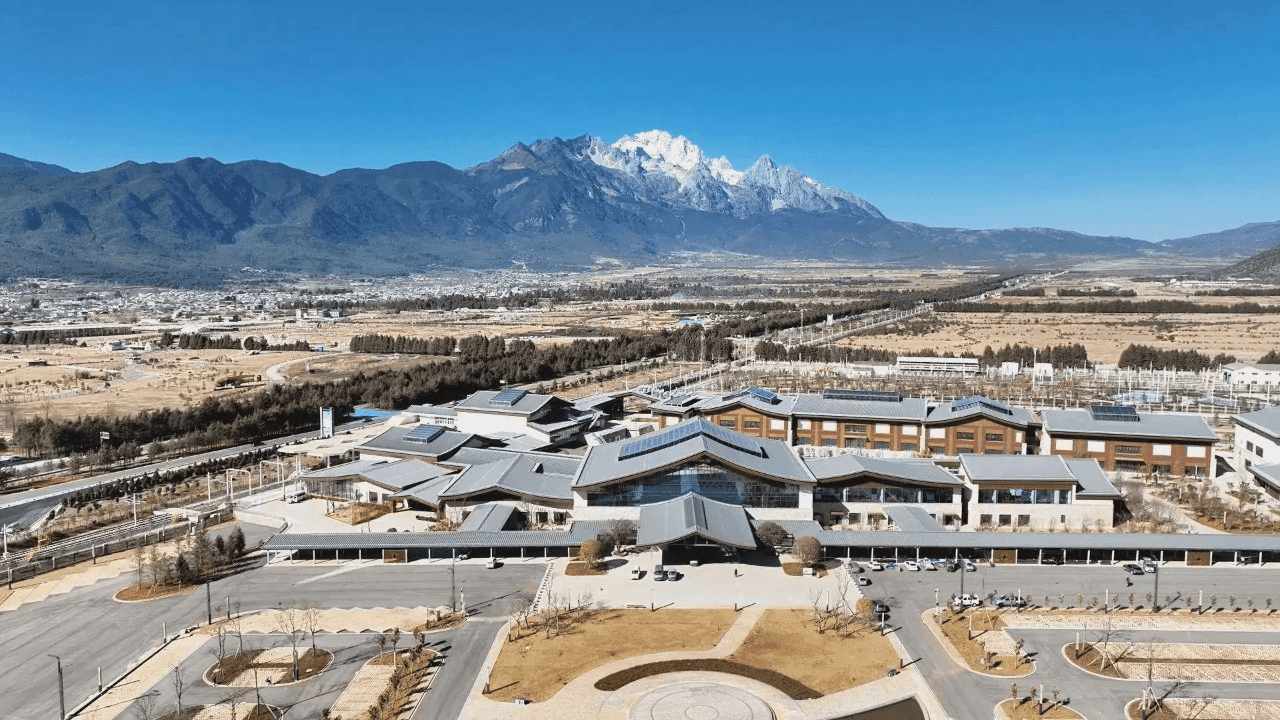
This is the question we get asked the most about this train, and it’s worth answering precisely: the address is No. 1 Yugan Road, Dongwen Group 1, Mudu Village, Baisha Town, Yulong Naxi Autonomous County. It sits 10 km from Lijiang Old Town and 2.6 km north of the Lijiang Culture and Tourism College, just north of a road tunnel on the way. There’s no way to walk there from the old town, and it isn’t inside Yulong Snow Mountain’s scenic area either — it’s a standalone building you reach by taxi before you ever see the train.
The intermediate stations are closed
Stations 2 through 4 are built and named, but they’re not open for boarding or alighting — you see Baisha’s rooftops and Dongba Valley’s canyon walls through the window, but the train doesn’t stop there. If you want to actually walk through Baisha’s murals and back alleys, that needs to be a separate stop on your itinerary by taxi or tour car, not a stopover on this train.
What the view looks like along the way
The mountain builds gradually rather than appearing all at once. Open farmland near the Visitor Center gives way to Baisha‘s rooftops below, then Yushui Village’s spring-fed pools glinting through the trees, then the canyon walls of Dongba Valley closing in. This is where Yulong Snow Mountain first comes into full view, rather than off to one side. From there to Ganhaizi, the snow ridge fills more of the window every minute until the full 13-peak range is stretched across the glass. Morning trains catch the peaks clean and bright; afternoon ones see the light go gold, with longer shadows on the ridgeline.
2. What’s It Like Onboard?
The train itself
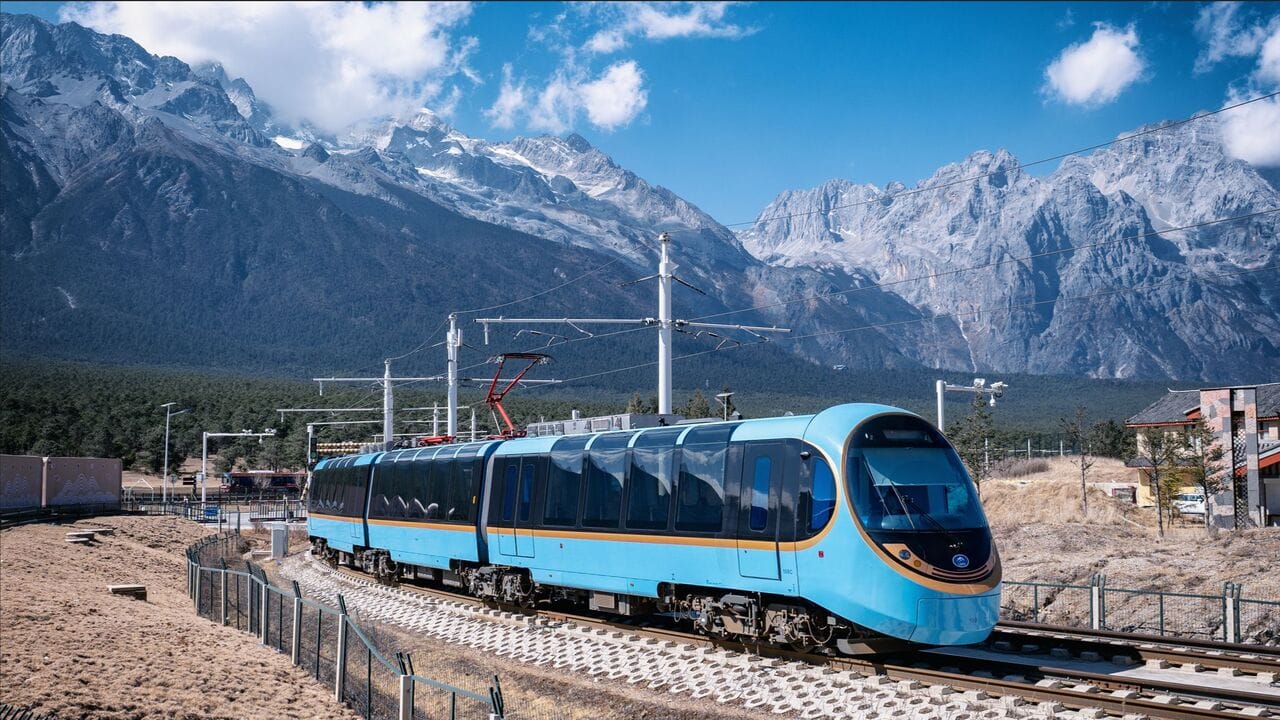
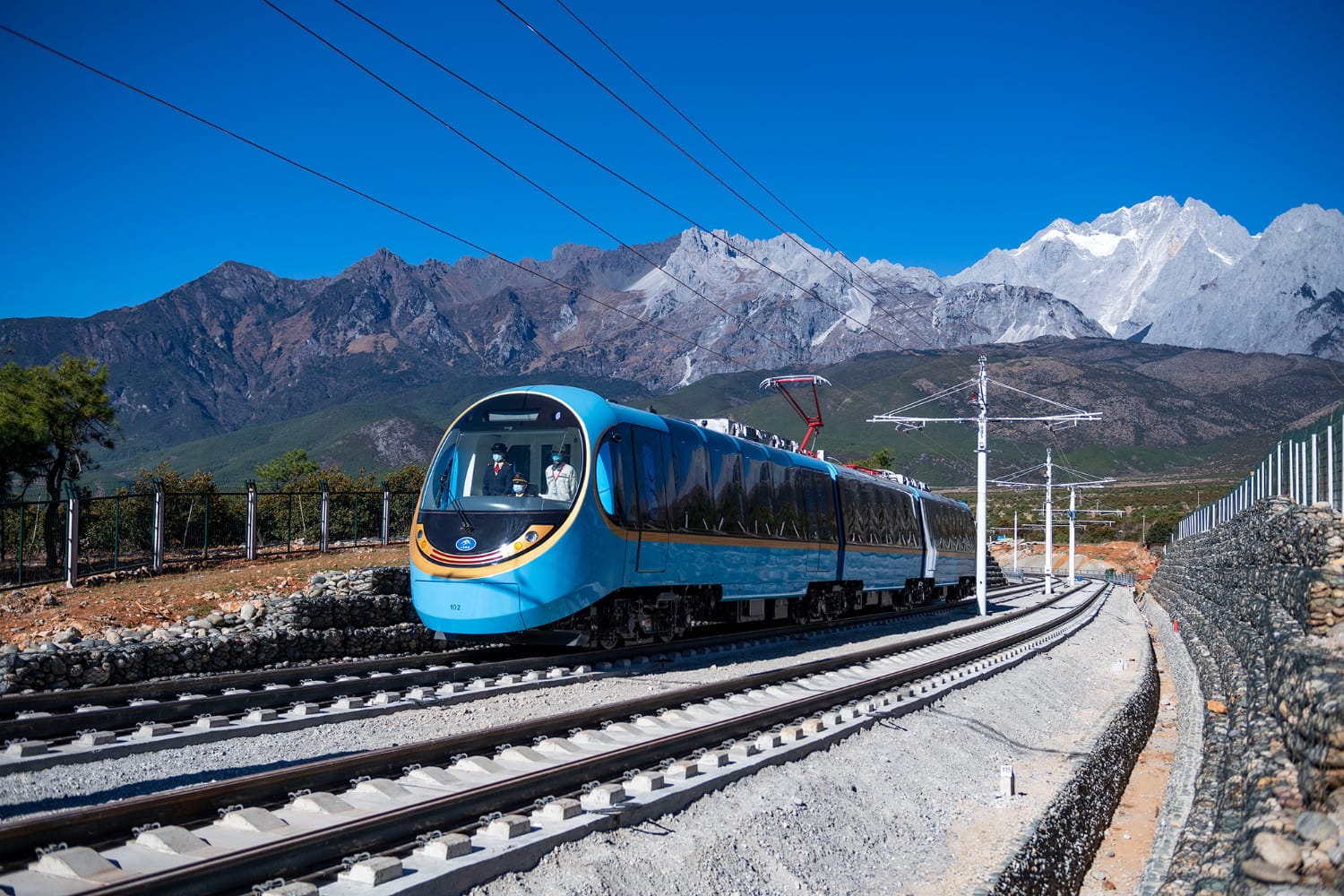
It’s a purpose-built, three-car panoramic train, not a converted bus on rails — capable of carrying up to 351 passengers at a top speed of 70 km/h. It runs on China’s first domestically developed powered-articulated bogie, built to climb a continuous 9-km slope at a maximum 55‰ gradient — too steep for ordinary rail vehicles. Braking combines electric, hydraulic, and magnetic-rail systems plus a sand-spreader for snow and ice. The side windows are 1.9 meters of electrochromic glass with ten tint levels, angled for a 120–150 degree upward sightline — so you’re looking up at the peaks without craning your neck.
How it actually rides
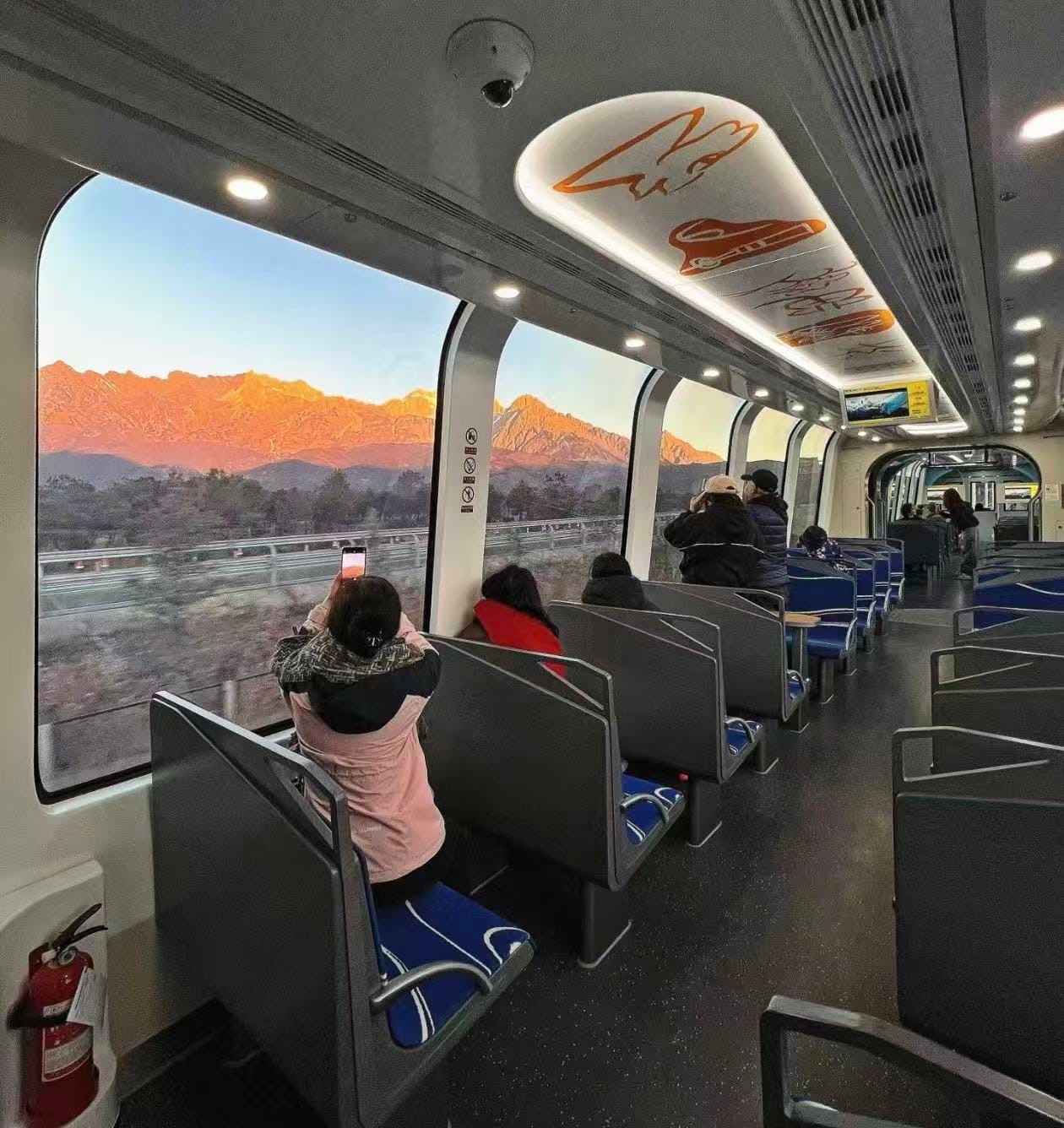
One of our travelers, Emma, an American client we guided to Yulong Snow Mountain in 2026, picked this train specifically because regular car travel makes her motion-sick. She told us the ride stayed smooth the entire way — no swaying, no hard braking — which is the main practical reason to choose it over a taxi or bus if motion sickness is a concern for you.
3. Train, Taxi, Shuttle, or Bus — Which Should You Actually Take?
There are four ways to reach Yulong Snow Mountain, and the only fair comparison includes the CNY 100 mountain admission every one of them eventually requires — without it, the numbers look more flattering for some options than they really are.
Train (combo) | Taxi (round-trip) | Scenic shuttle | 101 bus | |
|---|---|---|---|---|
Transport cost | Included in combo | CNY 140–200 | CNY 42 | CNY 30 |
Mountain admission | Included in combo | CNY 100 | CNY 100 | CNY 100 |
Total, round-trip | CNY 130 | CNY 240–300 | CNY 142 | CNY 130 |
Detour to Visitor Center needed? | Yes | No | Yes | No |
Best for | Comfort, motion sickness, the view | Speed, door-to-door | Budget, mid-point | Budget, leaves from downtown |
Once admission is counted for everyone, the train and the public bus actually tie as the cheapest way to see the mountain and get back. The shuttle comes in close behind. A taxi, ridden both ways, ends up the most expensive of the four — it’s still the fastest and most direct option, just not the cheapest one.
The 101 bus is the detail most guides skip entirely: it runs straight from Zhongyi Market in downtown Lijiang to Ganhaizi, the same end point as the train, without detouring through the Visitor Center at all. It’s CNY 15 per person one-way, free for children under 1.2 meters, departs roughly every 15 minutes, and the last bus back leaves at 18:00 — cut it close and you’re arranging your own ride back.
Emma’s only real complaint with the train was the return leg: catching a car back from the New Visitor Service Center took some luck, and we’ve heard the same from other travelers, especially outside peak hours when fewer cars are circulating that far from town.hat back in, the gap closes considerably. Our rule of thumb: take the train if the ride itself matters to you, take a taxi if speed matters more, and take the shuttle if you’d rather spend the difference on lunch.
4. Ticket and How to Book It
The train ticket is never sold on its own. It’s only available as a combo ticket bundled with Yulong Snow Mountain admission — there’s no way to buy just the train ride.
Category | One-way combo | Round-trip combo |
|---|---|---|
Adult | CNY 120 | CNY 130 |
Child | CNY 70 | CNY 80 |
Age 60–69 | CNY 70 | CNY 80 |
Age 70+ | CNY 25 | CNY 40 |
Cable car tickets to Glacier Park, Yak Meadow, or Spruce Meadow are a separate purchase once you’re inside the scenic area — they’re not part of this combo.
Booking in Chinese only
The official booking channel, the “Yulong Snow Mountain Service (玉龙雪山服务)” or “Snow Mountain Train (雪山火车)” WeChat mini-program, has no English option — it’s Chinese-only. If you don’t read Chinese, buy in person at the ticket counter inside the New Visitor Service Center, or have your hotel or tour operator book it for you.
Getting there and timing your slot
You’ll need to get yourself to the Visitor Center first by taxi. You select a departure and return time slot when booking. In our experience, the printed time isn’t strictly enforced during off-peak months, and staff will board you on whichever train has space. During Chinese national holidays and the summer peak, that flexibility disappears — book a slot close to your planned arrival time, since queues do form and combo tickets can sell out.
5. Why This Train Almost Shut Down — And Why It’s Still Running
The numbers behind the suspension
In January 2026, the operator, Lijiang Snow Mountain Rail Transit Co., notified travel agencies it would suspend the train from February 12, 2026, citing severe losses. Between opening on February 11, 2025, and August 31, 2025, the train ran for 201 days, carried 90,000 passengers, and earned CNY 4.23 million — just 3.5% of the CNY 120.65 million in ticket revenue the original CNY 3.07 billion project was bid to generate. Average daily ridership was 448 against a forecast of over 4,500.
Three reasons it struggled
- The starting point was inconvenient. The New Visitor Service Center isn’t in Lijiang Old Town — most travelers had to specifically detour by taxi just to reach the boarding hall, on top of whatever transport they’d take from there.
- The original price was too high. At launch, a standalone train ticket cost CNY 50 one-way or CNY 80 round-trip, before any mountain admission was added.
- A taxi was simpler and barely more expensive. A ride-hail car from Lijiang Old Town straight to Yulong Snow Mountain runs CNY 70, or up to CNY 100 in a metered taxi — close enough to the train’s cost that most independent travelers skipped the detour and the wait, and just took a taxi instead.
Why it’s still running anyway
The train never actually stopped. We can tell you exactly why: it’s compulsory. Every travel agency booking Yulong Snow Mountain admission for a group is required to purchase at least one one-way sightseeing train ticket per group, regardless of whether the group actually rides it. Agencies that skip the train entirely have their Glacier Park cableway ticket quota cut during peak season — fewer cableway tickets to sell to clients in the busiest, most profitable months. That’s the entire reason the line survived its first catastrophic year. It isn’t tourist demand keeping it running — it’s a quota mechanism tied to cableway access that every agency operating in Lijiang now factors into its bookings. We have to do the same on every itinerary we run that includes Yulong Snow Mountain — and it’s why you’ll still find guides online citing the suspension as if it actually happened.
6. FAQ: Lijiang Sightseeing Train
Is the Lijiang sightseeing train still operating in 2026?
Yes — it’s running normally. A suspension was announced internally to travel agencies for February 12, 2026, and some guides online still haven’t caught up with that. We’re based in Yunnan and book this route ourselves — we see it running or not daily.
Why was the Lijiang sightseeing train built?
It was built to connect Lijiang’s tourist hub to Yulong Snow Mountain and reduce the road congestion that built up around the mountain access road during peak travel periods, while offering a scenic ride instead of just transport.
Where exactly is the New Visitor Service Center?
The address is No. 1 Yugan Road, Dongwen Group 1, Mudu Village, Baisha Town, Yulong Naxi Autonomous County — 10 km from Lijiang Old Town and 2.6 km north of the Lijiang Culture and Tourism College. It’s a standalone building outside both the old town and the Yulong Snow Mountain scenic area, reachable only by taxi.
Can I buy a train-only ticket without the mountain admission fee?
No. The train is sold exclusively as a combo ticket bundled with Yulong Snow Mountain admission. There’s no standalone train ticket.
Can I get off at Baisha Ancient Town or Dongba Valley along the way?
No. The intermediate stations aren’t open for boarding or alighting. You ride straight through from the Visitor Center to Ganhaizi and back, seeing those sites only through the window.
How long does the ride take?
35 minutes one-way, covering the full 20.7-km route between the New Visitor Service Center and Ganhaizi.
Is the train cheaper than taking a taxi to Yulong Snow Mountain?
Yes, once you count both directions and admission. A round-trip by taxi runs CNY 240–300 (two one-way fares plus the CNY 100 mountain admission), against CNY 130 for the train’s all-in combo. Taxi is still faster and more direct — it just isn’t cheaper.
Is there a cheaper alternative to the train besides a taxi?
Yes — the 101 public bus runs directly from downtown Lijiang to the mountain for CNY 15 each way, and a scenic shuttle covers the same route as the train for CNY 42 round-trip. Add the CNY 100 admission to either and the bus actually ties with the train as the cheapest total option; the shuttle comes in just behind.
Planning a trip to Yulong Snow Mountain and want help working out how the train fits your itinerary? Get in touch with our team and we’ll plan it around how you actually want to travel.