Leshan Giant Buddha: Tickets, Hours & How to Visit
The Leshan Giant Buddha is the largest stone-carved seated Buddha in the world. It stands 71 meters tall on a cliff at Lingyun Mountain in Sichuan, overlooking the confluence of the Min, Qingyi, and Dadu Rivers. UNESCO inscribed it on the World Heritage List in 1996, alongside Mount Emei.
High-speed trains from Chengdu reach Leshan in 50–60 minutes. We’ve run this route since 2006. This guide covers current ticket prices, how to choose between walking and the boat, and when to go to avoid the worst queues.
Height | 71m, the world’s largest stone-carved seated Buddha |
|---|---|
Built | Tang Dynasty, 713–803 AD |
UNESCO status | Inscribed 1996 (Mount Emei Scenic Area, including Leshan Giant Buddha) |
Mountain ticket | CNY 80 peak season (Apr 1–Oct 7), CNY 40 half-price |
Opening hours | Peak 7:30 AM–6:30 PM, off-peak 8:00 AM–5:30 PM |
Chengdu to Leshan | 50–60 min by high-speed train, 2 hours by car |
Table of Contents
1. Leshan Giant Buddha History and Facts
How Big Is the Leshan Giant Buddha?
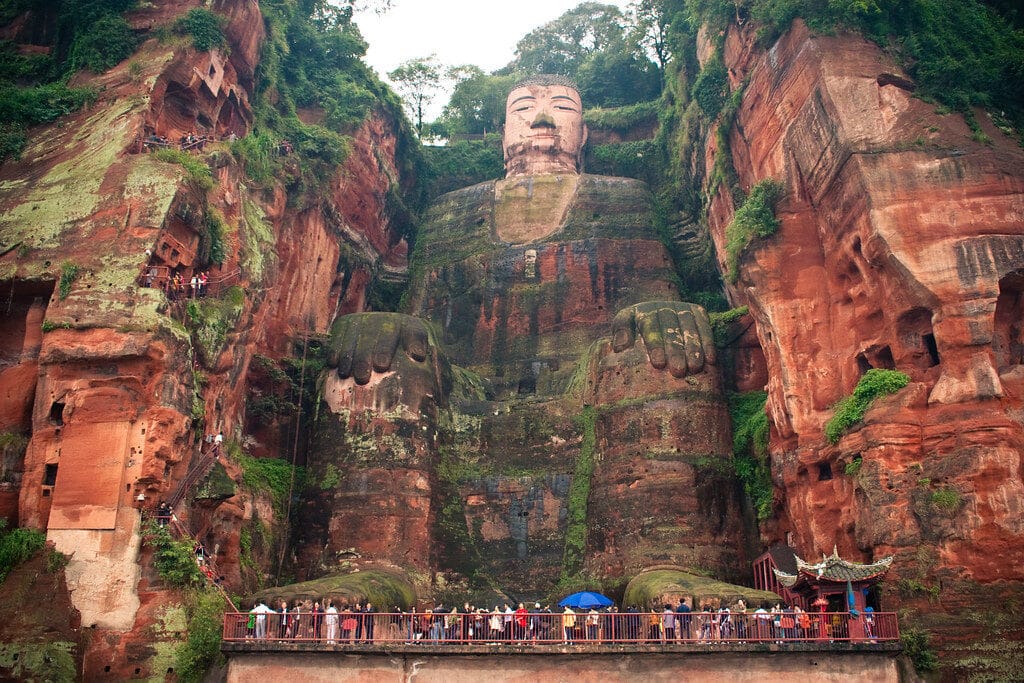
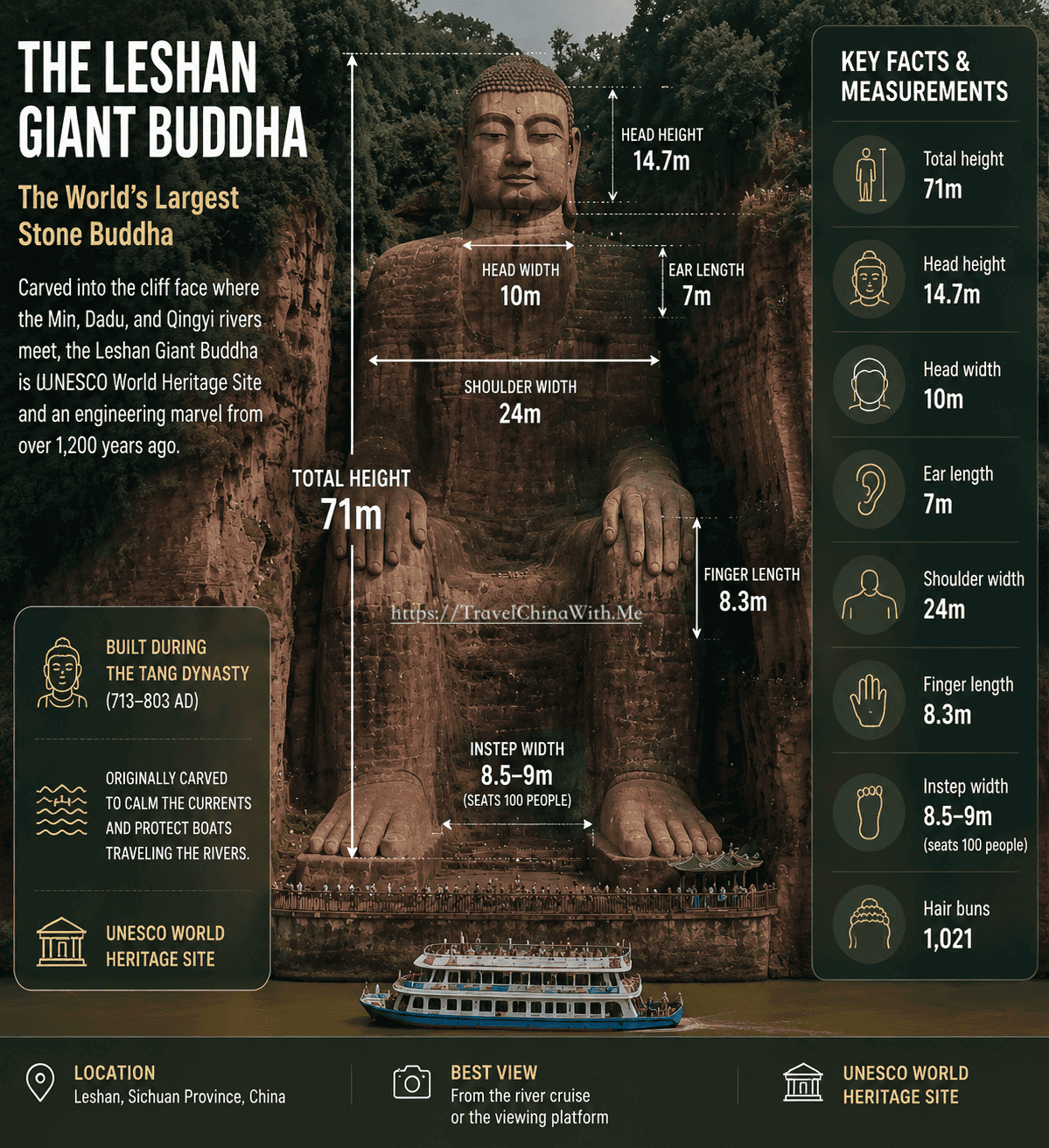
The Leshan Giant Buddha stands 71 meters tall — 16 meters taller than the larger of the two Bamiyan Buddhas in Afghanistan, which stood 55 meters before their destruction in 2001. UNESCO recognizes it as the largest Buddhist sculpture in the world. It’s specifically the largest Buddha carved from stone. Modern statues built from concrete or metal stand taller — the Spring Temple Buddha in Henan reaches 128 meters. None of them are carved from a cliff face.
Total height | 71m | Shoulder width | 24m |
|---|---|---|---|
Head height | 14.7m | Finger length | 8.3m |
Head width | 10m | Instep width | 8.5m (seats 100 people) |
Ear length | 7m | Hair buns | 1,021 |
The statue faces the point where the Min, Qingyi, and Dadu Rivers meet. These currents were dangerous for centuries, and boats regularly capsized on the rocks below.
Who Built the Leshan Giant Buddha, and Why?
In 713 AD, a monk named Haitong vowed to carve a Buddha into the cliff. He believed it would calm the water and protect river traffic. Raising the funds took him 20 years of begging alms.
When local officials tried to seize the money, Haitong reportedly gouged out his own eye rather than hand it over: “You may take my eyeball, but not the Buddha’s funds.” The officials backed down.
Haitong died before the statue was finished. A regional military governor later took over the project. It took a total of 90 years, finishing in 803 AD.
UNESCO World Heritage Status
In 1996, UNESCO inscribed the Leshan Giant Buddha alongside Mount Emei on the World Heritage List, as part of the “Mount Emei Scenic Area, including Leshan Giant Buddha Scenic Area” (Site No. 779). The combined property covers 15,400 hectares across both sites, with a 46,900-hectare buffer zone — the Leshan portion is a small fraction of that total, since Mount Emei accounts for most of the land area.
The statue has survived more than 1,300 years largely because of a hidden drainage system carved into the hair, collar, and behind the ears. These channels divert rainwater away from the stone.
2. Leshan Giant Buddha Tickets: Prices, Hours, and How to Buy
Mountain Ticket (Includes Wuyou Temple and Mahao Cliff Tombs)
Type | Price |
|---|---|
Adult, full price | CNY 80 |
Half price (students, ages 7–17) | CNY 40 |
Free (age 65+, children under 1.2m) | Free |
Boat Ticket (Separate From the Mountain Ticket)
Type | Price |
|---|---|
Adult | CNY 70 |
Free (children under 1.2m) | Free |
Purchased at the pier or online, separately from the mountain ticket.
Night Tours
Both night tours run year-round, though hours shift between peak and off-peak season (see the table below). Both can pause for bad weather or water levels — the river cruise was suspended for several days after the August flooding, but that closure wasn’t long-term.
Tour | Price | Notes |
|---|---|---|
Lingyun Mountain night walk (full loop) | CNY 158 adult, CNY 79 child/student | Adds White Marble Bridge and the Oriental Buddha Capital gallery |
Lingyun Mountain night walk (short loop) | CNY 80 adult, CNY 40 child/student | Skips the gallery |
Three Rivers Night Cruise | CNY 138 adult, CNY 69 child under 1.2m | Sails from Wuyou Temple Pier past the lit-up Buddha; capped at 200 riders/day |
Neither night option reaches the feet — both are viewing-only. For the full route and which to pick, see the How to Visit section above.
Opening Hours
Peak (Apr 1–Oct 7) | Off-Peak (Oct 8–Mar 31) | |
|---|---|---|
Daytime entry | 7:30 AM–6:30 PM | 8:00 AM–5:30 PM |
Lingyun Mountain night walk | Entry 7:30–9:30 PM, site open to 10:30 PM | Entry 7:00–9:00 PM, site open to 10:00 PM |
Three Rivers Night Cruise | Departs 8:00 PM and 9:30 PM | Departs 7:30 PM and 9:00 PM |
Ticket sales for daytime entry close 30 minutes before closing. Both the daytime boat and the night walk run on daily caps — 6,000 riders for the daytime cruise, 1,500 for the night walk, split into two entry windows. Book ahead on busy dates rather than assuming same-day availability.
How to Buy Tickets
Book through the official “大佛旅游” mini-program on WeChat, Alipay, or Douyin. Same-day walk-up tickets are also available at the North and South Visitor Centers and the North, South, and West Gates, but availability isn’t guaranteed on busy days — booking ahead online is safer.
Book 1–3 days ahead with your passport number, then scan in at the gate.
- Traveling on a passport, not a Chinese ID? You can’t scan straight through — exchange your online booking for a paper ticket at the counter first, so build in a few extra minutes.
- No WeChat Pay or Alipay? The scenic area’s own official WeChat account links out to Trip.com for ticket booking, or your hotel front desk can usually book on your behalf.
- Traveling during a Chinese holiday? Tickets can sell out days in advance, so book early.
Payment on Site
Cash and Alipay/WeChat work at most vendors inside the scenic area, but foreign credit cards are hit-or-miss. Bring some cash as backup, and keep your passport on you — it’s needed both for entry and for any half-price or free tickets.
A Few Rules to Know Before You Go
- Entry runs on a timed-slot system — arrive within the window on your ticket.
- Tickets can be booked up to 30 days ahead.
- Pets aren’t allowed anywhere in the scenic area.
- The site sits within a forest fire prevention zone — no open flames or smoking.
- Tourist assistance line for anything urgent on site: 0833-6116666.
3. Getting Leshan Giant Buddha From Chengdu
Method | Time | Cost | Best For |
|---|---|---|---|
High-speed train | 50–60 min to Leshan Station | CNY 54 one-way | Fastest, most reliable |
Long-distance bus | 2 hours | Lower than train | Flexible schedules, tighter budget |
Private car / self-drive | 2 hours | Varies | Control over return time |
High-Speed Train
Trains from Chengdu East or Chengdu South Station reach Leshan Station in 50–60 minutes, with frequent departures. This is the fastest, most reliable option.
From Leshan Station: bus K1 or 601 to Jiadingfang Station (CNY 2), then walk 500 meters to the North Visitor Center. Or taxi, 30 minutes, CNY 25.
From the North Visitor Center, it’s another 1.9km to the North Gate itself. A shuttle covers that stretch for CNY 10 one-way, or CNY 15 for an unlimited day pass. Walking takes 20–25 minutes.
Long-Distance Bus
Buses run from Chengdu’s Xinnanmen or Shiyang bus stations, 2 hours. Less frequent than the train — suits flexible schedules or a tighter budget.
Private Car or Self-Drive
The expressway covers 162km, a 2-hour drive. The advantage: control over your return time — useful if the plank road queue runs long or you’re combining the trip with Mount Emei.
See our charter car service if you’d rather not deal with tickets and transfers yourself.
4. How to Visit Leshan Giant Buddha: Walking, the Head Platform, or the Boat

There are a few distinct ways to see the Giant Buddha. Each shows you something different.
- Short on time or heat-sensitive? Take the river cruise.
- Have the energy and want the up-close detail? Walk to the feet.
- Bad knees, afraid of heights, or just passing through? Stick to the head platform.
- Want the evening atmosphere? Either night option works.
Leshan Giant Buddha: Five Ways to Visit
Walking Down to the Feet
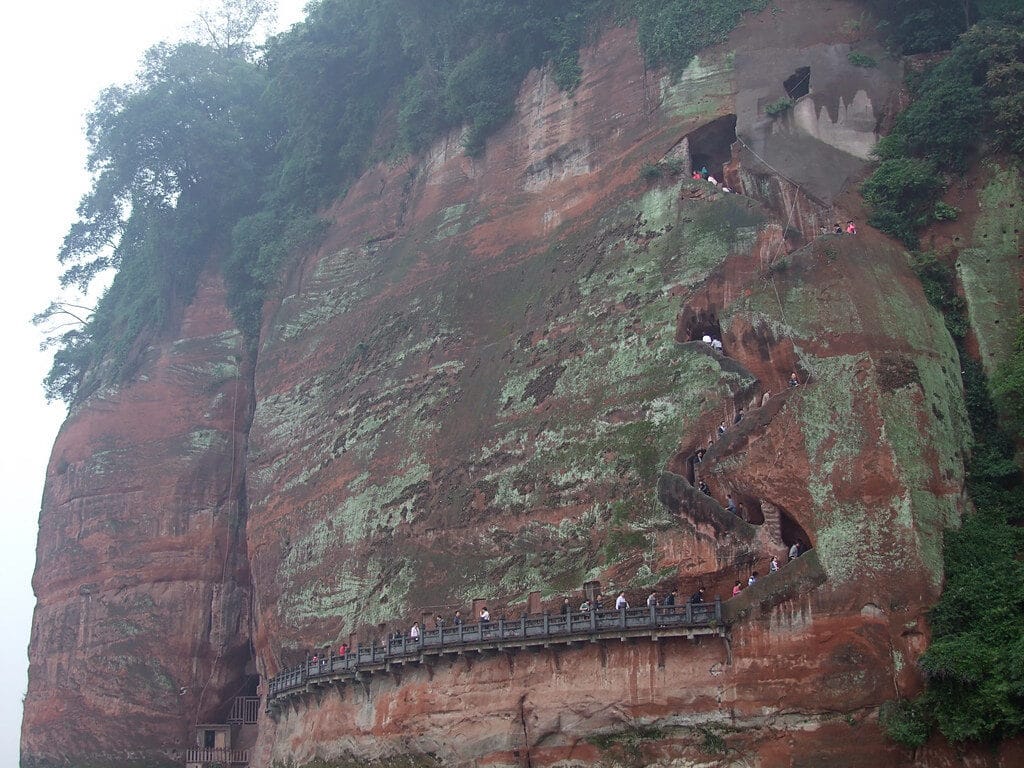
The original Jiuqu Plank Road is currently closed for maintenance. The only route down now is the Lingyun Plank Road. Several English guides still list Jiuqu as active — it isn’t. Capacity on the Lingyun route is limited, so expect a queue regardless of when you go.
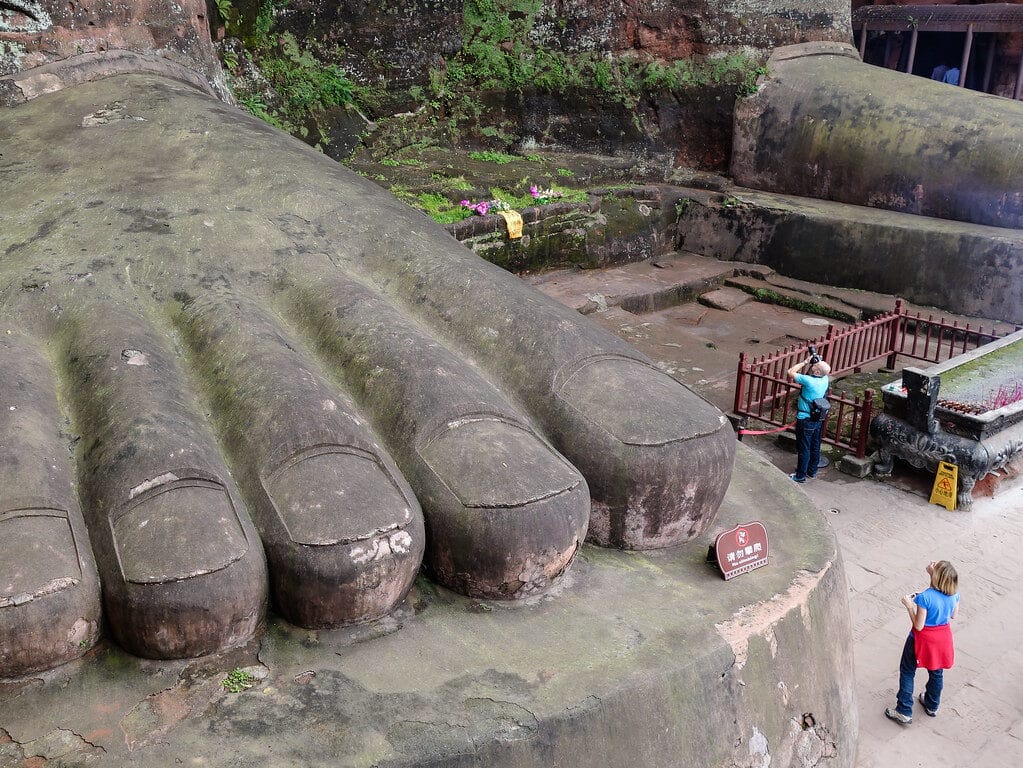
You pass close to the ears, shoulders, and hands on the way down. The instep alone is 8.5 meters wide, big enough to seat a hundred people. The shoulders span 24 meters.
During peak season the plank road runs one-way only, downhill: once you’re on it, there’s no turning back to the top. When you reach the bottom, at the Buddha’s feet, you don’t retrace your steps — you exit by climbing a separate stairway back up to the South Gate. This is where the longest queues form. Skip it if you have mobility concerns, small children in tow, or low heat tolerance.
Stopping at the Head Platform

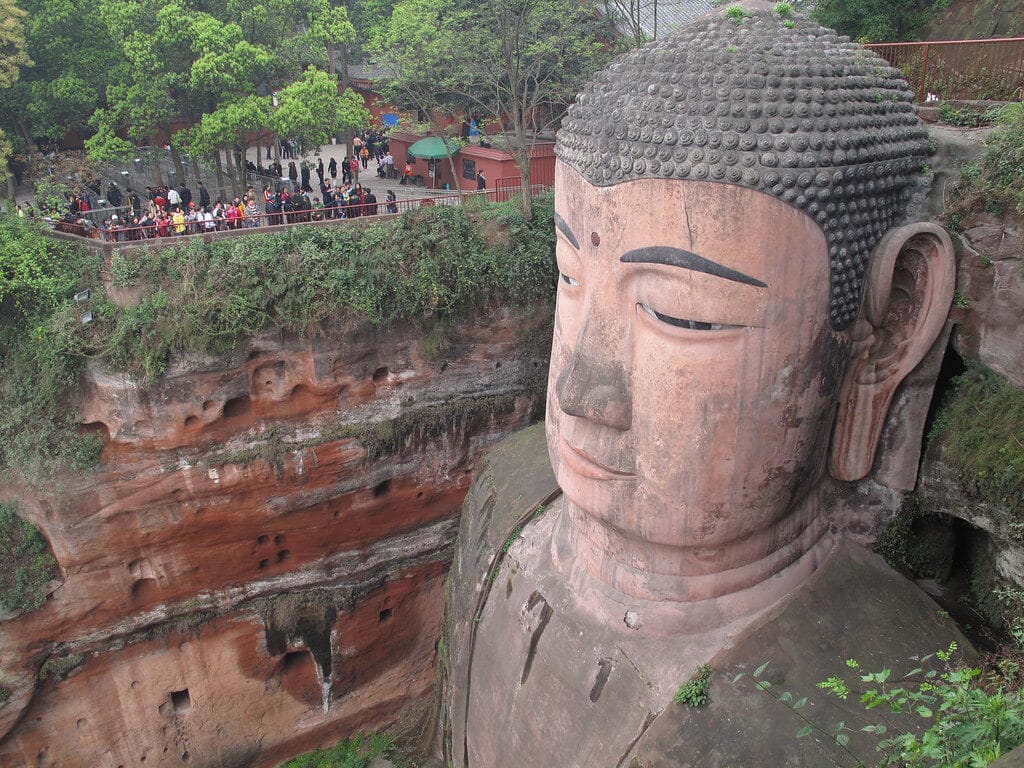
Not everyone needs to go all the way down. The head platform sits after a gentle uphill walk from the north gate. It puts you eye-level with the statue’s face, close to the drainage carvings in the hair and ears.
We often suggest this as the fallback — for anyone unsure about their knees, uneasy with heights, or visiting on an extremely hot day when the feet queue is at its worst.
The River Cruise
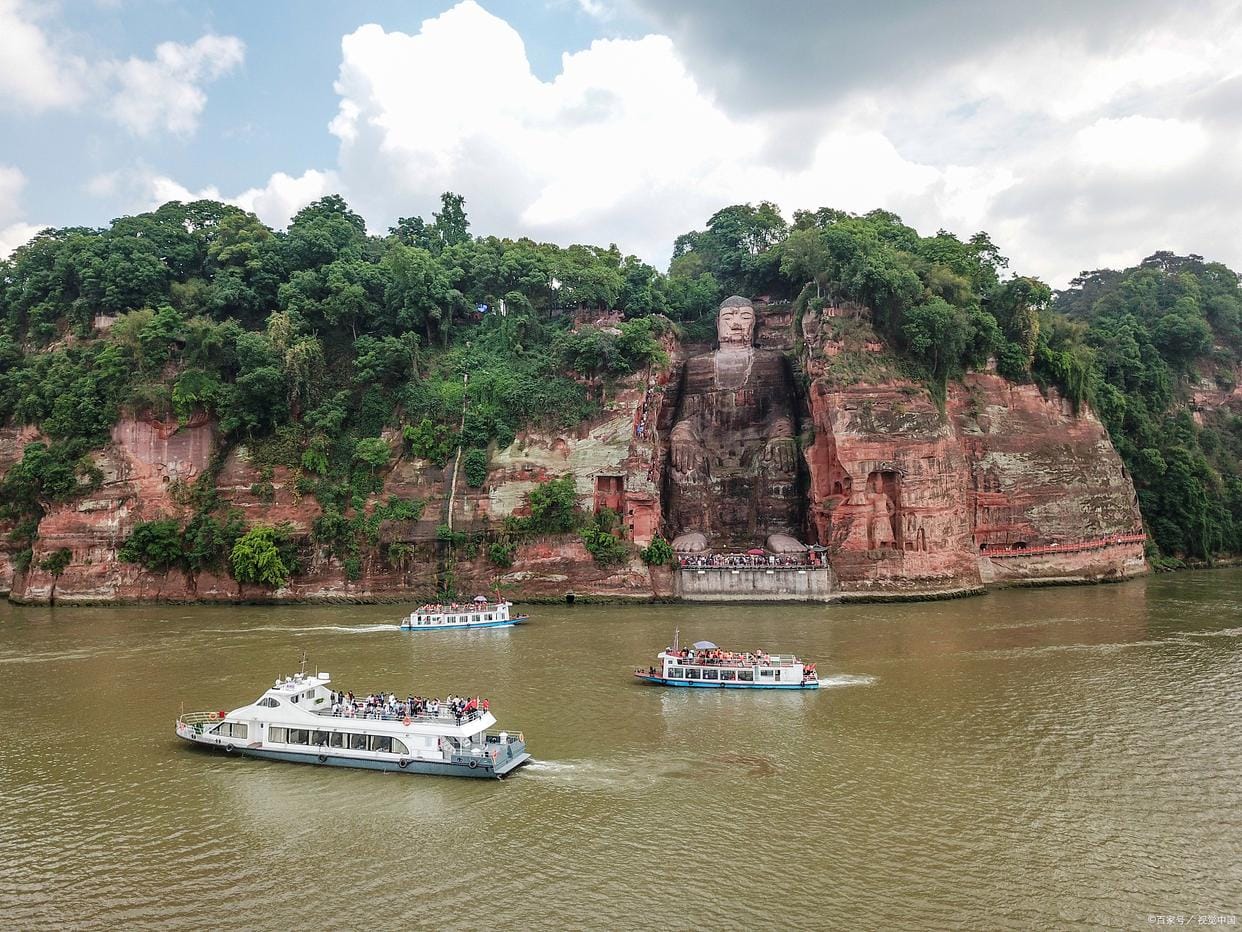
The boat gives you a full view of the statue’s proportions from the water. It holds position in front of the Buddha for photos, then continues.
There are two piers, and which one operates depends on the river’s water level.
Jiazhou Ferry Pier (North) | Wuyou Temple Pier (South) | |
|---|---|---|
Near | North Visitor Center | South Visitor Center |
Route | One-way — board at Jiazhou, disembark at Baxiandu, 800m from the North Visitor Center | Loop — board and disembark at the same point |
Reliability | Can suspend in low water or after rain | More stable, less affected by water level |
Getting to it | Drive or navigate to “North Visitor Center” | Drive to “South Visitor Center parking,” then cross the footbridge and take the free shuttle to the pier |
Best for | Combining with a walk down from the North Gate | Hot weather, elderly travelers, anyone who wants the simpler round trip |
In summer, we’d lean toward Wuyou Temple Pier. It’s far less likely to leave you stranded after a long wait, since it doesn’t depend on water levels the way Jiazhou does. The tradeoff is a slightly longer walk to reach it.
If you’re combining the boat with the walk down, Jiazhou Ferry Pier is the more efficient choice — it sits close to the North Gate route, so you’re not backtracking.
One thing to watch for: mapping apps sometimes send you to “Wuyou Temple” itself rather than the boat pier. That means an extra kilometer of walking in the sun, plus rickshaw touts asking CNY 15–20 for a short ride. Navigate to “South Visitor Center parking lot” instead, then take the free shuttle across the footbridge.
Buy tickets only through the official “大佛旅游” WeChat mini-program — some third-party platforms have charged extra for a “guided commentary” that never materializes. Book a day ahead, passport holders exchange for a paper ticket at the counter instead. Ticket sales run 7:30 AM–6:00 PM in peak season, with boats departing every 30 minutes; unused same-day tickets can be refunded up to midnight, but once you’ve checked in they can’t be returned.
No queueing, minimal effort. The tradeoff: no close-up detail, no standing beside the statue.
Doing Both
If time allows, take the boat first for the full-scale view, then walk down for the close-up detail. Combined, expect 3–4 hours including queueing.
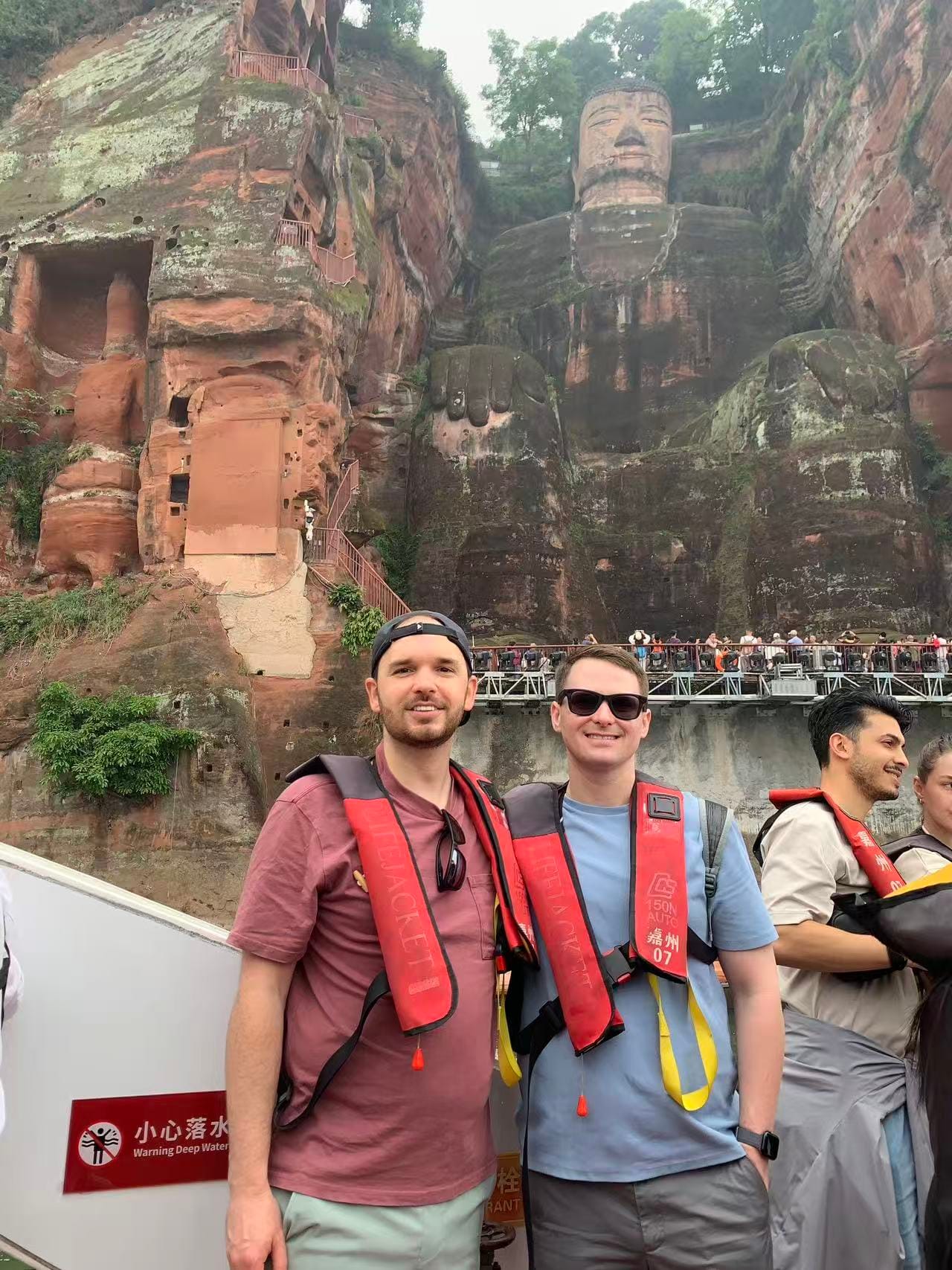
In May 2026 we brought two American guests, Christian and Kevin, through exactly this combination. Seeing the statue from the water first gave them a sense of its proportions that the walk alone doesn’t convey. By the time they stood at the feet looking up, they already understood what they were looking at. Both said the scale was the part that stayed with them.
If you only have half a day, prioritize the walk down. The close-up is what most first-time visitors care about most.
Night Walk on Lingyun Mountain
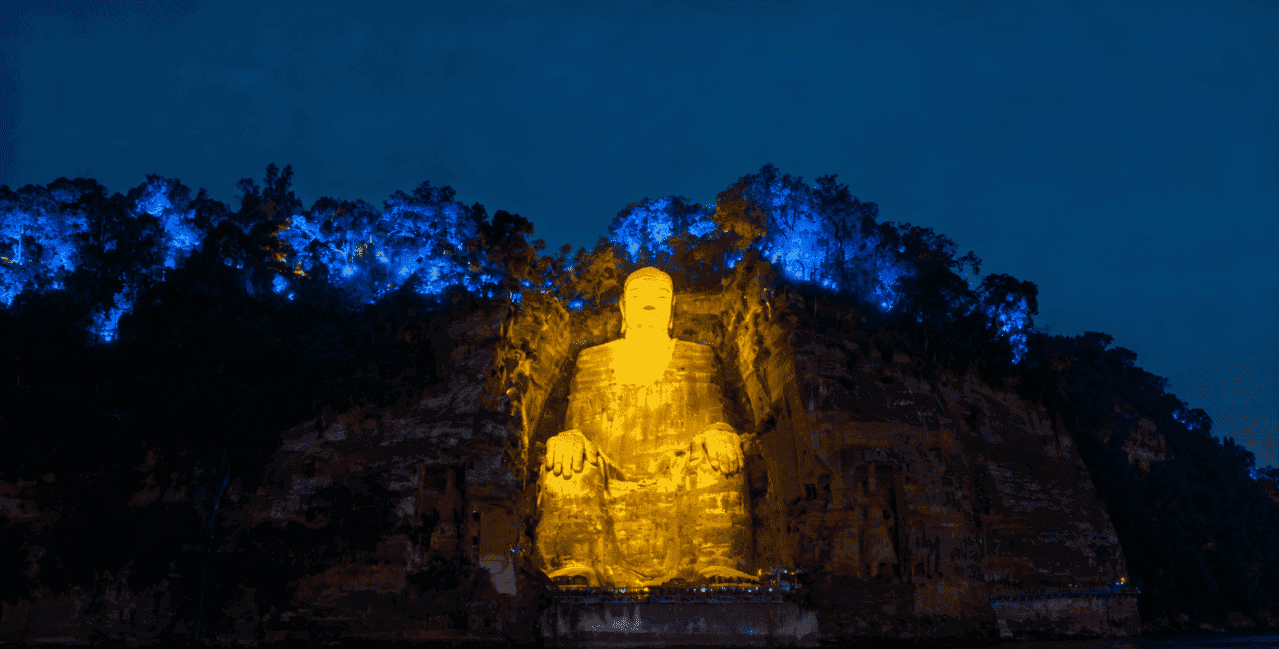
This runs a set route starting from Buddha Culture Plaza. Stops include a lantern-lit corridor, the north gate of Lingyun Mountain, the Buddha’s head lit up after dark, White Marble Bridge, a stretch of stone inscriptions, the south gate, and a recreated fishing village. The full-loop ticket (CNY 158 adult, CNY 79 child/student) continues into the underground gallery at Oriental Buddha Capital; the short-loop ticket (CNY 80 adult, CNY 40 child/student) stops before it. Neither version reaches the feet.
This is the better pick if you want the atmosphere of walking the grounds after dark, or if you’re combining it with dinner in town beforehand.
Three Rivers Night Cruise
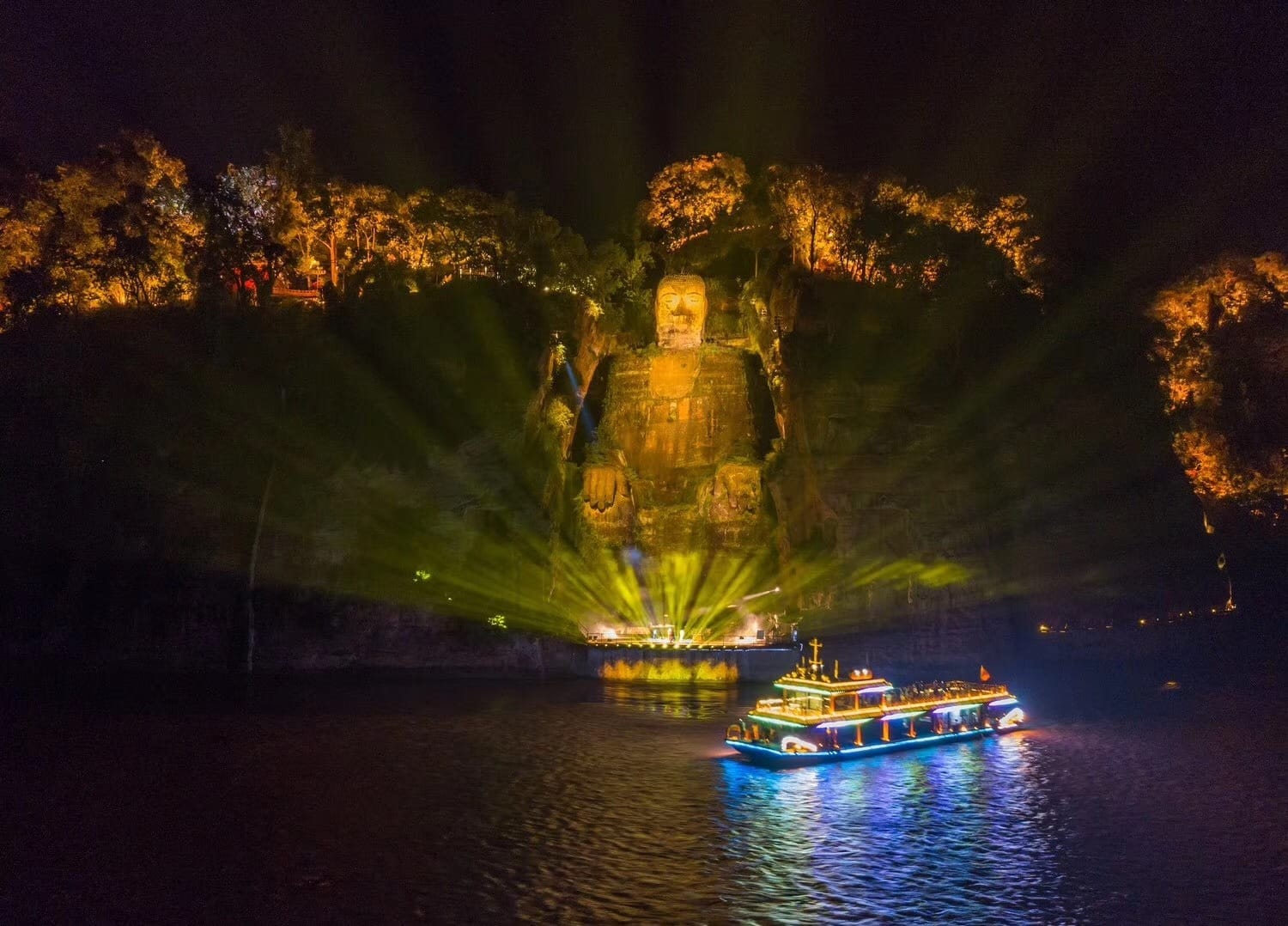
This one’s built around three stages — mountain, river, city. You walk up from the east gate past illuminated carvings for a night view of the statue. Then you board at Wuyou Temple Pier to see the riverbanks lit up from the water, before the boat returns you to the pier to close out the night. It costs CNY 138 (CNY 69 for children under 1.2m), with a free shuttle to the pier from either visitor center 30 minutes before departure.
This is the better pick if the water view matters more to you than walking the mountain grounds, or if you already did the daytime walk and just want the evening city-and-river atmosphere.
Both night options can pause for bad weather or water levels — the river cruise was suspended for several days after the August flooding, though that closure wasn’t long-term. Full hours for both are in the Tickets section below.
5. Which Gate Should You Use?
Route planning trips up more visitors here than almost anything else.
Entry Point | What It’s For | Note |
|---|---|---|
North Gate | Main entrance, standard route in | 1.9km from North Visitor Center |
South Gate | Standard route out | Not the same as either boat pier |
East Gate | Connects to Oriental Buddha Capital | Not a queue-skipping shortcut — see below |
Enter North, Exit South
This is the standard route locals recommend, running North Gate to South Gate without backtracking. Nearly the entire walk is downhill once you’re past the head platform.
Leshan Giant Buddha: Enter North, Exit South — The Standard Route
Nearly the entire route is downhill after the head platform. Neither boat pier sits at the South Gate — plan a separate ride to Jiazhou Ferry Pier (north) or Wuyou Temple Pier (south).
The South Gate Isn’t the Boat Dock
Neither boat pier sits at the South Gate — one is near the North Visitor Center, the other near the South Visitor Center (see the pier comparison above). Don’t plan on walking straight from the South Gate to the boat. The North and South Visitor Centers themselves sit 4.5km apart by the scenic area’s own measurement, so this isn’t a short walk you can improvise — budget the shuttle or a taxi.
Watch Out for “Skip the Line” Offers
Around the scenic area, train station, and parking lots, unlicensed drivers and guides sometimes offer to get you in through Oriental Buddha Capital to “skip the queue” at the Giant Buddha. This isn’t true. The two are separately operated attractions. Entering through Oriental Buddha Capital doesn’t bypass ticketing or the plank road queue — you still need your own Giant Buddha ticket. It’s a sales tactic, not a shortcut. If you want to avoid the queue, the boat is the real answer — book everything through official channels.
What About Oriental Buddha Capital?
Right next to the South Gate sits a separate paid attraction that’s easy to mistake for part of the same site. It isn’t. Oriental Buddha Capital is a modern theme park built in 1989, with replica Buddhist statues carved by contemporary sculptors — no connection to the Tang Dynasty original.
We don’t generally recommend spending much time there. It’s a commercial add-on, not a historical site. If you’re deeply interested in Buddhist sculpture and have the time, a combined ticket is worth considering.
6. Best Time to Visit Leshan Giant Buddha: Season, Day, and Time of Day
This is the question we get asked most, and it’s exactly the detail most English guides skip.
Season | Water Level | Weather | Crowds |
|---|---|---|---|
Spring (Mar–May) | Moderate, clear | Comfortable | Moderate |
Summer (Jul–Aug) | High, muddy — flood season | Hot, humid | Heaviest |
Autumn (Sep–Oct) | Moderate, clear | Comfortable | Moderate |
Winter (Nov–Feb) | Can run low, limits boat piers | Cool, occasional fog | Thinnest |
Spring and autumn are the strongest windows — good water clarity and comfortable walking temperatures. Summer’s heat makes the shadeless plank road queue miserable, on top of poor boat visibility from the muddy water. Winter brings the thinnest crowds, but fog occasionally suspends cruises.
🌦️ Leshan Weather Guide: Best Time to Visit the Giant Buddha
Historical monthly averages for Leshan. Source: Tianqihoubao, compiled from Leshan weather station records.
Queue Length in Peak Season
During peak season, the plank road queue typically runs 1–2 hours, longer on national holidays. The bottleneck is the one-way checkpoint at the top. The path is narrow, there’s no passing, so the whole line moves at the pace of its slowest walker.
Best Time of Day to Avoid Crowds
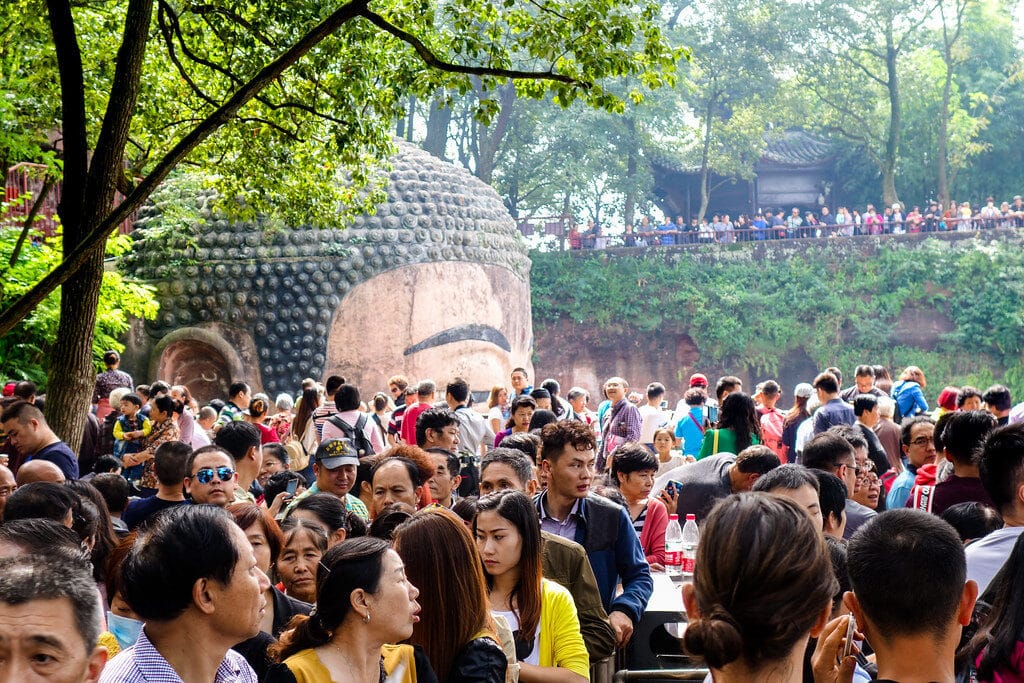
Arriving right at the 7:30 AM opening is consistently the shortest queue window, based on what we’ve seen running tours here over the years. Missed it? The next-best window is later in the afternoon, once most tour groups have left.
Best Day of the Week to Go
Tuesdays and Wednesdays tend to be quietest. Mondays can be surprisingly busy with domestic travelers extending their weekend.
On weekends and holidays, queues rarely disappear regardless of arrival time. Take the boat instead, or stop at the head platform.
Weather Disruptions
Heavy rain can close the plank road and boat — not a rare edge case. In August 2020, floodwater reached the Buddha’s toes for the first time since 1949, closing the site for a week. In August 2026, a 10-year flood event submerged the feet platform by 20cm, closing it again for several days.
The boat can also be suspended in fog or extreme water levels, and the feet platform has closed on extremely hot days as a heat-safety measure. Check the scenic area’s official channels before you go, especially in July or August.
7. A Sample One-Day Leshan Giant Buddha Itinerary
This is how we’d sequence a full day for a client with no other time constraints.
🗓️ Leshan Giant Buddha: A Sample One-Day Itinerary
For the river cruise: if the boat matters more to you than the walk down, it’s worth skipping the South Gate exit entirely. Head straight to Jiazhou Ferry Pier from the head platform instead — that’s how you get the classic full-body photo without backtracking.
8. Before You Go: Food, Where to Stay, and What’s Nearby
Where to Eat
Leshan is one of Sichuan’s better food cities, and most visitors build in time for it after the scenic area. The streets around Zhanggong Bridge and Shangzhongshun food street are the best base — walkable, dense with stalls, a short taxi from either gate. Jiaxing Road is a solid third option if you want something less touristed.
Order a little of everything rather than committing to one restaurant.
Dish | What It Is |
|---|---|
Tiaojiao beef (跷脚牛肉) | Leshan specialty — beef in a light herbal broth, dipping sauce on the side |
Bobo chicken (钵钵鸡) | Skewered meats and vegetables cured in chili oil, ordered by the stick |
Danhong tofu pudding (蛋烘糕) | Folded, griddled batter with sweet or savory fillings |
Youzha chuan (油炸串) | Deep-fried skewers sold from streetside carts |
Bingfen | Chilled jelly dessert — good for cutting the heat and the chili |
Where to Stay
Staying overnight near Zhanggong Bridge or Shangzhongshun puts you walking distance from the food street, and a short taxi from either gate. It also means starting at the North Gate at 7:30 AM without catching an early train first.
What Else Is Nearby
Mount Emei shares the same UNESCO listing and sits 31km away by expressway — the natural next stop if you have more than a day in the area. Within Leshan itself, Wuyou Temple (included in the mountain ticket) and the old town streets near the confluence are worth an extra hour if you’re not rushing back to Chengdu.
Frequently Asked Questions
Is the Leshan Giant Buddha worth visiting?
Yes. It’s the largest stone-carved seated Buddha in the world, with a scale and history few sites in China can match. Half a day on a peak-season weekend will feel more crowded than a full day midweek.
How long does a visit take?
Either the walk or the boat alone, with queueing and transport, usually takes 3–4 hours. Doing both: plan for a full day.
Is it suitable for elderly visitors or young children?
Yes, but we’d steer most families toward the boat or the head platform rather than the full walk down. The plank road is steep, narrow, and one-way. The boat and head platform both get you close without the climb.
Does the ticket include Mount Emei?
No. Separate scenic areas, separate tickets. The Leshan ticket includes Wuyou Temple and the Mahao Cliff Tombs.
Can I buy tickets at the gate?
Same-day tickets are technically available at the visitor centers and gates, but availability isn’t guaranteed, especially on busy days. Booking through the official WeChat mini-program in advance is the safer bet. Your hotel or a platform like Trip.com can book for you if you don’t use WeChat Pay or Alipay.
Can you visit as a day trip from Chengdu?
Yes. A round trip by high-speed train, plus time at the site, is entirely doable in a single day.
Can you do Leshan and Mount Emei in one day?
Not comfortably. Each site alone takes half a day or more once you include transport, and they’re best experienced without rushing. Most of our clients split them across two days — Leshan one day, Emei’s summit the next.
If you’re planning a Chengdu-area itinerary, get in touch and we can help sequence the Leshan Giant Buddha and Mount Emei around your time and energy levels.