The Definitive Guide to Huanglong Cave: Navigating Zhangjiajie’s Subterranean Empire
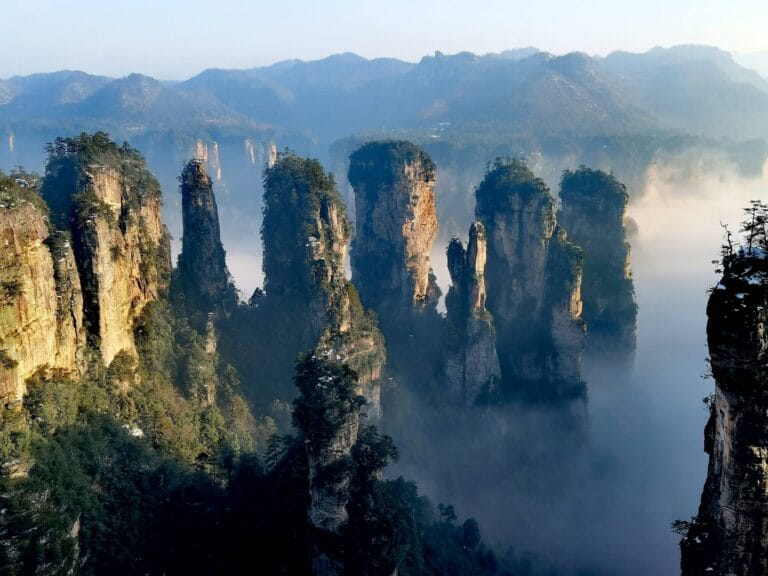
Most travelers come to Zhangjiajie with their heads in the clouds. They seek the soaring sandstone pillars of Wulingyuan. They want the “Avatar” experience. But we always tell our guests at Travel China With Me one thing. You cannot truly understand the soul of this landscape without descending into its belly.
Huanglong Cave, or the Yellow Dragon Cave, is a geological masterpiece. It is a four-story underground kingdom. It sits in the eastern part of the Wulingyuan Scenic Area. It is not just a “tourist cave.” It is one of the most complex karst systems in Asia.
In this guide, we share our collective boots-on-the-ground experience. We cover the 100-million-RMB rock. We cover the secret “Maze.” We give you the exact logistics to beat the 2026 crowds. This is an expert manual for the curious traveler.
Table of Contents
Quick Facts: The 2026 Data Sheet
Before we journey inward, let us look at the scale. Huanglong Cave is a giant. It is vertically stacked. This is rare for karst formations.
Metric | 2026 Detail | Significance for You |
|---|---|---|
Total Explored Area | 100,000 square meters | Large enough to hold a small city. |
Vertical Height | 140 meters | Equivalent to a 46-story building. |
Explored Length | 15 kilometers (7.6 km open) | You will walk about 3-4 km total. |
Internal Temp | Constant 16°C (61°F) | Perfect year-round “natural AC.” |
Humidity | 95% – 98% | Supports active, living stalactites. |
Key Attraction | Sea-Calming Divine Needle | Insured for 100 Million RMB. |
Boat Route | 800 meters | Features a silent, electric boat ride. |
The Geological Genesis: How Water Carved a Kingdom

To appreciate Huanglong Cave, you must understand time. The limestone here is from the Permian period. That was about 380 million years ago. Back then, Zhangjiajie was a vast, shallow ocean.
Over millions of years, the earth shifted. The waters receded. The Wuling mountains rose. But water never truly left. It began to seep into the cracks of the limestone. Rainwater absorbs carbon dioxide. It becomes a weak carbonic acid.
This acid slowly eats away at the calcium carbonate. In Huanglong, this process created a “multi-story” effect. As the water table dropped, new levels were carved out. This is why we see four floors today.
The top two floors are “dry.” They are older and more stable. The bottom two floors are “wet.” They contain the Xiangshui River. We often tell our guests to look at the ceiling. Those tiny drips are the architects. They are still building the cave today. A single stalactite grows only about 1 millimeter every ten years. When you look at a 10-meter pillar, you are looking at a million years of patience.
The Human History: From Forbidden Mystery to Global Wonder
For centuries, Huanglong Cave was a place of taboo. The local Tujia people lived in the valleys below. They believed the cave was the home of the “Yellow Dragon King.”
Legends said the cave led to the East China Sea. Locals feared that entering would disturb the dragon. This would bring floods or droughts to the rice fields. During the Qing Dynasty, people only entered the mouth for shelter. They never dared to go deep into the “Forbidden Zone.”
The 1983 Breakthrough
The modern history of the cave began in 1983. Eight local militiamen decided to explore the depths. They had no professional gear. They used simple flashlights and ropes made of hemp.
They crawled through narrow “squeeze” holes. They navigated the underground river on makeshift rafts. What they found was a “Dragon Palace” beyond imagination. This discovery changed the economy of Zhangjiajie forever.
In 1984, the cave officially opened to the public. It was one of the first sites in China to receive “AAAAA” status. But even today, much of the system remains unexplored. We are still learning about its secret passages.
Why Huanglong Cave is Worth Your Visit (The Insider View)

Is it just another cave? We hear this often. Some travelers have seen caves in Europe or the USA. They wonder if this is unique. We believe it is essential for three specific reasons.
1. The Vertical Diversity
Most caves are a single, long tunnel. Huanglong is a 3D labyrinth. You walk through vast halls. Then you descend to a river. Then you climb back up into a “palace.” This change in perspective keeps the tour exciting. You never get “cave fatigue” here.
2. The Cultural Aesthetics
In China, caves are treated like underground gardens. The lighting is deliberate. It highlights the shapes of the rocks. To some, the neon colors are intense. To us, they help you see the “spirit” in the stone. The Chinese names for the rocks add a layer of storytelling. You aren’t just looking at calcium; you are looking at folklore.
3. The Sensory Contrast
Zhangjiajie is a loud, bright place. The mountains are grand and epic. The cave is quiet, cool, and intimate. It provides a sensory reset. It is the perfect counterbalance to the heights of the National Park.
A Step-by-Step Walkthrough: Into the Deep

Let us take you through the actual route. We start at the entrance and work our way to the exit.
The Ecological Entrance
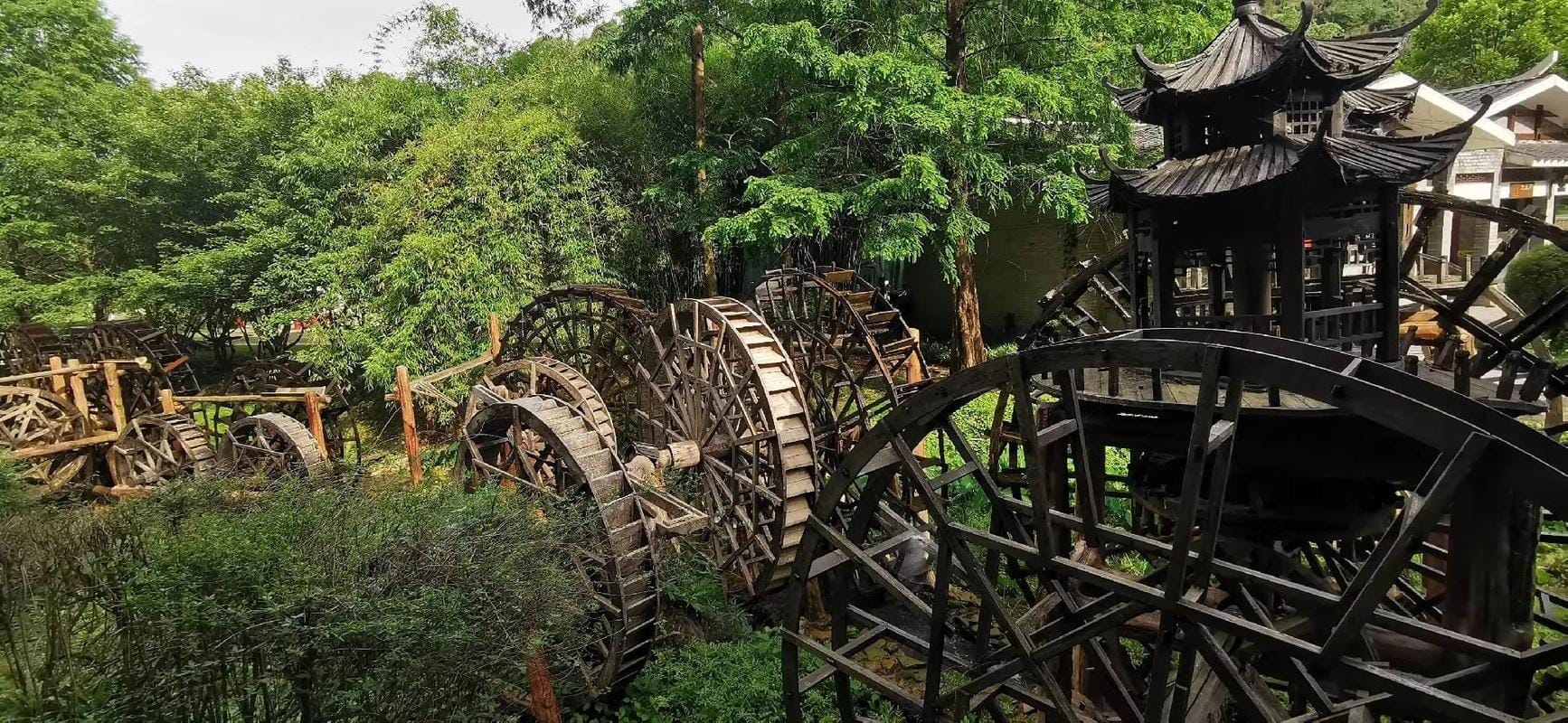
The approach to the cave is a masterclass in architecture. The Visitor Center was designed by Yu Kongjian. He is a world-renowned landscape architect. The building has a grass-covered roof. It blends into the surrounding rice paddies.
You will pass massive wooden water wheels. These are not just for show. They represent the agricultural heritage of the Tujia people. We always recommend taking five minutes here. Breathe the fresh mountain air before you descend.
Entering the Dragon’s Mouth
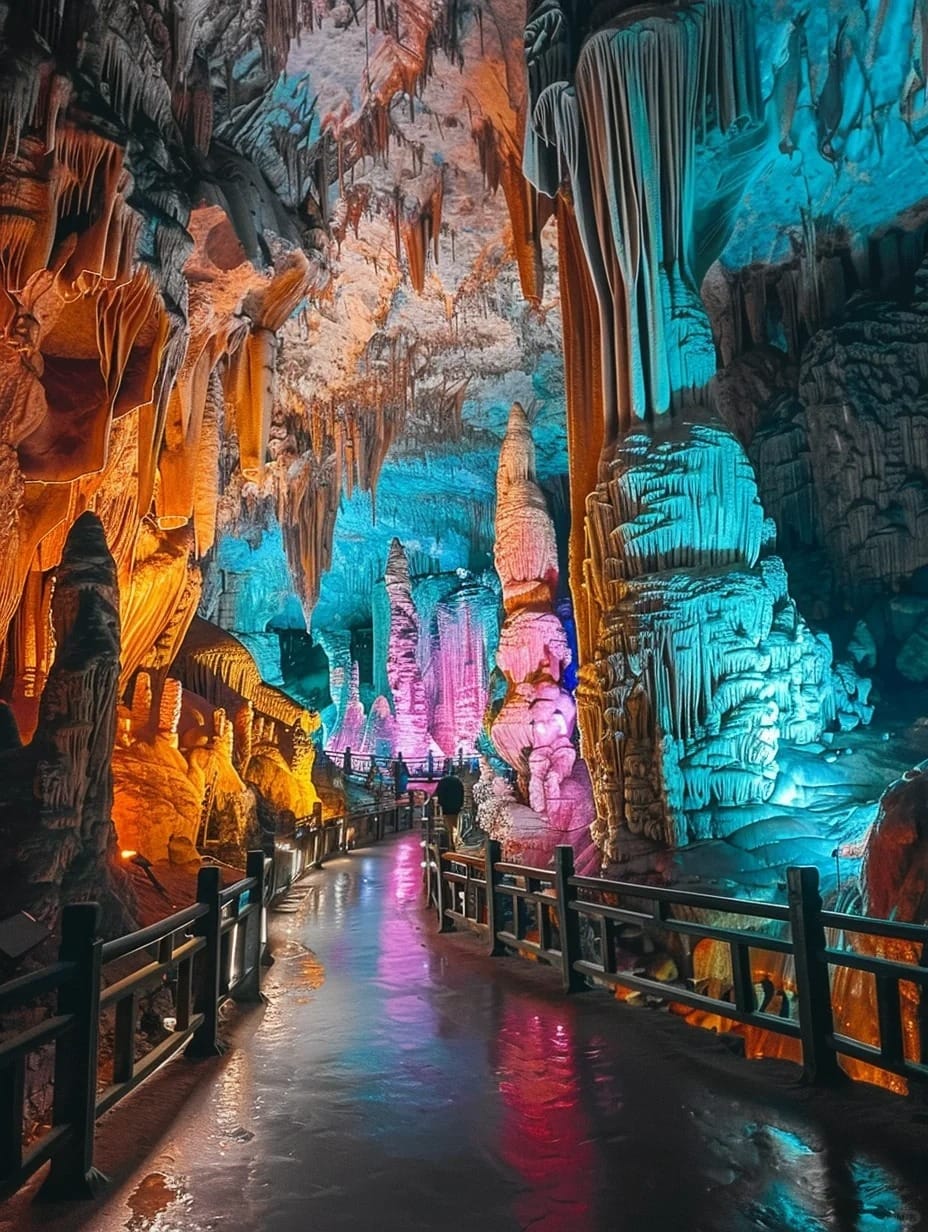
As you enter, the temperature drops immediately. You will feel a rush of 16°C air. The path starts in a wide tunnel. The walls are smooth. You will pass the “Happiness Gate.” Locals believe passing through it brings good fortune. We always make sure our guests take a photo here.
The Xiangshui River: The Silent Voyage
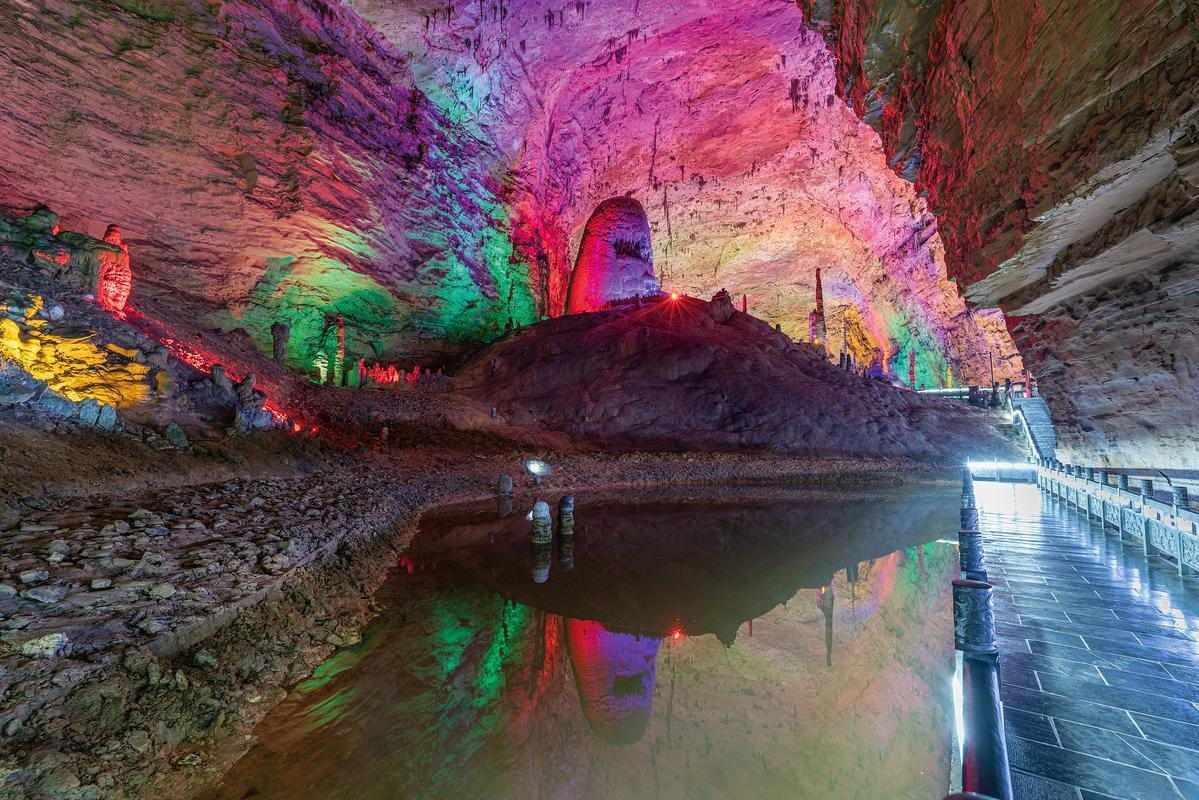
This is the second floor. It is the “wet” level. You will board a flat-bottomed electric boat. The water is crystal clear. The route is about 800 meters long.
The boat ride is silent. You will pass under “The Stone Bridge.” You will see the “Dragon King’s Flag.” The lights reflect on the ripples of the water. It is a hauntingly beautiful experience. Keep your hands inside the boat. The walls can be narrow and jagged.
The Palace of the Dragon King
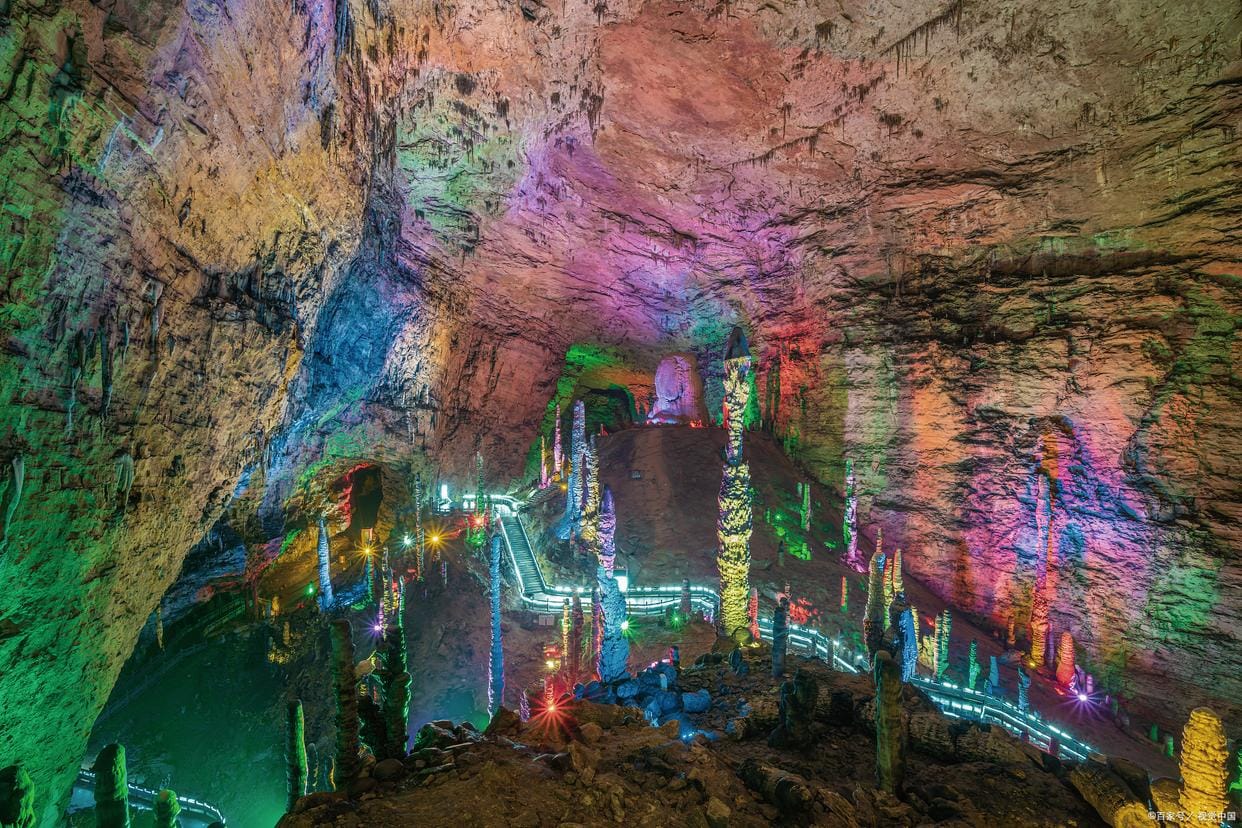
After the boat, you begin the climb. You are heading to the third and fourth floors. This is the heart of the cave. The “Dragon Palace” is a massive chamber. It covers 14,000 square meters.
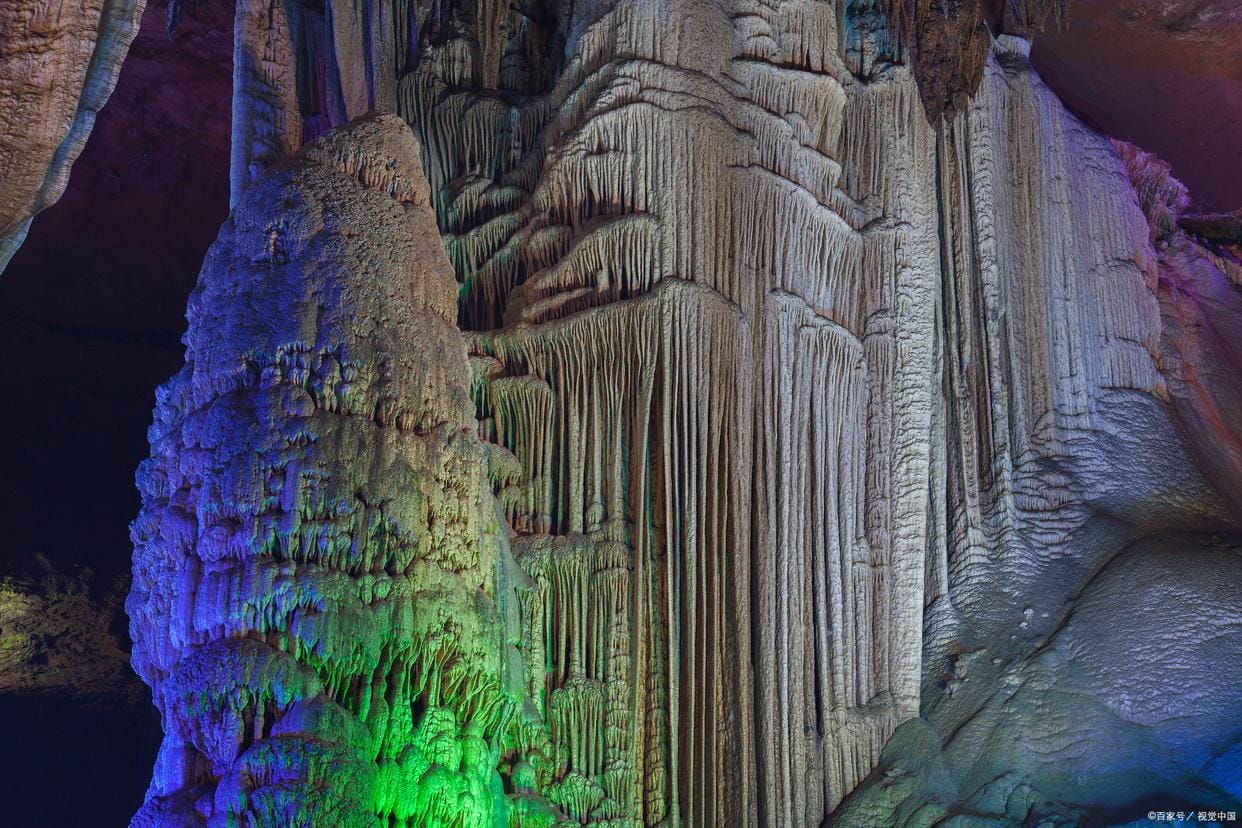
Imagine a space that could fit 100,000 people. That is the scale. The ceiling is draped with “stone curtains.” The floor is covered in “stone bamboo shoots.” It looks like a forest made of frozen light. It is arguably the most impressive cave chamber in China.
Continuing our journey into the depths of the Yellow Dragon, we now approach the most famous geological structures in the world.
The Sea-Calming Divine Needle: A 100-Million-RMB Miracle
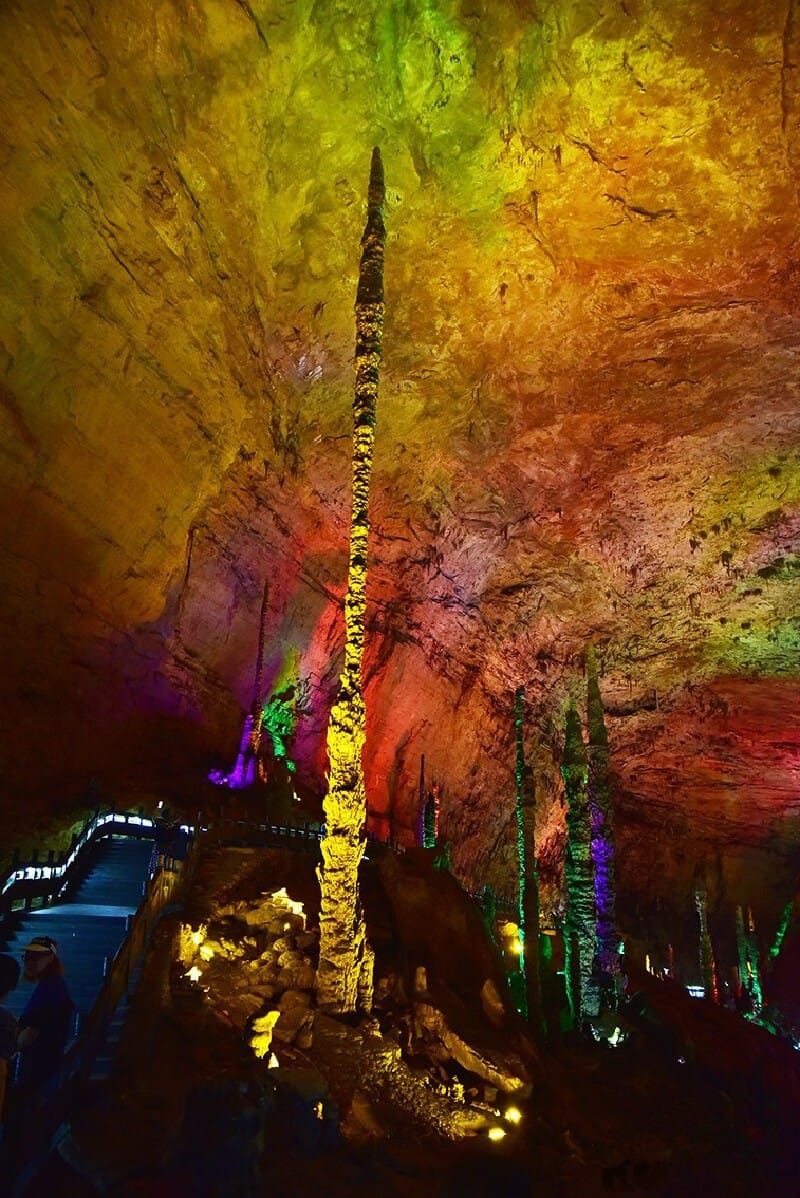
When you stand in the center of the Dragon Palace, your eyes will inevitably drift to a single, impossible pillar. This is the “Ding Hai Shen Zhen,” or the Sea-Calming Divine Needle.
At Travel China With Me, we have seen many natural wonders. However, this stalagmite defies logic. It stands 19.2 meters tall. That is about the height of a six-story building. Yet, at its narrowest point, it is only 10 centimeters wide.
In 1998, the cave management made international headlines. They purchased a 100-million-RMB insurance policy for this single rock. Why such a high price? Because it is a geological anomaly. Most stalagmites of this height are thick and conical. The Needle is perfectly vertical and incredibly thin.
The Science Behind the Needle
Geologists estimate that the Needle has been growing for over 200,000 years. It is formed by a single, consistent drip of water from the ceiling.
For 200,000 years, the water has hit the exact same spot. It has deposited calcite in a perfect vertical line. If the earth had shifted even slightly, the Needle would have crooked or collapsed.
Expert Tip: Look at the gap between the tip of the Needle and the ceiling. It is roughly 6 meters. Based on current growth rates, it will take another 60,000 years to connect. You are witnessing a masterpiece in progress.
The King’s Throne: The Massive Counterpart
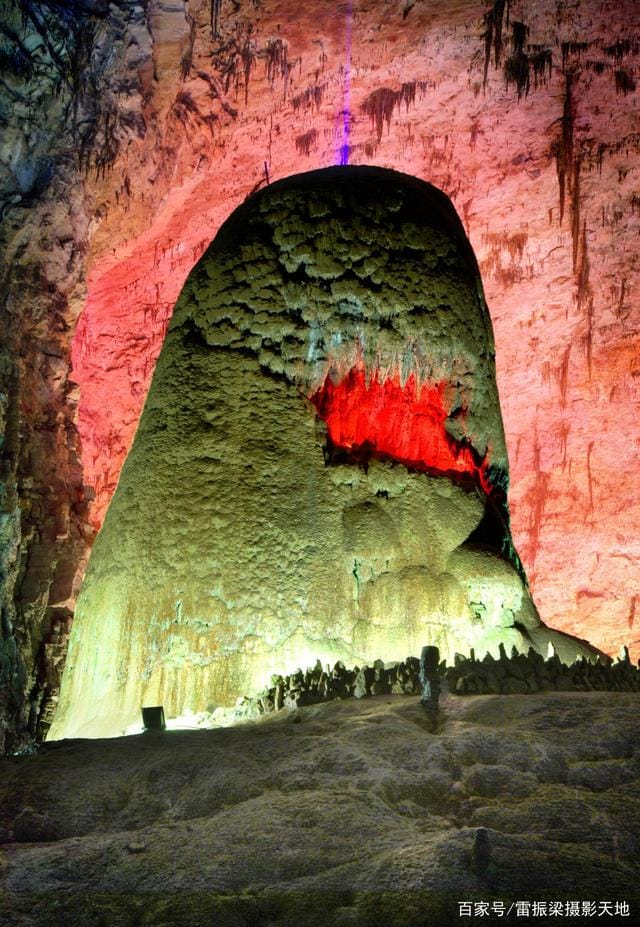
Opposite the slender Needle sits the King’s Throne. This is the physical opposite of the Needle. It is the thickest stalagmite in the cave.
It is roughly 15 meters high. The base is massive, measuring 10 meters in diameter. It looks like a giant, melting wax candle. It is hollow in the center. Legend says the Yellow Dragon King sits here to watch over his empire.
When our groups stand between the Needle and the Throne, the contrast is striking. You see the two extremes of karst formation: the delicate and the monumental.
The Secret “Maze” (Mi Gong): Why You Must Pay the Extra 15 RMB
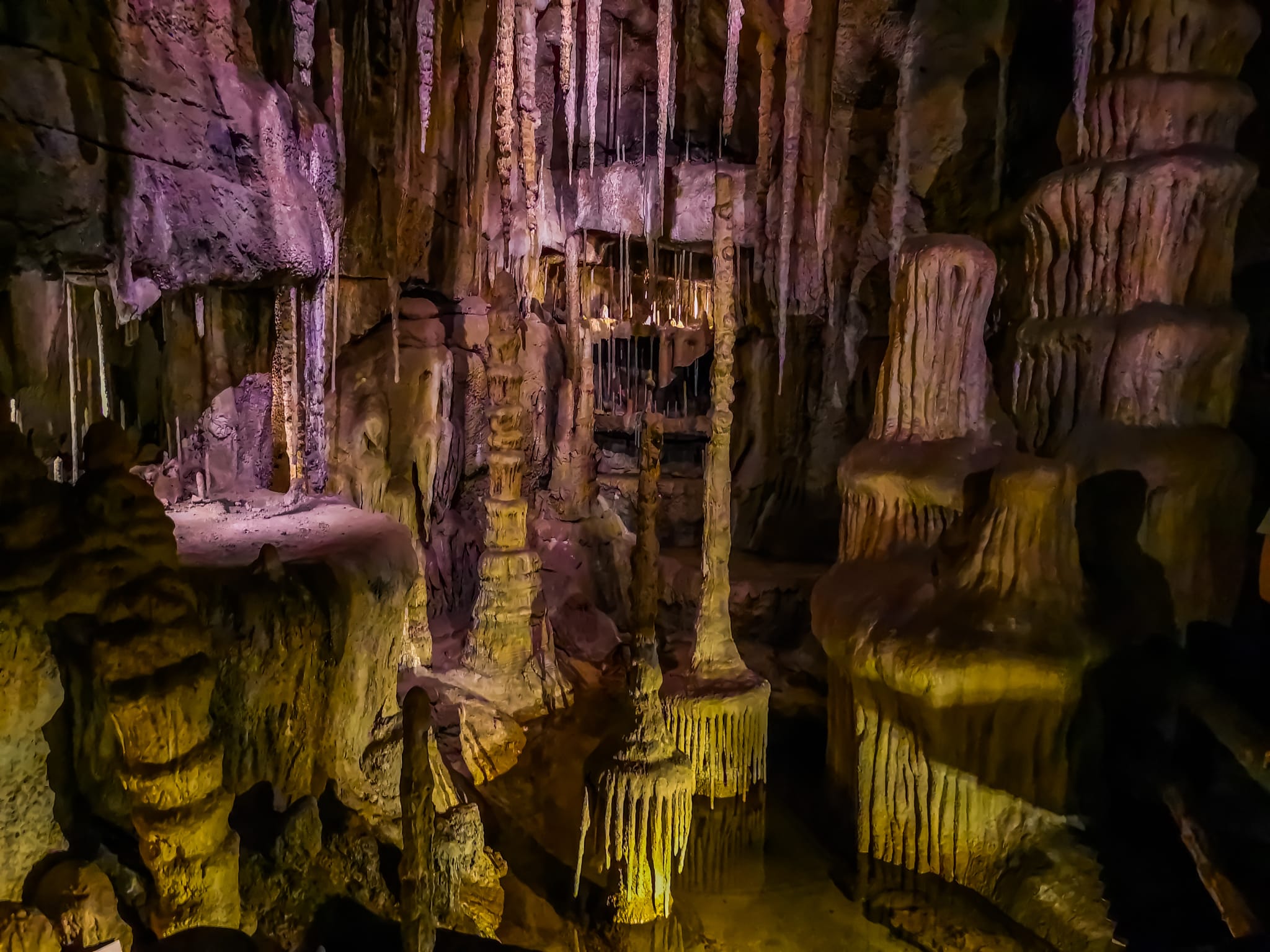
As you exit the Dragon Palace, you will see a small entrance with a separate ticket gate. This is the Maze.
Most budget tours and large groups skip this. They want to get back to the bus. We strongly advise our guests to go inside. In 2026, the Maze remains the most pristine section of the cave.
Why the Maze is Unique
The Maze is only 1,600 square meters. It is much smaller than the grand halls. However, the density of formations is ten times higher.
In the Maze, the stalactites and stalagmites are “younger” and cleaner. In the main halls, the carbon dioxide from millions of visitors has slightly dulled the rock. In the Maze, the formations still sparkle.
You will see:
- Stone Hair: Tiny, translucent needles of calcite.
- Stone Flowers: Formations that look like blooming desert roses.
- Stone Pearls: Small, round deposits in shallow pools.
The Maze is a restricted area. Only a small number of people are allowed in at once. This creates a quiet, meditative atmosphere. If you are a photography enthusiast, this is the only place where you can get close-up shots of delicate crystals.
The Tianxian Waterfall: Water from the Heavens
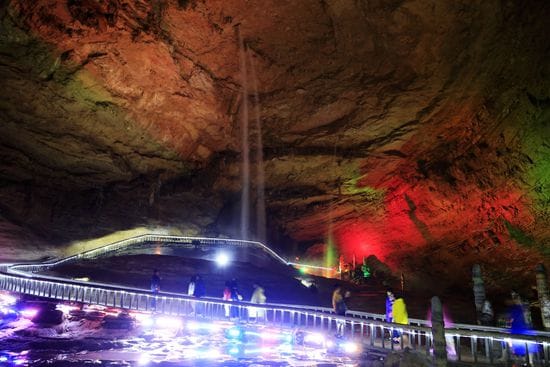
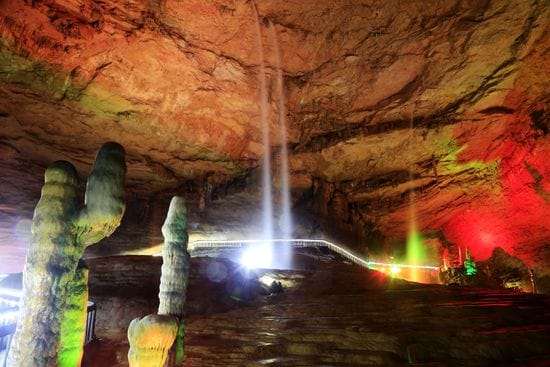
One of the most surprising features of Huanglong Cave is the Tianxian Waterfall (Fairy Waterfall). It is not a river falling over a cliff. It is a waterfall falling from a hole in the ceiling.
The water drops 27.3 meters. It hits a pool on the third level. The sound is deafening in the enclosed space. During the rainy season (April to June), the volume of water is incredible.
This waterfall is the reason the bottom levels are “wet.” It constantly feeds the Xiangshui River. We recommend standing on the viewing platform for a minute. Feel the mist on your face. It is a reminder that the mountain above is alive with water.
2026 Logistics: Navigating Like a Pro
Travel in China has changed significantly in the last year. Digital integration is now 100%. Here is how you handle the logistics in 2026.
Booking Your Tickets
You no longer need to wait in long lines. You can book tickets through the “Travel Zhangjiajie” (张家界旅游) mini-program on WeChat.
- Adult Price: 100 RMB (includes the boat).
- Maze Ticket: Usually purchased separately inside for 15 RMB.
- ID Requirements: You must bring your physical passport. Digital copies are rarely accepted at the entrance gates.
Beating the “Group Rush”
The biggest challenge at Huanglong Cave is the tour groups. They usually arrive in waves.
- The Morning Wave: 9:30 AM – 11:30 AM.
- The Afternoon Wave: 1:30 PM – 3:30 PM.
Our Expert Strategy: Aim for an 8:30 AM entry. You will be ahead of the buses coming from Zhangjiajie city. Alternatively, go at 4:00 PM. The last entry is usually 5:00 PM. By 4:00 PM, most groups are heading to dinner. You will have the Dragon Palace almost to yourself.
Transportation Updates for 2026
- Public Bus No. 1: This remains the most efficient way. It runs every 10-15 minutes from Wulingyuan Bus Station. The fare is still 2 RMB.
- Didi (Ride-hailing): This is very reliable in Wulingyuan. A trip from the Wulingyuan East Gate to the cave should cost no more than 25 RMB.
- Private Drivers: If you are with Travel China With Me, we provide a private vehicle. This allows us to drop you at the entrance and pick you up at the exit, which are in different locations.
Physical Requirements: The “Stair” Reality Check
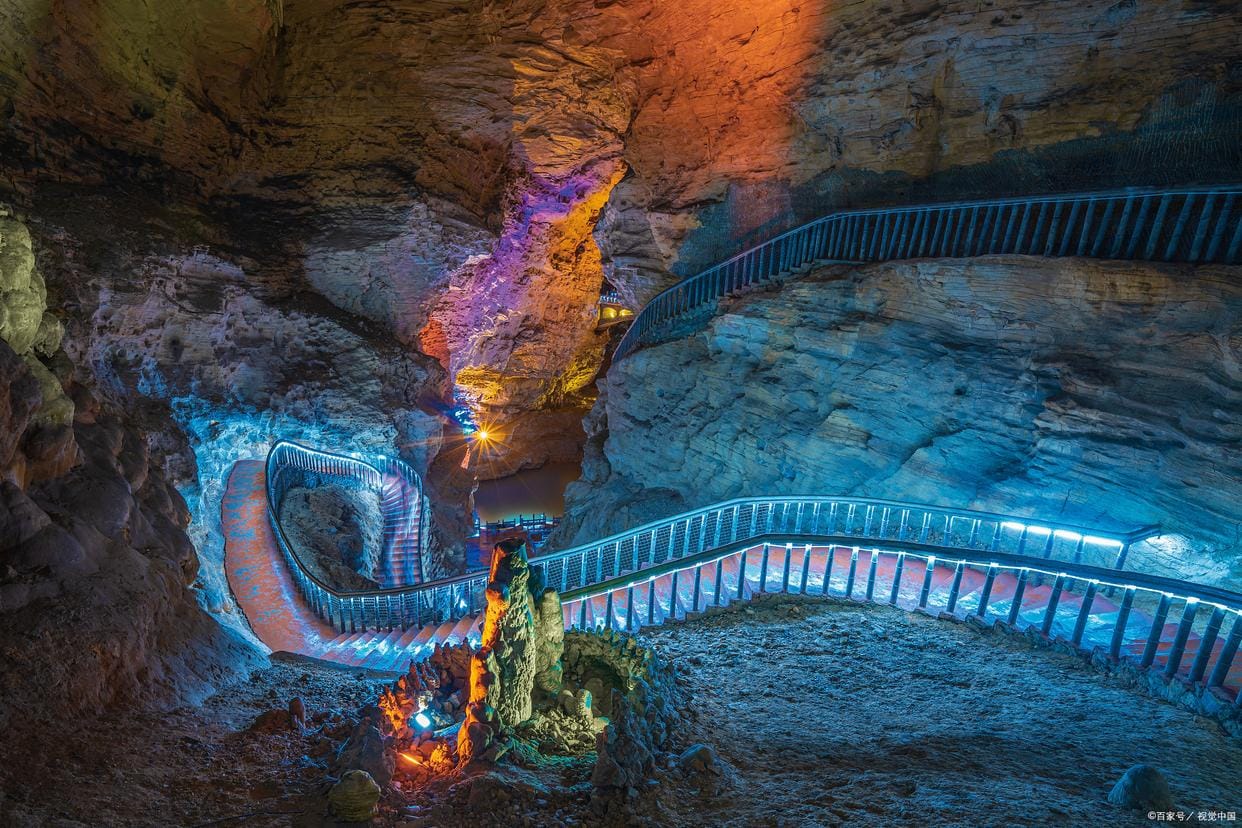
We have to be honest with our readers. Huanglong Cave is a workout.
There are approximately 1,000 steps throughout the tour. You will climb up to the fourth floor and then descend back to the exit. There are no elevators. There are no escalators.
Who should be careful?
- Travelers with knee issues: The descent can be harder than the ascent.
- Families with toddlers: You will end up carrying them. Strollers are impossible here.
- Elderly travelers: Take it slow. There are benches every few hundred meters.
However, the paths are well-maintained. The steps are made of non-slip stone. We recommend wearing hiking shoes or sturdy sneakers. Avoid “fashion” boots or flip-flops.
Managing Expectations: The Reality

We want to be very clear with you. Not every traveler falls in love with Huanglong Cave. At Travel China With Me, we believe in intellectual honesty. We are not here to sell you a ticket. We are here to help you decide if this is worth your limited time in Zhangjiajie.
In this section, we move away from the “highlights.” We will look at the criticisms, the comparisons, and the surrounding environment. This is the reality check every traveler needs.
The “Neon” Debate: Aesthetic vs. Naturalism
One of the most common complaints from Western travelers is the lighting. If you are used to the natural, dim lighting of Mammoth Cave in the USA or the caves of the UK, Huanglong Cave will be a shock.
Why the Lights are Colorful
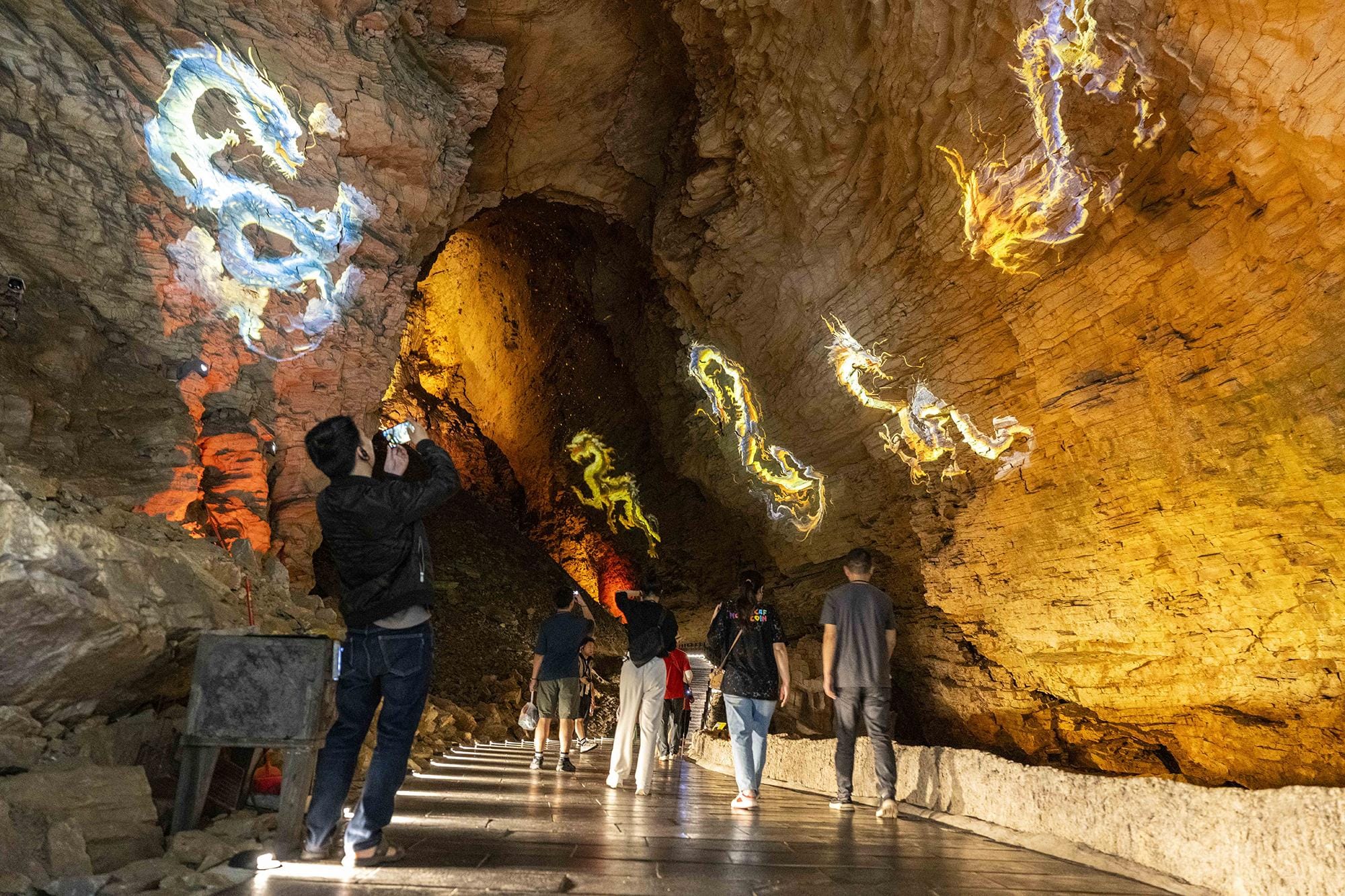
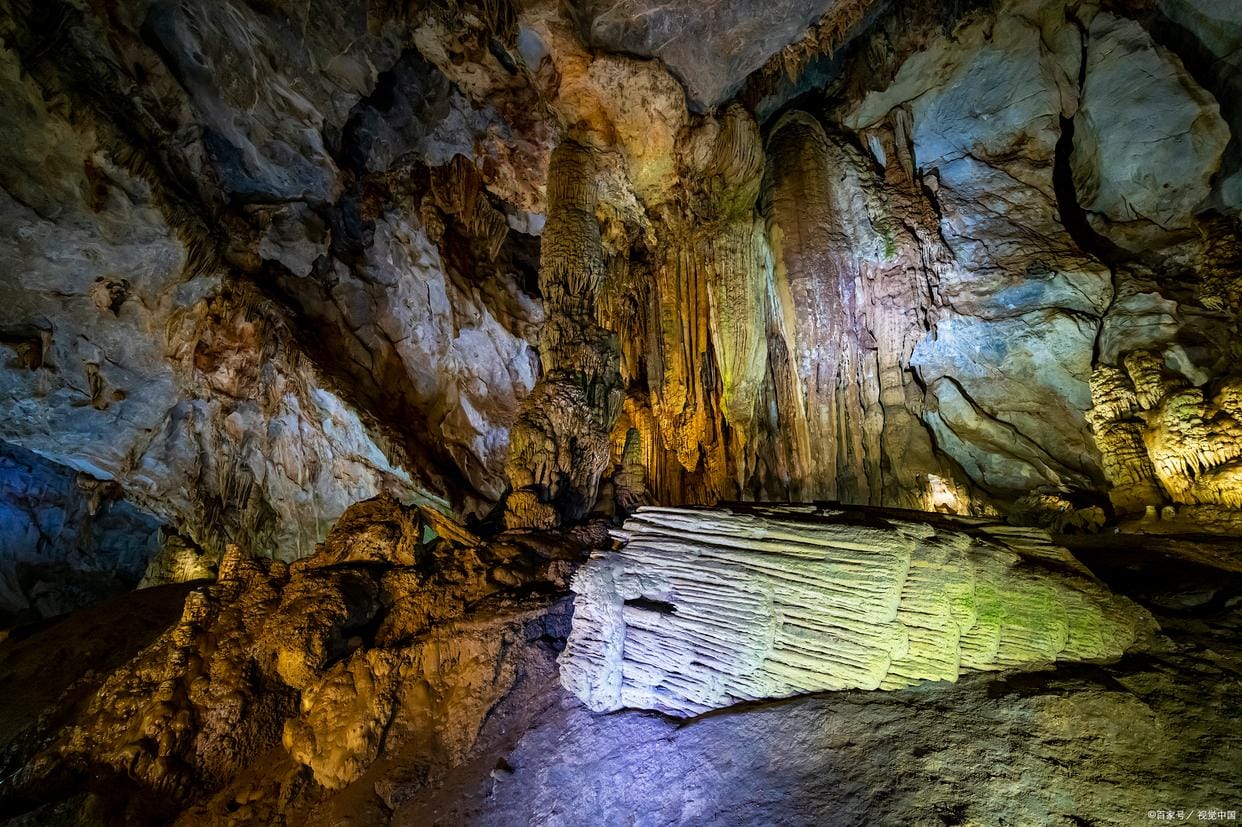
The management uses bright greens, blues, reds, and purples. From a Chinese aesthetic perspective, these colors help define the “spirit” of the rock. They make a stalagmite look like a pagoda or a dragon. It turns the cave into an underground theater.
The Critique
Many of our guests find the neon lights “tacky” or “artificial.” They feel it obscures the natural beauty of the limestone.
- Our Take: If you want a raw, rugged caving experience, you won’t find it here. This is a high-production tourist attraction. However, without these lights, you wouldn’t be able to see the ceiling of the Dragon Palace, which is 40 meters high. The light is a tool for scale, even if the colors are loud.
The Reality of Commercialization
Zhangjiajie is one of the most popular tourist destinations in the world. This brings certain “commercial” elements that can be frustrating.
The Guide Microphones
Inside the cave, almost every group has a guide with a headset and a loudspeaker. In the large halls, the sound echoes. It can get very noisy.
- Advice: If you want a quiet, spiritual experience, you must go early or late. Between 10:00 AM and 2:00 PM, the “noise pollution” is at its peak.
The Photo Stops
At several “prime” spots, like the Sea-Calming Needle, there are professional photography stations. They will offer to take your photo. They give you a tiny version for free. They try to sell you the large version for 20-30 RMB.
- Advice: You are under no obligation to buy. You can take your own photos right next to them. Just say “No, thank you” (Bu Yong Le) and move on.
Comparing the Giants: Is Huanglong the Best?
Huanglong vs. The World
To help you decide if Huanglong Cave earns a spot on your “Bucket List,” let’s look at how it stacks up against other famous caves globally.
Feature | Huanglong Cave (China) | Carlsbad Caverns (USA) | Postojna Cave (Slovenia) |
|---|---|---|---|
Unique Factor | Multi-story verticality | The “Big Room” scale | Underground Train |
Atmosphere | Mythological / Theatrical | Scientific / Natural | Historical / Grand |
Boat Access | Included (800m) | None | None |
Difficulty | High (1,000 steps) | Moderate (Elevators) | Easy (Electric Train) |
Total Time | 2.5 – 3 Hours | 2 Hours | 1.5 Hours |
The Verdict: Huanglong Cave is for the traveler who wants an active adventure. If you want to sit back and look, go to Postojna. If you want to sweat a little and feel the vertical scale of the earth, come to Huanglong.
Huanglong vs. China
China has many world-class caves. How does Huanglong rank objectively? Let’s look at the data.
Cave Name | Location | Primary “Vibe” | Verticality | Effort Level |
|---|---|---|---|---|
Huanglong Cave | Zhangjiajie | Grand, Layered, Theatrical | High (4 floors) | High (Many stairs) |
Reed Flute Cave | Guilin | “Art Gallery,” Small, Pretty | Low (1 floor) | Easy (Flat walk) |
Tenglong Cave | Enshi | Massive, Rugged, Raw | Medium | Medium (Electric carts) |
Zhijin Cave | Guizhou | “The Museum,” Vast, Scientific | High | High (Long walk) |
Our Objective Comparison:
- If you hate stairs, Reed Flute Cave is better.
- If you want pure, massive volume, Tenglong Cave is bigger.
- If you want the most diverse “experience” (boat, walk, palace, forest), Huanglong Cave wins.
The Perfect Day: A Curated 2026 “Water & Stone” Itinerary
Many travelers waste hours backtracking between Wulingyuan and Zhangjiajie City. To maximize your time and energy, we recommend the following “East-Side Combo.” This itinerary is designed for travelers who have already finished the high peaks (Yuanjiajie/Tianzi Mountain) and want a day that is physically easier but visually stunning.
Time | Activity | Insider Tip |
|---|---|---|
08:30 AM | Huanglong Cave Entry | Arrive as the gates open. You beat the 9:30 AM “Tour Bus Wave.” |
11:00 AM | The Maze (Mizhong) | Spend an extra 30 minutes here. It is the quietest time of day in the restricted area. |
12:00 PM | Lunch in Suoxiyu | Walk 10 minutes away from the cave exit to find local Tujia Sanxiaguo. |
02:00 PM | Baofeng Lake | A 15-minute taxi from the cave. The lake is most beautiful in the soft afternoon light. |
04:30 PM | Xibu Street Walk | Explore this “culture street” in Wulingyuan for souvenirs and snacks. |
07:30 PM | Smoky Rain Zhangjiajie | Watch the folk show located right next to the Huanglong Cave entrance plaza. |
Why this works:
Huanglong Cave and Baofeng Lake are both located in the Suoxiyu area. By combining them, you save roughly 2 hours of transit time compared to split-day visits. In 2026, the “Smoky Rain” (Yanyu Zhangjiajie) show has updated its stage technology, making it a perfect nightcap to your cave visit.
Seasonal Deep-Dive: When Nature and Numbers Align
We often get asked: “When is the best month to visit?” In Zhangjiajie, the answer depends on your tolerance for crowds versus your desire for perfect photos.
Spring (March – May): The Awakening
The underground rivers are at their highest volume due to spring rains. The Tianxian Waterfall inside the cave will be thunderous.
- Crowd Level: Moderate.
- Expert Advice: Bring a waterproof cover for your backpack. The “cave rain” (ceiling drips) is more frequent now.
Summer (June – August): The Great Escape
While the mountains outside are sweltering at 35°C+, the cave remains a steady 16°C.
- Crowd Level: Extreme (Summer school holidays).
- Expert Advice: If you visit in July or August, do not go between 10:00 AM and 2:00 PM. The humidity inside rises with the number of people, making it feel “stuffier” than usual.
Autumn (September – November): The Photographer’s Choice
The air outside is crisp, and the surrounding Suoxiyu valley turns gold and red.
- Crowd Level: Low to Moderate.
- Expert Advice: This is the best time for the Baofeng Lake combo. The reflections of the autumn leaves on the emerald water are world-class.
Winter (December – February): The Warm Sanctuary
While most travelers avoid Zhangjiajie in winter, we love it. The cave feels cozy.
- Crowd Level: Very Low.
- Expert Advice: You can often negotiate private boat rides because there are so few people. It is the only time you can hear the cave’s “natural silence.”
Safety & Accessibility: The “Stair Strategy”
We must emphasize the physical nature of Huanglong Cave. Unlike the Bailong Elevator on the mountains, there are no mechanical aids here.
For Seniors and Travelers with Knee Issues
- The Ascent: The climb from the boat dock to the Dragon Palace is the hardest part. Take it in 10-step increments. There are railings on both sides.
- The “Reverse” Option: If you realize the stairs are too much after the boat ride, talk to your guide immediately. It is sometimes possible (though not standard) to take the boat back to the entrance, but you will miss the Dragon Palace.
- Support: We recommend using a foldable walking stick. While the floor is paved, the moisture makes it slick.
For Families with Children
- Age Limit: We don’t recommend the cave for children under 4 unless you are prepared to carry them for 2 hours.
- The “Dragon” Hook: Use the folklore to keep kids engaged. Ask them to find the “Dragon’s scales” or the “King’s pets” in the rock formations. It turns a long walk into a scavenger hunt.
User Insights: What the Reviews Don’t Always Tell You
We have analyzed hundreds of reviews from TripAdvisor, CTrip, and Google. Here is the distilled truth from 2026 travelers:
- The “Stair” Surprise: Many people read “boat ride” and think it’s an easy day. They are shocked by the 900+ stairs. Traveler Tip: If you have a fitness tracker, you will likely hit your “floors climbed” goal for the week in three hours.
- The Boat Duration: The boat ride is only 8-10 minutes. Some travelers felt this was too short. However, the boat is meant to be a transition between the wet and dry levels, not the main event.
- The Exit Walk: The walk from the cave exit back to the main road is quite long (about 15 minutes). It takes you through a “shopping street.” Be prepared for people trying to sell you fruit, toys, and souvenirs.
Our Verdict: Should You Go?
To provide a truly helpful guide, we have created this simple decision matrix for you.
Go to Huanglong Cave if:
- You are visiting Zhangjiajie for more than two days.
- It is raining or extremely hot outside.
- You love geology and want to see the “All-around Champion” of karst.
- You have a moderate level of physical fitness.
Skip Huanglong Cave if:
- You only have one day in Zhangjiajie (Spend it on the mountains instead).
- You have severe knee pain or difficulty with stairs.
- You are a “naturalist” who hates neon lights and loud tour guides.
- You are already visiting another major cave in China (like Zhijin Cave).
Frequently Asked Questions (FAQ)

Is there a “best” guide to hire?
Most people use the site-provided guides. They are included in the ticket. However, they usually speak Chinese. If you want a deep-dive in English, you should hire a private guide from Wulingyuan.
Can I visit at night?
No. The cave closes by 5:30 PM. There are no night tours.
Is the water in the river safe to touch?
It is natural cave water. It is clean, but we don’t recommend drinking it. There are minerals and bacteria that your stomach might not be used to.
How do I photograph the Sea-Calming Needle?
The Needle is very tall. You need a wide-angle lens (16mm to 24mm). Most modern smartphones have a “0.5x” mode—use that. Stand as far back as the railing allows.
Beyond the Cave: Suoxiyu Town and Local Life

When you exit the cave, don’t just jump on a bus and leave. You are in Suoxiyu Town. This is a part of Wulingyuan that is slightly more “local” than the main tourist strip near the park entrance.
The Tujia Culinary Scene
The local Tujia people have a unique food culture. It is spicy, smoky, and sour.
- Smoked Pork (La Rou): You will see it hanging in the local markets. It is cured with wood smoke. It is salty and tough, but delicious when stir-fried with green peppers.
- Kudzu Root Powder (Ge Fen): This is a local specialty. It is a thick, translucent “pudding” made from the root of the Kudzu vine. It is very healthy and cooling after a hot walk.
- Sanxia Guo: This is the “soul” of Zhangjiajie food. It is a dry pot with three main ingredients (usually pork, tofu, and radish). It is cooked with plenty of chilies and Sichuan peppercorns.
Our Recommended Eateries
Avoid the restaurants directly facing the cave parking lot. Walk 10 minutes toward the town center. Look for places where locals are eating. If you see a table with a “Hot Pot” in the middle and people drinking local beer, that’s where you should go.
A Personal Note from the Travel China With Me Team
We have seen guests walk into Huanglong Cave skeptical of the “neon lights” and walk out completely transformed by the sheer scale of the Sea-Calming Divine Needle.
Zhangjiajie is a place that challenges your sense of reality. The mountains look like they are floating, and the caves look like they were carved by dragons. Whether you are a geology buff or just someone looking for a cool escape from the Hunan heat, Huanglong Cave offers a perspective you simply cannot get from a mountain peak.
Our goal with this guide was to give you the “unfiltered” truth. Yes, there are stairs. Yes, it can be crowded. But when you are gliding silently down the Xiangshui River with 140 meters of solid mountain above your head, those inconveniences disappear. You are, quite literally, in another world.
We hope this guide makes your 2026 journey to Zhangjiajie smoother, deeper, and more memorable. The Yellow Dragon is waiting for you.