
Unilateral 30-Day Visa-Free Policy in China: Everything You Need to Know
Latest Notice
The 30-day visa-free policy runs until December 31, 2026 for 48 countries (Russia: December 31, 2027; Brunei: no end date). China has not yet announced whether it will continue in 2027. It has renewed the policy every year so far, usually in November. If your trip falls in 2027, check again before booking flights.
LEARN ALSO: 240-Hour Visa-Free Transit Policy in China: Everything You Need to Know

In 2026, China has truly transformed from a “visa-challenge” destination into one of the most accessible countries for global travelers. At Travel China With Me, we have monitored these shifts daily. The most significant change is the 30-day visa-free policy, which has grown from 6 countries in December 2023 to 50 today.
This guide moves beyond the basic news snippets. We provide the specific, verified 2026 data and the “on-the-ground” expertise you need to clear immigration without a hitch.
Table of Contents
What is the Unilateral 30-Day Visa-Free Policy in China?
China’s unilateral 30-day visa-free policy lets ordinary passport holders from 50 countries enter mainland China without a visa for up to 30 days per visit. It covers tourism, business, visiting family or friends, exchanges and transit, and unlike the 240-hour transit policy, it needs no onward ticket to a third country and no designated entry port.
The policy runs until December 31, 2026 for 48 countries, December 31, 2027 for Russia, and has no end date for Brunei.
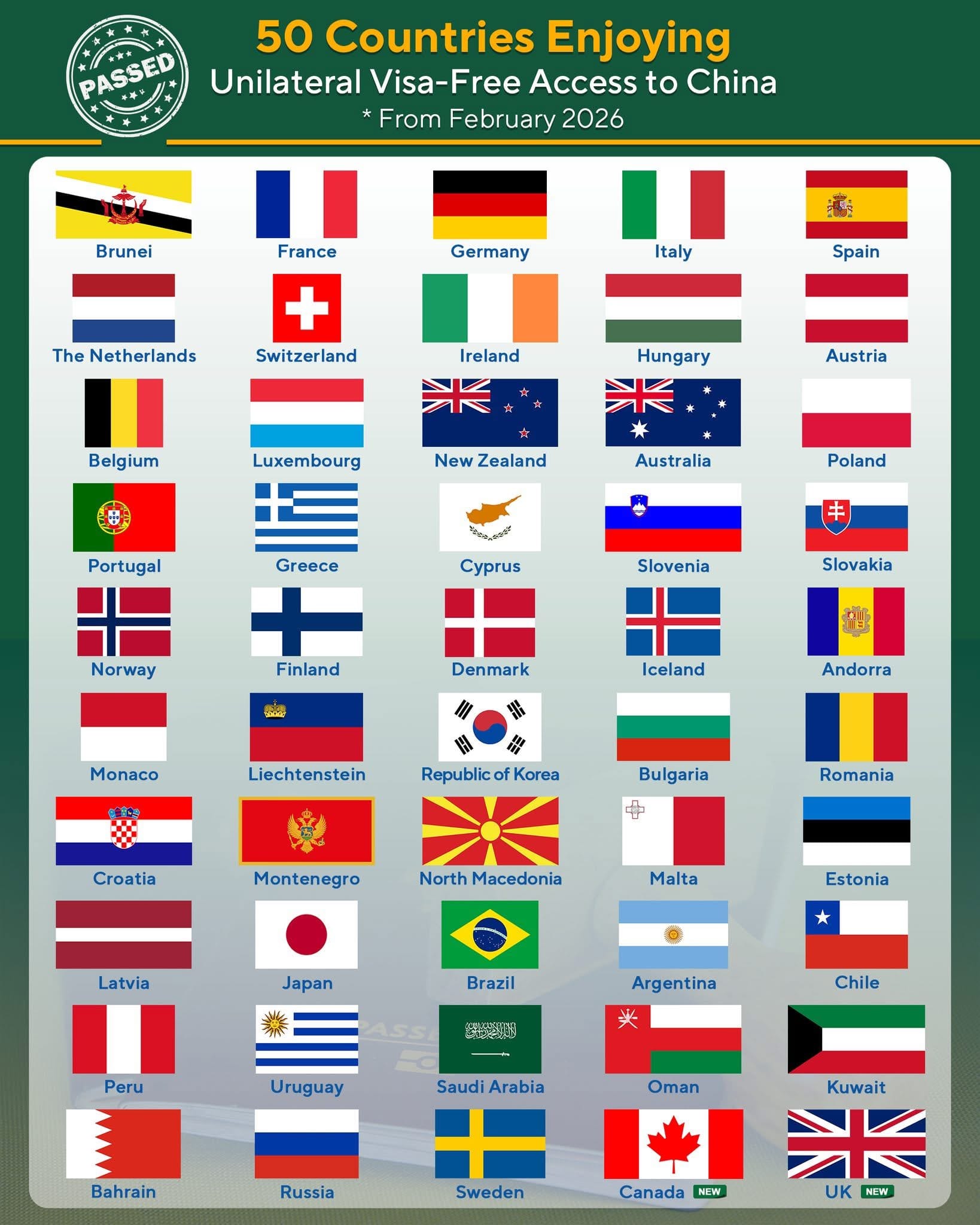
Latest Unilateral 30-Day Visa-Free Country List (2026 Verified)
According to China’s Ministry of Foreign Affairs, citizens of the following countries holding ordinary passports can enter China for up to 30 days for tourism, business, or visiting family.
Region | Eligible Countries |
|---|---|
Europe | UK, France, Germany, Italy, Spain, Netherlands, Switzerland, Ireland, Hungary, Austria, Belgium, Luxembourg, Poland, Portugal, Greece, Cyprus, Slovenia, Slovakia, Norway, Finland, Denmark, Iceland, Andorra, Monaco, Liechtenstein, Bulgaria, Romania, Croatia, Montenegro, North Macedonia, Malta, Estonia, Latvia, Russia, Sweden |
Americas | Canada, Brazil, Argentina, Chile, Peru, Uruguay. |
Asia & Oceania | Japan, South Korea, Brunei, Australia, New Zealand. |
Middle East | Saudi Arabia, Oman, Kuwait, Bahrain. |
Not on the list? Your passport may still qualify for 240-hour transit, Hainan visa-free entry or a mutual exemption agreement. Check your passport in seconds with our free visa checker.
Expert “On-the-Ground” Entry Requirements
Don’t let the word “visa-free” make you complacent. To ensure a 5-minute processing time at the border, have these four items ready:
- Passport Validity: China only requires your passport to be valid for your whole stay, but some airlines refuse boarding with less than 6 months left. Six months is the safe margin.
- The Paper Trail: Carry a printed copy of your return flight and your first hotel booking. Border officers frequently ask to see these.
- The 24-Hour Registration: If you stay in a hotel, they register you automatically. If you stay with friends or in a local rental, you must register at the local police station within 24 hours.
- The 30-Day Calculation: The clock starts at 00:00 the day after you arrive. If you enter on June 1st, your 30 days start on June 2nd.
Pro-Tip from the Field
Since November 20, 2025, every arrival in mainland China, visa-free or not, must complete a China Arrival Card. Fill it in before you fly through the NIA 12367 app or the WeChat or Alipay mini-program. It saves a queue at the desk, and our guests who skip it are almost always the last through immigration.
FAQs
Q: How long will the visa waiver be effective?
A: At present, China’s visa-free policy for holders of ordinary passports from Brunei has no specified expiration date. The visa-free policy for holders of ordinary passports from Russia is valid until December 31, 2027, while the visa-free policy for holders of ordinary passports from the other 48 countries remains in effect until December 31, 2026.
Q: Do foreigners need to pre-register with Chinese embassies or consulates for this visa-free entry?
A: Eligible foreigners do not need to pre-register with Chinese embassies or consulates to use the visa-free policy.
Q: How do Chinese border authorities verify the purpose of visit? Are additional documents required beyond a passport?
A: Foreigners entering for business, tourism, family visits, exchanges, or transit, as allowed by the visa-free policy, are permitted entry after lawful inspection by Chinese border authorities. Those with purposes inconsistent with the policy or other legal entry prohibitions will be denied entry. It’s recommended to carry supporting documents like invitation letters, flight/hotel bookings, or similar proof matching your stated purpose. Work, study, or journalism purposes are not covered under this policy.
Q: Are there special requirements for minors using the visa-free policy?
A: Minors face the same conditions as adults for visa-free entry to China.
Q: Are there requirements for the type and validity of entry documents?
A: Foreigners must hold a valid ordinary passport with sufficient validity for their travel in China. Travel documents, temporary, or emergency certificates do not qualify for visa-free entry.
Q: How is the 30-day stay period calculated?
A: The 30 days are counted from the day after you arrive. If you enter on June 1, day one is June 2, and you must leave by 24:00 on July 1.
Q: Can travelers depart from a country other than their own?
A: Yes, eligible foreigners can depart from any country or region outside China.
Q: Does the policy apply to entry methods beyond air travel?
A: The visa-free policy applies to all open sea, land, and air ports for foreigners, unless otherwise specified by laws, regulations, or bilateral agreements. If arriving by private transport, additional entry/exit procedures must comply with Chinese laws.
Q: Can tour groups use the visa-free entry policy?
A: Eligible foreigners, whether in tour groups or traveling solo, can use the visa-free policy to enter China.
Q: Can the 30-day stay be extended if needed?
A: If planning to stay beyond 30 days, foreigners should obtain a visa matching their purpose from a Chinese embassy or consulate beforehand. For valid reasons requiring an extended stay after visa-free entry, apply for a stay permit at a local public security immigration office.
Q: Can foreigners enter multiple times? Are there limits on frequency, intervals, or total stay days?
A: Eligible foreigners can use the visa-free policy for multiple entries with no current limits on frequency or total stay days. However, activities inconsistent with the stated entry purpose are prohibited.
Q: If a visa-free traveler loses the passport used to enter China, and the passport has been verified and stamped by Chinese border authorities, can they leave China with an emergency travel document issued by their embassy or consulate in China?
A: Yes. Border officers will check your identity, your entry record or police loss report, and a letter from your embassy. If everything matches and you haven’t overstayed, you can leave on the new or emergency document. If you have overstayed, you’ll need to clear that with the local Exit-Entry Administration first.
Why 30 Days Changes Everything
From our perspective at Travel China With Me, 30 days is the “Sweet Spot.” It allows you to move past the tourist traps and experience the “Slow China.” You can spend a week hiking the Tiger Leaping Gorge and still have 20 days left for the Silk Road or the futuristic skyline of Shenzhen.
We’ve helped thousands of travelers navigate these changing borders. The 2026 policy is the most traveler-friendly we have seen in decades.
Planning to use all 30 days? Tell us what you want to see, and we’ll design a private itinerary that fits the time you have, from the Great Wall to the villages of Guizhou.