Tianmen Mountain: Line A, B or C? The Ultimate Route Comparison Guide
CRITICAL UPDATE: The main cableway's upper section closed for renovations on November 6, 2025, and construction is expected to last for years. From November 2025, the adult ticket price has increased by 10 yuan to 288 CNY. All routes now include bus segments through the 99 Bends Road—dramatically changing the experience from what you'll read in older guides.
We still remember the panic in that tourist’s eyes as she realized her mistake. Standing at Tianmen Cave after climbing all 999 steps upward, legs trembling, she couldn’t continue to the summit. Her tour group moved on without her. She’d chosen Line B without understanding what it really meant.
After guiding over 8,000+ international visitors through Tianmen Mountain since 2006, we’ve learned this: the line you choose determines whether you’ll remember Tianmen Mountain as magical or miserable. The difference isn’t subtle.
Table of Contents
Understanding the Three Lines: What Actually Differs
Every Tianmen Mountain ticket costs exactly 288 CNY. Same price, same attractions, same mountain. What changes is the sequence you experience them and whether you’re climbing stairs up or walking down.
This isn’t about magical shortcuts or secret viewpoints. It’s about physical logistics that determine whether you conserve energy for the summit or exhaust yourself before reaching it.
Line A vs B vs C: Quick Comparison Table
Feature | Line A (Modified 2025) | Line B (Modified 2025) | Line C |
|---|---|---|---|
Physical Difficulty | ⭐⭐ Easy-Moderate | ⭐⭐⭐⭐ Hard | ⭐ Easy |
999 Steps Direction | ⬇️ DOWN (20-30 min) | ⬆️ UP (30-45 min) | Optional/Skip |
Main Cable Car | ✅ Yes (reduced 10 min) | ✅ Yes (return segment) | ❌ NO – Major loss |
99 Bends Bus | Early in visit (fresh) | Late in visit (tired) | None |
Peak Crowd Level | 🟡 Moderate | 🔴 Very Heavy | 🟢 Light |
Best For | 85% of visitors | Fit adventurers | Acrophobia only |
Total Time | 5-6 hours | 5.5-6.5 hours | 4.5-5.5 hours |
Energy Strategy | ✅ Optimal | ❌ Poor | Good but boring |
Experience Value | 90% complete | 90% complete | 60% complete |
Our Rating | ⭐⭐⭐⭐⭐ | ⭐⭐⭐ | ⭐⭐ |
The Four Transportation Systems Explained
Understanding these transport options clarifies everything about route selection.
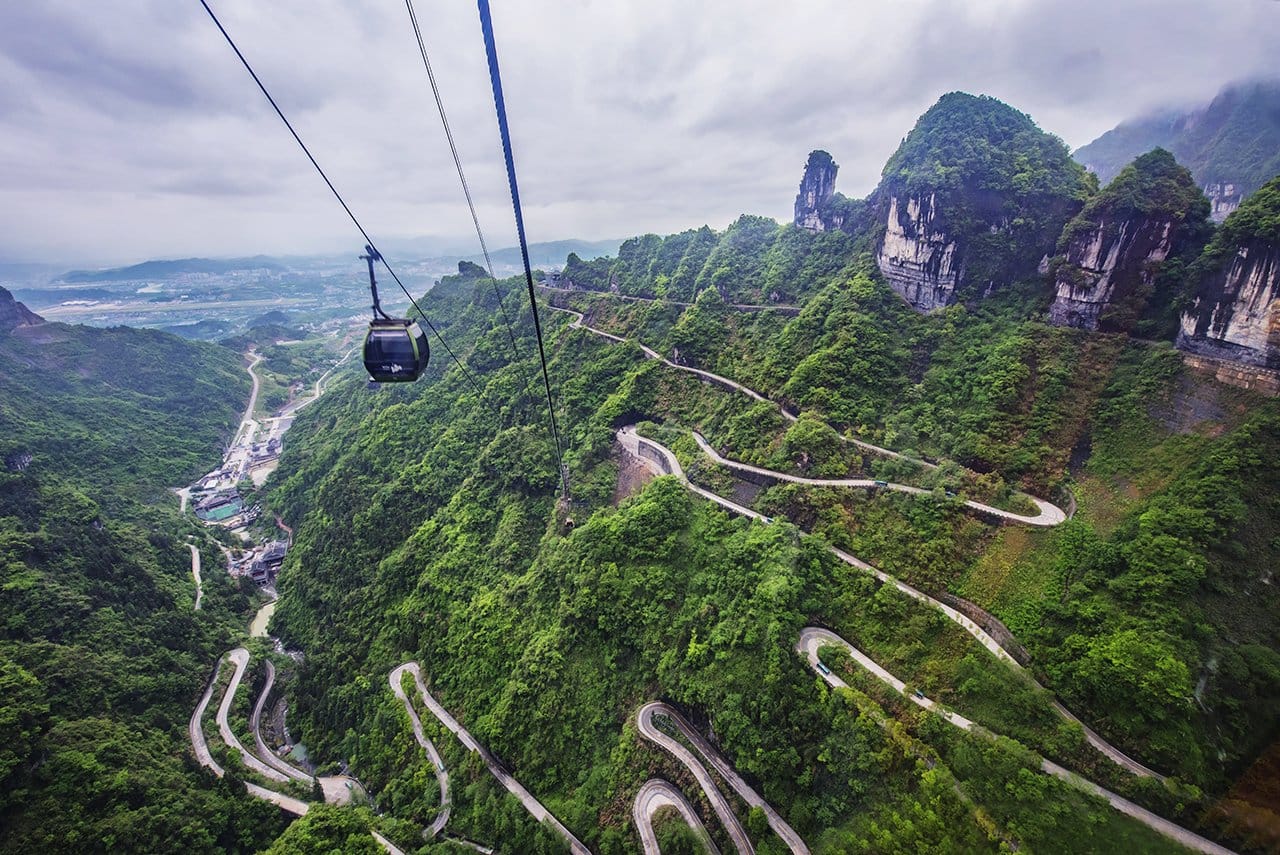
The Main Tianmen Mountain Cableway spans 7,455 meters with a vertical rise of 1,279 meters, making it the longest alpine cableway in the world. The journey normally takes about 28 minutes from downtown Zhangjiajie directly to the summit at 1,200 meters elevation. Currently, only the lower section operates (downtown to middle station), taking approximately 10 minutes.
The Express Cableway runs 1,200 meters from the mountain gate to Tianmen Cave plaza. Each cabin carries 26 people and completes the steep ascent in roughly 7 minutes. This cableway handles crowds more efficiently than the main line.

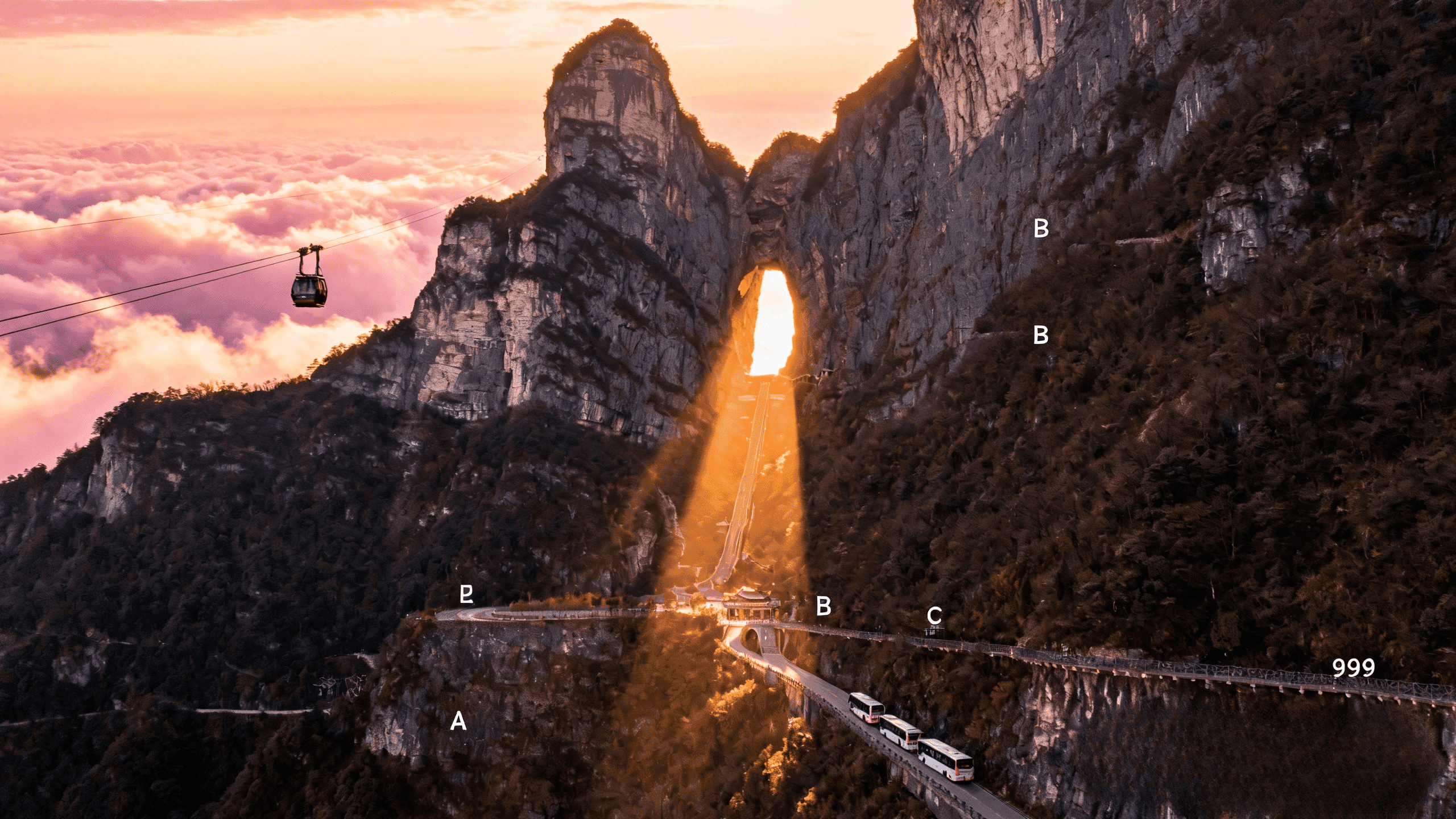
The 999 Steps to Heaven span 218 vertical meters between the cave plaza (1,050m) and Tianmen Cave itself (1,170m). Walking down requires 20-30 minutes. Climbing up demands 30-45 minutes from reasonably fit visitors—longer at altitude when you’re already tired.

The Transmountain Escalator System contains 12 segments total. Seven segments connect the summit to Tianmen Cave (included in your ticket). Five lower segments parallel the 999 Steps, costing an extra 32 RMB if you want to skip the stairs entirely.
How the November 2025 Renovation Changed Everything
The upper cableway section closure forces all routes to incorporate bus travel through the famous 99 Bends Road. Here’s what each line actually looks like now:
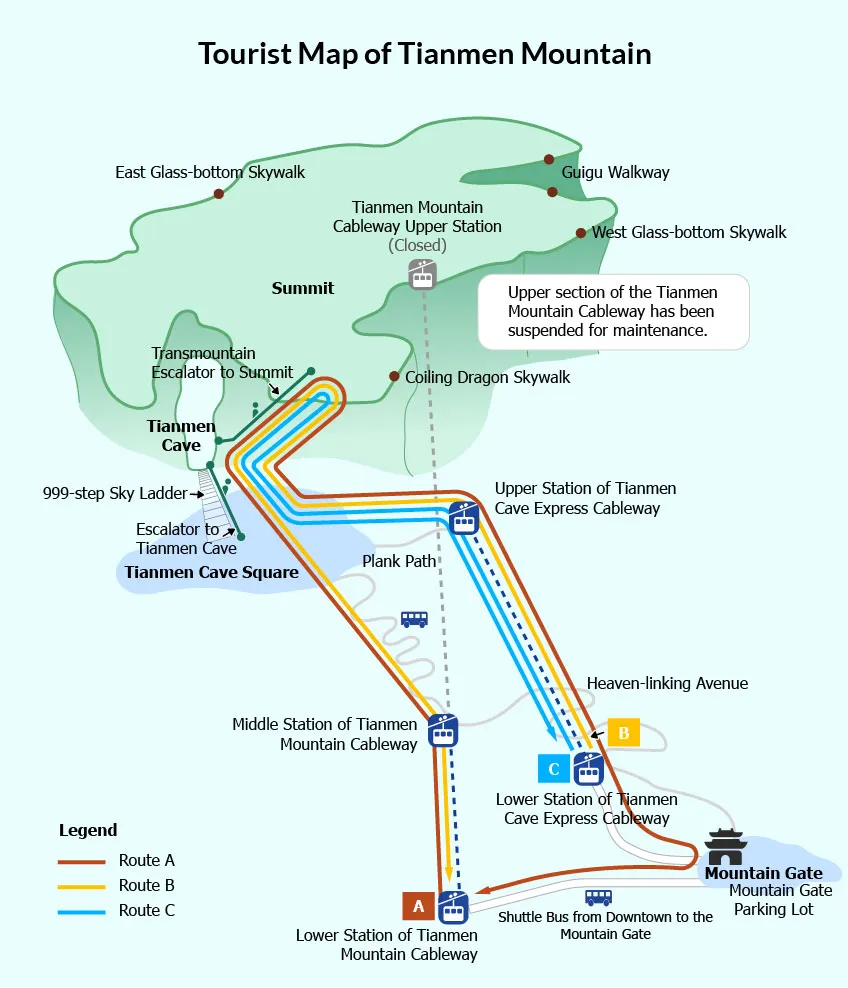
Modified Line A: Cable car to middle station → eco-bus up 99 Bends → escalator to summit → explore → escalator down → 999 Steps down (or pay 32 RMB for lower escalator) → Express Cableway down → shuttle back to city.
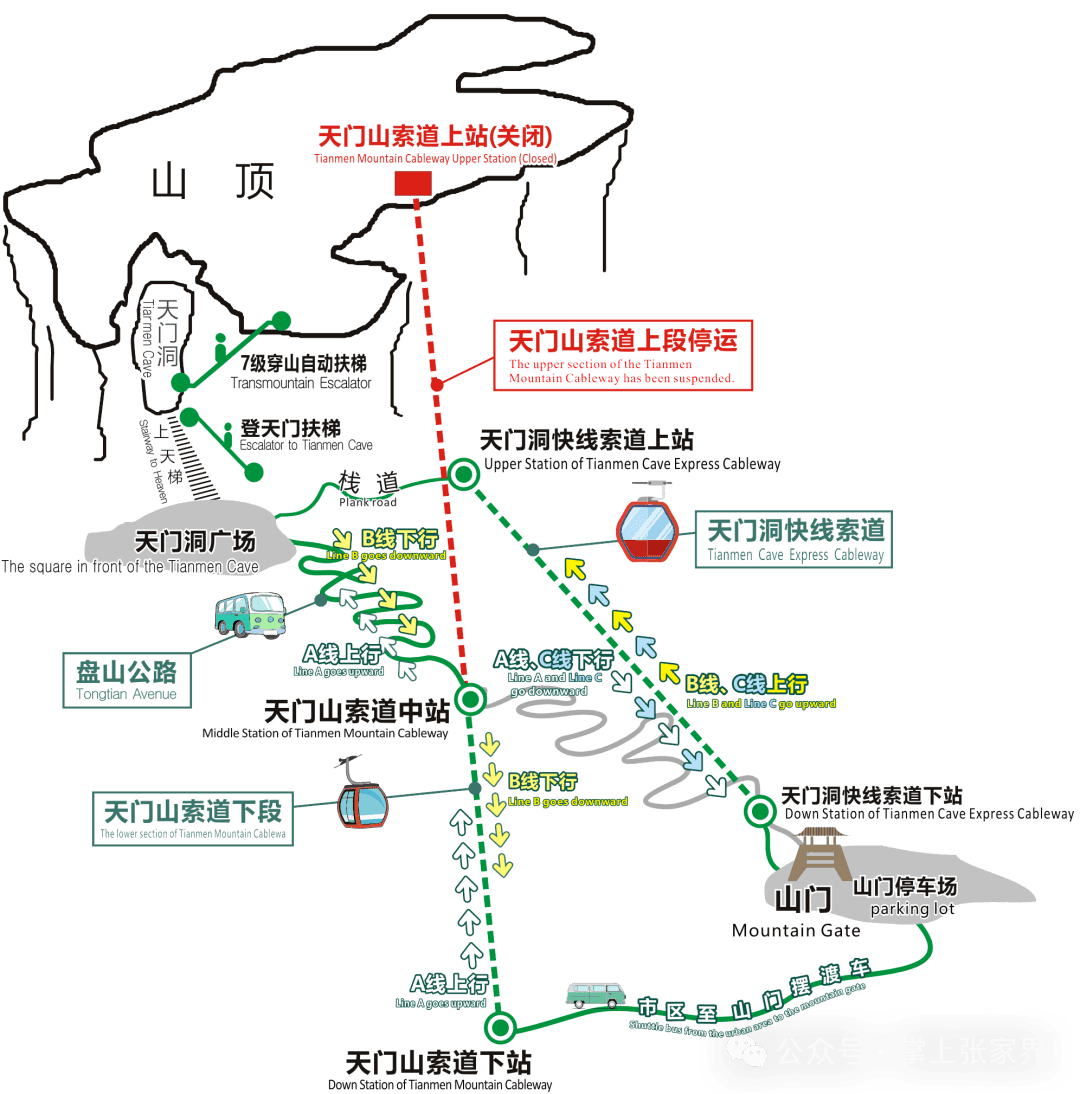
Modified Line B: Shuttle to mountain gate → Express Cableway to Tianmen Cave area → 999 Steps UP → escalator to summit → explore → escalator down to cave area → cable car from middle station down → eco-bus segment → cable car completion to downtown.
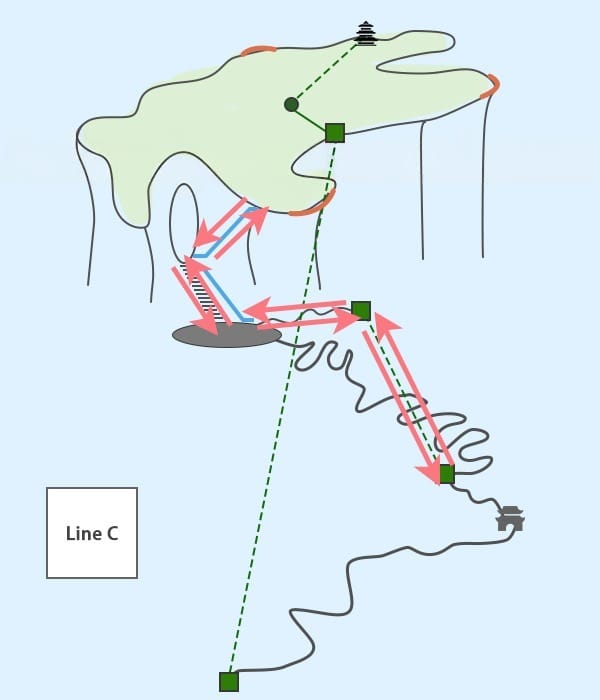
Line C (Unchanged): Shuttle to mountain gate → Express Cableway to Tianmen Cave → escalator to summit → explore → escalator down to cave → Express Cableway back down → shuttle to city.

Line A: Why We Recommend This Route for 85% of Visitors
The Modified Line A Experience
Your journey begins at the downtown cable car station near Zhangjiajie Railway Station. The ticket has nine time slots daily from 07:00 to 16:00, and tickets for certain slots sell out quickly. Arrive at opening time whenever possible.
Board the main cableway for a reduced 10-minute ride to the middle station. Transfer to an eco-bus that navigates the 99 Bends Road up to Tianmen Cave area. This segment takes approximately 25-30 minutes.
Take the escalator system to the summit (included in ticket). Spend 2-3 hours exploring the mountaintop circuit, glass skywalks, and cliff paths. Return via escalator to Tianmen Cave.
Here’s where Line A’s advantage becomes obvious: you walk DOWN the 999 Steps. Gravity works with you, not against you. Visit Tianmen Cave itself, then take the Express Cableway down to the mountain gate for your shuttle return to downtown.
Why Line A Works: The Physics and Psychology
Downward stairs preserve your summit energy. After three hours exploring cliff paths at 1,400+ meters elevation, you’re already tired. Line A lets you DESCEND on tired legs while Line B forces you to CLIMB on fresh legs only to arrive exhausted for the main attractions.
One visitor from Germany told us: “I chose Line B because I wanted the challenge. By the time I reached the summit after those stairs, I was too exhausted to enjoy the glass skywalks. I just wanted to sit down. My wife chose Line A, and she had energy to explore everything properly. I regretted it.“
Crowd patterns favor Line A. Chinese tour groups overwhelmingly select Line B because it fits their structured schedules. We’ve consistently observed 60-70% fewer people starting on Line A versus Line B during peak times.
A TripAdvisor reviewer noted: “My suggestion is to go for the more popular Line A, as you will walk down 999 steps instead of walking up at Heaven’s Gate Cave“. Despite calling it “more popular,” this review actually means more advisable—the actual usage data shows Line B draws larger crowds.
The cable car ascending perspective matters psychologically. Even the reduced segment from downtown to middle station provides that signature “earth to heaven” feeling. You witness the landscape transformation from urban to wilderness. Taking the Express Cableway UP (Line B) lacks this graduated ascent because it’s so short and steep.
Motion sickness timing works in your favor. The eco-bus through 99 bends affects some visitors. For those who have motion sickness, advisories recommend taking medicine beforehand. Line A places this bus segment early in your visit when you’re fresh and alert, not after hours of exhausting summit exploration.
One Canadian visitor shared with us: “I’m prone to car sickness, but the morning bus ride up was fine because I sat near the front and felt energized. If I’d taken that same bus after hiking for three hours, I definitely would have gotten sick.”
Line A Disadvantages: The Honest Assessment
The 99 bends bus segment deserves serious consideration if you experience motion sickness. The road has 99 bends with numerous tight turns, and travelers prone to motion sickness should exercise caution. Sit near the front, take medication beforehand, and avoid eating heavy breakfasts.
One motion-sickness-prone traveler reported on TripAdvisor: “I was terrified of the bus ride as I am very prone to motion sickness but it wasn’t a problem for me at all. I just made sure I was at the front of the bus“.
During high seasons, tourists normally have to wait 1 to 2 hours to use the cable car service because boarding areas stay busy and crowded. Line A’s cable car queues can reach these lengths during Chinese holidays. Arriving at opening time (7:00 AM high season, 7:30 AM low season) dramatically reduces this wait.
You miss experiencing the complete 7.5-kilometer cable car journey that normally defines Tianmen Mountain. The reduced segment still offers views, but you lose that full “ascending to heaven” narrative until renovations complete.
The 99 Bends Experience: What Nobody Tells You

The road spans 10.77 kilometers with an elevation difference of nearly 1,100 meters, featuring 99 hairpin turns. The section near Tianmen Cave features consecutive 180-degree sharp turns that resemble layers of a cake.
The experience polarizes visitors. Some find it thrilling—a rollercoaster with views. Others find it nauseating. Here’s what determines the difference:
Sit on the right side of the bus going up (left side coming down) for the best views of the valley and numbered turns. All the corners are numbered so you know how you are progressing. This psychological element helps.
One reviewer described it accurately: “The bus ride down through the 99 bends is like a roller coaster. The bus drivers are incredibly skilled and well trained specifically for this course”. These aren’t regular bus drivers—they train extensively for this specific road.
Visitors are advised not to eat food while on the moving bus as doing so may cause other travelers who suffer from car sickness to vomit. This warning appears frequently because it’s a real issue during peak times.
Line B: The Challenge Seeker’s Choice (With Serious Caveats)
The Modified Line B Reality
Take the shuttle from downtown to the mountain gate. Board the Express Cableway for a steep 7-minute ascent to Tianmen Cave plaza.
Now comes Line B’s defining moment: you must climb the 999 Steps UPWARD. No alternatives unless you pay 32 RMB for the lower escalator (which defeats the purpose if you chose Line B for the physical challenge).
After climbing and visiting Tianmen Cave, take the escalator system to the summit. Explore for 2-3 hours. Descend via escalator back to the cave area, then take the modified cable car system down (which now includes a bus segment due to renovations).
Line B Advantages: When This Route Makes Sense
Morning crowd avoidance at the start. The downtown cable car station sees heavier crowds in the morning because Line A visitors concentrate there. Line B experiences relatively looser crowds in the morning as Line A tourists concentrate at the downtown station.
This advantage disappears by mid-morning and actually reverses by afternoon when tour groups flood Line B.
Psychological conquest appeal. First climbing the ladder then reaching the top creates a stronger sense of conquest. Some visitors specifically want to “earn” their summit experience through physical challenge.
One fit Australian hiker told us: “I’m glad I climbed up. It felt more meaningful arriving at the summit after conquering those stairs. But I was also genuinely exhausted and needed 20 minutes rest before I could enjoy the glass skywalks.“
Descending cable car photography angles. The cable car descent provides different perspectives compared to ascending. Some photographers prefer these reversed angles for unique shots.
Line B Disadvantages: The Physical Reality Nobody Sugar-Coats
The 999 Steps present a moderate challenge, with most reasonably fit visitors completing the CLIMB in 30-45 minutes. “Moderate challenge” means different things at sea level versus 1,000+ meters altitude.
The steps are steep, narrow, and crowded. During peak times, ascending and descending crowds create bottlenecks where you’re forced to wait, extending the 30-minute climb to 45+ minutes.
One honest reviewer admitted: “Unfortunately, weather was foggy. Only positive was I could enjoy the cool, fresh air along the cliff side walk”—noting how exhaustion from the initial climb diminished summit enjoyment.
The timing works against you. You face the hardest physical challenge at the visit’s beginning when you should be conserving energy for 2-3 hours of summit exploration. This isn’t theoretical—we’ve guided families who split up because some members couldn’t complete the climb.
A TripAdvisor user questioned: “Hi, I would like to avoid the bus down the 99 bends”, demonstrating how the bus segment concerns many visitors. With the renovation, Line B now includes this bus ride anyway, so if avoiding it was your reason for choosing Line B, that advantage disappeared.
High physical strength requirements make this route genuinely difficult for middle-aged, elderly, or physically weaker visitors. We don’t mean “slightly harder”—we mean potentially impossible without the paid escalator.
Line C: The Incomplete Experience
How Line C Operates
Line C uses the Express Cableway and tunnel escalator for both ascent and descent, going up and down the mountain the same way. You never touch the main cableway system.
Shuttle bus from downtown to mountain gate. Express Cableway to Tianmen Cave area. Visit the cave via stairs or escalator. Escalator to summit. Explore. Reverse the exact route back down.
Why We Don’t Recommend Line C (Unless You Have Severe Acrophobia)
Line C has the least number of people choosing it because this line goes up and down the mountain the same way, and there is no Tianmen Mountain ropeway to ride.
The Tianmen Mountain cableway represents one of Asia’s engineering marvels and the mountain’s signature attraction. The ropeway spans 7 kilometers total, and the peaks along this section are dangerous and spectacular—genuinely worth experiencing.
Line C cannot experience the grand cableway, missing the 7.5-kilometer aerial walk experience—the biggest regret. We’ve consoled visitors who chose Line C then discovered what they missed when talking to other tourists.
The route becomes repetitive and monotonous. You pass through Tianmen Cave twice, use the same escalators twice, and see the same Express Cableway views twice. The tour rhythm becomes monotonous with upper and lower mountains passing through Tianmen Cave repeatedly.
Cost-performance ratio fails basic logic. Same 288 RMB ticket price as Lines A and B, but you miss the world’s longest cable car system that defines Tianmen Mountain’s international reputation.
Line C’s Only Valid Use Case
Choose Line C exclusively if severe acrophobia makes the long cable car impossible. But even then, consider whether visiting Tianmen Mountain makes sense given that glass skywalks and cliff paths dominate the summit experience.
If you’re fearful enough to avoid the cable car, you’ll likely avoid the glass skywalks too, eliminating most of what makes the mountain special.
The 999 Steps: Physical Reality Beyond Tourist Marketing

What the Numbers Actually Mean
The Stairway to Heaven has 999 steps total, starting from 1,050 meters altitude at the cave plaza and ending at 1,170 meters at Tianmen Cave, covering 218 vertical meters. The steps include five relatively flat sections and four steep sections.
The steepest sections genuinely challenge average fitness levels. The steps are narrow enough that passing requires careful maneuvering. During peak times, bottlenecks form where ascending and descending crowds meet.
One reviewer described descending after his summit exploration: “After finishing all the tracking we came down by tunnel elevator and then used the 999 steps. Took the bus and traveled through 99 bend road to the bottom. Nice place to visit again.”
The 32 RMB Escalator Decision: Worth It or Waste?
The lower part of the tunnel escalator with 5 segments parallels the 999 Steps, costing 32 yuan for service. This isn’t included in your ticket and must be purchased on-site.
Our honest assessment after guiding thousands of visitors:
Save the 32 RMB if taking Line A (descending). Most reasonably fit people handle the downward walk fine. You’ll experience the famous “Stairway to Heaven” that appears in all the photos. The descent provides authentic cultural immersion that the escalator misses.
Consider paying if taking Line B (ascending), have knee problems, travel with elderly family members, or feel unwell that day. The 32 RMB becomes insignificant compared to potential injury, family separation, or summit exhaustion.
One visitor noted the irony: “I chose to ride the escalators up because my legs were ruined by 3 days of hiking in ZJJ Wulingyuan; it was funny going up, up, up escalator after escalator almost all alone while people are streaming down the other side.”
Cultural Symbolism: The Spiritual Dimension
In Chinese culture, the number nine symbolizes infinity and eternity because its pronunciation matches another character meaning “long-lasting.” The 999-level ladder includes nine sections representing life’s ups and downs, serving as both physical passage and spiritual metaphor.
The five rest platforms represent five traditional blessings: wealth, happiness, longevity, power, and luck. Whether you find this meaningful or kitsch determines whether the stairs feel like cultural immersion or just stairs.
Local people consider the 999 Steps a spiritual place for wishing and blessing. During important holidays, you’ll see Chinese families making offerings at different platforms—a dimension most international visitors miss entirely.
Comparative Analysis: Making Your Decision
Visitor Profile Decision Matrix
Visitor Profile | Best Choice | Reasoning |
|---|---|---|
First-time visitors | Line A | Maximizes signature experiences with manageable effort |
Physically fit adventure seekers | Line B | Provides challenge and sense of accomplishment |
Families with elderly/children | Line A | Downward stairs, better crowd management |
Visitors with knee problems | Line A + escalator | Minimize strain, pay for lower escalator |
Photography enthusiasts | Line A | Ascending cable views, fewer crowds for shots |
Severe height phobia | Line C | Avoids long cable car, though mountain may not suit you |
Budget-conscious travelers | All same price | Cost doesn’t differentiate routes |
Tour group travelers | Line B | Groups typically choose this, expect crowds |
Time Investment and Cost Breakdown
Line A typically requires 5-6 hours total: cable car to middle station (10 min + 30-120 min wait during peak), eco-bus up 99 Bends (25-30 min), escalator to summit, exploration (2-3 hours), escalator down, 999 Steps descent (20-30 min), Express Cableway down (7 min), shuttle return (20 min).
Line B typically requires 5.5-6.5 hours: shuttle to gate (20 min), Express Cableway up (7 min + 30-45 min wait), 999 Steps climb UP (30-45 min), summit exploration (2-3 hours), escalator down, modified cable car descent with bus segment (40 min total).
Line C typically requires 4.5-5.5 hours: shuttle to gate, Express Cableway to cave, escalator to summit, exploration (2-3 hours), reverse the same route back. Fastest but most repetitive.
Note: Peak season wait times can add 1-2 hours to any route. Arriving at 7:00 AM opening reduces total time by 1-2 hours compared to 10:00 AM arrival.
Complete Cost Breakdown
Item | Price (CNY) | When Required | Our Recommendation |
|---|---|---|---|
Main Ticket | 288 | Everyone | Book 15 days in advance |
Lower Escalator | 32 | Optional (999 Steps alternative) | Yes if Line B; No if Line A |
Glass Skywalk Shoe Covers | 5 | Everyone walking skywalks | Included experience |
VIP Express Pass | 100-150 | Optional (skip queues) | Yes during holidays; No off-peak |
Forest Cable Car | 25 | Optional (Yunmeng Peak-Temple) | Skip it – walking is better |
Food/Water (Summit) | 15-20 per item | As needed | Buy in city beforehand |
Motion Sickness Medicine | 10-15 | If prone to car sickness | Essential for 99 Bends |
BUDGET ESTIMATE | 288-450 | Depends on choices | 320 typical for most visitors |
Weather and Seasonal Strategy: When to Visit
Complete Seasonal Comparison
Season | Months | Temperature | Crowd Level | Visibility | Our Rating |
|---|---|---|---|---|---|
Spring | Mar-May | 15-25°C (59-77°F) | Moderate-High | Good | ⭐⭐⭐⭐⭐ Best |
Summer | Jun-Aug | 20-32°C (68-90°F) | Very High | Variable | ⭐⭐⭐ Crowded |
Autumn | Sep-Nov | 12-22°C (54-72°F) | Moderate | Excellent | ⭐⭐⭐⭐⭐ Best |
Winter | Dec-Feb | 2-12°C (36-54°F) | Low | Poor (fog) | ⭐⭐ Risky |
Month-by-Month Visitor Strategy
Month | Crowd Level | Weather | Best Arrival | Special Notes |
|---|---|---|---|---|
January | ⭐ Very Low | Cold, snow/ice | 8:00 AM | Annual maintenance, verify operations |
February | ⭐⭐ Low | Cold, CNY spike | 7:30 AM | Avoid CNY week completely |
March | ⭐⭐⭐ Moderate | Mild, flowers | 7:30 AM | Sea of clouds peak season |
April | ⭐⭐⭐⭐ High | Comfortable | 7:00 AM | Cherry blossoms, excellent visibility |
May | ⭐⭐⭐⭐⭐ Very High | Warm | 7:00 AM | Avoid May 1-5 holiday completely |
June | ⭐⭐⭐⭐ High | Hot, humid, rain | 7:00 AM | Afternoon thunderstorms common |
July | ⭐⭐⭐⭐⭐ Peak | Very hot | 7:00 AM | Expect 2-3 hour wait times |
August | ⭐⭐⭐⭐⭐ Peak | Hot, crowded | 7:00 AM | Similar to July, very challenging |
September | ⭐⭐⭐⭐ High | Pleasant, clear | 7:00 AM | Post-holiday relief, excellent |
October | ⭐⭐⭐⭐⭐ Very High | Perfect weather | 7:00 AM | Avoid Oct 1-7 Golden Week |
November | ⭐⭐ Low | Cool, maintenance | 7:30 AM | Verify cable car status first |
December | ⭐ Very Low | Cold, closures | 8:00 AM | 99 Bends may close due to ice |
Optimal Seasons: Spring and Autumn
The best times remain spring (March-May) and autumn (September-November) when weather stays mild, skies are clearer, and you maximize chances for panoramic views without heavy fog.
Spring temperatures range 15-25°C (59-77°F) with occasional rainfall creating misty conditions perfect for photography. The famous “sea of clouds” phenomenon peaks during spring mornings.
Autumn brings crisp air, fewer crowds after Chinese holidays, and colorful foliage along cliffside trails—especially beautiful around glass walkways, with comfortable hiking temperatures.
One reviewer captured the weather gamble perfectly: “We selected Line A, and the route was not very crowded. Although we could decide on many options, we are unable to select the weather option. The fog masked the mountain scenery, and it was a total bland up there“.
Summer: Peak Season Challenges
High season runs from March to November, with opening hours from 07:00 to 20:30. Summer (June-August) brings hot, humid conditions as peak tourist season, though the mountain offers relief 5-8°C cooler than the valley.
One reviewer confirmed the summer crowd reality: “We were in line for tickets by 7 AM and still had to wait until 11:30 AM before we could get onto the cable car, so make sure you try to get in line early otherwise you won’t get to the top until afternoon”.
This isn’t exaggeration. During July-August peak season, 4.5-hour waits from arrival to boarding happen regularly. Arrive at 6:30 AM or accept this reality.
Winter: The Gamble Season
Low season runs December-February, with opening hours from 07:30 to 20:00. Winter brings fewer crowds and occasionally snow-covered landscapes, though cable cars operate weather permitting and service temporarily closes during annual inspection and maintenance each November for approximately one month.
Winter represents our least-recommended season unless you specifically want snow photography or extreme solitude. Visibility stays low unless you catch a rare clear day, and during winter, due to snow and icy roads, both Tianmen Cave and the 99 Bends Road leading to it are closed.
Summit Experience: What Awaits Regardless of Your Line Choice
The Glass Skywalks Reality Check
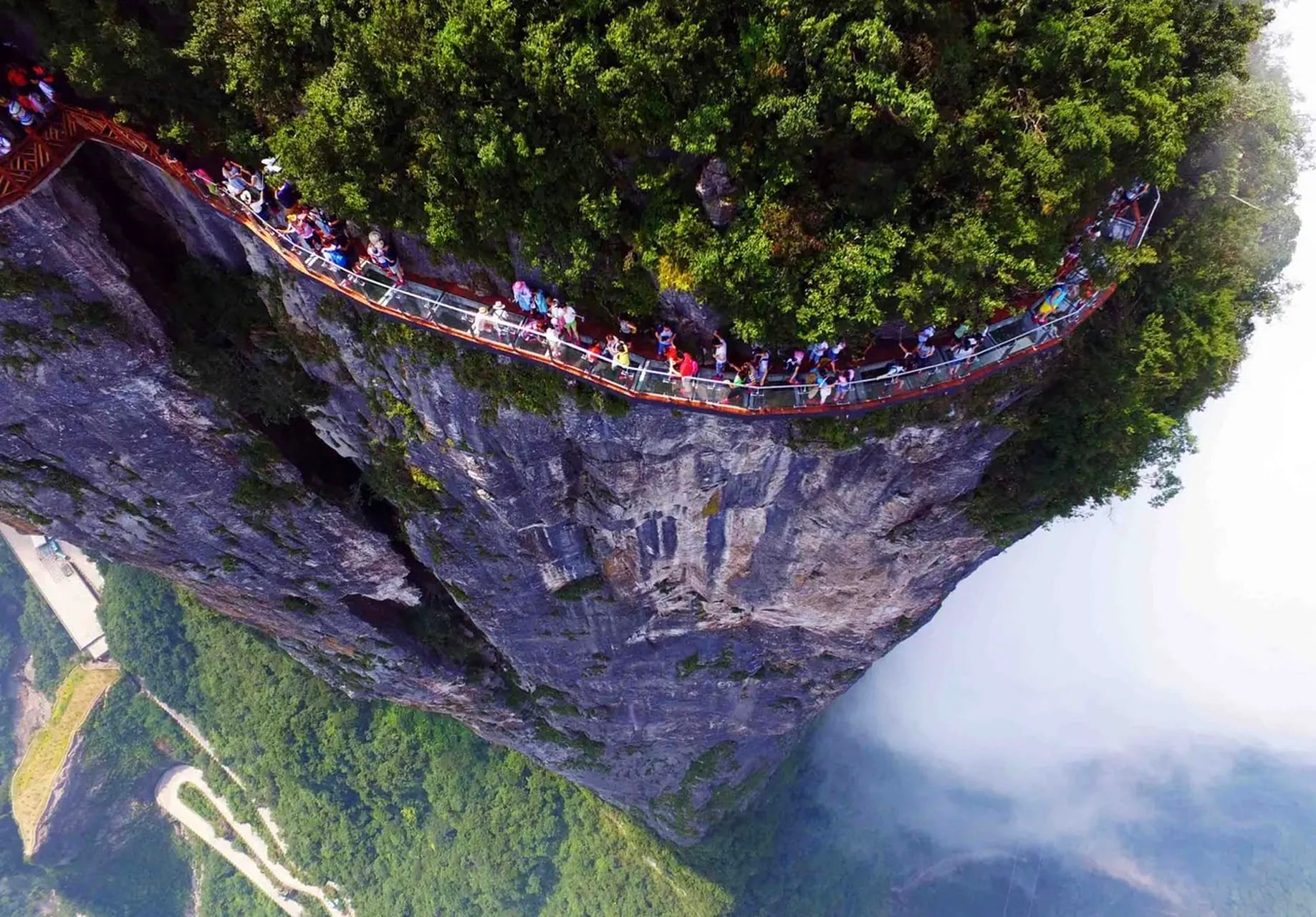
Three glass skywalks exist at the top: the East Line Glass Skywalk, the West Line Glass Skywalk, and the Coiling Dragon Cliff Glass Skywalk.
The Coiling Dragon Cliff, spanning 100 meters long and 1.5 meters wide, provides the best viewpoint for the 99 Bends Road and Tianmen Cave below. This represents the most photographed skywalk location where lines form during peak hours.
Here’s what tourist brochures won’t emphasize: glass skywalks represent brief 5-10 minute experiences, not the mountain’s primary attraction. The cliff paths, temple areas, and natural scenery consume most of your summit time.
Walking the glass skywalk requires 5 RMB shoe covers to protect the glass surface and ensure clear views for every tourist. The scenic area provides these covers—don’t try sneaking through without them.
West Line vs East Line: Strategic Summit Navigation
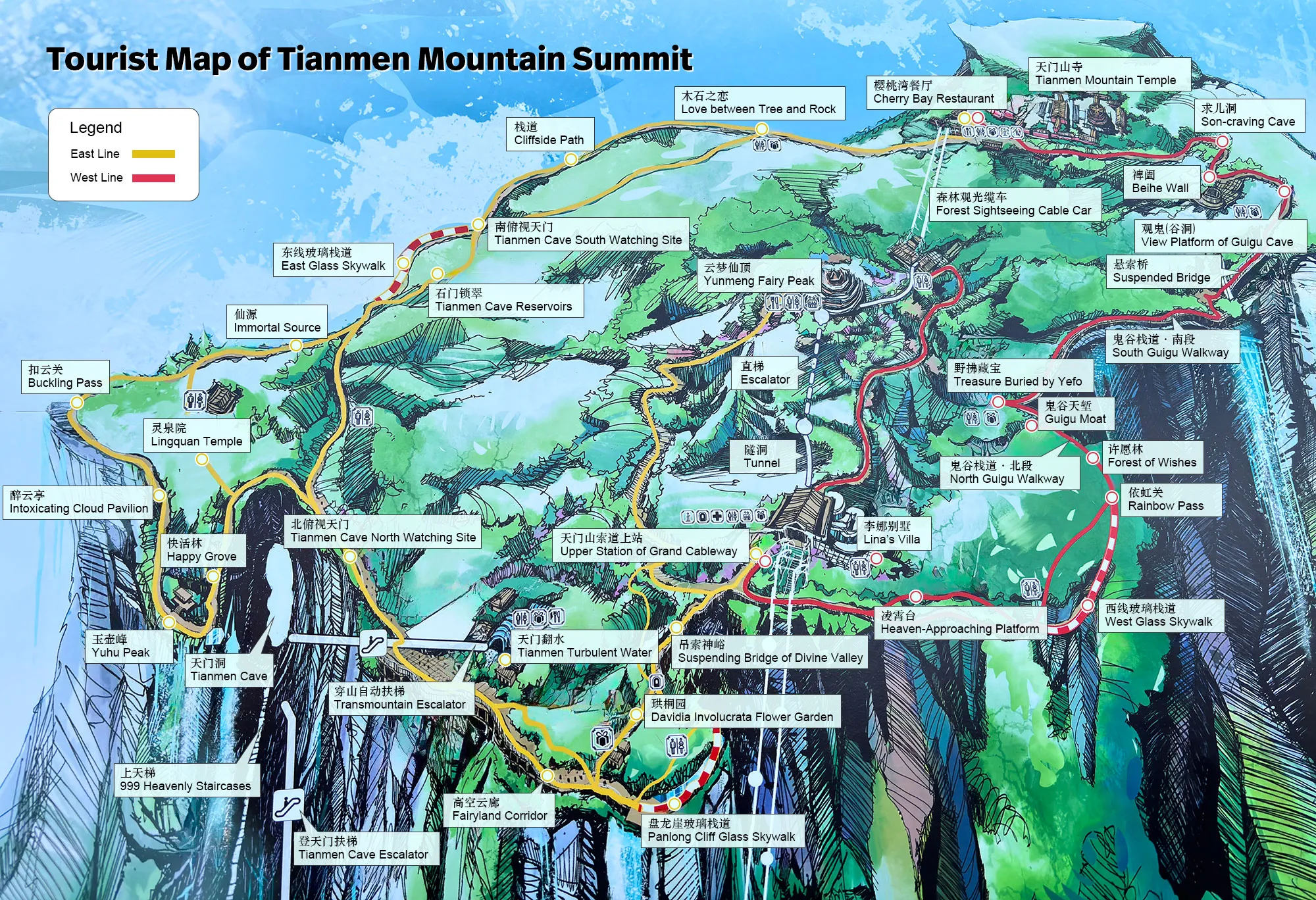
The mountaintop circuit divides into east and west lines, bordered by the cable car upper station, Tianmen Mountain Temple, and Yunmeng Fairy Peak.
West Line spans approximately 4 kilometers, taking around 2 hours. This shorter, more scenic route contains the Coiling Dragon Cliff and Ghost Valley Plank Road—the headline attractions.
East Line measures approximately 3.5 kilometers, requiring around 1.5 hours. It features the East Line Glass Skywalk, cliff paths, and scenic viewpoints.
Central area includes Tianmen Temple, Cherry Bay, and Yunmeng Fairy Peak, covering about 1 kilometer and requiring roughly 1 hour to explore properly.
Our proven summit strategy based on guiding 8,000+ visitors:
Exit the escalator at the summit and immediately turn toward the West Line. Complete this shorter, more scenic route first while morning light works best for photography and tour groups haven’t arrived yet. It was noisy and crowded initially, but was rather quiet and peaceful after 30 minutes of hiking along the western route.
Circle through to Tianmen Temple at the far end for a genuinely peaceful experience. From the temple, visitors noted it’s calm, quiet, and the perfect spot to catch your breath. Even though cliff paths were busy, the temple had way fewer people.
Return via the East Line if time and energy permit, or head directly to the escalator system for your descent.
Food and Hydration Reality
Food isn’t expensive at Cherry Village on the summit—sausage 5 RMB, corn 5 RMB, egg 3 RMB. However, options remain limited to simple snacks.
We strongly recommend eating a substantial breakfast before your visit and carrying snacks and water from the city. Mountaintop vendors charge 3-4 times normal prices for bottled water (15-20 RMB versus 3-5 RMB in the city).
Most visitors don’t want to spend limited mountain time hunting for expensive snacks when they could be exploring cliff paths.
Practical Booking and Visit Strategy
Ticket Booking Critical Details
Tianmen Mountain implements a daily capacity cap of 35,000 visitors with timed entry reservations. Never show up without advance tickets, especially during March-November.
Tickets only become available 15 days before your visit date, so set a calendar reminder and book immediately when your date opens. During peak periods, popular time slots sell out within hours.
The ticket is valid only for your selected date. Cancellation fees are 30 RMB if canceling 2+ days before, 60 RMB if 1 day before, and non-refundable on the visit day.
Booking Timeline Strategy: Book exactly 15 days in advance when tickets release. Check availability 7-14 days before if you haven’t booked yet (popular slots may sell out). Last chance booking happens 3-6 days before with limited time slots. Within 2 days, cancellation fees jump to 30-60 RMB. Same-day tickets are non-refundable.
Wait Time Reality: Arriving at 6:30-7:00 AM means 0-15 minute waits even in high season. Arriving at 9:00-10:00 AM means 60-90 minute waits during peak times. Arriving after noon means 90-120+ minute waits as lunch crowds arrive. Afternoon after 2:00 PM sees crowds thinning to 60-90 minute waits.
VIP Pass Decision: When 150 RMB Saves Hours
During peak tourist seasons, you can upgrade to the Scenic Spot General VIP Pass for 100 RMB per person or the Ctrip VIP Ticket for 150 RMB per person to skip lines.
Based on our experience guiding visitors:
Worthwhile during: Chinese national holidays (May 1-5, October 1-7), peak summer weekends (July-August Saturdays), and any time you arrive after 9:00 AM during high season.
Unnecessary during: Shoulder season weekdays (March-April, September-November), winter months, and any time you arrive at 7:00 AM opening.
We’ve had clients save 2+ hours with VIP passes during Golden Week. We’ve also had clients waste 150 RMB when they arrived early on a Tuesday in April and walked right on.
Physical Preparation Requirements
Fitness Level | Line A Suitability | Line B Suitability | Preparation Needed |
|---|---|---|---|
Sedentary/Low Fitness | ✅ Suitable with breaks | ❌ Not recommended | 2 weeks daily 30-min walks |
Average Fitness | ✅ Comfortable | ⚠️ Challenging but doable | 1 week cardio + stairs practice |
Good Fitness | ✅ Easy | ✅ Manageable | Minimal – stay hydrated |
Athletic/High Fitness | ✅ Very easy | ✅ Comfortable | None needed |
Knee Problems | ⚠️ Use escalator (32 CNY) | ❌ Avoid or use escalator | Knee brace, walking poles |
Elderly (60+) | ✅ With escalator option | ❌ Not recommended | Medical clearance advised |
Children (under 12) | ✅ With supervision | ⚠️ Only if very active | Energy snacks, frequent breaks |
Regular aerobic exercise improves cardiovascular endurance necessary for altitude and distance. We’re not suggesting marathon training, but if climbing hotel stairs leaves you breathless, Tianmen Mountain will challenge you significantly.
Remember to take motion sickness medicine before taking the bus if you often feel sick when taking a car. This applies to both the shuttle buses and particularly the 99 Bends Road eco-bus.
The mountain’s elevation creates temperature differences 5-8°C cooler than Zhangjiajie city. Layer your clothing. Morning visits feel cold regardless of valley temperatures. By afternoon, you’ll be sweating through summit exploration.
Equipment and Clothing Essentials
Item | Necessity | Why You Need It | Season Notes |
|---|---|---|---|
Comfortable walking shoes | ⭐⭐⭐⭐⭐ | 6+ km walking on summit | Non-negotiable year-round |
Layered clothing | ⭐⭐⭐⭐⭐ | 5-8°C cooler than valley | Critical spring/autumn/winter |
Water bottle (1L+) | ⭐⭐⭐⭐ | Hydration at altitude | Summit water costs 15-20 CNY |
Snacks/energy bars | ⭐⭐⭐⭐ | 5-6 hour visit duration | Limited expensive options on summit |
Motion sickness pills | ⭐⭐⭐⭐ | 99 Bends bus segment | Take 30 min before bus ride |
Sunscreen (SPF 30+) | ⭐⭐⭐ | High altitude UV exposure | Summer essential, useful year-round |
Rain jacket | ⭐⭐⭐ | Sudden weather changes | Spring/summer especially |
Walking poles | ⭐⭐ | Knee support on stairs | Useful for Line B climbers |
Power bank | ⭐⭐ | Photography + long day | 5-6 hours drains phones |
Small backpack | ⭐⭐⭐ | Carry all essentials | 15-20L capacity ideal |
Hat/cap | ⭐⭐ | Sun protection | Summer important |
Light gloves | ⭐⭐ | Handrail support | Winter/early spring |
Tianmen Mountain reaches 1,518 meters above sea level, creating temperature differences of 5-8°C cooler than Zhangjiajie city, with weather changing rapidly throughout the day.
Layer your clothing. Morning mountain visits feel cold regardless of valley temperatures. By afternoon, you might be sweating through summit exploration.
Walking poles help with stability on steeper sections, especially for the 999 Steps where handrail support proves valuable. Trekking poles aren’t necessary but significantly ease knee strain for middle-aged visitors.
Comfortable walking shoes rank as non-negotiable. Most walking trails on the summit are flat and paved, but you’ll still walk approximately 6 kilometers easily along cliff walkways. Fashion shoes cause blisters and worse.
Glass walkways require 5 RMB shoe covers per section to protect the glass surface. The scenic area provides these covers. Don’t try to sneak through without them—staff actively enforce this requirement.
Frequently Asked Questions
Q: Can I visit both Tianmen Mountain and Zhangjiajie National Forest Park in one day?
We wouldn’t recommend it. While Tianmen Mountain is located in Zhangjiajie city, the entrance to Zhangjiajie National Forest Park is around 45 minutes away by car. Both places deserve several hours to explore properly, and trying to do both in a single day will feel rushed and exhausting.
Plan separate days. Tianmen Mountain requires 5-6 hours minimum. The National Forest Park deserves 1-2 full days. Attempting both creates a miserable experience where you fully appreciate neither destination.
Q: I have fear of heights. Can I still visit?
You can still enjoy your visit. The famous glass skywalks might look intense, but they’re optional. For every cliffside path with a skywalk, there’s an alternative route that avoids it. Stick to inner trails and avoid looking over the edge, and you’ll be just fine.
The cable car ride might feel nerve-racking, but the cabins are enclosed and stable. Many visitors with height concerns report that the cable car bothers them less than expected because they’re inside an enclosed space.
Q: Is this actually a hiking mountain?
Not really. Tianmen Mountain isn’t a traditional hike. Most walking trails on the summit are flat and paved. There’s very little climbing involved because of the escalator series built inside the mountain. The only real challenge is the 999 steps to Heaven’s Gate, but even those can be avoided by taking the escalator down.
If reasonably fit, you’ll have no problem. Just wear comfortable shoes and take your time.
Q: How much time do I actually need?
Tourists spend an average of 5 hours on Tianmen Mountain. The ticket is valid for one day only with single-entry access to the park.
Plan for 6-7 hours including travel to/from the site, ticket collection, all waiting times, summit exploration, and descent. Rushing through in 4 hours is technically possible but defeats the purpose.
Q: What about the current cable car renovation?
The upper section of Tianmen Mountain cableway has been undergoing maintenance since November 6, 2025, and construction is expected to last for years. Both Lines A and B now require eco-bus segments through the 99 Bends Road.
The experience remains worthwhile but differs from pre-renovation descriptions in older guides. Line C stays unchanged.
Q: Are there food options on the mountain?
There are shops at Tianmen Cave selling simple snacks and bottled water, with prices three or four times higher than those sold at the foot of the mountain.
We recommend eating a substantial breakfast before your visit and carrying snacks and water from the city. The summit has limited food options at inflated prices.
Q: Can I use a VIP pass to skip lines?
Tianmen Mountain offers VIP express pass tickets allowing priority checking in and boarding of cable cars, largely reducing waiting time and efficiently avoiding tourist crowds especially in busy season.
VIP passes aren’t available online and must be bought locally from ticket windows. The pass costs extra (100-150 RMB) but can save 1-2 hours during peak periods. Worthwhile during Chinese holidays or peak summer weekends, unnecessary during shoulder season weekdays.
Our Final Recommendation: The Verdict
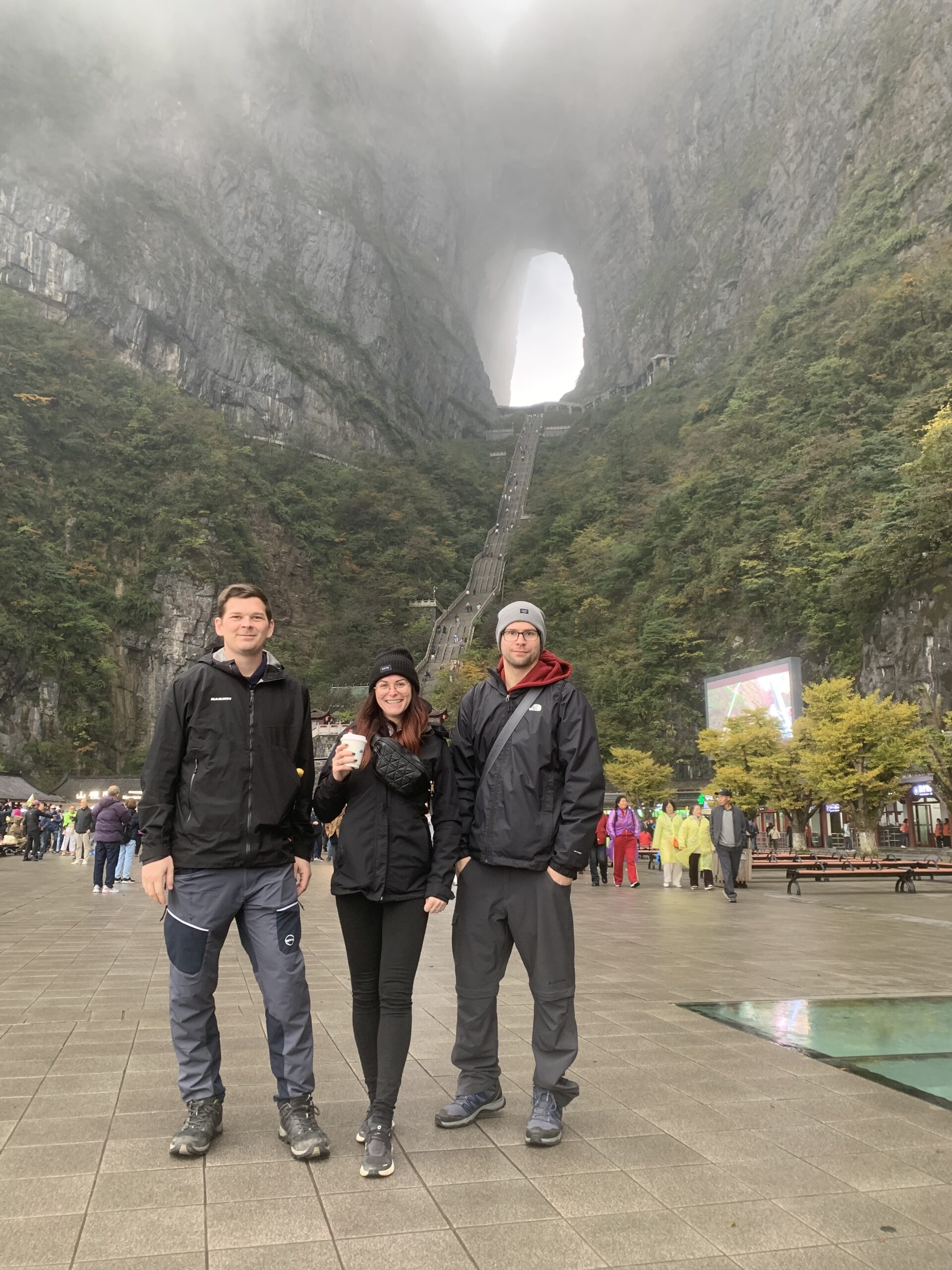
After guiding thousands of international visitors and experiencing each route dozens of times through all seasons and weather conditions, we consistently recommend Line A for 85% of travelers.
Line A provides the best balance of manageable physical effort (downward stairs), superior crowd management (fewer people than Line B), and signature experiences (cable car ascending views, even if shortened due to renovations). The eco-bus segment through 99 bends adds adventure rather than detracting from the overall experience when placed early in your visit.
Choose Line B only if you specifically want the physical challenge of climbing the 999 Steps upward AND possess the fitness level for this demanding task. The sense of conquest appeals to adventure seekers, but most families and first-time visitors find Line A’s downward approach overwhelmingly superior.
Avoid Line C unless severe acrophobia makes the long cable car impossible. Missing the world’s longest cable car system eliminates Tianmen Mountain’s primary claim to fame and international reputation.
The Real Success Factors Nobody Discusses
Route selection matters, but these factors determine whether you’ll love or hate your Tianmen Mountain experience:
Arrival timing trumps route choice. Arriving at 7:00 AM opening versus 10:00 AM creates a completely different experience regardless of line selection. Early arrival means no queues, cooler temperatures, better photography light, and peaceful cliff paths.
Weather luck affects everything. Fog can mask mountain scenery completely, making it a disappointing experience despite perfect planning. Check weather forecasts obsessively. Reschedule if possible when forecasts show heavy fog or rain.
Physical preparation prevents regret. If you’re sedentary, arrive two weeks early and walk 30 minutes daily to build basic fitness. You’ll enjoy the mountain exponentially more.
Expectation management creates satisfaction. Tianmen Mountain isn’t a leisurely stroll—it’s a physically demanding adventure. Come prepared for that reality and you’ll thrive. Expect easy tourism and you’ll suffer.
From dizzying cliff paths to the jaw-dropping cable car ride, Tianmen Mountain represents one of China’s most unforgettable stops. Choose Line A, arrive early, wear comfortable shoes, and prepare for an experience that combines natural wonder with engineering marvel.
The first visit leaves most visitors speechless despite years exploring China’s natural wonders. Standing before Heaven’s Gate after navigating those 999 steps creates a profound moment of accomplishment and awe, especially when morning mist parts to reveal the massive arch against clear blue skies.
The mountain changes through seasons and weather, never showing precisely the same face twice. That’s why we keep returning, and why you should experience it at least once in your lifetime.
We look forward to seeing you on the mountain.