Mount Huashan: The Complete Guide to China’s Most Thrilling Sacred Mountain
We’ll never forget watching a 68-year-old grandmother from Taiwan grip the chains on Canglong Ridge, tears streaming down her face—not from fear, but from joy. “I’ve dreamed of this for 40 years,” she told us. After organizing inbound tours to Mount Huashan for over two decades, we’ve learned that this mountain doesn’t just test physical limits. It reveals something deeper about what drives people to climb vertical cliffs at 2,000 meters above sea level.
Some travelers arrive for the legendary plank walk, only to discover it’s closed for maintenance. Others plan a quick day trip, then find themselves waiting six hours in line for a single attraction. The mountain teaches patience, humility, and respect. It also offers one of China’s most profound cultural experiences—if you prepare properly.
Table of Contents
Quick Facts About Mount Huashan
Detail | Information |
|---|---|
Location | Huayin City, Shaanxi Province (120 km east of Xi’an) |
Highest Peak | South Peak at 2,154.9 meters (7,070 feet) |
UNESCO Status | On Tentative List since 2001 |
Main Peaks | Five peaks forming a lotus flower shape |
Religious Significance | One of China’s Five Great Taoist Mountains |
Best Time to Visit | April-June and September-October |
Average Visit Duration | 6-10 hours for day trip, 2 days for overnight |
Difficulty Level | Moderate to challenging depending on route |
Crowd Factor | Severe on weekends/holidays, manageable on weekdays |
History and Cultural Significance: More Than Just a Mountain
Mount Huashan isn’t simply a scenic destination marketed to tourists. This mountain shaped Chinese civilization.
Archaeological evidence documents seven prehistoric sites and eight settlements spanning the Xia, Shang, Zhou, Qin, and Han periods. The name “China” (华/Hua) derives directly from this mountain. When ancient Chinese referred to themselves as “Huaxia” or “Zhonghua,” they were invoking Mount Huashan as the root of their identity.
The Taoist Sacred Ground
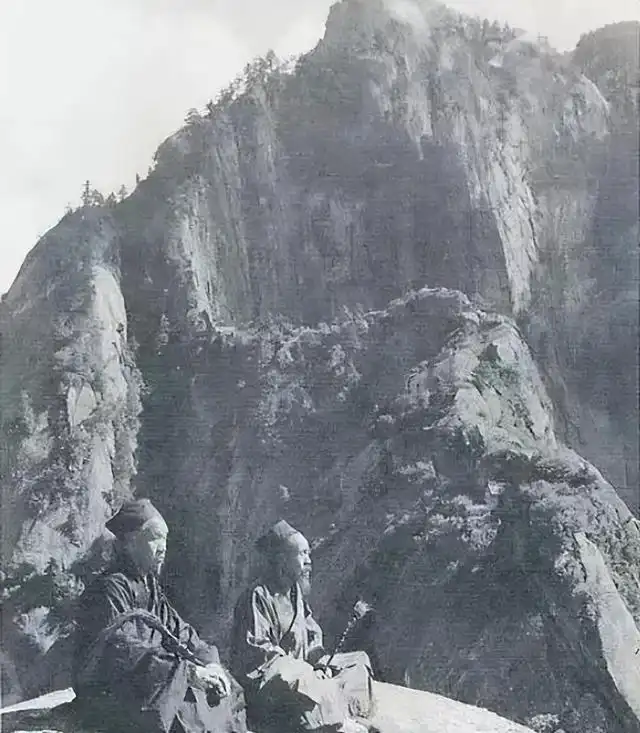
What distinguishes Huashan from China’s other sacred peaks is its pure Taoist devotion. While Mount Tai mixes Buddhism and Confucianism, and Mount Emei embraces Buddhist temples, Huashan remains singularly Taoist. This isn’t accidental—it’s the result of 2,000 years of continuous religious practice.
The earliest recorded Taoist temple, the Shrine of the Western Peak, stood here during the 2nd century BC. Today, 72 semi-suspended caves and more than 20 active Taoist temples dot the mountainside. During the Northern Song dynasty, Taoist master Chen Tuan carved diagrams of internal alchemy into cliff faces where he meditated. These carvings still exist, weathered but legible, documenting practices that predate modern China by a millennium.
From the Han dynasty forward, emperors designated Mount Huashan as the Western Marchmount and made regular pilgrimages to worship. During the Tang dynasty, when the mountain sat midway between the capitals of Chang’an and Luoyang, Emperor Xuanzong elevated its status by naming it the sacred mountain of the Tang royal family.
The Temple Complex That Rivals the Forbidden City
Most visitors rush straight to the peaks, missing the Xiyue Temple at the mountain’s base. This is a mistake. Built in 134 BC during Emperor Wu’s reign, this temple complex covers 12,000 square meters and follows second-category imperial architecture standards. Locals call it “the Forbidden City of Shaanxi Province”—not hyperbole, but accurate historical comparison.
Over 100 emperors climbed these peaks across 2,000 years. Their stone inscriptions, carved by the empire’s finest calligraphers, survive on cliff faces. Li Bai and Du Fu left poetry here. These aren’t tourist attractions preserved behind glass—they’re exposed to the elements, exactly as they were created centuries ago.
Why Mount Huashan Deserves Your Time (Despite the Crowds)

Let’s be honest about Mount Huashan’s biggest problem: overcrowding. On national holidays, you’ll wait 2-3 hours for cable cars. The plank walk queue can reach 6 hours. Food prices triple at altitude. The ticketing system confuses even Chinese visitors.
So why do we still recommend it? Because nowhere else in China combines these elements:
Genuine Vertical Challenge: Most “mountain hikes” involve gradual elevation gain. Huashan forces you upward through passages approaching 90 degrees. The famous Canglong Ridge rises 500 meters at slopes exceeding 45 degrees. Stairs are only 20 centimeters deep. Your hands grip chains bolted into granite while your calves burn from the relentless climb.
Active Religious Practice: This isn’t a preserved historical site. Taoist monks and nuns actively maintain temples, practice daily meditation in cliff caves, and conduct rituals that have continued unbroken for centuries. In 1998, management transferred most temples to the China Daoist Association specifically to protect the environment—the presence of religious practitioners deters poachers and illegal loggers more effectively than any regulation.
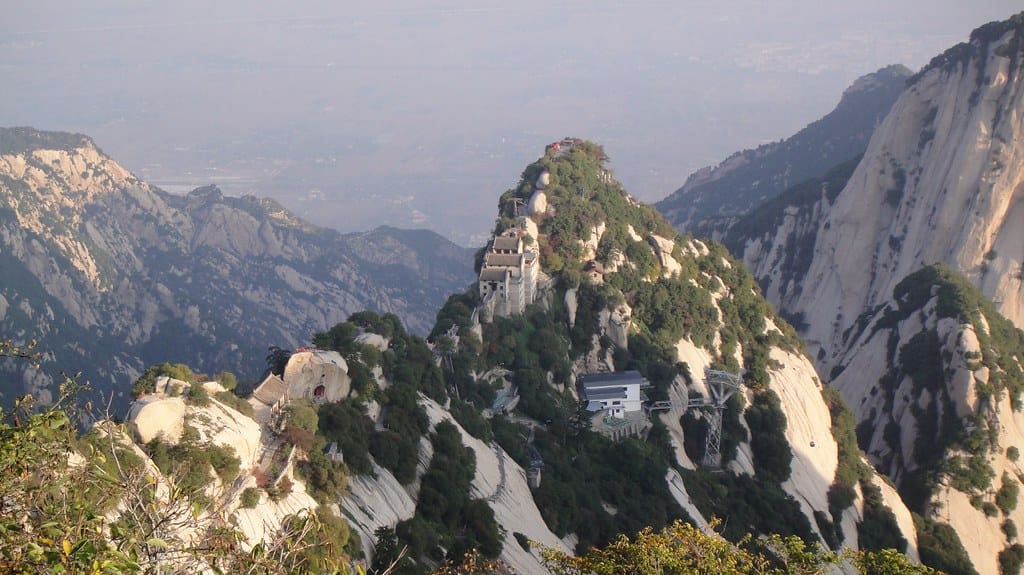
Five Distinct Peaks, Five Different Experiences: Unlike mountains with one dominant summit, Huashan spreads across five major peaks, each offering unique characteristics. East Peak captures legendary sunrises. West Peak resembles a blooming lotus. South Peak, at 2,154.9 meters, provides the most dramatic views. North Peak serves as the gateway. Middle Peak holds romantic Taoist legends.
Natural Granite Sculptures: The entire mountain consists of white granite shaped by millions of years of erosion. Natural formations create sculptures ancient poets compared to phoenixes, lotuses, and celestial beings. This isn’t decorative landscaping—it’s raw geological drama.
The Five Sacred Peaks: What Each Offers

East Peak (Chaoyang Peak) – 2,096 meters

The sunrise from Chaoyang Terrace ranks among China’s most celebrated natural spectacles. But here’s what other guides won’t tell you: the viewing platform accommodates about 100 people. During peak season, you’ll need to arrive by 4:30 AM to secure a spot. Latecomers watch from the stairs.
The “Immortal Palm Print”—a natural rock pattern resembling a giant handprint—decorates the cliff face. Legend claims a deity pushed the mountain apart here, leaving this mark. The geological truth involves differential weathering patterns, but the result is genuinely striking.
South Peak (Luoyan Peak) – 2,154.9 meters
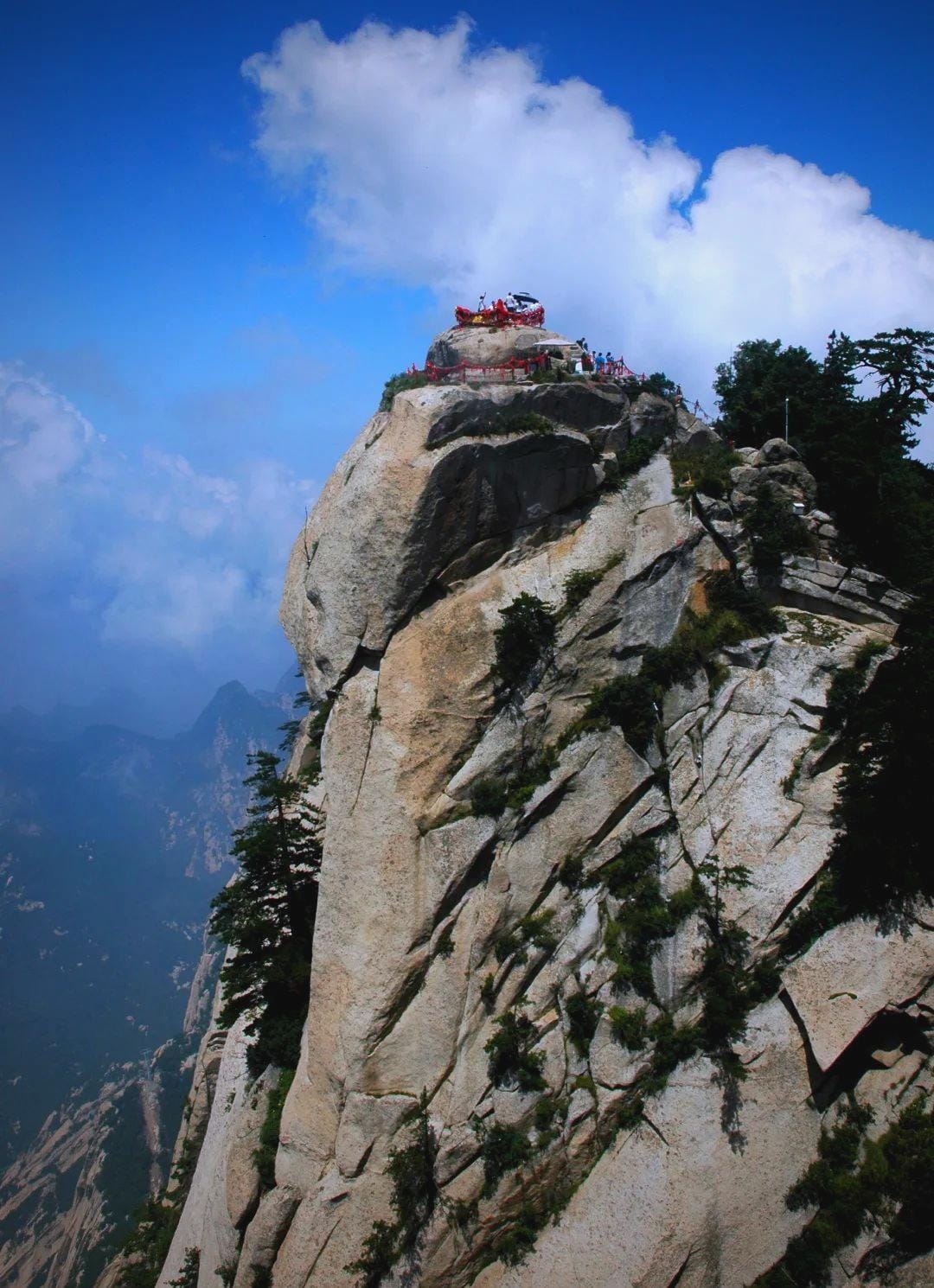
The highest point in the entire Qinling mountain range. On one side, a thousand-foot cliff stands straight as a cut, with deep ravines separating it from neighboring peaks.
This peak hosts the infamous Changkong Plank Road. But be prepared for reality: during our last visit in October 2024, we watched travelers wait 4.5 hours just to attempt the 100-meter section. Many gave up. Of those who started, about 15% turned back halfway.
West Peak (Lianhua Peak) – 2,038 meters
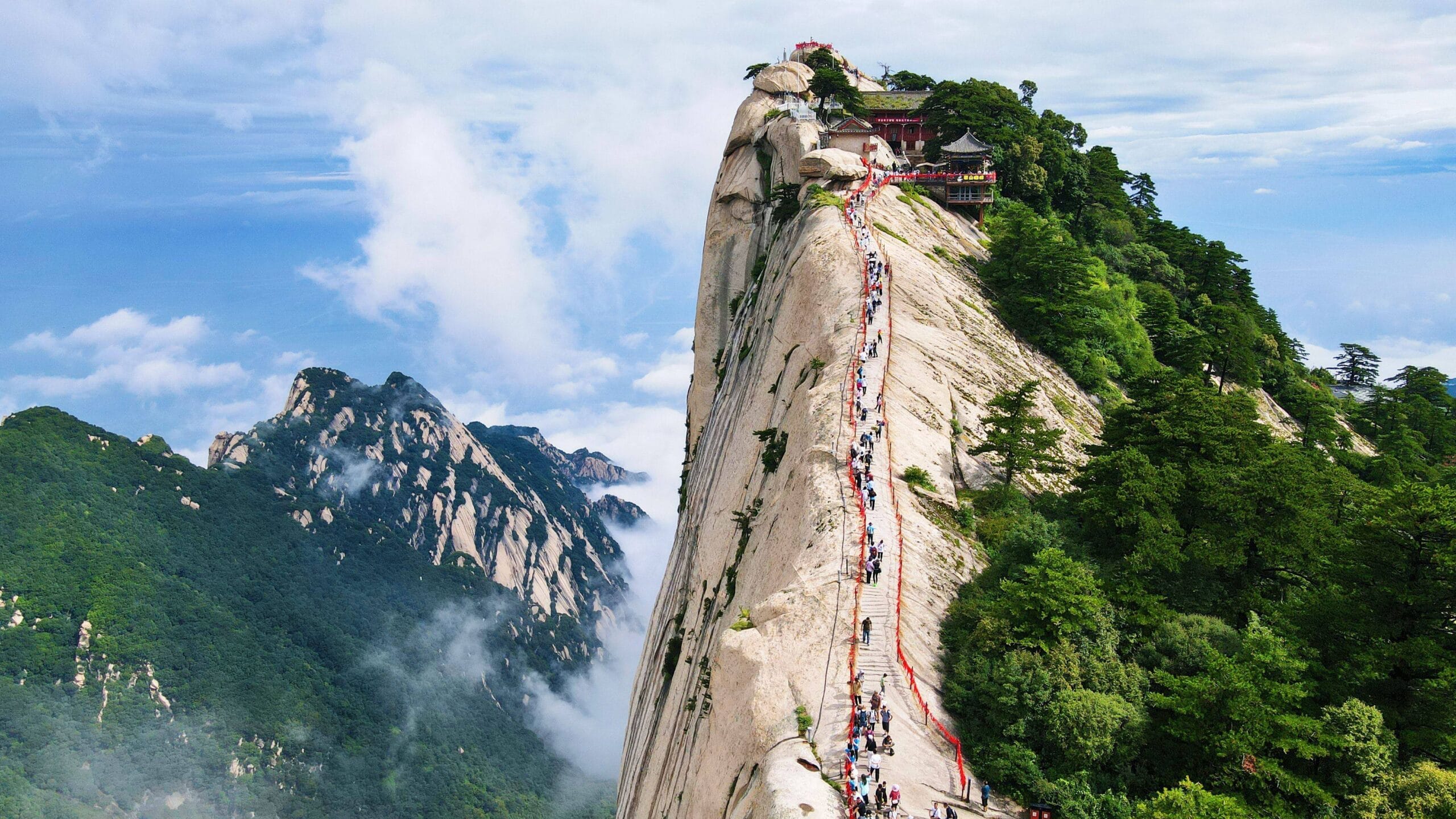
A massive rock formation at the summit resembles lotus petals, inspiring ancient literati to name it Lotus Peak. Every Chinese child knows the legend of this peak: Chenxiang split the mountain with a magic axe to rescue his mother, the goddess imprisoned inside.
The Axe-Split Stone supposedly marks where the mountain cracked open. The actual geological formation results from freeze-thaw cycles creating a natural fissure, but the storytelling tradition here spans 2,000 years.
North Peak (Yuntai Peak) – 1,614 meters
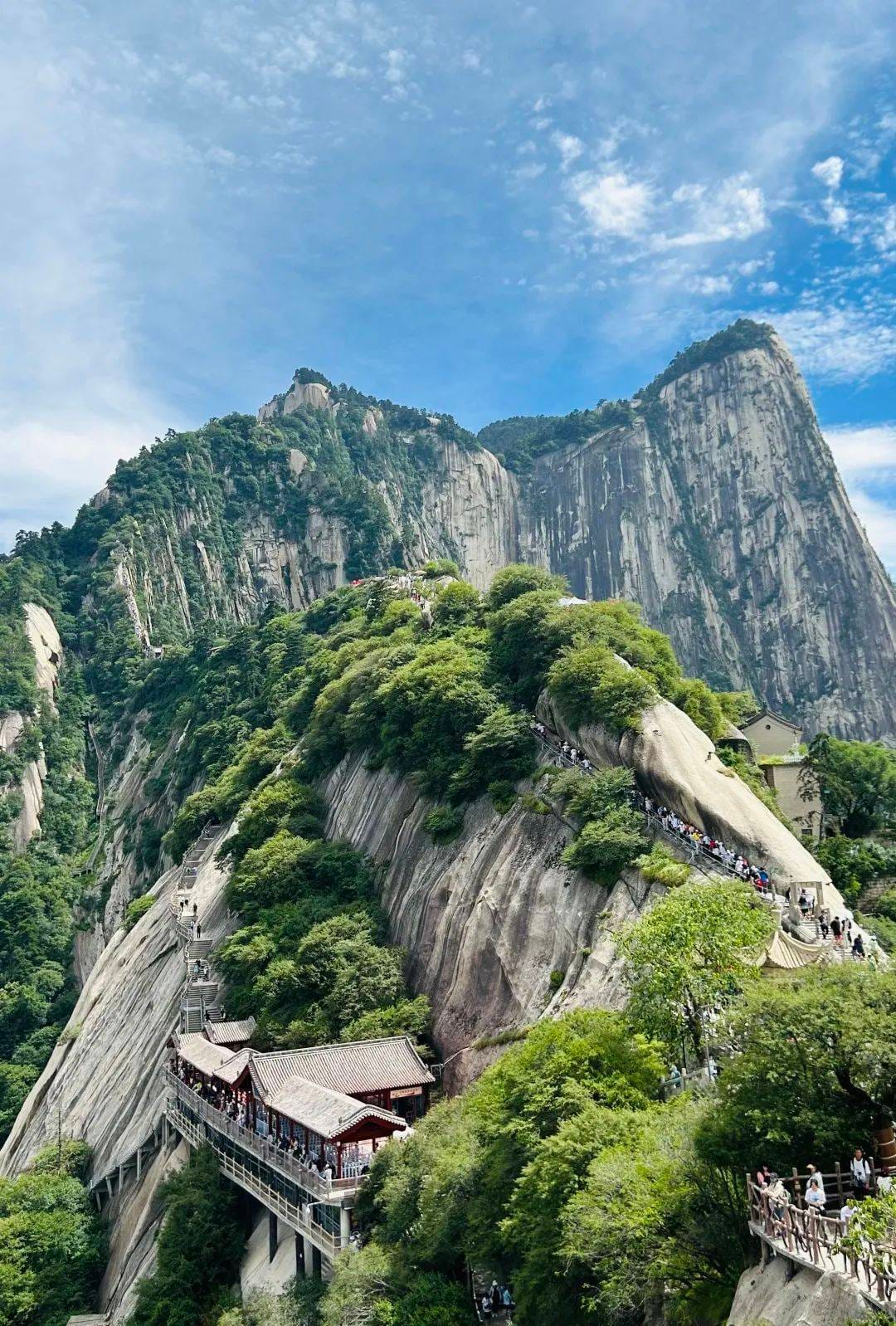
The lowest peak but historically most significant. The famous “Outwitting Mount Hua” incident occurred here in 1949 when People’s Liberation Army soldiers scaled cliffs to capture Nationalist forces. A small museum documents this military operation with photographs and equipment.
Middle Peak (Yunu Peak) – 2,042 meters
Named after Princess Nongyu, daughter of King Mu of Qin, who supposedly married a hermit and practiced immortality cultivation here. The Yunu Temple stands as one of the mountain’s oldest surviving structures, though the current building dates only to the Ming dynasty—the original burned during the Yuan dynasty.
The Truth About Mount Huashan’s “Dangerous” Attractions
Changkong Plank Road: Managing Expectations
Internet videos show people shuffling sideways on 30-centimeter-wide wooden planks with 2,000 meters of empty air below. These videos are accurate. What they don’t show: the operational reality.
Current Status (Based on 2024-2025 Visitor Reports): The plank walk operates intermittently. Weather conditions (rain, snow, high winds) close it without warning. Maintenance closures happen regularly. Multiple travelers reported closures in July 2024 and March 2025. When operating, it runs limited hours (typically 7:00-18:00) with capacity restrictions.
The Booking System: Recent visitors report a booking system implemented in Chinese via WeChat, limiting access to 50 people per round across five daily time slots (7:30, 9:30, 11:30, 13:30, 15:30). However, enforcement seems inconsistent—some days it operates first-come, first-served.
Wait Times Reality: On weekends and holidays, expect 4-6 hour waits. Weekdays in shoulder season: 1-2 hours. Winter: minimal crowds but high chance of closure.
Age Restrictions (Inconsistently Enforced): Official policy: ages 15-55. Actual enforcement: varies dramatically. We’ve seen fit 60-year-olds allowed through and healthy 51-year-olds denied. A 70-year-old woman reported being refused in 2024, while another visitor mentioned age restrictions weren’t checked. Height minimum of 1.5-1.6 meters (reports vary).
The Experience: You rent a safety harness (¥30). The path consists of three sections. The middle section requires pressing your body against the cliff while shuffling sideways on wooden planks barely 30 centimeters wide. You must return the same way. Meeting someone coming from the opposite direction creates careful negotiation moments on these narrow planks.
The harness system works: you use two carabiners, keeping one attached while moving the other. The psychological fear is intense—the safety equipment doesn’t prevent the feeling of exposure.
Our Honest Assessment After 20+ Years: About 20% of people who queue eventually choose not to attempt it. Of those who start, roughly 15% freeze up halfway and require significant time to continue or retreat. This isn’t failure—it’s self-awareness. The mountain rewards many kinds of courage, including the courage to recognize your limits.
If you have genuine acrophobia, skip it. The rest of Mount Huashan offers extraordinary experiences without requiring you to conquer height-related terror.
Chess Pavilion Trail (Botai): The Alternative Challenge
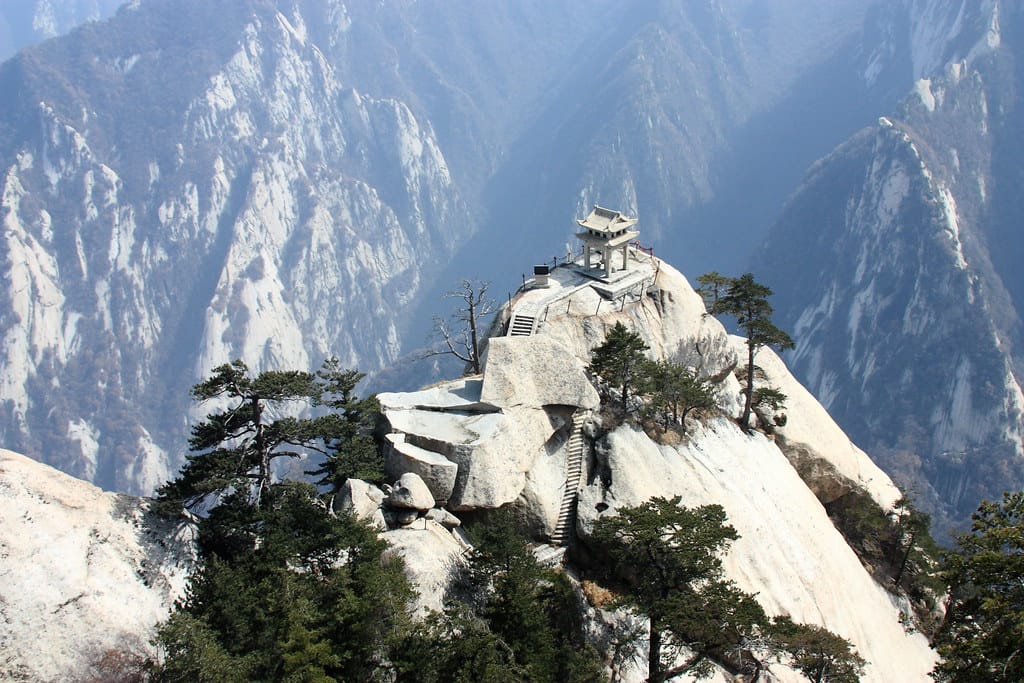
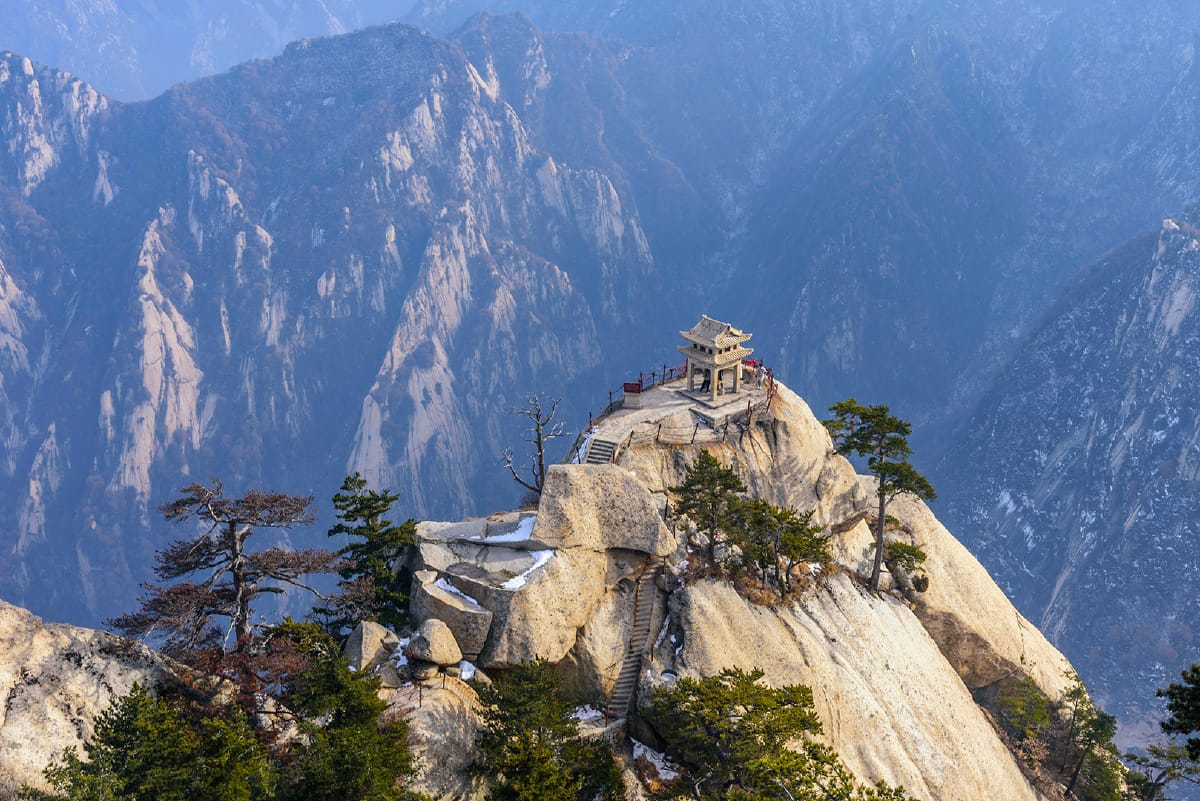
Often overshadowed by the plank walk but equally thrilling for some visitors. This trail leads to a pavilion where legend says Emperor Zhao of the Song dynasty played Chinese chess with Chen Tuan and lost, granting Taoists ownership of the mountain.
The route involves unhooking and rehooking carabiners on steep slopes, using rock holes for footing, and traversing exposed sections with significant drop-offs. Unlike the plank walk, this trail actually leads somewhere—the pavilion at the end offers genuine solitude because fewer tourists know about it.
Canglong Ridge (Dark Dragon Ridge): The Unavoidable Challenge

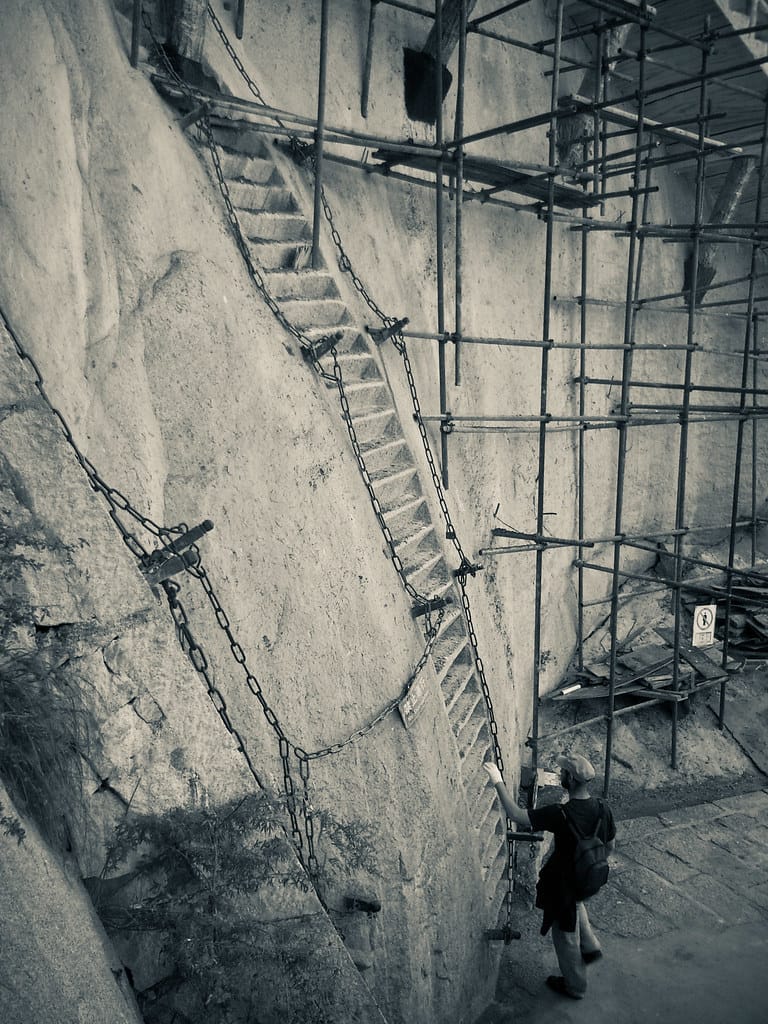
You cannot reach the four highest peaks without crossing Canglong Ridge. This knife-edge ridge separates North Peak from the others. Steps only two feet wide have deep ravines on both sides. The slope exceeds 45 degrees, and the vertical rise spans about 500 meters.
We’ve watched elderly Chinese women in their 70s tackle this ridge with determination. Iron chains line both sides. You’ll grip them with everything you have while your legs burn. This section sorts tourists from hikers—it’s where many people first understand what “precipitous” truly means.
How to Visit: Route Comparison
Route | Best For | Time | Difficulty | Cost | Pros | Cons |
|---|---|---|---|---|---|---|
West Up, North Down | First-timers | 6-8 hours | Moderate | ¥700+ | Mostly downhill after West Peak; sees all peaks | Expensive; crowded |
North Up and Down | Budget travelers | 4-5 hours | Moderate | ¥450+ | Most economical | Misses highest peaks; very steep climb from North |
Night Climb (Foot) | Enthusiasts | 10-12 hours | Challenging | ¥300+ | Cheapest; traditional; sunrise | Extremely tiring; navigation challenging; dangerous when wet |
Two-Day Stay | Photographers | 2 days | Moderate | ¥1,200+ | Sunrise + sunset; relaxed pace; beat day crowds | Most expensive; basic mountain hotels |
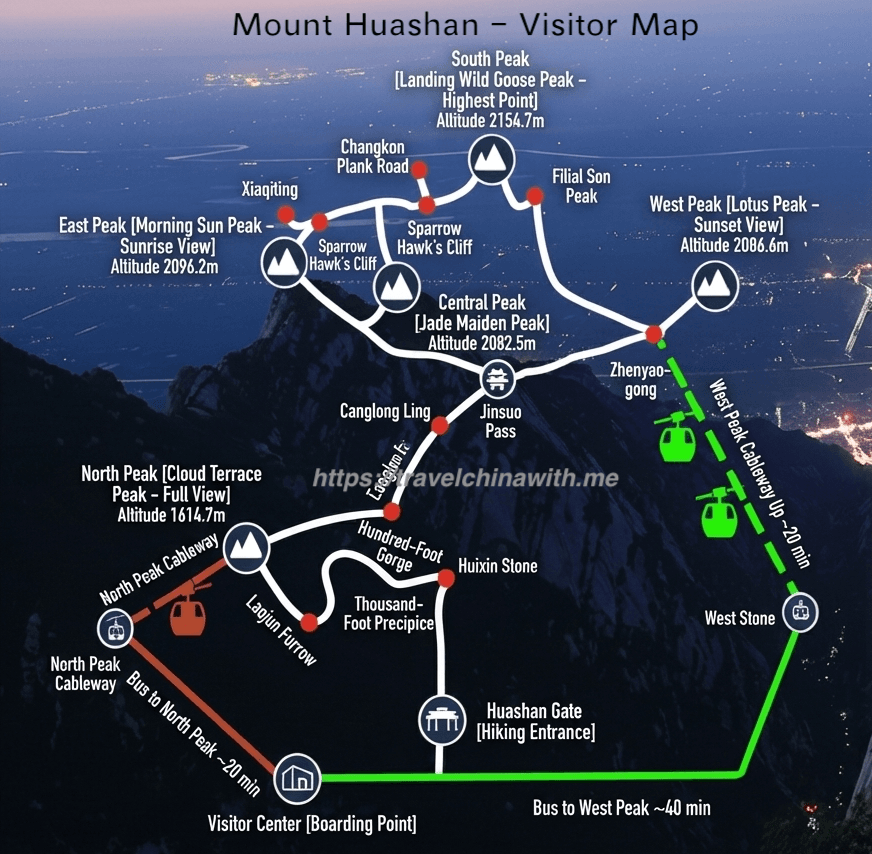
West Peak Up, North Peak Down (Our Top Recommendation)
Start with the West Peak cable car for spectacular 20-minute views. Hike West Peak → South Peak → East Peak → Middle Peak → North Peak. Descend via North Peak cable car.
Why We Recommend This:
- The West Peak cable car eliminates the hardest initial climb
- You visit all five peaks
- Most hiking is downhill or level after West Peak
- You can skip or include the plank walk without affecting the overall route
Realistic Timeline:
- 07:00: Arrive at visitor center, buy tickets
- 07:45: Board shuttle bus to West Peak cable car (40-minute journey)
- 08:30: Cable car to West Peak (20 minutes)
- 09:00-12:00: Hike West → South → East peaks
- 12:00-13:00: Lunch break
- 13:00-15:00: Hike Middle → North peaks
- 15:30: Cable car down from North Peak
- 16:00: Shuttle bus to visitor center
- 17:00: Return train/bus to Xi’an
North Peak Up and Down (Budget Option)
Take North Peak cable car up, tackle Canglong Ridge to reach other peaks if you have energy, return via same cable car.
Reality Check: The North Peak cable car deposits you at 1,614 meters. The other four peaks sit at 2,000+ meters. That means 400+ meters of near-vertical climbing after the cable car. Many budget-conscious visitors arrive at North Peak, see what’s required, and decide to explore just the North Peak area before descending.
Traditional Night Climb (For the Determined)
Start from Yuquan Temple at the mountain base around 23:00. Climb through darkness via the ancient imperial path (12.5 kilometers, 9,567 steps) to reach East Peak for sunrise (5-6 hours). Descend by cable car or on foot.
What Makes This Challenging:
- Navigation is difficult even with headlamps
- Sleep deprivation compounds physical exhaustion
- Weather can change rapidly during night ascent
- The Thousand-Foot Precipice and Hundred-Foot Gorge sections are genuinely dangerous in darkness
- If it rains, slippery steps become hazardous
Why People Still Do It:
- Cheapest option (entrance ¥160 + shuttle ¥40, versus ¥700+ for cable cars)
- Experiencing sunrise after a night climb creates powerful memories
- Following the same path emperors took for 2,000 years feels significant
- The sense of accomplishment is genuine
Two-Day Overnight Stay (For Deep Experience)
Day 1: West Peak cable car up, visit West and South peaks, watch sunset, stay overnight. Day 2: Wake for sunrise at East Peak, continue to North Peak, descend via cable car.
Mountain Hotel Reality: Don’t expect comfort. Rooms are basic. Hot water is inconsistent. Heating doesn’t exist in winter. Prices range ¥200-600 depending on peak and room type. You’re paying for location, not luxury.
Book 1-2 weeks ahead during peak season. Last-minute availability is rare.
Best Time to Visit: Beyond the Guidebook Advice
Spring (April-June) ★★★★★
Why Ideal:
- Temperatures comfortable (10-20°C at peaks)
- Fewer crowds than summer
- Minimal rainfall
- Spring flowers bloom on cliff faces
- Clear air after winter winds
What to Watch:
- Early April can still see freezing mornings
- May 1-3 (Labor Day) brings massive crowds—avoid
- Bring layers; morning temperatures can drop to near-freezing even in May
Summer (June-August) ★★☆☆☆
Reality Check: This is peak season for Chinese domestic tourism. Every problem Mount Huashan has—crowds, long waits, high prices—amplifies during summer.
June-August Challenges:
- Cable car waits: 1-2 hours routine, 3+ hours on weekends
- Plank walk waits: 4-6 hours typical
- Afternoon thunderstorms frequent (the mountain receives 1,030mm annual precipitation, concentrated in these three months)
- Temperatures in valleys reach 28°C, but peaks remain cooler (18-20°C)
- Accommodation prices double
- Food prices at altitude triple
The One Advantage: Longest daylight hours give you maximum time to explore. Sunset happens around 20:00, allowing extended evening hikes.
Autumn (September-October) ★★★★★
Our Top Recommendation: If you can only visit once, choose autumn. Post-summer crowds diminish but weather remains excellent.
September-October Benefits:
- Golden autumn foliage creates spectacular photography
- Temperatures ideal (10-20°C at peaks)
- Fewer tourists than July-August
- Stable weather with minimal rain
- Clear mountain views
One Major Exception: National Day Holiday (October 1-7) brings the worst crowds of the entire year. Cable car waits can reach 3 hours. Trails become so congested you’ll spend more time queuing than hiking. If visiting in October, plan for the second or third week.
Winter (November-February) ★★★☆☆
For Adventurous Souls: Winter Huashan offers solitude and snow-covered peaks that few foreigners experience. Temperatures vary from -24.9°C to 2.7°C. This isn’t casual hiking—it’s serious cold-weather mountaineering.
Winter Reality:
- Some trails close due to ice
- Plank walk usually closed
- Cable cars operate reduced hours (08:00-18:00)
- Mountain hotels may have minimal heating
- Sunrise requires sub-zero endurance
The Rewards:
- Dramatic snow-covered peaks
- Smallest crowds of the year
- Entrance tickets discounted 40% (¥100 vs ¥160)
- Cable cars discounted 30-40%
- Crystalline air creates stunning photography
Required Equipment:
- Serious winter hiking boots
- Multiple insulating layers
- Windproof outer layer
- Quality gloves (cheap ones won’t suffice)
- Hand/toe warmers
- Crampons if attempting the traditional hiking route
Planning Your Visit: The Practical Details Everyone Needs
Getting to Mount Huashan from Xi’an
High-Speed Train (Best Option): Twenty-nine trains daily run between Xi’an North and Huashan North stations, taking 31-48 minutes. Second-class seats cost ¥54.50.
Critical Details:
- First train: approximately 06:00
- Last train: approximately 21:00
- Trains run roughly every 30 minutes during peak hours
- Book via 12306.cn or Trip.com up to 30 days in advance (60 days during holidays)
- Bring passport—required for ticket purchase and station entry
From Huashan North Station to Mountain:
- Free shuttle bus: Green buses numbered Huayin 1 and Huayin 2 run between station and mountain entrance (look for them across from station exit)
- Taxi: About ¥20-30 for the 5km journey (negotiate first—meters rarely work)
- Hotel pickup: ¥50-80 if arranged in advance
Tourist Bus from Xi’an: Daily buses depart Chengdong Bus Station every 15 minutes from 06:00-19:00 (¥30, approximately 2 hours). Buses also leave from the square in front of Xi’an Railway Station.
Private Car/Tour: The 120km journey takes 1.5-2 hours via G30 Expressway. Private full-day tours cost ¥800-1,500 including vehicle, driver, and guide.
Entrance Logistics and Ticketing Confusion
The Multi-Layer Ticketing System: This confuses everyone. You’ll pay separately for:
- Mountain entrance ticket
- Shuttle bus (mandatory)
- Cable car (optional but recommended)
- Plank walk harness (if attempting it)
Entrance Tickets:
- Peak season (March-November): ¥160
- Off-season (December-February): ¥100
- Students: 50% discount with valid ID
- Children under 120cm: Free
- Children 120-150cm: Half price
- Valid period: 48 hours from first entry
What’s Included: Access to all five peaks, Yuquan Temple, Xianyu Scenic Area, and Xiyue Temple.
What’s NOT Included: Shuttle buses, cable cars, plank walk equipment.
Where to Buy:
- Online (Recommended): WeChat official account “Huashan Tourism Service Platform”
- On-site: Visitor Center ticket hall (special counter for foreign visitors)
- Travel agencies: Often included in tour packages
Cable Car Pricing (2026)

West Peak Taiping Cableway:
- One-way: ¥140 (peak), ¥120 (winter)
- Round-trip: ¥280 (peak), ¥240 (winter)
- Journey time: 20 minutes
- Vertical rise: 894 meters
- Route: Donggoukou station ↔ West Peak
- Hours: 07:00-20:00 (peak), 08:00-18:00 (winter)
North Peak Sante Cableway:
- One-way: ¥80 (peak), ¥45 (winter)
- Round-trip: ¥150 (peak), ¥80 (winter)
- Journey time: 7-8 minutes
- Vertical rise: 755 meters
- Route: Wamiaogou station ↔ North Peak
- Hours: 07:00-20:00 (peak), 08:00-18:00 (winter)
Mandatory Shuttle Buses:
- Round-trip: ¥40 (both routes)
- One-way: ¥20
- Operating hours: Align with cable car hours
Cost Breakdown: Budget Realistically
Item | Peak Season (Mar-Nov) | Winter (Dec-Feb) | Notes |
|---|---|---|---|
Entrance ticket | ¥160 | ¥100 | Valid 48 hours; 40% winter discount |
Shuttle bus (round-trip) | ¥40 | ¥40 | Mandatory for all visitors |
West Peak cable car (round-trip) | ¥280 | ¥240 | Recommended for first-timers |
North Peak cable car (round-trip) | ¥150 | ¥80 | Budget option; 47% winter discount |
Plank walk harness | ¥30 | ¥30 | Only if attempting and open |
Food/water on mountain | ¥80-150 | ¥80-150 | Prices 3× base; bring your own |
Mountain hotel (per night) | ¥300-600 | ¥200-400 | Basic facilities; book ahead |
TOTAL: West Peak day trip | ¥640-770 | ¥530-660 | Without overnight stay |
TOTAL: North Peak day trip | ¥510-640 | ¥380-510 | Budget-conscious option |
TOTAL: Overnight trip | ¥940-1,370 | ¥730-1,060 | Including accommodation |
Money-Saving Strategies:
- Visit during winter for 30-40% discounts
- Bring your own food and water (absolutely essential—prices triple at altitude)
- Take North Peak cable car (saves ¥260 round-trip versus West Peak)
- Visit weekdays to avoid potential weekend surcharges
- Book everything online via official platforms
- Student ID gets 50% off entrance
Accommodation Options
Hotel Name | Location | Price Range (¥) | Best For | Key Details |
|---|---|---|---|---|
East Peak Hotel | East Peak summit (2,096m) | 400-600 | Sunrise viewers | Closest to Chaoyang viewing platform; crowded 4-6 AM |
West Peak Hotel | West Peak area (2,038m) | 500-800 | Best facilities | Newest hotel; relatively better conditions |
Five Cloud Mountain Inn | Golden Lock Pass (central) | 300-500 | Central access | Junction of all peaks; convenient but books out fast |
North Peak Hotel | North Peak (1,614m) | 200-400 | Budget stays | Lowest elevation; requires climb to other peaks |
Capsule Hotel | Various locations | 150-250 | Solo travelers | Dormitory-style; minimal privacy; basic facilities |
Mountain Hotel Reality: Book 1-2 weeks ahead during peak season, 2-3 days ahead for shoulder season. Facilities are basic: no heating in winter, hot water inconsistent, minimal English spoken, communal bathrooms common at budget options.
At the Base (Huayin City): Over 60 hotels ranging from hostels (¥80-150) to 4-star properties (¥300-500). Huashan International Hotel and Huayin Grand Hotel offer Western standards with some English-speaking staff.
In Xi’an (Our General Recommendation): We recommend most travelers stay in Xi’an. Superior accommodation, dining, and other attractions. Early morning trains make day trips entirely feasible. First trains leave around 06:00, getting you to the mountain by 08:00—perfect timing.
Food on the Mountain: Price Reality
At the Base: Yuquan Temple area restaurants serve authentic Shaanxi specialties:
- Biang biang noodles: ¥15-25
- Roujiamo (Chinese hamburger): ¥12-18
- Yangrou paomo (lamb soup with bread): ¥25-40
- Dumplings: ¥20-35 per serving
On the Mountain (Typical Prices):
- Bottled water: ¥10-20 (¥3-5 at base)
- Instant noodles: ¥15-25 (¥5-8 at base)
- Packaged snacks: ¥15-30 (¥5-10 at base)
- Hot meals at rest stops: ¥30-60
- Fresh fruit: ¥20-40 per serving (¥8-15 at base)
Smart Strategy: Bring a full daypack of food and 2 liters of water minimum. You’ll save ¥100-200 and avoid depending on limited mountain options. Just be aware: carrying extra weight up the mountain is genuinely exhausting.
Practical Travel Tips: What We Tell Our Clients
Physical Preparation (Start 4-6 Weeks Before)
Fitness Assessment: You don’t need to be an athlete. We’ve successfully guided 70-year-olds and families with 10-year-old children. Cable cars eliminate the hardest sections. However, you’ll still hike 4-6 hours with significant elevation changes and thousands of stairs.
Training Suggestions:
- Stair climbing: 30-45 minutes, 3× weekly (this is the single most useful training)
- Cardio: Any form, building to 45-60 minutes
- Leg strength: Squats, lunges, step-ups
- Practice hiking: With a loaded daypack on uneven terrain
The Day Before:
- Hydrate thoroughly
- Eat carbohydrate-rich meals
- Get full night’s sleep (7-8 hours minimum)
- Avoid alcohol
- Pre-pack everything to avoid morning stress
Essential Packing List
Critical Items (Don’t Skip These):
- Non-slip gloves: Mentioned in 80% of traveler reviews. Hands become your lifeline on steep sections with chains. Cheap cotton gloves work fine (¥5-10 at the base).
- Water: 1.5-2 liters minimum per person. Dehydration is the most common problem we see.
- High-energy snacks: Nuts, chocolate, energy bars, dried fruit. Your body burns calories intensely.
- Broken-in hiking shoes: Or at minimum good athletic shoes. New shoes guarantee blisters.
- Layered clothing: Morning temperatures can be 15°C cooler than afternoon. Bring removable layers.
- Rain jacket: Even on clear days. Mountain microclimates create sudden weather changes.
- Sunscreen and hat: UV exposure intensifies with altitude.
- Cash: ¥600-1,000. Card payment very limited on mountain.
Highly Recommended:
- Hiking poles: Useful on descents (though some narrow sections don’t allow them)
- Headlamp: For night hiking or very early starts
- First aid kit: Blisters are common; bring moleskin, pain relievers, any personal medications
- Portable battery: Keep phone charged for photos, maps, emergencies
- Wet wipes: Washing facilities limited
- Small garbage bag: Carry out all trash
Leave Behind:
- Large backpacks: Narrow passages make these problematic
- Valuable jewelry: High risk of loss on challenging sections
- Drones: Strictly prohibited in scenic area
- Pets: Not allowed on trails
Safety Guidelines Based on Real Incidents
General Safety Principles:
- Always use iron chains on steep sections
- Face the mountain when descending near-vertical sections
- Let faster hikers pass at wide spots—don’t rush
- Most accidents happen to people hurrying to catch last cable car
- Download offline maps (service can be spotty)
- Share your itinerary with someone not on the hike
Common Issues We’ve Addressed:
Altitude Effects: Rare but possible above 2,000 meters. Symptoms include headache, nausea, dizziness, unusual fatigue. Mild symptoms often improve with rest and water. Severe symptoms require immediate descent.
Dehydration: Drink before feeling thirsty. Aim for 250ml every 30-45 minutes of active hiking. Dark urine indicates dehydration.
Blisters: Break in shoes beforehand. Apply moleskin at the first sign of hot spots, not after blisters form. Wet socks accelerate blister formation—change if you get sweaty feet.
Muscle Cramps: Stretch during breaks. Consume electrolytes, not just water. Bananas provide quick potassium. Cramps usually indicate dehydration or electrolyte imbalance.
Crowd Management: Visit weekdays if possible. Start by 08:00. Consider off-season. Accept that peak season means waiting—fighting crowds increases injury risk.
Emergency Contacts:
- Mountain rescue: 0913-4362666
- Huayin People’s Hospital: 0913-4622784
- Tourist complaint hotline: 0913-12301
- Police: 110 (standard China emergency number)
Real Traveler Reviews: What They Don’t Tell You Elsewhere

We’ve collected feedback from thousands of clients over 20 years. Here’s what stands out (recently):
From Traveling Sarah, Singapore (November): “We reached Huashan Service Center by private car and bought tickets at the special counter for foreigners—this counter exists and staff were helpful. The 45-minute bus ride to East Peak cable station gave us time to mentally prepare. Views were absolutely amazing. We couldn’t do the plank walk (closed for weather), but hiking the peaks themselves was stunning enough. Critical tip: bring gloves! Your hands become lifelines on the steep chain sections. Not recommended to bring hiking poles—too many narrow passages where you need both hands for chains.“
From Michael T., USA (March): “Started 7 AM from Xi’an hotel, reached West Peak by 10:15 AM, saw all five peaks by 3-4 PM, and got back to Xi’an for a 7 PM show. It’s absolutely doable as a day trip if you plan well. The cable car ride up West Peak is worth the money just for the views alone. Pro tip: Trains between Xi’an North and Huashan North run every 10-15 minutes—super convenient. Don’t stress about missing your scheduled train; just catch the next one.“
From Ananya K., India (July): “Visited July 30th. Plank walk was closed—staff said ‘maintenance’ but gave no reopening date. Honestly didn’t matter because the mountain itself was beautiful beyond words. Major warning: VERY crowded in summer. Arrive early or expect massive crowds. Trail markers are clear in English. Ticketing was confusing (multiple separate fees for entry, bus, cable car), but the foreign ticket counter staff helped navigate it. Budget more than you think—all those separate fees add up fast, plus food on the mountain costs 3× base prices.“
From Hans B., Germany (October): “The North Peak cable car takes you directly to explore Canglong Ridge in about 2 hours. Then we climbed to East, South, and West peaks. If doing West-to-North route like we did, it’s less tiring due to more descending than ascending. We found the Chess Pavilion trail (near East Peak) as thrilling as the famous plank walk but with zero crowds. Seriously, maybe 5 people total attempted it versus hundreds queuing for plank walk. If you want adventure without the wait, try Chess Pavilion. Requires carabiners and climbing through rock holes—genuinely exciting.“
From Li Wei, China (December): “Winter climbing requires serious winter mountaineering gear, but the solitude was absolutely worth it. We saw maybe 30 people total across 6 hours. The peaks covered in snow and ice create otherworldly scenery you’ll never see in guidebook photos. Cable cars operated reduced hours (8 AM-6 PM)—plan accordingly. Temperatures hit -15°C at sunrise. The East Peak Hotel had no heating, but provided extra quilts. Don’t attempt this without winter hiking experience and proper equipment—several sections became ice sheets requiring extreme caution.“
From Jennifer L., Canada (May): “We queued 4.5 hours for the plank walk. Yes, 4.5 hours standing in line on a narrow mountain trail. By the time we reached it, we had maybe 30 minutes before last cable car. Rushed through the actual plank walk, barely enjoyed it. If plank walk is your priority, start from West Peak cable car and go there FIRST before other peaks. Don’t do what we did—visiting other peaks first means arriving at plank walk to find massive queues. Also, the harness rental booth had no English—thank god for Google Translate.“
Common Themes from 500+ Reviews:
- Ticketing complexity frustrates 60% of international visitors
- Crowds during peak season significantly impact experience (mentioned in 75% of summer reviews)
- Cable cars make the mountain accessible to far more people than expected
- Gloves mentioned as essential in 80% of reviews
- 65% of visitors regret not bringing enough water
- The plank walk, while famous, “isn’t necessary for an amazing experience” (quoted in numerous reviews)
- Off-season visits offer dramatically better experiences for those who can handle weather
- Wait times for plank walk consistently underestimated by visitors (average 3-4 hours during peak season)
What Other Guides Won’t Tell You: The Honest Truth
The Plank Walk Might Be Closed: Multiple 2024-2025 reports confirm extended closures. Weather conditions close it regularly. Maintenance happens without warning. Don’t build your entire trip around it. If experiencing it is truly essential, have a backup day or accept potential disappointment.
The Ticketing System Genuinely Confuses Everyone: Even Chinese tourists complain about this. You’re not alone if you feel bewildered paying three separate fees (entrance + shuttle + cable car) at different locations. The foreign visitor counter exists specifically because this confuses international visitors so consistently.
Crowds During Peak Season Are Genuinely Oppressive: “Crowded” doesn’t capture it. You’ll wait 3+ hours for cable cars. Trails become so congested you can’t pass slower groups. Bathrooms have 20-minute queues. Photo spots are impossible. This isn’t exaggeration—it’s documented in hundreds of reviews. If you can only visit during summer or national holidays, adjust your expectations dramatically.
Food Prices Triple at Altitude: ¥5 water becomes ¥15-20. ¥8 instant noodles become ¥25. This isn’t gouging—it’s economics. Every item gets carried up by workers. But if you’re budget-conscious, this matters. A family of four spending a full day on the mountain can easily spend ¥300-400 on food and drinks alone.
Mountain Hotels Are Basic: “Hotel” is generous. These are mountain refuges with beds. Don’t expect hot showers, heating, or cleanliness by international standards. You’re paying ¥400-600 for a room because there are literally no other options at 2,000 meters elevation.
You’ll Get Tired: This sounds obvious, but people consistently underestimate the cumulative fatigue. After 6 hours of climbing stairs, gripping chains, navigating crowds, and carrying a pack, your legs turn to jelly. The last cable car ride down feels like salvation. Plan rest stops. Don’t rush. Most accidents happen to exhausted people hurrying to catch the last cable car.
Frequently Asked Questions (Real Ones from Our Clients)

Is Mount Huashan suitable for children and elderly people?
With cable cars: yes, with caveats. We’ve guided families with children as young as 8 and seniors in their 70s. The critical factor is using cable cars (especially West Peak) and skipping dangerous sections like plank walk and Chess Pavilion.
However, even with cable cars, expect 4-6 hours of walking with thousands of stairs. Children must be tall enough to grip chains (roughly 140cm minimum for safety). Elderly visitors need good mobility—arthritis in knees makes the descent particularly challenging.
The main trails between peaks have chains and proper steps. But “proper steps” on Mount Huashan means 45-degree inclines with steps only 15-20cm deep. This isn’t a casual walk.
How dangerous is Mount Huashan really?
Modern safety improvements have reduced risks significantly. Safety measures including deeper pathways, stone steps, wider paths, and railings have mitigated much of the historical danger.
Deaths occur rarely now—perhaps 1-2 per year across millions of visitors. Most involve people ignoring safety rules (removing harnesses, entering closed areas, hiking drunk, attempting night climbs in bad weather).
The main risks are:
- Slipping on wet or icy stones (wear proper shoes)
- Exhaustion leading to poor decisions (rest frequently)
- Ignoring closed trail signs (respect barriers—people died creating them)
- Not using safety equipment properly (attach carabiners correctly)
- Weather changes (thunder/lightning forces immediate evacuation)
Follow guidelines, use provided safety equipment, know your limits, and the mountain is no more dangerous than any serious mountain hike.
Can I do the plank walk if I’m afraid of heights?
Honestly? Probably not comfortably. The safety equipment is excellent, but if you have genuine acrophobia, the psychological stress overwhelms rational safety understanding.
We’ve seen people freeze up completely, requiring 30-60 minutes just to complete the 100-meter section or eventually turning back. About 15% of people who attempt it don’t complete it.
There’s zero shame in skipping it. The mountain offers incredible experiences without the plank walk. The views from South Peak are more spectacular than from the plank walk platform. Canglong Ridge provides vertical thrills without the extreme exposure. You can have an extraordinary Mount Huashan experience without ever attempting the plank walk.
Should I stay overnight on the mountain?
Stay overnight if:
- You’re a serious photographer wanting sunrise and sunset
- You want to experience the mountain when day-trippers have left
- You prefer splitting the hiking across two days (less exhausting)
- You’re visiting during peak season and want to avoid cable car queues
Don’t stay overnight if:
- You’re on a tight budget (adds ¥300-600 to costs)
- You expect comfortable accommodations
- You’re sensitive to cold (no heating)
- You can visit on a weekday in shoulder season
Most first-time visitors do fine with a day trip using cable cars. The overnight experience is special but not essential.
What’s the actual difference between West Peak and North Peak cable cars?
Factor | West Peak | North Peak |
|---|---|---|
Journey time | 20 minutes | 7-8 minutes |
Elevation gain | 894 meters | 755 meters |
Round-trip cost (peak) | ¥280 | ¥150 |
Deposits you at | 2,038m (near highest peaks) | 1,614m (lowest peak) |
Additional climbing needed | Minimal to reach South/East peaks | 400+ meters to reach other peaks |
Crowds | More crowded | Less crowded |
Views during ride | Spectacular | Good |
Best for | First-timers, limited time | Budget travelers, fitness enthusiasts |
We recommend West Peak up, North Peak down for 80% of first-time visitors. You see more, climb less, and the cost difference (¥260) is worth it for the experience and reduced exhaustion.
Can I hike up instead of taking cable cars?
Absolutely. The traditional route from Yuquan Temple to North Peak covers 12.5km with 9,567 steps, taking 4-6 hours for fit hikers (6-8 hours for average fitness).
This ancient imperial path passes through named gates: Wuliguan (Five Li Gate), Shimen (Stone Gate), Qianchi Chuang (Thousand-Foot Precipice), and Baiching Xia (Hundred-Foot Gorge). These aren’t poetic names—they’re literal descriptions.
Many hikers start around 23:00-24:00 to reach East Peak for sunrise. This requires good fitness, proper equipment, and mental preparation. The path is well-marked but climbing in darkness is genuinely challenging.
Is Mount Huashan open year-round?
Yes, but winter brings operational changes. Snow and ice close dangerous sections like the plank walk and some steep passages. Cable cars operate reduced hours (08:00-18:00 instead of 07:00-20:00).
Weather conditions determine daily operations. Heavy snow, ice, high winds, or thunderstorms can close sections without warning. Check official WeChat account or call ahead (0913-4368141) before visiting December-February.
Winter tickets are heavily discounted: ¥100 versus ¥160 entrance, cable cars discounted 30-40%. If you can handle cold-weather hiking, winter offers the best value.
What happens if I get stuck on the plank walk?
First: don’t panic. You’re safely harnessed with two attachment points.
Mountain staff monitor the plank walk and can assist if needed. Most people who freeze up can continue after a few minutes of controlled breathing and encouragement.
In rare cases (roughly 15% of attempts), staff will help you retreat back to the entrance. There’s no shame in turning back. About 150-200 people attempt it daily during peak season; 20-30 don’t complete it.
The harness system prevents falling. The fear is psychological, not physical danger.
How long does it really take to see all five peaks?
With cable cars:
- West Peak up, all five peaks, North Peak down: 6-8 hours active time
- Add 2 hours for breaks, meals, photos: 8-10 hours total
Full hiking from base:
- Yuquan Temple to North Peak: 4-6 hours
- North to other four peaks: 3-4 hours
- Descent: 3-4 hours
- Total: 12-15 hours
Just North Peak area:
- Cable car up, explore immediate vicinity, cable car down: 4-5 hours
These times assume moderate pace with photo stops. Fast hikers can do it quicker. Slow, careful hikers need more time. Crowds add 1-2 hours during peak season.
What about bathrooms on the mountain?
Public toilets appear at all major peaks and rest areas, spaced every 30-45 minutes of hiking. They’re squat toilets (standard in China), basic but maintained.
Toilet paper isn’t consistently available—bring your own. Small trash bins exist for used paper. Facilities improve at peaks with hotels and restaurants.
During peak season, expect 10-15 minute waits at popular rest stops. Off-season, no waits.
Can I leave luggage somewhere?
The visitor center at the base offers luggage storage (¥10-20 per item depending on size). Most hotels in Huayin City also store luggage for guests (usually free).
Don’t attempt the mountain with a large suitcase or full backpack. The narrow passages, steep climbs, and chain sections make this impractical and dangerous. Bring only a small daypack (20-30L maximum).
How do I book tickets if I don’t read Chinese?
Option 1: Ask your Xi’an hotel concierge to help book via WeChat platform Option 2: Use a travel agency or tour operator (we offer this service) Option 3: Purchase at the foreign visitor counter on-site (has English-speaking staff, but availability not guaranteed during peak periods) Option 4: Book via Trip.com or similar platforms that support English
The official WeChat platform offers best prices but requires Chinese language navigation and usually a Chinese phone number.
What if weather is bad on my scheduled visit day?
Check forecasts 3-5 days ahead using Chinese weather apps (more accurate than international forecasts for this region). Light rain doesn’t close the mountain—bring rain gear. But thunderstorms, heavy snow, and high winds do close dangerous sections and stop cable cars.
The 48-hour ticket validity provides some flexibility. If you arrive and conditions look dangerous, consider postponing. Visibility is crucial—spectacular views disappear in fog or rain.
Weather changes rapidly on mountains. Morning sunshine can become afternoon thunderstorms. Check weather hourly via your phone.
Are there ATMs on the mountain?
No ATMs exist on the mountain itself. ATMs appear only at the base near the visitor center and in Huayin City.
Most vendors accept Alipay and WeChat Pay, but cash remains essential as backup. Bring ¥600-1,000 in small denominations (¥50 and ¥100 notes). International cards rarely work anywhere in the area, even at the base.
A Personal Note from Our Team

Over 20+ years guiding travelers to Mount Huashan, we’ve witnessed this mountain transform lives. We remember the American retiree who conquered his lifelong fear of heights step by step up Canglong Ridge, crying with joy at the summit. The Indian couple who renewed their wedding vows at sunrise on East Peak after 25 years of marriage. The Australian backpacker who extended his China trip by two weeks after experiencing Huashan, saying “I finally understand why your culture values mountains so deeply.“
What strikes us most is how Huashan reveals different truths to different people. Some discover physical strength they didn’t know they possessed. Others find spiritual peace in ancient Taoist temples clinging impossibly to cliffsides. Many simply encounter beauty that makes them remember why they travel—to feel small before something vast and ancient.
The mountain has taught us patience. We’ve learned to recognize when someone needs encouragement and when they need permission to turn back. We’ve discovered that the “best” route varies by person—what exhausts one traveler exhilarates another. We’ve seen that courage takes many forms: sometimes it’s attempting the plank walk, sometimes it’s admitting your limits halfway up Canglong Ridge.
We’ve also learned that Mount Huashan demands respect. The vertical cliffs, exposed passages, and extreme weather aren’t theme park thrills engineered for perfect safety. This is a real mountain with real dangers. The hundreds of thousands who safely visit each year do so by following guidelines, using provided safety equipment, and honestly assessing their capabilities.
What frustrates us: the overcrowding during peak season. Watching people wait 6 hours for a 15-minute experience. Seeing families with young children attempt dangerous sections because they didn’t research beforehand. Finding trash on trails because visitors ignored “carry out” principles. These problems are solvable with better planning and realistic expectations.
What inspires us: watching a 70-year-old grandmother grip chains with determination, refusing her family’s suggestions to turn back. Seeing international visitors pause respectfully during Taoist ceremonies, even when they don’t understand the rituals. Finding travelers who packed out not only their own trash but trash left by others.
If you’re considering visiting Mount Huashan, understand this: it will challenge you. The physical exertion is real. The crowds during peak season are oppressive. The weather can be unforgiving. The costs add up quickly. The plank walk might be closed. Your legs will ache for days afterward.
But you’ll also stand on granite peaks where Chinese emperors stood 2,000 years ago, making the same journey for the same reasons—seeking something greater than themselves. You’ll grip chains worn smooth by millions of hands before yours. You’ll watch sunrise paint mountains gold while Taoist monks chant morning prayers in temples that have endured dynasties and wars and revolutions.
You’ll challenge yourself physically and discover what you’re capable of. You’ll connect with Chinese history and spirituality in ways no museum can replicate. You’ll earn views and experiences that can’t be bought, only earned through sweat and determination and sometimes a bit of fear overcome.
We at Travel China With Me have guided thousands of travelers safely up these peaks. We’ve experienced the mountain through all four seasons, celebrated temple festivals, developed relationships with local guides whose families have lived here for generations, and learned which routes suit which travelers based on fitness, interests, and travel style.
When you’re ready to experience Mount Huashan, we’ll be here. Not just to book tickets and arrange transport, but to ensure your visit matches your physical abilities, interests, and expectations. To provide context that transforms impressive views into meaningful experiences. To keep you safe while helping you test your limits.
Because ultimately, Mount Huashan offers something increasingly rare in modern tourism: the opportunity to genuinely challenge yourself against a mountain that has challenged humans for over 2,000 years. Whether you climb to all five peaks or just one, whether you attempt the plank walk or skip it entirely, you’ll descend with stories, photos, and memories that last far longer than sore legs.
The mountain waits. When you’re ready, we’ll help you climb it safely, meaningfully, and with realistic expectations of both its rewards and its challenges.