

How to Find Cheap Flights to China: Top Tips and Deals
Mastering cheap flights to China is less about luck and more about timing the country’s unique rhythms: dodge the 30-40% spikes of Golden-Week holidays, embrace winter or late-spring windows when crowds, heat and fares all plummet, and book 2-8 months out while letting flexible dates, nearby gateways and aggressive fare alerts capture the 20-30% flash-sales that Chinese and budget carriers launch almost monthly.
The article equips readers with a full toolkit—visual fare calendars, Asia-centric OTAs, loyalty hacks that credit miles to foreign partners instead of Chinese programs, stopover perks that turn layovers into free mini-vacations, and local-agency contacts who unlock unpublished student or post-holiday inventory—while also decoding baggage quirks, seat-selection work-arounds, visa-free transit loopholes, insurance fine print and app-based ground transport so every yuan saved on the ticket stays in your pocket for hotpot, hutongs and high-speed trains.
READ ALSO: Flights to China: Ultimate Guide for International Travelers
Table of Contents
Why Understanding Cheap Flights to China Matters
Master China's flight-price rhythms—fly November-March or late September, skip the 40% holiday surcharges, and you'll stroll the Great Wall in near-solitude while hotels quietly cut rates up to 60%.

How Price Trends Affect Your China Adventure
Imagine arriving at the Great Wall on a crisp November morning with only a handful of other visitors, or wandering through Beijing’s hutongs without the usual tourist crowds. We at Travel China With Me have guided countless travelers who discovered that understanding China’s flight pricing patterns transformed their entire journey. During peak seasons like Chinese New Year (January/February) and National Day holidays (early October), airfares can spike by 30-40% [1], while winter months offer both dramatic savings and more intimate cultural experiences [2].
Your flight timing shapes more than just your budget—it determines whether you’ll battle crowds at the Forbidden City or enjoy peaceful moments in the Emperor’s gardens. Summer’s premium prices (July-August) coincide with sweltering heat and packed tourist sites, while spring and autumn shoulder seasons deliver that perfect balance: comfortable weather, reasonable crowds, and wallet-friendly prices [2]. Here’s what excites us: China’s tourism industry is creating unexpected opportunities, with hotels now slashing rates by up to 60% even during traditionally busy periods [3].
Don’t worry—we’ll help you decode these patterns. Book your flights just after major holidays and watch prices drop by 30%, or target late September when hotels cost 20% less than during Golden Week [3]. Whether you’re flexible with dates or locked into specific travel times, understanding these rhythms transforms budget stress into confident planning.
Key Factors That Drive Cheap Flights to China
Let us guide you through the hidden forces that create those amazing flight deals we love sharing with our travelers. When global fuel prices dip, airlines often pass savings directly to you—especially on busy routes to Shanghai’s glittering skyline or Beijing’s imperial grandeur [5]. We’ve watched these patterns for years, helping clients save thousands by timing their bookings perfectly. Picture this: multiple airlines battling for your business, slashing prices by 20-30% overnight in sudden fare wars [6].
Routes with several competing carriers—including China’s growing budget airlines—consistently offer better deals than monopoly routes [5]. We monitor these competitive dynamics daily, alerting our travelers when those golden opportunities appear. Chinese airlines move like a well-rehearsed dragon dance during peak holidays, coordinating prices when millions of families reunite for Lunar New Year or National Day celebrations [6]. Yet these patterns create opportunities: we’ve seen airlines slash prices dramatically during sudden demand drops, then bounce back just as quickly [6].
Understanding this rhythm—short-lived but predictable—helps you catch those fleeting deals. Here’s an insider secret: Chinese booking platforms operate on completely different pricing logic than Western sites. Their hyper-local algorithms and aggressive discounting create price gaps that can save you hundreds on identical flights [4]. While navigating these platforms can be challenging for international travelers, the savings are real—we’ll explore the best tools and workarounds in our upcoming sections.
Seasonal Peaks and Off‑Peak Windows

Welcome to your China flight pricing calendar—think of it as your treasure map to amazing deals. Those three “Golden Week” holidays create predictable price tsunamis: Chinese New Year’s family reunions, May Day adventures, and October’s National Day celebrations send prices soaring 30-40% [8][1]. We’ve helped travelers dodge these peaks for years, steering them toward November’s consistent treasure trove of deals [8].
DIG DEEPER: China Travel Seasons: The Ultimate Guide to Peak, Off, and Shoulder Months
Winter travelers discover China’s best-kept secret: dramatically lower prices paired with experiences summer crowds never see. Picture Shanghai’s Yu Garden dusted with snow, or Beijing’s Summer Palace in serene winter light—all while paying half of peak season prices [7][1]. For detailed strategies on navigating these seasonal patterns and booking at the perfect moment (spoiler: it’s 2-8 months out), check our comprehensive timing guide in “Timing Purchases Around Chinese Holidays and Travel Festivals” below.
DIG DEEPER: Ultimate Guide to Winter Travel in China: Discovering Seasonal Magic from Snow-Capped Peaks to Tropical Paradise
The key takeaway? Plan ahead—deals vanish within 21 days of departure [8].
Airline Pricing Models for Major Chinese Gateways
Picture China’s major airports as bustling marketplaces where the “Big Three” carriers—Air China, China Eastern, and China Southern—dance between cooperation and competition. Unlike concentrated US hubs, Chinese gateways maintain healthier competition with carriers holding just 33% market share each [9]. This creates a fascinating rhythm we’ve learned to read: sudden fare wars followed by equally sudden price coordination [6]. Chinese carriers aren’t shy about coordinating prices—they’ll openly discuss maintaining fare floors, especially during holiday rushes when everyone needs to fly [6]. Beijing’s two-airport system (historic Capital and gleaming new Daxing) intensifies this dynamic, creating opportunities for savvy travelers who know when competition trumps coordination [9].
Then come the price wars—dramatic 26-30% drops that appear like flash summer storms and disappear just as quickly. Most end within a month, but if you’re watching (and we always are), these moments deliver incredible value [6]. November particularly sparkles with fare wars, while Beijing Daxing’s massive new capacity promises even more competitive pricing as airlines scramble to fill 72 million seats annually [9][6]. Each gateway tells its own pricing story. Beijing and Shanghai command premium prices, while Guangzhou, Shenzhen, and Chengdu offer more competitive alternatives [6].
The game is changing though—China’s aviation authority is unleashing market forces on hundreds of routes, including the golden Beijing-Shanghai corridor [9]. This deregulation means more dynamic pricing, more flash sales, and more opportunities for travelers who stay alert. We’re watching these changes unfold in real-time, ready to help you capitalize on this new era of Chinese aviation [9].
Mastering Flexible Planning for Budget Airfare
Shift your travel dates a few days off China's peak holidays, fly midweek into an alternate gateway like Guangzhou, and you can pocket 20–30% savings—enough to fund boutique-hotel nights in Beijing or a scenic high-speed train adventure to your final destination.
Choosing Travel Dates and Times with Flexibility
Welcome to the art of flexible travel planning! We at Travel China With Me have watched countless travelers unlock remarkable savings simply by shifting their dates by a few days. Imagine the difference: flying during peak season versus adjusting your schedule slightly can save you enough for several nights in a boutique Beijing hotel. The secret?
Work around China’s travel rhythms. As we explored in the pricing patterns section, those Golden Week holidays create predictable price surges. But here’s what we’ve learned from helping thousands plan their journeys: the sweetest travel spots hide just outside these peaks. Picture yourself strolling through Shanghai’s French Concession in late March, when plum blossoms frame the historic lanes and flight prices drop to their most attractive levels.
For the budget-conscious explorer, we recommend embracing Tuesday or Wednesday departures—your wallet will thank you, especially on those long-haul connections through Seoul or Tokyo [7]. Early morning flights might mean setting that alarm a bit earlier, but think of it as trading a few hours of sleep for an extra day exploring Xi’an’s Muslim Quarter. Remember: booking 2-8 months ahead opens the best fare windows, though last-minute miracles become rare within three weeks of departure [8].
Selecting Alternative Airports and Routes

Let us share a traveler’s secret: China’s vast network of airports creates wonderful opportunities for the savvy planner. We’ve helped families save hundreds by suggesting they fly into Guangzhou instead of Shanghai, then enjoy a scenic high-speed train journey to their final destination. Think of it as adding an unexpected adventure to your trip while keeping more money in your pocket! China’s major gateways—Beijing, Shanghai, Guangzhou, Chengdu, and Shenzhen—each tell their own pricing story [10]. Sometimes that story involves surprising savings of 20-30% just by choosing the road less traveled.
Picture landing in vibrant Chengdu, savoring authentic hotpot for lunch, then continuing to your Beijing destination refreshed and considerably richer. Don’t worry about choosing between Beijing’s two airports—we’ll help you pick the perfect landing spot! Capital Airport whisks you straight to the Forbidden City area, while the gleaming new Daxing terminal (a architectural marvel that looks like a golden phoenix from above) serves southern Beijing beautifully [12]. In Shanghai, savvy travelers love Hongqiao for its downtown proximity—imagine stepping off your plane and reaching the Bund in under an hour! Here’s where local knowledge shines: Shenzhen’s Bao’an Terminal 3 isn’t just stunning with its honeycomb design—it connects you to downtown in 30 minutes via Metro Line 11, and nearby ferries sail directly to Macau and Hong Kong [11][12].
DIG DEEPER:
For Western China adventures, we often suggest flying into Chengdu. Why? This panda capital offers lightning-fast metro connections downtown, plus bullet trains that zip you to Chongqing (home of authentic hotpot) in 90 minutes or Xi’an’s Terracotta Warriors in just 3. 5 hours [12].
DIG DEEPER: Shuangliu or Tianfu? Complete Chengdu Airport Guide
Leveraging Layovers, Stopovers, and Multi‑City Itineraries
Welcome to the wonderful world of creative routing! We’ve discovered that those “inconvenient” layovers can become the highlight of your journey. Imagine this: instead of rushing through Dubai airport, you’re watching the sunset from the Burj Khalifa, courtesy of airline stopover programs that include hotel stays. Turkish Airlines pampers business-class passengers with five-star Istanbul hotels (four-star for economy) when you pause for 20+ hours [13].
For China-bound adventurers, these programs create magic. Qatar Airways sweetens the deal with Doha hotel packages from just $14, while Japan Airlines lets you explore Tokyo’s neon-lit streets or Kyoto’s serene temples with complimentary domestic connections [13]. We at Travel China With Me love helping travelers craft these multi-destination stories—often for barely more than a standard ticket price! Here’s our insider approach: find your cheapest China flight dates first, then work backwards to discover which stopover cities align [14].
Allow at least nine hours for city adventures (accounting for two hours through immigration, city transfers, and that essential pre-flight buffer) [15]. Even better? Shanghai Pudong and Beijing Capital offer 24-72 hour visa-free transit—perfect for a quick dim sum feast or Great Wall glimpse before continuing your journey [15]. Let us design an itinerary that transforms your flight into an adventure!
Using Fare Calendars, Price Alerts, and Predictive Tools
Let’s unlock the treasure map of flight savings together! Visual fare calendars paint a colorful picture of pricing patterns—imagine seeing an entire month’s worth of fares spread before you like a painter’s palette, with deep discounts appearing as vibrant green days among the costly reds. As detailed in our tools section, platforms like Google Flights and Skyscanner excel at this visual storytelling. Here’s what we’ve learned from years of monitoring China routes: set those price alerts like a patient fisherman casting multiple lines!
When competitive airlines engage in their pricing dance, fares can tumble 20-30% overnight—we’ve seen it happen countless times [10]. Think of it as having a dedicated assistant who never sleeps, constantly watching for that perfect fare to Shanghai or Beijing. The real magic happens when you combine these digital tools with local knowledge. While Western platforms show one price story, Chinese booking sites often tell another—sometimes with dramatically different endings [10].
We at Travel China With Me navigate both worlds fluently, understanding when those November shoulder-season deals will appear or why fares spike around Spring Festival. Don’t worry about mastering every platform yourself; focus on flexibility, set those alerts, and remember—the best fare is often hiding just a few days away from your first choice.
Essential Tools, Apps, and Platforms to Spot Deals
Asia-based search engines, Google Flights’ real-time alerts, Skyscanner’s whole-month view, and Momondo’s quirky routings team up to uncover China’s hidden low fares—like September’s $1,006 round-trip—while Kayak’s data nails the perfect booking moment.

Top comparison sites for Asian and China flights
Welcome to the world of flight search engines—your digital compass for navigating China’s complex airfare landscape. Asia-based platforms often showcase direct partnerships with Chinese carriers like Air China, China Eastern, and China Southern, revealing local fares that Western search engines might miss [17]. These regional platforms typically offer multilingual support and understand the nuances of Chinese travel, from schedule changes to payment preferences. Don’t worry if the options feel overwhelming—we at Travel China With Me regularly help travelers decode these platforms and secure the best rates through our established airline relationships. Google Flights excels through powerful algorithms that deliver near real-time price updates with superior speed and visual clarity. Its price-tracking feature sends email alerts when fares drop on specific routes like London to Beijing or Los Angeles to Shanghai [17].
For flexible travelers, Skyscanner’s “whole month” and “cheapest month” search options identify optimal travel dates, while its multi-city search functionality supports complex itineraries [17]. Picture this: September’s golden autumn light dancing across the Great Wall while your wallet stays comfortably full—data reveals this month delivers the lowest average fares ($1,006 round-trip), while December’s winter chill and June’s summer heat bring premium prices [18]. Momondo and Kiwi. com serve adventurous travelers with unique routing strategies. Momondo’s “Trip Finder” reveals unconventional but cheaper routes through its ability to display unusual airline combinations [17].
Kiwi.com‘s innovative search connects flights from non-cooperating airlines, potentially delivering significantly lower fares—though travelers should prepare for longer layovers or airport transfers [17].
For travelers valuing both convenience and value, Kayak‘s detailed filtering capabilities and “Best Time to Book” analysis based on historical data makes informed timing possible [17].
Reddit users consistently recommend Google Flights for comprehensive searching, with many suggesting booking directly through airlines rather than third-party sites for smoother customer service experiences [19]. Rather than wrestling with Chinese airline websites (which can feel like decoding ancient scrolls for international travelers), seasoned visitors often turn to platforms built with global customers in mind [19]. As we explored in the flexible planning section, your departure day makes a real difference—with Tuesday flights and early morning departures delivering the sweetest deals [18]. While short-notice bookings might work for spontaneous adventures, remember our earlier advice about the “Goldilocks Window” of 2-8 months for securing the best international rates.
Meta‑Search Engines and Hidden‑City Tricks (with Cautions)
Specialized meta-search engines like Skiplagged.com have emerged to help travelers find “hidden city” fares—a money-saving strategy where you book a flight with a connection in your actual destination, then simply exit at the layover city instead of continuing to the ticketed final destination [20]. This technique exploits airline pricing algorithms that sometimes make multi-leg flights cheaper than direct routes. For example, a flight from New York to Amsterdam might cost $1,117, while booking New York to London with a connection in Amsterdam could cost just $458—saving $659 [22].
Though technically legal, hidden-city ticketing violates airline policies and carries significant risks. Airlines actively track this behavior and may respond with severe penalties including canceling your return flights, banning you from their loyalty program, or even blacklisting you from future travel [22]. American Airlines’ contract explicitly prohibits “purchasing a ticket without intending to fly all flights” [20]. Critical practical limitations make this strategy viable only for specific scenarios: you cannot check bags (they’ll go to the final destination), and if your flight gets rerouted without your planned stopover, you might end up in an unintended city [22].
To minimize risks when using these platforms, follow essential precautions: book one-way flights rather than round-trips (as skipping any segment typically cancels all subsequent flights), travel with carry-on luggage only, and maintain flexibility for unexpected itinerary changes [21]. The savings can be substantial—travelers report saving thousands on certain itineraries [21]—but weigh this against potential consequences. If airlines detect your intent, they might cancel your ticket before travel begins, as happened with a teenager whose North Carolina ID raised suspicions when he was supposedly flying to New York [22].
Real‑Time Mobile Apps That Push Cheap Flight Alerts
Imagine your phone buzzing with news of a flash sale to Beijing—that’s the magic of real-time flight alerts. Going (formerly Scott’s Cheap Flights) acts like your personal deal hunter, with premium members typically saving $550 on international flights—especially valuable for those long journeys across the Pacific [25]. The service catches those blink-and-miss mistake fares and flash sales, often delivering 40-90% discounts that vanish within hours [25].
For the patient planner, Hopper‘s crystal ball claims 95% accuracy in predicting price changes up to a year ahead [25]. Its traffic-light system—green for “book now,” yellow for “maybe wait,” red for “definitely wait”—takes the guesswork out of timing your purchase [25].
Google Flights paints a visual calendar of opportunities, clearly showing when flying to Chinese cities costs least. Their data confirms what we mentioned earlier about timing strategies—those Tuesday morning flights really do save money [25]. Meanwhile, Skyscanner’s “Everywhere” feature opens doors to Chinese destinations you might not have considered—perhaps Kunming‘s eternal spring instead of crowded Beijing?
Its “whole month” view can reveal price drops of 20% or more [25]. Let us at Travel China With Me share a secret: while these apps are fantastic for research, navigating the actual booking—especially for complex China itineraries mixing international and domestic segments—can get tricky. That’s where our expertise in securing the best routes and rates really shines.
Airline Newsletters, Loyalty Programs, and Credit‑Card Perks

Don’t let loyalty programs intimidate you—think of them as your personal savings account for future China adventures. Picture this: every flight you take today plants seeds for tomorrow’s journey to the Terracotta Warriors or Shanghai’s glittering skyline. SkyTeam Alliance opens the most doors within China through partners like China Eastern and Xiamen Airlines, while Star Alliance connects you via Air China [26]. Here’s insider wisdom we’ve gleaned from years of experience: skip Chinese airline programs directly (their redemption values can disappoint) and instead credit your miles to foreign partner programs with better flexibility [27]. For maximum value, focus on specific programs with China-friendly partnerships.
Virgin Atlantic Flying Club members can book China Airlines flights at competitive rates and easily accumulate points through multiple transfer partners including Chase, Amex, and Citi [26][28]. ANA Mileage Club delivers exceptional value for China routes via Japan, with round-trip business class available for just 108,000 miles during low season—transferable from Amex Membership Rewards [26]. Delta SkyMiles partners with multiple Chinese carriers through SkyTeam, while Alaska Airlines’ relationship with Hainan Airlines provides another valuable option (though booking is temporarily suspended) [26][27]. Credit cards offer the fastest path to free China flights through substantial sign-up bonuses and transfer opportunities. The Chase Sapphire Reserve provides 50,000+ bonus points after meeting spending requirements, which transfer at 1:1 ratios to multiple airlines serving China [27].
American Express Platinum cardholders can transfer points directly to ANA, Virgin Atlantic, and other programs with strong China coverage [26]. For travelers mixing Chinese domestic and international flights, combining the right loyalty program with strategic credit card earning delivers the best results—with some travelers reporting annual savings equivalent to three domestic China tickets [28]. When selecting cards, prioritize those waiving foreign transaction fees and offering travel protections relevant to China itineraries [27].
Local Insider Strategies for Unbeatable Prices
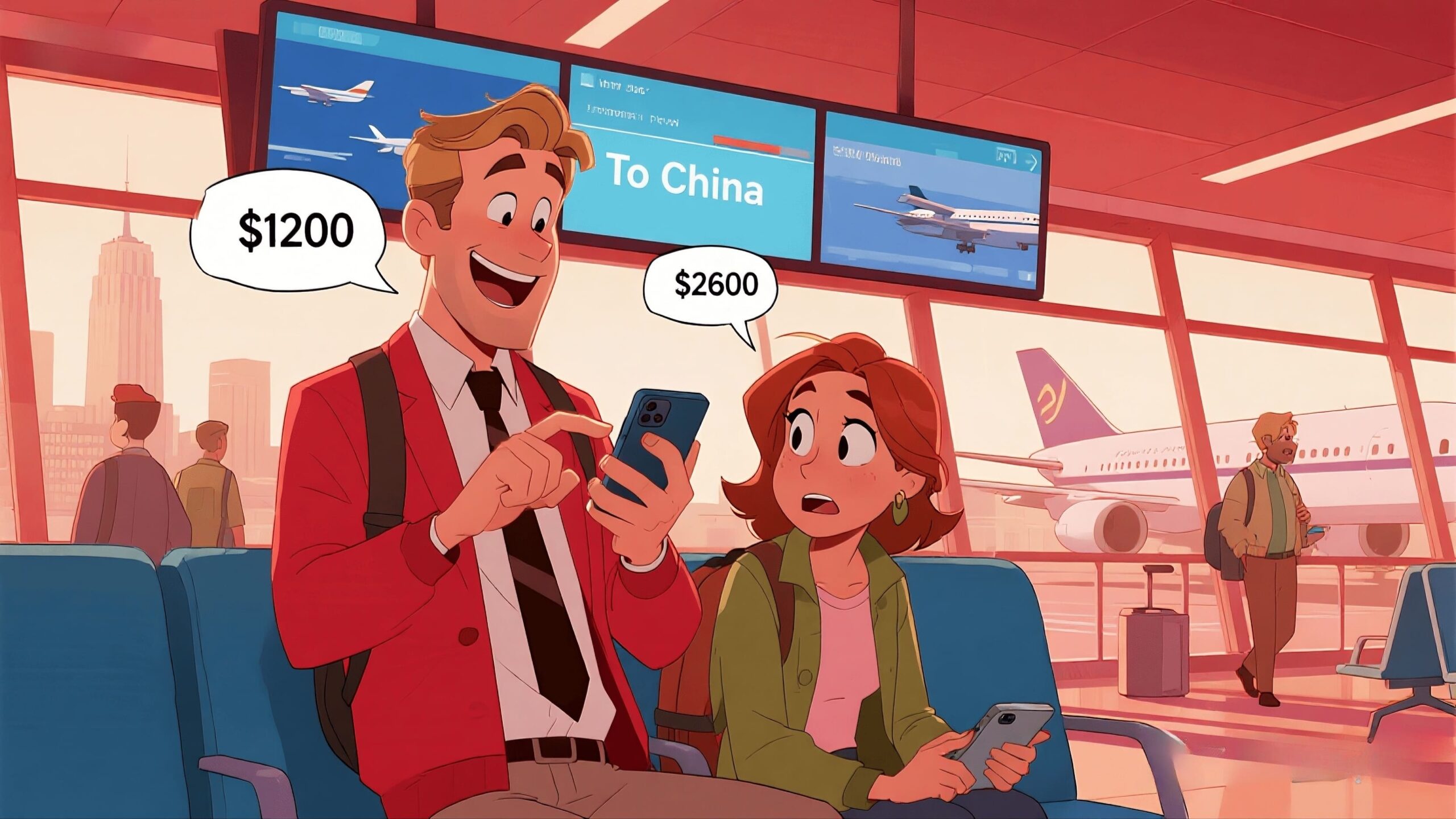
Skip the big booking sites and tap a veteran Chinese agency—our Beijing insiders snag Spring Festival business seats for $1,200 while Expedia asks $2,000, then stack on 30-40% savings by folding in domestic legs and quietly unlock student baggage, priority check-in, and flexible rebooking you’d never find in English.

Partnering with Chinese Travel Agencies for Exclusive Rates
Welcome to the world of insider flight deals that only local Chinese agencies can unlock! Imagine having a friend in Beijing who whispers, “I know someone at China Eastern who can get you that business class seat for half price. ” That’s essentially what experienced Chinese travel agencies offer through their direct airline partnerships—exclusive rates you won’t find on Expedia or Kayak.
These local partnerships shine brightest during Chinese holidays when international booking sites show sky-high prices. We at Travel China With Me have seen this firsthand: while global platforms display $2,000 flights during Spring Festival, our airline contacts often secure the same seats for $1,200. The real magic happens with multi-city journeys—combining that international arrival with domestic connections at package rates that beat booking separately by 30-40%.
But here’s what really matters: working with an established agency means having someone navigate the maze of Chinese booking systems in Mandarin, spot those student discounts buried in airline fine print, and know exactly when China Eastern releases their quarterly business class promotions [29]. Look for agencies with at least a decade of experience and, crucially, English-speaking staff who understand Western travelers’ needs. These partnerships often include hidden perks—extra baggage for students, flexible rebooking during holiday rushes, even priority check-in lanes at Beijing Capital that save you an hour of queuing.
Booking Directly with Chinese Carriers Like Air China, China Eastern, and Spring Airlines
Booking directly with Chinese carriers often yields surprising results that contradict conventional travel wisdom. Unlike Western airlines where direct bookings typically offer competitive pricing, Chinese carriers like China Eastern frequently display higher fares on their official websites compared to third-party platforms. This unusual pricing model creates significant opportunities for savings, with travelers reporting price differences of up to 50%—flights listed at $1,200 on China Eastern’s website appearing for just $600 through third-party sites [31].
This counterintuitive pattern occurs because Chinese airlines operate on discount-based pricing rather than standard fare codes, with their international websites sometimes displaying only premium fare classes [31]. Despite these potential savings, direct bookings provide valuable benefits including guaranteed seat selection (which third-party sites may not offer), access to exclusive promotions like special business class deals from Los Angeles, and student-specific baggage allowances [29]. For optimal results, use a hybrid approach—search through aggregators like Google Flights to identify baseline pricing, then compare with the airline’s direct site to evaluate the complete offering including amenities, flexibility options, and loyalty benefits [31][29].
When third-party booking proves significantly cheaper, prioritize Chinese-owned platforms like Trip. com, which maintains superior integration with domestic Chinese carriers and provides better customer support for these airlines than Western alternatives [31]. This approach balances cost savings with practical considerations while avoiding the customer service complications that can arise when itinerary changes become necessary [31].
Taking Advantage of Visa‑Linked Promotions and Travel Bundles

Let’s talk about a clever trick that turns visa rules into savings opportunities: China’s 240-hour visa-free transit policy. Picture this: you’re flying to Bangkok but want to explore Shanghai’s glittering skyline and Beijing’s ancient hutongs without paying for a visa. This policy lets citizens from eligible countries do exactly that—stop in major Chinese cities for up to six days when continuing to a third destination. Smart travelers leverage this into serious savings by booking strategic packages.
Instead of buying separate flights, hotels, and tours, comprehensive bundles often slash 20-30% off your total costs. We’ve seen travelers book “transit packages” that include everything: airport transfers that whisk you past the confusion of Chinese taxi queues, pre-arranged tickets to must-see spots like the Forbidden City (no waiting in those infamous lines! ), and even bullet train connections between cities. The sweet spot?
Shoulder season packages in April-May or September-October, when the weather paints Beijing’s temples in perfect light and prices drop by about 8%. The real value comes from bundled transportation—that Shanghai-Beijing high-speed train ticket that costs $100 separately might be just $40 when packaged with flights. Look for bundles that include those expensive but essential elements: reliable WiFi devices, local SIM cards, and most importantly, 24/7 support when you’re navigating Pudong Airport at midnight.
Timing Purchases Around Chinese Holidays and Travel Festivals
Here’s an insider secret we at Travel China With Me share with every traveler: China’s holiday calendar is your roadmap to massive flight savings. While the basic rule “avoid Golden Weeks” appears throughout travel guides, let’s reveal what actually happens behind the scenes during these periods. Picture Chinese New Year: 1. 4 billion people trying to get home, creating what locals call “chunyun”—the world’s largest human migration. Airlines know families will pay anything, so prices soar 30-40% [34].
But here’s what most guides don’t tell you: book your flight to arrive three days after the holiday ends, and you’ll often find seats at 50% off peak prices as airlines desperately fill empty planes returning from family reunions. Beyond the obvious summer peaks and winter valleys, Sunday morning departures consistently offer hidden savings—we’re talking 6 AM flights that save you $200 compared to convenient Friday evenings [35]. Why? Business travelers avoid them, and leisure travelers haven’t thought of it. Even better: combine this with what we call “reverse Golden Week” strategy.
While everyone flees China during October’s National Day, flying into China during this exodus often yields surprisingly cheap fares. Don’t just memorize “book 2-8 months ahead”—understand why. Airlines release their schedules in waves, and [as mentioned in our flexible planning section], the sweet spot hits when they’re trying to build momentum for new routes or season launches.
Saving Beyond the Ticket: Extras and Hidden Costs
Master Chinese airline baggage rules—know that international flights give Economy one 23 kg checked bag, domestic flights switch to a 20 kg total weight limit, and students can double their allowance with proper paperwork—to dodge surprise fees and glide through check-in.

Smart Baggage Choices and Fee‑Free Options
Welcome to the world of Chinese airline baggage policies—where smart packing can save you hundreds. We at Travel China With Me have guided countless travelers through these sometimes-confusing rules, and we’re here to help you navigate them with confidence. For international flights to China, most carriers use a piece-based system: Economy passengers typically enjoy one free checked bag (23kg), while Business Class travelers can bring two pieces (32kg each) [38]. Picture yourself arriving at check-in with perfectly packed bags, knowing exactly what you’re entitled to. Domestic flights within China switch to weight-based allowances—20kg total for Economy and 30kg for Business [38].
Here’s where it gets interesting: carry-on rules vary by class too. Economy passengers can bring one item (5-7kg), while Business travelers enjoy two pieces (8kg each), all fitting within the standard 55cm x 40cm x 20cm dimensions [37][38]. Imagine gliding through security with your perfectly sized bags while others struggle with oversized luggage. Let us share a valuable tip: certain passenger categories qualify for generous exceptions. Students and workers with proper documentation can check two bags (23kg each) on many international routes, even in Economy class [36].
Travelers with assistive devices receive special accommodation—these essential items fly free without counting against your allowance [36]. Don’t worry about the complexity of connecting between international and domestic flights—we’ll help you understand how allowance systems change from piece to weight-based, preventing those surprise excess fees. Air China’s zone-based excess baggage fees can vary dramatically, but with our local knowledge, you’ll know exactly what to expect [37]. The secret? Book with airlines that partner with your frequent flyer program, where elite status often unlocks additional free baggage across alliance carriers.
Seat Selection, Meals, and Ancillary Services Without Extra Cost
Imagine settling into your perfect airplane seat without paying a single extra yuan—we at Travel China With Me know exactly how to make this happen. While airlines increasingly charge for advance seat selection, especially on budget fares, savvy travelers can still secure great seats for free. Here’s our insider secret: most Chinese carriers open free seat selection 48 hours before departure. China Airlines, for example, allows complimentary seat choices once check-in begins, even for the lowest fare classes [39]. Picture yourself at exactly 48 hours before takeoff, selecting that coveted aisle or window seat while others wait—timing truly is everything [39]. For frequent flyers, loyalty pays off beautifully.
Dynasty Program members (Paragon, Emerald, and Gold Card holders) enjoy free advance seat selection in premium zones [40]. Just remember to add your membership number when booking—this small step unlocks significant value [40]. Traveling with special needs? Don’t worry—Chinese airlines provide excellent free accommodations. Whether you need wheelchair assistance (WCHC), a bassinet for your little one (BSCT), or special cabin baggage arrangements (CBBG), simply contact customer service instead of using online selection [40]. We’ve helped many families navigate these services smoothly.
Let us share some aircraft wisdom that saves money: avoid paying for seats that don’t recline. On China Airlines’ A321, rows 48-49 stay upright due to emergency exit requirements, as does row 16 on their B738 aircraft [40]. Why pay premium prices for these less comfortable spots? With our local knowledge, you’ll make smarter choices and keep more money for experiencing China’s wonders.
Airport Lounge Access, Transit Hotels, and Budget Ground Transport
Welcome to the clever world of Chinese airport layovers, where smart choices transform waiting time into savings. We at Travel China With Me have discovered countless ways to make your airport experience both comfortable and affordable. Picture this: you’re facing a long layover at Shanghai Pudong, but instead of expensive city hotels, you discover Aerotel’s brilliant hourly booking system [41]. Pay only for the exact hours you need—whether that’s a quick four-hour rest or a full night’s sleep. No more wasting money on unused hotel time!
At the stunning new Chengdu Tianfu International Airport, comfort meets convenience in remarkable ways. Imagine walking directly from your terminal gate to the Joyhub Cheer Hotel without ever leaving the building [42]. Even better, this hotel offers airport check-in services from its lobby between 5:00-22:00—perfect for those early morning departures when every minute of sleep counts [42]. For shorter layovers, Chinese airports surprise with their generosity. Chengdu Tianfu provides cozy rest areas with complimentary earplugs, fresh towels, toothbrushes, charging cables, and warm blankets for overnight passengers [42].
It’s these thoughtful touches that make Chinese airports increasingly traveler-friendly. Let us guide you to budget-friendly ground transport too: Chengdu’s gleaming subway Line 18 whisks you downtown in just 35 minutes via express service [42]. Airport shuttle buses run round-the-clock with incredibly affordable fares—only ¥15 during the day (6:00-23:30) and ¥25 overnight [42]. Compare that to taxi fares, and you’ll see why locals choose these options!
Using Local Transport Apps for Cheap Airport Transfers
Let us introduce you to the game-changing world of Chinese transport apps—your key to stress-free, budget-friendly airport transfers. We’ve helped thousands of travelers master these tools, and now we’ll share our secrets with you. Imagine arriving at Beijing Capital Airport and seamlessly catching the subway downtown using just your phone. Alipay transforms into your universal transport companion with its magical ‘Transport’ button. Simply scan the QR code at subway gates—no fumbling with tickets, no language barriers, just smooth sailing to your destination at a fraction of taxi costs [43].
Here’s where it gets even better: both Alipay and WeChat connect directly with Didi (think of it as China’s Uber), allowing you to book rides without a Chinese phone number [44]. Picture yourself confidently summoning a car with English-language instructions right in the Alipay app—it’s that simple [45]. We at Travel China With Me always recommend using Didi through Alipay’s mini-program for the smoothest experience and best English support [45]. For subway adventures, the MetroMan app becomes your personal guide, calculating routes and fares across every Chinese city with metro service [43]. Watch as it plots the perfect path from Shanghai Pudong Airport to the Bund, showing you exactly where to transfer and how much you’ll save compared to other options.
DIG DEEPER: Taxis and Ride-Hailing Services in China: Your Complete Guide
The beauty of Alipay’s metro pass feature? Activate it once for your current city, then simply switch when you travel elsewhere—no more buying separate transit cards in each destination [45]. It’s these small conveniences that transform your China journey from stressful to seamless. And remember, our 24/7 support team is always here to help you navigate these apps, ensuring you never feel lost in translation.
Travel Confidence: Transparency, Insurance, and Post‑Booking Tips
Know the real price of that bargain China ticket—$100-$300 change fees, weight-based baggage rules, and 24-hour refund windows—before one missed connection cancels your whole itinerary.

Reading the Fine Print: Change Fees, Refunds, and Hidden Charges
Don’t let the fine print derail your China adventure. We at Travel China With Me have guided countless travelers through the maze of airline policies, and we’re here to demystify those budget ticket rules that can catch you off guard. Picture this: you’ve found an incredible fare to Beijing, but tucked in the terms are penalties that could turn your bargain into a budget-buster. Most discount international tickets carry hefty change fees—typically $100 to $300—with some being completely non-refundable [48].
The good news? Recent U.S. regulations now clearly define “significant” delays (three hours domestic, six hours international) that qualify for refunds [46]. This protection extends to your long-haul China flights, giving you clearer rights when things go wrong. Hidden charges lurk like dragons in the details: phone booking fees, airport printing charges, and—here’s the tricky one—Chinese airlines often calculate baggage by total weight rather than number of pieces (as discussed in our baggage section) [47]. Third-party booking sites might tack on their own $75 processing fees for changes [48]. We’ve seen travelers save hundreds simply by knowing these pitfalls ahead of time.
Your shield against surprises? Each airline’s “contract of carriage”—think of it as your traveler’s bill of rights. These documents spell out everything from check-in deadlines to compensation policies [47]. Here’s our insider tip: book within the magic 24-hour window when most airlines offer free holds or full refunds if you change your mind [47]. But beware the domino effect—miss one flight on your multi-city China journey, and airlines might cancel your entire remaining itinerary [47]. That’s why we always recommend understanding these policies before clicking “purchase,” especially for complex China itineraries.
Choosing Travel Insurance That Covers Cheap‑Ticket Contingencies
Let’s talk insurance—your safety net when budget flights to China hit turbulence. We at Travel China With Me have seen how the right coverage transforms travel worries into mere inconveniences. Here’s the catch with cheap tickets: insurance premiums run 5-8% of your trip cost, so that bargain fare might make comprehensive coverage seem pricey [49]. But imagine this scenario: you’ve snagged a $400 flight to Chengdu, but the discount carrier only flies twice weekly.
One cancellation could mean days of delay—suddenly that insurance looks smart. Picture insurance as layers of protection, like the ancient city walls of Xi’an. Your foundation: coverage for schedule changes, carrier problems, and missed connections—especially crucial with budget airlines serving China. Standard policies cover the basics (illness, natural disasters), but we recommend adding Cancel For Any Reason (CFAR) coverage.
Yes, it adds about 51% to your insurance cost [50], but it provides 50-75% reimbursement when China’s entry requirements shift or regional advisories pop up—situations we’ve helped many travelers navigate. Don’t forget medical evacuation coverage of at least $500,000, particularly vital when venturing beyond Beijing and Shanghai to cities where international-standard hospitals are scarce [49].
Look for trip delay benefits of at least $1,000 that kick in after just six hours—this cushion covers unexpected hotel nights when your budget carrier faces lengthy delays [50]. We’ve found that travelers who invest in proper coverage sleep better, knowing they’re protected against the unexpected twists that make travel an adventure.
Staying Updated on Health, Visa, and Policy Changes for China
Welcome to the new era of China travel! Since 2023, the Middle Kingdom has thrown open its doors wider than they’ve been in years. Gone are the maze of COVID tests, quarantine hotels, and health codes [51]. But China’s policies can shift like Beijing weather—sunny one moment, transformed the next. Don’t worry: we at Travel China With Me monitor these changes daily, so you can focus on planning your adventure while we track the details. The visa landscape has blossomed with opportunities.
Picture walking through Beijing’s hutongs or Shanghai’s neon-lit streets visa-free—it’s now reality for travelers from France, Germany, Italy, the Netherlands, Spain, Malaysia and many more enjoying 30-day visa-free entry [51]. The 240-hour visa-free transit policy (detailed in our layover section) now spans 65 ports, perfect for sampling China en route elsewhere [51]. American travelers, take note: visa applications have simplified dramatically. You’ll only list one year of travel history instead of five, making that application form far less daunting [51]. Those 10-year visas issued before March 2020? Many remain valid—check yours before applying anew [51].
Stay informed but not alarmed: the US State Department maintains a Level 2 advisory for China, recommending increased caution [52] (check our thoughts about it). Business travelers should understand exit ban policies—rare but worth knowing about [52]. For medical peace of mind, remember that hospitals in major cities offer excellent care but require immediate payment (often via WeChat or Alipay). This reality makes comprehensive travel insurance with evacuation coverage your best companion—think of it as your golden ticket to worry-free exploration.
After‑Flight Follow‑Up: Feedback, Loyalty Points, and Future Savings
Your China journey doesn’t end at baggage claim—it’s just the beginning of building travel wealth for future adventures. Picture those miles from your Beijing flight transforming into a business class seat to Shanghai next year. We’ve helped travelers turn single trips into travel treasure troves by maximizing post-flight opportunities. As covered in our loyalty programs section, the key lies in strategic mile collection: credit to programs like ANA Mileage Club, Alaska Airlines, or Virgin Atlantic Flying Club rather than directly to Chinese carriers [26]. Here’s insider wisdom from years of guiding China travelers: immediately log your flights while details remain fresh. Those Air China miles?
They bloom into 30-50% bonuses, first-class lounge access, and Star Alliance Gold status through PhoenixMiles [55]. China Airlines’ Dynasty Flyer Program works like instant coffee—Status Points trigger immediate upgrades, no monthly waiting required [54]. Even better, complete their environmental challenges for flight discounts—saving money while saving the planet [54]. Transform hiccups into opportunities. When service falls short (delayed luggage in Guangzhou, perhaps, or a missed connection in Chengdu), submit detailed, constructive feedback. Airlines often respond with mile bonuses, vouchers, or status boosts—we’ve seen travelers receive thousands of bonus miles simply for sharing their experience.
China Airlines even provides an AI Miles Assistant for instant support [54]. Business travelers, take note: corporate programs now offer enhanced flexibility and immediate rewards with each trip [54]. Remember: every flight plants seeds for future journeys. Log those miles strategically, share your experiences constructively, and watch your China travels multiply. After all, the best souvenir from any trip is the ticket to your next adventure.
Key Takeaways
- Flying 2-8 months ahead and avoiding Golden Week spikes can cut China fares 30-40%.
- Booking via Chinese platforms or local agents often undercuts Western sites by hundreds of dollars.
- Use 240-hour visa-free transit plus bundled flight-hotel-train packages to save 20-30% overall.
- Tuesday/Wednesday dawn departures and November or late September dates consistently show lowest prices.
- Credit China flights to foreign partners like ANA or Virgin Atlantic for better mile value than Chinese programs.
- Check 48 hours pre-departure for free seat selection and leverage student or worker baggage exceptions.
- Carry at least $500k medical-evacuation insurance and CFAR add-on to hedge budget-ticket risks.