The Definitive Guide to China Train Luggage Allowance and Policy
Traveling across China by high-speed rail is one of the great joys of modern travel. Watching the countryside blur past at 350 km/h while sipping tea is an experience that beats the stress of airports any day. However, as you pack for your dream trip to the Middle Kingdom, a nagging question likely haunts you:
“Will my luggage actually fit?”
You have read conflicting reports online. Some forums say, “Anything goes!” Others warn of strict conductors with measuring tapes. You are standing in your living room, looking at your 28-inch hard-shell suitcase, wondering if it’s going to be a liability on your journey from Beijing to Xi’an.
At Travel China With Me, we believe in radical transparency. We don’t just copy-paste the official handbook from the China Railway website. We are travelers, just like you. We have navigated the chaotic spring rush at Shanghai Hongqiao, dragged ski bags to the slopes of Chongli, and helped families with strollers navigate the labyrinth of Hangzhou East.
This is not just a list of rules. This is a survival guide.
In this 4,000-word masterclass, we are going to cover every single centimeter of the luggage experience. We will break down the engineering of the luggage racks, the psychology of security checks, the hidden storage spots only locals know, and exactly what to do when you have packed too much.
Let’s demystify the Chinese rail system, once and for all.
Table of Contents
Chapter 1: The “Official” Rules vs. The Ground Reality
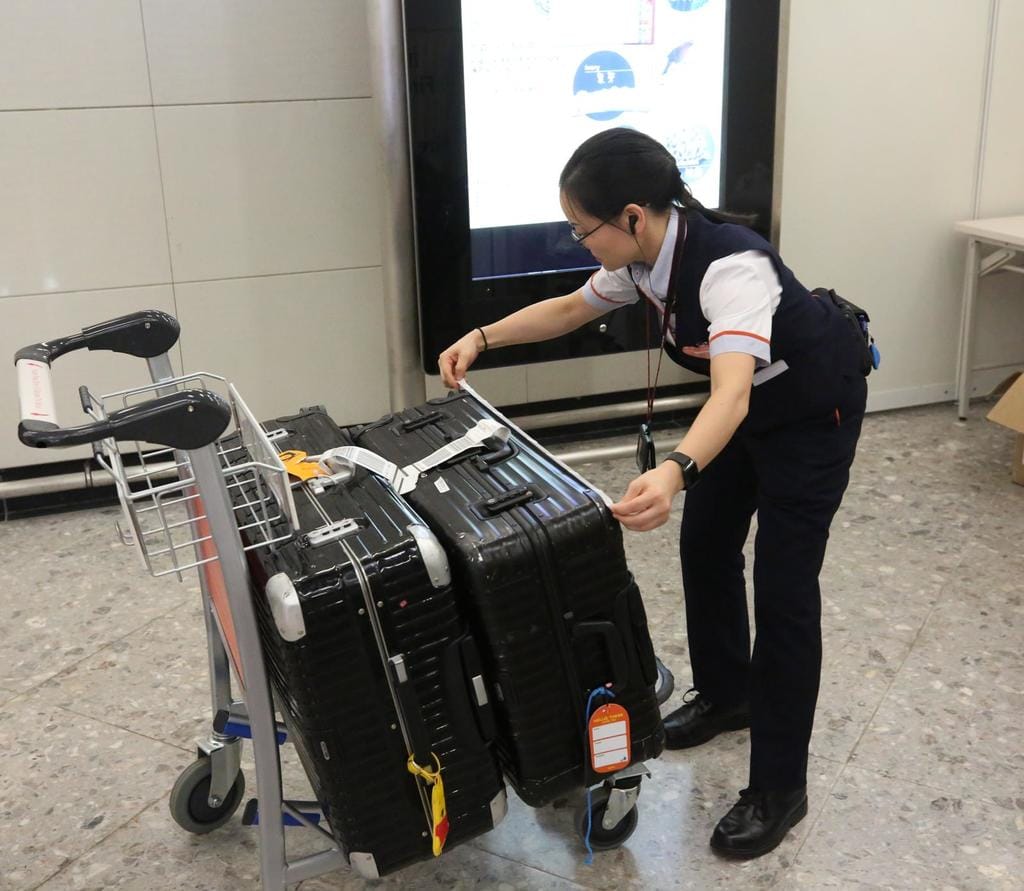
Understanding the gap between “policy” and “practice” is the key to surviving China.
The Official 12306 Regulations (2025 Update)
According to the Regulations on Railway Passenger Transport (latest revision), here are the hard numbers legally binding every passenger:
Category | High-Speed Train (G/D/C) | Normal Train (Z/T/K) |
External Dimensions (L+W+H) | Max 130 cm (approx. 51 inches) | Max 160 cm (approx. 63 inches) |
Rod-Shaped Items (Length) | Max 130 cm | Max 200 cm |
Weight Allowance (Adult) | 20 kg (44 lbs) | 20 kg (44 lbs) |
Weight Allowance (Child) | 10 kg (22 lbs) | 10 kg (22 lbs) |
Wheelchairs | Free (Exempt from limits) | Free (Exempt from limits) |
The Reality Check
If you look at those numbers closely, you might panic. A standard large check-in suitcase (28-inch) usually measures around 158 cm (Linear dimensions).
- Technically: A 28-inch suitcase is banned on high-speed trains.
- In Reality: We have taken hundreds of trips with 28-inch suitcases. We have never been stopped.
Why the discrepancy?
China’s railway security is primarily focused on public safety, not revenue generation (unlike budget airlines). The security staff at the entrance scanners are looking for lithium batteries, knives, aerosols, and explosives. They are not holding tape measures. If you can drag your bag efficiently and it looks like “normal luggage,” you will pass security 99.9% of the time.
The Real Constraint: Physics, Not Policy
The reason the rule exists is not to fine you, but because there is nowhere to put huge bags. High-speed train carriages are optimized for aerodynamics and passenger capacity. The overhead racks are shallow. The closets are tiny.
- The Risk: If you bring a bag that is too big, you aren’t risking a fine; you are risking a miserable 5-hour journey standing in the vestibule hugging your suitcase because it physically fits nowhere else.
Chapter 2: High-Speed Trains (G, D, C Series) – A Detailed Anatomy
To pack correctly, you need to understand the vehicle you are stepping onto. Not all high-speed trains are created equal.
1. The Fuxing (复兴号 – CR400 Series)
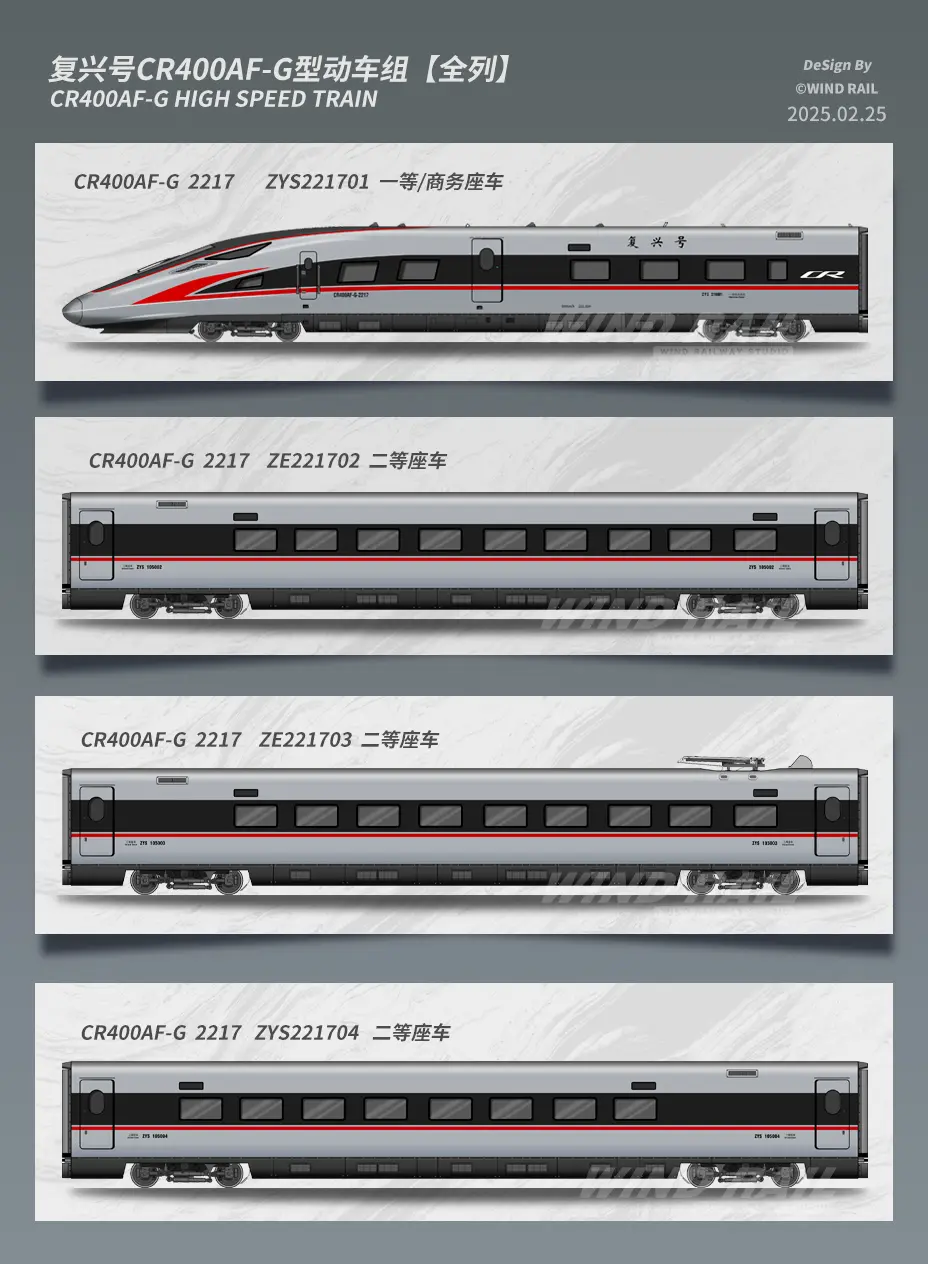
These are the newest, fastest, and most common trains on major routes (Beijing-Shanghai, Beijing-Xi’an).
- Overhead Racks: These are sleek and modern, but shallow.
- Depth: Approx 40-45 cm.
- Lip Height: Very low.
- Verdict: A 24-inch bag fits perfectly wheels-in. A 26-inch bag is risky. A 28-inch bag is dangerous—it will overhang significantly, and conductors will force you to move it to the floor to prevent it from falling on passengers during high-speed turns.
- Seat Spacing:
- Second Class: 2-3 Layout. Very tight legroom. You cannot fit a suitcase in front of your knees unless you are under 160cm tall.
- First Class: 2-2 Layout. Generous legroom. You can fit a 24-inch bag in front of you and still sit (somewhat) comfortably.
2. The Harmony (和谐号 – CRH380 Series)
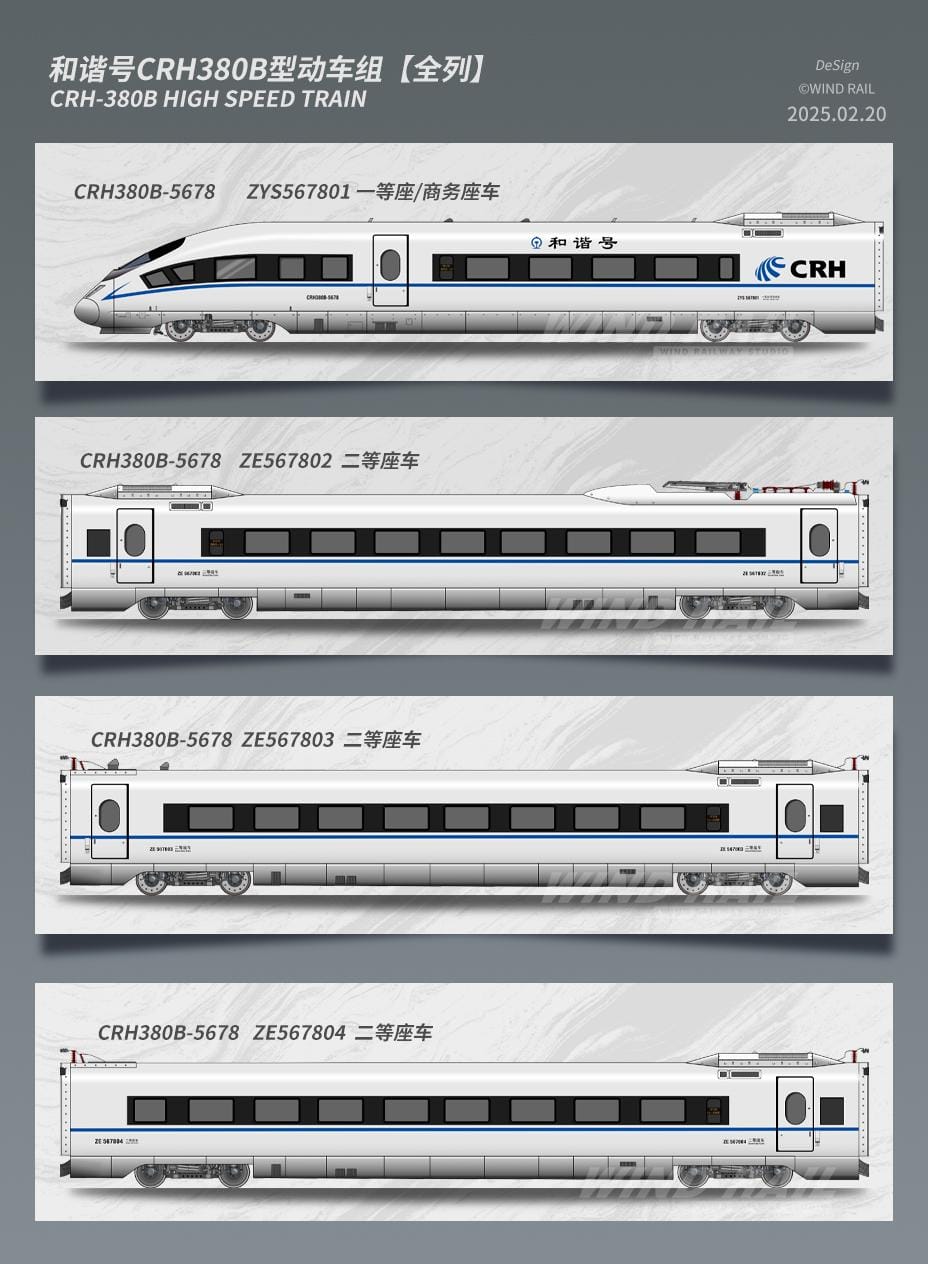
These are the older generation workhorses.
- Overhead Racks: Slightly more forgiving and sometimes deeper than the Fuxing, but still not built for check-in bags.
- The “Closet” Difference: On some older CRH models, the large luggage closets are smaller or sometimes non-existent in certain cars. This makes boarding early even more critical.
3. The “Vibrating” Challenge
High-speed trains are incredibly smooth, but they do vibrate at 350 km/h.
- Safety Warning: Hard-shell plastic suitcases have very low friction. If you place a smooth suitcase on the overhead metal rack without securing it or wedging it in, it can slide back and forth. Always ensure the wheels are locked or the bag is wedged against a backpack.
Chapter 3: The Secret Storage Map (Where to Actually Put Your Stuff)
You’ve boarded the train with your “technically too big” 28-inch suitcase. Panic sets in. The overhead bin is too small. Where does it go? Here is your tactical map.
Priority 1: The Large Luggage Closet (The Holy Grail)
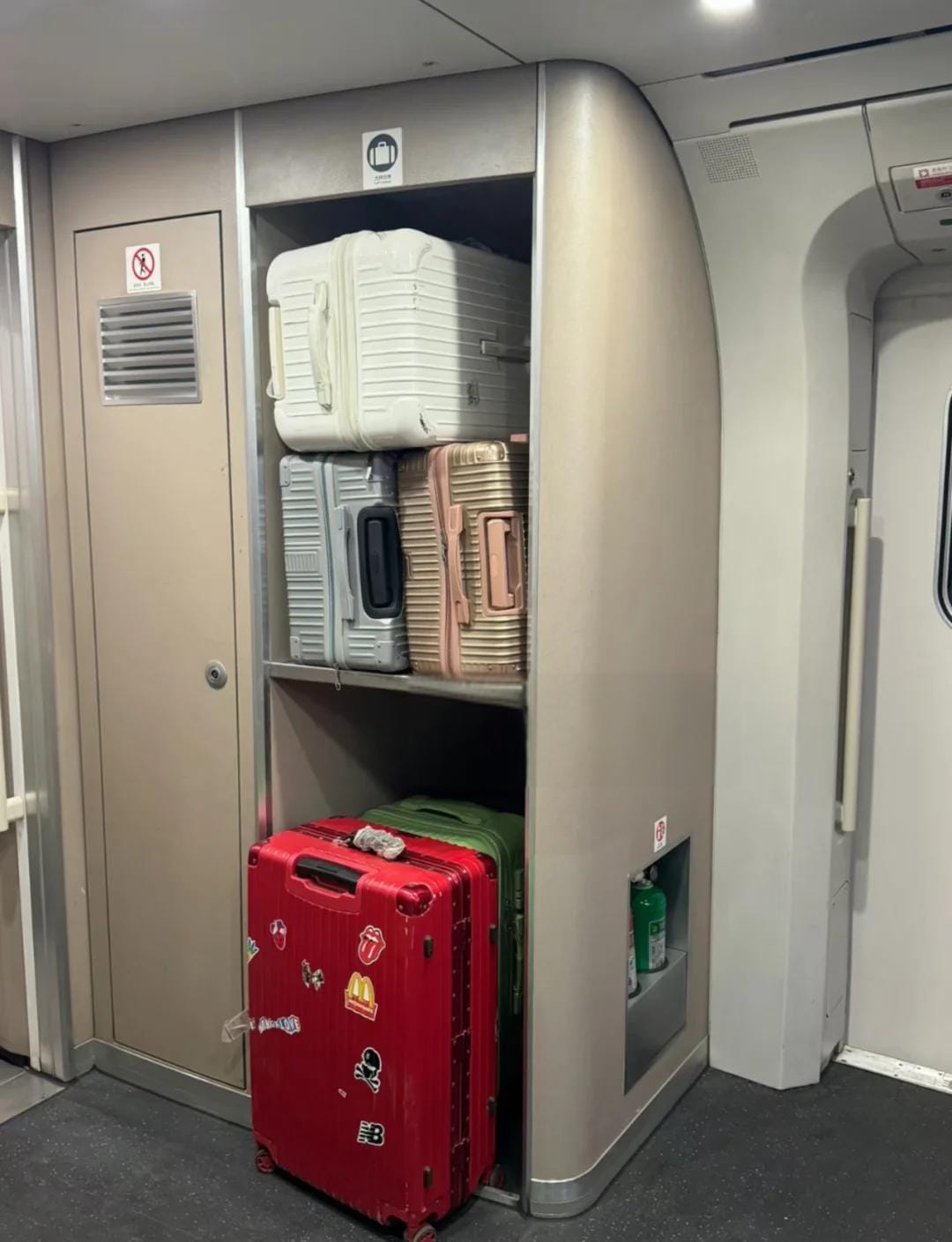
Located at the junction of carriages (e.g., behind Row 1 or Row 18).
- Capacity: Usually fits 6-8 large suitcases.
- Availability: Gone within 2 minutes of boarding at the originating station.
- Pro Tip: If you are boarding at an intermediate stop (e.g., getting on at Tianjin en route to Shanghai), assume this space is already full. Do not rely on it.
Priority 2: The “Last Row” Gap (The Local’s Secret)

This is the most reliable spot for savvy travelers.
- Location: Behind the very last row of seats in every carriage.
- Dimensions: There is a gap of about 30-50 cm between the seat back and the carriage wall.
- Capacity: Can fit 2-3 massive suitcases sideways.
- Etiquette: You do not need to be sitting in the last row to use this. It is public space. However, be polite. Ask the person sitting there, “Excuse me, may I put my bag behind your seat?” (劳驾,我可以把箱子放后面吗? – Láojià, wǒ kěyǐ bǎ xiāngzi fàng hòumiàn ma?). They almost always say yes.
Priority 3: The “Aisle Seat” Trap
Some older guides suggest putting luggage in the aisle.
- Do NOT do this. The conductors strictly forbid blocking aisles. Food carts pass through every 10 minutes. You will be yelled at.
Priority 4: The Water Dispenser Nook
In the vestibule area (where the hot water dispenser is), there is often a small open space.
- The Trade-off: You cannot leave your bag here unattended. It is out of your sight line. If you leave it here, you effectively have to stand next to it for the whole trip. This is the “punishment” for packing too heavy.
Chapter 4: Normal Speed Trains (Z, T, K) – The Backpacker’s Jungle

The “Green Trains” are a cultural experience, but they are luggage anarchy.
Hard Seat Carriages (Not for the faint of heart)
- The Vibe: Crowded, noisy, chaotic. People bring sacks of produce, buckets of paint, and woven bags.
- The Racks: Strong, open metal bars. You can put almost anything up there if you have the strength to lift it.
- Security: Theft is higher here. Keep your bag in sight.
Hard Sleeper (The Best Value)
- The layout: Open compartments with 6 bunks (Top, Middle, Bottom).
- Storage: The space under the bottom bunk is prime real estate.
- Height Limit: ~30 cm.
- The Conflict: If you are on the Top Bunk, you have no designated floor space. You must negotiate with the Bottom Bunk passenger.
- Strategy: If you have a huge suitcase, pay extra for the Bottom Bunk. It gives you control over the under-bed storage.
Soft Sleeper (The VIP Choice)
- The layout: Closed door, 4 bunks.
- Storage: There is a massive “cubby hole” above the door inside the compartment. It is huge—easily fitting two 30-inch bags. But it is high. You need to be able to lift your 25kg bag over your head.
DIG DEEPER: China Train Sleeper Guide: Hard vs Soft vs Premium Sleepers – Which to Choose?
Chapter 5: Navigating the Station (The Physical Test)

Your luggage journey starts long before the train. Chinese train stations are not just buildings; they are cities.
1. The Approach
- Traffic: Drop-off zones at stations like Beijing South are notoriously jammed. You might be dropped off 500 meters from the entrance.
- The Surface: Expect smooth tiles inside, but potentially rough pavement outside. Four-wheeled “spinner” bags are great indoors, but large two-wheeled “roller” bags are better for the uneven streets of China.
2. Security Screening
- The Lift: You must lift your bag onto the X-ray belt. It is about waist height. If you can’t lift your bag, you are in trouble. Staff will rarely help you (they are too busy).
- Liquids: Unlike airports, you usually don’t need to take liquids out.
- Electronics: Laptops can stay in the bag.
- The “Sip” Test: If you are holding a water bottle or coffee cup, the guard may ask you to take a sip to prove it’s not a hazardous chemical.
3. The Boarding Gate Rush
This is the most critical moment for luggage owners.
- Ticket Check: Gates open 15-20 minutes before departure.
- The Stampede: Chinese travelers are anxious about luggage space too. When the gate opens, people run.
- Your Move: If you have a large bag, do not be polite. Line up 30 minutes early. Be at the front of the queue. Your comfort for the next 5 hours depends on securing that closet space.
Chapter 6: The “No-Go” List – Prohibited Items in 2025
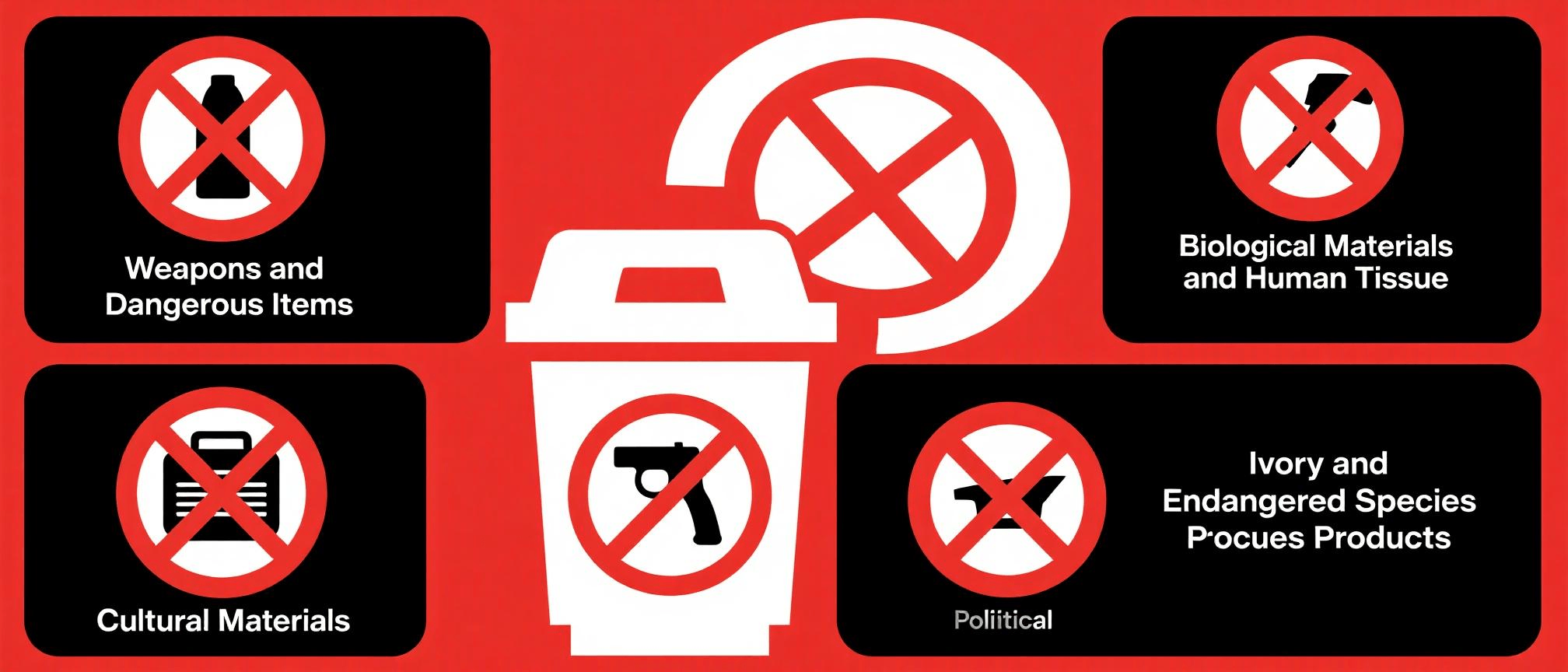
You have packed your bag. It fits the size limits. But will the contents get you flagged?
China’s list of prohibited items is strict and often differs from airline rules. The most common tragedy we see at stations is tourists forced to throw away expensive Swiss Army knives or brand-new power banks.
Here is the detailed breakdown of the 2025 Security Standards.
1. The Power Bank Panic (Lithium Batteries)
This is the single most common issue for international travelers. China is hyper-vigilant about lithium battery fires.
- The Limit: You cannot bring a power bank exceeding 100Wh (Watt-hours).
- Note: This is stricter than many airlines (which often allow up to 160Wh).
- The “Label” Rule: This is non-negotiable. The capacity (in Wh or mAh + Voltage) must be clearly printed on the device.
- Scenario: You have a small 10,000 mAh battery, but the text has rubbed off from years of use.
- Result: Confiscated. No label = No entry. Security will not test it; they will toss it.
- How to Calculate Wh: Most batteries show mAh. Use this formula:
- Standard Voltage is usually 3.7V.
- 20,000 mAh = $20,000 \times 3.7 / 1000$ = 74Wh (✅ Safe)
- 27,000 mAh = $27,000 \times 3.7 / 1000$ = 99.9Wh (✅ Safe – The maximum limit)
- 30,000 mAh = 111Wh (❌ Banned)
2. Liquids, Sprays, and Aerosols
Do not apply “airport logic” here. The rules for trains focus on flammability and pressure, not volume per se.
Item Type | Rule | Common Trap |
Nail Polish / Remover | Max 50 ml | It used to be 20ml. It was relaxed recently, but 50ml is still tiny. A standard OPI bottle is ~15ml, so you are fine. |
Hair Dye | Max 60 ml | – |
Pressure Sprays (Hairspray, Sunscreen, Shaving Foam) | Max 150 ml per bottle.Max 600 ml total (4 bottles). | The “Container Rule”: If you have a 200ml bottle of sunscreen that is half empty, it is BANNED. The capacity printed on the bottle determines the rule. |
Pump Sprays (Perfume, Toners) | Generally treated as liquids (loosely enforced). | – |
Alcohol (Baijiu, Whiskey, Wine) | Max 3,000 ml (approx 6 bottles).Must be sealed in original factory packaging.24% – 70% ABV only. | You cannot bring an opened bottle of whiskey. You cannot bring homemade rice wine in a plastic jug. >70% ABV is banned. |
3. Sharp Objects (The “Fruit Knife” Myth)
The official regulation states that knives with a blade length under 60mm (approx 2.4 inches) are allowed.
However, the enforcement reality is different.
We have seen security guards confiscate tiny fruit knives, scissors, and multi-tools simply because they “look sharp.”
- Our Advice: Do not bring any knife. Zero. Buy a cheap 10 RMB fruit knife at a local supermarket when you arrive at your destination. It is not worth the argument or the delay.
- Multi-tools: If you have a Leatherman or Swiss Army Knife, put it in your consigned luggage (if shipping) or leave it at home. It is a high-risk item.
4. Food and Smell
- Durian: Explicitly banned due to the smell. (Yes, really).
- Stinky Tofu: Banned.
- Self-Heating Hotpots: These are those convenient instant meals where you add cold water to a chemical packet. Banned. The chemical reaction releases hydrogen gas and high heat, which can trigger smoke alarms on the train.
Chapter 7: The “Red Cap” Service – Your Secret Weapon
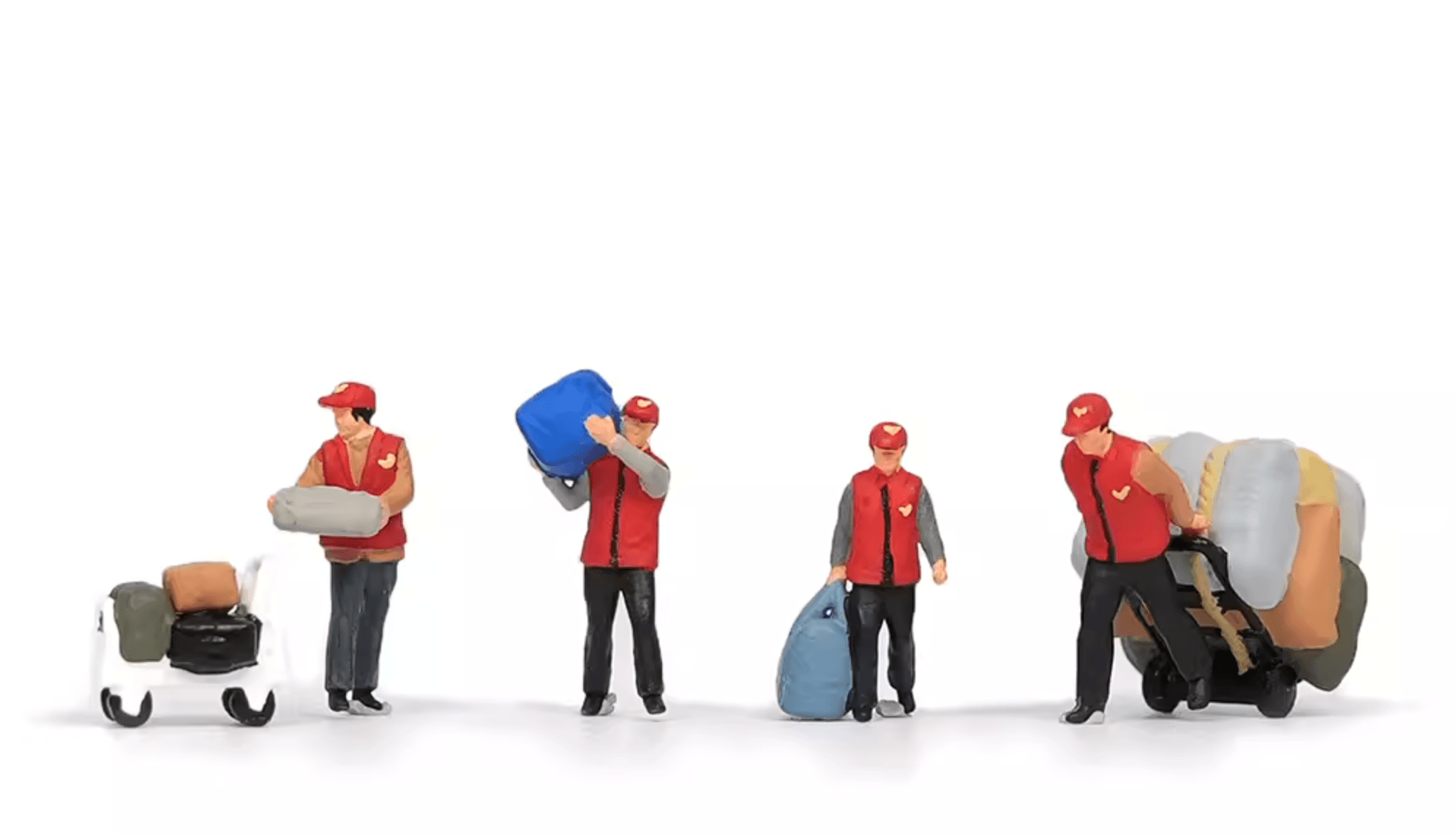
If you take one thing away from this article, let it be this hack.
If you are traveling with elderly parents, young children, or just way too much luggage, you do not need to suffer. You can hire a “Red Cap” (小红帽 – Xiǎo Hóng Mào) porter.
What is a Red Cap?
They are official station porters, easily identified by their red hats or red vests. They are not scammers; they are station employees (or sanctioned contractors).
Why use them?
It is not just about muscle. It is about VIP access.
When you hire a Red Cap, you don’t just get someone to carry your bag. You get:
- Priority Boarding: They escort you through a special staff lane.
- Early Entry: You enter the platform 10-20 minutes before the general public.
- Guaranteed Storage: Since you are the first on the train, you get 100% access to the large luggage closets.
How to use the Red Cap service
- Find them: Look for the “Red Cap Luggage Service” counter in the departure hall. It is usually near the main entrance or prominently marked.
- The Cost: Usually 10 RMB to 20 RMB per piece of luggage. (approx $1.50 – $3.00 USD). It is incredibly cheap.
- The Process:
- Show them your ticket.
- They load your bags onto a trolley.
- They give you a receipt/tag.
- They tell you to follow them or meet them at a specific gate.
- They lead you down the elevator to the platform.
- They put your bags on the train rack for you.
Expert Tip: At huge stations like Beijing South or Shanghai Hongqiao, this service is a lifesaver. The walk from the waiting hall to the platform can be long, and the crowds are intense. The Red Cap cuts through all of it.
Chapter 8: Consignment & “Travel Light” Services

What if your luggage is simply too big? What if you are moving to China and have four 30-inch suitcases? Or a bicycle?
You cannot take them on the high-speed train with you. You must use the China Railway Express (CRE) consignment service.
1. Station-to-Station Consignment
This is similar to checking a bag on a plane, but your bag goes on a different (slower) train.
- Where: Go to the “Luggage Consignment” (行李托运) office, usually located outside the main station building (look for signs).
- Timing: Do this 1-2 hours before your train, or ideally the day before.
- Speed: It usually takes 1-3 days to arrive.
- Cost: Very affordable. Usually around 20-50 RMB per piece depending on weight and distance.
- Pickup: You must go to the consignment office at your destination station to pick it up.
2. The New “Door-to-Door” Service (12306 App)
In 2025, China Railway has fully integrated with logistics giants like SF Express and JD Logistics.
- The Service: You can book a pickup from your hotel in Beijing, and they will deliver it to your hotel in Shanghai.
- How to Book:
- Open the 12306 App.
- Select “Railway Express” (or “Luggage” icon).
- Input your train number and addresses.
- Convenience: This allows you to travel “hands-free.” You board the high-speed train with just a backpack, and your heavy suitcases meet you at your next hotel.
- Cost: More expensive than station consignment (expect 50-100 RMB per bag), but worth every penny for the convenience.
Chapter 9: Special Luggage (Bikes, Skis, Instruments, Wheelchairs)

We get many emails from cyclists and musicians. Here is the deal for your specialized gear.
1. Bicycles
- Assembled Bikes: Strictly Prohibited. You cannot roll a bike onto a Chinese train.
- Disassembled Bikes:
- You must remove the front wheel (and ideally the rear).
- It must be packed in a proper bike travel bag/case.
- Size Check: Technically, it might exceed the 130cm dimension limits.
- Reality: If it is in a sleek, black bag and you can carry it on your shoulder, staff usually ignore it. If it is a massive cardboard box, they will stop you.
- Storage: You must secure the large luggage closet or the space behind the last row. A bike bag will not fit in the overhead rack.
2. Skis and Snowboards
With the post-2022 Winter Olympics boom, ski trains are common (especially to Zhangjiakou).
- Designated Ski Trains: The line from Beijing North to Zhangjiakou/Chongli has special carriages with ski lockers.
- Regular Trains: You must put skis in a bag. Long skis might be an issue for the 130cm vertical limit. Try to stand them up in the closet area or lay them flat behind the last row.
3. Musical Instruments
- Guitars: Generally allowed. Put them in the overhead rack (on top of other suitcases).
- Cellos: This is tricky. A cello case is bulky. You usually need to buy a ticket for the cello (essentially buying the seat next to you) if you want to guarantee its safety, or hope for closet space.
- Small Instruments (Violins): No problem. Overhead rack.
4. Wheelchairs
- Exempt: Wheelchairs are exempt from size and weight limits.
- Accessibility:
- Most high-speed trains have a Handicap Accessible Car (usually Car 4 or Car 5).
- This car has a much wider door, a massive bathroom, and an open area with straps to park a wheelchair.
- Tip: When booking, try to select a seat in the accessible carriage for ease of movement.
Chapter 10: What to Do if Things Go Wrong
1. “I Left My Bag on the Train!”
It happens. You rushed off at the wrong stop or just forgot.
- Immediate Action: Go to the Station Master’s Office (值班站长) at your arrival station immediately.
- The 12306 App: There is a “Lost & Found” section in the app. You can register your lost item there.
- The Outcome: China Railway is surprisingly efficient at this. If the train crew finds it, they will hand it off at the next major station. They can then put it on the next train back to your station. You will just need to go to the station to pick it up.
2. “My Luggage Was Stolen”
- Reality: Extremely rare. The Real-Name Ticket system and ubiquitous CCTV make train theft a terrible career choice in China.
- Prevention:
- Keep valuables (passport, laptop, cash) in a small bag attached to your body.
- Place your suitcase in the rack opposite your seat, not above your head. This way, you can see it.
- Turn the handle of your suitcase inward (towards the wall) in the closet. This makes it harder for a “grab-and-go” thief to snatch it as the doors close.
Chapter 11: Frequently Asked Questions (FAQ)
Q: Can I bring a stroller for my baby?
A: Yes, absolutely. Strollers are exempt from size limits. If it is a compact “yoyo” style, it fits overhead. If it is a large pram, you will need to fold it and put it in the closet or behind seats.
Q: Is there a weight limit for carry-on food?
A: No specific weight limit, but be reasonable. You can bring fruit, snacks, and instant noodles. Just remember: no self-heating pots, and no durian!
Q: Do I need to pay for luggage?
A: No. Unlike budget airlines, your ticket includes the luggage allowance. There are no “baggage fees” unless you use the consignment service.
Q: Can I bring medication?
A: Yes. Liquid medicines exceeding 100ml are generally allowed if you have a prescription, but expect a longer security check. They may ask you to open it.
Q: Is it better to use a backpack or a suitcase?
A: Backpack wins. Stations have stairs. Trains have gaps. Streets have uneven pavement. A 40L-50L travel backpack gives you agility that a suitcase user can only dream of. If you must bring a suitcase, bring a 4-wheel “spinner” for the smooth station floors, but be ready to lift it.
Q: What is the “130 cm” rule really for?
A: It is mostly to prevent people from bringing commercial cargo (like boxes of merchandise) onto passenger trains. If your item looks like personal luggage, you get a “tourist pass.”
Final Conclusion: China Train Luggage Allowance and Policy
Navigating China’s train system with luggage is a balance of preparation and adaptation.
The official rules (130 cm limit, 20 kg weight) are the framework, but the reality is flexible—provided you are smart about it.
- Don’t be the person blocking the aisle with a 30-inch monster case.
- Do be the smart traveler who uses the Red Cap service to board early.
- Do pack lighter than you think you need to.
Remember, the high-speed train is the best way to see China. Don’t let the stress of a heavy bag ruin the view. Pack smart, use the closets, and if in doubt—ship it!
Safe travels, and we will see you on the platform!
Summary of Key Takeaways for the User
- Luggage Size: Aim for 24-inch suitcases for a hassle-free experience. 28-inch is possible but requires strategy (Red Cap, early boarding).
- Prohibited: Watch out for Power Banks (>100Wh), Knives, and Aerosols (>150ml). These are the most common confiscations.
- Hacks: Use the Red Cap service for priority boarding. Use Space Behind Last Row for storage.
- Mindset: Physical ability to lift and carry your bag is more important than the official weight limit.